
Markets & Finance
World Trade 2027: Tariffs, Supply Chains and Pakistan Exports


The WTO sees expanding goods trade but an uneven recovery in services. Pakistan needs to distinguish rising global transaction volumes from guaranteed demand for its own export mix. This feature explains the mechanisms, risks and practical decisions that matter through 2027, with particular attention to Pakistan’s different exposure to energy prices, external financing, global trade and AI investment.
At a glance
- World output is forecast to rise, but opportunities and costs are uneven across countries.
- Global inflation forecasts do not predict household prices in Pakistan.
- The AI capital expenditure cycle lifts trade in electronics but may not translate into productivity gains everywhere.
- Pakistan’s IMF staff-level agreement is a milestone, not final Board approval.
- Stronger exports, competitive energy, fiscal credibility and skills are essential to durable growth.
The verified starting point: what the numbers actually say
The IMF October 2026 World Economic Outlook projects global growth of 3.1% in calendar 2026 and 3.4% in calendar 2027, alongside global headline inflation of 4.7% and 4.1%, respectively. Its statistical cutoff is 1 October 2026. The WTO October 2026 trade outlook projects merchandise trade volume growth of 3.9% in 2026 and 4.1% in 2027, versus commercial-services trade volume growth of 3.3% and 6.4%. These are forecasts from different statistical systems, not interchangeable growth measures.
For Pakistan, the IMF Pakistan October 7 staff-level agreement estimated FY2026 growth of 3.6%, September headline inflation of approximately 10.3%, and gross reserves near $21.5 billion at end-September. The fourth EFF review and third RSF review had reached staff-level agreement only, pending IMF Executive Board approval as of the release. Pakistan’s fiscal years run July–June; IMF global growth figures refer to calendar years.
| Indicator | 2026 | 2027 | Important distinction |
|---|---|---|---|
| IMF world GDP growth | 3.1% | 3.4% | Calendar-year projection |
| IMF world headline inflation | 4.7% | 4.1% | Global estimate, not Pakistan CPI |
| WTO goods trade volume growth | 3.9% | 4.1% | Real volume, not nominal trade value |
| WTO commercial services volume growth | 3.3% | 6.4% | Conditional rebound, not guaranteed |
The World Bank June 2026 Global Economic Prospects provides an earlier comparison framework, but its publication date and methodology differ from the October IMF and WTO releases. A thoughtful analysis should compare like with like and should never treat projections as realized outcomes. For a Pakistan-focused story, the crucial question is how global conditions enter domestic economic life.
Why this story matters now
The WTO October 2026 executive summary says AI-enabling goods accounted for 47% of year-on-year growth in the value of world merchandise trade during the first half of 2026. That does not mean 47% of all merchandise trade was AI-related. It identifies a contribution to growth, and in nominal value terms. The same source notes that AI-enabling goods trade rose 67% year-on-year in that period. These figures show how a narrow technology cycle can make global trade appear stronger even as other sectors struggle.
Meanwhile the Reuters October 2026 IMF annual meetings reports persistent concern about global financial risks, geopolitical disruptions and the uneven sharing of AI gains. The Reuters October 2026 Asian growth describes a region where technology investment supports some exporters while energy costs and higher yields challenge others. Pakistan is therefore exposed simultaneously to a potential technology opportunity and to more conventional fuel, financing and trade vulnerabilities.
Why the WTO raised its goods forecast
For why the wto raised its goods forecast, Trade resilience is not evenly shared. Diversion can reward suppliers with dependable shipping, certifications and capacity, while uncompetitive producers may see no benefit at all. The relevance of a global rebound depends on what a country makes and whether buyers can switch suppliers.
This matters for economic decision-making because firms and households cannot adjust instantaneously when conditions shift. Prices, contracts, worker skills and financial obligations move on different schedules. Analysts should identify the timetable, who bears the immediate cost, and who may capture the longer-term benefit.
A credible implementation plan requires named institutions, measurable indicators and regular public reporting. The point is not to promise an effortless transition; it is to make policy options concrete enough to compare their benefits and trade-offs.
Pakistan-specific decision test. For why the wto raised its goods forecast, ask four questions: (1) Which import cost, export opportunity, credit channel or productivity constraint is affected? (2) Which groups face the first-round effects? (3) What could policymakers or firms change within six months? (4) Which published indicator would demonstrate improvement rather than merely announce activity?
What to monitor: (i) official monthly or quarterly data; (ii) movements in export receipts and import bills; (iii) price changes versus changes in physical volumes; (iv) borrowing and working-capital costs; and (v) job quality and household purchasing power. A single monthly reading can be noisy. Comparing several releases helps distinguish a trend from a short-lived disturbance.
Services are a different story
For services are a different story, Pakistan must distinguish nominal export revenue, which can rise because of price changes, from real production volume and domestic value added. A stronger textile invoice is less meaningful if expensive imported energy and materials absorb the gain.
This matters for economic decision-making because firms and households cannot adjust instantaneously when conditions shift. Prices, contracts, worker skills and financial obligations move on different schedules. Analysts should identify the timetable, who bears the immediate cost, and who may capture the longer-term benefit.
A credible implementation plan requires named institutions, measurable indicators and regular public reporting. The point is not to promise an effortless transition; it is to make policy options concrete enough to compare their benefits and trade-offs.
Pakistan-specific decision test. For services are a different story, ask four questions: (1) Which import cost, export opportunity, credit channel or productivity constraint is affected? (2) Which groups face the first-round effects? (3) What could policymakers or firms change within six months? (4) Which published indicator would demonstrate improvement rather than merely announce activity?
What to monitor: (i) official monthly or quarterly data; (ii) movements in export receipts and import bills; (iii) price changes versus changes in physical volumes; (iv) borrowing and working-capital costs; and (v) job quality and household purchasing power. A single monthly reading can be noisy. Comparing several releases helps distinguish a trend from a short-lived disturbance.
Trade diversion versus real competitiveness
For trade diversion versus real competitiveness, Frequent data on delivery times, rejected shipments and repeat orders can help policymakers determine whether export incentives translate into durable commercial relationships rather than short-lived volume spikes.
This matters for economic decision-making because firms and households cannot adjust instantaneously when conditions shift. Prices, contracts, worker skills and financial obligations move on different schedules. Analysts should identify the timetable, who bears the immediate cost, and who may capture the longer-term benefit.
A credible implementation plan requires named institutions, measurable indicators and regular public reporting. The point is not to promise an effortless transition; it is to make policy options concrete enough to compare their benefits and trade-offs.
Pakistan-specific decision test. For trade diversion versus real competitiveness, ask four questions: (1) Which import cost, export opportunity, credit channel or productivity constraint is affected? (2) Which groups face the first-round effects? (3) What could policymakers or firms change within six months? (4) Which published indicator would demonstrate improvement rather than merely announce activity?
What to monitor: (i) official monthly or quarterly data; (ii) movements in export receipts and import bills; (iii) price changes versus changes in physical volumes; (iv) borrowing and working-capital costs; and (v) job quality and household purchasing power. A single monthly reading can be noisy. Comparing several releases helps distinguish a trend from a short-lived disturbance.
Tariffs and the limits of headline access
For tariffs and the limits of headline access, Trade resilience is not evenly shared. Diversion can reward suppliers with dependable shipping, certifications and capacity, while uncompetitive producers may see no benefit at all. The relevance of a global rebound depends on what a country makes and whether buyers can switch suppliers.
This matters for economic decision-making because firms and households cannot adjust instantaneously when conditions shift. Prices, contracts, worker skills and financial obligations move on different schedules. Analysts should identify the timetable, who bears the immediate cost, and who may capture the longer-term benefit.
A credible implementation plan requires named institutions, measurable indicators and regular public reporting. The point is not to promise an effortless transition; it is to make policy options concrete enough to compare their benefits and trade-offs.
Pakistan-specific decision test. For tariffs and the limits of headline access, ask four questions: (1) Which import cost, export opportunity, credit channel or productivity constraint is affected? (2) Which groups face the first-round effects? (3) What could policymakers or firms change within six months? (4) Which published indicator would demonstrate improvement rather than merely announce activity?
What to monitor: (i) official monthly or quarterly data; (ii) movements in export receipts and import bills; (iii) price changes versus changes in physical volumes; (iv) borrowing and working-capital costs; and (v) job quality and household purchasing power. A single monthly reading can be noisy. Comparing several releases helps distinguish a trend from a short-lived disturbance.
Trade reform priorities through 2027
For trade reform priorities through 2027, Pakistan must distinguish nominal export revenue, which can rise because of price changes, from real production volume and domestic value added. A stronger textile invoice is less meaningful if expensive imported energy and materials absorb the gain.
This matters for economic decision-making because firms and households cannot adjust instantaneously when conditions shift. Prices, contracts, worker skills and financial obligations move on different schedules. Analysts should identify the timetable, who bears the immediate cost, and who may capture the longer-term benefit.
A credible implementation plan requires named institutions, measurable indicators and regular public reporting. The point is not to promise an effortless transition; it is to make policy options concrete enough to compare their benefits and trade-offs.
Pakistan-specific decision test. For trade reform priorities through 2027, ask four questions: (1) Which import cost, export opportunity, credit channel or productivity constraint is affected? (2) Which groups face the first-round effects? (3) What could policymakers or firms change within six months? (4) Which published indicator would demonstrate improvement rather than merely announce activity?
What to monitor: (i) official monthly or quarterly data; (ii) movements in export receipts and import bills; (iii) price changes versus changes in physical volumes; (iv) borrowing and working-capital costs; and (v) job quality and household purchasing power. A single monthly reading can be noisy. Comparing several releases helps distinguish a trend from a short-lived disturbance.
Policy options: three alternative paths, not numerical forecasts
| Scenario | Assumptions | Implications for Pakistan | Early warning or confirmation |
|---|---|---|---|
| More favorable | Energy costs stabilize; export markets remain open; AI use generates measurable efficiency | Space for investment, steadier purchasing power and stronger services exports | Export orders, real income and private investment improve together |
| Central case | Global growth follows the broad institutional outlook; commodity and funding pressures fluctuate | Gradual recovery with uneven gains across sectors | Stable external balances without a broad productivity surge |
| Adverse | Energy disruptions persist; financing costs rise; AI investment is repriced | Imports become more costly, credit tighter and fiscal choices harder | Reserves, inflation expectations and financing costs weaken at once |
These are qualitative editorial scenarios, not probabilities assigned by an econometric model. Their value lies in clarifying which evidence would require an updated judgment. The IMF October 2026 World Economic Outlook explicitly emphasizes downside risks involving conflict, trade tension, debt and reassessment of AI expectations.
A practical action agenda
For policymakers, the first responsibility is to protect hard-won macroeconomic stability while removing barriers to productivity. Regulatory predictability, tax administration, targeted social protection and transparent energy decisions are more useful than shifting incentives that are impossible for businesses to plan around. The IMF Pakistan 2026 country report identifies revenue mobilization, reform of state enterprises, energy-sector viability and improvements in human capital as linked policy priorities.
For exporters, resilience means identifying where demand is growing, investing in reliable delivery and obtaining credible certifications. Export strategies should track volumes, domestic value added and customer retention; gross receipts alone do not disclose profitability. For small businesses, the practical priority is to map exposure to fuel, electricity, imports and foreign-exchange requirements and to stress-test cash flows before making expansion commitments.
For households, risk management begins with an affordable budget, attention to debt servicing and a realistic distinction between nominal wage gains and purchasing power. For workers, portable skills and credible training can expand options across changing industries. None of this makes external shocks harmless; it simply offers concrete ways to be less exposed.
How this analysis differs from generic global coverage
Major international reporting is indispensable for establishing what happened. The Reuters October 2026 WTO briefing emphasizes the boost from AI to merchandise trade and the pressure of geopolitical disruption. Institutional releases provide detailed projections. This article goes a step further by asking how those macroeconomic signals might translate into local import costs, export competitiveness, employment, household budgets and reform choices. It is an interpretation of attributed evidence, not a claim of exclusive interviews or original field reporting.
The difference is particularly relevant for Pakistan because a global technology boom may coincide with higher costs for countries that import fuel but do not manufacture the equipment in highest demand. No serious strategy should assume that a worldwide headline rate automatically delivers the same benefits locally.
Frequently asked questions
What is the IMF’s global growth forecast for 2027?
The IMF’s October 2026 World Economic Outlook projects 3.4% global GDP growth in 2027, following 3.1% in 2026. These are calendar-year forecasts and may be revised as new data becomes available. See the IMF October 2026 World Economic Outlook.
Is global inflation expected to fall in 2027?
Yes, the October IMF forecast projects global headline inflation easing from 4.7% in 2026 to 4.1% in 2027. That describes the world aggregate and does not imply that prices in Pakistan will fall in absolute terms.
Is Pakistan’s latest IMF financing already approved?
The 7 October 2026 IMF release announced staff-level agreement for the fourth EFF and third RSF reviews, subject to Executive Board approval. The release should not be described as a completed Board decision. See the IMF Pakistan October 7 staff-level agreement.
Will AI investment create jobs in Pakistan?
It could create demand for implementation, software services and specialist support, while also changing tasks in existing occupations. The result depends on skills, investment, electricity reliability and competitive access to customers. No credible source guarantees a particular employment gain.
Does the WTO predict rapid growth in all kinds of trade?
No. Its October outlook differentiates merchandise volume growth from commercial-services volume growth and notes uneven performance by sector and region. Read the WTO October 2026 executive summary.
What should Pakistani companies monitor through 2027?
Export order books, input costs, electricity reliability, financing terms, exchange-rate conditions and customer demand are more operationally useful than a single global growth figure. Businesses should compare these against their own cash flows and margins.
Conclusion: the decisive issue is transmission, not the headline
The WTO sees expanding goods trade but an uneven recovery in services. Pakistan needs to distinguish rising global transaction volumes from guaranteed demand for its own export mix. The balance of risks is mixed: advanced technology can expand world production and trade, but it does not neutralize an energy shock or a financing squeeze. For Pakistan, policy credibility, internationally competitive exports and productivity-enhancing investment will determine how much of a fragile global expansion becomes better living standards at home.
Discover more from The Economy
Subscribe to get the latest posts sent to your email.



Best Global Stocks to Watch in 2026: Four Sectors to Research matters in 2026 because global economic growth is becoming more uneven, capital is increasingly sensitive to financing costs, and investors must distinguish a convincing story from an investable price. This guide focuses on research methods and risks rather than predictions of guaranteed returns. The IMF October 2026 outlook projects 3.1% global growth and 4.7% inflation for 2026, while the IMF financial-stability assessment warns that market resilience coexists with important vulnerabilities.
Key takeaways
- Match each investment decision to its time horizon, currency and ability to withstand losses.
- Separate observable earnings or contractual cash flows from optimistic forecasts.
- Compare diversification, fees, taxes, liquidity and regulatory restrictions before committing capital.
- Track primary institutional evidence and update assumptions when conditions change.
- Readers in Pakistan should consider rupee exposure and availability of regulated investment channels.
Why this matters now
The central question behind global stocks to watch in 2026 is not merely what may happen next. It is which economic mechanisms could change cash flow, purchasing power or risk. The Bank for International Settlements’ 2026 review describes an economy supported by technological investment but constrained by geopolitical and fiscal pressures. A robust financial plan must therefore survive both a favourable and an adverse scenario.
AI infrastructure: the earnings test
AI chip designers, semiconductor equipment manufacturers, hyperscalers and power suppliers are linked, but their risks differ. A supplier earning cash from signed orders is not interchangeable with a start-up projecting future demand. Examine customer concentration, lead times, gross margins, debt-funded capital expenditure and free cash flow. The BIS notes that AI capital spending helped global growth, while the IMF warns that an AI repricing could unsettle markets. See the primary institutional research.
For practical analysis, separate the baseline, the upside case and the downside case. Document the specific development that would change your assessment. Assess timing: a promising long-term theme may still be inappropriate for cash needed within twelve months.
Defence: budgets are not the same as profits
Defence contractors can benefit from multi-year programmes, but investors must distinguish policy announcements from approved budgets and contracted orders. Backlogs can be cancelled, delayed or delivered at disappointing margins. Foreign-exchange movements and export licensing also affect manufacturers with international customers. A prudent analyst compares valuation, execution history, cash conversion and programme concentration rather than buying solely on geopolitical headlines.
For practical analysis, separate the baseline, the upside case and the downside case. Document the specific development that would change your assessment. Assess timing: a promising long-term theme may still be inappropriate for cash needed within twelve months.
Energy: diversify beyond one oil-price forecast
Oil and gas producers, pipelines, utilities, renewables developers and grid-equipment manufacturers have markedly different cash-flow profiles. High oil prices may support producers while harming refiners or power importers. Grid infrastructure can benefit from electrification but also face financing and permitting risks. Compare cash generation under several commodity-price scenarios; avoid treating every energy share as an inflation hedge. See the primary institutional research.
For practical analysis, separate the baseline, the upside case and the downside case. Document the specific development that would change your assessment. Assess timing: a promising long-term theme may still be inappropriate for cash needed within twelve months.
Healthcare: defensive demand with real product risk
Drug developers, medical-device firms, hospital operators and insurers offer different exposures. Patent expiry, clinical trial failures and reimbursement changes can overwhelm demand for healthcare services. Focus on diversified revenue, capital discipline and how much growth is already priced into shares. Defensive industries can still have large drawdowns when an individual company’s valuation is excessive.
For practical analysis, separate the baseline, the upside case and the downside case. Document the specific development that would change your assessment. Assess timing: a promising long-term theme may still be inappropriate for cash needed within twelve months.
A watchlist framework for global investors
Create a shortlist based on earnings quality rather than a ranking of guaranteed winners. Test five questions: Is revenue recurring? Is the balance sheet strong? What assumptions justify the valuation? Where could regulation disrupt the thesis? Is liquidity sufficient for the investor’s horizon? Pakistan-based investors must separately assess lawful market access, foreign-exchange conversion, fees and tax obligations. See the primary institutional research.
For practical analysis, separate the baseline, the upside case and the downside case. Document the specific development that would change your assessment. Assess timing: a promising long-term theme may still be inappropriate for cash needed within twelve months.
Comparison and decision framework
| Question | Stronger evidence | Warning sign |
|---|---|---|
| What drives returns? | Audited cash flows, clear contract or transparent index | Undefined or projected returns |
| What can go wrong? | Explicit scenario and downside analysis | Claims of guaranteed gains |
| Is it affordable to hold? | Low transparent fees and adequate liquidity | Leverage, costly spreads or lockups |
| Is access legitimate? | Appropriate licensing and clear legal rights | Unverified brokers or custody |
| Is the exposure diversified? | Multiple independent sources of return | One company, sector or currency |
What it means for Pakistani savers and investors
A Pakistani reader faces both international investment risk and local purchasing-power risk. For example, a foreign asset can rise in US-dollar terms while the rupee conversion and transaction costs alter the realized local outcome. The opposite can also occur. Record the starting exchange rate, applicable taxes, custody charges and capital-transfer restrictions, and confirm current requirements with the State Bank of Pakistan and the relevant securities regulator. Overseas access should not be assumed universally available.
An emergency reserve, expensive consumer debt and near-term family obligations deserve attention before any speculative allocation. A portfolio that cannot meet a sudden cash requirement may force sales at the worst moment. The objective is not to remove risk—impossible in markets—but to choose risks that fit the investor’s actual liabilities.
Risks, limitations and uncertainty
Institutional forecasts are conditional and can change after policy decisions, commodity shocks, conflict escalation or unexpectedly weak earnings. Historic correlations are not binding promises about future asset performance. The analysis does not provide live stock prices, current investment product quotes, real-time exchange rates or individualized tax advice. Prices, regulations and product eligibility should be checked on the transaction date.
Frequently asked questions
Is this a guaranteed investment opportunity?
No. Every financial asset or strategy involves uncertainty. The existence of a popular investment theme is not evidence that an individual security is fairly priced.
What should beginners examine first?
Understand the product, the financial loss you could tolerate, fees and liquidity. Verify the provider and decide whether the money may be needed soon.
How do interest rates affect the analysis?
They influence financing costs, discount rates, exchange rates and demand. The effect differs by sector, maturity and business balance sheet.
Can Pakistani residents invest in foreign markets?
Access depends on current foreign-exchange, banking, brokerage, securities and tax rules, and on the investor’s individual circumstances. Check current regulations and regulated providers rather than assuming access.
How often should this analysis be refreshed?
Review institutional economic releases monthly and re-evaluate immediately after material earnings, regulatory or policy changes. Avoid reacting mechanically to every daily market movement.
Is diversification enough to prevent losses?
No. Diversification may reduce company-specific risk but cannot eliminate broad market, currency, inflation or systemic risks.
Conclusion
Sound financial decisions begin with verifiable evidence, reasonable valuation, awareness of uncertainty and a plan that survives adverse outcomes. Readers should compare multiple independent sources and avoid letting a compelling headline substitute for due diligence.
Discover more from The Economy
Subscribe to get the latest posts sent to your email.

An energy shock affects Pakistan through much more than the petrol pump. It can raise electricity costs, squeeze exporters, push up fertilizer bills and increase demand for foreign exchange. This feature explains the mechanisms, risks and practical decisions that matter through 2027, with particular attention to Pakistan’s different exposure to energy prices, external financing, global trade and AI investment.
At a glance
- World output is forecast to rise, but opportunities and costs are uneven across countries.
- Global inflation forecasts do not predict household prices in Pakistan.
- The AI capital expenditure cycle lifts trade in electronics but may not translate into productivity gains everywhere.
- Pakistan’s IMF staff-level agreement is a milestone, not final Board approval.
- Stronger exports, competitive energy, fiscal credibility and skills are essential to durable growth.
The verified starting point: what the numbers actually say
The IMF October 2026 World Economic Outlook projects global growth of 3.1% in calendar 2026 and 3.4% in calendar 2027, alongside global headline inflation of 4.7% and 4.1%, respectively. Its statistical cutoff is 1 October 2026. The WTO October 2026 trade outlook projects merchandise trade volume growth of 3.9% in 2026 and 4.1% in 2027, versus commercial-services trade volume growth of 3.3% and 6.4%. These are forecasts from different statistical systems, not interchangeable growth measures.
For Pakistan, the IMF Pakistan October 7 staff-level agreement estimated FY2026 growth of 3.6%, September headline inflation of approximately 10.3%, and gross reserves near $21.5 billion at end-September. The fourth EFF review and third RSF review had reached staff-level agreement only, pending IMF Executive Board approval as of the release. Pakistan’s fiscal years run July–June; IMF global growth figures refer to calendar years.
| Indicator | 2026 | 2027 | Important distinction |
|---|---|---|---|
| IMF world GDP growth | 3.1% | 3.4% | Calendar-year projection |
| IMF world headline inflation | 4.7% | 4.1% | Global estimate, not Pakistan CPI |
| WTO goods trade volume growth | 3.9% | 4.1% | Real volume, not nominal trade value |
| WTO commercial services volume growth | 3.3% | 6.4% | Conditional rebound, not guaranteed |
The World Bank June 2026 Global Economic Prospects provides an earlier comparison framework, but its publication date and methodology differ from the October IMF and WTO releases. A thoughtful analysis should compare like with like and should never treat projections as realized outcomes. For a Pakistan-focused story, the crucial question is how global conditions enter domestic economic life.
Why this story matters now
The WTO October 2026 executive summary says AI-enabling goods accounted for 47% of year-on-year growth in the value of world merchandise trade during the first half of 2026. That does not mean 47% of all merchandise trade was AI-related. It identifies a contribution to growth, and in nominal value terms. The same source notes that AI-enabling goods trade rose 67% year-on-year in that period. These figures show how a narrow technology cycle can make global trade appear stronger even as other sectors struggle.
Meanwhile the Reuters October 2026 IMF annual meetings reports persistent concern about global financial risks, geopolitical disruptions and the uneven sharing of AI gains. The Reuters October 2026 Asian growth describes a region where technology investment supports some exporters while energy costs and higher yields challenge others. Pakistan is therefore exposed simultaneously to a potential technology opportunity and to more conventional fuel, financing and trade vulnerabilities.
How disruptions travel from global markets to Pakistan
For how disruptions travel from global markets to pakistan, An energy price increase is a supply shock and a balance-of-payments shock at once. It can raise the amount paid for imported fuels before domestic firms have time to adjust production or prices. Electricity-intensive exporters are especially exposed to this timing mismatch.
This matters for economic decision-making because firms and households cannot adjust instantaneously when conditions shift. Prices, contracts, worker skills and financial obligations move on different schedules. Analysts should identify the timetable, who bears the immediate cost, and who may capture the longer-term benefit.
A credible implementation plan requires named institutions, measurable indicators and regular public reporting. The point is not to promise an effortless transition; it is to make policy options concrete enough to compare their benefits and trade-offs.
Pakistan-specific decision test. For how disruptions travel from global markets to pakistan, ask four questions: (1) Which import cost, export opportunity, credit channel or productivity constraint is affected? (2) Which groups face the first-round effects? (3) What could policymakers or firms change within six months? (4) Which published indicator would demonstrate improvement rather than merely announce activity?
What to monitor: (i) official monthly or quarterly data; (ii) movements in export receipts and import bills; (iii) price changes versus changes in physical volumes; (iv) borrowing and working-capital costs; and (v) job quality and household purchasing power. A single monthly reading can be noisy. Comparing several releases helps distinguish a trend from a short-lived disturbance.
Oil and LNG create different vulnerabilities
For oil and lng create different vulnerabilities, Supply diversification can be valuable, but not if it simply transfers risk into costly contracts or underused infrastructure. Energy security requires portfolio thinking: fuel alternatives, reliable grids, transparent procurement, and efficiency in final use.
This matters for economic decision-making because firms and households cannot adjust instantaneously when conditions shift. Prices, contracts, worker skills and financial obligations move on different schedules. Analysts should identify the timetable, who bears the immediate cost, and who may capture the longer-term benefit.
A credible implementation plan requires named institutions, measurable indicators and regular public reporting. The point is not to promise an effortless transition; it is to make policy options concrete enough to compare their benefits and trade-offs.
Pakistan-specific decision test. For oil and lng create different vulnerabilities, ask four questions: (1) Which import cost, export opportunity, credit channel or productivity constraint is affected? (2) Which groups face the first-round effects? (3) What could policymakers or firms change within six months? (4) Which published indicator would demonstrate improvement rather than merely announce activity?
What to monitor: (i) official monthly or quarterly data; (ii) movements in export receipts and import bills; (iii) price changes versus changes in physical volumes; (iv) borrowing and working-capital costs; and (v) job quality and household purchasing power. A single monthly reading can be noisy. Comparing several releases helps distinguish a trend from a short-lived disturbance.
Why fertilizer is an economic-security issue
For why fertilizer is an economic-security issue, The political challenge is that universal subsidies make a shock less visible in the short run but can crowd out spending on services and resilience. Explicit, budgeted protection for people in need is more transparent.
This matters for economic decision-making because firms and households cannot adjust instantaneously when conditions shift. Prices, contracts, worker skills and financial obligations move on different schedules. Analysts should identify the timetable, who bears the immediate cost, and who may capture the longer-term benefit.
A credible implementation plan requires named institutions, measurable indicators and regular public reporting. The point is not to promise an effortless transition; it is to make policy options concrete enough to compare their benefits and trade-offs.
Pakistan-specific decision test. For why fertilizer is an economic-security issue, ask four questions: (1) Which import cost, export opportunity, credit channel or productivity constraint is affected? (2) Which groups face the first-round effects? (3) What could policymakers or firms change within six months? (4) Which published indicator would demonstrate improvement rather than merely announce activity?
What to monitor: (i) official monthly or quarterly data; (ii) movements in export receipts and import bills; (iii) price changes versus changes in physical volumes; (iv) borrowing and working-capital costs; and (v) job quality and household purchasing power. A single monthly reading can be noisy. Comparing several releases helps distinguish a trend from a short-lived disturbance.
The exchange-rate and current-account feedback loop
For the exchange-rate and current-account feedback loop, An energy price increase is a supply shock and a balance-of-payments shock at once. It can raise the amount paid for imported fuels before domestic firms have time to adjust production or prices. Electricity-intensive exporters are especially exposed to this timing mismatch.
This matters for economic decision-making because firms and households cannot adjust instantaneously when conditions shift. Prices, contracts, worker skills and financial obligations move on different schedules. Analysts should identify the timetable, who bears the immediate cost, and who may capture the longer-term benefit.
A credible implementation plan requires named institutions, measurable indicators and regular public reporting. The point is not to promise an effortless transition; it is to make policy options concrete enough to compare their benefits and trade-offs.
Pakistan-specific decision test. For the exchange-rate and current-account feedback loop, ask four questions: (1) Which import cost, export opportunity, credit channel or productivity constraint is affected? (2) Which groups face the first-round effects? (3) What could policymakers or firms change within six months? (4) Which published indicator would demonstrate improvement rather than merely announce activity?
What to monitor: (i) official monthly or quarterly data; (ii) movements in export receipts and import bills; (iii) price changes versus changes in physical volumes; (iv) borrowing and working-capital costs; and (v) job quality and household purchasing power. A single monthly reading can be noisy. Comparing several releases helps distinguish a trend from a short-lived disturbance.
Building shock resistance before the next crisis
For building shock resistance before the next crisis, Supply diversification can be valuable, but not if it simply transfers risk into costly contracts or underused infrastructure. Energy security requires portfolio thinking: fuel alternatives, reliable grids, transparent procurement, and efficiency in final use.
This matters for economic decision-making because firms and households cannot adjust instantaneously when conditions shift. Prices, contracts, worker skills and financial obligations move on different schedules. Analysts should identify the timetable, who bears the immediate cost, and who may capture the longer-term benefit.
A credible implementation plan requires named institutions, measurable indicators and regular public reporting. The point is not to promise an effortless transition; it is to make policy options concrete enough to compare their benefits and trade-offs.
Pakistan-specific decision test. For building shock resistance before the next crisis, ask four questions: (1) Which import cost, export opportunity, credit channel or productivity constraint is affected? (2) Which groups face the first-round effects? (3) What could policymakers or firms change within six months? (4) Which published indicator would demonstrate improvement rather than merely announce activity?
What to monitor: (i) official monthly or quarterly data; (ii) movements in export receipts and import bills; (iii) price changes versus changes in physical volumes; (iv) borrowing and working-capital costs; and (v) job quality and household purchasing power. A single monthly reading can be noisy. Comparing several releases helps distinguish a trend from a short-lived disturbance.
Policy options: three alternative paths, not numerical forecasts
| Scenario | Assumptions | Implications for Pakistan | Early warning or confirmation |
|---|---|---|---|
| More favorable | Energy costs stabilize; export markets remain open; AI use generates measurable efficiency | Space for investment, steadier purchasing power and stronger services exports | Export orders, real income and private investment improve together |
| Central case | Global growth follows the broad institutional outlook; commodity and funding pressures fluctuate | Gradual recovery with uneven gains across sectors | Stable external balances without a broad productivity surge |
| Adverse | Energy disruptions persist; financing costs rise; AI investment is repriced | Imports become more costly, credit tighter and fiscal choices harder | Reserves, inflation expectations and financing costs weaken at once |
These are qualitative editorial scenarios, not probabilities assigned by an econometric model. Their value lies in clarifying which evidence would require an updated judgment. The IMF October 2026 World Economic Outlook explicitly emphasizes downside risks involving conflict, trade tension, debt and reassessment of AI expectations.
A practical action agenda
For policymakers, the first responsibility is to protect hard-won macroeconomic stability while removing barriers to productivity. Regulatory predictability, tax administration, targeted social protection and transparent energy decisions are more useful than shifting incentives that are impossible for businesses to plan around. The IMF Pakistan 2026 country report identifies revenue mobilization, reform of state enterprises, energy-sector viability and improvements in human capital as linked policy priorities.
For exporters, resilience means identifying where demand is growing, investing in reliable delivery and obtaining credible certifications. Export strategies should track volumes, domestic value added and customer retention; gross receipts alone do not disclose profitability. For small businesses, the practical priority is to map exposure to fuel, electricity, imports and foreign-exchange requirements and to stress-test cash flows before making expansion commitments.
For households, risk management begins with an affordable budget, attention to debt servicing and a realistic distinction between nominal wage gains and purchasing power. For workers, portable skills and credible training can expand options across changing industries. None of this makes external shocks harmless; it simply offers concrete ways to be less exposed.
How this analysis differs from generic global coverage
Major international reporting is indispensable for establishing what happened. The Reuters October 2026 WTO briefing emphasizes the boost from AI to merchandise trade and the pressure of geopolitical disruption. Institutional releases provide detailed projections. This article goes a step further by asking how those macroeconomic signals might translate into local import costs, export competitiveness, employment, household budgets and reform choices. It is an interpretation of attributed evidence, not a claim of exclusive interviews or original field reporting.
The difference is particularly relevant for Pakistan because a global technology boom may coincide with higher costs for countries that import fuel but do not manufacture the equipment in highest demand. No serious strategy should assume that a worldwide headline rate automatically delivers the same benefits locally.
Frequently asked questions
What is the IMF’s global growth forecast for 2027?
The IMF’s October 2026 World Economic Outlook projects 3.4% global GDP growth in 2027, following 3.1% in 2026. These are calendar-year forecasts and may be revised as new data becomes available. See the IMF October 2026 World Economic Outlook.
Is global inflation expected to fall in 2027?
Yes, the October IMF forecast projects global headline inflation easing from 4.7% in 2026 to 4.1% in 2027. That describes the world aggregate and does not imply that prices in Pakistan will fall in absolute terms.
Is Pakistan’s latest IMF financing already approved?
The 7 October 2026 IMF release announced staff-level agreement for the fourth EFF and third RSF reviews, subject to Executive Board approval. The release should not be described as a completed Board decision. See the IMF Pakistan October 7 staff-level agreement.
Will AI investment create jobs in Pakistan?
It could create demand for implementation, software services and specialist support, while also changing tasks in existing occupations. The result depends on skills, investment, electricity reliability and competitive access to customers. No credible source guarantees a particular employment gain.
Does the WTO predict rapid growth in all kinds of trade?
No. Its October outlook differentiates merchandise volume growth from commercial-services volume growth and notes uneven performance by sector and region. Read the WTO October 2026 executive summary.
What should Pakistani companies monitor through 2027?
Export order books, input costs, electricity reliability, financing terms, exchange-rate conditions and customer demand are more operationally useful than a single global growth figure. Businesses should compare these against their own cash flows and margins.
Conclusion: the decisive issue is transmission, not the headline
An energy shock affects Pakistan through much more than the petrol pump. It can raise electricity costs, squeeze exporters, push up fertilizer bills and increase demand for foreign exchange. The balance of risks is mixed: advanced technology can expand world production and trade, but it does not neutralize an energy shock or a financing squeeze. For Pakistan, policy credibility, internationally competitive exports and productivity-enhancing investment will determine how much of a fragile global expansion becomes better living standards at home.
Discover more from The Economy
Subscribe to get the latest posts sent to your email.
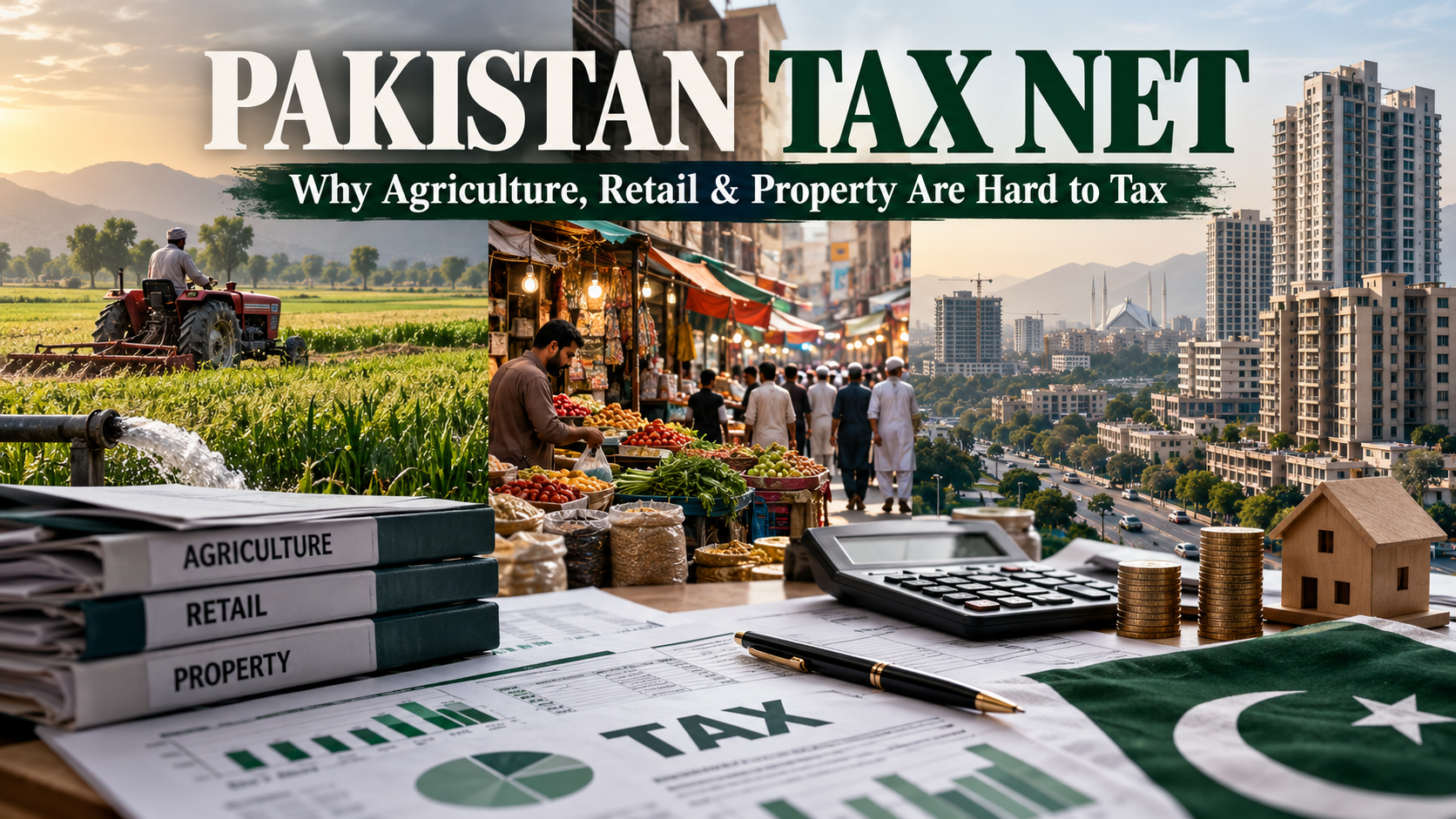
Why does Pakistan struggle to tax retail, property and agriculture? Explore evidence, fiscal trade-offs and fairer reform choices for FY2026–27.
Key Takeaways
- The FY2026–27 budget sets an FBR federal tax-revenue target of Rs15.264 trillion, an estimate rather than an actual collection.
- Agricultural income taxation is substantially a provincial matter, while federal income and sales taxes involve other jurisdictions and rules.
- An effective reform must distinguish workers who cannot avoid withholding from economic activity that is poorly documented; the tax burden is not identical across sectors.
- The World Bank’s 2025 tax-reform announcement reported 1.5 million new taxpayers supported through revenue-system reform, a programme result requiring ongoing scrutiny.
A schoolteacher’s salary is visible every month. Many transactions in farming, wholesale trade or property, by contrast, can be harder for authorities to observe and value accurately. That difference lies at the heart of the Pakistan tax net problem. The federal government budgeted Rs15.264 trillion in FBR revenue for FY2026–27, according to the official budget book. Yet debates about higher taxes often focus on people whose incomes are already documented.
The issue is not that every farmer or shopkeeper pays nothing. They can face sales taxes, input taxes, withholding taxes, provincial levies and indirect price burdens. The real policy question is whether profitable income and economic activity are taxed consistently and fairly, without turning registration into an administrative punishment for small businesses.
How narrow is the Pakistan tax net, and what does narrow mean?
A narrow tax base means too much revenue comes from a limited range of identifiable people, transactions or imports while other income is harder to measure and collect from. The 2026–27 federal budget expects Rs15.264 trillion in FBR taxes, with gross federal taxes and other receipts also supporting provincial transfers. The target describes planned collections, not proof the base has broadened.
| Area | Typical enforcement difficulty | Sensible reform direction |
|---|---|---|
| Salaries | Regular payroll records | Accurate withholding and fair rates |
| Retail trade | Cash receipts and fragmented records | Simple digital invoicing |
| Agricultural income | Provincial rules; farm income variability | Comparable records and provincial enforcement |
| Property | Valuation and transaction transparency | Credible valuations and verified records |
| Professional services | Mixed cash and account receipts | Third-party matching with due process |
The World Bank’s June 2025 tax-project update described data and administration improvements that had helped add 1.5 million taxpayers. The number should not be mistaken for 1.5 million consistently paying high taxes every year. Registration, active filing and actual liabilities are different steps.
A fair scorecard would report tax collected per sector after refunds, number of active returns, audit adjustments upheld on appeal and compliance costs paid by honest firms.
Why is agricultural income tax such a difficult issue?
Under Pakistan’s constitutional distribution of tax powers, provincial governments hold the main responsibility for taxing agricultural income. That makes coordination essential: a federal speech cannot itself ensure consistent agricultural-income enforcement in Punjab, Sindh, Khyber Pakhtunkhwa and Balochistan.
Agriculture is not one homogeneous business. A small tenant farmer exposed to crop failure is very different from a large, highly profitable farming enterprise with irrigation assets and multiple income streams. Rules should protect small producers while making substantial taxable profits harder to conceal.
The Pakistan Economic Survey 2025–26 reported agriculture at 23.44% of GDP in FY26. That economic significance is one reason the sector receives attention in reform discussions, but GDP share does not equal the share of people liable for agricultural income tax. Production value contains wages, inputs and costs; it is not identical to taxable net income.
A credible system requires usable land and crop records, transparent treatment of losses, protection against arbitrary assessment and data-sharing between federal and provincial agencies.
Why is Pakistan’s tax net considered narrow?
Large parts of economic activity are difficult to document or enforce against consistently, while payroll and formal transactions are easier to tax. A narrow base can make governments rely heavily on withholding and indirect taxes. It does not mean every farmer, shopkeeper or property owner pays zero taxes.
Why do cash-heavy retail markets remain hard to measure?
A retailer’s taxable profit is not equal to the cash that passes through the till. Shopkeepers pay rent, salaries, electricity and suppliers. Yet transactions without receipts can make it difficult to verify sales, input credits or profit. Complex filing rules can also discourage small shops from formalising.
Take a shop that records Rs1 million in monthly sales with Rs850,000 in legitimate goods and operating costs. Its gross-to-net calculation depends on inventory, returns and allowable expenses. Taxing total sales at an inappropriate profit rate would penalise thin-margin businesses; ignoring sales entirely would reward noncompliance. Accurate documentation allows both better assessment and fairer treatment.
The October 2026 IMF statement urges risk-based audits, digital invoicing and greater use of third-party data. Such systems can catch evasion while reducing arbitrary inspections, but only if data quality, appeal rights and taxpayer support are taken seriously.
Small retailers should receive genuinely simple registration and a chance to correct mistakes. Without that, digital tools become a new administrative barrier rather than a way to build trust.
What makes property tax and transaction tax so confusing?
Property sits at the intersection of federal taxes on specified income or transactions and provincial or local charges on ownership, transfer and registration. A headline that one federal provision has been abolished does not tell a buyer the complete cost of a transfer. Valuation differences between market prices and official records create obvious opportunities for understatement or disputes.
The Finance Act 2026 source should be consulted for federal provisions, while relevant provincial departments determine many transfer and property charges. A transaction may also face different rules according to purchase date, seller status and the type of property.
A reform with credibility would align valuations with observable evidence, keep an audit trail of major transfers and publish straightforward fee calculators. More transparency can improve revenue and reduce the bargaining power of unofficial intermediaries.
Tax policy should not be designed exclusively around reducing transaction costs for investors. It should also ask whether land and property rules support affordable housing, productive construction and efficient urban development.
Worked example: broadening the base without lifting payroll rates
Suppose a government needs Rs100 billion in additional annual revenue. One approach is to add that entire amount to an already compliant payroll base. Another is to collect Rs20 billion each from five previously under-documented groups through verified liabilities and lawful compliance. The total is the same, but the incidence is different. This is an illustrative allocation, not an estimate of evasion or the yield available in Pakistan.
To assess a real proposal, subtract the cost of collection and the compliance burden. If a scheme raises Rs100 billion but imposes Rs30 billion of administrative cost on firms, its economic payoff differs sharply from one raising the same tax with simple records and fewer disputes.
Fairness requires enforcement and appeal
A powerful institution can easily produce impressive audit notices. The harder task is to issue correct assessments, give taxpayers a reasonable response period and resolve appeals promptly. Digital enforcement should be measurable by collections sustained after appeal, not notices dispatched.
Which reforms should come first?
First, align federal and provincial definitions where legally possible, while respecting constitutional powers. Second, simplify filing for microbusinesses and identify fraudulent registrations through proportionate checks. Third, publish clear property valuation methods and reduce unofficial discretion. Fourth, link tax collection to visible public services and publish an independent assessment of whether exemptions produce jobs or investment.
The World Bank revenue project targets better data systems, transparent reporting and a broader base. The IMF reform recommendations of October 2026 also emphasise a simpler, fairer tax system. The policy challenge is to prevent digitalisation from becoming merely more aggressive surveillance of people already visible in databases.
Trust matters. Citizens are more likely to comply when powerful businesses and politically connected incomes face the same law, refunds arrive, and public money is accounted for. Durable revenue reform is as much an institutional project as a tax-rate decision.
What This Means for You
Salaried worker: Compare effective taxes, not only headline rates. Understand what payroll withholding covers and why broadening the base could reduce pressure for repeated rate increases in the future.
Shopkeeper: Keep separate business accounts, save invoices and learn the current rules for your category and jurisdiction. Good records can protect you from both underpayment penalties and arbitrary overassessment.
Farmer: Agricultural-income rules differ by province. Document yields, sales, rent and genuine expenses, and seek province-specific guidance before assuming federal salaried tax tables apply.
Property buyer: Obtain itemised federal and provincial tax estimates with a date and valuation basis; do not rely on an online claim that a property transaction is ‘tax-free’.
What to Watch Next
- 26 October 2026: The State Bank monetary-policy decision and any revision to its inflation assessment; verify any schedule change with the SBP.
- Early November 2026, exact release date to be confirmed: Pakistan Bureau of Statistics October inflation and merchandise-trade releases.
- Late October–November 2026, date not yet confirmed: Any IMF Executive Board announcement on the October staff-level agreement; staff agreement is not Board approval.
- Throughout FY2026–27: Updated SBP monthly balance-of-payments and remittance statistics; compare cumulative results rather than one month alone.
Frequently Asked Questions
Why is Pakistan’s tax net considered narrow?
Large parts of economic activity are difficult to document or enforce against consistently, while payroll and formal transactions are easier to tax. A narrow base can make governments rely heavily on withholding and indirect taxes. It does not mean every farmer, shopkeeper or property owner pays zero taxes.
Is agricultural income tax federal or provincial in Pakistan?
Agricultural income taxation largely falls under provincial jurisdiction, so rules and implementation differ across provinces. Federal income-tax provisions do not automatically substitute for provincial agricultural-income legislation. Farmers should verify applicable provincial rules and exemptions rather than rely on a national generalisation.
Does being registered with FBR mean a person paid income tax?
No. Registration, filing a return, declaring taxable income and paying an assessed amount are different steps. A person may file lawfully with no final income-tax liability. Evaluating tax reform requires more than counting newly registered taxpayers.
How can digital invoicing improve tax collection?
Digital records can make sales and input claims more verifiable, helping authorities target fraud and reducing manual disputes. But systems need simple onboarding, affordable equipment, safe data handling and a fair appeal process. Otherwise small compliant businesses may face disproportionate costs.
What is the federal FBR tax target for FY2026–27?
The official federal Budget in Brief provides an FBR tax-revenue budget estimate of Rs15.264 trillion for FY2026–27. This is a target set in the budget, not the amount ultimately collected. Actual fiscal reports should be checked as the year progresses.
Pakistan cannot permanently finance a modern state by repeatedly demanding more from the easiest pay packets to identify. Broadening the base must mean lawful, predictable taxation of real economic capacity, paired with stronger public accountability.
Discover more from The Economy
Subscribe to get the latest posts sent to your email.

How Global Interest Rates Affect Savings, Loans and Investments

How to Invest During High Inflation: A Global Guide

Best Global Stocks to Watch in 2026: Four Sectors to Research

Pakistan’s 2027 Growth Strategy: Exports, AI, Energy and Jobs

Pakistan Economy FY2027: IMF Reform, Debt and Recovery Outlook

Global Interest Rates 2027: Risks for Pakistan’s Rupee and Debt

Energy Shock 2026–2027: Oil, Gas and Pakistan’s Economy

World Trade 2027: Tariffs, Supply Chains and Pakistan Exports

AI Investment Boom 2026–2027: Can Pakistan Capture the Upside?

Global Economy 2026–2027: What Slower Growth Means for Pakistan

Why Global Inflation Is Rising Again in 2026, and What It Means for Pakistan

Raast Pakistan 2026: Digital Payments, Fintech

Pakistan Real Estate Tax 2026: What Buyers, Sellers and Investors Must Check

SME Finance Pakistan 2026: Why Small Businesses Still Struggle for Credit

Crude Oil & Petroleum Market Analysis: OPEC+ Decisions and Price Forecasts

World’s Largest Economies: Ranking the Top Global Powers

Pakistan Economy 2026: Inside the SBP’s Balancing Act

Asian Stock Markets 2026: Japan, China, Pakistan & More

Silver Price Today: Why the Xi-Trump AI Standoff Is Fueling a Safe-Haven Rally

Oil Prices 2026: Inside the Hormuz Crisis That Won’t End

SpaceX IPO 2026: History’s Biggest Stock Debut?

Algorithmic Dogfights: Why the U.S. and China Must Establish Rules of Engagement for Autonomous Air Power

Top US Convenience Store Chains: Store Counts, EV Charging, and Sales Trends

Who Is Shivon Zilis? The Neuralink Executive at the Center of the Musk–OpenAI Trial

Business Insurance: What Coverage You Actually Need and What It Costs in 2026

Global Economic Outlook 2026: 7 Forces Reshaping Markets, Trade and Business

Corporate America Faces a New Debt Test as US Borrowing Costs Surge

Is AI a Stock Bubble in 2026? What the Data Shows
-

 Markets & Finance10 months ago
Top 15 Stocks for Investment in 2026 in PSX: Your Complete Guide to Pakistan’s Best Investment Opportunities
-

 Analysis8 months ago
Johor’s Investment Boom: The Hidden Costs Behind Malaysia’s Most Ambitious Economic Surge
-

 Analysis8 months ago
Top 10 Stocks for Investment in PSX for Quick Returns in 2026
-

 Banks9 months ago
Best Investments in Pakistan 2026: Top 10 Low-Price Shares and Long-Term Picks for the PSX
-

 Analysis9 months ago
Brazil’s Rare Earth Race: US, EU, and China Compete for Critical Minerals as Tensions Rise
-

 Investment9 months ago
Top 10 Mutual Fund Managers in Pakistan for Investment in 2026: A Comprehensive Guide for Optimal Returns
-

 Global Economy10 months ago
15 Most Lucrative Sectors for Investment in Pakistan: A 2025 Data-Driven Analysis
-

 Global Economy10 months ago
Pakistan’s Export Goldmine: 10 Game-Changing Markets Where Pakistani Businesses Are Winning Big in 2025