
Economics
Global Interest Rates 2027: Risks for Pakistan’s Rupee and Debt


Global borrowing conditions can tighten even if Pakistan is making domestic progress. Higher foreign yields change the price and availability of capital and can complicate debt management and currency stability. This feature explains the mechanisms, risks and practical decisions that matter through 2027, with particular attention to Pakistan’s different exposure to energy prices, external financing, global trade and AI investment.
At a glance
- World output is forecast to rise, but opportunities and costs are uneven across countries.
- Global inflation forecasts do not predict household prices in Pakistan.
- The AI capital expenditure cycle lifts trade in electronics but may not translate into productivity gains everywhere.
- Pakistan’s IMF staff-level agreement is a milestone, not final Board approval.
- Stronger exports, competitive energy, fiscal credibility and skills are essential to durable growth.
The verified starting point: what the numbers actually say
The IMF October 2026 World Economic Outlook projects global growth of 3.1% in calendar 2026 and 3.4% in calendar 2027, alongside global headline inflation of 4.7% and 4.1%, respectively. Its statistical cutoff is 1 October 2026. The WTO October 2026 trade outlook projects merchandise trade volume growth of 3.9% in 2026 and 4.1% in 2027, versus commercial-services trade volume growth of 3.3% and 6.4%. These are forecasts from different statistical systems, not interchangeable growth measures.
For Pakistan, the IMF Pakistan October 7 staff-level agreement estimated FY2026 growth of 3.6%, September headline inflation of approximately 10.3%, and gross reserves near $21.5 billion at end-September. The fourth EFF review and third RSF review had reached staff-level agreement only, pending IMF Executive Board approval as of the release. Pakistan’s fiscal years run July–June; IMF global growth figures refer to calendar years.
| Indicator | 2026 | 2027 | Important distinction |
|---|---|---|---|
| IMF world GDP growth | 3.1% | 3.4% | Calendar-year projection |
| IMF world headline inflation | 4.7% | 4.1% | Global estimate, not Pakistan CPI |
| WTO goods trade volume growth | 3.9% | 4.1% | Real volume, not nominal trade value |
| WTO commercial services volume growth | 3.3% | 6.4% | Conditional rebound, not guaranteed |
The World Bank June 2026 Global Economic Prospects provides an earlier comparison framework, but its publication date and methodology differ from the October IMF and WTO releases. A thoughtful analysis should compare like with like and should never treat projections as realized outcomes. For a Pakistan-focused story, the crucial question is how global conditions enter domestic economic life.
Why this story matters now
The WTO October 2026 executive summary says AI-enabling goods accounted for 47% of year-on-year growth in the value of world merchandise trade during the first half of 2026. That does not mean 47% of all merchandise trade was AI-related. It identifies a contribution to growth, and in nominal value terms. The same source notes that AI-enabling goods trade rose 67% year-on-year in that period. These figures show how a narrow technology cycle can make global trade appear stronger even as other sectors struggle.
Meanwhile the Reuters October 2026 IMF annual meetings reports persistent concern about global financial risks, geopolitical disruptions and the uneven sharing of AI gains. The Reuters October 2026 Asian growth describes a region where technology investment supports some exporters while energy costs and higher yields challenge others. Pakistan is therefore exposed simultaneously to a potential technology opportunity and to more conventional fuel, financing and trade vulnerabilities.
What higher global yields actually transmit
For what higher global yields actually transmit, A global rate increase affects Pakistan through risk appetite, dollar funding and the benchmark returns sought by international investors. The transmission is not one-to-one: country risk, reserve adequacy and domestic policy credibility can amplify or dampen it.
This matters for economic decision-making because firms and households cannot adjust instantaneously when conditions shift. Prices, contracts, worker skills and financial obligations move on different schedules. Analysts should identify the timetable, who bears the immediate cost, and who may capture the longer-term benefit.
A credible implementation plan requires named institutions, measurable indicators and regular public reporting. The point is not to promise an effortless transition; it is to make policy options concrete enough to compare their benefits and trade-offs.
Pakistan-specific decision test. For what higher global yields actually transmit, ask four questions: (1) Which import cost, export opportunity, credit channel or productivity constraint is affected? (2) Which groups face the first-round effects? (3) What could policymakers or firms change within six months? (4) Which published indicator would demonstrate improvement rather than merely announce activity?
What to monitor: (i) official monthly or quarterly data; (ii) movements in export receipts and import bills; (iii) price changes versus changes in physical volumes; (iv) borrowing and working-capital costs; and (v) job quality and household purchasing power. A single monthly reading can be noisy. Comparing several releases helps distinguish a trend from a short-lived disturbance.
How dollar strength reaches emerging markets
For how dollar strength reaches emerging markets, Domestic rates affect deposits, government securities and credit; international rates affect the opportunity cost of lending abroad. When both remain elevated, long-term private investment becomes harder to justify, particularly in sectors with weak margins.
This matters for economic decision-making because firms and households cannot adjust instantaneously when conditions shift. Prices, contracts, worker skills and financial obligations move on different schedules. Analysts should identify the timetable, who bears the immediate cost, and who may capture the longer-term benefit.
A credible implementation plan requires named institutions, measurable indicators and regular public reporting. The point is not to promise an effortless transition; it is to make policy options concrete enough to compare their benefits and trade-offs.
Pakistan-specific decision test. For how dollar strength reaches emerging markets, ask four questions: (1) Which import cost, export opportunity, credit channel or productivity constraint is affected? (2) Which groups face the first-round effects? (3) What could policymakers or firms change within six months? (4) Which published indicator would demonstrate improvement rather than merely announce activity?
What to monitor: (i) official monthly or quarterly data; (ii) movements in export receipts and import bills; (iii) price changes versus changes in physical volumes; (iv) borrowing and working-capital costs; and (v) job quality and household purchasing power. A single monthly reading can be noisy. Comparing several releases helps distinguish a trend from a short-lived disturbance.
Debt servicing versus headline public debt
For debt servicing versus headline public debt, Currency forecasts should not be sold as certainty. A narrow exchange-rate target can obscure the variables that actually matter: export receipts, remittances, import payments, financing schedules and confidence.
This matters for economic decision-making because firms and households cannot adjust instantaneously when conditions shift. Prices, contracts, worker skills and financial obligations move on different schedules. Analysts should identify the timetable, who bears the immediate cost, and who may capture the longer-term benefit.
A credible implementation plan requires named institutions, measurable indicators and regular public reporting. The point is not to promise an effortless transition; it is to make policy options concrete enough to compare their benefits and trade-offs.
Pakistan-specific decision test. For debt servicing versus headline public debt, ask four questions: (1) Which import cost, export opportunity, credit channel or productivity constraint is affected? (2) Which groups face the first-round effects? (3) What could policymakers or firms change within six months? (4) Which published indicator would demonstrate improvement rather than merely announce activity?
What to monitor: (i) official monthly or quarterly data; (ii) movements in export receipts and import bills; (iii) price changes versus changes in physical volumes; (iv) borrowing and working-capital costs; and (v) job quality and household purchasing power. A single monthly reading can be noisy. Comparing several releases helps distinguish a trend from a short-lived disturbance.
How the State Bank balances competing priorities
For how the state bank balances competing priorities, A global rate increase affects Pakistan through risk appetite, dollar funding and the benchmark returns sought by international investors. The transmission is not one-to-one: country risk, reserve adequacy and domestic policy credibility can amplify or dampen it.
This matters for economic decision-making because firms and households cannot adjust instantaneously when conditions shift. Prices, contracts, worker skills and financial obligations move on different schedules. Analysts should identify the timetable, who bears the immediate cost, and who may capture the longer-term benefit.
A credible implementation plan requires named institutions, measurable indicators and regular public reporting. The point is not to promise an effortless transition; it is to make policy options concrete enough to compare their benefits and trade-offs.
Pakistan-specific decision test. For how the state bank balances competing priorities, ask four questions: (1) Which import cost, export opportunity, credit channel or productivity constraint is affected? (2) Which groups face the first-round effects? (3) What could policymakers or firms change within six months? (4) Which published indicator would demonstrate improvement rather than merely announce activity?
What to monitor: (i) official monthly or quarterly data; (ii) movements in export receipts and import bills; (iii) price changes versus changes in physical volumes; (iv) borrowing and working-capital costs; and (v) job quality and household purchasing power. A single monthly reading can be noisy. Comparing several releases helps distinguish a trend from a short-lived disturbance.
Signals to monitor before assuming rate relief
For signals to monitor before assuming rate relief, Domestic rates affect deposits, government securities and credit; international rates affect the opportunity cost of lending abroad. When both remain elevated, long-term private investment becomes harder to justify, particularly in sectors with weak margins.
This matters for economic decision-making because firms and households cannot adjust instantaneously when conditions shift. Prices, contracts, worker skills and financial obligations move on different schedules. Analysts should identify the timetable, who bears the immediate cost, and who may capture the longer-term benefit.
A credible implementation plan requires named institutions, measurable indicators and regular public reporting. The point is not to promise an effortless transition; it is to make policy options concrete enough to compare their benefits and trade-offs.
Pakistan-specific decision test. For signals to monitor before assuming rate relief, ask four questions: (1) Which import cost, export opportunity, credit channel or productivity constraint is affected? (2) Which groups face the first-round effects? (3) What could policymakers or firms change within six months? (4) Which published indicator would demonstrate improvement rather than merely announce activity?
What to monitor: (i) official monthly or quarterly data; (ii) movements in export receipts and import bills; (iii) price changes versus changes in physical volumes; (iv) borrowing and working-capital costs; and (v) job quality and household purchasing power. A single monthly reading can be noisy. Comparing several releases helps distinguish a trend from a short-lived disturbance.
Policy options: three alternative paths, not numerical forecasts
| Scenario | Assumptions | Implications for Pakistan | Early warning or confirmation |
|---|---|---|---|
| More favorable | Energy costs stabilize; export markets remain open; AI use generates measurable efficiency | Space for investment, steadier purchasing power and stronger services exports | Export orders, real income and private investment improve together |
| Central case | Global growth follows the broad institutional outlook; commodity and funding pressures fluctuate | Gradual recovery with uneven gains across sectors | Stable external balances without a broad productivity surge |
| Adverse | Energy disruptions persist; financing costs rise; AI investment is repriced | Imports become more costly, credit tighter and fiscal choices harder | Reserves, inflation expectations and financing costs weaken at once |
These are qualitative editorial scenarios, not probabilities assigned by an econometric model. Their value lies in clarifying which evidence would require an updated judgment. The IMF October 2026 World Economic Outlook explicitly emphasizes downside risks involving conflict, trade tension, debt and reassessment of AI expectations.
A practical action agenda
For policymakers, the first responsibility is to protect hard-won macroeconomic stability while removing barriers to productivity. Regulatory predictability, tax administration, targeted social protection and transparent energy decisions are more useful than shifting incentives that are impossible for businesses to plan around. The IMF Pakistan 2026 country report identifies revenue mobilization, reform of state enterprises, energy-sector viability and improvements in human capital as linked policy priorities.
For exporters, resilience means identifying where demand is growing, investing in reliable delivery and obtaining credible certifications. Export strategies should track volumes, domestic value added and customer retention; gross receipts alone do not disclose profitability. For small businesses, the practical priority is to map exposure to fuel, electricity, imports and foreign-exchange requirements and to stress-test cash flows before making expansion commitments.
For households, risk management begins with an affordable budget, attention to debt servicing and a realistic distinction between nominal wage gains and purchasing power. For workers, portable skills and credible training can expand options across changing industries. None of this makes external shocks harmless; it simply offers concrete ways to be less exposed.
How this analysis differs from generic global coverage
Major international reporting is indispensable for establishing what happened. The Reuters October 2026 WTO briefing emphasizes the boost from AI to merchandise trade and the pressure of geopolitical disruption. Institutional releases provide detailed projections. This article goes a step further by asking how those macroeconomic signals might translate into local import costs, export competitiveness, employment, household budgets and reform choices. It is an interpretation of attributed evidence, not a claim of exclusive interviews or original field reporting.
The difference is particularly relevant for Pakistan because a global technology boom may coincide with higher costs for countries that import fuel but do not manufacture the equipment in highest demand. No serious strategy should assume that a worldwide headline rate automatically delivers the same benefits locally.
Frequently asked questions
What is the IMF’s global growth forecast for 2027?
The IMF’s October 2026 World Economic Outlook projects 3.4% global GDP growth in 2027, following 3.1% in 2026. These are calendar-year forecasts and may be revised as new data becomes available. See the IMF October 2026 World Economic Outlook.
Is global inflation expected to fall in 2027?
Yes, the October IMF forecast projects global headline inflation easing from 4.7% in 2026 to 4.1% in 2027. That describes the world aggregate and does not imply that prices in Pakistan will fall in absolute terms.
Is Pakistan’s latest IMF financing already approved?
The 7 October 2026 IMF release announced staff-level agreement for the fourth EFF and third RSF reviews, subject to Executive Board approval. The release should not be described as a completed Board decision. See the IMF Pakistan October 7 staff-level agreement.
Will AI investment create jobs in Pakistan?
It could create demand for implementation, software services and specialist support, while also changing tasks in existing occupations. The result depends on skills, investment, electricity reliability and competitive access to customers. No credible source guarantees a particular employment gain.
Does the WTO predict rapid growth in all kinds of trade?
No. Its October outlook differentiates merchandise volume growth from commercial-services volume growth and notes uneven performance by sector and region. Read the WTO October 2026 executive summary.
What should Pakistani companies monitor through 2027?
Export order books, input costs, electricity reliability, financing terms, exchange-rate conditions and customer demand are more operationally useful than a single global growth figure. Businesses should compare these against their own cash flows and margins.
Conclusion: the decisive issue is transmission, not the headline
Global borrowing conditions can tighten even if Pakistan is making domestic progress. Higher foreign yields change the price and availability of capital and can complicate debt management and currency stability. The balance of risks is mixed: advanced technology can expand world production and trade, but it does not neutralize an energy shock or a financing squeeze. For Pakistan, policy credibility, internationally competitive exports and productivity-enhancing investment will determine how much of a fragile global expansion becomes better living standards at home.
Discover more from The Economy
Subscribe to get the latest posts sent to your email.



The world continues to produce extraordinary wealth, yet public confidence in capitalism is increasingly unsettled. The problem may not be that markets have stopped working, but that economic power, opportunity and the rewards of prosperity are becoming dangerously disconnected.
The market economy has a peculiar problem: it continues to demonstrate its extraordinary capacity to create wealth while struggling to persuade millions of people that the system is working in their interests.
The contradiction is becoming difficult to ignore.
The International Monetary Fund’s October 2026 World Economic Outlook projects global economic growth of 3.1 percent this year and 3.4 percent in 2027. Technological investment continues to transform industries, while international trade remains a powerful engine of production and innovation.
Yet another assessment tells a less reassuring story. The World Bank reported in October that approximately 811 million people—roughly one in ten globally—still live below its international extreme-poverty threshold of $3 a day. Progress against extreme poverty has largely stalled since the pandemic.
Meanwhile, Americans’ relationship with capitalism is becoming increasingly complicated. A Gallup survey published in September 2026 found that 55 percent viewed capitalism positively, compared with 43 percent who viewed socialism positively. Only 35 percent expressed favourable opinions of big business, while an overwhelming 95 percent viewed small businesses favourably.
These figures do not describe a worldwide rejection of markets. They reveal something more interesting: at least in the United States, enthusiasm for enterprise can coexist with profound skepticism toward the institutions that dominate an economy.
That distinction points toward a potentially defining economic conflict of our time.
The market economy’s greatest vulnerability may no longer be its ability to generate prosperity. It may be its diminishing ability to convince people that prosperity remains genuinely accessible.
The question is not simply whether capitalism can survive. It is whether a market economy can remain legitimate when competition becomes concentrated, opportunity becomes expensive and economic success increasingly depends on advantages that newcomers cannot easily acquire.
The Economy Can Grow While Opportunity Shrinks
Economic growth is often presented as the ultimate measure of national success. Governments celebrate rising output, investors applaud stronger corporate earnings, and economists search for signs of productivity improvements.
These achievements matter. Without sustained growth, improving living standards and financing public services become considerably harder.
But growth is an aggregate statistic. Economic security is an individual experience.
A national economy can expand while the household confronting higher rents, uncertain employment and expensive childcare feels no corresponding improvement. Companies may become more productive without workers receiving proportional gains. Property values may rise while younger generations find homeownership increasingly remote.
The divergence is not merely psychological.
According to the OECD Employment Outlook 2026, employment across OECD economies reached historically high levels, but real wages remained below early-2021 levels in approximately one-third of member countries.
This is precisely the kind of contradiction that conventional economic debate struggles to explain. Employment can be strong without purchasing power having fully recovered. Inflation can slow without reversing earlier increases in prices.
For households, the distinction between a declining inflation rate and declining prices is not academic. A family that has absorbed several years of rising expenses does not automatically regain its former standard of living simply because prices begin increasing more slowly.
The distribution of economic income presents another concern.
Writing in The New York Times in September 2026, economist Brent Neiman examined the long decline in labour’s share of American income, estimating that it had fallen to approximately 53 percent from around 65 percent after World War II.
The causes are contested, and labor-share measures require careful interpretation. Technological change, globalization, industrial composition, capital investment and market power may all contribute.
Nevertheless, the underlying political problem is unmistakable.
When an economy becomes more productive without delivering commensurate improvements in ordinary economic security, citizens begin to question the relationship between effort and reward.
That relationship is fundamental to the moral legitimacy of capitalism.
People do not require perfect equality to support a market economy. They do, however, need convincing reasons to believe that work, enterprise, ingenuity and reasonable risk can improve their circumstances.
A market economy that preserves the possibility of enormous wealth while narrowing the perceived pathways toward it risks transforming aspiration into resentment.
The Public Is Not Rejecting Markets. It Is Questioning Who Controls Them.
One of the most consequential mistakes in contemporary economic debate is treating dissatisfaction with capitalism as equivalent to hostility toward markets.
The two are not the same.
A market economy is fundamentally a mechanism through which decentralized producers and consumers coordinate decisions through prices, exchange and competition. Capitalism generally adds an institutional structure in which productive assets are predominantly privately owned.
Neither concept requires every industry to be dominated by a handful of corporations. Nor does either guarantee that concentrated private economic power will remain accountable to public interests.
Indeed, the popularity of small businesses in Gallup’s polling suggests that many Americans remain deeply attracted to entrepreneurship, competition and independent ownership.
Their skepticism appears more strongly directed at the behaviour and influence of large institutions.
This matters because the free-market tradition contains a longstanding suspicion of concentrated power.

Adam Smith, whose The Wealth of Nations turned 250 in 2026, did not imagine an economy in which business interests should be permitted to shape public rules without scrutiny. As a Washington Post discussion of Smith’s economic philosophy emphasised, the distinction between wealth earned through competition and advantage secured through political access remains central to his intellectual legacy.
The distinction is especially important today.
When a company succeeds because it produces better goods, develops superior technology or serves customers more efficiently, its profits can signal genuine economic value.
When it succeeds because competitors cannot obtain financing, access distribution channels, overcome regulatory favouritism or escape a dominant platform’s control, profits may instead reflect restricted competition.
Both outcomes can produce impressive earnings statements. Only one necessarily demonstrates that competitive markets are functioning well.
This is the uncomfortable question confronting modern capitalism: Are the largest economic rewards increasingly going to those who create value, or to those best positioned to control access to it?
The answer varies considerably across industries and countries. But the distinction should be at the centre of economic policy.
When the Winners Become the Gatekeepers
The market economy depends on a paradox.
Successful businesses must be allowed to grow, accumulate capital and benefit from innovation. Yet the greater their economic power becomes, the more capable some may be of protecting their position from competitive threats.
An efficient market rewards successful companies. A genuinely competitive market also preserves the possibility that those companies can be displaced.
These principles are complementary only when entry remains possible.
The OECD’s research on competition and market dynamism documents weakening competition across several advanced economies. In a sample covering 15 European countries and 127 industries, the combined market share of the four largest firms increased from 26 percent in 2000 to 32 percent in 2019.
The OECD also identifies higher average markups and declining business dynamism.
Concentration alone, however, does not establish abusive market power. Some companies become large precisely because economies of scale allow them to produce more efficiently and offer customers better prices.
A market filled exclusively with small businesses would not necessarily be more productive, innovative or equitable.
Indeed, an October 2026 Financial Times argument in defense of big business made an important counterpoint: large firms can contribute disproportionately to research, productivity, exports, employee training and higher-quality employment.
The proper objective, therefore, cannot simply be to make big companies smaller.
It must be to ensure that size is a consequence of competitive success rather than a permanent exemption from competition.
A recent Centre for Economic Policy Research discussion paper by Giammario Impullitti and Pontus Rendahl offers a theoretical explanation of how declining competition can simultaneously increase firm valuations, weaken productivity growth and intensify wealth concentration.
The research is a model-based contribution, not definitive proof that one mechanism explains every industry. Its significance lies in identifying how market power can reshape the distribution of economic gains over time.
The political consequences may be equally important.
If citizens increasingly perceive economic success as inherited, protected or purchased through political influence, then even legitimate corporate achievements become suspect.
An economy in which businesses can compete but outsiders cannot realistically challenge incumbents is not merely unequal. It risks becoming less dynamic.
And when competition weakens, the market economy begins losing the feature that historically provided one of its strongest defenses against concentrated economic authority.
Artificial Intelligence Is the Market Economy’s Defining Test
No contemporary development exposes this contradiction more clearly than artificial intelligence.
AI promises extraordinary possibilities: greater productivity, cheaper services, new scientific discoveries, lower barriers to entrepreneurship and economic activities that previously required enormous technical resources.
It also raises the possibility that the ownership of computational infrastructure, data and intellectual property will become an increasingly powerful source of economic advantage.
The outcome is not predetermined.
According to OECD research published in 2026, the number of developers producing language models for cognitive tasks increased from nine in January 2024 to 47 in April 2026.
Over the same period, the number of active text-to-text models rose from 22 to 453, while quality-adjusted model prices fell sharply.
This is genuine evidence of technological dynamism. It complicates the assumption that AI development has already become an irreversible monopoly.
Yet competition in AI applications does not guarantee competition across the infrastructure supplying them.
Advanced semiconductors, cloud computing, specialized data centers, electricity, and access to large datasets remain costly and strategically important.
A small developer may create a successful product while depending on infrastructure controlled by companies that could eventually become competitors.
The central issue, therefore, is not simply how many AI companies exist. It is whether new entrants can obtain essential inputs under fair and competitive conditions.
The stakes extend beyond Silicon Valley.
A July 2026 IMF working paper examining global AI usage found that the estimated economic value associated with AI use in developing economies is concentrated heavily within relatively small professional groups.
This suggests that technological diffusion does not automatically translate into broadly shared opportunity.
In countries where electricity, computing capacity, digital infrastructure and advanced skills remain scarce, the productivity revolution may initially benefit the people already best positioned to take advantage of it.
There is a further distinction between creating wealth and distributing the returns from technological change.
If AI enables a company to produce more with fewer employees, productivity may rise. Consumers may enjoy lower prices. Shareholders may receive higher profits. Workers may move into more valuable occupations—or find that their bargaining power has weakened.
These outcomes are not mutually exclusive, and their relative importance will differ across industries.
A recent Financial Times examination of AI investment risks also underscores the financial vulnerability that can accompany extraordinary technological expectations.
The market economy has repeatedly financed innovations that transformed society. It has also repeatedly generated investment booms in which enthusiasm outran sustainable commercial returns.
Neither possibility cancels the other.
The essential question is whether AI becomes an instrument for widening economic participation or an accelerator of advantages already concentrated among owners of capital and infrastructure.
A technological revolution should not be judged solely by the wealth it creates. It should also be judged by how widely it expands the capacity to participate in creating that wealth.
The State Is Returning. But It Never Really Left.
The political response to these economic tensions has increasingly involved a stronger role for government.
Industrial subsidies, strategic investment, trade restrictions, energy-security measures and supply-chain policies have moved toward the center of economic debate.
The apparent return of industrial policy, however, should not be confused with the disappearance of the market economy.
Markets have always depended on institutions: enforceable contracts, property rights, stable currencies, public infrastructure, transparent regulations and functioning legal systems.
The meaningful question is not whether governments participate in economic life. They inevitably do.
It is whether their participation strengthens competition and productive investment—or protects politically favored interests.
An IMF analysis published in May 2026 examined more than 52,000 industrial-policy interventions recorded across 75 countries since 2009. It found that such measures have increased significantly, often driven by supply-chain resilience, security concerns and geopolitical competition.
But the evidence of success remains mixed.
Targeted subsidies can stimulate investment, yet their effects on productivity and output may fade. Support for strategic industries can address genuine market failures, but it can also transfer public resources toward politically influential firms.
This is where contemporary policy debates become dangerously simplistic.
Advocates of unrestricted markets sometimes overlook the extent to which public investment, effective regulation and legal institutions enable private prosperity.
Advocates of state intervention sometimes underestimate the ability of governments to misallocate capital, suppress competition and entrench inefficient producers.
Both failures can generate concentrated privilege.
The global trading system illustrates what is at stake.
The World Trade Organization’s 2026 World Trade Report estimates that approximately 72 percent of global merchandise trade continues under non-discriminatory most-favored-nation tariff terms.
Its economic simulations also suggest that severe fragmentation of multilateral trade cooperation could impose substantial long-term global output losses.
These are conditional model scenarios, not predictions of inevitable collapse. But they establish an important point: dismantling international cooperation would carry costs, particularly for smaller and poorer economies.
A functioning market economy needs public authority strong enough to enforce competition, yet constrained enough to prevent government from becoming the distributor of permanent economic privileges.
The choice between markets and the state is therefore often misleading.
The more consequential distinction is between institutions that make markets contestable and institutions that make economic power untouchable.
The Developing World’s Problem Is More Complicated
For developing economies, the debate cannot simply be imported from the United States or Europe.
The institutional failures facing countries such as Pakistan are not identical to those confronting wealthy economies.
Advanced economies frequently struggle with the distribution of accumulated prosperity, entrenched market power and the social consequences of technological transformation.
Many developing economies face a more fundamental challenge: generating sufficient productive employment and investment in the first place.
Pakistan offers a revealing example.
The World Bank’s October 2026 Pakistan Development Update reported real GDP growth of 3.7 percent in fiscal 2026, while real per-capita growth remained around 1.6 percent.
The country’s return to stronger macroeconomic stability matters. But stability alone cannot guarantee adequate jobs, sustained productivity growth or rising household incomes.
The World Bank has also documented an increase in Pakistan’s national poverty rate from 22 percent in 2018–19 to 29 percent in 2024–25.
These findings illustrate why the quality of growth matters as much as its existence.
In economies characterized by large informal sectors, weak institutions, costly energy, limited financing and barriers to investment, the promise of markets may remain unrealized not because competition has become too intense, but because genuinely competitive conditions never fully developed.
Government ownership, preferential taxation, politically connected enterprise and regulatory unpredictability can distort investment incentives.
Yet wholesale deregulation would not automatically resolve shortages of infrastructure, skills, credit or effective public services.
The productive alternative requires institutional reform: more predictable rules, wider access to finance, reliable energy, better education, broader tax compliance and competition that is not reserved for privileged economic groups.
The World Bank’s analysis suggests that sufficiently ambitious reforms could substantially improve Pakistan’s long-run growth trajectory. Such outcomes are scenarios dependent on sustained implementation, not guaranteed forecasts.
There is also a wider global dimension.
Developing countries that cannot build competitive digital infrastructure or participate meaningfully in international production networks may find themselves excluded from the most profitable stages of the AI-driven economy.
For them, the future of the market economy will depend not merely on opening borders or attracting foreign investment.
It will depend on building the institutional capacity to turn access to global markets into domestic productivity, employment and rising living standards.
The Case Against Abandoning Capitalism
Criticism of capitalism becomes intellectually weak when it overlooks the system’s achievements—or assumes government intervention is inherently more equitable.
Competitive markets remain exceptionally effective mechanisms for processing dispersed information, coordinating economic activity and encouraging innovation.
Prices convey information that no central authority can collect perfectly. Entrepreneurs discover opportunities that established institutions overlook. Competition can pressure companies to lower costs and improve quality.
These advantages are not theoretical curiosities. They help explain the durability of mixed market economies across different political systems.
The fact that economic growth has failed to benefit everyone equally does not mean growth is dispensable.
The World Bank’s latest poverty assessment emphasizes the importance of faster per-capita income growth and better employment opportunities. Redistribution without expanding productive capacity cannot, by itself, sustainably eliminate extreme poverty.
Nor are politically attractive interventions necessarily well designed.
Writing in The Atlantic in July 2026, Idrees Kahloon challenged proposals that promise broad consumer subsidies without sufficiently addressing the supply constraints and fiscal costs underlying expensive services.
His criticism raises a serious objection to simplistic affordability politics.
Subsidizing demand without expanding housing, childcare or other constrained services can create new costs rather than solve the original problem.
A similar concern applies to permanent price suppression.
The IMF’s October 2026 analysis of cost-of-living crises finds that temporary, targeted transfers can protect vulnerable households more efficiently than broad measures designed to suppress prices.
Effective economic policy must distinguish among failures of competition, failures of supply, unequal bargaining power and inadequate social protection.
Different problems require different instruments.
There is no convincing case for dismantling market coordination simply because existing market institutions distribute opportunity imperfectly.
But there is equally little reason to defend every concentration of wealth or every entrenched corporate advantage as an expression of economic freedom.
The strongest defense of the market economy may be to make its promise of competition more credible.
A New Social Contract for the Market Economy
The debate over capitalism’s future needs a more demanding definition of economic success.
GDP growth, corporate profitability and stock-market performance should remain important indicators. But they cannot independently establish whether an economy is competitive, inclusive or politically sustainable.
A better assessment would ask three fundamental questions.
First, can new participants realistically enter the economy?
An entrepreneur’s freedom to establish a business means little if essential infrastructure, financing or distribution channels are inaccessible.
Competition policy should therefore examine not merely whether consumers face high prices today, but whether markets remain open to potential competitors tomorrow.
That means scrutinizing exclusionary contracts, unnecessary licensing barriers, discriminatory access to infrastructure and acquisitions that eliminate emerging competition.
Second, can ordinary workers and households share meaningfully in productivity gains?
An economy that generates innovation without expanding purchasing power and opportunity will struggle to maintain broad political consent.
Education, retraining, portable social benefits, affordable housing, access to healthcare and effective labor-market institutions can help people adapt to economic change.
The precise policy mix will differ across countries. These measures are not substitutes for productivity growth; they are ways to make participation in a changing economy more feasible.
Third, can economic power be challenged and corrected?
Market competition requires credible public institutions capable of resisting political capture.
Regulators must be independent enough to challenge dominant enterprises, but accountable enough to avoid arbitrary intervention.
Governments must be able to support strategic investment without converting subsidies into permanent entitlements.
And citizens must retain meaningful democratic authority over the rules governing economic power.
The necessary reforms will involve trade-offs.
Stronger competition enforcement can create uncertainty for investment. More extensive social protection requires sustainable financing. Industrial policy may be justified where coordination failures are severe, but badly designed subsidies can encourage rent-seeking.
No serious economic argument should pretend these costs disappear simply because its objectives are desirable.
Still, the consequences of inaction could be greater.
If markets become less contestable, economic opportunity increasingly depends on inherited advantages. If technological gains remain concentrated, productivity becomes politically divisive. If governments respond by protecting favored firms, the resulting system risks combining the worst features of private monopoly and state favoritism.
That is neither a persuasive defense of free enterprise nor a promising model of inclusive development.
The essential reform is to restore a distinction that contemporary economic debate too often neglects: being pro-market is not necessarily the same as being pro-business.
A government committed to competitive markets may sometimes need to challenge powerful corporations. A government seeking productive investment may need to reject subsidies demanded by politically connected industries.
Protecting capitalism from its own excesses can require policies that established capitalists oppose.
The Real Question Is Who Gets to Compete
The market economy has survived wars, financial crises, technological revolutions and repeated predictions of its demise.
Its adaptability remains one of its most impressive qualities.
But adaptability is not automatic. Economic systems evolve through institutions, political decisions and the distribution of power.
The central danger today is not necessarily that capitalism will collapse under the weight of its contradictions.
It is that markets may continue producing wealth while their most important legitimizing promise—the possibility of advancement through open competition—gradually loses credibility.
That would represent a quieter, more enduring crisis than a stock-market crash or recession.
A market economy can survive considerable inequality. It can even survive prolonged political dissatisfaction. What it cannot indefinitely preserve is public confidence in competition if the rules increasingly appear designed to protect those who have already won.
The task is not to choose between unrestricted capitalism and comprehensive state control.
It is to build an economic order in which innovation remains profitable, productive enterprise remains possible, public institutions remain accountable and ordinary citizens have a credible opportunity to improve their circumstances.
The market economy does not need fewer winners.
It needs a system in which winning does not mean acquiring the power to prevent everyone else from competing.
Discover more from The Economy
Subscribe to get the latest posts sent to your email.
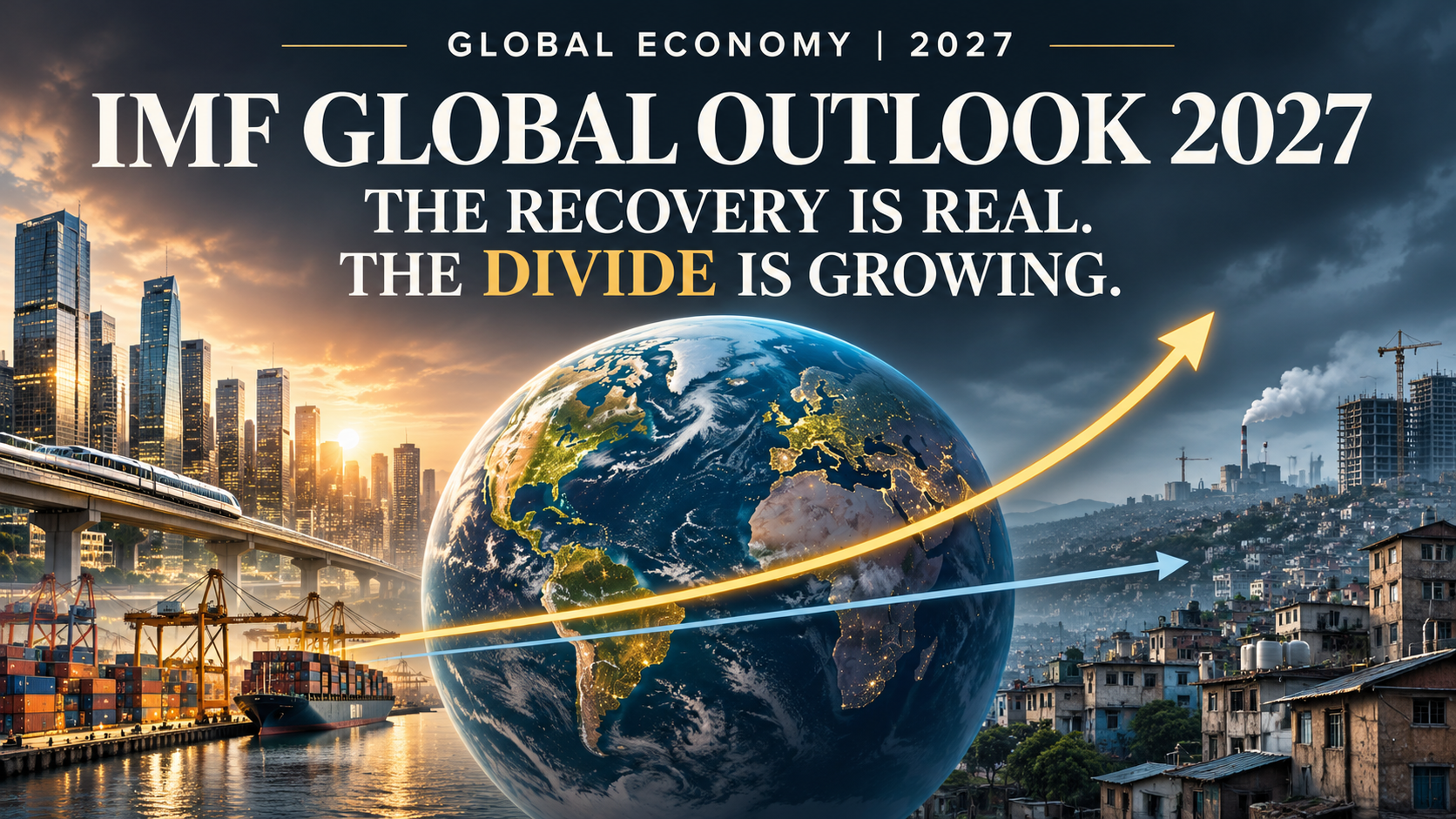
The IMF expects a modest rebound in 2027. Yet an energy shock and AI investment are distributing growth unevenly across countries and industries.
The IMF expects a modest rebound in 2027. Yet an energy shock and AI investment are distributing growth unevenly across countries and industries. This analysis draws on primary documents and contemporaneous reports available on November 6, 2026; subsequent market movements or policy announcements may change the outlook.
The IMF’s October 2026 World Economic Outlook forecasts global growth of 3.1% in 2026 and 3.4% in 2027, with headline inflation moderating from 4.7% to 4.1%. These figures are not a declaration that the world economy has fully recovered. The report, subtitled Resilience Under Strain, Urgent Choices, stresses geopolitical conflict, trade tension, stretched fiscal positions and the possibility of a change in investors’ expectations for AI.
One of its most important caveats is the underlying information cutoff: October 1, 2026. Subsequent market movements, including the November technology sell-off, should be assessed against—not silently folded into—that earlier baseline.
The two-speed world economy
AI-capital investment can sustain exports from economies integrated into advanced technology supply chains, while energy-importing countries outside those networks absorb higher bills. That distinction makes national growth forecasts more useful than one global average. Look at whether earnings are broadening across sectors, whether consumer demand is strengthening and whether investment is productive rather than merely speculative.
The IMF’s Asia-Pacific economic briefing forecasts regional growth of 4.8% in 2026 and 4.4% in 2027. A slowdown can still represent substantial economic expansion. But growth quality, distribution and fiscal headroom determine what households actually experience.
Inflation remains an economic constraint
Global inflation projected at 4.1% in 2027 would be lower than in 2026 yet still imply an increase in overall prices. Consumers care about cumulative food, rent and transport bills, not just whether an inflation percentage has fallen. Central banks must also distinguish one-off supply shocks from persistent wage-price dynamics.
The World Bank’s October commodity outlook projects an easing in broad commodity prices for 2027, but explicitly conditions that outlook on no major further conflict escalation. Policymakers should plan for both baseline normalization and a plausible renewed energy shock rather than assuming a smooth downward path.
The risk of an AI expectations reset
Massive AI investment contributes to GDP through construction, equipment orders and business spending. A correction in the expected profit from those investments can affect valuations immediately even if factories continue operating. If financing becomes harder, projects may be delayed and demand for chips, networking equipment and electricity infrastructure could soften.
The IMF explicitly includes a repricing of AI expectations among downside risks. That is not a prediction that AI will fail. It means that strong technology demand and vulnerable financial valuations can coexist. Investors should distinguish deployment and productivity metrics from the price paid for participating in the boom.
Policy choices are becoming harder
Governments want to support vulnerable households after energy and food shocks but cannot ignore rising interest costs. Broad subsidies can suppress immediate inflation while increasing fiscal pressure or discouraging adjustment. Narrowly targeted support may be cheaper but harder to administer.
A sensible 2027 policy agenda protects essential social spending, mobilizes investment with measurable returns and restores credible medium-term public finances. The key test is whether inflation declines without a severe employment shock, and whether productivity gains spread beyond the technology supply chain.
What a closer look at the source record shows
The available record supports a useful separation between confirmed developments and interpretation. The first column below identifies the type of evidence; the second explains the analytical use, not an independently measured market statistic.
| Research focus | How it informs this story |
|---|---|
| Confirmed evidence | IMF October 2026 World Economic Outlook |
| Interpretive opportunity | Translate forecast into household consequences |
| Secondary question | Date-source cutoffs |
| Next verification | Follow 2027 revisions, incoming inflation prints, oil inventories and credit markets. |
The research priority is relevance rather than sheer citation volume. Repeated references to the same press release do not represent independent confirmation, and authoritative data can support a narrower claim than an ambitious headline suggests. Wherever a numerical fact is used, the source date and stated coverage should travel with it.
How to interpret the evidence without overclaiming
Forecast vintages matter. A projection issued in October must not be quietly represented as knowledge of a market event in November. When comparing forecasts, preserve each report’s publication date and information cutoff. In this article’s subject—IMF global outlook 2027—that distinction prevents superficially precise figures from becoming misleading conclusions. A credible account should explain exactly which evidence supports each inference and what would change the analysis.
Growth is not the same as welfare. Higher output can coexist with falling affordability in some households or regions. Distribution, employment and access to public services matter when judging the quality of recovery. Follow 2027 revisions, incoming inflation prints, oil inventories and credit markets. These checks are important because individual data points can be correct while the story assembled from them is incomplete.
Three specific tests make the coverage stronger:
- Translate forecast into household consequences. Ask what the underlying observation actually measures, which population or companies it covers, and how recent it is. A relevant primary document outweighs a popular unsourced claim.
- Date-source cutoffs. Compare plausible explanations and resist attributing every market or policy movement to one event. When an observed change has several possible causes, explain which are supported and which remain hypotheses.
- Explain divergence between AI winners and importers. Describe what new fact would falsify the prevailing interpretation. Reporting that cannot be revised in the face of new evidence is advocacy, not analysis.
What could validate or derail the IMF baseline
Disinflation becomes broad-based. If oil and food pressures ease and central banks can reduce restrictive settings without destabilizing currencies, more countries may participate in the projected 2027 growth improvement. The strongest confirmation would be rising real household purchasing power and business investment outside the AI supply chain, not merely higher financial-asset prices.
AI and energy risks collide. A renewed disruption in shipping or oil production could sustain inflation just as markets reassess the profitability of massive technology investments. That combination would be harder than a conventional slowdown: authorities could face weak spending and elevated import costs simultaneously. The October IMF forecast explicitly warns about both classes of risk, but does not prescribe one inevitable sequence.
Recovery continues unevenly. The global average reaches something near the baseline while oil importers, indebted states and low-income households lag. That outcome matters for international institutions because a world growth figure can conceal worsening financing and development trade-offs. Country-level revisions, real wages and public debt-service burdens would be more useful tests than headline GDP alone.
A practical research checklist
A reader evaluating this issue should first open the primary sources linked in the article and check their publication dates. Next, identify the specific claim being tested, its units and its geographic or institutional scope. Then compare that evidence with at least one independent account, asking whether the sources are reporting the same underlying data or repeating one another. Finally, distinguish a dated observation from a prediction and note the developments that would demand an update.
For a working editorial desk, this sequence is equally important. A clearly dated article can remain valuable after prices or politics change if its explanations endure and its volatile numbers are identified as snapshots. An article that quietly presents yesterday’s quote as today’s fact, by contrast, loses credibility even when the broader argument is sensible.
A final distinction worth checking
For an editor, the IMF forecast should be paired with the date on which underlying information was available. October 1 is not November 6. If a November market disruption materially changes borrowing or investment assumptions, it is appropriate to discuss that development as a new risk, but not to claim it was already incorporated into the published forecast. Country-specific IMF tables provide a more precise starting point than a global average when evaluating household or corporate consequences.
Questions readers are asking
What is IMF world growth forecast for 2027?
The October 2026 IMF outlook projects 3.4% global growth in 2027.
What inflation does the IMF expect?
Global headline inflation is forecast at 4.1% for 2027, down from 4.7% in 2026.
What are key downside risks?
Conflict escalation, renewed trade tension, fiscal vulnerabilities and reassessment of AI investment expectations.
Is the IMF forecast updated daily?
No. The October outlook uses statistical information available through October 1, 2026; later developments require separate analysis.
The judgment
The IMF expects a modest rebound in 2027. Yet an energy shock and AI investment are distributing growth unevenly across countries and industries. The most responsible conclusion is conditional: Follow 2027 revisions, incoming inflation prints, oil inventories and credit markets. The argument should evolve when new source material is published, rather than being defended simply because it made a compelling headline on November 6. For readers, the value is a clearer distinction among what has already happened, what remains uncertain and what developments would actually change the decision.
Discover more from The Economy
Subscribe to get the latest posts sent to your email.
Economic Reforms
Brian Kemp’s Georgia Legacy: Economic Growth, Elections and the Costs of His Policy Choices

Brian Kemp leaves a consequential and contested record as Georgia’s two-term Republican governor. His administration presided over major investment announcements, tax reductions and industrial recruitment. It also advanced restrictive abortion legislation, changes to voting rules and a limited Medicaid program that critics say left many eligible residents without coverage. The central question is not whether Georgia attracted business, but who benefited, what public resources were committed and which problems remain for his successor.
Kemp is term-limited, not a defeated candidate. After the November 3, 2026 election, news organisations reported Democratic former Atlanta mayor Keisha Lance Bottoms winning the contest against Rick Jackson. The Reuters election report establishes the political transition; official certification should still be checked before final publication. The shift creates a natural moment to audit rather than simply celebrate or condemn the Kemp years.
The economic headline is real, but its accounting matters
Georgia’s September 2026 economic-development report recorded about $35.2 billion in project investment commitments during fiscal 2026, across 436 supported expansions and new locations. Officials projected that those projects would create roughly 25,300 private-sector jobs over coming years. The language is deliberate: commitments and expected jobs are not the same as completed spending and employees already on payroll.
According to the state, existing-company expansions accounted for 79% of supported projects, and projects outside metro Atlanta’s 10-county core made up 75% of expansions and new locations. These are revealing figures. They indicate that policy did not consist solely of courting headline-grabbing foreign factories. Retaining employers, making sites usable and connecting established firms to suppliers also mattered. The administration says manufacturing accounted for 67% of projected new jobs. Those numbers reflect the state’s own development pipeline, not a comprehensive independent evaluation of economic welfare.
| Measure, fiscal 2026 | Officially reported | Proper interpretation |
|---|---|---|
| Project investment | Approximately $35.2 billion | Committed/planned; not all expended |
| Expansion and location projects | 436 | Supported projects; not companies newly founded |
| Jobs associated with projects | Approximately 25,300 | Expected in subsequent years |
| Existing-company expansion share | 79% of projects | An activity mix, not a share of wages |
| Projects outside 10-county Atlanta area | 75% | Distribution of projects, not necessarily equal benefits |
A better retrospective should follow announced projects three, five and ten years later. How many facilities operated at intended scale? Did average wages surpass local benchmarks? Were tax incentives and infrastructure investments recovered through additional revenue? Did workers displaced by automation find comparable employment? On each measure, the announcement supplies the starting data, not the final verdict.
The industrial bet: manufacturing, logistics and local infrastructure
Georgia’s attractions include established logistics assets, major highways, ports, a large metro labor market and a growing ecosystem of industrial suppliers. Kemp’s administration built an economic narrative around turning those underlying advantages into factories and distribution jobs. But no governor independently creates a global supply chain. Company strategy, federal incentives, consumer demand, interest rates and local governments affect the result.
One especially consequential choice was support for site preparation. The economic-development release says the state has invested $28 million in its Rural Site Development Initiative since its FY2025 launch. Shovel-ready land and reliable utilities can make a smaller county competitive for industrial investments, although a prepared site is not a guarantee that a company will choose it. For residents, the decisive outcome is whether recruitment creates durable careers without excessive public costs.
The state’s project figures suggest a more geographically dispersed pipeline than a narrow Atlanta story would imply. That does not establish that rural poverty or access to healthcare was solved. A county can win an industrial announcement while families still struggle with transport, childcare, broadband and affordable housing. Reporting Georgia’s business ranking without checking these conditions risks confusing an investor’s assessment of convenience with a resident’s assessment of quality of life.
Tax reductions: popular, measurable and not costless
The strongest argument Kemp’s supporters make is that keeping taxes competitive gives households more disposable income and makes Georgia attractive to businesses. In May 2026, he signed legislation that, according to the governor’s official legislative announcement, reduced the state’s individual income-tax rate from 5.19% to 4.99% beginning January 1, 2026, alongside other changes to deductions and exemptions. The law also introduced future provisions, including a higher retirement-income exclusion beginning in 2027.
That is a concrete policy change, not just campaign rhetoric. Yet the distribution of benefits depends on taxable income, household characteristics and the interaction of credits and deductions. A percentage-point reduction cannot be assumed to save the same amount for every household. Some residents with little taxable income benefit less than higher-income families, while some earners receive larger dollar savings. A proper distributional evaluation requires tax-return microdata and spending comparisons.
The amended fiscal 2026 budget signed in March also included funding for educational programs, mental-health capacity, transport and tax relief. The administration emphasized a $325 million endowment for the DREAMS Scholarship and $409 million for a new regional hospital. These allocations show that the governing philosophy cannot be summarized as tax cuts alone. But an appropriation is neither a completed project nor an independently audited improvement in outcomes.
The fundamental fiscal question is whether revenue reductions, infrastructure subsidies and public-service commitments remain sustainable through a weaker economy. Supporters argue lower rates increase competitive advantage; critics warn they restrict future policy options. Both positions demand evidence beyond slogans.
The data-center exception tests the pro-business consensus
The rise of artificial-intelligence data centers exposes a trade-off within Kemp’s investment strategy. An Atlanta Journal-Constitution investigation in August 2026 documented the governor’s defense of large data-center sales-tax exemptions even as some legislators and communities questioned their value. Citing state estimates, the paper reported the exemption’s fiscal cost exceeding $2.5 billion in 2026, potentially approaching $3 billion in 2027.
The number should not be mislabeled as a direct cash grant to one business. A tax exemption is foregone revenue measured under a particular fiscal estimate. Nevertheless, it imposes an opportunity cost: money that might otherwise be available for schools, roads or tax relief for other taxpayers. It also raises questions about power generation, water consumption and whether relatively few permanent jobs justify a large project’s benefits.
There is a case for data centers: digital services require computing capacity, construction creates work, and local tax bases may gain taxable assets. The opposing case is equally tangible: fast-rising electricity demand, land-use conflict, limited operating employment and opaque incentives. After the November midterms, Reuters reported that opposition to the industry had become an election issue in several states. Georgia’s next administration inherits decisions about which projects meet the public-interest test.
A credible legacy judgment therefore asks how incentives were structured and whether utility customers were insulated from the incremental costs of new capacity. Describing every data-center dollar as a public loss—or every announced project as an economic triumph—misses the complexity.
Voting rules and the 2020 election: two different tests
Kemp’s handling of pressure after Georgia’s 2020 presidential election has become a defining political episode. He resisted efforts to overturn the certified result, even as Donald Trump attacked him. That mattered for the integrity of lawful procedures. It did not erase disagreements about Kemp’s broader voting policy. His administration also enacted Senate Bill 202 in 2021, changing absentee-ballot procedures, identification requirements and other election-administration rules.
Supporters of SB 202 argued it standardized practices and strengthened confidence. Voting-rights groups said parts of the measure burdened participation and brought litigation. The League of Women Voters’ legal case summary traces challenges to the law. It is incorrect to say that resisting presidential election pressure proves the enacted election rules were universally praised; it is equally inaccurate to say litigation proves every contested provision was judicially struck down.
Fair assessment should separate election-administration claims from measured effects. How long did voters wait? Were absentee-ballot rejections disproportionately distributed? Which provisions survived court challenges? How did turnout change when candidate interest and campaign spending are controlled? Those are answerable questions requiring administrative datasets, not a verdict based on one dramatic political confrontation.
Medicaid Pathways: an experiment with an unresolved coverage gap
Healthcare is perhaps the sharpest contrast between business-oriented goals and household welfare. Georgia did not adopt conventional Affordable Care Act Medicaid expansion. Instead it introduced Pathways to Coverage, a restricted pathway with qualifying activity requirements. The Urban Institute’s Georgia policy profile outlines that distinction and the state’s remaining uninsured population.
In a November 2, 2026 KFF Health News investigation, reporters described Pathways providing coverage to more than 20,000 people while facing questions about its federal waiver and program future. This count and earlier estimates vary by reporting date and definition; they must not be blended into a single trend without checking official enrollment reports.
The program’s defenders argue that an activity-based route extends some coverage without adopting full expansion. Critics contend that verification rules make enrollment difficult and that many low-income adults are still excluded. Both realities can coexist: a participating resident may receive valuable care while the total enrollment remains far below the population that might qualify under broader rules.
For the incoming governor, the decision is not simply whether to retain Kemp’s signature. It involves federal authorization, budget implications, enrollment administration, eligibility rules and legislative cooperation. Healthcare coverage is a measurable public outcome, and the final verdict will require tracking who actually obtained and retained insurance.
Abortion policy: legislation, courts and real-world access
Kemp signed Georgia’s 2019 LIFE Act, which restricts most abortions after approximately six weeks, subject to statutory exceptions and ongoing legal litigation. The Urban Institute’s current overview describes the state’s restrictions and service-access context. The distinction between the enacted statute, the latest court rulings and actual medical access is essential because court actions can change enforceability.
Supporters view the law as protecting fetal life and expressing a moral obligation. Opponents emphasize bodily autonomy, complex medical situations, delayed care and reduced access for people with fewer resources. These are major substantive disagreements, not merely messaging errors. A useful evaluation should examine maternal outcomes, clinic access and patients’ travel burdens with reliable time series and clinical context, while avoiding simplistic claims that any single statistic can identify the effect of one law.
Kemp’s legacy includes making a durable choice on a question where Georgians remain divided. The election of his successor may change legislative priorities but cannot independently repeal statutes without the applicable legislative and legal process.
What the 2026 vote says—and does not say—about Kemp
Democrat Keisha Lance Bottoms’ victory is significant for the state’s political direction, but she ran against Republican Rick Jackson, not Kemp. Reuters’ November 4 coverage confirms the outcome as reported by major news organizations; final certified tallies may follow. Voters considered the economy, candidates and national political conditions alongside the previous administration’s record.
The election does not isolate a single causal verdict on every Kemp decision. Individual candidate qualities, presidential approval, national inflation, urban-suburban turnout and turnout among younger voters all matter. Nor should Republican policy continuity be assumed simply because Kemp’s preferred approach shaped the previous legislature. Laws, contracts and long-term projects constrain any incoming administration.
For Republicans, the hard question is whether Kemp’s distinctive combination of conservative policy and partial independence from Trump’s election claims remains electorally transferable. For Democrats, the challenge is converting victory into measurable policy change while navigating the state constitution, fiscal constraints and legislative composition. For residents, the question is far simpler: will wages, healthcare, infrastructure and affordability improve?
A scorecard for evaluating the legacy fairly
| Policy area | Evidence in Kemp’s favor | Unresolved accountability test |
|---|---|---|
| Industrial recruitment | Large committed projects and geographically dispersed expansions | Completed investments, net jobs, wages and public cost |
| Taxes | Enacted income-tax rate reductions | Distributional benefits and long-term service funding |
| Infrastructure | Appropriations for transport and hospital capacity | Delivery dates, service quality and costs |
| Data centers | Potential investment and computing capacity | Fiscal incentives, utility bills and permanent jobs |
| Elections | Refusal to overturn 2020 presidential result | Effects and legal status of contested voting changes |
| Medicaid | A new coverage route for some adults | Enrollment access, administrative burden and remaining uninsured |
| Abortion | Enacted conservative policy priorities | Healthcare access, litigation and health outcomes |
A fair summary is neither that Georgia prospered solely because of Kemp nor that every benefit was illusory. The administration combined durable growth-oriented choices with decisions that created costs and conflicts. That mixed inheritance is why its legacy will be judged beyond one election night.
Frequently asked questions
Is Brian Kemp leaving office because he lost the 2026 governor race?
No. Kemp was term-limited after two terms and was not on the gubernatorial ballot. The reported contest was between Keisha Lance Bottoms and Rick Jackson.
How many jobs did Kemp create in 2026?
The state announced approximately 25,300 jobs expected from FY2026-supported projects. That is not a verified count of jobs filled or a net statewide job-creation estimate.
Did Kemp lower Georgia income taxes?
Yes. The governor’s office says a law signed in May reduced the state individual income-tax rate from 5.19% to 4.99%, effective January 1, 2026. Individual savings depend on taxable income and other provisions.
Did Georgia expand Medicaid under Kemp?
Not through conventional ACA expansion. Georgia adopted Pathways to Coverage, a more limited program with qualifying activity requirements.
What will happen to Georgia’s data-center tax breaks?
Future changes depend on legislation, administration, existing commitments and litigation or regulatory developments. No single election automatically cancels every exemption.
Did Brian Kemp oppose Donald Trump?
He resisted pressure over Georgia’s 2020 certified presidential result while remaining a conservative Republican. It would be misleading to describe their relationship as unconditional alliance or permanent opposition.
Conclusion: the difference between a winning pitch and a lasting record
Economic-development announcements are attractive political evidence because the numbers are big and immediately shareable. Health insurance enrollment, the cost of utility expansion and long-term earnings are harder to reduce to a slogan. Kemp’s legacy should be examined at that second, more demanding level. He leaves an ambitious industrial pipeline and major tax-policy changes alongside fiercely contested decisions over healthcare, voting and reproductive rights. For Georgia, the next phase is not just choosing a new governor; it is auditing whether the promises made under the old one were delivered.
Discover more from The Economy
Subscribe to get the latest posts sent to your email.

Open Banking Trends 2026: What Consumers Should Know

Nvidia After the Selloff: What to Watch Before Earnings

Black Friday 2026 Early Deals: A Data-Driven Shopping Guide

Fed Policy Path 2027: Rate Expectations After the Hold

Asia’s Economic Resilience in 2026: The Strategic Blueprint for Sustaining the Global Growth Engine

Credit Scoring Changes 2026: What Mortgage Buyers Need to Know

10-Year Treasury Yield Outlook for 2027 After the Democratic Sweep

Is the AI Infrastructure Boom Sustainable? A Reality Check

Disability Insurance Demand in 2026: Who’s Buying and Why

What the 2026 Midterms Mean for Treasury Yields and Bond Markets

Payroll Outlook After the Midterms: 2027 Tax Changes, Compliance Risks and AI Trends

Lisa Su: AMD Is Now a “Data Center First Company” – 2027 Outlook

Reasons for Falling US Gas Prices in November 2026: A Seasonal Shift

SoftBank’s $3.7 Billion Turbine Loss: What the AI Power Bet Reveals

Dow Jones Today: Dow Slips 237 Points After the Worst Day Since April 2025

US–Iran Conflict in October 2026: Hormuz, Oil Prices and Diplomacy

Pakistan IMF Programme 2026: Why Bailouts Keep Returning

SSI November 2026 Payment: Why Benefits Arrive October 30

Singapore Stock Market Outlook 2027: The STI’s Bank-and-Yield Test

2027 Federal Tax Brackets: New IRS Rates and Standard Deductions Explained

IMF Global Outlook 2027: The Recovery Is Real, but the Divide Is Growing

World Bank Debt Report 2026: The $9.4 Trillion Burden Behind the Recovery

Stock Market Crash 2026? What the November Rout Actually Tells Us

KSE-100 Index 2026: Is Pakistan’s Stock-Market Recovery Sustainable?

Germany–France ‘Made in Europe’ Deal Could Reshape China’s EV Ambitions

Zhuhai Airshow 2026: How China’s Stealth Jets, Drones and Missiles Are Redrawing Global Air Power

Global Markets Today: The AI Sell-Off Has Become a Test of Liquidity

Democrats Won Congress. Can They Fix the U.S. Economy
-

 Markets & Finance10 months ago
Top 15 Stocks for Investment in 2026 in PSX: Your Complete Guide to Pakistan’s Best Investment Opportunities
-

 Analysis9 months ago
Johor’s Investment Boom: The Hidden Costs Behind Malaysia’s Most Ambitious Economic Surge
-

 Analysis9 months ago
Top 10 Stocks for Investment in PSX for Quick Returns in 2026
-

 Banks10 months ago
Best Investments in Pakistan 2026: Top 10 Low-Price Shares and Long-Term Picks for the PSX
-

 Analysis9 months ago
Brazil’s Rare Earth Race: US, EU, and China Compete for Critical Minerals as Tensions Rise
-

 Investment10 months ago
Top 10 Mutual Fund Managers in Pakistan for Investment in 2026: A Comprehensive Guide for Optimal Returns
-

 Global Economy11 months ago
15 Most Lucrative Sectors for Investment in Pakistan: A 2025 Data-Driven Analysis
-

 Global Economy11 months ago
Pakistan’s Export Goldmine: 10 Game-Changing Markets Where Pakistani Businesses Are Winning Big in 2025