
Business
Trump Sues JPMorgan and Jamie Dimon for $5 Billion: Inside the Debanking Battle

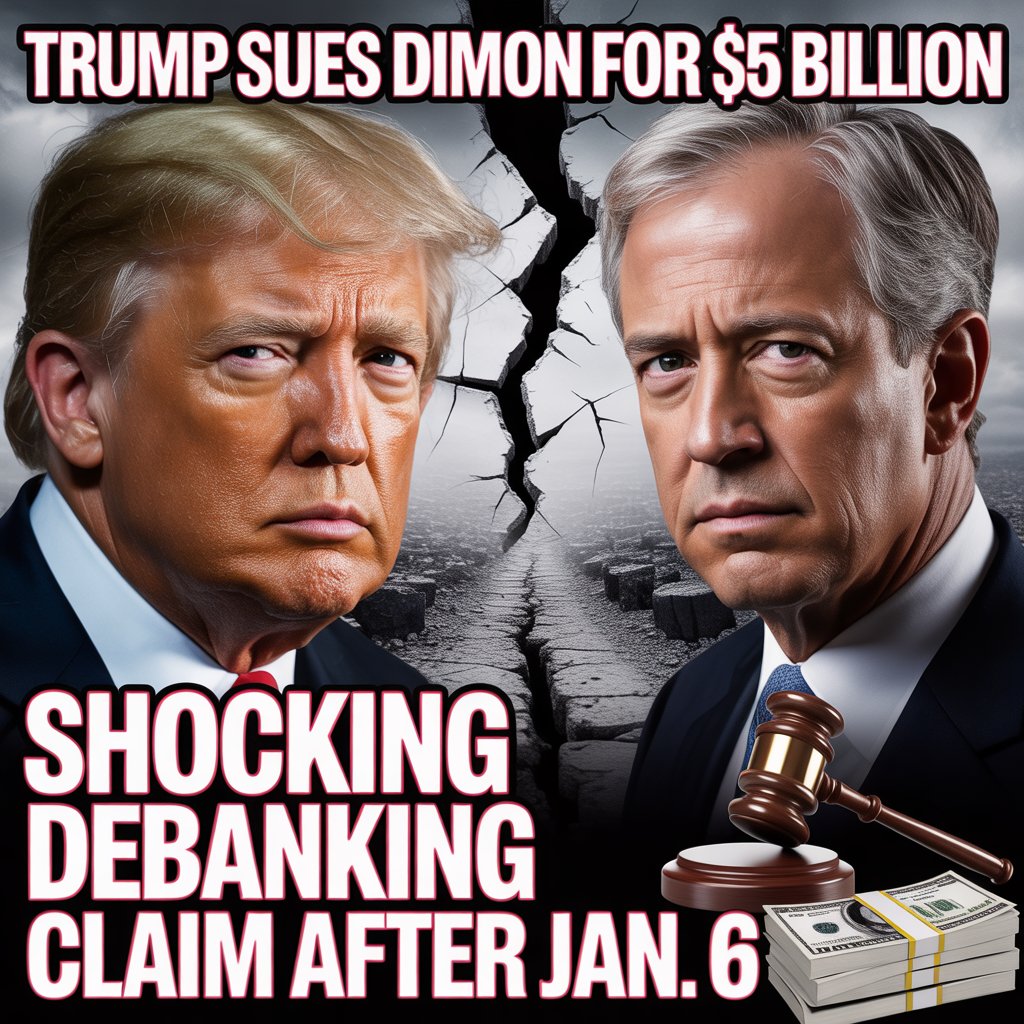
Trump files $5B lawsuit against JPMorgan and CEO Jamie Dimon over alleged political debanking after Jan. 6. Inside the explosive legal battle reshaping Wall Street.
The Lawsuit That Could Redefine Banking’s Political Boundaries
On a crisp January morning in 2026, Donald Trump—now barely two weeks into his second presidency—fired what may prove to be one of the most consequential legal salvos against Wall Street in modern American history. The $5 billion lawsuit, filed in Florida state court on January 22, targets not only JPMorgan Chase, America’s largest bank, but also its formidable CEO Jamie Dimon, alleging “political debanking” in the aftermath of the January 6, 2021 Capitol riot.
The complaint centers on a stark allegation: that JPMorgan, under Dimon’s leadership, closed Trump’s personal and business accounts in February 2021 not for legitimate compliance reasons, but as political retaliation. According to The New York Times, the lawsuit characterizes the bank’s actions as a “coordinated effort to weaponize financial access against political opponents,” invoking Florida’s recently enacted anti-debanking statute to claim unprecedented damages.
The timing is extraordinary. Trump returns to the Oval Office with an ambitious agenda of financial deregulation and tariff restructuring, yet immediately finds himself in open warfare with the very institution that once helped finance his real estate empire. For Jamie Dimon—often described as the most powerful banker in America—the lawsuit represents an uncomfortable collision between his role as a nonpartisan financial steward and the increasingly politicized landscape of corporate America.
This case transcends a dispute between a former president and his banker. It strikes at fundamental questions about the boundaries of corporate power, the role of banks as gatekeepers to the financial system, and whether access to banking can—or should—be conditioned on political considerations. The reverberations will be felt far beyond Palm Beach and Manhattan.

The Fracture: From Business Partners to Courtroom Adversaries
The Pre-2021 Relationship
The relationship between Donald Trump and JPMorgan Chase was never warm, but it was functional. Throughout the 2000s and 2010s, JPMorgan maintained various banking relationships with Trump Organization entities, though the bank had reportedly scaled back its exposure following Trump’s 1990s casino bankruptcies. Unlike Deutsche Bank, which became Trump’s primary lender during years when major Wall Street institutions avoided him, JPMorgan maintained a cautious but present role—managing accounts, processing transactions, facilitating international transfers for his global properties.
Jamie Dimon, for his part, navigated the Trump presidency with characteristic pragmatism. The JPMorgan CEO publicly supported aspects of Trump’s 2017 tax reform, attended White House business councils, and maintained cordial relations even as he occasionally criticized specific policies. It was classic Dimon: engage with power, advocate for business interests, avoid unnecessary confrontation.
The January 6 Turning Point
Then came January 6, 2021. As rioters stormed the Capitol and the nation reeled, corporate America faced a reckoning. According to The Washington Post, JPMorgan’s risk management and compliance teams initiated an urgent review of all Trump-related accounts in the riot’s immediate aftermath. The bank’s concerns reportedly centered on three factors: reputational risk, regulatory scrutiny, and potential exposure to sanctions or legal complications given ongoing investigations into the events of that day.
By February 2021, JPMorgan had made its decision. In a series of terse notifications—described in the lawsuit as “cold and peremptory”—the bank informed Trump and several affiliated entities that their accounts would be closed within 30 days. No detailed explanation was provided beyond boilerplate language about “business decisions” and “risk tolerance.”
Trump, then a private citizen banned from major social media platforms and facing his second impeachment, had few immediate options for recourse. But he evidently did not forget.
Inside the Lawsuit: Claims, Legal Strategy, and the Florida Debanking Law
The Core Allegations
The 87-page complaint, filed in Palm Beach County Circuit Court, makes sweeping allegations of political discrimination and viewpoint-based financial censorship. Bloomberg reports that Trump’s legal team argues JPMorgan violated Florida Statutes Section 542.336, a law enacted in 2023 that prohibits financial institutions operating in the state from denying services based on political views, religious beliefs, or social credit scores.
The lawsuit claims that JPMorgan’s decision was “pretextual and politically motivated,” pointing to several pieces of circumstantial evidence:
- Timing: The account closures came mere weeks after January 6, suggesting a direct causal link.
- Selective application: The complaint alleges other high-profile clients with controversial political profiles or legal troubles maintained their JPMorgan accounts.
- Lack of explanation: JPMorgan allegedly refused to provide substantive justification beyond generic risk management language.
- Public statements: The lawsuit references internal communications and public comments by JPMorgan executives about corporate responsibility and ESG commitments following January 6.
The $5 Billion Question
The astronomical damages figure—$5 billion—is based on claims of reputational harm, business disruption, and punitive damages. Trump’s attorneys argue that being “debanked” by America’s largest financial institution inflicted severe damage on his business empire, complicating transactions, raising costs, and signaling to other institutions that he was an unacceptable client. Forbes notes that the complaint specifically cites lost opportunities, increased borrowing costs, and the “digital scarlet letter” of being rejected by JPMorgan.
Legal experts interviewed by multiple outlets express skepticism about the damages calculation, noting that proving direct financial harm from account closures—particularly for someone with Trump’s access to alternative banking options—will be extraordinarily difficult. Yet the symbolic value of the number is clear: this is warfare, not negotiation.
Jamie Dimon in the Crosshairs: Personal Liability and Corporate Leadership
Why Sue Dimon Personally?
The inclusion of Jamie Dimon as an individual defendant elevates this from a routine corporate dispute to something far more personal. The Financial Times reports that Trump’s complaint alleges Dimon was directly involved in the decision to close the accounts, citing board meeting minutes and internal communications that purportedly show the CEO weighing in on Trump-related risk management decisions in early 2021.
This is unusual. CEOs of major banks typically insulate themselves from individual account decisions through layers of compliance, legal, and risk management infrastructure. Piercing that corporate veil requires demonstrating that Dimon personally directed or ratified the allegedly discriminatory conduct—a high bar in litigation.
Yet Trump’s team appears confident. The complaint portrays Dimon as the architect of a broader corporate strategy to distance JPMorgan from controversial political figures in the post-January 6 environment, allegedly using compliance mechanisms as cover for viewpoint discrimination.
Dimon’s Delicate Position
For Jamie Dimon, the lawsuit creates acute discomfort. He has cultivated an image as a steady hand in turbulent times—someone who can navigate political crosscurrents while keeping JPMorgan above the fray. He maintained working relationships with both the Trump and Biden administrations, advocated for practical business policies regardless of partisan source, and positioned himself as a voice of reason in polarized times.
Now he faces a lawsuit from a sitting president who commands fierce loyalty from roughly half the American electorate and who has never been shy about using his platform to wage public relations warfare. According to Reuters, JPMorgan’s initial response has been measured but firm: the bank denies all allegations and insists the account closures were based solely on “routine risk management protocols unrelated to any client’s political views.”
JPMorgan’s Defense: Risk Management or Political Censorship?
The Bank’s Rationale
JPMorgan has not yet filed a formal response to the lawsuit, but its public statements and background briefings to journalists reveal the contours of its defense. The bank argues that:
- Regulatory compliance: As a globally systemically important bank (G-SIB), JPMorgan faces extraordinary regulatory scrutiny and must maintain rigorous anti-money laundering, sanctions compliance, and risk management protocols.
- Reputational risk: The January 6 events triggered massive reputational risk assessments across corporate America. Banks routinely evaluate whether clients pose unacceptable reputational hazards—a legitimate business consideration.
- Operational independence: Account closure decisions are made by specialized risk and compliance teams using objective criteria, not by the CEO’s office based on political animus.
- Preexisting concerns: CNBC reports that sources close to JPMorgan suggest the bank had been conducting enhanced due diligence on Trump Organization accounts well before January 6, related to longstanding questions about the company’s financial practices.
The Industry Context
JPMorgan’s predicament reflects broader tensions in the banking sector. After January 6, numerous financial institutions severed ties with Trump-affiliated entities or individuals. Payment processors like Stripe stopped processing donations for Trump campaign entities. Banks conducting business with anyone connected to the Capitol riot faced intense public pressure and potential regulatory complications.
Yet this creates a troubling precedent. If banks can effectively de-person individuals from the financial system based on political controversy—however defined—where do the boundaries lie? Conservative activists have documented dozens of cases where individuals and organizations on the right claim they were “debanked” for their political views, from gun rights advocates to anti-abortion activists.
The Debanking Phenomenon: A Growing Flashpoint
What Is Political Debanking?
“Debanking” refers to financial institutions closing or denying accounts to customers based on factors unrelated to traditional banking risk—most controversially, political views or associations. The practice exists in a legal and ethical gray zone. Banks have broad discretion to choose their clients, but that discretion isn’t absolute, particularly when anti-discrimination laws or public utility considerations come into play.
The BBC describes the phenomenon as part of a broader trend in which major corporations use their market power to enforce ideological boundaries—what critics call “corporate cancel culture” and defenders characterize as legitimate risk management and values alignment.
Florida’s Anti-Debanking Law
Florida’s 2023 legislation specifically prohibits financial institutions from discriminating based on political opinions, religious beliefs, or “social credit scores”—a term borrowed from concerns about Chinese-style social monitoring systems. The law allows individuals and businesses to sue for damages if they can prove they were denied financial services for these prohibited reasons.
Trump’s lawsuit is the highest-profile test of this statute. If successful, it could open the floodgates for similar litigation and encourage other Republican-controlled states to enact comparable protections. If it fails, it may establish that banks retain broad discretion to evaluate clients holistically, including reputational and political considerations.
Wall Street’s Trump Dilemma: Navigating the Second Term
The Complicated Courtship
Wall Street’s relationship with Donald Trump has always been transactional and ambivalent. The financial sector enthusiastically supported his 2017 tax cuts and deregulatory agenda, yet many executives were privately appalled by his conduct and rhetoric. Jamie Dimon himself once criticized Trump’s handling of racial tensions, though he later walked back some comments.
Now, with Trump back in the White House pursuing an ambitious agenda that includes further banking deregulation, financial institutions face an uncomfortable calculus. Antagonizing the president risks regulatory retaliation, but appearing to capitulate to political pressure undermines their claims to operational independence.
The lawsuit intensifies this dilemma. If JPMorgan settles quickly or backs down, it may embolden Trump to use similar pressure tactics against other institutions. If the bank fights aggressively, it risks a protracted public battle with a president who thrives on conflict and commands a megaphone unlike any other.
Regulatory and Legislative Implications
The Trump administration’s financial regulatory appointees will be watching this case closely. While the lawsuit is a civil matter in state court—not subject to federal intervention—the broader questions it raises about banking access and political neutrality could inform federal policy.
Congressional Republicans have already signaled interest in federal anti-debanking legislation, modeled on Florida’s law. If Trump’s lawsuit gains traction, it could accelerate those efforts and create a new front in the ongoing culture wars over corporate America’s role in policing political speech and association.
Economic and Market Implications
Short-Term Market Reaction
JPMorgan’s stock barely flinched on news of the lawsuit—testimony to investors’ view that the case poses minimal financial risk to the bank. The $5 billion figure, while eye-catching, represents less than two weeks of JPMorgan’s typical quarterly profit. Legal fees and reputational damage are the more realistic concerns.
Long-Term Structural Questions
The deeper economic question is whether this lawsuit accelerates fragmentation in the financial services industry along political lines. Some conservative entrepreneurs are already building “anti-woke” banking alternatives, positioning themselves as havens for customers who fear political discrimination by mainstream institutions.
If successful, these parallel financial infrastructures could reduce efficiency, increase costs, and fragment liquidity in the banking system. Alternatively, they might introduce healthy competition and discipline for incumbent institutions that have grown complacent about customer service and political neutrality.
The Precedent Problem: Where Does This End?
Slippery Slopes on Both Sides
Both sides in this dispute can point to troubling hypotheticals. If banks cannot consider political factors at all in client selection, can they be forced to serve individuals or entities under sanctions, involved in ongoing criminal investigations, or credibly accused of financial fraud—provided those targets can frame their situation as political persecution?
Conversely, if banks have unlimited discretion to debank based on ideology, couldn’t conservative-led institutions refuse to serve progressive clients? Couldn’t banks in certain regions effectively exclude entire classes of politically disfavored customers?
The lawsuit forces courts to grapple with these questions without clear precedent. Banking law has traditionally granted financial institutions broad discretion in client selection, but those principles were developed in an era when banking and politics occupied more separate spheres.
What Happens Next: Legal Timeline and Likely Outcomes
Procedural Roadmap
JPMorgan will likely move to dismiss the case, arguing that Trump has failed to state a valid legal claim and that the bank’s actions fall within its protected business judgment. Florida’s anti-debanking law remains largely untested in litigation, so courts will have to interpret its scope and application.
If the case survives dismissal, discovery could be explosive. Trump’s attorneys would gain access to JPMorgan’s internal communications, risk assessments, and decision-making processes around the account closures. The bank would similarly probe Trump’s actual financial damages and alternative banking relationships.
Most legal analysts expect the case to settle rather than go to trial, though Trump’s litigious history and Dimon’s institutional resolve make predictions hazardous. A settlement could include no admission of wrongdoing but might involve JPMorgan agreeing to clearer, more transparent account closure policies.
The Political Calculus
Trump appears to view the lawsuit as both a genuine grievance and a useful political narrative. The “debanking” story resonates with his base’s sense that elite institutions weaponize their power against conservatives. Whether the case has legal merit may matter less than its political utility in reinforcing that narrative.
For JPMorgan, the priority will be containing damage—to its reputation, its regulatory standing, and its relationships with both political parties. The bank cannot afford to be seen as capitulating to political pressure, but neither can it afford a years-long public brawl with the President of the United States.
Conclusion: Banking, Power, and the Politics of Access
The Trump-JPMorgan lawsuit crystallizes tensions that extend far beyond one controversial president and one powerful bank. At its heart, this case asks who controls access to the infrastructure of modern capitalism—and on what terms.
Financial institutions occupy a quasi-public role in democratic societies. They are private enterprises with shareholder obligations, yet they also serve as gatekeepers to essential economic participation. When banks exercise that gatekeeping power based on political considerations—whether explicitly or through the malleable language of risk management—they enter contested terrain.
Trump’s lawsuit, whatever its ultimate legal fate, has already succeeded in forcing this question onto the national agenda. It challenges the post-January 6 consensus among corporate leaders that distancing from Trump carried no serious institutional cost. And it previews what may be a defining feature of Trump’s second term: the use of litigation, regulation, and executive power to reshape corporate America’s relationship with political controversy.
Jamie Dimon, who has navigated financial crises, regulatory transformations, and political upheavals with unusual dexterity, now faces perhaps his most delicate challenge. The lawsuit is a reminder that in contemporary America, even the most powerful banker cannot fully insulate his institution from the gravitational pull of politics.
The $5 billion question is ultimately not about damages—it’s about boundaries. Where does legitimate risk management end and political discrimination begin? The answer will reverberate through boardrooms and courtrooms for years to come.
Discover more from The Economy
Subscribe to get the latest posts sent to your email.


Analysis
KSE-100 Plunges Nearly 7% Amid Escalating Middle East Tensions: What It Means for Pakistan’s Economy
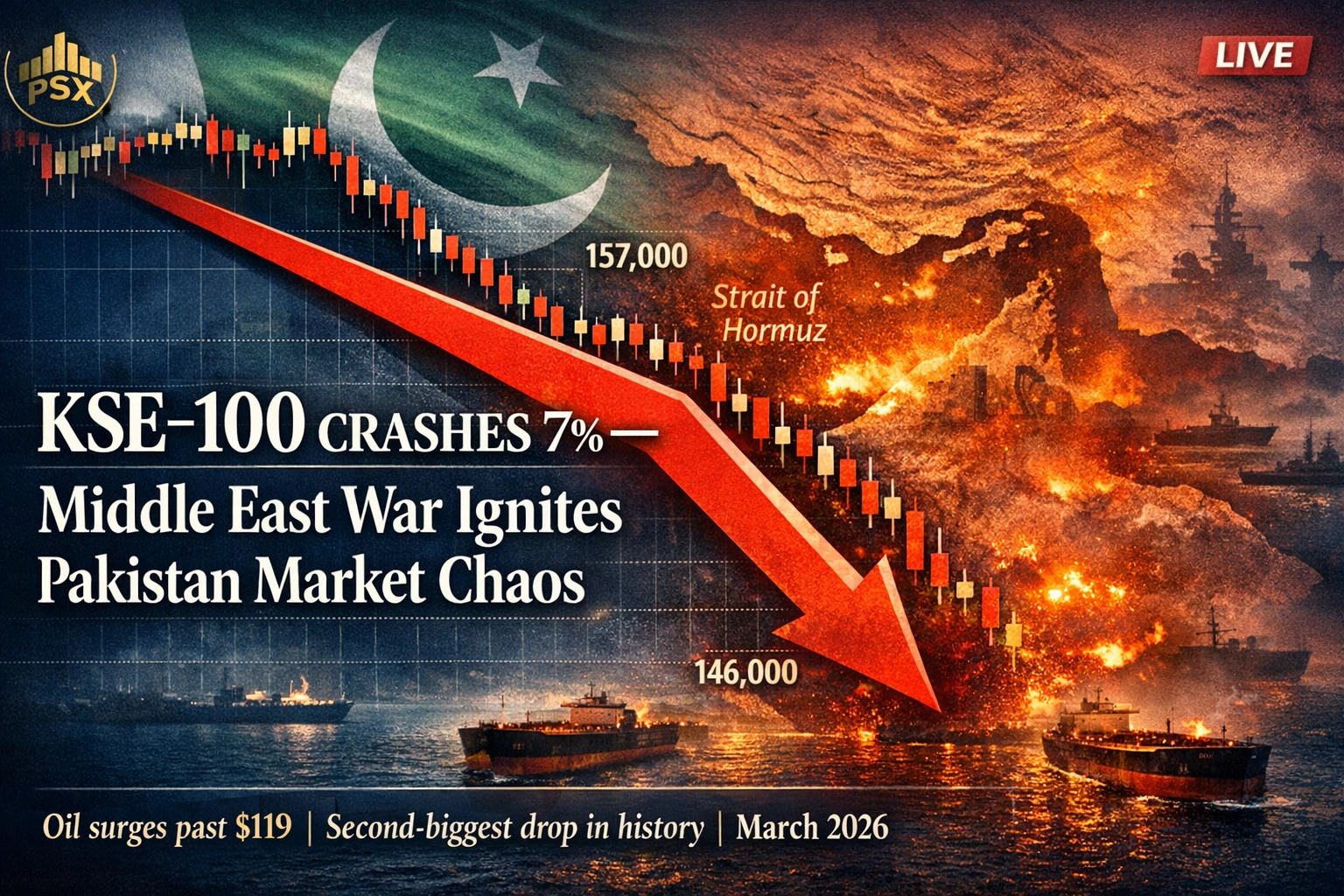
The digital clock on Mr. Ahmed’s trading terminal in Karachi’s bustling financial district had barely clicked past 9:15 AM when the screen turned a ghastly red, reflecting the collective dread that swept through the Pakistan Stock Exchange (PSX). His life savings, meticulously built over decades of cautious investment, seemed to evaporate with each precipitous drop in the KSE-100 Index.
“It’s not just numbers on a screen,” he’d often tell his children, “it’s the future of our family, the cost of our education, the roof over our heads.” Today, that future felt acutely fragile. The morning’s aggressive sell-off wasn’t merely a market correction; it was a visceral reaction to geopolitical tremors reverberating from distant shores, a stark reminder of Pakistan’s deep integration into a volatile global economy.
Why KSE-100 Fell Today: A Cascade of Geopolitical Risk
Monday, March 9, 2026, will be etched into the annals of Pakistan’s financial history as a day of profound market distress. The KSE-100 Index settled at 146,480.14, marking a stunning 11,015.96 points (or 6.99%) decline. This devastating fall, the second-highest single-day percentage drop in the index’s history, sent shockwaves across the nation’s financial landscape.
The day began with an immediate and aggressive sell-off, shedding 9,780.15 points (6.21%) by 9:22 AM. This dramatic freefall triggered a full market halt, as per PSX rules for circuit breakers, with the KSE-30 Index down 5%. Trading resumed precisely an hour later, at 10:22 AM, yet any hopes of a substantial recovery were dashed. A limited midday rebound gave way to a largely sideways and uncertain afternoon, as investors grappled with the unfolding global narrative.
The primary catalyst for this precipitous decline was unmistakably clear: escalating tensions in the Middle East. The deepening U.S.-Israeli conflict with Iran has unleashed a wave of uncertainty across global markets, but its impact is acutely felt in economies like Pakistan, highly dependent on imported energy. The immediate and most alarming fallout has been in the oil markets, with prices surging by an astounding ∼20% to multi-year highs, now exceeding $119 per barrel. Fears of disruption to the vital Strait of Hormuz, through which a significant portion of the world’s oil transits, have ignited a scramble for energy security and sent commodity markets into disarray [reuters_oil_surge_analysis].
A Troubling Precedent: KSE-100 Single-Day Decline 2026
The severity of today’s market performance is amplified by its historical context. Topline Securities research highlights a deeply concerning trend: the three largest single-day declines in the KSE-100’s history have all occurred in 2026. This alarming statistic suggests not merely a temporary blip, but potentially a new, more volatile paradigm for Pakistan’s equity markets, underscoring the fragility inherent in its economic structure in the face of external shocks.
Historically, Pakistan’s markets have shown resilience, navigating political upheavals, economic crises, and regional conflicts. However, the confluence of persistent domestic vulnerabilities — including perennial balance of payments issues, high public debt, and inflationary pressures — with intensified global geopolitical instability is creating a perfect storm. The market’s reaction today is a testament to the fact that while local factors are always at play, the sheer force of global events can swiftly overshadow them, particularly when they impinge on fundamental economic costs like energy.
Macroeconomic Fallout: Impact of Iran Conflict on Pakistan Stock Market
The implications of the surging oil prices and the wider Middle East conflict for Pakistan’s economy are profound and multifaceted.
- Inflationary Spiral: Pakistan is a net oil importer, making its economy highly vulnerable to global energy price shocks. A sustained increase in oil prices to over $119/barrel will inevitably translate into higher domestic fuel and power costs. This will directly feed into an already elevated inflation rate, eroding purchasing power and potentially triggering social unrest. The State Bank of Pakistan will face immense pressure to maintain tight monetary policy, further stifling economic growth [bloomberg_energy_crisis_inflation_shock].
- Rupee Depreciation & Balance of Payments Crisis: Higher oil import bills will place an unbearable strain on Pakistan’s foreign exchange reserves. This intensified demand for dollars to finance imports will inevitably lead to further depreciation of the Pakistani Rupee. A weaker rupee makes all imports more expensive, fueling a vicious cycle of inflation and exacerbating the balance of payments deficit. The central bank’s ability to defend the currency will be severely tested.
- IMF Programme Jeopardised: Pakistan is currently engaged in a critical International Monetary Fund (IMF) programme, which often hinges on fiscal discipline and external account stability. The unforeseen surge in oil prices could derail key macroeconomic targets, jeopardizing tranche disbursements and potentially leading to renegotiations or even suspension of the programme. This would send a catastrophic signal to international lenders and investors, further tightening access to much-needed external financing.
- FDI Flight and Investor Confidence: Foreign Direct Investment (FDI), always a sensitive indicator, is likely to pull back significantly. Global investors perceive Pakistan as an emerging market with inherent risks; escalating regional conflict and economic instability dramatically heighten that risk premium. The why KSE-100 fell today Middle East Iran war narrative sends a clear message of heightened risk, prompting a flight to safer assets and reducing the appetite for frontier market exposure.
- Energy Cost & Industrial Output: For Pakistan’s manufacturing and industrial sectors, higher energy costs mean reduced competitiveness and increased operational expenses. This could lead to factory closures, job losses, and a slowdown in economic activity, further dampening prospects for growth and poverty alleviation.
Global Echoes & Investor Lessons: Lessons from Past Crises
The current geopolitical and energy shock, while unique in its specifics, echoes past crises that have tested the resilience of emerging markets. Comparisons might be drawn to the oil shocks of the 1970s or the Asian Financial Crisis of the late 1990s, where external vulnerabilities coupled with internal imbalances created systemic risks. Bloomberg’s analysis of the Iran conflict’s impact on emerging markets [bloomberg_emerging_markets_fallout] highlights the fragility of recovery narratives when confronted with such potent external forces.
For international investors, today’s PSX trading suspended oil price surge 2026 event serves as a sharp reminder of the importance of geopolitical risk assessment, especially in regions with high energy import dependence and pre-existing economic fragilities. Diversification, hedging strategies, and a keen eye on global macro trends become not just advisable, but imperative. The KSE-100, once hailed for its potential, now stands as a cautionary tale of how quickly sentiment can turn amidst global uncertainty.
Outlook: Will Markets Stabilise?
The immediate outlook for the Pakistan Stock Exchange decline remains precarious. While the initial shock of the largest single-day falls KSE-100 history event has been absorbed, sustained market stability will depend on several critical factors:
- De-escalation in the Middle East: Any diplomatic breakthroughs or de-escalation of military tensions would provide immediate relief to oil markets and, by extension, to Pakistan’s economy. However, the current trajectory suggests a prolonged period of uncertainty.
- Global Oil Price Trajectory: If oil prices consolidate at or above $119/barrel, the economic headwinds for Pakistan will persist and intensify. A significant pullback in crude prices would offer a much-needed reprieve.
- Policy Response: The Government of Pakistan and the State Bank will need to demonstrate swift and decisive policy responses. This includes robust fiscal management to mitigate inflationary pressures, strategic foreign exchange interventions (if feasible), and clear communication with the public and international stakeholders to restore confidence. Austerity measures, however unpopular, may become unavoidable.
- International Support: The role of international financial institutions and friendly nations will be crucial. Access to emergency financing or favourable credit lines could provide a much-needed buffer against external shocks and prevent a full-blown financial crisis.
Conclusion: Navigating the Storm with Measured Hope
Today’s dramatic events on the Pakistan Stock Exchange are more than just a blip on the radar; they are a stark reflection of the interconnectedness of global finance and geopolitics. The KSE-100’s near 7% plunge underscores Pakistan’s acute vulnerability to external shocks, particularly when domestic economic fundamentals remain challenging.
For investors, both local and international, prudence is paramount. For policymakers, the path ahead demands decisive action, strategic foresight, and unwavering commitment to economic stability. While the immediate future appears fraught with challenges, Pakistan has a history of resilience. With judicious policy-making, transparent communication, and timely international support, the nation can hope to navigate these tempestuous waters. The human stories, like Mr. Ahmed’s, remind us that behind every market statistic lies real livelihoods, real aspirations, and a profound hope for a more stable tomorrow.
Discover more from The Economy
Subscribe to get the latest posts sent to your email.

On a Friday afternoon in early March, Boeing’s stock did something it hadn’t done in months: it surged. Shares of the aerospace giant jumped as much as 4 percent — the best performance on the Dow Jones Industrial Average that day — after Bloomberg reported that the company is closing in on one of the largest aircraft sales in its 109-year history. The prize: a 500-aircraft order for 737 Max jets from China, to be unveiled when President Donald Trump makes his first state visit to Beijing since 2017 — scheduled for March 31 to April 2.
If confirmed, the deal would represent nothing less than Boeing’s formal re-entry into the world’s second-largest aviation market after years of diplomatic cold-shouldering, safety-related groundings, and trade-war turbulence. It would also cement a pattern that has quietly defined Trump’s second term: the systematic use of America’s largest exporter as a diplomatic sweetener in geopolitical negotiations.
The Numbers Behind the Boeing 737 Max China Deal
Let’s be precise about what is reportedly on the table. According to people familiar with the negotiations cited by Bloomberg, the headline figure is 500 Boeing 737 Max jets — narrowbody, single-aisle workhorses that form the backbone of Chinese domestic aviation. Separately, the two sides are in advanced discussions over a widebody package of approximately 100 Boeing 787 Dreamliners and 777X jets, though that portion of the deal is expected to be announced at a later date and would not feature in the Trump-Xi summit communiqué.
At current list prices — the 737 Max 8 carries a sticker price of roughly $101 million per aircraft — the narrowbody package alone would approach $50 billion in nominal terms before the standard deep discounts that large airline orders attract. Factor in the widebody tranche, and the full package could eventually represent the single largest bilateral aviation deal ever struck between the United States and China.
Boeing itself declined to comment. China’s Ministry of Commerce did not respond to requests outside regular hours. The White House offered no immediate statement. But the market spoke clearly enough.
A Decade of Order Drought — and Why China Needs Boeing Now
To appreciate the magnitude of this potential agreement, consider the context. China once made up roughly 25 percent of Boeing’s order book. Today, Boeing holds only 133 confirmed orders from Chinese airlines — approximately 2 percent of its total book. Investing.com That collapse in Chinese demand was not accidental. It was the deliberate consequence of a cascade of crises: the global grounding of the 737 Max following two fatal crashes in 2018 and 2019, the trade tensions of Trump’s first term, and the pandemic-era freeze on civil aviation procurement.
Yet Chinese airlines have been quietly suffocating under constrained fleet capacity. Aviation analysts and industry sources say China needs at least 1,000 imported planes to maintain growth and replace older aircraft. WKZO The country’s carriers — Air China, China Eastern, China Southern — are operating aging fleets while passenger demand has rebounded sharply. The arithmetic of Chinese aviation is unforgiving: a country of 1.4 billion people, a rapidly expanding middle class, and a domestic network that still relies heavily on Western-certified jet technology cannot simply wait indefinitely for political stars to align.
Beijing has also been hedging. China is simultaneously in talks for another 500-jet order with Airbus that would be in addition to any Boeing deal — negotiations that have been in on-off discussions since at least 2024. WKZO But Airbus has its own capacity constraints and delivery backlogs. The reality is that both European and American planemakers are needed to feed China’s aviation appetite, which gives Boeing considerable strategic leverage — if it can navigate the politics.
Trump’s Boeing Diplomacy: A Playbook Refined
There is a recognizable pattern here, and it is worth naming explicitly. Trump has used Boeing as a tool to sweeten accords with other governments Yahoo Finance, and the China deal fits squarely within that framework. Earlier in his second term, large Boeing orders from Gulf carriers and Southeast Asian airlines followed Trump diplomatic visits — deals that generated political headlines and tangible employment commitments in American manufacturing states.
The Beijing summit, however, would be the most significant deployment of this strategy yet. US-China trade tensions have been acute in early 2026. Trump threatened to impose export controls on Boeing plane parts in Washington’s response to Chinese export limits on rare earth minerals. Yahoo Finance During earlier trade clashes, Beijing ordered Chinese airlines to temporarily stop taking deliveries of new Boeing jets — before resuming later that spring. WKZO
That on-off pattern illustrates the extraordinary vulnerability of commercial aviation to geopolitical temperature. Unlike soybeans or semiconductors, a Boeing 737 Max is not a fungible commodity. It requires years of certified maintenance infrastructure, pilot training, and regulatory framework built around American aviation standards. Both sides know this, which is precisely why aircraft orders have become such potent bargaining chips.
The planned summit structure — Trump in Beijing from March 31 to April 2, followed by Xi visiting Washington later in the year — also suggests a two-stage negotiation architecture. The 737 Max order would serve as a confidence-building gesture at the first meeting; the widebody 787 and 777X tranche would follow as trust is consolidated.
Boeing’s Recovery Trajectory: Why Timing Matters
For Boeing CEO Kelly Ortberg, the timing of a China breakthrough could scarcely be more critical. Boeing’s total company backlog grew to a record $682 billion in 2025, primarily reflecting 1,173 commercial aircraft net orders for the year, with all three segments at record levels. Boeing Yet the Chinese market has remained conspicuously absent from that recovery story.
Boeing has achieved FAA approval to increase 737 Max production to 42 jets per month, a significant step toward restoring manufacturing capacity, and the company plans to raise 787 Dreamliner output to 10 aircraft per month during 2026. Investing.com In short, for the first time in several years, Boeing actually has the industrial capacity to absorb a massive new order. Management has targeted approximately 500 737 deliveries in 2026 and 787 deliveries of roughly 90–100 aircraft, while targeting positive free cash flow of $1–3 billion for the year. TipRanks
A confirmed China order of this scale would not merely boost the backlog — it would validate the entire recovery narrative. It would signal to Wall Street that the 737 Max safety rebound is complete, that Chinese regulators have definitively recertified the aircraft, and that geopolitical risk has sufficiently receded to justify multi-year procurement commitments. As Reuters reported, Boeing’s share price rose 3.7 percent on the news — but analysts caution that several sticking points remain unresolved, and a deal is not yet assured.
Aviation Ripple Effects: What a China Mega-Deal Means for Global Travelers
The significance of a Boeing 737 Max China order in 2026 extends well beyond corporate balance sheets. Chinese carriers operating newer, more fuel-efficient 737 Max jets would dramatically expand route networks — both domestically and internationally. The 737 Max 10, capable of flying roughly 3,300 nautical miles at maximum range, opens trans-regional routes that older Chinese narrowbody fleets cannot economically serve.
For the global travel industry — and for the Expedia-era traveler booking multi-stop itineraries across Asia — this translates into more competitive airfares, denser flight schedules out of Chinese hub airports, and expanded connectivity between Chinese secondary cities and international destinations. Tourism economists estimate that each percentage point increase in seat capacity on a major international corridor correlates with a 0.6 to 0.8 percent increase in inbound tourist arrivals. A Chinese aviation expansion of this magnitude, fuelled by 500 new-generation jets, would register meaningfully in global travel demand forecasts through the late 2020s.
The geopolitical calculus cuts the other way too. Should talks collapse — perhaps due to escalation over Taiwan, renewed rare-earth export controls, or a postponement of the Trump visit, which Bloomberg noted could occur if the ongoing US-Iran situation deteriorates — Boeing’s China exposure remains an open wound rather than a healed scar.
Historical Context: The Ghosts of Boeing-China Deals Past
This would not be the first time a US presidential visit to China generated a headline Boeing order. In 2015, during Barack Obama’s final engagement with Xi Jinping, Chinese carriers placed orders for over 300 Boeing jets — a deal that at the time was celebrated as a pillar of the bilateral commercial relationship. It took less than four years for that relationship to unravel under the dual pressures of the MAX crisis and Trump’s first-term tariffs.
The lesson is not that such deals are illusory. It is that they are fragile by design — deeply dependent on the political weather. A Boeing 500-plane order tied to Trump’s Beijing summit is, in that sense, simultaneously a genuine commercial transaction and a diplomatic performance. Its durability will depend less on what is signed in Beijing in April than on what is negotiated, month by month, in the trade relationship that follows.
Forward Outlook: Promise, Risk, and the Long Game
Boeing’s aircraft stand to feature prominently in whatever trade framework emerges from the Trump-Xi summit. But seasoned observers of US-China commercial aviation will note that a similar mega-deal euphoria surrounded Airbus last year — and ultimately failed to materialize. Given the fraught geopolitical backdrop, Boeing’s order bonanza is not assured, and two people familiar with the talks have specifically cautioned that deal completion remains uncertain. Yahoo Finance
What is certain is this: the structural demand is real, the production capacity is finally in place, and the political incentive on both sides has rarely been stronger. For Boeing, recapturing even a fraction of what was once a market that constituted a quarter of its order book would represent a transformation of its strategic position. For China’s airlines, new Boeing jets mean competitive fleets, lower operating costs, and the capacity to serve a travelling public that has never stopped wanting to fly.
The planes, as ever, are ready. The question is whether the politics will let them take off.
Discover more from The Economy
Subscribe to get the latest posts sent to your email.
The February 2026 jobs report delivered the starkest labor market warning in months: nonfarm payrolls fell by 92,000 — far worse than any forecast — as federal workforce cuts, a major healthcare strike, and mounting AI-driven layoffs converged into a single, bruising data point.
The American jobs machine didn’t just stall in February. It reversed. The U.S. Bureau of Labor Statistics reported Friday that nonfarm payrolls dropped by 92,000 last month — a miss so severe it nearly doubled the worst estimates on Wall Street, which had penciled in a modest gain of 50,000 to 59,000. The unemployment rate climbed to 4.4%, up from 4.3% in January, marking the highest reading since late 2024.
The February 2026 jobs report doesn’t arrive in a vacuum. It lands at a moment of compounding economic pressures: a Federal Reserve frozen in a “wait-and-see” posture, geopolitical oil shocks from a new Middle East conflict, tariff uncertainty reshaping corporate hiring plans, and a relentless wave of AI-driven workforce restructuring. The convergence of all these forces — punctuated by what one economist called “a perfect storm of temporary drags” — produced a headline number that markets could not dismiss.
Equity futures reacted with immediate alarm. The S&P 500 fell 0.8% and the Nasdaq dropped 1.0% in the minutes after the 8:30 a.m. ET release. The 10-year Treasury yield retreated four basis points to 4.11% as investors rushed into safe-haven bonds, while gold rose 1% and silver 2%. WTI crude oil surged 6.2% to $86 per barrel, adding another layer of stagflationary pressure that complicates the Fed’s already knotted path.
What the February 2026 Nonfarm Payrolls Data Actually Shows
The headline figure — a loss of 92,000 jobs — is striking enough. But the full picture from the BLS Employment Situation report is considerably darker once the revisions are accounted for.
December 2025 was revised downward by a stunning 65,000 jobs, swinging from a reported gain of 48,000 to a loss of 17,000 — the first outright contraction in months. January 2026 was nudged down by 4,000, from 130,000 to 126,000. In total, the two-month revision erased 69,000 jobs from prior estimates. The three-month average payroll gain now stands at approximately 6,000 — essentially statistical noise. The six-month average has turned negative for the fourth time in five months.
“After lackluster job gains in 2025, the labor market is coming to a standstill,” said Jeffrey Roach, chief economist at LPL Financial. “I don’t expect the Fed to act sooner than June, but if the labor market deteriorates faster than expected, officials could cut rates on April 29.”
Sector Breakdown: Where the Jobs Disappeared
| Sector | February Change | Context |
|---|---|---|
| Health Care | –28,000 | Kaiser Permanente strike (31,000+ workers) |
| Manufacturing | –12,000 | Missed estimate of +3,000 |
| Information | –11,000 | AI-driven restructuring, 12-month trend |
| Transportation & Warehousing | –11,000 | Demand softening |
| Federal Government | –10,000 | Down 330,000 (–11%) since Oct. 2024 peak |
| Local Government | –1,000 | Partially offset by state gains |
| Social Assistance | +9,000 | Individual and family services (+12,000) |
The health care sector’s reversal is perhaps the most analytically significant. For much of 2025 and early 2026, health care was the single pillar keeping the headline payroll numbers out of outright contraction territory. In January it added 77,000 jobs. In February it shed 28,000 — a 105,000-job swing — primarily because a strike at Kaiser Permanente kept more than 30,000 nurses and healthcare professionals in California and Hawaii off the payroll during the BLS survey reference week. The labor action ended February 23, meaning the jobs will likely reappear in the March data, but the strike’s timing could not have been worse for February’s optics.
Federal government employment, meanwhile, continues its historic contraction. Federal government employment is down 330,000 jobs, or 11%, from its October 2024 peak Fox Business, a decline driven by the Trump administration’s aggressive reduction-in-force campaign. President Trump’s efforts to pare federal payrolls has seen a slide of 330,000 jobs since October 2024, a few months before Trump took office. CNBC
Manufacturing’s 12,000-job loss underscores the squeeze that elevated borrowing costs and trade-policy uncertainty are placing on goods-producing industries. Transportation and warehousing losses of 11,000 suggest logistics networks are already adjusting to softer demand expectations. The information sector’s 11,000-job decline continues a 12-month trend in which the sector has averaged losses of 5,000 per month — a structural signal, not a cyclical one, as artificial intelligence reshapes the contours of knowledge-work employment.
The Wage Paradox: Hot Pay, Cold Hiring
In an economy where the headline is undeniably weak, one data point stands out as paradoxically stubborn: wages.
Average hourly earnings increased 0.4% for the month and 3.8% from a year ago, both 0.1 percentage point above forecast. CNBC That combination — deteriorating employment alongside above-expectation wage growth — is precisely the stagflationary profile that gives the Federal Reserve its greatest headache. The Fed cannot simply cut rates to rescue the labor market if doing so risks reigniting the price pressures it has spent three years fighting.
The wage story is also deeply unequal. While higher-income wage growth rose to 4.2% year-over-year in February, lower- and middle-income wage growth slowed to 0.6% and 1.2% respectively — the largest gap since the beginning of available data. Bank of America Institute An economy where the well-paid are getting paid more while everyone else sees real-wage stagnation is not a healthy one, regardless of what the aggregate number says.
The household survey — which provides the unemployment rate and tends to be more sensitive to true labor-market stress — painted an even grimmer portrait. That portion of the report indicated a drop of 185,000 in those reporting at work and a rise of 203,000 in the unemployment level. CNBC The broader U-6 measure of underemployment, which includes discouraged workers and those involuntarily working part-time, came in at 7.9%, down 0.2 percentage points from January — a modest offset to the headline deterioration.
The Federal Reserve’s Dilemma
What the Jobs Report Means for Rate Cuts
Following the payrolls report, traders pulled forward expectations for the next cut to July and priced in a greater chance of two cuts before the end of the year, according to the CME Group’s FedWatch gauge of futures market pricing. CNBC
The Federal Reserve has been navigating a uniquely treacherous policy landscape. After cutting the federal funds rate to its current range of 3.50%–3.75%, it paused its easing cycle in early 2026 as inflation remained sticky above the 2% target and layoffs — despite slowing hiring — failed to produce the labor-market slack needed to justify further accommodation.
Fed Governor Christopher Waller said earlier in the morning that a weak jobs report could impact policy. “If we get a bad number, January’s revised down to some really low number… the question is, why are you just sitting on your hands?” Waller said on Bloomberg News. CNBC Waller has been among the minority of FOMC members pressing for near-term cuts. Friday’s data gave him considerably more ammunition.
San Francisco Fed President Mary Daly offered a characteristic note of caution. “I think it just tells us that the hopes that the labor market was steadying, maybe that was too much,” Daly told CNBC. “We also have inflation printing above target and oil prices rising. How long they last, we don’t know, but both of our goals are in our risks now.” CNBC
That dual-mandate tension — maximum employment under pressure, price stability still elusive — defines the central bank’s predicament heading into its next meeting.
Atlanta Fed GDPNow: A Warning Already Flashing
The jobs report doesn’t arrive as a surprise to those tracking the Atlanta Fed’s real-time growth model. The GDPNow model estimate for real GDP growth in the first quarter of 2026 was 3.0% on March 2 Federal Reserve Bank of Atlanta — a figure that already reflected softening in personal consumption and private investment. Critically, that pre-report estimate has not yet incorporated February’s job losses; Friday’s data will almost certainly pull the Q1 nowcast lower.
GDPNow had recently dropped to as low as –2.8% earlier in the current tracking period before recovering Charles Schwab, suggesting the model’s directional trajectory was already pointing toward deceleration even before the payroll shock. Whether the updated estimate breaks below zero again will be closely watched as a leading indicator of recession risk.
Is This a Recession Signal? A Closer Look
Temporary Shocks vs. Structural Deterioration
The intellectual debate emerging from Friday’s report centers on one critical distinction: how much of the 92,000-job loss is temporary, and how much is the economy genuinely breaking down?
The case for temporary distortion is real. Jefferies economist Thomas Simons called the result “a perfect storm of temporary drags coming together following an above-trend print in January.” CNBC The Kaiser Permanente strike alone subtracted roughly 28,000 to 31,000 jobs from the headline. Severe winter weather further depressed activity in construction and outdoor industries during the survey week. Both factors should partially reverse in March.
But the case for structural concern is equally compelling. “Looking through the weather-impacted sectors and the strike, which ended on February 23, this is still a poor jobs number,” Simons added. CNBC Strip out the healthcare strike and winter-weather effects and the underlying number is still deeply soft. Manufacturing lost 12,000 jobs without a weather excuse. Federal employment continues its unprecedented contraction. And the information sector’s ongoing slide reflects not a seasonal disruption but a multi-year rearchitecting of how corporations use labor in an age of generative AI.
“Still, the pace of job gains over the last few months is still dramatically slower than it was in 2024 and much of 2025 — this is going to make it harder for the Fed to sell the labor market stabilization narrative that’s been used to justify patience on further rate cuts. Add higher oil prices given conflict in the Middle East and renewed tariff uncertainty to the convoluted jobs market story, and you have a tricky, stagflationary mix of risks in the backdrop for the Fed,” Fox Business said one Ausenbaugh of J.P. Morgan.
What Happens Next: A Scenario Framework
Scenario A — Temporary Bounce-Back (Base Case): The Kaiser strike’s resolution and a weather reversal produce a March payroll rebound of 100,000–150,000. The Fed stays on hold through June, inflation data cools, and markets stabilize. Probability: ~45%.
Scenario B — Protracted Weakness (Risk Case): Federal workforce contraction deepens, manufacturing continues shedding jobs, and the three-month average payroll trend falls below zero outright. The Fed cuts rates in June or earlier. Recession risk climbs above 35%. Probability: ~35%.
Scenario C — Stagflationary Spiral (Tail Risk): Wage growth remains above 3.5%, oil sustains above $85, and tariff escalation drives goods-price inflation back above 3%. The Fed is paralyzed, unable to cut despite labor market deterioration. Dollar strengthens. Equity markets re-price earnings estimates lower. Probability: ~20%.
Global Ripple Effects
How the February 2026 US Jobs Report Moves the World
A weakening US labor market is not a domestic story. It travels — through capital flows, trade volumes, currency markets, and commodity demand — to every corner of the global economy.
Europe: The euro-area economy, which has been cautiously recovering from the energy crisis of 2023–2024, now faces the prospect of a softer US import demand picture just as its own manufacturing sector had begun to stabilize. The European Central Bank, which has already cut rates further than the Fed, finds its policy divergence potentially narrowing. A weaker dollar would provide some export-competitiveness relief to European firms, but it would also reduce the purchasing power of European consumers of dollar-denominated commodities like oil — of which Friday’s $86 WTI price is already a concern.
China and Emerging Markets: Beijing, which has been engineering its own modest stimulus program to stabilize growth at around 4.5%, will watch the US labor deterioration with some ambivalence. A slowing American consumer is a headwind for Chinese export sectors, particularly electronics, consumer goods, and industrial equipment. For dollar-denominated debt holders in emerging markets, however, any shift toward a weaker dollar — if the Fed is eventually forced to cut — would provide meaningful relief on debt-servicing costs.
Travel and Hospitality: The leisure and hospitality sector saw no notable job gains in February, continuing a pattern of stagnation in an industry still recalibrating from post-pandemic normalization. Expedia Group and other travel industry bellwethers will be monitoring whether consumer spending resilience — which has so far been concentrated among upper-income earners — can sustain international travel demand even as lower- and middle-income households face real-wage erosion. The risk is a bifurcated travel economy: business-class cabins full while economy-seat bookings slow.
The Bigger Picture: A Labor Market in Structural Transition
Zoom out far enough and February’s number is less a sudden rupture than the clearest confirmation yet of a trend that has been building for 18 months. Total nonfarm employment growth for 2025 was revised down to +181,000 from +584,000, implying average monthly job gains of just 15,000 — well below the previously reported 49,000. TRADING ECONOMICS An economy adding 15,000 jobs per month on average is not expanding its workforce in any meaningful sense; it is essentially flatlining.
Three structural forces are doing the work that cyclical headwinds once did:
Federal workforce reduction is real, large, and accelerating. A loss of 330,000 federal jobs since October 2024 is not a rounding error — it is a deliberate political restructuring of the size of the American state, with multiplier effects on contractors, lobbyists, lawyers, consultants, and the entire ecosystem of the Washington metropolitan area and beyond.
AI-driven labor displacement is moving from theoretical to measurable. The information sector’s 12-month average loss of 5,000 jobs per month reflects an industry actively substituting machine intelligence for human workers. Jack Dorsey’s announcement that Block would cut 40% of its payroll due to AI — cited in pre-report previews — was emblematic of a boardroom trend spreading well beyond Silicon Valley.
Healthcare dependency has masked the underlying weakness for too long. “One of the things that is very interesting-slash-potentially problematic is that we have almost all the growth happening in this health care and social assistance sector,” CNBC said Laura Ullrich of the Federal Reserve Bank of Richmond. When the single sector sustaining your jobs headline goes on strike, the vulnerability of the entire superstructure is suddenly visible.
Key Data Summary
| Indicator | February 2026 | January 2026 | Consensus Estimate |
|---|---|---|---|
| Nonfarm Payrolls | –92,000 | +126,000 (rev.) | +50,000–59,000 |
| Unemployment Rate | 4.4% | 4.3% | 4.3% |
| Avg. Hourly Earnings (MoM) | +0.4% | +0.4% | +0.3% |
| Avg. Hourly Earnings (YoY) | +3.8% | +3.7% | +3.7% |
| U-6 Underemployment | 7.9% | 8.1% | — |
| Dec. 2025 Revision | –17,000 | Prior: +48,000 | — |
| 10-Year Treasury Yield | 4.11% | ~4.15% | — |
| S&P 500 Futures | –0.8% | — | — |
The Bottom Line
February’s employment report is not a definitive verdict on the American economy. One month of data — distorted by a strike and abnormal weather — does not make a recession. But it does something arguably more important: it forces a serious reckoning with the possibility that the “stable but slow” labor market narrative that policymakers have been selling since mid-2025 was always more fragile than it appeared.
The Federal Reserve is now caught in a policy bind that will define the next six months of market psychology. Cut too soon and you risk re-igniting inflation in an economy where wages are still growing at 3.8%. Cut too late and you risk allowing a soft landing to become a hard one. The Fed’s March meeting was always going to be consequential. After Friday morning, it is indispensable.
The March jobs report — due April 3 — will be the next critical data point. If the healthcare bounce-back materializes and weather-related distortions reverse, the February number may be remembered as a noisy outlier. If it doesn’t, the conversation shifts from “when does the Fed cut?” to “can the Fed cut fast enough?”
For the full BLS Employment Situation data tables, visit bls.gov. For Atlanta Fed GDPNow real-time Q1 2026 tracking, see atlantafed.org.
Discover more from The Economy
Subscribe to get the latest posts sent to your email.
-

 Markets & Finance2 months ago
Top 15 Stocks for Investment in 2026 in PSX: Your Complete Guide to Pakistan’s Best Investment Opportunities
-

 Analysis1 month ago
Brazil’s Rare Earth Race: US, EU, and China Compete for Critical Minerals as Tensions Rise
-

 Banks2 months ago
Best Investments in Pakistan 2026: Top 10 Low-Price Shares and Long-Term Picks for the PSX
-

 Investment2 months ago
Top 10 Mutual Fund Managers in Pakistan for Investment in 2026: A Comprehensive Guide for Optimal Returns
-

 Asia2 months ago
China’s 50% Domestic Equipment Rule: The Semiconductor Mandate Reshaping Global Tech
-

 Global Economy2 months ago
Pakistan’s Export Goldmine: 10 Game-Changing Markets Where Pakistani Businesses Are Winning Big in 2025
-

 Global Economy2 months ago
What the U.S. Attack on Venezuela Could Mean for Oil and Canadian Crude Exports: The Economic Impact
-

 Global Economy2 months ago
15 Most Lucrative Sectors for Investment in Pakistan: A 2025 Data-Driven Analysis