
Analysis
Trump Signs Executive Order Enabling Secondary Tariffs on Iran’s Trade Partners as Nuclear Talks Resume

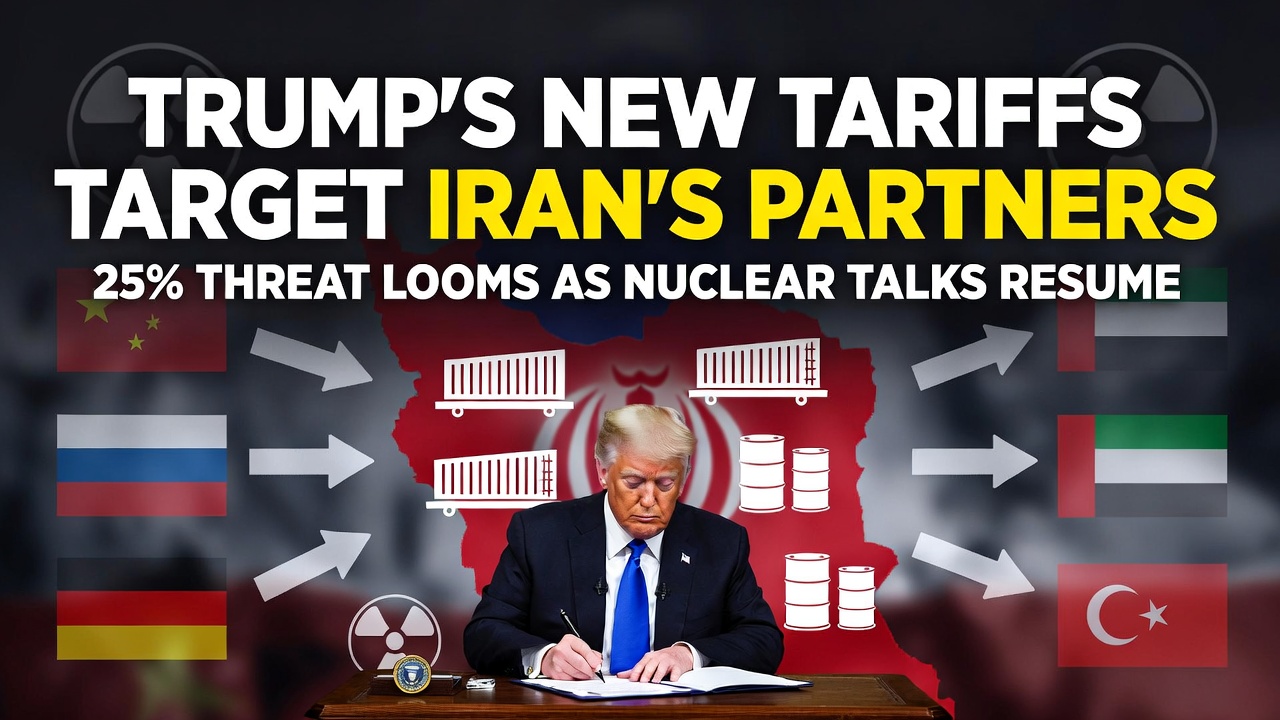
The framework for sweeping trade penalties arrives amid diplomatic overtures in Oman, raising questions about whether economic coercion can succeed where military pressure has failed
On February 6, 2026, President Donald Trump signed an executive order that could fundamentally reshape global trade architecture around Iran, establishing a legal framework to impose additional tariffs on any nation conducting commerce with the Islamic Republic. The order, which took effect February 7, represents the administration’s most ambitious attempt yet to weaponize America’s economic leverage against Tehran—while simultaneously opening a potential Pandora’s box of diplomatic and commercial complications for US allies and adversaries alike.
The timing is striking: Trump announced the measure even as American and Iranian officials engaged in indirect negotiations in Muscat, Oman—the first substantive dialogue since US involvement in coordinated strikes on Iranian nuclear facilities last June. Speaking to reporters aboard Air Force One en route to Mar-a-Lago, the president characterized the Oman talks as “very good” and indicated further sessions would occur “early next week,” suggesting the tariff framework may serve as both stick and carrot in a renewed campaign of maximum economic pressure.
Yet unlike Trump’s first-term sanctions regime, which primarily targeted Iran directly, this executive order casts a far wider net—one that could ensnare some of America’s most important economic and security partners.
The Mechanics of Secondary Economic Coercion
The executive order does not immediately impose tariffs. Instead, it reaffirms the national emergency declaration concerning Iran and establishes a bureaucratic process through which the Secretaries of State, Commerce, and Treasury can identify countries or entities “directly or indirectly” purchasing, importing, or acquiring goods and services from Iran. Once identified, those nations could face additional import duties—with Trump’s mid-January Truth Social post suggesting a 25% rate as the benchmark.
This framework represents secondary sanctions on steroids, extending beyond traditional financial restrictions to encompass broad trade penalties. The mechanism’s flexibility is both its power and its peril: administration officials retain discretionary authority over implementation, creating significant policy uncertainty for global businesses and governments alike.
The legal architecture builds on emergency powers Congress has granted presidents since the International Emergency Economic Powers Act of 1977, though legal scholars have increasingly questioned the constitutional boundaries of such delegated authority. Still, the Supreme Court has historically deferred to executive discretion in foreign commerce matters, particularly those framed as national security imperatives.
Who Stands in the Crosshairs?
The list of potential targets reads like a roster of the world’s largest economies and most strategically significant nations. China tops the list as Iran’s primary trading partner, with bilateral commerce reaching approximately $32.5 billion in 2024 according to World Trade Organization data—driven predominantly by Chinese oil imports that have sustained Iran’s economy despite Western sanctions.
Beijing’s response will prove critical. Chinese officials have consistently maintained that their economic relationship with Iran complies with international law, and Foreign Ministry spokesperson statements have repeatedly asserted China’s right to conduct “normal trade and economic cooperation.” A 25% tariff on Chinese goods entering the United States—even if selectively applied—would represent a dramatic escalation beyond the Trump administration’s existing tariff regime, potentially triggering retaliatory measures that could spiral into a broader economic confrontation.
The European Union faces its own dilemma. Germany, despite scaling back relations with Tehran, maintains residual trade ties, while several member states have worked to preserve economic channels even under US sanctions pressure. Brussels has historically resisted American extraterritorial sanctions applications, viewing them as violations of international law and European sovereignty. The Trump administration’s approach threatens to force a choice between transatlantic alliance cohesion and principles of trade autonomy.
Turkey presents perhaps the most acute diplomatic complication. As a NATO ally hosting crucial American military installations, Ankara has nevertheless maintained pragmatic economic relations with Iran, driven by geography, energy needs, and President Recep Tayyip Erdoğan’s regional ambitions. Penalizing Turkish trade could undermine alliance cooperation at a moment when NATO faces multiple security challenges from the Black Sea to the Eastern Mediterranean.
The United Arab Emirates occupies equally complex terrain. Despite Abraham Accords normalization with Israel and close security cooperation with Washington, Dubai’s business community has long served as a critical commercial hub for Iranian entities seeking to circumvent sanctions. Abu Dhabi has walked a careful line between American security partnership and regional economic pragmatism—a balancing act this executive order could render untenable.
India, the world’s fastest-growing major economy and an increasingly important US strategic partner in Indo-Pacific competition with China, imports significant Iranian oil when sanctions waivers permit. New Delhi has historically resisted choosing between Washington and Tehran, instead pursuing its national interests through strategic autonomy. Secondary tariffs could test that doctrine’s limits.
Even Russia, already heavily sanctioned over Ukraine, conducts substantial commerce with Iran, including reported arms transfers and energy cooperation. While Moscow has limited vulnerability to additional US trade penalties given existing restrictions, the executive order signals Washington’s willingness to treat the Russia-Iran partnership as an integrated strategic threat.
Economic Ripple Effects and Market Uncertainties
The global economic implications extend well beyond bilateral trade balances. Iran remains a significant oil producer despite sanctions, with exports estimated between 1.5 and 2 million barrels daily—much of it flowing to China through opaque channels. Any disruption to these flows, whether through enhanced enforcement or preemptive cutbacks by nervous buyers, could tighten global energy markets already navigating geopolitical volatility from Ukraine to the South China Sea.
Energy analysts at several investment banks have noted that Brent crude futures showed modest upticks following the executive order’s announcement, reflecting trader concerns about supply disruption risks. While global oil markets currently show adequate spare capacity, the psychological impact of threatening major importers like China could introduce new price volatility, particularly if Beijing responds by accelerating strategic petroleum reserve accumulation or seeking alternative suppliers at premium prices.
Supply chain vulnerabilities present another concern. Many products imported to the United States contain components manufactured in countries that trade with Iran, even if final assembly occurs elsewhere. The “directly or indirectly” language in the executive order creates ambiguity: Would a German automotive manufacturer sourcing steel from a company that also sells to Iranian clients face penalties? The lack of clarity generates compliance nightmares for multinational corporations and could trigger preemptive supply chain reorganizations with associated costs and inefficiencies.
For American consumers, secondary tariffs risk compounding inflation pressures. The US imports substantial volumes from China, the EU, Turkey, and other potential targets. Even selectively applied 25% duties would likely translate to higher retail prices for electronics, automobiles, textiles, and other goods—an awkward political reality for an administration that has emphasized economic strength as a signature achievement.
Diplomatic Calculations and the Oman Talks
The executive order’s announcement concurrent with renewed nuclear negotiations raises fundamental questions about the administration’s strategic theory. Is economic coercion meant to pressure Tehran toward concessions at the negotiating table? Or does it reflect skepticism about diplomacy’s prospects, with commercial warfare pursued as a parallel track?
Historical precedent offers mixed lessons. Trump’s first-term “maximum pressure” campaign succeeded in devastating Iran’s economy—GDP contracted roughly 13% between 2017 and 2020—but failed to produce the comprehensive nuclear agreement the administration sought. Instead, Tehran responded by expanding its nuclear program beyond Joint Comprehensive Plan of Action (JCPOA) limits, enriching uranium to near-weapons-grade levels and accumulating substantial stockpiles.
The June 2025 strikes on Iranian nuclear facilities, in which the United States reportedly provided intelligence and logistical support to regional partners, marked a dramatic escalation beyond economic pressure. Yet six months later, with Iran’s program damaged but not eliminated and regional tensions simmering, both sides appear willing to explore diplomatic off-ramps.
The Muscat talks—hosted by Oman, which has long served as a discreet intermediary between Washington and Tehran—represent the most serious engagement since the strike operations. While details remain closely held, informed observers suggest discussions focus on verifiable constraints on Iran’s nuclear program in exchange for sanctions relief and security assurances.
Into this delicate diplomatic dance, the tariff executive order injects significant complexity. Iranian officials have historically viewed economic pressure as evidence of American bad faith, arguing that Washington uses sanctions to pursue regime change rather than genuine policy modification. The timing could reinforce hardline narratives within Tehran’s political establishment, potentially strengthening voices skeptical of negotiation.
Conversely, the administration likely calculates that threatening third-party trade partners demonstrates resolve and raises the costs of Iranian intransigence, potentially accelerating Tehran’s timeline for concessions. The theory holds that fear of economic isolation—not just for Iran but for its vital commercial partners—creates additional pressure channels unavailable through direct bilateral sanctions alone.
Whether this strategy succeeds depends substantially on execution. Measured application targeting specific sectors or entities might preserve diplomatic space while signaling seriousness. Sweeping implementation against major economies would likely trigger defensive responses that harden positions rather than facilitate compromise.
Alliance Strains and the Broader Strategic Context
Beyond immediate Iran policy, the executive order raises fundamental questions about American alliance management and the sustainability of unilateral economic statecraft. European officials have long complained that US extraterritorial sanctions force compliance with American foreign policy preferences or exclusion from dollar-denominated finance and US markets—a choice they view as coercive and corrosive to transatlantic partnership.
The executive order arrives amid broader tensions over trade policy. Trump has threatened or imposed tariffs on numerous partners over issues ranging from steel production to digital services taxes, treating commerce as a primary tool of geopolitical influence. While this approach enjoys domestic political support, it risks accelerating efforts by allies and competitors alike to reduce dependence on US-dominated financial and commercial systems.
China has invested heavily in payment systems alternatives to SWIFT, Yuan-denominated oil contracts, and bilateral trade arrangements that bypass dollar settlement. Russia has pursued similar de-dollarization strategies. The threat of tariffs on Iran trade could provide additional impetus for developing economies to participate in these alternative frameworks, potentially eroding American economic leverage over the long term.
For regional Middle Eastern partners, the executive order creates difficult choices. The UAE and Saudi Arabia have sought to position themselves as indispensable US security partners while maintaining economic flexibility to pursue national interests, including periodic accommodation with Iran. Forcing stark binary choices risks either alienating partners who resist or creating dependencies that reduce their regional influence.
What Happens Next: The Week Ahead and Beyond
President Trump’s indication that further talks would occur “early next week” suggests the diplomatic track remains active despite economic saber-rattling. The proximity of these events—executive order signing and continued negotiations—may be deliberate sequencing: establish the framework for enhanced pressure while leaving actual implementation as a negotiating variable.
Several scenarios merit consideration. First, negotiations could produce preliminary agreements on nuclear monitoring or enrichment caps, with the United States agreeing to delay or limit tariff implementation as a reciprocal confidence-building measure. This would represent classic coercive diplomacy—threatening pain to secure concessions, then withholding implementation as reward for cooperation.
Second, talks could stall over verification mechanisms or sanctions relief sequencing, leading the administration to begin designating countries for tariffs—likely starting with smaller players rather than China or major European economies, testing international reaction before escalating further.
Third, external events could overtake both negotiation and tariff tracks. Iran’s domestic political calendar, potential Israeli actions, or regional proxy conflicts could shift calculations rapidly, either accelerating diplomatic urgency or rendering negotiations moot.
For global markets and policymakers, the executive order injects substantial uncertainty into an already complex geopolitical environment. Businesses engaged in Iran trade face pressure to demonstrate compliance or risk US market access. Governments must calibrate responses that balance sovereignty principles against economic interests. And all parties must navigate an administration that has demonstrated willingness to rapidly shift tactical approaches while pursuing strategic objectives.
The ultimate question remains whether economic coercion of this scale and scope can achieve outcomes that previous approaches—direct sanctions, military pressure, and diplomatic isolation—have not. History suggests that while economic pressure can inflict costs, translating those costs into desired policy changes requires adversaries to perceive acceptable off-ramps and negotiating partners to maintain credibility through consistent implementation.
As talks resume in Oman this week, the world will watch not only what occurs in closed-door negotiating sessions but also how the Trump administration wields—or restrains—the expansive economic weapon it has just forged. The answer will shape not only the Iranian nuclear issue but the broader international order’s trajectory in an age of renewed great power competition and economic nationalism.
Discover more from The Economy
Subscribe to get the latest posts sent to your email.


A new Reuters poll shows 90% of economists expect the BoE to hold rates at 3.75% for the rest of 2026 — up from 83% last month. Here’s why the consensus hardened.
The Bank of England looks set to sit tight for the rest of 2026, and the consensus behind that view is getting stronger, not weaker. Per Investing.com’s coverage of the Reuters poll, the Bank will leave rates unchanged at 3.75% for the rest of the year according to a strong majority of economists, who have held that view since the war began in late February. Nearly 90% — 56 of 64 respondents — now expect no change through year-end, up from 83% last month, with six expecting a hike and two a cut; no one in the poll, conducted August 13–18, expects a September move.
Key Takeaways
- A Reuters poll of 64 economists (Aug 13–18) shows 56 now expect the BoE to hold Bank Rate at 3.75% through year-end — 90%, up from 83% last month.
- No economist in the poll expects a rate change at the September MPC meeting.
- The consensus has held since the US-Israeli war on Iran began in late February, with little evidence yet of energy-price spillover into the broader economy.
- Markets remain slightly more hawkish than economists, still pricing some chance of a rise by year-end.
- The BoE’s own guidance flags rising Q3/Q4 inflation risk tied specifically to Middle East energy prices.
The consensus is driven less by domestic demand and more by an external variable the Bank has flagged repeatedly. Per the same Reuters poll coverage, the UK economy has stayed mostly resilient since the war began, with little evidence of energy-price spillover into the broader economy — giving the Bank room to stay on the sidelines.
That resilience is fragile by the Bank’s own admission. According to an August 2026 review from Hanbury Wealth, the MPC voted six-to-three at its July 30 meeting to hold at 3.75%, with policymakers signaling rates could rise if Middle East-linked inflationary pressure intensifies; Governor Andrew Bailey said inflation had fallen faster than expected, but the conflict continues to mean high and volatile energy prices that will push inflation back up later in the year. The Bank’s own trajectory reflects this: per the House of Commons Library’s inflation briefing, based on mid-June energy pricing, the Bank projected CPI at “a little under 3%” in Q3 2026 and “a little over 3¼%” in Q4 — a downgrade from its April forecast.
There’s a genuine two-sided risk the poll’s headline framing tends to flatten. On the downside for inflation, the same House of Commons briefing notes that if Middle East energy disruption proves short-lived and oil and gas prices decline, inflation could instead fall from a September 2026 peak toward the Bank’s 2% target by Q2 2027. On the upside risk, HSBC UK economist Elizabeth Martins told Reuters (via Investing.com) that “a big rebound in energy prices would certainly change things.”
Markets aren’t as settled as the economist consensus: per the same poll coverage, financial markets are still pricing in one quarter-point rate rise by year-end — a genuine gap between what economists expect and what traders are hedging against, reported by outlets as two separate data points rather than connected explicitly.
Underlying data support a “resilient but fragile” framing. A KPMG-cited economic overview from Opus Business Advisory Group shows GDP grew 0.7% in the three months to May, slightly down from 0.8% in April, while core inflation fell more than expected in the twelve months to June, reaching its lowest rate since March 2025 — evidence the disinflation trend independent of energy hasn’t reversed. Separately, the House of Commons Library data shows food price inflation eased to 1.7% in June, its lowest since August 2024, reinforcing that the risk is concentrated in energy rather than broad-based prices.
Why It Matters
For borrowers, a prolonged hold at 3.75% keeps mortgage costs elevated relative to sharper-cut scenarios floated earlier in the year. For savers, it sustains relatively attractive cash returns. For the government, Opus’s review notes Prime Minister Andy Burnham has pledged a £2 bus-fare cap and removal of VAT from household electricity bills from October while maintaining existing fiscal rules and avoiding tax rises — a combination that gets harder to fund if borrowing costs stay elevated through year-end.
Data and Evidence
- Bank Rate: held at 3.75% since the July 30 MPC vote (6-3)
- Reuters poll: 56 of 64 economists (90%) expect no change through year-end, up from 83% last month
- BoE inflation forecast: ~3% Q3 2026, ~3.25%+ Q4 2026
- GDP growth: 0.7% in the three months to May 2026
- Food inflation: 1.7% in June 2026, lowest since August 2024
Global Impact
A UK central bank holding firm against energy-driven inflation risk is a data point other energy-importing economies — including Pakistan and much of South and Southeast Asia — are watching as a template for treating Middle East-linked price shocks as transitory.
What Happens Next
The next live decision point is the September MPC meeting, where the poll shows unanimous expectation of no change. The Q3/Q4 inflation prints will show whether the Bank’s own ~3.25% forecast materializes — and whether the hold consensus survives contact with that data.
Frequently Asked Questions
What is the UK’s current interest rate?
3.75%, unchanged since July 30, 2026.
Why isn’t the BoE cutting further?
Concern that Middle East-driven energy prices could push inflation back up in H2 2026.
Will UK mortgage rates change soon?
Based on the current poll, no near-term move is expected.
What would change the outlook?
A significant rebound — or further de-escalation — in Middle East energy prices.
Do markets agree with economists?
Not entirely — traders still price some chance of a year-end rate rise.
Discover more from The Economy
Subscribe to get the latest posts sent to your email.
Pakistan is running two demanding reform programs at once, and they don’t obviously fit together. On one track, the IMF is pressing for stricter fiscal controls, expanded tax collection, and continued tight monetary policy under its Extended Fund Facility. On the other, Pakistan’s own constitution now mandates the removal of “riba” — interest — from the economy entirely, with a deadline set for January 2028, following a constitutional amendment passed in October 2024, according to IMF Country Report 25/109.
The IMF’s side of the ledger
Pakistan’s economic recovery gained real momentum in the first half of FY26, with GDP growth averaging 3.8% year-on-year, driven by the auto, construction, and garment industries, even as flooding in July-August weighed on output, according to IMF staff reporting. Inflation, however, climbed to 7.3% year-on-year in March as higher global commodity prices passed through to domestic energy costs. Foreign reserves have been rebuilding steadily — from $14.5 billion at end-June 2025 to $16 billion by end-December — while the primary fiscal surplus is expected to reach 1.6% of GDP in FY26, in line with IMF targets.
In May 2026, the IMF Executive Board completed the third review of Pakistan’s Extended Fund Facility and second review of its Resilience and Sustainability Facility, unlocking roughly $1.1 billion and $220 million respectively and bringing total disbursements under the two programs to about $4.8 billion, according to the IMF’s official press release. The Fund explicitly credited Pakistan’s “strong implementation” for maintaining stability despite the disruption from the Middle East war.
The parallel Islamic finance transformation
Running alongside that fiscal program is a structural transformation few outside Pakistan are tracking closely: the State Bank of Pakistan is required to develop a full financial sector strategy detailing the legal, regulatory, and strategic path to a riba-free economy, addressing monetary policy implementation, public debt management, and bank supervision — with a strategy deadline the IMF set for end-June 2026, per the same country report. Parliament has already moved on a related front, approving the Virtual Assets Bill in March 2026 and formally establishing the Pakistan Virtual Assets Regulatory Authority.
Why the IMF is watching this transition warily
The IMF’s own language signals concern about execution risk: publishing the riba-free transition plan “will help align the expectations of market participants, investors, and regulators… and mitigate concerns about any possible cliff effect,” according to the country report language. That is diplomatic phrasing for a real structural risk — an abrupt, poorly sequenced transition away from conventional interest-based finance could destabilize a banking sector the IMF has spent years helping stabilize.
The tax reform Pakistan still owes
Beyond monetary policy, Pakistan has committed to finalizing a new audit manual and centralizing taxpayer audit selection by August 2026, accelerating its Retailer Tax Registration Scheme, and making its Tax Policy Office fully operational, according to ProPakistani’s summary of IMF commitments. The Federal Board of Revenue has continued missing collection targets, prompting the IMF to propose making FBR revenue goals a formal Quantitative Performance Criteria — a stricter enforcement mechanism than before.
Why this matters for Gulf and global investors
Pakistan’s dual reform track — IMF-style fiscal orthodoxy alongside a constitutionally mandated Islamic finance transition — is unusual among IMF program countries and is drawing renewed Gulf capital interest, visible in DIFC’s decision to bring its Dubai FinTech Summit to Pakistan for the first time in August 2026 (see our companion report). Investors assessing Pakistan’s banking sector need to model both trajectories simultaneously, not just the more familiar IMF fiscal metrics.
Discover more from The Economy
Subscribe to get the latest posts sent to your email.

Singapore’s non-oil domestic exports rose 20.7% year-on-year in June 2026, driven by a 115.4% surge in integrated circuit shipments tied to AI demand, even as a separate and less-covered trade story unfolds next door: Malaysia-Indonesia bilateral trade is projected to grow 10% to US$29.3 billion in 2026, powered by expanding halal-sector cooperation.
The story most coverage is missing
Regional business press has extensively covered Singapore’s semiconductor export boom. What’s had far less coverage is the parallel, non-tech growth engine developing in the halal trade corridor between Malaysia and Indonesia — a structural, policy-driven trade relationship that is scaling steadily even as the AI trade headlines dominate attention.
Singapore: the AI supply chain’s export barometer
Singapore’s June non-oil domestic exports climbed 20.7% year-on-year, with integrated circuit exports jumping 115.4% and disk media products and personal computers rising 170.9% and 95.8% respectively — a direct read on how deeply the AI infrastructure buildout is flowing through the city-state’s electronics trade (VietnamPlus/VNA). Non-electronic exports told a different story, falling 2.9% in June after a 17.7% rise in May, mainly on weaker shipments of non-monetary gold, petrochemicals and food preparations — evidence the export strength is narrowly concentrated in the AI-linked segment rather than broad-based.
Singapore’s economic gravitational pull on its neighbours is intensifying too: a joint study by the Singapore Business Federation, Restaurant Association of Singapore and Singapore Retailers Association found Singaporean consumers are projected to spend an additional S$1.05 billion (roughly US$810 million) annually in Johor Bahru, just across the Malaysian border — a cross-border consumption pattern that is becoming a meaningful line item in regional retail planning (VietnamPlus/VNA).
The halal corridor: a steadier, policy-built growth story
While AI exports grab headlines, Malaysia’s bilateral trade with Indonesia is forecast to grow 10% to US$29.3 billion in 2026, according to Malaysia’s Chargé d’Affaires in Jakarta, Farzamie Sarkawi — up from US$26.61 billion in 2025, itself a 5.3% increase on the year before (BusinessToday Malaysia).
The driver is structural rather than cyclical: a halal Memorandum of Cooperation signed by the two countries in 2023 established mutual recognition of halal certification, easing product movement and market access across sectors. Sarkawi described the arrangement as delivering “positive progress” through knowledge exchange, training and improved market access for businesses in both countries (BusinessToday Malaysia). The ambition extends beyond the bilateral relationship: intra-D-8 trade — spanning the eight-nation Developing 8 bloc of Muslim-majority economies — currently runs between US$150 billion and US$160 billion annually, with a stated target of US$500 billion by 2030.
The macro backdrop: a region growing, unevenly
The Asian Development Bank’s July 2026 outlook shows Indonesia’s growth forecast holding steady at 5.2% for both 2026 and 2027, while Malaysia’s outlook is unchanged at 4.6% for 2026 and 4.5% for 2027 (ADB). Regional growth leadership, per McKinsey’s Q1 2026 review, sits with Indonesia, Singapore and Vietnam, while the Philippines lagged as domestic challenges weighed on activity (McKinsey).
Indonesia’s investment story has particular momentum: foreign direct investment grew for a second consecutive quarter, rising 8.1% to 249.9 trillion rupiah (roughly US$14.5 billion) in the first quarter of 2026, with Singapore remaining Indonesia’s largest single foreign investor at US$4.6 billion, ahead of China, Japan, Hong Kong and the United States (McKinsey). Realised investment for full-year 2025 reached a record Rp1,931.2 trillion (about US$120.7 billion), exceeding the government’s own target, driven by downstream industrial projects outside Java (BERNAMA).
Indonesia’s central bank has flagged currency management as an active watch item, signalling readiness to step up both onshore and offshore FX intervention to curb rupiah weakness and keep inflation within its 2026-2027 target band (McKinsey). Foreign investment in Indonesian government bonds has nonetheless rebounded, with net inflows of 17.7 trillion rupiah following outflows in the first quarter, alongside cumulative foreign holdings of 174 trillion rupiah in Bank Indonesia Rupiah Securities (BERNAMA).
Institutional context: Singapore’s coming ASEAN chairmanship
Adding a governance dimension to the economic picture, Singapore is set to take over the ASEAN chairmanship from the Philippines in 2027, with Prime Minister Lawrence Wong pledging a smooth transition — a leadership handover that will shape how the bloc coordinates trade and investment policy, including the halal-corridor and semiconductor-trade dynamics described above, through the second half of the decade (BERNAMA).
The bottom line
Southeast Asia’s 2026 growth story is not a single narrative but two distinct, converging tracks: a high-velocity, AI-linked export boom concentrated in Singapore’s electronics trade, and a steadier, policy-engineered halal-sector trade corridor between Malaysia and Indonesia that is quietly scaling toward a $500 billion bloc-wide target by 2030. Investors and policymakers tracking only the semiconductor headlines risk missing the second, structurally more durable growth engine sitting right alongside it.
Discover more from The Economy
Subscribe to get the latest posts sent to your email.

Silver Price Today: Why the Xi-Trump AI Standoff Is Fueling a Safe-Haven Rally

Citibank & Dólar Estadounidense: Forex Playbook After the Xi-Trump Truce

How the Trump-Xi White House Summit Is Reshaping Mortgage Rates Today for Real Estate Investors

Indonesia Navigates Mega-Project Risks as China and Russia Eye the 2,772km Trans-Kalimantan Railway

Trump-Xi 2026 Summit Takeaways: The Trade Truce, Taiwan, and the AI Divide

Solar Panel Installation Cost in 2026: Why the Math Changed Overnight

Business Insurance: What Coverage You Actually Need and What It Costs in 2026

Auto Insurance Quotes: How to Get the Lowest Rate Without Losing Coverage

Huntington Online Banking: Full Features, Fees, and How It Compares in 2026

Apply for a Bank Account Online: What You Need and How Long It Actually Takes

World’s Largest Economies: Ranking the Top Global Powers

Business Loan: A Complete 2026 Guide to Rates, Types, and Qualifying

Fast Invoice Factoring: How to Turn Unpaid Invoices Into Cash Within 24 Hours

Investment Banking Services: What They Cost and How to Choose the Right Firm in 2026

Top 30 Stocks for Investment in PSX for Massive ROI in 2026

SpaceX Starship Flight 14: First Orbital Attempt & Starlink V3 Launch Explained

Oil Prices Break $100 in 2026: Middle East Conflict & Energy Markets

BRICS+ Cross-Border Payments 2026: Interoperability Explained

AI Chip Stocks 2026: The Best Semiconductor Investments Beyond Marvell

Fidelity Investments Review 2026: SPAXX Yields & Zero-Fee Funds

Tween Back-to-School Trends 2026: What’s Driving the $85B Season

10-Year Treasury Yield Hits 4.80%: What It Means for Rates & Portfolios

Shein Clothes Quality & Safety in 2026: What Lab Tests Show

China’s US$10.8 Billion Trade Shortcut: Why the Pinglu Canal Matters

MRVL Earnings 2026: Why Marvell Sank Despite Beating Estimates

IMF & World Bank 2026 Global Economic Outlook: Growth, Inflation, Debt

High-CPM Finance Niches 2026: Publisher Monetization Blueprint

Middle East War Economics 2026: Oil Prices & Energy Markets
-

 Markets & Finance9 months ago
Top 15 Stocks for Investment in 2026 in PSX: Your Complete Guide to Pakistan’s Best Investment Opportunities
-

 Analysis7 months ago
Johor’s Investment Boom: The Hidden Costs Behind Malaysia’s Most Ambitious Economic Surge
-

 Analysis7 months ago
Top 10 Stocks for Investment in PSX for Quick Returns in 2026
-

 Banks8 months ago
Best Investments in Pakistan 2026: Top 10 Low-Price Shares and Long-Term Picks for the PSX
-

 Analysis8 months ago
Brazil’s Rare Earth Race: US, EU, and China Compete for Critical Minerals as Tensions Rise
-

 Investment9 months ago
Top 10 Mutual Fund Managers in Pakistan for Investment in 2026: A Comprehensive Guide for Optimal Returns
-

 Global Economy9 months ago
15 Most Lucrative Sectors for Investment in Pakistan: A 2025 Data-Driven Analysis
-

 Global Economy9 months ago
Pakistan’s Export Goldmine: 10 Game-Changing Markets Where Pakistani Businesses Are Winning Big in 2025