Connect with us

Analysis

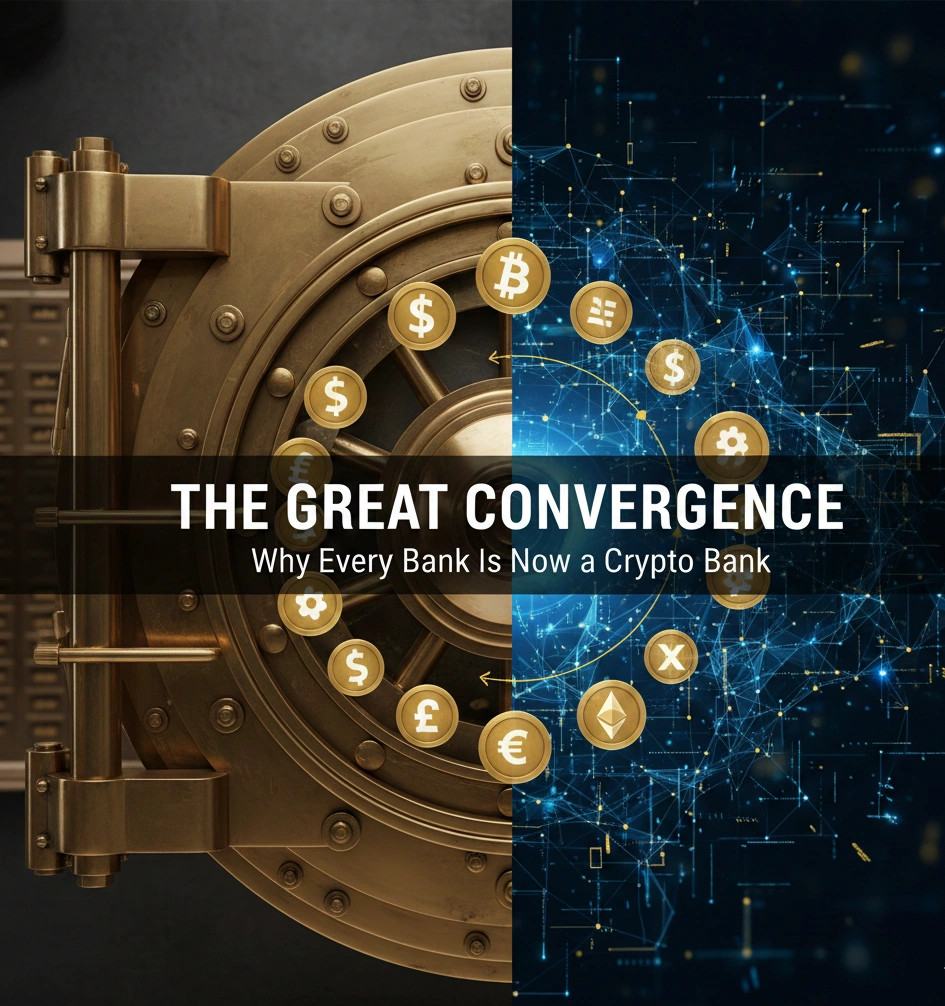
The Great Convergence: Why VASP Governance is the New Frontier of Prudential Risk

Published

on

If you think your bank isn’t a crypto bank, look closer at your wire transfers. In 2026, every institution is a digital asset institution—whether they want to be or not.

The marriage certificate arrived quietly. No fanfare, no regulatory press conference—just a series of accounting bulletins, cross-border payment upgrades, and custody announcements that, taken together, signaled something profound: traditional finance and digital assets are no longer dating. They’re cohabiting, sharing infrastructure, and—most critically—sharing risk.

For decades, banks treated cryptocurrency as someone else’s problem. A libertarian sideshow. A compliance headache best avoided. Yet by early 2026, the invisible rails connecting Wall Street to Web3 have become impossible to ignore. Tokenized Treasury bills flow through the same clearing systems as sovereign debt. Stablecoin settlements undergird cross-border trade finance. And when a poorly governed Virtual Asset Service Provider (VASP) collapses in Singapore, the contagion doesn’t stay in crypto—it ripples through correspondent banking networks from London to São Paulo.

Welcome to the era of institutional crypto compliance 2026: where prudential risk and digital asset governance are no longer separate disciplines, but two sides of the same regulatory coin.

The Invisible Integration: How Banks Became Crypto Banks

The transformation happened in layers, each one barely perceptible until the whole edifice shifted.

Layer One: The Custody Revolution
When the SEC issued Staff Accounting Bulletin 122 (SAB 122) in late 2023, reversing its earlier SAB 121 guidance, it eliminated a bizarre accounting penalty: banks could finally custody crypto assets without being forced to recognize them as liabilities on their balance sheets. The impact was seismic. Within eighteen months, institutions from BNY Mellon to State Street launched digital asset custody desks. By 2026, custodial crypto holdings at traditional financial institutions exceed $400 billion globally, according to PwC’s Global Crypto Report 2026.

Layer Two: Tokenized Instruments
The second layer arrived through tokenization—not of meme coins, but of mundane financial instruments. BlackRock’s BUIDL fund, launched in 2024, now holds over $1.5 billion in tokenized U.S. Treasuries. Franklin Templeton’s OnChain U.S. Government Money Fund processes settlements on Polygon and Stellar. These aren’t experiments; they’re operational infrastructure. And they’re governed not by DeFi protocols, but by the same prudential frameworks that regulate money market funds—with one crucial difference: the settlement rails involve VASPs.

Layer Three: The Stablecoin Settlement Web
Perhaps most invisibly, stablecoins have become the grease in international trade. A garment manufacturer in Bangladesh receiving payment from a retailer in Texas might never touch USDC directly—but their banks do. Cross-border wire transfers increasingly route through stablecoin rails for speed and cost efficiency, a practice turbocharged by the U.S. GENIUS Act’s regulatory clarity on dollar-backed tokens. The Bank for International Settlements estimates that by Q1 2026, stablecoin-mediated settlements account for 12% of cross-border commercial payments between non-sanctioned jurisdictions.

The implication? Every correspondent bank is now, functionally, exposed to VASP inherent risk assessment questions—even if they’ve never onboarded a single crypto-native client.

From Financial Crime to Prudential Stability: The Risk Paradigm Shift

For years, the regulatory conversation around crypto centered on anti-money laundering (AML) and combating the financing of terrorism (CFT). The Financial Action Task Force’s Travel Rule for VASPs was the regulatory pinnacle: ensure that virtual asset transfers carry the same identifying information as traditional wire transfers.

But 2026 marks a pivot. The new frontier isn’t just crime prevention—it’s prudential risk digital assets introduce to the financial system at large.

Liquidity Risk in Disguise
When a major VASP experiences a bank run—say, due to rumors about reserve adequacy—institutional clients don’t just lose access to crypto. They lose access to fiat liquidity channels. In March 2026, a Tier-2 VASP in the UAE faced withdrawal freezes after a smart contract exploit. Within 48 hours, three European banks flagged delayed settlements on tokenized asset redemptions. The Basel Committee on Banking Supervision is now drafting guidance that treats VASP counterparty exposure with the same capital weighting traditionally reserved for emerging market sovereign debt.

Operational Resilience Concerns
Unlike traditional banks, many VASPs operate on semi-decentralized infrastructure. A compromise in a widely used wallet-as-a-service provider doesn’t just affect retail users—it affects institutional treasuries holding tokenized assets. The European Banking Authority’s 2026 stress-testing framework now includes “VASP operational failure” scenarios alongside traditional market shocks.

Settlement Finality Ambiguity
Here’s the kicker: when does a blockchain transaction achieve legal finality? Six confirmations? Twelve? What if there’s a chain reorganization? Traditional finance has spent centuries perfecting settlement finality through legal frameworks. Digital assets introduce computational finality—and the two don’t always align. This isn’t theoretical. In January 2026, a deep chain reorg on a proof-of-stake network invalidated what institutional traders believed were settled positions, triggering margin calls that propagated through connected prime brokers.

The Regulatory Armory: MiCA, AMLA, and the GENIUS Act

Regulators haven’t been asleep. The twin pillars of Europe’s crypto regulation—the Markets in Crypto-Assets Regulation (MiCA) and the Anti-Money Laundering Authority (AMLA)—reached full implementation by January 2026. MiCA establishes authorization regimes, capital requirements, and investor protections for VASPs operating in the EU. AMLA provides direct supervisory oversight, breaking the previous patchwork of national regulators.

Across the Atlantic, the GENIUS Act (Guiding and Establishing National Innovation for U.S. Stablecoins) brought federal clarity to stablecoin issuance, requiring reserves be held in high-quality liquid assets and subject to monthly attestations. The result? A proliferation of compliant, bank-grade stablecoins—and an extinction event for shadowy offshore issuers.

Yet despite these advances, a governance gap remains. VASP risk assessment frameworks are maturing, but they’re not standardized. A VASP might pass muster under Singapore’s MAS licensing yet fail basic operational resilience tests under EU standards. For banks with global custody operations, this creates a compliance Rubik’s Cube: which jurisdiction’s standards take precedence when a VASP serves clients in twelve countries?

The VASP Governance Frontier: What Best Practice Looks Like

Leading institutions are getting ahead of the curve by treating VASP relationships with the same rigor they apply to critical outsourcing partners.

Tiered Due Diligence
BNY Mellon’s digital asset unit reportedly maintains a three-tier classification for VASP counterparties:

  • Tier 1: VASPs with bank-grade governance, external audits, and regulatory licenses in major jurisdictions.
  • Tier 2: Emerging VASPs with solid infrastructure but limited regulatory history.
  • Tier 3: Prohibited—VASPs operating in high-risk jurisdictions or with opaque ownership structures.

Real-Time Monitoring
JPMorgan’s Onyx division employs blockchain analytics not just for transaction screening, but for monitoring VASP reserves in real-time. If a VASP’s on-chain reserve ratio falls below thresholds, automated alerts trigger relationship reviews. This represents a paradigm shift: from periodic due diligence to continuous risk assessment.

Contractual Innovations
Legal teams are embedding digital-asset-specific terms into custody agreements. What happens if a hard fork creates two competing versions of an asset? Who bears the risk of smart contract failure? Cutting-edge contracts now include “chain-split protocols” and “immutability warranties”—clauses that would have been science fiction in 2020.

Why This Matters Beyond Banking

The convergence of traditional prudential oversight and crypto-native governance isn’t just a banking story—it’s a story about the architecture of 21st-century finance.

Consider supply chain finance. A multinational’s treasury desk tokenizes receivables, making them tradable on secondary markets via a licensed VASP. If that VASP lacks robust operational controls, the multinational’s working capital liquidity becomes hostage to blockchain uptime. If regulators treat this as equivalent to traditional securitization risk, capital requirements shift. If they don’t, systemic vulnerabilities emerge.

Or consider central bank digital currencies (CBDCs). As sovereigns experiment with digital cash, they’re partnering with—you guessed it—VASPs and banks to build distribution infrastructure. The People’s Bank of China’s e-CNY relies on commercial banks as intermediaries. The European Central Bank’s digital euro pilots involve both banks and supervised VASPs. Prudential oversight of these entities isn’t a nice-to-have; it’s foundational to monetary sovereignty.

The Path Forward: Integration, Not Isolation

The lesson of 2026 is clear: institutional crypto compliance isn’t about building moats between traditional finance and digital assets. It’s about building bridges—secure, well-governed, auditable bridges.

Financial institutions that treat VASP relationships as afterthoughts will find themselves exposed to risks they don’t fully understand. Those that embed tokenized asset governance into their enterprise risk frameworks—treating it as seriously as credit risk or market risk—will be positioned to capture the efficiencies digital infrastructure offers without courting catastrophe.

The great convergence is here. The question isn’t whether your institution is a digital asset institution. It’s whether you’re governing it like one.


Discover more from The Economy

Subscribe to get the latest posts sent to your email.

Analysis

Project Vault: How America’s $1.3 Billion Bet on Pakistan’s Reko Diq Mine Challenges China’s Mineral Dominance

Published

on

A Strategic Analysis of Critical Minerals Geopolitics

It is a significant geopolitical maneuver that signals Washington’s intensifying competition with Beijing over critical mineral supplies, the United States Export-Import Bank (EXIM) has committed up to $1.3 billion in financing for Pakistan’s Reko Diq copper-gold mining project. Announced during the 2026 Critical Minerals Ministerial on February 4, this investment represents the sole international project within EXIM’s ambitious $10 billion ‘Project Vault’ initiative—a strategic reserve program designed to reshape global supply chains for materials essential to electric vehicles, artificial intelligence infrastructure, and advanced manufacturing.

The commitment, detailed in a US State Department fact sheet released February 4, 2026, places Pakistan’s flagship mineral development project at the center of a broader American strategy to counter China’s overwhelming dominance in critical minerals processing. With Beijing controlling over 90% of global refined rare earth output and commanding substantial market shares across copper, cobalt, and lithium supply chains, the Reko Diq financing underscores how resource diplomacy has become central to great power competition in an era of energy transition and digital transformation.

Project Vault: Establishing America’s Critical Minerals Reserve

Announced by President Donald Trump on February 2, 2026, Project Vault marks an unprecedented commitment to securing domestic and allied access to strategic minerals. The EXIM Board of Directors approved a direct loan of up to $10 billion—more than double the largest financing in the institution’s 90-year history—to establish the US Strategic Critical Minerals Reserve. This initiative aims to shield American manufacturers from supply disruptions, expand domestic production and processing capacity, and fundamentally strengthen the nation’s critical minerals sector.

The timing reflects mounting concerns over supply chain vulnerabilities exposed by pandemic-era disruptions and heightened geopolitical tensions. According to the State Department, EXIM’s critical minerals portfolio now encompasses $1.3 billion for Reko Diq alongside domestic investments including $27.4 million for 6K Additive in Pennsylvania (titanium and nickel production), $23.5 million for Amaero Advanced Materials in Tennessee, $15.9 million for Empire State Mines in New York (zinc operations), and $11.1 million for IperionX in Virginia (titanium processing).

More broadly, EXIM has issued approximately $14.8 billion in Letters of Interest for critical minerals projects under the current administration, spanning rare earth development in the United States ($455 million), lithium extraction in Arkansas ($400 million), cobalt and nickel production in Australia ($350 million), and tin extraction across the United Kingdom and Australia ($215 million). The US government estimates it has mobilized over $30 billion in commitments for critical minerals initiatives in recent months, with officials arguing these public investments are crowding in substantially larger private capital flows.

Reko Diq: One of the World’s Largest Undeveloped Deposits

Located in the Chagai district of Balochistan province near the borders with Iran and Afghanistan, Reko Diq represents one of the planet’s most substantial untapped copper-gold resources. According to Barrick Gold Corporation, the project operator holding a 50% stake, the deposit contains approximately 5.9 billion tonnes of ore grading 0.41% copper and 0.22 grams per tonne gold—translating to roughly 41.5 million ounces of gold reserves.

An updated feasibility study completed in March 2025 by Oil and Gas Development Company Limited (OGDCL), one of the Pakistani state partners, outlines a 37-year mine life divided into two phases. Phase 1, requiring an estimated capital outlay of $5.6 billion (excluding financing costs and inflation), is planned to process 45 million tonnes of mill feed annually beginning in 2028. Phase 2, targeted for 2034, would double processing capacity to 90 million tonnes per annum. Over the project’s lifetime, Reko Diq is expected to yield approximately 13.1 million tonnes of copper and 17.9 million ounces of gold on a 100% basis.

However, cost estimates have escalated significantly. Pakistan’s Economic Coordination Committee revised the Phase 1 total cost to $7.72 billion in September 2025—a 79% increase from initial projections—citing higher loan costs and inflation hedging measures. Barrick CEO Mark Bristow stated in January 2025 that Phase 1 would require approximately $5.5 billion in initial capital, with Phase 2 adding roughly $3 billion, bringing total project costs to potentially $8-10 billion across both phases.

Based on market prices of approximately $3,016 per ounce for gold and $9,815 per tonne for copper prevailing in early 2025, Pakistan’s Ministry of Petroleum estimated the total value of projected yields at over $60 billion, comprising roughly $54 billion in gold and $6 billion in copper. Barrick projects the mine will generate approximately $74 billion in free cash flow over 37 years at consensus long-term commodity prices.

Ownership Structure: A Model of Resource Partnership

The reconstituted Reko Diq project, finalized in December 2022 following resolution of a decade-long legal dispute, features a carefully structured ownership arrangement designed to balance commercial viability with equitable benefit sharing. Barrick Gold Corporation holds 50% and serves as operator. The remaining 50% is divided between Pakistani stakeholders: 25% held by the Government of Balochistan (15% on a fully funded basis through Balochistan Mineral Resources Limited, and 10% on a free carried basis), and 25% by three federal state-owned enterprises—OGDCL, Pakistan Petroleum Limited (PPL), and Government Holdings (Private) Limited (GHPL)—each holding 8.33%.

This structure reflects Barrick’s philosophy of partnership with host countries and communities. Critically, Balochistan’s entire 25% shareholding is fully funded by the federal government and Barrick, meaning the province will receive dividends, royalties, and other benefits without contributing financially to construction or operations. Barrick has committed approximately $70 million in social development programs during the feasibility and construction period, focusing on healthcare, education, vocational training, food security, and potable water provision. The company also advanced up to $50 million in royalties to Balochistan ahead of commercial production, ensuring communities begin benefiting before the mine operates.

Geopolitical Dimensions: Countering China’s Mineral Hegemony

The US investment in Reko Diq cannot be understood outside the context of intensifying Sino-American competition over critical minerals—materials the International Energy Agency projects will see demand multiply four- to six-fold by 2040 under climate scenarios limiting global warming to 2°C. China’s systematic acquisition and vertical integration of mineral supply chains over the past two decades has created dependencies that Washington views as strategic vulnerabilities, particularly for technologies underpinning military capabilities, renewable energy systems, and advanced computing.

Copper, in particular, sits at the nexus of these concerns. The metal is essential for electric vehicle production (averaging 80 kg per EV versus 20 kg for conventional vehicles), renewable energy infrastructure (wind turbines require up to 15 tonnes each), and data center expansion driven by artificial intelligence deployment. Global copper consumption is forecast to exceed 30 million tonnes annually by 2030—up from approximately 25 million tonnes in 2024—even as mining grades decline and new discoveries diminish.

Secretary of State Marco Rubio, alongside Vice President JD Vance and senior economic officials, framed the 2026 Critical Minerals Ministerial—which convened representatives from 54 countries—as part of an effort to ‘reshape the global market for critical minerals and rare earths.’ The explicit naming of China’s dominance in official statements reflects a strategic shift toward open acknowledgment of resource competition as a dimension of great power rivalry.

For Pakistan, the Reko Diq investment represents both opportunity and complexity. The country’s mineral sector currently contributes merely 3.2% to GDP, with exports accounting for just 0.1% of global totals—vastly underperforming relative to geological endowment. Balochistan hosts substantial unexplored areas along the Tethyan Metallogenic Belt, suggesting Reko Diq could catalyze broader sectoral development. However, the province has experienced persistent insurgency and security challenges, necessitating an estimated 5,000-strong security force for the project at substantial cost.

Production Timeline and Projected Economic Contribution

Construction activities at Reko Diq commenced in 2025 following approval of the updated feasibility study. Fluor Corporation was selected in October 2025 as lead Engineering, Procurement, and Construction Management (EPCM) partner, bringing experience from comparable projects including Chile’s Quebrada Blanca Phase 2. First commercial production is targeted for late 2028, with Phase 1 operations expected to yield approximately 200,000 tonnes of copper concentrate and 250,000 ounces of gold annually.

The project anticipates employing 7,500 workers during peak construction and creating 4,000 permanent positions once operational—substantial numbers for a region characterized by limited economic opportunities and high unemployment. Barrick prioritizes local hiring and has established vocational training centers in Quetta and Chagai to prepare residents for mining-related trades. The company projects that 30% of supplies will be sourced from Pakistani small and medium enterprises, potentially fostering ancillary industrial development.

For the US economy, the financing is expected to generate approximately $2 billion in American equipment exports, supporting manufacturing employment in sectors producing mining machinery, processing equipment, and specialized technologies. This export dimension aligns with EXIM’s core mandate of supporting American jobs through overseas project financing.

Pakistan’s government estimates Reko Diq could contribute $5-7 billion annually to national GDP once fully operational, representing a transformative impact for an economy with total GDP of approximately $350 billion. The project’s fiscal contributions—including royalties, taxes, and dividend distributions to state shareholders—could provide significant budgetary relief for a country that has repeatedly required International Monetary Fund assistance due to chronic external imbalances.

Financing Architecture: Multilateral Support and Project Finance

The $1.3 billion EXIM commitment forms part of a broader financing package structured to minimize sovereign risk while securing adequate capital for Phase 1 development. The project is pursuing limited-recourse project financing of up to $3 billion, with the remainder funded through shareholder equity contributions. OGDCL approved an increased funding commitment of $627 million in March 2025, representing its proportional share of total capital requirements.

Multilateral development institutions have signaled support. The International Finance Corporation (IFC) reportedly disbursed $300 million in April 2025 and an additional $700 million in June 2025, though these figures require independent verification. The Asian Development Bank approved $410 million in August 2025, with ADB President Masato Kanda characterizing the package as ‘a game-changer for Pakistan… underpinning the nation’s transition toward a more resilient and diversified economy.’

Additional international investor interest has emerged. Saudi Arabia’s Manara Minerals—a joint venture between state-controlled miner Ma’aden and the $925 billion Public Investment Fund—conducted due diligence visits in 2024 exploring a potential equity stake. Pakistani officials indicated in early 2025 that negotiations were progressing, with an investment expected within six months, though no formal announcement has materialized. Barrick has stated it would support governmental decisions regarding additional partners but will not dilute its own equity position.

Navigating Risks: Security, Infrastructure, and Environmental Concerns

Despite its economic promise, Reko Diq confronts multifaceted challenges that could affect timelines, costs, and social outcomes. Security considerations loom large in Balochistan, which has experienced separatist insurgency for decades. Armed groups have historically targeted resource extraction projects, viewing them as exploitative of provincial wealth. The necessity of maintaining a substantial security force adds ongoing operational expenses and creates reputational sensitivities.

Environmental and resource constraints present technical hurdles. The Chagai district’s arid climate necessitates a $500 million desalination plant to ensure adequate water supply for mining and processing operations. The Environmental and Social Impact Assessment (ESIA), approved by Pakistani authorities, mandates dry-stack tailings management to prevent groundwater contamination and biodiversity offset programs to protect the Chagai Desert ecosystem. Implementation costs and compliance monitoring will require sustained attention throughout the mine’s operational life.

Infrastructure deficits compound development complexity. The project requires construction of a 340-kilometer road connecting the mine site to Gwadar Port, alongside power transmission lines and supporting utilities. While these investments create lasting regional benefits, they increase upfront capital requirements and extend construction timelines.

Human rights and governance concerns have attracted scrutiny from international civil society organizations. Critics argue that without binding human rights conditions, transparency mechanisms, and independent monitoring, foreign financing risks enabling state practices that restrict democratic freedoms in Balochistan. Barrick has emphasized its commitment to responsible mining, transparent engagement, and adherence to international environmental and social safeguards, but ongoing vigilance will be required to ensure these standards are maintained.

Broader Implications for Global Mineral Markets

Reko Diq’s development occurs against a backdrop of structural transformation in commodity markets driven by decarbonization imperatives and technological evolution. The global energy transition from fossil fuels to renewable electricity and electric mobility creates unprecedented demand for copper, lithium, cobalt, nickel, and rare earth elements—collectively termed ‘energy transition minerals’ by analysts.

Yet new mine development has lagged demand growth, constrained by declining ore grades, permitting delays in established mining jurisdictions, underinvestment during the commodity downturn of 2014-2020, and heightened environmental and social requirements. The average time from discovery to production for major copper projects now exceeds 15 years. Reko Diq itself endured a decade-long legal hiatus following the 2011 license rejection, underscoring how political and regulatory uncertainty can stall even world-class deposits.

Successful delivery of Reko Diq by 2028-2029 would add meaningful supply to tight global markets at a critical juncture. With 200,000 tonnes of annual copper production in Phase 1—potentially doubling to 400,000 tonnes post-2034—the project would rank among the world’s top copper producers and contribute approximately 1-2% of global supply. This scale offers genuine diversification benefits for consuming nations seeking alternatives to concentrated sources.

For emerging market resource holders, Reko Diq’s ownership model and financing structure may serve as a template for attracting international investment while preserving national interests. The free-carried provincial stake, advance royalty payments, and emphasis on local content and skills development represent mechanisms for ensuring mining projects deliver inclusive growth rather than enclave economics. Whether this model proves replicable will depend heavily on governance quality, institutional capacity, and political stability in host countries.

Conclusion: A Bellwether for Resource Geopolitics

The United States’ $1.3 billion commitment to Pakistan’s Reko Diq project through Project Vault represents far more than a discrete financing decision. It signals a fundamental recalibration of American economic statecraft toward active engagement in shaping mineral supply chains—domains Washington had largely left to market forces and Chinese initiative over recent decades.

Whether this approach succeeds in meaningfully diversifying critical mineral supplies and reducing strategic dependencies will depend on execution across numerous dimensions: delivering projects on time and budget, establishing commercially viable operations in challenging environments, building local capacity and ensuring equitable benefit distribution, and sustaining political support through inevitable complications and cost overruns.

For Pakistan, Reko Diq offers a genuine opportunity to unlock economic value from geological endowment, attract technology and expertise transfer, and demonstrate investment climate improvements that could catalyze broader foreign direct investment. The risks—security volatility, governance challenges, environmental stewardship demands—are substantial and will require sustained attention from government, operators, and civil society.

As construction accelerates through 2025-2028 and the first concentrate shipments approach, Reko Diq will serve as a bellwether for whether public financing can effectively reshape mineral geopolitics in an era of great power competition and climate-driven industrial transformation. The project’s ultimate success or failure will reverberate well beyond Balochistan’s arid highlands, influencing how governments worldwide approach resource security in the decades ahead.

Key Sources and References

1. US Department of State – 2026 Critical Minerals Ministerial

2. Barrick Gold Corporation – Reko Diq Project

3. Oil and Gas Development Company Limited (OGDCL) – Reko Diq Feasibility Study Announcements

4. The Express Tribune – US earmarks $1.3b for Reko Diq mining project

5. Geo.tv – Reko Diq emerges as strategic asset amid Washington’s push for critical minerals

6. Mining.com – Barrick’s Reko Diq project to generate $74bn over 37 years

7. Asian Development Bank – Reko Diq Project Financing Announcements

8. International Energy Agency – The Role of Critical Minerals in Clean Energy Transitions


Discover more from The Economy

Subscribe to get the latest posts sent to your email.

Continue Reading

Opinion

Pakistan Assumes Digital Cooperation Organization Presidency: A Pivotal Moment for Global Digital Inclusion

Published

on

As Islamabad takes the helm of the DCO in 2026, the world watches to see whether this coalition can bridge the widening digital divide—or simply become another multilateral talking shop.

KUWAIT CITY — Pakistan took control Thursday of a little-known but increasingly influential digital governance coalition, assuming the presidency of the 16-nation Digital Cooperation Organization at a moment when debates over artificial intelligence, data sovereignty and cybersecurity are fracturing the global tech landscape.

The handover at the organization’s fifth General Assembly in Kuwait elevates Shaza Fatima Khawaja, Pakistan’s minister of state for information technology, to the chairmanship of a bloc that represents more than 800 million internet users across the Middle East, South Asia and parts of Africa—a collective attempting to assert technological independence from both Western platforms and Chinese infrastructure.

The transfer of leadership wasn’t merely ceremonial. It represented a calculated bet by the 16-member organization—which now accounts for over 800 million digitally connected citizens across three continents—that Pakistan’s unique position between the developed and developing digital worlds could catalyze meaningful progress on issues ranging from cybersecurity frameworks to artificial intelligence governance. The question now is whether Islamabad can deliver substance to match the symbolism.

The DCO’s Rapid Evolution: From Regional Initiative to Global Digital Force

Founded in November 2020 by just five countries—Bahrain, Jordan, Kuwait, Pakistan, and Saudi Arabia—the Digital Cooperation Organization emerged from a recognition that the architecture of global digital governance was being written without sufficient input from emerging markets. What began as a modest Middle Eastern initiative has metastasized into something far more ambitious: a counterweight to Western-dominated tech policy frameworks that many members believe inadequately address the realities of developing digital economies.

The organization’s expansion tells its own story. From its original quintet, the DCO has grown to encompass 16 member states, creating a sprawling coalition that bridges the Gulf’s petrostate-funded digital ambitions with South Asia’s massive user bases and Africa’s leapfrog innovation ecosystems. According to research published by The Economist, the DCO’s focus on digital public infrastructure—the unsexy but essential backbone of modern digital economies—has positioned it as a serious player in debates about technological sovereignty and data governance.

The timing of Pakistan’s DCO presidency 2026 is particularly significant. As global powers fracture over AI regulation, data localization, and platform governance, middle powers are finding unprecedented leverage. The DCO represents an attempt to create what policy analysts call “regulatory optionality”—the ability for emerging economies to choose frameworks that serve their developmental needs rather than simply importing Silicon Valley’s libertarian ethos or Beijing’s surveillance-enabled model.

Shaza Fatima Khawaja’s Vision: Beyond Digital Rhetoric

In her acceptance remarks at the Kuwait assembly, Shaza Fatima Khawaja DCO leadership began with characteristic pragmatism. “I would like to reaffirm Pakistan’s unwavering support for the DCO,” she stated, her words carefully calibrated to signal both continuity and ambition. “Together through collaboration and shared purpose we can ensure that digital transformation delivers inclusive growth and shared prosperity for all and as a founding member Pakistan is proud to see it growing and see it prospering and working towards a shared future.”

The statement, while diplomatically anodyne, hints at Pakistan’s strategic priorities for its year-long tenure. Unlike previous presidencies that emphasized infrastructure connectivity or e-government platforms, Khawaja’s ministry has signaled that Pakistan’s chairmanship will prioritize what insiders call the “human layer” of digital transformation: education, safety, and genuinely inclusive access.

This focus isn’t accidental. Pakistan’s own digital journey has been characterized by stark contradictions. The country boasts over 125 million internet users and a thriving freelance economy that generates hundreds of millions in annual remittances, yet nearly 40% of its population remains offline, trapped on the wrong side of infrastructure, affordability, and literacy barriers. These domestic realities have made Khawaja’s ministry acutely aware of the gap between digital policy rhetoric and ground-level implementation—a gap the DCO digital economy goals must address if the organization wants to maintain credibility.

Pakistan Digital Transformation 2026: Ambition Meets Implementation Challenges

Pakistan’s assumption of the DCO presidency coincides with its own aggressive domestic digital agenda. The government’s “Digital Nation Pakistan” initiative—a sweeping framework unveiled in late 2025—aims to bring 50 million additional Pakistanis online by 2028 while quadrupling the IT services export sector to $15 billion annually. The DCO chairmanship offers Islamabad an opportunity to beta-test these initiatives on a regional scale while learning from peer countries facing similar challenges.

The priorities Pakistan has outlined for its DCO tenure reflect this dual focus on domestic transformation and regional cooperation:

Digital Education Infrastructure: Pakistan plans to champion the creation of a DCO-wide framework for digital literacy, drawing on successful models like Bangladesh’s “Learning Passport” initiative and adapting them for contexts where internet penetration remains sporadic. The goal is to create portable, standardized digital credentials that allow workers to move seamlessly across DCO member labor markets—a potentially revolutionary shift for regional economic integration.

Cybersecurity and Online Safety: With DCO member states experiencing a 340% increase in ransomware attacks between 2022 and 2025, according to cybersecurity data compiled by Forbes, Pakistan’s presidency will prioritize the establishment of a regional Computer Emergency Response Team (CERT) network. This infrastructure would allow real-time threat intelligence sharing—critical for countries that lack the resources for sophisticated independent cyber defense capabilities.

AI Collaboration and Governance: Perhaps most ambitiously, Pakistan intends to use its DCO platform to advocate for what Khawaja has termed “AI pluralism”—the principle that artificial intelligence development should reflect diverse cultural values and developmental priorities rather than converging on a single Western or Chinese model. This aligns with Pakistan’s own experimentation with large language models trained on Urdu and regional languages, an effort that has attracted interest from other Global South nations frustrated by English-language AI hegemony.

How Pakistan’s DCO Leadership Boosts Global Digital Inclusion: The Geopolitical Calculus

For observers tracking the evolving digital world order, Pakistan’s DCO presidency matters for reasons that transcend the organization’s specific policy agenda. The country occupies a strategic position in multiple overlapping technology ecosystems: it’s a major recipient of Chinese digital infrastructure investment through the Belt and Road Initiative, maintains deep technical partnerships with Turkey and the Gulf states, and retains significant educational and business ties to Western tech ecosystems through its vast diaspora.

This positioning allows Pakistan to serve as what diplomatic theorists call a “hinge state” in digital governance debates—capable of translating between competing visions of internet governance and potentially brokering compromises that pure regional blocs cannot achieve. The DCO digital inclusion agenda that emerges under Pakistan’s leadership will test whether this theoretical advantage translates into practical policy innovation.

Early indications suggest cautious optimism. Pakistan’s Ministry of IT has already convened working groups on three priority areas: establishing minimum standards for algorithmic transparency in government services, creating mutual recognition frameworks for digital identity systems, and developing shared protocols for cross-border data flows that balance privacy protection with economic efficiency. These aren’t revolutionary proposals, but they represent the kind of incremental technical diplomacy that can yield lasting institutional benefits.

The geopolitical implications extend beyond the DCO itself. If Pakistan can demonstrate effective digital multilateralism, it strengthens the case for middle-power leadership on technology governance at venues like the United Nations and the G20. Conversely, a presidency that produces only vague communiqués and unimplemented action plans would reinforce skepticism about whether emerging markets can move beyond grievance-based tech politics to constructive institution-building.

The Economist’s Take: Can Digital Cooperation Overcome Political Fragmentation?

Skeptics—and they are numerous—point to the DCO’s fundamental structural challenge: its members agree on the problem (Western digital dominance) far more than they agree on solutions. Saudi Arabia’s vision of digital development emphasizes state-directed megaprojects and close integration with Western tech giants. Pakistan’s approach favors distributed innovation and regulatory frameworks that empower local entrepreneurs. Jordan prioritizes becoming a regional tech services hub. These aren’t necessarily incompatible visions, but they create coordination problems that no single presidency can fully resolve.

Moreover, the DCO operates in an increasingly hostile geopolitical environment. U.S.-China tech decoupling creates pressure for countries to choose sides in ways that cut across DCO membership. India’s conspicuous absence from the organization—despite its obvious interests in digital governance—reflects concerns about associating too closely with Saudi and Gulf-led initiatives. And domestic political instability in several member states raises questions about whether governments can maintain consistent long-term digital strategies.

Yet these challenges also create opportunities. The very fragmentation of global digital governance—what scholars call the “splinternet”—increases demand for bridge institutions that can facilitate cooperation without requiring full alignment on values or political systems. The DCO’s emphasis on practical, technical cooperation rather than grand ideological projects positions it well for this role, particularly if Pakistan’s presidency can demonstrate tangible deliverables.

Looking Ahead: The 2026 Agenda and Beyond

As Pakistan settles into its DCO chairmanship, several concrete initiatives will test the organization’s effectiveness:

The planned launch of a DCO Digital Skills Certification Program in Q3 2026, designed to create portable credentials for tech workers across member states, will indicate whether the organization can move beyond policy documents to operational programs. Pakistan’s Ministry of IT is already piloting the framework with 5,000 students across three technical universities, with plans to scale to 100,000 participants by year-end if the model proves viable.

A proposed DCO Cybersecurity Fund, capitalized with $200 million in initial commitments, would provide grants and technical assistance to members building out national cyber defense capabilities. Pakistan is lobbying Gulf states to anchor the fund, leveraging its traditional diplomatic ties in the region.

Perhaps most significantly, Pakistan intends to use its presidency to convene the first-ever DCO summit on AI governance in Islamabad during November 2026. The gathering would bring together not just government officials but technologists, civil society representatives, and private sector leaders to hash out common approaches to algorithmic accountability, bias mitigation, and the ethical deployment of AI systems in contexts where regulatory capacity remains limited.

These initiatives operate on different timescales and face varying probability of success. But collectively, they represent an attempt to build what development economists call “institutional thickness”—the layered relationships and shared practices that allow cooperation to persist even when political headwinds shift.

The Bottom Line: Digital Sovereignty Meets Practical Multilateralism

Pakistan’s assumption of the Digital Cooperation Organization presidency arrives at a moment when digital governance feels simultaneously more urgent and more intractable than ever. The promise of technology to accelerate development and empower citizens competes with mounting evidence of surveillance capitalism, algorithmic discrimination, and the consolidation of digital power in the hands of a few platform giants.

The DCO won’t solve these dilemmas. No single organization can. But under Pakistan’s leadership, it has the opportunity to demonstrate that middle powers can craft pragmatic, culturally informed approaches to digital policy that serve their citizens’ needs without simply choosing between Washington’s market fundamentalism and Beijing’s digital authoritarianism.

Shaza Fatima Khawaja’s challenge is to convert the organization’s aspirational rhetoric into measurable progress—whether that’s thousands of newly certified tech workers, reduced cyber vulnerability across member states, or simply more robust dialogue on AI ethics that centers Global South perspectives. These would be modest achievements by the standards of revolutionary digital transformation, but meaningful ones nonetheless.

As the world fragments into competing digital blocs, the success or failure of institutions like the DCO will help determine whether technology becomes a force for global integration or further fragmentation. Pakistan’s year at the helm offers a chance to tip the scales toward cooperation. Whether Islamabad can deliver on that promise will become clear long before the next presidency rotates in February 2027.


Discover more from The Economy

Subscribe to get the latest posts sent to your email.

Continue Reading

Analysis

Brazil’s Rare Earth Race: US, EU, and China Compete for Critical Minerals as Tensions Rise

Published

on

Beneath Brazil’s red earth lies a geopolitical powder keg that few Americans are paying attention to. While Washington obsesses over microchip factories and supply chain resilience, a more fundamental struggle is unfolding in South America—one that will determine whether the United States can credibly compete in the clean energy economy it claims to champion.

The prize is rare earth elements, the unglamorous but indispensable minerals that power everything from the iPhone in your pocket to the guidance systems in Patriot missiles. And in this contest for Brazil’s largely untapped reserves, America is discovering an uncomfortable truth: when it comes to securing the resources that will define the 21st century, we’re arriving late, spending reluctantly, and competing against a Chinese government that planned for this moment decades ago while we were distracted by other priorities.

The competition reached a new inflection point in recent months as diplomatic tensions, investment pledges, and competing visions for resource development collided in Brasília. What’s at stake extends far beyond mining rights: control over rare earths means control over the technologies that will define the 21st century, from wind turbines and electric vehicles to advanced weapons systems and renewable energy infrastructure.

Brazil’s Hidden Wealth: A Strategic Asset in Plain Sight

Brazil sits atop approximately 21 million tons of rare earth reserves, making it the world’s second-largest holder of these critical minerals after China’s commanding 44 million tons, according to data compiled by industry analysts. Yet despite this geological fortune, Brazil produces less than one percent of the world’s rare earths—a stark disconnect that has captured the attention of global powers seeking to reduce their dependence on Chinese supply chains.

The irony is not lost on Brazilian officials. “We have the resources beneath our feet that the world desperately needs,” remarked one mining industry executive in Minas Gerais, speaking on condition of anonymity. “The question is whether we can develop them fast enough, and with which partners.”

China currently controls approximately 70 percent of global rare earth mining and a staggering 90 percent of processing capacity, giving Beijing enormous leverage over supply chains that underpin everything from consumer electronics to military hardware. This dominance has prompted what analysts describe as the most significant rush for mineral security since the Cold War scramble for uranium.

America’s Belated Awakening

Washington’s engagement with Brazil rare earth deposits represents a dramatic strategic shift. For years, US policymakers largely ignored the vulnerabilities inherent in relying on Chinese-controlled rare earth supply chains. That complacency evaporated as tensions with Beijing escalated and the pandemic exposed the fragility of global supply networks.

The US has pledged between $465 million and $565 million to support Brazilian rare earth projects, with a particular focus on the Serra Verde operation in Goiás state—one of the largest undeveloped rare earth deposits outside China. This US investment in Brazil rare earths comes through a combination of Export-Import Bank financing, Development Finance Corporation support, and private sector partnerships facilitated by recent diplomatic engagement.

The timing is noteworthy. Relations between former President Trump and Brazilian President Luiz Inácio Lula da Silva were, to put it charitably, frosty. But as geopolitical realities shifted and both nations recognized their mutual interests in rare earth supply chain diversification, pragmatism has prevailed. Recent bilateral meetings have produced agreements on critical minerals cooperation, technology transfer, and environmental standards—though skeptics note that implementation remains uncertain.

“The Americans arrived late to the party,” observed a São Paulo-based geopolitical analyst, “but they’re trying to make up for lost time with checkbooks and promises of technological partnership.”

Europe’s Frustrations and China’s Long Game

The European Union, meanwhile, has found itself repeatedly outmaneuvered in what officials privately describe as a frustrating contest for Brazilian partnerships. Despite early interest and exploratory missions, EU China competition Brazil minerals has tilted toward Washington and Beijing, who have proven more willing to make concrete financial commitments and accept Brazil’s environmental conditions.

European representatives have complained, according to sources familiar with diplomatic exchanges, that US preemption of key deals has left the bloc scrambling for secondary opportunities. The EU’s Critical Raw Materials Act, announced with fanfare in 2023, aimed to secure diverse supply sources—but translating policy into projects has proven challenging when competitors move faster with larger financial packages.

China, for its part, has pursued what analysts call a “patient capital” strategy. Unlike the US with its recent surge of interest, Chinese companies have maintained a presence in Brazilian mining for over a decade. They’ve built relationships, navigated local politics, and positioned themselves as reliable partners unconcerned with the geopolitical lectures that sometimes accompany Western investment.

A recent report by the Center for Strategic and International Studies highlighted China’s methodical approach: securing minority stakes in multiple projects, offering processing technology that Brazil lacks, and coupling mineral investments with broader infrastructure development. “Beijing understands that influence is built through sustained engagement, not just one-off deals,” the report noted.

Brazil’s Delicate Balancing Act

Caught between competing suitors, Brazil has adopted what observers describe as a “multi-alignment strategy”—accepting investments from all sides while committing exclusively to none. President Lula’s administration has signaled openness to partnerships with the US, EU, and China, calculating that competition among external powers serves Brazilian interests by driving up investment and allowing Brasília to set terms.

This approach carries risks. Some Brazilian mining executives worry that trying to please everyone might result in regulatory gridlock or competing standards that slow development. Environmental groups, meanwhile, fear that the rush for Brazil critical minerals will override the country’s forest protection commitments and indigenous rights—concerns that have already slowed permitting for several projects.

Brazil’s Environmental Ministry has imposed stringent requirements on rare earth mining operations, including detailed impact assessments and community consultations. While these safeguards align with international best practices, they’ve frustrated investors accustomed to faster timelines. “Every month of delay is a month China extends its dominance,” warned one American executive working on rare earth supply chain diversification.

Yet Brazil’s cautious approach may prove prescient. The rare earth industry carries significant environmental risks—processing generates radioactive waste and toxic runoff. Moving too quickly could trigger the kind of ecological disasters that have plagued Chinese rare earth operations, undermining both local support and international partnerships.

The Economic and Security Stakes

The implications of this three-way competition extend well beyond quarterly earnings reports. Rare earth elements are essential for manufacturing permanent magnets used in electric vehicle motors, wind turbine generators, and a host of consumer electronics. They’re equally critical for defense applications: precision-guided missiles, jet engines, satellite communications, and radar systems all depend on rare earth components.

A comparison of global rare earth positions illustrates the challenge:

Country/RegionReserves (Million Tons)Production ShareProcessing Capacity
China4470%90%
Brazil21<1%Minimal
United States2.3~15%<10%
European Union1.2<1%<5%

This table, based on industry data compiled by Bloomberg and specialist mining analysts, reveals the enormous gap between potential and production. Brazil possesses roughly half of China’s reserves but produces a fraction of one percent of global output—a disparity that both represents opportunity and highlights the scale of investment required.

For the United States and European Union, reducing dependence on China rare earth dominance Brazil represents more than economic efficiency—it’s a national security imperative. Trade tensions between Washington and Beijing have already produced tariff wars, technology export controls, and sanctions that have rattled global markets. The prospect of China restricting rare earth exports as leverage, as it did briefly in 2010 during a territorial dispute with Japan, haunts Western defense planners.

“Imagine a scenario where conflict erupts over Taiwan,” suggested a retired Pentagon official now consulting on critical minerals strategy. “Within days, China could choke off rare earth supplies to the West. Our weapons systems would face severe component shortages within months. Brazil offers a partial solution—if we can help them develop production capacity quickly.”

Challenges on the Ground

Yet transforming Brazil’s geological potential into actual production faces formidable obstacles. Infrastructure remains inadequate in many mining regions, with poor roads and limited power supplies complicating operations. Brazil lacks the processing technology that China has refined over decades, meaning raw materials often need to be shipped abroad for refinement—defeating much of the supply chain diversification purpose.

Labor and expertise shortages present another challenge. Rare earth mining and processing require specialized skills that Brazil’s workforce currently lacks in sufficient numbers. Training programs and technology transfers are part of the US and EU investment packages, but developing expertise takes time.

Then there’s the question of market economics. China’s dominance has allowed it to control pricing, occasionally flooding markets to make competing projects financially unviable. Brazilian operations, with higher startup costs and smaller initial scales, could struggle to compete if Beijing decides to undercut prices strategically.

Environmental regulations, while crucial for sustainable development, add complexity and delay. The Serra Verde project, despite significant US backing, has faced repeated permitting challenges as regulators assess water usage impacts and community displacement concerns. Indigenous groups have filed legal challenges to several proposed mining operations, arguing that consultation processes were inadequate.

Looking Ahead: A Multipolar Mineral Future?

As trade tensions loom and the competition for Brazil’s rare earths intensifies, the ultimate outcome remains uncertain. The most likely scenario, according to geopolitical analysts at the Eurasia Group, involves all three powers maintaining some presence in Brazil’s rare earth sector, with different companies and projects aligned with different external partners.

This multipolar arrangement could serve Brazil’s interests by maximizing investment and limiting any single power’s leverage. But it could also create coordination challenges, competing standards, and political complications as global tensions ebb and flow.

What’s clear is that the quiet race for Brazil’s underground wealth has only just begun. As one Brazilian mining ministry official put it, leaning back in his Brasília office: “The world spent the last decade waking up to the rare earth problem. Now they’re all knocking on our door at once. We intend to answer carefully—but we will answer.”

For the United States, European Union, and China, Brazil represents a crucial test of their respective models for resource diplomacy. Washington offers financial muscle and security partnerships. Brussels promises regulatory alignment and technology standards. Beijing provides patient capital and no-questions-asked engagement.

Brazil, blessed with geological fortune and cursed with the attention it brings, must choose its partners wisely. The decisions made in Brasília over the coming years won’t just determine who extracts minerals from Brazilian soil—they’ll help shape the balance of power for decades to come.


Discover more from The Economy

Subscribe to get the latest posts sent to your email.

Continue Reading

Trending

Copyright © 2025 The Economy, Inc . All rights reserved .

Discover more from The Economy

Subscribe now to keep reading and get access to the full archive.

Continue reading