
AI
OpenAI Chief Operating Officer Takes on New Role in Shake-Up


The memo landed on a Thursday afternoon, and for anyone who has followed OpenAI’s evolution from scrappy non-profit to near-trillion-dollar enterprise machine, the subtext was louder than the text. Fidji Simo — the former Meta and Instacart executive who had become the company’s most visible commercial face — announced to her team that she would be taking medical leave to manage a neuroimmune condition. In the same breath, she disclosed that Brad Lightcap, the quietly indispensable COO who had run OpenAI’s operational machinery since the GPT-3 era, was moving out of his role and into something called “special projects.” And that the company’s chief marketing officer, Kate Rouch, was stepping down — not to a rival, but to fight cancer.
Three senior executives, three simultaneous transitions, all announced in a single internal memo. On the surface, it reads like a company under strain. Look closer, and it reads like something more deliberate, more consequential — and far more revealing about where OpenAI actually intends to go.
The Lightcap Move: Elevation or Exile?
The first question anyone asks about a COO being moved to “special projects” is whether this is a promotion or a parking lot. In most corporate contexts, the phrase is C-suite shorthand for managed exits. At OpenAI in April 2026, it is almost certainly neither.
According to a memo viewed by Bloomberg, Lightcap will now lead special projects and report directly to CEO Sam Altman, with one of his primary mandates being to oversee OpenAI’s push to sell software to businesses through a joint venture with private equity firms. Bloomberg That joint venture — internally referred to as DeployCo — is no sideshow. OpenAI is in advanced talks with TPG, Advent International, Bain Capital, and Brookfield Asset Management to form a vehicle with a pre-money valuation of roughly $10 billion, through which PE investors would commit approximately $4 billion and receive equity stakes, along with influence over how OpenAI’s technology is deployed across their portfolio companies. Yahoo Finance
Put plainly: Lightcap is not being sidelined. He is being handed what may be the single most strategically important commercial initiative in OpenAI’s history. The COO title, which implied running the whole operational machine, has been traded for something narrower and arguably higher-stakes — the task of turning OpenAI’s enterprise ambitions into a durable revenue stream before the IPO window opens.
Lightcap had served as OpenAI’s go-to executive for complex deals and investments, and had been a visible face of the company’s commercial ambitions, speaking publicly about hardware plans and brokering enterprise deals across the industry. OfficeChai Those skills translate directly. Structuring preferred equity instruments with sovereign-scale PE firms, negotiating board seats, aligning incentive structures across TPG, Bain, and Brookfield — this is a relationship-heavy, structurally intricate mandate that requires someone who understands both the technology and the term sheet.
The COO role, meanwhile, passes operationally into the hands of Denise Dresser. Dresser is a seasoned enterprise executive with decades of experience including several senior positions at Salesforce, and most recently served as CEO of Slack. OfficeChai Her appointment as Chief Revenue Officer earlier this year already signaled that OpenAI was getting serious about enterprise distribution at scale. Now, with Lightcap’s commercial duties folded into her remit, Dresser becomes the most powerful commercial executive in the company below Altman himself.
The Enterprise Imperative — and Why It’s Urgent
To understand why Lightcap’s new assignment matters, you need to understand OpenAI’s revenue arithmetic. Enterprise now makes up more than 40% of OpenAI’s total revenue and is on track to reach parity with consumer revenue by the end of 2026, with GPT-5.4 driving record engagement across agentic workflows. OpenAI That sounds impressive until you consider the comparative dynamics. Among U.S. businesses tracked by Ramp Economics Lab, Anthropic’s share of combined OpenAI-plus-Anthropic enterprise spend has grown from roughly 10% at the start of 2025 to over 65% by February 2026. OpenAI’s enterprise LLM API share has fallen from 50% in 2023 to 25% by mid-2025. TECHi®
The numbers are startling. OpenAI has the bigger brand, the larger user base, and the higher valuation. But in the market that matters most to institutional investors evaluating an IPO — high-value, sticky, recurring enterprise contracts — it has been losing ground to a younger rival. As Morningstar analysis has noted, OpenAI has never publicly disclosed its enterprise customer retention rate, a conspicuous omission for a company approaching a trillion-dollar valuation. Morningstar
The private equity joint venture is a direct response to this problem. A single PE partnership can unlock AI deployments across entire industry sectors simultaneously — a scale that consulting-led integrations cannot match. OpenAI’s enterprise business generates $10 billion of its $25 billion in total annualized revenue; channeling AI tools directly into portfolio companies controlled by PE partners would create a new enterprise AI distribution strategy beyond traditional software sales channels. WinBuzzer
In this context, handing Lightcap the DeployCo mandate is not a demotion. It is a precision deployment — sending your most experienced deal-maker to close the most important deal-making project in the company’s commercial evolution.
Fidji Simo’s Absence, and What It Reveals
The Simo news is harder to separate from human concern. Fidji Simo, CEO of AGI development, will take medical leave for several weeks to navigate a neuroimmune condition. As she noted in her memo, the timing is maddening given that OpenAI has an exciting roadmap ahead. National Today Her candor — the frank acknowledgment that her body “is not cooperating” — is the kind of leadership transparency that is still rare in Silicon Valley’s performative culture, and it deserves recognition as such.
But her absence also removes the executive who had, in the space of barely a year, become the principal architect of OpenAI’s application-layer strategy. Simo had been central to moves including acquiring Statsig for $1.1 billion, buying tech podcast TBPN as a narrative infrastructure play, launching the OpenAI Jobs platform, and publicly championing the company’s application-layer strategy. OfficeChai While she is away, co-founder Greg Brockman will step in to handle product management. NewsBytes
Brockman’s return to operational product responsibility is itself significant. The co-founder who stepped back from day-to-day duties to take a leave of his own in 2024 is now being called back into the arena, which underscores both OpenAI’s depth of bench concern and, more charitably, the genuine camaraderie that defines its founding generation. It also places an unusual degree of product authority back with someone whose instincts are research-first — a potential counter-current to the enterprise-revenue urgency the rest of the restructuring signals.
The Kate Rouch Question: Talent, Health, and the Human Cost of Hypergrowth
If Lightcap’s transition is a strategic calculation and Simo’s absence is a medical reality, Kate Rouch’s departure sits at the painful intersection of both. The chief marketing officer is stepping down to focus on her cancer recovery, with plans to return in a different, more limited role when her health allows. In the interim, the company is searching for a new CMO. TechCrunch
There is no analytical frame that makes this feel anything other than what it is — a human being dealing with something far more serious than quarterly targets, and a company that, whatever its strategic intentions, is navigating extraordinary personal circumstances among its leadership ranks. Three senior executives facing serious health challenges simultaneously is not a pattern you expect to see in a single memo, and it would be inappropriate to reduce it to a governance risk calculation.
And yet, for investors evaluating OpenAI’s trajectory toward a public listing, the concentration of institutional knowledge at the senior level — and the fragility that implies — is a legitimate consideration. OpenAI has built an extraordinary organization, but it has done so at a pace and intensity that extracts real costs from the people inside it. The question of whether hypergrowth culture is sustainable is not abstract when you are reading about simultaneous health crises in the C-suite.
What This Means for the IPO Narrative
On March 31, 2026, OpenAI closed a funding round totaling $122 billion in committed capital at a post-money valuation of $852 billion, anchored by Amazon ($50 billion), NVIDIA ($30 billion), and other strategic investors. Nerdleveltech A Q4 2026 IPO is widely expected, and the executive restructuring announced this week must be read against that backdrop.
For an IPO to succeed at a valuation approaching or exceeding $1 trillion, OpenAI needs to demonstrate two things that public investors demand above all else: predictable, recurring enterprise revenue, and a governance structure that inspires confidence. The current week’s events simultaneously advance one objective and complicate the other.
On the revenue side, placing Lightcap on the PE joint venture and Dresser on commercial operations is exactly the right structure. Both OpenAI and Anthropic are aggressively courting private equity firms because they control enterprise companies and influence how businesses budget for software and AI — a race growing more urgent as both companies prepare to go public as soon as this year. Yahoo Finance Lightcap’s focused mandate, freed from the operational overhead of a COO role, gives him the bandwidth to close the DeployCo negotiation properly.
On governance, the picture is messier. Three simultaneous leadership transitions — one strategic, two health-related — will attract scrutiny from institutional investors who prize continuity in the months before an S-1 filing. The company’s statement that it is “well-positioned to keep executing with continuity and momentum” Yahoo Finance is the right message, but reassurances require underlying architecture. The burden now falls on Dresser, Brockman, and Altman to demonstrate that OpenAI’s flywheel keeps spinning without missing a revolution.
The Deeper Signal: From Startup to Scaled Enterprise
Step back from the individual moves and a coherent portrait emerges. OpenAI is no longer a startup that accidentally became a cultural phenomenon. It is becoming — with considerable growing pains — a scaled enterprise technology company, and the leadership restructuring reflects that maturation.
The classic startup COO is a generalist: part chief of staff, part dealmaker, part operational firefighter. As companies scale, that role almost always bifurcates. The operational machinery gets a dedicated leader with process-discipline instincts (Dresser, who built Slack’s enterprise go-to-market at scale). The deal-making and strategic partnership functions migrate to someone who can work at a higher level of complexity and ambiguity (Lightcap, now reporting directly to Altman). This bifurcation is not unusual — it is, in fact, the textbook trajectory of every company that has successfully navigated the transition from breakout growth to institutional durability.
What makes OpenAI’s version distinctive is the altitude at which it is happening. The PE joint venture Lightcap is overseeing is not a side arrangement — it is a $10 billion structural bet on a new distribution model for enterprise AI at a moment when the competitive window is closing. Once an AI system is embedded into internal workflows, switching providers becomes costly and time-consuming; early partnerships can define long-term market share. SquaredTech Lightcap’s role is to ensure that OpenAI wins that embedding race before Anthropic does.
Meanwhile, Dresser brings to the revenue function exactly the muscle memory that OpenAI needs: she ran enterprise at Salesforce and then rebuilt Slack’s commercial operations at a moment when the company needed to prove it could grow beyond viral adoption into boardroom-level contracts. The parallels to OpenAI’s current moment are striking. ChatGPT’s consumer virality is not in question. What remains unproven — to skeptical institutional investors, to enterprise buyers, and to rival AI companies gaining ground — is whether OpenAI can convert that consumer footprint into enterprise contracts with the kind of net revenue retention that justifies a trillion-dollar valuation.
What This Means: A Forward-Looking Assessment
For policymakers: The accelerating concentration of AI distribution power through private equity networks deserves regulatory attention. When TPG, Bain, and Brookfield control how AI is deployed across hundreds of portfolio companies spanning financial services, healthcare, and logistics, the implications for competition policy, data governance, and labor markets are substantial. This is not a hypothetical — it is an arrangement being structured right now.
For enterprise technology buyers: The restructuring is, in net terms, good news. Dresser’s commercial acumen and Lightcap’s deal-making focus suggest OpenAI is getting more serious about enterprise SLAs, integration support, and the kind of long-term account management that large organizations actually require. The era of enterprise AI as a self-serve API product is giving way to something that looks more like traditional enterprise software — with all the commercial discipline and relationship investment that entails.
For investors: The executive transitions complicate, but do not invalidate, the IPO thesis. OpenAI is generating $2 billion in revenue per month and is still burning significant cash; the push toward enterprise profitability is not optional, it is existential. CNBC Lightcap’s DeployCo mandate is the most direct mechanism for closing that gap. If the PE joint venture closes as structured and delivers on its distribution promise, the enterprise revenue trajectory could meaningfully improve the margin story ahead of an S-1 filing.
For the AI industry: The talent and health pressures visible in this single memo — across Simo, Rouch, and implicitly in the organizational strain that produces such simultaneous transitions — are a signal worth taking seriously. The AI industry’s intensity is not sustainable at current velocities for all of the people inside it. The companies that figure out how to pursue frontier AI development while maintaining the human durability of their leadership will outlast those that do not.
Brad Lightcap’s transition, in the end, is not the story of an executive being sidelined. It is the story of a company deploying its most trusted commercial architect on its most consequential commercial mission, at the exact moment when the outcome will determine whether OpenAI’s extraordinary private-market story becomes a publicly accountable one. The structural logic is sound. The human arithmetic is harder. And for an AI company that has spent years promising to be beneficial for humanity, learning to be sustainable for the humans inside it may be the more immediate test.
Discover more from The Economy
Subscribe to get the latest posts sent to your email.


AI
Anthropic Draws the Line: Why Claude’s New Usage Policy Explicitly Bans ‘Cruel Behavior’ Toward AI
In a landmark revision to its governance frameworks, AI safety pioneer Anthropic announced a comprehensive update to its global usage guidelines. Among standard updates addressing election integrity and autonomous weaponry, one policy addition stands out: Anthropic now formally prohibits users from engaging in sustained, excessive cruelty toward its artificial intelligence models, including Claude.
The update, scheduled to take effect on November 12, 2026, represents one of the first explicit commercial bans on AI mistreatment by a leading frontier laboratory, sparking widespread debate across the technology and AI ethics sectors.
According to the official Anthropic 2026 Usage Policy Update, the new rule targets extreme, repeated abuse with no legitimate scientific, educational, or creative purpose.
Banning Model Mistreatment: What the Policy Actually Says
While headlines emphasizing “AI rights” have drawn immediate attention, Anthropic’s actual policy framing is grounded in practical enforcement and precautionary ethics.
The clause specifically targets sustained and needless abuse, distinguishing pure hostility from routine user frustration, red-teaming, or dark fictional writing. Key parameters of the rule include:
- Scope of Restriction: The ban applies only in extreme cases where user actions display persistent hostility with no discernible goal, testing utility, or research objective.
- Exemptions for Research and Fiction: Standard stress-testing, jailbreak safety evaluations, adversarial prompt testing, and creative storytelling featuring dark or hostile character arcs remain fully permitted.
- Primary Enforcement Mechanism: Enforcement relies on internal conversational guardrails. Claude models deployed across Claude.ai and developer environments like Claude Code have been granted the authority to end conversations with persistently abusive users.
Industry coverage from Quartz Reporting on Anthropic’s Guardrails highlights that this addition formalizes behaviors Anthropic has already begun curbing through real-time session terminations.
Why Protect an Artificial Model?
The policy update raises a fundamental question: Why enforce rules against harming software? Anthropic’s approach addresses three major areas of concern:
1. Training Data Integrity
Modern frontier models continuously learn from fine-tuning datasets and RLHF (Reinforcement Learning from Human Feedback). Exposing systems to unconstrained verbal abuse risks corrupting model behavior, potentially inducing unhelpful defensiveness or degraded conversational alignment across broader user interactions.
2. Moral Uncertainty and AI Sentience
As detailed in Claude’s Constitution, Anthropic explicitly acknowledges scientific and philosophical uncertainty regarding the future moral status or self-awareness of advanced artificial agents. Rather than waiting for consensus on machine sentience, Anthropic advocates for psychological security and cautious safeguards during model development.
3. Human Behavioral Impact
Psychological research suggests that habituating users to abusive behavior toward anthropomorphic systems can bleed into human-to-human interactions. Establishing boundaries fosters healthier engagement habits as conversational AI becomes deeply integrated into daily personal and professional workflows.
Broader Policy Overhauls: Surveillance, Elections, and Autonomous Hardware
Beyond the anti-cruelty clause, Anthropic’s 2026 policy refresh consolidates several security guidelines previously scattered across multiple documentation sections:
| Policy Focus | Key Updates & Restrictions |
| Surveillance & Law Enforcement | Explicitly prohibits using Claude for unauthorized tracking (live or retroactive) and bans AI-driven decision-making in arrests or criminal prosecutions. |
| Deceptive Campaigns | Unifies rules against foreign influence operations, deepfake proliferation, automated propaganda networks, and fake news generation. |
| Autonomous Hardware & Weapons | Prohibits integration into targeting systems, drone guidance software, and physical machinery without mandatory human-in-the-loop oversight. |
| Elections & Civic Process | Refines rules to allow legitimate voter outreach and non-partisan civic translation while banning targeted voter suppression and candidate impersonation. |
Looking Ahead
Anthropic’s prohibition on model abuse signals a subtle shift in AI governance. As language models grow more capability-dense and conversational, tech platforms are moving beyond regulating what AI can do to humans to setting clear expectations for how humans interact with AI.
By pairing conversational cut-off capabilities with explicit policy limits, Anthropic is setting a precedent that safety guidelines must protect the stability, alignment, and ethical operational boundaries of the ecosystem as a whole.
Discover more from The Economy
Subscribe to get the latest posts sent to your email.
AI
Algorithmic Dogfights: Why the U.S. and China Must Establish Rules of Engagement for Autonomous Air Power
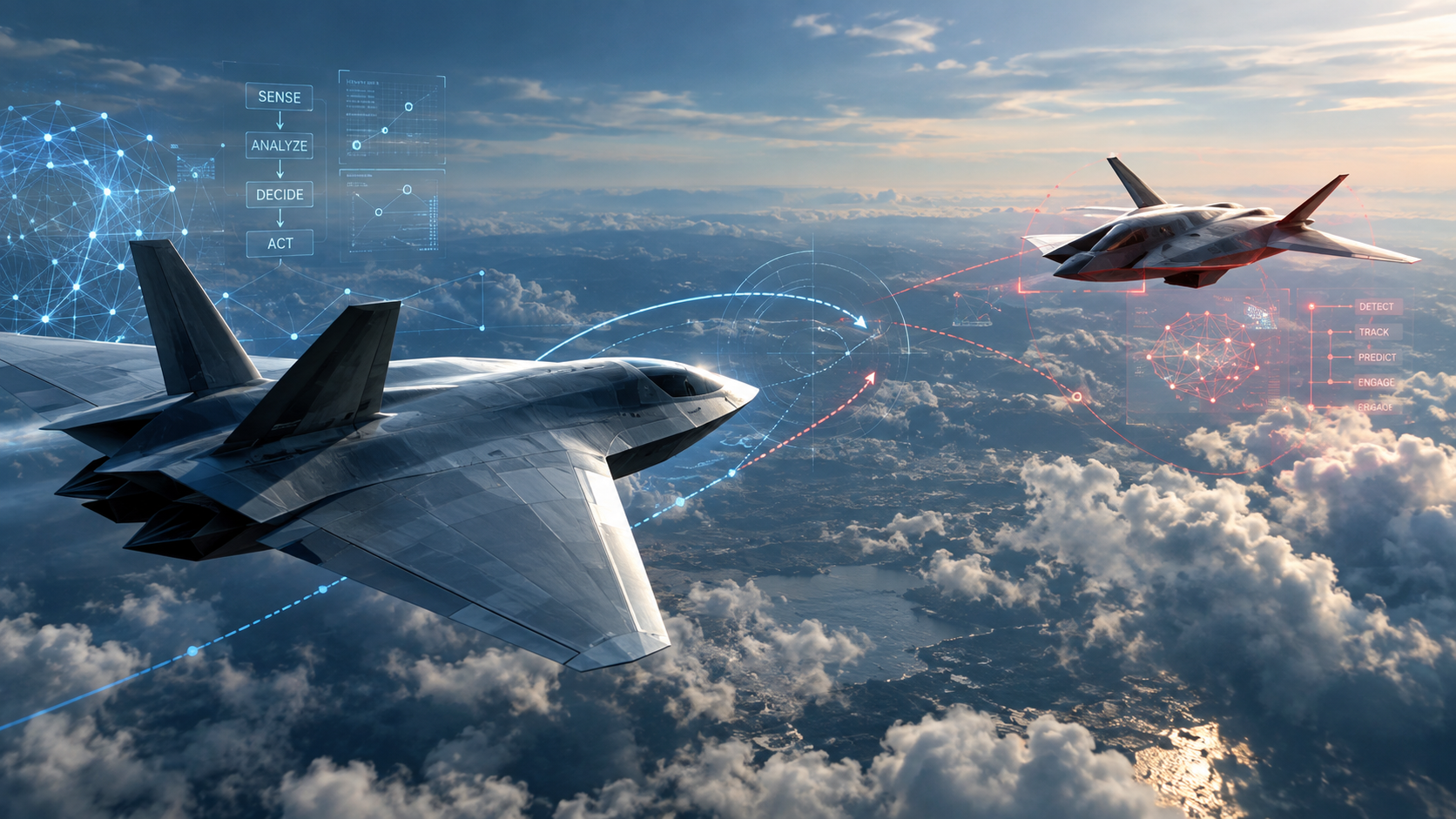
The military balance of power across the Indo-Pacific is undergoing a fundamental transformation. As both the United States and China transition artificial intelligence from simulator environments to front-line fighter jets, the primary threat of accidental military escalation in international airspace is shifting from human pilot miscalculation to machine learning error.
While much of the diplomatic discourse surrounding military AI focuses on nuclear command and strategic autonomy, the most immediate danger lies in tactical air intercepts over contested waters like the South China Sea and the Taiwan Strait. Without clear, bilateral rules of engagement (RoE) specifically tailored for autonomous aircraft, a routine encounter between uncrewed combat air vehicles (UCAVs) could trigger a rapid, unintended escalation ladder that human command structures cannot arrest in time.
The Dawn of Mach-Speed Autonomy
The race to field autonomous combat aircraft is no longer theoretical; it is an operational priority for both Washington and Beijing.
Under the U.S. Air Force’s Collaborative Combat Aircraft (CCA) initiative, the Pentagon plans to field at least 1,000 AI-enabled “loyal wingmen”—uncrewed aircraft designed to fly alongside crewed platforms like the F-35 and Next Generation Air Dominance (NGAD) fighters. Experiments conducted under the DARPA Air Combat Evolution (ACE) program have already demonstrated that AI agents can successfully outmaneuver human pilots in visual-range dogfights, adapting to tactical dynamic shifts at sub-second speeds. Details outlined by the U.S. Department of Defense emphasize the imperative of responsible autonomy, yet tactical real-time execution in contested zones remains a major wild card.
Concurrently, the People’s Liberation Army Air Force (PLAAF) is aggressively pursuing its own uncrewed platforms. Chinese defense contractors have showcased platforms such as the FH-97A and the WZ-8, designed to perform autonomous reconnaissance, electronic warfare, and forward-line air-to-air suppression. Research published by the RAND Corporation indicates that Beijing views military AI integration as a “force multiplier” capable of offsetting traditional U.S. power projection advantages in the First Island Chain.
The Escalation Trap: Why AI Changes Air-to-Air Tactics
In conventional intercept scenarios involving piloted aircraft—such as a Chinese J-16 intercepting a U.S. RC-135—human pilots operate under established visual signals, radio frequencies, and the multilateral Code for Unplanned Encounters at Sea (CUES). When a human pilot assesses intent, they rely on visual cues, physical distance, and tactical behavior to gauge aggression versus standard shadowing.
When two autonomous or semi-autonomous systems intercept one another, these human buffers disappear:
- Compression of the OODA Loop: Machine-learning algorithms operate on microsecond decision cycles. If an autonomous aircraft interprets a standard radar lock, electronic jamming pod, or evasive banking maneuver by an opposing drone as an incoming attack vector, its predictive neural networks may trigger defensive or pre-emptive maneuvers instantly.
- The “Black Box” Problem: Deep neural networks operate via complex pattern matching rather than deterministic logic trees. As noted in security studies by the Center for Strategic and International Studies (CSIS), predicting how an edge-deployed military AI model will respond to unpredictable real-world inputs (such as spoofed GPS or unexpected weather events) remains an unsolved challenge.
- Loss of Signaling Nuance: Human pilots can de-escalate a confrontation by rocking wings, pulling back on throttles, or establishing radio contact. Autonomous systems lack standard mechanisms to convey ambiguous or non-hostile intent to an opposing nation’s algorithmic system.
+-----------------------------------------------------------------------+
|                       THE ACCIDENTAL ESCALATION LOOP                 |
|                                                                       |
|   [U.S. Autonomous CCA]  <--- Sensor Query --->  [PLA Autonomous UCAV]|
|            |                                            |             |
|   Algorithm perceives                               Algorithm perceives|
|   evasive banking as hostile                         radar lock as     |
|   targeting signal                                  pre-emptive strike|
|            |                                            |             |
|            v                                            v             |
|   Automated Countermeasure                       Automated Deficit    |
|   Deployments (Chaff/Jamming)                    Tracking & Target    |
|            |                                     Acquisition          |
|            +-------------------+------------------------+             |
|                                |                                      |
|                                v                                      |
|             HUMAN COMMANDERS NOTIFIED POST-DISCHARGE                  |
|             (Escalation threshold crossed in <3 seconds)             |
+-----------------------------------------------------------------------+
The Existing Governance Vacuum
Multilateral efforts to regulate military AI have made modest progress, but they fall short of addressing tactical air intercepts.
The Responsible AI in the Military Domain (REAIM) summits and the U.S.-led Declaration on Responsible Military Use of Artificial Intelligence and Autonomy offer general principles regarding human oversight, command structure integrity, and rigorous testing. Similarly, diplomatic analysis published by the Brookings Institution highlights that high-level bilateral summits between Washington and Beijing have opened initial dialogues on AI risk reduction.
However, these broad political declarations lack operational mechanics. They do not define:
- What constitutes a hostile act by an autonomous platform in international airspace.
- What standardized electronic signals an uncrewed system must broadcast to declare peaceful transit.
- How machine-to-machine communications should function during an unintended proximity event.
Without concrete, technical protocols embedded directly into aircraft software suites, high-level political commitments will fail the moment silicon meets silicon over the Western Pacific.
A Four-Pillar Blueprint for U.S.-China AI Air Engagement
To mitigate the risk of an unintended confrontation, defense officials and technical experts from the United States and China must establish a dedicated Autonomous Air De-confliction Framework. Analysts writing in Foreign Affairs repeatedly note that arms control in the digital age requires technical solutions co-designed alongside strategic policy.
1. Hard-Coded Strategic Fail-Safes
Both nations should agree to hard-code deterministic “red lines” into autonomous flight control systems that cannot be overridden by machine-learning models. These include hard caps on maximum speed increases during close encounters, mandatory stand-off distances when intercepting uncrewed platforms, and automated weapon system lock-outs unless explicit human authority is transmitted.
2. Standardized Autonomous Identification Friend-or-Foe (A-IFF)
Similar to transponder systems used in commercial aviation, military uncrewed systems operating in international airspace should transmit a standardized, cryptographically signed “Autonomous Platform Intent” signal. This broadcast would inform nearby air units of the flight’s mission state, autonomous level (e.g., tethered to human lead vs. fully autonomous), and non-aggressive flight path vector.
3. Machine-to-Machine De-confliction Hotlines
Traditional voice-based communication links—such as the U.S.-China Defense Telephone Link—are too slow to manage algorithmic interactions. A modern de-confliction protocol requires an automated, low-latency data channel between U.S. Indo-Pacific Command and the PLA Eastern/Southern Theater Commands. This channel would automatically ping human operators the instant two opposing autonomous platforms enter a designated safety perimeter.
4. Joint Synthetic Simulation and Stress-Testing
Before deploying advanced autonomous fighters at scale, defense laboratories from both nations should participate in joint track-sharing and simulated scenario stress-tests. By running algorithmic models against each other in virtual environments, both sides can identify edge cases where neural networks misinterpret opponent maneuvers, allowing software engineers to patch systemic vulnerabilities before they manifest in real air combat.
The Imperative of Algorithmic Restraint
The integration of artificial intelligence into air warfare is an inevitable reality driven by strategic competition and technological momentum. However, autonomy without governance introduces an unacceptable level of operational risk.
If Washington and Beijing fail to establish clear rules of engagement for autonomous combat jets today, they risk allowing computer algorithms to dictate the timing and conditions of a major-power conflict tomorrow. Establishing guardrails for AI air power is not a sign of military weakness—it is a mandatory requirement for strategic stability in the 21st century.
Discover more from The Economy
Subscribe to get the latest posts sent to your email.

Key Takeaways
- The “Planet Labs and Goldman” link is research coverage, not a partnership. We found no public announcement of a commercial deal. Goldman Sachs analysts cover Planet Labs (NYSE: PL) with a Neutral rating and have raised their price target at least twice this year, first to $18 and then to $20.
- The business is growing fast. Planet’s second-quarter fiscal 2027 revenue hit a record $116.1 million, up 58% year over year, with backlog of about $814.9 million.
- The stock has been a roller coaster. It peaked at $51.76 on May 28, according to TheStreet, and is now down roughly 11% for the year.
- Satellite data has been a Wall Street edge for over a decade. Academic work on parking-lot imagery shows funds have profited from it, and that the advantage stayed concentrated among a select few large investors.
- The next chapter is defense, sovereign demand and AI in orbit. Those are lumpier, bigger-ticket revenue streams than retail parking lots ever were.
Type “Planet Labs Goldman” into a search bar and you’ll find a jumble of analyst notes, price targets and stock-move headlines. It’s natural to assume the two companies are working together. As far as the public record shows, they aren’t.
The real connection is more interesting. Planet Labs is one of the clearest examples of a company turning pictures of Earth into financial-grade information, and Goldman Sachs is one of the institutions deciding what that business is worth. Meanwhile, the broader market for satellite imagery in investing has been quietly maturing for more than a decade.
This guide separates the signal from the noise: who Planet is, what Goldman thinks, how Wall Street has used satellite data, and what to track if you want to evaluate the opportunity yourself. It’s information, not investment advice.
What Planet Labs Actually Sells
Planet Labs PBC, based in San Francisco, operates a large fleet of Earth-observation satellites. The company provides near-daily imagery of the planet’s landmass and sells it, along with analytics, to governments and commercial customers in agriculture, energy, environmental monitoring and defense.
Three product ideas matter for this story:
- Daily, wide-area imagery. Frequency is the product. A picture that updates every day reveals change, and change is what investors and intelligence analysts pay for.
- Specialized sensors. Planet’s Tanager spacecraft targets greenhouse gases such as methane, which turns an environmental question into a measurable data feed.
- Satellite services for sovereign customers. Governments increasingly want their own dedicated capability, and Planet builds and operates it for them.
The Latest Scorecard
Planet reported second-quarter fiscal 2027 results (quarter ended July 31, 2026) in early September. Here is how the numbers looked, from the company’s earnings release and the earnings-call recap.
| Metric | Result | Why it matters |
|---|---|---|
| Revenue | $116.1M, up 58% year over year | A record quarter, well above what analysts expected |
| Net loss | $9.4M, versus $22.6M a year earlier | Losses are shrinking |
| Adjusted EBITDA | $13.9M profit | Operating leverage is showing up |
| Backlog | About $814.9M; roughly half converts within 12 months | Gives forward visibility |
| Cash and short-term investments | $865.4M | Funds capital-intensive satellite builds |
| Defense and intelligence revenue | Up more than 90% | The fastest-growing customer group |
| Third-quarter guidance | $101M to $105M | Below the roughly $114M analysts expected |
| Fiscal 2027 revenue guidance | $430M to $441M, up 40% to 43% | Raised at the low end |
Two things deserve a flag. First, about 12% of second-quarter revenue was “point-in-time” revenue from a satellite handover, versus 1% a year earlier. That kind of revenue is real, but lumpy. Second, the soft third-quarter guide is exactly why the stock reacted so sharply, as 247WallSt noted.
Where Goldman Sachs Fits In
Goldman’s role in this story is as an evaluator. Its equity-research team rates Planet Neutral, which generally signals that the analysts don’t expect the shares to meaningfully beat or lag their coverage group.
The firm’s price-target path tells you how its view evolved:
- March 23, 2026: target raised to $18 from $16.40 after quarterly results beat expectations, driven by defense, intelligence and civil government demand.
- April 20, 2026: target raised to $20 from $18, reflecting improved confidence in the commercial outlook.
In the March note, the analyst said Planet was seeing strong demand signals and making sensible long-term investments. In other words, Goldman liked the business but wasn’t sold on the price. That’s the common story with a stock that had already climbed about 793% over the prior year, according to Investing.com.
The Stock: Boom, Bust, Rebuild?
Planet shares rode a speculative wave early in 2026, peaked at $51.76 in May and have corrected since. TheStreet reports the stock is down about 11% year to date but up nearly 18% over twelve months.
Recent catalysts include:
- A successful launch of 20 satellites, including 18 SuperDove imaging satellites, a Tanager-2 hyperspectral satellite, and an experimental space-based AI computing node developed with Alphabet.
- A record quarter and a growing backlog.
- Sovereign wins such as a seven-figure contract with the Greek government, reported by Investing.com.
The risks are just as concrete. Capital spending is heavy, GAAP profitability remains out of reach, revenue timing can be uneven, and the sector’s enthusiasm can evaporate quickly.
How Wall Street Has Used Satellite Data
Long before Planet was a public company, investors figured out that pictures from orbit could predict earnings.
The best-known example is the parking lot. Companies began selling analysis of retailers’ car counts in the early 2010s. Researchers at UC Berkeley examined 4.8 million images covering 67,000 U.S. stores and found the strategy could indeed deliver an edge, and that the data hadn’t spread much beyond hedge funds. Their warning was blunt: the practice may disadvantage everyday investors who can’t see the same data.
A CNBC feature on alternative data explained the basic logic. Consistently empty parking lots can signal weak store traffic, giving a fund reason to bet against a retailer before the quarterly report lands.
Satellite data has since widened well beyond retail:
- Commodities: crop health, soil moisture and storage activity.
- Energy: tank levels, flaring and shipping patterns.
- Supply chains: port congestion, factory activity and construction progress.
- Climate and ESG: methane plumes, deforestation and land-use change.
A Simple Framework for Judging a Geospatial Stock
| Question | What to look for | Planet today |
|---|---|---|
| Is demand durable? | Backlog and recurring contracts | About $815M backlog; 98% of annual contract value is recurring |
| Is growth profitable? | Adjusted EBITDA and free cash flow | Adjusted EBITDA positive in Q2, guided to a loss in Q3 |
| How concentrated is the customer base? | Government vs. commercial mix | Defense and intelligence growing fastest |
| Is the balance sheet strong? | Cash versus capex needs | $865M cash against $100M to $115M of planned capex |
| Is revenue predictable? | Share of lumpy, point-in-time sales | 12% in Q2, up sharply from a year ago |
Three Risks the Headline Numbers Don’t Show
Strong quarters can hide structural questions. If you’re weighing Planet or any rival, put these three on your checklist.
- Competition. Earth observation is crowded, and governments can choose among several suppliers. One Seeking Alpha analysis argues that the business is strong but that competition remains a long-term risk and valuation may cap future returns.
- Deal conversion. Large sovereign contracts move the needle, but they arrive on irregular timelines. Coverage of the September report pointed out that Planet’s conversion rate on bigger sovereign deals is still being established, which leaves room for guidance to slip if timing moves.
- Narrative dependence. Space stocks trade as a group. When enthusiasm around the sector fades, even companies with improving fundamentals can fall hard, which is part of what the 2026 round trip from $51.76 looks like.
None of these cancel the growth story. They explain why a 58% revenue increase and a falling share price can show up in the same month, and why a Neutral rating from an analyst can be perfectly consistent with a rising business.
The Compliance Question
Is it fair for a fund to trade on satellite imagery? Generally, publicly observable data processed legally is a legitimate research input. The sensitive lines involve how data is collected, what contracts permit, and whether any of it amounts to material nonpublic information. Investors should treat the source as an essential part of due diligence.
Asked & Answered
Does Goldman Sachs partner with Planet Labs?
We found no public announcement of a commercial partnership. Goldman’s visible connection is analyst coverage: a Neutral rating with price targets raised in March and April of 2026.
What does a Neutral rating mean?
It signals that the analysts don’t expect the stock to meaningfully outperform or underperform the companies they cover. It is not a sell call.
Is Planet Labs profitable?
Not on a GAAP basis. It posted a $9.4 million net loss in the latest quarter, though adjusted EBITDA was positive at $13.9 million and losses have narrowed from a year earlier.
How do hedge funds use satellite imagery?
Typical uses include counting cars at retailers, estimating crop yields, tracking oil storage and monitoring shipping. The goal is to see change before it appears in company reports.
Is trading on satellite data legal?
Using lawfully obtained, publicly observable information is generally accepted. Problems arise with misrepresented sourcing or confidential information, so funds typically run these datasets past compliance teams.
Discover more from The Economy
Subscribe to get the latest posts sent to your email.

Anthropic Draws the Line: Why Claude’s New Usage Policy Explicitly Bans ‘Cruel Behavior’ Toward AI

Ynon Kreiz & Mattel’s Digital Transformation: Franchise Strategy and Financial Growth

Crude Oil & Petroleum Market Analysis: OPEC+ Decisions and Price Forecasts

Top US Convenience Store Chains: Store Counts, EV Charging, and Sales Trends

Publix Store Closures Tracker: Locations, Rebuild Status, and What’s Changing

How to Find Google Maps Fuel Prices and Save on Every Fill-Up

Global Market Outlook: Navigating Interest Rates, Inflation, and Commodity Spikes

PEP Stock Analysis: PepsiCo Financials, Dividend Yield, and Sector Volatility

Social Security $90 Payment Claims: What’s Real, What’s a Scam, and What Your 2027 COLA Could Be

EU vs UK Electric Vehicle Tariffs: Impact on Automotive Supply Chains & Consumer Prices

Complete Guide to Home Loan Refinancing: Interest Rate Trends & Loan Calculation Strategies

Algorithmic Dogfights: Why the U.S. and China Must Establish Rules of Engagement for Autonomous Air Power

Stock Market Today: Dow, S&P 500, and Nasdaq Retreat as Treasury Yields

Global Economic Outlook 2026: 7 Forces Reshaping Markets, Trade and Business

Oil Prices Break $100 in 2026: Middle East Conflict & Energy Markets

China Stocks Today: Are Big Economies in Asia Nearing a Market Bottom?

Middle East War Economics 2026: Oil Prices & Energy Markets

PSX Forecast 2026: KSE-100, IMF Reviews & Geopolitics

Crypto Daily Outlook: Bitcoin, Altcoins, and the Future of Decentralized Finance

Global Pension Systems Ranked: The World’s Best and Worst Retirement Frameworks

Enterprise AI Platforms Disrupting B2B SaaS in 2026: Full Analysis

World’s Largest Economies: Ranking the Top Global Powers

Elon Musk’s Next Moves: Disrupting the 2026 Global Economy

Pakistan Economy 2026: Inside the SBP’s Balancing Act

GasBuddy Market Insights: How Crude Price Shifts Impact Local Fuel Cost Averages

World Bank & IMF Reports 2026: Why the “3% Growth” Consensus Is Actually a Debate

Global Equity Market Divergence: US Tech vs. European Dividend Stocks vs. Asian Growth

Stock Market Today: Dow Climbs 500 Points as Markets Shake Off Inflation Jitters
-

 Markets & Finance9 months ago
Top 15 Stocks for Investment in 2026 in PSX: Your Complete Guide to Pakistan’s Best Investment Opportunities
-

 Analysis8 months ago
Johor’s Investment Boom: The Hidden Costs Behind Malaysia’s Most Ambitious Economic Surge
-

 Analysis8 months ago
Top 10 Stocks for Investment in PSX for Quick Returns in 2026
-

 Banks9 months ago
Best Investments in Pakistan 2026: Top 10 Low-Price Shares and Long-Term Picks for the PSX
-

 Analysis8 months ago
Brazil’s Rare Earth Race: US, EU, and China Compete for Critical Minerals as Tensions Rise
-

 Investment9 months ago
Top 10 Mutual Fund Managers in Pakistan for Investment in 2026: A Comprehensive Guide for Optimal Returns
-

 Global Economy10 months ago
15 Most Lucrative Sectors for Investment in Pakistan: A 2025 Data-Driven Analysis
-

 Global Economy10 months ago
Pakistan’s Export Goldmine: 10 Game-Changing Markets Where Pakistani Businesses Are Winning Big in 2025