
Inflation
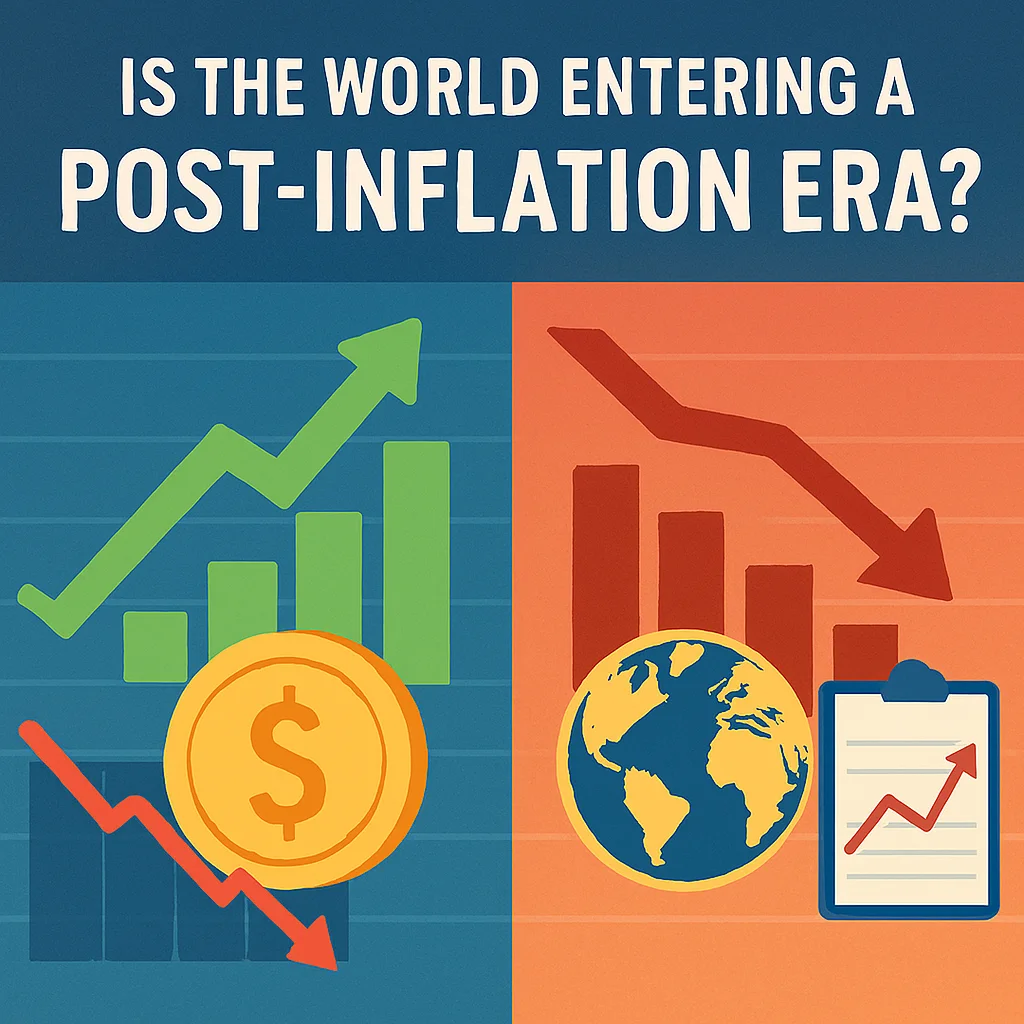
Global Inflation Trends: Is the World Entering a Post-Inflation Era?

Introduction
Inflation has been the economic buzzword of the past few years. From grocery bills to mortgage payments, households across the globe have felt the sting of rising prices. Central banks scrambled to raise interest rates, governments rolled out subsidies, and businesses struggled to balance costs with consumer demand. Yet, as we step into 2025, a new question emerges: are we entering a post-inflation era?
This opinion piece explores the shifting dynamics of global inflation, the forces driving disinflation, and whether the world is truly moving beyond the inflationary storm — or simply pausing before the next wave.
🌍 The Inflationary Storm of the Early 2020s
- Pandemic Aftershocks: COVID-19 disrupted supply chains, creating shortages in everything from semiconductors to food staples.
- Energy Crisis: Russia’s invasion of Ukraine triggered spikes in oil and gas prices, fueling inflation worldwide.
- Monetary Policy Lag: Central banks initially underestimated inflation, labeling it “transitory.” By the time they acted, prices had already surged.
- Consumer Behavior: Pent-up demand after lockdowns led to spending sprees, further pushing prices upward.
The result? Inflation rates hit multi-decade highs in the US, Europe, and emerging markets, including Pakistan.
📉 Signs of Disinflation in 2025
Now, the tide seems to be turning. Several indicators suggest inflation is cooling:
- Falling Energy Prices: Oil and gas markets have stabilized, with renewables cushioning supply shocks.
- Supply Chain Recovery: Logistics bottlenecks have eased, reducing costs for manufacturers and consumers.
- Central Bank Tightening: Aggressive interest rate hikes are finally curbing demand.
- Technological Deflation: AI, automation, and digitalization are lowering production costs.
These factors hint at a possible post-inflation era, where price stability returns as the norm.
⚖️ The Case for a Post-Inflation Era
- Global Coordination: Central banks are more vigilant, ready to act swiftly against inflation.
- Energy Transition: Renewables reduce dependence on volatile fossil fuels.
- Demographics: Aging populations in advanced economies dampen demand growth.
- Technology: AI-driven productivity gains create deflationary pressures.
Together, these forces could usher in a period of low and stable inflation, reminiscent of the pre-pandemic decade.
🚨 Counterarguments: Inflation Isn’t Dead Yet
However, declaring victory over inflation may be premature.
- Geopolitical Risks: Conflicts in the Middle East or Asia could reignite energy shocks.
- Climate Change: Extreme weather events disrupt food supply, pushing prices up.
- Fiscal Pressures: Governments burdened with debt may resort to money printing.
- Emerging Market Volatility: Countries like Pakistan remain vulnerable to currency depreciation and imported inflation.
In other words, inflation may be subdued, but it’s far from extinct.
🏠 Human Impact: Why This Debate Matters
For households, inflation isn’t just an abstract number. It’s the difference between affording a home, saving for retirement, or putting food on the table.
- Middle-Class Squeeze: Even modest inflation erodes purchasing power.
- Youth & Employment: Rising costs affect job creation and wages.
- Retirees: Pension reforms become critical in safeguarding against inflation shocks.
Thus, whether we’re entering a post-inflation era directly affects everyday lives.
📊 Regional Perspectives
- United States: Inflation cooling, but housing remains expensive.
- Europe: Energy stabilization helps, but fiscal deficits loom.
- China: Facing deflationary pressures due to slowing demand.
- Pakistan: Inflation remains sticky due to currency weakness and structural issues.
This divergence shows that while some economies may enjoy disinflation, others remain trapped in inflationary cycles.
✍️ Opinion: A Fragile Post-Inflation Era
My view? The world is not entering a permanent post-inflation era, but rather a fragile disinflationary phase. Structural forces like technology and demographics will keep inflation subdued, but shocks — geopolitical, climate, or fiscal — can quickly reverse the trend.
The challenge for policymakers is to balance vigilance with flexibility. For households and businesses, the lesson is clear: don’t assume inflation is gone; prepare for its return.
📢 Conclusion
The narrative of a “post-inflation era” is tempting, offering hope after years of economic pain. Yet, history teaches us that inflation is cyclical, not linear. While 2025 may mark a turning point toward stability, the world must remain cautious.
In the end, the question isn’t whether inflation is dead — it’s whether we’ve learned enough to manage it better next time.
Discover more from The Economy
Subscribe to get the latest posts sent to your email.


This 10-point personal finance checklist—grounded in real data—will actually protect your wealth.
Here is the thing about inflation anxiety: it tends to peak at precisely the wrong moment. Markets lurch. Cable news fills its chyrons with the word “stagflation.” Your neighbour emails you a link to a gold dealer. And somewhere in Washington, a Federal Reserve official who has said “data-dependent” eleven times in the same press conference is being asked, again, whether 2026 will look like 1979.
It will not. But that does not mean you should do nothing.
The US Consumer Price Index for All Urban Consumers rose 2.4 percent over the 12 months to January 2026—a figure that sounds almost quaint after the bonfire years of 2022. Yet beneath that headline sits a persistent ember. Core Personal Consumption Expenditure inflation, the Federal Reserve’s preferred measure, remains above target, and tariffs continue to threaten further goods-price pressure in the months ahead. Meanwhile, oil prices jumped more than 15 percent in a single week in early March 2026 as geopolitical tensions escalated, pushing the 10-year Treasury yield to around 4.14 percent and sending the VIX intraday to 28.15—a sharp reminder that markets can go from “Goldilocks” to “gyrating” in 72 hours.
The good news? Being financially prepped for higher inflation is not complicated. It requires neither a bunker nor a Bitcoin wallet. It requires a clear-eyed checklist, worked through calmly, once. Here is that checklist.
Why Higher Inflation Remains the Base Case in 2026
The story of inflation in 2026 is not a simple repeat of 2021–22’s supply-shock spiral. It is something more structural and, in some ways, more durable.
The Federal Reserve’s own staff projections note that tariff increases are still expected to provide some upward pressure on inflation in 2026, with inflation only projected to reach 2 percent in 2027. The Congressional Budget Office echoes this view: PCE inflation is projected to soften slightly in 2026 to approximately 2.7 percent as the full tariff effect begins to wane, but the return to the Fed’s 2 percent target is not expected until 2030.
The transmission channels are multiple. Import tariffs are repricing goods that households buy every month—consumer electronics, clothing, vehicle parts. Rabobank’s analysis flags that while higher goods prices are being partly offset by lower housing costs, the full impact of import tariffs has yet to materialize, with a meaningful decline in core inflation likely only in the second half of 2026. Shelter, the single largest component of the CPI basket, is cooling—but slowly. And energy is back as a wildcard: Brent crude near $84 a barrel on a single day in March 2026 showed how quickly the inflation channel can re-open via geopolitical shocks.
The picture in Europe is more complex still. The European Central Bank held its key deposit rate at 2 percent in early 2026, acknowledging that the inflation trajectory and wider economic conditions did not warrant a move, but cautioning that the outlook remains unpredictable. In the United Kingdom, the Bank of England cut to 3.75 percent, navigating between four hawks concerned about persistent 3.6 percent inflation and four doves focused on deteriorating labour market conditions.
The net global read: central banks are not rushing to rescue your purchasing power. That job falls to you.
The 10-Point “Financially Prepped for Higher Inflation” Checklist
1. Audit Your Emergency Fund—and Reprice It for 2026 Inflation
The emergency fund calculus has changed. Three to six months of expenses is the conventional benchmark—but which expenses? Most people set their fund target based on what they spent in 2022 or 2023. With the CPI shelter index still rising month-over-month in January 2026 and food costs up modestly too, your monthly burn rate is almost certainly higher today. Recalculate using your last three months of actual bank statements, multiply by six, and hold the result in a high-yield savings account currently yielding 4.5–5.0 percent annually (many online banks remain competitive at this level). This single step ensures your emergency fund for inflation 2026 is calibrated to reality, not memory.
Action: Open a dedicated HYSA. Move any emergency cash earning less than 3.5 percent. Review the target figure every January.
2. Lock in Real Yield With I-Bonds and TIPS
US Treasury I-Bonds adjust their interest rate every six months based on CPI. The composite rate resets each May and November; with headline inflation running above 2.4 percent and a fixed-rate component, current I-Bonds offer a risk-free real return unavailable in cash. The annual purchase limit is $10,000 per person per year (plus $5,000 via tax refunds). Treasury Inflation-Protected Securities (TIPS), available via TreasuryDirect.gov or a brokerage, adjust their principal with CPI and are ideal for amounts exceeding the I-Bond cap. With 10-year Treasury yields stabilising in the 4.10–4.20 percent range, a short-duration TIPS ladder running one to five years provides inflation protection without significant interest-rate risk.
Action: Maximise this year’s I-Bond purchase for every adult in your household. Add a TIPS allocation of 5–10 percent of your fixed-income sleeve.
3. Pressure-Test Your Mortgage or Rent Exposure
Homeowners with fixed-rate mortgages are, structurally, among the few winners in an inflationary environment: their debt shrinks in real terms while their asset appreciates. Mortgage rates stabilised near 6.2 percent in early 2026, creating a significant divide between those locked in below 4 percent and those refinancing or renting today. If you are renting, your landlord’s cost base is rising too—budget for a rental increase of 4–7 percent at your next renewal and build the contingency into your annual plan. Variable-rate mortgage holders should model a 100-basis-point shock to their monthly payment and ensure they can absorb it from savings alone, without touching investments.
Action: Model three mortgage-rate scenarios (flat, +100bp, +200bp) in a simple spreadsheet. Know your break-even point before you need it.
4. Review Your Equity Allocation for Inflation-Resilient Sectors
Not all equities perform equally when prices rise. Historically, energy, materials, consumer staples, and healthcare tend to outperform in inflationary periods because they can pass costs to customers. Utilities and highly leveraged growth stocks tend to underperform when real rates rise. The S&P 500 was up over 1.9 percent year-to-date in early 2026 after gaining 17.9 percent in 2025, but that index-level calm masks significant sector dispersion. Rebalancing into a modest tilt toward value and commodity-linked equities—perhaps 10–15 percent of your equity sleeve—is not a market-timing bet. It is a deliberate hedge against the inflation scenario that remains in play.
Action: Check your current sector weights. If financials, tech, and discretionary collectively exceed 60 percent of your equity exposure, consider a rebalancing conversation with your adviser. [Internal link placeholder: “Best inflation-resistant ETFs for 2026”]
5. Trim Floating-Rate Consumer Debt Immediately
This is the most urgent point on any personal finance checklist inflation 2026 should carry. With the Fed holding the funds rate at 3.50–3.75 percent in January 2026 and markets still pricing only two cuts this year, credit card rates—which track the prime rate—remain north of 20 percent at most US issuers. Carrying a $5,000 balance at 22 percent APR costs you $1,100 per year in interest alone. No investment strategy can reliably beat a guaranteed 22 percent return from eliminating that liability. Prioritise: credit cards, personal loans, then home equity lines of credit. Do it now, before any further tariff-driven price shocks widen the gap between what you earn and what you owe.
Action: Use the avalanche method—pay minimum on all debts, direct every extra dollar to the highest-rate balance first. Set a 90-day target to eliminate credit card balances entirely.
6. Renegotiate Discretionary Subscriptions and Insurance Premiums
Tariffs are feeding into goods prices, and insurance costs—auto, home, and health—have proved particularly sticky, rising faster than headline CPI in recent years. Most households have not reviewed their insurance premiums in 18 months or more. A 30-minute comparison exercise on auto and home insurance could realistically save $400–$800 annually—the equivalent of a half-point raise. Similarly, subscription services have quietly layered on price increases: the average American household now carries 12 active subscriptions, according to C+R Research. Audit your statement, cancel two or three, and redirect the savings to your HYSA.
Action: Set a calendar reminder for this weekend: compare home and auto insurance quotes online. Cancel any subscription not used in 30 days.
7. Negotiate Your Salary—With Inflation Data in Hand
Real wages—earnings adjusted for inflation—have only recently turned positive after being negative for much of 2022–24. The window to recapture lost ground is now. With the CPI running at 2.4 percent over the year to January 2026, asking for a 5–6 percent raise is both defensible and, in a tight labour market, increasingly achievable. The Bureau of Labor Statistics’ own wage tracker and sector-specific salary surveys (LinkedIn Salary, Glassdoor) arm you with the numbers. Walk into the conversation not with emotion but with data: “CPI is X, my sector median is Y, I am at Z—let’s close that gap.”
Action: Research your sector’s current median salary before your next performance review. Frame any ask in real terms, not nominal ones. Every 1 percent of annual salary left on the table compounds significantly over a career.
8. Diversify Into Real Assets—Modestly and Deliberately
Real assets—commodities, timberland, farmland, listed infrastructure—have a historical tendency to maintain or grow in value as prices rise. Gold is the most discussed: spot gold was trading near $5,150 per ounce on March 6, 2026, having reached an all-time high of $5,595 in late January before correcting. A 5–10 percent portfolio allocation to gold via a physically-backed ETF (iShares Gold Trust, SPDR Gold Shares) or commodity-linked fund is a reasonable hedge—not a speculation. Avoid leveraged commodity ETFs, which decay in value over time regardless of the underlying asset’s direction.
Action: Check whether your portfolio holds any real assets. If not, consider a modest gold or broad commodity allocation during the next rebalancing. Hold in a tax-advantaged account if possible.
9. Stress-Test Your Retirement Contributions Against Real Return
The insidious damage of persistent inflation is not what it does to your monthly grocery bill. It is what it does to your retirement projection. A 2.7 percent annual inflation rate over 20 years reduces the real value of a £100,000 or $100,000 nominal sum by more than 40 percent. If your pension or 401(k) statements still project returns in nominal terms without inflation adjustment, you may be significantly overestimating your retirement readiness. Maximise contributions to tax-advantaged accounts—401(k), IRA, ISA, SIPP—where compounding works hardest because taxes are deferred. The 2026 401(k) contribution limit is $23,500 (plus $7,500 catch-up for over-50s), per the IRS.
Action: Ask your pension provider or brokerage to model your projected balance in real, inflation-adjusted terms. Increase your contribution by at least one percentage point this year.
10. Build a “Prices-Paid” Baseline—Know Your Actual Inflation Rate
The CPI is a national average across a diverse population. Your personal inflation rate—shaped by your city, housing tenure, diet, commuting habits, and healthcare consumption—could be meaningfully higher or lower. A Londoner who rents, cycles to work, and eats plant-based food faces a very different price environment from a suburban American who drives, owns a home, and carries private health insurance. Tracking your spending by category for 60 days using a budgeting app (YNAB, Copilot, Emma) reveals your actual exposure. Once you know your personal inflation rate, every item on this checklist becomes more precisely targeted.
Action: Download a budgeting app this weekend. Tag every transaction for 60 days. Calculate your personal CPI. Revisit this checklist with your real number.
The Global Traveller’s Angle—Currency Hedging and the Beat Rising Inflation 2026 Strategy for International Readers
For internationally mobile readers—and for anyone who travels frequently for business or leisure—inflation has a second dimension: currency exposure.
The euro has appreciated nearly 14 percent against the dollar over the last 12 months amid rising concerns over the unpredictability of US economic policy, a shift that has both depressed returns on US-denominated assets held by European investors and made American holidays more affordable for Eurozone travellers. Conversely, the ECB is keeping rates at 2 percent while the Fed continues cutting toward 3 percent by year-end—a narrowing rate differential that many strategists believe will continue to support a stronger euro into the second half of 2026.
Practical tips for the internationally mobile reader:
- Multi-currency accounts. Services like Wise, Revolut, or Charles Schwab’s brokerage account (which refunds all foreign ATM fees) eliminate punitive currency conversion charges. If you travel or pay bills in more than one currency, holding balances in USD, EUR, and GBP simultaneously shields you from conversion-rate timing risk.
- Book flights and hotels in local currency. When booking internationally via platforms like Expedia, always pay in the destination currency rather than accepting dynamic currency conversion—the latter typically embeds a 3–5 percent markup. [Internal link placeholder: “How to avoid hidden FX fees when booking travel in 2026”]
- TIPS and gilts as currency hedges. UK readers holding inflation-linked gilts benefit not only from CPI protection but also from potential sterling appreciation as the Bank of England’s relatively higher rates attract capital inflows.
- Dollar-cost average into foreign equities. Rather than making a single large conversion at today’s rate, systematic monthly purchases of an international equity ETF spread your currency entry points over 12 months, reducing the risk of buying at a EUR/USD peak.
What NOT to Do—The Four Mistakes Most People Make When Inflation Rises
1. Panic-selling equities for cash. Cash appears safe when markets gyrate, but it is the one asset class guaranteed to lose real value when inflation runs above your savings rate. Bonds delivered positive performance in 2025 with most traditional bond categories returning 6–8 percent—far ahead of cash—demonstrating that patience within a diversified portfolio outperforms reactionary moves.
2. Overloading on commodities. Gold at $5,150 is not cheap. A 5–10 percent portfolio allocation is prudent. Forty percent is a bet. The same logic applies to oil futures, agricultural commodities, and Bitcoin—all of which are significantly more volatile than inflation itself and can inflict real losses at precisely the moment you cannot afford them.
3. Ignoring the denominator. Focusing exclusively on investment returns while ignoring spending inflation is a common mistake. A portfolio growing at 7 percent nominally while your personal cost of living rises 5 percent produces only a 2 percent real gain. The checklist above deliberately addresses both sides of that equation.
4. Waiting for certainty. The Fed’s own policymakers acknowledged that rising tariff revenue could push goods inflation higher in coming months while simultaneously signalling a data-driven approach to rate decisions. There is no clarity coming soon. The households who navigate this environment best will be those who act on incomplete information—systematically, unemotionally, and early.
Conclusion
The most dangerous response to an inflationary environment is paralysis—scrolling through market data, refreshing portfolio apps, waiting for the Federal Reserve to solve a problem that monetary policy alone cannot fully address. The households that will emerge from this period financially stronger are not the ones who predicted the next CPI print correctly. They are the ones who quietly built up their emergency buffers, locked in real yields, eliminated high-cost debt, and understood their own spending well enough to know where they were genuinely exposed.
Higher inflation is not an emergency. It is a context. Work through this list, one item per weekend if you prefer, and you will arrive at the end of 2026 in materially better financial shape—regardless of what the central banks decide to do.
Because the best hedge against an uncertain price level is a clear-eyed personal balance sheet.
Discover more from The Economy
Subscribe to get the latest posts sent to your email.

Explore how Bangladesh’s new PM Tarique Rahman aims to boost GDP growth, manage remittances, and navigate China-US relations amid post-election revival.
When Tarique Rahman finally set foot on Bangladeshi soil after nearly two decades in London exile, the crowds that greeted him weren’t merely celebrating a political homecoming. They were, in a very real sense, betting their livelihoods on him. The BNP’s sweeping two-thirds majority in February 2026 — an election made possible only by the extraordinary student-led uprising that drove Sheikh Hasina from power in 2024 — handed Rahman a mandate that is simultaneously historic and terrifying in its weight. Bangladesh’s GDP stands at roughly $460 billion, growth has decelerated to a sluggish 4%, and a geopolitical tightrope stretches in every direction. The question isn’t whether Rahman wants to revive Bangladesh’s economy. The question is whether the tools he has are equal to the task.
The Economic Inheritance: More Fragile Than It Looks
Bangladesh’s macro story has long been one of development economics’ favorite fairy tales — a low-income country that outpaced neighbors through garment exports, microfinance, and disciplined remittance flows. That story has grown considerably more complicated.
The IMF projects GDP growth to rebound to 4.7% in FY2026, a modest recovery from the post-Hasina political turbulence that rattled investor confidence in late 2024 and through 2025. But 4.7% is not the 6–7% Bangladesh needs to absorb its vast young workforce, reduce poverty meaningfully, or finance the public investment that decades of cronyism left underfunded. The structural gaps are significant: private investment hovers well below the 35% of GDP economists identify as necessary for sustained high growth. Public institutions — tax administration, the judiciary, anti-corruption bodies — carry the scars of 15 years of systematic politicization.
Agriculture still employs roughly 44% of the workforce, a share that underscores both the rural depth of economic vulnerability and the limits of an export-led model that has concentrated prosperity in Dhaka and Chittagong. When a cyclone hits the Sundarbans or global cotton prices spike, nearly half the country feels it in their bones.
Then there’s the remittance lifeline. Bangladeshis abroad sent home $30 billion in 2025 — a remarkable surge driven partly by the depreciation of the taka making dollar transfers more attractive, and partly by the expanded diaspora built up across the Gulf, Malaysia, and Europe. Remittances now rival garment export earnings as the backbone of foreign exchange reserves. That’s a double-edged asset: invaluable as a buffer, but structurally fragile because it depends on labor-market conditions in Riyadh and Dubai, not Dhaka.
The Garment Sector: A Crown Jewel Under Pressure
Bangladesh’s readymade garment industry — a $40+ billion export engine that dresses much of the Western world — faces its most complex moment in a generation. The challenges are formidable: automation threatens lower-skill sewing jobs, Western buyers are demanding ESG compliance that many Bangladeshi factories can’t yet afford, and competitors from Vietnam and Ethiopia are chipping away at market share.
US tariff policy adds another layer of uncertainty. Bangladesh’s garment exports to America — its single largest market — flow under preferences that have never been fully secure and are now subject to the broader unpredictability of Washington’s trade posture. Rahman’s government has signaled it will pursue a formal trade framework with the US, a pragmatic move that would reduce vulnerability but requires diplomatic capital Bangladesh is only beginning to rebuild.
The harder domestic challenge is labor. The 2024 revolution was partly ignited by garment workers and students united by economic grievance. Any BNP government that ignores wage stagnation in the sector risks repeating the political miscalculations that ultimately doomed Hasina. Rahman has spoken of a “social compact” with workers — the test will be whether that translates into enforceable minimum wages and functional unions, or remains campaign rhetoric.
Navigating the Great Power Triangle: China, the US, and India
China: Partner, Creditor, or Competitor?
Bangladesh’s trade relationship with China is the defining economic relationship most Western analysts underestimate. Bilateral trade runs at approximately $18 billion, overwhelmingly weighted toward Chinese exports — machinery, raw materials, electronics — that Bangladesh’s industry desperately needs but can’t yet produce domestically. Chinese firms have also financed key infrastructure, from the Padma Bridge rail link to power plants, creating debt obligations that constrain fiscal flexibility.
Rahman’s stated approach is “multipolar pragmatism” — maintaining strong economic ties with Beijing while signaling openness to Washington and Tokyo. It’s a reasonable strategy, and it reflects a broader trend across Southeast and South Asia. But it requires a diplomatic dexterity that Bangladesh’s foreign ministry has not traditionally needed to exercise. The risk is that both great powers interpret hedging as hostility rather than prudence.
The India Question: Thaw or Freeze?
Relations with India are the most emotionally charged variable in Rahman’s foreign policy inbox. New Delhi was perceived as Hasina’s patron — a relationship Bangladeshi nationalists resented and the BNP stoked for electoral advantage. Border tensions have flared since the revolution, with incidents along the fencing that runs most of the 4,000-kilometer frontier. The Teesta water-sharing agreement, long in diplomatic limbo, remains unsigned.
And yet the economics of India-Bangladesh interdependence are powerful enough to compel engagement regardless of political temperature. Indian goods flood Bangladeshi markets via both formal and informal channels. Bangladesh’s northeast-facing connectivity — ports, power grids, transit routes — cannot be optimized without Indian cooperation. A sustained chill with Delhi would cost Rahman more than it costs Modi. The smart money is on a gradual, face-saving thaw: enough symbolism to satisfy nationalist sentiment at home, enough pragmatism to keep the border economy functioning.
ASEAN: The Aspiration That Requires Homework
Bangladesh’s ASEAN aspirations have been discussed for years with more enthusiasm than strategy. Joining ASEAN — even as a dialogue partner — would require institutional reforms, trade liberalization, and a regional diplomatic posture that Dhaka has not historically prioritized. Rahman’s team has floated ASEAN engagement as part of a broader Indo-Pacific pivot. It’s an appealing vision. Translating it into policy requires, first, getting the basics right at home.
The Political Economy of Reform: Who’s Really in the Room?
Any honest assessment of Bangladesh’s economic outlook has to grapple with the coalition Rahman is governing within. The BNP’s two-thirds majority is a powerful instrument — but it came partly on the back of Jamaat-e-Islami’s organizational muscle in constituencies where the BNP had been weakened during the Hasina years. Jamaat’s social conservatism and ambiguous attitude toward Bangladesh’s secular liberal elite creates real tension with the reform agenda that investors and multilaterals are expecting.
Youth are the other critical constituency. The students who brought down Hasina want jobs — real ones, not patronage positions — transparency, and an end to the culture of political violence that has made Bangladeshi politics so costly to its own institutions. Rahman’s government has promised a crackdown on corruption and civil service reform. These are not merely good governance talking points; they are the precondition for private investment to grow toward that 35% of GDP target. Foreign capital follows institutional credibility, and Bangladesh’s institutional credibility is currently being rebuilt from a low base.
The Awami League, despite its electoral collapse, commands deep roots in parts of the bureaucracy, the military officer class, and civil society. A wise BNP government manages this not through purges — which historically backfire — but through transparent accountability processes that don’t look like victors’ justice.
LDC Graduation: The November 2026 Cliff
Looming over everything is Bangladesh’s scheduled graduation from Least Developed Country status in November 2026. This is, in development terms, a success story — Bangladesh has met the income, human assets, and economic vulnerability thresholds for graduation. But success brings a cost: the erosion of preferential trade terms that have underpinned garment export competitiveness for decades.
Duty-free access to the EU under the Everything But Arms initiative will phase out. WTO-TRIPS flexibilities on pharmaceuticals will tighten. The IMF and World Bank have urged Bangladesh to negotiate transition arrangements and diversify its export base before the preferences expire. Rahman’s government has approximately two years of post-graduation transition runway — time that must be used to move up the value chain, attract technology-intensive investment, and build the trade infrastructure that makes Bangladeshi exports competitive on merit rather than preference.
This is where the $460 billion economy’s future is genuinely being written. Not in political speeches, but in whether Chittagong port gets the upgrades it needs, whether the power grid can reliably supply the industrial zones, and whether the education system starts producing graduates with skills the 21st-century economy demands rather than the 20th.
Opportunities and Pitfalls: A Forward Look
Where the optimists have a point:
- The remittance surge provides a genuine foreign exchange cushion that buys reform time.
- Bangladesh’s demographic dividend — a young, urbanizing population — is a real asset if youth employment programs gain traction.
- The global supply chain diversification away from China creates an opening for Bangladesh in electronics and light manufacturing if the enabling environment improves.
- The BNP’s large majority, paradoxically, gives Rahman room to absorb short-term political pain from reform — a luxury narrow coalition governments rarely have.
Where the pessimists may be right:
- Jamaat-e-Islami’s influence in the coalition could slow liberal economic reforms and deter Western investors with ESG mandates.
- India-Bangladesh tensions, if they deepen, could disrupt the connectivity projects that unlock northeastern Bangladesh’s economic potential.
- LDC graduation without adequate preparation could trigger a garment sector shock that reverberates across the 4 million workers — mostly women — who depend on it.
- Institutional rebuilding takes longer than election cycles. The IMF’s 4.7% projection is predicated on policy continuity and reform progress that is far from guaranteed.
The Bottom Line
Tarique Rahman inherits a Bangladesh that is more resilient than its critics acknowledge and more fragile than its boosters admit. The $460 billion economy has real foundations — a hardworking diaspora, an adaptable garment sector, a tradition of pragmatic policymaking that survived even the Hasina years’ worst excesses. But those foundations need serious maintenance: institutional reform, investment in human capital, and a foreign policy sophisticated enough to manage great power competition without becoming a casualty of it.
The students who made this government possible are watching with the same energy they brought to the streets in 2024. They are not an audience to be managed with press releases. They are Bangladesh’s most important economic asset — and its most demanding constituency. Getting the economy right, for Rahman, is not just a technocratic challenge. It’s the condition of his political survival, and the measure by which history will judge whether the 2024 revolution delivered on its promise.
Discover more from The Economy
Subscribe to get the latest posts sent to your email.
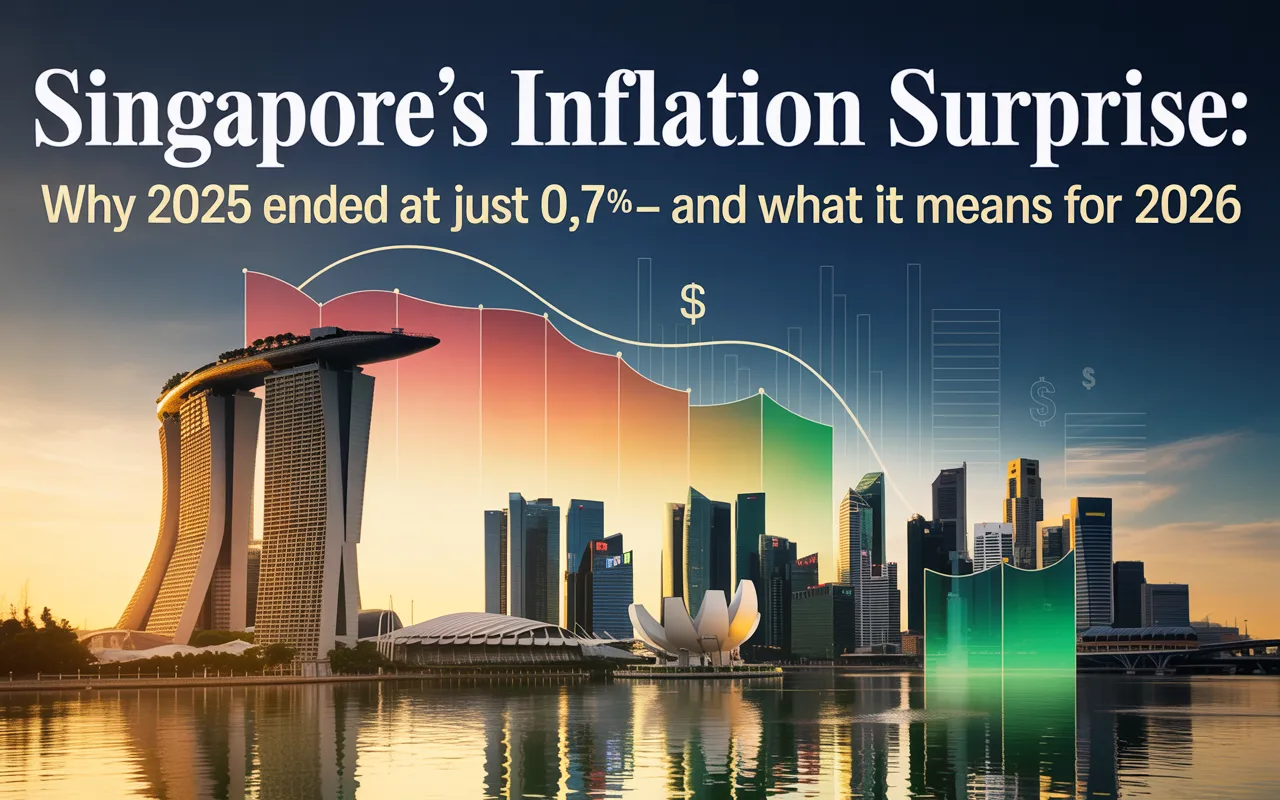
Singapore’s core inflation fell to 0.7% in 2025. With price pressures receding, the MAS is expected to hold policy steady in January 2026, marking a new phase for the city-state’s economy.
The late afternoon sun slants through the canopy of the Tiong Bahru Market hawker centre, glinting off stainless steel steamers and the well-worn handles of kopi cups. Here, at the heart of Singapore’s quotidien life, the most consequential economic conversation of the year is being had, not in the jargon of central bankers, but in the simple calculus of daily purchases. An auntie considers the price of char siew before ordering; a taxi driver compares the cost of his teh tarik to last year’s. For the first time in nearly half a decade, that mental math is bringing a faint, collective sigh of relief. The fever of inflation—which spiked to a 14-year high in 2023—has broken. The Monetary Authority of Singapore (MAS), the nation’s powerful central bank, now faces a delicate new reality: not of battling runaway prices, but of navigating a return to profound price stability in a world still rife with uncertainty.
On January 29, 2026, the MAS will release its first semi-annual monetary policy statement of the year. All signs, confirmed by the latest data from the Singapore Department of Statistics (SingStat), point to a unanimous decision: the central bank will keep its exchange rate-centered policy settings unchanged. The full-year data for 2025 is now in, and it tells a story of remarkable disinflation. Core Inflation—the MAS’s preferred gauge, which excludes private transport and accommodation costs—came in at 0.7% for 2025, a dramatic decline from 2.8% in 2024 and 4.2% in 2023.

Headline inflation for the year was 0.9%. December’s figures showed both core and headline inflation holding steady at 1.2% year-on-year, indicating a stable plateau as the economy adjusts to a post-shock norm. This outcome, while slightly above the government’s earlier 2025 forecast of 0.5%, underscores a victory in the battle against imported global inflation. Economists widely anticipate that alongside its stand-pat decision, the MAS and the Ministry of Trade and Industry (MTI) will revise the official 2026 inflation forecast range upward, from the current 0.5–1.5% to a likely 1–2%. This adjustment would not signal a new tightening impulse, but rather a recognition of stabilizing domestic price pressures and base effects, framing a modestly more hawkish guardrail for the year ahead.
The Data Unpacked: A Return to Pre-Pandemic Normality
To appreciate the significance of the 0.7% core inflation print, one must view it through the corrective lens of recent history. Singapore, as a miniscule, trade-reliant economy, is a hyper-sensitive barometer of global price pressures. The supply-chain cataclysm of 2021-2022 and the energy shock following Russia’s invasion of Ukraine were transmitted directly into its domestic cost structure, amplified by robust post-pandemic domestic demand.
Table: Singapore Core Inflation (CPI-All Items ex. OOA & Private Road Transport)
| Year | Core Inflation Rate (%) | Key Driver |
|---|---|---|
| 2022 | 4.1 | Broad-based imported & domestic cost pressures |
| 2023 | 4.2 | Peak passthrough, tight labour market |
| 2024 | 2.8 | MAS tightening, global disinflation begins |
| 2025 | 0.7 | Sustained MAS policy, falling import costs |
| 2026F | 1.0 – 2.0 | Stabilising domestic wages, moderated global decline |
The journey down from the peak has been methodical, reflecting the calibrated tightening by the MAS. Since October 2021, the authority had undertaken five consecutive rounds of tightening, primarily by adjusting the slope, mid-point, and width of the Singapore Dollar Nominal Effective Exchange Rate (S$NEER) policy band. This unique framework, which uses the exchange rate as its primary tool, effectively imported disinflation by strengthening the Singapore dollar, making imports cheaper in local currency terms. The decision to pause this tightening cycle in July 2024 was the first signal that the worst was over.
The 2025 disinflation was broad-based. Key contributors included:
- Food Inflation: Eased significantly from 3.8% in 2024 to an average of 1.8% in 2025, as global supply chains normalized and commodity prices softened.
- Retail & Other Goods: Inflation turned negative in several quarters, reflecting lower imported goods prices and weaker discretionary spending.
- Services Inflation: Moderated but remained stickier, a testament to persistent domestic wage pressures in a tight labour market. However, even here, the pace decelerated markedly by year-end.
The slight overshoot of the 0.7% outcome relative to the official 0.5% forecast is statistically marginal but analytically noteworthy. It likely reflects the residual stickiness in domestic services costs and perhaps a firmer-than-anticipated trajectory for accommodation costs, which are excluded from the core measure but feed into overall economic sentiment.
The MAS Mandate in a New Phase: Vigilance Over Volatility
The MAS operates under a singular mandate: to ensure price stability conducive to sustainable economic growth. Unlike most central banks, it does not set an interest rate but manages the S$NEER. The current expectation of an unchanged policy stance is a statement of confidence that the existing level of the currency’s strength is sufficient to keep imported disinflation flowing while guarding against any premature loosening of financial conditions.
“The current rate of appreciation of the S$NEER policy band is sufficient to ensure medium-term price stability,” the MAS stated in its October 2025 review. The latest inflation data validates this assessment. Holding the policy band steady now achieves two objectives:
- It Anchors Expectations: It signals to businesses and unions that the central bank sees no need for further tightening, but is equally not prepared to risk its hard-won credibility by easing policy while core inflation, though low, is expected to rise modestly through 2026.
- It Provides a Buffer: A stable, moderately strong Singapore dollar acts as a shock absorber against potential renewed volatility in global energy and food prices, which remain susceptible to geopolitical flare-ups.
The anticipated upward revision of the 2026 forecast range to 1–2% is the key nuance in this meeting. This is not a hawkish pivot, but a realistic recalibration. It acknowledges several forward-looking dynamics:
- Base Effects: The very low inflation in late 2024 and early 2025 will create less favourable base effects for year-on-year comparisons in late 2026.
- Domestic Cost Pressures: Wage growth, while moderating, is expected to remain above pre-pandemic trends, supported by structural tightness in the local labour market and ongoing initiatives like the Progressive Wage Model.
- Policy-Driven Price Increases: The scheduled 1%-point GST increase to 10% in January 2026 will impart a one-time upward push to price levels, which the MAS will look through but must account for in its communications.
The Global and Comparative Lens: Singapore as a Bellwether
Singapore’s disinflation narrative is not occurring in a vacuum. It mirrors, and in some respects leads, trends in other small, advanced, open economies. A comparative view is instructive:
- Switzerland: Like Singapore, Switzerland has seen inflation return to target rapidly, aided by a strong currency (the Swiss Franc) and direct government interventions on energy prices. The Swiss National Bank has already shifted to a neutral stance, with discussions of easing emerging.
- Hong Kong: Linked to the US dollar via its currency peg, Hong Kong has had its monetary policy dictated by the Federal Reserve. Its disinflation path has been bumpier, complicated by its unique economic integration with mainland China and a slower post-pandemic recovery in domestic demand.
- New Zealand: The Reserve Bank of New Zealand has maintained a more hawkish stance, with inflation proving stickier due to a less open consumption basket and intense domestic capacity constraints. New Zealand’s cash rate remains restrictive.
Singapore’s experience stands out for the precision of its policy tool. The S$NEER framework allowed it to respond directly to the imported nature of the inflation shock. As Bloomberg Economics noted in a January 2026 analysis, “The MAS’s exchange-rate centered policy has acted as a targeted filter for global inflation, proving highly effective in the post-pandemic cycle.” This successful navigation has bolstered the authority’s international credibility and the Singapore dollar’s status as a regional safe-haven asset.
The Looming Risks: Why Complacency is Not an Option
The path to a sustained 2% inflation environment is not without its pitfalls. The MAS’s steady hand in January belies a watchful eye on several risk clouds:
- Geopolitical Supply Shocks: Any major escalation in the Middle East or renewed disruption in key trade lanes like the Straits of Malacca could trigger a sudden spike in global energy and freight costs. Singapore’s strategic petroleum reserves and diversified supply chains provide a buffer, but the inflationary impact would be swift.
- Wage-Price Spiral Precautions: The slope of Singapore’s Phillips Curve—the historical relationship between unemployment and inflation—has flattened but remains a concern. Robust wage settlements in 2026, if they significantly outstrip productivity growth, could embed inflation in the services sector, which is less sensitive to exchange rate policy.
- Global Monetary Policy Divergence: The timing and pace of interest rate cuts by the US Federal Reserve and the European Central Bank will cause significant currency and capital flow volatility. The MAS must ensure the S$NEER moves in an orderly fashion amidst this global repricing of risk.
- Climate Transition Costs: The green energy transition, while deflationary in the long term, may impose episodic cost pressures through carbon taxes, regulatory costs, and investments in new infrastructure. Singapore’s carbon tax is scheduled to rise significantly in the coming years.
As the Financial Times reported following the release of the 2025 data, analysts caution that “the last mile of disinflation—stabilising at the 2% sweet spot—is often the most treacherous.” The MAS is acutely aware that premature declarations of victory could unanchor inflation expectations.
Conclusion: The Steady Centre in a Churning World
As the hawker centre stalls begin to shutter for the evening, the economic reality they embody is one of cautious normalization. The MAS’s expected decision to hold policy unchanged is a powerful signal of this new phase. It is the policy equivalent of a skilled sailor easing the sails after successfully navigating a storm: the vessel is steady, the immediate danger has passed, but the horizon is still watched for the next shift in the wind.
The recalibration of the 2026 forecast to a 1–2% range is a masterclass in central bank communication—acknowledging progress while managing expectations upward from unsustainably low levels. It leaves the MAS with maximum optionality: it can maintain its stance through much of 2026 if inflation drifts toward the upper end of the band, but it is not locked into any pre-committed path.
For Singaporeans, the profound disinflation of 2025 offers tangible respite. For global investors and policymakers, Singapore’s trajectory serves as a compelling case study in the effective use of an unconventional monetary framework in a crisis. The nation has emerged from the global inflationary maelstrom not just with stable prices, but with reinforced confidence in the institutions that guard its economic stability. The challenge ahead is one of preservation, not conquest. And in that endeavour, a steady hand on the tiller is the most valuable tool of all.
Discover more from The Economy
Subscribe to get the latest posts sent to your email.
-

 Markets & Finance2 months ago
Top 15 Stocks for Investment in 2026 in PSX: Your Complete Guide to Pakistan’s Best Investment Opportunities
-

 Analysis1 month ago
Brazil’s Rare Earth Race: US, EU, and China Compete for Critical Minerals as Tensions Rise
-

 Banks2 months ago
Best Investments in Pakistan 2026: Top 10 Low-Price Shares and Long-Term Picks for the PSX
-

 Investment2 months ago
Top 10 Mutual Fund Managers in Pakistan for Investment in 2026: A Comprehensive Guide for Optimal Returns
-

 Asia2 months ago
China’s 50% Domestic Equipment Rule: The Semiconductor Mandate Reshaping Global Tech
-

 Global Economy2 months ago
Pakistan’s Export Goldmine: 10 Game-Changing Markets Where Pakistani Businesses Are Winning Big in 2025
-

 Global Economy2 months ago
What the U.S. Attack on Venezuela Could Mean for Oil and Canadian Crude Exports: The Economic Impact
-

 Global Economy2 months ago
15 Most Lucrative Sectors for Investment in Pakistan: A 2025 Data-Driven Analysis