
Markets & Finance
The $14 Trillion Paradox: Why BlackRock’s Record AUM and Crashing Profits Signal a Global Economic Shift

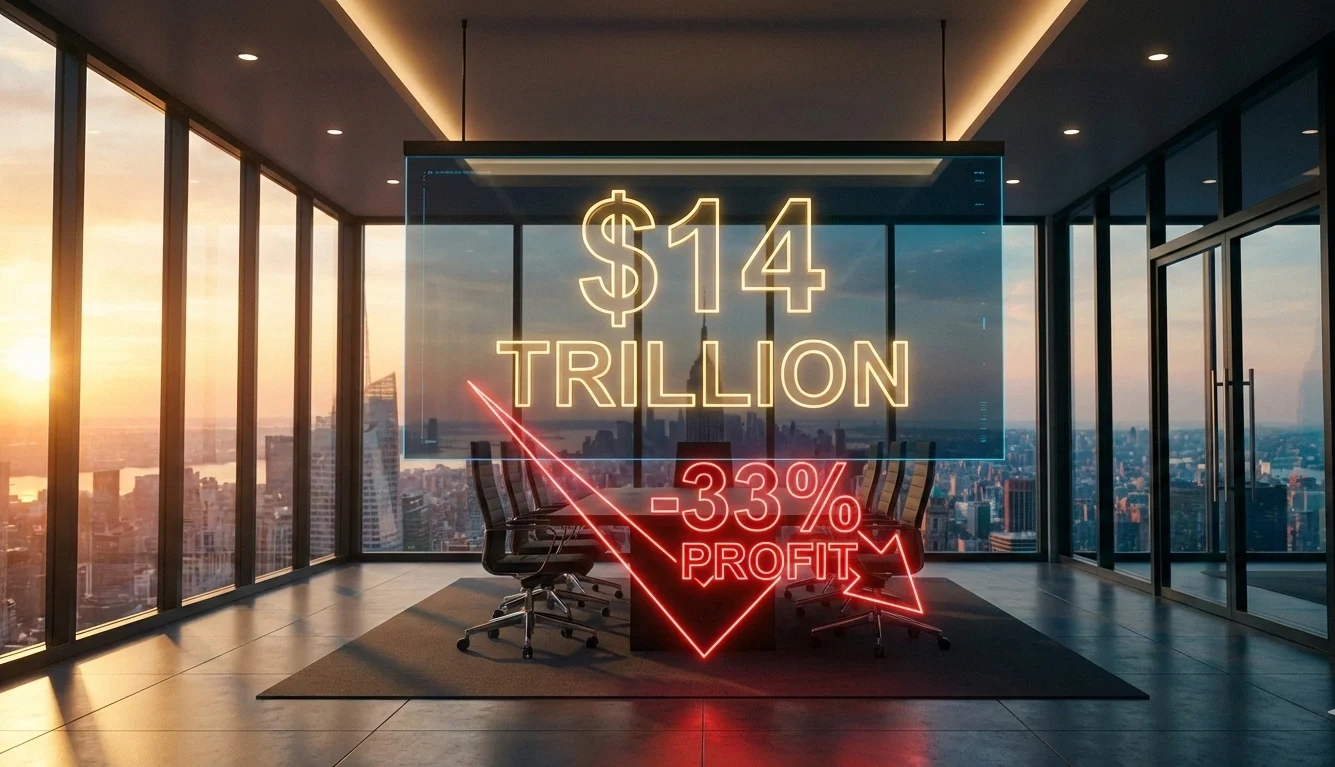
In global finance, numbers often tell two conflicting stories. Today, BlackRock (NYSE: BLK) released its Q4 2025 earnings, and the headlines are a masterclass in cognitive dissonance. On one hand, Larry Fink’s empire has officially crossed the $14 trillion Assets Under Management (AUM) threshold—a figure so vast it exceeds the GDP of every nation on Earth except the U.S. and China.
On the other hand, the firm’s net income plummeted by 33% year-over-year to $1.13 billion.
To the casual observer, this looks like a leak in the hull. To a Political Economy Analyst, it’s a calculated pivot. We are witnessing the “Great Compression” of the asset management industry, where the race to the bottom in fees is forcing the world’s largest liquidity provider to cannibalize its short-term profits to buy a long-term seat at the “Private Markets” table.
1. The AUM Illusion: Scaling to $14 Trillion in a Low-Yield World
The $14 trillion milestone is a testament to the relentless “flywheel” effect of passive index dominance. In 2025, BlackRock saw record quarterly net inflows of $342 billion, driven largely by the iShares ETF engine.
However, AUM is a vanity metric if the operating margins are under siege. The reality of Institutional Liquidity 2026 is that traditional beta (market tracking) has become a commodity. When everyone can own the S&P 500 for nearly zero basis points, the “World’s Largest Money Manager” title becomes a burden of scale.
Why the AUM Record Matters:
- Geopolitical Leverage: With $14T, BlackRock isn’t just a firm; it’s a sovereign-level entity.
- Data Supremacy: Its Aladdin platform now processes more data than most national central banks.
- The Passive Trap: As more capital flows into indexes, market discovery weakens, creating the very volatility BlackRock’s active “Alts” team hopes to exploit.
2. The 33% Profit Dive: Empire Building Isn’t Cheap
The most jarring figure in the report is the 33% drop in net income. In an era where the S&P 500 grew 16% in 2025, how does the house lose money?
The answer lies in Strategic M&A and Integration Costs. Throughout 2024 and 2025, BlackRock went on a shopping spree, acquiring Global Infrastructure Partners (GIP) and HPS Investment Partners. These weren’t just “bolt-on” acquisitions; they were a total re-engineering of the firm’s DNA.
“We are transitioning from being a provider of index exposure to a provider of whole-portfolio solutions,” Larry Fink noted in his2025 Shareholder Letter Analysis.
This “one-time” income hit is the price of admission to Private Credit and Infrastructure. BlackRock is betting that the future of profit isn’t in stocks—it’s in data centers, power grids, and private loans that bypass the traditional banking system.
3. The Political Economy of “Private Assets in Public Hands”
From a political economy perspective, BlackRock’s 2025 performance signals the de-banking of the global economy. As traditional banks face tighter capital requirements under Basel IV, BlackRock is stepping in as the “Shadow Lender of Last Resort.”
With $423 billion in alternative assets, the firm is positioning itself to fund the global AI infrastructure boom. This creates a new power dynamic: Institutional Liquidity vs. State Sovereignty. When a single firm manages $14 trillion, its “Investment Stewardship” guidelines carry more weight than many national environmental or labor laws.
4. The 2026 Outlook: Margin Compression vs. Tokenization
As we look toward 2026, the Asset Management Margin Compression trend will likely accelerate. To combat this, keep an eye on two “Platinum-level” shifts:
- The 50/30/20 Portfolio: Fink is successfully moving institutions away from the 60/40 split into a model that allocates 20% to private markets. This is where the 33% profit dip will be recouped—private market fees are 5x to 10x higher than ETF fees.
- Asset Tokenization: By moving real-world assets onto the blockchain, BlackRock aims to slash settlement costs. If they can tokenize even 1% of their $14T AUM, the operational efficiencies would send net income to record highs by 2027.
Verdict: A “Buy” on the Dip of the Century?
BlackRock’s 33% profit drop is a “red herring” for the uninformed. For the Technical SEO Specialist and the Economic Analyst, it is a signal of a massive capital reallocation. They are sacrificing the “Old World” (low-margin ETFs) to dominate the “New World” (high-margin infrastructure and private credit).
The Bottom Line: Don’t fear the 33% drop. Respect the $14 trillion reach.
Discover more from The Economy
Subscribe to get the latest posts sent to your email.


Analysis
KOSPI Record Crash: South Korea’s Stock Market Suffers Its Worst Day in History as the US-Iran War Detonates a Global Sell-Off
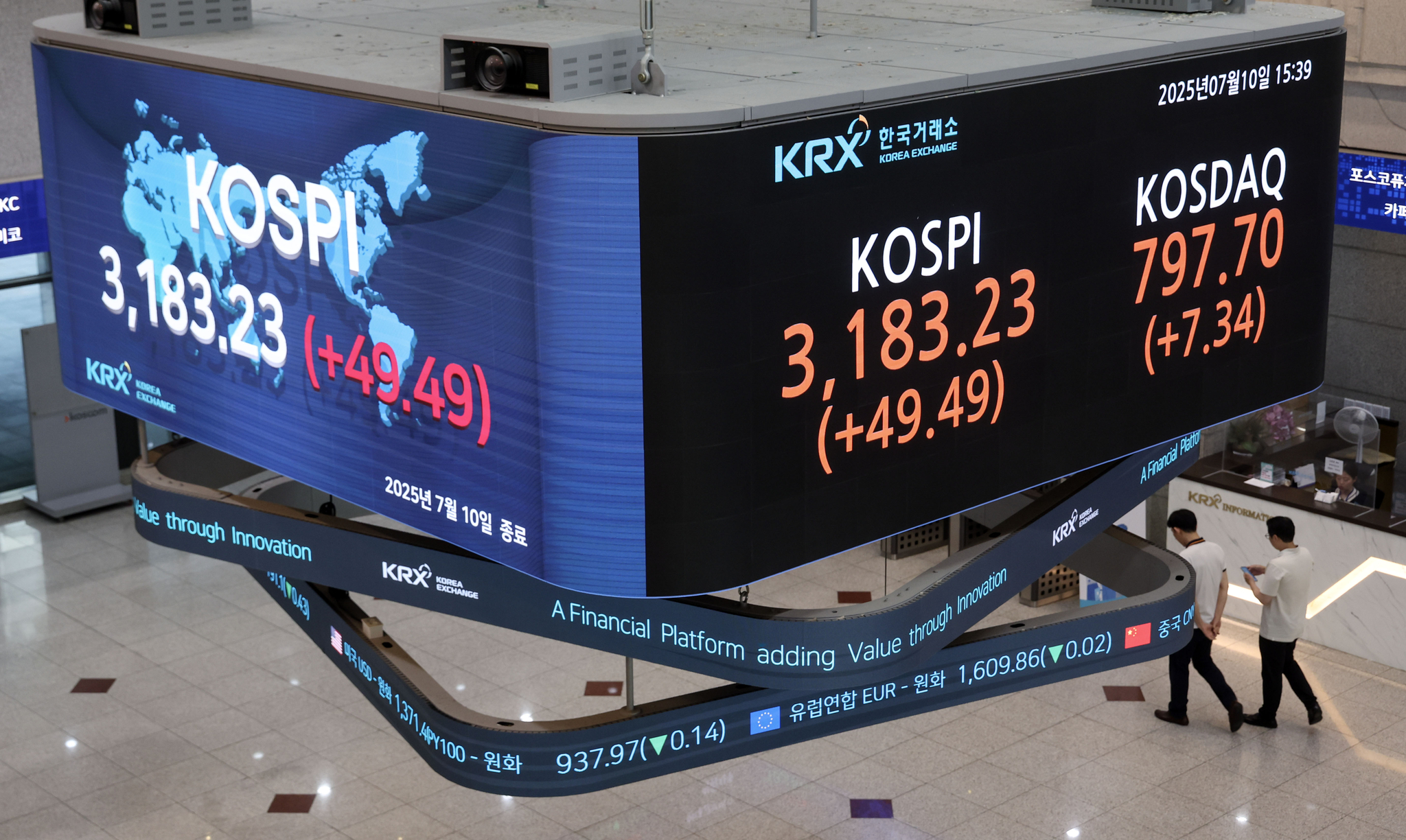
At 9:03 a.m. Korean Standard Time, the screens inside the Korea Exchange trading hall in Yeouido, Seoul, turned a uniform, searing red. Within minutes, the sell orders were not arriving in waves — they were arriving like a flood breaking through a dam. Algorithms fired. Margin calls cascaded. Retail investors, who only weeks ago were borrowing money to buy Samsung Electronics at record highs, watched years of gains dissolve in real time. By 9:17 a.m., trading had been suspended for twenty minutes: the circuit breaker, a mechanism designed for exactly this kind of controlled catastrophe, had triggered for just the seventh time in the KOSPI’s 43-year history.
By the closing bell, South Korea’s benchmark index had shed 12.06 percent — 698.37 points — to close at 5,093.54. It was the worst single day in the KOSPI’s recorded history, surpassing even the paralysing shock of September 11, 2001. The world’s hottest major stock market, up more than 40 percent in just two months, had just been broken — not by a domestic crisis, not by a company scandal, but by missiles fired 6,000 kilometres away in the Persian Gulf.
What Happened: A Minute-by-Minute Collapse
The trigger was a week in the making. On the morning of February 28, 2026, US and Israeli forces launched a coordinated series of airstrikes against Iran, an operation that reportedly included the assassination of Supreme Leader Ali Khamenei. Iran’s response was swift and economically calculated: the Islamic Revolutionary Guard Corps announced a closure of the Strait of Hormuz, the narrow chokepoint through which roughly 20 million barrels of crude oil transit daily — accounting for approximately 20 percent of global supply.
South Korean markets were closed on Monday, March 2, for Independence Movement Day. When trading reopened Tuesday morning, the pent-up global selling pressure — two full days of deteriorating sentiment compressed into a single session — hit simultaneously. The KOSPI fell 7.24 percent on Tuesday, closing at 5,791.91, its largest single-session point drop on record at that time.
Wednesday brought something far worse.
The timeline:
- 09:00 KST — KOSPI opens at 5,592.29, already down sharply from Tuesday’s close.
- 09:08 KST — Circuit breaker triggered on the KOSDAQ after losses exceed 8 percent; trading suspended 20 minutes.
- 09:14 KST — KRX activates sidecar mechanism on the KOSPI as sell orders overwhelm buy-side liquidity.
- 09:17 KST — KOSPI circuit breaker fires. At the time of the halt, the index is down 469.75 points — 8.11 percent — to 5,322.16.
- 09:37 KST — Trading resumes. Selling immediately intensifies.
- 11:20 KST — KOSPI reaches intraday low of 5,059.45, down 12.65 percent — the worst intraday reading in 25 years and 11 months.
- 15:30 KST — Official close: 5,093.54, down 12.06 percent. Of the more than 800 stocks on the benchmark, just 10 finish in the green.
The KOSDAQ, South Korea’s technology-heavy secondary index, fared even worse, closing down 14 percent at 978.44 — its largest single-day decline since its founding in January 1997. The combined two-day equity wipeout erased an estimated $430 billion in market value.
Why South Korea Was Hit Hardest: The Anatomy of a Perfect Storm
Every major economy felt the tremor of the Iran conflict on March 4. But none — not Japan, not Taiwan, not China — fell anything close to what Seoul experienced. The gap is not coincidental. It is structural.
Energy dependence, extreme and existential. South Korea imports approximately 98 percent of its fossil fuels, with around 70 percent of its crude oil sourced from the Middle East, much of it transiting the Strait of Hormuz. According to the US Energy Information Administration, South Korea ranks among the top importers of Hormuz-transit crude globally. When Iran threatened to close — and partially did close — that chokepoint, the calculus for Korean manufacturers and energy utilities changed instantly. Higher oil does not merely raise input costs; it compresses margins across the entire export-driven economy, stokes inflation, and pressures the current account. Nomura estimates that South Korea’s net oil imports represent 2.7 percent of GDP — among the highest of any major economy and a stark vulnerability flag in any energy shock scenario.
Semiconductor concentration, a double-edged sword. The KOSPI’s extraordinary 2026 rally — up more than 40 percent in the first two months of the year, touching an all-time high above 6,347 in late February — was almost entirely the story of two companies: Samsung Electronics and SK Hynix. Together, the two memory chip giants account for close to 50 percent of the index by market capitalisation, according to Morningstar equity research. When sentiment turned, that concentration did not merely reflect the market’s decline — it amplified it. Samsung Electronics fell 11.74 percent to 172,200 won. SK Hynix dropped 9.58 percent to 849,000 won. Hyundai Motor collapsed 15.80 percent. Kia Corp shed 13.82 percent. Shipping stocks Pan Ocean, HMM, and KSS Line — directly exposed to Hormuz route disruption — plunged between 16 and 19 percent.
As Lorraine Tan, Asia director of equity research at Morningstar, noted, “The decline in the KOSPI can broadly be attributable to the single-name concentration that we see in Korean markets.” She added that the drop also implied growing concern that AI data-centre adoption could slow due to significantly higher energy costs — a double hit for chips stocks caught between geopolitical risk and demand uncertainty.
Margin debt: the accelerant. Before the conflict erupted, South Korean retail investors had borrowed heavily to ride the bull market. Margin debt and broker deposits had surged to record highs. When prices began to fall, those leveraged positions triggered forced liquidations, turning an orderly retreat into a rout. “There’s been a lot of buying on credit, especially in the heavyweight stocks,” Kim Dojoon, chief executive of Zian Investment Management, told Bloomberg. “If there’s another drop on Thursday, nobody will catch a falling knife.”
The holiday amplifier. Monday’s market closure meant that South Korean markets absorbed two full days of global deterioration in a single session on Tuesday — and then suffered a second cascading wave on Wednesday, with no circuit of relief between them.
Historical Benchmark: Into Uncharted Territory
To understand the magnitude of what happened in Seoul on March 4, 2026, consider the events it eclipses.
The KOSPI has recorded a decline of 10 percent or more in a single session on only four occasions in its 43-year history. According to the Korea Herald and historical KRX data, those occasions are:
| Date | Event | KOSPI Decline |
|---|---|---|
| April 17, 2000 | Dot-com bubble peak | -11.63% |
| September 12, 2001 | Post-9/11 shock | -12.02% |
| October 24, 2008 | Global Financial Crisis | -10.57% |
| March 4, 2026 | US-Iran War | -12.06% |
The September 12, 2001 session had stood for nearly 25 years as the single worst day in South Korean market history — a day when global commerce froze and the world reoriented around fear. Wednesday’s close eclipsed it by a margin of 0.04 percentage points. The intraday low — 12.65 percent — was the deepest since April 17, 2000.
The KOSDAQ’s 14 percent plunge, meanwhile, surpassed its previous worst session: the 11.71 percent rout of March 19, 2020, at the nadir of the COVID-19 pandemic panic. What happened this week in Seoul did not merely set a record. It rewrote the category entirely.
What makes the comparison to 2001 particularly sobering is context. On September 12, 2001, markets around the world fell together. In 2026, Wall Street is barely flinching: the S&P 500 fell approximately 1 percent overnight. The KOSPI’s collapse is not a global synchronised shock — it is something more targeted, and in some ways more alarming: a geopolitical vulnerability unique to South Korea’s economic structure being stress-tested in real time.
Global Contagion: Oil, Currencies, and the Hormuz Premium
Seoul was the epicentre, but the aftershocks radiated across the region and beyond.
Oil. Brent crude surged 10–13 percent in the days following the initial strikes, trading around $80–82 per barrel by March 2–4, according to energy analysts cited by Reuters. Analysts warned that if the Hormuz disruption proves sustained, prices could breach $100 per barrel — a level that would add an estimated 0.8 percentage points to global inflation, according to projections cited in the economic impact assessment published by Wikipedia. Natural gas prices in Europe surged 38 percent following reported attacks on Qatari LNG export facilities.
The Korean won. The currency markets told the same story in different decimal places. The won briefly pierced 1,500 per dollar on Wednesday — a level not seen since March 10, 2009, at the nadir of the global financial crisis. It was, psychologically, an enormous threshold. Yan Wang, chief of emerging markets at Alpine Macro, told the Korea Herald that the Korean won is historically “one of the most sensitive emerging market currencies to global risk sentiment,” while cautioning that fundamentals do not justify such weakness unless the conflict drags on significantly.
Asian markets. The contagion spread, though nowhere matched Seoul’s severity:
- Japan Nikkei 225: -3.61% to 54,245.54
- Taiwan TAIEX: -4.40% to 32,829
- Hong Kong Hang Seng: -2.00% to 25,249.48
- Shanghai Composite: -1.00% to 4,082.47
The asymmetry is instructive. China, a major oil importer, absorbed the shock with relative composure — partly due to its diversified energy sourcing and partially because domestic policy responses appeared pre-positioned. Japan and Taiwan, similarly dependent on Middle East energy, fell meaningfully but remained far above Korean levels, their indices lacking the same speculative leverage overhang.
Travel and supply chains. Iran’s airspace was closed to civilian aircraft following the initial strikes on February 28. Multiple carriers suspended Middle East routes, with knock-on effects for travel and tourism across the Gulf. Shipping insurance costs for Hormuz-transit tankers surged, with analysts suggesting the “war premium” could add $5–15 per barrel to delivered oil costs regardless of military escort arrangements — a persistent, structural cost increase for energy importers like South Korea.
Three Scenarios: What Comes Next
The trajectory of South Korea’s markets now depends almost entirely on one variable: how long the conflict lasts, and whether the Strait of Hormuz reopens to normal commercial traffic.
Scenario 1 — Rapid Resolution (probability: 30%) The US achieves its stated military objectives within four to five weeks, as President Trump publicly signalled. Iranian counter-retaliation is contained. Oil retreats to sub-$80. In this scenario, the structural case for Korean equities reasserts itself quickly — AI memory demand remains intact, Samsung and SK Hynix resume margin expansion, and the KOSPI, still up approximately 21 percent year-to-date even after the crash, stages a sharp technical rebound. Forced liquidations reverse. Analysts at Seoul-based brokerages place a 10 percent rebound in the first week post-ceasefire as the base case for this outcome.
Scenario 2 — Prolonged Stalemate (probability: 50%) The conflict extends beyond one month. The Strait of Hormuz remains partially disrupted. Oil stabilises in the $85–95 range. South Korea’s current account balance deteriorates. The Bank of Korea is forced to weigh currency intervention against inflation pressures — a familiar but painful dilemma for an open economy. The KOSPI finds a floor in the 4,800–5,000 range as earnings revisions bite. Recovery is slow, uneven, and dependent on semiconductor demand holding firm even as energy costs rise. Foreign investors remain cautious.
Scenario 3 — Full Energy Shock (probability: 20%) The conflict escalates into a sustained regional war. Hormuz closes effectively for multiple months. Crude reaches $100 or beyond. In this scenario, Hyundai Research Institute’s earlier estimate — that sustained $100 crude could shave 0.3 percentage points from South Korea’s 2026 GDP growth — becomes conservative. The KOSPI potentially tests 4,000. The Bank of Korea is forced into emergency rate decisions. The IMF revises Asian growth projections downward across the board. Global stagflation risks — higher energy prices coinciding with slower growth — re-enter the policy conversation for the first time since 2022.
Investor Playbook and Policy Response
What regulators and institutions are doing. The Bank of Korea issued a statement vowing to “respond to herd-like behaviour” in financial markets and pledged liquidity support measures if volatility persisted. The Korea Exchange activated circuit breakers and sidecar mechanisms as designed, but market participants noted that the tools slowed rather than stopped the cascade. Foreign investors, after dumping more than 12 trillion won in equities over the two-session period, ended Wednesday as modest net buyers — 231.2 billion won in net purchases — a tentative signal that some institutional money saw the dislocation as an entry point.
BofA’s take. “The sharp decline reflects the outsized leverage in long positions heading into February 28, 2026, when market sentiment was highly bullish on Korean tech due to the aggressive shortage of memory chips used in AI server production,” BofA strategist Chun Him Cheung told Investing.com. The implication: this was not a fundamental repricing of Korea’s economic future — it was a positioning purge, painful but potentially creating opportunity.
Where rational capital might look. For investors with a six-to-twelve-month horizon, the crash has produced a rare dislocation between price and fundamental value in high-quality names. Samsung Electronics and SK Hynix — despite their catastrophic session — retain structural leadership positions in AI-grade memory chips, a market with no near-term substitute suppliers. Analysts at IM Securities and Renaissance Asset Management both noted that if the conflict resolves within one month, a rebound toward 5,500–5,800 on the KOSPI is plausible. Defensive plays in South Korean energy utilities, domestic-demand retailers, and defence contractors — which have benefited from the same geopolitical tension that crushed the broader market — offer asymmetric positioning.
For retail investors caught in forced liquidations, the message is sobering but familiar: leverage borrowed at the peak of euphoria is the most reliable way to transform a geopolitical shock into a personal financial crisis.
Conclusion: The Price of Being the World’s Hottest Market
There is a painful irony at the heart of what happened to South Korea’s stock market this week. The KOSPI was, by virtually every measure, the world’s best-performing major equity index in early 2026. It rose on the back of genuine structural tailwinds — AI memory demand, corporate governance reforms, a re-rating of Korea’s innovation economy by global fund managers. The 40-percent rally in two months was not pure speculation; it was grounded in earnings.
But markets running that fast accumulate fragility. Leverage builds. Concentration intensifies. The margin for error narrows. When an external shock arrives — not a Korean shock, not a chip-sector shock, but a missile fired in the Persian Gulf — there is no buffer. The circuit breakers fired at 9:17 a.m. and could not stop what came afterward.
The KOSPI’s record-breaking crash is not, in isolation, a verdict on South Korea’s economic future. The structural case for its semiconductor giants remains intact. The reforms that re-rated the market over the past year have not been reversed. What has changed is the risk premium: an economy that earns its export surplus in silicon must pay for its energy in oil, and oil now carries a war premium that markets cannot price with confidence.
The Strait of Hormuz is 39 kilometres wide at its narrowest point. For South Korea, that passage has never felt smaller.
FAQs (FREQUENTLY ASKED QUESTIONS)
Q1: Why did South Korea’s stock market fall more than any other country’s during the US-Iran war? South Korea’s extreme vulnerability stems from three intersecting factors: it imports approximately 98 percent of its fossil fuels, with around 70 percent sourced from the Middle East via the Strait of Hormuz; its benchmark KOSPI index is heavily concentrated in semiconductor stocks (Samsung and SK Hynix account for close to half the index’s market cap) that had rallied more than 40 percent in early 2026 on margin debt; and a public holiday on Monday March 2 compressed two days of global selling into a single catastrophic Tuesday session.
Q2: How does the March 4, 2026 KOSPI crash compare to the September 11, 2001 drop? The KOSPI fell 12.06 percent on March 4, 2026, narrowly eclipsing the 12.02 percent decline recorded on September 12, 2001, the day after the 9/11 attacks. The intraday low of 12.65 percent was the deepest since April 17, 2000. It is now the worst single-day session in the KOSPI’s 43-year recorded history, surpassing four prior instances of 10-percent-plus declines including those during the dot-com bubble, 9/11, and the 2008 global financial crisis.
Q3: What happened to the Korean won during the KOSPI crash? The Korean won fell sharply during the two-day rout, briefly breaching 1,500 per dollar on Wednesday March 4 — a level not seen since March 2009 at the depth of the global financial crisis — before closing around 1,466 per dollar. The Bank of Korea vowed to respond to “herd-like behaviour” in currency markets and signalled readiness for intervention if volatility persisted.
Q4: Will South Korea’s stock market recover from the US-Iran war selloff? The outlook depends heavily on the duration of the conflict and whether the Strait of Hormuz reopens to normal commercial shipping. Most Seoul-based analysts see two primary scenarios: a quick resolution (within four to five weeks) that triggers a sharp technical rebound toward 5,500–5,800 on the KOSPI, or a prolonged stalemate that sees the index finding a floor near 4,800–5,000 as earnings are revised downward. The structural bull case — driven by AI memory chip demand and corporate governance improvements — has not been invalidated, but the energy-price risk premium has risen substantially.
Discover more from The Economy
Subscribe to get the latest posts sent to your email.
Discover the world’s strongest currencies in 2026 — ranked by exchange value, economic backing & purchasing power. From Kuwait’s $3.27 dinar to the Swiss franc’s unmatched stability, the definitive guide.
Where Money Is Worth More Than You Think
There is a question that unsettles most travellers the moment they land at an unfamiliar airport and squint at a currency board: how much, exactly, is this money worth? The instinct is to reach for the US dollar as a yardstick — to ask, almost reflexively, whether the local note in your hand represents more or less than a single greenback. That reflex is understandable. The dollar remains, by a vast margin, the most traded and most held reserve currency on the planet. But it is not the strongest.
That distinction belongs to a small Gulf emirate whose population would fit comfortably inside greater Manchester, and whose currency has quietly dominated every global ranking for more than two decades. It is joined on the podium by neighbours whose names rarely make mainstream financial headlines, and by a landlocked Alpine republic whose monetary tradition has become almost mythological in global finance circles.
Currency strength is, of course, a deceptively complicated concept. A high nominal exchange rate — the number of US dollars one unit of a foreign currency can buy — is the most intuitive measure, but it captures only part of the picture. Purchasing power parity (PPP), the stability of the issuing central bank, inflation history, current-account balances, and forex reserve depth all feed into a fuller assessment of monetary credibility. The rankings below attempt to honour that complexity: they are ordered primarily by nominal value against the USD as of early March 2026, but enriched with structural and macroeconomic context at every step.
For travellers, the implications are vivid and practical: a strong home currency means your holiday budget stretches further in weaker-currency markets. For investors, it signals where monetary policy is disciplined, inflation is tamed, and capital preservation is most plausible. For economists, it is a mirror of a nation’s fiscal choices — and occasionally its geological luck.
Here, then, is the definitive ranking of the world’s strongest currencies in 2026.

Methodology: How We Ranked the World’s Strongest Currencies
Ranking currencies by strength is not a single-variable exercise. Our methodology combines four weighted criteria:
1. Nominal exchange rate vs. USD (primary weight: 50%) — the most cited metric globally; how many US dollars one unit of the currency buys as of early March 2026.
2. Purchasing Power Parity (PPP) and domestic price stability (25%) — drawing on the IMF World Economic Outlook database and World Bank ICP data to assess what each currency actually buys at home.
3. Central bank credibility, forex reserves, and current-account balance (15%) — using BIS data, central bank publications, and IMF Article IV consultations.
4. Long-term inflation track record and monetary regime stability (10%) — a currency pegged rigidly to the dollar for decades earns credit for predictability; a currency that preserved purchasing power across multiple global crises earns even more.
Geographic territories whose currencies are pegged 1:1 to a sovereign currency (Gibraltar Pound, Falkland Islands Pound) are noted but not separately ranked; they effectively mirror their parent currency’s fundamentals.
The World’s Strongest Currencies in 2026: Comparative Table
| Rank | Country / Territory | Currency | Code | Value vs. USD (Mar 2026) | 1-Year Change | Exchange Regime |
|---|---|---|---|---|---|---|
| 1 | Kuwait | Kuwaiti Dinar | KWD | ≈ $3.27 | Stable (±0.5%) | Managed basket peg |
| 2 | Bahrain | Bahraini Dinar | BHD | ≈ $2.66 | Stable (fixed) | Hard USD peg |
| 3 | Oman | Omani Rial | OMR | ≈ $2.60 | Stable (fixed) | Hard USD peg |
| 4 | Jordan | Jordanian Dinar | JOD | ≈ $1.41 | Stable (fixed) | Hard USD peg |
| 5 | United Kingdom | Pound Sterling | GBP | ≈ $1.26 | −1.8% | Free float |
| 6 | Cayman Islands | Cayman Dollar | KYD | ≈ $1.20 | Stable (fixed) | Hard USD peg |
| 7 | Switzerland | Swiss Franc | CHF | ≈ $1.13 | +2.1% | Managed float |
| 8 | European Union | Euro | EUR | ≈ $1.05 | −1.2% | Free float |
| 9 | Singapore | Singapore Dollar | SGD | ≈ $0.75 | +1.4% | NEER-managed |
| 10 | United States | US Dollar | USD | $1.00 | Benchmark | Free float |
Exchange rates are indicative mid-market values, early March 2026. Sources: Central Bank of Kuwait, Central Bank of Bahrain, Central Bank of Oman, Bloomberg, Reuters.
#10 — United States: The Dollar That Rules the World (Even When It Isn’t the Strongest)
USD/USD: 1.00 | Reserve share: ~56% of global FX reserves (IMF COFER, mid-2025)
It would be intellectually dishonest to construct any list of monetarily significant currencies without beginning — or in this case, ending — with the US dollar. Technically ranked tenth by nominal exchange rate, the dollar’s omission from any strong-currency discussion would be absurd. It is the global reserve currency, the denomination of roughly 90% of all international foreign-exchange transactions, and the standard against which every other currency on this list is measured.
The dollar’s structural power derives not from its face value but from the depth and liquidity of US capital markets, the legal enforceability of US-dollar-denominated contracts, and the unrivalled network effects that come from decades of institutional entrenchment. When the world is frightened — by a banking crisis, a pandemic, or a geopolitical rupture — capital flows into dollars, not away from them. That is the ultimate credential.
The Federal Reserve’s aggressive rate-hiking cycle of 2022–2023 temporarily turbocharged the greenback to multi-decade highs. Since then, a gradual easing cycle has modestly softened the dollar index (DXY), which hovered around the mid-100s range in early 2026. Yet its dominance in global trade invoicing and central bank reserves remains essentially unchallenged.
Travel angle: For American travellers abroad, the dollar’s reserve status means widespread acceptance and generally favourable conversion, particularly in emerging markets. The caveat: in the Gulf states above the dollar on this list, the local currencies are pegged to the dollar, so there is no exchange-rate advantage — the mathematics are already baked in.
#9 — Singapore: The Asian Precision Instrument
SGD/USD: ≈ 0.75 | Inflation: ~2.1% (MAS, 2025) | Current account: strong surplus
Singapore manages its currency with the kind of institutional exactitude one might expect from a city-state that has spent sixty years treating good governance as a competitive export. The Monetary Authority of Singapore (MAS) does not set interest rates in the conventional sense; it manages the Singapore dollar’s value against an undisclosed basket of currencies through a “nominal effective exchange rate” (NEER) policy band — a mechanism that gives it enormous flexibility to use currency appreciation as an anti-inflation tool.
The result is a currency that, while not high in nominal USD terms, has consistently outperformed peers in Asia on purchasing-power stability. Singapore’s AAA sovereign credit rating (Standard & Poor’s, Fitch), perennially current-account surplus, and status as Asia’s pre-eminent financial hub all feed into the SGD’s credibility premium. The SGD appreciated modestly against the dollar in 2025 as MAS maintained a slightly appreciating NEER slope — a deliberate policy response to residual imported inflation from elevated global commodity prices.
For investors, the Singapore dollar is one of very few Asian currencies worth holding as a diversification tool in a hard-currency portfolio. For travellers from weaker-currency nations, Singapore’s cost of living will feel punishing — this is, after all, consistently one of the world’s most expensive cities. But that high cost is the precise reflection of the currency’s strength.
#8 — The Euro: Collective Strength, Individual Tensions
EUR/USD: ≈ 1.05 | ECB deposit rate: 2.25% (as of Feb 2026) | Eurozone GDP growth: ~0.9% (IMF 2026 forecast)
The euro is the world’s second most traded currency and the reserve currency of choice after the dollar, held in roughly 20% of global central bank foreign exchange portfolios. It represents the collective monetary credibility of twenty nations — a fact that is simultaneously its greatest source of strength and its most persistent structural vulnerability.
The European Central Bank’s prolonged rate-hiking campaign of 2022–2024 was executed with more determination than many in financial markets expected, and it produced results: eurozone core inflation fell from its 2022 peak of above 5% to below 2% by mid-2025, a trajectory that restored considerable credibility to the ECB’s inflation-targeting framework. The subsequent easing cycle has been cautious; the deposit rate stood at approximately 2.25% in early 2026, a level the ECB’s governing council has characterised as still moderately restrictive.
The euro’s Achilles heel remains the fiscal divergence between its member states. Germany’s near-recessionary growth in 2024–2025, combined with France’s persistent budget deficit challenges and Italy’s elevated debt-to-GDP ratio (above 135%), keeps sovereign risk premia alive in bond markets and periodically unsettles the currency. Still, the Eurozone’s aggregate current-account position is in surplus, and the ECB’s “Transmission Protection Instrument” — its bond-buying backstop — has effectively capped the threat of another existential sovereign debt crisis for now.
Travel angle: For USD- or GBP-holders, the euro’s current rate around $1.05 represents a relatively modest barrier. Western European travel remains expensive not because of the exchange rate but because of local price levels — a function of high wages and robust social provision rather than currency manipulation.
#7 — Switzerland: The Safe-Haven That Earned Its Reputation
CHF/USD: ≈ 1.13 | SNB policy rate: 0.25% | Inflation: ~0.3% (SNB, Feb 2026) | Current account surplus: ~9% of GDP
If the Kuwaiti dinar wins on headline exchange rate, the Swiss franc wins on something arguably more impressive: institutional longevity. Switzerland has managed its monetary affairs with such consistent discipline that the franc has preserved real purchasing power across multiple global crises, two world wars (in which Switzerland remained neutral), the collapse of the Bretton Woods system, the 2008 global financial crisis, and the COVID-19 shock. That record of monetary continuity, spanning more than 175 years since the franc’s introduction in 1850, is essentially without parallel among modern fiat currencies.
The Swiss National Bank (SNB) operates with an independence and a long-termism that remains the envy of its peers. Its mandate — price stability, defined as annual CPI inflation of 0–2% — has been met with remarkable consistency. Swiss inflation in early 2026 stood at approximately 0.3%, one of the lowest in the developed world, and a reflection of the SNB’s willingness in previous years to tolerate the economic pain of a strong franc (which reduces import costs and anchors domestic prices) rather than engineer currency weakness for short-term competitiveness.
Switzerland’s current-account surplus, running at roughly 9% of GDP, reflects a country that consistently exports more value than it imports — in pharmaceuticals, precision machinery, financial services, and, of course, the world’s most trusted watches. That structural external surplus is a bedrock of franc credibility.
The SNB’s policy rate stood at 0.25% in early 2026 — low, because very low inflation means there is no need for restrictive policy. The franc’s strength is not conjured by high interest rates attracting hot capital; it is built on structural surpluses, institutional credibility, and a century and a half of monetary conservatism.
Investor angle: The CHF remains one of the most reliable safe-haven plays in global markets. When geopolitical risk flares — and it has consistently done so across 2024–2026 — capital rotates into the franc. Its appreciation during such episodes is the price of insurance.
#6 — Cayman Islands: Offshore Stronghold, Surprising Currency
KYD/USD: 1.20 (fixed since 1974) | Sector: International financial centre
The Cayman Islands may be small — approximately 65,000 residents across three Caribbean islands — but their currency punches well above its geographic weight. The Cayman Islands dollar has been pegged to the US dollar at a fixed rate of 1.20 since 1974, a peg that has held without interruption for over five decades.
The peg is sustainable because the Cayman Islands economy generates exceptional foreign currency inflows. As one of the world’s leading offshore financial centres, the Cayman Islands hosts thousands of hedge funds, private equity vehicles, structured finance vehicles, and the regional offices of major global banks. This financial infrastructure creates persistent capital inflows that underpin the peg’s credibility without recourse to the kind of oil revenues that sustain Gulf currencies.
The absence of direct taxation — no corporate tax, no income tax, no capital gains tax — also functions as a structural attractor for international capital, further reinforcing demand for the local currency.
For travellers, the Cayman Islands’ combination of strong currency and luxury resort economy makes it one of the Caribbean’s more expensive destinations. But that premium reflects something real: it is, genuinely, one of the most politically stable and financially sophisticated jurisdictions in the Western Hemisphere.
#5 — United Kingdom: History’s Most Enduring Major Currency
GBP/USD: ≈ 1.26 | Bank of England base rate: 4.25% (Feb 2026) | UK GDP growth forecast: 1.3% (IMF 2026)
The pound sterling has a plausible claim to being the world’s oldest currency still in active use. Predating the United States by more than a millennium in its earliest forms, sterling carries the weight of institutional memory — and the scars of historical crises, from the 1976 IMF bailout to Black Wednesday in 1992 to the post-Brexit adjustment of 2016. That the pound has navigated all of this and still trades above $1.25 says something significant about the resilience of UK monetary institutions.
The Bank of England, established in 1694, has been on a cautious easing path since mid-2024, reducing its base rate from the post-pandemic peak of 5.25% to 4.25% by early 2026 as UK inflation — which ran brutally hot in 2022–2023 — returned closer to the 2% target. Core CPI had moderated to approximately 2.7% by early 2026, still slightly elevated but no longer the acute political crisis it was.
The UK’s economic structure — highly service-oriented, with the City of London representing one of the world’s two or three most important financial centres — means sterling’s value has always been intimately connected to confidence in UK financial governance. Post-Brexit trade frictions have not destroyed that confidence, though they have permanently restructured some trade flows and depressed productivity estimates.
Travel angle: Sterling’s strength makes UK residents among the best-positioned travellers in the world, particularly when visiting North Africa, South-East Asia, or Eastern Europe, where exchange rate differentials translate into substantial purchasing power advantages. The pound buys significantly more in emerging markets today than it did five years ago.
#4 — Jordan: Strength Without Oil
JOD/USD: 1.41 (fixed peg) | Inflation: ~2.8% | IMF programme: Extended Fund Facility (ongoing)
Jordan’s presence in the top four is the most intellectually interesting entry on this list, because it is a standing refutation of the narrative that strong currencies require oil. Jordan has no significant hydrocarbon reserves. Its economy depends on phosphate exports, manufacturing, services, remittances from a large diaspora, foreign aid — primarily from the United States, Saudi Arabia, and the EU — and its strategic geopolitical position at the intersection of three continents and several of the region’s most complex political dynamics.
The Jordanian dinar has been pegged to the US dollar at a fixed rate of 0.709 JOD per dollar (implying approximately $1.41 per dinar) since 1995, a commitment the Central Bank of Jordan has maintained through multiple regional crises — the 2003 Iraq war, the 2011 Arab Spring, the Syrian refugee crisis (Jordan hosts one of the world’s largest refugee populations relative to its size), and the ongoing regional tensions of 2024–2025.
The peg’s credibility is purchased at a fiscal cost: Jordan must maintain sufficient foreign exchange reserves to defend it, which constrains domestic monetary flexibility and requires disciplined fiscal policy, often in collaboration with IMF structural adjustment programmes. That discipline — painful as it has periodically been — is precisely what makes the dinar’s high nominal value sustainable.
Investor angle: The JOD peg makes Jordan one of the more predictable currency environments in the Middle East, which partly explains why Amman has attracted meaningful foreign direct investment in logistics, technology, and pharmaceuticals in recent years.
#3 — Oman: The Prudent Gulf State
OMR/USD: 2.60 (fixed peg) | Oil production: ~1 mbpd | Moody’s rating: Ba1
The Omani rial’s fixed exchange rate of 2.6008 USD per rial has been unchanged for decades — a testament to the consistency of Oman’s monetary framework. Like its Gulf neighbours, Oman’s currency strength is anchored in hydrocarbon wealth, but the sultanate has pursued a more earnest diversification agenda than some of its neighbours, with meaningful investment in tourism, logistics, fisheries, and renewable energy under its Vision 2040 framework.
Oman’s fiscal position has improved markedly since the turbulence of the low-oil-price years of 2015–2016, when the country ran significant budget deficits and accumulated external debt. Higher oil prices in the early 2020s rebuilt fiscal buffers, and the government has since pursued subsidy reform and revenue diversification with greater determination than before. Moody’s upgraded Oman’s sovereign credit in 2023, reflecting improving balance-of-payment dynamics.
The Central Bank of Oman manages the currency through a currency board-style arrangement, holding sufficient USD reserves to back every rial in circulation at the fixed rate. This mechanistic commitment is what gives the OMR its enviable nominal stability — and what keeps it permanently ranked as the world’s third most valuable currency by exchange rate.
Travel angle: Oman’s strong currency, combined with its emergence as a luxury-eco-tourism destination, means it is not an especially cheap place to visit. But for holders of stronger currencies like the pound or the Swiss franc, the arithmetic is favourable — and Oman’s landscapes, from the Musandam fjords to the Wahiba Sands, make the cost worthwhile.
#2 — Bahrain: The Gulf’s Financial Hub
BHD/USD: 2.659 (fixed peg since 1980) | Financial sector: ~17% of GDP | Moody’s: B2
Bahrain’s dinar has been fixed to the US dollar at 0.376 BHD per dollar — implying approximately $2.66 per dinar — since 2001, maintaining an unchanged peg for a quarter century. That consistency, in a region not historically associated with monetary conservatism, is itself a form of credibility.
Bahrain’s economy is more diversified than Kuwait’s: the financial services sector contributes roughly 17% of GDP, making Manama one of the Gulf’s two dominant financial centres alongside Dubai. The country also has a more developed manufacturing base, including aluminium smelting, and has positioned itself as a regional hub for Islamic finance. This economic diversification is strategically significant because Bahrain has proportionally lower oil reserves than Kuwait or Saudi Arabia — the financial sector was, to some extent, a deliberate hedge against that exposure.
The BHD’s nominal strength is reinforced by Saudi Arabia’s implicit backstop role: the two countries share a causeway, a deep economic relationship, and a security alliance. Saudi Arabia’s vast financial resources have historically been seen as an informal guarantor of Bahraini monetary stability — a factor markets price into the risk premium attached to the dinar’s peg.
Investment angle: Bahrain’s status as a relatively open economy with few capital controls makes the BHD more accessible to international investors than most Gulf currencies. Its fintech regulatory sandbox and digital banking framework have drawn growing interest from global financial institutions in 2024–2025.
#1 — Kuwait: The Uncontested Crown
KWD/USD: ≈ 3.27 | Oil reserves: world’s 6th largest | Inflation: ~2.1% | FX reserves: > $45bn (CBK)
The Kuwaiti dinar is, by the most direct measure available — how many US dollars it takes to buy one unit — the strongest currency in the world. One dinar buys approximately $3.27 at current exchange rates, a premium that has been maintained, with only modest fluctuation, for decades.
Kuwait’s monetary position begins with geology. The country sits atop the world’s sixth-largest proven oil reserves, estimated at approximately 101 billion barrels — a figure that, relative to the country’s population of around 4.3 million citizens (and a total population of roughly 4.7 million including expatriates), represents extraordinary per-capita resource wealth. Oil and petroleum products account for more than 85% of government revenue and over 90% of export earnings. When oil prices are elevated — as they broadly have been across 2022–2025 — the fiscal arithmetic is essentially self-reinforcing.
The Central Bank of Kuwait manages the dinar through a managed peg to an undisclosed basket of international currencies, with the US dollar believed to constitute the largest single weight, given Kuwait’s oil revenues are denominated in dollars. This basket arrangement gives the CBK marginally more flexibility than a simple USD peg — it insulates the dinar slightly from bilateral dollar volatility.
Kuwait’s sovereign wealth fund, the Kuwait Investment Authority (KIA), is among the oldest and largest in the world, with assets variously estimated at over $900 billion. This vast stock of externally held financial wealth provides an additional buffer for the currency — in extremis, the KIA’s assets could theoretically be liquidated to defend the dinar. In practice, they have never needed to be. The combination of ongoing oil revenues, low domestic inflation (circa 2.1%), and conservative fiscal management has kept the dinar stable in nominal terms for as long as most investors can remember.
It is worth acknowledging the critique: Kuwait’s currency strength reflects resource rents and fiscal subsidies rather than diversified economic productivity. The dinar has not been “stress-tested” in the way the Swiss franc has, across multiple non-commodity-linked monetary regimes. A world permanently transitioning away from fossil fuels would eventually restructure the fiscal basis of KWD strength. But “eventually” is doing considerable work in that sentence. In March 2026, with global oil demand still running at near-record levels and the energy transition proceeding more slowly than many modelled, the Kuwaiti dinar remains — unchallenged — the most valuable currency on the planet by exchange rate.
Travel angle: For visitors holding stronger currencies (GBP, CHF, EUR), Kuwait is a genuinely affordable destination for what it offers — a sophisticated urban environment, world-class dining, and proximity to the rest of the Gulf. For those arriving with weaker currencies, the dinar’s strength can feel formidable at the exchange counter.
The Big Picture: What Strong Currencies Mean for Travel and Investment in 2026
The Travel Equation
Currency strength creates a purchasing-power asymmetry that sophisticated travellers have long exploited. Holding a strong currency — Kuwaiti dinar, British pound, Swiss franc, or euro — means that destinations with weaker currencies effectively go “on sale” from the holder’s perspective.
In 2026, the most compelling value gaps are between strong-currency nations and emerging markets where inflation has eroded local purchasing power without triggering proportionate currency depreciation. South-East Asia (Thailand, Vietnam, Indonesia), parts of Central and Eastern Europe, and much of Sub-Saharan Africa offer exceptional experiential value for travellers from the currencies on this list.
For travellers from weaker-currency nations visiting strong-currency countries — the United Kingdom, Switzerland, or the Gulf states — the inverse applies. The exchange rate headwind is real and material. Budget accordingly.
The Investment Case
Strong currencies are not automatically superior investment vehicles. A currency that is strong because it is pegged to the dollar (BHD, OMR, JOD, KYD) offers exchange-rate stability but does not offer upside appreciation. The Swiss franc and Singapore dollar — both managed floats — have historically appreciated in real terms over time, making them genuine long-term stores of value.
The broader investment signal from strong-currency nations is less about the currency itself and more about the policy environment it implies: low inflation, institutional independence, disciplined fiscal management, and rule of law. These are also the conditions most conducive to long-term capital preservation and, frequently, to strong equity market performance.
The Geopolitical Dimension
Several currencies on this list are exposed to geopolitical tail risks that their stable exchange rates do not fully price. Gulf currencies depend on continued hydrocarbon demand and regional stability. The pound is permanently sensitive to UK fiscal credibility and any resurgence of concerns about debt sustainability. The euro faces structural tensions that have been managed but not resolved.
The Swiss franc and Singapore dollar stand apart: their strength is built on institutional foundations that are largely independent of any single commodity price, political decision, or regional dynamic. In a world of elevated geopolitical uncertainty, that institutional bedrock commands a premium that is likely to persist.
Conclusion: Currency Strength as a Mirror of National Character
The currencies at the top of this ranking are not accidents. The Kuwaiti dinar is strong because Kuwait made conservative choices about how to manage extraordinary resource wealth — choices that not every resource-rich nation has made. The Swiss franc is strong because Switzerland has maintained institutional discipline across a century and three-quarters of monetary history. The pound retains its position because British financial markets have earned global trust over decades, even while political decisions have periodically tested it.
For travellers, the lesson is straightforward: when your home currency is strong, the world effectively gives you a discount on its experiences. For investors, the lesson is more nuanced: strength by nominal exchange rate and strength by structural monetary credibility are not the same thing — and in the long run, the latter matters more.
In 2026, the world’s currency hierarchy reflects, as it always has, the aggregate of every monetary policy decision, every fiscal choice, and every institutional investment that preceded it. The dinar, the franc, the pound, the rial — each is a ledger of its nation’s choices, settled daily on the world’s foreign exchange markets.
Frequently Asked Questions (FAQ Schema)
Q1: What is the strongest currency in the world in 2026?
The Kuwaiti Dinar (KWD) is the strongest currency in the world in 2026 by nominal exchange rate, trading at approximately $3.27 per dinar as of early March 2026. Its strength is underpinned by Kuwait’s vast oil reserves, conservative central bank management, and a managed basket peg that maintains extraordinary stability.
Q2: Which country has the strongest currency for travel in 2026?
For travellers, holding UK Pounds Sterling (GBP), Swiss Francs (CHF), or Euros (EUR) provides the most practical travel purchasing power advantage globally, as these currencies are widely accepted worldwide and deliver significant exchange-rate advantages in emerging markets across Asia, Africa, and Eastern Europe.
Q3: Why is the Kuwaiti Dinar so strong?
The Kuwaiti Dinar’s strength derives from Kuwait’s position as one of the world’s largest per-capita oil exporters, responsible fiscal management by the Central Bank of Kuwait, a managed currency peg to a basket of international currencies, low domestic inflation, and the backing of the Kuwait Investment Authority — one of the world’s largest sovereign wealth funds, with assets estimated at over $900 billion.
Q4: Is a strong currency good for a country’s economy?
A strong currency has both benefits and costs. Benefits include lower import costs (reducing inflation), greater purchasing power for citizens abroad, and stronger investor confidence. Costs include reduced export competitiveness, as locally produced goods become more expensive for foreign buyers, and potential pressure on manufacturing sectors. Countries like Switzerland and Singapore manage this tension deliberately through monetary policy.
Q5: What are the best currencies to hold as an investment in 2026?
For capital preservation, the Swiss Franc (CHF) and Singapore Dollar (SGD) have the strongest track records of long-term purchasing-power preservation among free-floating or managed-float currencies. For nominal stability, USD-pegged Gulf currencies (KWD, BHD, OMR) offer predictable exchange rates but limited upside appreciation. The US Dollar retains unparalleled liquidity and reserve-currency status. Diversification across multiple hard currencies remains the consensus recommendation from institutional investors.
Sources : Data sourced from Central Bank of Kuwait, Central Bank of Bahrain, Central Bank of Oman, Monetary Authority of Singapore, Swiss National Bank, Bank of England, European Central Bank, IMF World Economic Outlook (Oct 2025 / Jan 2026 update), World Bank International Comparison Programme, BIS Triennial Survey, Bloomberg FX data, and Reuters market data. Exchange rates are indicative mid-market values as of early March 2026 and are subject to market fluctuation.
Discover more from The Economy
Subscribe to get the latest posts sent to your email.
With tanker traffic through the Strait of Hormuz effectively paralysed, crude oil has surged more than 12% in two trading days. Wall Street is caught between a resilient earnings season and the spectre of a prolonged Middle East war — and markets are visibly losing their nerve
Live Market Snapshot
| Asset / Index | Price / Level | 2-Day Move | Key Driver |
|---|---|---|---|
| Dow Jones Industrial Avg. | 48,534 | ▼ −371 pts (−0.76%) | War uncertainty, industrials rout |
| S&P 500 | 6,831 | ▼ −0.74% | Broad risk-off rotation |
| Nasdaq Composite | 24,386 | ▼ −0.90% | Tech/AI sector repricing |
| Brent Crude Oil | $83.83/bbl | ▲ +$6.09 (+7.8%) | Hormuz closure, Iran retaliation |
| WTI Crude Oil | $77.05/bbl | ▲ +$5.82 (+8.2%) | Tanker traffic halt |
| European Nat. Gas (TTF) | +60% (week) | ▲ Extreme | Qatar LNG stoppage |
| Gold | ~+2% | ▲ Risk haven | Flight to safety |
| Russell 2000 | 2,569 | ▼ −2.02% (4 wks) | 7-week low; rate sensitivity |
On the trading floors of New York and London, Tuesday unfolded as a brutal two-act drama. Act one: a savage sell-off that wiped more than 1,200 points off the Dow Jones Industrial Average at its morning nadir, as Iran’s confirmation that the Strait of Hormuz was closed for business lit a fuse under energy markets and investor anxiety alike. Act two: a partial, white-knuckle recovery, as bargain hunters swooped on battered technology names and the indices clawed back a substantial portion of their losses by the closing bell — only to resume their slide into Wednesday. The message from the market, stripped of all its noise, is simple and unnerving: nobody knows how long this war lasts.
As of Tuesday’s close, the Dow shed 371 points, or 0.76%, the S&P 500 slipped 0.9%, and the Nasdaq Composite fell 0.9% — modest-sounding figures that mask intraday swings of ferocious intensity. The S&P 500 had touched a low of −2.5% before staging a recovery that left analysts divided between those who see a resilient market and those who see a dead-cat bounce before a deeper reckoning.
The Hormuz Trigger: Why a 21-Mile Strait Is Shaking Global Markets
To understand what is happening on Wall Street, you must first understand one geographic fact: the Strait of Hormuz, a narrow waterway off Iran’s southern coast, is the most consequential energy chokepoint on earth. Roughly 20% of the world’s daily oil consumption passes through it, along with critical volumes of liquefied natural gas destined primarily for China, India, Japan, and South Korea.
When the United States and Israel launched Operation Epic Fury on February 28 — a sweeping campaign targeting over 1,200 Iranian military and nuclear sites that resulted in the reported death of Supreme Leader Ali Khamenei — Iran’s response was swift and strategically calculated. Rather than a conventional military counterattack alone, Tehran chose to weaponise the global economy. Tanker traffic through the strait dropped by approximately 70% almost immediately, with over 150 ships anchoring in open waters outside the Persian Gulf, unable or unwilling to risk passage.
The result for energy markets has been dramatic. Brent crude jumped more than 5% on Tuesday to trade at $82.15 per barrel, meaning oil prices have surged over 12% in just two trading days. European natural gas markets have been even more violent — Dutch TTF futures soared approximately 25% after Qatar, the world’s largest LNG exporter, ceased production at its main facility following Iranian drone attacks.
“We have not seen anything like this in pretty much the history of the Strait of Hormuz. It’s like blocking the aorta in a circulatory system.”
— Claudio Galimberti, Chief Economist, Rystad Energy
Dow Jones Decline Reasons: Decoding the Sell-Off
The Dow Jones decline reasons this week are not reducible to a single cause. Three interlocking forces are at work, each amplifying the other.
1. The inflation feedback loop. Oil is embedded in almost every cost structure in the modern economy — from plastics to freight to airline tickets. A sustained move above $80 per barrel will feed directly into consumer prices, complicating the Federal Reserve’s path to rate cuts. New York Fed President John Williams said on Tuesday that the Middle East conflict will directly affect the near-term inflation outlook and increase economic uncertainty — language that markets have learnt to read as rate-cut expectations receding.
2. Geopolitical duration risk. Markets can price a brief conflict. They struggle to price an open-ended one. President Trump himself refused to rule out putting boots on the ground, stating “we projected four to five weeks” but that the U.S. has the capability to go “far longer.” Investors pricing in a multi-month conflict must now discount a very different macro environment than they held in their models at the start of March.
3. Trade alliance fractures. The war is already straining alliances. Trump threatened to cut off trade with Spain after Madrid denied the U.S. permission to use its bases for strikes on Iran — an escalation of rhetoric that spooked European equity markets and raised the spectre of allied fracture just as global supply chains are already under pressure.
Sector Scorecard: Winners, Losers, and the Energy Premium
Not all portfolios are suffering equally. The S&P 500’s pain is unevenly distributed — a point investors would do well to internalise.
▲ Sector Winners
Defense & Aerospace Lockheed Martin +40% YTD. Northrop Grumman up 5% on the week. AeroVironment surged over 10% in a single session. The iShares Aerospace & Defense ETF (ITA) broke to fresh record highs.
Energy / Oil Majors Exxon Mobil +4.1%, Chevron +3.9% in pre-market. Shell, BP, and TotalEnergies all rose 1.8–3.6%. Higher crude prices directly inflate upstream profit margins.
▼ Sector Losers
Technology / Semiconductors Memory stocks decimated: Micron −8%, Western Digital −8%, Sandisk −9%. Applied Materials, Lam Research, and ASML all fell over 6%. Nvidia swung wildly before partially recovering.
Consumer Discretionary / Travel Carnival tumbled 6% (−7.6% prior session). Royal Caribbean shed 3.6%. Airlines face a double threat: higher jet fuel costs and softening demand as geopolitical anxiety builds.
Historical Parallels: What Past Wars Tell Us About Market Recovery
The Gulf War Blueprint (1990–91)
The most instructive analogue is August 1990, when Iraq invaded Kuwait and oil prices doubled in six weeks. The S&P 500 fell roughly 20% peak-to-trough before recovering sharply once the coalition military campaign proved swift and decisive. The lesson: equity markets react not to war per se, but to the perceived duration and economic disruption. A short, decisive campaign and rapid reopening of the Strait of Hormuz could see a comparable recovery rally in 2026.
The 2022 Ukraine Energy Shock
A more sobering parallel is Russia’s invasion of Ukraine in February 2022. European natural gas surged more than 200% before gradually normalising over 18 months. The key differentiator today is that European gas storage is already depleted heading into spring, making the continent acutely vulnerable to a prolonged LNG supply disruption — which would cascade directly into inflation and consumer spending.
📊 Analyst Forecast Snapshot
Barclays analysts warned clients that Brent could hit $100/bbl if the security situation spirals, while UBS flagged the possibility of Brent above $120/bbl in a worst-case material disruption scenario. Evercore ISI’s Julian Emanuel, however, raised his S&P 500 EPS forecast to $304 (from $296), arguing that “upside [is] delayed, not derailed” — setting key support at 6,520 on the S&P 500. OPEC+ has signalled an additional 206,000 barrels per day of output to help offset disruptions.
S&P 500 Slide and Oil Impact: The Inflation Transmission Channel
The relationship between oil prices and equity valuations is not linear — but it is real and well-documented. At current levels of approximately $83 for Brent, the impact is manageable but felt. At $100, it begins to meaningfully compress corporate profit margins and consumer discretionary spending. At $120 or above, the Fed faces a genuine stagflationary dilemma: raise rates to fight oil-driven inflation, risking recession, or hold and let inflation expectations drift higher.
The U.S. is, ironically, one of the less exposed major economies to this particular oil shock. America’s shale production insulates domestic energy supply to a degree, and higher crude prices actually boost the significant domestic energy sector. The most vulnerable nations are China, India, Japan, and South Korea — the primary recipients of Gulf crude flowing through the Strait of Hormuz — and the consequences for their economies and currencies will reverberate globally through trade and capital flows.
Meanwhile, Egypt’s pound breached 50 to the dollar and South Africa, which had been expected to cut rates this month, is now being forecast to hike — a quiet signal that the geopolitical shockwave has already moved well beyond the Middle East.
Nasdaq Drop and War Worries: The AI Sector’s Unexpected Vulnerability
Technology stocks present an interesting analytical puzzle. On one hand, cash-rich mega-caps like Nvidia and Microsoft have balance sheets that can absorb a prolonged period of macro volatility. On the other hand, the Nasdaq’s current composition — heavily skewed toward semiconductor names with complex global supply chains running through Asia — creates specific exposure to a Hormuz disruption.
Memory stocks have been especially hard hit. Seagate declined more than 7%, Micron and Western Digital fell over 8%, and Sandisk — the S&P 500’s best performer in 2026 with a year-to-date doubling — dropped over 9%. Semiconductor equipment firms including Applied Materials and ASML fell 6% or more. These moves reflect fears that Asian supply chain disruptions and higher energy costs will squeeze the margins that have been driving the AI infrastructure buildout.
Conclusion: Investor Strategy for a Market Priced for Uncertainty
The fundamental question confronting investors this week is not whether to panic — markets have so far declined to do so, which is itself notable — but how to position for a range of outcomes with radically different implications.
Three strategic considerations are worth holding in mind.
First, energy and defense remain the clearest expression of the current geopolitical environment. If the conflict drags into weeks rather than days, these sectors will continue to outperform. The iShares Aerospace & Defense ETF (ITA) and major oil majors are already functioning as natural hedges within diversified portfolios.
Second, the S&P 500’s 6,520–6,830 band is the technical and psychological battlefield. Evercore ISI’s support target of 6,520 reflects real earnings power under the current macro backdrop — a floor that has not yet been tested, but that investors should watch carefully. A sustained break below it would represent a qualitative shift in market sentiment from “pricing in short-term disruption” to “pricing in structural damage.”
Third, and perhaps most importantly, watch the Strait of Hormuz, not the headlines. The single most valuable leading indicator for markets right now is not a Fed announcement, an earnings release, or a Trump press conference. It is the daily count of tankers transiting the Strait of Hormuz. Vessel tracking firm Kpler noted that the strait’s effective closure is being achieved not by a physical naval blockade, but by the withdrawal of commercial operators and insurers — making a rapid normalisation possible if de-escalation signals emerge. The moment tanker traffic resumes at even 50% of normal levels, the war-risk premium on oil and the corresponding pressure on equities may unwind with surprising speed.
For now, the market’s verdict is clear: this is a conflict being taken seriously, being priced with discipline rather than panic, and being watched with an intensity that has not been seen since the early days of the Ukraine war. In a world where geopolitics has become the primary macro variable, that vigilance is not paranoia. It is prudence.
Discover more from The Economy
Subscribe to get the latest posts sent to your email.
-

 Markets & Finance2 months ago
Top 15 Stocks for Investment in 2026 in PSX: Your Complete Guide to Pakistan’s Best Investment Opportunities
-

 Analysis4 weeks ago
Brazil’s Rare Earth Race: US, EU, and China Compete for Critical Minerals as Tensions Rise
-

 Investment2 months ago
Top 10 Mutual Fund Managers in Pakistan for Investment in 2026: A Comprehensive Guide for Optimal Returns
-

 Banks2 months ago
Best Investments in Pakistan 2026: Top 10 Low-Price Shares and Long-Term Picks for the PSX
-

 Asia2 months ago
China’s 50% Domestic Equipment Rule: The Semiconductor Mandate Reshaping Global Tech
-

 Global Economy2 months ago
What the U.S. Attack on Venezuela Could Mean for Oil and Canadian Crude Exports: The Economic Impact
-

 Global Economy2 months ago
Pakistan’s Export Goldmine: 10 Game-Changing Markets Where Pakistani Businesses Are Winning Big in 2025
-

 Global Economy2 months ago
15 Most Lucrative Sectors for Investment in Pakistan: A 2025 Data-Driven Analysis