
Development Finance
Indonesia Navigates Mega-Project Risks as China and Russia Eye the 2,772km Trans-Kalimantan Railway

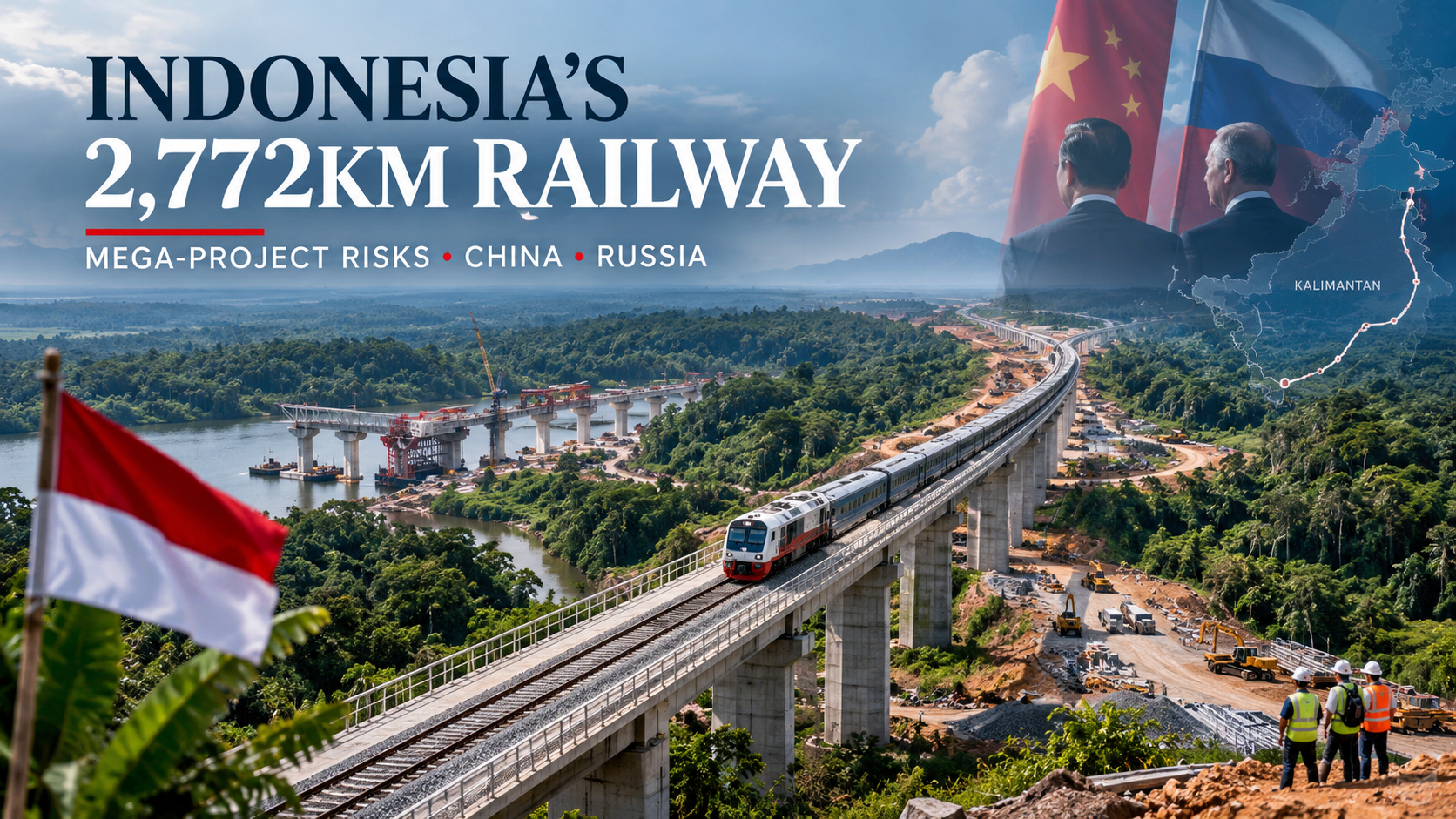
Indonesia is looking to foreign investors—primarily China and Russia—to help fund the ambitious 2,772-kilometer Trans-Kalimantan railway. The sprawling network aims to transform the resource-rich island of Borneo by vastly improving the transportation of minerals and passengers. However, as Jakarta maps out the future of its national rail infrastructure, financial hangovers from previous mega-projects are dictating a far more cautious approach to international commercial agreements.
While the completion of Southeast Asia’s first high-speed rail line between Jakarta and Bandung initially boosted confidence, its crippling cost overruns—alongside the recently stalled underground metro project in Bali—have analysts and government watchdogs warning against the unmitigated risks of foreign-backed debt traps.
The Trans-Kalimantan Vision: Minerals, Connectivity, and Foreign Capital
The Trans-Kalimantan railway is a central pillar of Indonesia’s broader National Railway Master Plan, which targets an expanded 12,100 km of operational railways by 2030. The initial phases aim to construct a 730-kilometer rail link connecting South, Central, and East Kalimantan. The railway will be crucial for the logistical transport of commodities and will eventually integrate with Indonesia’s new capital city, Nusantara.
According to statements by Indonesia’s Transportation Minister, Dudy Purwagandhi, the government is actively exploring foreign investment to shoulder the immense costs of the undertaking. Both Beijing and Moscow have expressed strong interest in the project, seeing it as a prime opportunity to deepen their economic footprint in Southeast Asia.
However, attracting the capital is only half the battle. Negotiating terms that protect Indonesia’s sovereign and economic interests is where the true challenge lies.
The “Whoosh” Warning: High-Speed Rail’s Lingering Debt
If Jakarta needs a blueprint on what to avoid, it only has to look at “Whoosh”—the Jakarta-Bandung high-speed rail. Originally championed as a symbol of Indonesian modernization and a flagship of China’s Belt and Road Initiative, the project broke ground in 2016 with an estimated price tag of $5.5 billion.
By the time it became operational in late 2023, complications ranging from delayed land acquisitions to the COVID-19 pandemic pushed the total project cost past $7.2 billion. The resulting cost overruns of between $1.2 billion and $1.9 billion forced Indonesian state-owned entities to take on heavy financial burdens.
Furthermore, lower-than-anticipated passenger revenues have generated operating losses reaching roughly $258 million in 2024, placing massive pressure on the state rail operator Kereta Api Indonesia (KAI). The high 3.4% interest rate on refinancing loans has triggered widespread domestic criticism and prompted the current administration to push for immediate debt renegotiations with Beijing. The “Whoosh” debacle demonstrates the acute fiscal vulnerability of heavy reliance on a single foreign creditor.
Bali’s Stalled Underground Metro
Concerns over foreign-funded infrastructure are not limited to Java. The highly publicized Bali Urban Subway (Bali Metro) provides another fresh cautionary tale regarding the viability of international megaproject investments.
Conceived as a solution to Bali’s crippling tourist traffic, the underground rail network held a high-profile groundbreaking ceremony in September 2024, backed by anticipated funding from Chinese and South Korean investors. However, as of late 2026, the project has suffered from zero visible progress. Facing an exorbitant estimated price tag of $20 billion and a stark lack of private investment commitment, the Bali provincial government was forced to abandon the underground design entirely in August 2026, pivoting to a much cheaper above-ground Light Rail Transit (LRT) alternative instead.
The abrupt stalling of the Bali Metro highlights the friction between grand infrastructure proposals and the harsh reality of foreign investor risk appetite—particularly when complex land acquisition and local topography are involved.
Strategic Caution Moving Forward
As Indonesia brings China and Russia to the negotiating table for the Trans-Kalimantan railway, it will likely prioritize rigorous feasibility studies, diversified funding models, and strict caps on state budget exposure.
Jakarta is learning that while international capital can expedite its transition into a modern economic powerhouse, the fine print of these multi-billion-dollar deals will determine whether these railways become engines of growth—or generations of debt. To successfully execute the Trans-Kalimantan railway, Indonesia must strike a delicate balance: leveraging foreign technological and financial muscle while fiercely protecting its domestic financial stability.
Discover more from The Economy
Subscribe to get the latest posts sent to your email.


Analysis
DBS Surges to Two-Month High After Q1 2026 Earnings Beat: Why Singapore’s Wealth Powerhouse Is Rewriting the Rate-Headwind Playbook
Singapore’s largest bank just delivered a quiet masterclass in strategic reinvention — and the market noticed.
The trading floor at Marina Bay Financial Centre opened on April 30 with a familiar tension: earnings season for Singapore’s big three banks, geopolitical noise from the Middle East, and a rate environment that refuses to cooperate. By mid-morning, DBS Group Holdings (SGX: D05) had answered the most pressing question. Its shares surged as much as 4.3% toward S$59, touching their highest level since early February 2026, after the bank reported first-quarter net profit of S$2.93 billion — a figure that exceeded the Bloomberg consensus estimate of S$2.88 billion and signaled something more significant than a routine beat: a structural pivot, years in the making, finally delivering at scale.
For those tracking the evolution of Asian banking, DBS’s Q1 2026 results are less a quarterly report than a proof of concept. When interest rates began their long descent from peak levels, the conventional wisdom held that Singapore’s lenders — deeply dependent on net interest income — would bleed margin. DBS has spent the better part of three years engineering a different outcome.
What the Numbers Actually Say: Anatomy of a Record Quarter
DBS’s Q1 2026 net profit reached S$2.93 billion, up 1% year-on-year and a robust 24% quarter-on-quarter, as strong wealth management and treasury performance offset lower interest margins. Total income achieved a record S$5.95 billion, up 1% year-on-year and 12% quarter-on-quarter, driven by robust fee income and treasury sales.
Flat year-on-year headline growth might tempt a casual reader to shrug. That would be a misreading. Strip away the rate-drag math, and the underlying quality of the quarter is striking:
- Net interest income declined 7% to S$3.48 billion during the period, weighed by heightened economic uncertainty and tighter monetary conditions.
- Net interest margin fell to 1.89%, narrowing 23 basis points year-on-year as SORA and HIBOR rates declined and the Singapore dollar strengthened. On a quarter-on-quarter basis, NIM compressed only four basis points, and group net interest income was little changed on a day-adjusted basis, as rate pressures were offset by hedging and balance sheet growth.
- Commercial book net fee and commission income increased 16% to S$1.48 billion. Wealth management fees hit a record S$907 million, driven by higher investment product sales and bancassurance.
- Profit before tax rose 2% year-on-year to S$3.51 billion, while return on equity held at a healthy 17%.
In blunter terms: DBS lost roughly S$240 million in annualized net interest income to rate compression, then proceeded to replace that and more through fee-based businesses. That is not a coincidence. It is a deliberate strategic architecture producing measurable results.
Why DBS Outperformed Expectations Despite NIM Pressure
The headline question for anyone following Singapore banking in 2026 is simple: how does a bank grow total income in a falling-rate environment? DBS’s answer involves three interlocking engines.
First, the wealth management machine is now genuinely world-class. Record fees of S$907 million in a single quarter represent a trajectory that would have seemed improbable five years ago. DBS’s wealth AUM reached S$488 billion at the end of 2025, and fee capture rates have risen as the bank has deepened its investment product suite and expanded its private banking capabilities. The bank has benefited from a structural tailwind that transcends quarterly noise: the accelerating concentration of private wealth in Asia, particularly among Chinese entrepreneurial families diversifying assets out of Hong Kong, Indian ultra-high-net-worth clients seeking Singapore domicile, and Indonesian conglomerates repatriating capital in a less predictable regional environment.
Second, treasury customer sales have emerged as a genuine earnings buffer. Volatile markets — driven by the Iran war, erratic U.S. tariff policy, and currency dislocations — have paradoxically been good for DBS’s treasury franchise. Corporate and institutional clients hedging currency and rate exposures have generated elevated transaction volumes, and DBS’s market-making infrastructure has translated that activity into fee and trading income. This is a business that benefits from complexity, not calm.
Third, deposit growth and hedging are doing surprisingly effective work on the NIM line. Management now assumes interest rates will remain at current levels — versus its earlier assumption of two Fed rate cuts — with the impact of greater rate headwinds on group net interest income largely mitigated by deposit growth, now expected to be in the high single-digit range, and ongoing hedging activities. That is a materially more conservative rate assumption than most peers are running, and DBS is still guiding for stable total income. The implication: the downside scenario is already baked into management’s thinking.
The Dividend Story: S$0.81 Per Quarter, and Why It Matters
For the income investor, the dividend announcement is the centerpiece of this earnings release. The board declared an interim dividend of S$0.66 per share and a capital return dividend of S$0.15 per share for Q1 2026, in line with the previous quarter. This brings the annualized total dividend to S$3.24 per share. Management has previously reaffirmed that the capital return dividend of S$0.15 per quarter will be maintained through 2026 and 2027.
Based on the closing price of S$56.56 as of April 29, 2026, this implies a dividend yield of approximately 5.7%. Post-earnings, with the stock trading closer to S$59, that yield moderates toward 5.5% — still among the most generous in the developed Asian banking universe.
The sustainability of this payout is underpinned by genuine capital strength. DBS’s CET1 ratio remains well above regulatory minimums, and the bank’s return on equity of 17% is generating capital faster than it can be deployed at equivalent returns. The capital return dividend — a structure DBS introduced to systematically distribute surplus capital — is, in effect, a managed excess-capital release mechanism. It signals that management sees no transformational acquisition on the near horizon that would absorb this capital, which is itself information.
DBS vs. OCBC and UOB: Comparative Edge in Wealth and Scale
Singapore’s banking sector operates as an oligopoly of three exceptionally well-run institutions. Comparing them illuminates where DBS’s competitive advantage is genuinely differentiated and where the narrative may be overstated.
| Metric (Latest Available) | DBS | OCBC | UOB |
|---|---|---|---|
| FY2025 Net Profit | S$11.03B | Record | S$4.68B |
| Wealth AUM | S$488B | S$343B | S$201B |
| Q1 2026 NIM | 1.89% | ~1.92% | ~1.75–1.80% (guided) |
| Annualized Dividend Yield | ~5.5–5.7% | ~4.3% | ~mid-4s% |
| ROE | 17.0% | 12.6% | ~12% |
OCBC has quietly become the standout among Singapore’s three local banks in terms of 2026 share price performance, hitting an all-time high in April 2026 and touching a record of S$22.83 on April 2, 2026, taking its market capitalisation above S$100 billion for the first time. OCBC’s advantage lies in its insurance engine through Great Eastern and a wealth platform — Bank of Singapore — that has delivered the strongest percentage AUM growth among the three. OCBC’s broader wealth management income reached a record S$5.6 billion and made up 38% of total income, up from 34% a year earlier.
UOB, meanwhile, remains the most rate-sensitive of the three. Its NIM guidance of 1.75–1.80% reflects greater exposure to conventional lending spreads, and its fee business — while growing — has yet to achieve the scale needed to offset margin compression at DBS or OCBC levels.
Where does DBS’s edge lie, then? Scale, franchise quality, and the self-reinforcing flywheel of AUM growth. At S$488 billion in managed assets, DBS is generating wealth management fees that dwarf its peers. Its digital banking infrastructure — recognized repeatedly by Euromoney and Global Finance as world-class — allows it to serve mass affluent and private banking clients at a cost efficiency that smaller platforms cannot replicate. The bank’s credit ratings of AA- (S&P) and Aa1 (Moody’s) are among the highest of any bank globally outside the Swiss franchise, which matters enormously for institutional counterparty relationships and wholesale funding costs.
DBS leads with FY2025 net profit of S$11.03 billion and ROE of 16.2%, far ahead of ASEAN peers.
What Lower Rates Mean for Singapore Banks in 2026
Can fee income permanently replace the lost NIM income? This is the foundational question for Singapore banking equity investors in 2026.
The short answer is: partially yes, structurally, and more so for DBS than for its peers. But the math is not frictionless.
Every 10 basis point decline in NIM costs DBS roughly S$130–150 million in annual net interest income, based on its approximate loan book scale. Offsetting that requires sustained double-digit fee income growth — achievable, but not guaranteed in every quarter. Market-dependent fee streams (wealth management, investment banking, treasury) can disappoint badly in risk-off environments. The first quarter of 2026 was not risk-off; geopolitical anxiety about the Iran war appears to have driven client hedging activity and safe-haven AUM inflows into Singapore — a perverse benefit for DBS’s franchise.
DBS maintained its FY2026 guidance of total income to be around 2025 levels despite continued rate headwinds and heightened geopolitical uncertainty. Commercial book non-interest income is still expected to grow at high single-digit rates, with management flagging potential upside if market sentiment improves.
That is a deliberately conservative stance — and it is the right one. Management teams that over-promise on fee income trajectory in rate-transition environments tend to disappoint badly when markets turn. DBS’s guidance framing effectively sets a floor with a visible upside scenario, which is exactly how credible institutional investor relations communication should work.
Geopolitics as Both Risk and Catalyst: The Iran Variable
One of the more nuanced aspects of this earnings story is the Iran war’s dual role in DBS’s operating environment. The conflict — which has disrupted shipping lanes, elevated energy prices (crude oil trading near $105 per barrel as of April 30, 2026), and driven a flight-to-quality in global capital flows — has simultaneously increased credit risk in certain sectors and driven wealth inflows into Singapore’s perceived safe-haven financial ecosystem.
DBS management noted in its earnings statement that “while the Iran war and its potential second-order effects have added uncertainty to the outlook, our stress tests indicate that our credit portfolio remains sound.”
Asset quality remains reassuringly stable. The NPL ratio was stable at 1%, unchanged quarter-on-quarter. Specific provisions (ECL3) were 31% higher year-on-year but significantly lower quarter-on-quarter, and at 14 basis points of total loans — an entirely manageable level.
The geographic concentration of DBS’s loan book — predominantly Singapore, Hong Kong, and ASEAN — provides less direct exposure to Middle Eastern commodity credits or European leveraged finance, where stress is more visible. That said, a prolonged conflict-driven energy price shock would feed into inflation dynamics globally, complicate the Fed’s rate path, and potentially reverse some of the rate-cut assumptions embedded in DBS’s hedging strategy.
The ASEAN Wealth Boom: Why DBS Is Structurally Positioned for the Next Decade
Singapore’s emergence as the undisputed wealth management hub of Asia is not an accident, nor is it a temporary phenomenon. It reflects deliberate government policy, legal system reliability, tax competitiveness, and geographic centrality in a region generating unprecedented private wealth. The numbers are staggering: Asia-Pacific is projected to account for the largest share of global HNWI wealth growth through the end of the decade.
DBS sits at the intersection of three critical wealth migration corridors: Chinese entrepreneurial capital seeking offshore diversification post-2020, Indian ultra-HNW families consolidating multi-generational wealth in Singapore family offices, and Indonesian and Malaysian conglomerates professionalizing their balance sheets through Singapore-domiciled holding structures. For each of these client categories, DBS’s regional franchise — with operations across 18 markets — provides the cross-border infrastructure that standalone private banks cannot replicate.
The bank’s investment in digital onboarding, AI-driven investment advisory tools, and its digibank platform for mass affluent clients in India and Indonesia positions it to capture the next wave of wealth accumulation at margins that traditional relationship-banking models cannot achieve at scale.
This is what the S$907 million wealth management fee quarter represents: not just strong performance in one period, but the maturation of a decade-long franchise-building exercise.
Counterpoints: Why the Stock Reaction May Moderate
A rigorous analysis demands engagement with the bear case.
Valuation is not cheap. At approximately S$59 post-earnings, DBS trades at roughly 2.4x book value and 14–15x forward earnings — a meaningful premium to ASEAN banking peers and broadly in line with OCBC’s current premium multiple. DBS’s price-to-book ratio is higher than its peers’, so its valuation could be hurt if it disappoints in continuing to deliver ROE above its peers. At 17% ROE, the premium is justifiable — but it leaves little room for earnings misses.
NIM compression is not finished. The move from 2.12% to 1.89% year-on-year is significant, and the hedging strategy that has buffered further decline is not infinitely scalable. If SORA rates decline more sharply than current assumptions, or if deposit pricing proves stickier than expected, NIM could surprise to the downside.
Wealth fee volatility is real. The record S$907 million quarter was partly a function of elevated market activity. In genuinely risk-off quarters — sharp equity drawdowns, credit spread widening — investment product sales contract. DBS’s fee income is structurally higher than five years ago, but it is not immune to cyclical pressure.
The Iran war tail risk remains unquantified. A broader regional escalation, disruption to Asian shipping lanes, or a spike in energy prices that triggers a global growth slowdown would stress all of these fee income assumptions simultaneously.
Strategic Investor Takeaways
For long-term dividend income investors, DBS at a 5.5–5.7% yield — with a capital return dividend explicitly committed through 2027 — remains one of the most attractive risk-adjusted income positions in the Singapore equity universe. The payout is backed by 17% ROE and capital ratios that are comfortably above regulatory requirements. The dividend is not under threat in any plausible base-case scenario.
For total return investors, the path to meaningful share price upside requires either a re-rating of the wealth franchise (plausible if AUM growth continues to accelerate), a recovery in NIM to the 1.95–2.00% range (which would require rate stabilization or reversal), or a sustained re-rating of Singapore financial equities by global asset allocators as ASEAN becomes a larger weight in emerging market and Asia-Pacific mandates.
For institutional investors benchmarking against regional peers, DBS’s ROE advantage over ASEAN banking peers of 400–500 basis points is durable and reflects genuine franchise quality rather than leverage. The bank’s AA- rating and conservative provisioning culture make it a core holding in any Asia-Pacific financial sector allocation.
The consensus 12-month price target for DBS sits near S$61–68, implying meaningful upside from current levels even after today’s surge — though the wide range reflects genuine uncertainty about the NIM trajectory and geopolitical tail risks.
Conclusion: Resilience Is Not a Quarterly Accident
DBS’s Q1 2026 earnings beat is best understood not as a positive surprise relative to a consensus model, but as validation of a strategic thesis that has been building for years. Singapore’s largest bank has successfully navigated the most challenging interest rate transition in a decade by investing, methodically and at considerable cost, in fee-based businesses that are now large enough to matter at the group level.
The record wealth management fees, the resilient asset quality, the disciplined capital management, and the maintained dividend all tell the same story: this is an institution that has internalized the lesson that rate cycles are temporary and franchise quality is permanent.
As a long-time observer of Asian banking, I have watched DBS transform from a predominantly Singapore-centric retail lender into a genuinely regional wealth and institutional banking franchise. What the Q1 2026 numbers confirm is that the transformation has reached the point where it is visible in the income statement, not just the strategy slides.
Whether the stock sustains its two-month high depends on the variables DBS cannot control: the rate path, the Iran conflict’s evolution, and the global appetite for risk assets. What it can control — credit discipline, wealth franchise growth, capital allocation, and digital infrastructure investment — it is managing about as well as any bank in Asia.
For investors wondering whether this earnings beat changes the DBS thesis: it doesn’t change it. It confirms it.
Key Data Summary
| Metric | Q1 2026 | Year-on-Year Change |
|---|---|---|
| Net Profit | S$2.93 billion | +1% YoY, +24% QoQ |
| Total Income | S$5.95 billion (record) | +1% YoY, +12% QoQ |
| Profit Before Tax | S$3.51 billion | +2% YoY |
| Net Interest Income | S$3.48 billion | -7% YoY |
| Net Interest Margin | 1.89% | -23bps YoY |
| Wealth Management Fees | S$907 million (record) | — |
| Fee & Commission Income | S$1.48 billion | +16% YoY |
| Return on Equity | 17.0% | — |
| NPL Ratio | 1.0% | Stable |
| Dividend Per Share | S$0.81 | — |
| Annualized Dividend | S$3.24 | ~5.5–5.7% yield |
Discover more from The Economy
Subscribe to get the latest posts sent to your email.
The call came, as these things often do, without warning. A seasoned equity partner at one of the Big Four — two decades of late nights, cross-border engagements, client dinners, and carefully cultivated relationships distilled into a six-figure “units” allocation — was summoned for what was framed as a career conversation. The language was collegial, the room was quiet. And then, politely but unmistakably, the message landed: you will no longer share in the firm’s profits. We are moving you to a salaried partner role.
No performance improvement plan. No transparent benchmark they had failed to meet. Just the quiet arithmetic of a partnership that needed fewer people at the table.
This is not an isolated anecdote. According to reporting by the Financial Times, both KPMG and EY have in recent years removed members of their UK equity partnerships and instead offered them “salaried partner” roles — a demotion wrapped in the same title, drained of its financial substance. And on April 23, 2026, the story took on transatlantic dimensions: KPMG announced it was cutting roughly 10% of its US audit partners — approximately 100 individuals — after years of failed voluntary retirement programmes. The message to the profession has never been louder: the partnership is no longer a destination. It is, increasingly, a temporary assignment.
The Golden Ticket, Tarnished
For generations, making partner at a Big Four firm was the legal and financial world’s closest equivalent to a tenured professorship. You had, in the popular imagination and in contractual reality, arrived. The equity partnership conferred ownership, profit-sharing, prestige, and an implicit understanding that barring catastrophic misconduct, your position was secure until mandatory retirement. It was, in the language of another era, a job for life.
That compact is dissolving — not with a dramatic rupture, but through a series of quiet institutional manoeuvres that, taken together, signal a structural reorientation of how these firms are governed, whom they reward, and what professional excellence is now expected to deliver.
The statistics are unambiguous. Big Four partner promotions across the UK fell to just 179 in 2025, a five-year low and a sharp retreat from the 276 promoted at the peak of the post-pandemic boom in 2022, according to analysis by the Financial Times of Companies House filings, press releases, and LinkedIn data. EY elevated only 34 equity partners, down from 74 in 2022. Deloitte made just 60 promotions, against 124 in 2022. Overall, the total number of equity partners across the four firms fell for the first time in five years, dropping by roughly 80 to approximately 3,050.
The belt-tightening is deliberate, and its beneficiaries are the incumbents. KPMG’s average UK partner pay reached £880,000 in 2025 — an 11% year-on-year increase — putting it ahead of both PwC (£865,000) and EY (£787,000) for the first time since 2014. Deloitte partners crossed the £1 million threshold. Revenue, meanwhile, has barely moved: EY reported 2% growth in what it called a “challenging market”, while KPMG posted just 1% growth after 9% in 2023, and Deloitte suffered its first annual revenue decline in 15 years.
The mechanism is elementary. When you constrain the denominator — fewer equity partners sharing the profit pool — the numerator rises for those who remain. Profit-per-equity-partner (PEP) is the prestige metric in professional services, the figure that determines lateral hire competitiveness, graduate recruitment marketing, and the partner’s own sense of institutional worth. And right now, the Big Four are protecting it with considerable ruthlessness.
Demotion Without Firing: A New Instrument of Control
What distinguishes the current moment from previous cycles of partner attrition is not the reduction in numbers per se — firms have always managed their equity pools — but the instrument being used. The introduction of a salaried or “non-equity” partner tier creates a new, lower rung on the ladder that can be used not merely as a holding pen for promising directors, but as a landing zone for underperforming incumbents.
Deloitte, EY, and KPMG have all introduced this salaried partner tier, widely regarded in the industry as a mechanism for retaining senior staff without sharing profits. PwC, the only firm still operating an equity-only partnership, has created a “managing director” grade as its structural equivalent. The title is preserved; the economics are fundamentally altered.
In the case of KPMG’s UK operation, multiple people with knowledge of the matter told the Financial Times that partners were called into rooms for what were “positioned as career conversations” but were in reality mechanisms to reduce equity partner headcount. Some received the news with little warning, having been given positive performance feedback until the conversation itself. Several chose to leave rather than accept what they experienced as a demotion, describing the process as blindsiding.
EY, meanwhile, has demoted a small number of equity partners to salaried roles since introducing the tier in 2022, according to three people familiar with the matter. The firm declined to comment.
To be clear, “departnering” is not unique to accountancy. Goldman Sachs has long managed partner membership with clinical precision; law firms regularly de-equitise underperforming partners, particularly in mid-tier practices. But the cultural signal from the Big Four is significant precisely because of the scale, the prestige mythology, and the professional pipeline implications. These are the firms that recruit tens of thousands of graduates annually on the implicit promise of a meritocratic climb toward a life-altering outcome.
Why Now? Three Interlocking Forces
1. The Consulting Hangover
The pandemic generated an extraordinary and, in retrospect, unsustainable surge in demand for advisory services. Governments needed economic modelling, corporations needed digital transformation, boards needed risk assessment. The Big Four expanded headcount aggressively. By 2022, PwC was promising to add 100,000 staff globally; KPMG was promoting equity partners at a rate it could not sustain.
The hangover has been severe. PwC’s revenue growth slowed to 2.9% in fiscal 2025, down from 9.9% in 2023. Consulting revenues have contracted across the sector as clients, now operating in a tighter macro environment, question the value of expensive advisory mandates. James O’Dowd, managing partner at Patrick Morgan, told City AM that the firms are “cutting jobs to protect partner profits and rebalance bloated teams” after years of aggressive post-pandemic hiring.
2. AI Restructuring the Audit Architecture
Perhaps more structurally significant than the revenue cycle is the accelerating role of artificial intelligence in reshaping what partners actually do. KPMG launched its Workbench multi-agent AI platform in June 2025, developed with Microsoft, connecting 50 AI agents with nearly 1,000 more in development. EY granted 80,000 tax staff access to 150 AI agents through its EY.ai platform, investing more than $1 billion annually in AI platforms and products. Deloitte struck a deal with Anthropic to deploy Claude AI to its 470,000 employees worldwide.
The point is not that AI will replace partners tomorrow. It is, rather, that the work historically required to justify a partner’s existence — managing audit workflows, overseeing large teams of junior staff performing repetitive compliance tasks, supervising structured data review — is increasingly automated. KPMG acknowledged as much in its US announcement, noting that artificial intelligence is “increasingly handling key steps of audits, spurring firms to rethink staffing and delivery”. At PwC, leadership has indicated that new hires will be doing the work of managers within three years, supervising AI rather than performing the audit tasks themselves.
This compression of the value chain has a direct implication for partner economics. If AI can execute the audit procedures that previously required six team members, you need fewer partners to supervise them. The case for a large partnership structure becomes harder to make.
3. The Future-Revenue Problem
Laura Empson, professor of management at Bayes Business School, has articulated the third driver with particular precision. The question being asked of potential partners has shifted from “can you generate enough business this year?” to something more existential: “Will this person generate a substantial stream of income for the foreseeable future — and right now the future is particularly hard to foresee?” A director with a strong practice in regulatory compliance was, five years ago, a safe bet. Today, as AI takes on compliance automation and regulatory technology firms encroach on traditional advisory turf, the projection is far murkier. The firms are not just managing the present — they are hedging against futures they cannot yet model.
Winners, Losers, and the Long Game
The winners in this restructuring are, in the near term, the incumbent equity partners who remain. By shrinking the pool and reweighting units toward rainmakers — under KPMG’s current leadership, the firm has reallocated profit units to place less weight on tenure and more on business generation — the firms are concentrating extraordinary wealth among a smaller group. KPMG’s UK partners, who were earning £816,000 on average in 2025’s reporting cycle and £880,000 in the most recent period, now out-earn their counterparts at EY for the first time in a decade.
The losers are harder to count but easier to identify. The most acute damage falls on the cohort of ambitious directors and senior managers who have spent a decade or more building toward equity partnership as their defining professional objective. James O’Dowd of Patrick Morgan noted that whereas 20 years ago, Big Four employees could make equity partner by around 35, they are now looking at their early 40s — if they get there at all. The salaried partner tier is, for many, not a staging post but a terminus.
There is also a diversity dimension that deserves sharper scrutiny than it typically receives. Research consistently shows that informal sponsorship, visibility networks, and the “cultural fit” judgements that govern partnership decisions tend to replicate existing demographic profiles. When promotion cycles compress and the bar rises, historically underrepresented groups — women, minorities, first-generation professionals — disproportionately absorb the attrition. The firms publish annual diversity data with admirable transparency; whether that transparency translates into accountability when the pressure is on remains a live and uncomfortable question.
More troubling still is the impact on institutional knowledge. Partnership models, whatever their flaws, created an incentive for long-term relationship stewardship. A partner who owned the firm had reasons to invest in client relationships, mentorship, and institutional culture that extended well beyond the quarterly cycle. When you strip equity from people who have spent twenty years building domain expertise, you create a class of high-skilled employees with diminished loyalty and a market incentive to take their networks elsewhere — to boutiques, to in-house roles, to competitors offering better economics. The knowledge transfer implications are real.
The Contrarian View: Are They Trading Resilience for Returns?
Here is the question the managing partners are not asking loudly enough: does concentrating profits in fewer hands make these firms better, or merely more profitable in the short term?
There is a credible argument that what looks like strategic discipline is actually a structural fragility in the making. The Big Four derive much of their value not from capital but from trust — the trust that a client places in an auditor’s independence, the trust that a regulator places in a firm’s quality controls, the trust that markets place in a signed opinion. That trust is accumulated slowly, through relationships, through institutional memory, through the kind of deep sectoral expertise that takes years to develop.
When you compress the partner class aggressively, you signal to the broader professional pipeline that the implicit social contract has changed. Junior auditors at KPMG UK, earning around £32,500 as new graduates while partners take home nearly £880,000, are already observing a ratio that strains credulity as a meritocratic proposition. Removing overtime pay for busy season, shrinking the equity pool, and quietly demoting long-tenured partners does not create the conditions for the recruitment and retention of the next generation of exceptional audit professionals.
There is also the audit independence question. The Financial Reporting Council and its international equivalents have long expressed concern that commercial pressures on audit firms compromise the independence of judgment that audits require. A partnership model explicitly oriented toward protecting PEP — where the primary signal of success is partner compensation rather than audit quality — does not obviously serve the public interest that audit is meant to protect.
What Comes Next: Three Scenarios for the Profession
The optimistic scenario holds that these are rational adjustments to a structural oversupply of partners accumulated during an anomalous boom period, and that AI will simultaneously create new value — in AI assurance, ESG verification, regulatory technology — that supports a leaner but higher-margin partnership in the medium term. EY’s vision of a “service-as-a-software” commercial model, where clients pay by outcome rather than hour, might indeed generate the next platform for partnership growth.
The bearish scenario holds that compression of the talent pipeline, combined with AI-driven commoditisation of core services, will accelerate the fragmentation of the Big Four’s market position. Boutique advisory firms, technology-native audit platforms, and specialist consultancies are already capturing the mid-market segments where the Big Four’s scale is a disadvantage rather than an asset. If the firms price themselves out of the talent market by narrowing the partnership pathway, the talent goes elsewhere — and so, eventually, do the clients.
The structural scenario — and the one with the most historical precedent — is that this marks not a temporary adjustment but a permanent restructuring of what professional partnership means. The partnership model of the 20th century was predicated on human capital scarcity: expertise was concentrated in senior people, and those people needed to be economically incentivised to stay. AI erodes that logic. The next model may look less like a traditional partnership and more like a technology firm with a professional services overlay — equity concentrated at the top, a salaried technical workforce in the middle, and an AI infrastructure doing much of the work below.
For Aspiring Partners, Directors, and Regulators
If you are a director or senior manager at a Big Four firm reading this, the strategic implication is uncomfortable but clear: the pathway to equity partnership is narrower, later, and more uncertain than at any point in the past two decades. The hedge is diversification — cultivating expertise in areas where AI augments rather than replaces human judgment (regulatory navigation, complex cross-border transactions, AI assurance itself), and building client relationships that are genuinely portable. The salaried partner tier may, for some, represent a viable and well-remunerated alternative. For others, the boutique and in-house markets have never been more attractive.
For regulators, the questions are structural. Does the concentration of equity in fewer, higher-paid partners improve or compromise audit quality? Do the oversight frameworks that govern partnership conduct need updating to reflect the new realities of AI-assisted audit and performance-managed equity pools? The FRC and PCAOB have the tools to ask these questions. The political will to pursue them publicly is another matter.
For the firms themselves, the most important question may be one they are reluctant to examine: is the protection of partner compensation a strategy, or a symptom? A strategy would involve investing in the next generation of talent and expertise with the same vigour applied to protecting the equity pool. A symptom would be the short-term extraction of value from a franchise whose long-term competitive position is quietly eroding.
The Covenant, Rewritten
There is a moment, in the mythology of professional services, when a young accountant or consultant first allows themselves to imagine making partner. It is a moment of ambition and delayed gratification — the belief that if you are good enough, disciplined enough, client-focused enough, the institution will eventually reward your investment with a share in its future.
What KPMG and EY are doing — quietly, through human resource conversations in unremarkable meeting rooms — is rewriting that covenant. The reward is no longer guaranteed by longevity or even by excellence across a career. It is contingent, performance-managed, and revocable. In that sense, they are asking their most senior professionals to accept an employment relationship that the most junior associates have always known.
That may be a more honest model. It is certainly a more anxious one. And whether the profession that emerges from this restructuring will be better equipped to serve the public interest — or merely better equipped to serve the interests of those already at the top — is the defining question for the decade ahead.
Discover more from The Economy
Subscribe to get the latest posts sent to your email.
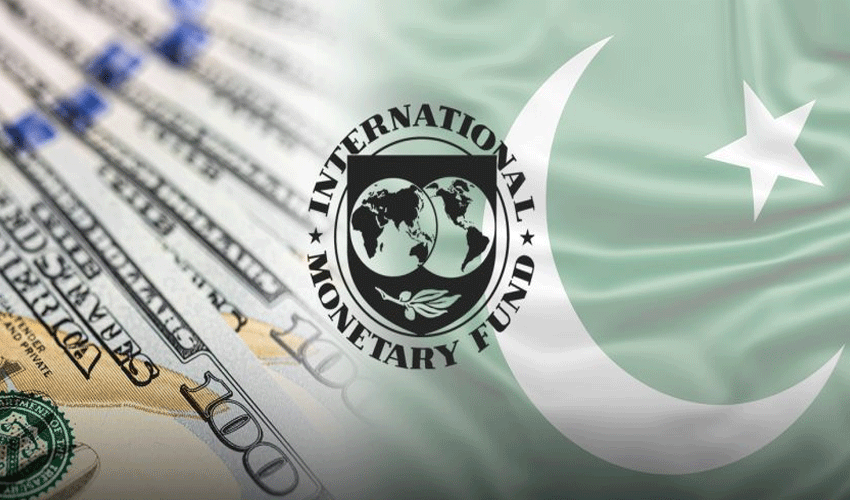
The clinking of porcelain teacups in Washington’s spring meetings often drowns out the sirens of global crises. But for Pakistan’s economic managers navigating the marble corridors of the International Monetary Fund (IMF), the latest nod of approval from multilateral creditors is less a cause for celebration and more a bracing, desperate intake of oxygen.
When Jihad Azour, the IMF’s Middle East and Central Asia Director, signaled this week that Pakistan’s program is firmly on track and that the Executive Board will “soon” approve the release of a new tranche, financial markets exhaled. The anticipated unlocking of approximately $1.2 billion—comprising $1 billion under the Extended Fund Facility (EFF) and a crucial $210 million under the Resilience and Sustainability Facility (RSF)—brings the total disbursements under the current $7 billion program to roughly $4.5 billion.
Yet, as the ink dries on the staff-level agreement reached last month, a sober reckoning is required. Is this an inflection point for the world’s fifth-most populous nation, or merely another temporary stay of execution? To view the impending Pakistan IMF tranche in isolation is to miss the forest for the trees. The global macroeconomic environment has rarely been this hostile, and Islamabad’s structural fatigue has rarely been this pronounced.
As we dissect the implications of the IMF board approving the new tranche for Pakistan in April 2026, we must look beyond the immediate liquidity relief. We must examine the precarious fiscal tightrope the country is walking amid Middle Eastern supply shocks, the pivot toward Chinese capital markets, and the agonizing political economy of domestic reform.
The Arithmetic of Survival: Behind the Latest Tranche Context
To understand the gravity of the impending board approval, one must look at the ledger. Over the past twenty-four months, Pakistan has engineered a textbook, albeit agonizing, macroeconomic adjustment. Driven by the harsh conditionalities of the ongoing EFF, Islamabad has tightened monetary policy, enforced a market-determined exchange rate, and imposed severe import controls.
The immediate dividends of this austerity are visible. Foreign exchange reserves, which had flirted with the terrifying abyss of mere weeks of import cover, have stabilized. The current account deficit has narrowed sharply. But this stability is essentially a medically induced coma.
- Growth at a Crawl: The World Bank and the IMF currently project Pakistan’s GDP to expand by a modest 3.6% in the current fiscal year, tapering slightly to 3.5% in FY27. For a nation with a burgeoning youth bulge entering the labor market daily, sub-4% growth feels functionally indistinguishable from a recession.
- The Inflation Paradox: While inflation has retreated from its historic, crushing peaks, it remains structurally embedded. The IMF forecasts inflation to average 7.2% in FY26 before ticking upward to 8.4% in FY27. This anticipated rise is not a domestic policy failure, but a chilling reflection of imported vulnerability.
The $1.2 billion tranche is, therefore, not a growth stimulus. It is foundational scaffolding. It provides the necessary sovereign signaling required to keep bilateral partners—namely Saudi Arabia, the UAE, and China—willing to roll over existing deposits. Without the IMF’s “seal of approval,” the entire architecture of Pakistan’s external financing collapses overnight.
Deep Analysis: Beyond the Headline Numbers
If the Pakistan economic recovery IMF tranche 2026 provides breathing room, how is Islamabad utilizing this time? The most fascinating development on the sidelines of the IMF-World Bank Spring Meetings was not the interaction with Western creditors, but Finance Minister Muhammad Aurangzeb’s quiet sit-down with Pan Gongsheng, Governor of the People’s Bank of China (PBOC).
The Pivot to Panda Bonds
Pakistan is desperately attempting to diversify its debt profile to avoid the punitive yields of traditional Eurobonds. The strategy involves tapping into the Chinese domestic capital market via an inaugural “Panda bond”—yuan-denominated sovereign debt.
While initially slated for early 2026, the issuance has faced regulatory delays. However, the pursuit of Panda bonds signals a profound geopolitical and financial shift. By integrating more deeply into Chinese debt markets, Pakistan is hedging against the volatility of the US dollar and Western interest rate cycles. As Reuters recently noted in their coverage of emerging market debt, sovereign reliance on bilateral lifelines is evolving into sophisticated, albeit risky, regional capital market integration.
The Domestic Reform Fatigue
Yet, international financial engineering cannot mask domestic dysfunction. The IMF’s Kristalina Georgieva rightly praised Pakistan’s “strong program implementation” this week. But who is bearing the cost of this implementation?
The fiscal adjustment has disproportionately punished the compliant. The salaried class and the organized corporate sector are being squeezed to the point of asphyxiation, while vast, politically protected swaths of the economy—real estate, wholesale retail, and agriculture—remain effectively untaxed. The state’s inability to widen the tax net means every revenue target set by the IMF is met by raising indirect taxes or energy tariffs, which inherently cannibalize industrial competitiveness and crush middle-class consumption.
Geopolitical and Regional Risks: The Middle East Price Transmission
The most imminent threat to Jihad Azour’s assertion that the Pakistan program is on track does not emanate from Islamabad, but from the Persian Gulf. The escalating conflict in the Middle East, particularly the intensifying US-Iran tensions, represents the most severe supply shock of the decade.
Pakistan is profoundly exposed to this geopolitical fault line. As a net importer of energy, any sustained spike in Brent crude prices immediately ruptures the country’s delicate current account mathematics.
During the Washington meetings, Minister Aurangzeb candidly acknowledged that Islamabad is currently managing the “first-order effects” of this crisis—scrambling to secure energy procurement, managing shipping logistics, and absorbing immediate price jolts. However, the second and third-order effects are looming:
- Freight and Logistics: Rising maritime insurance premiums in the Strait of Hormuz will inflate the landing cost of essential commodities.
- Remittance Vulnerability: While remittances remain robust at approximately $3.8 billion, a prolonged regional war could depress economic activity in the Gulf Cooperation Council (GCC) countries, jeopardizing the livelihoods of millions of Pakistani expatriates who serve as the country’s primary economic lifeline.
- Inflationary Resurgence: The IMF’s projection of inflation ticking back up to 8.4% next year is largely predicated on this “price transmission” from global energy markets.
As Financial Times analysts have repeatedly warned, emerging markets that have just barely stabilized their currencies are entirely defenseless against exogenous energy shocks. For Pakistan, a $10 increase in the price of oil can obliterate the gains of an entire IMF tranche in a matter of months.
The Verdict: A Genuine Turning Point or Another Reprieve?
Is this time different? The elite consensus in international financial circles is stubbornly cynical regarding Pakistan, viewing it as the ultimate “repeat customer” of the IMF. My view, however, is slightly more nuanced.
This is not a turning point, but it could be the precursor to one, provided the political elite weaponize this crisis rather than waste it. The positive signal from the IMF board regarding the new tranche Pakistan is a testament to the fact that the technocratic management at the Ministry of Finance and the State Bank of Pakistan is currently functioning with high competence. They have stopped the bleeding.
But stopping the bleeding is not curing the disease.
The structural malaise of the Pakistani economy is rooted in a fundamental refusal to redefine the role of the state. State-owned enterprises (SOEs) continue to bleed trillions of rupees, acting as patronage networks rather than productive assets. The energy sector’s circular debt remains a monstrous, compounding liability.
Until political capital is spent on privatizing moribund SOEs, taxing agricultural wealth, and dismantling import-substituting monopolies, the IMF tranches will remain what they have always been: expensive painkillers for a patient refusing surgery. The true test is not whether the IMF board approves the $1.2 billion in April 2026. The true test is whether Pakistan will use this capital to fund a structural transformation, or simply to finance the next election cycle.
Broader Implications for Emerging Markets and the IMF
Pakistan’s current trajectory offers a vital case study for the broader emerging market (EM) universe. We are witnessing an evolution in how the Bretton Woods institutions operate in fragile, climate-vulnerable states.
A critical, yet underreported, component of this upcoming tranche is the $210 million allocated under the Resilience and Sustainability Facility (RSF). The RSF represents a paradigm shift. Historically, the IMF dealt strictly in short-term balance of payments crises. Now, by providing long-term, affordable financing specifically tied to climate resilience and energy transition, the Fund is acknowledging that for countries like Pakistan, macroeconomic stability is inextricably linked to climate vulnerability.
As Bloomberg recently highlighted in its sovereign debt analysis, the global South is drowning in debt servicing costs. If the IMF can successfully utilize the RSF in Pakistan to catalyze private climate finance and restructure the energy grid, it will create a blueprint for dozens of other debt-distressed nations from Sub-Saharan Africa to Latin America.
Furthermore, the IMF’s leniency—or perhaps pragmatism—in allowing Pakistan to pursue Chinese Panda bonds while under an active EFF signals a new geopolitical realism in Washington. The Fund recognizes that it is no longer the sole lender in town, and must coexist in a multipolar financial architecture where Beijing plays an equally critical role in sovereign debt sustainability.
Conclusion: The Road Beyond the Tranche
The impending IMF tranche release implications are clear: Pakistan survives another day. Sovereign default, the specter that haunted Islamabad just a year ago, has been banished from the immediate horizon. The rupee will hold its ground, and the equity markets will likely rally on the news.
But survival should not be confused with success.
To transition from mere survival to sustainable growth, Pakistan’s policymakers must abandon the illusion that macroeconomic stability alone will attract foreign direct investment (FDI). Capital is cowardly; it flees from unpredictability. To secure its future, Islamabad must execute a ruthless restructuring of its energy sector, aggressively pivot its export base toward technology and value-added manufacturing, and construct an equitable tax system that does not penalize productivity.
The IMF has handed Pakistan a compass and a canteen of water. But the long, arduous trek out of the economic desert must be undertaken by Islamabad alone. If they fail, they will be back in Washington in three years, asking for another lifeline, while the world looks away.
Discover more from The Economy
Subscribe to get the latest posts sent to your email.

Silver Price Today: Why the Xi-Trump AI Standoff Is Fueling a Safe-Haven Rally

Citibank & Dólar Estadounidense: Forex Playbook After the Xi-Trump Truce

How the Trump-Xi White House Summit Is Reshaping Mortgage Rates Today for Real Estate Investors

Indonesia Navigates Mega-Project Risks as China and Russia Eye the 2,772km Trans-Kalimantan Railway

Trump-Xi 2026 Summit Takeaways: The Trade Truce, Taiwan, and the AI Divide

Solar Panel Installation Cost in 2026: Why the Math Changed Overnight

Business Insurance: What Coverage You Actually Need and What It Costs in 2026

Auto Insurance Quotes: How to Get the Lowest Rate Without Losing Coverage

Huntington Online Banking: Full Features, Fees, and How It Compares in 2026

Apply for a Bank Account Online: What You Need and How Long It Actually Takes

World’s Largest Economies: Ranking the Top Global Powers

Business Loan: A Complete 2026 Guide to Rates, Types, and Qualifying

Fast Invoice Factoring: How to Turn Unpaid Invoices Into Cash Within 24 Hours

Investment Banking Services: What They Cost and How to Choose the Right Firm in 2026

Top 30 Stocks for Investment in PSX for Massive ROI in 2026

SpaceX Starship Flight 14: First Orbital Attempt & Starlink V3 Launch Explained

Oil Prices Break $100 in 2026: Middle East Conflict & Energy Markets

BRICS+ Cross-Border Payments 2026: Interoperability Explained

AI Chip Stocks 2026: The Best Semiconductor Investments Beyond Marvell

Fidelity Investments Review 2026: SPAXX Yields & Zero-Fee Funds

Tween Back-to-School Trends 2026: What’s Driving the $85B Season

10-Year Treasury Yield Hits 4.80%: What It Means for Rates & Portfolios

Shein Clothes Quality & Safety in 2026: What Lab Tests Show

China’s US$10.8 Billion Trade Shortcut: Why the Pinglu Canal Matters

MRVL Earnings 2026: Why Marvell Sank Despite Beating Estimates

IMF & World Bank 2026 Global Economic Outlook: Growth, Inflation, Debt

Middle East War Economics 2026: Oil Prices & Energy Markets

High-CPM Finance Niches 2026: Publisher Monetization Blueprint
-

 Markets & Finance9 months ago
Top 15 Stocks for Investment in 2026 in PSX: Your Complete Guide to Pakistan’s Best Investment Opportunities
-

 Analysis7 months ago
Johor’s Investment Boom: The Hidden Costs Behind Malaysia’s Most Ambitious Economic Surge
-

 Analysis7 months ago
Top 10 Stocks for Investment in PSX for Quick Returns in 2026
-

 Banks8 months ago
Best Investments in Pakistan 2026: Top 10 Low-Price Shares and Long-Term Picks for the PSX
-

 Analysis8 months ago
Brazil’s Rare Earth Race: US, EU, and China Compete for Critical Minerals as Tensions Rise
-

 Investment9 months ago
Top 10 Mutual Fund Managers in Pakistan for Investment in 2026: A Comprehensive Guide for Optimal Returns
-

 Global Economy9 months ago
15 Most Lucrative Sectors for Investment in Pakistan: A 2025 Data-Driven Analysis
-

 Global Economy9 months ago
Pakistan’s Export Goldmine: 10 Game-Changing Markets Where Pakistani Businesses Are Winning Big in 2025