
Banks
Bank of England’s September 17 Decision: Will UK Interest Rates Finally Move?

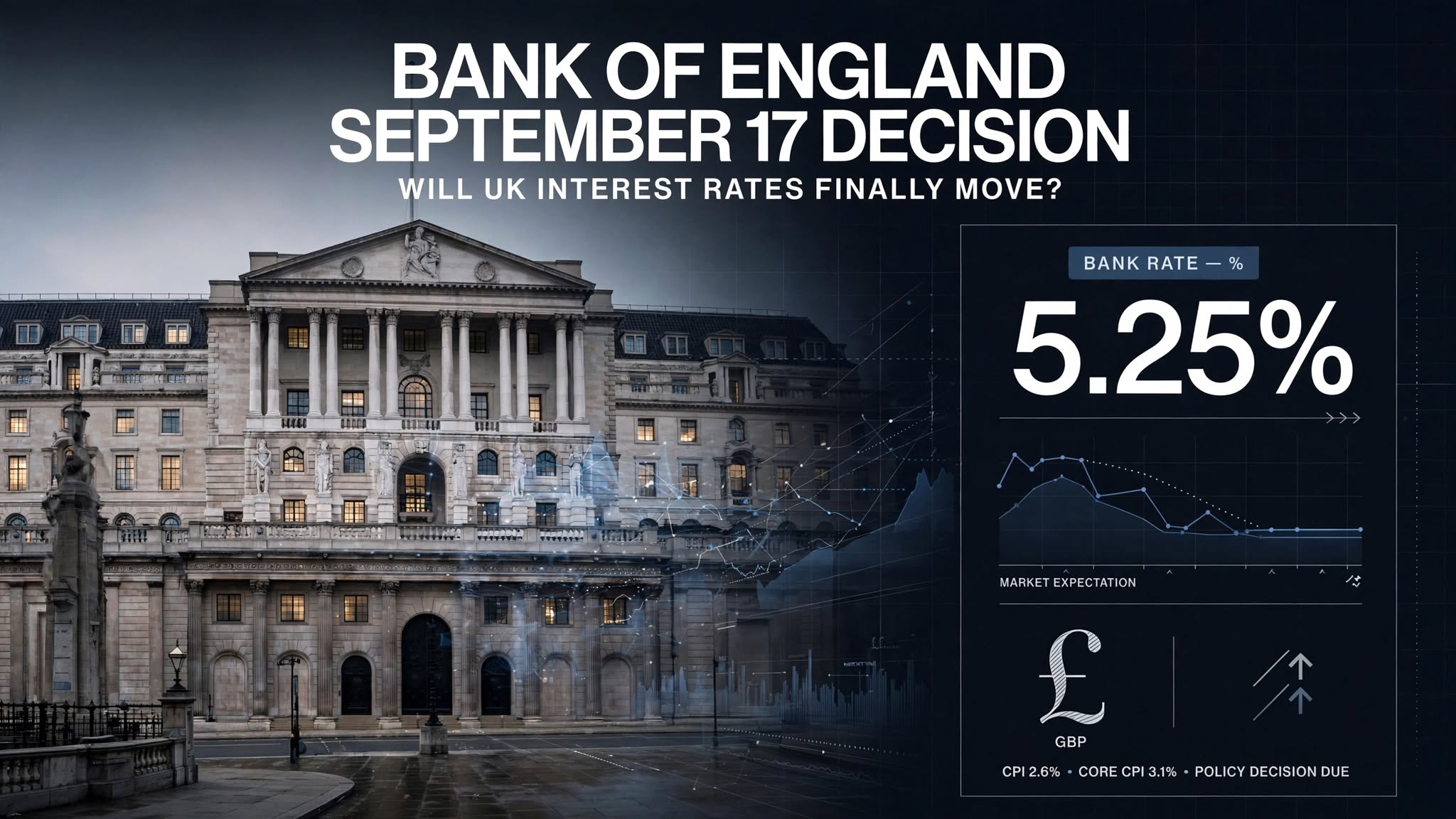
Key Takeaways
- The Bank of England’s Monetary Policy Committee (MPC) announces its next interest rate decision on Thursday, September 17, 2026, with Bank Rate having held at 3.75% for five consecutive meetings.
- At the July meeting, the MPC voted 6-3 to hold rates, with three members — including chief economist Huw Pill — voting for an immediate 25-basis-point hike, a rare degree of open division within the committee.
- UK inflation has been climbing steadily due to the Middle East conflict’s energy impact: 2.6% in June, rising to 2.9% in July, with the Bank’s own central projection showing CPI peaking around 3.2% in Q4 2026.
- Markets have swung sharply from pricing two rate cuts in 2026 before the Middle East war began, to now pricing the possibility of rate hikes, with some forecasts showing four quarter-point increases by July 2027 that could push Bank Rate to 4.75%.
- Unlike its US and Eurozone counterparts, the Bank of England has explicitly stated that “monetary policy cannot affect global energy prices” — its job is preventing the current energy-driven spike from becoming embedded in longer-term inflation expectations.
The Bank of England’s Monetary Policy Committee meets this Thursday, September 17, 2026, for a decision that carries more genuine uncertainty than it has in months — a marked shift from the largely telegraphed holds of earlier 2026. With inflation climbing on the back of the Middle East conflict and committee members increasingly split on the appropriate response, this meeting has become one of the more closely watched stock market today events for UK-exposed investors, mortgage holders, and businesses alike.
Where UK Rates Stand — And Why the Path Has Flipped
The Bank of England cut interest rates six times between August 2024 and December 2025 — roughly once a quarter, each by 0.25 percentage points — bringing Bank Rate down from a recent high of 5.25% to 3.75%. Since then, the MPC has held rates steady for five consecutive meetings, a pause that initially reflected a belief that rates were approaching the UK economy’s “neutral” level rather than any acute new concern.
That calculus has now shifted meaningfully. Before the Middle East conflict began, markets were pricing in two rate cuts for 2026. Since the war’s escalation and its energy-market spillover, market pricing has flipped toward the possibility of hikes instead — with some forecasts now showing as many as four quarter-point increases by July 2027, which would take Bank Rate to 4.75%.
The Inflation Trajectory Driving the Debate
UK headline inflation has been climbing steadily through the summer of 2026: 2.6% in June (a 15-month low at the time), rising to 2.9% in July, as higher energy costs tied to the Middle East conflict pushed price growth further above the Bank’s 2% target. The Bank’s own central projection, published alongside its July decision, showed CPI inflation peaking at around 3.2% in Q4 2026 — with the MPC explicitly cautioning that “risks to the inflation outlook are tilted to the upside.”
Governor Andrew Bailey summarized the Bank’s position bluntly following the July hold: “Inflation has fallen faster than we’d expected, but the conflict in the Middle East continues to mean high and volatile energy prices.” Crucially, the Bank has been explicit about the limits of its own policy tools in this situation: “Monetary policy cannot affect global energy prices; our job is to make sure that higher inflation does not persist and have long-lasting effects on the economy.”
A Divided Committee
Perhaps the clearest signal that Thursday’s decision is genuinely contested came from the July vote itself. The MPC split 6-3, with the majority voting to hold Bank Rate at 3.75%, while three members — Megan Greene, chief economist Huw Pill, and Catherine Mann — voted for an immediate 25-basis-point increase to 4%. Notably, Pill has publicly described himself as “uncomfortable with a ‘wait-and-see’ stance” from his fellow policymakers, an unusually direct public break from committee consensus for a sitting Bank of England chief economist.
What the Labour Market Says
Inflation isn’t the only variable feeding into the MPC’s calculus. UK unemployment held at 4.9% for the three months to June, unchanged for a third consecutive reading — a relatively stable labour market signal that hasn’t yet given policymakers a clear disinflationary counterweight to the energy-driven price pressure. A softer labour market with rising unemployment would typically argue for rate cuts; the current steady, if elevated, unemployment reading instead leaves the committee weighing inflation risk more heavily in isolation.
Comparing Central Banks’ Responses to the Same Shock
| Central Bank | Current Rate | Recent Move | Inflation Concern |
|---|---|---|---|
| Bank of England | 3.75% | Held 5 consecutive meetings | CPI to peak ~3.2% Q4 2026 |
| European Central Bank | 2.5% (deposit rate) | Hiked 25bps on Sept 10, 2026 | Inflation above 2% target, extended period |
| US Federal Reserve | TBD (decision imminent) | Markets pricing ~90% hike probability | August CPI at 3.4% |
Why This Matters for Mortgages and Markets
For UK homeowners and prospective buyers, the outcome directly affects fixed-rate mortgage pricing, since swap rates — which reflect market expectations for future Bank Rate moves — are the primary benchmark lenders use. Recent public surveys show genuine uncertainty among ordinary Britons too: roughly a quarter expect rates to rise, a similar share expect cuts, and nearly a quarter say they simply don’t know — reflecting how unsettled the broader economic picture has become since the Middle East conflict began reshaping every major central bank’s calculus simultaneously, from the Fed’s now-hawkish tilt to the ECB’s already-executed September hike.
Given the 6-3 split in July, the accelerating inflation trajectory toward a projected 3.2% Q4 peak, and Huw Pill’s public discomfort with further delay, Thursday’s decision is genuinely live in a way recent meetings have not been — markets, mortgage lenders, and UK-exposed investors will be watching closely for whether the committee finally moves, or extends its hold for a sixth consecutive meeting.
Frequently Asked Questions
What is the Bank of England’s current interest rate? Bank Rate has stood at 3.75% since December 2025, following six consecutive quarter-point cuts. The MPC has held that level for five consecutive meetings through July 2026, with the next decision due September 17, 2026.
Why might the Bank of England raise interest rates instead of cutting them? UK inflation has been climbing due to the Middle East conflict’s impact on energy prices, rising from 2.6% in June to 2.9% in July 2026, with the Bank’s own forecast showing a peak near 3.2% in Q4 — a reversal from earlier 2026 expectations of rate cuts.
How divided is the Bank of England’s rate-setting committee? Quite divided by recent standards — the July 2026 vote split 6-3, with three members including chief economist Huw Pill voting for an immediate rate hike rather than a hold, reflecting genuine disagreement about how to respond to the current inflation trajectory.
Discover more from The Economy
Subscribe to get the latest posts sent to your email.



Key Takeaways
- Bloomberg Tax projects federal income tax brackets will rise 3.2% for 2027 — up from the 2.7% inflation adjustment applied for 2026.
- All seven federal tax tiers are expected to shift upward, meaning taxpayers can earn more before crossing into a higher bracket.
- The IRS has not yet confirmed these figures; an official announcement is typically made in October or November.
- Bracket creep — when income grows faster than the tax thresholds — is the core risk these adjustments are designed to offset.
- Bloomberg Tax’s 2026 projections proved accurate against the IRS’s final figures, lending the 2027 forecast reasonable credibility, though it remains unofficial.
What Is “Bracket Creep” and Why It Matters
Bracket creep happens when a raise or cost-of-living adjustment pushes your income into a higher marginal tax bracket, even though your real purchasing power hasn’t improved. The IRS’s annual inflation adjustment exists specifically to prevent this — recalibrating the income thresholds for each of the seven federal brackets so inflation alone doesn’t quietly raise your tax bill.
Projected 2027 vs. 2026: What’s Changing
| Factor | 2026 (Confirmed) | 2027 (Projected) |
|---|---|---|
| Inflation adjustment | 2.7% | 3.2% (projected) |
| Number of brackets adjusted | 7 | 7 (projected) |
| Filing deadline | April 15, 2026 | April 15, 2027 |
| Source of figures | Official IRS | Bloomberg Tax forecast |
Exact dollar thresholds for each of the seven brackets were not yet published by the IRS at the time of writing and should be sourced directly from irs.gov once released.
Why a 3.2% Increase, and Why It’s Larger Than Last Year
The projected jump from 2.7% to 3.2% reflects a modest reacceleration in the inflation data the IRS uses (chained CPI) through the summer of 2026. A larger adjustment is generally favorable for taxpayers — it means:
- More income taxed at lower marginal rates before hitting the next bracket.
- A modestly larger paycheck in 2027 for many W-2 earners once employers update withholding tables.
- Potential increases to related figures — the standard deduction, retirement contribution limits, and estate tax exemption — though the IRS calculates these separately and on its own timeline.
How to Plan Before the Official Numbers Land
- Don’t restructure your withholding yet. Projections aren’t official; wait for the IRS’s confirmed 2027 figures before making payroll changes.
- Revisit tax-advantaged account contributions. If you’re near a bracket threshold, year-end moves — retirement contributions, HSA funding, charitable giving — can still shift where 2026 income lands.
- Watch for the official release. The IRS historically publishes final brackets in Revenue Procedure form each October or November for the following tax year.
- Talk to a tax professional before making decisions based on projected, not confirmed, figures — this article is informational and not individualized tax advice.
Will 2027 tax brackets change?
Yes — Bloomberg Tax projects a 3.2% inflation adjustment across all seven federal income tax brackets for 2027, up from 2.7% in 2026. The IRS has not yet confirmed these figures; official numbers are expected in October or November 2026.
Discover more from The Economy
Subscribe to get the latest posts sent to your email.

Key Takeaways
- The benchmark 10-year US Treasury yield briefly touched 5.014% on Monday, September 14, 2026 — its first move above the psychologically important 5% threshold since October 2023, and only its second time above that level since the 2007-2008 financial crisis.
- The move came just two days before the Federal Reserve’s September policy meeting, with markets now pricing roughly a 90% probability of a rate hike rather than a cut, according to CME Group’s FedWatch tool.
- The catalyst combines several forces at once: Brent crude topping $109/barrel, a hotter-than-expected August CPI report, swelling government and corporate borrowing needs, and a possible unwinding of the Japanese yen carry trade as Japanese rates climb.
- The 30-year Treasury yield reached 5.386%, directly affecting mortgage pricing, while 10-year yields in the UK and Australia have also climbed above 5% — signaling this is a global, not purely American, bond-market phenomenon.
- Veteran market strategist Ed Yardeni notes that neither the yield spike nor the global bond selloff has “broken” the stock market’s bull run so far, crediting continued strength in corporate earnings.
For the first time in nearly three years, the interest rate that anchors global borrowing costs — the US 10-year Treasury yield — has crossed the symbolically important 5% threshold. The move, which arrived just 48 hours before the Federal Reserve’s September policy decision, is rippling through mortgage markets, equity valuations, and central bank calculations from Washington to Tokyo. Here’s what actually happened, why, and what it means for anyone watching the stock market today.
What Happened
The 10-year Treasury yield climbed as high as 5.014% intraday on Monday, September 14, 2026, before paring the move back to around 4.94–4.99% by afternoon trading. It marked the first time the yield had crossed 5% during a trading session since October 23, 2023, and — as several outlets noted — only the second time it has traded this high since July 2007, just before the global financial crisis. A close above 5.02% would represent the highest level since that pre-crisis period.
The move wasn’t isolated to the 10-year note. The 2-year Treasury yield, which is more directly sensitive to near-term Fed policy, climbed to 4.679%, surpassing its previous July 2024 high. The 30-year yield — the benchmark most directly tied to fixed mortgage rates — touched 5.386% before paring some of its gains.
Why Yields Are Spiking: Four Forces Converging
1. Oil-driven inflation fears. Brent crude climbed to a session high past $109 a barrel as fighting between the US and Iran escalated, directly feeding into bond investors’ inflation expectations. Rising energy costs erode the fixed returns bondholders receive, pushing yields higher to compensate.
2. A hotter-than-expected inflation print. Friday’s August CPI report showed inflation running hotter than markets had anticipated. Goldman Sachs’ chief economist David Mericle wrote that while the report didn’t change the bank’s underlying inflation view, it pushed market pricing of a Fed rate hike this week to nearly 90% — a striking reversal from earlier-year expectations of continued rate cuts.
3. Swelling government and corporate borrowing. The yield spike is also being driven by basic supply-and-demand dynamics in the bond market: both the federal government and major corporations are issuing substantial new debt to fund spending, adding to the overall supply of bonds competing for investor capital.
4. A potential yen carry-trade unwind. Yardeni Research has floated a more technical explanation with global implications: as Japanese interest rates rise and the yen strengthens (partly on Japan’s own defense-spending and monetary-policy shifts), the long-popular “carry trade” — in which investors borrow cheaply in yen and invest in higher-yielding assets elsewhere — becomes less attractive. Unwinding those positions could be contributing to selling pressure across global bond markets, not just US Treasuries.
Global Context: This Isn’t Just an American Story
The yield surge isn’t confined to the US. Ten-year yields in both Australia and the UK have also climbed above 5%, reinforcing that this is a broader global bond-market repricing rather than a US-specific event. Yardeni’s assessment captures the moment’s tension well: a global yield spike of this magnitude “would normally be enough to break a global bull market in stocks. Neither has so far” — crediting resilient corporate earnings for equities’ relative calm despite the bond turmoil.
Rate Decision Timing: Why This Matters So Much Right Now
The timing amplifies the significance considerably. The yield spike landed just two days ahead of the Federal Reserve’s September policy meeting, transforming what might otherwise be a notable but contained bond-market move into a live variable in the Fed’s own deliberations. According to CME Group’s FedWatch tool, the probability of a rate hike this week has climbed above 90%, while Polymarket bettors have priced the same outcome at around 80%. Some market watchers are also monitoring rising tension between President Trump and Fed Chair Kevin Warsh as a wildcard factor in how the central bank navigates the decision.
Yield Snapshot
| Maturity | Peak Yield (Sept 14, 2026) | Significance |
|---|---|---|
| 2-year Treasury | 4.679% | Highest since July 2024; most Fed-sensitive |
| 10-year Treasury | 5.014% | First above 5% since October 2023 |
| 20-year Treasury | 5.426% | Sensitive to geopolitical risk |
| 30-year Treasury | 5.386% | Benchmark for mortgage rates |
Why This Matters: Mortgages, Portfolios, and the Fed’s Next Move
For everyday borrowers, the 30-year yield’s climb toward 5.4% translates fairly directly into higher fixed mortgage rates, making home purchases and refinancing meaningfully more expensive than earlier in 2026. For equity investors, the key question is whether corporate earnings can continue outrunning the drag from higher borrowing costs — the dynamic Yardeni credits for the stock market’s calm so far. And for the Fed, Wednesday’s decision now carries outsized weight: a hike would validate the bond market’s current pricing, while a hold could trigger further yield volatility if investors interpret it as the central bank falling behind an inflation trend that oil prices and geopolitical tension are actively worsening.
Frequently Asked Questions
Why did the 10-year Treasury yield cross 5% in September 2026?
The move was driven by a combination of surging oil prices tied to the escalating US-Iran conflict, a hotter-than-expected August CPI report, heavy government and corporate bond issuance, and a possible unwinding of the yen carry trade as Japanese rates rise.
How does a 5% Treasury yield affect mortgage rates?
The 30-year Treasury yield, which climbed to 5.386% alongside the 10-year’s move, is the most direct benchmark for 30-year fixed mortgage rates, meaning this yield spike is likely pushing mortgage borrowing costs higher for US homebuyers.
Will the Federal Reserve raise interest rates this week?
As of the yield spike, markets were pricing roughly a 90% probability of a rate hike at the Fed’s September meeting, according to CME Group’s FedWatch tool — a sharp reversal from earlier expectations of rate cuts.
Discover more from The Economy
Subscribe to get the latest posts sent to your email.
Remittance
Remittances 2026: Global Trends, Household Resilience & Economic Lifeline for Developing Nations

The Economic Lifeline of Developing Nations and Household Resilience
Remittances are financial transfers sent by migrant workers living and working abroad directly to individuals, families, or communities in their home countries. Unlike foreign direct investment (FDI) or sovereign loans, remittances are private, unrequited capital flows that do not create future debt liabilities or foreign ownership stakes in domestic enterprises.
For developing economies across South Asia, Africa, and Latin America—and for platforms like Thefinance.pk and Economy.com.pk—remittances are nothing short of an economic lifeline. They represent one of the largest sources of foreign exchange earnings, frequently eclipsing total merchandise export revenues and foreign aid combined.
The Macroeconomic Impact of Remittances
While remittances are initiated at the microeconomic level by individual families, their cumulative macroeconomic impact is staggering:
- Alleviating the Current Account Deficit: In countries burdened by heavy trade deficits (importing far more than they export), inward remittances act as a vital balancing mechanism. They inject hard currency into the banking system, directly strengthening the central bank’s foreign exchange reserves and providing essential import cover.
- Stabilizing the Local Currency: The constant inflow of US Dollars, Euros, and Gulf Dinars through official remittance channels helps supply the foreign exchange market, reducing downward pressure on the local currency and curbing imported inflation.
- Poverty Reduction and Social Safety Net: Remittances go directly into the hands of households. They are immediately utilized for basic necessities such as food, healthcare, school tuition, and housing construction. In many developing regions, remittances lift millions out of absolute poverty without requiring government bureaucracy or welfare programs.
- Boosting Domestic Consumption: Because remittance recipients spend their funds locally on retail goods, utilities, and construction services, these transfers stimulate domestic demand and support local small-and-medium enterprises (SMEs).
Official vs. Informal Channels (Hawala/Hundi)
A major challenge for governments and central banks tracking remittances is the prevalence of informal transfer networks, commonly known as Hawala or Hundi.
- Informal Channels: Workers often use unlicensed brokers because they offer faster delivery, better exchange rates, and require zero paperwork. However, informal channels drain hard currency from the formal banking sector, depriving the central bank of vital reserves and hiding true economic flows.
- Formal Channels: Commercial banks, licensed money transfer operators (MTOs like Western Union or MoneyGram), and digital fintech wallet apps route funds through official banking channels.
To incentivize workers to use formal channels, central banks and governments—such as the State Bank of Pakistan through its Rosette Digital Account and matching incentive programs—implement policies that eliminate transfer fees, offer superior exchange rates, and reward top-remitting households.
Remittances vs. Foreign Direct Investment (FDI)
Economists frequently compare remittances to Foreign Direct Investment, as both are major sources of foreign capital. However, their behaviors during global crises differ dramatically:
- FDI is Pro-Cyclical: When a developing nation enters an economic crisis or political instability, foreign multinational corporations immediately halt investments, freeze factory expansions, and pull their capital out. FDI dries up precisely when a country needs it most.
- Remittances are Counter-Cyclical: Interestingly, when a home country faces economic turmoil, natural disasters, or currency devaluations, migrant workers often increase the amount of money they send home. Knowing their families are suffering from inflation, expatriate workers sacrifice their own savings in destination countries to provide emergency financial support back home. This makes remittances one of the most reliable, resilient forms of external capital inflow in the world.
The Challenges and Costs of Remittances
Despite their immense benefits, the global remittance ecosystem faces structural bottlenecks:
- High Transfer Fees: Historically, sending money across borders has been plagued by extortionate transaction fees charged by traditional banks and wire services. The United Nations Sustainable Development Goals (SDGs) explicitly target reducing remittance transaction costs to under 3%.
- Macro-Dependence Risk: While remittances fund consumption, critics argue they can sometimes create “remittance dependency,” where local labor force participation drops because families rely entirely on money sent from abroad, disincentivizing domestic industrial productivity and structural reforms.
For editors and researchers at economist.media, tracking monthly remittance data published by central banks provides an immediate read on the health of diaspora communities in North America, Europe, and the Gulf, as well as a reliable gauge of domestic household purchasing power.
Key Takeaways:
- Remittances are private financial transfers sent home by migrant workers to their families.
- They serve as a vital source of foreign exchange, helping developing nations offset trade deficits and build up FX reserves.
- Unlike FDI, remittances are counter-cyclical, often increasing during times of domestic crisis to support struggling families.
- Encouraging workers to use formal banking channels over informal networks (Hawala) is a top priority for central banks.
Authoritative Sources & Further Reading:
- KNOMAD (World Bank): Migration and Development Briefs and Remittance Data
- World Bank: Personal Remittances, Received Data Portal
- State Bank of Pakistan (SBP): Workers’ Remittances Monthly Summaries
Discover more from The Economy
Subscribe to get the latest posts sent to your email.

Elon Musk’s Next Moves: Disrupting the 2026 Global Economy

INTC Stock Forecast 2026: Can Intel’s Government-Backed Turnaround Hold?

Bitcoin Price Action in Q4 2026: Safe-Haven Asset or High-Risk Tech Play?

The Target Pokémon x Owala Drop: Everything to Know Before It Sells Out

The U.S. Just Confirmed It Has Weapons in Space — Here’s What It Means for Defense Stocks

IRS 2027 Tax Bracket Projections: How to Get Ahead of Bracket Creep

Dow Jones vs. Middle East Tensions: How Wall Street Is Pricing In a 2026 Conflict Nobody Saw Coming

Bank of England’s September 17 Decision: Will UK Interest Rates Finally Move?

Inflation Is Outpacing Wage Growth Again: What It Means for Your Paycheck

10-Year Treasury Yield Tops 5%: What It Means for Mortgages, Stocks, and the Fed

Ceasefire Negotiations in 2026: Predicting the Rebound of European and Asian Economies

Emerging Markets Update: The Impact of World Bank Policies on PSX Stability

Costco Oil Shortage 2026: Will Prices Double for All Synthetic Motor Oils?

Trump’s $5,000 Promise: The Hidden Tax Implications for Retail Investors

State Farm’s $5B Dividend 2026: Who Qualifies & Payout Dates

US-China Relations in Q3 2026: Trade Tariffs and Supply Chain Risks

Gold’s Wild 2026: From a Record $5,600 Peak to a 24% Crash and Back Toward $4,500

Oil Surges as Strait of Hormuz Traffic Collapses Again

Bank of England Set to Hold Rates Through Year-End, Reuters Poll Shows

SpaceX Starship Flight 14: First Orbital Attempt & Starlink V3 Launch Explained

The 2026 Crypto Regulatory Shift: What It Means for Institutional Investors

Top 30 Stocks for Investment in PSX for Massive ROI in 2026

AI Chip Stocks 2026: The Best Semiconductor Investments Beyond Marvell

AI-Powered Training: The Next Multi-Billion Dollar Ecosystem in Fitness

Tween Back-to-School Trends 2026: What’s Driving the $85B Season

Russia’s Black Sea Oil Exports Fall for a Fifth Straight Week

Global Chip Selloff Deepens: What’s Driving the Aug. 19 Semiconductor Rout

Shein Clothes Quality & Safety in 2026: What Lab Tests Show
-

 Markets & Finance8 months ago
Top 15 Stocks for Investment in 2026 in PSX: Your Complete Guide to Pakistan’s Best Investment Opportunities
-

 Analysis7 months ago
Johor’s Investment Boom: The Hidden Costs Behind Malaysia’s Most Ambitious Economic Surge
-

 Analysis7 months ago
Top 10 Stocks for Investment in PSX for Quick Returns in 2026
-

 Analysis7 months ago
Brazil’s Rare Earth Race: US, EU, and China Compete for Critical Minerals as Tensions Rise
-

 Banks8 months ago
Best Investments in Pakistan 2026: Top 10 Low-Price Shares and Long-Term Picks for the PSX
-

 Investment8 months ago
Top 10 Mutual Fund Managers in Pakistan for Investment in 2026: A Comprehensive Guide for Optimal Returns
-

 Global Economy9 months ago
15 Most Lucrative Sectors for Investment in Pakistan: A 2025 Data-Driven Analysis
-

 Global Economy9 months ago
Pakistan’s Export Goldmine: 10 Game-Changing Markets Where Pakistani Businesses Are Winning Big in 2025