
China Economy
China’s Economy Has a Structural Problem: Factories Are Winning, Households Are Losing

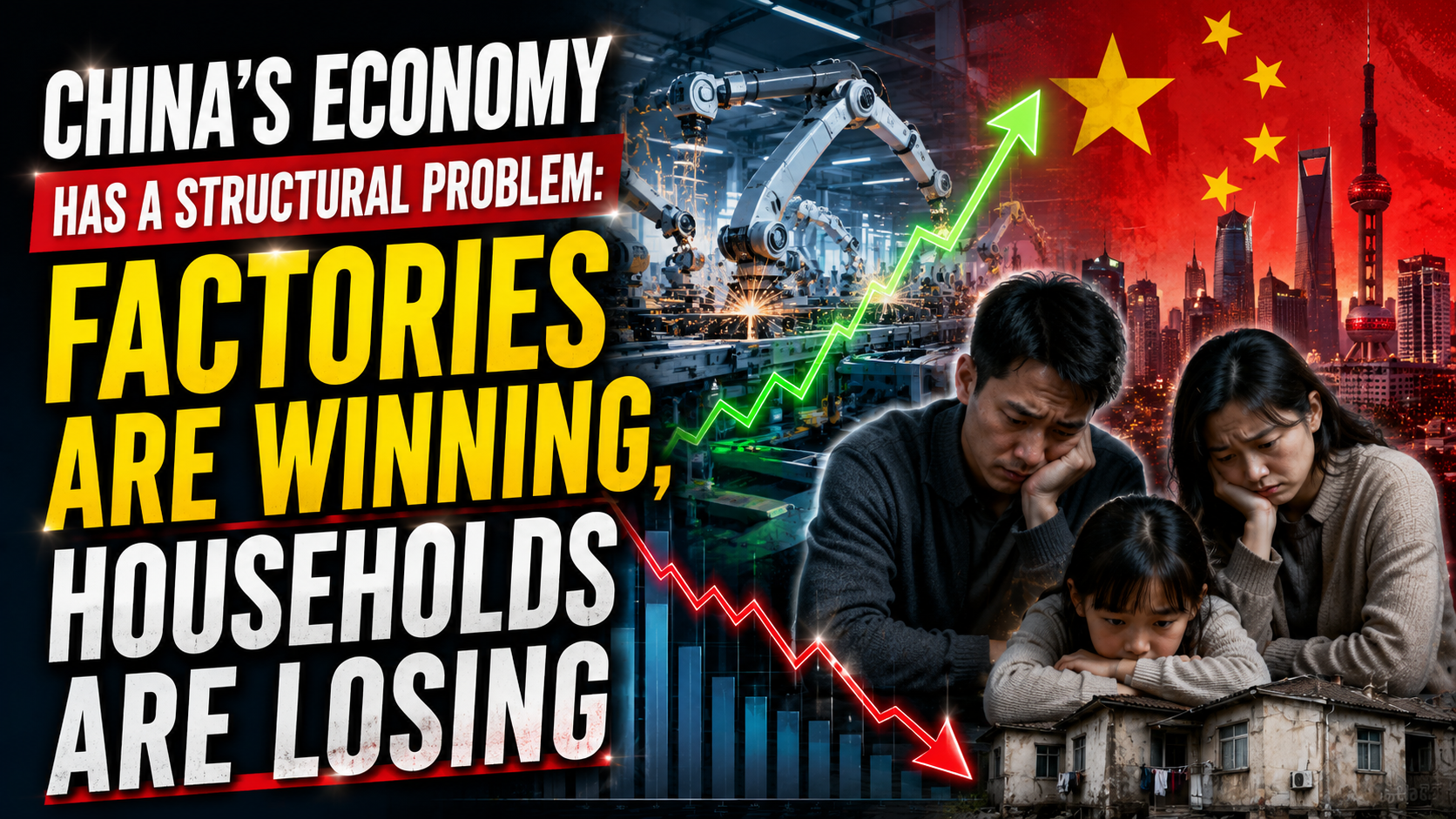
China’s headline growth numbers still look respectable at first glance. GDP expanded 4.3% year-on-year in the June quarter, down from 5.0% in the first quarter, bringing first-half growth to 4.7% (GoMarkets). But the composition beneath that headline is where the real story sits — and it points to a widening structural imbalance rather than a routine slowdown.
The production-consumption gap, in numbers
Industrial output rose 5.4% across the first half of 2026, anchored by a 5.3% annual gain in June concentrated in manufacturing and high-tech sectors (GoMarkets). Consumer activity, by contrast, remained deeply subdued: retail sales grew just 1.0% year-on-year in June and only 1.3% over the full six-month period (GoMarkets). That is roughly a four-to-one gap between how fast China is producing and how fast its own citizens are spending — a divergence with few precedents in the country’s post-2000 growth history.
Property remains the drag beneath the drag
Capital allocation data confirms the imbalance runs deeper than a temporary consumer pullback. Fixed-asset investment fell 5.7% across the first half of 2026, real estate development investment dropped a sharp 18.0%, and housing starts contracted alongside falling property sales (GoMarkets). For an economy in which real estate has historically been a primary household wealth store, an 18% investment contraction in the sector helps explain why consumer confidence — and therefore retail spending — has not recovered in line with industrial output.
Why manufacturing strength isn’t translating to household income
The pattern suggests China’s growth model is increasingly supply-driven rather than demand-driven: factories and high-tech manufacturing continue to expand production, largely for export markets, while the domestic income and confidence channels that would normally translate industrial strength into consumer spending remain broken. This is precisely the imbalance Beijing’s policymakers have spent years pledging to correct through “dual circulation” and consumption-boosting initiatives, with limited visible success by mid-2026.
The regional and global read-through
China’s uneven recovery profile is now one of three defining Asia-Pacific storylines for August 2026, alongside the Bank of Japan’s monetary normalisation and the Reserve Bank of Australia’s rate decision — and these narratives are increasingly intersecting rather than running independently, given how China’s demand weakness affects commodity exporters and regional supply chains alike (GoMarkets). China’s continued dominance within BRICS, and its willingness to use the platform to advance national economic interests, adds a geopolitical dimension to what is fundamentally a domestic demand problem (Inquirer).
What would actually close the gap
Closing a four-to-one production-to-consumption gap requires more than incremental stimulus — it requires either a sustained property-sector stabilisation that restores household wealth confidence, or a direct transfer-based approach to boosting disposable income that bypasses the property channel altogether. Absent one of those two shifts, China’s 2026 growth figures will likely keep looking healthier in aggregate than they feel to the households generating the underlying production.
Discover more from The Economy
Subscribe to get the latest posts sent to your email.


China’s economy in 2026 is best understood not as a single growth trajectory but as two divergent ones running in parallel. Citi Research’s 2026 outlook describes this explicitly as a “K-shaped” pattern that is becoming entrenched — one branch defined by booming AI-linked exports and equity markets, the other by a deepening property downturn that shows no clear sign of bottoming, according to Citi’s China Economics 2026 Outlook.
The upside branch: exports and AI are filling the demand gap
External demand has stepped in where domestic consumption has fallen short. High-tech exports are expanding, net exports are now contributing 1.4 percentage points to overall GDP growth, and China’s trade surplus is approaching $1.2 trillion, per Citi’s analysis. In equity markets, AI-related sectors have rallied sharply through 2026, even as “old economy” names — Baijiu, property, coal — have underperformed, illustrating just how concentrated the current growth engine has become.
Citi’s base case anticipates continued measured policy support: roughly RMB 1 trillion in additional fiscal stimulus, a 20 basis-point rate cut, and a 50 basis-point cut to the reserve requirement ratio, with the bank maintaining its 2026 GDP growth forecast at 4.7%.
The downside branch: a property sector still contracting
Housing investment may continue to contract by as much as 13% in 2026, with supply curbs remaining the primary tool policymakers are using to rebalance an oversupplied sector, according to Citi’s outlook. This is not a new phenomenon — it reflects a structural break from China’s prior debt-driven, real-estate-centric growth model — but the persistence of the contraction into a third consecutive year underscores how difficult the rebalancing has proven.
The overcapacity problem underneath the export strength
A separate analysis from the Brussels-based think tank Bruegel offers a less flattering read on the same export data: China’s growth model continues to rely on expanding industrial capacity and exporting to the world rather than lifting domestic consumption, and this has driven a marked increase in China’s global share of manufactured exports — raising international concern about overcapacity, according to Bruegel’s analysis. Capacity utilisation has declined even as exports have grown, pointing to a genuine mismatch between what Chinese factories can produce and what the domestic market can absorb. Producer and export prices have fallen in most months since the start of 2025 as a result — a form of exported deflation that has drawn criticism, and occasional retaliatory trade measures, from the US and EU.
Why the policy response has been narrow rather than broad-based
Despite years of external pressure to shift toward domestic-consumption-led growth, Chinese leaders have largely refrained from adopting broad stimulus measures, instead relying on narrower tools — tax incentives for technology and research, VAT export rebates, and “cash for clunkers”-style trade-in financing for EVs and appliances — partly to avoid adding further to already-elevated debt levels, according to the Congressional Research Service. At the Central Economic Work Conference in late 2025, leaders set a 2026 “proactive” fiscal policy aimed at boosting investment in key industries while maintaining austerity on local government debt — a combination that keeps the K-shaped divergence largely intact rather than resolving it.
Key takeaways
- Citi describes China’s 2026 growth pattern as increasingly “K-shaped”: AI-linked exports and equities surging, property and old-economy sectors declining.
- China’s trade surplus is approaching $1.2 trillion, with net exports contributing 1.4 percentage points to GDP growth.
- Housing investment may contract as much as 13% in 2026.
- Citi maintains a 4.7% GDP growth forecast for 2026, expecting roughly RMB 1 trillion in additional fiscal stimulus.
- Export strength partly reflects overcapacity rather than pure competitiveness, with falling producer and export prices since early 2025.
FAQ
What does “K-shaped” mean for China’s economy? It describes a growth pattern where some sectors (AI, high-tech exports) are expanding strongly while others (property, “old economy” industries) continue to contract — rather than the economy moving uniformly in one direction.
How large is China’s trade surplus in 2026? Approaching $1.2 trillion, according to Citi Research.
Is China’s property sector recovering in 2026? No — housing investment is projected to contract by as much as 13% in 2026, continuing a multi-year downturn.
Discover more from The Economy
Subscribe to get the latest posts sent to your email.
China’s home prices have now fallen for more than four and a half years — a household wealth shock comparable in scale to the 2008 U.S. crash, except still accelerating, according to Eurasia Group’s 2026 top-risks assessment. The consultancy ranked China’s deflation trap as its #7 global risk for the year, with a striking core argument: Beijing has the fiscal and monetary tools to break the cycle, but with the 21st Party Congress looming in 2027, Xi Jinping is prioritizing political control and technological supremacy over the consumption stimulus and structural reform that could actually fix it.
The Numbers Behind the Trap
Retail sales declined in May 2026 for the first time since December 2022, even as industrial output remained resilient — a sign that domestic demand weakness, not supply, is the core problem, according to The Economy’s reporting. Eurasia Group’s analysis is blunt about the mechanism: Beijing bet that high-tech manufacturing would fill the gap left by the property collapse, but state-driven investment has instead created overcapacity with too few buyers to absorb it — pushing China to keep “exporting its way out,” flooding global markets with cheap goods at other countries’ expense.
Beijing has responded, just cautiously. The government announced $51 billion in initial 2026 public spending to boost consumption and investment, including 295 billion yuan ($42 billion) front-loaded for national strategic initiatives, according to Bloomberg. Subsidies have been running since mid-2024 specifically to stabilize consumption battered by the housing slump and persistent deflation.
Where the Stimulus Is Working — Barely
The clearest evidence of partial success came during the Lunar New Year holiday: rail travel hit a record of over 18.7 million passengers in a single day, and CCB International Securities called the holiday spending data confirmation that recent stimulus is working, according to CNBC. Yet even that good news carried a deflationary asterisk: average spend per tourist trip fell 0.2% year-on-year, signaling that more people were traveling but spending less per trip.
February’s CPI print showed the strongest rebound since January 2023, up 1.3% year-on-year, beating forecasts, per separate CNBC coverage. But Beijing kept its annual inflation target at “around 2%” — the lowest in over two decades — treating it explicitly as a ceiling rather than a goal, while simultaneously lowering its 2026 GDP growth target to 4.5-5%, the least ambitious target on record since the early 1990s.
The Reform Beijing Isn’t Making
Asia Times argues the more consequential missed opportunity predates 2026: China’s over-the-top COVID lockdowns and Xi’s 2020 crackdown on internet giants — starting with Alibaba founder Jack Ma — set back consumer confidence for years and had Wall Street debating whether China was “uninvestable,” according to Asia Times’ analysis. The piece argues the genuine fix — ending the property crisis, strengthening capital markets, increasing transparency, making the yuan fully convertible — remains politically available but undeployed, with municipal leaders instead trapped chasing arbitrary annual GDP targets that “warp all economic incentives.”
For 2026, China is targeting roughly 5% GDP growth as the opening year of its 15th Five-Year Plan, according to reporting via MEXC, a target advisers reportedly want set explicitly to give the new plan a strong launch — political messaging as much as economic forecasting.
Discover more from The Economy
Subscribe to get the latest posts sent to your email.
China’s leadership used its closely watched late-July Politburo meeting to strike a more supportive tone on the economy without committing to the kind of sweeping stimulus package investors had hoped might follow a sharp second-quarter slowdown, reinforcing Beijing’s preference for targeted, precision-guided policy support over broad-based easing.
Growth Slows Below Beijing’s Own Target Range
China’s economy expanded 4.3% year-on-year in the second quarter of 2026, a marked deceleration from the 5.0% pace recorded in the first quarter and a figure that sits below the lower bound of Beijing’s own 4.5–5% full-year growth target — the lowest such target range Beijing has set since the early 1990s, according to CryptoBriefing’s analysis of the data. Consumer demand has remained persistently weak, and deflationary pressure has now been a recurring theme in the Chinese economy for several consecutive quarters.
A Reuters poll of economists ahead of the meeting found growth for 2026 as a whole is expected to cool to around 4.6%, before easing further to roughly 4.4% in 2027, as weak domestic demand offsets the boost from resilient exports recorded during a global oil-price shock earlier this year.
Fiscal Firepower Exists — But Beijing Is Choosing Restraint
Perhaps the most consequential signal from analysts previewing the meeting was not about new money, but about unused capacity. China retains roughly RMB 6.8 trillion of this year’s approved government bond issuance quota still undeployed as of the end of June, alongside an RMB 800 billion quasi-policy financing instrument and an estimated RMB 1.8 trillion in unused bond quota carried over from prior years, according to analysis published on Substack’s macro research platform. The implication: Beijing does not lack tools, it is choosing to prioritise faster execution of existing plans over announcing a new headline package.
Standard Chartered economists have argued the meeting was likely to emphasise accelerating fiscal execution in the second half rather than expanding the overall scope of policy support, with monetary policy relegated to a supplementary role. That reading is consistent with the People’s Bank of China’s approach since May 2025, when it last adjusted policy rates or reserve requirements, opting instead for short-term liquidity operations.
China’s July 2026 Politburo meeting signalled stronger support language without a large new stimulus package, after Q2 GDP growth slowed to 4.3% — below Beijing’s 4.5–5% target. With RMB 6.8 trillion in unused bond quota available, policymakers are prioritising faster fiscal execution over broad-based monetary or fiscal easing.
Property Downturn and Overcapacity Remain the Structural Drag
Beneath the headline growth numbers lies a widening bifurcation. New growth drivers — high-end manufacturing, the digital economy, and modern services — accounted for more than 40% of growth in the first half, with high-tech manufacturing value-added up 13.3%. Yet retail sales grew just 1.3% year-on-year in the same period, and fixed-asset investment fell 5.7%, according to detailed policy analysis from independent China economy newsletter Fred Gao. That divergence — a resilient “new economy” propping up an ailing “old economy” — is precisely the dynamic policymakers appear determined not to paper over with indiscriminate stimulus that could derail the structural transition central to the 15th Five-Year Plan’s opening year.
Markets Should Watch Implementation, Not Rhetoric
The consistent message from economists across Citi, Standard Chartered, and independent research houses ahead of the meeting was that markets should discount policy language and instead track fiscal execution data in the coming months — the pace of local government bond issuance, infrastructure project approvals, and any loosening of housing-related restrictions in major cities. Beijing’s playbook, as one analyst close to policymaking circles put it, increasingly resembles precision-guided support rather than the credit-fuelled stimulus waves of 2008–09 or 2015–16.
What It Means for Investors
For global investors positioned in Chinese equities, the yuan, or commodities exposed to Chinese infrastructure demand, the takeaway is one of managed disappointment: meaningful policy support is coming, but gradually, and calibrated to avoid reigniting the property-sector excesses Beijing spent years trying to unwind. A weaker yuan remains the most likely near-term consequence of any incremental stimulus, while a sharper-than-expected growth slowdown in the third quarter remains the primary catalyst that could force Beijing’s hand toward broader action.
Discover more from The Economy
Subscribe to get the latest posts sent to your email.

Russia’s War Economy Got a Reprieve From Iran

China’s Economy Has a Structural Problem: Factories Are Winning, Households Are Losing

How Malaysia “Shrugged Off” Trump’s Tariffs — and What Comes Next

Singapore’s AI Boom Is Now a Two-Country Story

Why Global Family Offices Are Converging on Dubai in 2026

A Weak Jobs Report Just Rewired the Fed’s Autumn — And Wall Street Cheered

Britain’s Fragile Rebound Meets a Budget Deadline and a Trump Ultimatum

Pakistan’s Economy Grew 3.7% — So Why Doesn’t It Feel Like a Recovery?

Top 15 Financial Stocks for Investment in PSX

Pakistan Exports 2026: Record $35.6B Forecast Masks Trade Deficit Risk

UK’s Jobs Downturn Now Matches the 2008 Financial Crisis — And AI Is Accelerating It

Fed Rate Cut Bets Surge After Shock US Jobs Report Exposes Labor Market Cracks

Pakistan’s Trade Gap Widens to $3.95bn Despite Meeting FY26 Current Account Target

Why Ottawa Is Betting on Dubai: Inside Canada’s Gulf Trade Pivot

Gold Price Forecast 2026: Fed’s July 29 Decision and Record Central Bank Buying Explained

China Politburo July 2026: Stimulus Signals Explained

Pakistan Economy 2026: GDP Grows 3.7% as IMF Completes EFF Review Amid Middle East Risk

Strait of Hormuz Blockade 2026: Oil Prices Surge 9% as US-Iran Conflict Reignites

Down But Not Out: Inside the Slow Sinking of Russia’s War Economy

Gulf Capital Retreat From Pakistan 2026: UAE Loan Freeze & What It Means

Global Stock Market Selloff 2026: Stagflation Fears Return as Iran Conflict Reignites

Pakistan’s Economic Survey FY26: Inflation Spike Insights

Russia Fuel Shortages 2026: Inside a Cracking War Economy

Strait of Hormuz Crisis 2026: How Trump’s Toll U-Turn Exposes Global Economic Risk

Bank of England Rate Decision Amid Energy Crisis

Russia’s War Economy Model Is Starting to Crack, Think Tank Warns

Pakistan’s Economic Growth: Resilience Amid Challenges

Andy Burnham, UK Gilts and Mortgages: July 2026 Explainer
-

 Markets & Finance7 months ago
Top 15 Stocks for Investment in 2026 in PSX: Your Complete Guide to Pakistan’s Best Investment Opportunities
-

 Analysis6 months ago
Johor’s Investment Boom: The Hidden Costs Behind Malaysia’s Most Ambitious Economic Surge
-

 Analysis6 months ago
Top 10 Stocks for Investment in PSX for Quick Returns in 2026
-

 Analysis6 months ago
Brazil’s Rare Earth Race: US, EU, and China Compete for Critical Minerals as Tensions Rise
-

 Banks7 months ago
Best Investments in Pakistan 2026: Top 10 Low-Price Shares and Long-Term Picks for the PSX
-

 Investment7 months ago
Top 10 Mutual Fund Managers in Pakistan for Investment in 2026: A Comprehensive Guide for Optimal Returns
-

 Global Economy8 months ago
15 Most Lucrative Sectors for Investment in Pakistan: A 2025 Data-Driven Analysis
-

 Global Economy8 months ago
Pakistan’s Export Goldmine: 10 Game-Changing Markets Where Pakistani Businesses Are Winning Big in 2025