
Banks
Kevin Warsh Fed 2026: Rate Hold, Hawkish Dot Plot, and the End of Forward Guidance


Federal Reserve Chair Kevin Warsh held rates at 3.5–3.75% on June 17, 2026, but nine officials signalled a 2026 rate hike as inflation hit 4.2%. What the “regime change” means for markets.In his first press conference as Fed chair, Kevin Warsh announced that the Federal Open Market Committee had voted unanimously to keep the benchmark federal funds rate in a range of 3.5% to 3.75% — the fourth consecutive hold. But the accompanying Summary of Economic Projections told a different story: nine of 18 participating officials now favour at least one interest rate increase before the end of 2026, with six pencilling in two separate quarter-point hikes. That is a dramatic reversal from as recently as March, when the base case remained an easing bias.
A Debut Defined by What Was Removed
Warsh has long criticised the Federal Reserve’s communications machinery as cluttered, forward-looking to the point of being counterproductive, and prone to generating market noise rather than policy clarity. His first meeting delivered on that critique in practice.
The policy statement was substantially shortened. References to “additional rate adjustments” were stripped out entirely, removing the easing-leaning language that had guided market pricing through most of 2025 and early 2026. In place of forward guidance, the closing sentence read simply: “The committee will deliver price stability.” Warsh announced task forces in five areas — monetary policy frameworks, communications, data sourcing, productivity, and labour markets — and signalled that even the quarterly dot plot itself was under review.
“When you have one [press conference], you want to make sure you have something important to say,” Warsh told reporters, hinting that he would reduce the frequency of post-meeting media appearances. He also confirmed he had not submitted his own interest rate projections for the dot plot — leaving one dot conspicuously absent from the published chart and keeping his personal baseline ambiguous.
What 4.2% Inflation Means for the Rate Path
The June dot plot was produced against a backdrop in which consumer prices are running at 4.2% annually — the fastest pace since April 2023 — driven in large part by the energy shock associated with the US-Iran conflict that began in late February. The FOMC’s revised economic projections now see PCE inflation at 3.6% by year-end, sharply higher than the 2.7% projected in March, while GDP growth estimates for 2026 were trimmed to 2.2%.
Fox Business reported that Warsh was explicit in his assessment: “Persistently high prices are a burden for the American people, but the recent past need not be prologue.” He offered assurance that the FOMC is “unambiguous and unanimous” in its commitment to delivering price stability — language that reads as a direct rebuke of the prolonged inflation tolerance that defined the post-pandemic era.
The immediate market reaction was sharp. Two-year Treasury yields jumped 16 basis points to 4.21%, their highest level in over a year. The S&P 500 fell 1.21%, the Nasdaq dropped 1.34%, and the US dollar index surged approximately 1% — its best daily performance in almost a year. Gold, which typically performs poorly when rate expectations shift hawkish and the dollar strengthens, fell more than 2%.
The Trump Complication
President Trump had nominated Warsh in part with the expectation that he would press for lower borrowing costs. That assumption has been quietly tested by events. Trump acknowledged higher rates “keeps the country down,” according to CNN, but notably declined to publicly criticise Warsh’s first decision — a restraint that former chair Jerome Powell rarely received. Powell, who remains on the Fed’s Board of Governors and retains a voting seat on the FOMC, is still under a Justice Department inspector general review related to the Fed headquarters renovation.
The gap between political preference and monetary reality is already visible. Citadel Securities had warned of rising September hike risks, citing strong wages, resilient consumer demand, supply chain strains from the Iran conflict, and AI-driven investment crowding out rate-sensitive sectors. The July 28-29 FOMC meeting will be the next scheduled test, and markets are already recalibrating.
What It Means for Borrowers
The practical consequences are already filtering through household balance sheets. With the benchmark rate held at elevated levels and rate cut prospects for 2026 effectively removed from the base case, mortgage rates, credit card rates, and auto loan rates will remain at or near current highs. “On paper nothing changes,” Michael Ryan of MichaelRyanMoney.com told Newsweek. “In real life it signals the Fed is still watching inflation. It doesn’t give relief to borrowers and it doesn’t reward savers.”
The June dot plot’s median projection for rates in 2026 has shifted higher, and the longer-run dot — treated as a guidepost for the neutral rate — signals the committee sees no urgency to ease even into 2027. The Warsh era at the Federal Reserve has opened with a clear message: price stability is the governing priority, and the toolbox for achieving it may yet include rate hikes that as recently as six months ago seemed inconceivable.
Discover more from The Economy
Subscribe to get the latest posts sent to your email.



The global Banking growth is becoming more uneven, capital is increasingly sensitive to financing costs, and investors must distinguish a convincing story from an investable price. This guide focuses on research methods and risks rather than predictions of guaranteed returns. The IMF October 2026 outlook projects 3.1% global growth and 4.7% inflation for 2026, while the IMF financial-stability assessment warns that market resilience coexists with important vulnerabilities.
Key takeaways
- Match each investment decision to its time horizon, currency and ability to withstand losses.
- Separate observable earnings or contractual cash flows from optimistic forecasts.
- Compare diversification, fees, taxes, liquidity and regulatory restrictions before committing capital.
- Track primary institutional evidence and update assumptions when conditions change.
- Readers in Pakistan should consider rupee exposure and availability of regulated investment channels.
Why this matters now
The central question behind global banking trends 2026 is not merely what may happen next. It is which economic mechanisms could change cash flow, purchasing power or risk. The Bank for International Settlements’ 2026 review describes an economy supported by technological investment but constrained by geopolitical and fiscal pressures. A robust financial plan must therefore survive both a favourable and an adverse scenario.
Digital banks are extending beyond borders
Technology can reduce the need to duplicate large physical branch networks, but banking remains subject to local licensing, deposit protection, consumer law and capital rules. Cross-border scale is a business model, not a regulatory exemption. Readers should distinguish a licensed bank from an e-money provider, broker or unregulated payments application. See the primary institutional research.
For practical analysis, separate the baseline, the upside case and the downside case. Document the specific development that would change your assessment. Assess timing: a promising long-term theme may still be inappropriate for cash needed within twelve months.
Artificial intelligence in credit and fraud
Banks use machine learning for transaction screening, fraud detection, service operations and risk analysis. The operational promise is significant, but opaque credit models can create unfair outcomes, and false-positive fraud alerts can disrupt customers. Model governance requires testing, human accountability, explainability and correction routes. Customer consent does not remove every data-protection obligation. See the primary institutional research.
For practical analysis, separate the baseline, the upside case and the downside case. Document the specific development that would change your assessment. Assess timing: a promising long-term theme may still be inappropriate for cash needed within twelve months.
Cybersecurity is now systemic finance risk
An attack against a large processing vendor can affect many institutions simultaneously. The IMF’s October 2026 stability assessment identifies sophisticated cyber threats alongside sovereign-yield and AI valuation shocks. Banks should test recovery procedures, third-party concentration, authentication controls and incident communications, not merely purchase security software. See the primary institutional research.
For practical analysis, separate the baseline, the upside case and the downside case. Document the specific development that would change your assessment. Assess timing: a promising long-term theme may still be inappropriate for cash needed within twelve months.
Compliance: technology must support judgment
Anti-money-laundering monitoring, sanctions screening and know-your-customer processes are increasingly automated. False matches and poor data can cause excessive account restrictions, while under-detection carries serious legal exposure. Institutions need measurable controls, independent audits and escalation channels. The Financial Stability Board provides international coordination context but rules vary by jurisdiction. See the primary institutional research.
For practical analysis, separate the baseline, the upside case and the downside case. Document the specific development that would change your assessment. Assess timing: a promising long-term theme may still be inappropriate for cash needed within twelve months.
What Pakistani customers and banks should do
Customers should verify a provider’s licensing status, understand complaint mechanisms, enable strong authentication and never disclose one-time passcodes. Financial firms need resilient payment systems, staff training and clear consent practices. Track SBP circulars for locally applicable requirements rather than extrapolating foreign regulations to Pakistan. See the primary institutional research.
For practical analysis, separate the baseline, the upside case and the downside case. Document the specific development that would change your assessment. Assess timing: a promising long-term theme may still be inappropriate for cash needed within twelve months.
Comparison and decision framework
| Question | Stronger evidence | Warning sign |
|---|---|---|
| What drives returns? | Audited cash flows, clear contract or transparent index | Undefined or projected returns |
| What can go wrong? | Explicit scenario and downside analysis | Claims of guaranteed gains |
| Is it affordable to hold? | Low transparent fees and adequate liquidity | Leverage, costly spreads or lockups |
| Is access legitimate? | Appropriate licensing and clear legal rights | Unverified brokers or custody |
| Is the exposure diversified? | Multiple independent sources of return | One company, sector or currency |
What it means for Pakistani savers and investors
A Pakistani reader faces both international investment risk and local purchasing-power risk. For example, a foreign asset can rise in US-dollar terms while the rupee conversion and transaction costs alter the realized local outcome. The opposite can also occur. Record the starting exchange rate, applicable taxes, custody charges and capital-transfer restrictions, and confirm current requirements with the State Bank of Pakistan and the relevant securities regulator. Overseas access should not be assumed universally available.
An emergency reserve, expensive consumer debt and near-term family obligations deserve attention before any speculative allocation. A portfolio that cannot meet a sudden cash requirement may force sales at the worst moment. The objective is not to remove risk—impossible in markets—but to choose risks that fit the investor’s actual liabilities.
Risks, limitations and uncertainty
Institutional forecasts are conditional and can change after policy decisions, commodity shocks, conflict escalation or unexpectedly weak earnings. Historic correlations are not binding promises about future asset performance. The analysis does not provide live stock prices, current investment product quotes, real-time exchange rates or individualized tax advice. Prices, regulations and product eligibility should be checked on the transaction date.
Frequently asked questions
Is this a guaranteed investment opportunity?
No. Every financial asset or strategy involves uncertainty. The existence of a popular investment theme is not evidence that an individual security is fairly priced.
What should beginners examine first?
Understand the product, the financial loss you could tolerate, fees and liquidity. Verify the provider and decide whether the money may be needed soon.
How do interest rates affect the analysis?
They influence financing costs, discount rates, exchange rates and demand. The effect differs by sector, maturity and business balance sheet.
Can Pakistani residents invest in foreign markets?
Access depends on current foreign-exchange, banking, brokerage, securities and tax rules, and on the investor’s individual circumstances. Check current regulations and regulated providers rather than assuming access.
How often should this analysis be refreshed?
Review institutional economic releases monthly and re-evaluate immediately after material earnings, regulatory or policy changes. Avoid reacting mechanically to every daily market movement.
Is diversification enough to prevent losses?
No. Diversification may reduce company-specific risk but cannot eliminate broad market, currency, inflation or systemic risks.
Conclusion
Sound financial decisions begin with verifiable evidence, reasonable valuation, awareness of uncertainty and a plan that survives adverse outcomes. Readers should compare multiple independent sources and avoid letting a compelling headline substitute for due diligence.
Discover more from The Economy
Subscribe to get the latest posts sent to your email.
Key Takeaways
- Workers sent about $10.9 billion in July–September 2026, around 14% above a year earlier, according to the 9 October official-news report of SBP figures.
- September 2026 inflows were about $3.6 billion, up 12.7% year on year but down 1.9% from August.
- Remittances support household consumption and foreign-exchange availability without creating a new debt obligation.
- A remittance is not an export and cannot replace productivity gains, better tax collection or a sustainable import bill.
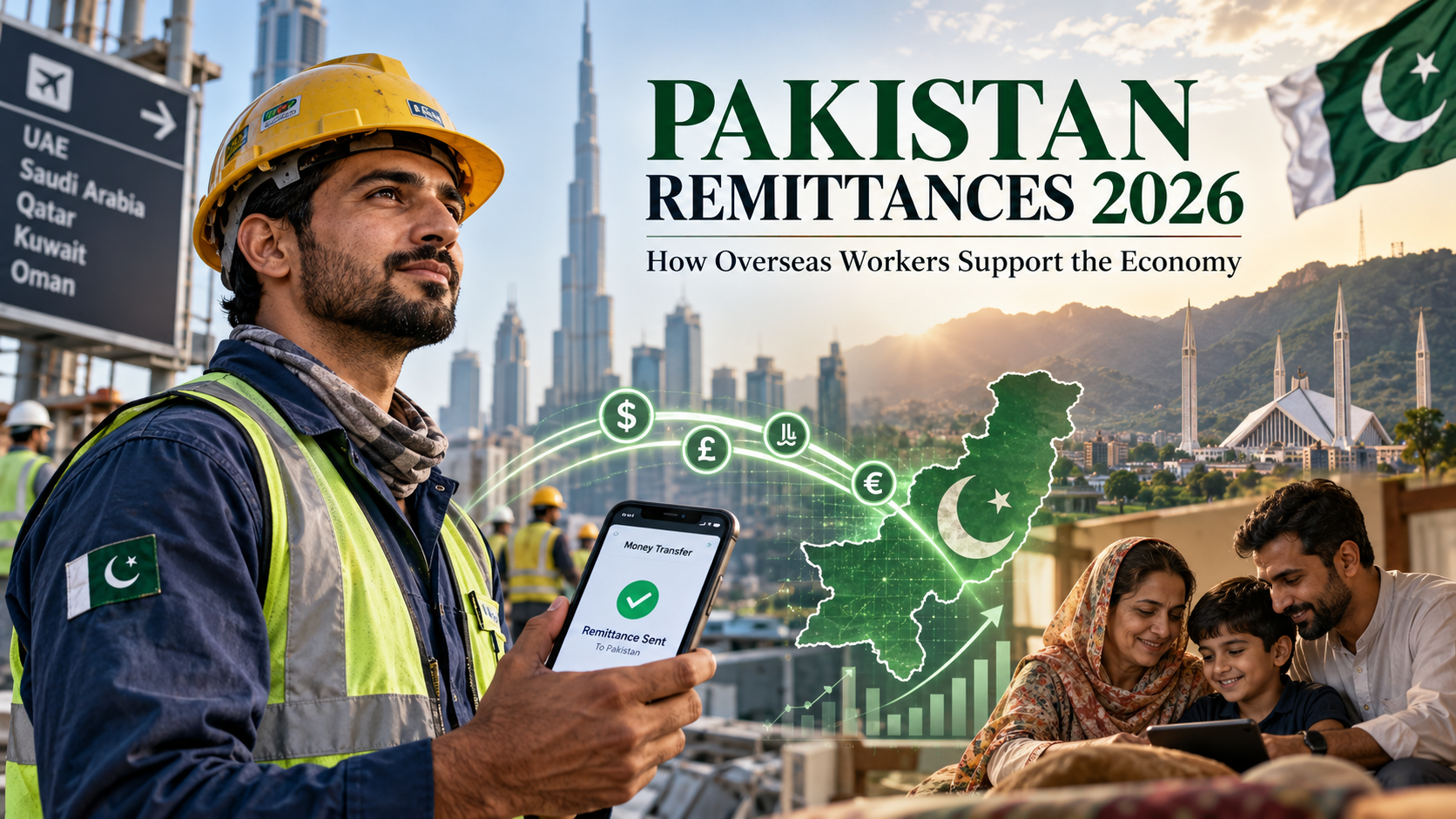
A worker in Jeddah transfers money to a family in Gujranwala. The family pays school fees, clears a medical bill and buys groceries. The transfer is personal, but millions of transactions like it have become central to Pakistan’s external finances. Pakistan remittances 2026 reached about $10.9 billion in the first quarter of FY2026–27, the latest reported State Bank data show. Associated Press of Pakistan’s 9 October 2026 coverage recorded a roughly 14% increase over the corresponding quarter.
The good news is a steadier supply of foreign currency and greater household spending power. The vulnerability is equally important: international employment, host-country growth, exchange rates and formal transfer costs remain outside any Pakistani family’s control. The goal should be to use remittance strength to buy time for productive reform, not treat it as a substitute for exports.
What is the latest Pakistan remittances 2026 picture?
The October 9 report citing State Bank figures put September remittances at about $3.6 billion, up 12.7% from September 2025 but down 1.9% from August 2026. Over the full first quarter, the inflow was around $10.9 billion, compared with roughly $9.54 billion a year earlier.
| Measure | Reported amount | Period |
|---|---|---|
| Remittances | About $3.6bn | September 2026 |
| Remittances | About $10.9bn | July–September 2026 |
| Prior-year comparison | About $9.54bn | July–September 2025 |
| Growth | About 14% | First-quarter year-on-year |
These are workers’ remittance flows as reported through formal channels. They are not a measure of every personal transfer, not a count of migrants and not an estimate of the income earned by Pakistanis abroad. Revisions and classification changes can alter subsequent tables.
Quarterly comparisons are more informative than a single month because religious holidays, working days and transfer campaigns can move payments across calendar boundaries. A decline from August to September is not, by itself, evidence that the trend has reversed.
How do the transfers help Pakistan’s foreign exchange position?
Remittances supply dollars, riyals, dirhams and other currencies that recipients generally exchange for rupees through banks or authorised payment channels. In balance-of-payments accounting, they support the current account and can offset part of the merchandise-trade gap. The PBS data put the July–September 2026 goods deficit at $10.768 billion. That does not mean remittances and the goods gap can simply be subtracted to calculate the current account: services, primary income and other transfers also matter.
The IMF’s October 2026 assessment said the current account was broadly balanced in FY26, supported by strong remittances, and reported gross reserves of about $21.5 billion at end-September 2026. This shows why policymakers value steady migrant inflows. Unlike a sovereign loan, the money arriving for households does not create a scheduled government repayment.
Yet the support has limits. If imports accelerate or global energy prices jump, even high remittance receipts may be insufficient to prevent pressure on the external account. A family transfer can strengthen the system without making an unsustainable import structure sustainable.
Which countries and families matter most?
In September 2026, the SBP figures reported by APP showed Saudi Arabia accounting for approximately $899.1 million and the United Arab Emirates $748.5 million. The United Kingdom contributed around $515.1 million and the United States $305.9 million. These are monthly corridor figures, not annual totals.
A father working in Riyadh may send money for rent and schooling. A nurse in the UAE may help a parent pay for medicine. A British-Pakistani family may transfer savings to relatives or support property maintenance. These transactions have very different household purposes. The macroeconomic total tends to hide that variation.
The highest social return may come when recipients can use transfers to keep children in school, buy productive tools, improve sanitation or escape high-cost debt. That does not mean recipients should be pressured to invest money they need for essentials. The priority is their financial security and informed choice.
Why do formal banking channels make such a difference?
A sender deciding between a licensed provider and an informal arrangement weighs the exchange rate, fee, speed and confidence that the money will arrive. Formal receipts improve the quality of the recorded balance-of-payments data and make disputes traceable. They can also provide a pathway into savings products and credit histories.
The State Bank’s external-sector data portal publishes country-wise remittance statistics, while its data-release calendar gives readers a way to check whether a recent month’s figures have arrived. Financial inclusion is more likely when a family can receive money in a low-cost account and spend it digitally without unnecessary charges.
An apparently zero-fee transfer is not always free. A poorer exchange rate can be a larger hidden cost than an upfront charge. Ask how many rupees the beneficiary will actually receive, compare that figure against another licensed channel, and keep confirmation records. Never transfer funds through an unverified agent merely because a messaging-app advertisement promises the best rate.
How much did overseas Pakistanis remit in September 2026?
Reported State Bank data put workers’ remittances at approximately $3.6 billion in September 2026, 12.7% higher than in September 2025 and 1.9% lower than in August 2026. Monthly transfers can fluctuate with holidays, exchange rates and payment timing.
Worked example: exchange-rate costs on a $500 transfer
Imagine two licensed providers accepting a $500 transfer. Provider A credits Rs275 per dollar after all fees, while Provider B credits Rs278 per dollar. The recipient gets Rs137,500 from A and Rs139,000 from B. The difference is Rs1,500, or about 1.1% of the smaller payout. These rates are invented solely for arithmetic illustration, not quoted market prices.
Families should compare the final deposit amount and delivery time, not just advertising. They should also consider refund policies and dispute channels. For a person sending money monthly, a seemingly small difference compounds over a year.
The second lesson is about currency exposure. If a family plans a large rupee-denominated payment next week, delaying the transfer to speculate on exchange rates may create a bigger problem than any hoped-for currency gain. Match the timing of remittances to household needs rather than attempt to trade currencies with living expenses.
Could the remittance boom become a policy trap?
Yes, if a government mistakes household sacrifices abroad for domestic export competitiveness. Strong inflows make it easier to finance essential imports and rebuild reserves. But they can also reduce urgency to address energy costs, slow industrial productivity and weak tax administration. The World Bank’s long-term Pakistan partnership framework stresses private investment, public resources for development and sustainable growth.
A better response is to make it easier for overseas workers to save or invest voluntarily with reliable safeguards while improving domestic opportunities. Transparent remittance products, consumer protection, lower fees and credible financial regulation matter more than publicity campaigns.
In the final analysis, the economy should be strong enough to offer attractive jobs at home. Remittances can be a lifeline now and a source of development finance later, but the ultimate economic achievement would be an economy less dependent on its citizens working abroad.
What This Means for You
Overseas worker: Compare the final rupee payout, transfer speed and complaint mechanism of licensed channels. Preserve receipts and do not share account passwords or verification codes.
Family receiving money: Make an essentials-first budget. Where possible, split money between immediate bills, emergency savings and optional investment; the mix depends on actual household needs.
Small business supported by a migrant relative: Put personal support and business capital in separate accounts, document whether the funding is a gift or a loan, and agree on expectations before investing it.
Economy watcher: Compare quarterly remittances with imports, services and current-account data. A large transfer total can coexist with fresh pressure on the rupee if the external financing need grows faster.
What to Watch Next
- 26 October 2026: The State Bank monetary-policy decision and any revision to its inflation assessment; verify any schedule change with the SBP.
- Early November 2026, exact release date to be confirmed: Pakistan Bureau of Statistics October inflation and merchandise-trade releases.
- Late October–November 2026, date not yet confirmed: Any IMF Executive Board announcement on the October staff-level agreement; staff agreement is not Board approval.
- Throughout FY2026–27: Updated SBP monthly balance-of-payments and remittance statistics; compare cumulative results rather than one month alone.
Frequently Asked Questions
How much did overseas Pakistanis remit in September 2026?
Reported State Bank data put workers’ remittances at approximately $3.6 billion in September 2026, 12.7% higher than in September 2025 and 1.9% lower than in August 2026. Monthly transfers can fluctuate with holidays, exchange rates and payment timing.
How much did Pakistan receive in remittances in the first quarter of FY27?
Pakistan received about $10.9 billion in workers’ remittances during July–September 2026, approximately 14% more than the roughly $9.54 billion received in the same quarter a year earlier, according to State Bank figures reported on 9 October 2026.
Do remittances increase Pakistan’s foreign exchange reserves?
They support the foreign-exchange market and current account by providing inward currency flows, but reserve levels also depend on imports, debt payments, central-bank market operations and other capital or financial flows. A remittance received by a bank does not automatically add the same dollar amount to the central bank’s reserves.
Which country sent the most remittances to Pakistan in September 2026?
Saudi Arabia was the largest of the reported named corridors for September 2026, at approximately $899.1 million, followed by the United Arab Emirates at about $748.5 million. Monthly ranks can change; use the State Bank’s country-wise series for historical comparison.
What is the safest way to send remittances to Pakistan?
Use a licensed bank or regulated money-transfer provider, verify the final rupee amount and fees, and keep receipts and transaction reference numbers. Avoid unlicensed agents and never provide account login credentials to someone claiming to speed up a transfer. Product suitability differs by country of residence.
The strength of overseas transfers deserves recognition, but the workers should not be asked to carry the economy indefinitely. Use the breathing space to build export capacity, reduce the cost of formal finance and create viable jobs at home.
Discover more from The Economy
Subscribe to get the latest posts sent to your email.

Infrastructure banks are judged most usefully not by the number of meetings they hold but by whether financed assets function, serve their intended communities and can be maintained without unsustainable obligations. That is a timely standard for assessing the Asian Infrastructure Investment Bank after its 2026 annual meeting.
The AIIB says its annual meeting took place in Doha on September 28–29 under the theme “Tomorrow’s Infrastructure: Impact and Innovation.” The agenda emphasized sustainable investment, cross-border connectivity, green finance, digital transformation and private capital. Those priorities define a development strategy; the harder work is demonstrating delivery.
What does AIIB actually do?
The Asian Infrastructure Investment Bank is a multilateral development bank that finances infrastructure and related development projects across its membership. Its business model differs from that of a conventional commercial bank: it can combine long-horizon lending, institutional safeguards and project preparation with capital mobilization. It still needs to assess repayment capacity and the environmental and social consequences of what it funds.
Projects can include electricity networks, transport, water and digital connectivity. The economic value depends on who gains access, how much service improves and whether user charges and public finances can support operations.
Green infrastructure needs a performance test
A solar project should be evaluated not only in installed megawatts but in delivered electricity, grid stability, curtailment and emissions performance. A public transport project should be examined through ridership, journey-time savings, safety and accessibility. Water infrastructure can be assessed through service reliability, water quality and reduction of leakage.
Labels such as “green” or “sustainable” are most informative when accompanied by credible baseline assumptions, public monitoring and independent evaluation. Without that, a project can appear successful on paper while leaving the underlying service problem largely untouched.
The investment gap is broader than lending
Many countries need new infrastructure but have limited fiscal space and large foreign-currency exposures. A long-term loan does not resolve the problem if the borrower has insufficient revenue or faces a sharp exchange-rate shock. AIIB and co-financiers therefore must think about project preparation, procurement quality, currency risk and maintenance funding at the outset.
Private capital may participate when risk is allocated sensibly. A toll road or grid investment should not rely on implausible demand assumptions simply to make a spreadsheet attractive. If public guarantees are provided, their potential cost should be disclosed rather than concealed outside the annual budget.
Why connectivity can produce wider benefits
An infrastructure asset has network effects. A border crossing may be far more useful when roads, customs processes and logistics providers on both sides work well. An electricity interconnector can create value when neighboring markets have complementary demand and supply. Digital infrastructure matters when affordable access leads to actual economic activity, not merely a fiber line on a map.
That means coordination among regulators and neighboring governments can be as important as concrete and cables. Project completion is a milestone; integration into a functioning network is the economic result.
What readers should demand from project announcements
Request the total financing package, implementation timeline, expected beneficiaries and the precise financing share provided by AIIB. Ask whether a sum is approved, committed or already disbursed. Look for environmental assessments, procurement records, completion reports and a plan for maintenance.
The bank’s 2026 meeting materials set out an ambitious decade-two agenda. Readers can judge the institution fairly by following projects over years rather than treating a single headline commitment as proof of impact.
Separating approval, disbursement and impact
Infrastructure financing has a sequence that is too often collapsed in news headlines. A project may be proposed, appraised, approved by a board, signed with a borrower, disbursed in installments, physically completed and later assessed for economic performance. An “approved $500 million project” is not necessarily $500 million already spent, and expenditure alone does not show improved household welfare. For an electricity investment, an evaluator might examine the number of additional reliable connections and hours of avoided outages after completion. Where performance falls short, credible institutions publish the findings and lessons rather than substituting future promises for evidence.
Frequently asked questions
What does AIIB stand for?
Asian Infrastructure Investment Bank, a multilateral institution focused on infrastructure and development finance.
Where was the 2026 AIIB annual meeting?
AIIB says it took place in Doha, Qatar, on September 28–29, 2026.
Is every AIIB project a green project?
No. Projects span sectors; environmental performance should be assessed individually using published criteria and results.
Discover more from The Economy
Subscribe to get the latest posts sent to your email.

The Global South: Debt, Climate Finance and Investment in 2026

Energy Security Is the New Economic Security

Can Global Tourism Survive Geopolitical Shocks?

Global Maritime Hegemony: How China Secured Over 81% of All New Shipbuilding Orders

The Coming Battle Over AI, Jobs and Wages

Why Developing Economies Face a Sharper Inflation Problem

The New Geography of Trade: Are Supply Chains Coming Home?

Is AI Saving Global Growth or Creating the Next Bubble?

Global Banking Trends 2026: Digital Banks, AI and Compliance

Gold vs US Dollar vs Bitcoin in 2026: Inflation Hedge Compared

How Global Interest Rates Affect Savings, Loans and Investments

How to Invest During High Inflation: A Global Guide

Best Global Stocks to Watch in 2026: Four Sectors to Research

Pakistan’s 2027 Growth Strategy: Exports, AI, Energy and Jobs

Crude Oil & Petroleum Market Analysis: OPEC+ Decisions and Price Forecasts

World’s Largest Economies: Ranking the Top Global Powers

Silver Price Today: Why the Xi-Trump AI Standoff Is Fueling a Safe-Haven Rally

Top US Convenience Store Chains: Store Counts, EV Charging, and Sales Trends

Algorithmic Dogfights: Why the U.S. and China Must Establish Rules of Engagement for Autonomous Air Power

Who Is Shivon Zilis? The Neuralink Executive at the Center of the Musk–OpenAI Trial

Social Security Extra $90 Deposit: Who Qualifies for the October 2026 Medicare Rebate?

Corporate America Faces a New Debt Test as US Borrowing Costs Surge

Business Insurance: What Coverage You Actually Need and What It Costs in 2026

Global Economic Outlook 2026: 7 Forces Reshaping Markets, Trade and Business

MAS Allocates S$1.45 Billion to Five Asset Managers in Third EQDP Batch: Total Deployment Reaches S$5.4 Billion

Gold Falls 3.7% as Yields Surge: Is Gold Still a Safe Haven in 2026?

Stock Market Today: Dow, S&P 500, and Nasdaq Retreat as Treasury Yields

US 10-Year Yield Hits 5.24%: What the Historic Bond Market Sell off Means for Mortgages and Investors
-

 Markets & Finance10 months ago
Top 15 Stocks for Investment in 2026 in PSX: Your Complete Guide to Pakistan’s Best Investment Opportunities
-

 Analysis8 months ago
Johor’s Investment Boom: The Hidden Costs Behind Malaysia’s Most Ambitious Economic Surge
-

 Analysis8 months ago
Top 10 Stocks for Investment in PSX for Quick Returns in 2026
-

 Banks9 months ago
Best Investments in Pakistan 2026: Top 10 Low-Price Shares and Long-Term Picks for the PSX
-

 Analysis9 months ago
Brazil’s Rare Earth Race: US, EU, and China Compete for Critical Minerals as Tensions Rise
-

 Investment10 months ago
Top 10 Mutual Fund Managers in Pakistan for Investment in 2026: A Comprehensive Guide for Optimal Returns
-

 Global Economy10 months ago
15 Most Lucrative Sectors for Investment in Pakistan: A 2025 Data-Driven Analysis
-

 Global Economy10 months ago
Pakistan’s Export Goldmine: 10 Game-Changing Markets Where Pakistani Businesses Are Winning Big in 2025