Connect with us

Analysis

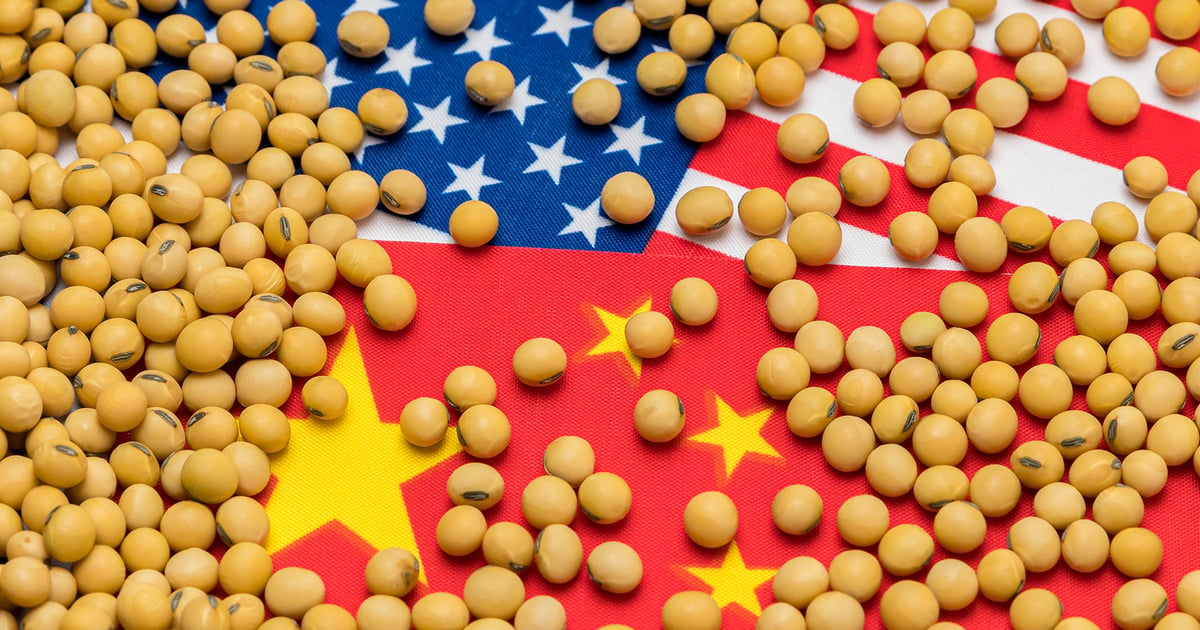
The Soybean Paradox: China’s Pragmatic Decoupling from Global Food Markets

Published

on

How Beijing is quietly rewiring the architecture of global agriculture — succeeding at the edges while remaining hostage to a single, stubborn bean.

There is a particular irony buried inside China’s most consequential agricultural statistic of 2024. The country’s total grain imports fell 2.3% that year to 157.53 million tonnes — the most deliberate retreat from global markets in nearly a decade — yet in that same calendar year, Chinese soybean imports hit a record 105.03 million tonnes, a 6.5% year-on-year increase, accounting for 66% of total grain imports by volume. The strategists in Zhongnanhai are simultaneously winning and losing the food security game they’ve been playing for thirty years. Grasping both truths at once is essential to understanding one of the defining economic relationships of the coming decade. Modern DiplomacyModern Diplomacy

Call it the Soybean Paradox: China is demonstrably, successfully reducing its dependence on global food markets for rice, wheat, and corn while deepening a structural addiction to imported oilseeds that no domestic policy, however muscular, has yet been able to cure. This is not a story of decoupling. It is a story of strategic de-risking — partial, pragmatic, and geopolitically loaded — with reverberations that will reach farmers in Iowa, traders in Santos, and smallholders in the Sahel for decades to come.

From Humiliation to Harvest: The Long Arc of Chinese Food Policy

Understanding where China stands today requires a brief detour through the memory that animates its every agricultural instinct. The great famine of 1959–1961 — which historians believe claimed between 15 and 55 million lives — left an indelible mark on the Communist Party’s institutional psychology. Food security is not, for Beijing, a technocratic concern to be managed through import optimization and comparative advantage logic, as Western economists might counsel. It is existential. It is sovereignty.

This explains why, since Xi Jinping consolidated power in 2013, the language surrounding food has hardened from policy to theology. “China’s rice bowl must always be firmly held in its own hands,” Xi has declared repeatedly — a phrase whose political weight dwarfs its agricultural specificity. Each year since 2004, the central government’s most symbolic annual directive — the so-called “No. 1 Document” — has been devoted to rural and agricultural priorities, signaling to provincial governors, state enterprises, and private farmers alike that food production is not a sector to be disrupted by market rationality alone.

The 2025 No. 1 Document doubled down. It emphasized agricultural technology as central to the food security strategy, directing the central government to accelerate research and application of advanced domestic agricultural machinery and smart farming systems, including AI, 5G, big data, and low-altitude systems. Then, in April 2025, Beijing unveiled its most ambitious blueprint yet: the “Plan for Accelerating the Construction of an Agricultural Powerhouse (2024–2035),” which sets foundational goals for securing China’s food production and supply, including strengthening production capacity, conserving arable land, diversifying food sources domestically and abroad, and advancing agricultural technology and machinery. The ten-year horizon is telling. This is not crisis management. It is civilizational architecture. Asia TimesChinaPower Project

What China Has Actually Achieved: The Staples Miracle

Before cataloguing vulnerabilities — and they are real and numerous — the record of achievement deserves honest acknowledgment.

In 2024, China’s grain output exceeded 700 million tonnes for the first time, with per capita grain possession reaching 500 kilograms — above the internationally recognized food security line of 400 kilograms per capita. Absorb that figure in its full historical context: in 1978, China’s per-capita grain production barely crossed 300 kilograms. The country has, with 8% of the world’s arable land, sustained the dietary needs of nearly 18% of the global population across four decades of rapid urbanization, industrialization, and dietary upgrading. This is an agricultural accomplishment without modern precedent. English.gov.cn

The recent trajectory of staple grain imports tells the de-risking story clearly. In 2024, wheat imports fell 8% to 11.18 million tonnes, rice imports dropped a striking 37% to 1.625 million tonnes, and corn imports decreased by 49% to 13.76 million tonnes. These are not modest adjustments at the margin — they represent a deliberate and largely successful policy of reasserting domestic sufficiency in the grains that matter most to political stability and caloric security. For rice and wheat — the twin pillars of the Chinese dietary identity — self-sufficiency rates have remained above 95% in recent years, with official data showing rice, maize, and wheat self-sufficiency above 98% as recently as 2019. Modern DiplomacyNature

The methods underpinning this success are instructive. China has pursued what academics call a “land red line” policy with near-religious discipline, enforcing a rigid farmland protection floor of 1.8 billion mu (120 million hectares) to prevent agricultural land from being converted to industrial or residential use. It has invested massively in high-standard farmland construction — leveling, draining, and irrigating lower-quality plots to boost per-hectare yields. And it has quietly reversed decades of official hostility toward biotechnology: in 2023, China’s Ministry of Agriculture and Rural Affairs approved GM corn and soybeans as well as GM seeds for commercial use, with another 17 GM crop variants approved in December 2024 — a profound change given long-standing public antagonism against GM foods. English.gov.cnChinaPower Project

The digital revolution is now arriving at the farm gate. In June 2025, seven key government agencies jointly released the Implementation Plan for the Food Industry Digital Transformation, an ambitious roadmap to bring precision farming, AI-driven planting optimization, and smart logistics to a sector still dominated by smallholder plots averaging less than half a hectare. The challenge is formidable; the intent is unmistakable. chinaobservers

The Soybean Trap: Where De-Risking Meets Its Limits

And then there is the bean that breaks every model.

China’s demand for soybeans is approximately 110 million tonnes per year, and roughly 90% of that must be imported. Soybeans are the primary source of vegetable oil in the Chinese diet and, far more consequentially, the dominant protein source for China’s livestock industry — the vast pig, poultry, and aquaculture complex that feeds the country’s growing appetite for meat. China’s Ministry of Agriculture and Rural Affairs noted in January 2025 that 70% of animal husbandry production costs derive from feeds, the bulk of which depends on soybean meal. China’s pork supply chain — the most politically sensitive food commodity in the country — is thus structurally dependent on the global soybean market. This is not a vulnerability that can be engineered away quickly. CssnChinaPower Project

The geopolitical dimension of this dependency has become acute. Trade tensions with the United States have accelerated a diversification that was already underway. Between 2016 and 2024, the US share of China’s soybean imports plummeted from 40% to just 18%. In 2024, Brazil alone accounted for approximately 71% of China’s total soybean imports, a concentration that has redrawn the commercial geography of global agriculture. US agricultural exports to China are projected at just $17 billion in 2025, down 30% from 2024 and more than 50% from 2022; by 2026, the figure is expected to fall to $9 billion — the lowest level since the 2018 trade war. Global Times + 2

From January through August 2025, US soybean exports to China totaled just 218 million bushels, down sharply from 985 million bushels in the equivalent period of 2024. This is not trade friction; it is a structural rupture. For the American agricultural heartland — corn-belt states whose entire revenue model was built around the assumption of Chinese demand — the implications are not merely uncomfortable. They are existential. American Farm Bureau Federation

China has not simply found a new supplier. It has begun constructing a new supply architecture. The “Soy China” initiative — modeled on a successful “Boi China” beef supply chain that Brazil developed specifically to Chinese quality and traceability standards — aims to create a dedicated soybean supply chain cultivated in accordance with sustainability and quality standards defined by China, with the PRC expected to inject capital into Brazil’s agricultural sector to support the recovery of degraded lands. This is agri-diplomacy with a precision that Washington has consistently failed to match: rather than simply purchasing commodities, China is co-designing supply chains, financing logistics infrastructure, and embedding preferential standards that make alternative sourcing progressively more difficult. USDA

The Brazil-China soybean relationship has become a case study in strategic commercial interdependence — but with asymmetries that favor Beijing. 73% of Brazil’s exported soybeans are now destined for China, a concentration that gives Beijing enormous leverage over Brasília’s agricultural policy, land use decisions, and trade posture in any multilateral negotiation. This is the quiet power of being the buyer that cannot be replaced. Farmdoc Daily

The Virtual Water Problem and Climate Reckoning

Soybean dependency is not only a geopolitical liability — it is, on one reading, an ecological strategy of stunning cleverness. Soybeans are extraordinarily water-intensive to produce. By importing 105 million tonnes annually, China effectively imports the equivalent of hundreds of billions of cubic meters of “virtual water” — the water embedded in traded agricultural goods — from Brazil and Argentina, thereby relieving pressure on its own chronically stressed aquifers, particularly in the North China Plain, where groundwater depletion has reached crisis levels in some provinces.

Yet this logic, elegant in the short run, becomes precarious in a world of accelerating climate disruption. Climate change is expected to reshape precipitation patterns, heat accumulation, and the frequency of extreme weather events, with water-stressed regions like the North China Plain becoming more vulnerable to production risks, while resource-rich northeastern provinces could emerge as critical grain expansion zones. Brazil’s soybean production is equally exposed to climatic volatility — La Niña events, deforestation-induced rainfall disruption in the Amazon basin, and the worsening drought cycles in Mato Grosso, which produces the majority of Brazilian soy. China’s supply security is therefore only as resilient as the climate systems of countries it has chosen to depend on — which is to say, increasingly fragile. MDPI

The domestic dimension is similarly sobering. Of China’s 31 provincial-level administrative regions, 19 have failed to achieve food self-sufficiency, with a stark divide between food-surplus northern inland provinces and food-deficit southern coastal regions that depend on inter-regional transfers. The national food self-sufficiency rate has declined to 82% by 2022 when broader food categories including beans and tubers are counted — a figure that underscores the gap between the officially celebrated grain self-sufficiency narrative and the full complexity of the food system. MDPIMDPI

The Global Ripple: Who Wins, Who Loses

Beijing’s strategic de-risking has already produced winners and losers, and the redistribution will intensify.

Brazil is the clearest beneficiary — a soybean superpower whose agricultural export revenues have become structurally dependent on Chinese demand. The risk, rarely discussed in Brasília, is that Brazil has traded one form of external dependency for another: it has diversified away from American market exposure only to concentrate on Chinese demand to a degree that rivals US exposure at its peak.

Russia and the Global South are increasingly integrated into China’s agricultural diversification playbook. Chinese investment in Russian Far East farmland, grain corridors through Central Asia, and agricultural cooperation agreements with ASEAN and African nations all reflect a Belt and Road logic applied to food security: building redundant supply networks so that no single geopolitical rupture can threaten the food chain. China has pledged 1 billion yuan in emergency food assistance to Africa, development of 100,000 mu of agricultural demonstration areas, and the dispatch of 500 agricultural experts — soft power investments that simultaneously build goodwill and create future supply dependencies. English.gov.cn

American farmers are experiencing the sharpest adjustment. In 2012, China purchased more than $25 billion in US farm products, nearly 20% of all agricultural exports. The recovery under the Phase 1 agreement was temporary; since then, China has steadily diversified its suppliers. The lesson that US agricultural policy has been slow to internalize is that Chinese diversification is not purely reactive to tariff cycles — it is a structural policy goal that trade concessions can slow but not reverse. American Farm Bureau Federation

Evaluating the Strategy: Partial Success, Persistent Gaps

How should this Chinese agricultural strategy be assessed against its own ambitions?

On staple grains: broadly successful. The combination of land protection policies, yield-enhancing technology, price support mechanisms, and strategic reserves has produced genuine food security for the 1.4 billion population’s core caloric needs. China’s average grain stock-to-consumption ratio of 54% stands far above the FAO’s food security warning line of 17% — a buffer that provides meaningful insulation against short-term supply shocks. Nature

On oilseeds and feed proteins: still deeply vulnerable. China’s soybean imports are on track to reach a record high in 2025, potentially exceeding 110 million tonnes — the inverse of what de-risking doctrine demands. Domestic soybean production, despite substantial policy support, achieved a self-sufficiency rate of just 18.5% as recently as 2022. The Five-Year Agricultural Plan targets domestic soybean production of 23 million tonnes by 2025 — an aspiration that would still leave 80% of demand unmet from imports. Dccchina + 2

On supplier diversification: genuine progress, but with new concentration risks. Reducing dependence on the US from 40% to 18% of soybean imports is a meaningful strategic achievement. But replacing it with 71% dependence on Brazil is less diversification than substitution. True resilience would require viable supply streams from five or six geographically dispersed sources, each capable of rapid scale-up — a supply architecture that does not yet exist for soybeans and may not be structurally achievable given the crop’s biophysical requirements.

On technology: genuinely promising, but with a decade-long lag. The embrace of precision agriculture, AI-optimized planting, and GM seed technology represents China’s most underappreciated long-term lever. Seven government agencies launched a joint Implementation Plan for the Food Industry Digital Transformation in June 2025, signaling the kind of whole-of-government coordination that tends to produce results in China’s development model. The productivity gains from widespread GM adoption, combined with precision irrigation in the water-stressed North China Plain, could materially improve self-sufficiency rates in oilseeds by the 2030s — but the timeline is uncertain, and the structural demand from a protein-hungry middle class is relentless. chinaobservers

The Broader Lesson: A New Model of Commodity Power

China’s agricultural strategy offers a masterclass in what might be called “dependency asymmetry management”: systematically reducing the leverage that any single foreign supplier holds over its food system while simultaneously increasing the leverage that China itself holds over those suppliers. The US-China soybean relationship was, at its peak, one of profound mutual dependency. Today, American farmers are more exposed to Chinese purchasing decisions than Chinese consumers are to American supply disruptions — a strategic inversion achieved over fifteen years through patient diversification, supplier cultivation, and infrastructure investment in the Global South.

This is not decoupling. It is something more sophisticated and arguably more destabilizing for the existing global trade order: selective interdependence, calibrated to minimize China’s vulnerability while preserving — and deepening — the vulnerabilities of its trading partners.

For commodity markets, the implications are profound. A China that continues buying record volumes of Brazilian soybeans while systematically excluding US origins will reshape the economics of both exporting nations, redirect global shipping patterns, and — through the “Soy China” initiative — begin to impose quality and sustainability standards on global production that Beijing, not Geneva, will define. China’s emergence as the buyer that sets the rules, rather than the buyer that follows them, represents a structural shift in global agricultural governance that has received insufficient attention.

For the broader project of globalization, China’s food security strategy embodies the central tension of our era: between the efficiency gains of comparative advantage and the resilience demands of geopolitical competition. Beijing has concluded, with some empirical justification, that the post-Cold War trade order was built on assumptions of political trust that no longer hold. Its response — partial, pragmatic, and increasingly effective — is not a rejection of global markets but a renegotiation of the terms on which it participates in them.

The Soybean Paradox will not be resolved quickly. China will remain the world’s largest agricultural importer for the foreseeable future, and its soybeans will continue to flow overwhelmingly from the Southern Hemisphere. But the trajectory is unmistakable: a country of 1.4 billion, armed with ambitious policy, deepening technology, and a strategic patience that Western democracies struggle to match, is slowly, deliberately tightening its grip on the one resource that every civilization has learned, sometimes through catastrophe, is too important to leave to markets alone.

The rice bowl, Beijing has decided, will be held in Chinese hands — even if the soybeans that fill it still arrive on Brazilian ships.


Discover more from The Economy

Subscribe to get the latest posts sent to your email.

Analysis

Trump’s 25% Tariff Hammer on EU Cars: Protectionism That Could Reshape Global Auto Trade — Or Ignite a Costly Backlash?

Published

on

President Trump’s shock announcement raising EU auto tariffs from 15% to 25% — citing Turnberry Agreement violations — threatens to rattle global supply chains, hike sticker prices by up to $15,000, and torch a fragile transatlantic trade peace. Here’s the full analysis.

The Announcement That Shook Stuttgart and Brussels at Once

Picture a Friday afternoon at a Bavarian assembly plant just outside Munich. The line foremen are running their final quality checks on a row of gleaming 5-Series sedans, their destination stickers reading Port of Baltimore. Then, at 7:23 PM Central European Time, a notification pops on every phone on the factory floor. The American president has just posted to Truth Social. By midnight, the implications are reverberating in boardrooms from Wolfsburg to Maranello.

President Donald Trump announced on Friday, May 1, 2026, that he was raising tariffs on cars and trucks imported from the European Union to 25%, claiming the bloc had “failed to fully comply” with a trade agreement the two sides had negotiated. In characteristic fashion, he delivered the news not through a formal White House press briefing, not through the Office of the United States Trade Representative, but through a post on his social media platform. Bloomberg

“Based on the fact the European Union is not complying with our fully agreed to Trade Deal, next week I will be increasing Tariffs charged to the European Union for Cars and Trucks coming into the United States. The Tariff will be increased to 25%,” Trump wrote. ABC News

The announcement landed like a wrench thrown into the gears of one of the world’s most economically significant bilateral trade relationships. It was brazen, it was deliberately vague, and — depending on which economist you ask — it was either a masterstroke of negotiating leverage or an act of reckless self-sabotage. Possibly both.

What Exactly Is the Turnberry Agreement — and Why Does It Matter?

To understand why this escalation is so jarring, you need to understand the delicate architecture of the deal it is now threatening to demolish.

Trump and European Commission President Ursula von der Leyen had agreed to a trade deal last July which set a 15% tariff on most goods — the agreement, dubbed the Turnberry Agreement after Trump’s golf course in Scotland, had already been questioned after the U.S. Supreme Court ruled that Trump lacked the authority to declare a national emergency to justify many of his tariffs. Euronews

The Turnberry Agreement was itself a product of extraordinary geopolitical pressure. It came after months of tense negotiations, with the U.S. seeking to address its $235.6 billion goods trade deficit with the EU in 2024. For Brussels, the deal — however painful — represented a pragmatic climb-down from a far more damaging 27.5% tariff cliff. For European automakers, the 15% rate was a lifeline. For the EU economy at large, it was a fragile but functional truce. Autobypayment

That truce is now in tatters.

The White House said Trump would increase the EU’s tariff levies under Section 232 — the same authority used to justify the original 25% Section 232 tariffs on foreign autos in March 2025, which were then lowered as part of the trade framework with the EU. CNBC

Crucially, neither the White House nor the Trump administration offered a single concrete example of EU non-compliance. Neither EU nor U.S. officials responded to questions about in what specific manner the agreement had been violated — a significant omission that drew immediate fire from European negotiators, who accused the U.S. of “clear unreliability” and “repeatedly breaking its commitments.” Euronews

Scott Lincicome of the Cato Institute’s Center for Trade Policy Studies cut to the chase with brutal clarity. He described Trump’s threats as “just another example of why these trade deals are vapourware. They all rely on handshakes and winks and hopes that Trump doesn’t get mad about something.” France 24

For anyone who has followed U.S. trade policy over the past two years, the sentiment is hard to argue with.

The Industrial Logic: Reshoring, Real or Rhetorical?

To be fair to the White House’s underlying industrial thesis — a thesis that deserves rigorous engagement rather than reflexive dismissal — there is a coherent logic buried beneath the tariff noise.

Trump touted American automobile production capabilities in his Truth Social post, claiming that U.S. manufacturing plants “will be opening soon” and that “over 100 billion dollars” is being invested. He added: “It is fully understood and agreed that, if they produce Cars and Trucks in U.S.A. Plants, there will be NO TARIFF.” ABC News

This is the carrot-and-stick theory of industrial policy in its most naked form. Use tariffs as a punitive nudge — make importing so expensive that foreign brands have no rational choice but to build American. And there is evidence, tentative as it is, that the broader tariff campaign has begun to move the needle. Domestic production rose to 54.4% of all new vehicles sold as automakers like Toyota and Stellantis invested billions in U.S. facilities, responding to the tariff pressure. Digital Dealer

But here is the uncomfortable counterfactual that the administration’s boosters rarely address: factory investment cycles run on decade-long timelines. A BMW plant in South Carolina, a Mercedes assembly line in Alabama — these do not materialize in response to a Friday afternoon Truth Social post. They require geological patience, regulatory certainty, workforce development programs, and — above all else — predictability. The very thing that Trump’s tariff strategy systematically destroys.

The higher costs and limited availability of affordable vehicles have already pushed many buyers toward the used-vehicle market — an outcome that serves neither domestic automakers nor U.S. consumers. Reshoring is a worthy industrial goal. Whipsawing policy is its worst possible instrument. Digital Dealer

The German Gut Punch: VW, BMW, Mercedes, and a €36.8 Billion Exposure

If there is one economy on the planet staring down the barrel of this tariff escalation with cold dread, it is Germany’s.

Germany’s three largest carmakers — Volkswagen, Mercedes-Benz, and BMW — are responsible for around 73% of EU car exports to the United States. In 2024, Germany exported vehicles worth 36.8 billion euros ($42.8 billion) to the United States, while importing just 7.9 billion euros — a trade asymmetry that has long been a source of American frustration. Xinhua

The scale of German exposure to U.S. tariff policy is not merely a balance sheet problem — it is a social and political one. The automotive sector is the backbone of the German Mittelstand, the web of mid-sized suppliers and specialist manufacturers that employ hundreds of thousands of workers and underpin the country’s industrial identity. A recent VDA survey of medium-sized automotive firms showed that 86% expect to be affected by the tariffs — 32% directly and 54% indirectly through supplier and customer networks. Euronews

The market reaction to the May 1 announcement was swift and punishing. European automobile producers were among the hardest hit in Thursday’s trading: Porsche AG plunged 5.4%, Mercedes-Benz fell 4.8%, Ferrari dropped 4.7%, BMW fell 3.7%, and Volkswagen shed 2.9%. Auto parts makers Continental AG and Pirelli each fell around 2%. Euronews

In 2025 alone, BMW, Mercedes, and Volkswagen faced a combined loss of $6 billion due to U.S. tariffs imposed under President Trump’s administration. With the rate now returning to 25%, analysts are already recalibrating those loss projections sharply upward for 2026. Digital Dealer

Italy, too, faces meaningful collateral damage. Oxford Economics estimates that German and Italian automotive exports could decline by 7.1% and 6.6% respectively, with gross value added falling by 5.3% in Germany and 4.7% in Italy. For a country like Italy, where Stellantis already faces structural headwinds and Ferrari’s pricing power may not fully insulate it from demand shock, those numbers represent real vulnerability. Autobypayment

The American Consumer: Buckle Up for Sticker Shock

The argument that tariffs are “paid by foreign exporters” — an assertion the Trump administration has repeated with spectacular disregard for basic economics — receives its most decisive rebuttal at the car dealership.

Goldman Sachs analyst Mark Delaney said in a note that imported car prices could rise between $5,000 and $15,000 depending on the vehicle. Even U.S.-assembled models could see cost increases of $3,000 to $8,000 due to the use of foreign-sourced components. Euronews

Think about what that means in practice. A mid-range BMW 3-Series, currently retailing around $45,000, could carry a tariff-driven surcharge pushing it past $55,000. A Mercedes E-Class could drift uncomfortably close to $75,000. A 25% tariff could increase the cost of a German-made BMW or Mercedes-Benz by over $10,000 in the U.S. market. Tset

And the pain does not stop at the luxury tier. The supply chain reality of modern automobile manufacturing means that virtually no car sold in America is made entirely in America. Components, sensors, transmissions, semiconductors — all flow across borders in highly optimized webs of production. Assuming that roughly 50% of parts in U.S.-made cars are imported, tariffs on auto parts could significantly raise production costs across the board — including for domestic brands. Euronews

Some European manufacturers have attempted heroic feats of cost absorption. Mercedes held relatively firm to its commitment to absorb tariff costs, with 2026 model year increases of only a couple of hundred dollars, while BMW announced price increases of roughly 1% — around $400 to $1,500 — excluding EVs and select models. But at 25%, that strategy of generous absorption becomes financially untenable. At some point, as any industrial economist will tell you, the cost lands on the consumer. The only question is whether it lands softly or with a thud. Dealership Guy

The EU’s Calculated Response: Patience, Then Proportionality

The European Commission’s reaction to the May 1 announcement has been measured — at least publicly. A spokesman for the European Commission rejected the claim that the bloc was somehow not in compliance, saying the Commission “will keep our options open to protect EU interests” if Trump does not honour the pre-existing deal. Al Jazeera

Behind closed doors, the calculus is considerably more fraught. Brussels faces a structural dilemma: retaliate hard and risk a full-scale trade war with its most important security and intelligence partner; capitulate and signal to Washington that unilateral escalation carries no cost. Neither option is attractive. The history of European trade diplomacy suggests a third path — proportional, targeted, legally defensible counter-measures — chosen with surgical care to maximize political pain while minimizing economic blowback.

The EU Parliament is currently negotiating the implementation of the Turnberry Agreement, with MEPs seeking to attach safeguards — including a “sunset clause” under which the deal expires in March 2028 unless both sides agree to extend it, and a “sunrise clause” making tariff preferences conditional on U.S. compliance. These provisions now look prescient. They may also become the legal architecture for a European suspension of its own trade concessions. Euronews

Meanwhile, the political fault lines within Europe are sharpening. Member states are split between those behind France and Spain — who back a tougher stance — and others led by Germany and Italy, who favour preserving the deal as it was originally agreed. Germany’s urgency is obvious: it has the most skin in this particular game. But France’s instinct for economic nationalism and Spain’s grievance politics create a European coalition that Trump may be underestimating. Euronews

The Geopolitical Subtext: Cars as Leverage in a Wider Contest

It would be naive to analyze this tariff announcement purely through an economic lens. The timing and context are telling.

The announcement came a day after Trump renewed criticism of German Chancellor Friedrich Merz, telling him to focus on ending the Ukraine war instead of “interfering” on Iran. He also referred to European allies Spain and Italy as “absolutely horrible” for their refusal to get involved in the Iran war. Euronews

Trade and geopolitics in the Trump era are inseparable. Tariffs are not merely revenue instruments or industrial policy tools — they are signals of displeasure, instruments of political coercion, and leverage mechanisms in negotiations that extend far beyond any single sector. The EU’s reluctance to fall in line on Iran policy, its ongoing tensions with Washington over NATO burden-sharing, its periodic sovereignty assertions on digital regulation — all of these feed into the ambient temperature of the transatlantic relationship that ultimately determines whether the president wakes up inclined toward accommodation or aggression.

In this context, the 25% auto tariff is not simply a response to alleged trade deal non-compliance. It is a message. The question for European capitals is whether they choose to receive it or to challenge it.

Reshoring Reality Check: How Much American Manufacturing Actually Moves?

The White House narrative of tariffs-as-industrial-catalyst deserves a rigorous evidence test. The empirical picture, two years into the broad tariff campaign, is decidedly mixed.

While the tariffs were intended to encourage automakers to shift production to the U.S., the lack of policy consistency has made it challenging for companies to commit to long-term investment. BMW’s South Carolina plant produces excellent cars. Mercedes’ Alabama operations are world-class. But these investments preceded the current tariff regime by decades — they were made in response to long-term market strategy, not presidential social media posts. Digital Dealer

The more honest assessment of tariff-driven reshoring acknowledges a fundamental tension: the investments Trump is demanding require the very predictability and rule-of-law that his governing style corrodes. A board in Stuttgart will not approve a billion-dollar greenfield U.S. facility on the basis of a trade agreement that the president can unilaterally abrogate on a Friday afternoon. The investment calculus requires confidence that 25% today will not become 35% tomorrow — or zero percent if a new deal is struck next quarter.

Experts have said progress towards the reshoring goal has been largely muted, while critics have noted the tariff fees have been footed by U.S. businesses, which then pass the costs to consumers. Al Jazeera

Three Scenarios: Where This Goes From Here

Any honest analysis of Trump’s 25% EU auto tariff must grapple with uncertainty — and offer readers a structured framework for thinking about possible trajectories.

Scenario 1: The Negotiating Gambit (Most Likely Near-Term)

This scenario holds that the 25% announcement is a pressure tactic — a deliberate escalation designed to force the EU back to the negotiating table with accelerated concessions, whether on digital services regulation, defense procurement, agricultural market access, or some combination thereof. In this reading, the tariff is the opening bid in a renewed negotiation, not a permanent policy. Markets have seen this movie before. If the EU blinks — offering concessions on procurement or beef access, perhaps — the tariff may never fully take effect, or may be walked back within weeks.

Scenario 2: Sustained Escalation (Dangerous Middle Path)

Here, Trump’s domestic political incentives — particularly his need to maintain credibility with the manufacturing base he has cultivated — prevent him from backing down quickly. The 25% tariff takes effect, European automakers absorb losses and raise prices, U.S. consumers absorb sticker shock, and the EU responds with targeted counter-measures on American agricultural exports, tech services, or industrial goods. Inflation ticks upward on both sides of the Atlantic. This scenario damages both economies but particularly punishes the German export machine and the American car-buying middle class.

Scenario 3: Full Trade War (Tail Risk, Not Negligible)

The nightmare scenario in which escalation begets retaliation begets counter-retaliation, the Turnberry Agreement collapses entirely, and the global trading system loses one of its most important bilateral frameworks. Given the current geopolitical context — a fragile global economy already absorbing the shock of Middle East instability — this scenario carries real risks to global growth that extend far beyond the auto sector.

The WTO Problem: Rules in a Ruleless Age

Any discussion of this tariff must acknowledge the elephant in the room: the World Trade Organization’s multilateral trading rules, which the current U.S. administration has treated with barely concealed contempt.

The Supreme Court ruled in February that a large part of Trump’s tariff agenda was illegal — finding in a 6-3 majority that the IEEPA “does not authorize the President to impose tariffs.” The administration subsequently pivoted to Section 232 of the Trade Expansion Act of 1962, which allows tariffs on national security grounds. CNBC

Section 232 is a blunt instrument that, in the hands of this administration, has been stretched far beyond its original conceptual boundaries. No credible national security analysis identifies German luxury sedans as a threat to American security. The legal architecture of this tariff is built on foundations that are simultaneously legally contested domestically and internationally non-compliant. The EU has standing WTO cases that it could pursue — and a resurgent appetite for doing so.

The Bottom Line: Leverage with Real Costs

Here is the honest assessment that neither the tariff’s cheerleaders nor its reflexive critics want to fully acknowledge: there are legitimate concerns about trade imbalances, intellectual property, and the vulnerability of U.S. industrial capacity that motivate the broader tariff agenda. Car trade accounts for 60% of the EU’s overall goods trade surplus — a figure that does represent a genuine asymmetry in the bilateral relationship. The desire to reshape that asymmetry is not inherently unreasonable. Rabobank

But the instrument being deployed — a shock tariff hike announced via social media, on the eve of a holiday weekend, citing unspecified non-compliance — is precisely the wrong tool for achieving durable structural change. It maximizes short-term leverage while destroying the long-term institutional trust that sustainable industrial policy requires. It hits U.S. consumers in the wallet while claiming to serve their interests. It undermines American credibility as a reliable partner at the very moment when building durable alliances is a geopolitical imperative.

The German factory worker staring at that Truth Social notification will keep her line running Monday morning. The question is whether she will still be running it for U.S.-bound vehicles by the end of this decade — or whether her company will have quietly pivoted its export strategy toward Asia and the Middle East, recalibrating its American bet as too politically volatile to anchor long-term production commitments around.

That would be the real cost of this tariff. Not the stock market sell-off. Not the quarterly earnings miss. But the slow, irreversible strategic decoupling of the world’s two largest democratic economies — driven not by any deliberate policy vision, but by the accumulation of Friday afternoon social media posts that no one in Stuttgart, Brussels, or Washington can confidently predict or plan around.

Reshoring American manufacturing is a noble goal. It deserves better than this.

FAQ: Trump’s 25% EU Auto Tariffs — What You Need to Know

Q: What exactly did Trump announce on May 1, 2026? President Trump announced via Truth Social that the United States would increase tariffs on cars and trucks imported from the European Union from 15% to 25%, citing the EU’s alleged non-compliance with the Turnberry Agreement trade deal reached in July 2025. The tariff was set to take effect the following week.

Q: What is the Turnberry Agreement? The Turnberry Agreement is the informal name for the U.S.-EU trade deal struck in July 2025 between Trump and European Commission President Ursula von der Leyen. It set a 15% tariff on most EU goods entering the U.S. — lower than the 27.5% previously threatened — in exchange for EU concessions on U.S. exports.

Q: Which European automakers are most affected by the 25% tariff? BMW, Mercedes-Benz, Volkswagen (including Audi and Porsche), Stellantis, and Ferrari face the most significant exposure. German automakers account for approximately 73% of EU car exports to the U.S. and are therefore most directly impacted by any rate increase.

Q: How much could the 25% tariff raise car prices for American consumers? Goldman Sachs analysts estimate that imported EU car prices could rise by $5,000 to $15,000 per vehicle, depending on the model. Even U.S.-assembled vehicles could see price increases of $3,000 to $8,000 due to reliance on imported components.

Q: Are any vehicles exempt from the 25% tariff? Yes. Trump explicitly stated that vehicles produced in U.S. manufacturing plants would face no tariff — the central incentive mechanism designed to encourage European automakers to relocate production to America.

Q: How has the EU responded to the tariff announcement? The European Commission rejected the claim that it was non-compliant with the Turnberry Agreement and stated it would “keep options open” to protect EU interests. Individual MEPs and the VDA (Germany’s auto industry association) called the announcement a violation of existing commitments and urged both sides to resolve the dispute quickly.

Q: What legal authority is Trump using for the 25% tariff? The administration is invoking Section 232 of the Trade Expansion Act of 1962, which allows the president to impose tariffs on national security grounds. This authority was also used for the original 25% auto tariffs imposed in March 2025.


Discover more from The Economy

Subscribe to get the latest posts sent to your email.

Continue Reading

Analysis

Why Global Markets Are Hitting All-Time Highs While America Is at War

Published

on

On the morning of May 1, 2026, as diplomats shuttled between Islamabad and Washington in a last-ditch effort to negotiate a ceasefire with Iran, American consumers were paying $4.30 per gallon at the pump — up 44% since February. The Strait of Hormuz, the jugular of global energy supply, remained functionally closed. Iranian officials were vowing the waterway would “under no circumstances” return to its previous state. And the International Energy Agency had just described the unfolding supply crisis as the “greatest global energy security challenge in history.”

Yet, in the same twenty-four-hour window, the S&P 500 closed at a fresh all-time high of 7,230.12. The Nasdaq surpassed 25,000 for the first time in its history, settling at 25,114.44. Both indices recorded their sixth consecutive weekly gain — the longest winning streak since October 2024. Hedge funds poured $45 billion into equities in the span of days, according to Bloomberg. Fear, as measured by the CBOE Volatility Index (VIX), sat at a placid 16.89 — barely elevated, well below the panic thresholds of prior crises.

The question that should be on every serious investor’s mind isn’t why markets are falling. It’s why, against a backdrop of active U.S. military engagement, a 55%-surging oil price, and the most severe energy supply shock in recorded history, global capital markets are surging to record highs. The answer is more nuanced — and more instructive — than the headlines suggest.

The Paradox: A Stock Market Rally Amid War in 2026

To understand the stock market surge despite the Iran war, you first need to discard the intuitive but empirically flawed assumption that war equals market decline.

History is consistently unkind to that narrative. The S&P 500 gained roughly 15% in the twelve months following the September 11 attacks, once the initial shock had cleared. It rose through the opening phase of the Iraq War. It climbed even as the Russia-Ukraine war ground into its second year. And most instructively for today, it bounced back violently from “Liberation Day” in April 2025 — the tariff shock that many analysts believed would be the event that finally broke the cycle. Instead, the market absorbed that blow and added over 21% in the subsequent twelve months, per Bloomberg data.

Markets are not thermometers of geopolitical temperature. They are discounting mechanisms — machines for pricing the future earnings stream of thousands of corporations, filtered through the lens of available capital and investor psychology. And right now, on both of those dimensions, the signal is unambiguously bullish.

The Iran conflict began in earnest in late February 2026. In the weeks that followed, global oil prices surged over 55%, the Strait of Hormuz was shut to 20% of the world’s crude supply, and stock markets did wobble — the S&P 500 was briefly down 0.65% since the conflict’s onset as of early April, per Bloomberg. But critically, it never broke. It never priced in a catastrophic scenario. As Invesco’s market strategists noted in a widely circulated April analysis: “Investors, particularly after last year’s Liberation Day whipsaw, have shown little appetite for pricing in open-ended worst-case scenarios.”

That institutional memory — forged in 2025’s tariff drama — may be the single most important factor driving the 2026 market’s resilience.

The Five Pillars Holding This Rally Up

1. Corporate Earnings: The Bedrock That War Cannot Easily Shake

The most important driver of markets is not geopolitics. It is earnings. And the Q1 2026 earnings season has delivered with striking force.

The S&P 500 is on course to report its sixth consecutive quarter of double-digit earnings growth, with the consensus estimate standing at 15.1% year-over-year expansion, according to FactSet’s John Butters. That is not the earnings profile of an economy collapsing under the weight of an oil shock.

The week of April 27–May 1 was the heaviest earnings week of the quarter, and it delivered. Microsoft reported fiscal Q3 revenue of $82.9 billion against a consensus of $81.4 billion. Amazon reported $181.5 billion — beating by over $4 billion. Meta’s revenue came in at $56.31 billion, besting estimates by $860 million. And Apple, the index’s single largest component, surged over 3% after reporting stronger-than-expected results, citing “extraordinary” demand for the iPhone 17 lineup and raising its second-quarter revenue guidance.

The message from Corporate America was unmistakable: while the war is creating friction — particularly in energy, travel, and consumer sentiment — the core productivity engine of the digital economy is operating at full throttle.

Key data: The Magnificent Seven are forecast by Morgan Stanley to grow net income 25% in 2026, versus just 11% for the remaining S&P 493 companies. That gap — 14 percentage points of relative earnings outperformance — is the structural foundation beneath this rally.

2. The AI Capital Expenditure Supercycle: A War Within a War

If the Iran conflict is the headline war, there is another war being fought simultaneously — and this one is bullish. The four largest American hyperscalers (Microsoft, Alphabet, Amazon, and Meta) are collectively projected to spend $649 billion on AI infrastructure in 2026, the largest capital expenditure commitment in corporate history, according to Bridgewater Associates analysis cited across Bloomberg and Yahoo Finance.

Consider what that number means in context. It is roughly equivalent to the entire U.S. annual Medicare budget. It is more than the GDP of Sweden. And it is being deployed in a single year, into a single technology vertical, by four companies.

Microsoft’s AI business generated $37 billion in revenue in the most recent quarter — up 123% year-over-year, CEO Satya Nadella disclosed. Alphabet’s Google Cloud rose 63% to $20 billion in Q1, fueled by enterprise AI infrastructure. Amazon’s AWS came in at $37.6 billion. This is not speculative enthusiasm. This is revenue.

The AI trade has also created a cascade of secondary beneficiaries — from semiconductor memory producers like Sandisk (up 360% year-to-date before earnings), to energy infrastructure companies benefiting from data center power demand, to industrial conglomerates like Caterpillar, which reported a record backlog driven in part by AI data center construction.

When capital is pouring into an economy at this velocity, geopolitical turbulence in a distant strait becomes, for equity markets at least, a manageable headwind rather than an existential threat.

3. The Forward-Looking Nature of Markets — and the Psychology of Ceasefire Optimism

Markets do not trade on what is happening today. They trade on what investors believe will be happening in 12 to 18 months. And what the market appears to believe — however tentatively — is that the Iran conflict will resolve.

President Trump disclosed on May 1 that negotiations were advancing through Pakistani mediators, though he acknowledged publicly that the exact status of talks was known only to “himself and a handful of others.” Oil prices fell sharply on those comments — WTI dropped nearly 3% in a single session — suggesting that even the faintest diplomatic signal is enough to move capital decisively.

Invesco’s strategists put the psychology succinctly in their April market note: “The psychological shift from not knowing whether there’s an end to believing that there’s one may be more important than knowing the exact date.” The bar for relief rally has proven surprisingly low. Markets are not waiting for a signed peace treaty. They are pricing a probability distribution, and that distribution has shifted toward resolution.

4. Liquidity, Policy Expectations, and the “Higher for Longer” Paradox

The Federal Reserve has signaled that rates will stay elevated, with markets beginning to price the prospect of a hike as late as 2027. That sounds bearish. And yet, high-yield credit spreads are near multi-year tights — meaning the bond market is simultaneously pricing in rate persistence and creditworthiness. Retail traders are piling into zero-day options. Prediction markets are humming.

The apparent paradox resolves when you recognize that the primary driver of equity valuations in 2026 is not rate-level sensitivity — it is earnings growth velocity. When corporate profits are expanding at 15% annually and the largest companies in the index are printing 25%+ net income growth, a “higher for longer” rate environment becomes a secondary concern rather than a fatal one.

Hedge fund inflows of $45 billion in a single week, as Bloomberg reported, underscore the degree to which institutional capital is actively chasing this market rather than fleeing it. Risk appetite, as measured across equities, credit, and crypto (Bitcoin rose 2.7% on May 1, crossing back above $78,000), is resolutely in expansion mode.

5. The Liberation Day Lesson — Scar Tissue as Asset

There is a behavioral dimension to this rally that deserves more attention than it typically receives in quantitative analysis. The Liberation Day tariff shock of April 2025 was, for many institutional investors, a terrifying near-miss. Those who sold at the bottom underperformed by over 21 percentage points in the subsequent year. That experience has created what behavioral economists would call asymmetric loss aversion in reverse — a visceral fear of being caught defensively positioned when the market recovers.

Traders are, in the language of Wall Street, “climbing a wall of worry” — and doing so deliberately, because they remember precisely what happened the last time they retreated to the bunker.

Sector Winners and Losers: Who Thrives When War Meets Markets

SectorTrendKey Driver
Technology / AI✅ Strong outperformerMag 7 earnings, AI capex cycle
Defense & Aerospace✅ OutperformerPentagon AI contracts, defense budget expansion
Energy (Integrated)⚠️ ComplexExxon net income -45%, Chevron -36%; revenue beats on volume
Semiconductors✅ StrongMemory chip crunch; SOXX outperforming
Tanker Shipping✅ WindfallHormuz disruption driving freight rates
Airlines/Travel❌ UnderperformerBooking disruptions; jet fuel costs
European Industrials❌ PressureEnergy shock; chemical/steel surcharges
Consumer Discretionary⚠️ MixedGas prices weighing on lower-income consumers

Defense deserves special mention. The Pentagon struck agreements with four additional technology companies in late April 2026 for expanded AI tools on classified military networks. The convergence of the AI supercycle and defense spending is creating a new category of beneficiary — call it the “military-AI complex” — that did not exist in prior conflict cycles.

Energy presents the most analytically interesting case. Exxon and Chevron both beat Wall Street estimates in Q1 2026 — yet both reported steep profit declines (45% and 36% respectively), because higher oil prices were offset by constrained production behind a closed Strait. This is a textbook supply shock: the price is up, but volume is down, and the net effect on earnings is negative for the very sector ostensibly “benefiting” from war.

Meanwhile, tanker shipping has become an unlikely war-beneficiary. With Hormuz closed, oil cargoes are being rerouted around the Cape of Good Hope, dramatically lengthening voyage times and sending freight rates soaring. BWET, the tanker shipping ETF, is among the top-performing funds in the current environment.

The Risks That Could Derail the Stock Market Rally

To be intellectually honest, the bull case described above rests on several assumptions that could shatter.

1. A Protracted Strait of Hormuz Closure. The IEA’s scenario analysis suggests that a closure extending beyond six months begins to have structural economic effects — not just in Asia, which imports 75% of Gulf oil exports, but in Europe, where Dutch TTF gas has nearly doubled to over €60/MWh. The European Central Bank has warned explicitly of a stagflationary recession scenario if the conflict persists into the second half of 2026. A European recession is not currently priced into U.S. equities.

2. AI Capex Without Revenue Conversion. The $649 billion AI infrastructure bet is predicated on an assumption — that monetization will follow at scale. Chris Brigati, Chief Investment Officer at SWBC, warned clients this week that “the S&P 500’s heavy concentration in the Mag 7 elevates downside risk should earnings fall short, as valuations leave little margin for error.” If Microsoft’s Copilot or Google’s Gemini fail to generate demonstrable enterprise ROI at scale within the next two to three quarters, the AI premium baked into these stocks faces a reckoning.

3. Earnings Concentration Risk. The current rally is built on an extraordinarily narrow foundation. Roughly one-third of S&P 500 performance is driven by seven companies. When Meta fell 5% after its earnings call — despite beating consensus estimates — the index barely flinched. But seven simultaneous misses would be a different story entirely.

4. A Fed Policy Misstep. The ISM prices paid sub-index rose 6.3 points in April 2026 to a four-year high of 84.6, well above the 80.3 expected. That is a measure of input cost inflation — the downstream effect of higher oil prices flowing through supply chains. If core inflation re-accelerates toward 3.5% or beyond, the Fed’s hand may be forced in ways that could genuinely compress multiples.

5. Escalation Without Warning. Iran’s Deputy Parliament Speaker stated that by controlling the Strait of Hormuz and Bab al-Mandab, Iran affects “25% of the world’s economy.” That is not hyperbole. A scenario in which Iranian proxies expand hostilities to include Gulf state energy infrastructure — Saudi Aramco facilities, UAE terminals — would be categorically different from the current calibrated conflict, and would likely overwhelm the market’s current equanimity.

What History Tells Us — and Where This Moment Is Unique

The 1973 oil crisis drove the S&P 500 down nearly 50% over eighteen months — but that was also a period of simultaneous Fed tightening, wage-price spiral inflation, and a domestic political crisis. The 1990 Gulf War sent oil to $40 per barrel (roughly $100 in today’s dollars), caused a sharp but brief equity correction, and was followed by one of the strongest bull markets in U.S. history. The Russia-Ukraine war of 2022 was absorbed within six months, even as European energy prices quadrupled.

The consistent lesson: conflict-driven market disruptions are almost always finite and mean-reverting, unless they coincide with pre-existing structural vulnerabilities. In 1973, those vulnerabilities were deep. In 2026, the U.S. economy enters the conflict with AI-driven productivity gains partially offsetting energy inflation, a still-employed consumer, and corporate balance sheets flush with cash.

There is, however, one genuinely novel element in today’s equation that distinguishes it from every prior conflict cycle: the speed and scale of capital reallocation enabled by algorithmic trading, zero-day options, and retail participation platforms. Markets in 2026 can price a ceasefire rumor from Islamabad within milliseconds. They can also price an escalation. The amplitude of swings — in both directions — is structurally higher than in any prior war cycle. This is not a bug. It is the feature of modern market microstructure. But it means that the transition from record-high to acute correction can now happen in hours rather than weeks.

The Investor Implication: Resilience Does Not Mean Invincibility

The market’s message in May 2026 is coherent, if unsettling: corporate earnings, AI-driven productivity, and global capital liquidity are powerful enough to overwhelm even the largest oil supply disruption in recorded history — for now.

That qualifier matters enormously. The six consecutive weeks of gains have been earned by a market that has correctly identified the earnings signal beneath the geopolitical noise. But it is a market trading at elevated multiples, concentrated in a handful of names, against a backdrop of genuine macro risks that have not disappeared — they have been deferred.

For long-term investors, the lesson is neither panic nor complacency. It is calibration. Maintain exposure to the AI productivity cycle — the capital expenditure commitment of $649 billion is not being reversed by any foreseeable event. Hedge the energy tail risk with selective exposure to domestic producers, LNG infrastructure, and alternative energy, which has become dramatically more cost-competitive as oil trades above $100. Be wary of European exposure until the Hormuz question resolves. And keep one eye on the VIX: at 16.89, it is not telegraphing fear. But it is also not incapable of moving swiftly toward 30.

The Nasdaq crossed 25,000 for the first time in history on May 1, 2026 — the same day Iran’s supreme leader vowed to retain nuclear capabilities and the Strait of Hormuz remained closed. That juxtaposition is not an anomaly. It is the defining image of modern capital markets: a $50 trillion voting machine that, in the short run, votes for earnings, liquidity, and the relentless, compounding logic of technological progress — and leaves geopolitical anxiety, however justified, to price itself out over time.

The wall of worry is high in 2026. Wall Street, as it has done for a century, is climbing it anyway.

Quick-Reference Data Snapshot: Markets vs. the Iran War (May 2, 2026)

IndicatorLevelChange Since Conflict (Feb 28)
S&P 5007,230Near flat → now all-time high
Nasdaq 10025,114All-time high (above 25K first time)
Dow Jones49,499Lagging
VIX (Fear Index)~16.89Subdued
Brent Crude~$107–111/bbl+55% from ~$72 pre-war
WTI Crude~$102–105/bblElevated; recently eased
U.S. Avg Gas Price$4.30/gallon+44% since war began
Hedge Fund Inflows$45B (April week)Risk-on positioning
Q1 S&P 500 EPS Growth+15.1% (est.)6th consecutive double-digit quarter
Mag 7 Net Income Growth (2026E)+25%vs. +11% for S&P 493

Discover more from The Economy

Subscribe to get the latest posts sent to your email.

Continue Reading

Analysis

America’s AI Engine Meets the China Fault Line: Can Growth Outrun Geopolitics in 2026?

Published

on

US GDP rebounded to 2.0% in Q1 2026 on AI investment, while jobless claims hit a 57-year low. But can America’s AI-driven growth outlast the fragile US-China trade truce and global uncertainty?

On the same Thursday morning that the Bureau of Economic Analysis confirmed America’s economic rebound, the Labor Department delivered a figure that made analysts double-check their screens: 189,000 initial jobless claims for the week ending April 25 — the lowest reading since September 1969, when Neil Armstrong’s moonwalk was still fresh in the national memory. Set against a backdrop of an active conflict with Iran, persistent inflation, and some of the most contentious trade diplomacy since the Cold War, the US economy’s resilience borders on the paradoxical.

The headline GDP number — a 2.0% annualized growth rate in Q1 2026, according to the BEA’s advance estimate — was slightly below the 2.2-2.3% consensus, and skeptics rightly note the mechanical lift from post-shutdown federal payroll normalization. But the number that deserves greater analytical weight is hidden deeper in the national accounts: business investment in equipment, particularly computers and AI-related infrastructure, surged to become the economy’s single most dynamic engine of demand. According to the Federal Reserve Bank of St. Louis, AI-related investment in software, specialized processing equipment, and data center buildout accounted for roughly 39% of the marginal growth in US GDP over the last four quarters — a contribution that exceeds even the tech sector’s peak impact during the dot-com boom of 2000.

That is an extraordinary fact. It is also a strategically dangerous one.


The AI Boost Behind US GDP Resilience

The private-sector numbers are staggering in their ambition. Microsoft has earmarked approximately $190 billion in capital expenditure for 2026. Alphabet is targeting $180–190 billion. Amazon is maintaining a near-$200 billion capex envelope. Meta projects $125–145 billion. At the midpoint, these four hyperscalers alone represent capital deployment equivalent to roughly 2.2% of annualized US nominal GDP — before a single smaller competitor, startup, or government AI initiative is counted.

The real-economy effects are tangible. Data center-related spending alone added approximately 100 basis points to US real GDP growth, according to Morgan Stanley’s chief investment officer. In Gallatin, Tennessee, Meta’s $1.5 billion hyperscale data center revitalized a local economy that had previously depended on declining manufacturing. In Washington, D.C., AI infrastructure investment materially buffered the regional economy during the federal government shutdown that dragged Q4 2025 GDP to a near-stall of 0.5%. The BEA’s own Q1 2026 data confirms that investment led the recovery, driven by equipment — computers and peripherals — and intellectual property products including software.

Oxford Economics chief US economist Michael Pearce summed it up with characteristic precision: “The core of the economy remained solid in Q1, driven by the AI buildout and the tax cuts beginning to feed through.” Cornell economist Eswar Prasad, Wells Fargo’s Shannon Grein, and Brookings’ Mark Muro have reached similar conclusions, though Muro’s framing is more pointed: “This AI gold rush is generating all the excitement and papering over a drift in the rest of the economy.”

That is the first tension embedded in America’s resilience story. The growth is real. Its distribution is not.


A Labor Market Defying Gravity — For Now

The jobless claims figure deserves its own moment of pause. Initial claims fell by 26,000 to 189,000 in the week ended April 25, according to Labor Department data — well below the 212,000 median forecast from Bloomberg’s economist survey. Continuing claims simultaneously dropped to 1.79 million, a two-year low. High Frequency Economics’ chief economist Carl Weinberg called it a clean report. “There is nothing to worry about in this report. YET!,” he wrote to clients, with the emphasis and punctuation entirely deliberate.

That caveat matters. The job market’s tightness reflects AI-driven demand for power engineers, data center technicians, and specialized researchers — occupational categories experiencing wage inflation that lifts aggregate statistics while leaving large swaths of traditional workers in wage stagnation. A “two-track economy,” as Brookings put it, rarely remains politically stable. And with the PCE price index — the Federal Reserve’s preferred inflation gauge — jumping to a 4.5% annualized rate in Q1 2026, real purchasing power erosion is biting even as employment remains robust. The Fed, under pressure not to cut rates into an inflationary surge, is boxed in.

This is the macroeconomic paradox of 2026: an economy generating headline strength through concentrated private investment and a historically tight labor market, while consumers decelerate, inflation accelerates, and geopolitical shocks keep piling up at the margins.


Navigating US-China Trade Diplomacy in Volatile Times

Against this domestic backdrop, the diplomatic chessboard between Washington and Beijing has been moving rapidly — and not always in predictable directions.

The arc of the past eighteen months reads like a crisis management manual. In April 2025, the Trump administration’s “Liberation Day” tariff regime ignited a full escalation, with mutual tariffs between the US and China ultimately exceeding 100% before a Geneva truce in May 2025 brought temporary de-escalation. That truce frayed quickly. By October 2025, Washington imposed additional 100% duties on Chinese goods alongside expanded export controls on critical software. Beijing countered with non-tariff measures — canceling orders, restricting rare earth exports, and tightening end-use disclosure requirements for American firms dependent on Chinese inputs.

Then came the Busan inflection point. At their summit in South Korea in late October 2025, Trump and Xi agreed to a new trade truce that suspended US escalatory tariffs through November 2026 and delivered Chinese commitments on fentanyl, rare earth pauses, and soybean purchases. The deal was described by analysts as tactical rather than structural — a détente without a doctrine. Persistent friction in technology, semiconductors, and strategic manufacturing was pointedly left unresolved.

In February 2026, the dynamics shifted again when the US Supreme Court ruled that the executive branch could not use the International Emergency Economic Powers Act (IEEPA) to impose tariffs, obligating the government to refund affected businesses and forcing the administration to shift to a 10% global tariff under Section 122 of the Trade Act of 1974. It was a legal earthquake that simultaneously constrained White House trade leverage and injected fresh legal uncertainty into bilateral negotiations.

Senior trade officials from both countries have since engaged in multiple rounds of talks — Paris in February, with both sides describing the discussions as “constructive,” a diplomatic adjective that in this context carries approximately the same information content as “ongoing.” President Trump’s planned visit to China in 2026 — his first trip in eight years — represents the highest-stakes diplomatic moment in the relationship since the first-term Phase One deal, and arguably since the 2001 WTO accession itself.


De-Risking, Decoupling, and the Silicon Chessboard

The language in this debate matters enormously. “Decoupling” — the full bifurcation of US and Chinese economic systems — is a fantasy embraced primarily by those who have not priced its consequences. The US imported over $400 billion in goods from China in 2024, from consumer electronics to pharmaceutical precursors to the very servers and peripherals that are now driving American GDP growth. The BEA noted that the Q1 2026 surge in goods imports was led by computers, peripherals, and parts — meaning that America’s AI boom is, in part, being assembled with Asian supply chains that run through Taiwan, South Korea, and yes, mainland China.

This is the central irony of US-China relations in 2026: the technology sector powering America’s economic resilience is also the sector most exposed to geopolitical disruption. Advanced semiconductors, rare earth magnets essential for defense and clean energy systems, and the specialized capital equipment for AI training clusters — all exist at the intersection of national security and economic interdependence.

The USTR’s 2026 Trade Policy Agenda explicitly frames the goal as “managing trade with China for reciprocity and balance” — a formulation that signals the administration understands full decoupling is neither achievable nor desirable, even as it maintains sweeping Section 301 tariffs inherited from the first Trump term and pursues new Section 301 investigations into Chinese semiconductor practices. The more honest strategic concept is “de-risking”: maintaining commercial engagement while systematically reducing dependencies in sectors where a supply shock could compromise national security or economic function.

That is, in principle, the correct instinct. The difficulty is execution. Export controls on advanced AI chips — the Nvidia H200 episode, where the administration allowed sales to China while collecting 25% of proceeds, drew fierce bipartisan criticism for precisely the reason that critics of managed trade always articulate: when economic and security concessions become transactional, you erode the credibility of both. Former senior US officials, quoted in Congressional Research Service analysis, noted that the decision “contradicts past US practice” of separating national security decisions from trade negotiations.


Risks and Opportunities in Bilateral Economic Ties

The structural risks are not hypothetical. They are identifiable, measurable, and — for policymakers willing to look — actionable.

On the American side, the AI buildout has created three distinct vulnerabilities. First, energy infrastructure: data centers are projected to require upwards of 25 gigawatts of new grid capacity by decade’s end, already driving electricity prices up 5.4% in 2025. A supply chain in which compute capacity races ahead of grid investment is a supply chain that will eventually encounter a hard ceiling. Second, talent concentration: the AI economy has generated insatiable demand for a narrow band of specialists — power engineers, ML researchers, data center architects — while leaving broader labor markets structurally unchanged. This is not a foundation for durable political economy. Third, import exposure: as Oxford Economics’ Pearce noted, the AI boom is partly self-limiting because US firms send substantial money abroad to import chips and components from South Korea and Taiwan — a geographic concentration that creates fragility precisely where resilience is most needed.

On the diplomatic side, the fragility of the current truce is not in dispute. The November 2026 deadline on the Busan commitments will arrive fast, and the structural issues — Chinese overcapacity in electric vehicles, solar, and steel; American restrictions on semiconductor exports and connected vehicle technology; Beijing’s tightening of rare earth export controls — will not have resolved themselves in the interim. A Trump-Xi meeting in May 2026 offers the possibility of extending the détente, perhaps structuring a more durable “managed trade” framework. But managed trade, when both parties define “management” differently, has a well-documented tendency to collapse at precisely the moment it is most needed.

The Iran war — now in its ninth week, with crude oil trading near $104 per barrel — adds a layer of global volatility that is already showing up in energy prices and consumer sentiment, and will appear in Q2 data. The Conference Board has warned that higher energy costs and supply chain disruptions are likely to weigh on GDP growth and keep the Fed on hold, further tightening the policy space available to manage whatever comes next.


The Path Forward: Smart Diplomacy or Missed Opportunity?

The case for measured optimism is real but requires specificity to be credible. The US holds asymmetric advantages in this competition: the frontier AI research ecosystem, the dollar’s reserve currency status, the depth of its capital markets, and the extraordinary private-sector energy now channeled into technological infrastructure. These are genuine strengths. They confer strategic leverage. They also, if mismanaged, create complacency — the assumption that technological lead translates automatically into diplomatic leverage, or that economic dynamism renders geopolitical risk management optional.

It does not. The Reagan-era trade disputes with Japan, the Clinton-era engagement with China, and the first-term Trump tariff campaigns all demonstrate that economic power and diplomatic sophistication must operate in tandem. The current moment calls for exactly that combination: a framework that protects semiconductor supply chains and critical technology leadership without sacrificing the commercial relationships that make the AI buildout itself possible. “Friend-shoring” — the deliberate diversification of supply chains toward allied democracies — is a genuine and necessary strategy, but it takes a decade to build what markets created over forty years.

The diplomats who navigate this most successfully will be those who resist the binary of engagement versus confrontation, and instead build durable, enforceable rules in the specific sectors where rivalry is sharpest: advanced chips, rare earths, AI governance, and data security. The USTR’s ambitious Reciprocal Trade Agreement program, which seeks binding market access commitments from partners across Asia and Europe, points in roughly the right direction — provided it does not inadvertently impose costs that undermine the private investment driving the very GDP growth policymakers are celebrating today.

America’s AI-driven resilience is real, and this week’s data — a 2.0% rebound from near-stall, jobless claims at a 57-year low — deserves genuine recognition. But economies, like tectonic plates, can appear stable right up to the moment they are not. The fault line running beneath the current recovery is not primarily technological. It is geopolitical. Managing it demands the same ambition and precision that the private sector is currently bringing to the AI buildout. There is, in 2026, no reason to believe it cannot be done. There is also no reason to assume it will be done automatically.

That, ultimately, is the work.


FAQ: US-China Relations, GDP Growth, and the AI Economy in 2026

Q: What drove US GDP growth in Q1 2026? The BEA’s advance estimate showed 2.0% annualized growth, driven by surging business investment in AI equipment, computers, and software, alongside a rebound in government spending following the end of the Q4 2025 federal government shutdown. Consumer spending and exports also contributed, while elevated imports — largely computers and AI-related parts — partially offset those gains.

Q: Why did US initial jobless claims fall to 189,000 in April 2026? The week ending April 25 saw claims fall by 26,000 to 189,000, the lowest since September 1969. The drop reflects a tight labor market in which layoff announcements — from companies like Meta and Nike — have not yet translated into actual terminations. AI-driven sectors are generating strong demand for specialized workers, keeping aggregate layoff rates historically low despite broader economic uncertainty.

Q: What is the current state of US-China trade relations in 2026? Relations are in a fragile détente. The Trump-Xi Busan summit in late 2025 produced a truce suspending escalatory US tariffs until November 2026 in exchange for Chinese commitments on fentanyl, rare earths, and agricultural purchases. However, structural disputes over semiconductors, technology export controls, Chinese industrial overcapacity, and rare earth access remain unresolved. A Trump visit to China in 2026 may seek to extend or deepen this framework.

Q: What does “de-risking” versus “decoupling” mean in the US-China context? Decoupling refers to a full economic separation — ending significant trade and investment ties between the two countries. De-risking is the more pragmatic approach: maintaining commercial engagement while systematically reducing dependencies in sectors critical to national security, such as advanced semiconductors, rare earth materials, and connected technology. The current US administration’s policy formally targets the latter, though execution remains contested.

Q: How much of US GDP growth is driven by AI investment? The Federal Reserve Bank of St. Louis estimates that AI-related investment in software, specialized equipment, and data centers accounted for approximately 39% of marginal US GDP growth over the four quarters through Q3 2025 — surpassing the tech sector’s contribution at the peak of the dot-com boom. Major tech companies have collectively planned over $700 billion in capital expenditure for 2026, much of it AI-related.

Q: What are the key risks to US economic resilience in 2026? The main risks include: elevated inflation (PCE at 4.5% annualized in Q1 2026) constraining consumer spending and Federal Reserve flexibility; the Iran war driving energy prices higher; AI investment’s over-concentration in a single sector; grid capacity failing to keep pace with data center energy demand; and the potential collapse of the US-China trade truce ahead of its November 2026 deadline.

Q: What is the outlook for a Trump-Xi summit in 2026? President Trump’s planned visit to China — his first in eight years — is expected in 2026 and would represent the most significant bilateral diplomatic moment since the Phase One trade deal. Analysts broadly expect any summit outcome to be tactical rather than structural: a potential extension of the tariff truce, some progress on fentanyl and agricultural trade, but no resolution of deeper disputes over technology, Taiwan, or the strategic competition in advanced manufacturing.


Discover more from The Economy

Subscribe to get the latest posts sent to your email.

Continue Reading

Trending

Copyright © 2025 The Economy, Inc . All rights reserved .

Discover more from The Economy

Subscribe now to keep reading and get access to the full archive.

Continue reading