
Analysis
Exxon and Chevron Defy Trump Pressure to Boost Oil Production

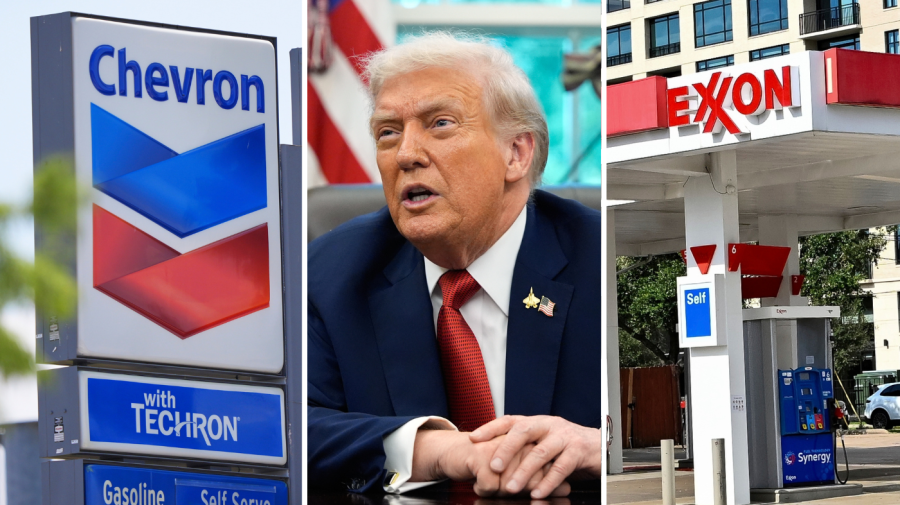
When the White House calls and Wall Street watches, America’s oil giants have chosen an uncomfortable answer—and they may be right to do so.
| Indicator | Figure |
|---|---|
| Brent crude peak (April 30, 2026) | $126/barrel |
| US average gasoline price (AAA) | $4.30/gallon |
| Global oil supply through Hormuz | ~20% |
| ExxonMobil shareholder returns, 2025 | $37.2 billion |
| Brent surge since Iran war began | 55%+ |
At a videoconference convened on April 16, Interior Secretary Doug Burgum and Energy Secretary Chris Wright delivered what amounted to a national security appeal to roughly a dozen of America’s most powerful oil executives: produce more crude, now, and help us contain the political catastrophe unfolding at the pump. Representatives of ExxonMobil, Chevron and Continental Resources were among those on the call. The message from Washington was as urgent as it was blunt.
The supermajors listened politely. Then they went back to their spreadsheets.
With Brent crude briefly touching $126 a barrel on April 30—its highest level in four years, driven by the de facto closure of the Strait of Hormuz following the US-Iran war—and the national average gasoline price hitting $4.30 a gallon according to the latest AAA reading, the temptation to cast America’s oil giants as unpatriotic rent-seekers is understandable and already bipartisan. But this reading is wrong, and dangerously so. What ExxonMobil and Chevron are practising is not dereliction. It is discipline—a hard-won corporate virtue that took two decades of boom-bust disasters to instil, and one that would take far less time to destroy.
The Geopolitical Backdrop: A Supply Shock Unlike Any Other
The scale of the current disruption demands context. Since the conflict with Iran began in late February, daily tanker transits through the Strait of Hormuz—ordinarily a conduit for around 20 percent of the world’s seaborne oil and liquefied natural gas—have plunged to single digits. The International Energy Agency, not an institution given to hyperbole, has characterised this as the “largest supply disruption in the history of the global oil market.” Brent crude surged more than 55 percent from its pre-war level of roughly $72 a barrel to a peak approaching $120, with March 2026 marking one of the largest one-month oil price surges on record.
Even after a fragile ceasefire was announced on April 8, traffic through the strait remained far below pre-conflict norms. Iran re-imposed tighter controls within hours of a brief reopening; the US Navy seized an Iranian-flagged vessel in the Gulf of Oman. Analysts at Commodity Context estimate that any genuine reopening of the strait would trigger an immediate $10-to-$20 drop in crude prices from speculative unwinding, but warn that supply chain bottlenecks and infrastructure damage would keep Brent anchored in the $80-to-$90 range thereafter—well above the pre-war equilibrium.
For American motorists, the arithmetic has been brutal. Gasoline prices briefly exceeded $4 a gallon in late March and have continued to climb; in Los Angeles, prices exceeding $8 a gallon were photographed at Chevron stations. Economists warn that if the disruption extends into the second half of the year, it risks triggering a global recession. The political stakes for the Trump administration ahead of November’s midterm elections could hardly be higher.
“The crux of the issue is that even if the government is willing, companies may not be able to respond promptly. The oil industry is inherently capital-intensive and long-cycle.”
— TradingKey Energy Analysis, April 2026
Why Supermajors Are Not Drilling Their Way Out of a Geopolitical Crisis
Here is the problem that Washington’s energy team appears unwilling to fully confront: every stage of oil production—from permitting to drilling to first oil—takes time. Even in the technically mature shale basins of West Texas and New Mexico, where infrastructure is relatively well-developed and regulatory friction has been substantially reduced under the Trump administration’s executive orders, bringing meaningful new production online typically takes six months at minimum. The Strait of Hormuz crisis, by contrast, is being priced in real-time. No volume of incremental Permian output can substitute for twenty percent of global seaborne supply on a quarterly timeframe.
This is not a technocratic caveat. It is the central flaw in the White House’s production-acceleration thesis. The administration is, in effect, asking ExxonMobil and Chevron to commit multi-year capital at politically-induced price peaks in order to address a geopolitical disruption that may partially or fully resolve itself—as ceasefire negotiations in Islamabad suggest is possible—within months. If that resolution comes, and crude falls precipitously, those capital commitments become stranded liabilities borne by shareholders, not taxpayers.
The Lessons of the Shale Cycle
The supermajors have been through this before, and they did not emerge from the experience unscathed. During the shale boom of 2011–2014, under sustained triple-digit oil prices, the US industry drilled aggressively, accumulated debt, and in many cases destroyed substantial value. When OPEC flooded the market in 2014 and Brent collapsed from $115 to $27, hundreds of smaller operators went bankrupt and even the majors were forced into painful restructurings. A second cycle followed in 2021–2022, as pandemic-era shutdowns gave way to a post-Covid demand surge and then the Russia-Ukraine war price spike—which ultimately corrected sharply as OPEC+ discipline frayed and demand growth disappointed.
The institutional memory of those cycles is now encoded in the financial frameworks that govern ExxonMobil and Chevron. Both companies have explicitly committed to spending and production decisions based on long-run price assumptions—typically in the $60-to-$70 per barrel range—rather than spot market euphoria. This is not timidity. It is the discipline that preserved their balance sheets through multiple downturns and enabled the shareholder distributions that fund American pension funds, endowments, and retail investors alike.
The Numbers Behind the Discipline
The financial data from both companies’ most recent reporting periods illustrates the point with unusual clarity. ExxonMobil’s full-year 2025 results, released in January, showed the company achieving its highest upstream production in more than four decades—while simultaneously distributing $37.2 billion to shareholders, including $17.2 billion in dividends (the second-largest dividend payment among S&P 500 companies) and $20 billion in share repurchases. The company has committed to continuing $20 billion in repurchases through 2026 and has grown its annual dividend per share for 43 consecutive years.
Chevron, meanwhile, reported record worldwide production of 3,723 thousand barrels of oil equivalent per day in 2025, driven by the integration of its $48 billion acquisition of Hess Corporation, new output from the Tengiz field in Kazakhstan, and expanding volumes from Guyana. The company returned $27.1 billion to shareholders during the year. For Q1 2026, Chevron raised its quarterly dividend payout by 4 percent to $1.78 per share, marking 39 consecutive years of annual dividend increases.
Why Supermajors Are Holding the Line: Five Strategic Rationales
- Cycle-disciplined capital allocation. Both companies use long-run price decks far below current spot prices. Committing capital at $120 Brent for projects that require $70 to be viable is a path to destruction tested twice in the last decade.
- Shareholder primacy and fiduciary duty. ExxonMobil and Chevron collectively returned over $64 billion to shareholders in 2025. Destabilising that commitment with politically motivated capex would trigger a shareholder revolt and potentially activist pressure.
- Portfolio optionality abroad. Both companies are expanding through international assets—Guyana (Exxon’s Stabroek block), Kazakhstan (Chevron’s Tengiz), and potential Venezuelan re-entry—that offer better long-term returns than marginal US shale at inflated capital costs.
- Permian growth already underway, on their own terms. Neither company has stopped growing Permian production. They simply refuse to accelerate beyond what their own engineers and economists determine is capital-efficient.
- Geopolitical uncertainty cuts both ways. A diplomatic resolution to the Hormuz crisis—which ceasefire negotiations suggest is possible—would crash prices within weeks. Drilling commitments made today would mature into an oversupplied market.
The Permian Basin Is Not a Spigot
One of the more persistent misconceptions in Washington’s energy discourse is that the Permian Basin—the prolific shale formation spanning west Texas and southeast New Mexico—can be turned up or down like a tap in response to political need. The reality is considerably more textured. Chevron has guided 2026 capital expenditure at the low end of its long-term range, at $18–$19 billion—a deliberate signal that the company is optimising for cash flow durability rather than volume maximisation. Exxon, with its $29 billion capex in 2025, has been more ambitious but equally clear that growth must earn returns above its cost of capital across cycles.
The operational constraints are equally real. Drilling and completion crews cannot be conjured instantly; supply chains for steel, proppant, and specialised equipment take months to scale; and the sweet spots of the Permian’s core acreage are, by definition, finite. The shale wells that would deliver meaningful incremental production in a compressed timeframe are increasingly in the inventory’s lower tiers—more expensive, faster-declining, and more sensitive to the capital cost environment that has risen sharply as the Fed has maintained restrictive monetary policy.
The International Chessboard: Where the Real Growth Lies
While the political debate fixates on American soil, both ExxonMobil and Chevron have been quietly executing a more sophisticated international strategy that may ultimately contribute more to global supply stability than any domestic drilling surge. Both companies are expanding production in nations tied to OPEC, including geopolitically complex environments where Trump’s assertive foreign policy has helped open previously closed doors.
Exxon’s Stabroek block in Guyana—a deepwater asset that has become one of the highest-return upstream developments in the industry—continues to ramp up output. Chevron’s $48 billion absorption of Hess brought with it a significant Stabroek stake as well as expanded production from Kazakhstan’s Tengiz field, one of the world’s largest. The company expects further production growth this year, primarily from Guyana and the Eastern Mediterranean. These are not hypothetical prospects; they are operating assets delivering first oil or expanding existing production trains.
The Venezuelan dimension adds another layer. Major US drillers face growing pressure to assist in the Trump administration’s aspiration to revive the Venezuelan oil sector following the ouster of Nicolás Maduro. If that materialises, it would represent a more durable supply increment than any shale acceleration—and one that contributes to OPEC-adjacent production balances rather than simply shifting market share within the non-OPEC universe.
The Political Economy of “Drill, Baby, Drill”
There is something almost theatrical about the Trump administration’s production appeal. The phrase “drill, baby, drill” has served as a reliable piece of campaign rhetoric since the 2008 election cycle—a confident invocation of American resource abundance as the solution to whatever energy problem the moment presents. But corporate chief executives are not voters, and they are certainly not campaigners. They answer to boards, investors, and—ultimately—long-run economics.
The uncomfortable truth is that the oil price spike of 2026 is, in structural terms, not primarily a supply story. It is a transit story: the physical inability to move roughly twenty percent of global crude and LNG exports through a narrow maritime chokepoint. No volume of new Permian output can substitute for Hormuz tanker access. The crude must still be shipped, refined, and distributed—and if the strait remains effectively closed, the downstream infrastructure to convert incremental US barrels into pump-price relief simply does not exist at the scale required.
What the administration is really seeking is a political signal: proof that it is doing something in the face of $4.30 gasoline. The supermajors, to their credit, have declined to be props in that performance. Some smaller executives on the April 16 call indicated they were responding to price signals—as one would expect rational producers to do—but the strategic discipline of the largest players has held.
“Chevron’s upstream breakeven remains below $50 per barrel, reinforcing its ability to remain cash-flow positive across cycles—a key advantage in any volatile environment.”
— Yahoo Finance / Nasdaq Analysis, December 2025
Capital Discipline as Energy Security
It is worth stepping back to consider what “energy security” actually requires in a world of persistent geopolitical volatility. The conventional answer—produce more, build more, drill more—contains an important partial truth. US domestic production has been a genuine buffer against OPEC pricing power for fifteen years, and it will remain one. But energy security also requires solvent producers: companies with strong balance sheets, diversified portfolios, and the financial resilience to sustain investment through the inevitable downturns that follow every spike.
A supermajor that drills recklessly at $120 Brent, overleverages its balance sheet, and then faces collapse when prices normalise is not a contribution to energy security. It is a liability. The boom-bust cycles of 2014 and 2020 temporarily crippled US production capacity precisely because operators had not maintained the financial discipline to survive the downturns. ExxonMobil’s industry-leading debt-to-capital ratio of 14 percent and its uninterrupted 43-year dividend growth record exist because the company has, in prior moments of political enthusiasm, refused to subordinate financial logic to short-term optics.
The supermajors’ discipline, in other words, is not a failure of patriotism. It is the accumulated institutional wisdom of companies that have learned—at considerable cost—that the market always gets the last word. In the meantime, as negotiations between Washington and Tehran continue in Islamabad, the surest path to lower gasoline prices runs through a reopened strait, not a new well pad in the Delaware Basin. The White House would do well to direct its urgency accordingly.
Discover more from The Economy
Subscribe to get the latest posts sent to your email.



Key Takeaways
- Rolex’s secondary market rose approximately 7.9% year-over-year as of 2026 (per WatchCharts data) — trailing Patek Philippe (+16.2%) and Tudor (+11.4%) but still outperforming Audemars Piguet (+3.4%).
- Rolex raised U.S. retail prices 4–9% in January 2026 (steel models ~5.6%, gold models ~8.7%), narrowing the historical gap between retail and pre-owned pricing.
- Not every model appreciates: steel sports references (Submariner, GMT-Master II, Daytona) have held value far better than two-tone or widely available dress references like the standard Datejust.
- The Lady-Datejust posted the sharpest 2026 gain among tracked collections — up 22.73%, from roughly $9,269 to $11,376 — driven by demand for smaller, “everyday luxury” watches.
- Gold’s rise past $2,400/oz has directly lifted the investment case for Rolex’s precious-metal references (Day-Date, Sky-Dweller, Yacht-Master).
The Model-by-Model Picture
| Category | 2026 Trend |
|---|---|
| Lady-Datejust | +22.73% (strongest performer among tracked collections) |
| Steel sports models (Submariner, GMT-Master II) | Held value well; corrected from 2022 peak but stabilized above retail |
| Daytona | Corrected from highs above $50,000 to the mid-$30,000s; still among the most sought-after references |
| Two-tone/widely available Datejust | Flat to negative — “holds value” is an overstatement for this category |
| Gold references (Day-Date, Sky-Dweller) | Lifted by gold’s rise above $2,400/oz |
Why the “Rolex Always Appreciates” Myth Is Fading
The pandemic-era boom pushed some references — the Daytona above all — to speculative highs disconnected from historical norms. Since the March 2022 peak, steel sports models have compressed meaningfully, and dealers who bought inventory near the top have in some cases faced 20–40% markdowns on liquidation. The lesson for 2026 buyers: Rolex as a category is not a monolith. Value retention depends heavily on specific reference, condition, and whether the piece comes with box and papers (“full set”).
What’s Actually Driving 2026 Strength
- Retail price increases raise the floor. When a new Submariner retails at $10,050 (up from $9,500), a pre-owned example at $11,000–$12,000 suddenly represents a smaller premium — narrowing the gap without secondary prices actually moving.
- Supply discipline remains Rolex’s core lever. The brand has never confirmed production numbers, and secondary-market premiums remain entirely a function of Rolex’s own manufacturing decisions — a risk factor as much as a support.
- Certified Pre-Owned rollout. Rolex’s now fully rolled-out CPO program has changed how buyers transact in the used market, adding a layer of brand-verified legitimacy that supports pricing.
The Case for Rolex as a Portfolio Diversifier
Financial advisors increasingly frame luxury watches not as a replacement for equities or bonds, but as a tangible, historically low-correlation diversifier — one that carries its own risks (illiquidity, condition-dependent pricing, no yield) but has demonstrated multi-decade resilience for specific references.
Is Rolex a good investment in 2026?
It depends heavily on the specific reference. Steel sports models like the Submariner and Daytona have held or grown in value; two-tone and widely available dress models generally have not. Overall, Rolex’s secondary market rose about 7.9% year-over-year in 2026, trailing Patek Philippe but ahead of Audemars Piguet.
Discover more from The Economy
Subscribe to get the latest posts sent to your email.

Navigating Mortgage and Loan Refinancing in a High-Yield Environment
Global public debt crossing critical thresholds has kept central bank policies volatile, resulting in fluctuating US Treasury yields throughout 2026. For homeowners and commercial property holders burdened by previous high-interest borrowing cycles, finding optimal refinance windows has become a high-stakes financial puzzle. Stalled disinflation and stubborn employment numbers mean rate cuts are incremental, requiring borrowers to act with precision.
Timing your mortgage or commercial loan refinance in this environment requires a deep understanding of yield curve movements and lender risk appetites.
Decoding 2026 Refinance Dynamics
The 10-Year Treasury Yield Benchmark
Mortgage rates continue to track closely with the 10-year US Treasury yield. When macroeconomic anxiety spikes debt issuance, yields rise, tightening consumer borrowing capacity. Savvy borrowers monitor weekly Treasury auctions to lock in rates during brief dip windows.
Hybrid ARMs and Alternative Structures
With fixed rates remaining elevated, 7/1 and 10/1 adjustable-rate mortgages (ARMs) have surged in popularity. These products offer lower initial monthly payments, giving borrowers breathing room until central bank easing cycles fully materialize.
| Loan Product | Current Rate Range | Best For | Key Risk Factor |
| 30-Year Fixed Mortgage | 6.2% – 6.8% | Long-term predictability | Higher initial monthly outlay |
| 7/1 Hybrid ARM | 5.5% – 5.9% | Short-term ownership / flipping | Rate reset risk after year 7 |
| Commercial Refinance | 7.0% – 8.2% | Corporate asset restructuring | Strict DSCR lender covenants |
Actionable Steps for Successful Refinancing
To maximize your chances of securing favorable refinance terms in a volatile market, follow a disciplined preparation strategy.
Boost Your Credit Score Immediately: Lenders in 2026 are applying stringent credit tiering; a 20-point increase can drop your APR by a crucial quarter-point.
Shop Regional Credit Unions: Smaller financial institutions often offer portfolio loans with more flexible underwriting than major national banks.
Calculate the Break-Even Point: Ensure your total closing costs are recouped through monthly savings within 24 months of closing.
“Market Strategist View: Refinancing in 2026 is an exercise in opportunistic timing. Borrowers must maintain immaculate financial profiles ready to strike the moment Treasury yields dip.”
Mastering the complexities of today’s debt environment ensures you can successfully lower your debt service costs and protect your long-term financial stability.
Discover more from The Economy
Subscribe to get the latest posts sent to your email.

The days of pulling generic auto insurance quotes based purely on your zip code and age are officially over. In 2026, insurance comparison engines are powered entirely by generative AI and real-time telematics. These platforms digest thousands of live data points—ranging from your driving smoothness via connected vehicle sensors to real-time traffic congestion patterns—to generate hyper-personalized premiums instantly.
For consumers, this evolution represents both a massive opportunity for savings and a hidden trap for penalty pricing. Understanding how AI algorithms evaluate risk is essential for anyone looking to lower their monthly auto insurance premiums.
How AI Comparison Engines Evaluate Your Risk Profile
Behavioral Telematics and Connected Cars
Modern cars stream performance data directly to insurance aggregators. Generative AI models analyze braking sharpness, acceleration curves, cornering G-forces, and phone distraction metrics. Drivers who maintain smooth, defensive habits are rewarded with dynamic rate cuts of up to 40% compared to traditional rating tiers.
Predictive Traffic and Weather Modeling
AI tools now cross-reference your daily commute route with predictive weather and accident probability models. If your standard parking location or driving corridor has a statistically higher incidence of uninsured motorist claims, your quotes will reflect that hyper-local risk assessment.
| Comparison Factor | Traditional Rating Model | 2026 Generative AI Model | Impact on Premium |
| Mileage & Usage | Annual estimated odometer reading | GPS tracking & live trip duration | High (up to 35% savings) |
| Driving Behavior | MVR driving record & accidents | Real-time braking, speed, & G-force | Critical (determines tier) |
| Vehicle Tech | Make, model, and safety rating | ADAS calibration & repair cost data | Moderate |
Strategies to Lower Your AI-Driven Insurance Quote
To outsmart the algorithm and secure the lowest possible premium in 2026, drivers must proactively manage their digital footprint on insurance platforms.
Opt-In for Telematics Trial Periods: Many insurers offer immediate 15% discounts just for installing their driving app; let it track safe habits for 30 days to lock in permanent savings.
Scrub Unverified Public Records: Ensure your motor vehicle report is free of clerical errors that AI risk models misinterpret as reckless behavior.
Compare AI Aggregators: Use platforms that integrate multi-carrier API feeds rather than single-brand comparison sites to find the best risk-adjusted rate.
“Industry Note: AI-driven pricing rewards transparency and precision. Drivers who actively manage their telematics data consistently out-save those relying on legacy quote calculators.”
Embracing AI comparison tools allows savvy policyholders to customize coverage limits precisely to their driving habits, eliminating wasted premium spend while ensuring robust protection.
Discover more from The Economy
Subscribe to get the latest posts sent to your email.

Bitcoin & XRP 2026: Inside Crypto’s Institutional Era

Global Economy 2026: IMF Growth, AI Stocks & Market Risk

China’s Local Debt Race Against Time: Why Economists Demand Central Action Before the Deflation Window Closes

Money News: How to Protect Your Portfolio From Global Inflation

World Bank Projections: Emerging vs. Big Economies of Asia

IMF Reports 2026: What the Latest Data Means for the Global Economy

Singapore Stocks Outlook: A Safe Haven in the Asian Market?

China Stocks vs. Japan Stocks: Where Should You Invest in Late 2026?

VIX Index Explained: How to Trade Wall Street’s Fear Gauge Today

Commercial vs Residential Real Estate: Which Wins in 2026?

Presidential Stock Market Performance: How Trump’s Second Term Compares to History

2026 Real Estate Market News: Are We Heading for a Correction?

Bitcoin Price Forecast 2026–2027: Will the 4-Year Cycle Hold?

Fidelity Crypto vs. Traditional Brokerages: A Guide for Modern Investors

US-China Relations in Q3 2026: Trade Tariffs and Supply Chain Risks

Top 30 Stocks for Investment in PSX for Massive ROI in 2026

SpaceX Starship Flight 14: First Orbital Attempt & Starlink V3 Launch Explained

AI Chip Stocks 2026: The Best Semiconductor Investments Beyond Marvell

The 2026 Crypto Regulatory Shift: What It Means for Institutional Investors

Tween Back-to-School Trends 2026: What’s Driving the $85B Season

AI-Powered Training: The Next Multi-Billion Dollar Ecosystem in Fitness

Oil Prices Break $100 in 2026: Middle East Conflict & Energy Markets

10-Year Treasury Yield Hits 4.80%: What It Means for Rates & Portfolios

Fidelity Investments Review 2026: SPAXX Yields & Zero-Fee Funds

BRICS+ Cross-Border Payments 2026: Interoperability Explained

Shein Clothes Quality & Safety in 2026: What Lab Tests Show

MRVL Earnings 2026: Why Marvell Sank Despite Beating Estimates

China’s US$10.8 Billion Trade Shortcut: Why the Pinglu Canal Matters
-

 Markets & Finance9 months ago
Top 15 Stocks for Investment in 2026 in PSX: Your Complete Guide to Pakistan’s Best Investment Opportunities
-

 Analysis7 months ago
Johor’s Investment Boom: The Hidden Costs Behind Malaysia’s Most Ambitious Economic Surge
-

 Analysis7 months ago
Top 10 Stocks for Investment in PSX for Quick Returns in 2026
-

 Analysis8 months ago
Brazil’s Rare Earth Race: US, EU, and China Compete for Critical Minerals as Tensions Rise
-

 Banks8 months ago
Best Investments in Pakistan 2026: Top 10 Low-Price Shares and Long-Term Picks for the PSX
-

 Investment8 months ago
Top 10 Mutual Fund Managers in Pakistan for Investment in 2026: A Comprehensive Guide for Optimal Returns
-

 Global Economy9 months ago
15 Most Lucrative Sectors for Investment in Pakistan: A 2025 Data-Driven Analysis
-

 Global Economy9 months ago
Pakistan’s Export Goldmine: 10 Game-Changing Markets Where Pakistani Businesses Are Winning Big in 2025