
Oil Markets
US Energy Secretary Chris Wright Pushes for Flood of Investment in Venezuela Oil Amid Revival Efforts


US Energy Secretary’s Venezuela visit signals major push for oil investment, but industry concerns and legal reforms complicate Trump’s $100B revival plan.
In an unprecedented diplomatic mission that signals a dramatic shift in hemispheric energy politics, US Energy Secretary Chris Wright touched down in Caracas on February 11, 2026, carrying with him Washington’s ambitious blueprint for resurrecting Venezuela’s moribund oil sector. The three-day visit—marking the highest-level American energy delegation to Venezuela in nearly three decades—encapsulates both the audacious promise and profound uncertainty surrounding President Donald Trump’s $100 billion gambit to transform the country with the world’s largest proven oil reserves into a reliable energy partner.
Wright’s handshake with interim President Delcy Rodríguez at the Miraflores Palace wasn’t merely a photo opportunity. It represented the culmination of a month-long whirlwind that began with the January 3 capture of former President Nicolás Maduro and has since unleashed a cascade of regulatory reforms, sanctions relief, and industry skepticism that will define the next chapter of global energy markets.
The Push for Venezuela Energy Sector Revival
“I bring today a message from President Trump,” Wright declared, standing alongside Rodríguez with both nations’ flags flanking them. “He is passionately committed to absolutely transforming the relationship between the United States and Venezuela, part of a broader agenda to make the Americas great again.”
The rhetoric matches the scale of ambition. Venezuela’s oil production has plummeted from 3.5 million barrels per day in the late 1990s to a mere 900,000 barrels currently—roughly equivalent to North Dakota’s output. As reported by The New York Times, the infrastructure decay is staggering: refineries operating at fraction capacity, pipelines corroded, skilled workers fled, and PDVSA—the state oil company—hollowed out by decades of mismanagement and corruption.
Wright’s itinerary reflected the magnitude of the challenge. Beyond high-level meetings with Rodríguez and executives from Chevron and Spain’s Repsol, according to Reuters, the Energy Secretary toured the Petropiar project in the Orinoco Oil Belt, where heavy crude extraction requires sophisticated technology and billions in capital investment. His assessment was diplomatically blunt: while Venezuela’s January 29 legal reforms represent “a meaningful step in the right direction,” they fall short of providing “the kind of large capital flows” Washington envisions.
The reforms in question fundamentally restructure Venezuela’s hydrocarbon sector. For the first time since Hugo Chávez’s 2007 nationalizations, private companies can now operate upstream activities through production-sharing contracts rather than being forced into joint ventures where PDVSA holds majority stakes. The law introduces independent arbitration for disputes, caps certain taxes, and includes economic stabilization mechanisms—all designed to reassure foreign investors scarred by past expropriations.
Yet the devil lurks in implementation. Venezuela passed this sweeping legislation in a matter of weeks, under obvious pressure from Washington. The Financial Times noted that Wright emphasized the administration’s desire for a “flood of investment,” but the rushed nature of reforms has raised eyebrows among legal experts who question whether such fundamental changes can provide the long-term stability that multibillion-dollar oil projects require.
Challenges in Attracting Flood of Investment in Venezuela Oil
The industry’s response to Trump’s Venezuela push has been decidedly mixed—and instructive about the real barriers to US Venezuela oil investment.
Chevron, the only major American oil company currently operating in Venezuela under special licenses, occupies the pole position. The company believes it can increase production by 50% over the next 18 to 24 months without significant additional capital expenditure. Its Vice Chairman Mark Nelson told Trump the company has “a path forward here very shortly to be able to increase our liftings from those joint ventures 100% essentially effective immediately.”
But beyond Chevron’s existing foothold, the landscape grows considerably more complex. According to CNBC, ExxonMobil CEO Darren Woods delivered a stark assessment to Trump on January 9: Venezuela is “uninvestable” in its current state. Woods’ blunt verdict—which reportedly angered the president—reflects hard-learned lessons from 2007, when Chávez nationalized ExxonMobil’s Venezuelan assets. The company is still pursuing approximately $2 billion in arbitration claims.
ConocoPhillips faces even steeper hurdles, with roughly $10 billion in outstanding claims from similar expropriations. CEO Ryan Lance echoed Woods’ concerns, emphasizing that Venezuela’s energy system requires fundamental restructuring before major capital commitments make sense.
The hesitancy extends beyond historical grievances. Energy consultancy Rystad Energy estimates that maintaining Venezuela’s current production flat would require $53 billion in investment through 2040. Returning to the glory days of 3 million barrels per day? That demands a staggering $183 billion—roughly equivalent to the entire annual GDP of Portugal.
The Washington Post highlighted another uncomfortable reality: at current oil prices, the economics of reviving Venezuela’s heavy, sulfur-rich crude are marginal at best. The country’s oil requires expensive diluents for transport and specialized refining capacity. Meanwhile, neighboring Guyana—where ExxonMobil has struck bonanza discoveries—offers lighter, cleaner crude with lower taxes, no state oil company partnership requirements, and crucially, political stability.
Treasury Secretary Scott Bessent’s comments on February 6 revealed the administration’s recalibration. “The big oil companies who move slowly, who have corporate boards, are not interested,” he acknowledged. Instead, Washington may rely more heavily on independent oil companies and “wildcatters” whose appetite for risk—and tolerance for political uncertainty—runs higher than publicly traded majors answerable to shareholders.
Geopolitical and Economic Implications
Wright’s Venezuela visit reverberates far beyond the oil patch, carrying profound implications for global energy security and geopolitical alignments.
From Washington’s perspective, Venezuelan oil represents a strategic lever on multiple fronts. Increased production from a friendly Caracas could dampen Russia’s energy influence, particularly if Venezuelan crude diverts buyers—like India—away from Russian supplies. Trump has explicitly framed this as part of his plan to weaken Moscow’s war-making capacity while simultaneously addressing American energy dominance.
The environmental calculus, however, complicates this narrative. Climate analysts warn that fully exploiting Venezuela’s reserves could add 13% to the global carbon budget—a sobering figure as nations struggle to meet Paris Agreement commitments. European energy companies with net-zero pledges may find Venezuelan crude incompatible with their climate strategies, potentially limiting the pool of willing investors despite the legal reforms.
The broader Latin American energy landscape is also shifting. Venezuela’s potential recovery alters regional dynamics, from pipeline politics in Colombia to refining capacity in the Caribbean. If Caracas can indeed ramp production meaningfully, it would reshape market fundamentals that have prevailed for over a decade.
China’s conspicuous absence from the current Venezuela equation warrants attention. Beijing had been Venezuela’s lifeline during the Maduro years, providing loans against future oil deliveries. Reuters reported that the new US sanctions framework explicitly blocks entities linked to China, Iran, and Russia from participating in Venezuela’s oil sector—a clear signal that Washington views energy development as inseparable from broader strategic competition.
The Reality Check: Timeline and Expectations
Industry analysts urge tempering expectations about Venezuela’s oil comeback. Francisco Monaldi, director of the Latin America Energy Program at Rice University’s Baker Institute, draws parallels to Iraq: it took nearly two decades to revitalize that country’s oil industry after the 2003 invasion, and corruption and mismanagement remain endemic.
Even optimistic scenarios envision Venezuela reaching 1.2 million barrels per day by late 2027—a modest 33% increase from current levels that still leaves production far below pre-crisis peaks. The challenges are structural: Venezuela needs to rebuild its electrical grid (chronic blackouts plague oil installations), import vast quantities of diluents, restore corroded pipelines, and most critically, attract and retain the skilled workforce that fled during the economic collapse.
Political stability remains the x-factor. While Rodríguez’s interim government has cooperated with Washington’s directives—including the oil law reforms and release of some political prisoners—Venezuela’s long-term governance trajectory remains uncertain. Opposition groups boycotted the hydrocarbons law vote, arguing that legislation governing the world’s largest oil reserves should emerge from inclusive national dialogue rather than rushed decree.
Wright acknowledged these concerns obliquely, noting during his Caracas press conference that professionalization of PDVSA would be “a subject of dialogue” with Venezuelan authorities. The state company, once Latin America’s crown jewel of technical competence, has been gutted by brain drain and politicization. Rebuilding institutional capacity may prove more challenging than repairing physical infrastructure.
Conclusion: A Generational Wager on Uncertain Terrain
Chris Wright’s Venezuela mission represents more than energy diplomacy—it’s a high-stakes wager on whether American influence and capital can resurrect a collapsed petro-state in months rather than years. The Trump administration’s swagger belies a complex reality where legal reforms, sanctions relief, and political will confront industry wariness, economic headwinds, and institutional decay.
The pieces for Venezuela energy sector revival are falling into place: reformed laws, sanctions relief, existing infrastructure (however degraded), and the world’s largest proven reserves. Yet as ExxonMobil’s Darren Woods bluntly reminded Trump, oil majors don’t commit tens of billions based on one month of political change and hurried legislation. They require clarity about contract terms, confidence in dispute resolution, certainty about political stability, and crucially, oil prices that justify the enormous capital and risk.
For now, the flood of investment in Venezuela oil remains more aspiration than reality—a “generational opportunity” that may yet materialize, but only if Washington, Caracas, and the global oil industry can bridge the chasm between rhetoric and the hard economics of heavy crude extraction in a still-fragile political environment.
The coming months will reveal whether Wright’s Caracas handshake marks the beginning of Venezuela’s energy renaissance—or merely another chapter in the country’s long history of promises unfulfilled. For investors, policymakers, and energy markets watching closely, the answer will reshape not just Venezuelan fortunes, but the broader equilibrium of global energy security for decades to come.
Discover more from The Economy
Subscribe to get the latest posts sent to your email.



GasBuddy forecast sub-$3 gas for 2026. The national average is $4.33. Inside the forecast that broke, and what drivers should expect through Q4.
Executive Summary / Key Takeaways
- The US national average for regular gasoline was $4.329 per gallon on 15 September 2026 — up from $4.07 a week earlier, $3.85 a month earlier and $3.14 a year earlier.
- GasBuddy’s annual outlook, published before the Middle East conflict, projected a 2026 national average of $2.97 — the first sub-$3 year since the pandemic — and a December average of $2.83.
- The gap between forecast and reality is roughly $1.35 a gallon, and the cause is entirely geopolitical.
- Houthi attacks shut a crucial Saudi crude pipeline bypassing the Strait of Hormuz in September 2026; WTI has traded near $102–103 and Brent near $107.
- AAA reports prices inching toward the year’s record high of $4.56, set on 21 May 2026.
1. Introduction & Immediate Context
In late 2025, GasBuddy published one of the more confident fuel forecasts in recent memory. The national average would fall to $2.97 in 2026, the first sub-$3 year since the pandemic and roughly 13 cents below the 2025 average, marking a fourth straight year of decline. Prices would peak in spring in the low $3.20 range as refiners switched to summer blends, then ease to an average of $2.83 in December. Diesel would average $3.55, down from $3.62. US drivers would spend $11 billion less on gasoline than in 2025, with the average household paying about $2,083 for the year.
Patrick De Haan, GasBuddy’s head of petroleum analysis, summarised it at the time: it was not a return to ultra-cheap fuel, but for the first time in a long while the wind was clearly behind drivers’ backs.
Nine months later, the national average is $4.329 per gallon, per AAA data compiled on 15 September 2026. Understanding why that forecast failed is more useful to commuters and logistics managers than any point prediction about the fourth quarter.
2. Core Market Analysis
2.1 Forecast versus outcome
| Metric | GasBuddy 2026 forecast | Actual (Sept 2026) | Gap |
|---|---|---|---|
| National average, regular | $2.97/gal (annual) | $4.329/gal (15 Sep) | +$1.36 |
| Spring peak | Low $3.20s | $4.56 record (21 May) | +$1.36 |
| December projection | $2.83/gal | — | Pending |
| Diesel average | $3.55/gal | — | Pending |
| Household annual spend | ~$2,083 | Materially higher | — |
2.2 What actually moved
Crude is the largest single cost in a gallon of gasoline, so pump prices generally track WTI and Brent with a one-to-two week lag. WTI has been trading near $103.30 and Brent near $107.56, per market data compiled alongside AAA averages.
The proximate trigger was infrastructure, not demand. Attacks by Iran-backed Houthi rebels shut down a crucial crude pipeline in Saudi Arabia that bypasses the Strait of Hormuz, according to Trading Economics market reporting. Saudi Arabia has indicated it could restore around half of the damaged East-West pipeline’s capacity within days and resume full operations within six weeks, while offering additional cargoes through ship-to-ship transfers near Oman.
US gasoline futures have held above $3.45 a gallon, close to their highest level in eight weeks. Gasoline itself fell to $3.46 on 18 September, down 1.22% on the day, but is up 6.43% over the past month and up 76.03% compared with the same time last year.
2.3 The domestic supply picture is not the problem
This is the part most local coverage gets backwards. EIA data showed US gasoline inventories unexpectedly rising for a second consecutive week, increasing by 800,000 barrels in the week ending 11 September, as refineries continued operating at elevated capacity — 96.8%, slightly lower than prior weeks — while delaying non-essential work. Demand rose by 300,000 barrels per day even as pump prices climbed.
Inventories building while prices rise is the signature of a crude-cost-driven move rather than a domestic shortage. The forward risk is maintenance: approaching seasonal fall refinery work remains a threat to refined-product supplies, and refiners have been deferring non-essential work to keep runs high. Deferred maintenance is borrowed capacity, and it gets repaid in October and November.
Earlier in the month, AAA reported that the Labor Day weekend set a record at the pump, with the national average at $4.14 — the first time it has exceeded $4 on Labor Day, against a previous record of $3.82 set in 2012. Gasoline demand had decreased from 9.04 to 8.92 million barrels per day, and crude inventories at 424.5 million barrels sat 1% above the five-year average. Prices rose anyway.
3. Structural Drivers and Competitor Gaps
Why state-level dispersion is widening. California’s regular gasoline reached $6.001 per gallon against Indiana at $3.586 — a spread of nearly $2.42. The drivers are the nation’s highest state gas taxes, a unique cleaner-burning CARB fuel blend that few refineries produce, and limited pipeline supply that isolates the state’s market. The top ten most expensive markets as reported by AAA were California ($6.08), Washington ($5.57), Hawaii ($5.48), Nevada ($5.19), Oregon ($5.11), Alaska ($5.07), Idaho ($4.85), Utah ($4.81), Illinois ($4.78) and Michigan ($4.75).
Crude shocks amplify dispersion rather than distributing evenly. Markets with constrained refining and unique blend requirements have the least ability to substitute supply, so the same $10 crude move produces a larger pump-price move in an isolated market than in a well-supplied one. Price-comparison apps deliver the most savings precisely in these markets, because station-level variance rises alongside regional variance.
What a forecast can and cannot do. GasBuddy’s outlook explicitly listed seasonal demand, refinery maintenance, hurricane season and geopolitical tensions as sources of fluctuation. The failure was not the analysis of the fundamentals — easing global economic pressure and added refining capacity were real — but that a supply-route disruption of this scale sits outside any statistical distribution built on normal conditions. Consumers reading annual fuel forecasts should treat them as conditional on geopolitical stability, not as point estimates.
The EV comparison held steady. The national average per kilowatt hour at a public EV charging station stayed at 42 cents through the period, unchanged week over week. When liquid fuel moves 76% year-on-year and electricity does not, the relative operating-cost calculation for fleet operators shifts materially — a second-order effect that will show up in 2027 procurement decisions.
4. Key Implications for Stakeholders
Daily commuters. The practical saving available from station-level price comparison rises with regional dispersion, and dispersion is currently near its widest. In high-variance markets the difference between the cheapest and most expensive station on a routine route can exceed 25 cents a gallon.
Logistics managers. Diesel was forecast at $3.55 for 2026 on pre-conflict assumptions. Any fuel-surcharge schedule or freight contract built on that number needs revisiting. The relevant forward risk through Q4 is deferred refinery maintenance, not crude.
Retail traders. Inventories rising while prices rise is a clean signal that the move is imported from crude rather than generated domestically. Watch Saudi East-West pipeline restoration progress — a six-week full-restoration timeline, if met, is the most likely source of relief.
Household budgeters. At $4.33 against a $3.14 average a year ago, the annual household fuel bill is running far above the roughly $2,083 projected. Budgets set in January on the sub-$3 forecast are materially understated.
5. Frequently Asked Questions
Q1: What is the national average gas price right now?
The US average for regular gasoline was $4.329 per gallon on 15 September 2026, up from $4.07 a week earlier and $3.14 a year earlier, according to AAA data.
Q2: Why did GasBuddy’s 2026 forecast miss?
The forecast of $2.97 per gallon was built on easing global economic pressure and expanded refining capacity, before Middle East conflict and attacks on a key Saudi pipeline bypassing the Strait of Hormuz pushed crude above $100 a barrel.
Q3: Why is California gas so much more expensive?
California combines the nation’s highest state gas taxes, a unique CARB cleaner-burning blend that few refineries produce, and limited pipeline access that isolates its market — currently producing a regular price near $6.00 against Indiana’s $3.59.
Q4: Will gas prices fall in late 2026?
That depends primarily on Saudi pipeline restoration, which the kingdom indicated could reach full capacity within six weeks. The countervailing risk is deferred seasonal refinery maintenance, which refiners have been postponing to keep runs near 97%.
Discover more from The Economy
Subscribe to get the latest posts sent to your email.
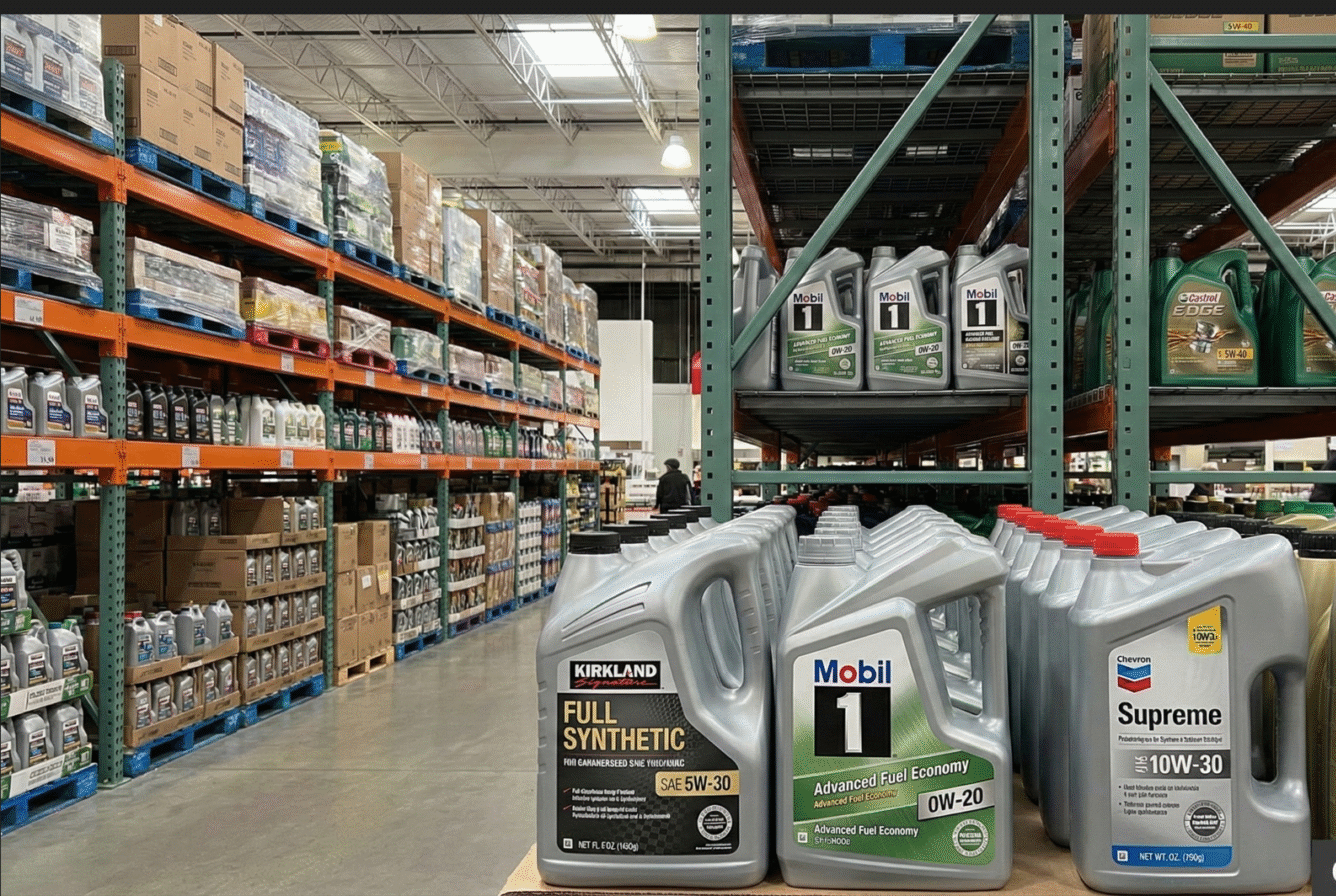
Key Takeaways
- Costco’s rationing of Kirkland Signature motor oil is a visible symptom of an industry-wide problem: the Independent Lubricant Manufacturers Association (ILMA) says roughly 44% of the US Group III base oil supply has been sidelined by Middle East conflict disruptions.
- Automakers Toyota and Nissan have already issued dealer guidance on oil-grade substitutions and allocation limits for low-viscosity synthetic formulations like 0W-8 and 0W-16, the grades most exposed to the shortage.
- Group III base oil prices have climbed to more than $10 per gallon, historically elevated levels, with some reports citing spot prices nearly tripling versus pre-conflict baselines.
- ILMA does not expect conditions to fully normalize until at least mid-2027, meaning this is a multi-quarter supply disruption rather than a temporary shelf-stocking issue.
- Retail-level “shortage” so far looks more like rising prices and shrinking selection than empty shelves nationwide — Costco’s rationing is currently one of the more extreme individual-retailer responses, not evidence that all synthetic oil is disappearing.
Costco’s decision to cap Kirkland Signature motor oil purchases made headlines, but it’s only the most visible data point in a much larger, months-long supply crunch that’s been building since the US-Iran conflict began disrupting Middle Eastern base-oil production and shipping. The real question for drivers isn’t whether one warehouse club is rationing — it’s whether all synthetic motor oil is headed toward sustained price increases and tighter supply, and the answer, based on the fullest available industry data, is a qualified yes.
The Scope of the Problem: It’s Not Just Costco
Executives at major lubricant and auto-parts companies — including Shell, Valvoline, and O’Reilly Automotive — have warned investors directly about cost pressure and supply-chain strain affecting synthetic motor-oil production. ILMA has characterized the situation as a “global base oil supply crisis,” attributing it to refinery outages and shipping disruptions through the Strait of Hormuz that have tightened the supply of Group III base oils — the refined lubricant feedstock used in most modern synthetic motor oil.
According to ILMA’s most detailed accounting, roughly 44% of US Group III base oil supply has been affected by the disruption, with the lightest viscosity grades — the 0W-20, 0W-16, and 0W-8 formulations increasingly required by modern, fuel-efficient engines — the most exposed. Group III base oil prices have climbed past $10 per gallon, a historically elevated level, with some reporting describing spot prices as having nearly tripled from pre-conflict baselines.
Automakers Are Already Rationing — Not Just Retailers
Perhaps the most telling sign that this is a supply-side, not retailer-side, problem: automakers themselves have begun rationing. Toyota has sent service departments guidance on substituting oil grades for certain hybrid models, while both Toyota and Nissan dealers reportedly received internal communications warning that allocations of genuine, factory-specified synthetic oils could become difficult to maintain consistently — particularly for lighter-viscosity grades like 0W-8 and 0W-16 used in newer, fuel-efficient engines.
A leaked memo reportedly circulated to AutoZone store managers in the Southeast described the situation bluntly, warning of “the largest supply shortage of lubricating fluids in the modern history of America” and cautioning that overall product availability could shrink by as much as 40%. Separately, industry sources indicated that Mobil and Shell informed both Costco and Walmart that they lacked sufficient packaged product to fulfill orders, raising the prospect of bare shelves in motor-oil sections at major retailers.
How Bad Is It At the Retail Level, Really?
Despite the alarming internal warnings, independent lubricant-industry analyst Tom Glenn, publisher of JobbersWorld, has cautioned against characterizing the situation as a full “broad retail shortage” — at least as of the disruption’s earlier stages. Consumer-quantity purchases (5-quart jugs at retailers like Walmart, AutoZone, and Amazon) had not been systemically constrained as of mid-2026, even as wholesale and dealer-allocation levels tightened significantly and prices rose 15–30% above 2025 baselines. Glenn’s assessment: “availability is beginning to matter as much as — and in some cases more than — price,” as suppliers increasingly operate defensively to protect access to approved synthetic formulations.
Costco’s explicit two-box, seven-day rationing policy, alongside its nearly doubled Kirkland Signature pricing, represents one of the more aggressive individual-retailer responses documented so far — suggesting either tighter supplier allocations specific to Costco’s bulk-purchase model, or a proactive anti-hoarding measure ahead of anticipated further tightening.
Price and Supply Snapshot
| Indicator | Pre-Conflict Baseline | Mid-2026 Status |
|---|---|---|
| Group III base oil price | Historically stable | $10+/gallon, up sharply |
| US Group III supply affected | 0% | ~44% |
| Retail 5-quart jug prices | Baseline | +15–30% |
| Kirkland Signature 10-qt box | ~$30 | $57.99 (rationed) |
| Expected normalization | N/A | Not before mid-2027 |
Which Vehicles Are Most Affected?
The shortage disproportionately affects owners of newer, fuel-efficient vehicles that require low-viscosity synthetic grades — particularly 0W-8, 0W-16, and 0W-20 formulations common in recent Toyota, Nissan, and other Asian-brand models. Owners of older vehicles using more conventional viscosity grades (5W-30, 10W-30) are somewhat less exposed, since those formulations rely less heavily on the specific Group III feedstock under the most severe supply pressure, though pricing pressure is being felt across nearly all synthetic categories.
Why This Matters: A Multi-Quarter Problem, Not a Blip
The most important data point for consumers planning ahead is ILMA’s own timeline: the association does not expect conditions to fully normalize until at least mid-2027, tying the recovery directly to when Middle East shipping and refining disruptions ease. That means this isn’t a short-term shelf-stocking hiccup tied to one retailer’s supply contract — it’s a structural, multi-quarter supply constraint that will likely keep upward pressure on oil-change pricing at dealerships, quick-lube chains, and DIY retail purchases well into 2027, regardless of whether any single retailer like Costco lifts its rationing policy sooner.
Frequently Asked Questions
Will all synthetic motor oil prices double, not just Costco’s?
Prices industry-wide have risen 15-30% at the consumer level as of mid-2026, with wholesale Group III base oil costs up far more sharply. Costco’s near-doubling of its Kirkland Signature product is among the more extreme individual cases rather than an industry-wide universal figure, but continued upward pressure across brands is expected through at least mid-2027.
Why are Toyota and Nissan rationing motor oil to dealerships?
Both automakers rely heavily on low-viscosity synthetic oil grades (0W-8, 0W-16) for newer, fuel-efficient engines, and these are the grades most exposed to the Group III base-oil supply disruption tied to the US-Iran conflict’s impact on Middle East shipping and refining.
When will the motor oil shortage end?
The Independent Lubricant Manufacturers Association does not expect conditions to fully normalize until at least mid-2027, meaning drivers should expect elevated prices and periodic availability issues for the coming several quarters.
Discover more from The Economy
Subscribe to get the latest posts sent to your email.
Six months into the war between the United States, Israel, and Iran, one pattern has become unmistakable to energy traders: every reported ceasefire has been followed, sooner or later, by a fresh escalation. What started as a limited conflict on February 28, 2026, has evolved into the most disruptive geopolitical shock to global oil supply since Russia’s invasion of Ukraine — and as of September 2026, it is still actively reshaping energy markets, shipping routes, and inflation forecasts worldwide.
The Ceasefire-and-Relapse Cycle
The conflict has produced at least three distinct ceasefire announcements since February, and none has held for more than a few weeks. In April 2026, a US-Iran arrangement briefly reopened the Strait of Hormuz and sent oil plunging below $100 a barrel, as reported by Euronews. Gold, which had surged as a safe haven, still traded near $4,750 an ounce that same week as investors openly doubted the truce would last, according to Trading Economics — key disputes remained unresolved and the Strait stayed effectively closed even after the announcement.
That skepticism proved warranted. By September 2026, oil had round-tripped decisively higher. Brent crude surpassed $100 a barrel for the first time in nearly six weeks after fresh attacks on oil facilities and tankers, settling at $97.89 before jumping 2.4% to $100.29, with WTI gaining to $94.77, according to reporting carried by the Washington Times. The proximate trigger: the U.S. military struck five Iranian tankers in response to attempted missile attacks on a Navy warship, while Iranian-backed Houthi forces ignited fires at Saudi Arabian oil facilities.
Oil price trajectory during the conflict:
| Date | Brent Crude | Context |
|---|---|---|
| Mar 21, 2026 | ~$106.77 | Fifth straight weekly gain amid escalation |
| Mar 20, 2026 | Forecast warning of $180+ | Saudi Aramco officials warned WSJ of extreme scenario |
| Apr 8, 2026 | Below $100 | Ceasefire announcement, Strait reopening pledge |
| Sept 7, 2026 | $97.31 | Six-week high; Iran vows to strike energy infrastructure |
| Sept 9, 2026 | $100.29 | Attacks on tankers and Saudi refineries |
| Sept 11, 2026 | ~$100, +9% week | Diplomatic talks announced on Hormuz shipping |
Why the Strait of Hormuz Is the Real Story
The Strait of Hormuz is the fulcrum of this entire crisis. Roughly 20% of the world’s oil supply passes through this chokepoint, including about half of Asia’s oil imports and a quarter of its LNG imports, according to TD Economics. Since the war began, fighting has halted most shipping through the strait, and — critically — markets have stopped believing repeated U.S. government proclamations that reopening is imminent. As one energy analyst told Marketplace, “The Strait of Hormuz won’t be what it was before. Now, we understand that Iran can and will block it.”
The physical impact on trade flows has been severe. Oil shipments out of the Middle East are running roughly 65% below year-ago levels, and the cost of shipping crude to Asia on the largest tankers has hit a record high, per the same Marketplace reporting. The United Arab Emirates has responded by actively building alternative export routes and trade corridors to avoid having its energy exports “held hostage” by the conflict, a senior UAE presidential adviser confirmed to Reuters in early September.
Demand Destruction Is Now the Dominant Theme
While supply disruption drove the initial price spike, the market’s focus by September 2026 has shifted decisively toward demand destruction. The International Energy Agency sharply lowered its 2026 global oil demand outlook, forecasting a contraction of 2.5 million barrels per day — the largest annual decline since the COVID-19 pandemic — as higher prices and tighter supply weigh on consumption, according to Trading Economics. OPEC has cut its own demand-growth forecast for a fifth consecutive month. Both organizations now agree that sustained triple-digit oil is actively destroying the demand it was created by.
OPEC+ itself has opted for caution rather than aggressive supply response, keeping its October output policy unchanged at its early-September meeting, pending agreement on new quotas before any further steps, Reuters reported.
The Inflation and Consumer Pass-Through
The war’s inflationary impact has already shown up in hard data. U.S. gasoline prices surged in March 2026 to an EIA-reported average of $3.638 per gallon, the highest since September 2023, with AAA data showing the national average briefly topping $4.02 per gallon — a monthly jump described by Trading Economics as exceeding even the spikes following Hurricane Katrina and Russia’s 2022 invasion of Ukraine. Euro-area inflation jumped to 2.5% in the same window, well above the European Central Bank’s 2% target, driven almost entirely by the energy component.
Who is most exposed:
| Category | Exposure | Why |
|---|---|---|
| Asian oil importers (Japan, India, Pakistan, China) | Very high | ~50% of Asia’s oil, 25% of LNG via Hormuz |
| European energy consumers | High | Already strained post-Russia diversification |
| Gulf oil exporters (Saudi, UAE, Qatar) | Mixed | Higher prices offset by direct attack risk on infrastructure |
| U.S. consumers | Moderate-high | Domestic production buffers some but not all of the shock |
| Global shipping/logistics | High | Record tanker rates, rerouting costs |
Diplomatic Off-Ramps Being Tested
The most significant near-term catalyst for de-escalation is the diplomatic track around Strait of Hormuz shipping management. Top diplomats from the six-member Gulf Cooperation Council were scheduled to meet their Iranian counterpart to negotiate a possible temporary arrangement for managing transit through the strait, according to Trading Economics. Iranian state media separately indicated Tehran would meet Gulf states in Oman for related talks. Markets have priced in modest optimism around these talks — crude paused its rally and settled near $100 on the news — but given the track record of failed ceasefires since February, traders are treating any de-escalation as tactical rather than durable until physical shipping data confirms a sustained reopening.
Final Verdict
The “ceasefire economics” of the 2026 Middle East war have proven to be a recurring, not a resolving, phenomenon: each truce has produced a short-lived relief rally in oil and a corresponding dip in inflation expectations, followed by renewed escalation that erases the gains. As of September 2026, Brent and WTI sit near six-week highs above $90–100, the Strait of Hormuz remains functionally impaired, and both the IEA and OPEC now forecast the sharpest demand contraction since the pandemic. For investors and policymakers, the actionable conclusion is that oil-price volatility itself — not a stable higher or lower price level — is the defining condition of this market, and near-term direction hinges almost entirely on whether the current Gulf-Iran diplomatic track produces a verifiable, physically confirmed reopening of shipping lanes rather than another rhetorical ceasefire.
Discover more from The Economy
Subscribe to get the latest posts sent to your email.

Beyond Paper Wealth: Unpacking Donald Trump’s Multibillion-Dollar Liquidity and Legal Crisis

Bitcoin & XRP 2026: Inside Crypto’s Institutional Era

Global Economy 2026: IMF Growth, AI Stocks & Market Risk

China’s Local Debt Race Against Time: Why Economists Demand Central Action Before the Deflation Window Closes

Money News: How to Protect Your Portfolio From Global Inflation

World Bank Projections: Emerging vs. Big Economies of Asia

IMF Reports 2026: What the Latest Data Means for the Global Economy

Singapore Stocks Outlook: A Safe Haven in the Asian Market?

China Stocks vs. Japan Stocks: Where Should You Invest in Late 2026?

VIX Index Explained: How to Trade Wall Street’s Fear Gauge Today

Commercial vs Residential Real Estate: Which Wins in 2026?

Presidential Stock Market Performance: How Trump’s Second Term Compares to History

2026 Real Estate Market News: Are We Heading for a Correction?

Bitcoin Price Forecast 2026–2027: Will the 4-Year Cycle Hold?

US-China Relations in Q3 2026: Trade Tariffs and Supply Chain Risks

Top 30 Stocks for Investment in PSX for Massive ROI in 2026

SpaceX Starship Flight 14: First Orbital Attempt & Starlink V3 Launch Explained

AI Chip Stocks 2026: The Best Semiconductor Investments Beyond Marvell

The 2026 Crypto Regulatory Shift: What It Means for Institutional Investors

Tween Back-to-School Trends 2026: What’s Driving the $85B Season

Oil Prices Break $100 in 2026: Middle East Conflict & Energy Markets

Fidelity Investments Review 2026: SPAXX Yields & Zero-Fee Funds

AI-Powered Training: The Next Multi-Billion Dollar Ecosystem in Fitness

10-Year Treasury Yield Hits 4.80%: What It Means for Rates & Portfolios

BRICS+ Cross-Border Payments 2026: Interoperability Explained

Shein Clothes Quality & Safety in 2026: What Lab Tests Show

MRVL Earnings 2026: Why Marvell Sank Despite Beating Estimates

China’s US$10.8 Billion Trade Shortcut: Why the Pinglu Canal Matters
-

 Markets & Finance9 months ago
Top 15 Stocks for Investment in 2026 in PSX: Your Complete Guide to Pakistan’s Best Investment Opportunities
-

 Analysis7 months ago
Johor’s Investment Boom: The Hidden Costs Behind Malaysia’s Most Ambitious Economic Surge
-

 Analysis7 months ago
Top 10 Stocks for Investment in PSX for Quick Returns in 2026
-

 Analysis8 months ago
Brazil’s Rare Earth Race: US, EU, and China Compete for Critical Minerals as Tensions Rise
-

 Banks8 months ago
Best Investments in Pakistan 2026: Top 10 Low-Price Shares and Long-Term Picks for the PSX
-

 Investment8 months ago
Top 10 Mutual Fund Managers in Pakistan for Investment in 2026: A Comprehensive Guide for Optimal Returns
-

 Global Economy9 months ago
15 Most Lucrative Sectors for Investment in Pakistan: A 2025 Data-Driven Analysis
-

 Global Economy9 months ago
Pakistan’s Export Goldmine: 10 Game-Changing Markets Where Pakistani Businesses Are Winning Big in 2025