Connect with us

Analysis

Pakistan’s Push for Climate-Resilient Budgeting Amid EU Carbon Pressures: A Path to Sustainable Exports?

Published

on

Professor Lubna Naz of Institute of Business Administration Karachi, delivered a warning that reverberated far beyond academic walls. “The European Union will bind Pakistan’s textile sector to carbon footprint thresholds by 2027-2030,” she told a January 2026 panel on decentralizing climate action. “If it happens, our major exports may suffer—and we’ll pay a heavy price.”

Her words cut to the heart of a dilemma now gripping Pakistan’s economic policymakers: how to reconcile surging climate vulnerabilities with trade realities that keep the nation afloat. Textiles account for approximately 60% of Pakistan’s exports, with the EU absorbing $9.0 billion worth of Pakistani goods in 2024 alone—making Pakistan the largest beneficiary of the EU’s GSP+ preferential trade scheme. Yet Europe’s Carbon Border Adjustment Mechanism (CBAM)—already targeting steel, cement, and fertilizers since October 2023—threatens to impose stringent carbon limits on textiles within the next four years, potentially offsetting the very trade benefits Pakistan has cultivated.

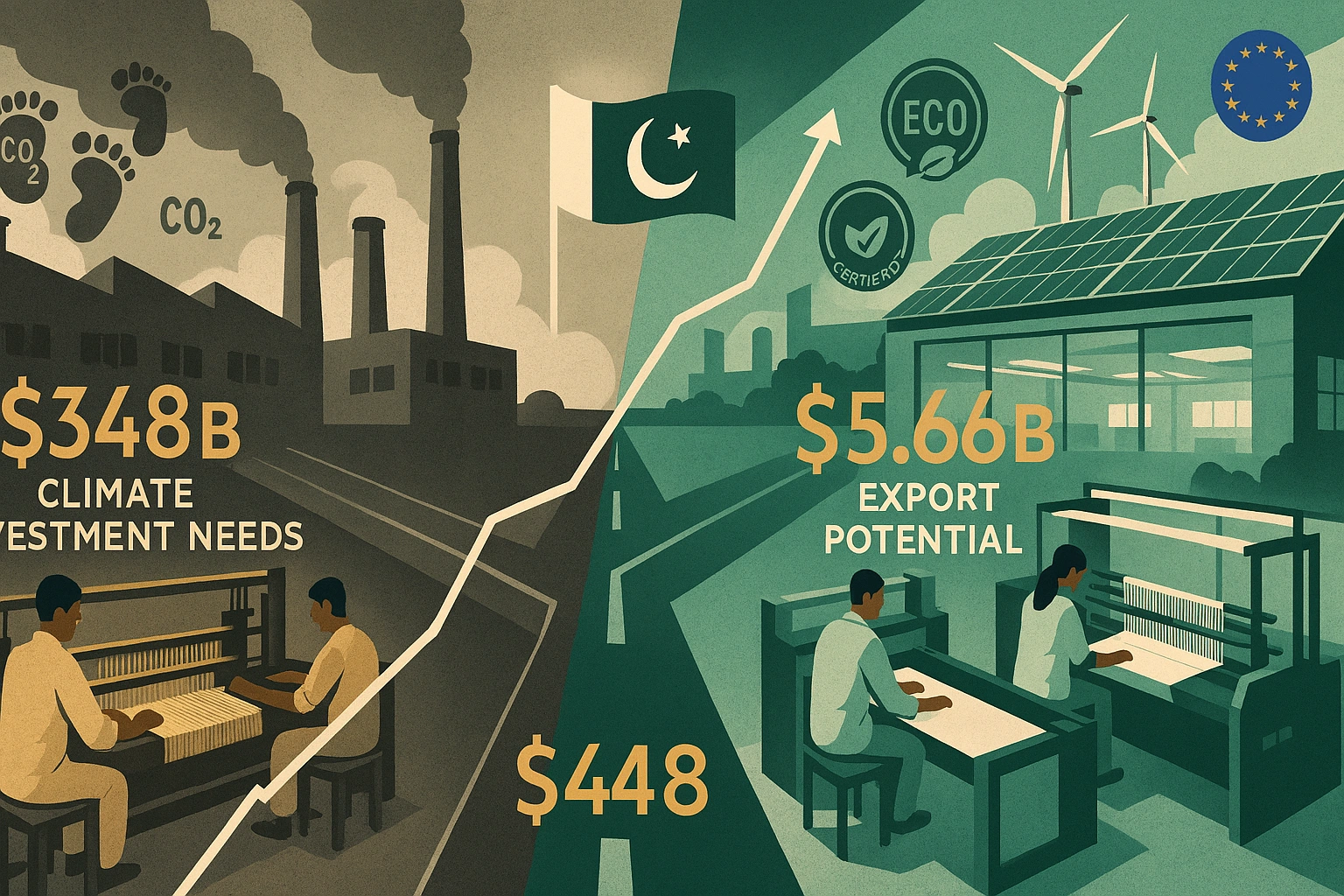
For the first time in history, Pakistan’s Finance Ministry has responded with an unprecedented directive: all federal ministries must submit pro-climate budget proposals for fiscal year 2026-27. Advisor to the Finance Minister Khurram Schehzad framed the move as existential, stating this marks “the first time” climate considerations will shape budget planning across government. But can green budgeting close a $348 billion climate investment gap by 2030—and save Pakistan’s textile lifeline in the process?

The EU’s Carbon Gauntlet: What CBAM Means for Pakistan’s Textile Dominance

The Carbon Border Adjustment Mechanism represents a fundamental shift in how the European Union approaches climate-linked trade policy. Launched in its transitional phase in October 2023, CBAM initially targets six carbon-intensive sectors: cement, iron and steel, aluminum, fertilizers, electricity, and hydrogen. By 2026, the mechanism enters its definitive regime, requiring EU importers to purchase carbon certificates reflecting the embedded emissions in their goods—certificates priced according to the EU’s Emissions Trading System allowances.

Currently, only 1.3% of Pakistan’s exports to the EU fall under CBAM’s scope, primarily steel and cement products. However, the European Commission has signaled its intention to expand the mechanism to cover additional sectors, including chemicals, polymers, and critically for Pakistan, textiles. As one recent analysis notes, “Beyond 2026, the EU has indicated that it intends to broaden CBAM to cover chemicals, polymers, and possibly textiles. For Pakistan, where textiles make up about 60 per cent of all exports and 28 per cent of trade with the EU, this is concerning.”

The threshold mechanism is particularly punishing: importers bringing more than 50 tons of covered goods annually into the EU must register as authorized CBAM declarants and purchase certificates matching their products’ carbon footprint. For Pakistan’s textile sector—characterized by high emission intensity due to reliance on fossil fuel-based energy and outdated machinery—this could translate into substantial cost increases that erode competitive advantages.

The timing couldn’t be worse. Pakistan’s textile exports have shown fragile recovery, growing just 0.93% to $16.655 billion in fiscal year 2023-24 after a steep 14.63% decline the previous year. Meanwhile, competitors like Bangladesh, Vietnam, and India are already implementing carbon pricing mechanisms and measurement, reporting, and verification (MRV) systems to prepare for CBAM compliance—moves that could position them favorably while Pakistan falls behind.

Pakistan Climate Change Budget FY2026-27: A Historic Fiscal Pivot

Against this backdrop, Pakistan’s Finance Division has issued its Budget Call Circular for FY2026-27, projecting 5.1% GDP growth and 6.5% inflation while introducing a groundbreaking climate dimension. For the first time, the budget incorporates Climate Budget Tagging (CBT), classifying over 5,000 cost centers across federal ministries under adaptation, mitigation, and supporting categories. This tagging has been integrated into the government’s Integrated Financial Management Information System (IFMIS), enabling real-time tracking of climate-sensitive expenditures.

The Pakistan green budgeting reforms extend beyond mere accounting. The government has introduced Form-III C screening mechanisms ensuring every federal subsidy aligns with national climate objectives before disbursement—a requirement also mandated under the IMF’s Extended Fund Facility program. Minimum thresholds now guarantee that at least 8% of current expenditures and 16% of Public Sector Development Program allocations are climate-tagged, representing a structural commitment to environmental accountability.

Pakistan’s first climate-focused budget allocates PKR 603 billion to mitigation efforts, targeting clean energy transitions, sustainable agriculture, and emission reductions across sectors. Yet the scale of the challenge dwarfs these initial commitments. According to UN analysis, Pakistan faces a climate finance gap of $40-50 billion annually—money needed for everything from flood protection infrastructure to renewable energy buildout. With climate-related disasters already costing the economy an estimated 1.03% of GDP per event without proper risk financing mechanisms, the urgency is palpable.

“The language is different,” explained Kashmala Kakakhel, an independent climate finance specialist, describing Pakistan’s steep learning curve in accessing international climate funds. “The way you curate the entire proposal is very different. The climate rationale is very different.” This procedural complexity helps explain why, despite the existence of a $2 trillion global climate finance market encompassing the Green Climate Fund, Global Environment Facility, and specialized facilities, Pakistan has struggled to mobilize resources at the scale required.

Pakistan Climate Finance Gap: Bridging the $348 Billion Chasm

The mathematics are sobering. Pakistan’s Nationally Determined Contributions outline $348 billion in climate investment needs through 2030—encompassing renewable energy infrastructure, climate-resilient agriculture, disaster preparedness systems, and green industrial transitions. Even with optimistic projections, domestic resource mobilization and traditional development finance cannot close this gap without innovative approaches.

Enter Islamic climate finance, a potentially transformative mechanism for a nation where faith-aligned financial instruments command broad public legitimacy. The Asian Development Bank’s analysis highlights how green sukuk (Islamic bonds) and climate-aligned Islamic financing structures could unlock billions in capital from regional Islamic financial institutions and sovereign wealth funds. WAPDA’s 2024 green euro bond issuance demonstrated proof of concept, though scaling such instruments requires robust regulatory frameworks and credible certification processes.

Yet institutional fragmentation hampers progress. “It’s just like a mismatch of jigsaw puzzle pieces,” observed Abid Qaiyum Suleri of the Sustainable Development Policy Institute, describing coordination challenges between federal and provincial authorities. “They will have their own projects. They will have their own priorities.” This siloed approach risks duplicating efforts, missing synergies, and failing to present coherent proposals to international climate funds that increasingly demand comprehensive national strategies.

The post-2022 flood period catalyzed some reforms. Pakistan launched its National Adaptation Plan in 2023 and published a National Climate Finance Strategy in 2024. The Planning Commission approved Climate Risk Screening Guidelines requiring all public investments to undergo climate-proofing assessments—critical steps toward the systematic integration Prof. Naz and others advocate. But implementation remains uneven, with technical capacity constraints particularly acute at provincial and district levels where climate impacts manifest most acutely.

EU Green Regulations Pakistan 2027: The Textile Sector at the Crossroads

For Pakistan’s textile manufacturers, carbon border adjustment Pakistan exports represents both an existential threat and a potential catalyst for long-overdue modernization. The sector’s emission intensity stems from multiple sources: coal and gas-fired power generation supplying energy-intensive processes, aging machinery operating below optimal efficiency, water-intensive dyeing and finishing operations, and limited adoption of circular economy principles in fiber sourcing.

Large conglomerates like Interloop Limited (which exported PKR 147 billion worth of textiles in FY2024), Style Textile, and Artistic Milliners have already begun sustainability transitions, investing in solar installations, water recycling systems, and certification programs meeting international environmental standards. However, these industry leaders represent a fraction of Pakistan’s textile ecosystem. Hundreds of small and medium enterprises operating with thin margins and limited access to capital face insurmountable barriers to rapid decarbonization without targeted support.

The GSP+ equation further complicates matters. Pakistan’s zero-tariff access to EU markets under the Generalized Scheme of Preferences Plus currently saves exporters billions in duties annually—a benefit that could be partially or entirely offset by CBAM certificate costs if textiles enter the mechanism’s scope as anticipated. One analysis suggests that inclusion of textiles in CBAM by 2027 would result in “carbon-related costs potentially neutralizing Pakistan’s preferential trade advantages,” forcing a fundamental reassessment of export competitiveness.

Professor Naz’s panel question resonates: what are the government’s accreditation plans? Without a national carbon registry, standardized emissions measurement protocols, and internationally recognized verification processes, Pakistani exporters cannot demonstrate compliance even if they invest in cleaner production. This creates a chicken-and-egg dilemma where investments in decarbonization may not yield market access if proper certification infrastructure doesn’t exist.

Carbon Border Adjustment Pakistan Exports: Risks, Opportunities, and Regional Responses

The risks are clear and quantifiable. Should CBAM extend to textiles at current emission intensities, Pakistan could face:

  • Export revenue losses estimated in the billions as EU buyers shift to lower-carbon suppliers or domestic production
  • Competitive disadvantage against regional rivals already implementing carbon pricing and building MRV capacity
  • Investment flight as multinational brands recalibrate supply chains toward CBAM-compliant jurisdictions
  • Employment shocks in a sector employing approximately 38% of Pakistan’s industrial workforce, predominantly lower-skilled workers with limited alternative opportunities

Yet crisis breeds opportunity. The same carbon pressures could accelerate Pakistan’s renewable energy transition, create new markets for eco-certified products, and position forward-thinking manufacturers as preferred partners for sustainability-conscious brands. Some potential pathways include:

Renewable Energy Scale-Up: Pakistan’s abundant solar and wind resources remain largely untapped for industrial use. Falling renewable costs now make distributed generation economically viable for textile clusters, offering both emissions reductions and energy security. The government’s recent focus on renewable energy in its NDC 3.0—incorporating specific targets for solar and wind capacity additions—provides policy support, though financing mechanisms and grid integration challenges require attention.

Technology Transfer and Innovation: The Diplomat’s analysis of climate-linked trade policy notes that “mechanisms to share emission reduction technology would be more effective” than punitive carbon tariffs alone. Pakistan could negotiate technology partnerships with European textile machinery manufacturers, potentially accessing cleaner production technologies at concessional terms through development finance institutions.

Green Premiums and Market Differentiation: A growing segment of EU consumers actively seeks sustainable products, willing to pay premiums for verified low-carbon textiles. Pakistani manufacturers achieving credible certification could capture this market segment, potentially offsetting CBAM costs through higher prices—though this requires investment in both production improvements and marketing.

Regional Learning: Competitor nations offer instructive examples. India recently expanded its carbon market to include petroleum refineries, petrochemicals, textiles, and secondary aluminum—explicitly building “CBAM Resilience” into industrial policy. Vietnam and Indonesia have launched national carbon pricing pilots. Even Turkey’s focus on electric arc furnaces in steel production demonstrates how sector-specific technological choices can dramatically reduce carbon intensity. Pakistan’s delayed response creates catching-up challenges but also allows learning from others’ successes and failures.

Policy Pathways Forward: What Pakistan Must Do Now

Transforming carbon constraints into competitive advantages requires coordinated action across multiple fronts. Based on international best practices and Pakistan’s specific circumstances, several priority interventions emerge:

Establish National Carbon Infrastructure: Pakistan needs a centralized carbon registry tracking emissions across industries, particularly export sectors. This registry should employ internationally standardized protocols (ISO 14064, GHG Protocol) ensuring EU recognition. The Planning Commission’s Climate Risk Screening Guidelines provide a foundation, but implementation must extend beyond project approval to operational monitoring.

Accelerate Sector-Specific Decarbonization Roadmaps: Rather than generic climate targets, Pakistan requires detailed transition plans for textiles, cement, steel, and other CBAM-vulnerable industries. These roadmaps should identify specific technological interventions (energy-efficient machinery, renewable power integration, process optimization), quantify costs and emission reductions, and sequence investments strategically. The National Climate Change Policy’s regular review mechanism provides an institutional home for such planning.

Mobilize Blended Climate Finance: Closing the $40-50 billion annual gap demands innovative financing combining public resources, development finance, green bonds, Islamic climate instruments, and private capital. Pakistan’s recent approval for a $1.4 billion IMF climate resilience facility represents a start, but scaling requires strengthening institutional capacity to design fundable projects meeting international climate fund criteria.

Build SME Capacity for Compliance: Large textile exporters can afford carbon audits, emissions monitoring, and certification—small enterprises cannot. Government-sponsored technical assistance programs, perhaps partnered with industry associations and international development agencies, could provide subsidized carbon accounting services, technology assessments, and compliance roadmaps for SMEs. Without such support, CBAM risks becoming a regressive mechanism favoring large players while eliminating smaller competitors.

Strengthen EU-Pakistan Climate Dialogue: Rather than viewing CBAM purely as an external imposition, Pakistan should engage proactively in EU climate policy discussions. The European Commission’s textiles strategy acknowledges supporting developing countries in green transitions. Pakistan could negotiate technical assistance, preferential access to EU climate technology, and potentially transitional measures recognizing countries making good-faith decarbonization efforts even if absolute emission levels remain elevated.

Integrate Climate into Trade Negotiations: Future trade agreements should explicitly incorporate climate provisions—not as barriers but as frameworks for mutual support. Pakistan’s trade offices, currently focused on traditional market access issues, need climate expertise to navigate this evolving landscape where environmental performance increasingly determines commercial access.

Turning Carbon Constraints into Export Resilience

Pakistan stands at a crossroads that Professor Naz articulated so starkly in Karachi. The convergence of climate vulnerabilities and carbon-linked trade regulations creates genuine risks to an export sector that remains the economy’s lifeblood. Yet this same pressure could catalyze the modernization, innovation, and sustainability transitions that Pakistan’s textile industry has deferred for decades.

The Pakistan climate change budget FY2026-27 represents a historic first step—acknowledgment that fiscal policy and climate action are inseparable in an era of European Green Deals and carbon border adjustments. Climate Budget Tagging, ministerial mandates for pro-climate proposals, and integration of environmental screening into subsidy allocation all signal genuine political commitment. But ambition must meet execution.

The $348 billion question—whether Pakistan can mobilize the investment required for climate resilience while maintaining export competitiveness—has no easy answer. It demands governmental coordination that transcends bureaucratic silos, private sector investment despite uncertain returns, international partnerships balancing support with accountability, and public understanding that short-term costs yield long-term sustainability.

For Pakistan’s textile exporters eyeing European markets nervously as 2027 approaches, the message is clear: adaptation is not optional. The only choice is whether to scramble reactively when CBAM expansion hits or to invest proactively in the cleaner, more efficient, climate-resilient production systems that increasingly define global competitiveness.

As Khurram Schehzad’s unprecedented budget directive demonstrates, Pakistan’s government has recognized the stakes. Now comes the harder work: translating recognition into action, climate tags into tangible emissions reductions, and constraint into catalyst. The path from carbon vulnerability to export resilience exists—but the window to walk it is narrowing with each passing fiscal year.


For more information on Pakistan’s climate adaptation efforts and financing challenges, see Dawn’s coverage of the climate funding gap and Business Recorder’s analysis of CBAM implications.


Discover more from The Economy

Subscribe to get the latest posts sent to your email.

Analysis

ECB Stands Firm: Interest Rates Held at 2% as Eurozone Navigates Economic Crossroads

Published

on

On a brisk morning in Frankfurt, café owners across the Eurozone poured their usual espressos, unaware that a decision made just kilometers away would ripple through their loan repayments, customer spending power, and business expansion plans for months to come. The European Central Bank has held its key interest rate at 2%, marking a pivotal moment in the institution’s delicate balancing act between taming stubborn inflation and nurturing fragile economic growth across the 20-nation currency bloc.

This decision, announced following the ECB’s February 2026 monetary policy meeting, represents a strategic pause in what has been one of the most aggressive tightening cycles in the central bank’s 27-year history. But as ECB President Christine Lagarde emphasized during her subsequent press conference, “data-dependent” doesn’t mean “data-passive”—the central bank remains vigilant as economic headwinds gather strength.

The Numbers Behind the Decision: What the Data Reveals

The ECB’s decision to maintain the deposit facility rate at 2% comes against a backdrop of conflicting economic signals that would challenge even the most seasoned policymakers. According to the latest Eurostat figures, headline inflation across the Eurozone stood at 2.4% year-on-year in January 2026—tantalizingly close to, yet stubbornly above, the ECB’s 2% target.

Key economic indicators influencing the decision:

  • Core inflation: Remains elevated at 2.7%, reflecting persistent price pressures in services
  • GDP growth: Eurozone economy expanded by a modest 0.8% in Q4 2025, below forecasts
  • Unemployment: Holding steady at 6.4%, near historical lows
  • Wage growth: Accelerating at 4.2% annually, raising concerns about second-round inflation effects
  • Consumer confidence: Improved marginally but remains in negative territory at -12.3

The ECB interest rate decision 2026 reflects what Bloomberg economists characterize as a “Goldilocks dilemma in reverse”—the economy isn’t hot enough to justify further tightening, yet inflation isn’t cool enough to warrant cuts.

Why the ECB Chose to Hold: Unpacking the Strategic Calculus

Understanding the ECB’s monetary policy requires appreciating the institution’s dual mandate: price stability above all, with economic growth considerations when inflation is under control. The decision to pause rate adjustments stems from several interconnected factors.

The Inflation Puzzle Remains Unsolved

Despite significant progress from the 10.6% peak recorded in October 2022, inflation continues to exhibit what ECB Chief Economist Philip Lane termed “uncomfortable stickiness,” particularly in the services sector. Energy prices, once a primary driver of inflation, have stabilized following the resolution of geopolitical tensions in Eastern Europe. However, this welcome development has been offset by persistent wage-price spirals in labor-intensive sectors.

Reuters analysis suggests that services inflation—accounting for roughly 45% of the Eurozone’s consumption basket—remains the central bank’s primary concern. Haircuts in Milan, legal services in Amsterdam, and restaurant meals in Madrid continue seeing price increases well above the ECB’s comfort zone, driven by businesses passing along higher labor costs to consumers who, despite economic uncertainty, continue spending.

Growth Concerns Constrain Policy Options

The Eurozone’s economic expansion, while positive, remains anemic by historical standards. Germany, the bloc’s economic locomotive, narrowly avoided technical recession in late 2025, with manufacturing output contracting for six consecutive quarters. France’s economy shows marginally better performance, but political uncertainty following recent parliamentary elections has dampened business investment.

Southern European economies present a mixed picture. Spain and Portugal demonstrate surprising resilience, benefiting from robust tourism sectors and successful labor market reforms. Italy, conversely, struggles with structural challenges that predate the current monetary policy cycle.

“The ECB finds itself threading a needle,” notes Dr. Carsten Brzeski, Global Head of Macro at ING, in a recent commentary. “Cut rates too soon, and you risk reigniting inflation. Hold too long, and you strangle the nascent recovery.”

Currency Dynamics and Global Policy Divergence

The ECB vs Fed policy comparison reveals significant divergence that complicates the European central bank’s task. While the Federal Reserve has signaled a more accommodative stance with its own interest rate holds following aggressive 2022-2023 hikes, market expectations for Fed rate cuts in H2 2026 have created downward pressure on the euro.

A weaker euro, while beneficial for Eurozone exporters, poses inflationary risks by making imported goods—particularly energy and raw materials priced in dollars—more expensive. The euro-dollar exchange rate, currently hovering around $1.09, reflects these cross-currents, with currency traders parsing every word from both Frankfurt and Washington for clues about future policy paths.

Market Reactions: How Investors Are Interpreting the Signal

Financial markets had largely anticipated the ECB’s decision to hold rates at 2%, with money market futures pricing in an 87% probability of unchanged rates in the days preceding the announcement. Nevertheless, the devil resided in the details—specifically, in the ECB’s forward guidance and its assessment of inflation persistence.

Immediate market responses included:

  • European equities: The Euro Stoxx 50 rose 0.8% in afternoon trading, with rate-sensitive bank stocks outperforming
  • Bond markets: German 10-year bund yields declined 6 basis points to 2.31%, suggesting investors expect eventual rate cuts
  • Currency markets: The euro strengthened modestly against the dollar, gaining 0.3% to $1.0925
  • Credit spreads: Italian-German bond spreads tightened slightly, indicating improved peripheral market sentiment

The impact of ECB rate hold on inflation expectations can be measured through break-even inflation rates derived from inflation-linked bonds. Five-year, five-year forward inflation expectations—the ECB’s preferred long-term gauge—remain anchored at 2.1%, suggesting market confidence in the central bank’s commitment to price stability.

Real-World Impact: What This Means for Businesses and Households

Beyond financial markets, the ECB’s decision reverberates through everyday economic life across the Eurozone. For the 340 million people living under the euro’s umbrella, interest rate policy translates into tangible effects on mortgages, savings, business loans, and employment prospects.

Homeowners and Mortgage Borrowers

Approximately 40% of Eurozone mortgages carry variable rates, meaning borrowers have experienced significant payment increases since the ECB began raising rates in July 2022. A household with a €300,000 mortgage has seen monthly payments rise by roughly €450 compared to the ultra-low rate environment of 2021.

The decision to hold rates provides welcome stability for these borrowers, though it offers no relief. New mortgage origination remains subdued across most Eurozone markets, with housing transaction volumes down approximately 22% compared to 2021 levels.

Savers Finally See Returns

After a decade of negative real interest rates that eroded purchasing power, savers are experiencing a remarkable reversal. Bank deposit rates across the Eurozone now average 2.8% for one-year term deposits, finally outpacing inflation and offering positive real returns for the first time since 2011.

This development has profound implications for wealth distribution and intergenerational equity. Older Europeans, who disproportionately hold savings rather than debt, benefit from higher rates. Younger cohorts, burdened with mortgages and education loans, face headwinds.

Corporate Investment Decisions

For businesses contemplating expansion, the cost of capital remains elevated compared to the 2015-2021 period. Corporate borrowing rates averaging 4-5% for investment-grade companies create a high hurdle rate for new projects, contributing to sluggish business investment that has characterized the Eurozone’s post-pandemic recovery.

However, companies with strong balance sheets find themselves in an advantageous position. “We’re seeing quality businesses able to access capital markets at reasonable rates, while weaker credits face significant challenges,” explains Marie-Claire Dubois, Chief Investment Officer at BNP Paribas Asset Management.

Regional Disparities: One Size Doesn’t Fit All

One of the ECB’s enduring challenges stems from the Eurozone’s economic heterogeneity. A single interest rate must somehow serve the needs of both Germany’s export-oriented manufacturing economy and Greece’s tourism-dependent service sector, both Netherlands’ robust labor market and Spain’s improving but still-elevated unemployment.

Current economic divergences across major Eurozone economies:

  • Germany: GDP growth 0.4%, inflation 2.1%, unemployment 3.3%
  • France: GDP growth 0.9%, inflation 2.6%, unemployment 7.4%
  • Italy: GDP growth 0.6%, inflation 2.3%, unemployment 7.8%
  • Spain: GDP growth 1.8%, inflation 2.7%, unemployment 11.2%

This heterogeneity means that the ECB’s interest rate policy inevitably fits some economies better than others. Current rates might be appropriate for overheating labor markets in Germany and the Netherlands, while potentially constraining already-weak growth in Italy and Greece.

Looking Ahead: What Comes Next for Eurozone Monetary Policy

The ECB’s forward guidance, carefully calibrated to avoid boxing policymakers into predetermined paths, suggests that interest rates will remain “sufficiently restrictive for as long as necessary” to ensure inflation returns sustainably to target. Translating this central banker-speak into actionable intelligence requires reading between the lines of Lagarde’s press conference remarks and the accompanying monetary policy statement.

Scenarios for Rate Movement

Financial markets currently assign the following probabilities to potential ECB actions by year-end 2026:

  1. One 25-basis-point cut (45% probability): Most likely if inflation continues gradual descent and growth remains subdued
  2. Rates unchanged (35% probability): If inflation proves more persistent than expected or growth accelerates
  3. Two or more cuts (15% probability): Only if significant economic deterioration or disinflationary breakthrough occurs
  4. Rate increase (5% probability): Highly unlikely absent major inflation shock

The European economic stability 2026 outlook hinges on several critical variables beyond the ECB’s control: geopolitical developments, energy market dynamics, global trade patterns, and fiscal policy decisions by member state governments.

The Fed Connection: Transatlantic Monetary Policy Coordination

While the ECB maintains its independence, Federal Reserve policy decisions inevitably influence European monetary conditions through currency and capital flow channels. The Fed’s own decision to hold its policy rate at 4.25-4.50% while signaling potential cuts later in 2026 creates both opportunities and challenges for ECB policymakers.

If the Fed cuts before the ECB, euro appreciation could help dampen European inflation by reducing import costs—a welcome assist. However, excessive euro strength could undermine Eurozone export competitiveness, particularly vis-à-vis American markets that absorb roughly 20% of European exports.

Recent IMF analysis suggests that central banks in advanced economies are entering a new era of policy coordination—not through explicit agreements, but through heightened awareness of spillover effects in an interconnected global economy.

Expert Perspectives: What the Analysts Are Saying

The financial community’s reaction to the ECB interest rate decision reveals nuanced interpretations of the central bank’s strategy:

Optimistic view: “The ECB has successfully engineered a soft landing,” argues Henrik Andersen, Chief Economist at Danske Bank. “Inflation is declining without triggering recession—a remarkable achievement given the magnitude of shocks absorbed since 2022.”

Cautious view: “Declaring victory prematurely would be a policy error,” warns Sylvie Matherat, former ECB Director General. “Core services inflation remains too high, and wage growth could reignite price pressures if the bank eases too soon.”

Bearish view: “The ECB is behind the curve and risks overtightening,” contends Willem Buiter, former Citigroup Chief Economist. “The economy is weaker than official data suggest, and maintaining restrictive policy courts unnecessary recession risk.”

The Historical Context: How We Got Here

To appreciate the significance of holding rates at 2%, consider the extraordinary journey European monetary policy has traveled. From 2014 to 2022, the ECB maintained negative deposit rates—an unprecedented experiment that saw banks paying for the privilege of parking reserves at the central bank.

The shift from -0.5% in June 2022 to the current 2% represents the fastest tightening cycle in ECB history, far exceeding the pace of adjustments during the 2005-2008 normalization. This aggressive action was necessitated by inflation that, at its peak, reached levels unseen since the euro’s launch in 1999.

Conclusion: Navigating Uncertainty in Uncharted Waters

The ECB’s decision to hold interest rates at 2% encapsulates the central bank’s cautious optimism tempered by persistent uncertainties. Policymakers have successfully reduced inflation from crisis levels without triggering economic collapse—no small feat given the magnitude of recent shocks. Yet the journey toward sustainable 2% inflation and robust growth remains incomplete.

For businesses, households, and investors across the Eurozone, the implications are clear: interest rates will remain elevated by recent historical standards for the foreseeable future, requiring continued adjustment to a higher-rate environment. The era of free money has definitively ended, replaced by a more traditional monetary policy regime that rewards savers, disciplines borrowers, and forces businesses to justify investment decisions with genuine economic returns.

As markets continue parsing every data release and every Lagarde utterance for clues about the ECB’s next move, one thing remains certain: the path from here will be determined by incoming data, not predetermined schedules. In this sense, the ECB’s data-dependent approach represents both prudent policy and acknowledgment of profound uncertainty about the post-pandemic, post-energy-crisis economic landscape.

What should you watch next? Key data releases including February inflation figures (due March 5), Q1 GDP growth (late April), and the ECB’s March meeting will provide crucial insights into whether the current pause represents a plateau before cuts or an extended hold. The Christine Lagarde ECB press conference scheduled for March 7 will be particularly scrutinized for any shifts in tone regarding the inflation outlook.


Discover more from The Economy

Subscribe to get the latest posts sent to your email.

Continue Reading

Opinion

Google Doubles Down on AI with $185bn Spend After Hitting $400bn Revenue Milestone

Published

on

Explore how Google’s parent Alphabet plans to double AI investments to $185bn in 2026 amid record $402bn 2025 revenue, analyzing implications for tech innovation and markets.

Google’s parent company Alphabet has announced plans to nearly double its capital expenditures to a staggering $175-185 billion in 2026—a figure that exceeds the GDP of many nations and underscores the ferocious intensity of the artificial intelligence race. This unprecedented AI investment doubling impact comes on the heels of a milestone achievement: Alphabet’s annual revenues exceeded $400 billion for the first time, reaching precisely $402.836 billion for 2025, a testament to the search giant’s enduring dominance across digital advertising, cloud computing, and emerging AI services.

The announcement, delivered during Alphabet’s fourth-quarter earnings report on Wednesday, sent ripples through financial markets as investors grappled with a paradox that defines this technological moment: spectacular results shadowed by even more spectacular spending plans. It’s a wager on the future, where compute capacity—the raw processing power that fuels AI breakthroughs—has become as strategic as oil reserves once were to industrial economies.

A Record-Breaking Year for Alphabet

The numbers tell a story of momentum. Alphabet’s Q4 2025 revenue reached $113.828 billion, up 18% year-over-year, with net income climbing almost 30% to $34.46 billion—performance that surpassed Wall Street’s expectations and reinforced the company’s position as a technology juggernaut. For context, this quarterly revenue alone exceeds the annual GDP of countries like Morocco or Ecuador, illustrating the sheer scale at which Alphabet operates.

What’s particularly striking about the Alphabet 400bn revenue milestone is not merely the figure itself, but the diversification behind it. While Google Search remains the crown jewel—Search revenues grew 17% even as critics proclaimed its obsolescence in the AI era—other divisions have matured into formidable revenue engines. YouTube’s annual revenues surpassed $60 billion across ads and subscriptions, transforming what began as a video-sharing platform into a media empire rivaling traditional broadcasters. The company now boasts over 325 million paid subscriptions across Google One, YouTube Premium, and other services, creating recurring revenue streams that cushion against advertising volatility.

Perhaps most impressive is the trajectory of Google Cloud, the division housing the company’s AI infrastructure and enterprise solutions. As reported by CNBC, Google Cloud beat Wall Street’s expectations, recording a nearly 48% increase in revenue from a year ago, reaching $17.664 billion in Q4 alone. This acceleration—outpacing Microsoft Azure’s growth for the first time in years, according to industry analysts—signals that Google’s decade-long cloud computing growth journey is finally paying dividends in the AI era.

The AI Investment Surge: Fueling Tomorrow’s Infrastructure

To understand the magnitude of Google’s 2026 Google capex forecast analysis, consider this: the company spent $91.4 billion on capital expenditures in 2025, already a substantial sum. The midpoint of the new forecast—$180 billion—represents a near-doubling that far exceeded analyst predictions. According to Bloomberg, Wall Street had anticipated approximately $119.5 billion in spending, making Alphabet’s actual projection roughly 50% higher than expected.

Where is this money going? CFO Anat Ashkenazi provided clarity: approximately 60% will flow into servers—the specialized chips and processors that train and run AI models—while 40% will build data centers and networking equipment. This AI infrastructure spending trends follows a pattern visible across Big Tech: Alphabet and its Big Tech rivals are expected to collectively shell out more than $500 billion on AI this year, with Meta planning $115-135 billion in 2026 capital investments and Microsoft continuing its own aggressive ramp-up.

But Google’s spending stands apart in scope and strategic rationale. During the earnings call, CEO Sundar Pichai was remarkably candid about what keeps him awake: compute capacity. “Be it power, land, supply chain constraints, how do you ramp up to meet this extraordinary demand for this moment?” he said, framing the challenge not merely as buying more hardware but as orchestrating a logistical feat involving energy grids, real estate, and global supply chains.

The urgency stems from concrete demand. Ashkenazi noted that Google Cloud’s backlog increased 55% sequentially and more than doubled year over year, reaching $240 billion at the end of the fourth quarter—future contracted orders that represent customers committing billions to Google’s AI and cloud services. This isn’t speculative investment; it’s infrastructure to fulfill orders already on the books.

Gemini’s Meteoric Rise and the Monetization Question

At the heart of Google’s Google earnings AI strategy sits Gemini, the company’s flagship artificial intelligence infrastructure model that competes directly with OpenAI’s GPT and Anthropic’s Claude. The progress has been striking: Pichai said on the call Wednesday that its Gemini AI app now has more than 750 million monthly active users, up from 650 million monthly active users last quarter. To put this in perspective, that’s roughly one-tenth of the global internet population engaging with Google’s AI assistant monthly, a user base accumulated in just over a year since Gemini’s public launch.

Even more impressive from a technical standpoint: Gemini now processes over 10 billion tokens per minute, handling everything from simple queries to complex multi-step reasoning tasks. Tokens—the fundamental units of text that AI models process—serve as a rough proxy for computational workload, and 10 billion per minute suggests processing demands equivalent to analyzing thousands of novels simultaneously, every second of every day.

Yet scale alone doesn’t guarantee profitability, which makes another metric particularly significant: “As we scale, we are getting dramatically more efficient,” Pichai said. “We were able to lower Gemini serving unit costs by 78% over 2025 through model optimizations, efficiency and utilization improvements.” This 78% cost reduction addresses a critical concern in the AI industry—whether these computationally intensive services can operate economically at scale. Google’s answer, backed by a decade of experience building custom Tensor Processing Units (TPUs), appears to be yes.

The enterprise market is responding. Pichai revealed that Google’s enterprise-grade Gemini model has sold 8 million paying seats across 2,800 companies, demonstrating that businesses are willing to pay for AI capabilities integrated into their workflows. And in perhaps the year’s most significant partnership, Google scored one of its biggest deals yet, a cloud partnership with Apple to power the iPhone maker’s AI offerings with its Gemini models—a relationship announced just weeks ago that positions Google’s AI as the backbone of Siri’s next-generation intelligence across billions of Apple devices.

Economic and Competitive Implications

The question hovering over these announcements—implicit in the stock’s initial after-hours volatility—is whether this level of spending represents visionary investment or reckless extravagance. Alphabet’s shares fluctuated wildly following the announcement, falling as much as 6% before recovering to close the after-hours session down approximately 2%, a pattern reflecting investor ambivalence.

On one hand, the numbers justify optimism. Alphabet’s advertising revenue came in at $82.28 billion, up 13.5% from a year ago, demonstrating that the core business remains robust even as AI reshapes search behavior. The company’s operating cash flow rose 34% to $52.4 billion in Q4, though free cash flow—what remains after capital expenditures—compressed to $24.6 billion as spending absorbed incremental gains.

This dynamic reveals the tension at the heart of Google’s strategy. As Fortune observed, Alphabet is effectively asking investors to underwrite a new phase of corporate identity, one where financial discipline is measured less by near-term margins and more by long-term platform positioning. The bet: that cloud computing growth, AI monetization, and infrastructure advantages will compound into durable competitive moats worth far more than the capital deployed today.

Competitors face similar calculations. Microsoft, through its partnership with OpenAI, has poured tens of billions into AI infrastructure. Meta has committed to comparable spending, reorienting around AI after its metaverse pivot stumbled. Amazon, reporting earnings shortly after Alphabet, is expected to announce substantial increases to its own already-massive data center buildout. What emerges is a kind of corporate MAD doctrine—Mutually Assured Development—where no major player can afford to fall behind in compute capacity lest they cede the next platform to rivals.

The Geopolitical and Environmental Dimensions

Yet spending at this scale extends beyond corporate strategy into geopolitical and environmental realms. Building data centers capable of training frontier AI models requires not just capital but also land, water for cooling, and—most critically—electrical power at scales that strain regional grids. Alphabet’s December acquisition of Intersect, a data center and energy infrastructure company, for $4.75 billion signals recognition that power availability, not just chip availability, will constrain AI development.

The environmental implications deserve scrutiny. Each data center powering Gemini or Cloud AI services draws megawatts continuously—power equivalent to small cities. While Alphabet has committed to operating on carbon-free energy, the physics of AI training and inference means energy consumption will rise alongside model sophistication. The 78% efficiency improvement Pichai cited helps, but the absolute energy footprint still expands as usage scales.

Economically, this spending creates ripples. Nvidia, the dominant supplier of AI training chips, stands to benefit enormously—Google announced it will be among the first to offer Nvidia’s latest Vera Rubin GPU platform. Construction firms building data centers, utilities expanding power infrastructure, even communities hosting these facilities all feel the effects. There’s an argument that Alphabet’s capital deployment, alongside peers’ spending, constitutes one of the largest peacetime infrastructure buildouts in history, comparable in scope if not purpose to the interstate highway system or rural electrification.

Looking Ahead: Risks and Opportunities

As 2026 unfolds, several questions will determine whether Google’s massive AI investment doubling impact delivers the returns shareholders hope for:

Can monetization scale with costs? Google Cloud’s 48% growth and expanding margins suggest AI products are finding paying customers, but the company must convert Gemini’s 750 million users into revenue beyond advertising displacement. Enterprise adoption offers higher margins than consumer services, making the 8 million paid enterprise seats a metric to watch quarterly.

Will compute constraints ease or worsen? Pichai’s comments about supply limitations—even after increasing capacity—suggest the industry may face bottlenecks in chip production, power availability, or skilled workforce. If constraints persist, Google’s early aggressive spending could prove advantageous, locking in capacity competitors struggle to access.

How will regulators respond? Antitrust scrutiny of Google continues globally, with particular focus on search dominance and competitive practices. Massive AI infrastructure spending, while ostensibly competitive, could draw questions about whether such capital intensity creates barriers to entry that stifle competition. Smaller AI companies lack the resources to compete at this scale, potentially concentrating power among a handful of tech giants.

What about returns to shareholders? Operating cash flow remains strong, but free cash flow compression raises questions about capital allocation. Alphabet maintains a healthy balance sheet with minimal debt, providing flexibility, yet some investors may prefer share buybacks or dividends over infrastructure bets with uncertain timelines. The company must balance immediate shareholder returns against investing for the next platform era.

Can efficiency gains continue? The 78% cost reduction in Gemini serving costs represents remarkable progress, but such improvements typically follow S-curves—rapid gains initially, then diminishing returns. Whether Google can sustain this pace of efficiency improvement will significantly impact the unit economics of AI services.

The Verdict: A Necessary Gamble?

Standing back from the earnings minutiae, Alphabet’s announcements reflect a broader reality about the artificial intelligence infrastructure transformation sweeping through technology: this revolution requires infrastructure at scales previously unimaginable. When Pichai describes being “supply-constrained” despite ramping capacity, when backlog more than doubles to $240 billion, when 750 million users adopt a product barely a year old—these aren’t signals of exuberance but of demand that risks outstripping supply.

The $175-185 billion question, then, isn’t whether Google should invest heavily in AI—that seems necessary just to maintain position—but whether the eventual returns justify the opportunity costs. Every dollar flowing into data centers and GPUs is a dollar not returned to shareholders, not spent on other innovations, not held as buffer against economic uncertainty. As The Wall Street Journal reported, Google’s expectations for capex increases exceed the forecasts of its hyperscaler peers, making this the most aggressive bet among already-aggressive competitors.

Yet perhaps that’s precisely the point. In a technological inflection as profound as AI’s emergence, the risk may lie less in spending too much than in spending too little—in optimizing for near-term cash flows while competitors build capabilities that define the next decade of computing. Google’s search dominance, once seemingly eternal, faces challenges from AI-native interfaces. Cloud computing, once dominated by Amazon, has become fiercely competitive. Advertising, the golden goose, must evolve as AI changes how people seek information.

From this vantage, the $185 billion isn’t profligacy but pragmatism—the cost of remaining relevant as the technological landscape shifts beneath every player’s feet. Whether it proves visionary or wasteful won’t be clear for years, but one conclusion seems certain: Google has committed, irrevocably, to the belief that the AI future requires infrastructure built today, at scales that once would have seemed absurd. For better or worse, the die is cast.


Key Takeaways

  • Alphabet’s 2025 revenue: $402.836 billion, marking the first time exceeding $400 billion annually
  • Q4 2025 performance: $113.828 billion revenue (up 18% YoY), $34.46 billion net income (up 30% YoY)
  • 2026 capital expenditures forecast: $175-185 billion, nearly doubling from $91.4 billion in 2025
  • Google Cloud growth: 48% YoY revenue increase to $17.664 billion in Q4, with $240 billion backlog
  • Gemini AI adoption: 750 million monthly active users, with 78% reduction in serving costs over 2025
  • YouTube milestone: Over $60 billion in annual revenue across advertising and subscriptions
  • Enterprise momentum: 8 million paid Gemini enterprise seats across 2,800 companies

As the artificial intelligence infrastructure race intensifies, Google’s historic spending commitment positions the company at the forefront—but also exposes it to scrutiny about returns, sustainability, and the wisdom of betting so heavily on compute capacity as the path to AI dominance. The coming quarters will reveal whether this gamble reshapes technology’s future or becomes a cautionary tale about the perils of following competitors into ever-escalating capital commitments.


Discover more from The Economy

Subscribe to get the latest posts sent to your email.

Continue Reading

Analysis

Malaysia’s 10-Year Chip Design Goal Faces Ultimate Test Amid Global Semiconductor Shifts

Published

on

Malaysia stands at a crossroads in its semiconductor journey. For decades, the Southeast Asian nation has thrived as a global hub for chip assembly and testing, ranking sixth worldwide in semiconductor exports. Yet beneath this impressive statistic lies a vulnerability that policymakers can no longer ignore: Malaysia lacks the intellectual property and design capabilities that command premium margins in today’s chip industry.

Economy Minister Akmal Nasrullah Mohd Nasir recently framed the challenge with remarkable candor. Speaking to The Business Times ahead of the Malaysia Economic Forum on February 5, 2026, he emphasized that the nation must transition from low-value assembly work to IP creation—a shift he described as the “ultimate test” for Malaysia’s semiconductor ambitions. This test isn’t merely rhetorical. It’s embedded in the 13th Malaysia Plan (RMK-13), a comprehensive blueprint that seeks to reposition the country’s semiconductor industry over the next decade.

The stakes couldn’t be higher. As global chip demand surges and supply chains undergo tectonic realignments following pandemic-era disruptions and geopolitical tensions, Malaysia faces both unprecedented opportunity and formidable competition. The question isn’t whether Malaysia can continue assembling chips—it’s whether the nation can climb the value chain to design them.

The RMK-13 Pivot: From Assembly to Innovation

The 13th Malaysia Plan represents a fundamental recalibration of the country’s semiconductor strategy. Unlike previous initiatives that reinforced Malaysia’s position in downstream activities—assembly, packaging, and testing (APT)—RMK-13 explicitly targets upstream capabilities in chip design and intellectual property development.

This pivot reflects economic necessity. According to Statista, global semiconductor revenues exceeded $600 billion in 2024, with design and IP licensing commanding profit margins two to three times higher than assembly operations. Malaysia’s current model, while generating substantial export volumes, captures only a fraction of this value creation.

The National Semiconductor Strategy (NSS), unveiled as part of RMK-13’s implementation framework, sets ambitious quantitative targets:

  • RM500 billion in investment attraction over the plan’s duration
  • 60,000 skilled semiconductor workers by 2030, representing a near-doubling of the current technical workforce
  • GDP growth of 4.5-5.5% annually, with semiconductors identified as a key high-growth sector
  • Home-grown chip designs within 5-7 years through strategic partnerships

These aren’t aspirational figures pulled from thin air. They’re undergirded by concrete partnerships, most notably a $250 million collaboration with Arm, the British chip architecture firm now owned by SoftBank. This deal, reported by Reuters, aims to develop Malaysia-designed processors leveraging Arm’s instruction set architecture—the same foundation used by Apple, Qualcomm, and countless other industry leaders.

Challenges in the Ultimate Test

Yet Minister Akmal’s characterization of this transition as an “ultimate test” acknowledges the formidable obstacles ahead. Moving from assembly to design isn’t a linear progression—it’s a quantum leap requiring fundamentally different capabilities, infrastructure, and mindsets.

The Intellectual Property Gap

Malaysia’s current semiconductor footprint is impressive in scale but limited in scope. The country hosts operations for multinational giants including Intel, Infineon, Texas Instruments, and NXP Semiconductors. These facilities perform sophisticated packaging and testing, but the underlying chip designs—the IP that drives profitability—originate elsewhere.

Creating indigenous IP requires years of R&D investment, extensive patent portfolios, and design expertise that Malaysia is only beginning to cultivate. According to The Economist, Taiwan spent three decades building TSMC into a foundry powerhouse, while South Korea invested hundreds of billions establishing Samsung’s design and manufacturing capabilities. Malaysia is attempting a comparable transformation on an accelerated timeline.

Talent Acquisition and Development

The NSS’s target of 60,000 skilled workers by 2030 underscores perhaps the most acute constraint: human capital. Chip design engineers require specialized training in areas like circuit design, verification, and electronic design automation (EDA) tools—competencies that take years to develop and aren’t easily imported.

Malaysian universities are expanding semiconductor programs, but they’re competing globally for both students and faculty. A design engineer in Penang must be convinced to forgo potentially higher salaries in Silicon Valley, Bangalore, or Shanghai. This brain-drain challenge, analyzed in depth by the Lowy Institute, affects all emerging semiconductor hubs but is particularly acute for countries without established design ecosystems.

The government’s response involves scholarship programs, industry-academia partnerships, and incentive packages for returning diaspora engineers. Yet scaling these initiatives to produce tens of thousands of qualified professionals in four years represents an unprecedented mobilization of educational resources.

Infrastructure and Ecosystem Development

Designing advanced chips requires more than talented engineers—it demands a comprehensive ecosystem. This includes:

  • Fabrication partnerships: Design houses need access to foundries willing to manufacture their chips, either domestically or through international agreements
  • EDA tool access: Software from Synopsys, Cadence, and Siemens (Mentor) costs millions annually and requires extensive training
  • IP licensing frameworks: Legal expertise to navigate complex patent landscapes and licensing negotiations
  • Venture capital: Patient capital willing to fund 5-10 year development cycles before revenue generation
  • Customer relationships: Trust-building with global OEMs who currently source designs from established providers

Malaysia’s competitors—particularly Singapore, Taiwan, and increasingly Vietnam—are simultaneously strengthening their own ecosystems, creating a regional arms race for semiconductor supremacy.

Global Context and Geopolitical Currents

Malaysia’s semiconductor ambitions unfold against a backdrop of profound industry transformation. The US CHIPS Act, the EU Chips Act, and China’s extensive subsidies have injected hundreds of billions into semiconductor development, reshaping global capacity allocation.

These initiatives present both opportunities and challenges for Malaysia. Financial Times reporting indicates that multinational corporations are diversifying supply chains away from over-concentration in Taiwan and South Korea—a trend that positions Malaysia favorably. The country’s political stability relative to some regional peers, combined with existing semiconductor infrastructure, makes it an attractive diversification destination.

However, this same diversification has intensified competition. Vietnam, Thailand, and India are also aggressively courting semiconductor investment, often with comparable or superior incentive packages. According to Bloomberg, India’s semiconductor mission involves $10 billion in government backing, while Vietnam offers corporate tax holidays extending beyond those available in Malaysia.

Moreover, technology transfer restrictions—particularly US export controls on advanced chip-making equipment and design software—complicate Malaysia’s path to indigenous capabilities. While these controls primarily target China, they create ripple effects throughout Asia’s semiconductor ecosystem, potentially limiting Malaysia’s access to cutting-edge tools and technologies.

Strategic Pathways Forward

Despite these challenges, Malaysia possesses genuine advantages that, if leveraged effectively, could make RMK-13’s goals achievable.

Established Manufacturing Presence: Unlike greenfield semiconductor initiatives, Malaysia can leverage decades of manufacturing experience. Its workforce understands cleanroom protocols, quality systems, and supply chain logistics—capabilities that complement design skills rather than replace them.

Pragmatic Partnerships: The Arm collaboration represents a viable model—partnering with established IP providers rather than developing everything indigenously. Similar arrangements with design automation companies, foundries, and academic institutions could accelerate capability development.

Focused Applications: Rather than competing directly with Taiwan or South Korea across all chip categories, Malaysia could target specific niches—automotive semiconductors for the ASEAN market, IoT chips for smart manufacturing, or specialized sensors. Success in focused applications can build credibility for broader ambitions.

Regional Integration: ASEAN’s collective market of 680 million people provides a substantial customer base for Malaysia-designed chips, particularly in consumer electronics, automotive, and industrial applications where extreme miniaturization isn’t always required.

The government’s approach, as articulated by Minister Akmal, appears to recognize these realities. Rather than wholesale abandonment of assembly operations—which remain profitable and employ thousands—RMK-13 seeks parallel development of higher-value activities, gradually shifting the country’s semiconductor center of gravity toward design and IP.

Measuring Success in the Ultimate Test

As Malaysia embarks on this transformation, clear metrics will determine whether the “ultimate test” yields passing grades. Beyond the NSS’s quantitative targets, qualitative indicators matter equally:

  • Patent filings in semiconductor design originating from Malaysian entities
  • Tape-outs (completed designs sent to fabrication) by domestic design houses
  • Talent retention rates among semiconductor graduates and experienced engineers
  • IP licensing revenue generated by Malaysian-developed designs
  • Diversification of the customer base beyond traditional assembly clients

Early results won’t appear for years—chip design timelines extend well beyond political cycles. This requires sustained commitment across administrations, insulation of semiconductor policy from electoral politics, and patience from stakeholders accustomed to faster returns.

Conclusion: A Decade-Defining Endeavor

Malaysia’s semiconductor transition represents more than industrial policy—it’s a bet on the nation’s capacity for economic transformation. The pathway from sixth-largest chip exporter to significant design player demands execution excellence, sustained investment, and perhaps most crucially, resilience in the face of inevitable setbacks.

Minister Akmal’s framing as an “ultimate test” captures both the high stakes and the uncertainty ahead. Yet unlike academic tests with predetermined answers, Malaysia’s semiconductor future remains unwritten. Success isn’t guaranteed by ambition alone, but the country’s combination of existing infrastructure, regional positioning, and—if RMK-13 is executed effectively—growing design capabilities provides a foundation that many emerging economies would envy.

As global semiconductor demand continues accelerating, driven by AI, electric vehicles, and ubiquitous connectivity, the question for Malaysia isn’t whether opportunity exists—it’s whether the nation can seize it before the window closes. The next decade will provide the answer, making RMK-13 not merely another development plan but potentially the defining initiative of Malaysia’s economic generation.


Discover more from The Economy

Subscribe to get the latest posts sent to your email.

Continue Reading

Trending

Copyright © 2025 The Economy, Inc . All rights reserved .

Discover more from The Economy

Subscribe now to keep reading and get access to the full archive.

Continue reading