Connect with us

Analysis

Pakistan’s Push for Climate-Resilient Budgeting Amid EU Carbon Pressures: A Path to Sustainable Exports?

Published

on

Professor Lubna Naz of Institute of Business Administration Karachi, delivered a warning that reverberated far beyond academic walls. “The European Union will bind Pakistan’s textile sector to carbon footprint thresholds by 2027-2030,” she told a January 2026 panel on decentralizing climate action. “If it happens, our major exports may suffer—and we’ll pay a heavy price.”

Her words cut to the heart of a dilemma now gripping Pakistan’s economic policymakers: how to reconcile surging climate vulnerabilities with trade realities that keep the nation afloat. Textiles account for approximately 60% of Pakistan’s exports, with the EU absorbing $9.0 billion worth of Pakistani goods in 2024 alone—making Pakistan the largest beneficiary of the EU’s GSP+ preferential trade scheme. Yet Europe’s Carbon Border Adjustment Mechanism (CBAM)—already targeting steel, cement, and fertilizers since October 2023—threatens to impose stringent carbon limits on textiles within the next four years, potentially offsetting the very trade benefits Pakistan has cultivated.

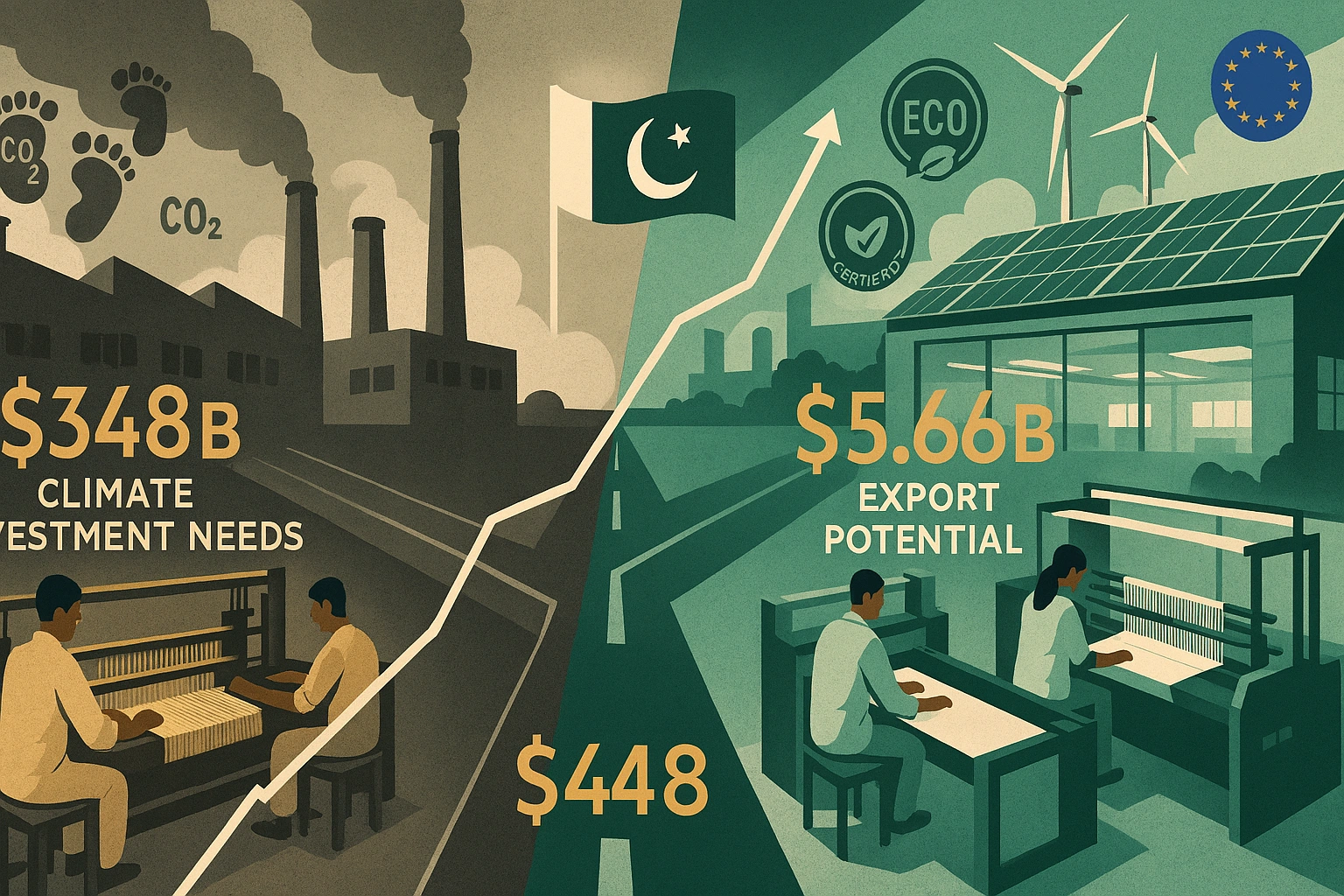
For the first time in history, Pakistan’s Finance Ministry has responded with an unprecedented directive: all federal ministries must submit pro-climate budget proposals for fiscal year 2026-27. Advisor to the Finance Minister Khurram Schehzad framed the move as existential, stating this marks “the first time” climate considerations will shape budget planning across government. But can green budgeting close a $348 billion climate investment gap by 2030—and save Pakistan’s textile lifeline in the process?

The EU’s Carbon Gauntlet: What CBAM Means for Pakistan’s Textile Dominance

The Carbon Border Adjustment Mechanism represents a fundamental shift in how the European Union approaches climate-linked trade policy. Launched in its transitional phase in October 2023, CBAM initially targets six carbon-intensive sectors: cement, iron and steel, aluminum, fertilizers, electricity, and hydrogen. By 2026, the mechanism enters its definitive regime, requiring EU importers to purchase carbon certificates reflecting the embedded emissions in their goods—certificates priced according to the EU’s Emissions Trading System allowances.

Currently, only 1.3% of Pakistan’s exports to the EU fall under CBAM’s scope, primarily steel and cement products. However, the European Commission has signaled its intention to expand the mechanism to cover additional sectors, including chemicals, polymers, and critically for Pakistan, textiles. As one recent analysis notes, “Beyond 2026, the EU has indicated that it intends to broaden CBAM to cover chemicals, polymers, and possibly textiles. For Pakistan, where textiles make up about 60 per cent of all exports and 28 per cent of trade with the EU, this is concerning.”

The threshold mechanism is particularly punishing: importers bringing more than 50 tons of covered goods annually into the EU must register as authorized CBAM declarants and purchase certificates matching their products’ carbon footprint. For Pakistan’s textile sector—characterized by high emission intensity due to reliance on fossil fuel-based energy and outdated machinery—this could translate into substantial cost increases that erode competitive advantages.

The timing couldn’t be worse. Pakistan’s textile exports have shown fragile recovery, growing just 0.93% to $16.655 billion in fiscal year 2023-24 after a steep 14.63% decline the previous year. Meanwhile, competitors like Bangladesh, Vietnam, and India are already implementing carbon pricing mechanisms and measurement, reporting, and verification (MRV) systems to prepare for CBAM compliance—moves that could position them favorably while Pakistan falls behind.

Pakistan Climate Change Budget FY2026-27: A Historic Fiscal Pivot

Against this backdrop, Pakistan’s Finance Division has issued its Budget Call Circular for FY2026-27, projecting 5.1% GDP growth and 6.5% inflation while introducing a groundbreaking climate dimension. For the first time, the budget incorporates Climate Budget Tagging (CBT), classifying over 5,000 cost centers across federal ministries under adaptation, mitigation, and supporting categories. This tagging has been integrated into the government’s Integrated Financial Management Information System (IFMIS), enabling real-time tracking of climate-sensitive expenditures.

The Pakistan green budgeting reforms extend beyond mere accounting. The government has introduced Form-III C screening mechanisms ensuring every federal subsidy aligns with national climate objectives before disbursement—a requirement also mandated under the IMF’s Extended Fund Facility program. Minimum thresholds now guarantee that at least 8% of current expenditures and 16% of Public Sector Development Program allocations are climate-tagged, representing a structural commitment to environmental accountability.

Pakistan’s first climate-focused budget allocates PKR 603 billion to mitigation efforts, targeting clean energy transitions, sustainable agriculture, and emission reductions across sectors. Yet the scale of the challenge dwarfs these initial commitments. According to UN analysis, Pakistan faces a climate finance gap of $40-50 billion annually—money needed for everything from flood protection infrastructure to renewable energy buildout. With climate-related disasters already costing the economy an estimated 1.03% of GDP per event without proper risk financing mechanisms, the urgency is palpable.

“The language is different,” explained Kashmala Kakakhel, an independent climate finance specialist, describing Pakistan’s steep learning curve in accessing international climate funds. “The way you curate the entire proposal is very different. The climate rationale is very different.” This procedural complexity helps explain why, despite the existence of a $2 trillion global climate finance market encompassing the Green Climate Fund, Global Environment Facility, and specialized facilities, Pakistan has struggled to mobilize resources at the scale required.

Pakistan Climate Finance Gap: Bridging the $348 Billion Chasm

The mathematics are sobering. Pakistan’s Nationally Determined Contributions outline $348 billion in climate investment needs through 2030—encompassing renewable energy infrastructure, climate-resilient agriculture, disaster preparedness systems, and green industrial transitions. Even with optimistic projections, domestic resource mobilization and traditional development finance cannot close this gap without innovative approaches.

Enter Islamic climate finance, a potentially transformative mechanism for a nation where faith-aligned financial instruments command broad public legitimacy. The Asian Development Bank’s analysis highlights how green sukuk (Islamic bonds) and climate-aligned Islamic financing structures could unlock billions in capital from regional Islamic financial institutions and sovereign wealth funds. WAPDA’s 2024 green euro bond issuance demonstrated proof of concept, though scaling such instruments requires robust regulatory frameworks and credible certification processes.

Yet institutional fragmentation hampers progress. “It’s just like a mismatch of jigsaw puzzle pieces,” observed Abid Qaiyum Suleri of the Sustainable Development Policy Institute, describing coordination challenges between federal and provincial authorities. “They will have their own projects. They will have their own priorities.” This siloed approach risks duplicating efforts, missing synergies, and failing to present coherent proposals to international climate funds that increasingly demand comprehensive national strategies.

The post-2022 flood period catalyzed some reforms. Pakistan launched its National Adaptation Plan in 2023 and published a National Climate Finance Strategy in 2024. The Planning Commission approved Climate Risk Screening Guidelines requiring all public investments to undergo climate-proofing assessments—critical steps toward the systematic integration Prof. Naz and others advocate. But implementation remains uneven, with technical capacity constraints particularly acute at provincial and district levels where climate impacts manifest most acutely.

EU Green Regulations Pakistan 2027: The Textile Sector at the Crossroads

For Pakistan’s textile manufacturers, carbon border adjustment Pakistan exports represents both an existential threat and a potential catalyst for long-overdue modernization. The sector’s emission intensity stems from multiple sources: coal and gas-fired power generation supplying energy-intensive processes, aging machinery operating below optimal efficiency, water-intensive dyeing and finishing operations, and limited adoption of circular economy principles in fiber sourcing.

Large conglomerates like Interloop Limited (which exported PKR 147 billion worth of textiles in FY2024), Style Textile, and Artistic Milliners have already begun sustainability transitions, investing in solar installations, water recycling systems, and certification programs meeting international environmental standards. However, these industry leaders represent a fraction of Pakistan’s textile ecosystem. Hundreds of small and medium enterprises operating with thin margins and limited access to capital face insurmountable barriers to rapid decarbonization without targeted support.

The GSP+ equation further complicates matters. Pakistan’s zero-tariff access to EU markets under the Generalized Scheme of Preferences Plus currently saves exporters billions in duties annually—a benefit that could be partially or entirely offset by CBAM certificate costs if textiles enter the mechanism’s scope as anticipated. One analysis suggests that inclusion of textiles in CBAM by 2027 would result in “carbon-related costs potentially neutralizing Pakistan’s preferential trade advantages,” forcing a fundamental reassessment of export competitiveness.

Professor Naz’s panel question resonates: what are the government’s accreditation plans? Without a national carbon registry, standardized emissions measurement protocols, and internationally recognized verification processes, Pakistani exporters cannot demonstrate compliance even if they invest in cleaner production. This creates a chicken-and-egg dilemma where investments in decarbonization may not yield market access if proper certification infrastructure doesn’t exist.

Carbon Border Adjustment Pakistan Exports: Risks, Opportunities, and Regional Responses

The risks are clear and quantifiable. Should CBAM extend to textiles at current emission intensities, Pakistan could face:

  • Export revenue losses estimated in the billions as EU buyers shift to lower-carbon suppliers or domestic production
  • Competitive disadvantage against regional rivals already implementing carbon pricing and building MRV capacity
  • Investment flight as multinational brands recalibrate supply chains toward CBAM-compliant jurisdictions
  • Employment shocks in a sector employing approximately 38% of Pakistan’s industrial workforce, predominantly lower-skilled workers with limited alternative opportunities

Yet crisis breeds opportunity. The same carbon pressures could accelerate Pakistan’s renewable energy transition, create new markets for eco-certified products, and position forward-thinking manufacturers as preferred partners for sustainability-conscious brands. Some potential pathways include:

Renewable Energy Scale-Up: Pakistan’s abundant solar and wind resources remain largely untapped for industrial use. Falling renewable costs now make distributed generation economically viable for textile clusters, offering both emissions reductions and energy security. The government’s recent focus on renewable energy in its NDC 3.0—incorporating specific targets for solar and wind capacity additions—provides policy support, though financing mechanisms and grid integration challenges require attention.

Technology Transfer and Innovation: The Diplomat’s analysis of climate-linked trade policy notes that “mechanisms to share emission reduction technology would be more effective” than punitive carbon tariffs alone. Pakistan could negotiate technology partnerships with European textile machinery manufacturers, potentially accessing cleaner production technologies at concessional terms through development finance institutions.

Green Premiums and Market Differentiation: A growing segment of EU consumers actively seeks sustainable products, willing to pay premiums for verified low-carbon textiles. Pakistani manufacturers achieving credible certification could capture this market segment, potentially offsetting CBAM costs through higher prices—though this requires investment in both production improvements and marketing.

Regional Learning: Competitor nations offer instructive examples. India recently expanded its carbon market to include petroleum refineries, petrochemicals, textiles, and secondary aluminum—explicitly building “CBAM Resilience” into industrial policy. Vietnam and Indonesia have launched national carbon pricing pilots. Even Turkey’s focus on electric arc furnaces in steel production demonstrates how sector-specific technological choices can dramatically reduce carbon intensity. Pakistan’s delayed response creates catching-up challenges but also allows learning from others’ successes and failures.

Policy Pathways Forward: What Pakistan Must Do Now

Transforming carbon constraints into competitive advantages requires coordinated action across multiple fronts. Based on international best practices and Pakistan’s specific circumstances, several priority interventions emerge:

Establish National Carbon Infrastructure: Pakistan needs a centralized carbon registry tracking emissions across industries, particularly export sectors. This registry should employ internationally standardized protocols (ISO 14064, GHG Protocol) ensuring EU recognition. The Planning Commission’s Climate Risk Screening Guidelines provide a foundation, but implementation must extend beyond project approval to operational monitoring.

Accelerate Sector-Specific Decarbonization Roadmaps: Rather than generic climate targets, Pakistan requires detailed transition plans for textiles, cement, steel, and other CBAM-vulnerable industries. These roadmaps should identify specific technological interventions (energy-efficient machinery, renewable power integration, process optimization), quantify costs and emission reductions, and sequence investments strategically. The National Climate Change Policy’s regular review mechanism provides an institutional home for such planning.

Mobilize Blended Climate Finance: Closing the $40-50 billion annual gap demands innovative financing combining public resources, development finance, green bonds, Islamic climate instruments, and private capital. Pakistan’s recent approval for a $1.4 billion IMF climate resilience facility represents a start, but scaling requires strengthening institutional capacity to design fundable projects meeting international climate fund criteria.

Build SME Capacity for Compliance: Large textile exporters can afford carbon audits, emissions monitoring, and certification—small enterprises cannot. Government-sponsored technical assistance programs, perhaps partnered with industry associations and international development agencies, could provide subsidized carbon accounting services, technology assessments, and compliance roadmaps for SMEs. Without such support, CBAM risks becoming a regressive mechanism favoring large players while eliminating smaller competitors.

Strengthen EU-Pakistan Climate Dialogue: Rather than viewing CBAM purely as an external imposition, Pakistan should engage proactively in EU climate policy discussions. The European Commission’s textiles strategy acknowledges supporting developing countries in green transitions. Pakistan could negotiate technical assistance, preferential access to EU climate technology, and potentially transitional measures recognizing countries making good-faith decarbonization efforts even if absolute emission levels remain elevated.

Integrate Climate into Trade Negotiations: Future trade agreements should explicitly incorporate climate provisions—not as barriers but as frameworks for mutual support. Pakistan’s trade offices, currently focused on traditional market access issues, need climate expertise to navigate this evolving landscape where environmental performance increasingly determines commercial access.

Turning Carbon Constraints into Export Resilience

Pakistan stands at a crossroads that Professor Naz articulated so starkly in Karachi. The convergence of climate vulnerabilities and carbon-linked trade regulations creates genuine risks to an export sector that remains the economy’s lifeblood. Yet this same pressure could catalyze the modernization, innovation, and sustainability transitions that Pakistan’s textile industry has deferred for decades.

The Pakistan climate change budget FY2026-27 represents a historic first step—acknowledgment that fiscal policy and climate action are inseparable in an era of European Green Deals and carbon border adjustments. Climate Budget Tagging, ministerial mandates for pro-climate proposals, and integration of environmental screening into subsidy allocation all signal genuine political commitment. But ambition must meet execution.

The $348 billion question—whether Pakistan can mobilize the investment required for climate resilience while maintaining export competitiveness—has no easy answer. It demands governmental coordination that transcends bureaucratic silos, private sector investment despite uncertain returns, international partnerships balancing support with accountability, and public understanding that short-term costs yield long-term sustainability.

For Pakistan’s textile exporters eyeing European markets nervously as 2027 approaches, the message is clear: adaptation is not optional. The only choice is whether to scramble reactively when CBAM expansion hits or to invest proactively in the cleaner, more efficient, climate-resilient production systems that increasingly define global competitiveness.

As Khurram Schehzad’s unprecedented budget directive demonstrates, Pakistan’s government has recognized the stakes. Now comes the harder work: translating recognition into action, climate tags into tangible emissions reductions, and constraint into catalyst. The path from carbon vulnerability to export resilience exists—but the window to walk it is narrowing with each passing fiscal year.


For more information on Pakistan’s climate adaptation efforts and financing challenges, see Dawn’s coverage of the climate funding gap and Business Recorder’s analysis of CBAM implications.


Discover more from The Economy

Subscribe to get the latest posts sent to your email.

Analysis

Indonesia Eyes Russian Crude as Hormuz Crisis Deepens Import Gap and Subsidy Strain

Published

on

Jakarta’s pivot to discounted Russian barrels is shrewd realpolitik. But it walks a razor-thin tightrope between Washington and Moscow — and lays bare the fragility of Asia’s entire oil architecture.

On the morning of April 13, 2026, President Prabowo Subianto arrived at the Kremlin carrying something most world leaders have long stopped bringing to Moscow: genuine leverage. With the Strait of Hormuz still convulsing under the weight of Iranian drone strikes and the global oil benchmark hovering above $100 a barrel for the first time in four years, Indonesia’s head of state sat across from Vladimir Putin not as a supplicant but as a customer — and Russia, desperate for new buyers in an era of tightening Western sanctions, was very much open for business.

The meeting lasted several hours. By the time the readouts emerged, the outlines of a deal were visible to anyone watching: long-term crude oil and LPG supply arrangements, cooperation on refinery development, and an explicit Russian offer to “increase supplies of oil and LNG to the Indonesian market.” Within 48 hours, Pertamina’s corporate secretary confirmed publicly that the company’s refineries were fully capable of processing Russian crude. Jakarta’s strategic pivot was no longer subtext. It was policy.

What followed was a global shrug from the Western press and a quiet tremor in the energy security community. Indonesia, after all, is not India. It is not China. It is a G20 democracy with a functioning multiparty system, a long-standing tradition of non-alignment, and a freshly signed defence cooperation agreement with the United States — on the very same day as the Moscow summit. The dual manoeuvre was audacious, and characteristically Prabowo: plant one foot in each camp, and dare anyone to push you over.

A Thousand Barrel Problem, Per Minute

To understand why Jakarta is willing to absorb the diplomatic friction of a Russian crude deal, one has to understand the arithmetic of Indonesia’s energy predicament. It is severe, and it has been structural for over two decades.

Indonesia currently consumes approximately 1.6 million barrels of oil per day against a domestic production base that — declining steadily since the late 1990s — has contracted to roughly 572,000 barrels per day as of December 2025. The arithmetic is unforgiving: a million-barrel-per-day import dependency, in an era of weaponised chokepoints. For a country of 280 million people sprawled across 17,000 islands, this is not merely a balance-of-payments challenge. It is a civilisational vulnerability.

Indonesia Energy Gap — At A Glance (2026)

IndicatorFigureSource
Domestic crude production~572,000 bpdTrading Economics / SKK Migas
Total oil consumption~1,600,000 bpdIndonesia Investments / IEA
Net import gap~1,028,000 bpdDerived
Share of fuel needs imported~60%Arab News / Antara
Share previously sourced from Middle East~20–25%Jakarta Post / Arab News
2026 energy subsidy budget (Pertamina + PLN)IDR 381.3 trn (~$22.5B)Indonesian Ministry of Finance / Invezz
Additional fiscal exposure per $1 oil rise~$400M widened deficitIndonesia Business Post
Urals discount to Brent (March 2026 avg.)~$6.4/bblCREA Monthly Tracker, April 2026

Sources: Indonesia Investments, Trading Economics, Arab News, Jakarta Post, Indonesian Ministry of Finance, Centre for Research on Energy and Clean Air (CREA). All figures April 2026.

Until February 2026, roughly 20 to 25 percent of Indonesia’s imported oil arrived through or from the Persian Gulf — a figure that had been declining as Jakarta diversified toward West African and North American crudes. Then the United States and Israel launched strikes on Iran, and everything changed at once.

Iran’s Revolutionary Guards declared the Strait of Hormuz effectively closed on March 4, 2026, following weeks of escalating attacks on commercial shipping. Tanker traffic through the world’s most consequential 33-kilometre waterway — through which some 25 percent of seaborne crude and 20 percent of global LNG normally transit — collapsed by more than 90 percent. The International Energy Agency’s Fatih Birol called it “the largest supply disruption in the history of the global oil market.” That is not a metaphor. It is a measurement.

For Indonesia, this was not an abstract geopolitical event. Two Pertamina tankers were immediately trapped in the Persian Gulf. Purchases from the Middle East — previously around a quarter of Indonesia’s crude import mix — were abruptly disrupted. Brent crude surpassed $100 per barrel on March 8 for the first time since 2022, and continued climbing. Against government budget assumptions of $70 per barrel, every dollar of incremental price increase widens Indonesia’s fiscal deficit by approximately $400 million. The government had already budgeted IDR 381.3 trillion — roughly $22.5 billion — for energy subsidies and compensation payments to Pertamina and PLN. That figure, built on a fragile $70 assumption, now looked dangerously inadequate.

“With the Middle East’s energy resources bottled up by the closure of the Strait of Hormuz, Indonesia is desperate to secure alternative supplies of crude oil — and Russia has plenty for sale.”

— Ian Storey, Principal Fellow, ISEAS-Yusof Ishak Institute, Singapore; quoted in the South China Morning Post, April 14, 2026


The Discount That Matters

Russia’s strategic offer arrives at a moment of unusual pricing opportunity. Urals crude averaged roughly $6.40 per barrel below Brent in March 2026, according to data from the Centre for Research on Energy and Clean Air — a discount that, while narrower than the $12.60 recorded in February and the vertiginous $30-plus discounts of early 2023, still represents material savings across a purchase programme of any scale. For a country importing upwards of a million barrels per day, even a $5-per-barrel discount translates to $1.8 billion annually. At $6 to $8, the savings approach $2.5 billion — fiscally meaningful in a year when Jakarta is already projecting a deficit approaching 2.9 percent of GDP.

There is also the question of ESPO Blend — Russia’s Pacific-facing export grade, loaded at Kozmino port and far better suited to Indonesian refineries given its lighter, sweeter profile relative to the sulphurous Urals. The transit route from Vladivostok to Indonesia’s refinery hubs at Balikpapan and Cilacap is comparatively direct, bypassing the Persian Gulf altogether. This is not a minor logistical footnote; it is the geological and geographic rationale that makes the entire proposition compelling. Russia’s east-of-Suez export infrastructure already serves China and South Korea. Indonesia is simply the next logical customer on the arc.

The precedent, moreover, is no longer theoretical. Ship-tracking data from Kpler and Vortexa indicated that two cargoes of Russian Sakhalin Blend crude — each approximately 700,000 barrels — were discharged at Balikpapan and Cilacap in December 2025 and January 2026, even as Pertamina publicly denied the imports. That corporate ambiguity has now dissolved: on April 15, a day after Prabowo’s return from Moscow, Pertamina’s corporate secretary stated plainly that “Pertamina’s refinery unit is capable of processing it into refined products” and that the company would “certainly support” any government directive to proceed.

The Subsidy Trap — and the Russian Exit Ramp

The most underappreciated dimension of this story is not geopolitical. It is fiscal. Indonesia’s fuel subsidy architecture is a system that was designed for a different era — one of cheap Gulf crude and stable rupiah — and it now functions as a fiscal trap that tightens with every dollar of oil price inflation.

In 2024, Indonesia spent $5.1 billion on its 3-kg LPG subsidy alone, $1.1 billion on transport fuel subsidies, and $7.3 billion in direct compensation payments to Pertamina and PLN — totalling over $13.5 billion in quantified oil and gas support. The 2026 budget earmarked even more: $22.5 billion, on the basis of $70 oil. Officials have now confirmed that subsidised fuel prices — Pertalite and Bio Solar — will remain frozen through end-2026, with the government absorbing the widening gap between international prices and domestic pump prices. As Coordinating Minister Airlangga Hartarto acknowledged in early April, this floor only holds “as long as oil prices do not exceed 97 on average.” With Brent well above that threshold, the government is already in territory where Pertamina is absorbing losses the state budget was not designed to cover.

Russian crude — cheaper at source and arriving through a sanctions-adjacent but not unnavigable commercial channel — offers a partial but genuine path toward narrowing that gap. Not a solution to the subsidy trap; but oxygen while Jakarta decides whether it has the political will to reform one of Southeast Asia’s most politically radioactive domestic programmes.

Three Scenarios: Russia’s Fiscal Impact on Indonesia

① Modest diversification (100–150k bpd Russian crude)
Annual saving of ~$220–$350M at a $6/bbl discount vs Brent alternatives. Buys political time. Limited sanctions exposure. Commercially viable via non-Western tankers.

② Substantial substitution (300–400k bpd)
Annual saving of ~$650M–$875M. Covers roughly 3–4% of the total energy subsidy bill. Meaningful fiscal relief. Raises EU/US diplomatic friction. Refinery upgrading required for Urals.

③ Strategic partnership (long-term G2G contract)
Includes Russian upstream investment in ageing Indonesian oil blocks, LPG supply, potential joint refinery development. Locks in supply certainty but deepens diplomatic exposure. Most significant fiscal and energy security upside; highest geopolitical cost.

The Tightrope Act — Washington, Sanctions, and the Non-Aligned Wager

No competent analysis of Indonesia’s Russian crude play can ignore the sanctions landscape. The G7 price cap on Russian oil — reduced to $44.10 per barrel effective February 2026 — ostensibly limits Western financial and maritime services to cargoes traded at or below that ceiling. In practice, roughly 48 percent of Russia’s seaborne crude is now transported by “shadow” tankers operating outside Western insurance and flagging systems, rendering the cap a leaky instrument at best. The EU briefly considered imposing sanctions on Indonesia’s Karimun transshipment hub in February 2026 after tracking data revealed Russian Sakhalin Blend being discharged at Pertamina ports. That threat has, for now, receded — partly because Jakarta simultaneously deepened its security ties with Washington.

The audacity of Prabowo’s April 13 positioning — signing a US defence cooperation agreement on the same calendar day as the Kremlin meeting — is not accidental naivety. It is doctrine. Since his election in 2024, Prabowo has pursued a foreign policy that Indonesia’s foreign ministry describes as “bebas aktif” — free and active. In practice: join BRICS, engage Trump’s Board of Peace, volunteer peacekeepers for Gaza, sign a defence pact with Australia, and buy oil from Russia. Indonesian Cabinet Secretary Teddy Indra Wijaya described the Moscow discussions as covering “long-term cooperation” in the oil and gas industries — language calibrated to signal seriousness without triggering immediate Western alarm.

For Jakarta’s economic planners, the calculus is clear-eyed: as Nailul Huda of the Centre of Economic and Law Studies in Jakarta put it, “these energy negotiations must cleverly avoid being controlled by US interests.” Indonesia needs bargaining chips to resist pricing pressure from any single supplier — including the United States, which would dearly love to sell LNG to Southeast Asia’s largest economy. Russian crude is less a geopolitical statement than a commercial hedge.

The Refinery Question — and the Infrastructure Clock

One structural constraint complicates the narrative of seamless diversification: Pertamina’s legacy refinery fleet. Indonesia’s major processing facilities — particularly the Cilacap complex and the Balikpapan refinery currently being expanded under the RDMP programme — were designed primarily for sweet, light domestic crude and Middle Eastern medium grades. Russian Urals is a medium-sour crude; ESPO is lighter and sweeter and considerably more compatible. Pertamina’s VP for Corporate Communication Muhammad Baron said the company would “examine crude specifications” and noted that ongoing refinery modernisation “is expected to give greater flexibility to process a wider range of crude types.”

This is not obfuscation. It is engineering reality. Crude substitution at scale requires desulphurisation upgrades, changes to coker configurations, and adjustments to hydrotreating units. The Balikpapan RDMP — which will bring that refinery’s capacity to 360,000 bpd — includes precisely such upgrades. But major capital works take years. In the near term, ESPO Blend is the practical option; full Urals compatibility is a medium-term proposition contingent on investment decisions being taken now. The stakes of delay are not trivial: Pertamina’s refinery chief confirmed as early as May 2025 that the company had “opened to imports from Russia since last May” — suggesting the technical groundwork, at least at the margins, is already underway.

Implications for Asia’s Oil Order

Zoom out, and what Indonesia is navigating in 2026 is a microcosm of a broader structural shift underway across the entire Indo-Pacific. The Strait of Hormuz crisis has crystallised something energy security analysts have argued for years: the architecture of Asian oil supply — built on Gulf crude, US-secured sea lanes, and Western-insured shipping — is not a given. It is a geopolitical construct, and constructs can fail.

India understood this first, pivoting aggressively to Russian crude after the 2022 Ukraine invasion. China had already built parallel supply chains. Now Indonesia, Thailand, Vietnam and even the Philippines are being forced into analogous calculations. The Philippines declared a national energy emergency; Thailand, Vietnam and Indonesia began encouraging remote work for civil servants to reduce fuel consumption. These are symptoms of a structural dependency that years of energy diversification policy quietly failed to address.

Russia, meanwhile, is the paradoxical beneficiary of a crisis its own earlier actions helped architect. Moscow is now earning an average of €510 million per day from oil and gas exports — roughly 14 percent higher than in February, even as G7 price caps nominally remain in force. The Hormuz closure has lifted Urals pricing just as Southeast Asian demand for alternative barrels surges. Putin, sitting in the Kremlin on April 13, needed no map to read the room: Indonesia was coming to him, not the other way around.

What emerges from this confluence is what might be called the new “non-aligned oil order” — a loose architecture in which price-sensitive developing-world importers, unconstrained by NATO obligations or EU membership, pragmatically route crude purchases toward whatever source is cheapest, most available, and least encumbered by chokepoint risk. India, China, Turkey, Indonesia: these are not ideological allies of Moscow. They are sovereign buyers making sovereign calculations. The G7’s price cap was supposed to close off this space. It hasn’t.

The Verdict: Smart Hedge, Structural Risk

Indonesia’s Russian crude pivot deserves neither the breathless alarm some Western commentators have attached to it nor the dismissal of those who treat it as purely transactional. It is both of those things at once — and something more: a window into the accelerating disintegration of the post-Cold War energy order that once gave Western-aligned institutions decisive leverage over the global oil market.

For Prabowo, the immediate arithmetic is compelling. Russian crude offers price relief, supply certainty, and a credible alternative to Middle Eastern dependence in a period when the Strait of Hormuz is a war zone. It gives Jakarta leverage in negotiations with American LNG sellers, Gulf producers, and West African exporters alike. It buys time — perhaps two to three years — for Indonesia to make the harder structural choices: subsidy reform, refinery upgrades, domestic upstream revival, and an energy transition that the government acknowledges it needs but has repeatedly postponed.

The risks are real and should not be minimised. Secondary sanctions exposure remains non-trivial; the EU’s willingness to sanction the Karimun hub signals that the line between tolerance and enforcement is thin and politically contingent. A Trump administration navigating a hot war with Iran is not a predictable partner, and Indonesia’s defence cooperation agreement is only as durable as the next presidential mood swing in Washington. Logistics and refinery compatibility, while manageable, are not trivial.

But the deeper risk is the one no one in Jakarta’s cabinet rooms is comfortable articulating publicly: that the Russian crude option, like so many emergency energy policies before it, becomes permanent. That what begins as pragmatic hedging calcifies into structural dependency — this time not on the Gulf, but on the Kremlin. Indonesia has navigated those shoals before. Whether it can do so again, in a world more fractured and less predictable than the one it inherited, is the question that will define its energy future long after the Strait of Hormuz reopens.


Discover more from The Economy

Subscribe to get the latest posts sent to your email.

Continue Reading

Analysis

Gulf States Turn to Private Deals in $10bn Wartime Borrowing Spree: Abu Dhabi, Qatar and Kuwait Sidestep Public Markets

Published

on

As missiles rain down on Gulf infrastructure and the Strait of Hormuz sits effectively closed to commercial traffic, the region’s sovereigns are doing what elite borrowers have always done when the crowd turns hostile: they are going around it.

The Quiet $10 Billion Rush Behind Closed Doors

In my two decades covering Gulf capital markets, I have never seen anything quite like the past six weeks. While the world’s financial press has been fixated on oil prices, ceasefire negotiations, and the Pentagon’s deployment of paratroopers to the region, something equally consequential has been happening in the quieter corridors of high finance — a discreet, accelerating rush by the Gulf’s most creditworthy sovereigns to raise cash through private bond placements that bypass the volatility, disclosure requirements, and brutal new-issue premiums of public markets entirely.

Abu Dhabi and Qatar have placed billions of dollars through private bond sales in recent weeks amid the market volatility caused by the war in Iran. The UAE capital raised $500 million by reopening a 2034 bond, a day after tapping the same bond and a separate 2029 issue for $2 billion, with the private deals arranged by Standard Chartered. Bloomberg Qatar, meanwhile, placed approximately $3 billion through a JPMorgan-led private transaction, with Qatar National Bank adding a further $1.75 billion in its own placement. Kuwait, whose petroleum chief has been the region’s most publicly anguished voice on the economic carnage, has now joined the discreet borrowing spree. By the second week of April 2026, total Gulf private bond sales were approaching $10 billion — a figure that would be remarkable in normal times and is staggering in these.

The question is not whether this borrowing was necessary. It plainly was. The question is what it tells us about the durability of Gulf sovereign credit, the architecture of global debt markets under geopolitical stress, and the hidden costs that Gulf finance ministries will be quietly paying for years.

When Public Markets Become Uninhabitable

To understand why Abu Dhabi, Qatar, and Kuwait have gone private, you need to understand what has happened to public bond markets since the escalation of the Iran conflict in late February 2026. The war — triggered by a coordinated wave of U.S.-Israeli airstrikes against Iran on February 28 — immediately shattered the benign issuance environment that had characterized the opening months of the year. Through January and February, Gulf hard currency debt issuance had been on track for a banner year, with $44 billion of bonds and sukuk placed in just two months, backed by strong appetite for investment-grade regional paper and average spreads of roughly 130 basis points.

That window slammed shut almost overnight. War-premium volatility pushed new-issue spreads to levels that made public issuance prohibitively expensive. Bankers working the region privately describe new-issue premiums of 10 to 30 basis points on private deals — painful, but manageable. In a public roadshow environment, with investor sentiment fractured and bid lists shortened by redemptions, those premiums would likely be double that, with no guarantee of a fully covered book. For sovereigns accustomed to issuing into oversubscribed order books, the optics of a partially-covered public deal would be worse than no deal at all.

Private placements solve that problem neatly. A sovereign finance ministry, working through a single mandated bank — Standard Chartered for Abu Dhabi, JPMorgan for Qatar — approaches a curated list of anchor investors directly. Price discovery happens off-screen. There is no public roadshow, no visible order book, no Bloomberg headline ticking the bid-to-cover ratio in real time. The deal closes, the cash arrives, and the sovereign moves on. The elegance of the mechanism is precisely its invisibility.

The Economic Damage: A Region Under Siege

To appreciate the urgency behind these transactions, consider the scale of economic devastation that has unfolded since hostilities began. Unlike previous crises, Gulf wealth funds are confronting a shock that is not driven by lower oil prices or a global credit crunch: the region itself is under attack and, because of Iran’s effective closure of the Strait of Hormuz, much of its oil wealth is trapped. Semafor

The numbers are breathtaking. The closure of the Strait of Hormuz, through which the bulk of Persian Gulf oil and gas is exported, along with an estimated $25 billion in damage wrought by Iranian rockets and drones on gas and oil infrastructure, is triggering the worst economic crisis in the Gulf region in decades. The IMF reports that the economies of Qatar, the UAE, Bahrain, and Kuwait will contract in 2026 to the tune of several tens of billions of dollars, while the entire Middle East’s projected economic growth will drop from 3.6% pre-war to 1.1%. CSMonitor.com

London-based Capital Economics is even more stark: Qatar’s GDP is forecast to shrink by 13% this year, the UAE’s by 8%, and Saudi Arabia’s by 6.6%. Tourism revenues — a central pillar of Gulf economic diversification strategies — have collapsed. The World Bank now expects Gulf growth to slow to 1.3% this year, from 4.4% in 2025, while Gulf officials estimate tourism losses of as much as $32 billion. The Kuwaiti and Qatari economies are expected to contract by more than 5%. Semafor

The human dimension should not be lost in the data. Kuwait was producing about 2.6 million barrels per day prior to the war, and it will take months for oil production in the Gulf to reach full capacity, as Kuwait and its neighbors have shut oil wells. CNBC Refineries have been hit. Tanker traffic has collapsed. Airport operations, once the envy of the aviation world, are running at severely diminished capacity across Dubai, Abu Dhabi, and Doha. For states that had spent a decade magnificently diversifying away from oil-dependency, the war has brutally reasserted just how much that diversification still relied on unimpeded energy exports flowing through 21 miles of contested water.

Strategic Sophistication or Hidden Vulnerability?

It would be easy — and lazy — to read the Gulf’s private placement spree purely as a sign of distress. That reading is incomplete. There is genuine strategic sophistication at work.

By moving to private markets, Abu Dhabi, Qatar, and Kuwait are preserving their public market credentials for when conditions normalize. A sovereign that hits the public market in wartime — paying wide, getting a patchy book, and enduring negative price action — can damage its benchmark bonds for years. A sovereign that quietly finances itself through discreet private channels, then returns to public markets with a clean slate once the ceasefire holds, emerges with its pricing power intact. The short-term cost — those 10-30bp premiums — is the price of protecting a far more valuable long-term asset: investor perception.

The choice of mandated arrangers is also telling. Standard Chartered’s deep Gulf franchise and its relationships with Asian sovereign wealth funds and central bank reserve managers make it the natural choice for Abu Dhabi’s discreet taps. JPMorgan’s dominance in the institutional U.S. fixed-income universe gives Qatar access to the deep-pocketed insurance companies and pension funds that can absorb large, private chunks of paper without flinching. These are not panicked phone calls to emergency lenders. They are disciplined transactions executed by well-staffed finance ministries that have war-gamed exactly this scenario.

And yet — and this is the part that should trouble investors and policymakers — there are real risks accumulating beneath the surface of this apparent calm.

The Hidden Costs of Going Dark

Private placements are structurally less transparent than public bond issuance. There is no prospectus, no regulatory filing, no roadshow presentation available to the broader market. The terms — exact spread, investor composition, covenant structure — are known only to the parties involved. For sovereigns that have spent years cultivating retail and institutional investor bases through transparent, well-documented public deals, a prolonged shift toward private channels could gradually erode the depth of that investor base. Relationships built on annual public roadshows atrophy when the roadshows stop coming.

There is also the question of cost aggregation. Each individual private placement, at 10-30bp over what a public deal might achieve in benign conditions, appears manageable. But consider: if Gulf sovereigns collectively place $10 billion privately at even a 15bp premium over hypothetical public pricing, the additional annual interest burden approaches $150 million. Over a five-year bond tenor, that is $750 million — real money, even for sovereigns with trillion-dollar sovereign wealth fund cushions.

Speaking of those cushions: they are being stretched. Saudi Arabia’s Public Investment Fund, Abu Dhabi-based Mubadala, and Qatar Investment Authority combined for almost $25 billion in new investments in Q1 2026 — a pace that, without war, would portend a banner year for state investors. But the pace of overseas investment will likely slow if the war drags on. Some funds — such as Abu Dhabi Investment Authority and Kuwait Investment Authority — may be used to support government budgets and slow investments in private markets. Semafor

This is the quiet fiscal tension that most commentary is missing. Gulf sovereign wealth funds — collectively worth some $5 trillion today, on a trajectory toward $18 trillion by 2050 — have historically been the region’s most powerful argument for long-term financial resilience. They are now being called upon to serve a dual function: continue generating returns abroad while standing ready to backstop domestic fiscal shortfalls. That is not an impossible ask. But it is a more difficult one than the funds have faced before, and it carries a real opportunity cost for the global portfolio mandates they have spent years refining.

What This Means for Global Finance and the Petrodollar System

The Gulf’s wartime borrowing spree is not happening in a vacuum. It intersects with several longer-term structural shifts in global finance that the Iran conflict is now forcibly accelerating.

The most significant is the continued erosion — quiet, incremental, but unmistakable — of the petrodollar architecture. The 2026 conflict has amplified discussions around non-dollar oil settlements, with reports of tankers potentially passing through the Strait of Hormuz when transactions use the yuan. KuCoin Private bond deals arranged through London-based banks and placed with a globally diversified investor base — rather than publicly issued in dollars under U.S.-regulated market frameworks — fit into this broader pattern of Gulf capital quietly seeking multiple anchors.

For investors, the implications are nuanced. Those who have been allocated chunks of Abu Dhabi’s or Qatar’s private placements are sitting on paper that is illiquid, opaque, and priced at a premium — but also backed by sovereigns with extraordinary balance sheets, real assets, and powerful geopolitical incentives to honor their obligations in full. The risk-reward calculus favors the patient, long-term institutional holder over the trading desk. For emerging market fund managers monitoring the region’s public bond curves, the near-term question is simpler: when do public markets reopen, and what will the first public deal after the war reveal about how much these private transactions have truly cost?

GlobalCapital has noted that the Iran war could permanently reshape the ultra-competitive Gulf capital markets landscape — a market where, before February 2026, sovereigns like Abu Dhabi and Qatar commanded among the tightest spreads of any emerging market issuer on the planet. The structural damage to that premium pricing reputation depends almost entirely on how long the conflict continues and how credible the eventual fiscal recovery story proves to be.

The Longer View: Resilience With Asterisks

It would be wrong to conclude that the Gulf’s wartime pivot to private markets represents a fundamental breakdown of sovereign creditworthiness. The region’s fiscal buffers, institutional quality, and strategic geopolitical relationships with both Western and Eastern creditors remain formidable. Abu Dhabi’s ability to move $2.5 billion in forty-eight hours through a single mandated bank, without a public roadshow and without visible market disruption, is itself a testament to how deeply its credit is embedded in the portfolios of the world’s most sophisticated institutional investors.

But resilience is not the same as immunity. The Gulf is currently running a multi-front stress test that no amount of pre-war financial modeling fully anticipated: oil revenues disrupted, tourism collapsed, airspace restricted, shipping hazardous, and borrowing costs elevated. The private placement spree is an intelligent, well-executed response to an extraordinarily difficult environment. It is not, however, a free lunch.

Finance ministers in Abu Dhabi, Doha, and Kuwait City are writing checks today — in the form of elevated private deal premiums, potential SWF drawdowns, and deferred public market activity — that their successors will be cashing for years. The bills, when they come due, will be payable in the currency of transparency and public market credibility that these sovereigns have spent a decade carefully accumulating.

The real test of Gulf sovereign finance will not be whether Abu Dhabi and Qatar can close private deals in wartime. They have just proved, emphatically, that they can. The test will be how cleanly they can return to public markets, at what spread, and with what story — and whether the world’s capital markets ultimately conclude that the Iran conflict was a crisis these states navigated, rather than a turning point from which they never fully recovered.

As of mid-April 2026, the answer to that question is still being written — one quiet private placement at a time.

Have Gulf sovereigns made the right call by going private — or are they incurring hidden costs that will haunt them when markets reopen? Share your analysis and follow the debate.


Discover more from The Economy

Subscribe to get the latest posts sent to your email.

Continue Reading

Analysis

Agency in the Age of AI: Why Human Initiative — Not Artificial Agents — Will Define the Next Decade

Published

on

On February 15, 2026, Sam Altman posted two sentences to X that encapsulated a decade of Silicon Valley ambition in a single breath. OpenAI had acquired OpenClaw, an open-source AI agent framework that could autonomously browse, code, and execute complex multi-step tasks — and its creator, Peter Steinberger, was joining the company to “bring agents to everyone.” The deal was quiet by tech-acquisition standards. No press conference. No billion-dollar number dropped to gasps at a conference. Just a pair of tweets that, read carefully, amount to a civilizational declaration: the age of artificial agents — AI systems that act on your behalf, that do rather than merely say — has arrived.

The question no one in those tweets was asking is the one that ought to keep us up at night. Not what will AI agents do for us? But what will they do to us?

Agency in the age of AI is not, at its core, a technology question. It is a human one. And across law firms, accounting houses, actuarial desks, and the laptops of twenty-four-year-olds trying to build careers in knowledge work, the contours of that question are becoming impossible to ignore.

The Rise of Autonomous Agents — And the Hidden Cost to Human Agency

“Agentic AI” is the industry’s term of the moment, and it deserves a plain-language translation: these are AI systems that do not merely answer questions but complete tasks — booking travel, filing documents, auditing spreadsheets, drafting briefs, managing inboxes — with minimal human instruction and, in many configurations, minimal human oversight. OpenAI’s Frontier platform, launched in February 2026 and described as a home for “AI coworkers,” gives enterprises AI systems with shared context, persistent memory, and permissions to act inside live business workflows.

The promise is intoxicating. The average knowledge worker, Silicon Valley’s pitch goes, will soon command a small army of autonomous agents the way a senior partner commands junior associates. Scale your output. Compress your timelines. Democratize expertise.

What this narrative conspicuously omits is what happens to the junior associates.

The hidden cost of autonomous agents is not primarily economic, though the economic costs are real and arriving faster than most forecasts anticipated. It is something harder to quantify and easier to dismiss: the erosion of the conditions under which human agency develops, deepens, and compounds over a life. The young lawyer who never drafts her first clumsy brief. The accountant who never wrestles with his first gnarly audit. The actuary who never builds intuition through the friction of getting it wrong. Agency — the capacity to act, judge, and take meaningful initiative in the world — is not innate. It is cultivated. And the cultivation requires doing the hard, error-prone, occasionally humiliating work that AI agents are now absorbing at scale.

This is not a Luddite argument. It is a developmental one. And it is urgent.

Why Lawyers, Accountants, and Actuaries Are Questioning Their Futures

The conversation has broken into the open in the corridors of professional services with a candor that would have been unthinkable three years ago. Senior partners at major law firms will tell you, off the record, that they have paused or sharply curtailed junior associate hiring. The work that used to season young talent — contract review, discovery, due diligence — is being absorbed by AI agents with an efficiency that makes the economics of junior staffing almost impossible to justify.

The data corroborates what the corridors are whispering. Goldman Sachs Research reported in April 2026 that AI is erasing roughly 16,000 net U.S. jobs per month — approximately 25,000 displaced by AI substitution against 9,000 new positions created by AI augmentation. The occupations most exposed to substitution, Goldman’s economists found, include accountants and auditors, legal and administrative assistants, credit analysts, and telemarketers: precisely the entry-level and mid-career roles that have historically served as the scaffolding of professional development.

The generational impact is particularly sharp. Goldman Sachs found that unemployment among 20- to 30-year-olds in AI-exposed occupations has risen by nearly three percentage points since the start of 2025 — significantly higher than for older workers in the same fields. Entry-level hiring at the top fifteen technology companies fell 25 percent between 2023 and 2024, and continued declining through 2025. The AI-related share of layoffs discussed on S&P 500 earnings calls grew to just above 15 percent by late 2025, up sharply from the year prior.

The career advice for young professionals navigating the AI age in 2026 used to be: develop technical skills, stay adaptable, embrace tools. That advice, while still valid, has become insufficient. What young professionals now face is a more fundamental disruption: the removal of the proving grounds where professional judgment is forged. You cannot develop the discernment of a seasoned litigator if the briefs are always already written. You cannot build the instincts of a skilled auditor if the anomalies are always already flagged.

The global picture adds further texture. In Southeast Asia, AI agents replacing jobs in BPO (business process outsourcing) — a sector employing hundreds of millions across the Philippines, India, and Vietnam — are compressing opportunities for a generation that had, through those very jobs, entered the formal economy and begun building transferable skills. In sub-Saharan Africa, where formal professional employment is expanding and could absorb more talent, the risk is that AI-agent adoption by multinationals shortcircuits the very job categories through which that transition happens. The AI agents replacing lawyers accountants and junior professionals in New York and London do not stay politely within American and European borders.

Pew’s 2025–2026 Data: Americans Demand More Control Over AI

The public has registered its discomfort — clearly, consistently, and in terms that policymakers should find impossible to dismiss.

Pew Research Center’s June 2025 survey of 5,023 U.S. adults found that 50 percent say the increased use of AI in daily life makes them feel more concerned than excited — up from 37 percent in 2021. More than half of respondents (57 percent) rated the societal risks of AI as high, against just 25 percent who say the benefits are similarly high. Majorities reported pessimism about AI’s impact on human creativity (53 percent say it will worsen people’s ability to think creatively) and meaningful relationships (50 percent say it will worsen our capacity to form them).

These are not the views of technophobes. They are the views of citizens watching something happen to their world and struggling to articulate, against the momentum of trillion-dollar valuations and breathless press coverage, what exactly it is they are losing.

The Pew data on control is the most politically significant finding of recent years. Fifty-five percent of U.S. adults say they want more control over how AI is used in their own lives. Among AI experts themselves — people who have built careers in the field — the figure is 57 percent. The demand for human agency in the AI era is not a fringe sentiment or a technophobic reflex. It crosses partisan lines, educational levels, and even the expert-layperson divide. What is remarkable is how little the policy architecture of any major government has responded to it.

In Europe, the EU AI Act has established a framework, but its enforcement mechanisms remain nascent and its treatment of agentic systems is notably underdeveloped for a technology moving at this pace. In the United States, the legislative response has been fragmented, preempted by a political environment in which AI has become entangled with culture-war dynamics that obscure rather than illuminate the actual governance questions. In China, regulatory assertiveness on AI coexists with state-directed deployment that raises its own agency concerns — for the individual citizen, not the system.

The gap between what people want — more control, more say, more human agency in the AI era — and what institutions are delivering is widening. It is into this gap that the next generation of social innovators, philanthropists, and policymakers must step.

Philanthropy’s Critical Role in Shaping AI Guardrails and Opportunity

Here is where the story gets interesting — and where institutional funders, foundations, and philanthropic capital have a genuinely historic role to play that they have, with a handful of exceptions, yet to fully embrace.

The governance of AI — particularly of agentic AI systems acting autonomously in high-stakes domains — cannot be left to the companies building it, to legislators who struggle to define a “large language model” without staff assistance, or to the uncoordinated preferences of individual consumers. The OECD and the World Economic Forum have outlined frameworks, but frameworks without funding are architectural drawings without builders.

Philanthropy AI governance has become one of the most consequential and underfunded intersections in public life. The MacArthur Foundation, Ford Foundation, and a handful of tech-originated donors (Omidyar Network, Schmidt Futures) have begun investing in responsible AI research and policy. But the scale of investment remains dramatically misaligned with the scale of the disruption underway. According to the Brookings Institution, the communities most exposed to AI displacement — lower-income workers, first-generation professionals, workers in routine cognitive roles — are precisely those with the least access to reskilling resources, legal literacy about their rights, and political power to shape the governance conversation.

Philanthropic capital can address this at multiple levels. First, funding public dialogue: creating the forums, commissions, and civic processes through which communities can articulate what they want from AI and what they will not accept — the kind of deliberative democracy that corporate AI development timelines do not organically produce. Second, building ethical guardrails: supporting independent technical audits of AI agent systems, especially those deployed in high-stakes contexts like hiring, credit, legal aid, and healthcare. Third, investing aggressively in reskilling: not the corporate upskilling programs that optimize for the needs of existing employers, but the genuinely human-centered education investments that give people the capacity to navigate a changed economy on their own terms. Fourth, and most visibly, creating opportunity for young people — the generation that stands to be most directly affected by the removal of the proving grounds of professional learning.

The philanthropic AI governance opportunity is not about slowing innovation. It is about ensuring that the benefits of innovation are not captured exclusively by those who already own the infrastructure, while the costs — in disrupted careers, eroded agency, and stunted development — are borne by everyone else.

Reclaiming Agency: What Young People, Leaders, and Funders Must Do Now

The future of human agency in the AI era will not be decided in Palo Alto. It will be decided in classrooms, in courtrooms, in legislative chambers, in the board rooms of foundations, and in the daily choices of individuals about which tasks they hand to machines and which they insist on doing themselves — not because machines cannot do them, but because the doing is the point.

For young professionals — the generation navigating career advice in the AI age of 2026 — the imperative is not to compete with AI agents on their own terms. That is a race designed for machines. The imperative is to cultivate what agents cannot: moral judgment, relational intelligence, contextual wisdom, creative vision, the capacity to care about what you’re doing and why. These are not soft skills. They are the hardest skills. They compound over a lifetime in ways that no model weight or token count does. Protect your learning curve fiercely. Seek out the friction that develops judgment. Resist the temptation to outsource your thinking to systems that are, however impressive, fundamentally indifferent to your growth.

For leaders — in business, government, education, and civil society — the reclamation of agency requires building institutions that are honest about trade-offs. Does AI erode human agency? In its current deployment trajectory: yes, in specific and important ways. The right response is not panic, and it is not denial. It is design. Invest in human-AI collaboration frameworks that genuinely keep humans in the loop, not as a compliance formality but as a developmental reality. Design apprenticeship and mentorship structures that survive the automation of the tasks around which they were traditionally built. Insist on AI impact assessments before deploying agentic systems in professional and educational contexts. Make the question of human development central to every AI deployment decision, not an afterthought.

For funders: this is the decade. The governance architecture being built — or not built — around agentic AI will shape the relationship between human agency and technological systems for a generation. The window for influence is not permanently open. Foundations that move early, with real capital and genuine intellectual seriousness, can help write the rules. Foundations that wait will be left funding the repair.

The global dimension matters here, too. The most consequential AI governance battles of the next decade may not be fought in Washington or Brussels, but in the Global South — in countries where the intersection of demographic youth, expanding educational access, and AI-driven disruption of professional labor markets creates conditions for either extraordinary opportunity or extraordinary waste of human potential. Philanthropic AI governance that ignores Lagos, Jakarta, and São Paulo is not global governance. It is just wealthy-country governance wearing a global mask.

The story Silicon Valley is telling about the age of AI is seductive and, in many of its details, accurate. Autonomous agents will transform professional life. Productivity will rise. Some categories of work will disappear and others will emerge. The arc, the industry insists, bends toward abundance.

What the story omits is the quality of the lives lived along that arc. The lawyer who never argued. The accountant who never judged. The twenty-three-year-old who handed her first decade of professional development to a system that learned everything and taught her nothing.

Agency in the age of AI is not a footnote to the productivity story. It is the story that matters most.

Two tweets launched the age of agentic AI. What we do next — in philanthropy, in policy, in education, in the daily texture of our professional and personal choices — will determine whether this age expands or diminishes what it means to be a capable, purposeful human being.

The question is not what AI agents will do for us. The question is what kind of agents we will choose to become.


Discover more from The Economy

Subscribe to get the latest posts sent to your email.

Continue Reading

Trending

Copyright © 2025 The Economy, Inc . All rights reserved .

Discover more from The Economy

Subscribe now to keep reading and get access to the full archive.

Continue reading