
Banks
Trump’s Fed Pick Signals Institutional Reckoning


Kevin Warsh’s nomination as chair could spark sweeping changes to the central bank—if he can navigate the political gauntlet ahead
President Donald Trump nominated Kevin Warsh as the next Federal Reserve chair on January 30, ending months of speculation and launching what promises to be one of the most consequential leadership transitions in the central bank’s modern history. The choice of Warsh, a former Fed governor who has publicly called for “regime change” at the institution, signals an impending reconsideration of the Fed’s expanded mandate and operational independence—even as markets rallied on relief that Trump selected a relatively orthodox candidate over potentially more pliable alternatives.
The announcement, delivered via Truth Social with characteristic Trumpian superlatives, positions Warsh to succeed Jerome Powell when his term expires in May. Yet beneath the market’s initial sigh of relief—the dollar surged nearly one percent while gold plummeted almost five percent—lies a more complex and potentially destabilizing dynamic. Warsh arrives at the Fed not as a continuity candidate but as an avowed critic who has spent years arguing that the institution has strayed dangerously from its core mission, expanded its balance sheet recklessly, and lost the credibility necessary to anchor inflation expectations.
“The credibility deficit lies with the incumbents that are at the Fed, in my view,” Warsh declared during a CNBC interview last July, using language rarely directed at the central bank by prospective chairs. This forthright assessment of the institution he now seeks to lead encapsulates the tension at the heart of his nomination: Warsh brings impeccable credentials and crisis-tested experience from his 2006-2011 tenure as a Fed governor during the global financial meltdown, yet he returns as something closer to a reformer than a steward.
The case for overhaul
Warsh’s critique of the Federal Reserve extends well beyond the tactical disagreements over interest rate policy that typically animate debates about monetary management. Instead, he has articulated a fundamental challenge to what he characterizes as “mission creep”—the Fed’s gradual expansion into climate risk assessment, diversity initiatives, and an arsenal of unconventional policy tools that, in his view, have politicized the institution and undermined its independence.
During an April lecture hosted by the Group of Thirty, Warsh argued that “the Fed’s current wounds are largely self-inflicted.” His prescription involves what he has termed a new “Treasury-Fed accord,” invoking the 1951 agreement that liberated the central bank from its obligation to support government bond prices. Such an accord, Warsh contends, would establish clearer boundaries around the Fed’s balance sheet management and restore a division of labor between monetary and fiscal authorities that has eroded over successive crises.
The intellectual coherence of Warsh’s position stands in stark contrast to the political pressures that brought him to this juncture. Trump has berated Powell relentlessly for maintaining rates he considers excessively restrictive, demanded cuts to levels historically associated with economic distress, and even launched a Justice Department criminal investigation into the Fed chair over renovation cost overruns—an episode that shocked senators from both parties and raised profound questions about central bank independence. Trump praised Warsh effusively, predicting he would “go down as one of the GREAT Fed Chairmen, maybe the best,” yet this endorsement comes freighted with expectations that may prove incompatible with the institutional reforms Warsh has long advocated.
The paradox of the hawk turned dove
Warsh built his reputation during his first Fed stint as an inflation hawk who frequently warned of price pressures that never materialized. During the recovery from the 2008 crisis, when unemployment hovered near ten percent, he persistently cautioned about upside inflation risks—a position that, in retrospect, appears to have unnecessarily constrained the Fed’s support for a struggling economy. This history makes his recent evolution toward endorsing rate cuts all the more noteworthy, and potentially suspect.
The transformation appears rooted in Warsh’s conviction that artificial intelligence and deregulation are ushering in a productivity renaissance that will allow faster growth without inflation—a thesis he outlined in a January 2025 Wall Street Journal column arguing that “the Trump administration’s strong deregulatory policies, if implemented, would be disinflationary” and that cuts in government spending would further reduce price pressures. This theoretical framework conveniently aligns with Trump’s political imperatives, raising questions about whether Warsh’s intellectual journey reflects genuine economic analysis or strategic positioning for the role he now seeks.
Markets appear uncertain how to reconcile these competing signals. As reported by Bloomberg, the dollar and short-dated Treasuries rallied on relief that Trump selected Warsh “rather than someone seen as more willing to ignore inflation and slash interest rates,” yet analysts remain skeptical about his newfound accommodation. Deutsche Bank analysts suggested they “do not view him as structurally dovish” despite his recent rhetoric, while University of Michigan economist Justin Wolfers noted that Warsh’s hawkish record represents “exactly not who the president wants,” raising concerns that “deals were made.”
The confirmation crucible
Even assuming Warsh’s nomination survives the Senate Banking Committee—itself far from assured—he faces structural constraints that may frustrate both his reformist ambitions and Trump’s demand for aggressive rate cuts. Interest rate decisions are made not by the chair alone but by the twelve-member Federal Open Market Committee, which includes seven governors and five rotating regional bank presidents. As the Council on Foreign Relations observed, “while the chair presides over the committee, he cannot dictate policy without securing the support of a majority of its members.”
Current committee members have shown little appetite for the dramatic easing Trump envisions. The Fed’s December projections indicated just one quarter-point cut expected in 2026, with policymakers citing inflation that remains stubbornly above the two percent target at 2.7 percent. Warsh would need to build consensus among colleagues, some of whom may view his appointment as a politicization of the central bank, at precisely the moment when his patron demands results that economic conditions may not justify.
The confirmation process itself has become unexpectedly treacherous. Senator Thom Tillis of North Carolina, a crucial Republican vote on the narrowly divided Banking Committee, has vowed to oppose any Fed nominee until the Justice Department probe of Powell is resolved—a probe widely viewed as political retaliation. As NBC News reported, Senate Majority Leader John Thune acknowledged that without Tillis’s support, Warsh could “probably not” win confirmation. Democratic senators, meanwhile, have denounced the nomination as fundamentally compromised, with Senator Elizabeth Warren calling on Republicans to block the pick unless Trump ends his “witch hunts” against Powell and Governor Lisa Cook.
Global reverberations
The implications extend well beyond domestic monetary policy. Warsh’s potential chairmanship arrives at a moment of extraordinary fragility in the international financial architecture. Trump’s erratic foreign policy—including threats against Greenland and sweeping tariff proposals—has already undermined confidence in American institutions. The spectacle of a president openly attempting to bend the Fed to his will, backed by criminal investigations and threats to fire sitting governors, has sent a chilling message to central bankers and finance ministers worldwide about the durability of American commitment to rules-based governance.
Atlantic Council experts noted that “if Warsh wants to cement the Fed’s standing, he will need to act—and be seen to act—as an independent guardian of price stability and full employment.” Yet achieving this will require navigating between Trump’s demands for accommodation and the Fed’s institutional imperative to maintain credibility. The risk is that Warsh becomes neither effective reformer nor trusted independent actor, but rather a chair whose every decision is scrutinized for evidence of political influence—a dynamic that could prove far more corrosive to Fed independence than any specific policy choice.
Markets have begun pricing in these uncertainties. The initial relief that greeted Warsh’s selection has given way to more sober assessments as investors contemplate the path ahead. According to CNBC, precious metals experienced historic volatility, with silver plunging thirty percent in its worst day since 1980—a dramatic unwinding of positions that had accumulated amid fears of Fed politicization and dollar debasement. This suggests markets are betting that Warsh will prove more institutionally conservative than feared, yet they remain vigilant for signs that political pressures will overwhelm technocratic judgment.
The productivity wager
At the core of Warsh’s intellectual framework lies a bet on supply-side transformation. He contends that artificial intelligence, deregulation, and efficiency gains can deliver the holy grail of economic policy: robust growth with subdued inflation. If correct, this would allow the Fed to cut rates while maintaining price stability, satisfying Trump’s political demands without sacrificing the institution’s credibility.
Yet this argument confronts considerable skepticism. The promised productivity boom from previous technological revolutions—personal computers, the internet, mobile computing—took years to materialize in aggregate statistics, and often arrived alongside disruptive transitions that central banks struggled to navigate. Warsh has criticized the Fed’s “bloated balance sheet” and called for significant reductions as reported by Yahoo Finance, but shrinking the balance sheet while simultaneously cutting rates presents technical and communications challenges that could roil markets accustomed to the Powell Fed’s cautious incrementalism.
Moreover, the productivity thesis serves conveniently to reconcile Warsh’s hawkish past with his dovish present, raising questions about whether it represents rigorous analysis or motivated reasoning. If inflation proves more persistent than his framework suggests—whether due to Trump’s tariffs, immigration restrictions, or other supply constraints—Warsh will face an excruciating choice between vindicating his intellectual evolution by staying accommodative or reverting to his inflation-fighting instincts and incurring presidential wrath.
Powell’s shadow
One factor that may complicate Warsh’s transition has received insufficient attention: Jerome Powell could choose to remain on the Board of Governors even after his chairmanship expires. While most chairs have resigned entirely upon losing their leadership role, Powell’s term as a governor extends until early 2028, and there are indications he may stay to serve as a counterweight to political pressure.
Such a scenario would present Warsh with a formidable challenge. Powell commands enormous respect within the institution and global financial community, having navigated the pandemic recession, the subsequent inflation surge, and now Trump’s unprecedented assault on Fed independence with a calm determination that has largely maintained market confidence. His presence on the board as a voting member would serve as a constant reminder of alternative approaches and potentially rally committee members resistant to Warsh’s reforms or susceptible to presidential pressure.
The way forward
Kevin Warsh’s nomination represents a pivotal moment for American economic governance. His potential chairmanship could catalyze an overdue reckoning with the Fed’s expanded mandate, bloated balance sheet, and tendency toward what he views as technocratic overreach. Alternatively, it could mark the beginning of a more politically pliable central bank that subordinates rigorous economic analysis to executive branch preferences—precisely the outcome that central bank independence was designed to prevent.
The most likely path lies somewhere between these extremes. Warsh possesses the credentials and crisis experience to command respect, the intellectual framework to justify policy choices that may diverge from both Trump’s demands and the Powell Fed’s approach, and sufficient political acumen to navigate the treacherous confirmation process ahead. Yet he assumes office at a moment when the Fed’s independence has never been more contested, when inflation remains above target despite three rate cuts, when fiscal deficits are expanding rapidly, and when global economic conditions remain volatile and uncertain.
The ultimate test will be whether Warsh can execute his vision of Fed reform while maintaining the institution’s credibility and independence—or whether the political circumstances of his appointment will overwhelm his reformist intentions, leaving the Federal Reserve neither fish nor fowl but rather an institution fundamentally changed in ways that undermine its effectiveness. For investors, policymakers, and citizens navigating an increasingly uncertain economic landscape, the answer to this question will shape not just interest rates and inflation outcomes, but the very architecture of American economic governance for decades to come.
As markets digest the Warsh nomination and prepare for his confirmation hearings in the spring, one reality has become clear: the Powell era’s studied pragmatism and consensus-driven incrementalism is ending. What replaces it—whether constructive reform or corrosive politicization—remains the most consequential economic policy question of 2026.
Discover more from The Economy
Subscribe to get the latest posts sent to your email.


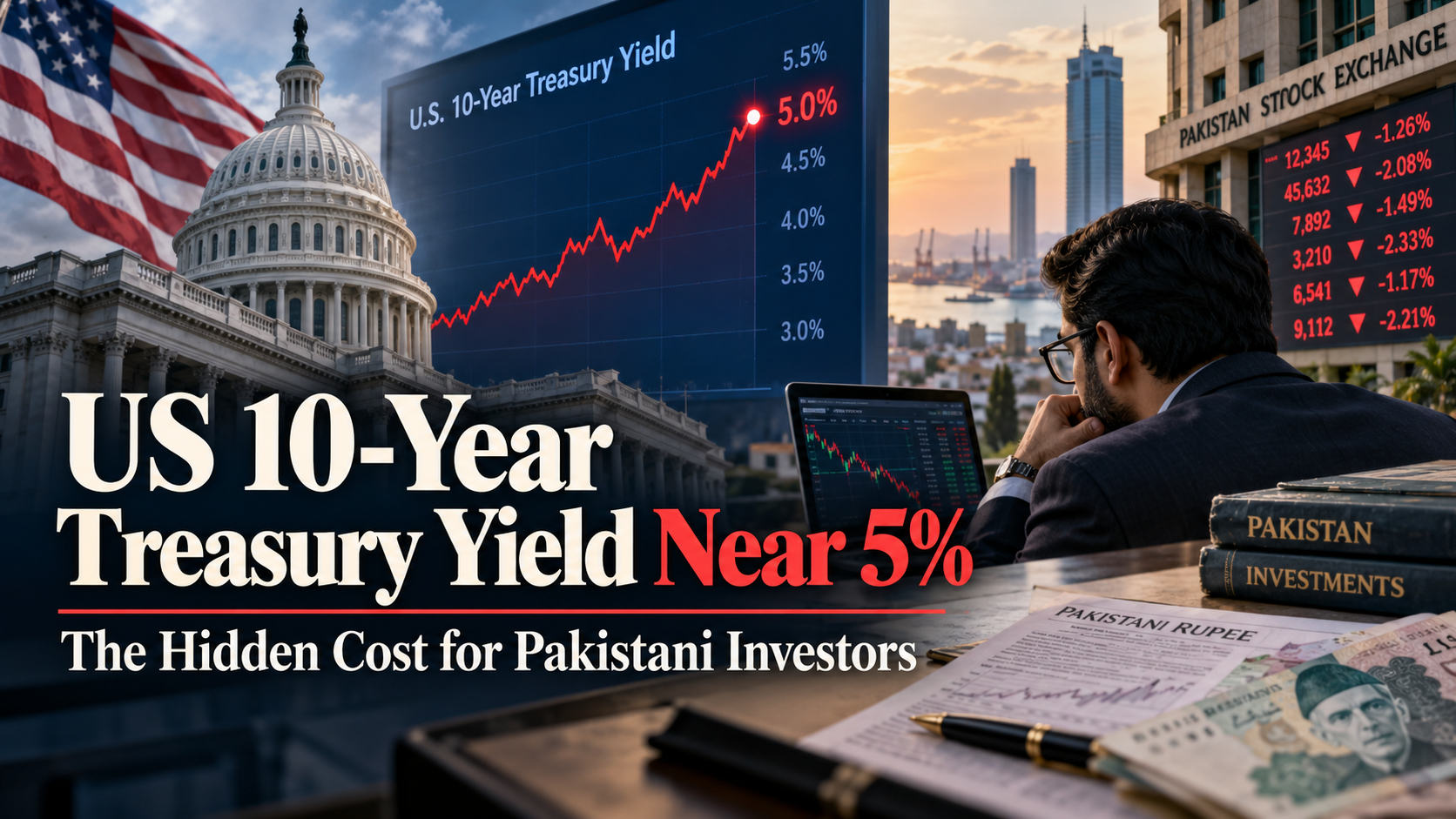
A US government bond can change the required return on a Pakistani investment without a single dollar physically crossing the border. The link runs through a basic idea: when a benchmark asset yields more, investors demand a stronger reason to take additional currency, liquidity and credit risks elsewhere.
The yield on the US 10-year Treasury stood near 5.00% on October 23, 2026, after reaching about 5.24% on October 9, according to historical Treasury-yield data. The user-friendly phrase above 5% should therefore be treated as a description of much of October, not a guaranteed quote for every moment of the latest trading day.
A bond yield is not a savings-account rate
A government-bond yield is the return implied by its market price and promised cash flows, assuming the relevant payment and holding assumptions. When investors sell an existing fixed-coupon bond and its price falls, its yield typically rises. That inverse relationship is central to interpreting the US Treasury market.
The 10-year yield reflects a mixture of expected short-term policy rates, expected inflation and a term premium for holding longer-dated debt. It can fall even while central-bank inflation concerns persist, for example if growth fears rise or investor demand for safe securities strengthens. Reading any single yield move as a pure Fed forecast is a mistake.
Four ways it reaches Pakistan
1. Dollar funding becomes a tougher benchmark. Investors weighing dollar-denominated assets may compare emerging-market returns with those available in US government debt. Pakistani external bonds must compensate for additional sovereign and market risk, although observed spreads change independently of benchmark yields.
2. Currency calculations shift. A domestic bond offering a high rupee yield can still disappoint a foreign investor if depreciation erodes converted returns. For Pakistani investors with future dollar obligations, currency exposure is similarly relevant.
3. Valuations face a higher discount rate. Equity valuations are sensitive to the interest rate used to discount expected future earnings. Companies promising distant profits may be more exposed than businesses generating cash immediately, but there is no perfect sector rule.
4. Sovereign refinancing risk draws scrutiny. Global debt investors assess not only current yields but also how costly it will be for governments to refinance existing obligations. Local T-bills and PIBs are nevertheless priced mainly by Pakistan-specific inflation, liquidity, central-bank policy and credit conditions; US yields do not mechanically set auction cutoffs.
The price-risk example
Imagine a fixed-coupon bond with a duration of seven years. A one-percentage-point increase in yields would imply an approximate 7% price decline, all else equal, using the basic duration approximation. That is not a prediction and not an exact valuation; convexity, yield-curve changes and cash-flow structure matter. It illustrates why holding a bond fund is different from locking in a bank deposit.
Duration risk also works in reverse: bond prices can rise when market yields fall. An investor buying only because the quoted coupon looks attractive may discover later that the resale price has moved against them.
What the latest global backdrop adds
The Federal Reserve raised its policy range to 3.75%–4.00% in September, amid persistent inflation concerns. At the same time, oil-market instability has made imported inflation a more acute concern for Pakistan. The IMF’s October World Economic Outlook forecasts 3.1% world growth for 2026 and highlights downside risks from conflict and financing strains.
This combination means bond yields may be high for reasons that are not benign. A superficially attractive yield could reflect inflation anxiety, fiscal uncertainty or a global risk premium. Investors need to ask why the yield is high, not just how high it is.
A useful comparison table
| Asset | Return quoted in | Main extra risk to examine |
|---|---|---|
| US 10-year Treasury | USD | Duration, inflation, reinvestment |
| Pakistan T-bill | PKR | Domestic rate/inflation, reinvestment |
| Pakistan Investment Bond | PKR | Duration, inflation, liquidity |
| Pakistan dollar bond | USD | Sovereign credit spread, liquidity, duration |
| PSX equity | PKR | Earnings, valuation, currency and market risk |
Currency hedging is not a free lunch
A Pakistani saver comparing foreign-currency investments with domestic government paper must think about more than headline yield. Converting rupees to dollars and back can involve spreads, banking charges, legal requirements and foreign-exchange movement. A hedging instrument, where available and suitable, usually embeds a cost related to interest-rate differences and market conditions. It cannot simply erase currency risk without consequence.
Tax treatment also matters. A quoted yield before withholding tax, custody expense or fund fees is not comparable with an after-tax return from another product. Similarly, a dollar asset can generate a positive dollar return but a different return in rupees. The investor should calculate both if future expenses are split between currencies.
For institutional portfolios, bond duration and liquidity become central. A long-maturity bond may have an attractive yield to maturity but be unsuitable for liabilities due next month. For individuals, the ability to meet an emergency expense without selling at a loss may be worth more than an extra percentage point of advertised return.
The sound comparison is liability-matched, not headline-driven: decide when the money is needed, in what currency and how much market-price movement is tolerable before selecting an asset.
Does a 5% US yield mean Pakistan must offer 5% plus a fixed margin?
No. Each instrument differs in currency, maturity, credit, liquidity and taxation; spreads vary with markets and policy.
Are US Treasuries risk-free?
They are commonly treated as a benchmark for dollar credit risk, but their market prices are not risk-free. Inflation and interest-rate changes can erode purchasing power and resale value.
What should a Pakistani retail investor do first?
List liabilities by currency and timing, then compare instruments on an after-tax, after-inflation and liquidity-adjusted basis. Seek licensed guidance where suitable.
The takeaway: a 5% US benchmark changes the world’s price of patience. Pakistani investors should respond by measuring real cash flows and risks, not by chasing whichever country advertises the biggest nominal yield.
Discover more from The Economy
Subscribe to get the latest posts sent to your email.
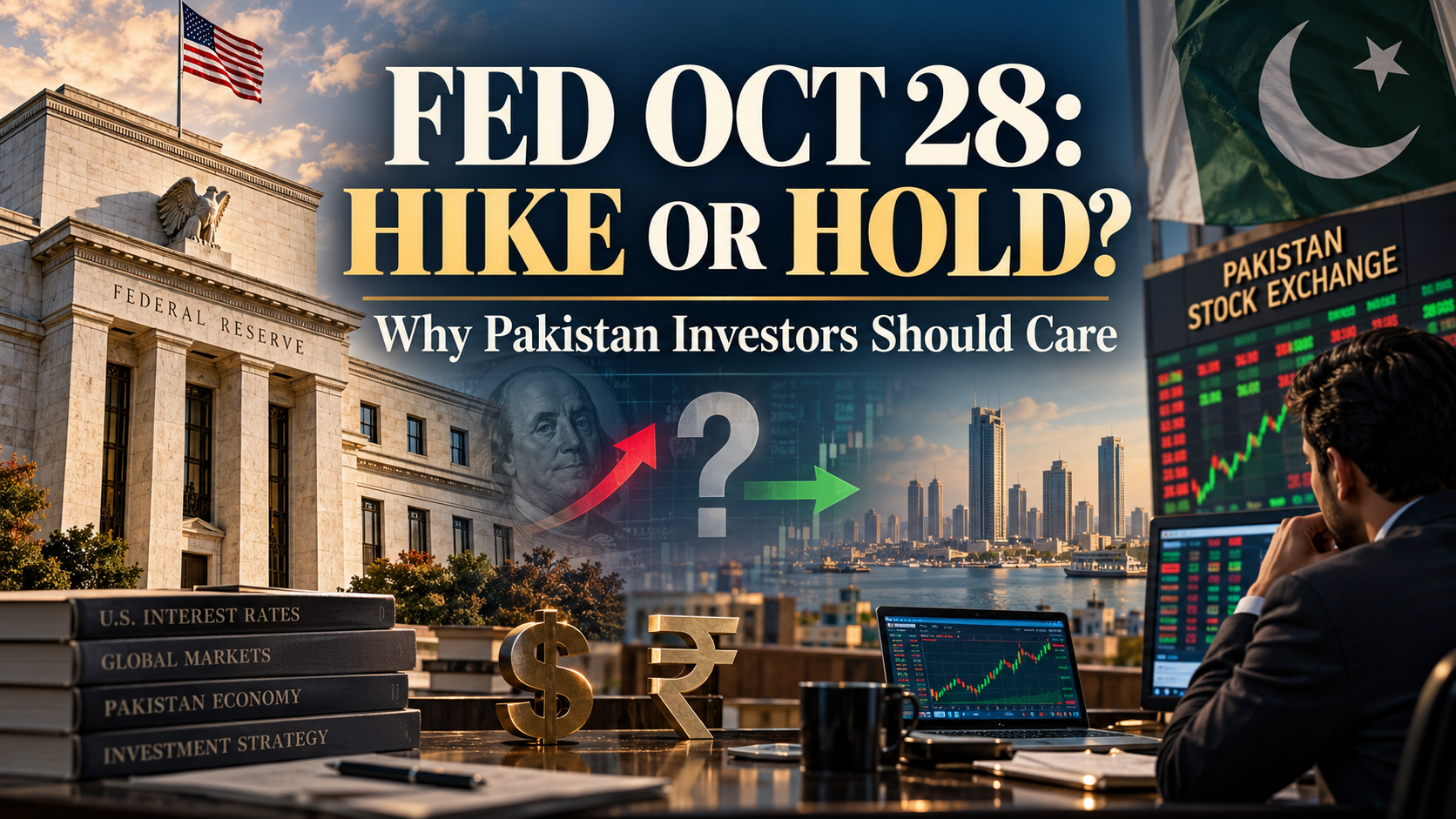
The Federal Reserve’s next interest-rate decision is scheduled for October 28, 2026, at the conclusion of a two-day Federal Open Market Committee meeting. For investors in Karachi, New York or Kuala Lumpur, the question is bigger than whether the Fed raises rates by another quarter point. It is whether persistent inflation and an energy shock will keep global financing conditions restrictive for longer.
The Federal Reserve’s September 16 statement confirmed a 25-basis-point increase in the federal funds target range to 3.75%–4.00%. The official October calendar fixes the next announcement for Wednesday, October 28. Predictions about the decision remain predictions until the statement is published.
Why the market cannot simply assume a hold
The Fed faces two forces pulling in different directions. A resilient US economy can withstand tighter financial conditions better than a slowing one, while high energy prices can feed inflation expectations. At the same time, tightening further risks increasing pressure on rate-sensitive sectors and debt-servicing costs. The September meeting minutes describe concern about elevated inflation and the geopolitical backdrop.
Traders often express their expectations through futures pricing, but a specific percentage quoted earlier in October may no longer be representative on October 25. A responsible preview should avoid presenting an old implied probability as a live market estimate. The announcement, accompanying statement and press conference deserve more attention than any one probability screen.
The three policy scenarios
Hold, with a hawkish message. The Fed leaves its target at 3.75%–4.00% but stresses persistent inflation. Treasury yields and the dollar could remain firm if investors infer that further increases are possible. A hold is not necessarily dovish.
Another 25-basis-point rise. A new increase could push short-term dollar funding costs higher, depending on whether it is already priced in. For emerging markets, this may sharpen competition for capital and raise the hurdle rate for risky assets.
Hold, with a softer outlook. If the language signals growing confidence on inflation, longer yields might ease and investors could reassess the attractiveness of emerging-market equities and bonds. Any such response would also depend on earnings, geopolitics and risk appetite.
How the Fed reaches the Pakistan Stock Exchange
The direct transmission is limited by Pakistan’s domestic policy and market structure, but there are real channels. The first is the US dollar: a stronger dollar can raise the local price of imports and influence emerging-market currency expectations. The second is global yields: investors compare returns across sovereign debt markets and require compensation for currency and credit risks. The third is equity valuation: higher discount rates can reduce the present value of future corporate earnings, particularly for expensive growth assets.
For Pakistan, imported energy complicates that picture. If a Fed hike reflects sticky US inflation linked to oil, local investors must evaluate both international monetary tightening and Pakistan’s own fuel-import exposure. The World Bank’s Pakistan Development Update reports improving macroeconomic conditions but also acknowledges conflict-related pressure.
Bonds versus stocks: the difference matters
Pakistan Treasury bills and investment bonds primarily respond to domestic rates, inflation expectations, liquidity and sovereign risk. Their yields need not mirror US Treasuries day for day. PSX sectors also differ: banks, exporters, highly leveraged firms and energy producers can react quite differently to the same exchange-rate or interest-rate surprise.
A simplistic Fed hikes, PSX falls formula misses positioning. Prices often move on the gap between expectations and the actual decision. Even a rate hike can coincide with a stock rally if the market expected a larger move or welcomes clarity.
A practical announcement-day checklist
| Watch | Why |
|---|---|
| Fed funds target range | Immediate policy decision |
| Statement language on inflation | Signal for coming meetings |
| Treasury yield reaction | Changing dollar discount rates |
| Dollar index and EM currencies | Cross-border risk sentiment |
| Brent crude | Separate but powerful inflation channel |
| Pakistan KIBOR, rupee and SBP communications | Local transmission |
The IMF’s October outlook cautions that energy importers outside the AI investment value chain have a difficult growth outlook. This makes risk diversification and the distinction between nominal yields and real returns especially relevant.
Why the press conference may matter more than the quarter-point move
Central-bank announcements bundle several messages. A policy-rate decision tells markets what the committee did today. The statement signals which risks officials emphasise. The chair’s subsequent explanations can change expectations about the next several meetings. Traders may initially react to the rate itself, then reverse direction as they digest the path implied by the language.
For emerging-market investors, that distinction is crucial. A 25-basis-point increase accompanied by confidence that inflation pressure is subsiding may prove less restrictive for global risk appetite than an unchanged rate accompanied by warnings of more tightening. The yield curve, dollar and market-implied path are useful contemporaneous checks, although each has competing drivers.
Pakistan-based investors should also consider market hours. US decisions may arrive after domestic exchanges have closed, while other Asian markets trade the following session. A next-day index move can reflect overnight global earnings or geopolitical events as well as the Fed. Attribution requires comparing the timing of all material news.
For a rigorous post-meeting update, include the exact target range, vote, key wording changes and a timestamped Treasury yield. Replace the scenarios with the actual decision rather than leaving the preview to masquerade as a live result.
When will the Fed decision be released?
The Fed lists the October 27–28 meeting and a 2 p.m. Eastern announcement on October 28. Verify time conversion and possible schedule changes before publishing a live ticker.
Is a rate hike guaranteed?
No. September’s action and October’s risks do not predetermine the committee’s vote.
Should Pakistani investors sell stocks because of the Fed?
There is no universal answer. Investment time horizon, portfolio concentration, company balance sheets and currency exposure matter more than a one-day headline.
Bottom line: October 28 is a test of the Fed’s inflation tolerance. For Pakistan, the most important signal will be how the decision reshapes the dollar, energy costs and global demand for emerging-market risk—not the label hike or hold alone.
Discover more from The Economy
Subscribe to get the latest posts sent to your email.

The global Banking growth is becoming more uneven, capital is increasingly sensitive to financing costs, and investors must distinguish a convincing story from an investable price. This guide focuses on research methods and risks rather than predictions of guaranteed returns. The IMF October 2026 outlook projects 3.1% global growth and 4.7% inflation for 2026, while the IMF financial-stability assessment warns that market resilience coexists with important vulnerabilities.
Key takeaways
- Match each investment decision to its time horizon, currency and ability to withstand losses.
- Separate observable earnings or contractual cash flows from optimistic forecasts.
- Compare diversification, fees, taxes, liquidity and regulatory restrictions before committing capital.
- Track primary institutional evidence and update assumptions when conditions change.
- Readers in Pakistan should consider rupee exposure and availability of regulated investment channels.
Why this matters now
The central question behind global banking trends 2026 is not merely what may happen next. It is which economic mechanisms could change cash flow, purchasing power or risk. The Bank for International Settlements’ 2026 review describes an economy supported by technological investment but constrained by geopolitical and fiscal pressures. A robust financial plan must therefore survive both a favourable and an adverse scenario.
Digital banks are extending beyond borders
Technology can reduce the need to duplicate large physical branch networks, but banking remains subject to local licensing, deposit protection, consumer law and capital rules. Cross-border scale is a business model, not a regulatory exemption. Readers should distinguish a licensed bank from an e-money provider, broker or unregulated payments application. See the primary institutional research.
For practical analysis, separate the baseline, the upside case and the downside case. Document the specific development that would change your assessment. Assess timing: a promising long-term theme may still be inappropriate for cash needed within twelve months.
Artificial intelligence in credit and fraud
Banks use machine learning for transaction screening, fraud detection, service operations and risk analysis. The operational promise is significant, but opaque credit models can create unfair outcomes, and false-positive fraud alerts can disrupt customers. Model governance requires testing, human accountability, explainability and correction routes. Customer consent does not remove every data-protection obligation. See the primary institutional research.
For practical analysis, separate the baseline, the upside case and the downside case. Document the specific development that would change your assessment. Assess timing: a promising long-term theme may still be inappropriate for cash needed within twelve months.
Cybersecurity is now systemic finance risk
An attack against a large processing vendor can affect many institutions simultaneously. The IMF’s October 2026 stability assessment identifies sophisticated cyber threats alongside sovereign-yield and AI valuation shocks. Banks should test recovery procedures, third-party concentration, authentication controls and incident communications, not merely purchase security software. See the primary institutional research.
For practical analysis, separate the baseline, the upside case and the downside case. Document the specific development that would change your assessment. Assess timing: a promising long-term theme may still be inappropriate for cash needed within twelve months.
Compliance: technology must support judgment
Anti-money-laundering monitoring, sanctions screening and know-your-customer processes are increasingly automated. False matches and poor data can cause excessive account restrictions, while under-detection carries serious legal exposure. Institutions need measurable controls, independent audits and escalation channels. The Financial Stability Board provides international coordination context but rules vary by jurisdiction. See the primary institutional research.
For practical analysis, separate the baseline, the upside case and the downside case. Document the specific development that would change your assessment. Assess timing: a promising long-term theme may still be inappropriate for cash needed within twelve months.
What Pakistani customers and banks should do
Customers should verify a provider’s licensing status, understand complaint mechanisms, enable strong authentication and never disclose one-time passcodes. Financial firms need resilient payment systems, staff training and clear consent practices. Track SBP circulars for locally applicable requirements rather than extrapolating foreign regulations to Pakistan. See the primary institutional research.
For practical analysis, separate the baseline, the upside case and the downside case. Document the specific development that would change your assessment. Assess timing: a promising long-term theme may still be inappropriate for cash needed within twelve months.
Comparison and decision framework
| Question | Stronger evidence | Warning sign |
|---|---|---|
| What drives returns? | Audited cash flows, clear contract or transparent index | Undefined or projected returns |
| What can go wrong? | Explicit scenario and downside analysis | Claims of guaranteed gains |
| Is it affordable to hold? | Low transparent fees and adequate liquidity | Leverage, costly spreads or lockups |
| Is access legitimate? | Appropriate licensing and clear legal rights | Unverified brokers or custody |
| Is the exposure diversified? | Multiple independent sources of return | One company, sector or currency |
What it means for Pakistani savers and investors
A Pakistani reader faces both international investment risk and local purchasing-power risk. For example, a foreign asset can rise in US-dollar terms while the rupee conversion and transaction costs alter the realized local outcome. The opposite can also occur. Record the starting exchange rate, applicable taxes, custody charges and capital-transfer restrictions, and confirm current requirements with the State Bank of Pakistan and the relevant securities regulator. Overseas access should not be assumed universally available.
An emergency reserve, expensive consumer debt and near-term family obligations deserve attention before any speculative allocation. A portfolio that cannot meet a sudden cash requirement may force sales at the worst moment. The objective is not to remove risk—impossible in markets—but to choose risks that fit the investor’s actual liabilities.
Risks, limitations and uncertainty
Institutional forecasts are conditional and can change after policy decisions, commodity shocks, conflict escalation or unexpectedly weak earnings. Historic correlations are not binding promises about future asset performance. The analysis does not provide live stock prices, current investment product quotes, real-time exchange rates or individualized tax advice. Prices, regulations and product eligibility should be checked on the transaction date.
Frequently asked questions
Is this a guaranteed investment opportunity?
No. Every financial asset or strategy involves uncertainty. The existence of a popular investment theme is not evidence that an individual security is fairly priced.
What should beginners examine first?
Understand the product, the financial loss you could tolerate, fees and liquidity. Verify the provider and decide whether the money may be needed soon.
How do interest rates affect the analysis?
They influence financing costs, discount rates, exchange rates and demand. The effect differs by sector, maturity and business balance sheet.
Can Pakistani residents invest in foreign markets?
Access depends on current foreign-exchange, banking, brokerage, securities and tax rules, and on the investor’s individual circumstances. Check current regulations and regulated providers rather than assuming access.
How often should this analysis be refreshed?
Review institutional economic releases monthly and re-evaluate immediately after material earnings, regulatory or policy changes. Avoid reacting mechanically to every daily market movement.
Is diversification enough to prevent losses?
No. Diversification may reduce company-specific risk but cannot eliminate broad market, currency, inflation or systemic risks.
Conclusion
Sound financial decisions begin with verifiable evidence, reasonable valuation, awareness of uncertainty and a plan that survives adverse outcomes. Readers should compare multiple independent sources and avoid letting a compelling headline substitute for due diligence.
Discover more from The Economy
Subscribe to get the latest posts sent to your email.

Neocloud Economics in 2026: GPU Debt, Utilization and Power

What Is a Neocloud? How AI GPU Clouds Work and Compare

Lula Re-elected in 2026: What Changes for the Dollar, Brazilian Stocks, and Interest Rates?

Lula Wins Brazil’s 2026 Election: Five Economic Tests for 2027

SSI November 2026 Payment: Why Benefits Arrive October 30

Russia Sanctions Waiver: What Asian Oil Buyers Gain

Asia Markets Weekly: How Oil, US Yields and the Fed Reach Tokyo, Kuala Lumpur and Karachi

Gold Near $4,000: Buy, Hold or Wait? A Pakistan Tola Price Guide

US 10-Year Treasury Yield Near 5%: The Hidden Cost for Pakistani Investors

Fed Meeting on October 28: Hike or Hold—and Why Pakistan Investors Should Care

Can Pakistan Turn US–Iran Mediation Into an Economic Dividend?

Oil Above $100: How Higher Crude Prices Reach Pakistan’s Rupee, Petrol and Imports

SBP Interest Rate at 11.5%: What Will Decide Pakistan’s Next Policy Move?

The Global South: Debt, Climate Finance and Investment in 2026

Crude Oil & Petroleum Market Analysis: OPEC+ Decisions and Price Forecasts

Top US Convenience Store Chains: Store Counts, EV Charging, and Sales Trends

Algorithmic Dogfights: Why the U.S. and China Must Establish Rules of Engagement for Autonomous Air Power

Who Is Shivon Zilis? The Neuralink Executive at the Center of the Musk–OpenAI Trial

Social Security Extra $90 Deposit: Who Qualifies for the October 2026 Medicare Rebate?

Corporate America Faces a New Debt Test as US Borrowing Costs Surge

Gold Price Outlook 2026: The Forces Behind the Forecasts—and What Could Reverse Them

Global Economic Outlook 2026: 7 Forces Reshaping Markets, Trade and Business

Gold Falls 3.7% as Yields Surge: Is Gold Still a Safe Haven in 2026?

Stock Market Crash in 2026? Warning Signs, Scenarios and a Calm Investor Checklist

MAS Allocates S$1.45 Billion to Five Asset Managers in Third EQDP Batch: Total Deployment Reaches S$5.4 Billion

Anthropic Bans Sustained Abuse of Claude AI Under New Usage Policy Effective November 12, 2026

Stock Market Today: Dow, S&P 500, and Nasdaq Retreat as Treasury Yields

Geopolitics and Your Portfolio: How International Affairs Move Global Markets
-

 Markets & Finance10 months ago
Top 15 Stocks for Investment in 2026 in PSX: Your Complete Guide to Pakistan’s Best Investment Opportunities
-

 Analysis8 months ago
Johor’s Investment Boom: The Hidden Costs Behind Malaysia’s Most Ambitious Economic Surge
-

 Analysis8 months ago
Top 10 Stocks for Investment in PSX for Quick Returns in 2026
-

 Banks9 months ago
Best Investments in Pakistan 2026: Top 10 Low-Price Shares and Long-Term Picks for the PSX
-

 Analysis9 months ago
Brazil’s Rare Earth Race: US, EU, and China Compete for Critical Minerals as Tensions Rise
-

 Investment10 months ago
Top 10 Mutual Fund Managers in Pakistan for Investment in 2026: A Comprehensive Guide for Optimal Returns
-

 Global Economy10 months ago
15 Most Lucrative Sectors for Investment in Pakistan: A 2025 Data-Driven Analysis
-

 Global Economy10 months ago
Pakistan’s Export Goldmine: 10 Game-Changing Markets Where Pakistani Businesses Are Winning Big in 2025