Connect with us

Banks

Singapore’s Banking Paradox: Why Fee Income and Loan Recovery Can’t Fully Save Margins in 2026

Published

on

The city-state’s banking giants are rewriting their revenue playbook as traditional profit engines sputter—here’s what investors need to know

When DBS CEO announced Q3 2025 results with wealth management fees surging 20% year-over-year, the stock dropped 4%. Welcome to the new reality for Singapore banking: spectacular growth in one revenue stream can’t quite compensate for what’s eroding in another.

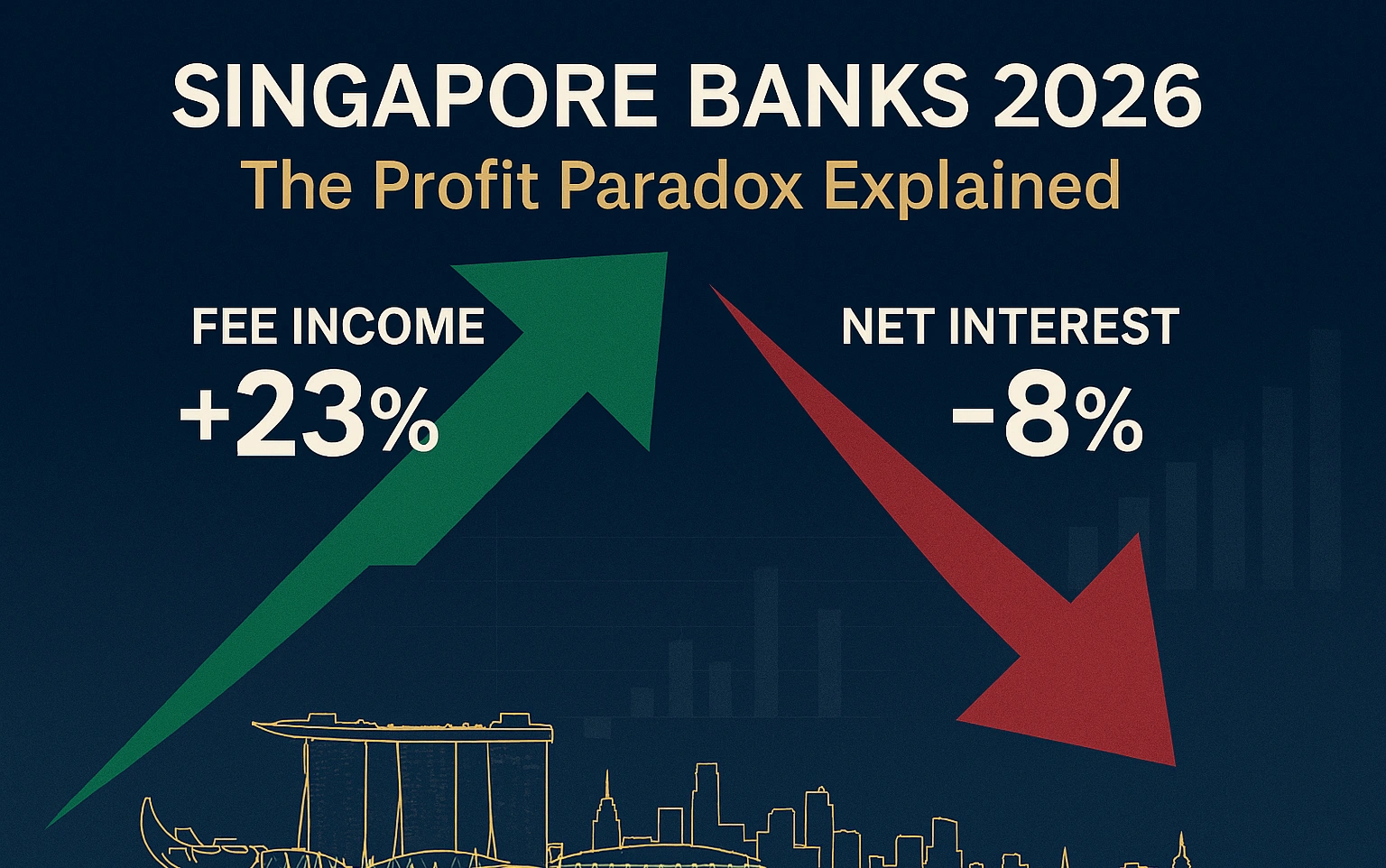
As 2026 unfolds, Singapore’s Big Three banks—DBS Group Holdings, OCBC Bank, and United Overseas Bank—find themselves navigating a fundamental recalibration. Analysts foresee a 2% growth in earnings per share for DBS in 2026, driven mainly through fee income, while net interest margins are anticipated to soften further, with UOB guiding for 1.75%-1.80%, down from 1.85%-1.90% in 2025.

This isn’t a crisis. It’s a transformation—one that reveals which banks have successfully diversified their revenue engines and which remain dangerously dependent on interest spreads that peaked in 2024 and won’t return anytime soon.

The Great Margin Squeeze: Why Singapore Banks Face Their Toughest Earnings Test in Years

The golden age of Singapore banking profitability, fueled by the 2022-2024 interest rate surge, is definitively over. Net interest margin declined to 1.84% for OCBC in Q3 2025 from 1.92% in Q2, while DBS reported the highest net interest margin at 1.96%, compared to 1.84% for OCBC and 1.82% for UOB.

These numbers tell a stark story. Between Q2 2024 and Q3 2025, Singapore’s banks watched their core profit engine—the spread between what they charge on loans and what they pay on deposits—compress by 15 to 28 basis points. For context, every 10 basis point decline in net interest margin reduces group profit by approximately 2-3%, according to bank management guidance.

Key Takeaways for Investors

  • Net interest margins will compress further in 2026, with UOB guiding 1.75-1.80% versus 1.85-1.90% in 2025
  • Wealth management AUM surged 18% year-over-year for DBS and OCBC, 8% for UOB in Q3 2025
  • Dividend yields forecast at 6.1% for DBS, 5.4% for OCBC and UOB in FY2026
  • Loan growth expected at low-to-mid single digits (2-5%), driven by corporate lending and regional expansion
  • All three banks maintain CET1 ratios above 15%, providing capital buffers for dividends and buybacks

The culprit? A perfect storm of declining benchmark rates and aggressive deposit repricing. Flagship current accounts and SGD fixed deposits have been repriced by -120 basis points to -175 basis points from Q3 2024 to Q3 2025, with UOB making a further 60 basis point cut to its flagship current account in December 2025.

Here’s what makes this particularly challenging: while rates fell sharply, banks couldn’t immediately reduce deposit rates without risking customer flight. This asymmetry—loans repricing downward quickly while deposits adjust slowly—creates a painful compression period that Singapore banks are navigating right now.

The regional comparison is equally sobering. UOB’s net interest margin narrowed to 1.82% from 2.05%, representing a 23 basis point decline that exceeds what many regional peers experienced. Hong Kong banks, facing similar rate dynamics, have generally maintained margins in the 1.6%-1.9% range, suggesting Singapore banks entered this downturn from a higher baseline—meaning they had further to fall.

Yet there’s a crucial silver lining buried in the data. DBS economists expect 3-month Singapore Overnight Rate Average (SORA) to rebound from lows of 1.13% in early December 2025 to hold at approximately 1.25% through 2026. This stabilization suggests the worst of the margin compression may be behind us, even if margins don’t recover to 2024 peaks.

Fee Income Revolution: The S$4.8 Billion Question Reshaping Singapore Banking

While net interest income declines, an extraordinary wealth management boom is reshaping Singapore’s banking landscape—and the numbers are staggering.

DBS’s wealth management assets under management rose 12% year-on-year in the first half of 2025, while wealth income grew 8% year-on-year. Meanwhile, OCBC recorded an 11% year-on-year increase in wealth management AUM, with wealth income up 4% year-on-year. Even UOB, dealing with integration challenges from its Citibank acquisition, posted respectable gains.

By Q3 2025, the momentum accelerated dramatically. Assets under management grew 18% year-over-year for both DBS and OCBC, while UOB recorded an 8% increase. To put these figures in perspective: DBS alone added approximately S$21 billion in net new money in 2024, lifting total AUM to S$426 billion.

What’s driving this wealth influx? Singapore’s transformation into Asia’s premier wealth management hub isn’t accidental—it’s structural. The city-state now hosts 1,650 single-family offices as of 2025, nearly double the count from two years earlier. Each of these family offices represents not just wealthy individuals parking capital, but sophisticated financial entities requiring comprehensive banking services: treasury management, foreign exchange hedging, multi-currency accounts, and bespoke lending arrangements.

The fee composition tells an even more interesting story. Wealth management income isn’t just investment management fees—it encompasses a sophisticated menu of services. DBS, for instance, generates wealth fees from discretionary portfolio management (where the bank makes investment decisions on behalf of clients), advisory services, custody fees, transaction commissions on securities trades, foreign exchange markups, and insurance product distribution through its bancassurance partnerships.

Fee income showed strong 20% year-over-year growth to S$1.58 billion for DBS in Q3 2025, driven primarily by wealth management fee income. OCBC’s performance was equally impressive, with 15% year-over-year growth in non-interest income to S$1.57 billion, driven particularly by net fees and commissions in wealth management.

The mathematics of fee income versus net interest income deserves scrutiny. While fee income is growing at double-digit rates, it starts from a much smaller base than net interest income. For DBS, total fee income of approximately S$6 billion annually still represents roughly one-third of total net interest income. This means even a 20% surge in fees can only partially offset a 5-8% decline in NII.

But here’s what makes the fee story genuinely transformational: quality of earnings. Net interest income is inherently cyclical, tied to central bank policies and economic cycles beyond any individual bank’s control. Fee income, particularly from wealth management, is stickier. Once a bank captures a wealthy family’s business—establishing trust, demonstrating competence, and embedding itself in the family’s financial infrastructure—that relationship tends to persist across interest rate cycles.

The sustainability question looms large, however. Can wealth inflows continue at this pace? Two factors suggest yes. First, geopolitical instability in Hong Kong continues to drive capital southward. Second, ESG-related investments in Singapore have surged to SGD 45 billion by 2025, doubling in just two years, creating entirely new fee pools as banks develop and distribute sustainable investment products.

Loan Growth: The Comeback That Almost Wasn’t

For most of 2023 and early 2024, loan growth was Singapore banks’ Achilles heel. High interest rates discouraged borrowing, corporate treasurers prioritized paying down debt, and property market cooling measures kept mortgage growth subdued.

The turnaround, while modest, is real. Overall loans to non-bank customers grew by 4.7% year-over-year as of August 2025, compared to 3.8% in Q2, driven by higher corporate loans to residents and increased lending to the Americas.

Breaking down the loan book reveals where growth is materializing. Singapore bank loans increased to SGD 853.3 billion in June 2025 from SGD 844.6 billion in May 2025, driven by higher loans to businesses. Within the business sector, particularly strong growth appeared in building and construction (up to SGD 178.8 billion), general commerce (SGD 88 billion), and financial and insurance activities.

Consumer lending tells a more nuanced story. Housing and bridging loans increased to SGD 237.2 billion in June 2025 from SGD 235.7 billion in May, representing growth but at a glacial pace given Singapore’s perpetually hot property market. This reflects the ongoing impact of property cooling measures—higher stamp duties, tighter loan-to-value ratios, and total debt servicing ratio frameworks that limit how much Singaporeans can borrow relative to their income.

The 2026 outlook for loan growth requires parsing bank-specific guidance and macroeconomic realities. UOB expects low single-digit loan growth, which translates to roughly 2-3% expansion. OCBC projects mid-single-digit loan growth (approximately 4-5%), while DBS, despite its optimistic tone, faces mathematical challenges in maintaining growth from the largest loan book base among the three.

Corporate lending opportunities exist but come with important caveats. Singapore’s GDP growth is projected at 1-3% for 2026, significantly below the 4.4% achieved in 2024. This slower growth naturally constrains business expansion and, by extension, credit demand. However, credit demand should stay healthy in the immediate term as business sentiment improves amid some reduction in uncertainty.

Trade finance represents another bright spot. Singapore’s position as ASEAN’s financial hub means it captures a disproportionate share of regional trade financing. As ASEAN economies continue their 5-6% growth trajectories—faster than developed markets—Singapore banks benefit from financing intra-regional commerce, even when Singapore’s own domestic economy grows more slowly.

The property market deserves special attention because it represents such a large portion of consumer loan books. While mortgage rates are likely to continue easing, potentially offering some relief to homeowners or those looking to enter the property market, banks are simultaneously becoming more cautious. Banks will be scrutinizing loan applications more carefully, particularly for investment properties or in sectors they perceive as higher risk.

This creates an interesting dynamic: borrowing costs are falling, which should stimulate demand, but credit standards are tightening, which constrains supply. The net effect will likely be modest loan growth—positive but underwhelming—that contributes to but doesn’t transform the earnings picture.

The Analyst Verdict: Flattish Profits, Spectacular Dividends

Wall Street and regional investment banks have coalesced around a remarkably consistent view of Singapore banks’ 2026 prospects: profits will plateau or decline slightly, but shareholder returns remain compelling.

DBS is forecast to post a dividend yield of 6.1% in FY2026, while OCBC and UOB are each expected to offer yields of about 5.4%. These yields sit well above Singapore’s 10-year government bond yield (approximately 2.8%) and comfortably exceed fixed deposit rates offered by the same banks (ranging from 2.5-3.2% for 12-month placements).

The earnings forecasts themselves paint a picture of stability rather than excitement. DBS, the sector bellwether, faces expectations of approximately 2% earnings growth—essentially flat in real terms after accounting for inflation. The net profit may ease slightly from 2025 peaks, while total income stays stable.

What underpins these dividend forecasts isn’t just current profitability but capital strength. All three banks maintain Common Equity Tier 1 (CET1) ratios exceeding 15%, which sits comfortably 5 percentage points above Monetary Authority of Singapore requirements. This excess capital provides multiple strategic options: higher dividends, share buybacks, or capital-return programs.

Dividend yields of up to 6% and excess capital continue to be strong tailwinds for the sector, with potential for general provisions writeback and excess capital on the cards (exempting UOB). The mention of general provisions writeback is significant. During 2020-2021, banks dramatically increased loan loss provisions anticipating COVID-related defaults that ultimately materialized less severely than feared. As these precautionary provisions prove unnecessary, banks can release them back into earnings, providing a one-time boost to reported profits.

The investment case increasingly hinges on total shareholder return (capital appreciation plus dividends) rather than earnings growth alone. At current valuations, DBS trades at the highest price-to-earnings and price-to-book ratios among the three banks, with the lowest dividend yield, reflecting its premium positioning and superior return on equity of 17.1%.

Regional comparisons provide useful context. Hong Kong banks trade at similar valuation multiples but face greater uncertainty from China’s property market struggles and geopolitical tensions. Australian banks offer comparable dividend yields but operate in a more mature, slower-growth market. Singapore banks occupy a sweet spot: developed-market stability with emerging-market wealth accumulation dynamics.

One crucial risk factor that analysts flag consistently is asset quality, particularly concerning exposure to Greater China property markets. UOB faced sharply higher allowances for credit and other losses, working through refinancing stress in parts of its real estate exposure. While systemic risk appears contained—Singapore banks’ direct exposure to distressed Chinese developers remains limited—any deterioration would quickly undermine the benign credit cost assumptions underpinning 2026 forecasts.

Strategic Crossroads: How Banks Are Adapting Beyond 2026

The banks’ strategic responses to margin pressure reveal dramatically different philosophies about the future of banking in Asia.

DBS has doubled down on digital transformation and regional expansion. The bank’s wealth management success stems partly from technology investments that allow relationship managers to serve more clients more efficiently. Its digital platforms process over $1 billion in daily transaction volumes, generating fee income from every foreign exchange conversion, cross-border payment, and securities trade.

OCBC’s strategy centers on insurance integration and what it calls the “multi-pillar” approach. OCBC Bank’s performance highlights the critical role of diversification in insulating total income, allowing net profit to remain virtually unchanged year-over-year. Through Great Eastern, its insurance subsidiary, OCBC cross-sells life insurance and investment-linked products to banking customers, generating commissions that appear in non-interest income but originate from the banking relationship.

UOB faces the most complex strategic challenge: integrating the Citibank consumer businesses it acquired across Thailand, Malaysia, Vietnam, and Indonesia. The synergy extraction phase from the integration of Citi Malaysia, Thailand, Indonesia, and Vietnam is proving more challenging than initially anticipated. However, UOB aims to accelerate Southeast Asia expansion, targeting 30% of revenue from the region in 2026, while keeping Singapore’s revenue share at 50%.

The technology arms race deserves particular attention. All three banks are investing heavily in artificial intelligence for credit underwriting, fraud detection, and customer service. DBS processes loan applications that once took three days in under 30 minutes using machine learning models that assess creditworthiness across hundreds of data points. These efficiency gains directly impact the cost-to-income ratio—a critical metric as revenue growth slows.

Regulatory environment shifts could also reshape the competitive landscape. The Monetary Authority of Singapore continues refining frameworks around digital banks, cryptocurrency, and family office regulation. Any tightening of wealth management regulations could slow the very fee income growth that banks are counting on to offset margin compression.

The 2026 Investment Case: Income Over Growth

For investors weighing Singapore bank stocks as 2026 approaches, the thesis has fundamentally shifted from a growth story to an income story.

The bull case rests on three pillars. First, Singapore equity valuations remain attractive, with the yield gap against T-bills tracking above historical averages. Second, dividend sustainability looks rock-solid given excess capital buffers. Third, the worst of net interest margin compression has likely passed, meaning earnings should stabilize rather than continue deteriorating.

The bear case centers on limited upside. With analysts forecasting essentially flat earnings growth, capital appreciation depends on multiple expansion—investors paying more for the same earnings—which seems unlikely in a higher-interest-rate world where bonds offer decent yields. Additionally, any negative surprises on asset quality, particularly from China exposure or Singapore property market weakening, could quickly undermine the defensive narrative.

For income-focused investors, particularly retirees or those building dividend portfolios, Singapore banks offer rare combination of yield, quality, and liquidity. The 5.4-6.1% dividend yields exceed what most developed-market banks offer, while Singapore’s regulatory framework and banks’ capital strength provide safety that emerging market banks cannot match.

The technical picture matters too. The sector is expected to see continued fund inflows, supported by a second round of Equity Market Development Programme fund deployment extending into early 2026. This government-driven initiative channels sovereign wealth into Singapore equities, providing steady bid support that can dampen volatility and support valuations.

Conclusion: Excellence Amid Moderation

Singapore’s banking sector enters 2026 not in crisis but in transition. The extraordinary profitability of 2023-2024, driven by interest rate tailwinds that won’t repeat, is giving way to a more nuanced revenue model where fee income and modest loan growth must compensate for narrowing margins.

Analysts foresee wealth management momentum continuing, creating compensatory fees in place of declines in net interest income. Whether this compensation proves complete or partial will determine whether 2026 earnings merely flatline or actually contract.

For DBS, OCBC, and UOB, the test isn’t survival—their balance sheets and market positions ensure that—but rather whether they can demonstrate the strategic agility to thrive in a lower-margin environment. Early evidence suggests they can, but the journey from record profits to sustainable, diversified excellence requires execution discipline that few banks globally have consistently demonstrated.

Investors should approach Singapore banks with realistic expectations: high dividend yields and defensive characteristics, but limited capital appreciation until either interest rates rise again or fee income growth accelerates beyond current trajectories. That’s not a condemnation—it’s simply the reality of mature, well-capitalized banks operating in a moderating economic environment.

The Singapore banking story for 2026 isn’t about explosive growth. It’s about quality income, prudent capital management, and the slow transformation of business models to match a changing economic reality. For investors seeking stable returns in uncertain times, that might be exactly what they need.


What’s your take on Singapore banks’ strategic pivot? Can fee income models sustainably replace net interest income dominance, or are we witnessing temporary compensation for cyclical margin pressure? Share your perspective in the comments below.


Discover more from The Economy

Subscribe to get the latest posts sent to your email.

Continue Reading
Click to comment

Leave a Reply

Global Economy

15 Most Lucrative Sectors for Investment in Pakistan: A 2025 Data-Driven Analysis

Published

on

While global investors chase saturated markets in established economies, Pakistan’s 240.49 million population presents a transformation that Goldman Sachs has quietly termed “the emerging market story of the decade”—yet 87% of international portfolios remain critically underexposed to this $350 billion economy poised at an inflection point.

The numbers tell a compelling story that contradicts mainstream narratives. Pakistan attracted $1.9 billion in FDI during fiscal year 2024, marking a 17% increase from the previous year, while the first seven months of FY25 saw FDI surge by 56% compared to the same period in FY24. But here’s what makes this moment historic: the convergence of demographic momentum, infrastructure maturity, and policy reforms is creating investment opportunities that won’t remain hidden much longer.

This analysis draws on institutional data from Pakistan’s Planning Commission, Ministry of Finance, State Bank of Pakistan, the IMF, World Bank, and Asian Development Bank to identify the 15 sectors where capital deployment offers the most attractive risk-adjusted returns through 2030.

Pakistan’s Economic Inflection Point: Understanding the 2025 Investment Landscape

The IMF projects Pakistan’s GDP growth at 2.7% for 2025 and 3.6% for 2026, but these headline figures mask profound sectoral dynamics. Inflation is expected to moderate to 4.5% in 2025, creating the most favorable monetary environment in five years for capital deployment.

Pakistan’s demographic dividend is perhaps its most underappreciated asset. With 65% of the population under 30 years old and agriculture employing half the labor force while contributing 24% to GDP, the economy is transitioning toward services and high-value manufacturing. The China-Pakistan Economic Corridor (CPEC) has already delivered $25 billion in infrastructure investments, with Phase II focusing on special economic zones and digital infrastructure that will unlock regional connectivity advantages.

The World Bank announced a $20 billion Country Partnership Framework with Pakistan, emphasizing clean energy and climate resilience projects, while the International Finance Corporation plans to invest up to $2 billion annually over the next decade. These institutional commitments signal a recalibration of Pakistan’s risk profile.

The Extended Fund Facility program with the IMF has driven critical reforms: currency stabilization, energy sector restructuring, and tax base expansion. For investors, this translates to improved repatriation conditions, reduced policy uncertainty, and a government increasingly aligned with market-oriented growth strategies.

Pakistan’s strategic geography positions it as the gateway between South Asia, Central Asia, and the Middle East. Gwadar Port’s operationalization creates a maritime trade corridor that reduces shipping costs for Central Asian republics by 40%, while road and rail networks connecting to China’s western provinces are transforming regional logistics economics.

THE 15 SECTORS: Where Smart Capital Finds Asymmetric Returns

1. Technology & IT Services: The $15 Billion Export Trajectory

Investment Thesis: Pakistan’s IT sector is experiencing explosive growth that few international investors have fully priced in.

Market Size & Growth: Pakistan’s IT and IT-enabled Services exports reached a record high of $3.8 billion in FY2024-25, while total IT, ITeS, and freelancers’ exports hit $4.6 billion for FY 2024-25, reflecting 26.4% growth. The government has set an ambitious but achievable target of $25 billion in IT exports by 2028.

Key Drivers: Zero income tax on IT exports until June 2025, 100% foreign ownership permitted, complete profit repatriation, and cost advantages where Pakistani developers charge 60-70% less than Western counterparts while delivering comparable quality. The United States accounts for 54.5% of Pakistan’s IT exports, but diversification into Gulf markets is accelerating rapidly.

Statistical Evidence: Monthly IT exports reached a historic high of $348 million in December 2024, up 28% year-over-year. Software services exports surpassed $1 billion for the first time in an 11-month period, showing 27.4% growth. The talent pipeline is robust, with over 300,000 IT graduates entering the workforce annually.

Opportunity Highlights: Software-as-a-Service (SaaS) startups, fintech platforms, blockchain development, artificial intelligence services, gaming development, and business process outsourcing. Pakistan hosted the first-ever Digital Foreign Direct Investment Forum, securing over $700 million in investment commitments. The upcoming Islamabad IT Park will provide state-of-the-art infrastructure for 10,000+ technology workers.

Risk Considerations: Internet reliability concerns and occasional policy uncertainty around VPN regulations require monitoring, though the government recognizes IT as a strategic growth sector.

Investment Entry Points: Direct stakes in Pakistani software houses, venture capital funds focused on Pakistani startups, partnerships with established firms like Systems Limited or TRG Pakistan, or real estate in technology parks.

2. Renewable Energy: The Solar Revolution Transforming Power Economics

Investment Thesis: Pakistan is experiencing the world’s fastest solar adoption rate, fundamentally restructuring energy economics.

Market Size & Growth: Pakistan imported 17GW of solar panel capacity in 2024, double the previous year’s imports, making it the world’s largest solar panel importer. The solar energy market is expected to grow from 6.75 gigawatts in 2025 to 15.5 gigawatts by 2030, representing an 18.09% compound annual growth rate.

Key Drivers: Electricity tariffs have doubled since 2021, creating powerful economic incentives for distributed solar. Between 2019 and 2025, cumulative solar panel imports surpassed Pakistan’s total installed power plant capacity by 2 gigawatts. Government targets call for 20% of electricity from renewables by 2025 and 30% by 2030.

Statistical Evidence: Net-metered rooftop solar reached 5.3 GW (5,300 MW) by end-April 2025, up from 2,500 MW a year earlier. Pakistan also imported an estimated 1.25 gigawatt-hours of lithium-ion battery packs in 2024, signaling the evolution toward solar-plus-storage solutions. Solar’s share of total electricity generation is expected to reach 1.6% in 2025, up from 0.7% in 2024.

Opportunity Highlights: Solar panel manufacturing and assembly (currently 90% imported from China), energy storage systems, solar farm development, agricultural solar pumps (with estimates that half of 1.5-2 million tube wells will switch to solar, adding 5.6-7.5 GW of capacity), and engineering, procurement, and construction (EPC) services. Wind energy presents complementary opportunities, with wind generation projected to reach 5,946 GWh in 2025.

Risk Considerations: Policy changes on net-metering tariffs could affect residential payback periods, though the economic fundamentals remain compelling given high grid electricity costs.

Investment Entry Points: Joint ventures with Chinese manufacturers for local assembly, solar farm development through PPIB, EPC contracting, or financing vehicles for commercial solar installations.

3. Agriculture & Agritech: Modernizing a $80 Billion Backbone

Investment Thesis: Agriculture contributes 24% to GDP and employs half the labor force, yet operates far below potential productivity due to outdated practices—creating massive modernization opportunities.

Market Size & Growth: The agriculture sector achieved 6.25% growth in FY2024, the highest in 19 years, driven by record wheat, rice, and cotton production. With 37.4% of employment in agriculture, productivity improvements translate directly to national GDP growth.

Key Drivers: State Bank of Pakistan allocated Rs 2,250 billion for agriculture lending in FY2024, 26.7% higher than the previous year. Climate-adaptive practices are essential following devastating 2022 floods that caused $12.9 billion in agricultural damages. Government focus on increasing oilseed and cotton production to reduce import dependence creates clear policy support.

Statistical Evidence: Wheat production reached 31.4 million tonnes in FY2024, up 11.6%, while cotton production surged 108.2% to 10.2 million bales after flood recovery. Livestock contributed 60.8% of agricultural value and grew 4.72% in FY2025, reflecting strong demand for dairy and meat products.

Opportunity Highlights: Precision agriculture technologies, drip irrigation systems, cold chain logistics, agricultural biotechnology, organic farming, livestock genetics improvement, dairy processing, and agricultural commodity trading platforms. CPEC agricultural cooperation includes technology transfer for disease-free zones, mechanization, and processing facilities.

Risk Considerations: Climate volatility remains a factor, with erratic rainfall patterns affecting crop yields. Land ownership disputes can complicate large-scale operations.

Investment Entry Points: Joint ventures in food processing, partnerships with agricultural universities for technology commercialization, or investment in agricultural finance institutions serving the unbanked rural population.

4. Textile & Apparel: Reclaiming the $25 Billion Export Vision

Investment Thesis: Textile exports rose 9.67% to $9.084 billion in the first half of FY25, with value-added segments driving growth as Pakistan capitalizes on Bangladesh’s manufacturing challenges.

Market Size & Growth: Pakistan’s textile exports reached $17.88 billion in FY2025, up 7.39%, with the sector representing 55.4% of total exports. Industry projections suggest $25 billion in annual textile exports is achievable with proper policy support.

Key Drivers: Political unrest in Bangladesh redirected export orders to Pakistan between December 2024 and March 2025, providing a window for Pakistani manufacturers to capture market share. Knitwear exports increased 15.47% and ready-made garments rose 17.52%, reflecting a strategic shift toward higher-value products.

Statistical Evidence: Textile exports in July-August FY2025 reached $2.92 billion, up 5.37% year-over-year. In 2024, textile exports increased by $1.3 billion compared to the previous year. The U.S. market accounts for $5 billion annually, representing 92% of Pakistan’s exports to America.

Opportunity Highlights: Vertical integration from spinning to garment manufacturing, technical textiles for automotive and industrial applications, sustainable fashion brands, and man-made fiber production. Cotton yarn faces challenges, but finished garments show strong momentum.

Risk Considerations: U.S. tariff policies could impact competitiveness, with President Trump’s tariffs potentially reducing exports by 20-25%. Energy costs and removal of zero-rating for local inputs pose cost pressures.

Investment Entry Points: Partnerships with established textile groups, investments in specialized segments like denim or home textiles, or development of export-oriented manufacturing facilities in special economic zones.

5. Construction & Real Estate: Urbanization’s $40 Billion Opportunity

Investment Thesis: With 65% of the population under 30 and rapid urbanization, Pakistan faces a housing shortage of 10 million units, creating sustained demand for decades.

Market Size & Growth: The construction sector contributes approximately 2.5% to GDP directly, with multiplier effects across 40+ allied industries. Government low-cost housing initiatives aim to deliver 500,000 units annually, while commercial real estate in Karachi, Lahore, and Islamabad shows 12-15% annual appreciation.

Key Drivers: State Bank of Pakistan’s construction financing schemes offer subsidized mortgages. Special Economic Zones under CPEC require industrial parks, warehousing, and worker housing. Tax incentives for construction materials and documented property transactions are improving sector transparency.

Statistical Evidence: Cement dispatches—a leading indicator—grew 8% in FY2024, reaching 52 million tonnes. Mortgage financing increased 35% year-over-year, though penetration remains below 0.3% of GDP, suggesting massive growth potential.

Opportunity Highlights: Affordable housing projects targeting middle-income families, commercial office spaces in metropolitan areas, hospitality infrastructure for tourism, logistics parks near CPEC routes, and Build-Operate-Transfer (BOT) infrastructure projects.

Risk Considerations: Property registration complexities and uneven documentation standards require thorough legal due diligence. Currency volatility affects imported construction materials.

Investment Entry Points: Real Estate Investment Trusts (REITs) are emerging, joint ventures with established developers, or direct land banking in areas designated for future development.

6. Healthcare & Pharmaceuticals: Serving 240 Million Lives

Investment Thesis: Pakistan’s healthcare expenditure is only 2.8% of GDP—far below the World Health Organization’s 5% recommendation—creating structural growth as incomes rise and health awareness increases.

Market Size & Growth: The pharmaceutical market is valued at $4.2 billion, growing 12-15% annually. With a doctor-to-patient ratio of 1:1,300 (WHO recommends 1:1,000), healthcare infrastructure expansion is inevitable.

Key Drivers: Rising middle class with health insurance coverage expanding, government’s push for Universal Health Coverage, COVID-19’s lasting impact on health consciousness, and pharmaceutical export potential to Africa and Central Asia.

Statistical Evidence: Pharmaceutical production increased 6.8% in FY2024, with local manufacturers meeting 70% of domestic demand. Medical device imports grew 15% annually, indicating market expansion. Private hospital chains are expanding bed capacity by 20% year-over-year in major cities.

Opportunity Highlights: Diagnostic laboratories, specialty hospitals (cardiac, orthopedic, oncology), telemedicine platforms, pharmaceutical manufacturing under licensing agreements, medical tourism targeting diaspora and regional patients, and health insurance platforms.

Risk Considerations: Price controls on essential medicines can compress margins. Regulatory approval processes require navigation with experienced local partners.

Investment Entry Points: Partnerships with hospital chains like Shaukat Khanum or Aga Khan University Hospital, pharmaceutical contract manufacturing, or diagnostic center franchises.

7. Financial Services: Banking the Unbanked Majority

Investment Thesis: Only 21% of Pakistani adults have bank accounts, while 53% have mobile phone connections—creating a massive fintech opportunity to leapfrog traditional banking.

Market Size & Growth: The banking sector holds assets of $180 billion, with Islamic banking growing at 20% annually and now comprising 22% of total banking assets. Digital payments grew 47% in FY2024.

Key Drivers: State Bank of Pakistan’s Digital Pakistan initiative, mandatory digital payments for government transactions, and branchless banking regulations. Remittances—$29.4 billion in fiscal year 2021—create demand for efficient money transfer solutions.

Statistical Evidence: Mobile wallet accounts surged to 120 million, with transaction values increasing 65% year-over-year. Credit card penetration remains below 2%, indicating massive potential. Microfinance institutions serve only 9 million borrowers against a target market of 40 million.

Opportunity Highlights: Digital payment gateways, peer-to-peer lending platforms, microfinance banks, Islamic finance products, insurance technology (insurtech), credit scoring using alternative data, and embedded finance solutions for e-commerce.

Risk Considerations: Cybersecurity infrastructure is developing but requires investment. Regulatory compliance for fintech startups demands careful attention.

Investment Entry Points: Equity stakes in fintech startups, partnerships with commercial banks for digital transformation, or microfinance bank investments serving underbanked segments.

8. Mining & Minerals: Unlocking $6 Trillion in Untapped Resources

Investment Thesis: Pakistan possesses world-class mineral deposits—including the Reko Diq copper-gold project valued at over $60 billion—that remain largely unexploited due to historical policy constraints now being resolved.

Market Size & Growth: Estimated mineral reserves total $6 trillion, yet mining contributes only 2.8% to GDP. Reko Diq alone will produce 200,000 tonnes of copper and 250,000 ounces of gold annually at full capacity.

Key Drivers: Saudi Arabia is considering acquiring a 10-20% stake in the Reko Diq project, validating the sector’s potential. New mining policies offer tax holidays, streamlined approvals, and guaranteed repatriation. Global energy transition increases demand for copper, lithium, and rare earth elements found in Pakistan.

Statistical Evidence: Coal reserves exceed 185 billion tonnes, primarily in Thar, where mining has commenced with power generation capacity of 1,320 MW operational. Cement industry consumes 45 million tonnes of limestone annually, supporting sustainable extraction. Gemstone exports (emeralds, rubies) reached $15 million in FY2024 with informal sector much larger.

Opportunity Highlights: Reko Diq copper-gold complex (Balochistan), Thar coal integrated mining and power projects, marble and granite extraction for export, rare earth element exploration, and mineral processing facilities near extraction sites.

Risk Considerations: Balochistan’s security situation requires robust risk management. Infrastructure connectivity to mines needs investment. Environmental permits demand comprehensive compliance.

Investment Entry Points: Joint ventures with government entities like Balochistan Minerals, equipment leasing to mining operators, or downstream mineral processing facilities.

9. Logistics & Transportation: Moving Goods Across Trade Corridors

Investment Thesis: Pakistan’s location at the intersection of $3 trillion in annual trade routes creates logistics demand that current infrastructure cannot meet, with e-commerce growth adding urgent capacity needs.

Market Size & Growth: Logistics costs represent 18-20% of GDP (versus 10-12% in developed economies), indicating massive efficiency gains possible. E-commerce penetration below 2% is growing at 40% annually, requiring supporting logistics.

Key Drivers: Gwadar Port operationalization, CPEC transport corridors, government’s push to increase railway freight share from 4% to 20% by 2030, and cold chain requirements for agricultural exports.

Statistical Evidence: Container traffic at Karachi Port grew 7% in FY2024, reaching 2.6 million TEUs. Road freight dominates 96% of cargo movement, but railway infrastructure investments of $8 billion are underway. Warehousing space in major cities commands 15-20% annual rental yields.

Opportunity Highlights: Cold chain facilities for agricultural products, last-mile delivery solutions for e-commerce, third-party logistics (3PL) providers, inter-city freight services, warehousing near ports and borders, and technology platforms for load optimization.

Risk Considerations: Road infrastructure quality varies significantly by region. Regulatory differences between provinces complicate inter-provincial operations.

Investment Entry Points: Partnerships with logistics companies like TCS or Leopard Courier, warehouse development in industrial estates, or specialized cold storage facilities.

10. Tourism & Hospitality: Rediscovering the ‘Switzerland of Asia’

Investment Thesis: Northern Pakistan’s mountain landscapes rival Switzerland’s beauty at 10% of the cost, while religious tourism (especially to Sikh and Sufi sites) creates year-round demand—yet hospitality infrastructure is severely underdeveloped.

Market Size & Growth: Tourism contributes only 5.9% to GDP (versus 10.4% in comparable economies), with 1.1 million international arrivals in 2024 (pre-pandemic levels were 1.9 million). Domestic tourism is booming, with 60 million domestic tourists annually.

Key Drivers: Government’s visa-on-arrival for 50 countries, marketing campaigns showcasing Pakistan’s beauty, improved security perceptions, and UNESCO World Heritage sites (6 total) gaining recognition. K2 base camp treks command $5,000+ per tourist, while Hunza and Skardu are becoming Instagram-famous destinations.

Statistical Evidence: Hotel occupancy in Gilgit-Baltistan reached 85% during summer 2024, with rates increasing 30% year-over-year. Religious tourism to Kartarpur Corridor (for Sikhs) exceeded 3 million visitors since opening. Adventure tourism revenue in northern areas grew 45% in FY2024.

Opportunity Highlights: Boutique hotels in scenic locations, adventure tourism operators (trekking, mountaineering, rafting), religious tourism facilities, eco-lodges, heritage site restoration with commercial operations, and travel technology platforms connecting tourists with verified services.

Risk Considerations: Seasonal demand concentration in summer months (May-October) requires business model adaptations. International perceptions of security, though improving, require proactive management.

Investment Entry Points: Hotel development in underserved tourist areas, partnerships with provincial tourism departments, or acquisition of heritage properties for restoration and operation.

11. Education Technology: Bridging the Skills Gap

Investment Thesis: With 26 million children out of school and a youth bulge requiring vocational training, education technology offers scalable solutions to Pakistan’s human capital challenge.

Market Size & Growth: The education sector is valued at $9 billion, growing 8% annually. Online education penetration accelerated during COVID-19 but remains below 5% of the market, suggesting massive headroom.

Key Drivers: Government partnerships for digital classrooms, corporate demand for skilled workers in IT and manufacturing, and parental willingness to invest in children’s education even in low-income segments. 4G coverage reaching 80% of population enables mobile-first learning.

Statistical Evidence: EdTech startups raised $28 million in venture funding in 2024, with platform enrollments growing 120% year-over-year. Vocational training market is valued at $600 million, with government allocating $100 million for skills development programs. Test preparation market (for MDCAT, ECAT, CSS, etc.) exceeds $200 million annually.

Opportunity Highlights: Online K-12 education platforms, vocational training in high-demand skills (coding, digital marketing, design), test preparation services, corporate training solutions, learning management systems for schools, and AI-powered personalized learning apps.

Risk Considerations: Payment collection from consumer segments requires robust systems. Content localization in Urdu and regional languages is essential for mass market penetration.

Investment Entry Points: Venture capital investments in promising EdTech startups, partnerships with educational institutions for technology deployment, or franchise models for test preparation centers.

12. Automotive & Electric Vehicle Manufacturing: Electrifying Mobility

Investment Thesis: Pakistan assembles 250,000 vehicles annually in a market dominated by three players, while EV adoption is emerging with government incentives—creating disruption opportunities for new entrants.

Market Size & Growth: Automotive sector contributes 4% to GDP and employs 3.5 million people directly and indirectly. Local assembly saves 30-40% versus full imports through tariff structures designed to encourage localization.

Key Drivers: Government’s EV policy offers 5-year tax holidays, lower duties on EV imports, and mandates for charging infrastructure. Rickshaws and motorcycles (5 million units annually) are prime electrification targets. Rising fuel costs (petrol at PKR 280/liter) make EVs economically attractive.

Statistical Evidence: Two-wheeler production reached 2.3 million units in FY2024, while car production was 190,000 units. Chinese brands (MG, Chery, BYD) are entering with competitive EVs. Motorcycle electrification pilot programs in Lahore and Karachi show 65% cost savings versus gasoline.

Opportunity Highlights: EV assembly plants through joint ventures, charging infrastructure networks, battery manufacturing and recycling, auto parts localization (currently 60% imported), and conversion kits for existing vehicles to electric/CNG.

Risk Considerations: Currency volatility affects CKD (completely knocked down) import costs. Consumer preference for established Japanese brands requires brand-building investment.

Investment Entry Points: Joint ventures with Chinese EV manufacturers, dealership networks for new brands, or specialized EV components manufacturing.

13. Food Processing & FMCG: Feeding a Nation of 240 Million

Investment Thesis: Post-harvest losses exceed 30% of agricultural production due to inadequate processing and storage, while packaged food penetration remains low—creating a $15 billion processing opportunity.

Market Size & Growth: FMCG market valued at $22 billion, growing 10% annually as urbanization and modern retail expand. Food processing contributes 2% to GDP versus 8-10% in comparable economies, indicating structural growth potential.

Key Drivers: Rising disposable incomes, nuclear family structures preferring convenience foods, halal certification providing export access to 1.8 billion Muslim consumers globally, and cold chain development enabling perishables handling.

Statistical Evidence: Packaged milk penetration reached 52% (from 3% in 2000), proving scalability of organized processing. Dairy exports to Afghanistan and Central Asia grew 18% in FY2024. Snack foods market expanded 15%, with local players like Kolson and Ismail Industries competing effectively.

Opportunity Highlights: Dairy processing for domestic and export markets, meat processing with halal certification, fruit and vegetable processing for export, snack foods for growing middle class, and organic food products targeting premium segments.

Risk Considerations: Raw material price volatility affects margins. Working capital requirements for agricultural sourcing need careful management.

Investment Entry Points: Partnerships with agricultural cooperatives for reliable sourcing, acquisition of existing brands, or greenfield processing facilities near production areas.

14. Telecommunications & 5G Infrastructure: Connecting Digital Pakistan

Investment Thesis: Mobile penetration exceeds 90%, but data usage is exploding as Pakistan transitions from 3G/4G to 5G, requiring infrastructure investments of $8 billion through 2030.

Market Size & Growth: Telecom sector generates $3.8 billion in annual revenue, with cellular companies investing $800 million annually in network expansion. Data revenue now represents 45% of operator revenue, up from 25% five years ago.

Key Drivers: 5G spectrum auctions scheduled for 2025, government’s smart city initiatives requiring connectivity, IoT applications for agriculture and logistics, and content streaming demand. Average data consumption per user doubled to 12GB/month in 2024.

Statistical Evidence: Pakistan has 196 million cellular subscribers with 122 million using mobile broadband. Fiber-to-the-home coverage reached 2.8 million connections, growing 40% year-over-year. Telecom sector contributed $4.5 billion to national exchequer in FY2024.

Opportunity Highlights: Tower infrastructure sharing models, 5G equipment deployment, fiber optic network expansion, data center facilities, content delivery networks, and telecom tower real estate investment trusts.

Risk Considerations: Regulatory environment includes high taxation on telecom services. License fee structures require monitoring.

Investment Entry Points: Infrastructure-sharing partnerships with operators, data center development for cloud services, or specialized 5G applications for industrial clients.

15. Chemical & Petrochemical Industry: Building Industrial Foundation

Investment Thesis: Pakistan imports $4 billion in chemicals annually while possessing feedstock advantages in natural gas—creating import substitution opportunities worth billions.

Market Size & Growth: Chemical sector contributes 1.2% to GDP, valued at $4.2 billion, with fertilizer production being largest segment. Plastics and polymer demand grows at 8% annually, driven by packaging and construction.

Key Drivers: Government’s policy to encourage downstream industries under CPEC special economic zones, guaranteed gas supply to priority industries, and rising agricultural demand for fertilizers and crop protection chemicals.

Statistical Evidence: Urea production reached 6.2 million tonnes in FY2024, with Pakistan largely self-sufficient. Phosphate fertilizer (DAP) production is expanding with new plants adding 1.2 million tonnes capacity. Plastics consumption per capita is only 11 kg (versus 45 kg in India), indicating growth runway.

Opportunity Highlights: Specialty chemicals for agriculture, plastics and polymer production, fertilizer manufacturing with gas-based feedstock, pharmaceutical intermediates, and petrochemical refining with value addition.

Risk Considerations: Natural gas pricing policies can impact feedstock economics. Environmental regulations on chemical manufacturing are tightening.

Investment Entry Points: Joint ventures in special economic zones with gas supply guarantees, partnerships with engineering firms for plant setup, or distribution networks for imported specialty chemicals.

Navigating Pakistan’s Investment Frontier: Strategic Takeaways

Pakistan’s investment narrative in 2025 is fundamentally different from the crisis-dominated years that preceded it. The convergence of structural reforms, demographic momentum, and strategic geography creates a rare alignment of factors that sophisticated investors recognize.

Seven Strategic Recommendations for Investors:

  1. Start with Sectors Showing Demonstrated Momentum: IT services, solar energy, and textile value-addition are already delivering returns and provide lower-risk entry points before moving to emerging opportunities.
  2. Leverage Government Policy Alignment: Sectors receiving explicit government support through Special Investment Facilitation Council—including IT, agriculture, mining, and EVs—benefit from bureaucratic streamlining.
  3. Partner with Established Local Players: Pakistan’s business ecosystem rewards relationships. Joint ventures with respected groups provide market access, regulatory navigation, and operational expertise.
  4. Build Repatriation Strategies from Day One: While regulations permit 100% profit repatriation, practical implementation requires banking relationships and documentation. Structure this proactively.
  5. Diversify Geographic Exposure: Punjab dominates economic activity, but opportunities in Sindh’s ports, Khyber Pakhtunkhwa’s minerals and tourism, and Balochistan’s natural resources offer higher-risk, higher-return profiles.
  6. Plan for Long-Term Capital Deployment: Pakistan rewards patient capital. Three-to-five-year horizons capture market development cycles better than short-term trading approaches.
  7. Monitor Political Economy Closely: IMF program compliance, U.S.-Pakistan trade relations, and China’s CPEC commitments significantly impact investment climate. Maintain scenario planning for policy shifts.

Risk Mitigation Framework:

Currency hedging through natural hedging (export-linked revenues), political risk insurance from multilateral agencies, diversified stakeholder engagement, and robust governance structures minimize downside exposure while capturing upside potential.

Three-Year Outlook: By 2028, successful investors will have established market positions in sectors transitioning from fragmented to organized. IT sector could realistically reach $12-15 billion in exports, solar installations could exceed 25 GW total capacity, and textile exports could approach the $25 billion target if tariff negotiations succeed.

Ten-Year Outlook: Pakistan’s economy could reasonably reach $500 billion by 2035 if current reform trajectories persist. Population exceeding 260 million, with median age of 25, creates consumer demand comparable to Indonesia’s growth in the 2000s. Infrastructure investments under CPEC Phase II unlock connectivity premiums in logistics, manufacturing, and services.

The question for institutional investors is not whether Pakistan presents opportunities—the data confirms it does—but rather which sectors align with their risk appetite, time horizons, and operational capabilities. The early movers who establish positions now, while valuations remain attractive and competition is manageable, will capture asymmetric returns as Pakistan’s economy matures over the coming decade.

For investor inquiries and detailed sector analysis reports, contact the Pakistan Board of Investment at invest.gov.pk or explore opportunities through the Special Investment Facilitation Council (SIFC).

Data Sources: Planning Commission of Pakistan (pc.gov.pk), Ministry of Finance (finance.gov.pk), Board of Investment Pakistan

Disclaimer: This analysis is for informational purposes only and does not constitute investment advice. Prospective investors should conduct thorough due diligence and consult with financial advisors before making investment decisions.


Discover more from The Economy

Subscribe to get the latest posts sent to your email.

Continue Reading

Banks

The Remaking of Global Banking: Why 2025’s Winners Signal a Seismic Shift in Financial Power

Published

on

How DBS and HBL’s Historic Victories Reveal the New Architecture of 21st Century Finance

When DBS Bank claimed its third Global Bank of the Year title from The Banker in December 2025, defeating 294 competing institutions, the Singapore-based giant didn’t just win an award. It marked the moment when the tectonic plates beneath global finance shifted irreversibly eastward—and when traditional Western banking supremacy became historical footnote rather than contemporary reality.

But here’s what the champagne celebrations in Marina Bay and the perfunctory congratulations from New York missed: DBS’s achievement, along with its capture of Asia Bank of the Year, Singapore Bank of the Year, and Investment Bank of the Year titles, represents far more than institutional excellence. It signals the emergence of a new banking paradigm where artificial intelligence deployment, digital-first infrastructure, and emerging market agility trump legacy balance sheets and century-old brand prestige.

Meanwhile, 6,000 miles west in Karachi, another revolution quietly unfolded. HBL’s recognition as Pakistan’s best bank, achieving record profit before tax of Rs 120.3 billion ($431.9 million)—a 6.9% increase year-over-year—tells an equally compelling story about resilience, innovation under constraint, and the surprising dynamism of frontier market banking in 2025.

These dual narratives—one from Asia’s most sophisticated financial hub, another from a nation navigating economic stabilization—illuminate the defining question of our era: What does banking excellence actually mean when the rules of engagement have fundamentally changed?

The Digital Dividend: Why Traditional Banks Are Playing Catch-Up

Let’s confront an uncomfortable truth that establishment banking would prefer remained unspoken: DBS’s 18.0% return on equity in 2024, achieved alongside an SGD 11.4 billion ($8.4 billion) net profit, didn’t emerge from conventional banking wisdom. It resulted from a deliberate, decade-long dismantling of every assumption that defined 20th-century financial services.

Consider the numbers that should alarm every legacy institution. By 2030, generative AI will be fully integrated into every aspect of banking, with the technology contributing up to $2 trillion to the global economy through innovative strategies and improved efficiency. DBS has already deployed AI in approximately 420 use cases across its operations, from customer support via chatbots to private banking personalization platforms, generating economic value exceeding SGD 750 million in 2024—more than double the previous year.

This isn’t incremental improvement. This is categorical transformation.

The conventional banking playbook—physical branches as trust anchors, relationship managers as revenue drivers, legacy systems as necessary evils—has become actively counterproductive. Scale is emerging as the ultimate competitive advantage, with the largest institutions leveraging unmatched efficiencies, technological innovation, and global reach to outpace competitors. But here’s the twist: scale no longer correlates with geographic footprint or century-old establishment pedigree.

DBS operates in 19 markets. JPMorgan Chase, by comparison, has operations across more than 100 countries. Yet DBS has captured nine global ‘Best Bank’ awards from leading financial publications since 2018, a frequency that would have been inconceivable a generation ago for an Asian regional player.

The explanation? Digital architecture as competitive moat.

Seventy-five percent of banks with over $100 billion in assets are expected to fully integrate AI strategies by 2025, but integration depth matters exponentially more than adoption announcement. DBS didn’t bolt AI onto legacy infrastructure—it reconstructed banking from first principles with AI as foundational layer, not cosmetic upgrade.

Pakistan’s Paradox: Excellence Amid Economic Turbulence

If DBS represents banking’s aspirational future, Pakistan’s 2025 landscape reveals something equally instructive: how institutions achieve excellence despite—perhaps because of—economic constraint.

Pakistan’s economy expanded by 2.7% in fiscal year 2025, with inflation declining sharply to 4.7% during the first ten months—down from 26% in the previous year. This macroeconomic stabilization, achieved through disciplined fiscal consolidation and tight monetary policy under the IMF’s Extended Fund Facility, created the operating environment where banking excellence could emerge.

Yet the numbers tell a more complex story than simple recovery narrative. Pakistan’s banking sector aggregate profits soared beyond Rs 600 billion in 2025, with tax contributions exceeding Rs 650 billion. This isn’t accident or windfall—it’s strategic positioning within a transforming economy.

HBL achieved record profit before tax of Rs 120.3 billion ($431.9 million), earning per share surging to Rs 39.85 ($0.14), while contributing Rs 62.5 billion to the national treasury. These metrics demonstrate profitability, certainly, but more critically they reveal institutional capacity to navigate volatility that would cripple less adaptive organizations.

Meezan Bank, as Pakistan’s foremost Islamic bank, achieved unprecedented profit of Rs 101.5 billion, with pre-tax profits recorded at Rs 222 billion and substantial tax contribution of Rs 121 billion. This performance occurred within Pakistan’s constitutional mandate requiring shift to Riba-free banking system by 2028, positioning Sharia-compliant institutions for structural advantage as regulatory landscape transforms.

The Pakistan banking story illuminates a crucial insight: constraint breeds innovation when institutions choose adaptation over entrenchment. The banking sector contributed approximately 35% to the KSE-100 Index’s historic rally from 50,000 to 150,000 points since June 2023, demonstrating how financial sector dynamism can catalyze broader economic confidence.

The Technology Arms Race: Where Winners Pull Away

Here’s where the 2025 banking excellence narrative becomes genuinely consequential for industry trajectory: the technology gap between leaders and laggards isn’t narrowing—it’s accelerating toward irreversibility.

DBS surpassed its goal of contributing €300 billion to sustainable finance by 2025, a year ahead of schedule, but this achievement masks the more significant development. The French banking giant Societe Generale, which won Global Finance’s World’s Best Bank designation while generating €4.2 billion in group net income (up 69% from previous year) on €26.8 billion in revenue (up 6.7%), demonstrated that multiple institutions can achieve excellence through different pathways.

Yet technology deployment remains the differentiating factor separating good from exceptional.

AI will contribute $2 trillion to the global economy through banking innovation and efficiency improvements, but this value creation won’t distribute evenly. More than half of banks now have mature cloud programs, with respondents planning to double the share of applications on cloud in next three years from 30-40% today to up to 70%, creating divergence between cloud-native operations and legacy system constraints.

Consider the implications. Generative AI is reversing the impersonal nature of digital banking, creating emotionally engaging experiences that feel like personalized service of the past. Banks achieving this transformation—DBS prominent among them—create customer experiences that legacy institutions literally cannot replicate without wholesale infrastructure replacement.

The technology gap manifests in every dimension of operations. Generative AI will drive ‘waste out’ by automating manual processes like risk and compliance testing, reducing costs by up to 60% in the next two to three years. Institutions capturing this efficiency gain compound advantages across customer acquisition costs, operational margins, and innovation velocity.

Pakistan’s leading banks demonstrate that technology adoption isn’t geography-dependent. BankIslami, awarded Best Bank of the Year in mid-sized banks category, pioneered deploying biometric ATMs and introducing Pakistan’s first Islamic digital banking solution, proving that innovation can emerge from unexpected quarters when institutions prioritize transformation over tradition.

The Regulatory Reckoning: How Policy Shapes Excellence

Banking excellence in 2025 cannot be understood separately from regulatory environment—and here again, we see bifurcation between enabling frameworks and constraining structures.

Global banking industry operated within environment of significant complexity in past year, with economic headwinds, high interest rates, persistent inflation, and geopolitical tensions all shaping banking strategies worldwide. Yet regulatory response varied dramatically across jurisdictions, creating asymmetric competitive landscapes.

Pakistan’s Finance Act 2025 drew significant controversy due to stringent taxation measures and expanded enforcement powers granted to Federal Board of Revenue, with key provisions allowing arrest of individuals without prior notice. This regulatory intensity creates operational friction that banks must navigate while maintaining profitability—a constraint that simultaneously burdens institutions and forces operational excellence.

Meanwhile, Singapore’s regulatory approach fostered the environment enabling DBS’s leadership. DBS has been accorded ‘Safest Bank in Asia’ award by Global Finance for 17 consecutive years from 2009 to 2025, reflecting not just institutional risk management but regulatory framework supporting prudent growth over reckless expansion.

The divergence extends to emerging technology regulation. Regulatory evolution will bring more specific AI requirements focusing on algorithmic transparency, standardized risk frameworks, and enhanced consumer protection. Jurisdictions that balance innovation enablement with consumer protection create competitive advantage for domestic institutions—those that overregulate or underregulate both create vulnerabilities.

Pakistan’s 26th constitutional amendment mandating shift to Riba-free banking system by 2028 represents regulatory transformation with profound competitive implications. Islamic banks positioned for this transition—Meezan Bank, BankIslami, and others—gain structural advantages as regulatory tailwinds accelerate their growth trajectories.

The Profitability Puzzle: Why Returns Diverge

Understanding 2025’s banking excellence requires examining the profitability architecture separating exceptional from mediocre performers.

DBS achieved net profit of SGD 11.4 billion with return on equity of 18.0%, one of the highest among developed market banks globally. This ROE—sustained across multiple years—reflects not cyclical advantage but structural superiority in capital deployment.

Compare this against broader industry dynamics. Pakistan’s banking sector recorded highest-ever profit after tax at $1.15 billion in first half of 2025, a 19% year-on-year increase, demonstrating that profitability growth opportunities exist across development stages and market sophistication levels.

Yet profitability sources matter critically. Limited private sector lending remains concern in Pakistan, as banks continue to rely heavily on government securities for profits. This revenue model—lucrative in high-interest-rate environment—creates vulnerability as monetary policy normalizes and yields compress.

United Bank Limited witnessed 34% surge in profits reaching Rs 75.7 billion, with pre-tax profits escalating to Rs 150 billion and significant strides in expanding Islamic banking operations across KPK and Balochistan. This growth trajectory reflects diversification across business lines and geographic markets—the sustainable profitability model versus concentration risk.

DBS’s profitability architecture offers instructive contrast. Total income rose 10% to SGD 22.3 billion, with net interest income increasing 6% due to balance sheet growth deployed into low-risk securities amid tepid loan growth, while non-interest income was star performer as market clarity buoyed investor confidence and fueled wealth management activity. Diversified revenue streams—interest income, wealth management fees, treasury operations—create resilience that monoline institutions cannot replicate.

The profitability lesson from 2025’s excellence winners: sustainable returns emerge from diversified revenue streams, operational efficiency through technology, and prudent risk management—not from concentrated bets on single revenue sources or excessive risk-taking.

The Wealth Management Inflection: Where Value Migrates

Perhaps no trend better explains 2025’s banking excellence pattern than wealth management emergence as primary value driver.

BBVA claims title of World’s Best Corporate Bank for third consecutive year, expanding market share and deal leadership during 2024, leading 86 deals across telecommunications, energy, infrastructure, consumer goods and services for total volume of €5.16 billion. Yet even corporate banking excellence increasingly depends on ancillary wealth management capabilities for high-net-worth executives and family offices.

The numbers reveal the magnitude of this shift. DBS serves over 18.4 million Consumer Banking/Wealth Management customers, but customer count tells incomplete story—revenue per customer in wealth management segments dwarfs traditional retail banking metrics.

DBS expects commercial book non-interest income to grow in high-single digits led by wealth management fees and treasury customer sales, positioning wealth management as primary growth engine even as interest income stabilizes. This strategic reorientation—from balance sheet size toward fee-based services—represents fundamental reconception of banking value proposition.

Pakistan’s market demonstrates similar dynamics at different sophistication level. Banking sector accounts for $15.12 billion of PSX’s $64.76 billion total market capitalization—representing about 23% of overall market, yet wealth management penetration remains nascent compared to developed markets, representing enormous growth runway for institutions positioned to capture affluent segment.

The wealth management inflection creates winner-take-most dynamics. Institutions with digital platforms enabling seamless omnichannel experiences, AI-powered personalization, and comprehensive product suites capture disproportionate market share. Those lacking these capabilities face commoditization pressure and margin compression in traditional banking services.

The Geopolitical Dimension: How Power Shifts Reshape Finance

Banking excellence in 2025 cannot be divorced from broader geopolitical realignment—and here the story becomes genuinely fascinating.

Geopolitical disruptions are reshaping trade, technology, and finance, with three factors—security, emerging resource and industrial battlegrounds, and ‘transactionalism’—testing globalization’s staying power. These forces create asymmetric opportunities and vulnerabilities across banking systems.

DBS’s position in Singapore—financial Switzerland of Asia with relationships spanning both Western and Eastern spheres—provides geopolitical optionality that institutions headquartered in explicitly aligned jurisdictions cannot replicate. This strategic ambiguity, combined with operational excellence, creates competitive advantage as global trade patterns fragment and regionalize.

Pakistan’s banking sector faces different geopolitical calculus. IMF’s 2025 Governance and Corruption Diagnostic Assessment estimates Pakistan’s economy loses 5-6.5 percent of GDP to corruption due to entrenched ‘elite capture,’ where influential groups shape public policy for their own benefit. This structural challenge constrains banking sector development even as individual institutions achieve excellence within imperfect ecosystem.

Yet geopolitical realignment creates opportunities alongside challenges. Pakistan’s exports have declined from 16 percent of GDP in 1990s to around 10 percent in 2024, leaving growth dependent on debt and remittance-driven consumption which underlies Pakistan’s recurrent boom-bust cycles. Banking institutions facilitating export sector transformation position themselves for structural tailwinds if policy reforms materialize.

The geopolitical lesson: banking excellence requires navigation of political economy realities that extend far beyond institution-level decisions. Winners in 2025 demonstrated not just operational superiority but strategic positioning within geopolitical landscapes enabling—rather than constraining—their growth trajectories.

The Sustainability Imperative: Beyond Greenwashing to Strategic Advantage

Banking excellence in 2025 increasingly correlates with sustainability leadership—not as reputational exercise but as strategic positioning for regulatory and market shifts.

Societe Generale surpassed its goal of contributing €300 billion to sustainable finance by 2025, a year ahead of schedule, demonstrating that sustainability commitments, when genuine, create business development opportunities rather than merely compliance costs.

DBS committed SGD 89 billion in sustainable financing net of repayments, representing substantial capital deployment toward transition finance, renewable energy, and climate-resilient infrastructure. This isn’t altruism—it’s recognition that sustainable finance represents among fastest-growing banking segments with improving risk-adjusted returns.

The sustainability shift creates competitive separation. BBVA led €383 million project financing of Repsol Renovables’ Gallo portfolio, a 777-megawatt solar and battery storage facility spanning Texas and New Mexico, while directing €51.1 billion into sustainable financing throughout year. Institutions building capabilities in sustainability assessment, transition finance structuring, and climate risk management capture market share in high-growth segments.

Pakistan’s context reveals sustainability’s differentiated impact across development stages. Pakistan’s recent floods imposed significant human costs and economic losses, dampening growth prospects and adding pressure on macroeconomic stability. Banking institutions offering climate-resilient lending products and disaster recovery financing demonstrate sustainability’s immediate, practical relevance beyond long-term carbon neutrality commitments.

The sustainability imperative separates 2025’s winners from institutions merely mimicking ESG rhetoric without operational transformation.

What 2026 Holds: The Acceleration Ahead

As 2025 closes, the trajectory for banking excellence becomes simultaneously clearer and more volatile. Several forces will shape which institutions sustain leadership and which fall behind.

First, AI deployment will separate winners from losers with increasing finality. Only 8% of banks were developing generative AI systematically in 2024, with 78% having tactical approach, but as banks move from pilots to execution, more are redefining strategic approach to service expansion including agentic AI. The institutions moving from experimentation to industrialization will compound advantages impossible for laggards to overcome without wholesale transformation.

Second, regulatory divergence will accelerate. Regulatory evolution will bring more specific AI requirements focusing on algorithmic transparency, standardized risk frameworks, and enhanced consumer protection, creating asymmetric compliance burdens that favor institutions with mature governance frameworks and technology infrastructure.

Third, macroeconomic volatility will test institutional resilience. Pakistan’s growth is projected to remain at 3.0 percent in FY26 due to flood impacts on agriculture sector before picking up in medium term as stability and reforms enhance growth prospects. Economic shocks separate well-capitalized, diversified institutions from fragile competitors dependent on benign conditions.

DBS expects net interest income to be slightly higher than 2024 levels as impact of lower interest rates is more than offset by loan growth, with commercial book non-interest income growing in high-single digits and pretax profits around record 2024 levels. This guidance reflects confidence born from operational excellence rather than optimistic assumptions about external conditions.

The banking excellence template for 2026 and beyond: technology-enabled operations, diversified revenue streams, prudent risk management, sustainability leadership, and strategic positioning within favorable regulatory and geopolitical landscapes. Institutions possessing these attributes will thrive. Those lacking them will struggle regardless of legacy brand strength or balance sheet size.

The Uncomfortable Truth

Let’s return to where we began: DBS’s third Global Bank of the Year award and HBL’s Pakistan leadership aren’t just institutional success stories. They’re harbingers of comprehensive restructuring of global financial architecture.

The uncomfortable truth that establishment banking must confront: traditional competitive advantages—century-old brands, physical branch networks, legacy relationship management approaches—have transformed from assets into liabilities. The future belongs to institutions that rebuilt themselves from first principles with technology as foundation rather than ornament.

DBS’s exceptional performance stood out among 294 participating banks, underscoring its sustained leadership and profound impact in global financial industry. This wasn’t victory through marginal superiority but categorical difference in institutional DNA.

For Pakistan’s banking sector, the excellence achieved in 2025 demonstrates that frontier markets can produce world-class institutions when leaders prioritize transformation over incrementalism. HBL remains undisputed leader as Pakistan’s best bank, demonstrating standout financial growth and continuous improvement in digital space—proving that excellence transcends market sophistication when institutions embrace change.

The question confronting every banking CEO as 2025 closes isn’t whether to transform—it’s whether they possess courage to dismantle organizational structures and cultural assumptions that delivered past success but guarantee future irrelevance.

DBS and HBL didn’t win Bank of the Year 2025 awards by being incrementally better. They won by being fundamentally different. That’s the lesson that separates next decade’s survivors from its casualties.

The remaking of global banking isn’t coming. It has arrived. The only question remaining: which institutions recognize this reality quickly enough to adapt, and which will insist on defending obsolete models until market forces render the decision moot?

Excellence in banking—real excellence, not the cosmetic variety celebrated in aspirational mission statements—requires confronting these uncomfortable realities. The 2025 winners demonstrated this courage. The 2026 winners will be those who learn from their example.


Abdul Rahman is Senior Political Economy Columnist covering global financial systems, emerging market dynamics, and regulatory policy. His analysis has appeared in leading English Newspapers and Magazines .

Data Sources: The Banker (Financial Times), Global Finance Magazine, Euromoney, World Bank, International Monetary Fund, Asian Development Bank, State Bank of Pakistan, DBS Annual Reports, Accenture Banking Research, McKinsey Global Banking Studies, IBM Institute for Business Value, CFA Society Pakistan.


Discover more from The Economy

Subscribe to get the latest posts sent to your email.

Continue Reading

Banks

Pakistan’s Banking Powerhouses: Top 10 Banks by Assets, Operations, and Profitability in 2024-2025

Published

on

Deep dive into Pakistan’s banking giants: comprehensive analysis of the top 10 banks by assets, profitability, and operations with latest 2024 data.

When Meezan Bank became the first bank in Pakistan to cross the Rs. 100 billion profit milestone in 2024, it signaled more than just a financial achievement. It marked a fundamental shift in Pakistan’s banking landscape, where Islamic finance, digital transformation, and unprecedented profitability are reshaping an industry that contributes over 50 trillion rupees to the nation’s economy.

Pakistan’s banking sector stands at a fascinating crossroads. Total banking sector assets surpassed Rs. 50 trillion by the end of 2024, yet the industry faces a constitutional mandate to eliminate interest-based banking by 2028. This confluence of record profits and regulatory transformation makes understanding Pakistan’s banking hierarchy more crucial than ever for investors, policymakers, and consumers navigating this 340-billion-dollar economy.

Key Takeaways

  • Meezan Bank leads in profitability with Rs. 101.5 billion profit, becoming first Pakistani bank to cross Rs. 100 billion threshold
  • HBL remains largest by assets at Rs. 6.1 trillion despite being fourth in profitability
  • Banking sector collectively earned Rs. 600+ billion in 2024 profits while paying Rs. 650+ billion in taxes
  • Islamic banking assets approached Rs. 10 trillion with constitutional mandate for complete transition by 2028
  • Digital transactions now represent 84% of retail banking activity, up from 76% previous year
  • State Bank of Pakistan reduced policy rates from 22% to 12%, pressuring bank margins
  • Consolidation activity increased with multiple acquisition deals in progress
  • Technology investment and cybersecurity emerged as critical competitive differentiators
  • Financial inclusion expansion continues through digital wallets, branchless banking, and RAAST payment system
  • Top banks maintain strong capital adequacy ratios well above regulatory minimums

Pakistan’s Banking Sector: A Market Overview

The Pakistani banking industry has evolved into a sophisticated financial ecosystem that serves as the backbone of the nation’s economic infrastructure. The banking industry accounts for up to 55% of GDP and about 74% of the assets in the financial industry, demonstrating its outsized role in national development.

As of 2024-2025, Pakistan operates 44 banks comprising local and foreign institutions, including commercial banks, Islamic banks, microfinance institutions, and development financial institutions. This diverse banking landscape serves a population of over 240 million people, with urban centers like Karachi, Lahore, and Islamabad driving significant banking activity.

The sector’s performance in 2024 exceeded expectations despite economic headwinds. Listed banks’ profits rose to Rs. 597 billion in 2024 despite higher taxes, while tax contributions surpassed Rs. 650 billion. This resilience stems from strategic positioning in government securities, particularly Sukuks, robust deposit mobilization, and accelerated digital transformation initiatives.

Regulatory Framework and Digital Innovation

The State Bank of Pakistan (SBP) serves as the central regulatory authority, maintaining monetary stability through statutory frameworks and supervisory oversight. In 2024, the SBP implemented several key regulatory measures addressing foreign exchange operations, SME financing, and cybersecurity, establishing new departments like the Financial Institutions Resolution Department to proactively manage systemic risks.

Digital transformation has emerged as a defining characteristic of Pakistan’s banking evolution. According to the State Bank of Pakistan, 84 percent of retail transactions in fiscal year 2023 to 2024 were digital, a sharp jump from 76 percent the year before. The launch of RAAST, Pakistan’s first instant payment system, has revolutionized real-time payments and accelerated financial inclusion across previously underserved populations.

The Islamic Banking Revolution

Perhaps the most significant development reshaping Pakistan’s banking sector is the accelerating momentum of Islamic finance. Islamic banking assets approached Rs. 10 trillion, with deposits exceeding Rs. 8 trillion, while the branch network expanded significantly, exceeding 4,500 branches. This growth trajectory intensified following the parliamentary approval of a constitutional amendment mandating complete elimination of interest-based banking by January 1, 2028.

Top 10 Banks in Pakistan: Comprehensive Rankings

Ranking Methodology

This analysis ranks Pakistan’s top 10 banks using three primary metrics: total assets (reflecting institutional scale and market presence), profitability (measured by profit after tax for 2024), and operational footprint (branch networks, digital platforms, and customer reach). Data sources include State Bank of Pakistan reports, Pakistan Stock Exchange filings, individual bank financial statements, and verified third-party financial analyses.


1. Meezan Bank Limited

Total Assets: Approaching Rs. 3 trillion
Profit After Tax (2024): Rs. 101.5 billion
Pre-Tax Profit: Rs. 222 billion
Tax Contribution: Rs. 121 billion
Branch Network: 815+ branches nationwide
Market Position: #1 in Profitability, Largest Islamic Bank

Meezan Bank has achieved what seemed impossible just years ago. Meezan Bank set an all-time record with a profit exceeding Rs. 100 billion in 2024, the highest ever in the country’s banking and corporate sectors, marking a remarkable 20% annual growth from Rs. 84.5 billion in 2023.

As Pakistan’s first and largest Islamic bank, Meezan Bank operates exclusively on Shariah-compliant principles since receiving its Islamic Commercial Banking license from the State Bank of Pakistan in 2002. The bank provides a wide range of Islamic banking products and services and has been recognized as the Best Islamic Bank in Pakistan by various local and international institutions.

Key Differentiators:

The bank’s earnings per share surged to Rs. 57 from Rs. 47 in 2023, with shareholders receiving a dividend of Rs. 28 per share. Meezan Bank’s strategic focus on Sukuk investments and private sector financing enabled it to navigate the high-interest-rate environment effectively while maintaining its ethical banking mandate.

“When Meezan Bank became the first in Pakistan to cross Rs. 100 billion in profit, it marked more than financial achievement—it signaled Islamic finance’s ascendancy in South Asia’s fifth-largest economy.”

With the 2028 deadline for complete elimination of interest-based banking approaching, Meezan Bank stands uniquely positioned. Its established infrastructure, customer trust in Islamic finance, and operational expertise in Shariah-compliant products provide significant competitive advantages as conventional banks scramble to transition their operations.

Digital Innovation: Meezan Bank has invested heavily in digital platforms, launching mobile banking applications and internet banking services that maintain Islamic banking principles while offering modern convenience. The bank’s technology infrastructure supports seamless transaction processing while ensuring Shariah compliance at every step.

2. United Bank Limited (UBL)

Total Assets: Rs. 2.8 trillion
Profit After Tax (2024): Rs. 75.7 billion
Pre-Tax Profit: Rs. 150 billion
Tax Contribution: Rs. 74.3 billion
Branch Network: 1,390+ branches across Pakistan, presence in 19+ countries
Market Position: #2 in Profitability, Major Private Sector Bank

United Bank Limited secured the second spot in 2024, with profits surging by 34%, reaching Rs. 75.7 billion, up from Rs. 56.4 billion the previous year. This impressive growth trajectory propelled UBL from fourth place in 2023 to second position in 2024, demonstrating exceptional strategic execution.

Founded in 1959, UBL represents one of Pakistan’s oldest and most established banking institutions. With total assets of Rs. 2.8 trillion, the bank serves approximately 4 million customers through an extensive domestic and international network.

Strategic Transformation:

UBL’s remarkable performance stems from aggressive digital transformation initiatives and a strategic pivot toward Islamic banking. The bank made significant strides in its transition to Islamic banking, converting its operations in Khyber Pakhtunkhwa and Balochistan, positioning itself ahead of the 2028 regulatory deadline.

The bank’s total income saw a remarkable 48.8% jump to Rs. 257 billion, largely driven by a 132% surge in non-markup income, which reached Rs. 83.7 billion. Earnings per share grew to Rs. 61 from Rs. 45, reflecting improved operational efficiency and revenue diversification.

Operational Excellence:

UBL dominated as the highest dividend-paying bank with an outstanding Rs. 44 payout, rewarding shareholders handsomely while maintaining robust capital adequacy ratios. The bank’s emphasis on technological infrastructure provides a strong foundation for continued growth and resilience.

With overseas presence in more than 19 countries and comprehensive product offerings spanning retail, corporate, and investment banking, UBL maintains a diversified revenue stream that cushions against market volatility.


3. MCB Bank Limited

Total Assets: Rs. 1.9 trillion
Profit After Tax (2024): Rs. 63.4 billion (Annual reports show Rs. 57.6 billion in some quarters)
Pre-Tax Profit: Rs. 118.4 billion
Tax Contribution: Over Rs. 60 billion
Branch Network: 1,400+ branches nationwide
Market Position: #3 in Profitability, Established 1947

MCB Bank, one of Pakistan’s oldest banking institutions established in 1947, maintains its position among the top three despite facing headwinds in 2024. MCB Bank slipped to third place in 2024, recording a profit of Rs. 57.6 billion, down from Rs. 59.8 billion the previous year.

The slight decline in profitability reflects the challenging operating environment characterized by policy rate fluctuations and increased operational costs. However, MCB’s pre-tax profit of Rs. 118.4 billion demonstrates strong core performance, with the tax burden significantly impacting net earnings.

Market Leadership:

Despite the profit decline, MCB Bank declared a dividend of Rs. 36 per share, maintaining its reputation for shareholder-friendly policies. The bank’s earnings per share stood at Rs. 48, down from Rs. 50 in the previous year, reflecting the compressed margins in a highly competitive environment.

MCB Bank operates through multiple business segments including Branch Banking, which serves retail, small business, and corporate clients with comprehensive banking services including loans, securities, and agricultural financing. The bank has been recognized with the prestigious Euromoney Award for Best Investment Bank in Pakistan for consecutive years.

Strategic Focus:

MCB Bank’s strategy revolves around customer-centricity, digital transformation, asset quality, and talent retention, leveraging technology and making strategic investments to ensure compliance, efficiency, and innovation-driven progress.

The bank’s vast branch network of over 1,400 locations across Pakistan ensures extensive market penetration, while its asset management services cater to sophisticated investors seeking professional wealth management solutions.


4. Habib Bank Limited (HBL)

Total Assets: Rs. 6.1 trillion
Profit After Tax (2024): Rs. 57.8 billion
Pre-Tax Profit: Rs. 120.3 billion
Tax Contribution: Rs. 62.5 billion
Branch Network: 1,751 branches, 2,007 ATMs, international presence
Market Position: #4 in Profitability, Largest Bank by Assets

HBL, the largest bank of Pakistan, declared a record profit before tax of PKR 120.3 billion for the year ended December 31, 2024, 6 percent higher than in 2023. However, the massive 54% tax rate on banks significantly impacted net earnings, resulting in profit after tax of Rs. 57.8 billion.

Founded in 1941, HBL represents Pakistan’s most extensive banking institution with total assets of Rs. 6.1 trillion and deposits of Rs. 4.4 trillion. HBL’s balance sheet grew by 9 percent to PKR 6.1 trillion, with total deposits growing by PKR 228 billion over December 2023.

Operational Scale:

HBL’s operational footprint dwarfs competitors, with 1,751 branches domestically and extensive international operations spanning Europe, Australia, the Middle East, America, Asia, and Africa. This global presence enables HBL to capture remittance flows and serve Pakistan’s diaspora effectively.

The bank’s Capital Adequacy Ratio improved from 16.0% in December 2023 to 17.7% in 2024, well above regulatory requirements, demonstrating financial resilience. The CASA (Current Account Savings Account) ratio reached nearly 90%, indicating strong low-cost deposit mobilization.

Recognition and Leadership:

Euromoney Awards for Excellence 2024 awarded HBL the accolades of ‘Pakistan’s Best Bank’, ‘Pakistan’s Best Bank for Corporates’, and ‘Pakistan’s Best Bank for ESG’. The Federation of Pakistan Chambers of Commerce and Industry honored HBL as the ‘Best Conventional Bank of the Year’.

Despite flat profit growth, HBL paid shareholders a dividend of Rs. 16.5 per share (Rs. 4.25 final dividend plus Rs. 12 interim dividends), maintaining its commitment to investor returns. The bank’s EPS for 2024 stood at Rs. 39.85, slightly higher than Rs. 39.32 in 2023.

Strategic Initiatives:

HBL has positioned itself as a thought leader in sustainable banking, actively supporting the State Bank of Pakistan and World Bank in developing the National Green Taxonomy. This forward-thinking approach has enabled the bank to identify green financing opportunities for climate change mitigation and adaptation, aligning profit with planetary health.


5. Standard Chartered Bank Pakistan Limited

Total Assets: Competitive positioning among top banks
Profit After Tax (2024): Rs. 46 billion
Pre-Tax Profit: Rs. 100 billion
Tax Contribution: Rs. 54 billion
Branch Network: Selective premium locations
Market Position: #5 in Profitability, International Banking Leader

Standard Chartered Bank reported its highest-ever profit of Rs. 46 billion, reflecting a 7.9 percent annual growth, improving its position from sixth to fifth among Pakistan’s most profitable banks. This remarkable performance demonstrates the effectiveness of the bank’s premium banking strategy and international connectivity.

As a subsidiary of the global Standard Chartered Group, the Pakistani operations benefit from world-class banking expertise, sophisticated risk management frameworks, and access to international capital markets. The bank’s earnings per share stood at Rs. 11.90, with shareholders receiving a dividend of Rs. 9 per share.

Strategic Positioning:

Standard Chartered Bank Pakistan focuses on serving corporate clients, multinationals, and high-net-worth individuals with specialized banking solutions. This selective approach generates higher margins than mass-market retail banking while maintaining manageable risk profiles.

The bank has announced aggressive plans for transitioning to Islamic banking, recognizing the regulatory imperative and market opportunity presented by the 2028 deadline for elimination of interest-based banking. This strategic pivot positions Standard Chartered to maintain its premium market position while complying with evolving regulations.

Digital Excellence:

Standard Chartered Bank Pakistan leverages its parent company’s global digital banking platforms, offering customers seamless international banking services, sophisticated treasury solutions, and cutting-edge trade finance products. The bank’s technology infrastructure supports complex cross-border transactions while maintaining regulatory compliance across multiple jurisdictions.


6. Allied Bank Limited (ABL)

Total Assets: Rs. 1.7 trillion
Profit After Tax (2024): Rs. 43 billion
Pre-Tax Profit: Rs. 87 billion
Tax Contribution: Rs. 44.8 billion
Branch Network: Extensive national coverage
Market Position: #6 in Profitability

Allied Bank Limited climbed to sixth place, reporting its highest-ever profit of Rs. 43 billion, with a share value of Rs. 37.5 and dividend distribution of Rs. 16 per share. This represents ABL’s strongest financial performance, reflecting successful execution of growth strategies and operational improvements.

Founded in 1942, Allied Bank brings over eight decades of banking experience to Pakistan’s financial landscape. With total assets of Rs. 1.7 trillion, the bank serves diverse customer segments through comprehensive product offerings.

Customer-Centric Innovation:

Allied Bank is committed to deepening relationships with existing customers by offering an extensive suite of financial products, including credit cards, personal finance, car finance, home finance, solar system finance, scooty finance, and electric bike finance. These tailored solutions address Pakistan’s evolving financial needs, from traditional banking to sustainable energy financing.

A game-changer in ABL’s customer service strategy is the introduction of the Intelligent Virtual Assistant (IVA), powered by advanced AI technology. This 24/7 support system provides seamless, human-like interactions for inquiries, requests, and complaint resolutions, enhancing customer satisfaction while reducing operational costs.

Growth Trajectory:

Allied Bank’s consistent profit growth and strong operational strategies highlight its ability to navigate Pakistan’s complex banking environment. The bank’s focus on technology adoption, product innovation, and customer experience positions it well for continued expansion in an increasingly competitive market.


7. Bank Al Habib Limited

Total Assets: Competitive market positioning
Profit After Tax (2024): Rs. 39 billion
Pre-Tax Profit: Rs. 83.8 billion
Tax Contribution: Rs. 43.9 billion
Branch Network: National presence
Market Position: #7 in Profitability

Bank Al Habib jumped to seventh place, recording 12% profit growth to Rs. 39 billion in 2024. This upward trajectory reflects the bank’s successful market positioning and effective execution of business strategies in a challenging economic environment.

The bank’s improved performance demonstrates resilience and adaptability, with management successfully navigating policy rate fluctuations and competitive pressures. Bank Al Habib’s focus on service quality and customer relationships has enabled consistent market share gains.

Operational Strategy:

Bank Al Habib maintains a balanced approach between retail and corporate banking, serving individual consumers while cultivating relationships with businesses across various sectors. This diversification provides revenue stability and reduces concentration risk.

The bank has invested in branch infrastructure and digital platforms simultaneously, recognizing that Pakistan’s banking customers expect both physical presence and online convenience. This omnichannel strategy has proven effective in attracting and retaining customers across demographic segments.


8. Bank Alfalah Limited

Total Assets: Over Rs. 2 trillion
Profit After Tax (2024): Rs. 38.3 billion
Pre-Tax Profit: Rs. 83 billion
Tax Contribution: Rs. 44.7 billion
Branch Network: 890+ branches in 200+ cities, international operations
Market Position: #8 in Profitability

Bank Alfalah reported its highest-ever profit of Rs. 38.3 billion in 2024, marking a 5% growth from the previous year. The bank’s share value increased from Rs. 23.1 to Rs. 24.3, with a dividend payout of Rs. 8.5 per share to shareholders.

Bank Alfalah’s journey from Habib Credit and Exchange Bank to becoming one of Pakistan’s largest private banks demonstrates remarkable institutional transformation. The bank has crossed significant milestones of 1,000 branches and Rs. 2 trillion in deposits, improving its industry ranking in terms of deposit base, total assets, and branch footprint.

Expansion Strategy:

Bank Alfalah is Pakistan’s fourth largest lender by assets and is owned by UAE-headquartered Abu Dhabi Group, having seen the second fastest deposit growth in the past five years among Pakistani banks. This aggressive growth trajectory stems from strategic acquisitions, organic expansion, and market share gains.

The bank is actively pursuing acquisition opportunities, including reaching final stages of agreement to acquire Saudi National Bank’s majority stake in Samba Bank. This growth-through-acquisition strategy enables rapid scale expansion while absorbing existing customer bases and branch networks.

Digital Leadership:

In 2018, Bank Alfalah launched its digital banking group, setting industry standards with its Alfa app, which brings together unprecedented services and features in one platform. In 2023, the bank opened Pakistan’s first ‘Digital Lifestyle’ branch, combining physical presence with cutting-edge digital experiences.

Bank Alfalah received awards including ‘Best Digital Banking’ by Pakistan Banks Association and recognition as one of the ‘Top 25 Companies’ by Pakistan Stock Exchange, validating its innovation-focused strategy.


9. National Bank of Pakistan (NBP)

Total Assets: Rs. 3.9 trillion
Profit After Tax (2024): Rs. 26.8 billion
Pre-Tax Profit: Rs. 56.6 billion
Tax Contribution: Rs. 29.8 billion
Branch Network: 1,450+ branches nationwide, 21 branches internationally
Market Position: Largest State-Owned Bank

National Bank of Pakistan saw a significant decline in profitability in 2024, dropping from fifth to ninth place, with profits falling to Rs. 26.8 billion, down from Rs. 56.8 billion in 2023. This 50% decline represents the most dramatic profitability shift among Pakistan’s major banks.

Founded in 1949, NBP serves as the largest state-owned financial institution in Pakistan, playing a crucial role as trustee of public funds and agent to the State Bank of Pakistan. With total assets of Rs. 3.9 trillion, NBP ranks among Pakistan’s largest banks by balance sheet size.

Challenges and Restructuring:

NBP’s one-time pension expense of Rs. 57 billion in Q4 2024 significantly impacted profitability, explaining much of the dramatic year-over-year decline. This extraordinary charge masked underlying operational performance, though challenges remain in improving efficiency and reducing costs.

The bank’s earnings per share decreased to Rs. 12 from Rs. 24 in the previous year, reflecting the compressed profitability. However, NBP paid a cash dividend of Rs. 8 per share in 2024, marking its first cash payout since 2016, signaling management’s confidence in future performance.

Market Role:

NBP plays a unique role in Pakistan’s financial ecosystem, serving both public and private sectors while supporting government initiatives in agricultural financing, small business development, and financial inclusion. The bank’s extensive branch network reaches remote areas where private banks rarely operate, providing essential banking services to underserved populations.

With over 12,000 employees and 1,450 branches spread across Pakistan plus 21 international branches, NBP maintains unparalleled market penetration. The bank has developed consumer products to enhance marketing effectiveness and engage with diverse societal segments through cultural activities.


10. Habib Metro Bank

Total Assets: Competitive market positioning
Profit After Tax (2024): Rs. 24.6 billion
Pre-Tax Profit: Rs. 56.7 billion
Tax Contribution: Rs. 27.9 billion
Branch Network: National presence
Market Position: #10 in Profitability

Habib Metro Bank maintained its position among the top 10 profitable banks, reporting a profit of Rs. 24.6 billion, showing flat profit growth compared to the previous year. This stability amid market volatility demonstrates the bank’s operational resilience and effective risk management.

Habib Metro Bank’s share value stood at Rs. 23, with the bank paying a dividend of Rs. 12 per share to shareholders. The consistent performance reflects solid fundamentals and prudent management of the changing interest rate environment.

Competitive Positioning:

While lacking the dramatic growth stories of peers, Habib Metro Bank’s steady performance appeals to risk-averse investors seeking predictable returns. The bank maintains conservative lending practices and focuses on quality over quantity in customer acquisition.

The bank’s ability to maintain profitability despite intense competition and regulatory pressures demonstrates effective cost management and revenue optimization. Habib Metro Bank serves as a reliable mid-tier banking option for customers seeking personalized service and local market expertise.


Sector Analysis: Key Trends and Patterns

Record Profitability Amid High Taxation

In 2024, Pakistani banks collectively earned over Rs. 600 billion in profit after tax, representing the sector’s strongest performance ever. However, this came at a cost, with the government extracting over Rs. 650 billion in tax revenues from banks, resulting in an effective tax rate exceeding 50% for many institutions.

The profitability surge stemmed primarily from high interest rates that prevailed through most of 2024, enabling banks to earn substantial spreads between lending rates and deposit costs. Government issuance of Sukuks (Islamic bonds) provided lucrative investment opportunities, particularly for Islamic banks, while private sector lending grew modestly.

Digital Transformation Acceleration

The COVID-19 pandemic catalyzed digital adoption that continues accelerating in 2024-2025. Mobile banking transactions have increased over 150% in volume and nearly 200% in value compared to pre-pandemic levels. Digital wallets like JazzCash and Easypaisa have become mainstream payment methods, with JazzCash alone processing over 10.7 trillion rupees in transactions.

Traditional banks have responded by launching sophisticated mobile applications, internet banking platforms, and AI-powered customer service tools. The competitive pressure from fintech companies has forced established banks to innovate rapidly or risk losing market share to nimbler competitors.

Islamic Banking Ascendancy

The parliamentary approval of constitutional amendments mandating complete elimination of interest-based banking by 2028 has fundamentally altered strategic planning across Pakistan’s banking sector. Banks with established Islamic banking operations enjoy significant advantages, while conventional-only banks scramble to build Shariah-compliant infrastructure.

Islamic banking assets approached Rs. 10 trillion, with deposits exceeding Rs. 8 trillion, while the branch network expanded significantly, exceeding 4,500 branches. This rapid growth trajectory positions Islamic finance as Pakistan’s banking future rather than a niche market segment.

Consolidation and Acquisition Activity

The banking sector witnessed increased merger and acquisition activity in 2024, with Bank Alfalah pursuing Samba Bank acquisition and multiple foreign banks divesting Pakistani operations. This consolidation trend likely continues as smaller banks struggle to compete against larger, technology-enabled competitors with deeper capital bases.

Regulatory pressure for higher capital adequacy ratios and investments in cybersecurity infrastructure create barriers to entry and operating challenges for smaller institutions. Expect further consolidation as the sector matures and efficiency pressures intensify.

Cybersecurity Challenges

A high-profile cyberattack on Meezan Bank that compromised customer data highlighted growing cybersecurity risks facing Pakistani banks. The State Bank of Pakistan responded by establishing a dedicated Cyber Risk Management Department to strengthen oversight and provide guidance to financial institutions.

As digital transactions proliferate and customers conduct more banking activities online, cybersecurity emerges as a critical competitive differentiator. Banks investing in robust security frameworks, continuous monitoring, and incident response capabilities will earn customer trust and regulatory approval.


The Road Ahead: Banking Sector Outlook 2025-2027

Interest Rate Normalization

The State Bank of Pakistan reduced the policy rate from a peak of 22% to 12% by late 2024, with further cuts expected in 2025. This normalization will compress bank margins, forcing institutions to focus on fee-based income, operational efficiency, and loan volume growth rather than high interest spreads.

Banks with diversified revenue streams, strong deposit franchises, and efficient operations will navigate this transition successfully. Those overly dependent on interest income face margin compression and profitability challenges.

Islamic Banking Transition

The 2028 deadline for complete Islamic banking conversion creates both challenges and opportunities. Banks like Meezan, UBL, and those with strong Islamic banking divisions gain competitive advantages. Conventional banks face massive technology investments, staff retraining, and customer migration challenges.

Expect accelerated product innovation in Islamic finance, with banks developing sophisticated Shariah-compliant solutions for corporate banking, trade finance, and wealth management. The transition represents the most significant structural change in Pakistani banking since nationalization in the 1970s.

Financial Inclusion Expansion

Despite progress, Pakistan’s financial inclusion remains limited, with significant populations in rural areas and low-income segments lacking access to formal banking services. Digital banking, branchless banking models, and microfinance initiatives continue expanding reach.

The RAAST instant payment system’s success demonstrates technology’s potential to bridge financial inclusion gaps. Banks partnering with fintech companies, mobile network operators, and retail chains can tap underserved markets while fulfilling regulatory expectations for inclusive growth.

Technology Investment Imperatives

Artificial intelligence, machine learning, and data analytics are transforming banking operations from customer service to credit underwriting. Banks investing in these technologies improve efficiency, enhance customer experiences, and make better risk decisions.

Cloud computing enables smaller banks to access enterprise-grade technology without massive infrastructure investments. API banking facilitates ecosystem partnerships, allowing banks to embed their services in non-banking platforms and applications.

Regional Economic Integration

Pakistan’s strategic location between China, India, and the Middle East presents opportunities for banks to facilitate cross-border trade, investment flows, and remittances. The China-Pakistan Economic Corridor (CPEC) continues generating banking opportunities in project finance, trade finance, and infrastructure development.

Banks with international networks and correspondent banking relationships can capitalize on Pakistan’s position as a regional trade hub, particularly as economic conditions stabilize and investor confidence returns.


Conclusion: Navigating Pakistan’s Banking Renaissance

Pakistan’s banking sector in 2024-2025 presents a fascinating study in transformation and resilience. Record profits of over Rs. 600 billion demonstrate the industry’s financial strength, while the mandatory transition to Islamic banking by 2028 ensures continuous evolution. Digital transformation accelerates at unprecedented pace, with 84% of retail transactions now conducted digitally.

The top 10 banks profiled here represent diverse institutional models—from Meezan Bank’s pure Islamic banking leadership to HBL’s global reach and asset scale, from UBL’s remarkable turnaround to NBP’s state-owned market penetration. Each institution brings unique strengths while facing common challenges of regulatory compliance, technological investment, and competitive differentiation.

For investors, Pakistan’s banking sector offers compelling opportunities tempered by execution risks. Banks with strong Islamic banking franchises, robust digital platforms, and efficient operations appear best positioned for the transition ahead. The sector’s contribution to national economic development, representing over 55% of GDP and 74% of financial sector assets, ensures continued policy support despite high taxation.

For policymakers, balancing financial sector stability with transformation imperatives requires careful calibration. The 2028 Islamic banking deadline approaches rapidly, necessitating clear regulatory guidance, implementation support, and monitoring frameworks to ensure orderly transition without disrupting credit availability or payment systems.

For consumers and businesses, Pakistan’s evolving banking landscape promises improved services, greater accessibility, and more choices. Digital banking reduces transaction costs and increases convenience, while Islamic banking provides Shariah-compliant alternatives aligned with religious preferences. Competition drives innovation, ultimately benefiting end users through better products and services.

The banking sector that emerges from this transformation period will look dramatically different from today’s landscape. Islamic finance principles will dominate, digital channels will handle the vast majority of transactions, and technology-enabled efficiency will replace labor-intensive processes. The banks profiled here are navigating this transition with varying degrees of success, but all recognize that standing still means falling behind.

Pakistan’s banking renaissance is well underway. The institutions that embrace change, invest in technology and talent, and maintain customer focus will thrive in the new landscape. Those clinging to legacy models and traditional approaches risk obsolescence. For a sector this vital to national economic health, the stakes couldn’t be higher.


About the Author:
A senior financial journalist and digital economy expert with over 15 years of experience covering South Asian markets, banking sector transformation, and fintech innovation for leading international publications.


  • Sources:
    State Bank of Pakistan Annual Reports and Quarterly Statements,
  • Pakistan Stock Exchange Filings,
  • Individual Bank Annual Reports 2024,
  • KPMG Pakistan Banking Perspective 2024-2025,
  • Pakistan Bureau of Statistics, International Monetary Fund Pakistan Country Reports,
  • World Bank Pakistan Economic Updates,
  • Bloomberg Terminal Data,
  • Reuters Financial Services.


Discover more from The Economy

Subscribe to get the latest posts sent to your email.

Continue Reading

Trending

Copyright © 2025 The Economy, Inc . All rights reserved .

Discover more from The Economy

Subscribe now to keep reading and get access to the full archive.

Continue reading