
Analysis
US-China Paris Talks 2026: Behind the Trade Truce, a World on the Brink

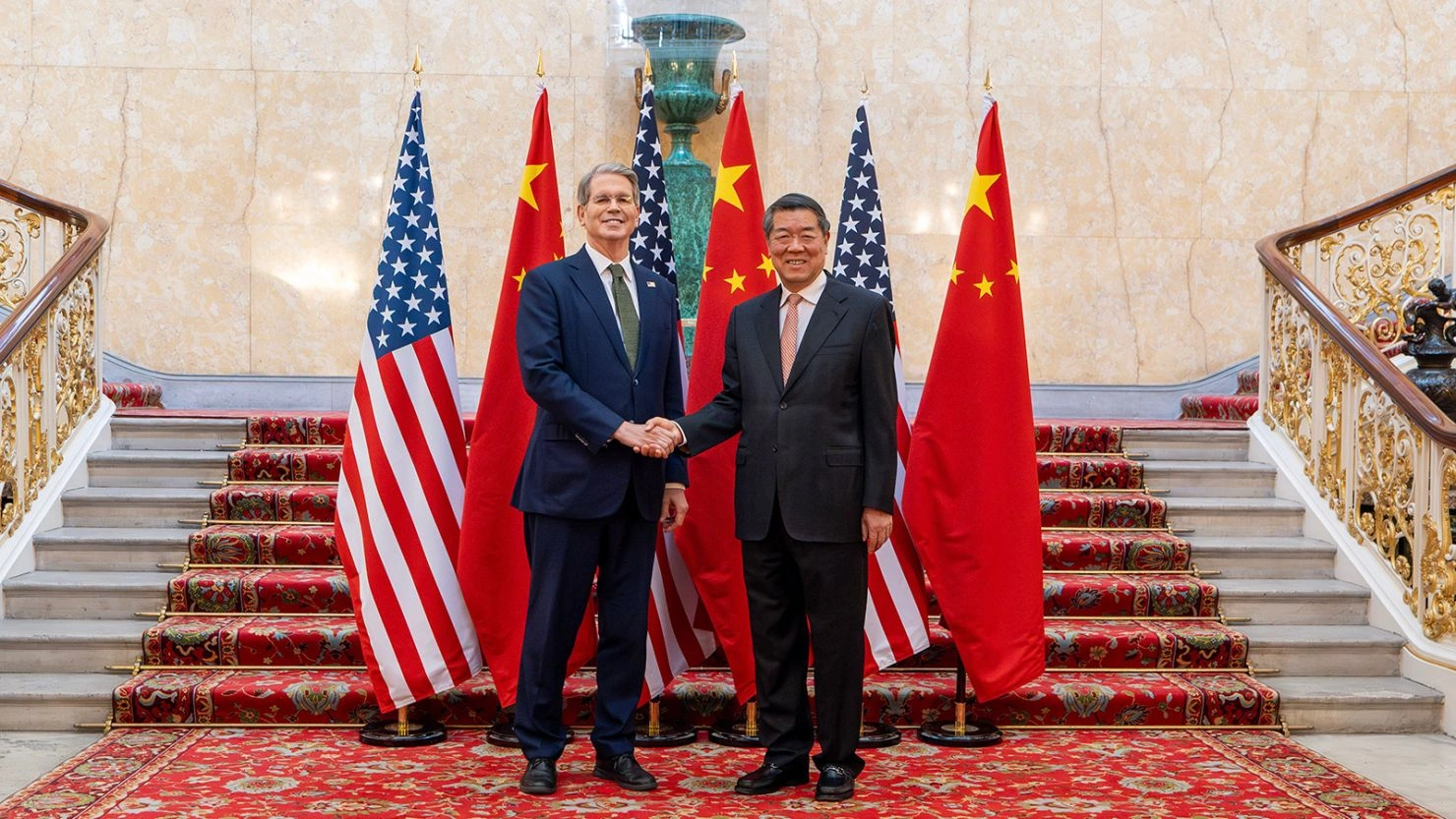
Bessent and He Lifeng meet at OECD Paris to review the Busan trade truce before Trump’s Beijing summit. Rare earths, Hormuz oil shock, and Section 301 cloud the path ahead.
The 16th arrondissement of Paris is not a place that announces itself. Discreet, residential, its wide avenues lined with haussmann facades, it is the kind of neighbourhood where power moves quietly. On Sunday morning, as French voters elsewhere in the city queued outside polling stations for the first round of local elections, a motorcade slipped through those unassuming streets toward the headquarters of the Organisation for Economic Co-operation and Development. Inside, the world’s two largest economies were attempting something rare in 2026: a structured, professional conversation.
Talks began at 10:05 a.m. local time, with Vice-Premier He Lifeng accompanied by Li Chenggang, China’s foremost international trade negotiator, while Treasury Secretary Scott Bessent arrived flanked by US Trade Representative Jamieson Greer. South China Morning Post Unlike previous encounters in European capitals, the delegations were received not by a host-country official but by OECD Secretary-General Mathias Cormann South China Morning Post — a small detail that spoke volumes. France was absorbed in its own democratic ritual. The world’s most consequential bilateral relationship was, once again, largely on its own.
The Stakes in Paris: More Than a Warm-Up Act
It would be tempting to dismiss the Paris talks as logistical scaffolding for a grander event — namely, President Donald Trump’s planned visit to Beijing at the end of March for a face-to-face with President Xi Jinping. That reading would be a mistake. The discussions are expected to cover US tariff adjustments, Chinese exports of rare earth minerals and magnets, American high-tech export controls, and Chinese purchases of US agricultural commodities CNBC — a cluster of issues that, taken together, constitute the structural skeleton of the bilateral relationship.
Analysts cautioned that with limited preparation time and Washington’s strategic focus consumed by the US-Israeli military campaign against Iran, the prospects for any significant breakthrough — either in Paris or at the Beijing summit — remain constrained. Investing.com As Scott Kennedy, a China economics specialist at the Center for Strategic and International Studies, put it with characteristic precision: “Both sides, I think, have a minimum goal of having a meeting which sort of keeps things together and avoids a rupture and re-escalation of tensions.” Yahoo!
That minimum — preserving the architecture of the relationship, not remodelling it — may, in the current environment, be ambitious enough.
Busan’s Ledger: What Has Been Delivered, and What Has Not
The two delegations were expected to review progress against the commitments enshrined in the October 2025 trade truce brokered by Trump and Xi on the sidelines of the APEC summit in Busan, South Korea. Yahoo! On certain metrics, the scorecard is encouraging. Washington officials, including Bessent himself, have confirmed that China has broadly honoured its agricultural obligations under the deal Business Standard — a meaningful signal at a moment when diplomatic goodwill is scarce.
The soybean numbers are notable. China committed to purchasing 12 million metric tonnes of US soybeans in the 2025 marketing year, with an escalation to 25 million tonnes in 2026 — a procurement schedule that begins with the autumn harvest. Yahoo! For Midwestern farmers and the commodity desks that serve them, these are not abstractions; they are the difference between a profitable season and a foreclosure notice.
But the picture darkens considerably when attention shifts to critical materials. US aerospace manufacturers and semiconductor companies are experiencing acute shortages of rare earth elements, including yttrium — a mineral indispensable in the heat-resistant coatings that protect jet engine components — and China, which controls an estimated 60 percent of global rare earth production, has not yet extended full export access to these sectors. CNBC According to William Chou, a senior fellow at the Hudson Institute, “US priorities will likely be about agricultural purchases by China and greater access to Chinese rare earths in the short term” Business Standard at the Paris talks — a formulation that implies urgency without optimism.
The supply chain implications are already registering. Defence contractors reliant on rare-earth permanent magnets for guidance systems, electric motors in next-generation aircraft, and precision sensors are operating on diminished buffers. The Paris talks, if they yield anything concrete, may need to yield this above all.
A New Irritant: Section 301 Returns
Against this backdrop of incremental compliance and unresolved bottlenecks, the US side has introduced a fresh complication. Treasury Secretary Bessent and USTR Greer are bringing to Paris a new Section 301 trade investigation targeting China and 15 other major trading partners CNBC — a revival of the legal mechanism previously used to justify sweeping tariffs during the first Trump administration. The signal it sends is deliberately mixed: Washington is simultaneously seeking to consolidate the Busan framework and reserving the right to escalate it.
For Chinese negotiators, the juxtaposition is not lost. Beijing has staked considerable domestic political credibility on the proposition that engagement with Washington produces tangible results. A Section 301 investigation, even if procedurally nascent, raises the spectre of a new tariff architecture layered atop the existing one — and complicates the case for continued compliance within China’s own policy bureaucracy.
The Hormuz Variable: When Geopolitics Enters the Room
No diplomatic meeting in March 2026 can be quarantined from the wider strategic environment, and the Paris talks are no exception. The ongoing US-Israeli military campaign against Iran has introduced a variable of potentially severe economic consequence: the partial closure of the Strait of Hormuz, the narrow waterway through which approximately a fifth of the world’s oil passes.
China sources roughly 45 percent of its imported oil through the Strait, making any disruption there a direct threat to its industrial output and energy security. Business Standard After US forces struck Iran’s Kharg Island oil loading facility and Tehran signalled retaliatory intent, President Trump called on other nations to assist in protecting maritime passage through the Strait. CNBC Bessent, for his part, issued a 30-day sanctions waiver to permit the sale of Russian oil currently stranded on tankers at sea CNBC — a pragmatic, if politically contorted, attempt to soften the energy-price spike.
For the Paris talks, the Hormuz dimension introduces a paradox. China has an acute economic interest in stabilising global oil flows and might, in principle, be receptive to coordinating with the United States on maritime security. Yet Beijing’s deep reluctance to be seen as endorsing or facilitating US-led military operations in the Middle East constrains how far it can go. The corridor between shared interest and political optics is narrow.
What Trump Wants in Beijing — and What Xi Can Deliver
With Trump’s Beijing visit now functioning as the near-term endpoint of this diplomatic process, the outlines of a summit package are beginning to take shape. The US president is expected to seek major new Chinese commitments on Boeing aircraft orders and expanded purchases of American liquefied natural gas Yahoo! — both commercially significant and symbolically resonant for domestic audiences. Boeing’s recovery from years of regulatory and reputational turbulence has made its order book a quasi-barometer of US industrial confidence; LNG exports represent a strategic diversification of American energy diplomacy.
For Xi, the calculus involves threading a needle between delivering enough to make the summit worthwhile and conceding so much that it invites criticism at home from nationalist constituencies already sceptical of engagement. China’s state media has consistently characterised the Paris talks as a potential “stabilising anchor” for an increasingly uncertain global economy Republic World — language carefully chosen to frame engagement as prudent statecraft rather than capitulation.
The OECD itself, whose headquarters serves as neutral ground for today’s meeting, cut its global growth forecast earlier this year amid trade fragmentation fears — underscoring that the bilateral relationship between Washington and Beijing carries systemic weight far beyond its two principals. A credible summit, even one short of transformative, would send a signal to investment desks and central banks from Frankfurt to Singapore that the world’s two largest economies retain the institutional capacity to manage their rivalry.
The Road to Beijing, and Beyond
What happens in the 16th arrondissement today will not resolve the structural tensions that define the US-China relationship in this decade. The rare-earth bottleneck is systemic, not administrative. The Section 301 investigation reflects a bipartisan American political consensus that China’s industrial subsidies represent an existential competitive threat. And the Iran war has introduced a geopolitical variable that neither side fully controls.
But the Paris talks serve a purpose that transcends their immediate agenda. They demonstrate, to a watching world, that diplomacy between great powers remains possible even as military operations unfold and supply chains fracture. They keep open the channels through which, eventually, more durable arrangements might be negotiated — whether at a Beijing summit, at the G20 in Johannesburg later this year, or in another European capital where motorcades slip, unannounced, through quiet streets.
The minimum goal, as CSIS’s Kennedy observed, is avoiding rupture. In the spring of 2026, with the Strait of Hormuz partially closed and yttrium shipments stalled, that minimum has acquired the weight of ambition.
Discover more from The Economy
Subscribe to get the latest posts sent to your email.


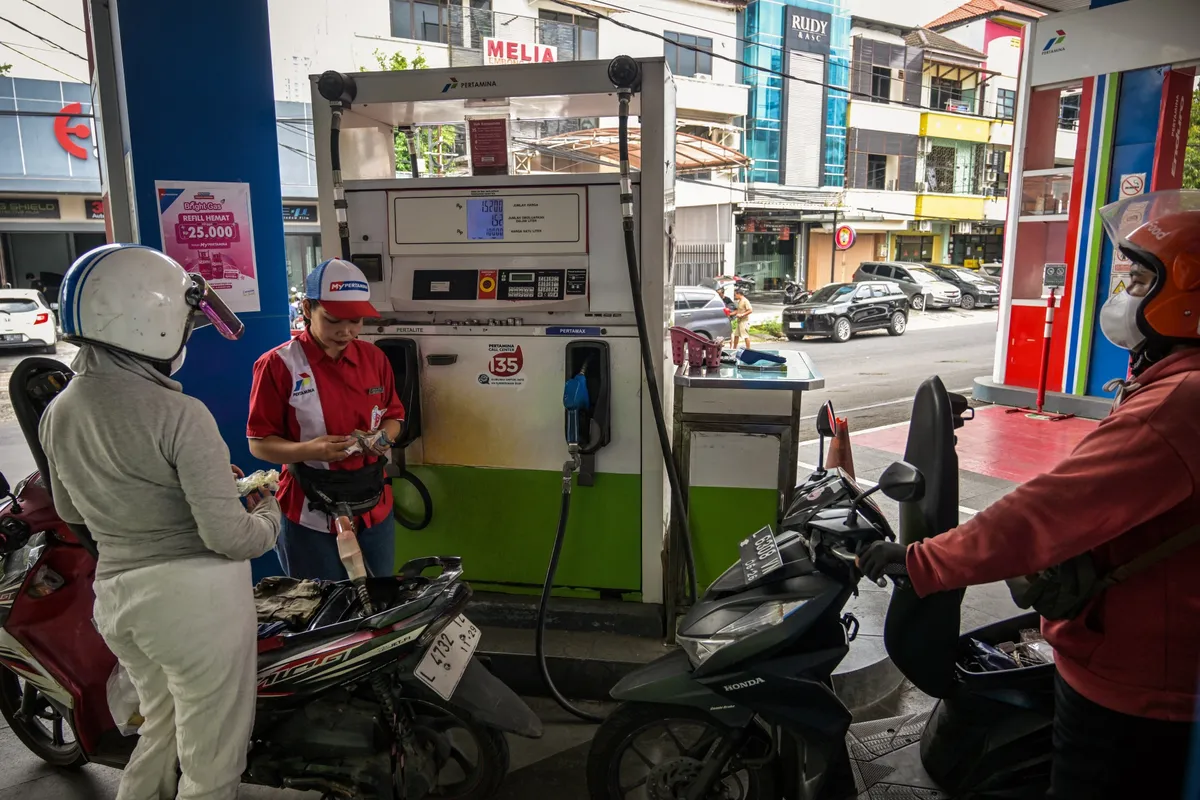
As Brent crude climbs above $85 a barrel and the Strait of Hormuz trembles under the weight of geopolitical crisis, Southeast Asia’s largest economy is walking a tightrope — and 100 million travellers are about to test it.
The Road Home, and the Price of Getting There
Every year, in the days before Eid Al-Fitr, Indonesia undergoes a transformation that has no real parallel anywhere on earth. Highways seize up from Surabaya to Semarang. Ferries groan under the weight of motorbikes strapped three-deep to their decks. Buses depart Jakarta at midnight, headlights cutting through diesel haze, carrying families back to villages they left for the city a generation ago. The mudik — the great homeward migration — is less a logistical event than a national act of faith: the moment when modern, urbanised Indonesia briefly remembers where it came from.
This year, that journey carries an unfamiliar undercurrent of anxiety. As Eid Al-Fitr falls on 20–21 March 2026, the Iran war and the attendant turbulence in global energy markets have transformed what is normally a question of traffic management into a test of macroeconomic resilience. The question hanging over Jakarta’s ministries is no longer simply whether the roads can handle the load — it is whether the fuel can.
Iran War Fuel Risk Indonesia: The Supply Chain Under Siege
The arithmetic of Indonesia’s exposure to the Iran-Israel-US conflict is stark. Historically, roughly a quarter of the country’s crude oil imports and approximately 30 percent of its liquefied petroleum gas have transited the Strait of Hormuz — the narrow, strategically irreplaceable chokepoint between Oman and Iran through which some 20 percent of global crude and gas supply ordinarily flows. With hostilities now disrupting that corridor, Brent crude has breached $85 per barrel for the first time since July 2024, and analysts at Goldman Sachs and elsewhere are openly modelling scenarios in which sustained Hormuz disruptions push prices above $100.
For a country that imports more petroleum products than any of its Southeast Asian neighbours — and that subsidises those products for a population of 280 million — this is not an abstract commodity-market fluctuation. It is a direct fiscal threat arriving at the worst conceivable moment on the domestic calendar.
State energy company Pertamina has moved quickly to diversify supply routes, accelerating a shift toward US crude purchases under the framework of a newly announced $15 billion bilateral energy agreement with Washington. The company has also offered discounts on aviation turbine fuel (avtur) to keep airline ticket prices from spiking ahead of the holiday. But industry insiders acknowledge that reserve buffers are tighter than public communications suggest, and that the pivot to American supply — while strategically sensible in the medium term — cannot be executed instantaneously at the volumes required.
Fuel Prices Indonesia Eid Al-Fitr 2026: The Demand Spike That Cannot Be Deferred
Indonesia’s fuel demand typically surges 30 percent or more in the regions through which mudik traffic flows — Java’s north coast road, the Trans-Sumatran Highway, the arteries feeding Bali’s ferry terminals — in the week surrounding Eid. LPG demand climbs sharply in parallel, as tens of millions of families prepare festive meals in villages where cooking-gas cylinders are the primary heat source and where informal supply chains are already stressed.
This cyclical demand surge has historically been manageable. Pertamina pre-positions stocks. The government calibrates subsidised fuel distribution. The system creaks, but it holds. What changes the calculus in 2026 is the compounding of domestic demand pressure with a global supply shock of unusual severity. The prolonged energy market impact of the Iran conflict — unlike previous Gulf crises, which were resolved or contained within weeks — shows no imminent sign of resolution. Shipping insurers have raised war-risk premiums on tanker routes through the Gulf of Oman. Several major trading houses have quietly rerouted cargoes. The market is pricing in duration, not a spike.
For Indonesia, the timing could scarcely be worse. The mudik demand surge is not deferrable. It arrives on a fixed schedule, indifferent to geopolitics.
Prabowo Fuel Subsidies: A Budget Under Existential Pressure
The government’s formal fiscal response has been to expand the subsidy envelope. Finance Minister Sri Mulyani Indrawati and Energy and Mineral Resources Minister Bahlil Lahadalia have sanctioned a fuel and energy subsidy allocation of approximately Rp381 trillion — equivalent to roughly $22.6 billion at current exchange rates — a figure that was already politically contentious before Brent moved above $85. If crude sustains current levels or rises further, the actual cost of honouring that commitment at current pump prices will balloon beyond the budgeted envelope, forcing either a mid-year supplementary budget, a drawdown of fiscal reserves, or — the option the Prabowo administration has categorically ruled out ahead of Eid — a price increase passed to consumers.
President Prabowo Subianto, who took office in October 2024 inheriting an economy navigating a complex post-pandemic fiscal consolidation, has staked considerable political capital on stability messaging. His administration has publicly committed to no retail fuel price increases through the holiday period and has launched public reassurance campaigns emphasising supply security. Prabowo himself has called on citizens to practise fuel-saving behaviours — a request with limited practical resonance for the family loading a motorbike with luggage at 3am for a 12-hour journey to Central Java.
The concern among analysts is not that the government’s immediate commitment is insincere. It is that the structural mismatch between subsidy arithmetic and crude-price reality is being papered over rather than addressed.
“Calm Without Concrete Solutions”: The Analyst Warning
Few observers have articulated this concern more precisely than Bhima Yudhistira Adhinegara, Executive Director of the Center of Economic and Law Studies (CELIOS) in Jakarta. “The government is asking the public to remain calm without presenting concrete solutions,” Bhima said in recent days. “This is highly risky, especially ahead of Eid Al-Fitr, when consumption typically rises.”
The critique cuts to a structural tension in Indonesian energy policy that predates Prabowo. Subsidised fuel prices are politically sacrosanct — any government that raises them ahead of a major holiday, or in the immediate aftermath of one, risks the kind of street-level anger that has complicated Indonesian politics since the reformasi era. But the fiscal cost of suppressing prices in a sustained high-crude environment is equally unsustainable. The IMF has repeatedly flagged Indonesia’s subsidy burden as a drag on the productive investment its growth ambitions require.
Across Southeast Asia, governments have responded to the oil-price surge with a patchwork of demand-management and price-cap measures — Malaysia has introduced targeted consumption limits for commercial users, Thailand has reinstated a temporary fuel price cap, and the Philippines has signalled a review of its automatic price-adjustment mechanism. Indonesia’s approach — absorb costs, reassure the public, defer difficult decisions — is not unique in the region, but it carries heightened risk given the scale of the subsidy commitment and the breadth of the domestic demand event it must now bridge.
Indonesia Oil Imports Strait of Hormuz: Shifting the Supply Map
There is a longer strategic story embedded in the immediate crisis. Indonesia’s accelerated pivot toward US crude purchases — partly driven by Washington’s own interest in cementing the $15 billion energy framework as a geopolitical counterweight to Chinese influence in the archipelago — represents a meaningful, if painful, diversification of import geography. Pertamina’s procurement teams are reportedly in active discussions with US Gulf Coast exporters and West African producers to expand non-Hormuz supply lines.
This is the right direction. But energy supply chain reconfiguration is measured in quarters and years, not days. For the purposes of the Eid surge beginning this week, Indonesia’s import exposure to Hormuz-adjacent disruption remains materially significant. The shipping lead times involved in rerouting US cargoes — longer voyages, higher freight costs, different refinery configurations — mean that the buffer between current physical inventory levels and a genuine shortage scenario is narrower than official statements imply.
The fiscal squeeze is compounded by currency pressure. The rupiah has been under persistent downward pressure throughout early 2026 — a function of global risk-off sentiment, capital outflows from emerging markets, and Indonesia-specific concerns about fiscal discipline. A weaker rupiah directly inflates the local-currency cost of dollar-denominated crude imports, creating a negative feedback loop between currency depreciation and the subsidy bill: as the rupiah falls, the cost of maintaining fixed domestic fuel prices rises, which widens the fiscal deficit, which pressures the rupiah further.
Prabowo’s Growth Gamble and the Subsidy Math
The deepest tension in Indonesia’s current predicament is not the Eid surge itself — it is the collision between the subsidy commitment and Prabowo’s signature economic ambition. The president has set a target of 8 percent annual GDP growth, a level Indonesia has not sustained since the Suharto era and one that presupposes a dramatic acceleration of productive investment, infrastructure spending, and industrial policy. The fiscal arithmetic of that ambition requires a leaner, better-targeted subsidy regime, not an expanded one.
Every additional trillion rupiah committed to fuel subsidies under crisis conditions is a trillion rupiah not available for the downstream industrial diversification, port infrastructure, or education investment that Prabowo’s growth model nominally requires. Sri Mulyani — widely regarded as the anchor of fiscal credibility in the cabinet — has worked hard to maintain Indonesia’s 3 percent deficit cap, a constraint that is now visibly strained by the combination of falling commodity revenues (nickel and palm oil export prices have softened) and rising import costs.
The political economy is equally fraught. Prabowo entered office with strong popular approval but has since navigated significant turbulence: student-led protests over democratic backsliding concerns, anxiety in markets about the coherence of his economic team, and now an external shock that strikes directly at the daily cost of living for ordinary Indonesians. The mudik is not merely a logistical event — it is a moment of national emotional and political temperature-taking. Fuel queues or price spikes during the homeward journey would land with particular symbolic force.
Beyond the Holiday: Energy Transition as the Only Durable Hedge
There is, ultimately, an irony in Indonesia’s predicament that its policymakers are not unaware of. The country sits on extraordinary renewable energy potential — geothermal reserves second only to the United States, solar irradiance across the equatorial archipelago, hydropower capacity in Kalimantan and Papua that remains largely untapped. A serious long-term hedge against Hormuz-style supply shocks is not a cleverer procurement strategy for crude oil; it is the accelerated electrification of transport and cooking — precisely the transition that $22.6 billion in annual fossil fuel subsidies structurally delays.
Every year that the subsidy regime absorbs a crisis of this kind and survives — narrowly, expensively, through improvisation rather than structural reform — is a year in which the case for energy transition grows stronger in the technocratic ministries and weaker in the political calculus. Eid will pass. The mudik will happen, probably without a catastrophic fuel crisis, because Indonesian governments have long experience of managing this event and because the commitment to price stability ahead of the holiday is politically non-negotiable. The crude price may ease. The immediate danger will subside.
But the structural exposure will remain. And the next Hormuz crisis — or the next rupiah slide, or the next commodity downturn that squeezes fiscal space precisely when a demand shock requires its expansion — will find Indonesia in the same position: a large, subsidy-dependent importer with ambitious growth targets, navigating an energy system whose architecture was designed for a different era.
For the family loading the motorbike in the predawn darkness of South Jakarta this week, none of that is the immediate concern. The pump is open; the price, for now, holds; the road awaits. But for the economists watching the budget spreadsheets, and for a president who has staked his legacy on 1990s-style growth in a 2020s world, the Iran war has illuminated something that neither reassuring press conferences nor expanded subsidy lines can fully obscure: Indonesia’s energy vulnerability is not a crisis to be managed. It is a structural condition to be transformed.
FAQ: Iran War Fuel Risk and Indonesia’s Eid 2026
How does the Iran war affect Indonesia’s Eid travel fuel prices? The conflict has disrupted Hormuz transit routes for roughly a quarter of Indonesia’s crude and 30 percent of its LPG imports, pushing Brent crude above $85/bbl. The government has committed to holding pump prices stable through Eid, absorbing the difference via expanded subsidies — but the fiscal cost is significant and growing.
Will there be a fuel shortage in Indonesia during Eid Al-Fitr 2026? The government and Pertamina say no, citing pre-positioned stocks and new US supply agreements. Independent analysts are less categorical, noting that reserve buffers are tighter than official messaging suggests and that the supply-chain pivot to non-Hormuz sources cannot be completed at the required scale before the holiday.
What is Indonesia’s total fuel subsidy budget for 2026? The government has allocated approximately Rp381 trillion (around $22.6 billion) for fuel and energy subsidies. At current crude prices, sustaining domestic price controls through a prolonged high-oil environment would likely require supplementary budget measures.
How is Prabowo Subianto’s government responding to the oil price surge? The administration has ruled out pre-Eid price increases, expanded the subsidy envelope, initiated a supply diversification toward US crude, and launched public messaging campaigns emphasising stability. Critics argue the approach manages optics without addressing structural exposure.
Could the Iran war derail Indonesia’s 8 percent growth target? Sustained high oil prices would widen the current account deficit, pressure the rupiah, inflate the subsidy bill, and crowd out the productive investment spending the growth target requires. Most analysts regard 8 percent growth as aspirational under current conditions; an extended energy crisis would make it arithmetically improbable.
Discover more from The Economy
Subscribe to get the latest posts sent to your email.

On November 19, 2023, Houthi militants seized a Bahamian-flagged cargo ship in the Red Sea. That single act of piracy — framed as solidarity with Gaza — triggered the most consequential maritime disruption to global trade since the 2021 Ever Given blockage. Two and a half years later, the Strait of Bab el-Mandeb remains a war zone in all but name, the Suez Canal handles barely a fraction of its former traffic, and the economies of eighteen nations stretching from Sri Lanka to the Philippines are absorbing cascading shocks they did not generate and cannot fully control. This is the story of how a distant conflict has become a near-present economic emergency across ASEAN and SAARC — and what it means for growth, inflation, remittances, and supply chains through 2028.
The Red Sea in Numbers: A Chokepoint Under Siege
The statistics are staggering. According to UNCTAD’s 2025 Maritime Trade Review, tonnage through the Suez Canal stood 70 percent below 2023 levels as recently as May 2025 UNCTAD, and the trajectory of recovery remains deeply uncertain. Container shipping has been devastated: traffic through the canal collapsed by roughly 75 percent during 2024 compared with 2023 averages, with no meaningful recovery through mid-2025 — data from July 2025 showing no recovery in container vessel transit through the canal, and Houthi attacks as recently as August 2025 making recovery unlikely soon Project44. The Suez Canal’s share of global maritime traffic has slipped from roughly 12 percent to below 9 percent — a structural shift that may not fully reverse even if hostilities cease.
The rerouting of vessels around Africa’s Cape of Good Hope adds 10–14 days to Asia–Europe voyages, pushing total transit times to 40–50 days. Freight rates between Shanghai and Rotterdam surged fivefold in 2024 Yqn. Rates between Shanghai and Rotterdam remained significantly higher than before the attacks began — up 80 percent relative to pre-crisis levels as of 2025. Coface UNCTAD notes that ship ton-miles hit a record annual rise of 6 percent in 2024, nearly three times faster than underlying trade volume growth. By May 2025, the Strait of Hormuz — through which 11 percent of global trade and a third of seaborne oil pass — also faced disruption risks. UNCTAD
The Asian Development Bank’s July 2025 Outlook modelled three Middle East scenarios. In its most severe case — a protracted conflict with Strait of Hormuz disruption — oil prices could surge $55 per barrel for four consecutive quarters. Asian Development Bank The Strait of Hormuz, through which roughly one-third of all seaborne oil and over one-fifth of global LNG supply passes (the latter primarily from Qatar), is a chokepoint of existential importance to every oil-importing nation from Dhaka to Manila.
The Oil Shock Transmission: How Energy Costs Hit 18 Economies
For most of 2025, Brent crude had traded in the $60–$74/barrel range, offering breathing room to energy-hungry emerging economies. That calculus shifted dramatically in early 2026. With fresh military action involving the United States and Israel targeting Iran, Brent broke above $100/bbl — roughly 70 percent above its 2025 average of $68/bbl — according to OCBC Group Research. European gas (TTF) simultaneously pushed past €50/MWh. OCBC
MUFG Research sensitivity modelling shows that every $10/barrel increase in oil prices worsens Asia’s current account balance by 0.2–0.9 percent of GDP. Thailand is the region’s most exposed economy (current account impact: -0.9% of GDP per $10/bbl), followed by Singapore (-0.7%), South Korea (-0.6%), and the Philippines. Inflationary effects are equally asymmetric: a $10/bbl oil price rise pushes annual headline CPI up by 0.6–0.8 percentage points in Thailand, 0.5–0.7pp in India and the Philippines, and 0.4–0.6pp across Malaysia, Indonesia, and Vietnam. MUFG Research Countries with fuel subsidies — notably Indonesia and Malaysia — absorb part of the pass-through fiscally, but at escalating cost to their budgets.
ASEAN: The Differentiated Exposure
ASEAN nations face wildly varying degrees of vulnerability. The Philippines sources 96 percent of its oil from the Gulf, Vietnam and Thailand approximately 87 percent and 74 percent respectively, while Singapore is more than 70 percent dependent on Middle Eastern crude — with 45 percent of its LNG imports arriving from Qatar alone. The Diplomat
The ADB’s April 2025 Outlook cut Singapore’s 2025 growth forecast to 2.6 percent (from 4.4% in 2024), citing weaker exports driven by global trade uncertainties and weaker external demand. Asian Development Bank The IMF revised ASEAN-5 aggregate growth down further to 4.1 percent in July 2025, versus earlier forecasts of 4.6 percent, with trade-dependent Vietnam (revised to 5.2% in 2025), Thailand (2.8%), and Cambodia most acutely affected. Krungsri
SAARC: The Remittance Fault Line
For the eight SAARC economies, the crisis is doubly coercive: higher energy import bills on one side, threatened remittance flows on the other.
India illustrates the tension most sharply. The country consumes approximately 5.3–5.5 million barrels per day while producing barely 0.6 million domestically, making it nearly 85 percent import-dependent. Petroleum imports already account for 25–30 percent of India’s total import bill, and every $10 oil price increase adds $12–15 billion to the annual cost. IANS News Historically, such episodes have triggered rupee depreciations exceeding 10 percent.
The remittance dimension is equally alarming. India received a record $137 billion in remittances in 2024, retaining its position as the world’s largest recipient. United Nations The 9-million-strong Indian diaspora in Gulf countries contributes nearly 38 percent of India’s total remittance inflows — roughly $51.4 billion from the GCC alone, based on FY2025 inflows of $135.4 billion. These workers are concentrated in oil services, construction, hospitality and retail: precisely the sectors most vulnerable to Gulf economic disruption. Oxford Economics estimates a sustained shock “would worsen India’s external position and could put some pressure on the rupee.” CNBC
Pakistan: Caught in the Crossfire
Pakistan’s total petroleum import bill reached approximately $10.7 billion in FY25, with crude petroleum imports of over $5.7 billion sourced predominantly from Saudi Arabia and the UAE. Its trade deficit has widened to approximately $25 billion during July–February FY26. Domestic fuel prices have already risen by approximately Rs55 ($0.20) per litre, reflecting the war-risk premium embedded in global crude markets. Profit by Pakistan Today
The remittance channel is equally fragile. Pakistan received $34.6 billion in remittances in 2024 — accounting for 9.4 percent of GDP — with Saudi Arabia alone contributing $7.4 billion (25 percent of the total), and the UAE contributing $5.5 billion (18.7 percent). Displacement Tracking Matrix An Insight Securities research note from March 2026 warns that geopolitical tensions involving the US, Israel, and Iran “have taken a hit on the security and stability perception” of Gulf economies, with the effect on Pakistani remittances expected to materialise with a lag. About 55 percent of Pakistan’s remittance inflows come from the Middle East, making the country particularly vulnerable. Arab News PK
For Pakistani exporters, shipping diversions around the Cape of Good Hope are extending transit times to Europe by 15–20 days, while freight rates on key routes could rise by up to 300 percent under war-risk classification. Profit by Pakistan Today
Bangladesh and Sri Lanka: Garments, Tea, and the Weight of Distance
Bangladesh’s vulnerability is concentrated in one devastating statistic: more than 65 percent of its garment exports — representing roughly $47 billion of an approximately $55 billion annual export economy — pass through or proximate to the Red Sea corridor. LinkedIn When Maersk confirmed on March 3, 2026, that it had suspended all new bookings between the Indian subcontinent and the Upper Gulf — covering the UAE, Bahrain, Qatar, Iraq, Kuwait, and Saudi Arabia — it confirmed that the escalating Iran crisis was no longer merely raising risk premiums; it was severing commercial flows entirely. The Daily Star
The garment sector cannot absorb air freight as a substitute: the BGMEA president notes that air freight costs have increased between 25–40 percent for some European buyers due to the Red Sea crisis, and some buyers are renegotiating contracts or diverting orders. The Daily Star As one garment vice president told Nikkei Asia, air freight costs 10–12 times more than sea transport — an instant route to negative margins. Bangladesh cannot afford order diversion at scale.
Sri Lanka’s exposure cuts across multiple arteries simultaneously. With over 1.5 million Sri Lankans (nearly 7 percent of the population) employed in the Gulf region, and the island recording a record $8 billion in remittances in 2025, any large-scale evacuation or Gulf economic contraction would shatter the fiscal stability the government has only recently achieved. Sri Lanka’s tea exports to Iran, Iraq, and the UAE — where the Iranian rial’s collapse has triggered a freeze in new orders — threaten the livelihoods of smallholder farmers across the southern highlands. EconomyNext
The Hormuz Wildcard: A Scenario That Could Rewrite Everything
Much of the analysis above rests on a scenario in which the Strait of Hormuz remains open. Should it be disrupted — even temporarily — the macroeconomic calculus transforms. Approximately 20 percent of global oil consumption transits the Strait daily, along with over one-fifth of the world’s LNG supply. Alternative land pipelines — Saudi Arabia’s East-West Pipeline and the UAE’s Abu Dhabi Crude Oil Pipeline to Fujairah — can offer some help, but their capacity represents barely one quarter of normal Hormuz throughput. MUFG Research
Under the ADB’s most severe scenario — a $55/barrel sustained oil shock — the impact on current account balances across ASEAN and South Asia would be severe. Current account deficits for the Philippines and India could widen above 4.5 percent and 2 percent of GDP respectively if oil prices were to rise above $90/bbl on a sustained basis. MUFG Research Pakistan, with minimal fiscal buffers, would face renewed currency crisis. India’s annual import bill would expand by roughly $82 billion relative to 2025 averages — approximately equal to its entire defence budget.
Silver Linings and Second-Order Winners
Crises reshape competitive landscapes. Vietnam’s electronics and apparel sector recorded export turnover of $4.45 billion in July 2025 — an 8.2 percent increase over June and 21 percent higher than the same month last year — driven partly by supply chain shifts away from China. Asian Development Bank Malaysia and Indonesia, as partial net energy exporters, benefit from elevated crude prices on the revenue side. Singapore, with a FY2025 fiscal surplus of 1.9 percent of GDP, has the deepest fiscal reserves in ASEAN to deploy energy transition support without macroeconomic destabilisation. OCBC
Thailand has launched planning work on its $28 billion Landbridge project — deep-sea ports at Ranong and Chumphon connected by highway and rail — as a potential alternative corridor to the Strait of Malacca. India is accelerating infrastructure at Chabahar Port, a corridor that bypasses Pakistani territory and opens Central Asian trade routes. The “friend-shoring” dynamic identified by the IMF is also accelerating: as Western supply chains reconfigure away from single-region dependence, ASEAN economies — particularly Vietnam and Indonesia — stand to attract manufacturing diversion from China that partially offsets the Middle East trade cost shock. Krungsri
China’s Shadow: The Geopolitical Dimension
No analysis of the Middle East’s economic impact on ASEAN and SAARC is complete without acknowledging Beijing’s role. China, which imports roughly 75 percent of its crude from the Middle East and Africa, has more at stake in Hormuz stability than almost any other economy. Yet Beijing has maintained studied neutrality, positioning itself as potential peacebroker while expanding bilateral energy security arrangements with Gulf states.
Meanwhile, China’s Belt and Road Initiative (BRI) port infrastructure — Gwadar in Pakistan, Hambantota in Sri Lanka, Kyaukpyu in Myanmar — is emerging as a hedging option for economies seeking to reduce Red Sea exposure. The IMF’s Regional Economic Outlook warns that geoeconomic fragmentation — the splitting of global trade into rival blocs — carries a potential output cost, with a persistent spike in global uncertainty producing GDP losses of 2.5 percent after two years in the MENA and adjacent regions, with the impacts more pronounced than elsewhere due to vulnerabilities including higher public debt and weaker institutions. International Monetary Fund
Outlook 2026–2028: GDP Drag Estimates and Divergent Trajectories
Baseline projections remain broadly positive for the region, underpinned by demographic dividends and resilient domestic demand. The World Bank’s October 2025 MENAAP Update projects regional growth reaching 2.8 percent in 2025 and 3.3 percent in 2026. World Bank The IMF’s October 2025 Regional Outlook projects Pakistan’s growth increasing to 3.6 percent in 2026, supported by reform implementation and improving financial conditions. International Monetary Fund ADB’s September 2025 forecasts show Indonesia at 4.9%, Philippines at 5.6%, and Malaysia at 4.3% for 2025. Asian Development Bank
But the scenario distribution has widened materially. In a contained-conflict baseline (oil averaging $75–85/bbl), the GDP drag for oil-importing SAARC economies is estimated at 0.3–0.7 percentage points annually through 2027 — painful but manageable. In a protracted Hormuz-disruption scenario, modelled GDP losses escalate to 1.5–3.0 percentage points for the most energy-dependent economies: Sri Lanka, Philippines, Bangladesh, and Pakistan. Currency pressures in that scenario could trigger sovereign debt rating downgrades for Pakistan (still under IMF programme) and Sri Lanka (still restructuring external debt).
Policy Recommendations for ASEAN and SAARC Governments
The foregoing analysis suggests a multi-track policy agenda structured across three time horizons:
Immediate (0–6 months)
- Strategic petroleum reserves: Economies with fewer than 30 days of import cover — Bangladesh, Sri Lanka, Pakistan, Philippines — should accelerate bilateral arrangements with GCC suppliers for deferred-payment oil stocking.
- Freight & insurance backstops: State-owned development banks in India, Indonesia, and Malaysia should establish temporary freight insurance facilities for SME exporters unable to access war-risk cover at commercial rates.
- Fiscal fuel-price buffers: Governments should resist immediate full pass-through of oil price increases to consumers in 2026 — the inflationary second-round effects of premature deregulation risk destabilising monetary policy just as disinflation was being consolidated.
Medium-Term (6–24 months)
- Trade corridor diversification: ASEAN and SAARC should jointly accelerate operationalisation of the India-Middle East-Europe Economic Corridor (IMEC) and Chabahar-Central Asia links to reduce exclusive dependence on the Suez/Red Sea routing for European-bound exports.
- Renewable energy acceleration: Each percentage point of fossil fuel imports replaced by domestic solar, wind, or nuclear capacity is a permanent reduction in geopolitical exposure. ADB Green Climate Fund allocations should be explicitly linked to energy import substitution targets.
- Remittance formalisation: Bangladesh, Pakistan, and Sri Lanka should extend incentive schemes to maximise remittance capture through official banking channels, maximising their foreign-exchange multiplier effect.
Long-Term (2–5 years)
- “Asia Premium” hedge architecture: A regional crude futures market, potentially anchored in Singapore, could provide more effective price discovery and hedging access to smaller economies that currently pay a structural premium above Brent.
- Supply chain friend-shoring with selectivity: ASEAN’s competitive advantage is best served by remaining in the middle of the US-China geopolitical competition rather than choosing sides definitively, attracting Western supply-chain investment without triggering Chinese economic retaliation through rare earth or intermediate input export controls.
- Multilateral maritime security: ASEAN and SAARC together represent a significant share of the global trade disruption cost. A formal joint diplomatic initiative requesting a UN-mandated naval security corridor for commercial shipping through the Red Sea and Gulf would add multilateral legitimacy to what is currently a US-led Western operation.
Conclusion: The Geography of Exposure
The Middle East conflict has delivered a masterclass in the hidden geography of economic exposure. Countries that share no border with Israel, Hamas, or Iran — countries that have issued no military guarantee and sent no troops — are nonetheless absorbing the full force of an energy price shock, a logistics cost spiral, and a remittance fragility that was structurally built into their growth models over decades.
Even if hostilities ceased tomorrow, the Red Sea crisis — now stretching into its third year as of 2026 — has tested the limits of global logistics. With Red Sea transits down up to 90 percent and Cape of Good Hope routing now the industry standard, companies face 10–14 extra days in transit, higher inventory costs, and sustained freight premiums of 25–35 percent. DocShipper The ceasefire declared in October 2025 barely shifted the dial. Shipping insurers remain risk-averse; carriers have rebuilt vessel schedules around the longer route.
What the crisis has done is clarify something that globalisation’s practitioners long preferred to obscure: deep economic integration produces deep interdependence, and deep interdependence produces deep vulnerability. The eighteen economies of ASEAN and SAARC are not passive bystanders in a conflict 4,000 miles away. They are, in the most material and measurable sense, participants in its economic consequences. The policy leaders who understand that soonest — and build the resilience architecture accordingly — will determine which countries emerge from the coming years stronger, and which emerge diminished.
Discover more from The Economy
Subscribe to get the latest posts sent to your email.
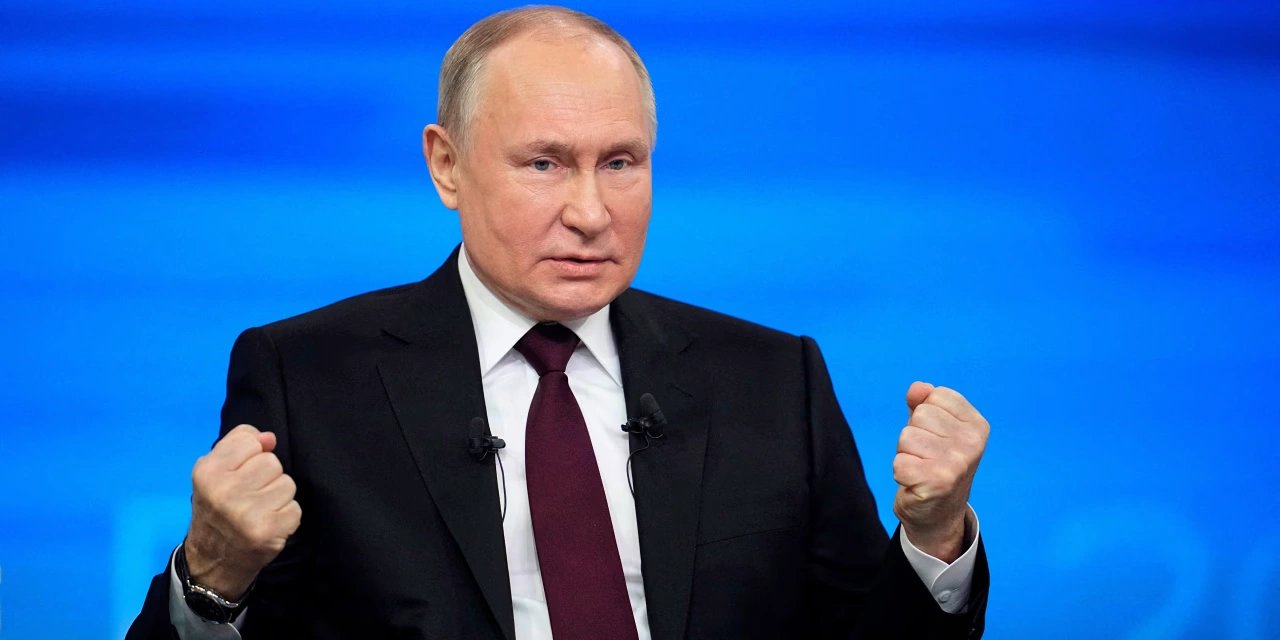
Russian oil prices have surged from $40 to over $100 a barrel in less than a fortnight. Vladimir Putin didn’t engineer this stroke of fortune — but he is quietly pocketing it. The question haunting energy desks from Houston to Mumbai is how long the party lasts.
The timing was almost cinematic. As missiles arced over the Strait of Hormuz in the opening days of March 2026 and Iranian crude abruptly vanished from global shipping lanes, the Kremlin’s oil accountants found themselves staring at spreadsheets they could scarcely believe. Urals crude price surge 2026 has become the phrase of the month in energy markets: in barely twelve days, Russia’s benchmark export blend climbed from a sanctions-depressed $40 per barrel to north of $100 — a trajectory that, as The Economist first reported, amounts to one of the most sudden revenue injections any petrostate has received since the invasion of Ukraine. Forbes calculates that every $10-per-barrel lift to Urals adds roughly $1.6 billion to Moscow’s monthly hydrocarbon revenues. Do the arithmetic on a $60 jump and the figure becomes staggering — and politically consequential in ways that extend far beyond the trading floor.
This is not a story Putin wrote. It is a story that was written for him.
The Sarah’s Midnight Pivot – How One Tanker Tells the Whole Story
On the evening of March 4, a Hong Kong-flagged vessel called the Sarah — twenty years old, unremarkable in every maritime register — completed a sharp course correction roughly 140 nautical miles southeast of Muscat. She had been loitering near the Omani coast for the better part of a week, waiting, as tanker-tracking analysts at Kpler and Vortexa now confirm, for a cargo assignment that kept shifting. When the assignment finally arrived, it was not the consignment of Middle Eastern crude her manifest had vaguely suggested. It was Russian Urals, loaded at Primorsk, bound for an Indian refinery on the west coast of Gujarat.
The Sarah is, in miniature, the entire geopolitical drama of this moment. She is part of what the industry calls the shadow fleet Russian crude network — a loose armada of ageing, often inadequately insured tankers assembled after Western majors abandoned Russian oil routes in 2022. Under normal conditions, this fleet operates at a discount, moving barrels that Western sanctions have rendered toxic to mainstream shipping and insurance markets. Under the conditions prevailing in early March 2026, it is operating at something close to a premium. With Iranian supply suddenly off the table and Brent lurching above $120, even the Sarah‘s unconventional provenance and patchy insurance history ceased to trouble her buyers. Beggars, as the saying goes, cannot be choosers — and India’s refining sector, with its voracious appetite for cheap feedstock, was not in a position to be precious.
The Sarah’s pivot is not an isolated data point. Bloomberg’s tanker-tracking desk reported that Indian refiners have snapped up approximately 30 million barrels of Russian crude in the first ten days of March alone — a volume that, spread across the country’s refining complex, represents a significant acceleration even by the elevated standards of the past three years. The Sarah and her sister vessels are not smugglers, exactly. They are the infrastructure of a sanctions regime that has been quietly, methodically hollowed out.
Three Tailwinds Handing Putin an Unexpected $1.6 Billion Windfall
Three forces have converged to produce what one senior European energy official, speaking privately, called “the sugar high Putin never asked for — and may not know how to manage.”
First: the price spike itself. The Urals-Brent spread, which had widened to an embarrassing $20–$25 discount through much of 2024 and early 2025, has collapsed dramatically. As of March 14, Urals was trading at a discount of barely $4 to Brent — a near-parity that would have been unthinkable eighteen months ago. The mechanism is straightforward: Iranian crude, which competes directly with Russian heavy-sour barrels in Asian refinery configurations, has essentially disappeared from the market. Refineries in India, China, and South Korea that had been blending Iranian and Russian feedstock are now bidding aggressively for whatever Russian supply is available. The Urals-Brent spread compression alone represents billions in additional monthly revenue for Rosneft, Lukoil, and Gazprom Neft.
Second: the extraordinary, if temporary, erosion of the sanctions architecture. Here the story takes a turn that has discomfited officials in Brussels and London considerably more than they publicly acknowledge. The Trump administration Russian oil waiver extension, formalised in a general license issued in mid-February and extended again on March 12 according to Reuters, was conceived as a pragmatic gesture to prevent a global price shock in the run-up to what Washington feared would be a disruptive Middle Eastern escalation. It has instead become, in the eyes of its critics, a subsidy to the Kremlin at the precise moment when the Kremlin is benefiting from that very escalation. The waiver permits certain categories of transaction — including, critically, Indian purchases of Russian crude above the G7 price cap — to proceed without triggering secondary sanctions. The result, as Forbes has noted, is that the price-cap mechanism, already severely strained, is now functioning as barely more than a paper constraint.
Third: China’s quiet desperation. Beijing’s role in this drama is less visible than India’s but arguably more structurally significant. Chinese independent refiners — the “teapots” of Shandong province — have been quietly rebuilding inventories of Russian ESPO blend and Urals at a pace not seen since the post-invasion purchasing surge of 2022. With Iranian barrels unavailable and Saudi Arabia managing production carefully, Chinese buyers find themselves with fewer alternatives than at any point in recent memory. This demand concentration gives Moscow unusual pricing leverage: for the first time since the sanctions regime was assembled, Russian oil exporters are, in certain grades and configurations, genuinely capacity-constrained rather than price-constrained.
Data Snapshot: Russia’s Oil Windfall in Numbers
- Urals price, March 14, 2026: ~$102/barrel (vs. ~$40 in late February)
- Urals-Brent spread: approx. –$4 (vs. –$22 in January 2026)
- Estimated monthly revenue uplift: $8–10 billion (based on ~130m barrels/month export volume)
- Indian Russian crude purchases, March 1–10: ~30 million barrels (Bloomberg)
- Shadow-fleet vessels active, Primorsk–Gujarat route: 47 (Kpler estimate, March 13)
- G7 price cap: $60/barrel — currently ~$42 below market
- US general-license waiver expiry (current extension): April 14, 2026
The Sugar High: Why This Boom Is Temporary
And yet. The history of petrostate windfalls is substantially a history of misallocated euphoria — of budget assumptions revised upward at precisely the moment when prudence counselled caution, and of fiscal structures reconfigured for a price environment that proved, in retrospect, to be an aberration rather than a new normal.
There are at least four reasons to believe that Putin’s present windfall is more confection than substance.
The most pressing is the US waiver expiry. The current general-license extension lapses on April 14. Renewing it has become politically toxic in Washington: critics on both sides of the aisle have framed it, with some justification, as a de facto subsidy to a country still prosecuting a war in Ukraine. The Treasury Department’s Office of Foreign Assets Control is under significant pressure not to issue a further extension, and several senior administration officials have privately indicated that the political calculus has shifted since February. If the waiver expires and is not renewed, the secondary-sanctions exposure for Indian and Chinese buyers increases materially — potentially enough to chill the purchasing volumes that are currently sustaining Urals prices.
The second constraint is European enforcement. The EU’s fourteenth sanctions package, adopted in late 2025, contains provisions targeting shadow-fleet operators that are only now beginning to be implemented. The Guardian has reported that three EU member states — Greece, Cyprus, and Malta, all major ship-registry and management jurisdictions — have begun issuing formal compliance notices to vessel owners suspected of shadow-fleet participation. The legal and insurance exposure for owners of vessels like the Sarah is rising in ways that have not yet been fully priced into freight markets.
Third: Indian payment hesitancy. The structural awkwardness of the India-Russia oil trade — routing payments through UAE-based intermediaries, using rupee-ruble conversion mechanisms that neither side finds entirely satisfactory — has not been resolved. Indian refiners have been willing to absorb this friction when Urals is trading at a significant discount. At near-parity with Brent, the calculation changes. IOC, HPCL, and BPCL are commercial enterprises with shareholder obligations; they will not pay a premium for Russian crude simply to accommodate Moscow’s revenue requirements. Several New Delhi-based energy executives have indicated, informally, that $95–100 Urals is approaching the threshold at which Middle Eastern or West African alternatives become genuinely competitive, logistical complications notwithstanding.
Fourth, and most structurally, there is the question of long-term demand destruction. The International Energy Agency’s March 2026 oil-market report (published the day before the Economist piece) contains a passage that has received insufficient attention: it projects that OECD oil demand will contract by 1.1 million barrels per day by end-2027, driven primarily by accelerating electric-vehicle penetration in Europe and the United States. Russia’s customer base — concentrated in Asia, where the energy transition is proceeding more slowly — provides a partial buffer. But China’s own EV market is the world’s largest, and Beijing’s long-term energy strategy explicitly targets reduced dependence on imported hydrocarbons. The demand floor beneath Russian crude is not collapsing, but it is demonstrably eroding.
What It Means for Global Energy Security and the Ukraine War
Set against the backdrop of the Ukraine conflict, now entering its fourth year, the revenue implications of this windfall are neither trivial nor transformative. Russia’s defence budget for 2026, as published by the Finance Ministry in December, assumes an average Urals price of $70 per barrel. Every dollar above that figure generates approximately $160 million annually in additional fiscal headroom. At $102 sustained through the year — an unlikely but not inconceivable scenario — the cumulative surplus above budget assumptions approaches $15 billion: meaningful, but not war-changing.
More significant, perhaps, is the political signal. Moscow has spent eighteen months managing a narrative of economic resilience under sanctions pressure — a narrative that required careful messaging precisely because the underlying data was, at points, genuinely uncomfortable. The windfall of March 2026 has handed Putin’s communications apparatus a gift: evidence, real and visible, that the Western sanctions architecture is porous, that Russia’s Asian market pivot was strategically correct, and that geopolitical chaos in one part of the world reliably generates revenue opportunities in another.
The New York Times and CNN have both noted, in recent days, the muted character of Western governments’ public response to the Urals surge. That muting is deliberate: calling attention to Putin’s windfall requires acknowledging the scale of sanctions erosion, which in turn raises uncomfortable questions about policy effectiveness that no Western capital is currently eager to answer in public.
Bloomberg’s energy desk put it with characteristic precision last week: “The price-cap was designed to constrain Russian revenues without starving global markets of supply. It is currently doing neither.”
For energy-security planners in Berlin, Tokyo, and Washington, the broader lesson of this episode may prove more durable than the episode itself. The Strait of Hormuz remains the world’s single most consequential chokepoint — a fact that the events of early March have re-dramatised with some force. Any disruption there creates immediate, cascading price effects that disproportionately benefit the alternative suppliers best positioned to absorb displaced demand. Russia, for all the damage inflicted by three years of sanctions, remains exactly such a supplier. That structural reality is not going to be wished away by policy declarations or price-cap communiqués.
The Sarah, her hull cutting south through the Arabian Sea toward Gujarat, is not carrying a political statement. She is carrying crude oil, loaded at a Russian Baltic terminal, bound for an Indian refinery that needs feedstock at a workable price. But the wake she leaves behind her traces the outline of a geopolitical problem that neither sanctions advocates nor their critics have fully resolved: how to constrain a major energy producer without either emptying your own consumers’ wallets or handing that producer a windfall every time the world’s other energy sources become unavailable.
Putin didn’t ask for this sugar high. But he is, for now, enjoying it — and spending the revenues in ways that will outlast the spike that generated them.
Discover more from The Economy
Subscribe to get the latest posts sent to your email.
-

 Markets & Finance2 months ago
Top 15 Stocks for Investment in 2026 in PSX: Your Complete Guide to Pakistan’s Best Investment Opportunities
-

 Analysis1 month ago
Brazil’s Rare Earth Race: US, EU, and China Compete for Critical Minerals as Tensions Rise
-

 Banks2 months ago
Best Investments in Pakistan 2026: Top 10 Low-Price Shares and Long-Term Picks for the PSX
-

 Investment2 months ago
Top 10 Mutual Fund Managers in Pakistan for Investment in 2026: A Comprehensive Guide for Optimal Returns
-

 Asia2 months ago
China’s 50% Domestic Equipment Rule: The Semiconductor Mandate Reshaping Global Tech
-

 Analysis4 weeks ago
Top 10 Stocks for Investment in PSX for Quick Returns in 2026
-

 Global Economy3 months ago
Pakistan’s Export Goldmine: 10 Game-Changing Markets Where Pakistani Businesses Are Winning Big in 2025
-

 Global Economy3 months ago
15 Most Lucrative Sectors for Investment in Pakistan: A 2025 Data-Driven Analysis