
Global Economy
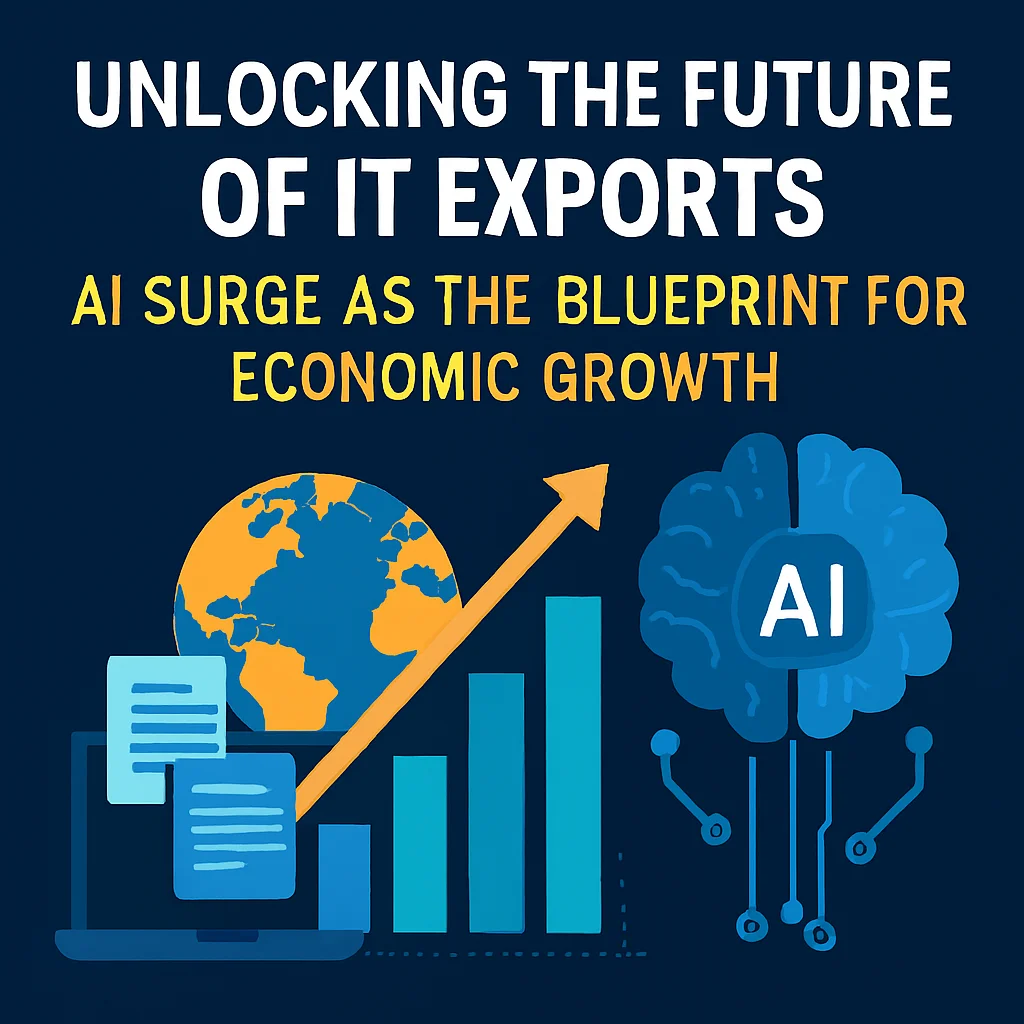
Unlocking the Future of IT Exports: AI Surge as the Blueprint for Economic Growth

Introduction
The global economy is at a crossroads. Traditional growth engines—manufacturing, agriculture, and extractive industries—are struggling to keep pace with the demands of a hyper-connected world. Meanwhile, the digital economy has emerged as the most dynamic frontier, reshaping trade flows, labor markets, and national competitiveness. For developing nations, the stakes are particularly high: either embrace digital transformation or risk being left behind in a rapidly evolving global order.
At the heart of this transformation lies Artificial Intelligence (AI). Once confined to research labs and niche applications, AI has now entered the mainstream. Tools like Google Gemini and AI Studio are no longer curiosities for tech enthusiasts; they are becoming everyday instruments for productivity, creativity, and commerce. This surge in adoption is not merely a technological trend—it is an economic revolution in motion.
The thesis of this article is bold yet urgent: AI adoption is the single most potent, overlooked policy lever for transforming national economies, bridging trade deficits, and creating globally competitive IT export powerhouses. If policymakers act decisively, AI can become the cornerstone of export-led growth, particularly in developing nations where the future of IT exports could redefine economic destiny.
But this transformation will not happen automatically. It requires a policy roadmap for AI adoption in SMEs, infrastructure reform, and a deliberate strategy to bridge the digital divide in developing economies. Without these interventions, the promise of AI risks being squandered, leaving nations trapped in cycles of underdevelopment.
The AI Surge: From Silicon Valley to the National Economy
The Tipping Point of Tools
The story of AI’s rise is not just about algorithms—it is about accessibility. For decades, AI was the preserve of elite institutions and tech giants. Today, however, platforms like Google Gemini and AI Studio have democratized access. A freelance designer in Karachi, a small business in Nairobi, or a startup in Dhaka can now harness AI for tasks ranging from content creation to predictive analytics.
This tipping point of tools matters profoundly for economic policy. Why? Because mass adoption transforms AI from a niche innovation into a general-purpose technology—akin to electricity or the internet. When electricity became widespread, it powered factories, homes, and offices, catalyzing industrial revolutions. Similarly, AI’s mainstreaming is poised to catalyze a digital transformation vs. traditional economic growth debate.
Consider the following examples:
- Google Gemini enables real-time language translation, bridging communication gaps for export-oriented firms.
- AI Studio allows SMEs to automate marketing campaigns, reducing costs and expanding reach.
- Freelancers leveraging AI tools can deliver services at global standards, contributing to the freelance economy’s role in boosting national revenue.
For policymakers, the lesson is clear: AI is not just about innovation—it is about economic productivity. By leveraging Google Gemini for economic productivity, nations can unlock efficiencies that ripple across industries, from IT exports to agriculture supply chains.
The Policy Blueprint for Export Revenue: $10 Billion and Beyond
If AI adoption is the lever, policy is the fulcrum. Without deliberate intervention, the potential of AI will remain underutilized. To translate adoption into export revenue, governments must craft a policy blueprint that aligns incentives, infrastructure, and regulation.
Here are the critical pillars of such a blueprint:
- Tax Incentives for AI-driven firms: Offer tax breaks to SMEs and startups that integrate AI into their operations, encouraging rapid adoption.
- Regulatory Sandboxes: Create controlled environments where firms can experiment with AI applications without fear of punitive regulation.
- Digital Infrastructure Investment: Prioritize broadband expansion, cloud computing facilities, and reliable energy grids to support AI scalability.
- Export Promotion Programs: Establish dedicated funds to help firms market AI-enabled services abroad, positioning them as competitive players in global IT markets.
- Human Capital Development: Launch AI-focused training programs to equip workers with skills that match global demand.
The future of IT exports in developing nations hinges on these interventions. Imagine a scenario where a country like Pakistan or Bangladesh channels AI adoption into IT services exports. With the right blueprint, export revenues could surge past $10 billion annually, bridging trade deficits and strengthening foreign reserves.
This is not speculative optimism—it is grounded in precedent. Nations that invested in digital infrastructure and policy alignment (e.g., Estonia, Singapore) transformed themselves into IT export hubs. Developing nations can replicate this trajectory by treating AI adoption as a national economic strategy, not just a technological experiment.
“
Unlocking the SME Engine: AI’s Humanized Impact on the Ground
While policymakers debate macroeconomic strategies, the real transformation happens at the grassroots. Small and Medium Enterprises (SMEs) are the forgotten backbone of most economies, contributing up to 60% of employment and nearly 40% of GDP in many developing nations. Yet SMEs often struggle with limited resources, outdated practices, and restricted access to global markets.
Here is where AI becomes a humanized disruptor. By integrating AI tools, SMEs can achieve operational efficiency at a fraction of the cost. Consider the following impacts:
- Operational Efficiency: AI-powered inventory management reduces waste and optimizes supply chains.
- Marketing Automation: Tools like AI Studio allow SMEs to run targeted campaigns, reaching customers beyond local boundaries.
- Financial Inclusion: AI-driven fintech platforms provide SMEs with access to microcredit and digital payments, bridging liquidity gaps.
- Global Reach: AI-enabled translation and content creation empower SMEs to market products internationally, contributing to IT exports.
This is the policy roadmap for AI adoption in SMEs:
- Provide subsidies for AI tool subscriptions.
- Establish AI training hubs in industrial clusters.
- Facilitate partnerships between SMEs and global tech firms.
- Ensure affordable cloud access for small businesses.
The impact is not abstract—it is deeply human. A textile SME in Lahore using AI to predict fashion trends can compete with global brands. A farmer cooperative in Kenya using AI for crop yield predictions can access export markets. These stories illustrate how AI adoption is not just about numbers—it is about empowering people and communities.
The Digital Chasm: Analyzing Constraints and Mitigating Risks
No transformation is without challenges. The promise of AI is immense, but so are the risks. Developing nations face a digital chasm that must be bridged to sustain growth.
Key constraints include:
- Data Privacy Concerns: Without robust frameworks, AI adoption risks exposing sensitive information.
- Energy Costs: AI infrastructure is energy-intensive, posing challenges for nations with unstable grids.
- Infrastructure Stability: Broadband gaps and unreliable connectivity hinder scalability.
- Skill Gaps: Human capital development lags behind technological progress, creating mismatches in labor markets.
To address these, policymakers must prioritize sustaining IT sector growth through infrastructure reform. Concrete strategies include:
- Data Governance Frameworks: Establish national data protection laws aligned with global standards.
- Green Energy Integration: Invest in renewable energy to power AI infrastructure sustainably.
- Public-Private Partnerships: Collaborate with telecom firms to expand broadband access.
- Skill Development Programs: Launch AI literacy campaigns and vocational training to close the skill gap.
The digital transformation vs. traditional economic growth debate is not about choosing one over the other—it is about integration. Traditional sectors can be revitalized through AI, while digital sectors can drive exports. The challenge is to ensure inclusivity, so that bridging the digital divide in developing economies becomes a reality, not a slogan.
Conclusion
The surge of AI adoption is not a passing trend—it is the defining economic lever of our time. Tools like Google Gemini and AI Studio symbolize a broader shift: from niche innovation to mainstream productivity. For developing nations, this shift offers a once-in-a-generation opportunity to bridge trade deficits, boost IT exports, and create globally competitive economies.
But opportunity without action is wasted potential. Policymakers must craft a policy blueprint, empower SMEs, and reform infrastructure to sustain growth. The freelance economy’s role in boosting national revenue must be recognized, and the digital divide must be bridged.
The call to action is clear: act now, or risk being left behind. AI adoption is not just about technology—it is about national destiny. Developing nations that seize this lever will not only survive the digital age—they will thrive, becoming IT export powerhouses in a global economy hungry for innovation.
Discover more from The Economy
Subscribe to get the latest posts sent to your email.


Two of the world’s most authoritative economic institutions have published starkly different verdicts on the global economy in 2026 — and the gap between them tells you more about the state of the world than either number alone. The IMF’s most recent projection puts global growth at 3.0% for 2026. The World Bank, using a different methodology and a more pessimistic read on the Middle East war’s fallout, puts the same year at 2.5% — the weakest rate since the COVID-19 pandemic. Understanding why these two numbers diverge is essential for anyone allocating capital across the world’s largest economies in the second half of 2026.
The IMF’s Case: Resilience Interrupted, Not Broken
The IMF entered 2026 with genuine optimism. Its January 2026 World Economic Outlook Update projected 3.3% global growth for the year — a small upward revision from October 2025 — crediting technology investment, fiscal and monetary support, and private-sector adaptability for offsetting ongoing trade-policy disruption.
The outbreak of war in the Middle East on February 28 forced a rapid downward revision. The April 2026 World Economic Outlook, titled pointedly “Global Economy in the Shadow of War,” cut the 2026 forecast to 3.1%, warning that a longer or broader conflict, a reassessment of AI-driven productivity expectations, or renewed trade tensions could weaken growth significantly further. By the July 2026 update, the figure had settled at 3.0% for 2026, rising to 3.4% in 2027 — a forecast the IMF frames as “broadly unchanged cumulatively” from April, arguing that AI-driven demand lifting technology-integrated economies is offsetting the war’s drag on energy importers.
IMF global growth revisions through 2026:
| Report Date | 2026 Projection | 2027 Projection | Key Framing |
|---|---|---|---|
| January 2026 | 3.3% | 3.2% | “Steady amid Divergent Forces” |
| April 2026 | 3.1% | 3.2% | “Shadow of War” |
| July 2026 | 3.0% | 3.4% | “Crosscurrents of War and Technology” |
The World Bank’s Case: The Weakest Growth Since COVID
The World Bank’s Global Economic Prospects report tells a more sobering story. Its June 2026 edition cut global growth to 2.5% for 2026, down from 2.9% in 2025 — explicitly the lowest rate since the onset of the COVID-19 pandemic. Forecasts for two-thirds of the world’s economies were downgraded relative to the World Bank’s own January 2026 report, which had initially projected 2.6% growth for the year.
World Bank Group Chief Economist Indermit Gill did not mince words in the report’s foreword, warning per the World Bank’s own press release that the 2020s remain on track to be the weakest decade for global growth since the 1960s, and that “virtually half of all developing economies have failed since 2019 to advance on the most rudimentary promise of development: narrowing the income gap with the world’s most prosperous economies.”
World Bank global growth revisions:
| Report Date | 2026 Projection | Context |
|---|---|---|
| January 2026 | 2.6% | Up from June 2025 forecast, driven by U.S. strength |
| June 2026 | 2.5% | Lowest since COVID-19; Middle East war impact |
| 2027 (June forecast) | 2.8% | Still 0.4pp below 2010s average |
Why the Numbers Don’t Match: Methodology, Not Disagreement on Facts
The roughly half-a-percentage-point gap between the IMF’s 3.0% and the World Bank’s 2.5% is not really a disagreement about the war’s severity — both institutions cite the same core shock. It reflects different weighting of technology-driven offsetting growth versus energy-importer drag, and different treatment of emerging-market vulnerability. The World Bank’s framing emphasizes that growth in low-income countries (LICs) is expected to reach 5.4% in 2026, 0.3 percentage points lower than previous forecasts specifically because of the conflict, with real per-capita GDP growth across LICs averaging only about 2.7% through 2026–28 — insufficient, in the Bank’s own assessment, to meaningfully reduce poverty.
Breaking Down the Big Economies
Both institutions converge more closely at the country level than at the global aggregate, which is instructive for investors trying to translate the headline debate into portfolio decisions.
2026 growth projections by major economy/bloc:
| Economy/Bloc | Projection | Source |
|---|---|---|
| United States | 2.2%–2.4% | World Bank (2.2%) / IMF (2.4%) |
| Advanced economies (aggregate) | 1.7%–1.8% | IMF |
| GCC states | 4.4% | World Bank |
| MENAP region (incl. Pakistan) | 3.6% | World Bank |
| Low-income countries | 5.4% | World Bank / IMF |
| Global (IMF) | 3.0% | IMF, July 2026 |
| Global (World Bank) | 2.5% | World Bank, June 2026 |
The United States is the one major economy where both institutions agree growth is holding up better than expected, with the World Bank crediting the U.S. for roughly two-thirds of its own upward revision to global growth back in January — before the war reversed some of that optimism. Gulf Cooperation Council economies are the other standout, benefiting directly from elevated oil prices even as the same conflict drags down oil-importing peers.
Inflation: The Shared Warning
Both reports converge on inflation risk. The IMF’s April 2026 outlook explicitly modeled inflation rising to 4.4% globally under its reference war scenario, a sharp reversal from the disinflation trend of 2024–25. The World Bank similarly flagged that headline inflation expectations have risen broadly across emerging markets and developing economies, with local-currency bond yields and external spreads remaining elevated in commodity-importing nations specifically because of the conflict’s pass-through to energy and food costs.
What This Means for Asset Allocation
The practical takeaway from the IMF-World Bank gap is that “global growth” is now a genuinely bimodal concept in 2026: technology-exposed and energy-exporting economies are outperforming, while energy-importing emerging markets and low-income countries are absorbing a disproportionate share of the war-driven slowdown. A portfolio built around a single “global growth” assumption risks missing this bifurcation entirely — the more useful lens for 2026 is regional and sectoral, not aggregate.
Final Verdict
The IMF’s 3.0% and the World Bank’s 2.5% are not competing predictions so much as two honest readings of the same uncertain war-affected environment, filtered through different modeling emphasis. What both institutions agree on matters more than where they diverge: growth in 2026 is meaningfully weaker than it would have been absent the Middle East conflict, inflation risk has returned after two years of disinflation, and the burden of the shock is falling disproportionately on energy-importing emerging markets rather than being evenly distributed. Investors and policymakers should treat both the 3.0% and 2.5% figures as bookends of a realistic range rather than seeking a single “correct” number — and should watch the IMF’s next scheduled update for whether the numbers converge toward the optimistic or pessimistic end as the war’s duration becomes clearer.
Discover more from The Economy
Subscribe to get the latest posts sent to your email.
A war in the Middle East has done what tariffs, elevated interest rates, and a fragile disinflation cycle could not: it has forced the International Monetary Fund to cut its global growth forecast twice in six months. At the same time, a separate and less-covered story is unfolding in institutional finance — private credit, once a niche corner of alternative investing, is being reframed by Wall Street’s own analysts as a $41 trillion opportunity. Together, these two threads define the defining money story of 2026.
The IMF’s Moving Target: From 3.3% to 3.0%
At the start of the year, the outlook looked stable. The IMF’s January 2026 World Economic Outlook Update projected global growth at 3.3% for 2026 and 3.2% for 2027, a modest upward revision driven by technology investment, resilient private-sector adaptability, and accommodative financial conditions. That optimism did not survive the first quarter.
The outbreak of a US-Israel-Iran war on February 28, 2026 changed the calculus entirely. By April, the IMF’s World Economic Outlook had cut its 2026 growth projection to 3.1%, warning that inflation would climb to 4.4% under its reference scenario as energy and food prices spiked. IMF Chief Economist Pierre-Olivier Gourinchas told reporters the fund had been preparing to upgrade its forecasts before the conflict began, only to reverse course entirely.
By July, with the Strait of Hormuz disruption dragging into its fifth month, the IMF’s mid-year update settled on 3.0% growth for 2026, ticking up to 3.4% in 2027. The report’s subtitle — “Global Economy in Crosscurrents of War and Technology” — captures the split-screen nature of the current cycle: AI-driven capital expenditure is propping up growth in technology-exposed economies even as war-linked energy costs squeeze importers and lower-income nations.
Regional growth divergence (IMF, 2026 estimates):
| Region/Economy | 2026 Growth Projection | Key Driver |
|---|---|---|
| Advanced economies | 1.8% | AI capex, fiscal support |
| United States | 2.4% | Fiscal expansion, tech investment |
| Global (IMF, July) | 3.0% | War drag offset by AI demand |
| Global (World Bank, June) | 2.5% | Lowest since COVID-19 pandemic |
| GCC states (World Bank) | 4.4% | Energy exporter windfall |
| Low-income countries | 5.4% | Structural catch-up growth |
Notably, the World Bank’s Global Economic Prospects report is more pessimistic than the IMF, projecting just 2.5% global growth for 2026 — the weakest rate since the pandemic — as the Middle East conflict drives what it calls “the sharpest energy price increases since the onset of hostilities.” Two-thirds of the world’s economies have seen their growth forecasts downgraded relative to January.
Inflation: A War Premium on Top of a Stalled Disinflation
Global disinflation, which had been the dominant macro narrative through 2024 and 2025, has effectively stalled. Energy-importing economies are bearing the brunt: euro-area flash inflation jumped to 2.5% in March 2026 from 1.9% in February — a spike Eurostat attributed directly to the military operation against Iran and its impact on energy markets. In the U.S., the IMF now expects inflation to return to target “more gradually” than previously assumed, complicating the Federal Reserve’s rate-cut timeline. TD Economics’ March 2026 forecast noted the earliest realistic window for a U.S. rate cut had already slipped to September.
The $41 Trillion Private Credit Story
While macro headlines have focused on war and inflation, a structural shift in how the world’s largest companies raise capital has been building quietly. At SuperReturn Europe in January 2026, Bloomberg’s Global Head of Private Credit told delegates that the addressable credit market — public and private combined — now totals roughly $41 trillion, and that private credit could eventually capture up to 15% of it, according to reporting from Forbes Councils. That figure is not today’s private credit AUM — direct lending funds currently hold an estimated $1.5–2 trillion, per the Financial Stability Board — but it reframes the addressable opportunity as an order of magnitude larger than the existing asset class.
Private credit market size trajectory:
| Year | Estimated AUM | Source |
|---|---|---|
| 2019 | ~$970 billion | Preqin Global Alternatives Report |
| Early 2026 | ~$1.7 trillion | Preqin 2026 |
| 2026 (year-end) | $1.96–2 trillion | Mordor Intelligence / Moody’s |
| 2028 (forecast) | $2.8–3 trillion | Bain & Company / Cleary Gottlieb |
| 2035 (TAM, incl. ABF) | $30 trillion | Oliver Wyman |
| Addressable credit universe | $41 trillion | Bloomberg (SuperReturn 2026) |
Three forces are accelerating this expansion. First, structural bank capital constraints under finalized Basel frameworks continue pushing lending exposures toward nonbank channels, according to Mordor Intelligence. Second, an August 2025 U.S. executive order opened qualified retirement plans — a roughly $13 trillion defined-contribution market — to alternative assets including private credit, a move Cleary Gottlieb says could unlock trillions in previously inaccessible retail capital. Wellington projects U.S. retail allocation to private credit will compound at nearly 80% annually through 2030, reaching $2.4 trillion from roughly $100 billion today.
Third, the asset class is diversifying beyond direct corporate lending into asset-backed finance (ABF), specialty finance, and debt-equity hybrids — the fastest-growing segment, at a projected 13.97% CAGR through 2031. Asia-Pacific is now the fastest-growing regional market for private credit, expanding at a projected 12.5% CAGR as infrastructure financing and supply-chain diversification away from China accelerate borrowing needs.
The Risk Side of the Ledger
Growth of this speed invites scrutiny. The Financial Stability Board’s May 2026 report flagged that private credit’s expansion into larger, more liquid-seeming vehicles — including retail-facing interval funds and evergreen structures — creates redemption-mismatch risks that didn’t exist when the asset class was purely institutional and locked-up. Meanwhile, the five largest listed alternative managers — Apollo, Ares, Blackstone, Carlyle, and KKR — now control a combined $1.5 trillion in “perpetual capital,” roughly 40% of their AUM, according to WithIntelligence, concentrating both scale and systemic exposure in a handful of firms entering what the same report calls the sector’s “first big test” since the 2008 financial crisis.
Final Verdict
2026 is a year of two speeds. Headline GDP growth is decelerating under the weight of a war that has disrupted a fifth of the world’s oil supply, and both the IMF and World Bank have cut their forecasts accordingly — 3.0% and 2.5% respectively, with inflation proving stickier than expected. But beneath that slowdown, institutional capital markets are undergoing a structural transformation: private credit is moving from a niche allocation to a mainstream, retail-accessible asset class targeting a $41 trillion total addressable market. For investors, the actionable takeaway is to treat 2026 macro headlines and private-markets allocation as separate decisions — the former argues for defensive positioning, the latter for structural, multi-year exposure to a genuinely expanding asset class, with appropriate attention to liquidity terms and manager concentration risk.
Discover more from The Economy
Subscribe to get the latest posts sent to your email.

The latest joint diagnostics from the IMF and World Bank reveal a bifurcated global economy. While developed economies attempt soft landings, emerging markets face severeliquidity squeezes. Sovereign debt restructuring mechanisms are failing to keep pace with US-dollar obligations, signaling suppressed infrastructure spending in developing nations.
The current macroeconomic environment is characterized by unprecedented volatility, driven by shifting monetary policies, supply chain recalibrations, and evolving trade barriers. As central banks navigate the delicate balance between curbing inflation and preventing deep recessions, emerging markets face asymmetric risks. Developing economies must rigorously manage their foreign exchange reserves while calibrating import duties and trade frameworks—often leveraging insights from national tariff commissions to protect domestic industries without stifling vital foreign direct investment. This delicate equilibrium directly impacts global liquidity, equity valuations, and sovereign debt yields. The restructuring of global supply chains, initially sparked by geopolitical friction, has now become a structural reality. Corporations are transitioning from ‘just-in-time’ manufacturing to ‘just-in-case’ inventory management, fundamentally altering capital expenditure cycles. Furthermore, the integration of advanced digital tracking and open-source intelligence is allowing multinational firms to better anticipate supply shocks, although the cost of implementing these technologies creates new barriers to entry for smaller enterprises. Ultimately, the intersection of foreign policy and economic strategy is tighter than ever, with trade tariffs and sanctions acting as primary instruments of geopolitical leverage.
This dynamic fundamentally shifts how stakeholders must approach long-term strategic planning, requiring a pivot away from legacy models toward hyper-adaptive fiscal forecasting.
2. Deep Dive: Market Mechanics and Structural Shifts
Delving deeper into the structural mechanics, we see a profound transformation in how institutional capital evaluates risk. Historically, geographic diversification offered a reliable hedge against localized downturns. Today, however, the rapid transmission of financial shocks across borders—facilitated by highly integrated banking networks and algorithmic trading—means that systemic risk is virtually ubiquitous. Asset managers are heavily scrutinizing cash flow durability, favoring sectors with inelastic demand characteristics. The regulatory environment is also tightening. Heightened scrutiny over data privacy, antitrust concerns in the technology sector, and rigorous ESG (Environmental, Social, and Governance) compliance mandates are forcing companies to overhaul their operational frameworks. These compliance costs are inevitably passed down to the consumer, fueling core inflationary pressures. Concurrently, the labor market is undergoing a structural shift. The automation of routine tasks, coupled with the rising premium on specialized technical and analytical skills, is widening the productivity gap between different segments of the workforce. For policymakers and corporate strategists alike, navigating this landscape requires a nuanced understanding of these intersecting vectors, moving beyond traditional econometric models to incorporate real-time, alternative data sources.
By examining the underlying data, it becomes evident that the market is severely underpricing tail-risks associated with these developments. Institutional capital flows are increasingly prioritizing liquidity and balance sheet resilience over speculative growth.
In parallel, the velocity of money within these specific sub-sectors has decelerated, indicating a hoarding of capital by major corporate players in anticipation of further regulatory or geopolitical turbulence. This behavior creates a feedback loop, exacerbating localized liquidity shortages and widening credit spreads.
3. Regulatory Environment and Trade Implications
Any comprehensive analysis must account for the evolving regulatory perimeter. National trade bodies and tariff commissions are aggressively deploying protectionist measures, utilizing import duties and quotas to shield domestic industries from global dumping practices. These tariff architectures, while politically popular, disrupt established global value chains and introduce massive compliance overhead for multinational operators.
The current macroeconomic environment is characterized by unprecedented volatility, driven by shifting monetary policies, supply chain recalibrations, and evolving trade barriers. As central banks navigate the delicate balance between curbing inflation and preventing deep recessions, emerging markets face asymmetric risks. Developing economies must rigorously manage their foreign exchange reserves while calibrating import duties and trade frameworks—often leveraging insights from national tariff commissions to protect domestic industries without stifling vital foreign direct investment. This delicate equilibrium directly impacts global liquidity, equity valuations, and sovereign debt yields. The restructuring of global supply chains, initially sparked by geopolitical friction, has now become a structural reality. Corporations are transitioning from ‘just-in-time’ manufacturing to ‘just-in-case’ inventory management, fundamentally altering capital expenditure cycles. Furthermore, the integration of advanced digital tracking and open-source intelligence is allowing multinational firms to better anticipate supply shocks, although the cost of implementing these technologies creates new barriers to entry for smaller enterprises. Ultimately, the intersection of foreign policy and economic strategy is tighter than ever, with trade tariffs and sanctions acting as primary instruments of geopolitical leverage.
Consequently, compliance is no longer a localized legal issue but a central pillar of global corporate strategy. Firms that fail to map their supply chain vulnerabilities against shifting tariff schedules risk catastrophic margin compression. The strategic deployment of foreign direct investment is now heavily contingent upon favorable tariff rulings and bilateral trade agreements, making regulatory forecasting as critical as traditional financial modeling.
4. Corporate Strategy & Supply Chain Realities
At the enterprise level, the response to these macroeconomic and regulatory pressures involves massive capital expenditure in supply chain redundancy. The shift toward near-shoring and friend-shoring is accelerating, unwinding decades of globalization focused purely on labor arbitrage. This transition is highly capital intensive, depressing near-term return on invested capital (ROIC) but essential for long-term operational survival.
Delving deeper into the structural mechanics, we see a profound transformation in how institutional capital evaluates risk. Historically, geographic diversification offered a reliable hedge against localized downturns. Today, however, the rapid transmission of financial shocks across borders—facilitated by highly integrated banking networks and algorithmic trading—means that systemic risk is virtually ubiquitous. Asset managers are heavily scrutinizing cash flow durability, favoring sectors with inelastic demand characteristics. The regulatory environment is also tightening. Heightened scrutiny over data privacy, antitrust concerns in the technology sector, and rigorous ESG (Environmental, Social, and Governance) compliance mandates are forcing companies to overhaul their operational frameworks. These compliance costs are inevitably passed down to the consumer, fueling core inflationary pressures. Concurrently, the labor market is undergoing a structural shift. The automation of routine tasks, coupled with the rising premium on specialized technical and analytical skills, is widening the productivity gap between different segments of the workforce. For policymakers and corporate strategists alike, navigating this landscape requires a nuanced understanding of these intersecting vectors, moving beyond traditional econometric models to incorporate real-time, alternative data sources.
Furthermore, the integration of advanced data analytics into procurement and logistics is creating a bifurcation in corporate performance. Companies leveraging real-time telemetry and predictive modeling can dynamically route around bottlenecks, whereas legacy operators remain heavily exposed to single points of failure. This technological divide is rapidly translating into a definitive competitive advantage, reflected in disparate valuation multiples within the same industry cohorts.
5. Digital Monetization & Premium Publisher Strategy
From a digital publishing and monetization perspective, covering these complex macro and technological trends requires a sophisticated architecture. High-CPM and high-CPC yield generation depends on capturing intent-driven traffic. Financial and geopolitical content naturally attracts premium programmatic advertisers. Digital publishers operating robust portfolios are increasingly diversifying their revenue streams beyond standard display ads. By integrating specialized publisher networks, such as Coin.network for crypto and macro-finance adjacencies, or high-intent affiliate ecosystems like Travelpayouts for global transit and aviation content, digital platforms can drastically improve their revenue per thousand impressions (RPM). Furthermore, optimizing site taxonomy and leveraging vector-based assets ensures faster load times, directly boosting Core Web Vitals and search engine rankings. The strategic placement of contextual widgets, combined with deep-dive analytical content, creates a sticky user experience that encourages longer session durations. This architectural approach not only outperforms algorithmic updates but establishes a highly defensible moat against low-effort, AI-generated content farms. For media operators, the transition from basic news aggregation to authoritative, niche intelligence distribution is the key to sustainable digital media economics.
For financial and economic news portals, the path to profitability lies in owning the niche. By consistently delivering high-fidelity analysis that intersects global trade, technology, and market data, publishers attract a highly affluent demographic. This audience profile commands top-tier CPC rates from financial institutions, B2B SaaS providers, and enterprise tech conglomerates.
Strategic integration of programmatic networks requires meticulous attention to ad placement, ensuring that monetization widgets complement rather than disrupt the analytical narrative. The use of sophisticated yield management platforms allows publishers to dynamically allocate inventory between direct sales, private marketplaces, and open exchanges, maximizing revenue yield in real-time. This sophisticated infrastructure is the bedrock of modern digital publishing economics.
6. Future Outlook and Risk Assessment
The current macroeconomic environment is characterized by unprecedented volatility, driven by shifting monetary policies, supply chain recalibrations, and evolving trade barriers. As central banks navigate the delicate balance between curbing inflation and preventing deep recessions, emerging markets face asymmetric risks. Developing economies must rigorously manage their foreign exchange reserves while calibrating import duties and trade frameworks—often leveraging insights from national tariff commissions to protect domestic industries without stifling vital foreign direct investment. This delicate equilibrium directly impacts global liquidity, equity valuations, and sovereign debt yields. The restructuring of global supply chains, initially sparked by geopolitical friction, has now become a structural reality. Corporations are transitioning from ‘just-in-time’ manufacturing to ‘just-in-case’ inventory management, fundamentally altering capital expenditure cycles. Furthermore, the integration of advanced digital tracking and open-source intelligence is allowing multinational firms to better anticipate supply shocks, although the cost of implementing these technologies creates new barriers to entry for smaller enterprises. Ultimately, the intersection of foreign policy and economic strategy is tighter than ever, with trade tariffs and sanctions acting as primary instruments of geopolitical leverage.
Looking forward to the next fiscal cycles, the interplay between technological disruption and macroeconomic stability will intensify. Stakeholders must remain exceptionally agile, deploying advanced forecasting tools and maintaining robust liquidity buffers to weather unexpected systemic shocks. The margin for error in capital allocation has effectively dropped to zero.
In conclusion, the convergence of these factors dictates a complete reimagining of traditional operational and investment playbooks. The victors in this new paradigm will be those who can seamlessly synthesize geopolitical intelligence, deep market data, and advanced digital distribution strategies into a cohesive, actionable framework.
Discover more from The Economy
Subscribe to get the latest posts sent to your email.

Crypto Daily Outlook: Bitcoin, Altcoins, and the Future of Decentralized Finance

Anthony Scaramucci’s Crypto Prediction: Why MicroStrategy’s Move Is Bitcoin’s “iPhone Moment”

Best Dividend Stocks 2026: European & Asian Blue Chips

World Bank & IMF Reports 2026: Why the “3% Growth” Consensus Is Actually a Debate

Elon Musk’s Boring Company Hits $23B Valuation After UAE-Led $3 Billion Series D

Middle East War Economics 2026: Oil Prices & Energy Markets

PSX Forecast 2026: KSE-100, IMF Reviews & Geopolitics

Asian Markets Outlook 2026: China, Japan & Singapore Stocks

Global Economy 2026: IMF Growth, Inflation & Private Credit

Current Account Deficit (CAD) : Causes and Impact

Balance of Payments (BOP)

The Falkland Islands Dispute: Sovereign Wealth, Offshore Drilling, and Market Impacts

Gross Domestic Product (GDP): Nominal vs. Real

What is Inflation and the Consumer Price Index (CPI)?

State Farm’s $5B Dividend 2026: Who Qualifies & Payout Dates

US-China Relations in Q3 2026: Trade Tariffs and Supply Chain Risks

Gold’s Wild 2026: From a Record $5,600 Peak to a 24% Crash and Back Toward $4,500

Oil Surges as Strait of Hormuz Traffic Collapses Again

The Rocket That Won’t Quit: Inside SpaceX’s Falcon 9 Launch Machine

Bank of England Set to Hold Rates Through Year-End, Reuters Poll Shows

SpaceX Starship Flight 14: First Orbital Attempt & Starlink V3 Launch Explained

The 2026 Crypto Regulatory Shift: What It Means for Institutional Investors

AI Chip Stocks 2026: The Best Semiconductor Investments Beyond Marvell

Retail Earnings Week: What Home Depot, Target & Walmart Reveal

AI-Powered Training: The Next Multi-Billion Dollar Ecosystem in Fitness

Top 30 Stocks for Investment in PSX for Massive ROI in 2026

Russia’s Black Sea Oil Exports Fall for a Fifth Straight Week

Tween Back-to-School Trends 2026: What’s Driving the $85B Season
-

 Markets & Finance8 months ago
Top 15 Stocks for Investment in 2026 in PSX: Your Complete Guide to Pakistan’s Best Investment Opportunities
-

 Analysis7 months ago
Johor’s Investment Boom: The Hidden Costs Behind Malaysia’s Most Ambitious Economic Surge
-

 Analysis7 months ago
Top 10 Stocks for Investment in PSX for Quick Returns in 2026
-

 Analysis7 months ago
Brazil’s Rare Earth Race: US, EU, and China Compete for Critical Minerals as Tensions Rise
-

 Banks8 months ago
Best Investments in Pakistan 2026: Top 10 Low-Price Shares and Long-Term Picks for the PSX
-

 Investment8 months ago
Top 10 Mutual Fund Managers in Pakistan for Investment in 2026: A Comprehensive Guide for Optimal Returns
-

 Global Economy9 months ago
15 Most Lucrative Sectors for Investment in Pakistan: A 2025 Data-Driven Analysis
-

 Global Economy9 months ago
Pakistan’s Export Goldmine: 10 Game-Changing Markets Where Pakistani Businesses Are Winning Big in 2025