
Legal
Truck Collision Attorney: What Your Case Is Really Worth After a Semi-Truck Crash


A fully loaded semi-truck can weigh 20 times more than the sedan it hits — and that single fact, more than any other, is why truck collision claims settle for dramatically more than ordinary car accident claims.
In 2024, large trucks were involved in 168,118 crashes nationwide, resulting in 74,314 injuries and 4,868 fatalities, according to Federal Motor Carrier Safety Administration data. Seventy percent of the people killed in large-truck crashes were occupants of the other vehicle — not the truck driver — which is the core reason truck collision litigation looks so different from a standard auto accident claim.
This guide explains how truck collision liability actually works, what determines settlement value, and why hiring an attorney who specializes specifically in commercial trucking — not general auto accidents — materially changes the outcome.
Why Truck Collisions Are a Different Legal Category Entirely
A car accident claim usually involves one driver, one insurance policy, and a fairly contained set of facts. A truck collision claim can involve the driver, the trucking company, the vehicle owner (if leased), a cargo loading company, a maintenance contractor, and even the truck or parts manufacturer — each potentially carrying separate insurance and separate liability exposure.
Key takeaway: Federal law requires interstate trucking companies to carry liability insurance ranging from $750,000 to $5 million depending on cargo type — far above the $25,000–$100,000 minimums typical for passenger vehicles. That’s precisely why truck collision settlements can be dramatically larger: there is simply more coverage available to draw from.
Who Can Be Held Liable in a Truck Collision
- The truck driver — for direct negligence such as speeding, fatigue, distraction, or failure to follow safety regulations.
- The trucking company — under vicarious liability (respondeat superior) for its employee-driver’s actions, and directly for negligent hiring, training, or dispatch practices.
- The vehicle/trailer owner — if the tractor or trailer was leased or owned separately from the operating carrier.
- A cargo loading or logistics company — where improper loading caused a rollover, jackknife, or load-shift event.
- A maintenance contractor — where mechanical failure (brakes, tires, steering) traces back to inadequate servicing.
- A parts or vehicle manufacturer — in cases involving defective components under product liability law.
Step-by-Step: Building a Truck Collision Claim
- Preserve the evidence immediately. Trucking companies are only required to retain electronic logging device (ELD) and dashcam data for a limited period; a specialized attorney sends a spoliation letter within days to legally compel preservation.
- Pull the driver’s qualification and safety file. This includes hours-of-service logs, drug and alcohol testing records, and prior FMCSA violations.
- Identify every layer of insurance. Commercial policies are frequently “stacked” across the motor carrier, the owner-operator, and an umbrella policy.
- Document medical damages comprehensively. Because truck collisions frequently cause catastrophic injury, future medical needs and lost earning capacity — not just current bills — drive claim value.
- Negotiate or litigate. Most claims resolve through settlement, though litigation may be necessary where a carrier disputes liability or the claim exceeds available coverage.
Financial and Strategic Implications: What Determines Settlement Value
Settlement figures for truck collisions vary enormously depending on injury severity, liability clarity, and available insurance. Federal regulations set minimum financial responsibility levels that put a practical ceiling — and, in serious cases, a starting point — on negotiations.
| Injury Category | Typical Settlement Range | Primary Cost Drivers |
|---|---|---|
| Minor injuries (soft tissue, whiplash) | Tens of thousands of dollars | Short-term medical treatment, minor lost wages |
| Moderate injuries (fractures, herniated discs) | Roughly $100,000–$500,000 | Surgery, extended recovery, moderate lost wages |
| Severe injuries (traumatic brain injury, spinal damage, amputation) | Roughly $500,000–$2 million+ | Long-term care, permanent disability, diminished earning capacity |
| Catastrophic injury or wrongful death | Seven figures and up, occasionally into the tens of millions in extreme cases | Lifetime care costs, loss of financial support, punitive damages where gross negligence is shown |
Expert insight: Insurance adjusters and defense counsel almost always cite “average” settlement figures pulled from a broad mix of minor and catastrophic cases. A specialized truck collision attorney evaluates your case against comparable injury-matched outcomes and available policy limits — not a blended national average — which is where most of the negotiating leverage actually comes from.
Why Truck Cases Move Slower Than Car Accident Claims
Because multiple defendants and layered insurance policies are frequently involved, truck collision claims typically take longer to resolve than a standard fender-bender — often 12 to 18 months for cases that proceed toward litigation, compared to a few months for straightforward auto claims. Firms that specialize in trucking litigation build in early investigation specifically to compress this timeline where possible.
Contingency Fees Remain Standard
As with most personal injury litigation, truck collision attorneys typically work on a contingency-fee basis, commonly in the 25%–40% range, meaning the client owes nothing upfront and the fee is paid only from a successful recovery.
How to Choose the Right Truck Collision Attorney
- Trucking-specific case experience — ask directly how many commercial trucking cases (not general auto claims) the firm has handled and resolved.
- In-house accident reconstruction resources — the ability to independently analyze ELD data, black-box (event data recorder) output, and skid patterns is critical in disputed-liability cases.
- Knowledge of Federal Motor Carrier Safety Regulations (FMCSRs) — hours-of-service rules, driver qualification standards, and inspection requirements are frequently the basis for proving negligence.
- Willingness to litigate, not just settle — carriers and their insurers negotiate harder when they know a firm is prepared to take a case to trial.
- Free initial consultation and contingency terms in writing — standard industry practice; confirm both before signing.
Key takeaway:The fastest-moving evidence in a truck collision case — ELD data, dashcam footage, and hours-of-service logs — can be erased or overwritten within days if not formally preserved. Speed in hiring counsel is often the single biggest factor in how strong the eventual claim turns out to be.
Future Outlook: Truck Collision Litigation Trends Heading Into 2027
- Crash volumes remain elevated relative to a decade ago. Large trucks involved in fatal crashes are up roughly 30% over the last 10 years, according to National Safety Council analysis of federal data, even as year-over-year totals have edged down slightly since 2023.
- Nuclear verdicts continue to reshape carrier risk. A small but growing number of catastrophic-injury trucking verdicts have reached eight and nine figures in recent years, prompting carriers and insurers to settle high-exposure claims earlier rather than risk a jury outcome.
- Electronic logging and telematics data are central to litigation strategy. As more fleets adopt advanced telematics, plaintiff attorneys increasingly rely on granular driving-behavior data — hard-braking events, speed logs, route deviations — to establish negligence beyond the police report.
- Regulatory scrutiny of driver qualification is intensifying. Continued FMCSA enforcement emphasis on hours-of-service compliance and driver drug/alcohol testing means violation histories are becoming an even more central piece of liability evidence.
Frequently Asked Questions
Who is liable when a truck driver causes a collision?
Liability commonly extends beyond the driver to the trucking company under vicarious liability, and potentially to a cargo loader, maintenance contractor, or parts manufacturer depending on the cause of the crash.
How much insurance do trucking companies carry?
Federal law requires interstate motor carriers to carry liability coverage ranging from $750,000 to $5 million depending on cargo type, substantially more than typical passenger-vehicle minimums.
How long does a truck collision claim take to settle?
Straightforward claims can resolve in a few months, but cases involving disputed liability, multiple defendants, or catastrophic injury commonly take 12–18 months or longer to reach resolution.
Do I need a lawyer who specializes in trucking cases specifically?
It’s strongly advisable. Truck collision cases involve federal safety regulations, electronic logging data, and layered commercial insurance that general auto-accident attorneys typically have limited experience navigating.
What percentage does a truck accident attorney take?
Most work on contingency, typically in the 25%–40% range of the final settlement or verdict, with no upfront legal fees.
Discover more from The Economy
Subscribe to get the latest posts sent to your email.


Legal
Mesothelioma Attorney: How to Choose the Right Lawyer to Maximize Your 2026 Asbestos Settlement

A mesothelioma diagnosis starts a legal clock that most patients never knew was running — and the attorney you choose in the next 30 days can be worth hundreds of thousands of dollars in the outcome.
Every year, roughly 3,000 Americans are diagnosed with mesothelioma, a rare and aggressive cancer caused almost exclusively by inhaling asbestos fibers decades earlier. Unlike most personal injury claims, mesothelioma cases sit at the intersection of tort law, bankruptcy law, and veterans’ benefits — which means a generalist personal injury lawyer, however capable, is rarely equipped to extract full value from a claim.
This guide breaks down exactly how mesothelioma compensation works in 2026, what separates a specialized asbestos law firm from a general practice, and the financial mechanics you need to understand before you sign a retainer agreement.
How Mesothelioma Compensation Works
Asbestos litigation is unusual because the companies responsible for exposing workers to the mineral — insulation manufacturers, shipbuilders, brake-pad producers, industrial suppliers — have largely gone bankrupt under the weight of decades of lawsuits. That bankruptcy history is actually what makes claims easier to pursue today, not harder.
Key takeaway: Because dozens of asbestos manufacturers are already bankrupt, most claimants are not suing a live company in open court — they are filing structured claims against court-supervised trust funds that were created specifically to pay future victims.
The Two Primary Compensation Pathways
1. Asbestos Bankruptcy Trust Funds Under Section 524(g) of the U.S. Bankruptcy Code, more than 60 trusts currently hold an estimated $30 billion set aside to compensate asbestos victims. Because many workers were exposed to multiple asbestos-containing products over a career, claimants can often file against several trusts simultaneously.
2. Personal Injury Lawsuits Against Solvent Defendants Where a liable company is still operating — a supplier, a premises owner, or a downstream distributor — an attorney can file a traditional lawsuit. These cases typically resolve through settlement rather than trial, since defendants generally prefer to avoid the reputational and financial exposure of a jury verdict.
Step-by-Step: What Happens After You Hire a Mesothelioma Attorney
- Case investigation — the firm builds an occupational and exposure history, often using proprietary databases of job sites, ships, and worksites with documented asbestos use.
- Medical documentation — a confirmed pathology report and exposure timeline are compiled to meet each trust fund’s or defendant’s evidentiary standard.
- Trust fund filing — claims are submitted to all trusts with a plausible exposure link; expedited review tracks can resolve in as little as 90–120 days.
- Litigation (where applicable) — a lawsuit is filed against any solvent, liable party; most of these cases settle 12–18 months after filing, frequently in the days before trial.
- Settlement disbursement — once terms are signed, funds are typically distributed within a few months, net of attorney contingency fees and case costs.
Financial and Strategic Implications: What a Claim Is Actually Worth
Compensation varies enormously based on diagnosis stage, occupational exposure history, age, dependents, and the number of liable defendants identified. The two compensation pathways also differ sharply in both speed and payout size.
| Compensation Pathway | Typical Timeline | Typical Payout Range | Process |
|---|---|---|---|
| Single asbestos trust fund claim | 90–180 days | Roughly $41,000 average per trust (RAND Institute for Civil Justice) | Administrative filing, no trial |
| Multiple trust fund claims combined | 3–12 months | Roughly $300,000–$400,000 total across trusts | Administrative filings across several trusts |
| Personal injury lawsuit / settlement | 12–18 months | Commonly cited industry range of $1 million–$1.4 million | Litigation, typically resolved pre-trial |
| Jury verdict (litigated to trial) | 18+ months | Highly case-specific; can run into the millions in high-exposure, well-documented cases | Full trial |
Expert insight: Attorneys who work exclusively in asbestos litigation typically file across every trust and every viable solvent defendant at once, rather than sequentially — this parallel-filing strategy is one of the biggest drivers of total recovery size, and it’s difficult for a general injury firm to replicate without the case volume to justify the infrastructure.
Contingency Fees and Out-of-Pocket Cost
Reputable mesothelioma firms work on a contingency-fee basis — typically in the 25%–40% range, consistent with standard personal injury practice — meaning the client pays nothing upfront and the fee is deducted only from a successful recovery. Case costs (medical record retrieval, expert witnesses, court filing fees) are usually advanced by the firm and reimbursed from the settlement.
Veterans’ Claims Run on a Separate Track
U.S. military veterans make up a disproportionate share of mesothelioma diagnoses, largely due to historic asbestos use in Navy shipbuilding, insulation, and equipment through the 1970s. Veterans can generally pursue VA disability compensation in addition to civil settlements and trust fund payouts — these are separate systems and one does not offset the other. A firm with veterans-specific experience can help navigate VA disability ratings alongside the civil claim.
How to Choose the Right Mesothelioma Attorney
Not every “personal injury lawyer” who advertises for asbestos cases has the infrastructure to run a multi-trust, multi-defendant claim effectively. Use these criteria to evaluate a firm before signing:
- Case focus, not case volume — look for a firm whose practice is substantially or exclusively asbestos litigation, not a general injury practice that also runs asbestos ads.
- National trust fund experience — the firm should have a documented track record filing across a broad range of the 60+ active trusts, not just the two or three most common ones.
- In-house medical-legal support — access to oncologists or medical experts who can substantiate diagnosis and exposure causation strengthens both trust filings and litigation.
- Transparent fee structure — get the contingency percentage and cost-advancement terms in writing before signing anything.
- Statute-of-limitations awareness — filing deadlines vary by state and are typically measured from date of diagnosis, not date of exposure; a specialist will confirm your jurisdiction’s window during the first consultation.
- Free initial case evaluation — this is standard across the industry; be cautious of any firm that charges for an initial consultation.
Key takeaway:The single biggest determinant of claim value isn’t the eloquence of the lawyer — it’s how thoroughly the firm reconstructs your occupational exposure history and how many trusts and defendants it identifies as a result.
Future Outlook: The Asbestos Litigation Landscape Through Late 2026
Several structural trends are shaping mesothelioma litigation heading into 2027:
- Trust fund depletion pressure. With roughly $30 billion still held across active trusts but ongoing claim volume, payment percentages at several major trusts have been adjusted downward over time to preserve funds for future claimants — reinforcing the value of filing promptly after diagnosis rather than delaying.
- New exposure sources under scrutiny. Beyond legacy industrial and shipyard exposure, litigation involving asbestos-contaminated consumer products — most notably talc-based products — has continued to expand the pool of viable defendants and, in some cases, produced substantially larger verdicts than traditional occupational-exposure cases.
- Aging claimant population and case urgency. Because mesothelioma has a latency period commonly cited at 20–50 years between exposure and diagnosis, most new claimants are older, which continues to push firms and courts toward expedited-review pathways and faster settlement timelines rather than protracted litigation.
- Continued institutional funding of trusts. Section 524(g) trusts remain a durable, court-enforced compensation mechanism, and no major legislative rollback of the framework is currently active — meaning the trust system is likely to remain the primary compensation pathway for the foreseeable future.
Frequently Asked Questions
How much does it cost to hire a mesothelioma attorney?
Reputable firms work entirely on contingency, meaning there is no upfront fee. The attorney’s fee — typically 25%–40% — is deducted from the settlement only if the case succeeds, and case costs are usually advanced by the firm.
How long do I have to file a mesothelioma claim?
Every state sets its own statute of limitations, generally measured from the date of diagnosis rather than the date of asbestos exposure. Because timelines are jurisdiction-specific and can be short, specialists recommend consulting an attorney as soon as possible after diagnosis.
Can I file a claim if the company that exposed me is out of business?
Yes. This is precisely what asbestos bankruptcy trust funds were created for — over 60 trusts currently hold an estimated $30 billion specifically to compensate victims of now-defunct manufacturers.
Can veterans receive both a settlement and VA benefits?
Generally yes. VA disability compensation and civil asbestos settlements or trust fund payouts operate on separate tracks, and pursuing one typically does not reduce eligibility for the other.
How long does a mesothelioma settlement take?
Trust fund claims can resolve in as little as 90–120 days under expedited review. Lawsuits against solvent defendants typically take 12–18 months, since most settle shortly before a scheduled trial date rather than proceeding to verdict.
Discover more from The Economy
Subscribe to get the latest posts sent to your email.

Artificial intelligence has rapidly transitioned from a backend operational tool to a frontline decision-maker, and with that shift comes a surge in physical, financial, and occupational risks. In 2026, corporate liability is no longer shielded by the novelty of machine learning. Courts and state legislatures are actively piercing traditional software immunities, treating AI deployments as products and services subject to strict negligence standards. For plaintiffs and their attorneys, the question is no longer whether an AI system can cause injury, but who is legally responsible when its safeguards fail.
Historically, companies deploying algorithmic tools relied on Section 230 of the Communications Decency Act or framed their software as a ‘service’ rather than a ‘product’ to evade strict liability. In 2026, these defenses are fracturing. Plaintiffs are successfully leveraging traditional negligence theories by proving that companies failed to meet established standards of care.
Recent state laws have operationalized these standards. Colorado’s AI Act explicitly mandates that deployers of high-risk AI use ‘reasonable care’ to protect consumers from foreseeable harms. Similarly, Texas’s TRAIGA law points to the NIST AI Risk Management Framework as a compliance safe harbor. When a corporation ignores these frameworks—failing to map, measure, or govern their AI tools—plaintiffs can cite this omission as direct evidence of corporate negligence.
Emerging Vectors of AI-Related Personal Injury Claims
Medical Misdirection and Chatbot Liability
One of the most aggressive frontiers in AI litigation involves consumer health tools. Instead of arguing product liability, aggressive plaintiffs are pursuing claims under state codes for the unlicensed practice of medicine. A defining 2026 case, Winters v. OpenAI, involves a plaintiff who suffered severe medical complications after relying on a chatbot’s advice to ‘rest’ rather than seek immediate emergency care. By framing the AI’s output as negligent medical advice rather than protected free speech, attorneys are bypassing standard tech immunities to reach the courtroom.
Workplace Safety and ‘Foreseeability’ Traps
In industrial and construction sectors, corporations are increasingly adopting AI to monitor workplace safety, detect hazards, and flag high-risk activities. However, these systems inadvertently create a massive liability footprint. If an AI safety platform flags a hazardous condition and human managers fail to intervene, the AI’s system log becomes an irrefutable paper trail. In personal injury lawsuits, plaintiff attorneys are now subpoenaing these automated dashboards to prove that the company had advanced notice of the danger. In jurisdictions allowing punitive damages, an ignored AI warning is being framed as a conscious disregard for human safety.
Autonomous Systems and Design Defects
Physical injuries caused by autonomous hardware—from delivery robots to self-driving vehicles—are heavily litigated under ‘design defect’ theories. The legal test asks whether a safer alternative design existed (such as better sensor arrays, bias audits, or human-in-the-loop override requirements) that the manufacturer ignored.
| Claim Category | Typical Injury Vector | Core Legal Theory | Key Evidence Required |
| Medical / Advisory AI | Delayed treatment, incorrect diagnosis | Unlicensed practice, standard negligence | Chat transcripts, medical records, system prompt logs |
| Workplace Safety AI | Physical injury on job site | Foreseeability, gross negligence | AI hazard alert logs, manager response times |
| Autonomous Hardware | Collisions, structural failures | Design defect, strict liability | Crash data recorders, version history of AI updates |
When to Involve a Personal Injury Attorney
Navigating an AI-induced injury requires technical discovery that standard attorneys may not be equipped to handle. Individuals and employees should consult legal counsel immediately if they experience injuries where automated systems played a role in the chain of events.
Preserve Digital Evidence: Do not delete chat histories, app data, or account logs. In consumer AI cases, the exact phrasing of the prompt and the system’s output is the foundation of the claim.
Request Workplace Data Fast: In occupational injuries, demand that the employer preserve all AI safety monitoring data, camera feeds, and automated hazard reports before standard data-retention policies overwrite them.
Identify the Deployer vs. Developer: Liability may fall on the company that built the AI, the third-party vendor that customized it, or the employer who deployed it without proper human oversight.
“Key Takeaway: If an automated system diagnosed your condition, monitored your worksite, or controlled a physical machine that caused you harm, the legal burden has shifted. Corporations can no longer blindly blame the algorithm; failing to govern the algorithm is now recognized as corporate negligence.”
As case law matures throughout 2026, the blueprint for AI liability is clear: technological complexity is no longer an excuse for avoiding a fundamental duty of care. Victims of algorithmic failures now have viable pathways to hold corporations fully accountable forancial and operational risks.
Discover more from The Economy
Subscribe to get the latest posts sent to your email.
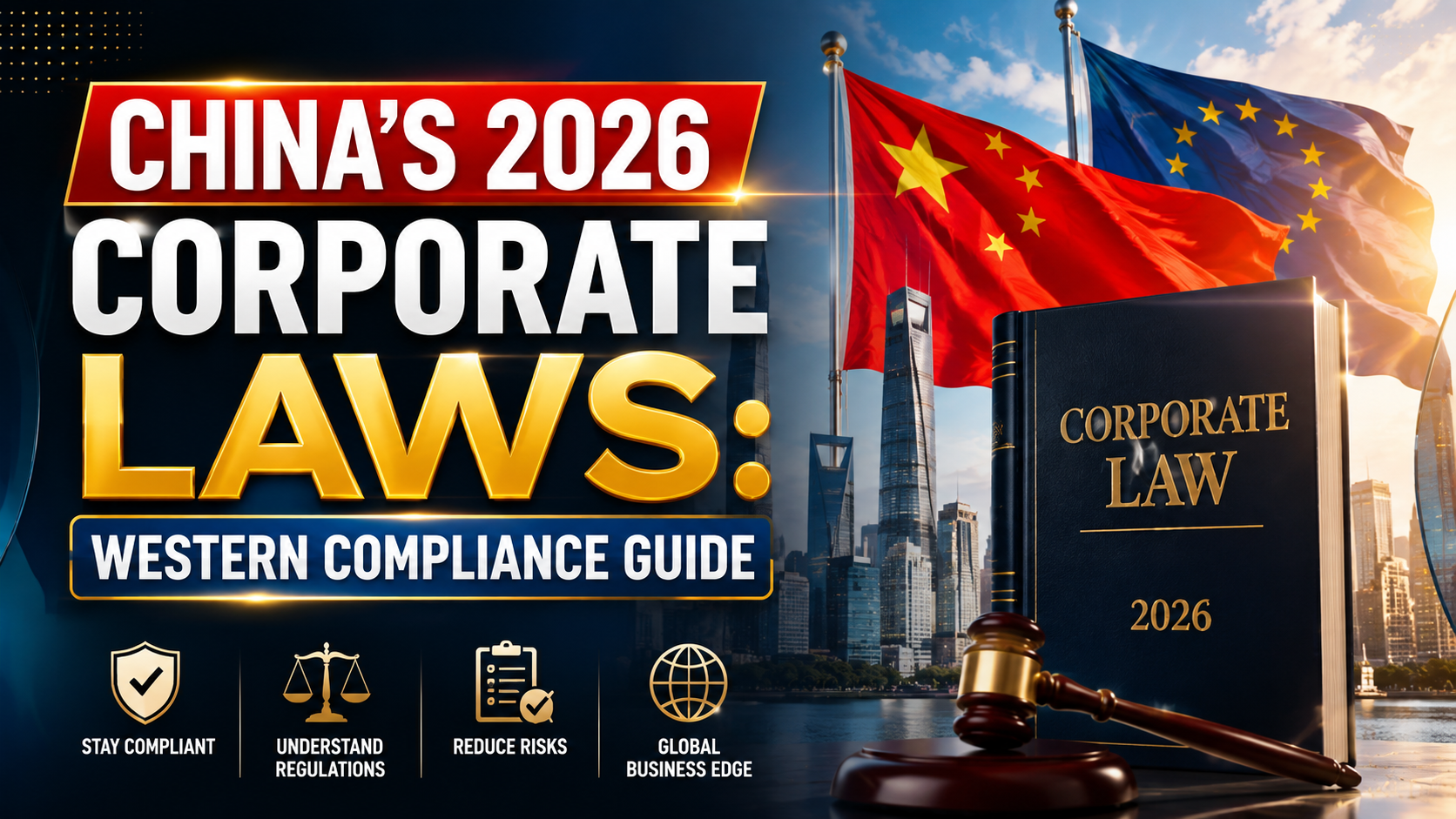
For multinational corporations and Western investors, operating in the People’s Republic of China has always required a delicate balance between massive market potential and stringent regulatory oversight. However, 2026 marks a watershed moment in corporate governance and geopolitical risk assessment. The Chinese government has systematically rolled out a series of aggressive, sweeping legislative updates targeting data security, cross-border information transfers, and supply chain sovereignty.
The era of regulatory leniency—often referred to by analysts as the “education phase” for foreign enterprises—is officially over. With the Cyberspace Administration of China (CAC) levying multi-million RMB fines on major corporations, Western boards and legal compliance teams must rapidly adjust to a legal landscape where data governance is inextricably linked to national security.
Here is the comprehensive, high-level analysis of China’s 2026 corporate law revisions, why they matter, and the investment strategies required to mitigate emerging regulatory risks.
The 2026 Regulatory Paradigm Shift
China’s regulatory strategy in 2026 is built upon closing loopholes in existing frameworks while introducing powerful new tools to counteract Western economic pressures (such as ESG due diligence and export controls).
1. The Amended Cybersecurity Law (Effective January 1, 2026)
The most substantial update to China’s digital infrastructure since 2017 occurred on January 1, 2026, when the amended Cybersecurity Law (CSL) took effect. This amendment tightly aligns network security obligations with the Personal Information Protection Law (PIPL) and the Data Security Law (DSL).
Crucially, the 2026 amendment overhauls the penalty structure. Regulators are no longer required to issue an “initial warning” or order a correction before imposing heavy fines. For critical information infrastructure operators (CIIOs) and standard network operators, violations regarding data minimization, purpose limitation, and consent now trigger immediate, tiered financial penalties.
2. Supply Chain Security and Counter-Extraterritoriality (Spring 2026)
In response to Western “de-risking” strategies and sanctions, the State Council enacted two highly consequential decrees:
- The Supply Chain Security Provisions (Decree No. 834): Effective March 31, 2026, this decree establishes an encompassing administrative structure to safeguard domestic industrial supply chains against foreign interference. It mandates strict scrutiny of foreign capital entering sectors deemed critical to China’s self-reliance.
- The Counter-Extraterritoriality Regulation (Decree No. 835): Effective April 13, 2026, this framework expands China’s legal toolkit to penalize companies that comply with “inappropriate” foreign sanctions or extraterritorial jurisdictions. This places Western companies in a precarious legal paradox: complying with US or EU sanctions could actively violate Chinese law, risking placement on the Unreliable Entity List (UEL).
Enforcement is Real: The End of the “Education Phase”
The assumption that China’s data enforcement apparatus primarily targets domestic tech giants has been shattered. The CAC is now actively auditing cross-border data transfers conducted by multinational corporations (MNCs).
The Ctrip Precedent
In June 2026, the Shanghai CAC fined Ctrip—a massive multinational travel agency—RMB 10 million. The penalty was issued for illegally transferring personal data overseas and failing to implement mandated security assessments. This enforcement action followed similar penalties levied in 2025 against the Shanghai affiliate of a Western luxury brand for transmitting user data to its global headquarters without completing cross-border compliance mechanisms.
The message to Western C-suites is clear: routine internal data sharing between a Chinese subsidiary and a Western headquarters is now a high-risk operational vulnerability.
Economic Impact Before vs. After 2026 Amendments
The financial and operational consequences of non-compliance have escalated dramatically. The table below illustrates the shift in the regulatory environment for foreign entities.
| Regulatory Area | Pre-2026 Landscape | Post-2026 Reality | Corporate Impact |
| Cybersecurity Fines (CSL) | Warnings issued prior to financial penalties. Max fines capped lower. | Immediate tiered penalties without warning. Explicit link to PIPL violations. | Compliance budgets must scale; zero-tolerance for data breaches. |
| Cross-Border Data Transfers | Ambiguous enforcement; companies granted a “grace period” to adjust. | Active CAC auditing; multi-million RMB fines (e.g., Ctrip case). | Requires localized data centers (data localization) and localized IT stacks. |
| Foreign Sanctions Compliance | Companies could quietly align with US/EU ESG or export controls. | Decree No. 835 makes complying with foreign sanctions a liability in China. | Companies face a “dual-compliance trap”; potential restructuring of Chinese entities. |
| M&A Due Diligence | Financial and commercial viability were the primary hurdles. | Data compliance posture dictates deal timelines and transaction structures. | Extended M&A timelines; mandatory pre-deal data audits. |
Why It Matters for Western Companies
This legislative overhaul fundamentally alters the cost-benefit analysis of foreign direct investment (FDI) in China.
- The Dual-Compliance Trap: Western companies are caught between conflicting legal obligations. Obeying a US Department of Commerce export restriction could trigger penalties under China’s Counter-Extraterritoriality Regulation.
- M&A Market Friction: For foreign acquirers, target companies must now undergo exhaustive cybersecurity and data handling audits. A target company’s failure to adhere to the PIPL can seamlessly transfer liability to the Western acquiring firm, freezing potential M&A activity.
- Bifurcation of Tech Stacks: To survive, Western companies can no longer rely on global, centralized IT infrastructure. Operating in China now requires a fully localized, ring-fenced tech stack to ensure Chinese citizen data never crosses borders without explicit, government-approved security assessments.
What to Do Next: Compliance and Investment Strategies
For wealth managers, enterprise leaders, and corporate counsel, immediate action is required to protect shareholder value and prevent catastrophic regulatory fines.
- Conduct Immediate Cross-Border Data Audits: Map every single data flow between your Chinese subsidiaries and your global headquarters. If employee HR data, customer profiles, or financial metrics are being transmitted outside of China without a CAC-approved Standard Contract, halt the transfer immediately.
- Restructure Joint Ventures: Consider insulating your global brand by restructuring Chinese operations into legally distinct, localized entities. This “In China, For China” strategy limits the parent company’s liability under the new Supply Chain Security Provisions.
- Invest in Chinese Data Compliance Tech: From an investment strategy perspective, B2B software companies specializing in data localization, Chinese server hosting, and automated PIPL compliance are positioned for massive enterprise growth. Capital should be allocated toward localized tech infrastructure providers.
Frequently Asked Questions (FAQ)
1. Does the amended Cybersecurity Law apply to B2B companies, or just consumer tech?
It applies to all network operators and data processors in China, including B2B manufacturing, logistics, and professional services. If your company processes employee data or supplier information on a network, you are subject to the CSL and PIPL.
2. What happens if a Western company complies with a US government subpoena for Chinese data?
Under the Data Security Law (DSL) and the new 2026 Counter-Extraterritoriality Regulation, transferring domestic data to a foreign judicial or law enforcement body without prior approval from Beijing is strictly illegal and will trigger severe corporate penalties.
3. Is it still profitable for Western companies to operate in China?
Yes, but the margin profile has changed. The overhead costs required to maintain a localized, compliant IT infrastructure and navigate the complex legal environment mean that only companies with substantial, committed market share in China will find the risk-reward ratio favorable in 2026.
Discover more from The Economy
Subscribe to get the latest posts sent to your email.

Inside the White House Feud: How Trump’s Allies Are Painting Anthropic’s Dario Amodei as the Face of ‘AI Doomerism’

Truck Collision Attorney: What Your Case Is Really Worth After a Semi-Truck Crash

Beyond Petrochemicals: How Indonesia’s Chandra Asri is Constructing an Integrated ASEAN Mobility Powerhouse

Pakistan Moves From Stabilization to Recovery as IMF Review Puts Reform Momentum in Focus

Mesothelioma Attorney: How to Choose the Right Lawyer to Maximize Your 2026 Asbestos Settlement

SpaceX IPO 2026: History’s Biggest Stock Debut?

Pakistan Economy 2026: Inside the SBP’s Balancing Act

Is AI a Stock Bubble in 2026? What the Data Shows

Oil Prices 2026: Inside the Hormuz Crisis That Won’t End

Gold Price 2026: Inside the Wildest Rally in Decades

Federal Reserve 2026: Inside Kevin Warsh’s First Year

Fox Corp 2026: Record Revenue, Tubi Growth & Roku Deal

Wendy’s Stock 2026: Inside the Turnaround Plan

Technology News 2026: Inside the $1.3T AI Chip Boom

Top 30 Stocks for Investment in PSX for Massive ROI in 2026

SpaceX Starship Flight 14: First Orbital Attempt & Starlink V3 Launch Explained

AI Chip Stocks 2026: The Best Semiconductor Investments Beyond Marvell

Oil Prices Break $100 in 2026: Middle East Conflict & Energy Markets

Fidelity Investments Review 2026: SPAXX Yields & Zero-Fee Funds

Tween Back-to-School Trends 2026: What’s Driving the $85B Season

BRICS+ Cross-Border Payments 2026: Interoperability Explained

10-Year Treasury Yield Hits 4.80%: What It Means for Rates & Portfolios

Shein Clothes Quality & Safety in 2026: What Lab Tests Show

China’s US$10.8 Billion Trade Shortcut: Why the Pinglu Canal Matters

MRVL Earnings 2026: Why Marvell Sank Despite Beating Estimates

Leveraging Viral AI & Climate Hashtags for Brand Growth on X

IMF & World Bank 2026 Global Economic Outlook: Growth, Inflation, Debt

Middle East War Economics 2026: Oil Prices & Energy Markets
-

 Markets & Finance9 months ago
Top 15 Stocks for Investment in 2026 in PSX: Your Complete Guide to Pakistan’s Best Investment Opportunities
-

 Analysis7 months ago
Johor’s Investment Boom: The Hidden Costs Behind Malaysia’s Most Ambitious Economic Surge
-

 Analysis7 months ago
Top 10 Stocks for Investment in PSX for Quick Returns in 2026
-

 Banks8 months ago
Best Investments in Pakistan 2026: Top 10 Low-Price Shares and Long-Term Picks for the PSX
-

 Analysis8 months ago
Brazil’s Rare Earth Race: US, EU, and China Compete for Critical Minerals as Tensions Rise
-

 Investment9 months ago
Top 10 Mutual Fund Managers in Pakistan for Investment in 2026: A Comprehensive Guide for Optimal Returns
-

 Global Economy9 months ago
15 Most Lucrative Sectors for Investment in Pakistan: A 2025 Data-Driven Analysis
-

 Global Economy9 months ago
Pakistan’s Export Goldmine: 10 Game-Changing Markets Where Pakistani Businesses Are Winning Big in 2025