Connect with us

Analysis

Oil Prices Set to Skyrocket as Iran Closes Strait of Hormuz Following US-Israel Strikes

Published

on

Iran has closed the Strait of Hormuz after US-Israel strikes on February 28, 2026. With 20% of global oil supply at risk, Brent crude—trading at $72.87 before markets close—could surge to $100–$140. Here’s what it means for the global economy.

On the morning of February 28, 2026, smoke was still rising above Tehran when the world’s most consequential maritime chokepoint fell silent to commercial tankers. Iran’s state-run Tasnim News Agency confirmed what oil traders had dreaded for decades: the Strait of Hormuz, a narrow 21-mile-wide waterway through which roughly 20 percent of the world’s entire oil supply flows daily, has been closed in the wake of coordinated US-Israel strikes on Iranian military and governmental targets. Markets are not yet open — they will be on Monday — but the tremors are already being felt across futures exchanges, commodities desks, and the corridors of OPEC ministries from Riyadh to Abu Dhabi.

This is not merely a geopolitical crisis. It is a potential structural rupture in the architecture of global energy supply.

What Happened: The Strikes That Changed Everything

Shortly before dawn on Saturday, US President Donald Trump announced what he called “major combat operations” in Iran, saying the US military, acting in coordination with Israel, was targeting Iran’s missile industry, leadership infrastructure, and defense installations. Multiple cities, including Tehran, Shiraz, and Isfahan, reported explosions. Iran’s foreign minister, Seyed Abbas Araghchi, denounced the assault as “wholly unprovoked, illegal, and illegitimate,” and confirmed that Iran’s supreme leader Ayatollah Ali Khamenei and the president remained alive. Iran swiftly launched retaliatory missiles toward Israeli territory.

The strikes came after diplomatic talks in Geneva — mediated by Oman’s Foreign Minister — failed to produce a nuclear agreement. Reuters reported that some of the world’s largest oil majors and trading houses had already suspended crude shipments through the strait within hours of the attacks, citing four trading sources. Iran’s Tasnim News Agency subsequently confirmed the Strait of Hormuz had been closed, invoking what analysts call the “Hormuz card” — a threat Tehran has held, and never previously played in full, for nearly four decades.

President Trump’s own video address that morning had specifically called for neutralizing Iran’s navy, a signal, analysts note, that Washington anticipated Tehran would reach for its most powerful economic weapon.

The Strait of Hormuz: Why This Chokepoint Has No Equal

To understand the magnitude of what is unfolding, it is worth stepping back from the headlines and examining the geography of global energy.

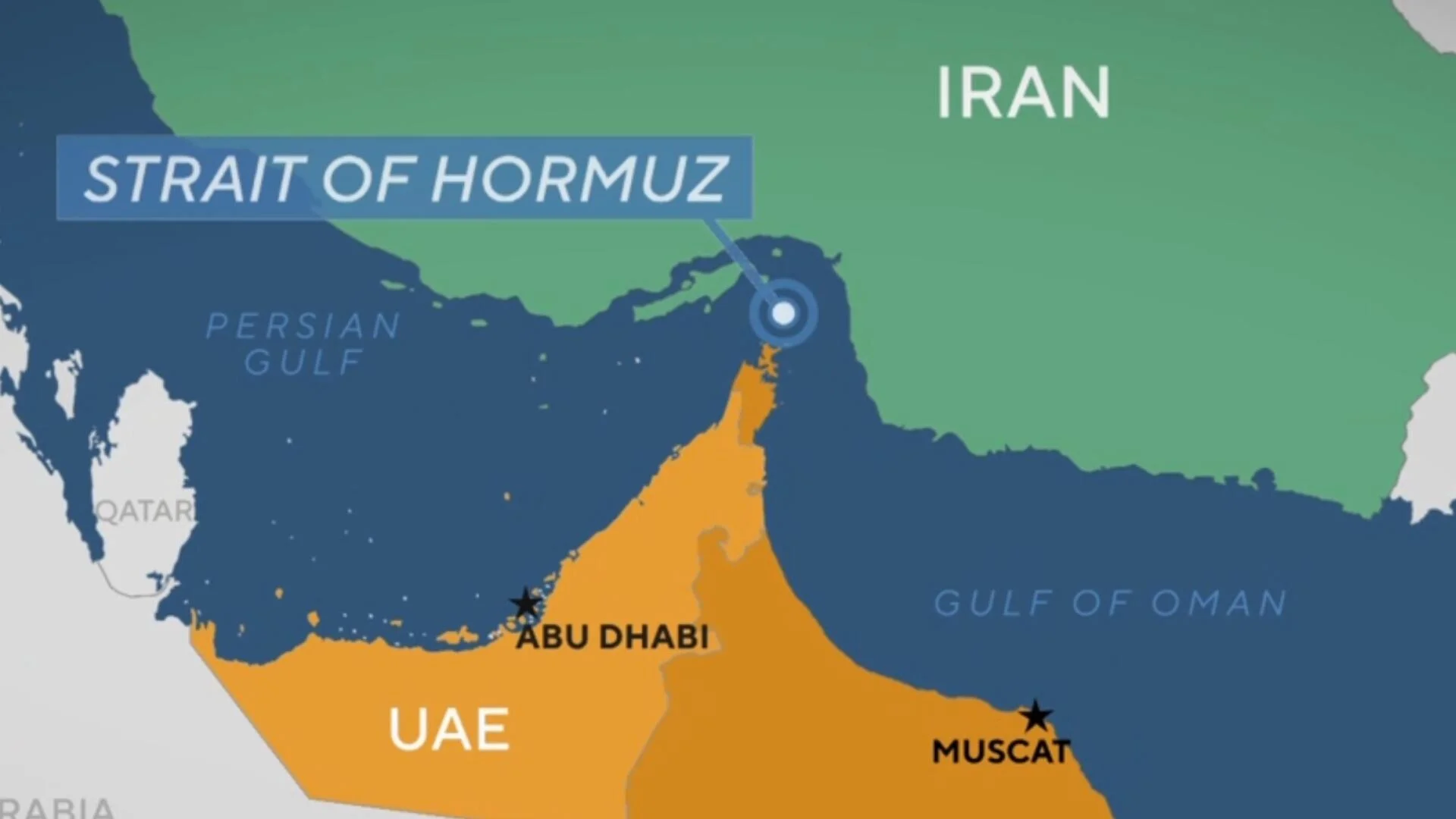
The Strait of Hormuz sits between Iran to the north and Oman to the south, connecting the Persian Gulf to the Gulf of Oman and, ultimately, to the Indian Ocean and global markets. According to the US Energy Information Administration (EIA), approximately 20 million barrels of oil and petroleum products transited the strait daily in 2024, representing close to 20 percent of global liquid oil consumption. Bloomberg notes the strait handles roughly a quarter of the world’s entire seaborne oil trade. Market intelligence firm Kpler puts seaborne crude flows alone at around 13 million barrels per day in 2025, accounting for roughly 31 percent of global seaborne crude.

The strait also carries 22 percent of global LNG trade, making it uniquely critical for both oil-importing nations in Asia and gas-dependent economies in Europe.

Unlike the Suez Canal or even the Red Sea — where Houthi disruptions over the past year prompted painful but ultimately navigable rerouting — the Strait of Hormuz has no viable alternative. Existing pipeline capacity can divert only a fraction of these flows. ING Group’s commodities strategy team calculates that even accounting for all available pipeline diversions, approximately 9 million barrels per day of crude oil and 6 million barrels per day of refined products remain fully exposed to disruption if the strait is compromised.

As one Foreign Policy analysis put it bluntly: “Unlike the Red Sea and the Suez Canal, Hormuz does not have any real alternatives.”

Oil Price Forecasts: From $72 to $140 — What Analysts Say

ScenarioBrent Crude ForecastSource
Pre-strike baseline (Feb 28 close)$72.87/bblMarket data
Partial disruption / tanker harassment$80–$100/bblING Group, Lombard Odier
Iranian export infrastructure damaged~$90/bbl peak, then retreatGoldman Sachs
Full Hormuz blockade (sustained)$120–$140/bblJ.P. Morgan, ING Group
Worst-case: regime collapse scenario$110+/bbl sustainedNomura, Business Standard

Brent crude closed 2.87 percent higher at $72.87 per barrel on Friday, and West Texas Intermediate (WTI) ended at $67.02, both reflecting mounting risk premiums even before the strikes were confirmed, according to The National. On decentralized exchange Hyperliquid, oil-linked perpetual futures had already surged more than 5 percent in overnight trading, with one contract advancing above $86, per CoinDesk.

Vandana Hari, chief executive of Singapore-based Vanda Insights, told The National she expected prices to jump to $80 per barrel in a “knee-jerk reaction” if the war continues into Monday’s open. Swiss bank Lombard Odier estimated that a prolonged disruption to the Strait of Hormuz could produce a temporary spike to $100 per barrel or beyond. J.P. Morgan’s analysis, cited by TheStreet, warned that a full blockade could push prices to $120–$130 per barrel.

ING Group’s Warren Patterson, head of commodities strategy, is starker still: a successful sustained blockade would push Brent to $140 per barrel, at which point “higher prices would be needed to ensure demand destruction” — the brutal market mechanism where consumption collapses because it becomes unaffordable.

The current geopolitical risk premium already embedded in the oil price is estimated at $10 per barrel by ING and Goldman Sachs, meaning that in a scenario where tensions de-escalate rapidly — if, say, a ceasefire is announced — a pullback of $10 or more is equally possible.

Cause and Consequence: What Triggered This and Who Moved First

The strikes of February 28 did not emerge from a vacuum. Diplomatic talks between the US and Iran had been ongoing through February, mediated by Oman in Geneva, with both sides reportedly making “significant progress” on nuclear issues as recently as Thursday. But Trump had set an aggressive deadline — one the Iranian side was either unable or unwilling to meet in full. Washington’s core demands included a complete cessation of uranium enrichment, the handover of enriched stockpiles, limits on ballistic missile development, and an end to support for regional proxies. Tehran, which insists its nuclear program is civilian in nature, sought to retain limited enrichment rights and the lifting of crippling economic sanctions.

When those talks adjourned without a deal, US and Israeli forces moved.

Critically, Trump stated in his video address that the objective was to “eliminate imminent threats from the Iranian regime” and called on the Iranian military to stand down — language that many analysts interpreted as signaling a potential regime-change goal rather than a limited deterrent strike. That distinction matters enormously for the oil market. A regime-change campaign would imply a prolonged conflict, greater Iranian desperation, and a far higher probability that Tehran actually uses the Hormuz card, rather than merely threatening it.

Ripple Effects: Inflation, Shipping, and the Global Consumer

The economic consequences of a prolonged Hormuz disruption would radiate far beyond the pump price.

Inflation: Rising oil prices feed directly into consumer price indices through transportation, manufacturing, and energy costs. CNBC noted that higher energy costs would make it harder for central banks to cut borrowing costs or support growth — particularly painful for economies already navigating elevated debt loads. In the United States, which heads into mid-term elections later in 2026, the political sensitivity of energy price spikes adds a layer of domestic constraint on the administration’s options.

Shipping: Very Large Crude Carrier (VLCC) rates on Middle East-to-China routes had already tripled since the start of 2026, exceeding $150,000 per day — the highest since 2020. A Hormuz closure would send these rates into uncharted territory. Iran’s “shadow fleet,” which accounts for roughly 18 percent of global tanker capacity, has already seen 86 percent of its vessels targeted by US sanctions, further tightening the available shipping pool.

LNG markets: If Hormuz is disrupted, global LNG prices could retest the record highs of 2022, according to analysts cited by Reuters. For European nations that spent 2022–2023 rewiring their gas import infrastructure away from Russia, this would be a second consecutive energy shock within four years.

Insurance premiums: Maritime war risk insurance costs are expected to spike by 200–400 percent in a sustained disruption scenario, per Mirae Asset Sharekhan analysts, adding further cost to every barrel that does manage to move through alternative routes.

The Global Stakes: China, India, and Europe in the Crosshairs

No economy faces a more direct exposure to Hormuz disruption than China. Over 80 percent of Iran’s oil exports are bound for Chinese refineries, and China’s total Gulf crude imports — from Saudi Arabia, Iraq, the UAE, and Kuwait combined — transit the strait entirely. Beijing has spent the past two years quietly building strategic oil stockpiles at roughly 1 million barrels per day, a buffer that provides some cushion, but nothing close to absorbing months of disruption. More broadly, China views Iran as a critical node in its Belt and Road trade architecture, meaning Beijing has both economic and strategic incentives to push for de-escalation — but limited direct leverage over either Washington or Tehran in this crisis.

India, which has substantially grown its dependence on discounted Russian and Gulf crude, faces comparable vulnerability. The country’s refinery infrastructure is calibrated for Middle Eastern crude grades that flow exclusively through Hormuz. A disruption at this scale would force emergency diversions and likely compel India to draw on strategic reserves while its economy absorbs a significant inflation shock.

Europe, largely dependent on pipeline gas and LNG from Gulf and US sources, faces the twin pressure of rising energy import costs and the inflationary knock-on effects of a global oil spike. The region had already navigated extraordinary energy disruptions following Russia’s invasion of Ukraine in 2022; a second major supply shock within four years would test the resilience of consumer confidence and industrial competitiveness across the continent.

Can the Strait Actually Be Closed? The Military Calculus

Experts are divided on Iran’s practical ability to sustain a Hormuz closure. The Congress Research Service has noted that a full closure has never occurred in history — even during the Iran-Iraq War of the 1980s, when Iran mined the strait and attacked tankers, traffic continued. The US Fifth Fleet is permanently stationed in Bahrain, with carrier strike groups and mine countermeasure vessels specifically designed and drilled for a Hormuz contingency. Trump’s own video address specifically called for neutralizing Iran’s navy as a war objective, suggesting US planners were pre-emptively targeting the capability Iran would need to sustain any blockade.

Analysts at Foreign Policy caution that while “Iran can degrade enough that it cannot sustain a closure of the strait,” it remains “less likely to completely remove the threat of one-off attacks or harassment of vessels.” The practical reality, in other words, is likely to be not a binary open-or-closed scenario, but a sustained period of elevated risk, intermittent attacks, and dramatically inflated shipping and insurance costs — all of which have substantial economic effects even without a full closure.

Critically, Saudi Arabia and the UAE have already positioned themselves to absorb some of the supply gap. Amro Zakaria, global financial markets strategist at Kyoto Network, confirmed that Gulf producers were ramping up output before the conflict erupted. “Saudi, the UAE, etc., were already boosting production to cover for any disruptions. They can more than replace Iranian exports — of course, as long as there are no Gulf disruptions,” Robin Mills, CEO of Qamar Energy, told The National.

OPEC+ producers are also holding an emergency meeting on Sunday to evaluate whether to increase output quotas beyond the planned 137,000 barrels per day increment — potentially a significant stabilizing signal for markets heading into Monday’s open.

The Road Ahead: De-escalation or Prolonged Crisis?

The central question now facing energy markets, governments, and consumers is duration. Quantum Strategy’s David Roche framed it to CNBC as a simple fork: if the conflict is short and contained, the oil spike and risk-off market move will be sharp but brief, reverting once the strait reopens and Iranian supply stabilizes. If it becomes a three-to-five-week campaign aimed at regime change, markets would price in prolonged supply disruption — and the global economy would face something analysts are already calling potentially “three times the severity of the Arab oil embargo and the Iranian Revolution combined.”

Three pathways are now in view. The first is a rapid ceasefire or diplomatic intervention — perhaps through China, Oman, or the UN Security Council, which has called an emergency meeting — that halts the strikes and reopens the strait quickly. The second is a targeted, time-limited campaign that degrades Iran’s military capabilities without toppling the regime, followed by a negotiated re-engagement. The third — and most disruptive — is a full regime-change war lasting weeks or months, during which the Hormuz threat becomes a persistent structural feature of oil markets rather than a tail risk.

Nomura’s analysts note that a longer war, paradoxically, might ultimately be bearish for oil prices — as history from the Russia-Ukraine conflict suggests that markets adapt over time, alternative supplies fill gaps, and the initial war premium gradually fades. The short-term shock, however, would be severe.

For now, the world waits for Monday’s market open. The numbers will tell their own story — but the human and economic stakes behind them are already clear.

Key Data Summary

MetricFigureSource
Daily oil flow through Hormuz~20 million barrelsEIA, 2024
Share of global oil supply~20%EIA / NPR
Share of global LNG trade~22%Congress Research Service
Brent crude close, Feb 28 (pre-open)$72.87/bblMarket data
WTI close, Feb 28 (pre-open)$67.02/bblMarket data
Current geopolitical risk premium~$10/bblING Group, Goldman Sachs
Partial disruption price estimate$80–$100/bblLombard Odier, ING
Full blockade price estimate$120–$140/bblJ.P. Morgan, ING Group
VLCC tanker rate (Middle East–China)$150,000+/dayMirae Asset Sharekhan
Iran daily oil exports~1.9–3.1 million bbl/dayIEA, OPEC


Discover more from The Economy

Subscribe to get the latest posts sent to your email.

Analysis

Trump’s Gamble on the Strait: The US Blockade of Iran’s Ports Is History’s Most Consequential Naval Move in a Generation

Published

on

As the world’s most critical oil chokepoint becomes a two-front battleground, Washington has placed a $100-a-barrel bet that squeezing Tehran’s last revenue lifeline will force a deal — or risk igniting the worst energy catastrophe since the 1970s.

At 10 a.m. Eastern Time on Monday, April 13, 2026, the United States Navy did something no American president had ordered since the Cold War: it declared a wartime blockade of a sovereign nation’s ports. The target was Iran. The battlefield was the 34-kilometre chokepoint through which roughly one-fifth of the world’s oil has historically flowed. And the stakes, for energy markets, global diplomacy, and the fragile ceasefire still clinging to life on paper, could scarcely be higher.

This is not posturing. This is history, unfolding in real time.

What the US Navy Is Actually Doing Right Now

The terminology matters. President Trump initially threatened to shut down the Strait of Hormuz entirely — to stop “any and all ships trying to enter, or leave.” CENTCOM’s actual operational order was narrower but no less significant: the blockade applies to “all maritime traffic entering and exiting Iranian ports and coastal areas,” encompassing the entirety of Iran’s coastline along the Arabian Gulf, Gulf of Oman, and the Arabian Sea east of the strait. Ships transiting to and from non-Iranian ports retain the right of passage.

In practice, this means the US Navy — fielding at least 15 warships in the region, including the USS Abraham Lincoln carrier strike group, the USS Tripoli amphibious group, and 11 guided-missile destroyers — is positioned to intercept, divert, or capture any vessel that has paid Tehran’s notorious “Hormuz toll.” Trump had already instructed the Navy “to seek and interdict every vessel in international waters that has paid a toll to Iran.” Iran, for its part, has been charging ships up to $2 million per transit — what the president called “WORLD EXTORTION.” Annualized across roughly 100 ships a day, that is a potential windfall of $73 billion — more than the entire US Navy’s annual shipbuilding budget.

The blockade took effect, and by Tuesday morning, at least 31 vessels had passed through the strait in the prior 24 hours — though most were empty, and several were sanctioned Chinese-linked tankers testing enforcement boundaries. The US Navy’s mine-clearance operation, which CENTCOM says involves destroyers USS Frank E. Peterson and USS Michael Murphy sweeping IRGC-laid mines, is also underway. Trump announced on April 11 that American forces had begun “clearing” the strait.

The machinery of naval warfare is now fully engaged.

The Oil Lifeline at Stake — and the Global Ripple Effects

To understand why this matters far beyond the Persian Gulf, consider what the Strait of Hormuz represents in raw economic terms. Before February 28, 2026, when the US and Israel launched their surprise air campaign against Iran and killed Supreme Leader Ali Khamenei, the strait carried approximately 20 million barrels of oil per day — roughly 20% of all global seaborne crude — and 20% of the world’s liquefied natural gas. Since Iran closed it in retaliation, shipments through the strait have fallen by more than 90%, trapping an estimated 230 loaded oil tankers inside the Gulf.

Brent crude, which traded at roughly $70 per barrel before the war, surged 7% to $102 on Monday alone — a 40% rise since hostilities began. WTI climbed above $104. Analysts at the Quincy Institute warned that a sustained blockade of Iran’s remaining oil exports — which had averaged around 1.85 million barrels per day through March, up slightly from pre-war levels as Tehran exploited the price spike — could drive Brent to $150 per barrel. Fatih Birol, head of the International Energy Agency, has already described the ongoing disruption as “the worst energy shock the world has ever seen — more severe than the oil crises of the 1970s and the Ukraine war combined.”

The IEA now projects global oil demand will fall by 80,000 barrels per day in 2026, with Middle East and Asia-Pacific economies absorbing the steepest consumption drops. The IMF, in a joint statement with the World Bank and IEA, warned that “even after a resumption of regular shipping flows through the Strait, it will take time for global supplies of key commodities to move back towards their pre-conflict levels — and fuel and fertilizer prices may remain high for a prolonged period.” The IMF is now projecting global growth at 3.1% in 2026.

For American consumers, the pain is already visible at the pump. The average price of a US gallon of gasoline has risen past $4.12, up from under $3 before the war began. Iran’s parliamentary speaker, Mohammad Bagher Ghalibaf, taunted Americans on Monday, predicting the “so-called blockade” would soon make them “nostalgic for $4–$5 gas.”

He may not be wrong in the short term. But that is precisely the wager Trump appears willing to make.

Geopolitical Blowback and the Ceasefire Tipping Point

The April 7 ceasefire — brokered with the involvement of Pakistan as mediator — was always fragile. Iran agreed in principle to reopen the strait; in practice, it began conditioning and restricting passage, charging its $2 million “toll booth” fee and allowing only favored vessels through. The ceasefire’s collapse accelerated when Israel resumed large-scale airstrikes across Lebanon on April 8, targeting Hezbollah leadership. Tehran accused Washington of violating the truce. Islamabad, which had declared the ceasefire covered all regional fronts including Lebanon, urged both sides to return to the table.

The Islamabad Talks of April 11–12 lasted 21 hours. Vice President Vance spent those hours in Pakistan, negotiating through the night. The sticking points were existential: Washington demanded Iran surrender its stockpile of highly enriched uranium and halt all nuclear-weapons-related activity. Tehran refused to accept joint management of the Strait of Hormuz. Iran insisted the ceasefire must cover Lebanon. The talks ended without agreement. Vance departed. Trump declared the blockade.

Iran’s IRGC has since warned that any military vessel approaching the strait constitutes a ceasefire violation warranting a “severe response.” Iran’s acting defense minister placed its armed forces on “maximum combat alert.” Iranian Foreign Minister Abbas Araghchi warned Saudi Arabia and Qatar directly of “dangerous consequences.” Tehran has described the blockade as “piracy” and an act of war under international law.

Russia’s Kremlin spokesman Dmitry Peskov warned the blockade “will continue to negatively impact international markets.” France and the United Kingdom announced a joint summit to convene a “peaceful multinational mission” to restore freedom of navigation — a diplomatic pivot that implicitly signals European discomfort with both Iran’s toll regime and Washington’s escalatory response. The UK is reportedly leading planning efforts for a coalition of more than 40 nations. That coalition exists not to support the US blockade, but to chart a third path.

The ceasefire, due to expire on April 21, is now barely alive.

Historical Parallels and Strategic Calculus

History offers imperfect but instructive precedents. The most commonly cited is the US naval blockade of Cuba in October 1962 — euphemistically called a “quarantine” — which stopped Soviet arms deliveries and forced Khrushchev to blink. The lesson drawn by hawks in Washington is simple: economic and naval pressure, applied sharply enough, compels adversaries to negotiate.

But there is a second, less flattering parallel: the 1980s Tanker War, when Iranian and Iraqi forces attacked each other’s oil shipping in the Gulf, eventually drawing the US into Operation Earnest Will — the largest naval convoy operation since World War II — to escort Kuwaiti tankers under American flags. That operation demonstrated how quickly commercial shipping incidents can entangle great powers in a conflict not of their choosing. Today, with Chinese-owned sanctioned tankers already transiting the strait in defiance of the blockade, and Beijing explicitly warning that its ships will continue doing so, that escalatory risk is acutely real.

There is also the Venezuelan precedent worth examining. When the Trump administration tightened sanctions and threatened naval interdiction of Venezuelan oil exports in 2019–2020, Caracas’s output collapsed — but Maduro did not fall. Tehran is a far more capable military actor than Caracas, with drone technology battle-tested in Ukraine and missile systems capable of threatening every Gulf state.

Retired Admiral James Stavridis, NATO’s former supreme allied commander, has framed the blockade as falling “halfway between leaving it under Iranian control and Trump’s earlier threat to wipe out Iran as a civilization.” It is, as he put it, economic pressure without destroying oil infrastructure “which you should want to preserve into the future.” Robin Brooks of the Brookings Institution made a sharper argument: cutting Iran’s oil revenue could “implode Iran’s economy,” and crucially, it would give China — the largest buyer of Iranian crude — powerful incentive to lobby Tehran toward a deal.

That China calculus may be the most underappreciated dimension of this entire strategy.

Why This Matters for Asia, Europe, and Global Energy Security

In 2024, an estimated 84% of crude oil shipments through the Strait of Hormuz were destined for Asian markets. China alone receives roughly a third of its oil via the strait and imports approximately 10% of its crude from Iran — often through “dark transit” third-country intermediaries. Beijing holds large crude reserves as a buffer, but a protracted disruption will ripple through its chemical, manufacturing, and LNG sectors for months. Oxford Institute for Energy Studies research from March 2026 identified China’s chemical and petrochemical hubs in Zhejiang, Jiangsu, and Guangdong as particularly exposed, facing a “double whammy” of price spikes and naphtha and LPG availability concerns.

China’s foreign ministry has called the US blockade “dangerous and irresponsible.” But Beijing’s response has been characteristically calibrated — it denied supplying Iran with shoulder-fired air defense systems (after Trump threatened 50% tariffs on any country arming Tehran), urged all parties to return to negotiations, and confirmed that Chinese vessels will continue transiting the strait. The Chinese-owned tanker Rich Starry was reportedly the first vessel to pass through the blockade zone on Tuesday morning, defying American enforcement. Trump also acknowledged on Monday that President Xi “would like to see” the war end.

That acknowledgment is not incidental. It is a signal that Washington is using the blockade partly as leverage over Beijing — to push China to push Iran. It is coercive diplomacy operating on multiple levels simultaneously.

For Europe, the stakes are more immediate and less amenable to strategic patience. Macron and Starmer are convening partners this week on a “strictly defensive” multinational mission to restore freedom of navigation — a politically necessary move that distances Europe from the legal and moral complications of Trump’s blockade while aligning with the shared interest of reopening the world’s most important oil chokepoint.

India, notably, has deployed over five warships — including destroyers and frigates — under Operation Urja Suraksha to escort Indian-flagged cargo ships stranded west of Hormuz, a quiet but meaningful assertion of energy sovereignty by the world’s third-largest oil importer.

Expert Opinion: Is Trump’s Gamble Worth the Risk?

Let me be direct about something that most of the commentary on this blockade has skirted around: the Trump administration’s logic is more coherent than its critics are admitting.

The status quo before April 13 was arguably worse. Iran was running a shadow toll operation through the world’s most critical waterway — collecting up to $2 million per ship, financing its military machine, profiting from the very crisis it had created — while nominally observing a ceasefire it was systematically undermining. That combination of economic terrorism and diplomatic bad faith left Washington with diminishing options. Continued bombardment of Iranian infrastructure risked civilian casualties and widening the war. Accepting Iran’s toll regime amounted to legitimizing extortion on a geopolitical scale. The blockade threads a middle path: it denies Tehran the revenue that funds the war machine, without adding to the kinetic destruction.

The Brookings argument deserves serious weight: China — facing supply disruptions to its chemical and industrial sectors, watching its LNG imports dry up, and now threatened with 50% tariffs if it arms Tehran — has powerful economic incentives to push Iran toward a deal. If Beijing leans on Tehran in the next two weeks before the ceasefire expires on April 21, a negotiated reopening of the strait becomes imaginable. The S&P 500 closed up more than 1% on Monday, erasing all losses since the war began — suggesting that markets, at least for now, are pricing in exactly this scenario.

But the risk calculus has several under-discussed failure modes. First, enforcement is genuinely hard. Blockade line control requires identifying and searching vessels, aerial surveillance, deterring IRGC fast-attack boats, and responding to mines — all simultaneously, across an extended maritime perimeter, with a Navy already stretched across the Indo-Pacific and Mediterranean. The longer this lasts, the greater the strain on American naval readiness elsewhere.

Second, Iran still holds the trump card of symmetric escalation. Tehran’s threat that “no port in the Persian Gulf and the Arabian Sea” would be safe if its own ports are threatened is not idle. A drone strike on a Saudi terminal or Abu Dhabi’s ADNOC infrastructure would instantly erase any blockade-induced economic pressure on Iran by cratering Gulf state oil production and sending prices to levels that make $100 per barrel look nostalgic.

Third, the legal status of the blockade is genuinely contestable. International law — specifically the rules governing transit passage through international straits — prohibits even coastal states from suspending transit through the Strait of Hormuz. The US, which is not a coastal state of the strait, lacks the legal authority under UNCLOS to impose a blockade on the international waterway. CENTCOM’s narrower formulation — targeting only vessels heading to Iranian ports, not all transit traffic — is legally cleaner, but Iran’s counter-argument that any interdiction constitutes piracy will resonate in international forums.

My assessment: this is a high-risk, high-reward gambit that has roughly a 40% chance of working as intended — forcing Iran back to the table within the next two weeks, producing a negotiated ceasefire that includes a genuine reopening of the strait and a framework on Iran’s nuclear program. It has a roughly 35% chance of producing a messy stalemate — the blockade partially enforced, Iranian oil flowing at reduced volumes through shadow-fleet vessels, prices plateauing around $100–$110, and the ceasefire technically surviving while both sides maneuver. And it has a roughly 25% chance of triggering the scenario markets are most afraid of: an Iranian strike on Gulf state infrastructure, a direct confrontation between the US Navy and Chinese-flagged vessels, or a miscalculation at sea that turns a naval standoff into a kinetic exchange.

That last scenario, even at 25%, represents an unacceptable downside for the global economy and regional stability. Which is why the next 72 hours — the first real test of blockade enforcement — matter enormously.

FAQ: The US Blockade of Iran’s Ports — What You Need to Know

What exactly is the US naval blockade of Iran’s ports? The US military blockade, which took effect at 10 a.m. ET on April 13, 2026, targets all maritime traffic entering and exiting Iranian ports and coastal areas along the Arabian Gulf, Gulf of Oman, and Arabian Sea. CENTCOM has clarified that ships transiting between non-Iranian ports retain their right of passage through the Strait of Hormuz.

Why did Trump order the Hormuz blockade now? The blockade was declared immediately after 21 hours of US–Iran peace talks in Islamabad collapsed on April 12, with Iran refusing to surrender its enriched uranium stockpile or agree to joint management of the strait. Trump had also accused Iran of charging illegal tolls of up to $2 million per ship, which he characterized as “economic terrorism.”

What is the economic impact of the US blockade of Iran in 2026? Brent crude surged to over $102 per barrel on April 13, up roughly 40% since the war began. Iran’s oil exports — averaging approximately 1.85 million barrels per day through March — risk being cut off entirely, though China-linked vessels are already testing enforcement. The IEA, IMF, and World Bank have jointly warned that fuel and fertilizer prices may remain elevated “for a prolonged period” even after the strait reopens.

Does the US naval blockade of Iran’s ports violate international law? This is genuinely disputed. Several legal experts contend that the US lacks authority under UNCLOS to impede transit passage through the Strait of Hormuz, as only coastal states Iran and Oman can regulate passage — and even they cannot suspend it. CENTCOM’s narrower operational order, which targets only Iranian port traffic rather than all strait transit, is more legally defensible, but Iran has characterized any interdiction as piracy.

What is Saudi Arabia’s reaction to the US Hormuz blockade? Saudi Arabia has not made a strong public statement endorsing or condemning the blockade. The CEO of Abu Dhabi National Oil Company, Sultan Al Jaber, confirmed on April 9 that the strait remains effectively closed, with 230 loaded oil tankers trapped inside the Gulf — reflecting Gulf state frustration with Iran’s toll regime. France and the UK are now organizing a multinational coalition that Gulf states are likely to support diplomatically.

How does the Hormuz blockade affect Asian energy security? Asia is the most exposed region. Roughly 84% of Hormuz oil flows to Asian markets, with China and India being the largest buyers. China imports around a third of its crude via the strait and approximately 10% from Iran through third-country intermediaries. India has deployed its own warships under Operation Urja Suraksha to escort stranded Indian-flagged cargo ships. South Korean and Japanese energy companies face critical supply shortfalls if the disruption persists.

Is a second round of US–Iran talks possible despite the blockade? Yes, and it may be the most likely near-term outcome. VP Vance signaled on Monday that the ball is “in Iran’s court,” while Trump said he was “called by the right people” in Iran. Pakistan says it remains committed to mediation. Second-round talks were reportedly being eyed for as early as this week, even as the blockade remains in force. The ceasefire technically expires on April 21 — giving all parties a narrow window to de-escalate.

A Narrow Window Before History Forecloses Options

Twenty-one miles wide at its narrowest point. That is the physical space through which the geopolitical fate of the global energy economy is now being decided. Two navies — one American, one Iranian — are asserting competing claims over a chokepoint that neither, strictly speaking, owns. The rest of the world — China, India, Europe, the Gulf states — watches and waits, adjusting their strategic calculus in real time.

What Trump has done is audacious in the classical sense: he has seized the initiative at the risk of overextending. The bet is that cutting Iran off from the war profits of its own making — the oil windfall that the Hormuz crisis generated — will make the Islamic Republic’s continued defiance unsustainable. The counter-bet, placed by Tehran, is that American consumers will flinch before Iranian leaders do.

History will judge which was correct. But it will render that judgment quickly. The ceasefire expires April 21. The clock is running.


Discover more from The Economy

Subscribe to get the latest posts sent to your email.

Continue Reading

Analysis

China Export Controls 2026: How Rare Earths, Tungsten, and Middle East Chaos Are Reshaping Global Trade

Published

on

Beijing is weaponizing export controls on rare earths, tungsten, and antimony like never before. But the Iran war and Strait of Hormuz crisis are slowing China’s exports faster than expected.

The Shanghai Dilemma: Power Projection Meets Geopolitical Blowback

At 6:47 a.m. on a rain-slicked Tuesday in Shanghai, the Yangshan Deep Water Port hums with a tension that belies its orderly choreography. Container cranes glide above stacks of solar panels bound for Rotterdam, electric vehicle batteries destined for Stuttgart, and precision-machined tungsten components awaiting shipment to Japanese automotive plants. Yet the port captain’s dispatch log tells a different story: three vessels bound for the Persian Gulf have been rerouted to anchorages off Singapore, their insurance premiums having quadrupled overnight due to the ongoing Strait of Hormuz crisis.

This is the paradox defining global trade in April 2026. China has constructed its most sophisticated export control architecture in history—weaponizing rare earths, tungsten, antimony, silver, and lithium battery technologies as instruments of economic statecraft—yet the very global instability Beijing once exploited is now biting back with surgical precision. The Middle East war, now entering its third month, has transformed from a distant energy crisis into an immediate threat to China’s export engine, exposing the fragility beneath Beijing’s muscular trade posture.

The numbers are stark. China’s exports grew just 2.5% year-on-year in March 2026—a precipitous collapse from the 21.8% surge recorded in January and February, and well below the 8.6% consensus forecast from a Reuters poll of economists. Imports, conversely, surged 27.8% as Beijing stockpiled energy and commodities ahead of further price shocks, compressing the trade surplus to $51.1 billion against expectations of $108.2 billion.

“China’s exports have decelerated as the Iran war starts to affect global demand and supply chains,” observes Gary Ng, senior economist for Asia Pacific at French bank Natixis. The assessment is understated. What we are witnessing is not merely a cyclical slowdown but a structural inflection point where China’s trade dominance confronts the limits of its own geopolitical risk tolerance.

Why China’s Export Controls Are Soaring in 2026

To understand the current moment, one must first grasp the scope of Beijing’s regulatory offensive. In late 2025 and early 2026, China’s Ministry of Commerce (MOFCOM) constructed a dual-track control system that represents a fundamental departure from market-based commodity allocation.

Track One: The Fixed Exporter Whitelist. For tungsten, antimony, and silver, Beijing designated precisely 15, 11, and 44 authorized exporters respectively for the 2026–2027 period. These are not mere licensing requirements—they constitute state trading enterprise frameworks where the government selects who may participate before determining how much they may ship. Companies cannot petition for inclusion; exclusion is effectively permanent without administrative remediation.

Track Two: Case-by-Case Licensing. For rare earths, gallium, germanium, and graphite, Beijing maintains individual shipment review processes where the nominal 45-day review window can stretch indefinitely, transforming administrative delay into strategic leverage.

The architecture is deliberately extraterritorial. Article 44 of China’s Export Control Law and the January 2026 Announcement No. 1 explicitly prohibit exports to Japanese military end-users—and any civilian entities whose products might enhance Japan’s defense capabilities. This represents a country-specific tightening beyond the general control framework, with third-party entities in Southeast Asia or Europe held liable for facilitating transfers to restricted Japanese destinations.

“The delay-based approach transforms administrative bureaucracy into economic warfare infrastructure, where uncertainty becomes a strategic asset,” notes one critical minerals analysis. The strategy is elegant in its WTO compliance: Beijing achieves practical supply disruption without triggering formal trade violation claims.

The November Truce: A Temporary Reprieve With Precision Exceptions

The export control escalation reached such intensity that it precipitated a rare diplomatic de-escalation. Following U.S.-China trade negotiations in November 2025, MOFCOM issued Announcements No. 70 and 72, suspending implementation of six October directives that would have tightened licensing for rare earths, magnet materials, lithium-battery inputs, and super-hard materials.

Most significantly, Article 2 of Announcement No. 46 (2024)—which imposed enhanced U.S.-focused licensing requirements for gallium, germanium, antimony, and graphite—was suspended until November 27, 2026

. The “50% rule” extraterritorial licensing obligations for foreign-made products incorporating Chinese-origin rare earth materials were similarly paused.

But this is not a strategic reversal. The underlying architecture remains intact:

  • Article 1 of Announcement 46 (2024) still categorically prohibits exports of dual-use items to U.S. military end-users
  • Announcement 18 (2025)—adding seven medium and heavy rare earth elements including samarium, gadolinium, terbium, dysprosium, lutetium, scandium, and yttrium—continues uninterrupted
  • Japan-specific controls announced January 6, 2026, remain in force, with enhanced scrutiny on rare earth oxides, metals, and permanent magnets destined for Japanese firms

The suspension offers a one-year window for supply chain reassessment, but the controls are scheduled to snap back in November 2026 unless diplomatic momentum persists. Beijing has essentially traded temporary restraint for long-term optionality.


The Middle East Wild Card Crushing China’s Export Momentum

While Beijing perfects its regulatory architecture, external reality intrudes. The Iran war and subsequent Strait of Hormuz crisis have created a three-front assault on China’s export competitiveness:

Energy Price Shocks. China’s producer price index (PPI) returned to positive territory in March 2026 after 41 consecutive months of deflation—a nominal victory that masks severe input cost pressures. Oil and gas mining prices surged 15.8% month-on-month, while petroleum processing rose 5.8%. The manufacturing PMI’s raw materials purchase price index hit 63.9%, its highest level since March 2022.

Shipping Insurance and Logistics Disruption. War-risk premiums for Strait of Hormuz transit increased from 0.125% to between 0.2% and 0.4% of vessel value—a quarter-million-dollar increase per very large crude carrier transit. Supplier delivery times lengthened to their greatest extent since December 2022, with the official supplier delivery time index at 49.5% indicating persistent delays.

Demand Destruction in Key Markets. The energy crisis is compressing discretionary demand across Europe and emerging markets precisely as China’s exports to the U.S. collapse 26.5% year-on-year due to elevated tariffs. While shipments to the EU rose 8.6% and ASEAN 6.9% in March, these gains cannot offset the simultaneous loss of American and Middle Eastern market momentum.

The irony is exquisite. China positioned itself as the primary beneficiary of the 2022–2024 energy realignment, securing discounted Russian crude and building strategic petroleum reserves while Western consumers absorbed inflation. Now, the Iran war’s disruption of the Strait of Hormuz—through which China receives one-third of its oil imports—has inverted that calculus. Beijing’s vast reserves provide buffer, but they cannot insulate export-oriented manufacturers from global demand contraction.

Rare Earths, Tungsten, and the New Geopolitical Chessboard

Beneath the headline trade figures, a more subtle battle unfolds. China’s rare earth exports to Japan increased 26% year-on-year in volume terms during 2025, even as policy volatility created acute supply uncertainty. This apparent contradiction—rising volumes amid tightening controls—reveals Beijing’s sophisticated approach: maintaining commercial relationships while weaponizing regulatory unpredictability.

The January 2026 Japan-specific controls demonstrate this strategy’s evolution. Unlike the 2010 total embargo on rare earth shipments to Tokyo, the current framework employs “enhanced license reviews” that halt or slow approvals without formal prohibition. Japanese magnet producers—Proterial, Shin-Etsu Chemical, TDK—face disrupted long-term supply contracts not because Beijing refuses to ship, but because MOFCOM indefinitely extends review timelines.For tungsten and antimony, the defense-critical applications are explicit. Tungsten’s high-density penetrator cores armor-piercing ammunition; antimony’s flame retardant systems protect military vehicles; silver’s conductivity enables advanced electronics and solar infrastructure. By restricting these materials while maintaining rare earth licensing ambiguity, Beijing constructs multiple chokepoints across the defense technology supply chain.

The silver inclusion is particularly telling. After prices surged to multi-year highs in 2025, Beijing replaced its old quota system with licensing tied to production scale and export track record—echoing the post-WTO rare earth control evolution. Silver’s dual role as precious metal and industrial input makes it a perfect leverage instrument: restricting exports simultaneously pressures Western electronics manufacturers while supporting domestic renewable energy deployment.

What This Means for Global Supply Chains and Western Strategy

The implications extend far beyond commodity markets. China’s export control architecture represents a fundamental transformation of international economic organization—from efficiency-optimized global supply chains to strategically fragmented alliance-based systems.

For U.S. and EU Policymakers:

The November 2026 snap-back deadline for suspended controls creates an 18-month window for decisive action. Western governments should:

  • Accelerate alternative sourcing for heavy rare earths, where China maintains 99% refining dominance
  • Subsidize domestic tungsten and antimony production, recognizing these materials as defense-critical infrastructure
  • Coordinate Japanese alliance integration, ensuring Tokyo’s supply vulnerabilities do not become Western systemic risks
  • Prepare for “delay as denial” tactics, building strategic stockpiles that can absorb 90+ day licensing disruptions

For Multinational Corporations:

The compliance burden has shifted from documentation to supply chain archaeology. Companies must now conduct “deep audits” of bills of materials to identify every Chinese-origin component subject to dual-use restrictions. The extraterritorial liability provisions—holding third-party entities responsible for re-export violations—require restructuring of global subsidiary relationships.

Most critically, the temporary suspension until November 2026 offers a false security. As one legal analysis notes: “There is no guarantee that export controls will not be reinstated after the expiry of the suspension period or even earlier, as future decisions will likely depend on geopolitical developments”.

The 2026–2027 Outlook: When Leverage Becomes Liability

China’s manufacturing PMI returned to expansion territory at 50.4% in March, with production and new order indices both above threshold. The headline suggests resilience. But the sub-indices reveal stress: small and medium enterprises remain below 50%, employment recovery is tentative at 48.6%, and supplier delivery times continue extending.

The divergence between strong domestic demand (evidenced by 27.8% import growth) and weakening external demand (2.5% export growth) suggests Beijing’s stimulus measures are successfully supporting internal consumption while the export engine sputters. This is sustainable only if the property sector slump stabilizes and domestic investment compensates for lost foreign orders—a proposition that remains uncertain despite first-quarter GDP likely exceeding the 4.5% growth target floor.

For Western economies, the strategic imperative is clear. China’s export controls have demonstrated that critical minerals are no longer commercial commodities but diplomatic instruments. The Middle East turmoil, while temporarily constraining Beijing’s export momentum, has also reminded global markets of energy supply vulnerabilities that China is actively working to dominate through renewable technology exports.

The coming quarters will test which vulnerability proves more constraining: the West’s dependence on Chinese critical minerals, or China’s dependence on Middle East energy security and Western consumer demand. The answer will determine whether 2026 marks the peak of Beijing’s trade power projection—or the moment its limitations became undeniable.


Discover more from The Economy

Subscribe to get the latest posts sent to your email.

Continue Reading

Analysis

Corporate America Set to Deliver Bumper Earnings Despite Iran War

Published

on

How antifragile U.S. corporations are turning geopolitical chaos into profit — and what it signals about American economic power in an age of great-power friction

Imagine the scene: a Goldman Sachs earnings call on April 13, 2026, with oil hovering near $100 a barrel, a U.S. Navy blockade encircling Iranian ports, and cable news cycling through footage of tankers adrift in the Persian Gulf. And yet, on the other end of the line, CFOs and analysts are parsing record trading revenues, double-digit profit growth, and upward guidance revisions. Welcome to the paradox at the heart of Q1 2026 earnings season — a quarter in which Corporate America appears set not merely to survive a shooting war in the Middle East, but to thrive because of the volatility it has unleashed.

This is not an accident. It is, in fact, the most compelling evidence yet that the S&P 500 has become something the textbooks struggle to categorise: an antifragile organism that feeds on disorder.

The Numbers That Defy the Headlines

Let’s start with the data, because the data is extraordinary.

According to FactSet, the consensus estimate for S&P 500 first-quarter 2026 earnings growth, as of March 31, stands at 13.2% year-on-year — the highest going into any earnings season in FactSet data since Q2 2022. IG Should companies beat at historical rates — and they almost always do — the index could approach actual growth of approximately 19% for Q1, which would represent the strongest quarterly earnings performance since Q4 2021. FactSet

The baseline fact: this would mark the sixth consecutive quarter of double-digit earnings growth for the S&P 500. That kind of unbroken streak, through pandemic aftershocks, rate-hiking cycles, and now an active war in one of the world’s most critical energy corridors, is not something you can attribute to luck or lag effects. It demands a structural explanation.

The upward momentum heading into the season has been driven primarily by the Information Technology and Energy sectors, which recorded the largest and second-largest increases in expected dollar-level earnings of all eleven sectors since December 31. FactSet Meanwhile, 77 S&P 500 companies have issued positive revenue guidance for Q1 2026 — the highest number since FactSet began tracking this metric in 2006, surpassing the previous record of 71 set in Q1 2021. FactSet

That last figure deserves to be read twice. Companies are issuing more positive revenue guidance now, during an active Middle East war with oil north of $95 a barrel, than at virtually any point in the modern earnings data record. That is not the behaviour of a brittle system. That is something more interesting.

Goldman’s Windfall: How War Became a Trading Bonus

The first and most vivid illustration of corporate antifragility arrived Monday morning, when Goldman Sachs reported its results for the quarter ended March 31.

Goldman Sachs reported net revenues of $17.23 billion and net earnings of $5.63 billion, with diluted earnings per share of $17.55 — representing a 19% rise in profit and a 14% rise in revenue on a year-over-year basis, topping analyst expectations and marking the firm’s second-highest quarterly total on record. Yahoo Finance The standout was Goldman’s equities desk: at $5.33 billion, the equities trading segment posted a 27% gain over the year-ago period, driven by prime brokerage lending to hedge funds and robust volume in cash equities — a record quarter for the desk. Yahoo Finance

The mechanism is almost elegant in its perversity. Geopolitical volatility generates institutional repositioning. Institutional repositioning generates order flow. Order flow generates trading revenue. Goldman Sachs CEO David Solomon, in a statement that could serve as the motto for this entire earnings season, noted that clients had continued to depend on the firm “for high-quality execution and insights amid the broader uncertainty.” In other words: the chaos was the product.

The Financials sector as a whole is predicted to report the third-highest year-over-year earnings growth rate of all eleven sectors for Q1 at 15.1%, above the expectations of 14.6% at the start of the quarter. FactSet JPMorgan Chase, reporting today, is expected to extend that story further: market expectations call for adjusted earnings per share of approximately $5.46, a year-over-year increase of 7.7%, with revenue estimated at roughly $48.56 billion, up 7.2% year-over-year. Tradingkey The war, paradoxically, has been a gift to Wall Street’s trading infrastructure.

The AI Engine: War-Proof Earnings at 28.9% Margins

But it is technology, not finance, that is the true load-bearing pillar of this earnings season.

While the Tech sector is expected to see earnings surge by 27.1%, the remaining sectors of the S&P 500 are projected to grow at a much more modest pace of just 5.6% — a nearly five-to-one growth ratio that highlights a “two-speed” market where the heavy lifting is being done by a handful of elite firms. FinancialContent Critically, the technology sector’s earnings are largely immune to oil-price shocks. A software company selling enterprise AI licences doesn’t see its gross margin compressed when Brent crude spikes. It doesn’t face supply chain disruption from a closed Strait of Hormuz. Its product — code, models, cloud compute — travels through fibre optic cables, not tankers.

The Information Technology sector is expected to maintain a net profit margin of 28.9% in Q1 2026, compared to the 5-year average of 25.0% FactSet — a structural expansion that reflects the compounding returns of years of AI infrastructure investment finally hitting the income statement. Goldman Sachs Research estimates that AI investment spending will account for roughly 40% of S&P 500 EPS growth this year as the investment starts to translate into higher returns. Goldman Sachs

This is the critical insight that much of the financial press misses when it frets about war-driven volatility: the centre of gravity of American corporate profits has migrated away from the physical world. The Magnificent Seven — Microsoft, Alphabet, Amazon, Nvidia, Apple, Meta, and Tesla — generate a disproportionate share of their revenues from software subscriptions, cloud platforms, and advertising algorithms. None of these business lines require cargo ships to traverse the Gulf of Oman.

The broader “Mag 7” cohort is projected to grow earnings at approximately 22.7% this quarter. But the more important number may be the 12.5% growth rate projected for the other 493 companies in the index — evidence that the AI productivity dividend is finally broadening out from Silicon Valley’s balance sheets into the wider economy’s operational efficiency.

Energy: War Winners Hiding in Plain Sight

The Iran conflict has, predictably, been devastating for airline margins, punishing for logistics companies, and inflationary for consumer staples. But it has been extraordinarily profitable for a significant slice of the S&P 500’s energy complex.

From February 28th to March 27th, Brent crude oil went from $72.48 to $112.57 — a 55% increase — as Iran’s effective closure of the Strait of Hormuz disrupted approximately 20% of global oil supplies. Wikipedia As of this week, U.S. crude oil futures for May delivery have settled near $99 per barrel, with international benchmark Brent advancing sharply following the U.S. Navy blockade of Iranian ports after peace talks in Pakistan collapsed. CNBC

For ExxonMobil, Chevron, and the integrated majors with large Permian Basin operations, this is not a crisis — it is a windfall. ExxonMobil and Chevron possess the balance sheet strength, diversified operations, and operational flexibility to generate substantial free cash flow whether oil trades at $70 or $120 per barrel, having recently raised dividends by 4% while beating fourth-quarter earnings estimates. Intellectia.AI Defense contractors, meanwhile — Northrop Grumman, Lockheed Martin, RTX — are experiencing a demand surge that will flow into earnings for quarters to come, as the war has accelerated European and Indo-Pacific rearmament with an urgency that no NATO summit ever quite managed to conjure.

The Dollar’s Hidden Gift to U.S. Multinationals

There is a third structural tailwind that receives insufficient attention: the weakening U.S. dollar.

Geopolitical instability has historically driven capital toward the dollar, but 2026 has complicated that pattern. Uncertainty about U.S. policy, combined with elevated oil revenues flowing to Gulf producers (and being recycled into non-dollar assets), has kept the dollar relatively soft. Multinational giants within the S&P 500 are seeing a boost from their international revenue streams, which now account for approximately 42% of total index sales. BYDFi A weaker dollar translates directly into higher reported earnings when foreign revenues are converted back to greenbacks — a mechanical tailwind that shows up automatically in the headline EPS number without any improvement in underlying business performance.

Add to this the ongoing fiscal environment: the residual effects of the 2025 corporate tax framework, continued federal spending on defence and semiconductor production incentives, and a Federal Reserve that has kept rates near 5% but has signalled patience rather than aggression. The macro backdrop for American corporations entering this earnings season was, in the aggregate, more supportive than the geopolitical noise suggested.

The Risks Pundits Are Right to Name

None of this is to suggest the bulls should be complacent. The risks embedded in this earnings season are real, and the guidance commentary — not the backward-looking results — will be the true market-moving data of the coming weeks.

As the bulk of Q1 business activity predates the conflict’s outbreak on February 28, the headline numbers will offer limited insight into the true cost impact. The critical test will be companies’ forward guidance — particularly revenue beats as signals of underlying demand, operating margin trends, and any changes to capital expenditure plans. IG

Three scenarios warrant serious attention. First, if the Strait of Hormuz blockade extends into Q2, the inflationary pass-through to consumer goods — fertilisers, petrochemicals, plastics, packaging — will compress margins for retailers, food producers, and manufacturers in ways that the Q1 data simply cannot capture. Current consensus estimates place Brent crude prices between $100 and $190 per barrel across various scenarios, with an average forecast of approximately $134.62 if current disruptions are sustained. Intellectia.AI A sustained $130+ Brent print would change the corporate calculus materially.

Second, the concentration risk in Technology is genuine. The nearly five-to-one ratio of Tech earnings growth to the rest of the index highlights a market where the heavy lifting is being done by a handful of elite firms — raising critical questions about market breadth and the long-term sustainability of the rally in the face of geopolitical instability. FinancialContent If any of the Magnificent Seven miss guidance — whether from AI capex anxiety, regulatory pressure, or simply the law of large numbers catching up with them — the damage to the index will be disproportionate.

Third, the consumer is beginning to show stress. Gasoline prices above $4 per gallon are a regressive tax on American households, and the consumer price index, which had fallen to 2.4% in January, faces the risk of the oil shock wiping out those gains. Wikipedia A demand softening among lower-income consumers may not show up fully in Q1 numbers, but the trajectory matters for Q2 and Q3 guidance.

A Contrarian Reading: The Antifragility Thesis

Here is the argument that the consensus has not yet fully priced: the Iran war may, paradoxically, accelerate the very structural trends that make American corporate earnings so resilient.

The energy shock is accelerating U.S. domestic production investment. The defence spending surge is flowing directly to American primes. The trading volatility is generating windfalls for Wall Street’s capital markets infrastructure. The safe-haven demand for U.S. dollar assets is, at the margins, supporting Treasury markets and keeping U.S. borrowing costs from spiking. And the disruption to Asian supply chains — particularly for semiconductors reliant on Qatari helium, an essential production factor in semiconductor manufacturing used to prevent unwanted reactions and cool silicon wafers Wikipedia — is, over the medium term, accelerating the onshoring of American chip production that the CHIPS Act was designed to incentivise.

War is terrible. It is also, historically, one of the most reliable accelerants of industrial and technological transformation. Corporate America has been building, through diversified supply chains, AI-driven efficiency, and a deliberate move toward domestic energy production, a set of structural shock absorbers that are now visibly absorbing shocks.

Barclays Head of U.S. Equity Strategy Venu Krishna recently argued that the current bull market is no longer just about valuation expansion but a genuine explosion in profitability — “fundamental bottom-line growth” — backed by substantial cash flows and realised earnings rather than mere speculation. FinancialContent That assessment, delivered amid the geopolitical noise of early April, looks, if anything, understated.

The Forward Call: American Economic Exceptionalism, Measured in EPS

There is a larger story being written in these quarterly earnings files, one that transcends the mechanics of trading revenue and AI margins.

For decades, critics — in European chancelleries, Beijing think tanks, and on the pages of respectable journals — have predicted that the sclerosis of American finance capitalism, its short-termism, its dependence on financial engineering over productive investment, would eventually be its undoing. The Iran war has provided the most stress-test conditions for that thesis in a generation: a shooting war, a chokepoint crisis, an oil shock, and heightened inflation. And Corporate America is on track to report its strongest earnings quarter since Q4 2021.

For the full calendar year 2026, analysts are predicting year-over-year earnings growth of 17.4% for the S&P 500, with Q2 through Q4 growth rates expected at 19.1%, 21.2%, and 19.3% respectively. FactSet These are not rounding errors or accounting tricks. They reflect the underlying reality that American corporations — having spent three years restructuring supply chains, deploying AI at scale, diversifying energy sources, and building war chests of cash — have emerged from the post-pandemic era with a competitive architecture that their European and Chinese peers cannot yet replicate.

This is not triumphalism. The risks are real, the war is devastating for millions of people, and the second-order economic damage will be felt for years. But in the cold arithmetic of markets, the Q1 2026 earnings season is delivering a verdict: that in an era of great-power friction, chronic geopolitical instability, and accelerating technological disruption, the United States retains a structural corporate advantage that is wider, deeper, and more durable than most analysts — and most pundits — have been willing to credit.

The earnings calls are going on while the ships blockade the Gulf. And the numbers are beating. That is, in its own unsettling way, the most important geopolitical signal of 2026.


Discover more from The Economy

Subscribe to get the latest posts sent to your email.

Continue Reading

Trending

Copyright © 2025 The Economy, Inc . All rights reserved .

Discover more from The Economy

Subscribe now to keep reading and get access to the full archive.

Continue reading