
currency
Indonesia’s Rupiah and FDI Confidence Gap Widens Despite Headline Growth

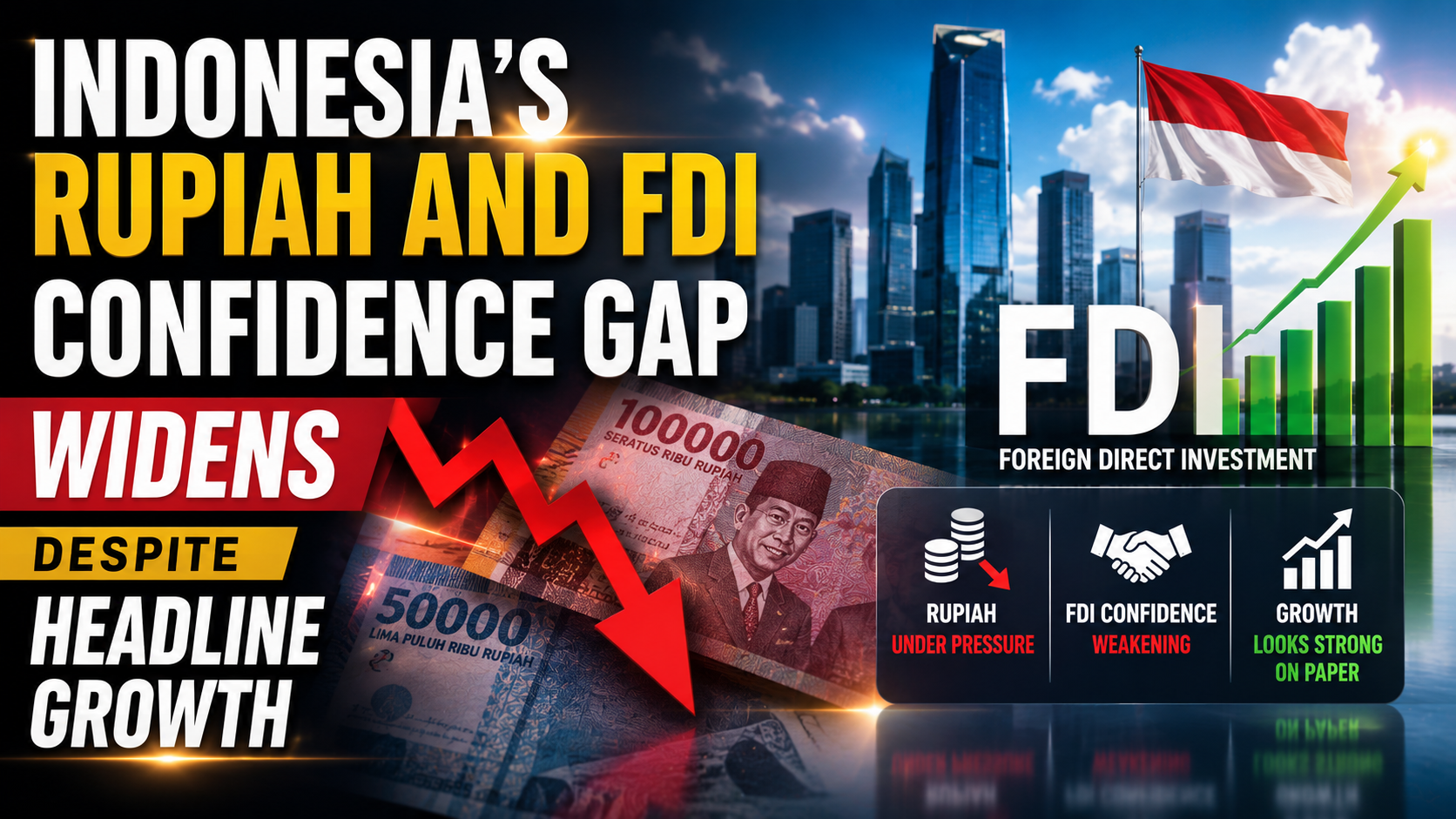
Indonesia’s official data shows resilient FDI, but independent analysts see a 26% FDI contraction and record-low rupiah levels. Here’s the real story behind the conflicting numbers.
Key Takeaways
- Indonesia’s official data (BKPM) shows Q1 2026 FDI at IDR250 trillion, up modestly and framed as FDIevidence investor confidence “remains strong.”
- Independent regional analysis from Krungsri puts the picture very differently — describing net FDI contracting 26% year-on-year in Q1 2026 amid deteriorating investor sentiment.
- The rupiah has repeatedly hit record lows despite Bank Indonesia intervention, even as GDP growth held at 5.6% in Q1 2026.
- Q2 2026 data shows a rupiah rebound tied to a reported 27.4% year-on-year FDI surge — a swing that itself illustrates how volatile the confidence signal has become.
- A 32% US tariff on key Indonesian exports, including textiles, electronics and furniture, adds a further headwind to the FDI outlook.
Indonesia’s investment story depends heavily on which data source you read. Official government messaging is unambiguously positive: per Tempo, Indonesia’s Investment Coordinating Board (BKPM) reported FDI reaching Rp250 trillion (about $15.4 billion) in Q1 2026, contributing 50.1% of total investment realization, with a BKPM spokesperson explicitly arguing that investor confidence “should not be measured solely by short-term financial market movements” and that sustained FDI growth “proves that global investors’ confidence in Indonesia remains strong.”
Independent regional analysis tells a considerably less reassuring story about the same period.
The disconnect is stark and worth stating plainly, because it’s the genuine content gap in existing coverage. Per Krungsri’s regional research, as investor sentiment continued to deteriorate through the year, net FDI actually contracted by 26% year-on-year in Q1 2026 — a figure suggesting the confidence shock had moved beyond financial markets into real investment decisions. The same analysis notes equities had fallen sharply, the rupiah had repeatedly hit record lows despite continued Bank Indonesia intervention, and government bond yields had risen as investors demanded a higher risk premium for holding Indonesian assets. Krungsri’s assessment of the underlying economy is nuanced rather than alarmist: GDP growth reached 5.6% in Q1 2026, but a closer look at the growth composition suggests much of the momentum came from fiscal stimulus and temporary factors rather than durable private investment — meaning the resilient headline growth number may not be sustainable once those supports fade.
Official BKPM data for the following quarter appears to support a more optimistic reading, though the comparison methodology differs. Per Indonesia-Investments’ coverage of BKPM’s H1 2026 report, Q2 2026 FDI realization reached IDR257.7 trillion, with total H1 investment of IDR1,010.6 trillion meeting nearly half the annual target — and, notably, Hong Kong overtook other sources to become the top FDI origin in Q2, at $5 billion, with Investment Minister Rosan Roeslani noting Chinese investment has become more aggressive via Hong Kong for the first time in a decade, partly channeled through Singapore-based subsidiaries as well.
Currency markets registered a genuinely sharp swing around this same data. Per FXStreet, the rupiah strengthened on a reported 27.4% year-over-year surge in Q2 FDI — a dramatically different trajectory from the 26% Q1 contraction Krungsri had described just weeks earlier, illustrating just how sensitive currency and confidence readings are to which quarter’s data and which source’s framing gets cited.
Structural headwinds remain layered on top of this volatility. Analysis from GBG Indonesia points to a 32% US tariff on key Indonesian exports — including textiles, electronics and furniture — set to take effect unless negotiations succeed, a risk that has itself contributed to rupiah selling pressure and reserve concerns, alongside inflation that climbed to 5.2% year-on-year in mid-2025, above Bank Indonesia’s 2-4% target range.
Why It Matters
Indonesia’s is a genuinely rare case where a country’s own official investment data and independent regional research diverge sharply on direction, not just magnitude — a distinction that matters enormously for how investors, and Indonesia’s ASEAN neighbors sizing up their own competitive position, should read the country’s underlying economic trajectory.
Data and Evidence
- BKPM Q1 2026 FDI: IDR250 trillion (~$15.4bn), 50.1% of total investment
- Krungsri’s Q1 2026 estimate: net FDI contracted 26% YoY
- Q1 2026 GDP growth: 5.6%
- Q2 2026 FDI (BKPM): IDR257.7 trillion; reported YoY growth of 27.4% per FXStreet
- Threatened US tariff on key exports: 32%
- Mid-2025 inflation: 5.2% YoY, above the 2-4% target band
Global Impact
Indonesia’s confidence volatility is a bellwether for how ASEAN’s largest economy is absorbing simultaneous pressure from US tariff threats and regional geopolitical shocks — a contrast worth reading alongside Malaysia’s (Article 10) and Singapore’s (Article 9) considerably steadier growth trajectories over the same period.
What Happens Next
Watch whether the Q2 FDI rebound BKPM reported holds up in Q3 data, whether the threatened 32% US tariff takes effect or gets negotiated down, and whether Bank Indonesia’s rupiah interventions stabilize the currency without depleting reserves.
Frequently Asked Questions
Is Indonesia’s FDI growing or shrinking?
Depends on the source and quarter — official BKPM data shows growth, while independent Q1 2026 analysis from Krungsri described a 26% year-on-year contraction; Q2 data shows a rebound.
Why has the rupiah been so volatile?
A combination of shifting FDI sentiment, Middle East-driven risk aversion, and looming US tariff threats on Indonesian exports.
What’s driving Indonesia’s resilient GDP growth despite the confidence concerns? Largely fiscal stimulus and temporary factors, according to Krungsri’s analysis, rather than durable private investment.
Which country became Indonesia’s top FDI source in Q2 2026? Hong Kong, at $5 billion, reflecting more aggressive Chinese investment channeled partly through Hong Kong and Singapore.
What tariff risk does Indonesia face? A potential 32% US tariff on textiles, electronics and furniture exports unless negotiations succeed.
Discover more from The Economy
Subscribe to get the latest posts sent to your email.


Indonesia’s economy just posted its best quarterly performance since 2023, but the central bank’s response to that strength tells a more cautious story than the headline number suggests — one with direct implications for anyone tracking capital flows into Southeast Asia’s largest economy.
The Growth Number
Indonesia’s economy expanded by 5.61 percent in the first quarter of 2026, its fastest pace in more than three years, according to McKinsey’s Southeast Asia quarterly review, boosted by a surge in government spending and strong household consumption tied to the Eid festive period. The Asian Development Bank’s July outlook has since nudged its own 2026 forecast for Indonesia higher by half a percentage point to 3 percent for the year, while separately projecting Indonesia’s growth to hold stable at 5.2 percent in both 2026 and 2027 in its base scenario — reflecting how much forecasts vary depending on the specific window and methodology used.
Why Bank Indonesia Is Playing It Safe
Despite the strong print, Bank Indonesia has kept its benchmark policy rate unchanged at 4.75 percent for a seventh consecutive meeting, prioritising rupiah stability over further easing in the face of external volatility. The central bank has explicitly signalled readiness to step up both onshore and offshore foreign exchange intervention to defend the currency and keep inflation within its 2026–2027 target range — a notably defensive posture for an economy growing at its fastest pace in years.
That caution is paying off on the capital-flow side. Foreign direct investment into Indonesia grew for a second consecutive quarter, rising 8.1 percent to 249.9 trillion rupiah, or roughly $14.5 billion, in the first quarter of 2026.
How fast is Indonesia’s economy growing in 2026?
Indonesia’s GDP grew 5.61% in Q1 2026, its fastest pace in more than three years, driven by government spending and Eid-season consumption, while Bank Indonesia held its policy rate at 4.75% to protect the rupiah amid regional currency volatility.
The Singapore Connection
Much of that capital has a specific source: Singapore. Indonesia’s Coordinating Minister for Economic Affairs, Airlangga Hartarto, confirmed that Singapore’s investment in Indonesia reached approximately $17.4 billion in 2025, calling the city-state “a reliable partner,” with investment into the Batam-Bintan-Karimun corridor specifically reaching $5.7 billion in 2025, up from the prior year. The two governments are now expanding cooperation into the digital economy and green energy, alongside a Young Farmer Development Program launched in June 2026 aimed at deepening agricultural technology ties.
The Regional Context
Indonesia’s performance sits within a broader Southeast Asian picture that is, in McKinsey’s own framing, showing “signs of softening” even as growth foundations remain broadly stable, with higher costs, currency volatility and weaker external demand weighing on households and businesses across the region. Cushman & Wakefield’s Southeast Asia Outlook similarly frames the region as expanding 4.8 percent in 2025 before slowing to a projected 4.3 percent in 2026, citing resilient domestic consumption and moderating interest rates as the main supports.
The ADB’s own assessment is blunter about the source of the regional drag: the Strait of Hormuz-linked Middle East conflict is weighing more heavily on developing Asia than previously anticipated, with higher energy costs, supply disruptions and tighter financial conditions expected to dampen growth in the months ahead even as inflation broadens and stays elevated for longer than earlier forecast.
What It Means for Investors
Indonesia’s combination of strong headline growth, disciplined currency management, and deepening Singapore-anchored capital inflows makes it one of the more structurally sound growth stories in Southeast Asia heading into the second half of 2026 — provided Bank Indonesia’s defensive rate stance succeeds in insulating the rupiah from the broader regional energy-price shock now working through the system.
Discover more from The Economy
Subscribe to get the latest posts sent to your email.
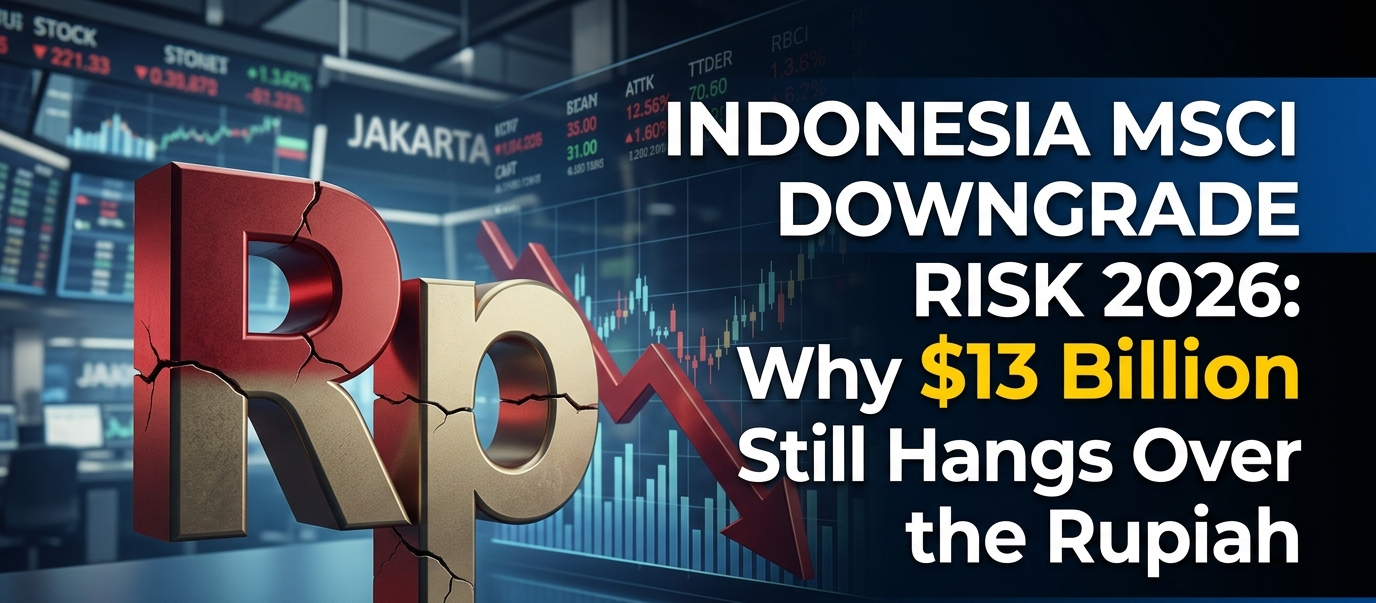
Indonesia avoided the worst-case outcome in June 2026 when MSCI declined to reclassify the country from “emerging market” to “frontier market” status, but the index provider extended its review until November and kept an active freeze on Indonesian equities — blocking a potentially significant source of structural foreign capital in the interim (Indonesia Investments).
Why This Story Deserves More Attention Than It’s Getting
Most coverage has treated the June reprieve as the end of the story. It is closer to a stay of execution. Goldman Sachs calculates that a downgrade to frontier status in November could trigger automatic selling by passive index-tracking funds worth between $2.2 billion and $13 billion, according to analysis cited by both Fortune and The Diplomat (Fortune; The Diplomat).

The Rupiah Is Already Signalling the Verdict
The rupiah fell 7.23% in the first half of 2026, ranking among Asia’s worst-performing currencies and sliding from IDR 16,670 to the dollar at the start of the year to IDR 17,875 by June 30 (Indonesia Investments). The currency has depreciated more than 14% since President Prabowo Subianto took office, and is now worth less against the dollar than during the 1997–98 Asian financial crisis, according to The Diplomat’s tracking of central bank data.
Three Compounding Shocks, Not One
The rupiah’s slide reflects at least three distinct pressures stacking on top of each other. First, the Strait of Hormuz disruption drove a $3.76 billion oil-and-gas trade deficit in May alone, ending a 72-month streak of consecutive monthly trade surpluses and pushing the current account into deficit (Indonesia Investments). Second, a corruption scandal tied to the government’s flagship Free Nutritious Meal program — including the June detention of the former National Nutrition Agency chief — has unsettled fiscal credibility. Third, MSCI’s own transparency concerns, including opaque shareholding structures and a foreign-exchange market that lacks an efficient offshore mechanism, are structural rather than cyclical, meaning they will not resolve simply because oil prices fall.
Bank Indonesia’s Blunt Instrument
Bank Indonesia delivered a surprise rate hike to 5.75% in June specifically to defend the currency, temporarily steadying the rupiah near 17,750 per dollar and easing 10-year bond yields from a near four-year high (Finimize). But as OCBC’s senior ASEAN economist Lavanya Venkateswaran notes, rate defence alone cannot substitute for the transparency reforms MSCI is demanding, and retail investors — an increasingly large share of the Jakarta stock exchange after $3.4–3.65 billion in foreign outflows this year — carry direct household balance-sheet exposure if the market falls further (Fortune).
What to Watch Before November
Fitch has already moved Indonesia’s sovereign outlook to Negative from Stable. The reforms Jakarta announced — doubling the minimum free float requirement to 15% and a leadership change at the exchange and its regulator — are the metrics that will determine the November verdict, not the headline growth rate.
Discover more from The Economy
Subscribe to get the latest posts sent to your email.
South Korea’s won has not traded at these levels since Lehman Brothers collapsed and the world was sorting through the wreckage of its worst financial crisis in eighty years. That the currency has returned to those depths under entirely different circumstances — not a global credit event, but a sustained combination of dollar strength, political uncertainty, and structural capital outflows — makes the current episode more complex, and in some ways more concerning, than 2009.
The Numbers
On July 1, 2026, the won declined as much as 0.6 percent to 1,559.10 per dollar, following a prior session low of 1,562.20 — a level last seen in March 2009. Overseas investors sold a net 1.46 trillion won ($938 million) of stocks in the Kospi index on a single trading day, marking the eighth consecutive session of equity outflows from the Korean market.
“The dollar’s strength is such that a fresh low for the won would not be surprising,” said Moon Dawoon, an economist at Korea Investment & Securities. “If it does break through, it will be difficult to identify the next technical level, so from a qualitative perspective, the downside for the won should be kept open to around 1,600 per dollar.”
A breach of 1,600 would represent territory not visited since the 1997 Asian financial crisis — a threshold that carries both technical and psychological significance for regional currency markets.
Why the Won Is Falling
The 2026 won story is not a simple export slump. South Korea continues to run a current-account surplus — $18.70 billion in December 2025, $13.26 billion in January 2026. The fundamentals of the trade balance have not deteriorated dramatically. What has changed is the capital account.
Several forces are pulling simultaneously in the wrong direction. The US-Korea interest rate differential remains wide, making dollar-denominated assets relatively attractive to Korean investors. Structural outward investment — Korean residents and institutions consistently moving capital into foreign assets — keeps upward pressure on dollar demand. Trade friction and tariff uncertainty from the United States raise risk premia on Korean assets broadly. And geopolitical stress in the Middle East has driven a risk-off flight to dollar safety that penalises emerging market currencies disproportionately.
The IMF estimated Korea’s growth at 0.9 percent in 2025, with a projected rebound to 1.8 percent in 2026 — an improvement, but well below Korea’s historical growth trajectory. The Bank of Korea has held its base rate at 2.50 percent, balancing growth support against exchange-rate and financial stability concerns.
The Semiconductor Exposure
Korea’s currency vulnerability is amplified by its sector concentration. Samsung and SK Hynix together constitute a dominant share of the global memory chip market — and global memory chip markets are themselves being stress-tested by the AI infrastructure boom. The so-called “RAMageddon” dynamic, in which AI-fuelled demand for memory chips has sent prices soaring, has provided export revenue support. But it has also created concentration risk: a reversal in AI capex demand, which the BIS and Chinese hedge funds have been warning about, would hit Korea’s export base and currency simultaneously.
The Kospi index’s heavy weighting toward Samsung, Hyundai, and semiconductor-adjacent companies means that institutional investors who reduce technology sector exposure globally tend to sell Korean equities as a primary execution path. Eight consecutive days of outflows is the market expressing that thesis in real time.
Regulatory Response
Following an earlier episode in which the won slid to its lowest since 2009 in June 2026, South Korean authorities convened an emergency meeting between the Bank of Korea governor and financial regulators. The government announced measures including stepped-up oversight of offshore currency derivatives, boosted inspections for suspected market misconduct, and investigations into potentially illegal foreign-exchange transactions.
The won briefly rebounded following those announcements before resuming its decline in early July. The pattern is familiar in currency management: administrative measures can slow momentum but rarely reverse the underlying capital flow dynamics that are driving the move.
Regional Contagion Signals
The won’s decline on July 1 led a broader retreat in Asian currencies, reflecting the dollar’s role as the default safe haven in periods of global risk aversion. The Japanese yen simultaneously extended losses to multi-decade highs against the dollar — a different dynamic driven by the US-Japan rate differential, but contributing to a picture of simultaneous stress across the major Asian currency pairs.
Emerging market investors are monitoring whether won weakness begins translating into spillover dynamics: whether Korean retail investors rotate into crypto as a won hedge (measurable through the “kimchi premium” on Korean crypto exchanges), and whether institutional outflows from Korean equity and bond markets intensify as currency losses erode total returns for foreign holders.
A currency at 1,562 per dollar, trending toward 1,600, with eight straight days of equity outflows and a semiconductor sector exposed to an AI capex cycle that global institutions are increasingly questioning — is not a crisis yet. But it is accumulating the conditions for one.
Discover more from The Economy
Subscribe to get the latest posts sent to your email.

Indonesia’s Rupiah and FDI Confidence Gap Widens Despite Headline Growth

Global Aviation Split: Cargo Boom Masks Falling Passenger Demand

Malaysia’s Chip Exports Defy the Wall Street Selloff

Singapore Upgrades 2026 Growth Forecast Again as AI Exports Surge

Dubai’s Property Market Posts Second-Best H1 Ever — While Hotels Sit Empty

Gold’s Wild 2026 Round Trip Resumes as Chip Selloff Revives Haven Demand

Russia’s Black Sea Oil Exports Fall for a Fifth Straight Week

Oil Surges as Strait of Hormuz Traffic Collapses Again

Pakistan’s Deficit Hits 22-Year Low — But Its Debt Stock Just Rose Again

Bank of England Set to Hold Rates Through Year-End, Reuters Poll Shows

Global Chip Selloff Deepens: What’s Driving the Aug. 19 Semiconductor Rout

Trump Extends Canada Tariff Deadline: What the 50% Duty Threat Means for CUSMA

Pakistan’s Flood Recovery Collides With Rising Spending

Gold’s Wild 2026: From a Record $5,600 Peak to a 24% Crash and Back Toward $4,500

China Politburo July 2026: Stimulus Signals Explained

Russia Fuel Shortages 2026: Inside a Cracking War Economy

Top 15 Financial Stocks for Investment in PSX

Pakistan Passed Its Third IMF Review

Andy Burnham, UK Gilts and Mortgages: July 2026 Explainer

SpaceX Stock Lockup Expiration Explained: Why $123B in Shares Could Hit the Market

Pakistan IMF Program 2026: Inside the Push Toward an Interest-Free Economy

Pakistan’s 2026 Monsoon Floods Threaten Fragile Economic Recovery as Inflation Nears 9%

Russia Oil Revenue 2026: How Sanctions on Rosneft and Lukoil Are Draining the War Chest

Russia’s Budget Deficit Blew Past Its Full-Year Target in Three Months

Russia Oil Revenue 2026: The Iran War Windfall and What a Hormuz Deal Means for Moscow

Canada US Trade War 2026: Inside Carney’s Push to Cut Ties With Trump’s Tariffs

Oil Prices Fall as Strait of Hormuz Reopens: 2026 Update

China Economy 2026: How AI Exports and a Property Crash Are Splitting Growth in Two
-

 Markets & Finance7 months ago
Top 15 Stocks for Investment in 2026 in PSX: Your Complete Guide to Pakistan’s Best Investment Opportunities
-

 Analysis6 months ago
Johor’s Investment Boom: The Hidden Costs Behind Malaysia’s Most Ambitious Economic Surge
-

 Analysis6 months ago
Top 10 Stocks for Investment in PSX for Quick Returns in 2026
-

 Analysis6 months ago
Brazil’s Rare Earth Race: US, EU, and China Compete for Critical Minerals as Tensions Rise
-

 Banks7 months ago
Best Investments in Pakistan 2026: Top 10 Low-Price Shares and Long-Term Picks for the PSX
-

 Investment7 months ago
Top 10 Mutual Fund Managers in Pakistan for Investment in 2026: A Comprehensive Guide for Optimal Returns
-

 Global Economy8 months ago
15 Most Lucrative Sectors for Investment in Pakistan: A 2025 Data-Driven Analysis
-

 Global Economy8 months ago
Pakistan’s Export Goldmine: 10 Game-Changing Markets Where Pakistani Businesses Are Winning Big in 2025