
AI
How Generative AI is Reshaping Car Insurance Comparison Quotes


The days of pulling generic auto insurance quotes based purely on your zip code and age are officially over. In 2026, insurance comparison engines are powered entirely by generative AI and real-time telematics. These platforms digest thousands of live data points—ranging from your driving smoothness via connected vehicle sensors to real-time traffic congestion patterns—to generate hyper-personalized premiums instantly.
For consumers, this evolution represents both a massive opportunity for savings and a hidden trap for penalty pricing. Understanding how AI algorithms evaluate risk is essential for anyone looking to lower their monthly auto insurance premiums.
How AI Comparison Engines Evaluate Your Risk Profile
Behavioral Telematics and Connected Cars
Modern cars stream performance data directly to insurance aggregators. Generative AI models analyze braking sharpness, acceleration curves, cornering G-forces, and phone distraction metrics. Drivers who maintain smooth, defensive habits are rewarded with dynamic rate cuts of up to 40% compared to traditional rating tiers.
Predictive Traffic and Weather Modeling
AI tools now cross-reference your daily commute route with predictive weather and accident probability models. If your standard parking location or driving corridor has a statistically higher incidence of uninsured motorist claims, your quotes will reflect that hyper-local risk assessment.
| Comparison Factor | Traditional Rating Model | 2026 Generative AI Model | Impact on Premium |
| Mileage & Usage | Annual estimated odometer reading | GPS tracking & live trip duration | High (up to 35% savings) |
| Driving Behavior | MVR driving record & accidents | Real-time braking, speed, & G-force | Critical (determines tier) |
| Vehicle Tech | Make, model, and safety rating | ADAS calibration & repair cost data | Moderate |
Strategies to Lower Your AI-Driven Insurance Quote
To outsmart the algorithm and secure the lowest possible premium in 2026, drivers must proactively manage their digital footprint on insurance platforms.
Opt-In for Telematics Trial Periods: Many insurers offer immediate 15% discounts just for installing their driving app; let it track safe habits for 30 days to lock in permanent savings.
Scrub Unverified Public Records: Ensure your motor vehicle report is free of clerical errors that AI risk models misinterpret as reckless behavior.
Compare AI Aggregators: Use platforms that integrate multi-carrier API feeds rather than single-brand comparison sites to find the best risk-adjusted rate.
“Industry Note: AI-driven pricing rewards transparency and precision. Drivers who actively manage their telematics data consistently out-save those relying on legacy quote calculators.”
Embracing AI comparison tools allows savvy policyholders to customize coverage limits precisely to their driving habits, eliminating wasted premium spend while ensuring robust protection.
Discover more from The Economy
Subscribe to get the latest posts sent to your email.



AI investment is supporting global activity in 2026, but that does not by itself prove the investment will earn satisfactory returns.
Spending on data centres, chips, networking and electricity infrastructure boosts production today. Profits and productivity may arrive much later—or fall short of expectations. The most useful way to understand the boom is to separate the real assets being built from the valuations attached to their future cash flows.
The IMF’s October 2026 World Economic Outlook identifies AI-led investment as one reason growth has held up despite energy and geopolitical shocks. Meanwhile the IMF Global Financial Stability Report lists an AI-related market correction among the threats that could tighten financial conditions. Those two findings are compatible: a technology can be economically consequential while assets associated with it are mispriced.
Key takeaways
- AI capital expenditure contributes immediately to equipment orders, construction and power infrastructure.
- The WTO says AI-enabling goods accounted for 47% of global merchandise trade growth by value in the first half of 2026.
- Large investment does not automatically establish durable profits, nor do high valuations prove a speculative bubble.
- Power, water, grid access, financing and actual adoption are constraints on the return to AI infrastructure.
- Asia has supply-chain advantages, but emerging economies need to compete in services, skills and reliable infrastructure too.
Follow the economic chain, not the slogans
A cloud company decides to build computing capacity. It buys advanced processors, storage and networking equipment. Contractors build or expand a facility. A utility upgrades substations; engineering firms install cooling. Suppliers hire workers and purchase materials. These are real economic activities even before the data centre’s first customer pays for a computing service.
The supply-chain effects can travel across borders. A server system may depend on design, fabrication, assembly, electrical equipment and software from different economies. The WTO’s October 2026 trade analysis found that AI-enabling goods accounted for 47% of global merchandise trade growth in value terms during the first half of the year. The statistic covers contribution to trade-value growth, not 47% of all world exports and not 47% of GDP growth.
The distinction matters. It shows that AI equipment demand has become unusually important to the change in trade, but it does not mean the gains are widely distributed. Economies producing the most specialized equipment may gain disproportionately, while energy importers or countries outside these supply chains experience few immediate benefits.
Three separate investment stories
The hardware cycle
Demand for processors, memory, networking and cooling systems generates revenue for companies with production capacity. But supply can eventually catch up, and buyers may change specifications or postpone purchases. Equipment that is scarce in one year can have weaker pricing power in another. The investment case should therefore consider order durability and dependence on a few major customers.
The infrastructure cycle
Data centres require land, grid connections, resilient power, fibre links and cooling. The IEA’s October 2026 report on powering AI evaluates electricity-system issues across 34 jurisdictions covering roughly 90% of global data-centre capacity. It identifies affordability, emissions, water use and electricity security as policy concerns. A financially attractive building can still impose costs on surrounding ratepayers if grid upgrades and pricing are poorly designed.
The adoption cycle
Businesses need to integrate AI into actual workflows. A model that produces draft documents faster may reduce working time, but a company does not automatically record higher revenue or better output quality. Training, verification, cybersecurity and software integration can absorb part of the gains. The OECD’s 2026 cross-country evidence finds advanced-technology adoption varies greatly across industries and firm sizes, with human and technological capital important to productivity differences.
This is why the third cycle may take longer than the first two. Building capacity is easier to measure than reorganizing an entire business around a new tool.
What would make the boom a bubble?
The word ‘bubble’ is often used to describe any rapidly rising market. A more disciplined test asks whether asset prices depend on cash-flow assumptions that are both unusually optimistic and difficult to revise. In AI, analysts should consider whether customer demand and price per unit of computing will support the cost of hardware replacement, capital financing, energy, staffing and security.
Another issue is circular financing. If infrastructure suppliers, major customers and financiers depend heavily on the same expected growth trajectory, an adverse revision can affect multiple balance sheets simultaneously. This does not prove that such a collapse will happen. It explains why concentration can magnify a shock even when initial projects are economically genuine.
The IMF’s 2026 financial-stability assessment warns that an AI-related correction could be amplified by leverage and concentrated positions. The relevant question is therefore how much risk sits outside transparent public equity markets—in private credit, leveraged investment vehicles and large contractual commitments.
An investor’s and policymaker’s dashboard
| Question | Healthy evidence | Warning sign |
|---|---|---|
| Are customers paying? | Repeat revenue and demonstrable usage | Rising capacity without confirmed demand |
| Is computing economic? | Positive returns after energy and replacement costs | Profitability reliant on permanent high prices |
| Is electricity available? | Funded grid connection and transparent tariffs | Unfunded or delayed grid upgrades |
| Is adoption productive? | Better verified output per worker or process | Only demonstrations and time-saved surveys |
| Is financial exposure diversified? | Broad customer base and prudent funding | Crowded positions, leverage and opaque obligations |
| Can low-income countries participate? | Skills, connectivity and export access | Incentives restricted to a small group of hubs |
Original editorial due-diligence framework; the indicators are tests, not factual ratings of particular companies.
Why Asia could win without every economy winning
AI hardware’s international supply chain rewards clusters with manufacturing expertise, deep supplier networks and reliable power. But clustering also means a handful of economies capture much of the immediate capital expenditure. The UNCTAD World Investment Report 2026 describes a global investment rebound concentrated in a narrow set of recipients and strategic sectors.
For South Asia the route to participation may be less glamorous but more achievable. Software services, testing, security review, back-office workflow redesign and domain-specific digital services all sell expertise rather than massive server farms. These activities still require reliable broadband, predictable cross-border payments, trained workers and credible data governance.
Pakistan’s economic policy should distinguish an exportable service from a subsidized prestige project. Investing public funds in computing infrastructure makes sense only if realistic demand, electricity availability and measurable local benefits justify the expenditure. A smaller programme improving technical education, network reliability and digital payments may sometimes deliver more development value than a headline-grabbing facility.
Productivity is the ultimate scorecard
The International Labour Organization’s June 2026 evidence review finds real but uneven gains, with reported time savings not yet consistently translated into measured output, earnings or employment. That observation neither debunks AI nor validates unlimited spending. It suggests adoption and measurement are lagging behind deployment.
Consider a legal services business. Faster document drafting might reduce the hours needed for a first version. But lawyers must check accuracy, safeguard confidentiality and remain responsible for advice. Whether the firm becomes more productive depends on client pricing, workload, quality control and staff redeployment. A narrowly defined speed improvement should not be extrapolated into an economy-wide productivity miracle.
Productivity can also appear in unexpected places: lower error rates, fewer customer callbacks, better scheduling or quicker identification of equipment faults. Firms should measure outcomes, not only the number of employees using AI tools. Governments in turn should measure diffusion among ordinary enterprises, not just investment announcements by technology leaders.
The energy bill is part of the AI bill
The new infrastructure cannot run on investor expectations alone. It needs physical electricity, generation capacity, transformers, water or alternative cooling systems and dependable grid management. Pricing decisions determine who bears those costs. A development strategy that promises cheap dedicated electricity to data centres while passing network expenses to households can distort both competition and social acceptance.
The IEA’s October 2026 AI-electricity study makes the challenge concrete: policymakers must integrate fast-growing concentrated demand while maintaining affordability and security. The opportunity is to build infrastructure that serves broader industrial needs, not merely one class of customers.
There is an additional investment trap. Infrastructure can remain productive for decades, while specialized chips may face faster economic obsolescence. Valuations must reflect depreciation and replacement cycles. A data centre may have a long-lived building and grid connection but require costly hardware renewal to remain competitive.
What would change the verdict in 2027?
A credible bullish case would feature continued broad customer adoption, profits after depreciation, productivity improvements and expansion beyond the richest firms and countries. A bearish case would feature overcapacity, falling revenue per unit of computing, financing stress or slower-than-expected enterprise uptake. Between those extremes lies a more plausible uneven outcome: useful AI services alongside disappointed investors in some projects.
To judge the outcome, watch capital expenditure and customer revenue, investment commitments and grid availability, user adoption and verified output. Avoid treating stock-market performance as a direct proxy for society’s benefit from technology.
Frequently asked questions
Is the AI boom causing global GDP growth?
AI-related investment supports construction, hardware sales and services. The IMF identifies it as an important source of current resilience, but not the sole explanation for global growth.
Does a large increase in AI trade mean all countries benefit?
No. The WTO’s statistic concerns AI-enabling goods’ contribution to merchandise trade growth in value terms. Benefits depend on each economy’s position in the supply chain.
Is there definitely an AI bubble in 2026?
No definitive test establishes that the whole sector is a bubble. Valuation risk is elevated where expected future earnings are highly optimistic or financing is fragile.
Why do data centres affect household electricity costs?
They can require new network capacity and generation. Whether households pay part of the bill depends on utility regulation, connection charges and electricity tariffs.
Can Pakistan benefit without making chips?
Potentially, through software, compliance, workflow redesign, data services and workforce skills—provided domestic infrastructure and payment systems improve.
What is the most important performance measure?
Sustainable returns and verified productivity gains after total costs are counted, not just the number of models, users or newly announced facilities.
Conclusion
AI can sustain near-term global activity and still disappoint some investors. That is not a contradiction; it is the difference between economic spillovers and financial returns. For policymakers, the priority should be broad diffusion, affordable infrastructure and competition. For investors, it should be evidence of durable customers and profits. The boom becomes more valuable—and less fragile—when its benefits extend beyond an expensive and concentrated build-out.
Discover more from The Economy
Subscribe to get the latest posts sent to your email.

The AI capital-spending boom is driving a concentrated global trade expansion. Pakistan cannot assume it will capture semiconductor profits, but it can compete for selective services, implementation and skills-intensive opportunities. This feature explains the mechanisms, risks and practical decisions that matter through 2027, with particular attention to Pakistan’s different exposure to energy prices, external financing, global trade and AI investment.
At a glance
- World output is forecast to rise, but opportunities and costs are uneven across countries.
- Global inflation forecasts do not predict household prices in Pakistan.
- The AI capital expenditure cycle lifts trade in electronics but may not translate into productivity gains everywhere.
- Pakistan’s IMF staff-level agreement is a milestone, not final Board approval.
- Stronger exports, competitive energy, fiscal credibility and skills are essential to durable growth.
The verified starting point: what the numbers actually say
The IMF October 2026 World Economic Outlook projects global growth of 3.1% in calendar 2026 and 3.4% in calendar 2027, alongside global headline inflation of 4.7% and 4.1%, respectively. Its statistical cutoff is 1 October 2026. The WTO October 2026 trade outlook projects merchandise trade volume growth of 3.9% in 2026 and 4.1% in 2027, versus commercial-services trade volume growth of 3.3% and 6.4%. These are forecasts from different statistical systems, not interchangeable growth measures.
For Pakistan, the IMF Pakistan October 7 staff-level agreement estimated FY2026 growth of 3.6%, September headline inflation of approximately 10.3%, and gross reserves near $21.5 billion at end-September. The fourth EFF review and third RSF review had reached staff-level agreement only, pending IMF Executive Board approval as of the release. Pakistan’s fiscal years run July–June; IMF global growth figures refer to calendar years.
| Indicator | 2026 | 2027 | Important distinction |
|---|---|---|---|
| IMF world GDP growth | 3.1% | 3.4% | Calendar-year projection |
| IMF world headline inflation | 4.7% | 4.1% | Global estimate, not Pakistan CPI |
| WTO goods trade volume growth | 3.9% | 4.1% | Real volume, not nominal trade value |
| WTO commercial services volume growth | 3.3% | 6.4% | Conditional rebound, not guaranteed |
The World Bank June 2026 Global Economic Prospects provides an earlier comparison framework, but its publication date and methodology differ from the October IMF and WTO releases. A thoughtful analysis should compare like with like and should never treat projections as realized outcomes. For a Pakistan-focused story, the crucial question is how global conditions enter domestic economic life.
Why this story matters now
The WTO October 2026 executive summary says AI-enabling goods accounted for 47% of year-on-year growth in the value of world merchandise trade during the first half of 2026. That does not mean 47% of all merchandise trade was AI-related. It identifies a contribution to growth, and in nominal value terms. The same source notes that AI-enabling goods trade rose 67% year-on-year in that period. These figures show how a narrow technology cycle can make global trade appear stronger even as other sectors struggle.
Meanwhile the Reuters October 2026 IMF annual meetings reports persistent concern about global financial risks, geopolitical disruptions and the uneven sharing of AI gains. The Reuters October 2026 Asian growth describes a region where technology investment supports some exporters while energy costs and higher yields challenge others. Pakistan is therefore exposed simultaneously to a potential technology opportunity and to more conventional fuel, financing and trade vulnerabilities.
The evidence for an extraordinary AI hardware cycle
For the evidence for an extraordinary ai hardware cycle, The spectacular rise of AI-enabling goods trade should not be confused with a universal productivity breakthrough. Buying servers is an input; measurable economic gains require organizations to redesign processes and solve problems for customers.
This matters for economic decision-making because firms and households cannot adjust instantaneously when conditions shift. Prices, contracts, worker skills and financial obligations move on different schedules. Analysts should identify the timetable, who bears the immediate cost, and who may capture the longer-term benefit.
A credible implementation plan requires named institutions, measurable indicators and regular public reporting. The point is not to promise an effortless transition; it is to make policy options concrete enough to compare their benefits and trade-offs.
Pakistan-specific decision test. For the evidence for an extraordinary ai hardware cycle, ask four questions: (1) Which import cost, export opportunity, credit channel or productivity constraint is affected? (2) Which groups face the first-round effects? (3) What could policymakers or firms change within six months? (4) Which published indicator would demonstrate improvement rather than merely announce activity?
What to monitor: (i) official monthly or quarterly data; (ii) movements in export receipts and import bills; (iii) price changes versus changes in physical volumes; (iv) borrowing and working-capital costs; and (v) job quality and household purchasing power. A single monthly reading can be noisy. Comparing several releases helps distinguish a trend from a short-lived disturbance.
Why AI-enabled trade is geographically concentrated
For why ai-enabled trade is geographically concentrated, Pakistan’s competitive case is more likely to begin in software implementation, business-process services, local-language tools and industry-specific integration than in cutting-edge semiconductor fabrication. That is an assessment of attainable starting conditions, not a forecast of guaranteed success.
This matters for economic decision-making because firms and households cannot adjust instantaneously when conditions shift. Prices, contracts, worker skills and financial obligations move on different schedules. Analysts should identify the timetable, who bears the immediate cost, and who may capture the longer-term benefit.
A credible implementation plan requires named institutions, measurable indicators and regular public reporting. The point is not to promise an effortless transition; it is to make policy options concrete enough to compare their benefits and trade-offs.
Pakistan-specific decision test. For why ai-enabled trade is geographically concentrated, ask four questions: (1) Which import cost, export opportunity, credit channel or productivity constraint is affected? (2) Which groups face the first-round effects? (3) What could policymakers or firms change within six months? (4) Which published indicator would demonstrate improvement rather than merely announce activity?
What to monitor: (i) official monthly or quarterly data; (ii) movements in export receipts and import bills; (iii) price changes versus changes in physical volumes; (iv) borrowing and working-capital costs; and (v) job quality and household purchasing power. A single monthly reading can be noisy. Comparing several releases helps distinguish a trend from a short-lived disturbance.
Pakistan’s realistic position in the value chain
For pakistan’s realistic position in the value chain, A healthy AI investment program measures output per worker, error rates, export revenues and customer retention. If those indicators do not improve, expenditure on software licenses may merely raise operating costs.
This matters for economic decision-making because firms and households cannot adjust instantaneously when conditions shift. Prices, contracts, worker skills and financial obligations move on different schedules. Analysts should identify the timetable, who bears the immediate cost, and who may capture the longer-term benefit.
A credible implementation plan requires named institutions, measurable indicators and regular public reporting. The point is not to promise an effortless transition; it is to make policy options concrete enough to compare their benefits and trade-offs.
Pakistan-specific decision test. For pakistan’s realistic position in the value chain, ask four questions: (1) Which import cost, export opportunity, credit channel or productivity constraint is affected? (2) Which groups face the first-round effects? (3) What could policymakers or firms change within six months? (4) Which published indicator would demonstrate improvement rather than merely announce activity?
What to monitor: (i) official monthly or quarterly data; (ii) movements in export receipts and import bills; (iii) price changes versus changes in physical volumes; (iv) borrowing and working-capital costs; and (v) job quality and household purchasing power. A single monthly reading can be noisy. Comparing several releases helps distinguish a trend from a short-lived disturbance.
Electricity and connectivity as economic constraints
For electricity and connectivity as economic constraints, The spectacular rise of AI-enabling goods trade should not be confused with a universal productivity breakthrough. Buying servers is an input; measurable economic gains require organizations to redesign processes and solve problems for customers.
This matters for economic decision-making because firms and households cannot adjust instantaneously when conditions shift. Prices, contracts, worker skills and financial obligations move on different schedules. Analysts should identify the timetable, who bears the immediate cost, and who may capture the longer-term benefit.
A credible implementation plan requires named institutions, measurable indicators and regular public reporting. The point is not to promise an effortless transition; it is to make policy options concrete enough to compare their benefits and trade-offs.
Pakistan-specific decision test. For electricity and connectivity as economic constraints, ask four questions: (1) Which import cost, export opportunity, credit channel or productivity constraint is affected? (2) Which groups face the first-round effects? (3) What could policymakers or firms change within six months? (4) Which published indicator would demonstrate improvement rather than merely announce activity?
What to monitor: (i) official monthly or quarterly data; (ii) movements in export receipts and import bills; (iii) price changes versus changes in physical volumes; (iv) borrowing and working-capital costs; and (v) job quality and household purchasing power. A single monthly reading can be noisy. Comparing several releases helps distinguish a trend from a short-lived disturbance.
What would signal a sustainable AI payoff
For what would signal a sustainable ai payoff, Pakistan’s competitive case is more likely to begin in software implementation, business-process services, local-language tools and industry-specific integration than in cutting-edge semiconductor fabrication. That is an assessment of attainable starting conditions, not a forecast of guaranteed success.
This matters for economic decision-making because firms and households cannot adjust instantaneously when conditions shift. Prices, contracts, worker skills and financial obligations move on different schedules. Analysts should identify the timetable, who bears the immediate cost, and who may capture the longer-term benefit.
A credible implementation plan requires named institutions, measurable indicators and regular public reporting. The point is not to promise an effortless transition; it is to make policy options concrete enough to compare their benefits and trade-offs.
Pakistan-specific decision test. For what would signal a sustainable ai payoff, ask four questions: (1) Which import cost, export opportunity, credit channel or productivity constraint is affected? (2) Which groups face the first-round effects? (3) What could policymakers or firms change within six months? (4) Which published indicator would demonstrate improvement rather than merely announce activity?
What to monitor: (i) official monthly or quarterly data; (ii) movements in export receipts and import bills; (iii) price changes versus changes in physical volumes; (iv) borrowing and working-capital costs; and (v) job quality and household purchasing power. A single monthly reading can be noisy. Comparing several releases helps distinguish a trend from a short-lived disturbance.
Policy options: three alternative paths, not numerical forecasts
| Scenario | Assumptions | Implications for Pakistan | Early warning or confirmation |
|---|---|---|---|
| More favorable | Energy costs stabilize; export markets remain open; AI use generates measurable efficiency | Space for investment, steadier purchasing power and stronger services exports | Export orders, real income and private investment improve together |
| Central case | Global growth follows the broad institutional outlook; commodity and funding pressures fluctuate | Gradual recovery with uneven gains across sectors | Stable external balances without a broad productivity surge |
| Adverse | Energy disruptions persist; financing costs rise; AI investment is repriced | Imports become more costly, credit tighter and fiscal choices harder | Reserves, inflation expectations and financing costs weaken at once |
These are qualitative editorial scenarios, not probabilities assigned by an econometric model. Their value lies in clarifying which evidence would require an updated judgment. The IMF October 2026 World Economic Outlook explicitly emphasizes downside risks involving conflict, trade tension, debt and reassessment of AI expectations.
A practical action agenda
For policymakers, the first responsibility is to protect hard-won macroeconomic stability while removing barriers to productivity. Regulatory predictability, tax administration, targeted social protection and transparent energy decisions are more useful than shifting incentives that are impossible for businesses to plan around. The IMF Pakistan 2026 country report identifies revenue mobilization, reform of state enterprises, energy-sector viability and improvements in human capital as linked policy priorities.
For exporters, resilience means identifying where demand is growing, investing in reliable delivery and obtaining credible certifications. Export strategies should track volumes, domestic value added and customer retention; gross receipts alone do not disclose profitability. For small businesses, the practical priority is to map exposure to fuel, electricity, imports and foreign-exchange requirements and to stress-test cash flows before making expansion commitments.
For households, risk management begins with an affordable budget, attention to debt servicing and a realistic distinction between nominal wage gains and purchasing power. For workers, portable skills and credible training can expand options across changing industries. None of this makes external shocks harmless; it simply offers concrete ways to be less exposed.
How this analysis differs from generic global coverage
Major international reporting is indispensable for establishing what happened. The Reuters October 2026 WTO briefing emphasizes the boost from AI to merchandise trade and the pressure of geopolitical disruption. Institutional releases provide detailed projections. This article goes a step further by asking how those macroeconomic signals might translate into local import costs, export competitiveness, employment, household budgets and reform choices. It is an interpretation of attributed evidence, not a claim of exclusive interviews or original field reporting.
The difference is particularly relevant for Pakistan because a global technology boom may coincide with higher costs for countries that import fuel but do not manufacture the equipment in highest demand. No serious strategy should assume that a worldwide headline rate automatically delivers the same benefits locally.
Frequently asked questions
What is the IMF’s global growth forecast for 2027?
The IMF’s October 2026 World Economic Outlook projects 3.4% global GDP growth in 2027, following 3.1% in 2026. These are calendar-year forecasts and may be revised as new data becomes available. See the IMF October 2026 World Economic Outlook.
Is global inflation expected to fall in 2027?
Yes, the October IMF forecast projects global headline inflation easing from 4.7% in 2026 to 4.1% in 2027. That describes the world aggregate and does not imply that prices in Pakistan will fall in absolute terms.
Is Pakistan’s latest IMF financing already approved?
The 7 October 2026 IMF release announced staff-level agreement for the fourth EFF and third RSF reviews, subject to Executive Board approval. The release should not be described as a completed Board decision. See the IMF Pakistan October 7 staff-level agreement.
Will AI investment create jobs in Pakistan?
It could create demand for implementation, software services and specialist support, while also changing tasks in existing occupations. The result depends on skills, investment, electricity reliability and competitive access to customers. No credible source guarantees a particular employment gain.
Does the WTO predict rapid growth in all kinds of trade?
No. Its October outlook differentiates merchandise volume growth from commercial-services volume growth and notes uneven performance by sector and region. Read the WTO October 2026 executive summary.
What should Pakistani companies monitor through 2027?
Export order books, input costs, electricity reliability, financing terms, exchange-rate conditions and customer demand are more operationally useful than a single global growth figure. Businesses should compare these against their own cash flows and margins.
Conclusion: the decisive issue is transmission, not the headline
The AI capital-spending boom is driving a concentrated global trade expansion. Pakistan cannot assume it will capture semiconductor profits, but it can compete for selective services, implementation and skills-intensive opportunities. The balance of risks is mixed: advanced technology can expand world production and trade, but it does not neutralize an energy shock or a financing squeeze. For Pakistan, policy credibility, internationally competitive exports and productivity-enhancing investment will determine how much of a fragile global expansion becomes better living standards at home.
Discover more from The Economy
Subscribe to get the latest posts sent to your email.
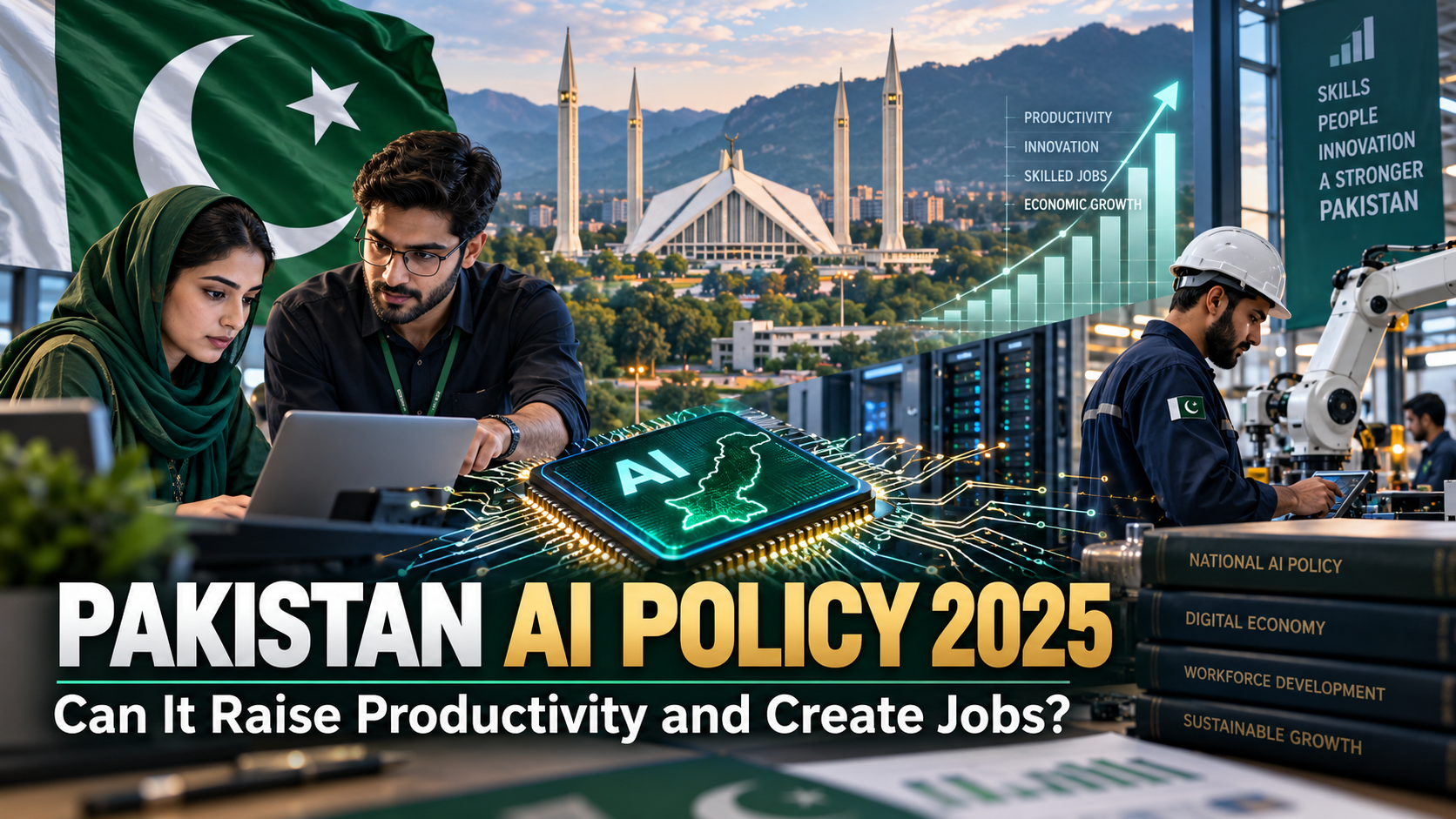
Pakistan AI Policy 2025 sets an ambitious direction. See its status, skills priorities, privacy risks and practical tests of economic impact.
Key Takeaways
- The Ministry of IT lists the National Artificial Intelligence Policy as approved on 31 July 2025, according to its policy registry.
- A 10 February 2026 government announcement described a proposed $1 billion AI investment by 2030 and 1,000 PhD scholarships; these are commitments, not audited disbursements.
- Real AI gains depend on usable data, electricity, institutional capability and whether employers redesign tasks.
- The relevant output is measured productivity, service quality and wages, not the number of events or policy slogans.
Pakistan does not need another grand technology announcement as much as it needs evidence that technology is saving time and creating better-paid work. The Pakistan AI Policy 2025 is officially listed as approved by the Ministry of Information Technology on 31 July 2025. The government subsequently announced skills and investment ambitions through 2030.
The stakes are tangible. Can a farmer get a more accurate warning about water stress? Can a public hospital process appointments without making patients wait half a day? Can a small IT company in Lahore sell more valuable services instead of competing solely on lower wages? This analysis looks past slogans, distinguishes policy approval from implementation, and proposes ways to measure whether artificial intelligence actually makes Pakistan more productive.
What has the Pakistan AI Policy 2025 actually approved?
The Ministry of IT policy portal records the National Artificial Intelligence Policy as approved on 31 July 2025. The portal separately lists a Data Governance Policy 2026 as a draft, a useful reminder that connected policy areas may be at different stages of adoption. An approved strategy is a statement of direction. It does not prove every proposed fund, institution or training programme is operating at scale.
A government statement dated 10 February 2026 said the administration intended to invest $1 billion in the AI sector by 2030, offer 1,000 fully funded AI PhD scholarships, and train one million non-IT professionals. These are stated goals. Before reporting them as achievements, an editor should request annual budgets, implementation milestones, university acceptance records and independently validated trainee completions.
| Policy test | What to verify | Why it matters |
|---|---|---|
| Approval | Official status and date | Separates draft from adopted policy |
| Funding | Budget allocation and disbursement | Distinguishes promise from spending |
| Skills | Completed training and job outcomes | Measures real human capital |
| Public-service pilots | Baseline and after-pilot performance | Demonstrates actual service gains |
| Safeguards | Published privacy and appeal mechanisms | Protects citizens and trust |
This distinction is particularly important for fast-moving technology. Announcements can be made quickly; safe procurement, testing and staff training take time.
Where could AI raise productivity first?
Start with routine, data-heavy tasks that employees already understand. In agriculture, models could help classify crop stress from satellite imagery, but only if their advice is checked against local irrigation conditions and field evidence. In industry, machine vision may detect defects earlier on an export production line. In health, decision-support tools can reduce administrative delays without replacing licensed clinicians.
Pakistan’s Economic Survey 2025–26 documents a growing digital-services sector, including $3.388 billion in ICT export remittances during July–March FY26. That is an economic base on which to build; it is not evidence that AI itself generated the receipts.
The best pilot usually starts with a narrow question. Can a customs clerk process a standard form in six minutes rather than nine, without an increase in errors? Can an irrigation office send useful alerts that farmers actually follow? A project that cannot state its before-and-after measures should not be called a productivity programme.
What is the employment opportunity and the employment risk?
AI can make a small software team more productive, allowing it to serve more clients. It can also automate basic work previously sold as data entry or simple content production. Both effects can occur at once. The question is whether Pakistan can move workers into higher-value design, engineering, assurance, cybersecurity and domain-specialist roles quickly enough.
A student who learns to call an AI application programming interface but cannot check its output has learned a tool, not necessarily a marketable profession. Strong programmes combine programming, statistics, communication, data privacy and business understanding. For non-IT workers, the equivalent is knowing when a model output must be verified by a human.
The World Bank’s Pakistan partnership framework places human capital and private-sector productivity at the heart of long-term growth. AI training should strengthen that agenda rather than produce certificates with little job value. Publish placement rates and earnings changes six and twelve months after courses finish, with clear caveats about selection bias.
Why are data quality and electricity economic issues?
AI tools run on information and computation. A land registry with inconsistent spelling, missing records and uncertain ownership cannot be transformed simply by installing a chatbot. Nor can a small business confidently use sensitive customer records if storage and access rules are unclear. Correcting data, designing privacy controls and defining responsibility are often the difficult, expensive part.
Reliable connectivity and energy matter too. A hospital pilot that fails whenever internet service drops can make service worse, not better. A factory that already experiences production interruptions may gain more from stable supply and basic digitisation than from sophisticated predictive software.
The government’s policy status register showing data governance still at draft stage in 2026 underlines the need to monitor regulatory foundations. AI adoption without a practical way for citizens to correct incorrect data or challenge harmful automated decisions creates a trust problem that can quickly become a political problem.
Worked example: when does an AI pilot pay for itself?
Imagine an export-services firm assigns eight employees to a repetitive document-verification process costing Rs160,000 per month in combined dedicated labour time. A proposed AI-assisted system would cost Rs35,000 per month to operate and require Rs300,000 upfront to implement and train staff. Suppose a controlled pilot shows it safely saves half the prior dedicated labour time, valued at Rs80,000 monthly. The net monthly saving is Rs80,000 − Rs35,000 = Rs45,000. Simple payback on the setup expense would be roughly 6.7 months.
These are hypothetical figures, not market-rate estimates. More importantly, the labour time might not translate into cash savings: the company may choose to redeploy staff to quality assurance or higher-value sales. That can still create value if output and revenue rise.
The calculation must also account for model mistakes, data breaches, staff retraining and downtime. A pilot that saves minutes but increases serious errors may have negative value. Compare against the next-best alternative, including basic workflow redesign without AI.
Is Pakistan AI Policy 2025 approved?
Yes. Pakistan’s Ministry of Information Technology lists the National Artificial Intelligence Policy as approved on 31 July 2025. Approval establishes policy status, but it does not mean every promised training, funding or technology programme has been implemented. Check agency budgets and progress reports for evidence of delivery.
What should a credible implementation scorecard show?
A useful public scorecard would publish a budget for each initiative; participating institutions; baseline cost and service time; pilot completion; error and complaint rates; independent audit findings; and evidence of value at scale. The February 2026 announced commitments can then be tracked against funded and delivered milestones rather than repeated as if already achieved.
Pakistan also needs a practical route for small firms to experiment without surrendering customer data to unknown vendors. Standard procurement terms, open technical benchmarks, shared testing resources and strong privacy rules would lower adoption costs.
AI should complement a larger growth strategy: competitive exports, education, dependable energy and firms capable of selling sophisticated services. If those fundamentals are neglected, imported models may add impressive demonstrations while leaving the underlying productivity gap intact.
What This Means for You
Student: Build one verified portfolio project solving a Pakistan-relevant problem, document your dataset and errors, and show the business or social value. Certificates alone provide weak evidence of skill.
Small-business owner: Pilot an assistant on a repetitive, low-risk workflow. Record hours saved, correction time, subscription costs and customer complaints before expanding. Keep sensitive data out of tools without appropriate safeguards.
Teacher or public official: Ask who is accountable when the model gets an answer wrong. Test workflows with real users and provide a human appeal route.
Investor: Evaluate paying customers, retention and unit economics of AI startups. Claims about the size of the future market are not a replacement for evidence of a product people use.
What to Watch Next
- 26 October 2026: The State Bank monetary-policy decision and any revision to its inflation assessment; verify any schedule change with the SBP.
- Early November 2026, exact release date to be confirmed: Pakistan Bureau of Statistics October inflation and merchandise-trade releases.
- Late October–November 2026, date not yet confirmed: Any IMF Executive Board announcement on the October staff-level agreement; staff agreement is not Board approval.
- Throughout FY2026–27: Updated SBP monthly balance-of-payments and remittance statistics; compare cumulative results rather than one month alone.
Frequently Asked Questions
Is Pakistan AI Policy 2025 approved?
Yes. Pakistan’s Ministry of Information Technology lists the National Artificial Intelligence Policy as approved on 31 July 2025. Approval establishes policy status, but it does not mean every promised training, funding or technology programme has been implemented. Check agency budgets and progress reports for evidence of delivery.
How much has Pakistan allocated to AI by 2030?
In February 2026, the government announced an ambition to invest $1 billion in AI by 2030. That is a stated future commitment, not proof that $1 billion has been spent or legally appropriated. The relevant checks are annual allocations, actual disbursements and independently measured project outcomes.
Will AI replace jobs in Pakistan?
Some repetitive tasks may be automated while new roles emerge in software, verification, cybersecurity and business operations. The net employment effect is uncertain and depends on demand, skills and firm investment. Workers are better protected by transferable knowledge and hands-on experience than by learning a single prompt technique.
Can AI help Pakistani farmers?
Potentially, through better crop monitoring, irrigation planning, demand forecasting and access to information. Benefits depend on local data, field validation and reliable delivery channels. Farmers should not make expensive planting or pesticide decisions solely on unverified algorithmic advice.
How should a small company measure AI productivity?
Choose one workflow, measure the baseline time, cost and error rate, then run a controlled pilot. Include software fees, setup, staff review and compliance costs. Compare the results with simpler automation or process redesign. Scale only if the measured benefit persists without unacceptable mistakes.The sensible standard for Pakistan’s AI policy is not whether AI is fashionable. It is whether a worker earns more, a firm exports more, or a citizen receives a better service at a cost the country can sustain.
Discover more from The Economy
Subscribe to get the latest posts sent to your email.

Is AI Saving Global Growth or Creating the Next Bubble?

Global Banking Trends 2026: Digital Banks, AI and Compliance

Gold vs US Dollar vs Bitcoin in 2026: Inflation Hedge Compared

How Global Interest Rates Affect Savings, Loans and Investments

How to Invest During High Inflation: A Global Guide

Best Global Stocks to Watch in 2026: Four Sectors to Research

Pakistan’s 2027 Growth Strategy: Exports, AI, Energy and Jobs

Pakistan Economy FY2027: IMF Reform, Debt and Recovery Outlook

Global Interest Rates 2027: Risks for Pakistan’s Rupee and Debt

Energy Shock 2026–2027: Oil, Gas and Pakistan’s Economy

World Trade 2027: Tariffs, Supply Chains and Pakistan Exports

AI Investment Boom 2026–2027: Can Pakistan Capture the Upside?

Global Economy 2026–2027: What Slower Growth Means for Pakistan

Why Global Inflation Is Rising Again in 2026, and What It Means for Pakistan

Crude Oil & Petroleum Market Analysis: OPEC+ Decisions and Price Forecasts

World’s Largest Economies: Ranking the Top Global Powers

Pakistan Economy 2026: Inside the SBP’s Balancing Act

Silver Price Today: Why the Xi-Trump AI Standoff Is Fueling a Safe-Haven Rally

Oil Prices 2026: Inside the Hormuz Crisis That Won’t End

Top US Convenience Store Chains: Store Counts, EV Charging, and Sales Trends

SpaceX IPO 2026: History’s Biggest Stock Debut?

Algorithmic Dogfights: Why the U.S. and China Must Establish Rules of Engagement for Autonomous Air Power

Who Is Shivon Zilis? The Neuralink Executive at the Center of the Musk–OpenAI Trial

Corporate America Faces a New Debt Test as US Borrowing Costs Surge

Global Economic Outlook 2026: 7 Forces Reshaping Markets, Trade and Business

Business Insurance: What Coverage You Actually Need and What It Costs in 2026

Is AI a Stock Bubble in 2026? What the Data Shows

Social Security Extra $90 Deposit: Who Qualifies for the October 2026 Medicare Rebate?
-

 Markets & Finance10 months ago
Top 15 Stocks for Investment in 2026 in PSX: Your Complete Guide to Pakistan’s Best Investment Opportunities
-

 Analysis8 months ago
Johor’s Investment Boom: The Hidden Costs Behind Malaysia’s Most Ambitious Economic Surge
-

 Analysis8 months ago
Top 10 Stocks for Investment in PSX for Quick Returns in 2026
-

 Banks9 months ago
Best Investments in Pakistan 2026: Top 10 Low-Price Shares and Long-Term Picks for the PSX
-

 Analysis9 months ago
Brazil’s Rare Earth Race: US, EU, and China Compete for Critical Minerals as Tensions Rise
-

 Investment9 months ago
Top 10 Mutual Fund Managers in Pakistan for Investment in 2026: A Comprehensive Guide for Optimal Returns
-

 Global Economy10 months ago
15 Most Lucrative Sectors for Investment in Pakistan: A 2025 Data-Driven Analysis
-

 Global Economy10 months ago
Pakistan’s Export Goldmine: 10 Game-Changing Markets Where Pakistani Businesses Are Winning Big in 2025