China Economy
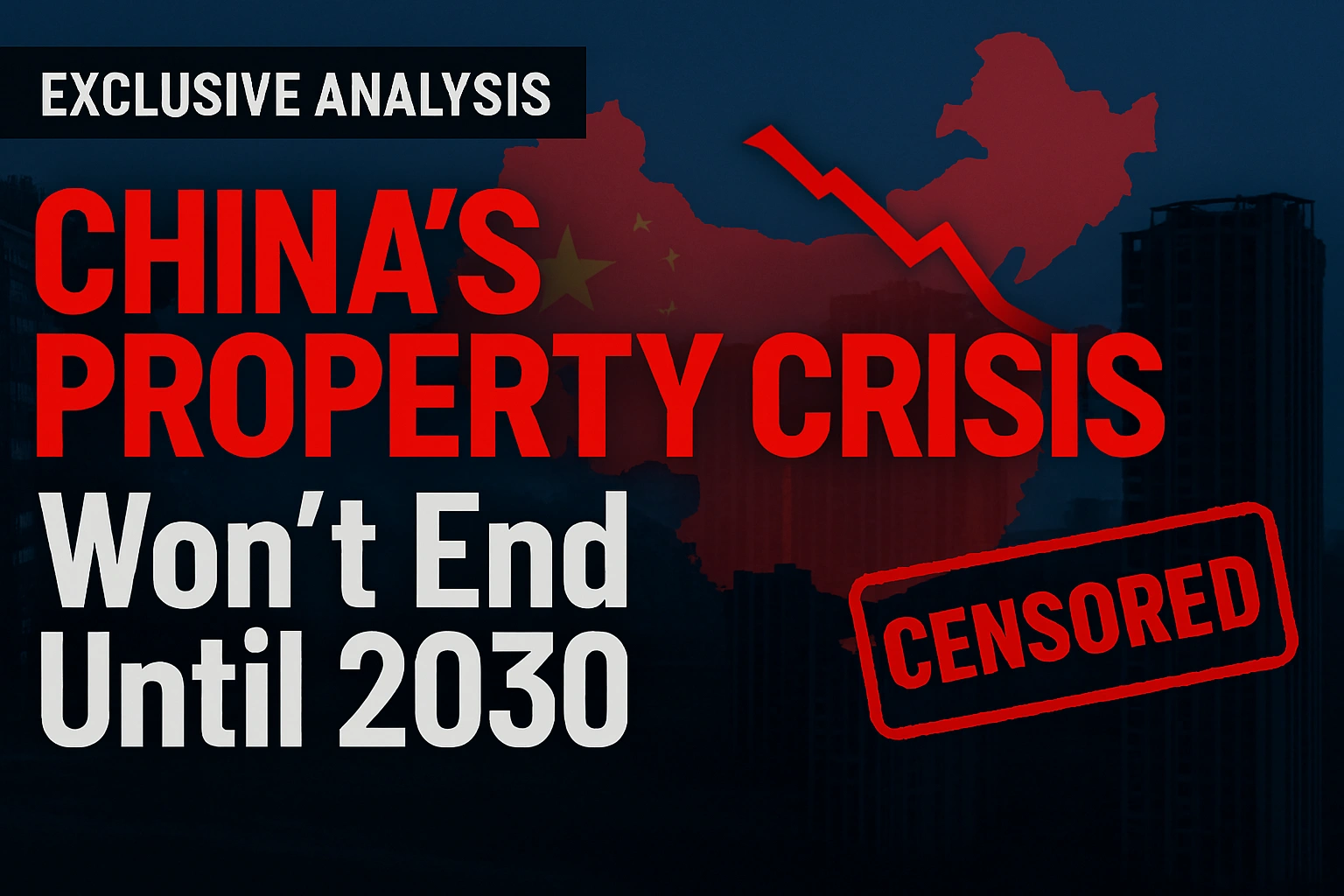
China’s Property Woes Could Last Until 2030—Despite Beijing’s Best Censorship Efforts
The world’s second-largest economy faces a reckoning that no amount of information control can erase
The construction cranes stand frozen against Shanghai’s skyline like monuments to excess. In Guangzhou, half-finished apartment towers cast long shadows over streets where homebuyers once lined up with cash deposits. Across China’s tier-two and tier-three cities, the evidence is impossible to ignore: new home prices dropped 2.4% year-on-year in November 2025, marking the 29th consecutive month of price declines.
This isn’t just another market correction. It’s the unraveling of a $60 trillion real estate ecosystem that powered four decades of unprecedented growth—and here’s what keeps global economists awake at night: despite aggressive government intervention and increasingly sophisticated censorship machinery, this crisis won’t bottom out until 2030.
The Staggering Scale of China’s Property Collapse
Numbers tell stories that social media censors can’t delete. The Index of Selected Residential Property Prices registered a 6.40% year-on-year contraction in Q2 2025, but the human cost cuts deeper. Zhang Wei, 34, has dutifully paid mortgage installments for two years on an apartment in Chongqing that remains a concrete skeleton, unfinished and uninhabitable. His story echoes across hundreds of cities.
The developer collapses read like a who’s who of China’s corporate giants. China Evergrande Group, with over $300 billion in debt, received a liquidation order in January 2024 and was delisted from the Hong Kong Stock Exchange in August 2025. But Evergrande wasn’t alone. China Vanke Co. reported a record 49.5 billion yuan ($6.8 billion) annual loss for 2024, sending shockwaves through a sector that believed state-backed developers were immune to failure.
Country Garden, once China’s largest private developer with 3,000 projects nationwide, defaulted on international bonds in October 2023 after missing payments within a 30-day grace period. Investment in real estate development declined by 14.7% in the first ten months of 2025, with sales of new homes projecting an 8% decrease for the full year, marking the fifth consecutive year of negative growth.
The construction sector tells an equally grim story. The total area of residential projects started declined by 22.55% year-on-year to 536.6 million square meters, while completed residential units fell by 25.81% to 537 million square meters. Construction workers remain unpaid, suppliers face bankruptcy, and the entire supply chain—from cement manufacturers to elevator installers—struggles to survive.
Why This Isn’t Just Another Downturn: The Structural Trap
Understanding why recovery will take until 2030 requires examining the unique architecture of China’s economy. Unlike typical real estate downturns, this crisis strikes at the foundational model that has powered Chinese growth since the 1990s.
The Property-Dependency Problem
Real estate and related industries accounted for approximately 25% of China’s GDP in 2024, despite the ongoing decline. This isn’t simply about construction—it’s about land sales, furniture manufacturing, home appliances, property management, legal services, and financial products all built around housing.
Housing prices have fallen 20% or more since they peaked in 2021, and with 70% of household wealth tied to property, falling home prices directly erode family balance sheets. This creates a vicious cycle: declining wealth leads to reduced consumption, which slows economic growth, which further pressures property values.
The Local Government Fiscal Catastrophe
Here’s where the crisis becomes truly intractable. Revenue from land sales by China’s local governments dropped 16% in 2024 compared with the previous year, after a 13.2% decline in 2023. But land sales aren’t just one revenue stream among many—they’ve been the primary funding mechanism for local governments since the 1990s.
Local Government Financing Vehicles (LGFVs), the shadow banking entities that local officials created to circumvent borrowing restrictions, are now drowning. Total debt raised directly by local governments and via their financing vehicles now stands at around 134 trillion yuan, equal to roughly $19 trillion.
These LGFVs were designed with a simple assumption: land values would continue rising, providing both collateral for new loans and revenue from sales to service existing debt. That assumption has catastrophically failed. The call for LGFVs to buy land to create revenue for local governments made matters worse, turning land from a key source of revenue into a source of new debt.
The Inventory Overhang
The inventory turnover ratio in China shortened by five months from its peak of 25.9 months in April 2025, but at the current pace, it may take another year and a half for the clearance cycle to reach 12-18 months—a relatively healthy range. That’s optimistic. In many tier-three and tier-four cities, years’ worth of unsold inventory sits vacant, with no clear demand in sight.
The math is unforgiving. Even if sales stabilize tomorrow, clearing existing inventory while developers and local governments simultaneously restructure trillions in debt requires time measured in years, not quarters.
Censorship vs. Economic Reality: When Propaganda Meets Balance Sheets
Beijing has deployed its formidable censorship apparatus with surgical precision. In less than three weeks, social media platforms Xiaohongshu and Bilibili removed more than 40,000 posts under a “special campaign” to regulate online real estate content. The Shanghai branch of the Cyberspace Administration led efforts to scrub negative sentiment about housing markets from social media.
The censorship strategy extends beyond simple post deletion. After authorities urged platforms to clean up material containing problems such as “provoking extreme opposition, fabricating false information, promoting vulgarity, and advocating bad culture,” the Cyberspace Administration of China announced in early 2025 that platforms had removed more than a million pieces of content.
This represents a coordinated campaign to control the narrative around the property crisis. Posts discussing falling home values, developer defaults, or economic pessimism are systematically removed. Even discussions of the Zhuhai vehicular attack in November 2024 were censored, part of a broader effort to suppress anything that might undermine social stability.
But here’s the fundamental problem with censoring an economic crisis: you can delete social media posts, but you can’t delete non-performing loans. You can remove hashtags about Evergrande’s default, but you can’t remove the actual debt from bank balance sheets. You can silence influencers discussing property values, but you can’t force buyers into a market where confidence has evaporated.
The contrast between official statements and ground-level reality grows starker by the month. State media emphasizes “stability” and “gradual recovery,” while sales of the top 100 developers plunged 36% in terms of value in November 2025 from a year earlier. Beijing announces stimulus packages, yet investment in fixed assets, which includes property, contracted 2.6% over the January through November period compared with a year earlier.
The 2030 Timeline: Breaking Down the Recovery Math
Why 2030? The projection isn’t arbitrary—it’s based on the time required to work through structural imbalances that took decades to build.
Inventory Clearance: 3-4 Years Minimum
Even optimistic scenarios require 2027-2028 to clear excess housing inventory in major cities, and potentially 2029-2030 for tier-three and tier-four cities. This assumes sales don’t deteriorate further—an assumption that grows shakier as demographic headwinds intensify.
Developer Balance Sheet Repair: 4-6 Years
Dozens of Chinese developers have been approved for debt restructuring plans since the start of 2025, clearing more than 1.2 trillion yuan ($167 billion) in liabilities. But this represents a fraction of total developer debt. The restructuring process—negotiating with creditors, selling assets, and gradually rebuilding financial viability—typically requires multiple years even in the best circumstances.
Local Government Fiscal Restructuring: 5-7 Years
This is the longest and most complex component. Beijing authorized 10 trillion yuan in local debt issuance—to be disbursed over five years—to address hidden obligations in 2024. But this merely refinances existing debt at lower interest rates; it doesn’t create new revenue sources.
The fundamental problem remains: local governments structured their finances around continuously rising land values. Rebuilding fiscal sustainability requires either dramatically cutting expenditures (politically painful and economically damaging) or finding alternative revenue sources (difficult and slow to implement).
Demographic Drag: Permanent Headwind
China’s working-age population is shrinking, and urbanization—the force that drove housing demand for three decades—has plateaued. These aren’t cyclical issues that resolve with stimulus; they’re structural realities that reduce baseline housing demand permanently.
Historical Parallels: Lessons from Japan’s Lost Decades
The comparison to Japan’s 1990s property bubble isn’t perfect, but it’s instructive. By 2004, prime “A” properties in Tokyo’s financial districts had slumped to less than 1 percent of their peak, and Tokyo’s residential homes were less than a tenth of their peak. It took until 2007—16 years after the bubble burst—for property prices to begin rising again.
From 1991 to 2003, the Japanese economy grew only 1.14% annually, while the average real growth rate between 2000 and 2010 was about 1%. What was initially called the “Lost Decade” became the “Lost Two Decades,” and many economists now reference “Lost Three Decades.”
Japan’s experience demonstrates several sobering realities:
Balance sheet recessions take years to resolve. Even with aggressive monetary easing (Japan pioneered zero-interest-rate policy in the late 1990s) and massive fiscal stimulus, deleveraging proceeds slowly. Households and corporations prioritize debt repayment over spending and investment.
Zombie companies drain economic vitality. Banks kept injecting funds into unprofitable firms that were too big to fail, preventing capital reallocation to productive uses. China faces a similar risk with its state-owned enterprises and developers.
Property-driven wealth effects create powerful negative feedback loops. As Japanese real estate values declined, household wealth evaporated, consumption stagnated, and deflation became entrenched. China’s even greater concentration of household wealth in property suggests potentially worse wealth effects.
The key difference: China’s crisis is arguably more structurally complex. Japan’s property bubble was primarily driven by speculative excess and loose monetary policy. China’s bubble involved speculation plus local government fiscal dependency plus shadow banking plus a fundamental economic model built around property development. Unwinding this requires more than monetary and fiscal tools—it requires redesigning the growth model itself.
Global Ripple Effects: No Crisis Is an Island
China’s property troubles send shockwaves far beyond its borders. Australia and Brazil, major commodity exporters, already face reduced demand for iron ore, copper, and other construction materials. European luxury brands that catered to China’s affluent property developers and homebuyers report softening sales.
The exposure runs deeper than trade flows. Foreign investors hold portions of Chinese developer bonds, though many have already taken massive losses. More concerning are the indirect linkages: Chinese state-owned companies with overseas investments potentially scaling back as domestic pressures mount, Chinese tourists and students spending less abroad as household wealth declines, and geopolitical implications of a economically stressed superpower.
Financial contagion risks remain contained for now—China’s capital controls and state banking sector provide insulation. But the growth drag is unavoidable. China’s housing market correction continues as an ongoing headwind, with KKR’s chief economist for Greater China estimating a 1.5 percentage point dent on China’s gross domestic product in 2025, compared with 2.5 percentage points in 2022.
What Tier-1 Companies Should Do Now
For multinational corporations and investors, the 2030 timeline requires strategic adjustments:
Diversify China exposure. Companies heavily dependent on Chinese property-related demand should accelerate diversification into other Asian markets or sectors. The “China-only” growth strategy needs fundamental reevaluation.
Watch local government creditworthiness. Companies with receivables from Chinese local governments or infrastructure projects face rising payment risks. Credit insurance and careful monitoring of local fiscal conditions are essential.
Reconsider real estate collateral. Lenders and investors using Chinese property as collateral should reassess valuations aggressively. The assumption that property values provide a floor has proven catastrophically wrong.
Monitor consumer wealth effects. Consumer-facing businesses should prepare for years of constrained spending as household wealth remains depressed. The Chinese consumer, long expected to drive global growth, faces significant headwinds.
Prepare for policy volatility. Beijing will likely cycle through various stimulus measures, creating temporary market movements. Distinguishing genuine structural improvements from short-term liquidity injections is critical.
The Painful Path Forward
Beijing recognizes that the core issue lies in reducing local governments’ dependence on LGFVs, with Premier Li Qiang underscoring the need to “remove government financing functions from local financing platforms and press ahead with market-oriented transformation”. This is the right diagnosis, but the treatment will be painful and prolonged.
“China’s property crisis represents more than a cyclical downturn—it’s the unwinding of a growth model that took 30 years to build. Recovery to sustainable equilibrium requires 5-7 years minimum, with 2030 representing the earliest realistic bottom under optimistic scenarios. Censorship can control information but cannot alter the underlying economics.“
China needs to rebuild its entire fiscal architecture. This means new tax structures, revised central-local government responsibilities, transparent budget constraints, and allowing insolvent entities to actually fail rather than propping them up indefinitely. Each of these reforms faces powerful resistance from vested interests.
The alternative—continuing to refinance bad debts, prop up zombie developers, and hope for a return to property-driven growth—merely extends the crisis. It’s Japan’s playbook from the 1990s, and the results speak for themselves.
Conclusion: When Censorship Meets Economic Gravity
Beijing’s censors can scrub social media clean of negative sentiment. They can delete posts, suspend accounts, and create the digital appearance of stability. What they cannot do is delete the structural imbalances in China’s economy, rewrite the math of debt-to-GDP ratios, or manufacture demand in a demographically declining society with excess housing supply.
The 2030 timeline isn’t pessimism—it’s arithmetic. Clearing inventory, restructuring debt, rebuilding local government finances, and allowing new economic models to emerge requires time measured in years, not quarters. Japan’s experience, with similar structural challenges but arguably simpler economics, took more than a decade even with aggressive policy responses.
For global businesses, investors, and policymakers, the implications are profound. The Chinese growth engine that powered the global economy for three decades is fundamentally transforming. The property-driven model is over, and what replaces it remains uncertain.
The censors can control the narrative on Weibo. They cannot control economic reality. And economic reality suggests that 2030 marks not the beginning of recovery, but merely the year when China might finally hit bottom—if, and only if, Beijing pursues genuine structural reforms rather than continued extend-and-pretend tactics.
For hundreds of millions of Chinese families like Zhang Wei’s, still paying mortgages on unfinished apartments, that timeline offers cold comfort. But it offers something perhaps more valuable: honesty about the scale of the challenge ahead. No amount of censorship can change what the numbers tell us—this is a crisis that will define China’s next decade.
Data Sources :
This analysis draws from National Bureau of Statistics of China, International Monetary Fund reports, Bloomberg Intelligence, Goldman Sachs research, and major property developer financial statements through December 2025. Statistical projections are based on historical recovery timelines from comparable property crises, adjusted for China-specific structural factors.
Discover more from The Economy
Subscribe to get the latest posts sent to your email.
Asia
China’s 50% Domestic Equipment Rule: The Semiconductor Mandate Reshaping Global Tech
How Beijing’s Quiet Policy Shift Is Accelerating Chip Independence and Putting $18 Billion in Foreign Sales at Risk
When Chinese chipmakers began receiving approval applications for new fabrication plants in early 2024, they encountered an unexpected requirement: demonstrate that at least half of their equipment purchases would come from domestic suppliers, or face rejection. No formal regulation announced it. No press conference explained it. Yet this unpublished rule—requiring chipmakers to use at least 50% domestically made equipment for adding new capacity—represents one of Beijing’s most aggressive moves yet in the technology cold war with the West.
The mandate arrives at a pivotal moment. China’s semiconductor equipment market reached $23.89 billion in 2024, accounting for roughly 40% of global wafer fabrication equipment spending. With major chip equipment makers’ China revenue doubling from 17% in late 2022 to 41% by early 2024, the new policy threatens to fundamentally reshape who wins and loses in the world’s largest chip market.
This isn’t just another trade restriction. It’s a calculated industrial strategy that’s already yielding measurable results—and forcing both Chinese manufacturers and foreign suppliers to completely rethink their approach to the most critical technology of our time.
The Policy Decoded: What the 50% Rule Really Means
The mandate operates through China’s state approval process rather than published regulations. When companies like Semiconductor Manufacturing International Corporation (SMIC) or Hua Hong Semiconductor submit proposals to build or expand facilities, authorities now require detailed procurement tenders proving that domestic equipment will constitute at least 50% of total spending.
Applications that fail to meet the threshold are typically rejected, though the policy includes strategic flexibility. Advanced production lines targeting cutting-edge nodes receive temporary exemptions where domestic alternatives simply don’t exist yet—particularly for lithography equipment, the most sophisticated tools in chip manufacturing.
The scope is revealing. State-affiliated entities placed a record 421 orders for domestic lithography machines and parts in 2024 worth around 850 million yuan ($121.3 million), signaling an unprecedented surge in demand for locally developed technologies. However, these orders include both new systems and spare parts, making the actual number of new tools difficult to assess.
To put this in perspective, a single advanced lithography tool from ASML—the Dutch company that dominates the market—costs approximately $27.9 million for dry ArF systems used in mature node production. The total value of China’s domestic orders barely covers four or five equivalent machines, illustrating both the progress Chinese suppliers have made and the massive gap that remains.
What makes this policy particularly potent is its timing. While US export controls blocked China’s access to the most advanced chipmaking equipment, the 50% rule forces Chinese manufacturers to choose domestic suppliers even in areas where foreign equipment remains available and technically superior.
Winners Rising: China’s Semiconductor Equipment Champions
The mandate is producing exactly what Beijing intended: a rapid acceleration in domestic equipment capabilities, backed by extraordinary revenue growth and technological breakthroughs.

Naura Technology: The Emerging Powerhouse
Naura Technology Group’s 2024 revenue reached between 27.6 billion yuan and 31.78 billion yuan ($3.79-$4.36 billion), reflecting growth of 25% to 44%. Net profit surged even faster, climbing 33% to 53% year-over-year. This isn’t just financial engineering—it’s a company rapidly closing the technology gap.
Naura is testing its etching tools on SMIC’s cutting-edge 7-nanometer production line, a crucial milestone that puts Chinese equipment into advanced node manufacturing for the first time. Previously, such sophisticated etching was exclusively the domain of American giants Lam Research and Tokyo Electron.
The company’s innovation pipeline is equally impressive. Naura successfully developed key products including capacitively coupled plasma etching equipment, plasma-enhanced chemical vapor deposition systems, atomic layer deposition vertical furnaces, and stacked wafer cleaning systems—all of which have been integrated into customer production lines at scale.
Perhaps most revealing: Naura filed a record 779 patents in 2024, more than double what it filed in 2020 and 2021. This isn’t incremental improvement; it’s a company operating in overdrive.
AMEC: Specializing Under Pressure
Advanced Micro-Fabrication Equipment (AMEC) is taking a different path, focusing intensely on etching technologies. The company’s 2024 revenue hit 9.065 billion yuan ($1.24 billion), up 45% year-over-year, with etching equipment accounting for 7.276 billion yuan—a 55% increase.
AMEC developed electrostatic chucks to replace worn parts in Lam Research equipment that the company could no longer service after 2023 restrictions, demonstrating how necessity drives innovation. When American suppliers were forced to withdraw support, Chinese companies didn’t just wait—they engineered solutions.
China gained nine percentage points in the dry etch tool segment between 2019 and 2024, with AMEC and Naura each capturing roughly 5% market share. It’s a small but strategically significant foothold in a market previously dominated by the United States (59%) and Japan (29%).
ACM Research: The Quiet Achiever
ACM Research, specializing in cleaning and polishing equipment, expects 2024 revenue between 5.6 billion yuan and 5.88 billion yuan ($769-$807 million), reflecting growth of 44% to 51%. The company projects 2025 revenue will reach 6.5-7.1 billion yuan thanks to a robust order backlog.
Analysts estimate that China has now reached roughly 50% self-sufficiency in photoresist-removal and cleaning equipment, a market previously dominated by Japanese firms but now increasingly led by domestic players like Naura and ACM.
These aren’t paper achievements. Multiple sources confirmed that the 50% rule is “accelerating results” and forcing rapid quality improvements as domestic suppliers work directly with leading fabs under commercial pressure.
Losers Squeezed: Foreign Equipment Makers Face Strategic Loss
For Western equipment suppliers, the 50% mandate represents a slow-motion strategic catastrophe—even as some maintain strong China revenues in the near term.
The Scale of Exposure
The top five global wafer fabrication equipment manufacturers experienced a 48% year-over-year revenue increase from China in 2024, with China now accounting for 42% of total system sales. At first glance, this seems positive. In reality, it’s a warning sign—companies are enjoying a final surge before the hammer falls.
Applied Materials provides a cautionary tale. The company’s China business dropped from 54% of semiconductor equipment revenue in Q1 2024 to 39% in Q2 2024, representing a loss of approximately $750 million in DRAM business. Applied Materials’ CFO acknowledged that China exposure would decline further to around 29% in Q4, with the expectation that depressed levels would persist for several quarters.
ASML’s revenue from mainland China reached 10.195 billion euros (about $11.16 billion) in 2024, accounting for 36.1% of total sales. Yet management forecasts this will drop to approximately 20% in 2025, reverting toward historical averages as the mandate takes full effect.
The Technological Lock-Out
The financial impact is significant, but the strategic implications are more profound. China represents not just revenue but the world’s fastest-growing semiconductor market and a critical testbed for new equipment technologies.
Bernstein analysts estimate that potential further restrictions could jeopardize up to 50% of China’s wafer fabrication equipment spending, with China’s total equipment spending at $43 billion in 2024 and $41 billion forecast for 2025.
Lam Research, which competes directly with AMEC in etching equipment, has seen its fortunes shift. The company expects China’s share of revenue to normalize around 30% in Q4 2024, down from 37% in Q1, with management noting that spending from domestic Chinese customers specifically would decrease.
Even sectors where Chinese capabilities lag dramatically—like lithography—are experiencing pressure. While ASML maintains dominance in extreme ultraviolet (EUV) lithography for advanced nodes, its deep ultraviolet (DUV) systems for mature nodes face increasing competition as China aggressively develops alternatives and employs multi-patterning workarounds.
The Feasibility Question: Can China Actually Hit 50%?
The ambition is clear. The execution is another matter entirely.
Where China Has Achieved Parity
As of 2024, China’s semiconductor equipment self-sufficiency rate reached 13.6% overall, but this average masks significant variation across different equipment categories.
In specific segments, China has already achieved or exceeded the 50% threshold:
- Photoresist stripping and cleaning: Approximately 50% self-sufficiency, with Naura taking market leadership from Japanese firms
- Chemical mechanical planarization (CMP): China’s market share jumped from 1.5% in 2022 to nearly 11% in 2023
- Dry etching: China reached 11% market share, up from under 3% in 2019
In areas such as etching, a critical chip manufacturing step that involves removing materials from silicon wafers to carve out intricate transistor patterns, the policy is already yielding results.
The Critical Gaps
Lithography remains the Achilles’ heel. China’s leading lithography company, Shanghai Micro Electronics Equipment (SMEE), produces systems roughly equivalent to technology ASML developed 15-20 years ago. For advanced nodes requiring extreme precision, no domestic alternative exists.
China’s domestic equipment industry can handle various stages of semiconductor manufacturing processes (excluding lithography machines), according to TrendForce analysis. Challenges also persist in measurement, coating, development, and ion implantation equipment.
This explains why authorities grant flexibility for advanced production lines. SMIC’s 7-nanometer manufacturing—used to produce Huawei’s breakthrough Kirin 9000s chip—still relies on ASML’s DUV immersion lithography systems combined with multiple patterning techniques to achieve features smaller than the equipment was originally designed to create.
The Timeline Reality
By 2030, China’s mature semiconductor process market (≥22nm) is projected to reach nearly 40% global market share, up from 30% in 2023, according to IDC. This suggests China will dominate older-generation chip production where domestic equipment can compete effectively.
For advanced nodes, the timeline extends much further. Industry experts estimate China remains roughly a decade behind the cutting edge, and the gap may widen rather than narrow for the most sophisticated processes. Each new generation of lithography—from EUV to the emerging High-NA EUV—represents exponentially greater technical complexity.
The Geopolitical Chessboard: Washington’s Dilemma
The 50% mandate didn’t emerge in a vacuum. It’s a direct counter-move to US technology restrictions that began escalating in 2022 and intensified dramatically in 2023.
The Export Control Paradox
A former Naura employee noted that before 2024 export restrictions, domestic fabs like SMIC would prefer US equipment and would not really give Chinese firms a chance. Washington’s sanctions created an inadvertent gift to Chinese equipment makers: captive customers with no alternative suppliers.
The October 2023 US export controls blocked sales of advanced AI chips and sophisticated semiconductor equipment to China, forcing companies like Applied Materials, Lam Research, and KLA to withdraw personnel from Chinese facilities. These restrictions targeted not just finished equipment but also inputs to Chinese domestic equipment makers, attempting to strangle the emerging industry in its cradle.
It hasn’t worked as intended. Instead of crippling China’s chip sector, the controls accelerated exactly what they aimed to prevent: the development of indigenous alternatives.
The State Backing
China established the National Integrated Circuit Industry Investment Fund Phase III in May 2024 with registered capital of 344 billion yuan ($47.5 billion)—larger than the previous two phases combined and representing the largest government semiconductor investment globally.
The fund operates on a 15-year timeline extending to 2039, acknowledging the long-term nature of semiconductor development. China’s Ministry of Finance holds the largest stake at 17%, with five major state banks each contributing approximately 6% of total capital.
This isn’t venture capital seeking quick returns. It’s strategic industrial policy willing to sustain losses for years to achieve technological sovereignty. The fund targets both the entire semiconductor supply chain and specific critical areas including large manufacturing plants, high-bandwidth memory, and advanced AI chips.
Allied Nations Caught in the Middle
Europe, Japan, and South Korea face an impossible position. Their companies—ASML, Tokyo Electron, and others—generated enormous revenue from China, but increasingly must align with US restrictions or risk their own access to American technology and markets.
The Netherlands, under pressure from Washington, restricted ASML from selling its most advanced High-NA EUV lithography machines to China. Japan implemented similar export controls on advanced chipmaking equipment. These allied restrictions close potential loopholes but also accelerate China’s determination to eliminate foreign dependencies entirely.
Taiwan presents perhaps the thorniest dilemma. TSMC, the world’s leading chipmaker, supplies chips to Chinese customers while maintaining advanced fabs in Taiwan that depend on American equipment and technology. Any escalation in US-China tensions or moves toward Chinese reunification could severely disrupt global chip supplies.
Business Strategy Imperatives: What Companies Must Do Now
The 50% mandate forces a fundamental reassessment of China strategy across multiple stakeholder groups.
For Foreign Equipment Makers: The Diversification Imperative
Companies cannot reverse the trend. The question is how quickly to pivot and where to redirect resources.
Short-term (1-2 years):
- Maximize revenue from remaining China business while it lasts
- Accelerate sales to customers in Taiwan, Korea, Japan, and the United States
- Expand service and upgrade offerings for existing installed base in China
Medium-term (3-5 years):
- Diversify manufacturing footprint to reduce dependence on any single geography
- Develop product variants that comply with various export control regimes
- Strengthen positions in advanced packaging, where Chinese competition remains limited
Long-term (5+ years):
- Accept that China will develop domestic alternatives for most equipment categories
- Focus innovation on areas requiring such extreme precision that Chinese suppliers cannot readily replicate
- Build relationships in emerging semiconductor manufacturing regions (India, Vietnam, Eastern Europe)
China spent $41 billion on wafer fabrication equipment in 2024, accounting for about 40% of all purchases worldwide. Losing this market cannot be fully offset, but AI-driven demand in other regions provides a partial buffer.
For Chinese Chipmakers: The Quality-Versus-Sovereignty Tradeoff
Domestic equipment works, but not always as well as foreign alternatives—at least not yet. Chinese fabs must balance production efficiency against strategic imperatives.
SMIC achieved a significant breakthrough with its 7nm process, notably used for manufacturing Huawei’s Kirin 9000s chip, demonstrating that Chinese fabs can produce sophisticated semiconductors despite equipment limitations. However, yields remain lower and costs higher than at TSMC or Samsung using cutting-edge tools.
The pragmatic approach involves tiering:
- Advanced nodes (7nm and below): Use best available equipment, including remaining foreign tools, to maximize competitiveness
- Mature nodes (28nm and above): Aggressively adopt domestic equipment to drive volume and improvements
- Memory and specialty chips: Leverage areas where Chinese equipment has achieved near-parity
For Multinational Tech Companies: The Supply Chain Nightmare
Companies like Apple, Nvidia, and automotive manufacturers face cascading risks. If Chinese chipmakers using domestic equipment cannot match the quality or capacity of global alternatives, supply chains fragment.
The scenarios range from manageable to catastrophic:
- Optimistic: China achieves competent domestic production for mature nodes, bifurcating the global market into “advanced” (TSMC, Samsung, Intel) and “mature” (Chinese fabs) with minimal disruption
- Pessimistic: Quality gaps persist, forcing companies to duplicate supply chains entirely, one using Chinese chips for Chinese markets and another using TSMC/Samsung for everywhere else
Either way, costs increase. China expanded foundry capacity by 15% in 2024 and is scheduled to add another 14% in 2025, creating enormous production capability that must be absorbed somewhere.
The Venture Capital Angle: Where Smart Money Is Moving
The 50% mandate creates asymmetric investment opportunities for those willing to navigate geopolitical complexity.
The Chinese Equipment Thesis
Naura Technology rose to sixth place globally among semiconductor equipment manufacturers in 2024, making it the only Chinese company in the top ten. For investors willing to accept governance and geopolitical risks, Chinese equipment makers offer:
- Revenue visibility: Captive domestic demand virtually guaranteed by policy
- Margin expansion potential: As technology improves, pricing power increases
- Export upside: Eventually, cost-competitive Chinese equipment could compete in other price-sensitive markets
The caveat: US sanctions could expand to block Chinese equipment companies from accessing critical components, and corporate governance in state-backed firms sometimes prioritizes national objectives over shareholder returns.
The Picks-and-Shovels Alternative
Rather than betting on chipmakers or equipment makers directly, sophisticated investors are targeting:
- Materials suppliers: Chemicals, gases, and substrates required regardless of equipment nationality
- Advanced packaging: China lags in this area, creating opportunities for domestic and foreign providers
- Design tools: Chinese chip designers still depend heavily on Synopsys, Cadence, and other EDA providers
These segments face less direct policy pressure while still benefiting from China’s semiconductor expansion.
The 2026-2030 Outlook: Three Scenarios
Scenario 1: Managed Bifurcation (60% probability)
China achieves competent self-sufficiency in mature node equipment by 2027-2028, while advanced nodes remain dependent on limited foreign tool access. The global semiconductor industry splits into parallel ecosystems:
- “Free world”: TSMC, Samsung, Intel leading on advanced nodes using Western/Japanese/Korean equipment
- “China sphere”: Chinese fabs dominating mature nodes with domestic equipment, serving primarily Chinese and developing market customers
Trade continues but within clearly defined boundaries. Western equipment makers lose 50-70% of China revenue but offset partially through AI-driven demand elsewhere.
Scenario 2: Breakthrough Acceleration (25% probability)
Chinese equipment makers advance faster than expected, achieving near-parity with foreign competitors in most categories by 2028-2030. This could occur through:
- Continued talent recruitment from foreign firms
- Breakthroughs in alternative lithography approaches (multi-beam, nanoimprint)
- Brute-force R&D spending enabled by state backing
In this scenario, Chinese equipment companies begin competing globally on cost, threatening Western suppliers’ positions even outside China.
Scenario 3: Technology Wall (15% probability)
Chinese equipment development stalls at current levels, unable to overcome fundamental physics and engineering challenges without access to Western technology and components. The 50% rule remains in place but creates inefficiency, with Chinese fabs producing lower yields and higher defect rates.
This scenario likely triggers more aggressive Chinese action—potentially including forced technology transfer, industrial espionage escalation, or geopolitical moves to secure access to Taiwan’s semiconductor capabilities.
What This Means for You
If you’re reading this as a tech industry executive, the message is clear: the era of a unified global semiconductor supply chain is ending. Every company with significant China exposure needs a bifurcation strategy—yesterday.
If you’re an investor, the 50% mandate creates both risks and opportunities. US equipment makers with high China exposure (Applied Materials, Lam Research, KLA) face structural headwinds regardless of how strong AI demand runs. Chinese equipment makers offer growth but with governance and geopolitical risks. The real opportunity may lie in picks-and-shovels providers and companies with defensible positions in segments where Chinese competition remains distant.
If you’re a policy maker, recognize that export controls alone won’t slow China’s semiconductor development—they may accelerate it. The 50% mandate proves that restrictions create determination, captive markets, and state-backed alternatives. A more effective strategy might focus on maintaining leadership in truly irreplaceable technologies while accepting China’s inevitable progress in commoditized segments.
The Bottom Line
The 50% rule suggests China has concluded that technological decoupling is no longer a risk to manage, but a reality to optimize around, marking a new phase in the global semiconductor standoff.
This isn’t about whether China will develop domestic semiconductor equipment capabilities. That question is answered: they will. The relevant questions are how quickly, how effectively, and what the rest of the world does in response.
The mandate is already producing measurable results—Chinese semiconductor equipment manufacturers set sales records in 2024, with leading companies posting 25-55% revenue growth. Beijing has poured hundreds of billions of yuan into its semiconductor sector through the Big Fund, demonstrating commitment that transcends typical industrial policy.
For Western companies, this represents an $18 billion annual revenue stream gradually slipping away. For China, it’s a forced march toward technology independence that’s happening faster than most observers expected. For the rest of us, it’s a reminder that in geopolitics, sometimes the quietest policies create the loudest consequences.
The semiconductor industry is fragmenting before our eyes, not through dramatic announcements or treaty violations, but through procurement rules that most people will never read. That may be the most important technology story of 2024—and it’s only just beginning to unfold.
What are your thoughts on China’s semiconductor strategy? How should Western companies respond? Share your perspective in the comments below.
Discover more from The Economy
Subscribe to get the latest posts sent to your email.
Asia
Asian Economic Order: Who Will Lead in 2026?
Introduction: The $50 Trillion Question
In early 2025, Apple shifted 14% of its iPhone production from China to India. Samsung announced a $20 billion semiconductor facility in Vietnam. Japanese automakers accelerated partnerships with Indonesian battery manufacturers. These aren’t isolated decisions—they’re symptoms of a tectonic shift reshaping the world’s most dynamic economic region.
Asia’s collective GDP now exceeds $50 trillion, representing over 60% of global growth. But as we approach 2026, a critical question looms: who will lead this economic powerhouse? Will China retain its crown despite structural headwinds? Can India’s demographic and digital revolution propel it to the forefront? Might ASEAN’s collective strength eclipse individual giants? Or will Japan and South Korea’s technological dominance redefine what leadership means?
The answer matters far beyond Asia. Supply chains, climate policy, technological standards, and geopolitical alliances all hinge on how this economic order evolves. Unlike previous decades defined by China’s singular rise, 2026 presents something more complex: a multipolar Asia where power is distributed, contested, and constantly negotiated.
Historical Context: From China’s Century to Multipolar Competition
To understand where Asia is heading, we must grasp how it arrived here. China’s transformation since the 1990s was unprecedented—300 million lifted from poverty, a manufacturing ecosystem unmatched globally, and GDP growth averaging 10% for three decades. Its 2001 WTO accession wasn’t just economic integration; it was a reshaping of global capitalism itself.
But China’s dominance obscured other transformations. India’s 1991 liberalization planted seeds that sprouted slowly, then explosively after 2014 when the Modi government launched initiatives like Digital India, Make in India, and GST tax reform. These weren’t just policy programs—they represented India’s bet on a services-and-digital-first economy fundamentally different from China’s manufacturing model.
Meanwhile, ASEAN pursued a quieter but equally significant path. From Thailand’s automotive hub to Vietnam’s electronics boom to Indonesia’s resource wealth, the ten-nation bloc integrated into a $3.6 trillion economy with 650 million consumers. The 2020 Regional Comprehensive Economic Partnership (RCEP) formalized what was already occurring: ASEAN had become the strategic center of Asian trade, partnering with everyone while dominated by none.
Japan and South Korea, facing demographic decline, made a different wager—betting on technological intensity over scale. Japan’s robotics, green technology, and advanced materials; South Korea’s semiconductors, batteries, and consumer electronics. Both proved that innovation could sustain relevance even as populations aged and domestic markets stagnated.
By 2026, these divergent strategies are colliding, creating a genuinely multipolar Asia for the first time in modern history.
Current Landscape: The Data Behind the Divergence
The numbers tell a striking story. According to Asian Development Bank projections, developing Asia will grow at 4.7% in 2026—three times the projected global average. But this aggregate masks radical divergence.
India leads with forecasted growth around 7%, driven by a $500 billion digital economy (doubled from 2023), 25 million annual additions to the workforce, and manufacturing output growing at 10% annually. The IMF projects India will contribute 18% of global growth in 2026, second only to China despite having one-fifth its GDP.
China’s story is more complicated. Growth projections hover around 4.6%—historically low but still representing $800 billion in absolute terms, more than most countries’ entire economies. Yet beneath aggregate figures lie structural concerns: property sector losses exceeding $1 trillion, local government debt at 120% of GDP, and a shrinking working-age population. China’s pivot toward electric vehicles, AI, and advanced semiconductors shows ambition, but geopolitical headwinds—US tariffs, supply chain diversification, technology restrictions—threaten this transition.
ASEAN’s six largest economies (Indonesia, Thailand, Singapore, Malaysia, Vietnam, Philippines) project collective growth around 5%. Vietnam’s manufacturing exports are growing at 15% annually, having captured production Apple, Samsung, and Nike shifted from China. Indonesia, with its nickel dominance, sits at the center of the global battery supply chain. The Philippines’ business process outsourcing sector rivals India’s in scale.
Japan’s 1-1.5% growth reflects demographic reality—a shrinking population means growth comes only from productivity gains. Yet Japan’s $60 billion green technology exports and dominance in industrial robotics show how quality compensates for quantity. South Korea’s 2.5-3% projection depends heavily on semiconductor demand, particularly from AI applications where its chip manufacturers hold 70% global market share.
These aren’t just numbers—they represent fundamentally different economic models competing for regional leadership.
The Manufacturing Race: Vietnam’s Rise and China’s Retention
Walk through Hanoi’s industrial parks and the transformation is visceral. Where rice paddies stood a decade ago, Samsung now produces 50% of its smartphones. Intel, Apple, and LG have followed. Vietnam’s manufacturing exports grew from $100 billion in 2015 to over $350 billion in 2024, with projections hitting $450 billion by 2026.
But China isn’t ceding manufacturing dominance easily. While labor-intensive assembly moves to Southeast Asia, China is climbing the value chain. It now produces 60% of the world’s electric vehicles, dominates battery production, and leads in industrial robots. The difference? Vietnam assembles iPhones; China increasingly designs and builds the machines that make them.
India presents a third model—selective manufacturing depth in pharmaceuticals (60% of global generic drugs), automotive components, and increasingly, electronics. Foxconn’s $1.6 billion investment in Indian iPhone production and Tesla’s planned Gigafactory signal India’s manufacturing ambitions. Yet infrastructure gaps remain stark. While China moves containers port-to-factory in 24 hours, India averages 3-5 days. Vietnam’s logistics efficiency sits between them.
The question isn’t whether manufacturing leaves China entirely—it won’t. It’s whether China can transition fast enough to higher-value production while Vietnam, India, and others capture what it leaves behind.
The Digital Economy Battle: India’s Unexpected Lead
If manufacturing defines China’s past, digital services may define India’s future. India’s Unified Payments Interface processed 13 billion transactions monthly in 2024—ten times more than any other real-time payment system globally. This infrastructure spawned a fintech ecosystem valued at over $150 billion, with companies like PhonePe, Paytm, and Razorpay processing more digital transactions than the entire European Union.
But it’s not just payments. India’s software services exports exceed $200 billion annually, while China’s lag at $30 billion despite five times India’s GDP. Why? India’s English proficiency, time zone advantage with Western markets, and democratic legal framework make it the natural hub for global digital services.
China’s digital strength lies elsewhere—in consumer platforms like WeChat and Douyin (TikTok), in AI applications deployed at massive scale, and in manufacturing digitization. China’s industrial internet market is projected at $240 billion by 2026, as factories integrate AI, IoT, and automation. These are fundamentally different digital economies: India services the world’s code; China digitizes production itself.
ASEAN countries are carving niches—Singapore as Asia’s fintech hub, Indonesia with its super-apps like Gojek and Grab, and the Philippines in business process outsourcing. By 2026, Southeast Asia’s digital economy is projected at $330 billion, smaller than India’s or China’s individually but growing faster than both.
Demographic Destinies: The Age Divide
Demographics may be destiny, and here the divergence is starkest. India adds 25 million working-age adults annually through 2030. China loses 5 million. By 2026, India’s median age will be 28; China’s 39; Japan’s 49; South Korea’s 45. ASEAN sits at 31—younger than China, older than India.
These aren’t just statistics—they’re economic trajectories. India’s demographic dividend means rising consumption, growing labor supply, and expanding tax bases. The Economist projects India will add 140 million middle-class consumers by 2030, creating a consumer market rivaling Europe’s.
China faces the opposite: a shrinking workforce, rising pension costs, and declining domestic consumption growth. Its response? Automation, AI, and productivity gains to offset labor decline. China installed 290,000 industrial robots in 2023—more than the rest of the world combined. Japan and South Korea follow similar paths, using technology to compensate for demographic decline.
ASEAN’s demographic advantage is more nuanced. Vietnam, the Philippines, and Indonesia have youthful populations; Thailand and Singapore face aging similar to Northeast Asia. This heterogeneity means ASEAN’s demographic dividend is real but unevenly distributed.
The question: can China’s technological intensity overcome demographic decline? Can India translate demographic advantage into productivity before its window closes? History suggests demographic dividends aren’t automatic—they require employment, education, and infrastructure that India must still prove it can deliver at scale.
Geopolitical Positioning: The New Great Game
Economics and geopolitics are inseparable in 2026’s Asia. The US-China rivalry isn’t just tariffs—it’s technology decoupling, military positioning, and alliance building. Each Asian economy must navigate this carefully.
India’s choice is increasingly clear. Quad membership with the US, Japan, and Australia; defense cooperation deepening; and positioning as a democratic alternative to China. The US-India Initiative on Critical and Emerging Technology (iCET) channels semiconductor investment and defense tech collaboration. India isn’t just diversifying from China—it’s explicitly positioning against it.
ASEAN takes the opposite approach: strategic ambiguity. Vietnam maintains security ties with Russia while deepening economic links with the US. Singapore hosts US naval facilities while serving as a financial gateway to China. This flexibility is ASEAN’s strength—playing major powers against each other while maintaining autonomy.
Japan and South Korea face unique pressures. Japan’s alliance with the US is bedrock, yet China remains its largest trading partner. South Korea’s semiconductor exports to China exceed $100 billion annually, even as it hosts US troops and participates in regional security frameworks. Both navigate between economic pragmatism and security alliances.
China counters with the Belt and Road Initiative, now investing over $1 trillion across 150 countries, and RCEP, which integrates Asian trade without US participation. Its Asian Infrastructure Investment Bank offers development finance rivaling Western institutions.
By 2026, these geopolitical positions will increasingly determine economic outcomes. Will US technology restrictions on China accelerate innovation—or stifle it? Will India’s democratic alignment attract investment—or its policy unpredictability deter it? Can ASEAN maintain neutrality—or will pressure force alignment?
Future Scenarios: Four Paths to 2026
Scenario 1: India’s Decade Begins India sustains 7%+ growth, infrastructure bottlenecks ease, and manufacturing competitiveness improves. Western firms accelerate China diversification, making India the primary beneficiary. Digital services expand globally, and demographic dividends translate into mass consumption. By 2026, India is unambiguously Asia’s growth leader, though still smaller than China in absolute terms.
Probability: 40%. Requires sustained reform momentum and geopolitical alignment.
Scenario 2: China’s Successful Pivot China manages its property crisis, technology investments in EVs and AI pay off, and it successfully moves up the value chain. Domestically, automation offsets demographic decline. Internationally, Belt and Road deepens influence while RCEP integrates Asian trade under Chinese leadership. Growth stabilizes at 4-5%, but quality improves and geopolitical influence grows.
Probability: 30%. Requires navigating debt, demographics, and US containment simultaneously.
Scenario 3: ASEAN’s Collective Rise ASEAN integration accelerates, infrastructure improves, and the bloc captures manufacturing leaving China while expanding its consumer market. Vietnam, Indonesia, and the Philippines become individually significant economies. RCEP deepens, making ASEAN the strategic center of Asian trade. No single ASEAN nation dominates, but collectively they rival China and India’s influence.
Probability: 20%. Requires political cohesion that has historically eluded ASEAN.
Scenario 4: Fragmented Multipolarism No single actor dominates. India grows fast but infrastructure constrains potential. China manages decline but doesn’t thrive. ASEAN remains fragmented. US-China rivalry deepens, fragmenting supply chains and slowing regional integration. Technology decoupling creates parallel ecosystems. Asia grows but below potential, and leadership remains contested.
Probability: 10%. The pessimistic scenario, but not implausible if geopolitics intensifies.
Most likely? A combination—India leading growth rates, China retaining scale and technology strength, ASEAN rising collectively, and Japan-South Korea sustaining through innovation. Truly multipolar, with leadership context-dependent.
Critical Uncertainties: What to Watch
Several variables will determine which scenario unfolds:
Capital Flows: Will foreign direct investment continue shifting to India and Southeast Asia, or will China’s technology and scale retain capital? Watch quarterly FDI figures and corporate investment announcements.
Technology Decoupling: How far will US-China technology separation go? Complete decoupling fragments Asian supply chains; partial separation might strengthen regional integration.
Infrastructure Delivery: Can India and ASEAN deliver roads, ports, and power grid improvements? Infrastructure investment-to-GDP ratios are leading indicators—India at 5%, China historically at 8%, ASEAN averaging 4%.
Domestic Consumption: Will China’s consumers return, or has the property crisis permanently damaged confidence? Watch retail sales growth and consumer sentiment indices.
Climate Shocks: ASEAN’s coastal economies face existential climate risks. Severe weather events could derail growth trajectories faster than any economic policy.
Geopolitical Flashpoints: Taiwan, South China Sea, and North Korea remain potential crisis points that could instantly reorder economic priorities.
These aren’t theoretical—each represents actionable intelligence for investors, policymakers, and businesses positioning for 2026.
Implications: What This Means for Business and Policy
For multinational corporations, the message is diversification without simplification. The “China Plus One” strategy is table stakes; the question is whether it’s “China Plus India,” “China Plus ASEAN,” or “China Plus Several.” Companies must maintain China presence for scale and technology while building alternatives for resilience.
For investors, a multipolar Asia means sector-specific strategies. Technology? Focus on South Korea and Taiwan. Digital services? India leads. Manufacturing? Vietnam and Indonesia are rising. Consumer growth? India and ASEAN offer the largest opportunities. One-size-fits-all Asia strategies no longer work.
For policymakers, particularly in the West, the question is whether to support multipolarity or attempt to create a single alternative to China. The former is more realistic; the latter risks overextending commitments and underestimating China’s resilience.
For Asian nations themselves, multipolarity creates opportunity. Smaller economies can leverage great power competition for investment, technology transfer, and market access. But it also creates risk—misjudging geopolitical alignment could mean economic isolation.
Conclusion: Preparing for Multipolar Asia
The Asian economic order of 2026 defies simple narratives. It’s not “the rise of China” or “the rise of India”—it’s the simultaneous rise, recalibration, and repositioning of multiple powers, each leveraging different strengths in an interconnected but increasingly fragmented global system.
India emerges as the growth leader, powered by demographics, digital infrastructure, and geopolitical alignment with the West. China recalibrates, slowing but climbing the value chain, retaining scale and technological depth that ensure continued influence. ASEAN rises as a collective bloc, capturing manufacturing shifts and expanding consumer markets without individual dominance. Japan and South Korea sustain relevance through technological intensity, compensating for demographic decline with innovation.
This multipolarity is both opportunity and challenge. It creates redundancy in supply chains, competition in innovation, and choice in partnerships. But it also creates complexity in navigation, risk in fragmentation, and potential for conflict if geopolitical tensions escalate.
The world must prepare not for one Asian leader, but for an Asia of distributed power—dynamic, diverse, and decisive. Those who understand this complexity will thrive; those expecting simplicity will be consistently surprised.
The question isn’t who will lead Asia in 2026. It’s how multipolarity will reshape what leadership means—and whether the world is ready for an Asia that defies singular narratives.
Key Takeaway: Watch India’s infrastructure delivery, China’s technology pivot, ASEAN’s integration progress, and geopolitical positioning closely. These will determine not just who leads, but what kind of Asian order emerges. The multipolar Asia of 2026 is already taking shape—the question is whether global institutions, businesses, and policies can adapt quickly enough to navigate it.
Discover more from The Economy
Subscribe to get the latest posts sent to your email.
China Economy
China’s 5% Growth Target: The Calculated Pivot From Speed to Substance
How Beijing’s quality-over-quantity doctrine signals the most consequential restructuring of the world’s second-largest economy in a generation
On the final day of 2025, as the world prepared to usher in a new year, President Xi Jinping announced China’s economy would reach its growth target of around 5% for 2025, reaching approximately 140 trillion yuan ($20 trillion) in total economic output. The declaration came not with triumphant fanfare but with measured emphasis on what Xi called China’s economy moving forward “under pressure…showing strong resilience and vitality.”
That qualifier—”under pressure”—reveals everything about where China stands at this inflection point.
For the first time in four decades, Beijing is publicly embracing a growth model that prizes quality over velocity. Xi emphasized the country will promote “effective qualitative improvement and reasonable quantitative growth”, a carefully calibrated phrase that marks China’s most significant economic pivot since Deng Xiaoping’s market reforms. The shift arrives as manufacturing data validates Xi’s confidence while exposing the economy’s underlying fragility.
December’s official manufacturing PMI reached 50.1, crossing the expansion threshold and beating forecasts, while factory activity expanded for the first time in nine months. Yet beneath these green shoots lies an economy wrestling with property sector paralysis, deflationary pressures, and youth unemployment approaching crisis proportions. This is the paradox of modern China: achieving its growth targets while simultaneously engineering its most fundamental structural transformation since opening to global markets.
The Numbers Behind the Narrative
In the first three quarters of 2025, China’s GDP reached 101.5 trillion yuan, expanding by 5.2% year-on-year. The trajectory appeared solid until momentum faltered in Q3, when growth decelerated to 4.8%, revealing the economy’s dependence on external demand.
Exports’ contribution to GDP growth hit its highest level since 1997, producing a record trade surplus of nearly $1 trillion. This export surge, driven by manufacturers front-loading shipments ahead of anticipated tariffs and trade tensions, provided the crucial buffer that enabled Beijing to declare victory on its growth target. But export-led growth contradicts Xi’s stated ambition of consumption-driven development.
The International Monetary Fund, in its December 2025 Article IV consultation, upgraded China’s growth projections to 5.0% for 2025 and 4.5% for 2026, revisions of 0.2 and 0.3 percentage points respectively from October forecasts. The World Bank followed suit, estimating 4.9% growth in 2025 and projecting 4.4% in 2026. Both institutions cited recent fiscal stimulus and lower-than-expected tariffs as catalysts, but their projections also acknowledged persistent structural drags.
China’s GDP exceeded 130 trillion yuan in 2024, marking continued expansion despite headwinds. Yet this aggregate figure obscures critical sectoral divergence. Manufacturing GDP reached 33.55 trillion yuan ($4.67 trillion) in 2024, representing approximately 24.86% of total GDP, while the service industry’s share rose to 56.7% in 2024. This gradual rebalancing toward services aligns with Beijing’s quality-growth doctrine, though the pace remains insufficient to offset manufacturing sector pressures.
The inflation picture reveals deeper troubles. Headline inflation averaged 0% in 2025 and is projected to reach only 0.8% in 2026, indicating persistent deflationary pressures that undermine corporate profitability and consumer confidence. The share of zombie firms—companies whose operating earnings cannot cover interest expenses—rose from 5% in 2018 to 16% in 2024, with the real estate sector particularly afflicted at 40% zombie share.
The Property Sector: Beijing’s $5 Trillion Problem
No force has constrained China’s economic trajectory more than the real estate crisis that began in 2020 when regulators implemented the “Three Red Lines” policy to curb excessive developer debt. The sector that once contributed up to 30% of GDP and served as the primary wealth accumulation vehicle for Chinese households now represents Beijing’s most intractable challenge.
Investment in real estate development for the first ten months of 2025 declined by 14.7%, with sales of new homes projecting a decrease of 8% for the full year, marking the fifth consecutive year of negative growth. Housing prices continued their relentless descent, with new and secondhand home prices falling at an accelerated pace in 2024.
The human toll appears in stark relief. Evergrande, once the world’s most indebted property developer, was ordered liquidated in January 2024 owing more than $300 billion. China Vanke reported a record 49.5 billion yuan ($6.8 billion) annual loss for 2024, becoming the first state-backed developer to signal debt restructuring needs. Country Garden reported a net loss of 12.8 billion yuan for the first half of 2024, with revenue plummeting 55% year-over-year.
The contagion extends beyond developers. Land sale revenue, which made up 24% of total local government income in 2022, dropped by 23% that year. China’s total debt exceeded 300% of GDP as of June 2025, with local government financing vehicles holding estimated debt at 46% of GDP in 2023. The IMF estimates resolving property-sector distortions could require resources equivalent to around 5% of GDP over several years, underscoring this is a medium-term structural adjustment, not a cyclical correction.
Beijing’s response has been measured but increasingly assertive. In May 2024, authorities reduced minimum down payment ratios to 15% for first homes and 25% for second homes, while the one-year loan prime rate stood at 3.0% and five-year at 3.5%, down 1.25 percentage points from 2019 peaks. Yet these monetary interventions cannot offset the fundamental problem: excess supply meeting cratering demand in an economy where household debt surged from less than 20% of GDP in 2008 to more than 60% by 2023.
The property crisis reveals Beijing’s shifting priorities. Rather than engineering a full-scale rescue that would perpetuate moral hazard and misallocated capital, authorities are accepting short-term pain for long-term rebalancing. The latest household income data showed housing-related expenditure declining to 21.6% from 22.2% in 2024, while China accumulated a historical high of 160 trillion yuan in total household savings by May 2025. This represents both a problem—weak consumption—and an opportunity: a pool of capital available for redirection if confidence can be restored.
The Youth Employment Crisis: Counting What Can’t Be Hidden
Few statistics have proven as politically sensitive as youth unemployment. After the rate hit a record 21.3% in June 2023, authorities suspended publication for six months, later resuming with a revised methodology excluding students. Even with this adjustment, youth unemployment for ages 16-24 stood at 17.3% in October 2025, while the 25-29 age bracket reached 7.2%.
Conservative estimates suggest at least 20 million urban Chinese youth aged 15-29 are out of work, representing just over 12% of that demographic excluding students. The true figure likely exceeds this, as official methodology counts anyone working even one hour per week as employed and excludes those not actively seeking work.
The timing could not be worse. China’s 2025 graduating class numbered 12.22 million, the largest in history, entering a labor market disrupted by AI automation, manufacturing overcapacity, and service sector weakness. By 2022, the average age of a Chinese worker reached 40, creating generational tensions as younger workers struggle to find footholds while the economy relies on an aging workforce with diminishing productivity.
The social implications extend beyond statistics. Young Chinese increasingly embrace “lying flat” (tangping) and “letting it rot” (bai lan)—movements rejecting hustle culture and intense competition. Migration patterns shift as Chengdu recorded a 71,000 increase in residents in 2024, the only Chinese megacity to grow, as youth flee expensive first-tier cities for lower-cost alternatives. More alarmingly, the number of Chinese citizens seeking political asylum overseas climbed to 120,000 in 2023, a twelvefold increase since the Hu Jintao era.
Beijing recognizes youth unemployment threatens social stability—the Party’s paramount concern. Yet the structural causes—manufacturing overcapacity, property sector stagnation, and service sector underperformance—resist quick fixes. Throughout 2024, 12.56 million new jobs were created in urban areas, but these positions increasingly consist of precarious gig economy work rather than stable employment offering paths to middle-class prosperity.
The Electric Vehicle Triumph: China’s Industrial Policy Vindication
If property represents Beijing’s greatest vulnerability, electric vehicles exemplify its strategic success. One in nearly every two cars sold in China in 2024 was an electric vehicle, a penetration rate unmatched globally and achieved through coordinated industrial policy, massive subsidies, and protected domestic markets.
BYD Auto delivered 4.27 million vehicles in 2024, capturing 34.1% market share, overtaking Tesla as the world’s largest EV manufacturer. The company’s vertical integration—manufacturing both vehicles and batteries—provides cost advantages and supply chain control that legacy automakers cannot match. China’s EV exports exceeded 1.25 million vehicles in 2024, flooding markets from Brazil to Thailand and triggering protectionist responses in Europe and North America.
The numbers reveal China’s dominance. In 2024, over 85% of new electric cars sold in Brazil came from China, while Chinese imports accounted for 85% of EV sales in Thailand. Chinese EV exports to Mexico skyrocketed over 2,000% in November 2025 as BYD aggressively expanded. China shipped 5.5 million vehicles in 2024, making it the world’s largest auto exporter, with projections exceeding 7 million by end of 2025.
This export surge partly reflects overcapacity at home. Despite selling around 4.3 million vehicles, BYD leads multiple rounds of price cuts in a discounting war that started in early 2023. The brutal domestic competition—with dozens of manufacturers vying for market share—forces weaker players to exit while strengthening survivors through Darwinian selection.
Beijing’s EV strategy demonstrates several critical advantages. First, technological leapfrogging: China bypassed internal combustion engine expertise to lead in battery technology, with CATL controlling 37.9% of the global EV battery market. Second, coordinated policy: subsidies, charging infrastructure investment, and purchase incentives created demand while restrictions on traditional vehicles accelerated transition. Third, scale economies: China’s massive domestic market enabled manufacturers to achieve cost structures unreachable by foreign competitors.
The geopolitical implications are profound. Chinese automakers are projected to capture 30% of global car sales by 2030, up from 21% in 2024. BYD commissioned the world’s largest roll-on/roll-off vessel in 2025, bringing total shipping capacity to more than 30,000 electric cars, while establishing manufacturing facilities in Brazil, Thailand, and Turkey to circumvent tariffs. This represents not merely exports but comprehensive industrial ecosystem replication globally.
Western responses—100% US tariffs, up to 45% EU tariffs—slow but don’t halt Chinese expansion. Despite tariffs, over 600,000 Chinese EVs entered Europe in the first eleven months of 2025. Manufacturers absorb costs through efficiency gains and premium positioning, or establish local production to sidestep barriers entirely. The EV sector validates Xi’s insistence that state-directed industrial policy, when executed with sufficient capital and coordination, can create commanding positions in strategic industries.
Quality Growth: Translating Rhetoric Into Reality
Xi’s quality-growth doctrine rests on three pillars: technological advancement, green development, and shared prosperity. Each confronts formidable obstacles.
Technological self-sufficiency remains paramount given US-China technology decoupling. Production of 3D printing devices, industrial robots, and new energy vehicles grew by 40.5%, 29.8%, and 29.7% year-on-year respectively in the first three quarters of 2025. China leads in AI applications, 5G deployment, and renewable energy capacity. Yet semiconductor independence—critical for technological sovereignty—remains elusive despite massive investment, as advanced chip manufacturing requires equipment and expertise concentrated in the US, Netherlands, Japan, and Taiwan.
Green development shows tangible progress. China dominates solar panel manufacturing, wind turbine production, and battery technology. China contributed around 30% of global manufacturing added value in 2024, maintaining its position as the world’s largest manufacturing powerhouse for 15 consecutive years. Yet this manufacturing prowess comes with environmental costs that conflict with carbon neutrality pledges. The contradiction between export-led growth driven by energy-intensive manufacturing and climate commitments requires reconciliation.
Common prosperity—reducing inequality while maintaining growth—presents perhaps the greatest challenge. Real wage growth lags productivity gains, urban-rural disparities persist, and the gig economy proliferates without adequate social protections. Low inflation relative to trading partners led to real exchange rate depreciation, contributing to strong exports but exacerbating external imbalances, with the current account surplus projected to reach 3.3% of GDP in 2025. This imbalance reflects weak domestic consumption, the inverse of consumption-led growth.
The IMF articulates the central tension clearly: China’s large economic size and heightened global trade tensions make reliance on exports less viable for sustaining robust growth. Yet pivoting to domestic consumption requires reforms Beijing has resisted: strengthening social safety nets, improving pension systems, reducing healthcare costs, and allowing yuan appreciation. Each measure would boost consumer confidence and spending power but requires fiscal expenditure or policy adjustments that conflict with other priorities.
The Path Forward: Navigating Contradictions
The central government allocated 62.5 billion yuan from special treasury bonds to local governments for the consumer goods trade-in scheme for 2026, while the state planner released early investment plans involving about 295 billion yuan in central budget funding. These measures represent incremental support rather than transformative intervention.
Three scenarios emerge for China’s trajectory through 2026 and beyond:
Base case: Growth decelerates to the 4.5% range as export momentum fades, property adjusts gradually, and consumption improvements remain modest. This scenario reflects institutional consensus—the IMF, World Bank, and major investment banks cluster around similar projections. Deflationary pressures persist, youth unemployment improves marginally, and structural imbalances narrow slowly. China remains globally significant but growth normalizes closer to potential output given demographic constraints and capital saturation.
Upside case: Beijing implements more aggressive fiscal stimulus—beyond the incremental measures announced—focusing on direct household transfers, accelerated pension reform, and consumption subsidies. Export competitiveness in EVs and advanced manufacturing offsets property weakness. Technological breakthroughs in semiconductors reduce foreign dependencies. Growth stabilizes around 5% through 2026-2027 with improving internal balance. This requires policy choices Beijing has historically resisted but growing external pressures could force adaptation.
Downside case: Property crisis deepens, triggering financial system stress and consumption collapse. Trade tensions escalate beyond current assumptions, shrinking export markets. Youth unemployment breeds social instability, forcing authorities to prioritize security over growth. Growth falls to 3-4% range, deflationary spiral intensifies, and “middle-income trap” concerns materialize. This scenario remains possible but looks less probable given authorities’ demonstrated willingness to support growth and financial system stability.
The most likely outcome falls between base and upside cases. Xi has consolidated sufficient authority to implement difficult reforms if convinced they’re necessary. The 15th Five-Year Plan (2026-2030) provides framework for consumption emphasis, though implementation determines outcomes. External pressures—Western tariffs, geopolitical tensions, technology restrictions—paradoxically may accelerate internal reforms by reducing export-dependency viability.
What Investors and Policymakers Should Watch
Several indicators will signal China’s trajectory:
Property stabilization: Monitor new home sales volume and pricing trends in first-tier cities. Stabilization there precedes broader recovery, but sustained improvement requires at least four consecutive quarters of positive data.
Consumption metrics: Retail sales year-over-year growth, service sector PMI, and household savings rate. Household savings reached 160 trillion yuan by May 2025—mobilizing even a fraction toward consumption significantly boosts growth.
Youth unemployment: The political sensitivity indicates this metric matters for stability. Sustained improvement below 15% for 16-24 age group would signal labor market health, while deterioration above 20% risks social instability.
Manufacturing profit margins: Industrial enterprise profits were up only 0.9% year-on-year in the first eight months of 2025. Margin improvement indicates pricing power recovery and demand strengthening; continued compression suggests overcapacity persists.
Yuan valuation: Real effective exchange rate movements reveal whether authorities prioritize export competitiveness or consumption rebalancing. Appreciation signals confidence in domestic demand; depreciation indicates continued export reliance.
Fiscal stance: Central government deficit size and composition matter. Direct household transfers and consumption subsidies signal genuine rebalancing intent; infrastructure investment and manufacturing subsidies indicate path dependency.
The December PMI uptick and export resilience enabled Xi’s confident 5% achievement declaration. But whether China masters the transition from speed to substance—from investment-driven to consumption-led, from quantity to quality—remains the defining economic question of this decade. Beijing has the resources and policy tools for success. What’s uncertain is whether political economy constraints allow their deployment before external pressures force less optimal adjustments.
For global markets, China’s rebalancing represents both opportunity and threat. A consumption-driven Chinese economy offers expanded markets for services, luxury goods, and consumer brands. But the transition period—characterized by volatile growth, sectoral disruption, and policy experimentation—creates uncertainty that challenges long-term capital allocation.
The world’s second-largest economy is attempting something unprecedented: engineering a fundamental growth model shift while maintaining social stability, geopolitical strength, and technological advancement. Xi’s 5% target achievement provides political validation, but the harder work of structural transformation extends far beyond 2025. Whether China emerges as a balanced, sustainable major economy or stumbles into the middle-income trap will shape global economic geography for the coming generation.
Statistical Sources: National Bureau of Statistics of China, International Monetary Fund, World Bank, China Passenger Car Association, Trading Economics, MERICS, Bloomberg, PwC China Economic Quarterly
Discover more from The Economy
Subscribe to get the latest posts sent to your email.
-
Acquisitions1 week agoAfter Four Decades of Decline, Can Private Ownership Save Pakistan’s National Airline?
-
Global Economy7 days agoPakistan’s Economic Outlook 2025: Between Stabilization and the Shadow of Stagnation
-
Governance3 weeks agoPakistan’s Corruption Perception 2025: A Wake-Up Call for Reform and Accountability
-
Global Economy1 week ago15 Strategic Pathways to Accelerate Pakistan’s GDP Growth: A Policy Roadmap for Economic Transformation
-
Global Economy3 weeks agoPSX Bull Run 2025: Why Pakistan’s Market Is Suddenly on Every Global Radar
-
Global Economy5 days ago15 Most Lucrative Sectors for Investment in Pakistan: A 2025 Data-Driven Analysis
-
Global Economy2 weeks agoPakistan’s Stock Market Renaissance: How 2025’s Hottest Investment Opportunity Is Democratizing Wealth—A Complete Beginner’s Guide
-
Governance2 weeks agoBeyond the Bailout: 10 Strategic Imperatives to Resolve Pakistan’s Balance of Payments Crisis