
Analysis
America’s Price Surge: OECD Warns US Inflation Hits 4.2%

The Middle East war has detonated a second inflation shock. This time, the U.S. leads the G7 in price growth — and the Federal Reserve has nowhere comfortable to run.
The warning arrived with the quiet authority of a institution that rarely shouts. On March 26, 2026, the Organisation for Economic Co-operation and Development released its Interim Economic Outlook: Testing Resilience — and its message for American consumers, policymakers, and investors was unambiguous: the United States is heading for 4.2% headline inflation this year, the highest price growth in the G7, driven by an energy shock that has already sent Brent crude trading within reach of $120 a barrel.
The OECD’s US inflation 4.2% OECD forecast represents a seismic upward revision. As recently as late 2025, the Paris-based organization had projected U.S. price growth at a comparatively comfortable 2.8%. That number now belongs to a different world — one that existed before February 28, 2026, when U.S. and Israeli forces launched joint air strikes on Iran, effectively shutting down tanker traffic through the Strait of Hormuz and igniting the most acute energy crisis since Russia’s invasion of Ukraine four years earlier.
The Spark: A War That Repriced the World’s Energy
The arithmetic of the Strait of Hormuz is brutal in its simplicity. According to the IEA’s March 2026 Oil Market Report, roughly 20 million barrels per day of crude oil and petroleum products — nearly 20% of global supply — transits this narrow chokepoint between Oman and Iran. When the Strait effectively closed to shipping in late February, markets did what markets always do when a critical supply node seizes: they panicked, then they repriced.
Brent crude futures soared to within a whisker of $120 per barrel before partially retreating. By March 9, the U.S. Energy Information Administration recorded a Brent settlement price of $94 per barrel — up roughly 50% from the start of the year and the highest since September 2023. By late March, the benchmark was oscillating between $101 and $107 a barrel as markets parsed each new diplomatic signal and military development.
For context: every sustained $10 rise in global benchmark crude oil prices typically adds approximately 0.3 to 0.4 percentage points to U.S. headline CPI within six to twelve months, according to standard Fed and BLS transmission models. A $30-plus shock, arriving on top of an economy already contending with tariff-driven price pressures, produces an entirely different — and significantly more uncomfortable — inflationary arithmetic.
“The breadth and duration of the conflict are very uncertain, but a prolonged period of higher energy prices will add markedly to business costs and raise consumer price inflation, with adverse consequences for growth,” the OECD stated in its March report.
The OECD’s Verdict: America Leads the G7 in the Wrong Direction
The OECD US inflation outlook 2026 stands in sharp contrast to where the United States found itself just months ago. In January 2026, U.S. headline inflation had declined to a relatively tame 2.4%, placing it comfortably within G7 norms. The UK, with structural rigidities in its energy market, was then the outlier — the only G7 nation with inflation above 3%.
The March 2026 interim report dramatically reverses that picture. At 4.2%, the U.S. now tops the G7 inflation table by a material margin. The upward revision — 1.4 percentage points above the previous forecast — reflects two compounding forces: the energy shock from Middle East war oil prices affecting the US economy, and the ongoing, if diminished, upward pressure from U.S. tariffs that continue to inflate the cost of imported goods.
G7 Headline Inflation Forecasts, 2026 — OECD March Interim Report
| Country | 2026 Headline CPI Forecast | Revision vs. Prior |
|---|---|---|
| 🇺🇸 United States | 4.2% | +1.4 pp |
| 🇬🇧 United Kingdom | ~3.5%+ | +significant |
| 🇨🇦 Canada | ~2.8% | +moderate |
| 🇩🇪 Germany | ~2.5% | +moderate |
| 🇯🇵 Japan | ~2.4% | +modest |
| 🇮🇹 Italy | ~2.2% | +modest |
| 🇫🇷 France | ~1.5% | +modest |
Source: OECD Economic Outlook Interim Report March 2026; individual country projections subject to OECD’s final published annex tables.
The headline figure for G20 advanced economies — 4.0% in 2026, some 1.2 percentage points above previous projections — underscores the global dimension of the shock. But the U.S. number commands particular attention. America imports less oil per capita than most other advanced economies and, crucially, is itself one of the world’s largest crude producers. That its energy crisis US inflation forecast has surged so dramatically reflects the double-barreled nature of the current shock: energy costs are rising simultaneously with tariff-driven goods-price inflation — a combination the Paris Accord’s chief economist, Mathias Cormann, described publicly as “testing the resilience of the global economy.”
A Haunting Parallel: 1973 and 1979 Revisited
History is a useful — and sobering — guide here. The 1973 Arab oil embargo, triggered by the Yom Kippur War, pushed U.S. CPI from roughly 4% in mid-1973 to above 12% by late 1974, according to BLS historical data. The 1979 Iranian Revolution and subsequent loss of Iranian oil supply sent prices on a second harrowing climb, peaking above 14% in 1980.
Today’s circumstances are both more and less dangerous than those episodes. On one hand, the U.S. economy is far better insulated from oil price movements than it was fifty years ago — domestic shale production has averaged approximately 13.6 million barrels per day in 2026, and the economy’s energy intensity (the amount of energy consumed per unit of GDP) has roughly halved since the 1970s. On the other hand, the compounding of tariff-driven inflation with an energy shock is a configuration that carries its own distinct risk: if supply-shock inflation becomes entrenched in wage-setting behaviour, the Fed’s challenge becomes significantly more difficult.
What the 1973 and 1979 episodes most clearly demonstrated is that energy-driven inflation can be deceptively self-reinforcing: higher fuel costs raise transport and logistics prices, which raise the prices of nearly everything else, which raises inflation expectations, which raises wage demands, which raises services inflation. Central banks that moved too slowly in those decades paid the price in a decade of stagflation.
The Federal Reserve’s Uncomfortable Position
The OECD’s forecast creates a genuinely difficult policy environment for Jerome Powell and his colleagues on the Federal Open Market Committee — and the OECD’s own projections suggest the Fed is likely to stay exactly where it is.
The Paris organization sees the Fed holding its policy rate flat through 2027, a decision described as “reflecting rising headline inflation in the near-term, core inflation projected to remain above target through 2027, and solid projected GDP growth.” Core inflation — which strips out food and energy, and is therefore more directly influenced by monetary policy — is forecast at a still-elevated 2.8% this year before easing to 2.4% in 2027.
The strategic calculus the Fed faces is textbook but no less treacherous for being familiar: should the central bank tighten policy to combat headline inflation driven by an energy shock that its own rate hikes cannot directly address? Or should it “look through” the supply-driven surge, as monetary orthodoxy suggests — and risk the inflation expectations becoming unmoored?
The OECD’s answer is a measured hedge: “The current supply-induced rise in global energy prices can be looked through provided inflation expectations remain well-anchored, but policy adjustment may be needed if there are signs of broader price pressures or weaker labour market conditions.” That conditionality — provided expectations remain anchored — is doing a great deal of work in that sentence. If the University of Michigan’s long-run inflation expectations gauge, or the Fed’s own market-based breakeven measures, begin moving materially higher, the calculus changes with considerable speed.
This scenario is further complicated by U.S. GDP growth, which the OECD projects at a solid 2.0% in 2026 before easing to 1.7% in 2027. The American economy is not, in the OECD’s baseline, suffering a recession. That removes one of the most common political and economic justifications for cutting rates into elevated inflation — and means the Fed remains, for now, on hold.
What the Energy Shock Means for Consumers and Markets
The transmission from oil market to kitchen table runs through several channels simultaneously, and all of them are currently active.
For households, the most immediate impact is at the gas pump. With Brent crude oscillating above $100 a barrel in late March 2026, national average gasoline prices have already climbed sharply from their pre-conflict levels — a real and highly visible tax on lower- and middle-income Americans, who spend a disproportionate share of their incomes on fuel.
Beyond transport, the energy price shock radiates outward:
- Utilities — natural gas prices, also disrupted by Hormuz LNG flows, are feeding through into electricity and heating bills.
- Food — agricultural production, transport, and fertiliser costs (the latter heavily exposed to Middle East petrochemical supply chains) are all under pressure.
- Manufacturing and logistics — higher diesel and jet fuel costs are lifting the price of nearly every physical good that moves through the U.S. supply chain.
For investors, the picture is nuanced. Sovereign bond markets have already begun to reprice duration risk: if the Fed stays on hold longer than expected, term premiums should widen. Equity markets face a complex crosscurrent: energy sector earnings (a significant S&P 500 constituent) benefit directly from higher oil prices, while consumer discretionary, transport, and interest-rate-sensitive sectors face meaningful headwinds.
The IEA noted that sovereign bond yields surged after the onset of the Middle East conflict, a development consistent with markets pricing in both higher inflation and greater fiscal risk as governments contemplate energy support measures. OECD Secretary-General Cormann has warned that any such government measures must be “targeted towards those most in need, temporary, and ensure incentives to save energy are preserved” — a direct caution against the broad-based subsidies that several G7 governments deployed during the 2022 energy crisis and that proved both fiscally costly and economically distorting.
The Worst-Case Scenario: Hormuz Stays Closed
The OECD’s 4.2% baseline is not the worst imaginable outcome. The March interim report explicitly models a scenario in which oil and gas prices rise a further 25% above the current baseline and remain elevated — with tighter global financial conditions layered on top.
In that scenario, global GDP could be approximately 0.5% lower by the second year, with inflation 0.7 to 0.9 percentage points higher than the baseline. Applied to the U.S., that would push headline CPI above 4.9% — within range of the post-pandemic inflation peaks that required the most aggressive Federal Reserve tightening cycle in forty years.
The critical variable is the Strait of Hormuz. With IEA member countries having agreed on March 11 to release an unprecedented 400 million barrels from emergency reserves, the world’s strategic petroleum stockpiles are providing a meaningful buffer. But the IEA itself characterized this as a “stop-gap measure” — adequate for a short disruption, insufficient for a prolonged one.
The EIA’s own model, which assumes Hormuz disruptions gradually ease over the coming months, projects Brent falling below $80 per barrel by Q3 2026 and to roughly $70 by year-end. If that assumption proves wrong — if geopolitical escalation extends the closure — the entire inflation trajectory resets materially higher.
The View From 2027: A Sharp Reversal?
The OECD’s longer-term outlook offers a notable counterpoint to the current alarm. If energy markets stabilize as the baseline assumes, the organization projects U.S. headline inflation collapsing to 1.6% in 2027 — well below the Fed’s 2% target and below even the Fed’s own 2.2% forecast for that year. Core inflation is expected to ease to 2.4%.
This remarkable potential reversal — from 4.2% headline inflation in 2026 to 1.6% in 2027 — reflects the mathematical reality that base effects and normalizing energy prices can be just as powerful as supply shocks on the way up. But it also highlights a significant risk that elite investors and policymakers should hold in mind: the danger of policy overreaction.
If the Fed were to respond to a supply-driven, temporary inflation spike by tightening rates aggressively — and if energy prices normalized quickly anyway — the U.S. could find itself in 2027 facing growth below potential and inflation well below target. The 1980–1981 Volcker tightening ultimately worked, but it also produced the deepest recession since the 1930s. The 2022–2023 rate cycle achieved a soft landing partly because the supply-side shocks that drove inflation also resolved — and the Fed avoided the temptation to keep tightening past the point of necessity.
Analysis: The Tariff-Energy Double Helix
What distinguishes the 2026 U.S. inflation surge from a pure oil shock — and what should give the most sophisticated readers pause — is its compound structure. The United States is simultaneously experiencing two distinct inflationary supply shocks: a geopolitical energy shock from the Middle East, and a structural trade shock from the tariff architecture that has been progressively layered onto the American economy since 2025.
Each shock is independently manageable. Together, they interact in a way that is more dangerous than the sum of parts. Tariffs have already embedded a degree of price-level elevation into the U.S. economy. When energy costs rise sharply on top of that elevated base, the risk of second-round effects — of businesses raising prices not just to offset energy costs but to rebuild margins eroded by prior tariff costs — increases materially.
The OECD’s core inflation projection of 2.8% for 2026 is significant here. Core inflation is the measure that the Fed most closely tracks as a signal of underlying inflationary dynamics. At 2.8% — with a supply shock driving headline CPI 1.4 points above core — the Fed can, for now, credibly claim that second-round effects remain contained. But that gap between headline and core is precisely the watch-point: if it begins to narrow upward (i.e., core inflation re-accelerates toward headline), the calculus shifts from “looking through” to “acting decisively.”
In that scenario, the United States would not merely be the G7’s highest-inflation economy in 2026. It would also be the economy facing the most acute central bank dilemma of the post-pandemic era: how to contain an inflation surge rooted in wars and trade architecture that monetary policy, by itself, cannot fix.
That is not a comfortable place for a $30 trillion economy to find itself. The OECD has named it clearly. Whether policymakers — in Washington and in central banks around the world — possess the analytical clarity and political will to navigate it is the question that will define economic history in the years ahead.
Discover more from The Economy
Subscribe to get the latest posts sent to your email.


The Meeting That Signals More Than Courtesy
When Chinese Ambassador Jiang Zaidong called on Prime Minister Muhammad Shehbaz Sharif at the Prime Minister’s House in Islamabad on Thursday, the optics were familiar — two officials exchanging pleasantries in a gilded diplomatic room. But the substance beneath the ceremony is anything but routine. It was a recalibration of the most consequential bilateral relationship in South Asia, a public doubling-down on CPEC 2.0 at a moment when Pakistan’s economy is attempting one of its most delicate pivots in a generation, and when the region around it burns with geopolitical uncertainty.
Prime Minister Shehbaz, appreciating China’s steadfast economic support, reaffirmed Pakistan’s commitment to advancing CPEC 2.0, with a focus on agriculture, industrial cooperation, and priority infrastructure projects. Associated Press of Pakistan He also felicitated the Chinese leadership on the successful conclusion of the “Two Sessions” and thanked President Xi Jinping, Premier Li Qiang, and Foreign Minister Wang Yi for their warm greetings on Pakistan Day. The Express Tribune
Deputy Prime Minister and Foreign Minister Ishaq Dar, Special Assistant Syed Tariq Fatemi, and the Foreign Secretary were also present — a seniority of delegation that underscores how seriously Islamabad is treating this moment.
From Iron Ore to Iron Friendship: The Economic Architecture
To understand why Thursday’s meeting matters, follow the money. According to figures from the General Administration of Customs of China, total bilateral trade in goods between China and Pakistan reached $23.1 billion in 2024, an increase of 11.1 percent from the previous year. China Daily And the momentum has not slackened. Bilateral goods trade soared to $16.724 billion from January to August 2025, marking a 12.5% increase year-on-year. The Daily CPEC
Those are not the numbers of a partnership in cruise control — they are the numbers of a relationship actively accelerating.
The deeper story, however, lies not in trade volumes but in structural investment. By the end of 2024, CPEC had brought in a total of $25.93 billion in direct investment, created 261,000 jobs, and helped build 510 kilometres of highways, 8,000 megawatts of electricity capacity, and 886 kilometres of national core transmission grid in Pakistan. Ministry of Foreign Affairs of the People’s Republic of China For a country that, barely two years ago, was rationing foreign exchange for fuel imports, this is a transformation of physical and economic geography.
CPEC’s first phase was fundamentally an emergency intervention — a transfusion of infrastructure into a body politic that desperately needed it. Power plants. Highways. Ports. The second phase is a different kind of ambition altogether.
CPEC 2.0: From Hard Concrete to Smart Connectivity
As He Zhenwei, president of the China Overseas Development Association, observed, CPEC has shifted from “hard connectivity” in infrastructure to “soft connectivity” in industrial cooperation, green and low-carbon growth, and livelihood improvements, making it a powerful driver of Pakistan’s socioeconomic development. China Daily
This is the strategic logic of CPEC 2.0 in a single sentence: it is no longer primarily about pouring concrete. It is about embedding China’s industrial ecosystem inside Pakistan’s economy — transferring manufacturing capacity, agricultural technology, digital infrastructure, and green energy know-how into a country of 245 million people that possesses, in abundance, what China increasingly lacks: cheap land, young labour, and untapped mineral wealth.
Prime Minister Shehbaz has said that industrial cooperation will remain the “cornerstone” of bilateral economic ties and a defining feature of CPEC’s high-quality development in its second phase, inviting Chinese companies to consider Pakistan a preferred investment destination, particularly for relocating industries into special economic zones. China Daily
The sectors at the top of the agenda — agriculture modernisation, IT parks, mineral extraction, and green industrial zones — each represent a deliberate attempt to diversify Pakistan’s economic base beyond remittances and textiles. The Rashakai Special Economic Zone in Khyber Pakhtunkhwa, already operational, serves as the template: a dedicated industrial enclave designed to attract Chinese manufacturing relocation, create local employment, and generate export earnings in hard currency.
Agriculture, listed prominently in Thursday’s reaffirmation, deserves special attention. It is anticipated that due to road infrastructure development under CPEC, the distance and time for transporting commodities between Pakistan and China will decrease considerably compared with the sea route — promising high potential for increased trade of agricultural products, especially perishable goods such as meats, dairy, and fruits and vegetables. MDPI For Pakistan’s farming sector, which employs roughly 38% of the labour force but suffers from chronic productivity deficits, Chinese agri-technology partnerships could be genuinely transformative.
Pakistan’s Unlikely Economic Resilience Story
Ambassador Jiang’s commendation of Pakistan’s “economic resilience and reform efforts” was diplomatic language, but it pointed to something real. Two years ago, Pakistan stood at the edge of a sovereign default. Today, it is back from the brink — battered, cautious, but standing.
Pakistan’s 37-month Extended Fund Facility with the IMF, approved in September 2024, aims to build resilience and enable sustainable growth, with key priorities including entrenching macroeconomic stability, advancing reforms to strengthen competition, and restoring energy sector viability. International Monetary Fund
The results, while modest, are genuine. The IMF has forecasted 3.2% GDP growth for Pakistan in FY2026, up from 3% in FY2025, and a moderation in inflation to 6.3% in the same period. Profit by Pakistan Today Gross reserves, which had collapsed to barely two weeks of import cover, stood at $14.5 billion at end-FY25, up from $9.4 billion a year earlier. International Monetary Fund
Pakistan’s “Uraan Pakistan” economic transformation plan, meanwhile, sets a more ambitious horizon: the initiative aims to achieve sustainable, export-led 6% GDP growth by 2028 through public-private partnerships, enhanced export competitiveness, and optimised public finances. World Economic Forum Foreign direct investment has grown by 20% in the first half of fiscal year 2025, reflecting renewed trust in Pakistan’s economic trajectory, and remittances have reached a record $35 billion this year. World Economic Forum
None of this is a clean success story. The IMF has been explicit that risks remain elevated, structural reforms are incomplete, and the energy sector’s circular debt remains a chronic wound. But the trajectory — for the first time in years — points upward. And China is betting on that trajectory.
The Geopolitical Chessboard: Why Beijing Is Leaning In
China’s intensified engagement with Pakistan is not purely altruistic. It is profoundly strategic.
Gwadar Port remains the crown jewel of Beijing’s calculations. As the terminus of CPEC — a 3,000-kilometre corridor running from Kashgar in Xinjiang to the Arabian Sea — it represents China’s most viable land-based alternative to the chokepoint-prone Strait of Malacca, through which roughly 80% of China’s oil imports currently pass. Following the proposal by Chinese Premier Li Keqiang in 2013, the operationalization of CPEC is expected to reduce the existing 12,000-kilometre journey for oil transportation to China to 2,395 kilometres, estimated to save China $2 billion per year. Wikipedia
In May 2025, the strategic calculus deepened further. During a trilateral meeting between the foreign ministers of China, Pakistan, and Afghanistan, Chinese Foreign Minister Wang Yi announced the extension of CPEC into Afghanistan to enhance trilateral cooperation and economic connectivity. Wikipedia This was not a minor footnote. It was a declaration that Beijing intends to use Pakistan as the anchor of a broader Central and South Asian connectivity architecture — one that could reshape trade flows across a swath of the globe currently disconnected from global value chains.
For Pakistan, this is an extraordinary opportunity and a significant responsibility. Being the fulcrum of Chinese strategic logistics means attracting investment, yes — but it also means hosting Chinese personnel in a volatile security environment, managing debt obligations carefully, and maintaining the domestic political consensus necessary to sustain multi-decade infrastructure commitments. Prime Minister Shehbaz highlighted Pakistan’s constructive role in promoting regional de-escalation and stability The Express Tribune — an implicit signal to Beijing that Islamabad remains a reliable partner even as tensions with Afghanistan simmer, and as the broader Middle East grinds through its own turbulence.
75 Years: A Partnership With Institutional Depth
Both sides looked forward to high-level exchanges to mark the 75th anniversary of diplomatic relations between the two countries. Geo News That milestone — China and Pakistan established formal ties on May 21, 1951 — is worth pausing on. Seventy-five years is a rarity in the volatile geography of South Asia. It spans the Partition, three Indo-Pakistani wars, Pakistan’s nuclear tests, 9/11, the war on terror, and multiple economic crises. Through all of it, the “iron brotherhood” held.
The 75th anniversary will not be merely ceremonial. High-level engagements planned for the occasion are expected to include renewed investment commitments, potentially new frameworks for agricultural cooperation, and possibly the formal signing of long-delayed agreements on mining and mineral exploration in Balochistan — a sector that both governments identify as transformational for Pakistan’s fiscal self-sufficiency.
The Road Ahead: Opportunities and Open Questions
The reaffirmation of CPEC 2.0 from Thursday’s meeting is a signal, not a guarantee. Three structural questions will determine whether the next decade of China-Pakistan economic cooperation delivers on its extraordinary promise.
First, can Pakistan create a genuinely investable environment? Chinese companies, increasingly sophisticated in their global operations, want rule of law, profit repatriation mechanisms, and secure personnel — not merely political assurances. The prime minister assured a secure and conducive environment for Chinese personnel and investments The Daily CPEC, but assurances must be backed by institutional reform, upgraded law enforcement, and expedited project approvals.
Second, can the trade imbalance be addressed? Of the $23.1 billion in bilateral trade in 2024, China’s exports to Pakistan surged 17% year-on-year to $20.2 billion, while Pakistan’s imports from China fell 18.2% to $2.8 billion. China Briefing A bilateral relationship where one partner runs a structural deficit of more than $17 billion is not a partnership of equals — and it is not sustainable. Agricultural exports, IT services, minerals, and textile value-addition must be fast-tracked to rebalance the ledger.
Third, can CPEC 2.0’s agricultural pillar deliver at scale? The promise is significant. Chinese precision agriculture technology, drip-irrigation systems, seed science, and cold-chain logistics could revolutionise Pakistan’s food economy. But past agricultural cooperation agreements between the two countries have struggled with implementation. The devil will be in the provincial-level execution.
What is not in question is the strategic intent on both sides. China needs Pakistan as a corridor, a consumer market, and a geopolitical anchor in a region where its influence is otherwise contested. Pakistan needs China as an investor, a market for its exports, and — frankly — a financier of last resort when the IMF’s medicine grows too bitter.
Conclusion: The Partnership’s Next Chapter
Thursday’s meeting between Prime Minister Shehbaz and Ambassador Jiang was a paragraph in an ongoing novel — not the first chapter, and certainly not the last. Both sides reaffirmed the enduring Pakistan-China All-Weather Strategic Cooperative Partnership, emphasising the importance of continued close coordination on issues of mutual interest. Associated Press of Pakistan
What makes this moment distinctive is the convergence of timing. Pakistan is mid-reform, mid-stabilisation, and mid-pivot. China is mid-BRI, mid-reshaping of its global industrial footprint, and actively seeking to lock in reliable partners before the geopolitical weather of the 2030s becomes even more unpredictable. The 75th anniversary of diplomatic relations provides not just an occasion but an impetus.
CPEC 2.0, with its agriculture, IT, minerals, and green industrial agenda, represents the most sophisticated iteration yet of what Beijing and Islamabad have been building together since the 1950s — a partnership that transcends any single government, any single economic cycle, and increasingly, any single geopolitical era.
Whether Pakistan can convert this ironclad political commitment into tangible economic transformation for its 245 million citizens remains the defining question. The answer will not be written in diplomatic press releases. It will be written in crop yields, factory floors, export invoices, and the balance sheets of a nation that has been, for too long, more corridor than economy.
That is the chapter both sides are now trying to write.
Discover more from The Economy
Subscribe to get the latest posts sent to your email.
Analysis
PSX Sheds Nearly 3,500 Points as Iran Rejects US-Backed Ceasefire: Geopolitical Shockwaves Hit Pakistan’s Markets
A Market in the Crossfire of Diplomacy’s Failure
At precisely 12:35 pm on Thursday, the Pakistan Stock Exchange told a story in a single number. The KSE-100 Index sat at 154,851.35 — down 3,462.09 points, or 2.19% from the previous close — as trading floors in Karachi absorbed the shockwave of a diplomatic rupture twelve hundred kilometres to the west. Iran had, in words almost contemptuous in their finality, dismissed Washington’s 15-point peace framework, delivered by Islamabad’s own envoys. “We do not plan on any negotiations,” Iranian Foreign Minister Abbas Araghchi told state television Wednesday evening. That sentence reached the Pakistan stock exchange before the opening bell.
The sell-off was not panic in the classical sense. It was something more calculated and, in some ways, more troubling: the rational response of investors recalibrating their probability trees when the single most important variable — ceasefire — has been removed. The KSE-100 has now shed roughly 18% from its all-time high of 191,032 points reached on January 23, 2026, a cumulative erosion that has quietly eviscerated the equity wealth of millions of Pakistani retail investors who piled into the market during last year’s bull run. Thursday’s session reaffirmed what the State Bank of Pakistan and institutional brokers have quietly acknowledged for weeks: the Middle East is no longer a distant variable in Pakistan’s macro story. It is the story.
Market Mechanics: A Broad-Based Rout
The damage on Thursday was, if anything, orderly — which is itself a signal of how far sentiment has fallen since the exchange’s historic circuit-breaker halt on March 2, when the KSE-100 plunged 16,089 points in a single session. Markets have re-priced geopolitical risk into baseline expectations; Thursday’s drop was a recalibration, not a meltdown.
Sector-level selling was pervasive:
- Oil & Gas Exploration Companies (OGECs): Among the heaviest casualties. MARI, OGDC, and PPL — three pillars of the energy sub-index — fell sharply as elevated Brent crude prices above $100 per barrel paradoxically squeeze downstream margins while threatening energy import costs. The disconnect between the commodity’s sticker price and the actual flow of oil through a near-blockaded Strait of Hormuz makes valuation models temporarily unreliable.
- Oil Marketing Companies (OMCs): PSO and POL extended losses as the combination of supply disruption risk and potential currency depreciation raised the spectre of working capital strain. OMCs in Pakistan operate on government-set pricing structures, and any lag in regulatory adjustment transfers losses directly to their balance sheets.
- Commercial Banks: MCB, MEBL, and NBP traded deep in the red. Elevated interest rate risk and the prospect of foreign portfolio outflows weigh on sector liquidity. Pakistan’s banking system has seen significant foreign institutional activity thin out since late February; Thursday’s selling confirmed the trend.
- Automobile Assemblers: Already suffering from a 26% month-on-month sales collapse in February, auto stocks saw additional pressure as consumer confidence — always the most sentiment-sensitive sector — receded further.
- Cement and Power Generation: HUBCO, a bellwether for the power sector, declined alongside cement majors. Both sectors are acutely exposed to energy input cost volatility. A sustained spike in furnace oil and LNG prices — now a structural reality while Hormuz flows remain restricted — compresses margins with mathematical precision.
The broader market context is stark. The KSE-100 has declined 7.84% over the past month, even as it remains elevated on a year-over-year basis — a statistical comfort that offers cold consolation to anyone who bought equities in January.
Geopolitical Context: When a Mediator’s Message Gets Rejected
Pakistan occupies an unusual seat in this crisis: simultaneously a potential beneficiary of diplomatic relevance and an economic casualty of the very conflict it is trying to mediate. The United States delivered its 15-point peace plan to Iranian officials through Pakistan, the sources said — a gesture that Prime Minister Shehbaz Sharif had publicly embraced, announcing on social media that his government “stands ready and honoured to be the host to facilitate meaningful and conclusive talks.”
Tehran’s response was unambiguous. Iran’s Foreign Minister Araghchi noted that the US is sending messages through different mediators, which “does not mean negotiations”. Iranian state broadcaster Press TV, citing a senior political-security source, laid out a five-point Iranian counteroffer that would in effect be a nonstarter in Washington: Iran’s five-point counteroffer would give Tehran control over the Strait of Hormuz, alongside demands for war reparations, a comprehensive halt to Israeli-American airstrikes, and legally binding guarantees against any future military action.
The Strait of Hormuz remains the fulcrum of the global energy crisis. The IEA assesses that the current episode is the largest supply disruption in the history of the global oil market, with flows through Hormuz collapsing from 20 million barrels per day to a trickle and Gulf production cuts of at least 10 million barrels per day. For context: on a yearly basis, 112 billion cubic metres of LNG, or 20% of global LNG trade, normally passes through the Strait of Hormuz.
Why does Pakistan feel this so acutely? The country sits at the intersection of three distinct vulnerabilities. First, as a net energy importer that covers roughly 80% of its oil needs through purchases priced in US dollars, any sustained elevation in Brent — which has traded above $100 per barrel since mid-March — mechanically expands the import bill and widens the current account deficit. Second, Pakistan’s worker remittances — its most important source of foreign exchange, recording a robust $3.3 billion in February 2026 — flow overwhelmingly from Gulf countries now engulfed in an active war zone. Workers’ remittances climbed 5% year-on-year to $3.3 billion in February 2026, although they declined 5% month-on-month. Analysts at Topline Securities have warned of a potential structural decline in Gulf-sourced remittances if Pakistani workers are evacuated or if Gulf economies contract under the weight of the crisis. Third, the China-Pakistan Economic Corridor (CPEC), which runs arterially through Pakistan’s western borderlands, depends on Gulf-linked energy commodity stability for both its operational economics and its Chinese financing logic.
The macroeconomic trap is elegant in its cruelty: the crisis that Pakistan hoped to mediate its way into diplomatic relevance on is simultaneously the crisis most likely to derail its IMF-supported stabilisation programme.
Deeper Analysis: A Fragile Macro Architecture Under Stress
Pakistan’s economy entered 2026 on a genuine upswing. The State Bank of Pakistan maintained its policy rate at 10.5%, signaling a cautious approach as policymakers monitor the impact of geopolitical developments and volatility in global commodity markets. Foreign exchange reserves had climbed to a relatively comfortable $16.3 billion at the SBP, with commercial banks adding a further $5.2 billion. After years of IMF conditionality, fiscal consolidation, and a painful devaluation cycle, the rupee had stabilised and inflation was finally trending downward from its 2023–2024 peaks.
The Iran war has introduced a new stress vector into every one of those achievements.
The table below contextualises Thursday’s drop within Pakistan’s recent history of geopolitically-driven market shocks:
| Event | Date | KSE-100 Drop (Points) | Drop (%) | Recovery Period |
|---|---|---|---|---|
| US-Israel Attack on Iran (Opening Shock) | 2 March 2026 | 16,089 | -9.57% | Ongoing |
| Iran-Pakistan-India Tensions (May 2025) | 7 May 2025 | ~3,560 | -3.13% | ~3 weeks |
| Covid-19 Global Shock | March 2020 | ~7,500 | -14.2% | ~5 months |
| India-Pakistan Military Standoff | Feb 2019 | ~2,300 | -4.8% | ~6 weeks |
| Iran Ceasefire Rejection (Today) | 26 March 2026 | 3,462 | -2.19% | TBD |
Thursday’s drop is not the largest Pakistan has endured in this crisis. But it arrives at a psychologically critical juncture: markets had spent the better part of the prior week pricing in the possibility of a US-brokered deal. Reports indicated that Washington is seeking a month-long ceasefire to facilitate negotiations on the proposed settlement plan. S&P 500 futures increased 0.9% during Asian trading hours, while European futures rose 1.2%. Brent crude declined around 6% to approximately $98.30 per barrel — numbers that had sent the KSE-100 racing upward by over 2,600 points in Wednesday’s session. Thursday’s reversal represents the full unwind of that hope trade.
The current account picture is deteriorating. Pakistan’s trade deficit stood at $3.0 billion in February 2026, with exports recorded at $2.3 billion and imports at $5.3 billion. Cumulative trade deficit for 8MFY26 widened 25.3% year-on-year to $25.1 billion. Sustained oil prices above $100 per barrel add approximately $1.5–2 billion annually to the import bill for every $10 per barrel increment above pre-crisis baseline. With Brent having averaged well above that threshold since late February, the pressure is both real and compounding.
Foreign portfolio investors, already cautious, have an additional reason to step back. Pakistan’s equity market had attracted significant foreign interest through 2024–2025 on the back of the IMF deal and stabilisation narrative. That narrative is intact — but it competes, now, with a geopolitical risk premium that no earnings growth story can easily offset.
Investor and Policy Lens: Caution Without Paralysis
For institutional investors navigating the Pakistan stock exchange today, the risk calculus has shifted but not inverted. The market’s price-to-earnings ratio — estimated at approximately 7x by leading brokerages — remains among the lowest of any major emerging market. That is not an invitation to complacency; it is, rather, the signal that the market has already priced in considerable stress and that entry levels for patient capital with a 12–18 month horizon are intellectually defensible.
What this week has clarified is that the resolution timeline for the Iran conflict is non-linear. Leavitt warned that if talks with Iran don’t pan out, President Donald Trump “will ensure they are hit harder than they have ever been hit before” — language that introduces a binary tail risk scenario that no valuation model can responsibly discount.
For policymakers in Islamabad, the immediate priority is rupee stability. The currency has shown unexpected resilience through the crisis — a reflection of the IMF programme’s credibility and the SBP’s reserve position — but a sustained period of elevated oil prices combined with declining remittances would test that resilience severely. The SBP’s decision to hold the policy rate at 10.5% reflects a careful balance: cutting rates prematurely risks inflation re-acceleration; raising them would strangle a recovery the government cannot afford to lose.
The Pakistan government’s diplomatic pivot — positioning itself as indispensable interlocutor — is strategically sound. The risk is that success in that role requires the conflict to end, and an end that benefits Pakistan’s macro position requires a ceasefire that Tehran has now explicitly rejected.
Global Ripple: Emerging Markets on the Defensive
Pakistan’s Thursday session did not occur in isolation. Goldman Sachs said crude prices were trading on geopolitical risk as Middle East supply fears remain elevated, noting that near-term price movements are being driven less by changes in the base case outlook and more by shifts in the perceived probability of worst-case scenarios. That observation applies with full force to frontier and emerging equity markets whose fundamentals are hostage to commodity prices they do not control.
From Istanbul to Jakarta, from Nairobi to Karachi, the message from Tehran on Wednesday night landed with the same cold clarity: the ceasefire that equity markets needed to stabilise has been deferred. Wall Street forecasters are raising their expectations of recession, driven in part by the Iran war and inflation risks — a recessionary shadow that, if it materialises in the United States, would compound Pakistan’s external account pressures through reduced export demand and tighter global financial conditions.
The emerging-market risk premium has widened measurably. Capital that would ordinarily rotate into high-yield frontier positions is staying home.
Conclusion
Markets, at their most honest, are simply the aggregated judgment of thousands of minds simultaneously estimating the future. On Thursday, those minds looked at Tehran’s rejection, calculated the diplomatic distance still to be covered, and moved the KSE-100 down by 3,462 points. It was not hysteria. It was arithmetic.
Pakistan is at once too geopolitically exposed to be insulated from this crisis and too strategically valuable to be abandoned by it. The country that carried Washington’s peace proposal to Tehran now awaits Tehran’s final answer — and so, with every tick of the index, does its stock market.
The gap between where oil trades and where it should, between where the rupee holds and where it could break, between diplomatic ambition and market reality — that gap is the story of Pakistan’s 2026. And it will not close until a ceasefire does.
Sources
- Bloomberg — Iran Rejects US Peace Plan
- Associated Press / Boston Globe — Iran Rejects Ceasefire, Issues Own Demands
- Al Jazeera — Iran Calls US Proposal ‘Maximalist, Unreasonable’
- NPR — Iran Rejects Trump’s Proposal, Sets 5 Conditions
- CNBC — Oil Prices Fall as Iran Signals Safe Passage
- CNBC — Oil Prices: Analysts Raise Alarm as Crude Soars
- Al Jazeera — Why the Oil Price Shock Won’t Fade Away
- The Express Tribune — PSX Crashes 9% in High-Volt Session
- Profit by Pakistan Today — PSX Gains Over 2,600 Points on Ceasefire Hope
- Dawn — PSX Rallies 1,200 Points After Eid Break
- State Bank of Pakistan
- Pakistan Stock Exchange — Data Portal
- Trading Economics — KSE-100 Index
- NBC News Live Updates — Iran War Talks
Discover more from The Economy
Subscribe to get the latest posts sent to your email.
In the early 1980s, something extraordinary was happening in rural China. Incomes were surging. Families who had known only collective poverty under Mao Zedong’s commune system were suddenly trading at market prices, leasing land, and tasting prosperity for the first time in a generation. To most observers — Western economists, development agencies, awed foreign correspondents — this was an unambiguous miracle. But inside the halls of the Chinese Communist Party, one senior official was deeply unsettled by what he saw.
His name was Deng Liqun — no relation to Deng Xiaoping, China’s paramount leader who had initiated these reforms — and he was alarmed not by poverty, but by its opposite: the emergence of rural businesses hiring large numbers of workers. Citing Das Kapital directly, Deng Liqun invoked Marx’s analysis of surplus extraction and warned his colleagues that China was breeding a new exploiter class from within the revolutionary state itself. His warnings were dismissed, sidelined, or quietly buried. Forty years later, as Chinese factory workers report daily wages collapsing to less than 100 yuan amid a record export boom, the uncomfortable question is: was Deng Liqun right all along?
The Seven-Worker Loophole: When Marx Became a Management Consultant
To understand the ideological contortion at the heart of modern China, one must revisit a peculiar episode in the history of economic thought. As Deng Xiaoping’s reformers sought to legalize private enterprise in the early 1980s, they faced a Marxist problem: how could a Communist Party permit capitalist employers? Their solution was as creative as it was absurd.
Party theorists dug into Volume IV of Das Kapital and located a passage in which Marx cited the example of an employer with eight workers as the threshold at which genuine capitalist exploitation begins. The inference was swift and convenient: hire no more than seven workers, and you are not a capitalist. The “seven-worker rule” became, briefly, the ideological boundary between socialism and sin. As one analyst of the period put it, the Party had transformed Marx into a management consultant — and a lenient one at that.
The rule did not last. Entrepreneurs like Nian Guangjiu, the Shazi Guazi (“Fool’s Sunflower Seeds”) magnate, hired hundreds of workers and dared Beijing to intervene. Deng Xiaoping, pragmatist to the bone, let it pass. The seven-worker rule was quietly abandoned. China’s private sector began its long, relentless ascent.
But Deng Liqun continued to press his case. Throughout the 1980s, as China’s reformist faction consolidated power, he remained one of the party’s most vocal critics of market liberalization, warning that unchecked private capital would reproduce exactly the exploitative dynamics Marx had described. He was repeatedly outmaneuvered. He died in 2015, at age 99, largely forgotten — a curio of ideological defeat.
What he could not have known is that the data would eventually vindicate him.
The Numbers Behind the Narrative
China’s economic rise remains one of history’s most astonishing chapters. Hundreds of millions lifted from poverty. A GDP that expanded from a fraction of the United States’ to roughly 70 percent of it in nominal terms. The construction of entire cities from bare earth. No serious analyst dismisses this achievement.
But growth and fairness are different metrics. And on the metrics that matter most to a self-proclaimed workers’ state, the picture is quietly damning.
According to estimates by the International Labour Organization, China’s output per hour worked in 2025 stood at just $20 in constant international dollars — behind the global average of $23, and roughly on par with Brazil and Mexico. The United States, by comparison, registers $82 per hour. China does not achieve its manufacturing dominance through efficiency or technological leverage. It achieves it through sheer volume of hours — the kind of raw labor extraction that, as a recent analysis in Foreign Affairs argued, is precisely the dynamic Deng Liqun warned about four decades ago.
Income inequality tells an equally uncomfortable story. China’s official Gini coefficient stands at 0.47 — already above the internationally recognized warning threshold of 0.40, beyond which social instability becomes a material risk. But economists at Cornell University and Peking University, working with alternative datasets, place the true figure closer to 0.52, putting China in the company of some of the world’s most unequal societies. Meanwhile, data from Peking University’s China Development Report reveals that the top 1 percent of Chinese households own roughly one-third of the country’s property — a concentration of wealth that would have struck the founders of the People’s Republic as counterrevolutionary.
The public-private wage gap compounds the picture. According to data from China Briefing, the average annual urban wage in China’s public sector reached RMB 120,698 in 2023, while the average in the private sector — where the vast majority of Chinese workers are employed — was just RMB 68,340. Those who work for the state earn nearly twice those who do not. In a country that officially represents the proletariat, the proletariat is still on the outside looking in.
The Factory Floor in 2026
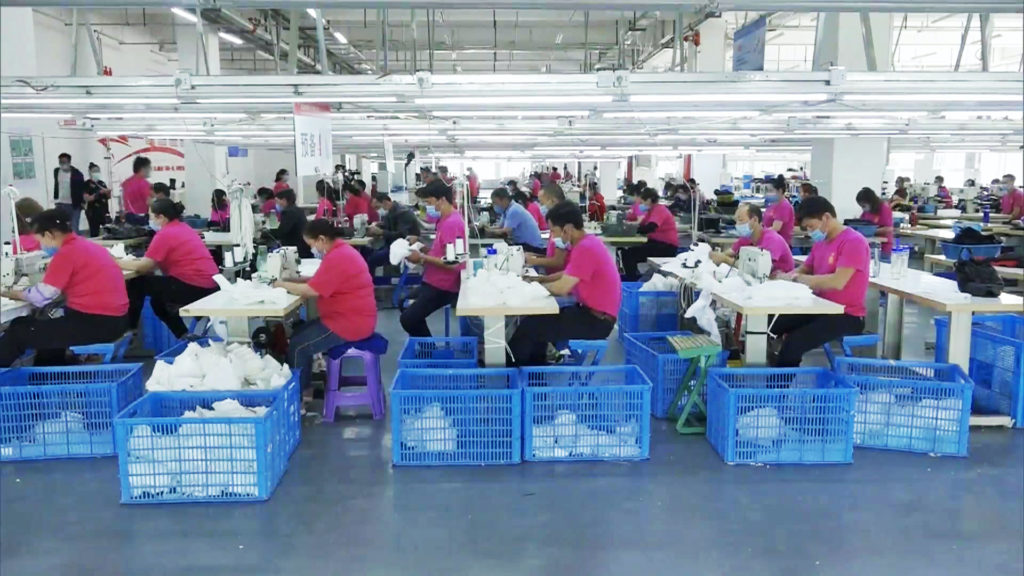
Abstract statistics find their most vivid expression on the ground. A Bloomberg investigation from March 2026 documented day laborers in Guangzhou waiting in winter cold for factory agents to offer work. One worker, Sheng, 55, described his income having more than halved to less than 100 yuan — roughly $14 — per day. Some workers cannot find employment for months at a time, he said. This is occurring while China posts record export numbers, defying the Trump administration’s escalating tariffs with a manufacturing juggernaut that continues to flood global markets.
The paradox is complete: the export machine hums, profits accumulate, trade surpluses swell — and the workers who power all of it are left behind. It is not incidental. It is structural. As China Labor Watch’s executive director Li Qiang argued in January 2026, China’s decisive competitive advantage lies in its weak labor protections, and it is now exporting this low-rights model globally — a race to the bottom dressed in the language of development.
Nowhere is this more starkly illustrated than in the platform economy. According to the All-China Federation of Trade Unions, the number of workers in “new forms of employment” — overwhelmingly gig-economy roles with minimal protections — surpassed 84 million in 2024, representing 21 percent of the total workforce. Among food-delivery riders on Meituan alone, nearly half worked fewer than 30 days per year, pointing to an army of precarious, intermittent laborers with no benefits, no unions, and no recourse. As of 2022, at least 70,000 of these riders held master’s degrees.
996, Involution, and the Vocabulary of Exhaustion
China’s young workers have developed their own lexicon for what Marxist theory would call surplus extraction. The “996” schedule — work from 9 a.m. to 9 p.m., six days a week — became the defining norm of China’s tech industry, a practice that a joint study by Chinese and Australian universities, published in October 2025, described as “modern labour slavery,” directly linking it to chronic burnout, mental health decline, and fertility postponement. Officially illegal under China’s Labor Law, 996 persists through what labor researchers describe as “informal-flexible despotism” — the unspoken threat of unemployment for those who refuse to comply.
The cultural response has been the phenomenon of neijuan, or “involution” — the sense of being trapped in relentless, self-defeating competition that produces no advancement. As youth unemployment reached 17.8% in July 2025 — six times the official urban headline rate — and this year’s graduating class of 12.22 million enters a trade-war-disrupted economy also disrupted by artificial intelligence, neijuan has metastasized from internet slang into political critique. Its counterpart, tangping — “lie flat” — is the passive resistance of those who have concluded that the system is designed not to reward their labor but to extract it.
These are not marginal, youth-culture curiosities. They are symptoms of a structural contradiction at the heart of the Chinese political economy: a party that claims to represent workers presiding over conditions that would have warranted a chapter in Volume I of Das Kapital.
Xi Jinping’s Marxist Revival: Signal or Noise?
Against this backdrop, Xi Jinping’s periodic invocations of Marxist rhetoric acquire a particular ambiguity. His “common prosperity” campaign, elevated in August 2021 as “an essential requirement of socialism,” set targets to reduce the Gini coefficient from 0.47 toward 0.40 by 2025 and 0.35 by 2035. The crackdown on tech giants — Alibaba, DiDi, Meituan — was framed in language recognizable to any student of Marx: reining in monopoly capital, redistributing to the people.
Yet the common prosperity campaign has conspicuously failed to deliver on its core promise. The Gini has not meaningfully declined. Minimum wages, while rising nominally, remain well below levels that would allow Chinese households to become the robust consumers the economy urgently needs. The crackdown on tech billionaires proved more politically convenient than structurally transformative: it punished visible wealth without redistributing it, and it chilled private investment without replacing it with workers’ power.
As CSIS’s Interpret: China project has noted, the common prosperity campaign’s success will ultimately be judged not by economics but by whether it can “maintain social harmony and stability” — which is to say, by whether the CCP can suppress the political consequences of inequality without addressing its material causes. That is not Marxism. That is its managed inverse.
The Overproduction Trap: What Karl Marx Got Right, and What China Ignored
Marx’s central warning in Capital was not simply about exploitation in isolation. It was about the systemic consequences of treating workers purely as inputs: overproduction crises, demand collapse, competitive race-to-the-bottom dynamics that ultimately undermine the capitalist system itself. He called it “the epidemic of overproduction.”
China in 2026 is exhibiting textbook symptoms. The electric vehicle sector’s median net profit margin collapsed to just 0.83% in 2024, down from 2.7% in 2019, as brutal price wars among BYD, Tesla, and dozens of domestic brands hollowed out margins. The solar manufacturing industry lost $40 billion to overcapacity. Steel, cement, food delivery — sector after sector is caught in the deflationary spiral that Chinese policymakers euphemistically call “involution” but that economists recognize as classic overproduction: too much supply chasing too little domestic demand, because workers who make the goods cannot afford to buy them.
The CCP’s own theorists have identified the root: household consumption remains stubbornly low as a share of GDP — hovering near 37-38 percent, compared with 68 percent in the United States and over 50 percent in most developed economies. The Foreign Affairs analysis draws the Henry Ford parallel with precision: Ford famously raised his workers’ wages so they could afford his cars. China’s economy does the reverse — it suppresses wages to make exports price-competitive, and then wonders why domestic demand refuses to ignite.
The Global Stakes: What China’s Labor Model Exports
The implications extend well beyond China’s borders. As China Labor Watch has documented, Beijing’s manufacturing dominance is now being actively exported through Belt and Road projects, industrial parks across Africa and Southeast Asia, and Chinese-owned factories in countries from Ethiopia to Cambodia. The labor conditions travel with the capital. A race to the bottom in labor rights is a deliberate feature, not an accident, of China’s industrial model — and it sets the competitive benchmark to which other manufacturing nations must respond or decline.
For Western policymakers, this reframes the trade debate. Tariffs address the symptom — price-competitive imports — without touching the cause, which is systematic wage compression underwritten by a state that suppresses independent unions, restricts collective bargaining, and classifies labor organizing as a political threat. The US-China trade war’s escalating tariff regime, which has seen duties on Chinese goods reach 145 percent, is economically disruptive for both sides. But it does not change the structural reality that China’s manufacturing advantage is built on a foundation that would have been recognizable to Friedrich Engels touring Manchester in 1845.
Conclusion: The Haunting of Deng Liqun
History’s ironies rarely arrive cleanly. Deng Liqun was, in many respects, a problematic figure — a hardliner who helped orchestrate ideological campaigns that silenced liberal reformers and contributed to the atmosphere of repression that culminated in Tiananmen. His Marxism was often a political instrument as much as a philosophical commitment.
But on this one point, his analysis was structurally sound: a Communist Party that permits unlimited private capital accumulation without empowering workers to claim a proportionate share of the value they create is not transcending Marx. It is fulfilling him. The exploitation he predicted has arrived — not in the form of Victorian factory owners with top hats, but in the form of platform algorithms calculating delivery routes to the nearest yuan, 996 schedules enforced through the threat of precarity, and a gig economy that has absorbed 84 million workers without offering a single one a union card.
Xi Jinping’s “common prosperity” rhetorical architecture is vast and elaborate. The material delivery, forty years after Deng Liqun’s warnings, remains insufficient. China’s economy runs on labor exploitation. Marx would have recognized it immediately. He would have found it almost unremarkable. What would have astonished him — what should astonish us — is that the party invoking his name is the one enforcing it.
Discover more from The Economy
Subscribe to get the latest posts sent to your email.
-

 Markets & Finance3 months ago
Top 15 Stocks for Investment in 2026 in PSX: Your Complete Guide to Pakistan’s Best Investment Opportunities
-

 Analysis2 months ago
Brazil’s Rare Earth Race: US, EU, and China Compete for Critical Minerals as Tensions Rise
-

 Banks2 months ago
Best Investments in Pakistan 2026: Top 10 Low-Price Shares and Long-Term Picks for the PSX
-

 Investment2 months ago
Top 10 Mutual Fund Managers in Pakistan for Investment in 2026: A Comprehensive Guide for Optimal Returns
-

 Analysis1 month ago
Top 10 Stocks for Investment in PSX for Quick Returns in 2026
-

 Asia3 months ago
China’s 50% Domestic Equipment Rule: The Semiconductor Mandate Reshaping Global Tech
-

 Global Economy3 months ago
Pakistan’s Export Goldmine: 10 Game-Changing Markets Where Pakistani Businesses Are Winning Big in 2025
-

 Global Economy3 months ago
15 Most Lucrative Sectors for Investment in Pakistan: A 2025 Data-Driven Analysis