
Bank Account
Huntington Online Banking: Full Features, Fees, and How It Compares in 2026

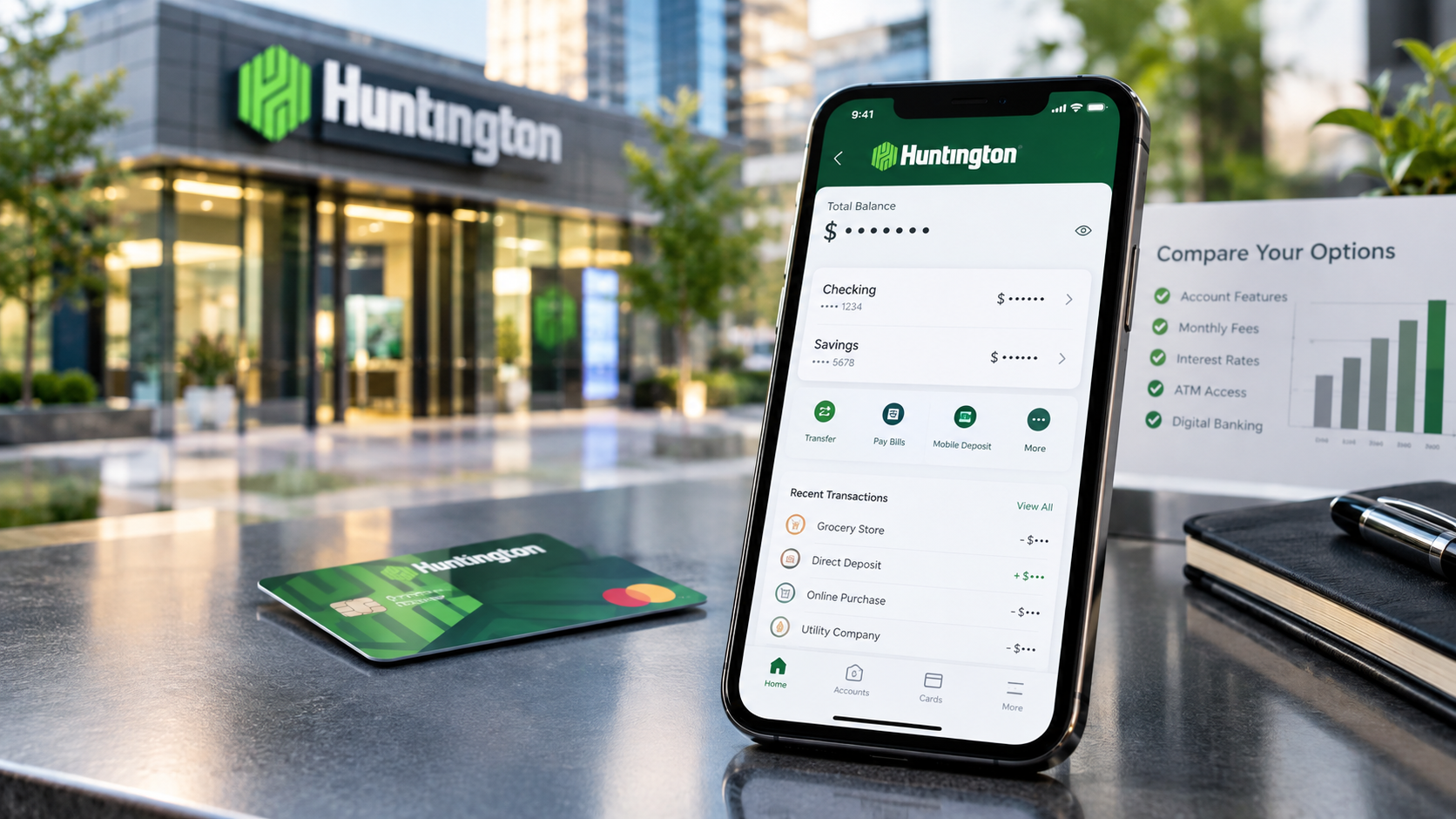
Most banks charge an overdraft fee the moment your balance dips below zero — Huntington built its entire consumer banking reputation on refusing to do that, and its 24-Hour Grace program remains one of the most distinctive features in U.S. retail banking more than a decade after launch.
Huntington National Bank, headquartered in Columbus, Ohio, operates one of the more feature-rich online and mobile banking platforms among regional U.S. banks, built around a “fair play” philosophy that predates the broader industry’s more recent overdraft-fee reforms. For anyone comparing online banking platforms, understanding exactly what Huntington offers — and where it falls short — matters more than generic marketing claims.
This guide breaks down Huntington’s online banking features, fee structure, and how it stacks up against typical regional and online-only bank alternatives.
How Huntington’s Online Banking Platform Works
Huntington’s digital banking centers on a small number of genuinely differentiated features rather than an exhaustive features list, with its overdraft-relief program as the clear centerpiece.
Key takeaway: Huntington was the first major U.S. bank to introduce a next-business-day overdraft grace period back in 2010, in direct response to shifting consumer attitudes following the 2008 financial crisis — a policy still in place today as “24-Hour Grace.”
Core Online and Mobile Banking Features
- 24-Hour Grace® — waives overdraft and return fees if the account is brought positive by midnight Central Time the next business day, with no enrollment required.
- All Day Deposit — extends the effective banking day until midnight Central Time for mobile and ATM deposits, meaning same-day deposit credit for a longer window than most banks offer.
- Mobile check deposit and bill pay — standard features available through Huntington’s highly rated mobile app.
- Account alerts — free text and email alerts for low balances, helping customers avoid triggering an overdraft in the first place.
- Account linking (overdraft transfer protection) — automatically transfers funds from a linked savings or money market account to cover a shortfall, free of charge.
- Digital wallet integration — debit cards can be linked to Samsung Pay and Google Pay for mobile purchases.
Step-by-Step: Setting Up Huntington Online Banking
- Open a Huntington checking or savings account, either online or in-branch, with identity verification and an opening deposit.
- Enroll in online banking through Huntington’s website or mobile app using your new account credentials.
- Set up account alerts for low balances to proactively manage overdraft risk, even with 24-Hour Grace as a backstop.
- Link external accounts, if desired, for transfers or a consolidated view of your full financial picture.
- Download the mobile app for check deposit, bill pay, and on-the-go account management.
- Enroll in overdraft transfer protection, if you hold a linked savings or money market account, for an additional layer of fee avoidance.
Financial and Strategic Implications: Huntington’s Fee Structure
Understanding the actual fee schedule — not just the marketing highlights — is essential before choosing any bank, including one with a strong overdraft-relief reputation.
| Fee Type | Huntington’s Rate | Context |
|---|---|---|
| Overdraft fee | $15 | Waived under 24-Hour Grace if cured by next business day |
| Nonsufficient funds fee | None | Notably more favorable than many competitors that still charge NSF fees |
| Monthly maintenance fee | $0–$25 depending on account tier | Often waivable via direct deposit or minimum balance |
| Out-of-network ATM fee | $3.50 | Comparable to industry norms; in-network access matters for frequent ATM users |
| Excessive transaction fee | None | Favorable compared to banks that still cap monthly transactions on savings accounts |
Expert insight: Huntington’s savings account APYs are generally on the lower end relative to dedicated online-only high-yield savings accounts, meaning customers primarily focused on maximizing savings yield may still want to pair a Huntington checking account with a separate high-yield savings account elsewhere, rather than consolidating everything at one institution.
Business Banking Features Mirror the Consumer Overdraft Philosophy
24-Hour Grace is also available free on Huntington’s business Checking, Savings, and Money Market accounts, extending the same next-business-day cure window to small business customers — a feature not universally matched by competing regional business banking platforms.
Branch and ATM Network Considerations
Huntington operates roughly 1,000 branches across 10 states, concentrated primarily in the Midwest and parts of the Southeast. Customers outside this footprint who want in-network branch or ATM access should weigh this limitation carefully against Huntington’s digital feature set.
How to Decide If Huntington Online Banking Is Right for You
- Heavy overdraft-risk customers benefit disproportionately from 24-Hour Grace, making Huntington a stronger fit for those who occasionally run tight on cash flow than for savers optimizing purely for yield.
- Compare savings APY separately from checking features — Huntington’s checking-account overdraft protections are strong, but its savings yields are not typically competitive with dedicated online-only high-yield accounts.
- Confirm you live or frequently travel within Huntington’s branch footprint if in-person banking access matters to you.
- Check current monthly fee waiver requirements for your specific account tier, since these can change and vary by account type.
- Consider a hybrid approach — many customers use Huntington (or a similar regional bank) for everyday checking and its overdraft protections, while keeping savings at a separate high-yield online bank.
Key takeaway: Huntington’s core value proposition isn’t the highest interest rates in the market — it’s meaningfully reduced overdraft and fee risk for everyday checking, which matters most to customers who periodically run close to a zero balance rather than those optimizing purely for savings yield.
Future Outlook: Huntington and Regional Bank Digital Trends Through 2027
- Overdraft-fee reform has become an industry-wide trend, not just a Huntington differentiator. Since Huntington pioneered 24-Hour Grace, broader regulatory and competitive pressure has pushed many banks to reduce or eliminate overdraft fees, meaning Huntington’s original advantage has partly narrowed relative to the rest of the industry — even as it remains a genuinely strong feature.
- Regional banks continue investing in mobile-first features to compete with fintech challengers. Expect continued expansion of in-app financial management tools, alerts, and budgeting features across Huntington and similar regional banks.
- Business banking digital features are expanding alongside consumer features. Huntington’s extension of 24-Hour Grace to business accounts reflects a broader trend of regional banks matching consumer-grade digital experience for small business customers.
- Branch footprint remains a differentiator versus online-only banks. As some consumers continue to value in-person access for certain transactions, Huntington’s roughly 1,000-branch network remains a relevant advantage over purely digital competitors, within its regional footprint.
Frequently Asked Questions
What is Huntington’s 24-Hour Grace program?
It’s a free, automatic feature that waives overdraft and return fees if you bring your account balance positive by midnight Central Time the next business day, with no enrollment required.
Does Huntington charge a nonsufficient funds (NSF) fee?
No. Huntington does not charge a separate NSF fee, which is more favorable than many competing banks that still charge this fee in addition to overdraft fees.
Is Huntington good for savings accounts specifically?
Not particularly, relative to dedicated online-only high-yield savings accounts. Huntington’s savings APYs tend to run lower than top online banks, making it a stronger fit for everyday checking than for maximizing savings yield.
How many branches does Huntington have?
Huntington operates approximately 1,000 branches across 10 states, concentrated primarily in the Midwest.
Does Huntington offer 24-Hour Grace for business accounts too?
Yes. The feature is available free on Huntington business Checking, Savings, and Money Market accounts, in addition to consumer accounts.
Discover more from The Economy
Subscribe to get the latest posts sent to your email.


Most online bank account applications take less than 10 minutes to complete, but the approval decision behind the scenes runs through a screening system most applicants have never heard of — and understanding it is the difference between instant approval and an unexpected denial.
Opening a checking or savings account online has become the default path for a large share of new bank customers, offering faster setup, often better rates, and none of the in-branch paperwork of traditional account opening. But the process still involves identity verification, documentation requirements, and — critically — a background check most applicants aren’t aware of until it causes a problem.
This guide walks through exactly what’s required to apply for a bank account online, what can cause a denial, and how to choose the right account type.
How Online Bank Account Applications Actually Work
Behind a simple-looking form, every bank runs your application through several verification layers before approving an account — identity confirmation, fraud screening, and a specialized consumer report most people have never checked.
Key takeaway: Most banks use a specialty consumer reporting agency called ChexSystems to screen new account applicants — similar to how lenders use credit bureaus for loans. A history of unpaid overdrafts, returned checks, or suspected fraud at a previous bank can appear in this report and lead to a denial, even if your credit score itself is strong.
What You Typically Need to Apply
- Government-issued photo ID — a driver’s license, state ID, or passport, used for identity verification.
- Social Security number or ITIN — required under federal “Know Your Customer” banking regulations.
- Proof of address — sometimes required, particularly if your ID reflects a different address.
- An initial deposit — requirements range from $0 to several hundred dollars depending on the bank and account type.
- A funding source — a debit card, existing bank account, or routing/account number to transfer the opening deposit electronically.
Step-by-Step: The Online Application Process
- Choose your account type — checking, savings, or a combined package — based on how you’ll primarily use the account.
- Complete the online application — personal information, identity verification, and employment/income details in some cases.
- Identity and background verification — the bank runs identity confirmation and typically a ChexSystems or similar consumer report check.
- Fund the account — via linked bank transfer, debit card, or mobile check deposit, depending on the bank’s options.
- Receive account confirmation — often instant for standard applications, though some are flagged for manual review, adding a few business days.
- Set up online and mobile access — including direct deposit, bill pay, and mobile check deposit where offered.
Financial and Strategic Implications: Account Types and What They Actually Cost
Understanding fee structures before applying prevents unpleasant surprises after the account is already open.
| Account Feature | What to Check Before Applying | Why It Matters |
|---|---|---|
| Monthly maintenance fee | Often waivable via direct deposit or minimum balance | Can silently erode a low-balance account over time |
| Minimum opening deposit | Ranges from $0 to $100+ depending on bank | Determines how quickly you can actually open the account |
| Overdraft fee structure | Varies widely; some banks offer grace periods | A meaningful cost difference between banks for occasional overdrafts |
| Out-of-network ATM fees | Commonly $2.50–$3.50 per transaction | Adds up quickly for customers without nearby in-network ATMs |
| FDIC insurance | Standard coverage is $250,000 per depositor, per bank, per ownership category | Confirm the institution is FDIC-insured (or NCUA-insured for credit unions) before depositing funds |
Expert insight: A denied application due to a negative ChexSystems record isn’t necessarily permanent — many banks offer “second chance” checking accounts specifically designed for applicants with a flagged history, though these often carry higher fees and fewer features than standard accounts.
Why Some Applications Get Flagged for Manual Review
Even with all documentation in order, some online applications don’t receive instant approval. Common triggers include a name or address that doesn’t precisely match public records, a very recent previous account closure, or unusually high stated initial deposit amounts relative to the applicant’s profile — all of which are standard fraud-prevention triggers rather than indicators of a problem with the applicant specifically.
How to Choose the Right Bank Account Online
- Match the account to your actual banking habits — heavy ATM users should prioritize fee-free ATM networks; savers should compare APY separately from the checking account decision.
- Check the fee-waiver requirements carefully — a “free” checking account that requires $500 in monthly direct deposits isn’t actually free for everyone.
- Confirm FDIC or NCUA insurance status — this should be clearly disclosed; if it isn’t, that’s a red flag.
- Compare mobile app ratings and features — since online account holders rely heavily on mobile deposit, bill pay, and account alerts.
- Check your own ChexSystems report in advance if you have any history of account problems — you’re entitled to a free annual report, and knowing your status prevents an unexpected denial.
- Read the overdraft policy specifically — grace period programs, opt-in requirements, and fee amounts vary meaningfully between banks.
Key takeaway: The biggest hidden cost in online bank account selection usually isn’t the advertised monthly fee — it’s the combination of overdraft fees and out-of-network ATM fees, which can quietly cost far more than a maintenance fee over a typical year of use.
Future Outlook: Online Banking Trends Through 2027
- Instant-approval technology continues to improve. Banks are increasingly investing in real-time identity verification and fraud detection, reducing the share of applications requiring manual review compared to just a few years ago.
- Digital-first and neobank competition remains intense. Fintech-driven banking apps continue to pressure traditional banks on fee structures and account-opening speed, pushing incumbent banks to streamline their own online application processes.
- “Second chance” banking products are expanding. As awareness of ChexSystems-related denials grows, more banks are rolling out dedicated second-chance account products, broadening access for previously-denied applicants.
- Account-opening bonuses remain a competitive tool. Banks continue to use cash bonuses for new accounts with qualifying direct deposits as a customer-acquisition strategy, meaning comparison shopping before applying can have a direct financial payoff.
Frequently Asked Questions
What credit score do I need to open a bank account online?
None, typically. Most banks don’t check your credit score to open a basic checking or savings account; instead, they generally check a specialty report like ChexSystems that reflects past banking history rather than borrowing history.
Why was my online bank account application denied?
The most common reasons are a negative ChexSystems record from a previous bank (unpaid overdrafts, suspected fraud, involuntary account closure), a mismatch between your provided information and public records, or an incomplete application.
How long does it take to open a bank account online?
Many applications are approved instantly and can be funded the same day, though some are flagged for manual identity or fraud review, which can add a few business days.
Is my money safe in an online-only bank?
Yes, provided the bank is FDIC-insured (or the credit union is NCUA-insured), your deposits are protected up to $250,000 per depositor, per institution, per ownership category, regardless of whether the bank has physical branches.
Can I open a bank account online with bad banking history?
Often yes, through a “second chance” checking account designed specifically for applicants with a flagged ChexSystems history, though these accounts typically carry more fees and fewer features than standard accounts.
Discover more from The Economy
Subscribe to get the latest posts sent to your email.

Business Insurance: What Coverage You Actually Need and What It Costs in 2026

Auto Insurance Quotes: How to Get the Lowest Rate Without Losing Coverage

Huntington Online Banking: Full Features, Fees, and How It Compares in 2026

Apply for a Bank Account Online: What You Need and How Long It Actually Takes

World’s Largest Economies: Ranking the Top Global Powers

Business Loan: A Complete 2026 Guide to Rates, Types, and Qualifying

Fast Invoice Factoring: How to Turn Unpaid Invoices Into Cash Within 24 Hours

Investment Banking Services: What They Cost and How to Choose the Right Firm in 2026

Structured Settlement Loan: What “Cash Now” Offers Actually Cost You

DUI Attorney: Why Your First Call After an Arrest Should Never Be to the Court

Personal Injury Lawyer: A Complete Guide to Filing Your Claim in 2026

Commercial Vehicle Accident Lawyer: Holding Companies Accountable Beyond the Driver

Inside the White House Feud: How Trump’s Allies Are Painting Anthropic’s Dario Amodei as the Face of ‘AI Doomerism’

Truck Collision Attorney: What Your Case Is Really Worth After a Semi-Truck Crash

Top 30 Stocks for Investment in PSX for Massive ROI in 2026

SpaceX Starship Flight 14: First Orbital Attempt & Starlink V3 Launch Explained

Oil Prices Break $100 in 2026: Middle East Conflict & Energy Markets

Fidelity Investments Review 2026: SPAXX Yields & Zero-Fee Funds

AI Chip Stocks 2026: The Best Semiconductor Investments Beyond Marvell

Tween Back-to-School Trends 2026: What’s Driving the $85B Season

BRICS+ Cross-Border Payments 2026: Interoperability Explained

10-Year Treasury Yield Hits 4.80%: What It Means for Rates & Portfolios

Shein Clothes Quality & Safety in 2026: What Lab Tests Show

China’s US$10.8 Billion Trade Shortcut: Why the Pinglu Canal Matters

MRVL Earnings 2026: Why Marvell Sank Despite Beating Estimates

IMF & World Bank 2026 Global Economic Outlook: Growth, Inflation, Debt

Middle East War Economics 2026: Oil Prices & Energy Markets

High-CPM Finance Niches 2026: Publisher Monetization Blueprint
-

 Markets & Finance9 months ago
Top 15 Stocks for Investment in 2026 in PSX: Your Complete Guide to Pakistan’s Best Investment Opportunities
-

 Analysis7 months ago
Johor’s Investment Boom: The Hidden Costs Behind Malaysia’s Most Ambitious Economic Surge
-

 Analysis7 months ago
Top 10 Stocks for Investment in PSX for Quick Returns in 2026
-

 Banks8 months ago
Best Investments in Pakistan 2026: Top 10 Low-Price Shares and Long-Term Picks for the PSX
-

 Analysis8 months ago
Brazil’s Rare Earth Race: US, EU, and China Compete for Critical Minerals as Tensions Rise
-

 Investment9 months ago
Top 10 Mutual Fund Managers in Pakistan for Investment in 2026: A Comprehensive Guide for Optimal Returns
-

 Global Economy9 months ago
15 Most Lucrative Sectors for Investment in Pakistan: A 2025 Data-Driven Analysis
-

 Global Economy9 months ago
Pakistan’s Export Goldmine: 10 Game-Changing Markets Where Pakistani Businesses Are Winning Big in 2025