
Fintech & Global Finance
Capital One vs Wells Fargo: Best Credit Card for Buying Crypto in 2026

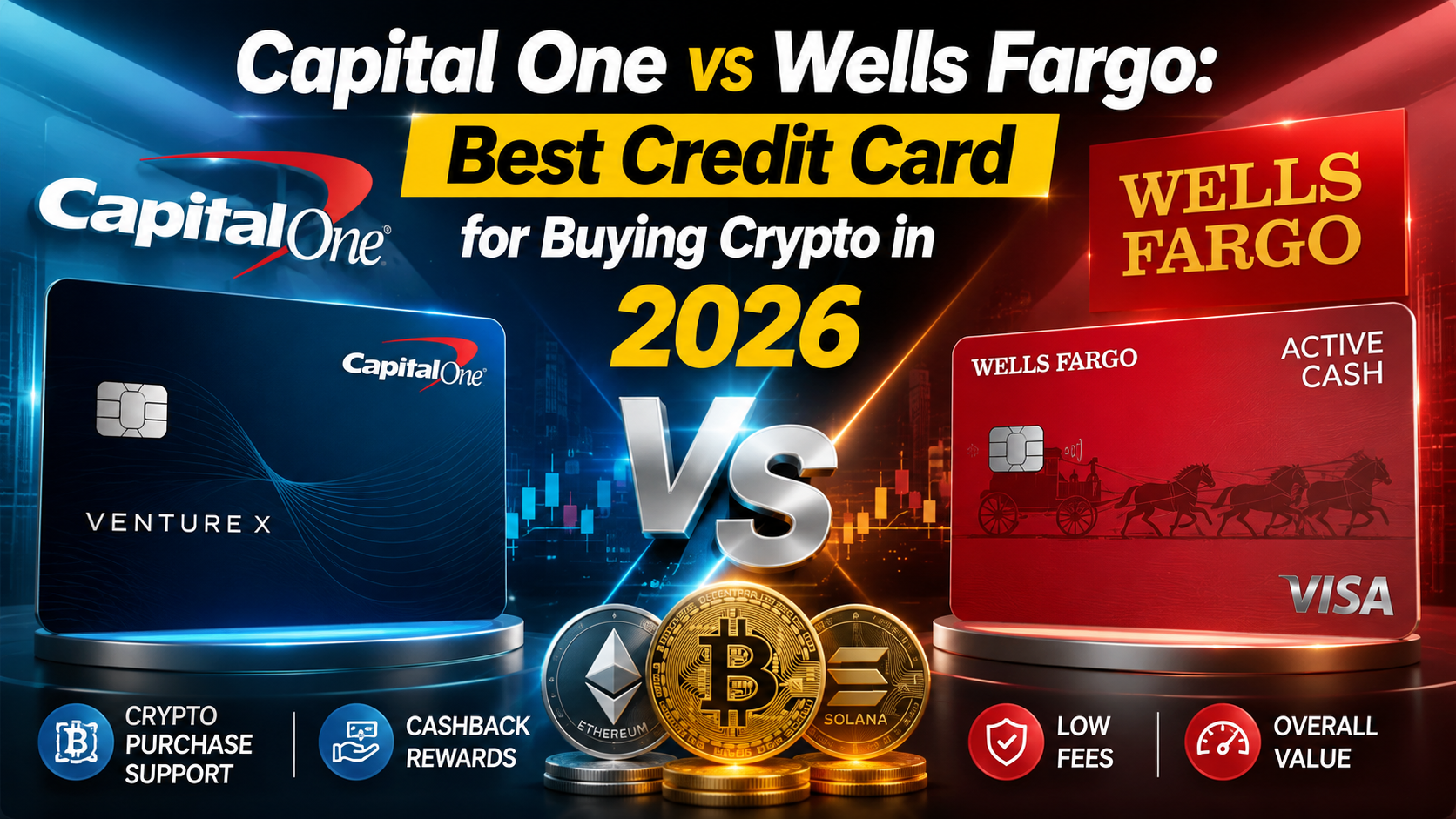
If you’re regularly buying Bitcoin, ADA, or other digital assets, the credit card you use to fund those purchases matters more than most people realize. Between foreign transaction-style cash advance fees, reward point restrictions, and outright purchase blocks, not all cards treat crypto transactions the same way. Capital One and Wells Fargo — two of the largest issuers in the country — have taken noticeably different approaches to crypto purchases, and picking the wrong one can quietly cost you in fees or lost rewards every time you buy.
This comparison breaks down exactly how each bank handles crypto exchange transactions, which cards offer the best terms for frequent crypto buyers, and what fees to watch out for before you tap your card on your next exchange purchase. If you’re actively building a crypto investment strategy, this is the kind of banking detail that adds up fast.
How Banks Classify Crypto Purchases (And Why It Matters)
The single biggest factor affecting your experience buying crypto with a credit card is how your bank codes the transaction. Some exchanges are coded as standard retail purchases, which earn normal rewards and incur no special fees. Others get flagged as “cash advances” or “cash-equivalent transactions” — a classification that typically strips away rewards earning, adds an immediate cash advance fee, and starts accruing interest from the moment of purchase with no grace period.
This classification isn’t always consistent even within the same bank, since it often depends on how the specific crypto exchange’s merchant category code is set up. That’s why understanding your specific bank’s general policy — rather than assuming based on one past transaction — is important before you make a large purchase.
Capital One’s Approach to Crypto Purchases
Capital One has generally taken a more permissive stance on crypto exchange purchases compared to many traditional banks, allowing crypto transactions on several of its consumer credit cards without automatically classifying them as cash advances — though policies can vary by exchange and card product. Rewards cards like the Capital One Venture and Quicksilver lines have been reported by users to process crypto exchange purchases as standard transactions in many cases, meaning you can still earn miles or cash back on your crypto buys.
Wells Fargo’s Approach to Crypto Purchases
Wells Fargo has historically been more restrictive, with several of its consumer credit cards blocking or heavily restricting purchases from major crypto exchanges outright, treating them similarly to gambling transactions in terms of risk classification. This is consistent with the more conservative posture large legacy banks have taken toward crypto exposure, driven partly by regulatory caution and partly by fraud-risk management on high-volatility purchase categories.
Key Differences to Know Before You Buy
- Purchase approval rates – Capital One cardholders report fewer declined crypto transactions than Wells Fargo cardholders
- Rewards eligibility – Standard-coded crypto purchases on Capital One cards can earn regular rewards; Wells Fargo’s more frequent cash-advance classification often strips rewards entirely
- Fee exposure – Cash-advance-classified purchases typically carry a 3-5% fee plus immediate interest accrual with no grace period
- Exchange compatibility – Purchase success can vary by which exchange you’re using, not just which bank issued your card
- Customer support clarity – Neither bank publishes a definitive public list of blocked or approved crypto merchants, requiring direct confirmation from support
Side-by-Side Comparison
| Factor | Capital One | Wells Fargo |
|---|---|---|
| Crypto purchase policy | Generally permissive on most consumer cards | More restrictive, higher decline rate |
| Rewards earned on crypto buys | Often yes (standard purchase coding) | Often no (cash-advance coding common) |
| Cash advance fee risk | Lower | Higher |
| Best card for crypto buyers | Capital One Venture / Quicksilver | Not typically recommended for frequent crypto purchases |
| Customer transparency | Moderate | Low |
How to Avoid Getting Hit With Cash Advance Fees
Regardless of which bank issues your card, a few habits will protect you from unexpected fees when funding crypto purchases:
- Start with a small test transaction before committing to a large crypto buy on a new card
- Check your card’s most recent statement immediately after a crypto purchase to confirm it wasn’t coded as a cash advance
- Consider using a debit card or bank transfer for large purchases if your credit card consistently codes crypto exchanges as cash advances
- Call your bank directly and ask specifically about their crypto merchant category code policy before making a large purchase
- Track any cash-advance-classified crypto purchases and consider disputing incorrectly coded standard retail transactions
Beyond the Purchase: Which Bank Is Better for Crypto Investors Overall?
Purchase friction is only part of the picture. Capital One has also been more active in fintech partnerships and digital banking features that appeal to crypto-active users, including more flexible account linking with major exchanges. Wells Fargo, despite its more conservative crypto purchase policy, still offers strong traditional banking infrastructure that many investors rely on for the fiat side of their crypto activity — moving USD in and out of exchanges, for example, tends to work reliably regardless of the bank’s card-level crypto restrictions.
The Broader Banking Landscape for Crypto Buyers
Capital One and Wells Fargo aren’t the only options worth considering, and it’s worth situating this comparison within the broader landscape of bank policies toward crypto. Several digital-first banks and fintech-forward card issuers have built crypto purchase compatibility directly into their product design, marketing themselves specifically to active crypto investors with guaranteed standard-transaction coding and even crypto-denominated cashback rewards. Traditional banks like Capital One and Wells Fargo, by contrast, generally didn’t design their card products with crypto purchases specifically in mind — their current policies reflect an evolving accommodation of crypto activity within legacy risk and fraud frameworks rather than a purpose-built crypto strategy. For investors who transact in crypto frequently and at meaningful volume, it may be worth maintaining one traditional bank relationship for everyday banking and a separate crypto-optimized card specifically for exchange purchases, rather than trying to force one card to serve both purposes well.
Frequently Asked Questions
Will using a credit card to buy crypto hurt my credit score?
Not directly, as long as you pay off the balance in full and on time — crypto purchases affect your credit utilization the same way any other purchase would. The bigger risk is carrying a balance on a cash-advance-classified crypto purchase, since those often accrue interest immediately at a higher rate than standard purchases.
Can I dispute a crypto purchase that was incorrectly classified as a cash advance?
Yes, this is worth attempting. If a purchase from an exchange that’s typically coded as a standard retail transaction gets flagged as a cash advance, contacting your bank’s dispute department with the transaction details has resulted in reclassification for some cardholders, though outcomes aren’t guaranteed.
Are there credit cards that offer crypto-specific rewards instead of just standard cash back?
Yes, a growing number of crypto-focused credit cards offer rewards paid directly in Bitcoin or other digital assets rather than traditional cash back or points. These are separate from Capital One and Wells Fargo’s traditional card offerings and are worth researching if crypto-denominated rewards specifically appeal to you.
Does it matter which crypto exchange I use with my credit card?
Yes, significantly. Transaction classification often depends more on how the specific exchange’s merchant account is set up than on your bank’s general policy alone, which is why the same bank might process one exchange’s purchases as standard retail and another’s as a cash advance.
Final Thoughts
If you’re a frequent crypto buyer prioritizing rewards and fewer declined transactions, Capital One’s more permissive approach to crypto exchange purchases generally makes it the stronger choice between these two issuers. Wells Fargo’s more conservative stance means a higher chance of hitting cash advance fees or outright transaction blocks, making it less ideal as your primary crypto-buying card — though it may still serve you well for other banking needs. As always with crypto-adjacent banking policies, call and confirm current terms before making a large purchase, since these policies can change without much public notice.
Has your bank ever classified a crypto purchase as a cash advance without warning? Tell us which card and exchange combination worked — or didn’t — for you in the comments.
Discover more from The Economy
Subscribe to get the latest posts sent to your email.



State Farm is distributing a historic $5 billion auto insurance dividend to 2025 policyholders, averaging $100 per vehicle—here’s who qualifies and how to maximize your savings.
State Farm Mutual Automobile Insurance Company has begun issuing the largest dividend payout in its 100-plus-year history, mailing $5 billion in cash-back checks to qualifying auto insurance customers across more than 49 million vehicles.
The one-time distribution, announced in February 2026 and now rolling out in waves, returns an average of $100 per vehicle to policyholders who maintained active coverage throughout 2025.
Payments vary by state—ranging from 4% to 10% of the premium paid in 2025—and are being delivered via paper check or direct deposit based on customer preference.
Qualifying policyholders will receive notification by email or postal mail, and funds can also be tracked through the State Farm mobile app or online account portal.
Who Qualifies for the State Farm Dividend?
Eligibility is straightforward but strictly defined:
- Auto policies must have been active between January 1, 2025, and December 31, 2025
- Only personal auto insurance policies underwritten by State Farm Mutual are included
- The dividend is retrospective and does not affect future premium calculations or auto rates
- Commercial auto policies, renters, and homeowners policies are excluded from this specific dividend
The distribution timeline spans several months due to the sheer volume of vehicles covered. Customers with questions can contact the dedicated Dividend Customer Contact Center at 1-888-808-9532 or visit sfdividend.com.
Why State Farm Is Returning $5 Billion Now
State Farm’s unprecedented dividend stems from stronger-than-expected underwriting performance in 2025, driven by lower auto repair costs and a reduced frequency of collisions industry-wide. As a mutual insurance company—owned by policyholders rather than shareholders—State Farm is uniquely positioned to return surplus capital directly to customers.
The dividend comes on top of recent auto insurance rate reductions in 40 states, which are already saving customers an estimated $4.6 billion annually.
How to Maximize Your Auto Insurance Savings in 2026
Receiving a dividend check is an ideal moment to audit your entire auto insurance portfolio. Here’s how to stretch those savings further:
- Compare car insurance rates from multiple carriers. Even if State Farm reduced your rates, market competition may offer lower premiums for the same coverage limits.
- Bundle your policies. Combining auto, home, and life insurance under one carrier often unlocks multi-policy discounts exceeding 20%.
- Ask about safe driver discounts. Telematics programs that monitor braking, acceleration, and mileage can reduce premiums by up to 30% for low-risk drivers.
- Raise your deductible cautiously. Increasing your collision deductible from $500 to $1,000 can lower monthly premiums, but ensure you have sufficient emergency savings to cover the gap.
- Review coverage annually. Dropping unnecessary add-ons like rental reimbursement or roadside assistance—if already covered elsewhere—can trim costs without exposing you to liability risks.
People Also Ask: State Farm Dividend 2026
How much is the State Farm dividend per vehicle? The average payout is approximately $100 per vehicle, though actual amounts range from 4% to 10% of 2025 premiums paid, varying by state.
When will I receive my State Farm dividend check? Distribution began in summer 2026 and will continue for several months due to the volume of 49 million vehicles. Check your State Farm app or mail for notification.
Does the State Farm dividend affect my future premiums? No. The dividend is retrospective and will not impact future auto insurance rates, which are based on expected future costs and individual risk profiles.
Discover more from The Economy
Subscribe to get the latest posts sent to your email.

S&P upgraded Pakistan’s credit rating to ‘B’ as its fiscal deficit hit a 22-year low — even as central government debt rose Rs5.7 trillion. Here’s how both are true.
Pakistan’s economic story this summer is two numbers that look contradictory but aren’t. Per Business Recorder’s economy coverage, Pakistan’s fiscal deficit fell to a 22-year low of 2.6% of GDP in FY2025-26 — a headline that would normally read as unambiguous good news. Nearly the same reporting notes Pakistan’s central government debt stock rose by Rs5.7 trillion during the same fiscal year — a figure that, in isolation, looks like the opposite story.
Both are accurate. Understanding why requires separating the flow (this year’s deficit) from the stock (total accumulated debt).
Key Takeaways
- S&P Global Ratings upgraded Pakistan’s long-term sovereign credit rating to ‘B’ from ‘B-‘ on July 22, 2026.
- Pakistan’s fiscal deficit fell to a 22-year low of 2.6% of GDP in FY2025-26.
- Despite the improved deficit ratio, Pakistan’s central government debt stock rose by Rs5.7 trillion during the same fiscal year.
- The KSE-100 has posted a parallel record run, reflecting investor optimism that hasn’t fully priced in the debt-stock trend.
- A ‘B’ rating remains firmly speculative-grade — the upgrade signals direction of travel, not investment-grade market access.
The credit-rating context frames why international investors are treating the deficit improvement as credible. Business Recorder’s coverage confirms S&P Global Ratings upgraded Pakistan’s long-term sovereign credit rating to ‘B’ from ‘B-‘ on July 22, 2026 — the kind of one-notch move that rarely makes global headlines on its own but matters to institutional investors whose mandates key off rating thresholds.
A ‘B’ rating needs context many searchers lack: it remains firmly speculative-grade, several notches below investment grade. The significance isn’t that Pakistan has “arrived” — it’s the direction of travel after a period when the rating trajectory pointed the other way.
The deficit figure deserves similar precision. A 2.6%-of-GDP fiscal deficit — the lowest in 22 years — reflects primarily disciplined current spending and improved tax collection relative to GDP, the kind of structural improvement IMF program conditions have specifically targeted. It’s a flow measure: how much more government spent than it collected in FY26 alone.
The debt stock is a different, cumulative measure — total outstanding government debt built up over decades, which can rise even in a year the deficit narrows. That happens through several channels: interest payments on existing debt compounding the principal, currency depreciation raising the rupee value of foreign-currency debt, and one-off financing needs (like flood-related spending) sitting outside the core deficit calculation. A rising debt stock alongside a shrinking deficit is therefore not a contradiction — it’s what a country climbing out of a debt overhang while still servicing historical borrowing looks like in the numbers.
This tension sits inside a broader stabilisation narrative built over more than a year: Pakistan’s IMF Extended Fund Facility program, a comparatively stable currency after prior volatility, and headline growth figures the government has pointed to as evidence of a turnaround. Per Wikipedia’s Economy of Pakistan data page, sourced from national statistics, GDP growth is estimated at 3.7% in 2026, inflation around 3%, with a labour force of roughly 78.9 million and unemployment near 6.9%.
Markets have responded with more enthusiasm than the debt-stock figure alone might suggest is warranted — the KSE-100’s continued record run this year reflects optimism priced substantially around the deficit-and-rating story rather than the debt-stock caveat (see Article 14 for the full index story).
Why It Matters
For a country whose recent history has been defined by repeated balance-of-payments crises, a credit upgrade paired with a record-low deficit is a meaningful signal to the market participants who decide how expensive Pakistan’s next Eurobond or external financing round will be. But the debt-stock trend determines how much of any future improvement gets eaten by interest costs before it reaches development spending.
Data and Evidence
- S&P rating: upgraded to ‘B’ from ‘B-‘ (July 22, 2026)
- Fiscal deficit: 2.6% of GDP, a 22-year low (FY2025-26)
- Central government debt stock increase: Rs5.7 trillion (FY2025-26)
- GDP growth: 3.7% (2026 estimate); Inflation (CPI): ~3% (2026)
- Nominal GDP: $452.1 billion (2026 estimate)
Global Impact
A sustained Pakistan fiscal turnaround has read-through for regional creditors and Gulf partners who provided bridge financing during past crises, and for global bond investors assessing frontier-market risk as several emerging economies pursue similar IMF-anchored stabilisation paths.
What Happens Next
Watch how rating agencies treat next fiscal year’s numbers once flood-related reconstruction spending works through the accounts, and whether debt-stock growth decelerates as disciplined primary balances compound over multiple years.
Frequently Asked Questions
What does Pakistan’s ‘B’ credit rating mean? A one-notch upgrade from ‘B-‘, still deep speculative-grade, but signaling improving creditworthiness. How can the deficit fall while debt rises? The deficit is one year’s shortfall; debt stock is cumulative and can grow from interest costs and currency effects even as the annual deficit narrows. Is Pakistan’s economy out of crisis? Meaningful stabilisation is visible, but the rating level and rising debt stock show underlying vulnerabilities remain. What’s driving the KSE-100’s run? Investor optimism tied to the fiscal deficit improvement, rating upgrade and broader IMF-program stabilisation. Why did S&P upgrade now? It reflects improved fiscal discipline and macro stabilisation trends built over the prior year rather than a single event.
Discover more from The Economy
Subscribe to get the latest posts sent to your email.

Dubai’s transformation from oil-adjacent trading post to global capital hub is no longer a talking point — it is a measurable trend. The emirate’s newly launched Economic Survey 2026 shows GDP climbing to $265 billion alongside rising employment, while international family offices are gathering for the Family Office Summit Dubai 2026 as the city cements its position as a family-wealth hub (Gateway Group; Arabian Business).
The non-oil growth engine
The UAE enters 2026 with the World Bank projecting national growth of roughly 5%, well above the global average, driven substantially by 5.3% expansion in the non-oil sector (Barchart). Technology, green energy and healthcare are the top-performing sectors, and 64% of UAE executives expect trade volumes to exceed 2025 levels — confidence underpinned by the country’s expanding network of Comprehensive Economic Partnership Agreements (Barchart). Historically, oil production accounted for half of Dubai’s GDP; today it contributes less than 1% (Wikipedia/Economy of Dubai).
Why family offices specifically are relocating
The Family Office Summit Dubai 2026 is drawing international participants precisely because the emirate has built regulatory infrastructure — inside jurisdictions like the DIFC — designed to attract exactly this category of capital. As one DIFC executive noted, incentives alone are no longer enough to win global finance; institutional credibility and regulatory clarity now matter more, which explains why firms such as Sixth Street have opened Abu Dhabi offices as global investment houses deepen their Middle East presence (Gateway Group).
Infrastructure is compounding the pull
Beyond finance, the UAE’s infrastructure build-out is reinforcing the wealth-hub thesis. Etihad Rail’s Abu Dhabi–Fujairah passenger service and the Madinat Zayed and Liwa station openings, arriving ahead of schedule, signal a state execution model that investors increasingly cite as a differentiator versus regional peers (GCC Business Watch). Dubai has also rolled out a AED 1 billion economic support package aimed at business liquidity and resilience amid regional geopolitical headwinds (GCC Business Watch).
The regional competition for capital
Dubai’s rise is happening alongside — not in isolation from — a broader Gulf capital race. Saudi Arabia’s economy is set for stronger growth per IMF assessments, and Gulf sovereign and corporate capital is increasingly being deployed across sectors from AI infrastructure to green growth commitments, meaning Dubai’s wealth-hub status will need continual reinforcement rather than passive maintenance (GCC Business Watch).
The bottom line for investors
For family offices weighing jurisdiction, Dubai’s pitch in 2026 combines three elements rarely available together: near-zero effective taxation, a non-oil economy growing faster than most G20 peers, and physical and financial infrastructure being built ahead of demand rather than in reaction to it. That combination — not simply low tax rates — is what is now pulling global family wealth toward the emirate.
Discover more from The Economy
Subscribe to get the latest posts sent to your email.

Canva vs Adobe: Best Design Software for E-commerce Brands in 2026

Capital One vs Wells Fargo: Best Credit Card for Buying Crypto in 2026

The 2026 Guide to Staking ADA and BNB: How to Earn Passive Crypto Income on the Best Platforms

BigLaw Backlash 2026: Why Top US Firms Are Being Slammed for “Crazy” 1L Hiring

SpaceX Falcon 9 Upper Stage Crashes Into Moon, Creating New Crater Near Einstein

7-Eleven, GameStop, and Grocery Outlet Slash Hundreds of Stores in 2026 Restructuring Wave

Toyota Recalls 508,000 Camrys Over Blank Dashboard Screens That Disable Turn Signals

State Farm Mails Record $5 Billion Dividend to Auto Policyholders: How to Claim Your Check

Indonesia’s Rupiah and FDI Confidence Gap Widens Despite Headline Growth

Global Aviation Split: Cargo Boom Masks Falling Passenger Demand

Malaysia’s Chip Exports Defy the Wall Street Selloff

Singapore Upgrades 2026 Growth Forecast Again as AI Exports Surge

Dubai’s Property Market Posts Second-Best H1 Ever — While Hotels Sit Empty

Gold’s Wild 2026 Round Trip Resumes as Chip Selloff Revives Haven Demand

China Politburo July 2026: Stimulus Signals Explained

Russia Fuel Shortages 2026: Inside a Cracking War Economy

Top 15 Financial Stocks for Investment in PSX

Pakistan Passed Its Third IMF Review

Andy Burnham, UK Gilts and Mortgages: July 2026 Explainer

SpaceX Stock Lockup Expiration Explained: Why $123B in Shares Could Hit the Market

Pakistan IMF Program 2026: Inside the Push Toward an Interest-Free Economy

Russia Oil Revenue 2026: How Sanctions on Rosneft and Lukoil Are Draining the War Chest

Pakistan’s 2026 Monsoon Floods Threaten Fragile Economic Recovery as Inflation Nears 9%

Russia Oil Revenue 2026: The Iran War Windfall and What a Hormuz Deal Means for Moscow

Russia’s Budget Deficit Blew Past Its Full-Year Target in Three Months

Canada US Trade War 2026: Inside Carney’s Push to Cut Ties With Trump’s Tariffs

Oil Prices Fall as Strait of Hormuz Reopens: 2026 Update

China Economy 2026: How AI Exports and a Property Crash Are Splitting Growth in Two
-

 Markets & Finance7 months ago
Top 15 Stocks for Investment in 2026 in PSX: Your Complete Guide to Pakistan’s Best Investment Opportunities
-

 Analysis6 months ago
Johor’s Investment Boom: The Hidden Costs Behind Malaysia’s Most Ambitious Economic Surge
-

 Analysis6 months ago
Top 10 Stocks for Investment in PSX for Quick Returns in 2026
-

 Analysis6 months ago
Brazil’s Rare Earth Race: US, EU, and China Compete for Critical Minerals as Tensions Rise
-

 Banks7 months ago
Best Investments in Pakistan 2026: Top 10 Low-Price Shares and Long-Term Picks for the PSX
-

 Investment7 months ago
Top 10 Mutual Fund Managers in Pakistan for Investment in 2026: A Comprehensive Guide for Optimal Returns
-

 Global Economy8 months ago
15 Most Lucrative Sectors for Investment in Pakistan: A 2025 Data-Driven Analysis
-

 Global Economy8 months ago
Pakistan’s Export Goldmine: 10 Game-Changing Markets Where Pakistani Businesses Are Winning Big in 2025