
AI
How AI Has Granted America Vast New Power

Washington no longer treats artificial intelligence as a Silicon Valley curiosity. By mid-2026, AI infrastructure has become the organizing principle of US economic and foreign policy, and the AI geopolitical power the country has accumulated is now measured in gigawatts, GPUs, and trillion-dollar pledges. The Stargate Project, a joint venture between OpenAI, Oracle, SoftBank, and the UAE’s MGX, has already deployed more than $100 billion of a planned $500 billion buildout, with hyperscalers collectively set to spend close to $700 billion on data centers in 2026 alone. That capital, concentrated almost entirely on American soil, is reshaping who sets the rules of the next industrial era.
The shift didn’t happen by accident. It’s the product of a deliberate fusion of state power and private capital that has no precedent since the postwar military-industrial buildout — and it’s producing leverage Washington is already using, from chip export controls to AI diplomacy with the Gulf states.
The Compute Gap Is the New Power Gap
The clearest evidence of America’s new advantage sits in raw computing capacity. According to analysis from the Institute for Progress, if the United States exported no advanced chips to China at all, its compute capacity in 2026 would run more than ten times China’s. Even with looser export policy, including the controversial sale of Nvidia’s H200 chips, the gap narrows but doesn’t disappear — and Chinese firms have already ordered more than two million H200 units, far beyond what domestic manufacturers like Huawei can currently produce (Foreign Affairs).
- Stargate’s scale: nearly 7 gigawatts of planned capacity confirmed across sites in Texas, Michigan, and beyond, with a path toward 10 gigawatts by 2029 (OpenAI).
- Capital commitment: roughly $400 billion already committed across Stargate’s first wave of sites, part of a broader $1.4 trillion compute-spending trajectory Sam Altman has floated for the project’s lifetime (Data Center Dynamics).
- Industry-wide spend: hyperscalers — Microsoft, Google, Amazon, Meta, and Oracle among them — are on track to spend close to $700 billion on data centers in 2026 (TechCrunch).
That’s not abstract market enthusiasm. It’s the physical infrastructure of a power base — and it’s why allies and rivals alike are recalibrating around it.
Why America’s AI Lead Is Becoming a Geopolitical Lever
How is AI changing America’s global influence in 2026?
AI has expanded US influence by turning compute and chip access into instruments of statecraft. Washington now uses export controls, data-center partnerships, and AI alliances with countries like the UAE to extend American technological standards abroad, much as it once did with finance and military hardware in the Cold War.
That’s not theoretical. The Trump administration’s “Winning the AI Race” action plan, released last July, frames AI leadership explicitly in terms of “overwhelming economic, military, and geopolitical advantages” for whichever country secures it (Foreign Affairs). Analysts at the Institut Montaigne describe the resulting arrangement as a “Hamiltonian” pact: in exchange for deregulation and privileged access to public contracts, major tech firms have effectively aligned themselves with the White House’s industrial strategy, promising to advance US interests abroad as they expand overseas (Institut Montaigne).
The UAE relationship is instructive. Under the Stargate framework, every dollar Abu Dhabi invests in its own domestic AI buildout is matched by an additional dollar flowing into American AI infrastructure — a structure that effectively recruits Gulf capital to underwrite US technological supremacy while tying a strategically vital region closer to Washington (Built In).
The Second-Order Effects: Energy, Markets, and Smaller Economies
The downstream consequences of America’s AI buildout extend well past Silicon Valley boardrooms. Three are already visible.
Energy demand is becoming a national security variable. The same data-center expansion that’s cementing US compute dominance is also straining power grids, pushing utilities toward new nuclear and gas commitments, and turning electricity capacity into a bottleneck as consequential as chip supply itself. EFG International’s 2026 outlook flags this directly, noting that the AI investment cycle is driving “unprecedented demands for data centre capacity” worldwide, with the US at the center of that surge (EFG International).
Capital markets are absorbing historic levels of leverage. Much of the Stargate buildout is debt-financed. The Abilene, Texas flagship site alone drew roughly $9.6 billion from JPMorgan across two loans, part of a broader pattern of hyperscalers and their financing partners taking on debt at a pace that’s reportedly making bank CFOs uneasy even as tech executives stay bullish (TechCrunch).
Middle powers are left negotiating from a weaker position. Countries without the capital or chip access to compete on frontier AI are increasingly pursuing “sovereign AI” strategies — smaller, nationally controlled systems built to preserve some independence from both Washington and Beijing. Chatham House research describes this as a defensive posture rather than genuine competition, reflecting how thoroughly the US-China duopoly has reshaped the playing field for everyone else (Chatham House).
For Pakistan and other emerging markets watching this from the outside, the implications are direct: access to frontier compute, AI talent pipelines, and chip supply chains is increasingly gated by alignment with one of two blocs, not by market merit alone.
Not Everyone Agrees America’s Lead Is Durable
That said, the picture is more complicated than triumphant headlines suggest. A growing body of analysis pushes back on the idea that AI dominance functions like a winner-take-all race at all.
Writing in Foreign Affairs, analysts argue that the US and China aren’t actually competing on the same track. China’s compute disadvantage is real, but its domestic chip production is constrained primarily by manufacturing bottlenecks rather than by lack of demand or talent — meaning export restrictions slow Beijing’s access to foreign chips without necessarily slowing its long-term self-sufficiency drive (Foreign Affairs). DeepSeek’s early-2026 research on more efficient training methods reinforced the point: China has repeatedly found ways to close capability gaps through algorithmic efficiency rather than raw chip volume, narrowing the practical advantage of America’s compute lead (Atlantic Council).
There’s also a structural risk inside America’s own strategy. The Stargate model relies on an unusually tight alignment between the federal government and a handful of private firms — a “let them cook” approach, in former administration adviser David Sacks’ phrasing — that concentrates enormous policy influence in companies whose interests won’t always match the national interest (Institut Montaigne). If that alignment frays, or if the debt financing underpinning the buildout sours, the foundation of America’s AI-driven leverage could prove less stable than its current scale suggests.
The Power Is Real, But So Is the Bet
America’s AI lead has translated into something unmistakably tangible: physical infrastructure, chip-supply leverage, and a deregulatory partnership between Washington and its largest tech firms that’s already reordering alliances from Abu Dhabi to Ann Arbor. Still, that power rests on continued capital flows, stable energy supply, and a compute advantage that rivals are working hard to erode through efficiency gains rather than brute-force matching.
What’s emerging isn’t a settled hierarchy. It’s a high-stakes bet that scale itself — gigawatts, trillions in committed capital, and chip-export control — will outpace whatever workarounds competitors devise. Washington is wagering the country’s economic future on that bet holding.
Discover more from The Economy
Subscribe to get the latest posts sent to your email.


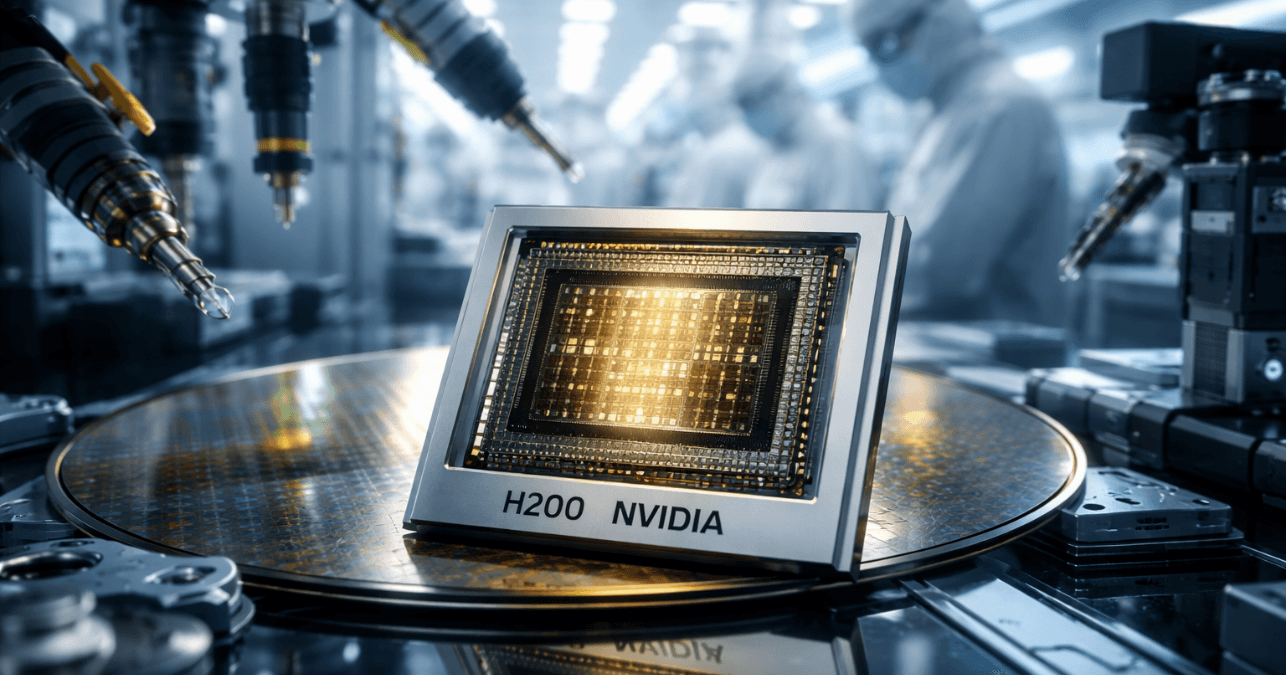
Nvidia has begun shipping its advanced H200 AI chips to China under a reversed US export policy, but the volumes moving so far are, in the words of a senior Commerce Department official, “trivial” — even as Chinese technology firms have collectively ordered more than two million units against a global Nvidia inventory of roughly 700,000.
A Policy Reversal That Remains Mostly Symbolic
Under Secretary of Commerce for Industry and Security Jeffrey Kessler told Congress on 14 July that H200 shipments to China remain minimal despite roughly $10 billion in approved licenses, according to TechTimes. Washington has approved sales to roughly ten Chinese firms — including Alibaba, Tencent, ByteDance, and JD.com — with each cleared buyer permitted to purchase up to 75,000 chips through Nvidia directly or via authorised distributors Lenovo and Foxconn.
The scale of pent-up Chinese demand dwarfs what can actually be delivered. Chinese technology companies have collectively ordered more than two million H200 chips for 2026, against Nvidia’s total global inventory of roughly 700,000 units — a supply gap severe enough to force emergency production discussions with TSMC to restart manufacturing of the older Hopper-generation chip architecture, according to the same TechTimes reporting.
Bipartisan Political Backlash in Washington
The limited shipments have nonetheless triggered a sharp political divide in Congress. Democratic Representative Gregory Meeks, the top Democrat on the House Foreign Affairs Committee, accused the administration of weakening safeguards by approving advanced AI chip licenses, describing export controls as being used as a bargaining chip in broader trade negotiations with China. Republican Representative Bill Huizenga separately criticised the Commerce Department over a reported loophole allowing Chinese subsidiaries operating outside mainland China to acquire the more advanced Blackwell-generation chips despite restrictions targeting the mainland market.
The Policy Architecture Is Genuinely Contradictory
The current framework traces back to a December 2025 announcement by President Trump permitting H200 sales to China, formally codified by the Commerce Department in January 2026 alongside conditions experts have called self-contradictory, according to detailed policy analysis from Semiconductor Insight. Those conditions include a 25% tariff on advanced AI chips meeting specific performance thresholds under Section 232 of the Trade Expansion Act, case-by-case licensing replacing a prior blanket presumption of denial, mandatory end-use certifications, and a volume cap estimated at roughly one million H200 units — about half of what Chinese buyers have already ordered.
The buyer list has continued to expand in recent weeks. Newly cleared purchasers include a unit of telecom equipment maker ZTE and a server assembly firm, alongside a cloud computing subsidiary of Kingsoft cleared to purchase competing AMD chips, according to Technetbook.
Why the Ambiguity Itself Is Costly
Perhaps the most consequential effect of the policy has been on long-term planning rather than near-term volume. Nvidia has not recovered the Chinese customer base it lost after roughly a year of regulatory uncertainty, as export controls introduced in 2022 and escalated under both the Biden and Trump administrations had already pushed the company’s China market share from roughly 95% toward zero, according to Semiconductor Insight’s analysis. Customers requiring long-term procurement certainty are reportedly reluctant to commit against a policy framework that could reverse again within months — while a bipartisan group of lawmakers has separately pushed Commerce Secretary Howard Lutnick and Secretary of State Marco Rubio toward a complete country-level ban on chipmaking equipment exports to China.
What It Means for Investors and the AI Supply Chain
For semiconductor investors, the H200 saga illustrates how thoroughly US-China technology policy has become entangled with broader trade diplomacy — a dynamic that leaves Nvidia’s China revenue outlook genuinely unpredictable regardless of near-term shipment volumes. For TSMC and its packaging partners, the emergency restart of Hopper-generation production lines signals capacity strain that may persist regardless of how the export-control debate ultimately resolves.
What to Watch
The Commerce Department’s enforcement posture on the reported Blackwell subsidiary loophole, along with any Congressional movement toward the proposed blanket equipment-export ban, will be the clearest signals of whether Washington’s China chip policy is heading toward further liberalisation or a renewed crackdown.
Discover more from The Economy
Subscribe to get the latest posts sent to your email.
AI
Anthropic Offers Up to $600,000 Salary for Critical IPO Role as AI Giant Prepares for Wall Street Debut

As anticipation builds around what could become one of the largest technology listings in recent history, artificial intelligence company Anthropic is offering an eye-catching base salary of up to $600,000 for a key investor relations position, underscoring how seriously the company is preparing for its expected initial public offering (IPO).
The San Francisco-based AI developer, best known for its Claude family of AI models, has posted a vacancy for a Director of Investor Relations with a base compensation ranging from $425,000 to $600,000, making it one of the most strategically important hires ahead of its anticipated public market debut. According to a report by Business Insider, the company is expected to pursue an IPO as early as fall 2026, following a surge in valuation and extraordinary revenue growth.
A Strategic Hire Ahead of a Landmark IPO
The investor relations director will be responsible for shaping Anthropic’s investment narrative, maintaining relationships with institutional investors, and helping Wall Street understand the company’s long-term strategy and financial outlook.
According to the job description, the successful candidate will:
- Develop Anthropic’s investment story for public markets.
- Serve as a primary liaison between executive leadership and investors.
- Analyze AI industry developments and communicate their financial implications.
- Support earnings communications, investor presentations, and regulatory disclosures.
- Work closely with the company’s newly appointed Head of Investor Relations.
The position reports into Kenneth Dorell, who joined Anthropic earlier this year after previously leading investor relations at Meta. His appointment reflects the company’s broader effort to build an experienced leadership team capable of navigating public market expectations.
Why Investor Relations Matters More Than Ever
While investor relations roles are common among public companies, they become especially significant during the transition from private to public ownership.
For Anthropic, the challenge extends beyond explaining quarterly financial results. The company must convince investors that its massive investments in AI research, computing infrastructure, and talent acquisition can translate into sustainable long-term growth.
Unlike many traditional software companies, Anthropic operates as a public benefit corporation, meaning it is legally committed to balancing shareholder returns with the responsible development of advanced artificial intelligence. The company’s official mission emphasizes building reliable, interpretable, and safe AI systems for the long-term benefit of society, according to the company’s website.
This dual mandate creates a unique communication challenge for investor relations executives, who must explain how commercial success aligns with responsible AI development.
AI Boom Drives Extraordinary Compensation
The offered salary highlights the increasingly fierce competition for executive talent across the AI industry.
Although a base salary of $600,000 is exceptional by conventional corporate standards, compensation at leading AI companies frequently includes stock awards, bonuses, and long-term incentives that can substantially increase total earnings.
Anthropic has become one of Silicon Valley’s fastest-growing companies, with demand for its enterprise AI products accelerating rapidly. The company’s coding assistant, Claude Code, has gained significant traction among software developers and businesses seeking AI-powered programming tools.
Recent reporting indicates that Anthropic’s annualized revenue has expanded dramatically as enterprise adoption of generative AI continues to accelerate, strengthening investor expectations ahead of a potential IPO.https://www.businessinsider.com/anthropic-ipo-hiring-investor-relations-director-2026-7
Preparing Wall Street for an Unconventional AI Company
Anthropic’s investor relations team faces a unique assignment.
Unlike mature technology companies with decades of operating history, frontier AI companies remain difficult to value because they invest billions of dollars annually in computing infrastructure, model training, and research talent while operating in a rapidly evolving competitive environment.
Potential investors will likely seek clarity on several key questions:
- Future profitability.
- Infrastructure spending.
- AI safety governance.
- Regulatory risks.
- Competitive positioning against OpenAI, Google, Meta, and xAI.
- Long-term monetization strategy.
The investor relations director will play a central role in translating these complex issues into a compelling investment thesis.
Strong Financial Momentum Strengthens IPO Expectations
Anthropic has emerged as one of the world’s most valuable privately held AI companies.
Backed by major investors including Amazon and Google, the company has attracted substantial funding over the past several years while rapidly expanding its enterprise customer base.
Its Claude models have become widely used for coding, research, enterprise automation, and business productivity, placing Anthropic among the strongest competitors to OpenAI.
The company’s remarkable financial momentum has fueled growing speculation that its IPO could become one of the defining public offerings of the AI era.
Competition for AI Talent Intensifies
The generous compensation package also reflects the broader battle for experienced executives across the artificial intelligence sector.
Companies developing frontier AI systems increasingly compete not only for elite researchers and engineers but also for specialists in finance, public markets, communications, and regulatory affairs.
As valuations continue climbing into the hundreds of billions of dollars, experienced executives capable of guiding companies through IPOs have become increasingly valuable.
Industry observers expect executive compensation across AI firms to remain elevated as competition intensifies.
The Bigger Picture
Anthropic’s decision to offer a base salary reaching $600,000 for an investor relations executive sends a clear signal that preparations for public markets are accelerating.
Beyond the headline salary, the recruitment reflects a broader transformation within the AI industry. As companies mature from venture-backed startups into global technology leaders, success increasingly depends not only on breakthrough research but also on convincing investors that enormous AI investments can produce sustainable long-term returns.
If Anthropic proceeds with its widely anticipated IPO, this investor relations hire could become one of the most influential behind-the-scenes roles in shaping how one of the world’s most valuable AI companies is introduced to public investors.
Sources
- Business Insider, Anthropic is offering a $600,000 salary for one of its most important IPO hires: https://www.businessinsider.com/anthropic-ipo-hiring-investor-relations-director-2026-7
- Anthropic, Official Company Website: https://www.anthropic.com/
Discover more from The Economy
Subscribe to get the latest posts sent to your email.
Anthropic is preparing for a possible October 2026 IPO with Morgan Stanley, Goldman Sachs and JPMorgan as lead underwriters, targeting a valuation close to or above $1 trillion — up from a $965 billion private valuation set in a May 2026 funding round. The listing would put Anthropic ahead of rival OpenAI, which has pushed its own IPO target from late 2026 into 2027.
Beyond the valuation headline
Most coverage of the Anthropic IPO has focused on a single number — the trillion-dollar valuation threshold. The more useful story for investors and market-watchers is the sequencing: why Anthropic is moving first, what its revenue trajectory actually looks like against that valuation, and what risks sit underneath the number that don’t show up in the headline.
Where things stand
Bankers working on Anthropic’s offering began scheduling meetings with prospective institutional investors in mid-July, according to reporting that cited people familiar with the process — a concrete signal that the company’s move toward a public listing, possible as early as October 2026, is advancing beyond speculation (CNBC via StartupHub; CNBC).
The valuation anchor is a $65 billion Series H funding round closed in May 2026, which pushed Anthropic’s post-money valuation to roughly $965 billion — surpassing OpenAI’s $852 billion valuation for the first time (CNBC; IG UK). Investment bankers and analysts widely expect the company to debut above the $1 trillion mark, assuming market conditions cooperate (IG UK).
Secondary-market pricing offers an early read on investor appetite: platforms tracking pre-IPO share transfers have shown an implied valuation range between roughly $1.05 trillion and $1.15 trillion, with one forecasting firm projecting a median first-day market capitalisation around $1.10 trillion — a 14% premium over the last private funding round (BitMEX).
The race against OpenAI
Timing is a deliberate part of the strategy. OpenAI also filed confidentially for an IPO but has since pushed its target from fall 2026 into 2027, giving Anthropic a window to list first (TheStreet). Being first matters for two structural reasons market analysts point to: the first mover sets the valuation benchmark the rest of the sector gets measured against, and it locks in institutional capital before broader AI-market sentiment has a chance to shift (TheStreet).
Prediction markets appear to be pricing that race directly: platform Kalshi has shown roughly a 72% probability of Anthropic listing before OpenAI, according to reporting (TheStreet).
The revenue math underneath the number
The valuation is aggressive relative to revenue by conventional software standards, though analysts describe it as within the range frontier AI companies have been commanding. Reported figures put Anthropic’s annualized revenue run-rate at roughly $47 billion as of May 2026, against the $965 billion private valuation — an implied multiple of around 20 times revenue (Luminix).
What stands out in the growth trajectory cited by analysts is its pace: the annualized run-rate reportedly moved from roughly $9 billion at the end of 2025 to $14 billion in February, $30 billion in April, and $47 billion by May — a rate of increase some analysts have described as effectively doubling every six weeks at points during that stretch (Luminix).
The consumer-versus-enterprise question
One structural risk analysts flag: Anthropic’s business is heavily weighted toward enterprise and API customers rather than consumer brand recognition. Estimates cited in investor analysis put ChatGPT’s share of consumer AI traffic at 53-68%, against roughly 2-6% for Claude (Luminix). That makes the IPO pitch to retail investors — who tend to reward consumer familiarity — different in kind from the enterprise-stickiness argument likely to anchor the institutional roadshow.
The SpaceX precedent looming over the deal
Anthropic’s timing follows closely behind SpaceX’s Nasdaq debut on June 12, 2026, which raised approximately $75 billion at a $1.77 trillion valuation under ticker SPCX. SpaceX shares have since fallen below their $135 IPO price — a data point IPO advisers and institutional buyers are reportedly weighing carefully as they assess how much premium markets will actually pay for a loss-making frontier technology company at IPO (StartupHub).
What’s confirmed versus speculative
It’s worth separating fact from forecast here. Confirmed: the confidential S-1 filing, the underwriter roster (Morgan Stanley, Goldman Sachs, JPMorgan), the $965 billion May funding round, and the ongoing investor meetings. Not yet confirmed: the actual offering price range, the exact IPO date, and the final valuation — none of which will be public until the S-1 is unsealed, expected in the lead-up to any autumn listing.
Anthropic has also taken an unusual defensive step ahead of the listing, warning multiple secondary-market platforms — including Forge, Hiive and Sydecar — that unauthorised transfers of its private shares are void and will not be recognised on the company’s books, a signal of how closely it is trying to control pre-IPO trading and pricing signals ahead of an official debut (IG UK).
The bottom line
For the nine markets covered in this analysis, the Anthropic listing is less a Silicon Valley story than a global capital-markets event: a trillion-dollar-plus debut would be among the largest IPOs in history, competing directly with OpenAI for the same pool of institutional capital and setting the valuation benchmark every subsequent AI listing — in the US, Singapore, the UK or elsewhere — will be measured against.
Discover more from The Economy
Subscribe to get the latest posts sent to your email.

Rachel Reeves’s £25 Billion Problem: What the Autumn Budget Gap Means for Britain

Inside the Fed’s Most Divided Vote in Years: Why Warsh Held the Line on Rates

Pakistan Passed Its Third IMF Review

The Fed Is Fractured — And a New Chair Just Made It Louder, Not Quieter

The UK Economy in 2026 Is Neither Recession Nor Recovery :Stagflaton

Indonesia’s $121 Billion Nickel Bet Is Facing a Battery Chemistry

Why Ultra-Wealthy Families Are Splitting Between Singapore and Dubai inmarkets 2026

China Chose Political Control Over Fixing Its Deflation Trap in 2026

Oil Markets Are Oversupplied and Geopolitically Explosive at the Same Time

Russia’s Budget Deficit Blew Past Its Full-Year Target in Three Months

Malaysia’s Rare Earth Bet: Six Powers Are Negotiating for Kuantan at Once

Gulf Sovereign Capital Bypasses Pakistan Despite Record 2026 Spending Spree

Pakistan’s $10bn US Facility Request: Inside the New Gulf Capital Triangle

China Criticizes US Bill Targeting Russian Oil Buyers — Why It Matters

AI Bubble Warning 2026: Why BIS, IMF and Bank of England Fear a Market Crash

Russia Bans Diesel Exports 2026: Global Fuel Market Impact Explained

Gold Price Forecast 2026: Fed’s July 29 Decision and Record Central Bank Buying Explained

Strait of Hormuz Blockade 2026: Oil Prices Surge 9% as US-Iran Conflict Reignites

Strait of Hormuz 2026: Why Markets Still Don’t Trust It’s Open

Down But Not Out: Inside the Slow Sinking of Russia’s War Economy

Gulf Capital Retreat From Pakistan 2026: UAE Loan Freeze & What It Means

China Politburo July 2026: Stimulus Signals Explained

Pakistan IMF Deal 2026: Third Review Cleared, Budget 2026-27 and Inflation Outlook

Pakistan Economy 2026: GDP Grows 3.7% as IMF Completes EFF Review Amid Middle East Risk

Apple vs OpenAI Lawsuit: The Economic Story Behind the Headline

Global Stock Market Selloff 2026: Stagflation Fears Return as Iran Conflict Reignites

The Yuan Now Settles 67% of Russian Oil Payments — Quiet De-Dollarization in Action

Indonesia Russian Oil Imports 2026: Why Jakarta Is Diversifying Crude Supply
-

 Markets & Finance7 months ago
Top 15 Stocks for Investment in 2026 in PSX: Your Complete Guide to Pakistan’s Best Investment Opportunities
-

 Analysis5 months ago
Johor’s Investment Boom: The Hidden Costs Behind Malaysia’s Most Ambitious Economic Surge
-

 Analysis6 months ago
Top 10 Stocks for Investment in PSX for Quick Returns in 2026
-

 Analysis6 months ago
Brazil’s Rare Earth Race: US, EU, and China Compete for Critical Minerals as Tensions Rise
-

 Banks7 months ago
Best Investments in Pakistan 2026: Top 10 Low-Price Shares and Long-Term Picks for the PSX
-

 Investment7 months ago
Top 10 Mutual Fund Managers in Pakistan for Investment in 2026: A Comprehensive Guide for Optimal Returns
-

 Global Economy7 months ago
15 Most Lucrative Sectors for Investment in Pakistan: A 2025 Data-Driven Analysis
-

 Global Economy7 months ago
Pakistan’s Export Goldmine: 10 Game-Changing Markets Where Pakistani Businesses Are Winning Big in 2025