
Global Economy
Crypto’s Battle with the Banks is Splitting Trump’s Base: The Stablecoin Yield War That Could Reshape American Finance

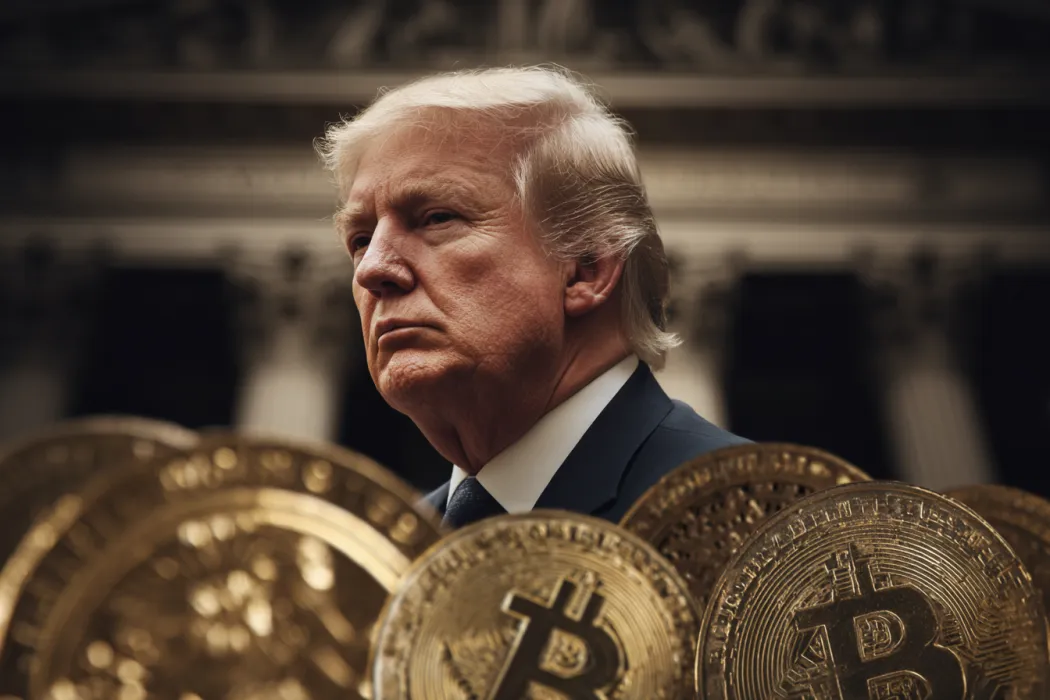
When President Donald Trump signed the GENIUS Act into law last July, the ceremony in the Rose Garden felt like a victory lap for his pro-crypto coalition. Brian Armstrong smiled for the cameras. Banks sent polite congratulations. Everyone claimed a win. Nine months later, that fragile truce has detonated into open warfare—and Trump finds himself caught between two factions of his own base, each demanding he choose a side in a fight that could determine whether traditional banking survives the digital age.
At stake is something far more consequential than regulatory minutiae: the future of roughly $18 trillion in U.S. bank deposits, and whether stablecoins—those dollar-pegged digital tokens—will function as benign payment rails or become what one bank executive privately called “digital vampires” draining the lifeblood from America’s financial system.
The Powder Keg: How Stablecoin Regulation Became Trump’s Toughest Call
The February 10, 2026 White House meeting wasn’t supposed to make headlines. Senior officials from Treasury, the Federal Reserve, and representatives from JPMorgan Chase, Bank of America, and Citigroup gathered ostensibly to “align on implementation frameworks” for stablecoin regulation. What actually transpired, according to three people familiar with the discussions, was a full-court press by traditional banks for a total prohibition on stablecoin yields—a move that would fundamentally alter the competitive landscape between crypto and conventional banking.
“They came with charts, projections, doomsday scenarios,” one White House adviser told reporters on background. “The message was clear: it’s us or them.”
The banks’ anxiety isn’t unfounded. Treasury Department estimates, first reported by CryptoSlate, suggest that without yield restrictions, stablecoins could attract between $500 billion and a staggering $6.6 trillion in deposits over the next decade—money that would otherwise sit in checking and savings accounts at traditional financial institutions. Standard Chartered’s more conservative forecast still projects $500 billion in bank deposit flight by 2028, enough to trigger capital adequacy concerns and force major institutions to restructure their balance sheets.
For context, that upper-end $6.6 trillion figure represents more than one-third of all U.S. bank deposits. It’s not an extinction event for banking, but it’s the financial equivalent of watching the ocean recede before a tsunami.
The GENIUS Act vs. The CLARITY Act: Two Visions, One Industry
Understanding this split requires decoding the legislative alphabet soup that’s consumed Washington’s crypto policy apparatus for the past year.
The GENIUS Act (Guiding and Ensuring Network Innovation for U.S. Stablecoins), signed by Trump in July 2025, was supposed to be the grand compromise. It established a federal framework for stablecoin issuers, mandated dollar-for-dollar backing with short-term Treasuries, and crucially, prohibited stablecoin issuers themselves from paying yields directly to token holders. The rationale, articulated by Treasury Secretary Scott Bessent at the signing, was to prevent stablecoins from becoming “unregulated money market funds in disguise.”
But here’s where the legal architecture gets interesting—and where the current battle lines have formed. While the GENIUS Act banned issuer yields, it explicitly permitted third-party platforms to offer rewards programs built on top of stablecoins. Think of it like credit card rewards: Visa doesn’t pay you 2% cashback, but Chase does for using its Visa card.
Crypto platforms immediately saw the loophole—or as they’d argue, the intentional design feature. Companies like Coinbase and Circle began structuring DeFi protocols and yield-bearing products that technically comply with the no-issuer-yield rule while effectively delivering returns to stablecoin holders. Some programs tout annual percentage yields of 4-6%, funded through lending protocols, transaction fees, and strategic partnerships.
The CLARITY Act (Comprehensive Legislation for Accountability and Regulatory Implementation in Tokenized Yields), by contrast, represents the banks’ preferred endgame. Introduced in the Senate last fall but currently stalled amid midterm political calculations, the bill would slam shut the third-party yield door entirely. Under its provisions, any entity—issuer, exchange, DeFi protocol, or intermediary—would be prohibited from offering compensation, rewards, or yields on stablecoin holdings above de minimis levels (defined as 0.1% annually).
“It’s the difference between competitive innovation and regulatory capture,” argues Coinbase CEO Brian Armstrong, who has emerged as the crypto industry’s most vocal opponent of the CLARITY Act’s yield ban. “Banks want to use government power to eliminate competition they can’t match through better service.”
Trump’s Tightrope: When Your Base Pulls in Opposite Directions
Donald Trump built his 2024 campaign partly on a promise to make America the “crypto capital of the world.” He accepted campaign donations in Bitcoin, spoke at crypto conferences, and stacked his administration with blockchain enthusiasts. His base includes everyone from Silicon Valley libertarians to Main Street bank executives—groups that rarely find themselves on the same side of regulatory debates.
Until now, that coalition worked. But the stablecoin yield ban debate has exposed the fault line between pro-crypto innovation advocates and financial stability traditionalists, both of whom consider themselves Trump allies.
On one side: tech entrepreneurs, crypto venture capitalists, and digital asset companies who funded super PACs supporting Trump and expected a light regulatory touch in return. They view stablecoins as the future of payments—faster, cheaper, and more accessible than legacy banking infrastructure. To them, yield bans are anti-competitive protectionism that would cripple American innovation and hand leadership to overseas competitors.
On the other: regional and national banks, whose executives contributed heavily to Trump’s campaign and who now face an existential question about their deposit base. At the World Economic Forum in Davos last month, JPMorgan Chase CEO Jamie Dimon didn’t mince words when asked about Armstrong’s position: “Brian is a smart guy running a valuable company, but he’s also fighting for his business model. Let’s not confuse entrepreneurial ambition with what’s best for financial stability.”
The split has gotten personal. Armstrong has publicly accused banks of orchestrating a coordinated lobbying campaign to “weaponize regulation” against competitors. Banking trade associations have fired back, arguing that yield-bearing stablecoins create systemic risk and could trigger bank runs during financial stress.
Trump’s response so far has been characteristic: strategic ambiguity. He’s praised “both sides” while declining to endorse the CLARITY Act explicitly. White House sources suggest he’s personally conflicted, appreciating the innovation story but nervous about bank CEOs warning of deposit flight and financial instability.
The Yield Debate: Innovation or Financial Alchemy?
Strip away the political theater, and the core dispute is surprisingly straightforward: should digital dollars be able to compete with bank accounts on interest rates?
The crypto argument runs like this: Stablecoins are more efficient than traditional banking. They don’t require expensive branch networks, legacy IT systems, or armies of compliance officers. That efficiency should translate into better returns for consumers. When DeFi protocols lend out stablecoins and earn interest, sharing those returns with token holders is just good business—the same model banks have used for centuries, just executed with smart contracts and blockchain rails.
Moreover, crypto advocates argue, the distinction between “issuer yields” and “third-party rewards” is economically meaningless. If Circle can’t pay yields on USDC but Coinbase can structure a wrapper product that does, you’ve simply added unnecessary complexity without achieving the policy goal. Better to allow transparent, well-regulated yield products than push activity into unregulated grey markets.
The banking counterargument emphasizes systemic risk and competitive fairness. Banks are subject to stringent capital requirements, stress testing, deposit insurance assessments, and extensive regulatory oversight—costs that translate to lower yields for depositors. Allowing stablecoins to offer higher returns without equivalent regulatory burden isn’t innovation; it’s regulatory arbitrage.
Furthermore, banks argue, yield-bearing stablecoins could exacerbate financial instability. During market stress, depositors might rapidly convert bank deposits to higher-yielding stablecoins, triggering the exact bank run dynamics that deposit insurance and Federal Reserve support are designed to prevent. The stability of the banking system depends on sticky deposits; making digital alternatives more attractive could undermine that foundation.
There’s also the matter of dollar dominance in global finance. Some analysts worry that if stablecoins become primarily yield-bearing investment vehicles rather than transaction mediums, they might attract regulatory crackdowns from the SEC as unregistered securities—potentially fragmenting the very innovation ecosystem Trump claims to support.
What February 2026 Tells Us: The Pressure Is Building
The immediate catalyst for the current crisis was the banks’ escalation strategy. Following the February 10 White House meeting, major financial institutions delivered a joint principles document to Congressional leadership—an unusual move that signals coordinated advocacy at the highest levels. The document, obtained by Politico, frames the debate in stark terms: either impose comprehensive yield bans or accept “the systematic dismantling of the traditional deposit base that has funded American economic growth for generations.”
Trump administration officials have reportedly set an internal deadline of March 1 to formulate a unified position, though sources caution that deadline might slip given the political sensitivity. The timing is particularly awkward given approaching midterm elections, where both crypto-friendly Republicans and banking-sector Democrats are jockeying for advantage.
Meanwhile, the CLARITY Act remains in legislative purgatory. Senate Banking Committee Chairman (name varies by political composition) has the votes to advance the bill, but several swing-state senators face pressure from both sides. Crypto industry PACs have threatened to fund primary challengers; banking associations have reminded lawmakers which sectors employ the most constituents.
Beyond Politics: What’s Really at Stake
Zoom out from the immediate political drama, and the stablecoin yield fight represents something larger: the latest chapter in an ongoing battle over whether technology will disrupt or complement traditional financial infrastructure.
History offers mixed lessons. Credit card networks didn’t destroy banks; they partnered with them. But online-only banks like Chime and SoFi have captured market share by offering better rates and user experiences, forcing incumbents to modernize. Money market funds, created in the 1970s, did siphon deposits from banks—prompting regulatory reforms that ultimately benefited consumers through competition.
The question is whether stablecoins represent evolutionary competition or revolutionary displacement. If they’re the former, yield restrictions might constitute unwarranted protectionism. If the latter, some guardrails might indeed be necessary to prevent financial instability.
What makes this fight uniquely complex is its intersection with geopolitics. U.S. stablecoins currently dominate global crypto markets, representing a form of digital dollar hegemony that extends American financial influence worldwide. But overly restrictive domestic regulations could push issuers offshore, fragmenting markets and potentially benefiting competitors in Asia or Europe.
Trump’s Commerce Secretary recently noted that China is watching American crypto policy closely, hoping regulatory overreach will create opportunities for yuan-denominated stablecoins to gain market share in international trade. That national security dimension adds another layer to Trump’s calculation.
The Path Forward: Compromise, Capitulation, or Continued Chaos?
Industry insiders are gaming out three scenarios for how this resolves:
Scenario One: The Grand Bargain. Trump brokers a compromise that caps third-party yields at moderate levels (say, 2-3% annually)—enough to allow crypto platforms to compete but not enough to trigger mass deposit flight. Banks accept some competitive pressure; crypto companies accept some restrictions. Both sides claim victory, legislation passes, and markets find equilibrium.
Scenario Two: Crypto Wins. Midterm election dynamics and public pressure force Congressional opponents to abandon the CLARITY Act. The GENIUS Act framework stands, third-party yields proliferate, and banks adapt by either acquiring crypto platforms or launching their own digital asset offerings. The banking lobby loses this round but continues fighting through regulatory agencies.
Scenario Three: Status Quo Gridlock. No additional legislation passes; the GENIUS Act remains the governing framework; legal ambiguity persists around third-party yields; and the issue gets decided through enforcement actions, agency rulemaking, and years of litigation. Markets hate uncertainty, but Washington delivers it anyway.
Prediction markets currently give the Grand Bargain scenario roughly 40% odds, Status Quo Gridlock 35%, and Crypto Wins 25%. But those probabilities shift with every Trump tweet and every banking lobby meeting.
Conclusion: A Defining Moment for Digital Finance
The stablecoin yield war of 2026 will likely be remembered as a hinge point—the moment when American policymakers either embraced digital finance innovation or retreated into protectionism and incumbency advantage.
For Trump, the stakes are both political and historical. His pro-crypto brand depends on following through on campaign promises, but his relationships with banking sector allies matter for both fundraising and economic credibility. Choose innovation too aggressively, and you risk financial instability narratives. Choose stability too conservatively, and you alienate the tech base that helped deliver your victory.
The deeper truth is that this fight transcends Trump or any individual political figure. The questions raised—how to balance innovation with stability, how to regulate emerging technologies without stifling them, how to maintain American competitiveness while ensuring consumer protection—will define financial policy for the next generation.
Stablecoins aren’t going away. Banks aren’t disappearing. The only question is whether these two forces will forge an uncomfortable partnership or wage a protracted war of attrition that benefits neither side.
As the March 1 deadline approaches, Washington insiders are watching closely. The decision Trump makes—or avoids—will echo far beyond the crypto world, shaping perceptions of American regulatory philosophy, signaling our approach to financial innovation, and potentially determining whether the next generation of digital finance is built in San Francisco, Shanghai, or Singapore.
One senior banker, speaking anonymously after the February 10 White House meeting, put it bluntly: “We’re not just fighting over basis points and yield curves. We’re fighting over what the word ‘deposit’ means in the 21st century. And whoever wins that fight wins the future of finance.”
The battle has been joined. Trump’s base is split. And the financial world is watching to see whether America’s traditional banking system and its crypto insurgency can coexist—or whether only one can survive.
Discover more from The Economy
Subscribe to get the latest posts sent to your email.


Banks
Pakistan’s Most Reliable Export Is Its People: Remittances Hit $41.6 Billion, Overtaking Total Exports

Introduction
For the first time in the country’s history, money sent home by Pakistan’s overseas workers has exceeded the value of everything Pakistan actually sells abroad. Remittances hit a record $41.6 billion in the fiscal year ending June 30, 2026, according to State Bank of Pakistan data — surpassing total merchandise exports for the same period and cementing a structural shift that economists are increasingly uneasy about (VOI World/State Bank of Pakistan).
The Numbers Behind the Milestone
Remittance inflows rose 8.6% year-on-year in FY26, up from $38.3 billion in FY25 (VOI World). Some reporting puts the full 11-month figure even higher at $38 billion before the final month was tallied, with May 2026 alone contributing $4.25 billion — an amount roughly equal to what the entire country spends on imports in a single month (Express Tribune). A separate Express Tribune report puts the full FY26 total even higher, at $41.58 billion, an increase of nearly $3.29 billion over the prior year, delivered “without structured educational, training or welfare support” for the overseas workforce generating it (Express Tribune — Remittances Without Structured Support).
Saudi Arabia remained the single largest source of remittances in June 2026 at $829.6 million, followed by the UAE ($792.3 million), the United Kingdom ($514.9 million) and the United States ($296.8 million), with Italy and Oman each contributing more than $100 million (VOI World). That geographic concentration matters: a substantial share of Pakistan’s remittance base originates from the Gulf, leaving the country’s external account exposed to labor market reforms, economic cycles and geopolitical developments concentrated in a single, currently volatile region (Business Recorder Editorial).
Exports Have Been Stuck for Years
The remittance surge stands in sharp contrast to Pakistan’s export performance, which has shown little sustained dynamism despite years of concessional financing, preferential tariff regimes and subsidized energy for exporters (Business Recorder Editorial). The textile sector — long considered the backbone of Pakistan’s export economy — has been stuck in a $15–18 billion annual range for years, even as a handful of forward-thinking textile groups have managed to grow exports and diversify product lines under the exact same operating conditions others cite as prohibitive (Express Tribune). Separately reported nine-month data for the fiscal year showed exports contracting 5.8% to $23.3 billion even as imports rose nearly 8% to $46.8 billion, widening the trade gap further (Minute Mirror).
Over the three fiscal years from 2023 to 2025, Pakistan received $95.8 billion in remittances compared with $91 billion in merchandise exports — a gap that reflects, according to Business Recorder analysis, a deliberate policy orientation that has effectively institutionalized remittances as the default tool for stabilizing the current account rather than addressing the underlying export weakness (Business Recorder Opinion).
The Dutch Disease Warning
Independent economists have begun explicitly framing this pattern as a precursor to Dutch disease — the phenomenon where a large, easy source of foreign currency inflow reduces the pressure and incentive to build a competitive tradeable export sector (Business Recorder Opinion). The policy dimension is not incidental: under IMF program conditions, a long-standing subsidy that had encouraged banks to actively mobilize remittance transfers was withdrawn in the 2026 Budget, contributing to a temporary slowdown in inflows during the early months of the fiscal year before the government released Rs30 billion from its contingency fund to help revive momentum (Business Recorder Opinion).
A Business Recorder editorial published in July 2026 was blunt about the implication: Pakistan’s overseas workers have effectively become the country’s “most reliable export,” with its own people functioning as its largest export commodity — a framing the editorial explicitly calls an unsustainable foundation for long-term development strategy (Business Recorder Editorial).
The Silver Linings
The remittance boom has provided genuine macroeconomic stabilization. Total liquid foreign reserves crossed $23.98 billion as of early July 2026, including $18.47 billion held by the State Bank of Pakistan itself, with the rupee holding relatively steady around Rs278 per dollar in the interbank market (Express Tribune — Remittances Without Structured Support). Inflation has also been easing, and large-scale manufacturing showed signs of recovery with 5.9% growth in earlier-reported data, while agricultural lending rose 14.4% during July–February, extending credit access to farmers (Minute Mirror). Separately, Pakistan has reportedly repaid roughly Rs4,722 billion in debt ahead of schedule and posted a historic milestone in IT sector exports, suggesting pockets of genuine structural improvement exist alongside the broader export stagnation (Radio Pakistan).
Why This Matters Beyond Pakistan
Pakistan’s experience is a useful case study for other remittance-dependent emerging economies navigating IMF program conditions. The core tension — using a reliable, low-effort capital inflow to paper over a harder structural problem in the tradeable goods sector — is not unique to Pakistan, but few economies illustrate the scale of the imbalance as starkly as a country where remittances now formally exceed total exports.
Key Takeaways
- Pakistan’s FY26 remittances hit a record $41.6 billion, surpassing total merchandise exports for the first time in the country’s history.
- Saudi Arabia and the UAE remain the largest single sources, concentrating external account risk in the Gulf region.
- Textile exports have been stuck between $15–18 billion annually for years despite sustained government support.
- Economists are increasingly framing the remittance-export imbalance as a Dutch disease risk rather than a stabilization success story.
- Reserves have strengthened to nearly $24 billion and the rupee has stabilized, but the underlying export competitiveness problem remains unresolved.
Sources: VOI World, Express Tribune — Remittances Dwarf Exports, Express Tribune — Remittances Without Structured Support, Business Recorder Opinion, Business Recorder Editorial, Minute Mirror, Radio Pakistan
Discover more from The Economy
Subscribe to get the latest posts sent to your email.
Markets & Finance
Indonesia’s Confidence Problem: Record Investment, a Sinking Rupiah, and a Widening Credibility Gap
Introduction
Indonesia’s economic story in mid-2026 is one of genuine contradiction. On one hand, the government posted a record Rp1,010.6 trillion ($56.1 billion) in realized investment for the first half of the year, up 7.2% from a year earlier and on pace to hit its full-year target (Antara News). On the other, the rupiah has been sliding toward Rp18,000 per US dollar, the state budget deficit has widened, and a growing chorus of domestic commentators is warning that Indonesia risks permanently losing what one Jakarta Post analysis called “the vital game of investor confidence” (The Jakarta Post).
The Investment Numbers Look Genuinely Strong
Indonesia’s Investment and Downstreaming Minister Rosan Roeslani reported that first-half 2026 investment realization reached 49.5% of the government’s full-year target of Rp2,041.3 trillion, creating 1.44 million jobs — a 15% increase in job creation compared to the first half of 2025 (Antara News). Domestic and foreign investment remained almost perfectly balanced, with foreign direct investment reaching Rp507.6 trillion (50.2% of the total) against Rp502.9 trillion in domestic investment (Antara News). Notably, investment outside the country’s most populous island, Java, exceeded inflows into Java itself for the first time in this dataset — Rp507.8 trillion versus Rp502.8 trillion — supporting the government’s long-standing goal of more balanced regional development (Antara News).
Singapore remained by far Indonesia’s largest source of foreign capital at $8.8 billion, followed by Hong Kong ($7.6 billion), China ($3.9 billion), Japan ($1.9 billion) and the United States ($1.7 billion) — together accounting for roughly 77.8% of all foreign direct investment into the country (Antara News). Second-quarter investment specifically rose 7.1% year-on-year to Rp511.8 trillion, with Minister Roeslani noting that investor commitment to Indonesia has held up despite significant “geopolitical and geoeconomic challenges” globally (The Jakarta Post).
But the Pace Is Slowing, and the Currency Is Under Pressure
Despite the record absolute figures, the Jakarta Post notes that investment growth in 2026 has been running at a distinctly slower pace than the country achieved in recent prior years, even as it remains on track to hit the annual target (The Jakarta Post). Meanwhile Bank Indonesia has had to actively respond to renewed rupiah weakness, attributing the currency’s slide toward Rp18,000 per dollar to hawkish signals from Federal Reserve officials and broader movements in the US dollar index (Samuel Sekuritas Daily Economic Insights). The state budget deficit reached Rp196.5 trillion in the first half of 2026, equivalent to 0.76% of GDP (Samuel Sekuritas Daily Economic Insights).
There has been some relief more recently: a 27.4% surge in second-quarter foreign direct investment helped strengthen the rupiah, with USD/IDR trading around 17,990 in mid-July as softer US inflation data reduced the odds of a near-term Fed hike (TMGM). Even so, the US dollar has retained broad support from escalating Middle East geopolitical tensions, keeping the rupiah’s recovery fragile rather than decisive (TMGM).
Why Growth Forecasts Keep Getting Trimmed
International lenders have grown more cautious about Indonesia’s growth trajectory for 2026. The OECD has held its outlook at 4.7% year-on-year — a clear deterioration from 2025’s realized 5.1% growth — with most major lending institutions clustering around the 5.0% threshold, implying a loss of momentum after Indonesia posted 5.61% growth in the first quarter of 2026 alone (Indonesia Investments). The deceleration is attributed to a softening labor market, weakening consumer confidence, and contracting retail sales in the second quarter (Indonesia Investments). High global oil prices are compounding the pressure on the government’s fiscal balance, since Indonesia continues to subsidize a significant portion of domestically sold fuel — a policy that transmits global energy volatility directly into the state budget rather than shielding consumers from it entirely (Indonesia Investments).
The Deeper Warning: A Confidence Problem, Not Just a Cyclical One
The most pointed recent critique comes from domestic commentary rather than foreign analysts. A Jakarta Post opinion piece published July 20, 2026 argues Indonesia must halt what it describes as erratic policymaking and institutional erosion before the country permanently damages its standing in the “vital game of investor confidence,” framing the rupiah’s weakness and shifting global market conditions as symptoms of a deeper credibility issue rather than purely external shocks (The Jakarta Post). That framing matters for how the strong headline investment numbers should be read: capital is still arriving, but the terms on which it arrives, and the confidence with which it stays, are visibly more fragile than the raw totals suggest.
Strategic Bright Spots
Not every recent development points toward strain. India secured access to Indonesian critical minerals through several major agreements signed during Prime Minister Narendra Modi’s visit to Jakarta, part of a broader push by Indonesia to leverage its resource base for deeper strategic partnerships (Samuel Sekuritas Daily Economic Insights). Indonesia is also pursuing energy independence through B50 biodiesel and compressed natural gas development, aimed explicitly at reducing reliance on imported LPG — a structural move that, if successful, would reduce exactly the kind of imported-energy vulnerability now straining the budget (Samuel Sekuritas Daily Economic Insights).
Key Takeaways
- Indonesia posted a record Rp1,010.6 trillion ($56.1 billion) in H1 2026 investment, up 7.2% year-on-year, with foreign and domestic capital nearly evenly split.
- The rupiah has weakened toward Rp18,000 per dollar on hawkish Fed signals, though a Q2 FDI surge has since provided partial relief.
- International lenders have trimmed Indonesia’s 2026 growth outlook to around 4.7–5.0%, down from 5.1% realized growth in 2025.
- The H1 2026 budget deficit reached 0.76% of GDP, pressured by continued fuel subsidies amid high global oil prices.
- Domestic commentary increasingly frames Indonesia’s challenge as a credibility and policymaking issue, not merely a cyclical external shock.
Sources: Antara News, The Jakarta Post — Investment Growth, The Jakarta Post — Confidence Game, Samuel Sekuritas Daily Economic Insights, Indonesia Investments, TMGM
Discover more from The Economy
Subscribe to get the latest posts sent to your email.
Introduction
The European Council formally extended its economic sanctions against Russia for another full year on 25 June 2026, keeping restrictive measures in place until 31 July 2027 (Council of the EU). More than four years into the war, the headline story of Russia’s economy has shifted from whether sanctions would work to a more nuanced question: how much longer can the Kremlin keep financing the war before the accumulated strain becomes impossible to hide behind favorable official statistics.
The Sanctions Architecture, Renewed Again
The EU’s economic measures against Russia, first introduced in 2014 and dramatically expanded after the February 2022 full-scale invasion, now span trade, finance, energy and dual-use technology restrictions, alongside asset freezes and travel bans on a broad range of individuals and entities (Council of the EU). Since February 2022, the EU has adopted 20 separate sanctions packages, and the European Council has explicitly stated it remains determined to keep weakening Russia’s war economy by further reducing its energy revenues, curbing shadow-fleet oil shipping operations and constraining its banking system (Council of the EU). Separately, on 3 July 2026 the EU sanctioned six individuals connected to the poisoning and death of opposition figure Alexei Navalny, underscoring that the sanctions regime continues to expand on human-rights grounds as well as economic ones (Council of the EU Sanctions Timeline).
The Headline Numbers Beijing-Style Optimism Can No Longer Explain Away
Russia’s GDP is now put at roughly $2.51 trillion, the world’s eleventh-largest economy — comparable in size to South Korea despite Russia’s vastly larger landmass and resource base — with 2026 growth projected at just 1.0% and inflation running at 5.2% (Statistics of the World). More pessimistic estimates put full-year 2026 growth even lower, at around 0.4%, which would be worse than 2025’s already-weak 1% expansion and would mark a sharp deceleration from the 4.1% growth Russia posted in 2023 as it forged new trading relationships to route around initial sanctions (Forbes).
Oil and gas revenues — historically around half of Russia’s state income — have fallen to roughly a quarter, a deliberate outcome of Western sanctions strategy that targets how much Russia earns from exports rather than blocking those exports outright (Stockholm School of Economics/SITE). Russia’s oil and gas budget revenues reportedly halved in January 2026 alone, with crude prices falling below $73 a barrel before the Middle East conflict briefly reversed the trend, sending Brent surging more than 55% to near $120 a barrel at its peak (Forbes).
The Middle East War: A Temporary Lifeline With Long-Term Costs
The spike in oil prices tied to the Iran conflict, combined with a period of eased US sanctions enforcement on Russian oil under President Trump, offered Moscow unexpected fiscal breathing room in mid-2026 (Forbes). But that same conflict has undermined Russia’s longer-term energy diversification ambitions in the region: two Russian-backed power plant projects in Iran have been put on hold, along with oil and gas exploration work and plans to build new transit routes linking Russia to India via Iran (Forbes).
The Gap Between Official Statistics and Underlying Reality
Perhaps the most important analytical point from recent research is not about any single data point but about the reliability of Russian statistics themselves. Torbjörn Becker of the Stockholm Institute of Transition Economics has argued the real test of sanctions is not whether they end the war overnight, but how much they erode the Kremlin’s capacity to finance it — and by that measure, the evidence points to deeper strain than headline GDP figures suggest (Stockholm School of Economics/SITE). Becker notes that Russia’s economy grew only modestly in 2022 despite oil prices rising sharply that year — a gap between expected and actual performance that implies a considerably larger hidden economic hit than the official contraction figures showed (Stockholm School of Economics/SITE). Compounding the problem, Russian authorities have stopped publishing several key statistics since 2022, making independent assessment of inflation, consumption and real economic conditions increasingly difficult — leading Becker to conclude that “statistics have become part of the narrative” rather than a neutral measure of economic reality (Stockholm School of Economics/SITE).
The Military-Civilian Economic Split
A recurring theme across recent analysis is the growing bifurcation between Russia’s overheating military-industrial sector and a stagnating civilian economy. This imbalance has pushed interest rates higher and forced the liquidation of a striking 71% of Russia’s gold reserves to help fund continued war spending (Forbes). Russia’s total fossil fuel export revenue is estimated at roughly €734 million per day, underscoring just how central hydrocarbon income remains to the entire war financing model even as that revenue stream shrinks (Forbes).
The Counter-Narrative: Wages Still Rising
It would be inaccurate to describe Russia’s economy as in freefall. CSIS research notes that Russian salaries rose 17.8% in nominal terms and 8.7% in real terms in 2024 compared to 2023, with disposable incomes up 6.1% in 2023 and 7.3% in 2024 — growth rates not seen in Russia in almost two decades (CSIS). Government budget projections still expect real salaries to rise, albeit at a decelerating pace: 7% in 2025, 5.7% in 2026 and 4.1% in 2027 — a marked slowdown from the 2024 peak but still roughly double the pre-invasion decade average (CSIS). This wage growth, driven substantially by wartime labor shortages and military-adjacent spending, is precisely the kind of headline-stabilizing data point that has allowed Putin to argue publicly that sanctions have failed to cripple his economy (Fortune) — even as think tanks describe the broader trajectory as pushing Russia toward what one report calls an “economic, political, and military abyss” (Fortune).
What Comes Next
Renewed legislative pressure in Washington — including the Sanctioning Russia Act introduced with strong bipartisan support — signals appetite in the US for tightening the screws further, even as the loss of a key congressional champion for that effort has complicated the political path forward (TIME). Whether the EU’s renewed sanctions regime, continued oil price pressure, and constrained reserves ultimately force a shift in Kremlin calculus toward negotiation remains the central open question for 2027.
Key Takeaways
- The EU has extended Russia sanctions for a further year, through 31 July 2027, continuing a regime built from 20 separate packages since 2022.
- Russia’s 2026 GDP growth is forecast between 0.4% and 1.0%, a sharp deceleration from 2023’s 4.1% post-shock rebound.
- Oil and gas revenue’s share of Russian state income has fallen from roughly half to about a quarter as Western sanctions target export earnings specifically.
- Russia has liquidated a large share of its gold reserves to sustain war financing amid a widening split between an overheating military sector and a stagnating civilian economy.
- Official Russian statistics likely understate the true economic strain, according to independent economists who cite a widening gap between reported and expected performance.
Sources: Council of the EU, Council of the EU Sanctions Timeline, Stockholm School of Economics/SITE, Forbes, Statistics of the World, CSIS, Fortune, TIME
Discover more from The Economy
Subscribe to get the latest posts sent to your email.

Global Central Banks 2026: Fed, BoE and BoJ Decisions Could Reshape Markets

Gulf Capital Retreat From Pakistan 2026: UAE Loan Freeze & What It Means

Pakistan’s Most Reliable Export Is Its People: Remittances Hit $41.6 Billion, Overtaking Total Exports

Indonesia’s Confidence Problem: Record Investment, a Sinking Rupiah, and a Widening Credibility Gap

Down But Not Out: Inside the Slow Sinking of Russia’s War Economy

China’s Growth Slips to a Four-Year Low: Why Beijing Still Won’t Pull the Stimulus Trigger

The Johor-Singapore Corridor: How Malaysia Became Southeast Asia’s AI Infrastructure Powerhouse

Canada’s Economy ‘On Pause’: Inside the CUSMA Deadline That Passed Without a Deal

Dubai’s Millionaire Magnet: How the UAE Turned Middle East Turmoil Into a Capital Safe-Haven Boom

Britain’s Sixth Prime Minister in a Decade: What Starmer’s Exit Means for Gilts, Sterling and Your Portfolio

Anthropic Offers Up to $600,000 Salary for Critical IPO Role as AI Giant Prepares for Wall Street Debut

EU Readies Crisis Team for Potential China Rare Earths Stand-Off as Supply Chain Risks Mount

Singapore Weighs Hedge Fund Tax Cuts to Counter Hong Kong’s Growing Financial Challenge

Facebook and Instagram Experience Global Outage

Carry Trade Unwind 2026: How the Yen’s Snapback Triggered a Global Margin Call

AI Bubble Warning 2026: Why BIS, IMF and Bank of England Fear a Market Crash

BRICS De‑Dollarization Strategy Takes Shape with $15 Billion Local‑Currency Push

Male Labor Force Participation Rate 2026: Why Men Are Leaving & Economic Impact

Russia Bans Diesel Exports 2026: Global Fuel Market Impact Explained

The AI Super Bubble Is Ready to Burst

Strait of Hormuz Blockade 2026: Oil Prices Surge 9% as US-Iran Conflict Reignites

IMF Cuts Pakistan Growth Forecast, Raises Inflation to 8.4%

Private Credit Warning: Most BDCs Turn Unprofitable in 2026, Reuters Finds
Gulf Capital Retreat From Pakistan 2026: UAE Loan Freeze & What It Means

India Economic Rise 2026: How the Subcontinent Toppled Japan

Bitcoin $150k Milestone Achieved as US Sovereign Crypto Pivot Looms

Strait of Hormuz 2026: Why Markets Still Don’t Trust It’s Open

China Housing Market Turnaround: White‑List Model Stabilises Prices
-

 Markets & Finance7 months ago
Top 15 Stocks for Investment in 2026 in PSX: Your Complete Guide to Pakistan’s Best Investment Opportunities
-

 Analysis5 months ago
Johor’s Investment Boom: The Hidden Costs Behind Malaysia’s Most Ambitious Economic Surge
-

 Analysis5 months ago
Top 10 Stocks for Investment in PSX for Quick Returns in 2026
-

 Analysis6 months ago
Brazil’s Rare Earth Race: US, EU, and China Compete for Critical Minerals as Tensions Rise
-

 Banks6 months ago
Best Investments in Pakistan 2026: Top 10 Low-Price Shares and Long-Term Picks for the PSX
-

 Investment7 months ago
Top 10 Mutual Fund Managers in Pakistan for Investment in 2026: A Comprehensive Guide for Optimal Returns
-

 Global Economy7 months ago
15 Most Lucrative Sectors for Investment in Pakistan: A 2025 Data-Driven Analysis
-

 Global Economy7 months ago
Pakistan’s Export Goldmine: 10 Game-Changing Markets Where Pakistani Businesses Are Winning Big in 2025