
Global Economy
Venezuelan Crude: Trump’s Oil Pivot & The Prize Beneath Chaos

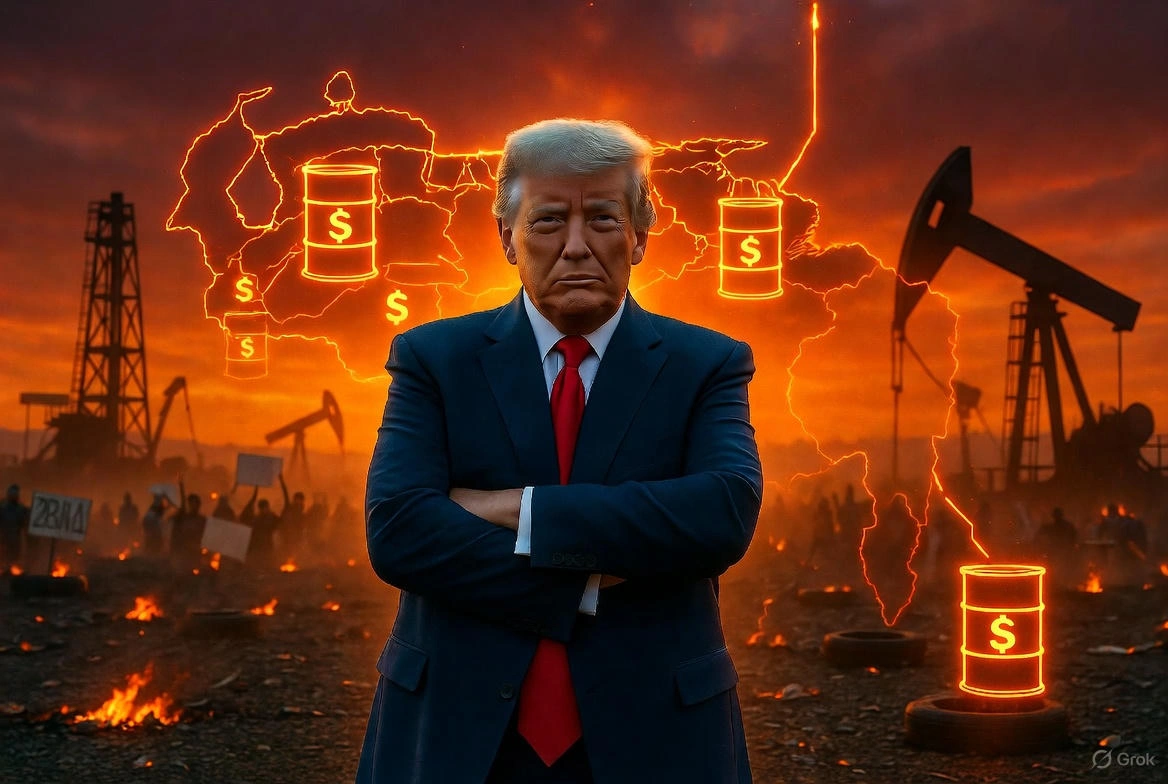
As Trump shifts from regime change to resource extraction, Venezuelan crude’s 303B barrel prize is rewriting Latin American geopolitics. Expert analysis with premium sources.
Sitting atop an estimated 303 billion barrels of proven oil reserves—roughly 17% of the world’s total and more than Saudi Arabia’s holdings—Venezuela today produces less crude than it did in 1950. This is not hyperbole but the staggering reality of a petrostate that transformed geological fortune into economic catastrophe. The country ranked just 21st in global oil production in 2024, pumping approximately 960,000 barrels per day, a fraction of its 3.5 million barrel peak in the late 1990s.
The paradox has never been starker, nor the stakes higher. In early January 2026, following unprecedented military action that resulted in the capture of Venezuelan President Nicolás Maduro, President Donald Trump announced his administration would take control of Venezuela’s oil sector. Trump declared that Venezuela would turn over between 30 million and 50 million barrels of sanctioned oil, with sales beginning immediately and continuing indefinitely. The move represents one of the most dramatic pivots in U.S. Latin American policy in generations—from regime change through maximum pressure sanctions to direct resource extraction.
For investors, policymakers, and energy analysts, Venezuela’s oil represents both immense promise and profound peril. This article examines the geological prize, chronicles the industry’s collapse, analyzes Trump’s transactional pivot, assesses the investment landscape, maps the geopolitical chess match, and most critically, asks whether oil wealth will ever benefit ordinary Venezuelans—or if the resource curse will simply acquire new management.
303 Billion Barrels: The Orinoco Advantage
Venezuela’s claim to the world’s largest proven oil reserves is not mere nationalistic boasting. According to OPEC’s Annual Statistical Bulletin 2025, Venezuela holds approximately 303 billion barrels, well ahead of Saudi Arabia’s 267 billion. The bulk of this bonanza sits in the Orinoco Belt, a 600-kilometer crescent stretching across Venezuela’s interior that may contain between 900 billion and 1.4 trillion barrels of heavy crude in proven and unproven deposits.
But geology tells only half the story. Venezuela’s crude is famously difficult. The oil is heavy and sour, requiring specialized equipment and high levels of technical prowess to produce. With API gravity ratings typically between 8 and 22 degrees—compared to the 30-40 range of lighter crudes—Venezuelan oil is thick, sulfurous, and expensive to refine. Most U.S. Gulf Coast refineries were specifically configured to process this type of heavy crude, creating a unique technical dependency that has shaped bilateral energy relations for decades.
The economic viability of Orinoco Belt production depends critically on oil prices, technology, and infrastructure. During periods when crude trades above $70-80 per barrel, extraction economics improve dramatically. Below that threshold, many deposits become marginal. Industry experts estimate that returning Venezuela to its early 2000s production highs would require approximately $180 billion in investment between now and 2040, according to energy intelligence firm Rystad Energy. Of that staggering sum, between $30-35 billion would need to be committed within the next two to three years just to stabilize and modestly increase current output.
The infrastructure decay is comprehensive. PDVSA acknowledges its pipelines haven’t been updated in 50 years, and the cost to update infrastructure to return to peak production levels would cost $58 billion. Upgrading facilities that convert extra-heavy crude into marketable products have fallen into disrepair. Power generation systems that drive extraction operations suffer chronic failures. Even basic maintenance on wellheads and pumping stations has been deferred for years.
Francisco Monaldi, director of the Latin American Energy Institute at Rice University’s Baker Institute, offers a sobering assessment of Venezuela’s reserve claims. Venezuela’s recovery rate for its oil is less than half of what the country claims, meaning a reasonable and conservative estimate of economically recoverable reserves would be closer to 100-110 billion barrels. The distinction matters enormously—not for geological surveys but for financial modeling and investment decisions.
From Boom to Bust: Anatomy of a Petrostate Failure
Venezuela’s oil story began spectacularly in 1922 when the Barrosos-2 well near Maracaibo erupted in a gusher that sprayed crude 200 feet into the air. By the 1970s, Venezuela had become Latin America’s wealthiest nation, riding OPEC-engineered price increases to prosperity. The 1976 nationalization of the oil industry under President Carlos Andrés Pérez created Petróleos de Venezuela S.A. (PDVSA), a state company that initially operated with remarkable efficiency and technical competence.
Through OPEC, which Venezuela helped found alongside Iran, Iraq, Kuwait, and Saudi Arabia, the world’s largest producers coordinated prices and gave states more control over their national industries. Venezuela’s nationalization, unlike many others, proceeded relatively smoothly. Foreign companies received compensation, technical partnerships continued, and PDVSA emerged as a world-class national oil company, retaining many of the operational practices of its multinational predecessors.
The first major shock arrived in December 2002, when a politically motivated strike against PDVSA—triggered by opposition to President Hugo Chávez—paralyzed production. The strike led to the firing of nearly 20,000 workers, or 40% of PDVSA’s total workforce, including many of its most capable engineers and skilled operators, which dropped production to less than 1 million barrels per day for a short period. This mass exodus of technical expertise created a knowledge vacuum from which PDVSA never fully recovered.
Chávez’s broader nationalization drive intensified after 2007. In 2007, he seized and nationalized the assets of foreign oil companies, including ExxonMobil and ConocoPhillips, driving them out of the country. Unlike the orderly 1976 transition, these expropriations were contentious and undercompensated. International arbitration tribunals later awarded billions in compensation—$1.6 billion to ExxonMobil and $8.5 billion to ConocoPhillips—which Venezuela has largely failed to pay. This episode fundamentally altered the risk calculus for foreign investment in the sector.
Under Chávez, PDVSA was transformed from a technical institution into a social welfare mechanism and political instrument, with the company effectively becoming an ATM machine for military spending and Bolivarian Missions. Revenue that might have been reinvested in maintenance, exploration, and upgrading facilities instead financed food subsidies, housing programs, and political patronage. The company was required to hire based on political loyalty rather than technical competence.
The 2014 oil price collapse delivered the coup de grâce. When crude plummeted from over $100 per barrel to below $30, Venezuela’s already fragile model shattered. By 2016, oil production reached the lowest it had been in 23 years, with analysts noting that the economic crisis would have occurred with or without U.S. sanctions due to chronic mismanagement. Production equipment failed without replacement parts. Electrical grid collapses shut down extraction facilities. Refineries operated at single-digit capacity utilization rates.
As unrest brewed under President Maduro, who succeeded Chávez in 2013, power was consolidated through political repression, censorship, and electoral manipulation. When the Trump administration imposed comprehensive oil sector sanctions in 2019, the industry was already in structural decline. The sanctions accelerated but did not initiate Venezuela’s production collapse.
Trump’s Pivot: From Regime Change to Resource Extraction
The transformation in U.S. policy toward Venezuela under Trump 2.0 represents one of the most dramatic tactical shifts in recent American foreign policy. During his first term (2017-2021), Trump pursued maximum pressure: comprehensive sanctions, recognition of opposition leader Juan Guaidó as interim president, and explicit calls for regime change. The Biden administration largely maintained this approach while offering selective relief, including a license for Chevron to resume limited operations.
The new calculus became clear on January 3, 2026, when U.S. military forces captured Maduro in a predawn operation. Trump officials subsequently outlined an ambitious, multi-part plan centering on seizing and selling millions of barrels of Venezuelan oil on the open market while simultaneously convincing U.S. firms to make expansive, long-term investments aimed at rebuilding the nation’s energy infrastructure. Secretary of State Marco Rubio and Energy Secretary Chris Wright have taken lead roles in articulating this strategy.
The shift from narcoterrorism rhetoric to energy pragmatism happened with remarkable speed. According to sources close to the White House, the Trump administration has set specific demands for Venezuela: the country must expel China, Russia, Iran, and Cuba and sever economic ties, and Venezuela must agree to partner exclusively with the U.S. on oil production. This represents a stark departure from previous democracy-promotion framing to a transactional, realpolitik approach focused on economic and strategic interests.
The timing reflects broader energy security considerations. The United States has light, sweet crude which is good for making gasoline but not much else, while heavy, sour crude like Venezuelan oil is crucial for diesel, asphalt, and fuels for factories and heavy equipment. Most U.S. Gulf Coast refineries were constructed to process Venezuelan heavy crude and operate significantly more efficiently when using it compared to domestic light sweet crude.
Energy Secretary Chris Wright confirmed at a Goldman Sachs conference that the U.S. will market crude coming out of Venezuela, first the backed-up stored oil and then indefinitely going forward, selling production into the marketplace. The administration plans to maintain control over initial oil sale revenues, with proceeds intended to “benefit the Venezuelan people” while funding infrastructure rebuilding.
However, significant logistical and political obstacles loom. Despite Trump’s insistence that U.S. oil companies would pour into Venezuela, officials have no ready plan for convincing firms to invest hundreds of billions of dollars in rebuilding the nation’s energy infrastructure. Major U.S. oil companies have remained largely silent on expansion plans, with Chevron—the only significant American operator currently in Venezuela—focusing on employee safety rather than announcing new investments.
The legal framework remains murky. Former Treasury sanctions policy advisor Roxanna Vigil noted that the private sector currently has nothing official to go on for any sort of assurance or confidence about how operations will be authorized based on U.S. sanctions. Without clear regulatory pathways and liability protections, even companies interested in Venezuelan opportunities face significant barriers to deployment of capital.
The political durability of this approach is questionable. Congressional Democrats have expressed concerns about the military intervention and lack of clear endgame. While some Republicans support a strong stance against Latin American drug cartels and the Maduro regime, others worry about open-ended commitments. Helima Croft, head of global commodity strategy at RBC Capital Markets, warned that accomplishing Trump’s goal will effectively require U.S. oil companies to play a “quasi-governmental role,” which could cost $10 billion a year according to oil executives.
The Investment Conundrum: Who Dares Capital in Caracas?
For international oil companies and financial institutions, Venezuela presents a uniquely challenging risk-reward calculation. The asset base is undeniably attractive—if it can be developed profitably and safely. The question is whether conditions will permit that development.
Chevron currently represents the largest Western oil presence in Venezuela, operating through joint ventures with PDVSA. Chevron pays PDVSA a percentage of output under a joint operation structure that accounts for about one-fifth of Venezuela’s official oil production. The company has approximately 3,000 employees in-country and billions in sunk assets. Walking away would likely mean forfeiting those assets entirely, as past nationalizations have demonstrated.
Chinese and Russian companies have become the dominant foreign players during the sanctions era. China National Petroleum Corporation (CNPC) holds stakes in consortiums with concessions covering 1.6 billion barrels of oil, while China Petroleum & Chemical Corporation (Sinopec) holds stakes covering 2.8 billion barrels. These ventures have continued operating despite sanctions, with Beijing treating U.S. restrictions as illegitimate unilateral measures rather than binding international law.
Chinese financial institutions, primarily the China Development Bank, loaned Venezuela approximately $60 billion through 17 different loan contracts—about half the Chinese loans committed to Latin America as of 2023. These loans were structured as oil-for-credit arrangements, with repayment in the form of crude shipments to China. Venezuela currently owes China between $17 billion and $19 billion in outstanding loans, creating substantial Beijing leverage over any future economic arrangements.
The political risk profile remains extreme. Venezuela has a documented history of asset expropriations, broken contracts, and failed arbitration payments. International Centre for Settlement of Investment Disputes tribunals awarded ExxonMobil $1.6 billion and ConocoPhillips $8.5 billion for earlier seizures, but Venezuela has not paid the money and ConocoPhillips continues attempting to collect. This track record understandably creates hesitation among institutional investors and corporate boards.
Operational risks compound the political uncertainties. Venezuela suffers from chronic electrical grid failures that interrupt extraction operations. Port infrastructure has degraded significantly. Security concerns range from equipment theft to more serious threats against personnel. The availability of diluents—lighter hydrocarbons needed to transport extra-heavy crude through pipelines—has been severely constrained. Maintaining production of heavy oil requires constant reinvestment, reliable power, and uninterrupted access to diluents, many of which historically came from the U.S. Gulf Coast.
The sovereign debt overhang presents another obstacle. Venezuela defaulted on over $150 billion in external debt obligations. A functioning government seeking international capital market access would need to negotiate comprehensive debt restructuring. PDVSA bonds, which traded as low as single-digit cents on the dollar, have surged on speculation about U.S.-backed restructuring, but recovery rates remain highly uncertain.
For potential investors, the upside scenario is compelling: privileged access to one of the world’s largest petroleum reserves, a government desperate for investment, and possible U.S. political backing. The downside risks are equally dramatic: expropriation, political instability, infrastructure failure, contract violations, and reputational damage from association with a regime that has committed documented human rights violations.
Geopolitical Chessboard: Beijing, Moscow, and the Scramble for Influence
Venezuela has become a focal point for great power competition in the Western Hemisphere, with China and Russia using economic and military engagement to expand influence in what Washington has traditionally considered its strategic backyard.
China’s relationship with Venezuela intensified dramatically under Chávez and continued under Maduro as both ideological alignment and economic pragmatism drove deepening ties. Between 2007 and 2016, China provided Venezuela with approximately $105.6 billion in loans, debt, and capital investments, according to AidData research. This made Venezuela one of China’s largest debtors globally and Beijing’s single most important financial commitment in Latin America.
Of the 900,000 barrels of oil Venezuela exported daily, approximately 800,000 barrels went to China, meaning nearly 90% of Venezuela’s oil was sold to Beijing. This created both dependency and leverage in complex ways. Venezuelan crude helped diversify China’s energy supplies and provided below-market pricing during sanctions. For Venezuela, Chinese purchases offered a critical lifeline when Western markets were closed by sanctions.
Beyond petroleum, Chinese involvement extends across critical infrastructure. Huawei Technologies secured a $250 million contract as early as 2004 to improve Venezuela’s fiber optic infrastructure, which became central to the country’s 4G network, while ZTE developed the Homeland Card national ID system key to citizens accessing state subsidies. Chinese firms also invested heavily in mining operations producing iron ore, bauxite, gold, and rare earth minerals—materials crucial for advanced weapons systems and technology supply chains.
Russia’s engagement has been more military-focused but strategically significant. Moscow has supplied weapons systems, provided military advisors, and allegedly facilitated drone manufacturing facilities on Venezuelan soil. These activities align with broader Russian objectives of contesting U.S. influence in Latin America and demonstrating global reach despite economic constraints.
Iran reportedly established drone manufacturing facilities on Venezuelan soil while Russia deployed military advisers—developments that align closely with threats outlined in Trump’s 2025 U.S. National Security Strategy, which rejects global hegemony for an America First realism. The Trump administration has cited these security concerns as partial justification for its intervention.
For Colombia and Brazil—Venezuela’s largest neighbors—the crisis creates impossible dilemmas. Colombia hosts approximately 2.8 million Venezuelan refugees and migrants, the highest concentration globally. The economic and social pressures on Colombian border regions are immense, with stretched public services, labor market tensions, and security concerns as criminal networks exploit porous borders. Brazil faces similar pressures in its northern states while trying to maintain diplomatic engagement with Caracas.
The Caribbean and Central America also feel Venezuelan dysfunction’s ripple effects. Several smaller nations had depended on Venezuela’s PetroCaribe program for subsidized oil supplies. That program’s collapse forced them to seek alternative energy sources at market prices, straining national budgets. The migration flow through Central America toward the United States has created humanitarian emergencies and diplomatic tensions.
According to Atlantic Council analysis, the U.S. capture of Maduro has paradoxically created both risks and potential opportunities for China—if Washington successfully rebuilds Venezuelan oil production and some flows to China, Beijing might recoup remaining loan balances. This creates perverse incentives where Chinese interests may partly align with U.S. success, despite the geopolitical rivalry.
For OPEC, Venezuela has become an embarrassing member. The country was a founding member alongside Iran, Iraq, Kuwait, and Saudi Arabia, but its influence has waned dramatically as production collapsed. Venezuelan representatives continue attending ministerial meetings, but the country has been unable to meet production quotas and contributes little to cartel strategy.
The Venezuelan People: Beyond the Barrels
While geopolitical players and oil companies calculate their interests, 28 million Venezuelans endure one of the world’s worst humanitarian catastrophes. The scale of suffering is staggering and directly linked to the oil sector’s collapse.
Approximately 7.9 million Venezuelans have fled the country since 2014, making this one of the largest displacement crises globally, with 6.9 million hosted by Latin American and Caribbean countries. This represents roughly 23% of the population—an exodus comparable to Syria’s refugee crisis but occurring without active warfare.
Inside Venezuela, 14.2 million people need humanitarian aid, including 5.1 million facing acute food insecurity, while the minimum wage stands at just $3.60 per month and 90% of the population experiences water shortages. These figures represent catastrophic state failure. Hospitals lack basic medications and equipment. Schools operate sporadically. Even Caracas, the capital, suffers frequent power blackouts.
The economic decline has left nearly 85% of Venezuelans in poverty while 53% live in extreme poverty, with the average monthly salary at $24 while a basic food basket for a family of five costs $500. Hyperinflation, while moderated somewhat from 2018-2019 peaks, continues eroding purchasing power. The local currency, the bolívar, has been redenominated multiple times to remove zeros that became meaningless.
The oil-producing regions tell particularly tragic stories. Zulia state, home to Lake Maracaibo where Venezuela’s petroleum industry began, has seen environmental devastation as poorly maintained infrastructure leaks crude into waterways. The Yanomami indigenous community in the Amazon spanning Venezuela and Brazil has faced dire humanitarian crisis, with over 570 children perishing in less than four years due to malnutrition and malaria on the Brazilian side, partly attributed to invasions by over 20,000 illegal miners.
The migration routes expose desperate people to terrible dangers. In 2023, a record 520,000 migrants crossed the treacherous 60-mile Darién Gap between Panama and Colombia, with Venezuelans making up almost 63% of all migrants, and over 20% of those crossing were children. The journey involves risk of death, human trafficking, sexual violence, dehydration, disease, and extortion by criminal groups controlling routes.
Despite the scale of suffering, international response has been grossly inadequate. Compared with $20.8 billion provided by the international community to address the Syrian refugee crisis in its first eight years, Venezuela received only $1.4 billion over a five-year period—one-tenth the per capita funding. Donor fatigue, the crisis’s protracted nature, and Venezuela’s diplomatic isolation have all contributed to this funding gap.
The fundamental question is whether oil wealth can finally benefit ordinary Venezuelans or if the resource curse will simply acquire new management. Historically, petroleum profits have enriched elites while bypassing most citizens. Analysts estimate that as much as $100 billion was embezzled between 1972 and 1997 alone, during earlier boom periods. Transparency International consistently ranks Venezuela among the world’s most corrupt nations.
For any future scenario to differ from this dismal pattern, robust safeguards would be essential: international revenue transparency mechanisms, independent auditing of oil sales and government expenditures, civil society oversight, opposition political participation, media freedom, and judicial independence. None of these conditions currently exist or appear likely to emerge quickly.
Future Scenarios: Three Pathways
Scenario 1: Managed Transition (Probability: 30%)
In this optimistic scenario, the U.S. brokers a negotiated political settlement that includes reformed Venezuelan governance, international revenue oversight, and coordinated sanctions relief. A multilateral trust fund manages oil proceeds, ensuring transparent allocation to reconstruction, debt service, and social spending. International financial institutions provide bridging support.
Production could gradually increase from current levels of approximately 960,000 barrels per day to 1.5 million within three years and potentially 2 million by 2035, assuming $40-50 billion in capital investment reaches critical infrastructure and operational improvements. Major international oil companies return under production-sharing agreements with clear legal protections. Chinese and Russian interests are either bought out or integrated into new arrangements.
This scenario requires sustained political will in Washington, buy-in from regional partners, acceptance by Venezuelan opposition groups and some Chavista factions, and Chinese pragmatism prioritizing loan recovery over geopolitical positioning. The barriers are formidable but not insurmountable.
Scenario 2: Muddle-Through Malaise (Probability: 50%)
This more likely scenario involves partial sanctions relief but continued political instability, corruption, and underinvestment. Production limps along between 800,000 and 1.2 million barrels per day—enough to generate revenue but insufficient for meaningful economic recovery. Chinese and Russian companies maintain dominant positions while U.S. firms participate cautiously through service contracts rather than major capital commitments.
Infrastructure continues degrading faster than repairs can address. Skilled workers remain abroad or retire without replacement. Revenue leakage through corruption persists. The humanitarian crisis moderates slightly as remittances from diaspora populations and modest economic activity provide survival income, but poverty remains widespread.
Political gridlock prevents structural reforms. The installed interim government lacks legitimacy and capacity. Elections, if held, produce disputed results. International attention wanes after initial intervention headlines fade. Venezuela stabilizes at a low equilibrium—neither recovering nor completely collapsing, but remaining broken indefinitely.
Scenario 3: Chaotic Deterioration (Probability: 20%)
In this worst-case scenario, the U.S. intervention fails to establish stable governance. Political fragmentation leads to regional power centers, potentially including armed groups controlling oil-producing areas. Production drops below 500,000 barrels per day as infrastructure fails catastrophically and security deteriorates.
Regional spillover intensifies. Colombia and Brazil face expanded migration flows and cross-border violence. Caribbean nations experience refugee waves overwhelming their limited capacities. Drug trafficking and oil smuggling networks expand into governance vacuums.
International responses fragment. China and Russia pursue separate engagements with whoever controls productive assets. The U.S. becomes entangled in stabilization efforts that prove far more costly and protracted than anticipated—an “oil quagmire” rather than the swift success initially projected.
Heavy crude markets experience significant disruption as Venezuelan barrels disappear from supply chains. Refineries configured for Venezuelan crude face either expensive reconfiguration or sustained margin compression. Oil prices experience sharp volatility as markets price conflict risk and supply uncertainty.
Conclusion: The Paradox Persists
Venezuela’s fundamental paradox—immense petroleum wealth coexisting with profound dysfunction—remains unresolved despite dramatic U.S. intervention. The nation sits atop more proven oil reserves than Saudi Arabia yet produces less crude than Ecuador. It possesses geological advantages that should fund prosperity but has instead delivered misery to millions.
Trump’s pivot from ideological regime change to transactional resource extraction represents a starkly different approach than the maximum pressure campaign of recent years. Whether this proves more effective depends critically on implementation details still being improvised. Can Washington navigate the complex politics of installing legitimate governance? Will oil companies risk billions without clear legal frameworks? Can infrastructure be rebuilt while preventing corruption from devouring investment? Will ordinary Venezuelans finally benefit from their country’s oil, or will new management extract wealth just as previous regimes did?
The historical record counsels skepticism. Petrostates face inherent governance challenges that transcend individual leaders or political systems. The resource curse has proven remarkably persistent across diverse contexts. Venezuela’s specific history—of corruption, Dutch disease economics, state capacity erosion, and polarized politics—suggests that even with American backing and industry expertise, recovery will be measured in years and decades, not months.
For investors, the risk-reward calculation depends entirely on time horizon and risk tolerance. Short-term traders may find volatility profitable. Long-term strategic players might accept elevated risk for privileged access to reserves. Most institutions will likely wait for clearer political and legal frameworks before committing substantial capital.
For policymakers, Venezuelan oil’s significance extends beyond energy supply. It represents a test case for resource-rich failed states, great power competition in developing regions, and the limits of external intervention in sovereign nations. Success or failure will influence approaches to similar challenges elsewhere.
For Venezuelans—those who remained and the nearly 8 million who fled—oil has brought far more curse than blessing. The coming months and years will determine if this generation finally sees petroleum wealth translate into healthcare, education, infrastructure, and opportunity, or if the prize beneath the chaos remains forever just beneath reach, enriching outsiders while impoverishing locals.
Key dates to watch: quarterly U.S.-Venezuela production reports, PDVSA financial disclosures, international debt restructuring negotiations, regional migration statistics, OPEC ministerial meetings addressing Venezuelan quota allocations, and most critically, any signals of transparent revenue management mechanisms taking root. Without the last element, all the technical expertise and capital investment in the world will simply fuel the same old extraction—of Venezuela’s oil and of Venezuelans’ hopes.
Discover more from The Economy
Subscribe to get the latest posts sent to your email.



Goldman Sachs has issued a stark warning that private markets’ circulatory system is fundamentally broken. We examine the liquidity crisis, exit pathway failures, and what the SpaceX IPO reopening means for the $13 trillion private capital ecosystem.
Key Takeaways
- Goldman Sachs published analysis arguing that the fundamental liquidity mechanism of private markets is broken
- U.S. IPO proceeds in 2025 totalled just $45 billion — the lowest level in years — creating a vast backlog of PE and VC-backed companies unable to exit
- The SpaceX IPO and the anticipated Anthropic and OpenAI listings are the most significant potential circuit-breakers for this logjam
- Secondary market transaction volumes have surged as primary exits remained closed, but at steep discounts
- The longer the exit drought, the greater the mark-to-market pressure on institutional LP portfolios holding illiquid private stakes
The Metaphor That Captured a Crisis
When Goldman Sachs analysts chose the words “the circulatory system is not working” to describe the state of private markets, they were not being hyperbolic. They were reaching for the most accurate description of a system in which the flow of capital — from institutional investors into private funds, through portfolio companies, and back out via exits — has become severely impaired at the exit stage, creating a dangerous accumulation of illiquid, aging positions across the global private equity and venture capital ecosystem (Fortune, June 2026).
The metaphor is apt. In a healthy private market cycle, liquidity flows in a circuit: endowments, pension funds, and sovereign wealth funds commit capital to PE and VC funds; those funds invest in private companies; the companies grow and exit via IPO or M&A; the proceeds are returned to investors; and those investors recommit to the next vintage. The system requires every stage of that circuit to function. In 2024 and 2025, the exit stage effectively seized, and the consequences are now propagating backward through the entire system.
How the Exit Drought Developed
The proximate cause of the private markets liquidity crisis was the repricing of risk assets in 2022–2023. Rising interest rates compressed valuation multiples across both public and private markets, making it impossible for PE sponsors to exit portfolio companies at prices that would justify their entry multiples — particularly for companies acquired at the peak of the 2021 bubble at 20x+ EBITDA.
IPO markets, which are the primary exit route for the most ambitious private companies, were effectively closed to all but the most exceptional candidates for much of 2023–2025. Total U.S. IPO proceeds in 2025 were approximately $45 billion — a fraction of the $156 billion record set in 2021, and insufficient to absorb the backlog of private companies that were IPO-ready but unable to clear the valuation gap between what sponsors needed to achieve and what public markets were willing to pay (IndMoney, June 2026).
The M&A market offered partial relief, but strategic acquirers — facing their own higher cost of capital — became significantly more selective, and the private equity secondary buyout market (where one PE fund sells to another) generated returns that satisfied neither sellers nor buyers at the prevailing price expectations.
The Scale of the Problem
The numbers behind Goldman’s warning are sobering. Global private equity dry powder — committed but undeployed capital — stood at approximately $3.9 trillion entering 2026, according to industry data. Simultaneously, the number of portfolio companies held by PE sponsors for more than five years — the normal outer limit of a holding period — was at a multi-decade high. Institutional LPs (limited partners) were sitting on portfolios of aging, illiquid positions while being asked to recommit to new vintages — a capital recycling problem that is straining the balance sheets of endowments, pension funds, and sovereign wealth vehicles globally.
For pension funds with defined benefit obligations, the illiquidity is more than an accounting inconvenience. It is a genuine solvency risk management issue. A pension fund that needs to make payments to beneficiaries cannot wait indefinitely for a portfolio company to achieve an acceptable exit valuation. At some point, secondary sales at steep discounts become the only option — crystallising losses that were previously carried at marks that bore little relationship to achievable transaction values.
The secondary market for private equity stakes has expanded dramatically in response, with firms like Lexington Partners, Ardian, and Blackstone’s secondary arm absorbing large volumes of portfolio sales from LPs desperate for liquidity. But secondary transactions typically price at 70–90% of net asset value in strong markets and as low as 60% in distressed conditions — representing a significant wealth transfer from sellers to buyers that does not occur when primary exit markets function normally.
The IPO Window Reopening: SpaceX as Circuit-Breaker
The most significant development for private markets in 2026 is the reopening of the large-cap IPO window. SpaceX’s successful $85.7 billion listing — and the impending Anthropic and OpenAI offerings — represents what private market practitioners have been waiting for: proof that institutional investors will allocate capital to new public offerings at scale, that valuation gaps between private marks and public prices can be bridged, and that the technical infrastructure for large, complex listings remains functional (IndMoney).
Goldman Sachs projects that total 2026 U.S. IPO proceeds could reach $160 billion — a more than three-fold increase over 2025 and potentially a record year (IndMoney). If that projection is realised, it would begin to clear the backlog of PE and VC-backed companies that have been waiting for a viable exit window.
The circular irony is not lost on market observers. The very mega-IPOs that Goldman is pointing to as evidence of market reopening — SpaceX, Anthropic, OpenAI — will themselves absorb a substantial portion of the available institutional capital, potentially crowding out the medium-sized IPOs that represent the bulk of the private equity backlog. A market that is simultaneously opening and saturated is one that will be highly selective about which companies actually clear. The best-positioned companies — those with real revenue, clear competitive moats, and credible paths to profitability — will find the window open. The rest may wait another cycle.
What “Not Working” Actually Means
Goldman’s “circulatory system” framing is useful precisely because it avoids attributing the dysfunction to any single cause. The private markets liquidity problem is not a valuation problem alone, not an interest rate problem alone, and not an IPO market problem alone. It is a systemic problem: all three variables moved adversely at the same time and reinforced each other.
High interest rates compressed public market multiples, widening the valuation gap that prevented private-to-public transitions. The resulting IPO drought prevented PE funds from returning capital to LPs. LPs, not receiving distributions, slowed new commitments to PE funds. PE funds, facing slower fundraising and portfolio companies unable to exit, reduced new investment activity. And the private companies at the end of the pipeline — many of which had been valued at 2021 peak multiples and needed a high-valuation exit to validate those marks — were left stranded.
The structural repair requires multiple elements to improve simultaneously: interest rates moderate enough to support growth multiples (partially happening), IPO market appetite for large new listings (underway with SpaceX), and institutional LP patience with a longer-than-expected J-curve on 2020–2022 vintage funds (running out in several cases).
The Opportunity in the Dysfunction
Goldman’s warning is also, implicitly, a market signal. When the firm’s analysts publish research saying the system is broken, they are typically also positioning to profit from the repair. The firms and strategies that benefit from private market normalisation include secondaries funds (buying distressed LP stakes), crossover funds (straddling private and public markets to manage the IPO transition), and the bulge-bracket banks themselves — whose IPO fees, M&A advisory revenues, and leveraged finance businesses all improve materially when exit markets reopen.
For sophisticated investors, the private markets dislocation of 2024–2025 created a rare opportunity to acquire high-quality assets at prices that reflected the exit drought rather than the underlying business quality. The 2023–2025 secondary vintage may prove, in retrospect, to have been among the best entry points in the asset class’s history — if the circulatory system, as Goldman expects, begins to flow again.
Discover more from The Economy
Subscribe to get the latest posts sent to your email.
Analysis
U.S. Inflation at a Three-Year High: How the Iran War Turned an Economic Recovery Into a Stagflation Risk
U.S. inflation hit 4.2% in May 2026 — its highest since April 2023 — driven by an oil price surge linked to the U.S.-Iran conflict and the Strait of Hormuz closure. Here’s what it means for households, the Fed, and economic growth.
Key Takeaways
- U.S. CPI rose 4.2% year-on-year in May 2026, the highest reading since April 2023
- Core CPI (ex-food and energy) is more contained at 2.9%, limiting but not eliminating the Fed’s concern
- WTI crude rose from ~$57/barrel in January to a peak of $113 in April — nearly doubling in three months
- The Federal Reserve has revised its 2026 PCE inflation forecast up sharply, from 2.7% to 3.6%
- The risk of second-round inflationary effects — where energy costs embed into the broader price level — is Citigroup’s primary concern
From Recovery to Renewed Pressure
Entering 2026, the U.S. economic outlook appeared broadly constructive. Inflation had trended down from post-pandemic peaks; the Federal Reserve had delivered three successive quarter-point rate cuts in the final months of 2025; the labour market, while cooling, remained healthy; and consumer spending was proving more resilient than many forecasters expected.
Then, in late February 2026, the United States and Israel launched military operations against Iran, and the macroeconomic calculus changed almost overnight.
The Consumer Price Index rose 4.2% year-on-year in May 2026 — the highest annual reading since April 2023, and a dramatic reversal of the disinflationary trajectory that had defined 2024 and most of 2025 (CBS News, June 2026). The Federal Reserve revised its headline PCE inflation forecast for 2026 up from 2.7% to 3.6% at the June FOMC meeting — a 90-basis-point upward revision in a single quarter, the most aggressive single-meeting inflation reassessment in years (Fox Business, June 17, 2026).
The Oil Price Channel: From $57 to $113
The transmission mechanism is straightforward. Iran’s declaration that the Strait of Hormuz was “closed” on March 4, 2026 — through which approximately 27% of globally traded crude flows — created an immediate and severe supply shock. West Texas Intermediate crude futures rose from approximately $57 per barrel at the start of the year to a peak of $113 in April (U.S. Bank Asset Management, June 2026).
At the pump, the consequences were immediate. U.S. gasoline prices track crude oil prices closely, with a lag of several weeks. By the time WTI peaked in April, American consumers were paying materially more to fill their tanks, heat their homes, and power their businesses. Energy is both a direct component of the CPI and an indirect input cost for virtually every sector of the economy — transportation, manufacturing, agriculture, and retail alike.
The energy shock was the primary driver behind the May CPI reading. Core inflation — which strips out volatile food and energy prices and is the Fed’s preferred gauge of underlying price dynamics — came in at a more contained 2.9% (NPR, June 17, 2026). That 130-basis-point gap between headline and core is the central interpretive challenge facing policymakers: it suggests the inflation is mostly a supply shock rather than a demand-driven phenomenon — but that is cold comfort when households are paying 4.2% more for their consumption basket than they were a year ago.
The Second-Round Effect: The Slow Spread
The more dangerous scenario, from a monetary policy perspective, is not the initial energy price spike — it is what economists call second-round effects. These occur when energy cost increases flow into the prices of non-energy goods and services through transportation costs, higher manufacturing input costs, and wage demands that workers make in response to a higher cost of living.
Citigroup flagged this risk in a late-May research note, warning that the prolonged run-up in crude prices was already beginning to spill into broader inflation pressures, with second-round effects becoming visible in sectors where energy costs are a significant input — logistics, food processing, and industrial manufacturing in particular (CNBC, May 28, 2026). Once second-round effects are embedded in the wage-price dynamic, the supply-shock origin becomes irrelevant: the inflation is self-sustaining regardless of what happens to oil.
This mechanism is why the Federal Reserve — which under normal doctrine would look through a supply-driven energy shock — has moved to a hawkish posture despite the conflict being the source of price pressure. Nine of 18 FOMC members now project a rate hike before year-end 2026 (Fox Business). The committee has explicitly raised its inflation outlook and removed its easing-biased forward guidance. That is not the behaviour of a central bank confident it can look through an energy spike.
Labour Market Complexity
What makes this inflation episode particularly difficult to manage is the backdrop of a surprisingly resilient labour market. U.S. employers added an average of 188,000 jobs per month over the three months to May, and the unemployment rate has held steady at 4.3% for a full year — a remarkably stable number given the geopolitical disruption (CNBC, June 17, 2026).
In a conventional supply-shock inflation scenario, one would expect the real income compression caused by higher energy prices to dampen consumer spending and slow growth — effectively doing the Fed’s tightening work for it. That has not clearly happened yet. Consumer spending has remained resilient, supported by a tight labour market, lower income and corporate taxes enacted earlier in the Trump administration, and fiscal tailwinds from government spending programmes.
The combination of elevated inflation and a still-strong labour market is, in monetary policy terms, the worst of all worlds for a central bank trying to justify patience. It removes the “growth is already slowing” argument that would otherwise support a hold-and-wait posture. The hawks within the FOMC have a clean case: prices are too high, jobs are plenty, and there is no compelling reason to leave rates where they are.
How American Households Are Feeling It
Behind the statistics is a lived economic reality for American households. Inflation has now been running above the Fed’s 2% target for five consecutive years (Fox Business). The compounding effect of sustained above-target inflation on real purchasing power is substantial: a household that was earning $75,000 in 2021 needs approximately $89,000 in 2026 to maintain the same standard of living, even before accounting for the latest energy-driven spike.
The political consequences are significant. Inflation is historically the most potent economic grievance among voters. An inflation reading of 4.2% — after a period when the public narrative had shifted to “inflation is under control” — represents a reputational setback for the administration and a genuine hardship for lower- and middle-income households, who spend a disproportionate share of their income on energy and food.
SNAP benefit restrictions — under active congressional consideration — would compound the impact on the most vulnerable households. Food companies and grocery chains are watching the policy debate closely, as changes to SNAP purchasing rules could meaningfully alter demand patterns for staple goods (CNBC, June 20, 2026).
The Path Forward
The good news — and it is significant — is that the primary driver of the inflation surge is now partially reversing. Brent crude has retreated from its April peak of approximately $113 to approximately $78 by mid-June, as the U.S.-Iran peace framework reduces near-term supply disruption fears (Al Jazeera, June 17, 2026). If Brent settles in the $70–80 range and the Strait reopening is durable, the energy component of CPI should provide disinflationary relief in the June, July, and August prints.
The lagged second-round effects will take longer to unwind. Wage growth that has been pulled higher by workers’ cost-of-living concerns does not retreat immediately when pump prices fall. Transportation costs embedded in goods pricing take months to work out of supply chain contracts. Services inflation — already running hot before the conflict — has limited sensitivity to oil prices in either direction.
The base case, shared by most economists surveyed ahead of the June FOMC meeting, is that inflation moderates back toward 3% by year-end as energy effects dissipate — but that the Fed holds rates steady at best, and hikes once at worst. The stagflationary risk — where growth slows meaningfully while inflation remains above target — is not the central scenario but is no longer a tail risk.
Discover more from The Economy
Subscribe to get the latest posts sent to your email.

Karachi’s fintech corridor produced another paper trail this week. ABHI Microfinance Bank has signed a memorandum of understanding with NADRA Technologies Limited (NTL), the commercial arm of Pakistan’s national identity authority, to explore digital financial solutions built on the country’s biometric backbone. It’s the bank’s fifth public MoU since January, a pace that says as much about Pakistan’s digital transformation push as the deal itself.
A Partnership Born From Pattern, Not Surprise
Anyone tracking ABHI Microfinance Bank’s communications over the past five months will recognize the shape of this announcement before reading past the headline. In January, it was Daira, a SECP-licensed digital lender, on Buy Now, Pay Later infrastructure. In February, Jaffer Business Systems on AI-enabled banking and TouchPoint on ATM and self-service hardware. By the following month, Knowledge Platform brought education financing into the fold. NADRA Technologies is simply the latest signature on a strategy that’s becoming impossible to miss.
That repetition matters. ABHI Microfinance Bank, formed in 2025 when fintech firm ABHI and TPL Corp Limited acquired and relaunched FINCA Microfinance Bank, has been explicit about its ambition: transform from a traditional lender into what its leadership calls a technology-led, customer-centric digital platform. Partnering with NADRA’s commercial wing — the entity behind Pakistan’s biometric passports, e-Sahulat network, and identity verification rails used across 200-plus global projects — gives that ambition a concrete identity-verification spine.
- State Bank of Pakistan data shows digital channels now handle roughly 88% of retail payment transactions, up from 78% two years prior — a structural shift that rewards banks who can onboard customers without paper.
- Branchless banking agents nationwide have crossed 731,000, yet rural penetration still lags, leaving a financial-inclusion gap that biometric-backed digital onboarding is designed to close.
Section 1 — What Was Actually Signed
The MoU follows a template ABHI Microfinance Bank has used with each of its recent technology partners: a non-binding framework establishing the intent to jointly explore use cases before either side commits to commercial terms. Based on the structure of ABHI’s other 2026 agreements — with JBS, TouchPoint, and Pathfinder Group — the NADRA Technologies arrangement most plausibly centers on integrating NTL’s identity-verification and biometric authentication infrastructure into ABHI’s customer onboarding and digital account-opening workflows.
That focus tracks with what NADRA Technologies has been building elsewhere. The company recently signed a separate MoU with Identity360 Global to develop AI-based digital identity and biometric onboarding tools aimed squarely at financial services, telecommunications, and government platforms — naming banking explicitly as a target sector. NTL has also rolled out live biometric verification for professional registration bodies like the Pakistan Medical and Dental Council, demonstrating the same eSahulat-based verification rails a microfinance bank would need for paperless account opening.
A few data points anchor why this matters operationally:
- ABHI Microfinance Bank already requires CNIC, NADRA token, or NICOP verification for digital account opening under its existing onboarding terms — meaning identity infrastructure isn’t a new dependency, it’s a deepening one.
- NADRA Technologies launched a Bug Bounty Challenge in February 2026 specifically to stress-test its digital identity systems ahead of wider private-sector integrations — a signal the agency is preparing its rails for exactly this kind of commercial banking traffic.
- The bank’s branch footprint — 110-plus branches across 100-plus cities — gives any biometric integration immediate physical reach beyond app-only fintech competitors.
Analytical Layer — Why Every Pakistani Microfinance Bank Wants a NADRA Deal
What does NADRA Technologies actually do for banks?
NADRA Technologies provides biometric identity verification, e-KYC infrastructure, and secure authentication services that let banks confirm a customer’s identity electronically using NADRA’s national database — replacing in-branch paperwork with instant digital verification through the eSahulat network and related biometric rails.
The deeper story isn’t this single MoU — it’s the identity-as-infrastructure model Pakistani fintech has quietly adopted. Where European neobanks lean on third-party KYC vendors and American fintechs stitch together credit-bureau APIs, Pakistani digital banks increasingly route through one sovereign chokepoint: NADRA. That’s a structural advantage no private vendor can replicate, because NADRA’s database covers essentially the entire adult population.
Still, concentration cuts both ways. A bank that ties its onboarding funnel to a single state-linked identity provider inherits that provider’s operational risk. NADRA’s own bug-bounty initiative this year is a tacit admission that its rails, now handling commercial-sector integrations at scale, face a widening attack surface. ABHI Microfinance Bank’s decision to formalize this dependency through an MoU — rather than a basic API contract — suggests its leadership wants governance terms, not just technical access, written into the relationship from the outset.
That’s consistent with the pattern across ABHI’s other recent agreements, which the bank has structured with explicit confidentiality, intellectual-property, and dispute-resolution clauses governed under Pakistani law with Islamabad jurisdiction. It reads less like opportunistic press-release diplomacy and more like a bank methodically assembling a technology stack — hardware from TouchPoint, AI capability from JBS, agent interoperability from Pathfinder, and now identity infrastructure from NADRA — one MoU at a time.
Implications — Who Feels This Beyond the Signing Room
For Pakistan’s roughly 91 million holders of formal financial-institution accounts, the near-term effect is invisible: faster account opening, fewer in-branch verification steps, lower friction for the two-fifths of adults the Asian Development Bank estimates still sit outside formal banking. Microfinance banks live or die on acquisition cost per customer, and biometric onboarding strips out exactly the paperwork-heavy steps that make rural and semi-urban account opening expensive.
For policymakers, the deal reinforces a direction Pakistan’s National Steering Committee on Cashless Pakistan has already set: digitizing government and retail payments fully by 2026, with digital financial inclusion targeted above 70% of adults by 2030. Every bank that wires itself into NADRA’s identity rails advances that target without the state spending a rupee on the integration.
For SMEs and informal merchants — the segment ABHI has targeted with prior financing partnerships covering Daraz, Foodpanda, and similar platforms — easier digital onboarding through NADRA verification could shorten the path from informal cash transactions to documented, creditworthy banking relationships. That matters for a sector where the SBP’s own 2026 payments review flagged a “sticky cash culture” as the single largest drag on digital migration, with ATMs still overwhelmingly used for cash withdrawal rather than deposit.
The risk runs the other direction too: as more banks plug into the same identity backbone, a single vulnerability in NADRA’s systems becomes a systemic one. NADRA Technologies’ decision to run a public bug bounty ahead of these integrations suggests the agency understands that concentration risk, even if it hasn’t said so explicitly.
Competing Perspectives — Not Everyone Reads This as Progress
Critics of Pakistan’s identity-centralization model — voiced periodically by privacy researchers and some technology-policy commentators — argue that funneling an expanding share of commercial banking traffic through a single state-linked identity authority creates exactly the kind of single point of failure that cybersecurity practitioners warn against. A breach or outage at NADRA’s commercial layer wouldn’t just disrupt one bank’s app; it could simultaneously degrade onboarding across every institution that has wired itself into the same rails.
There’s also a competitive argument worth airing: smaller fintechs without ABHI’s scale or TPL Corp’s backing may struggle to negotiate the same MoU-based, governance-rich access NADRA Technologies has extended to larger players, potentially entrenching an advantage for banks that can afford dedicated technology-partnership teams. ABHI’s pace — five MoUs in roughly five months — is itself evidence of the resources such relationship-building demands.
That said, NADRA’s own public materials lean toward optimism, framing collaborative partnerships and “ongoing change” as necessary preconditions for closing Pakistan’s institutional and infrastructure gaps in digital governance. Whether that optimism survives the operational reality of scaling biometric verification across dozens of bank integrations simultaneously is the genuine open question here — not whether the technology works, but whether the institution managing it can absorb the load without becoming the system’s weakest link.
The Bigger Picture
Strip away the press-release language and what’s left is a quieter, more consequential trend: Pakistan’s microfinance sector is rebuilding itself around a handful of shared digital chokepoints — NADRA for identity, Raast for payments, a thinning list of infrastructure vendors for everything else. ABHI Microfinance Bank’s MoU with NADRA Technologies is one data point in that consolidation, not an isolated announcement. Whether it produces the frictionless onboarding both parties are promising, or simply adds another dependency to an already concentrated stack, will show up in account-opening numbers long before it shows up in another press statement.
Pakistan’s banks are betting their growth on infrastructure they don’t fully control. That bet is either the fastest route to financial inclusion the country has tried, or the quiet construction of a single point of failure — and right now, nobody outside NADRA’s own bug-bounty reports can say which.
Discover more from The Economy
Subscribe to get the latest posts sent to your email.

Iran Nuclear Deal in Limbo: Trump Claims Inspection Agreement, Tehran Denies It

Oil Falls, Stocks Surge — But Analysts Warn Markets Are Pricing in Too Much Hormuz Optimism

Congress Passes Landmark Housing Affordability Bill

Kevin Warsh’s Fed Delivers “Regime Change”: Rate Hike Now Looms Over US Economy

Goldman Sachs: “The Circulatory System Is Not Working”

Why the U.S. Budget Airline Model Is Running Out of Runway

China’s Oil Shock Absorber: How Beijing Kept Crude Prices Half of What Analysts Predicted

CRH Nears Biggest-Ever Deal to Acquire Arcosa

U.S. Inflation at a Three-Year High: How the Iran War Turned an Economic Recovery Into a Stagflation Risk

IPO Summer 2026: Anthropic, OpenAI, and the Race to Price Artificial Intelligence on Public Markets

Strait of Hormuz Crisis 2026: How a Waterway War Broke Global Oil Markets

Kevin Warsh’s Fed Debut: Rate Hikes Now on the Table as U.S. Monetary Policy Enters a New Era

SpaceX IPO 2026: Inside the $85.7 Billion Listing That Made Elon Musk the World’s First Trillionaire

PSX KSE-100 Up 500+ Points: The Geopolitical Impact on Stocks

China Overhauls the World’s Biggest Surveillance Network with Advanced AI

SpaceX IPO: Inside the $2 Trillion Market Debut

KPMG Australia CEO Resigns After Whistleblower Claims Exposed Investigation Failures

PwC China Partner Payouts Cut Amid Evergrande Audit Fraud

Broadcom Market Value Loss: Revenue Forecast Disappoints

Pakistan Budget FY 2026-27: Relief, Prospects, and the Tightrope Walk

Benefitbay Raises $18M to Build the Plumbing for America’s ICHRA Shift

Here’s How Much It’ll Cost You to Be Part of SpaceX’s Record-Breaking $75 Billion IPO

Nasdaq Tumbles 4% as Chip and Memory Stocks Sink: A $1.2 Trillion Wipeout

Japanese Mid-Sized Firms Flock to Southeast Asia for Growth

Investors Pile Into Bullish Dollar Bets as ‘US Exceptionalism’ Trade Returns

Smash Capital Leads $200M Funding for Allen Control Systems

The Ferrari Luce Is Finally Here — and It’s Already Dividing the Room

How to Fix Pakistan’s Debt Economy: A Structural Blueprint
-

 Markets & Finance6 months ago
Top 15 Stocks for Investment in 2026 in PSX: Your Complete Guide to Pakistan’s Best Investment Opportunities
-

 Analysis4 months ago
Top 10 Stocks for Investment in PSX for Quick Returns in 2026
-

 Analysis5 months ago
Brazil’s Rare Earth Race: US, EU, and China Compete for Critical Minerals as Tensions Rise
-

 Analysis4 months ago
Johor’s Investment Boom: The Hidden Costs Behind Malaysia’s Most Ambitious Economic Surge
-

 Banks5 months ago
Best Investments in Pakistan 2026: Top 10 Low-Price Shares and Long-Term Picks for the PSX
-

 Investment5 months ago
Top 10 Mutual Fund Managers in Pakistan for Investment in 2026: A Comprehensive Guide for Optimal Returns
-

 Global Economy6 months ago
15 Most Lucrative Sectors for Investment in Pakistan: A 2025 Data-Driven Analysis
-

 Global Economy6 months ago
Pakistan’s Export Goldmine: 10 Game-Changing Markets Where Pakistani Businesses Are Winning Big in 2025