
Banks
The Remaking of Global Banking: Why 2025’s Winners Signal a Seismic Shift in Financial Power

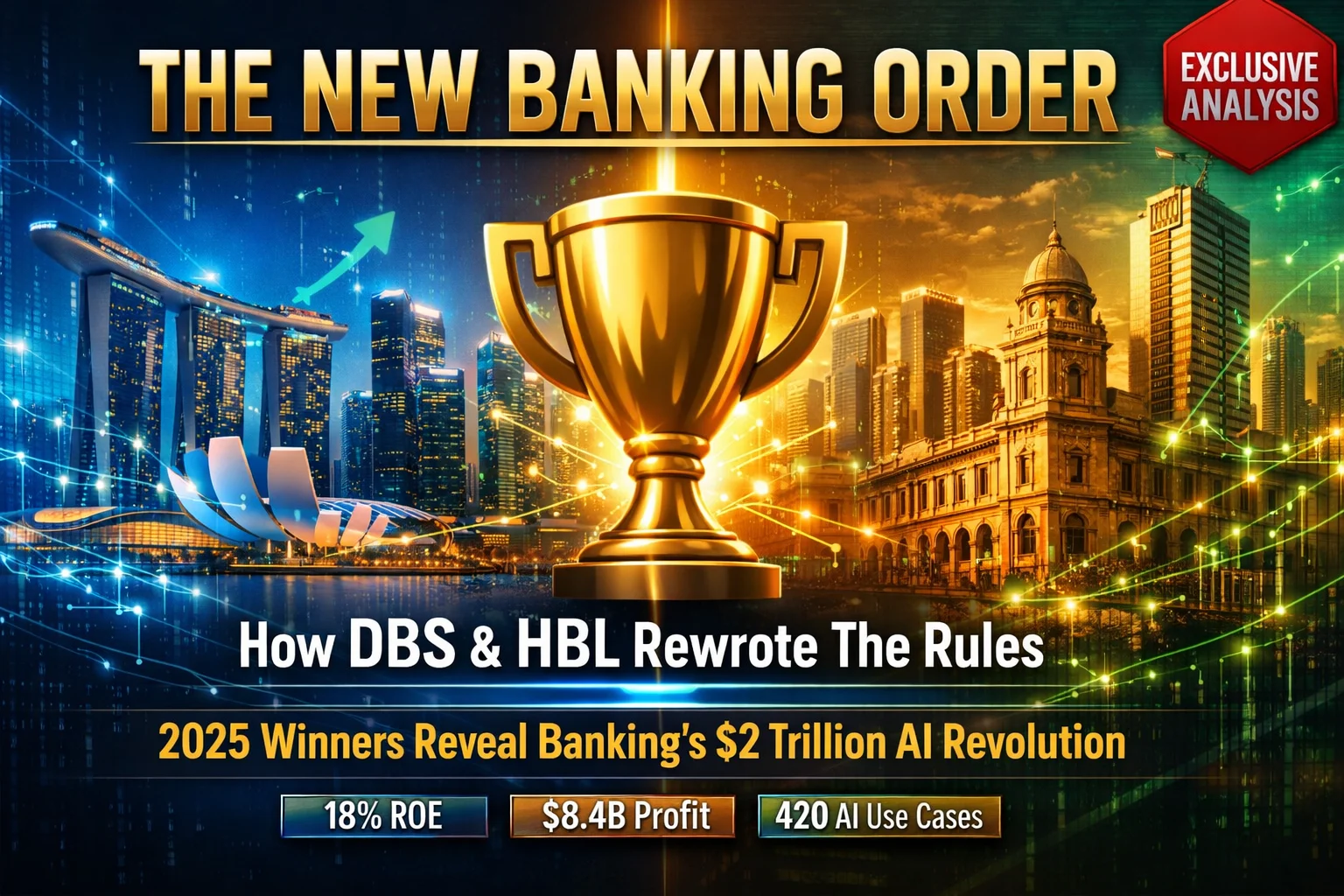
How DBS and HBL’s Historic Victories Reveal the New Architecture of 21st Century Finance
When DBS Bank claimed its third Global Bank of the Year title from The Banker in December 2025, defeating 294 competing institutions, the Singapore-based giant didn’t just win an award. It marked the moment when the tectonic plates beneath global finance shifted irreversibly eastward—and when traditional Western banking supremacy became historical footnote rather than contemporary reality.
But here’s what the champagne celebrations in Marina Bay and the perfunctory congratulations from New York missed: DBS’s achievement, along with its capture of Asia Bank of the Year, Singapore Bank of the Year, and Investment Bank of the Year titles, represents far more than institutional excellence. It signals the emergence of a new banking paradigm where artificial intelligence deployment, digital-first infrastructure, and emerging market agility trump legacy balance sheets and century-old brand prestige.
Meanwhile, 6,000 miles west in Karachi, another revolution quietly unfolded. HBL’s recognition as Pakistan’s best bank, achieving record profit before tax of Rs 120.3 billion ($431.9 million)—a 6.9% increase year-over-year—tells an equally compelling story about resilience, innovation under constraint, and the surprising dynamism of frontier market banking in 2025.
These dual narratives—one from Asia’s most sophisticated financial hub, another from a nation navigating economic stabilization—illuminate the defining question of our era: What does banking excellence actually mean when the rules of engagement have fundamentally changed?
The Digital Dividend: Why Traditional Banks Are Playing Catch-Up
Let’s confront an uncomfortable truth that establishment banking would prefer remained unspoken: DBS’s 18.0% return on equity in 2024, achieved alongside an SGD 11.4 billion ($8.4 billion) net profit, didn’t emerge from conventional banking wisdom. It resulted from a deliberate, decade-long dismantling of every assumption that defined 20th-century financial services.
Consider the numbers that should alarm every legacy institution. By 2030, generative AI will be fully integrated into every aspect of banking, with the technology contributing up to $2 trillion to the global economy through innovative strategies and improved efficiency. DBS has already deployed AI in approximately 420 use cases across its operations, from customer support via chatbots to private banking personalization platforms, generating economic value exceeding SGD 750 million in 2024—more than double the previous year.
This isn’t incremental improvement. This is categorical transformation.
The conventional banking playbook—physical branches as trust anchors, relationship managers as revenue drivers, legacy systems as necessary evils—has become actively counterproductive. Scale is emerging as the ultimate competitive advantage, with the largest institutions leveraging unmatched efficiencies, technological innovation, and global reach to outpace competitors. But here’s the twist: scale no longer correlates with geographic footprint or century-old establishment pedigree.
DBS operates in 19 markets. JPMorgan Chase, by comparison, has operations across more than 100 countries. Yet DBS has captured nine global ‘Best Bank’ awards from leading financial publications since 2018, a frequency that would have been inconceivable a generation ago for an Asian regional player.
The explanation? Digital architecture as competitive moat.
Seventy-five percent of banks with over $100 billion in assets are expected to fully integrate AI strategies by 2025, but integration depth matters exponentially more than adoption announcement. DBS didn’t bolt AI onto legacy infrastructure—it reconstructed banking from first principles with AI as foundational layer, not cosmetic upgrade.
Pakistan’s Paradox: Excellence Amid Economic Turbulence
If DBS represents banking’s aspirational future, Pakistan’s 2025 landscape reveals something equally instructive: how institutions achieve excellence despite—perhaps because of—economic constraint.
Pakistan’s economy expanded by 2.7% in fiscal year 2025, with inflation declining sharply to 4.7% during the first ten months—down from 26% in the previous year. This macroeconomic stabilization, achieved through disciplined fiscal consolidation and tight monetary policy under the IMF’s Extended Fund Facility, created the operating environment where banking excellence could emerge.
Yet the numbers tell a more complex story than simple recovery narrative. Pakistan’s banking sector aggregate profits soared beyond Rs 600 billion in 2025, with tax contributions exceeding Rs 650 billion. This isn’t accident or windfall—it’s strategic positioning within a transforming economy.
HBL achieved record profit before tax of Rs 120.3 billion ($431.9 million), earning per share surging to Rs 39.85 ($0.14), while contributing Rs 62.5 billion to the national treasury. These metrics demonstrate profitability, certainly, but more critically they reveal institutional capacity to navigate volatility that would cripple less adaptive organizations.
Meezan Bank, as Pakistan’s foremost Islamic bank, achieved unprecedented profit of Rs 101.5 billion, with pre-tax profits recorded at Rs 222 billion and substantial tax contribution of Rs 121 billion. This performance occurred within Pakistan’s constitutional mandate requiring shift to Riba-free banking system by 2028, positioning Sharia-compliant institutions for structural advantage as regulatory landscape transforms.
The Pakistan banking story illuminates a crucial insight: constraint breeds innovation when institutions choose adaptation over entrenchment. The banking sector contributed approximately 35% to the KSE-100 Index’s historic rally from 50,000 to 150,000 points since June 2023, demonstrating how financial sector dynamism can catalyze broader economic confidence.
The Technology Arms Race: Where Winners Pull Away
Here’s where the 2025 banking excellence narrative becomes genuinely consequential for industry trajectory: the technology gap between leaders and laggards isn’t narrowing—it’s accelerating toward irreversibility.
DBS surpassed its goal of contributing €300 billion to sustainable finance by 2025, a year ahead of schedule, but this achievement masks the more significant development. The French banking giant Societe Generale, which won Global Finance’s World’s Best Bank designation while generating €4.2 billion in group net income (up 69% from previous year) on €26.8 billion in revenue (up 6.7%), demonstrated that multiple institutions can achieve excellence through different pathways.
Yet technology deployment remains the differentiating factor separating good from exceptional.
AI will contribute $2 trillion to the global economy through banking innovation and efficiency improvements, but this value creation won’t distribute evenly. More than half of banks now have mature cloud programs, with respondents planning to double the share of applications on cloud in next three years from 30-40% today to up to 70%, creating divergence between cloud-native operations and legacy system constraints.
Consider the implications. Generative AI is reversing the impersonal nature of digital banking, creating emotionally engaging experiences that feel like personalized service of the past. Banks achieving this transformation—DBS prominent among them—create customer experiences that legacy institutions literally cannot replicate without wholesale infrastructure replacement.
The technology gap manifests in every dimension of operations. Generative AI will drive ‘waste out’ by automating manual processes like risk and compliance testing, reducing costs by up to 60% in the next two to three years. Institutions capturing this efficiency gain compound advantages across customer acquisition costs, operational margins, and innovation velocity.
Pakistan’s leading banks demonstrate that technology adoption isn’t geography-dependent. BankIslami, awarded Best Bank of the Year in mid-sized banks category, pioneered deploying biometric ATMs and introducing Pakistan’s first Islamic digital banking solution, proving that innovation can emerge from unexpected quarters when institutions prioritize transformation over tradition.
The Regulatory Reckoning: How Policy Shapes Excellence
Banking excellence in 2025 cannot be understood separately from regulatory environment—and here again, we see bifurcation between enabling frameworks and constraining structures.
Global banking industry operated within environment of significant complexity in past year, with economic headwinds, high interest rates, persistent inflation, and geopolitical tensions all shaping banking strategies worldwide. Yet regulatory response varied dramatically across jurisdictions, creating asymmetric competitive landscapes.
Pakistan’s Finance Act 2025 drew significant controversy due to stringent taxation measures and expanded enforcement powers granted to Federal Board of Revenue, with key provisions allowing arrest of individuals without prior notice. This regulatory intensity creates operational friction that banks must navigate while maintaining profitability—a constraint that simultaneously burdens institutions and forces operational excellence.
Meanwhile, Singapore’s regulatory approach fostered the environment enabling DBS’s leadership. DBS has been accorded ‘Safest Bank in Asia’ award by Global Finance for 17 consecutive years from 2009 to 2025, reflecting not just institutional risk management but regulatory framework supporting prudent growth over reckless expansion.
The divergence extends to emerging technology regulation. Regulatory evolution will bring more specific AI requirements focusing on algorithmic transparency, standardized risk frameworks, and enhanced consumer protection. Jurisdictions that balance innovation enablement with consumer protection create competitive advantage for domestic institutions—those that overregulate or underregulate both create vulnerabilities.
Pakistan’s 26th constitutional amendment mandating shift to Riba-free banking system by 2028 represents regulatory transformation with profound competitive implications. Islamic banks positioned for this transition—Meezan Bank, BankIslami, and others—gain structural advantages as regulatory tailwinds accelerate their growth trajectories.
The Profitability Puzzle: Why Returns Diverge
Understanding 2025’s banking excellence requires examining the profitability architecture separating exceptional from mediocre performers.
DBS achieved net profit of SGD 11.4 billion with return on equity of 18.0%, one of the highest among developed market banks globally. This ROE—sustained across multiple years—reflects not cyclical advantage but structural superiority in capital deployment.
Compare this against broader industry dynamics. Pakistan’s banking sector recorded highest-ever profit after tax at $1.15 billion in first half of 2025, a 19% year-on-year increase, demonstrating that profitability growth opportunities exist across development stages and market sophistication levels.
Yet profitability sources matter critically. Limited private sector lending remains concern in Pakistan, as banks continue to rely heavily on government securities for profits. This revenue model—lucrative in high-interest-rate environment—creates vulnerability as monetary policy normalizes and yields compress.
United Bank Limited witnessed 34% surge in profits reaching Rs 75.7 billion, with pre-tax profits escalating to Rs 150 billion and significant strides in expanding Islamic banking operations across KPK and Balochistan. This growth trajectory reflects diversification across business lines and geographic markets—the sustainable profitability model versus concentration risk.
DBS’s profitability architecture offers instructive contrast. Total income rose 10% to SGD 22.3 billion, with net interest income increasing 6% due to balance sheet growth deployed into low-risk securities amid tepid loan growth, while non-interest income was star performer as market clarity buoyed investor confidence and fueled wealth management activity. Diversified revenue streams—interest income, wealth management fees, treasury operations—create resilience that monoline institutions cannot replicate.
The profitability lesson from 2025’s excellence winners: sustainable returns emerge from diversified revenue streams, operational efficiency through technology, and prudent risk management—not from concentrated bets on single revenue sources or excessive risk-taking.
The Wealth Management Inflection: Where Value Migrates
Perhaps no trend better explains 2025’s banking excellence pattern than wealth management emergence as primary value driver.
BBVA claims title of World’s Best Corporate Bank for third consecutive year, expanding market share and deal leadership during 2024, leading 86 deals across telecommunications, energy, infrastructure, consumer goods and services for total volume of €5.16 billion. Yet even corporate banking excellence increasingly depends on ancillary wealth management capabilities for high-net-worth executives and family offices.
The numbers reveal the magnitude of this shift. DBS serves over 18.4 million Consumer Banking/Wealth Management customers, but customer count tells incomplete story—revenue per customer in wealth management segments dwarfs traditional retail banking metrics.
DBS expects commercial book non-interest income to grow in high-single digits led by wealth management fees and treasury customer sales, positioning wealth management as primary growth engine even as interest income stabilizes. This strategic reorientation—from balance sheet size toward fee-based services—represents fundamental reconception of banking value proposition.
Pakistan’s market demonstrates similar dynamics at different sophistication level. Banking sector accounts for $15.12 billion of PSX’s $64.76 billion total market capitalization—representing about 23% of overall market, yet wealth management penetration remains nascent compared to developed markets, representing enormous growth runway for institutions positioned to capture affluent segment.
The wealth management inflection creates winner-take-most dynamics. Institutions with digital platforms enabling seamless omnichannel experiences, AI-powered personalization, and comprehensive product suites capture disproportionate market share. Those lacking these capabilities face commoditization pressure and margin compression in traditional banking services.
The Geopolitical Dimension: How Power Shifts Reshape Finance
Banking excellence in 2025 cannot be divorced from broader geopolitical realignment—and here the story becomes genuinely fascinating.
Geopolitical disruptions are reshaping trade, technology, and finance, with three factors—security, emerging resource and industrial battlegrounds, and ‘transactionalism’—testing globalization’s staying power. These forces create asymmetric opportunities and vulnerabilities across banking systems.
DBS’s position in Singapore—financial Switzerland of Asia with relationships spanning both Western and Eastern spheres—provides geopolitical optionality that institutions headquartered in explicitly aligned jurisdictions cannot replicate. This strategic ambiguity, combined with operational excellence, creates competitive advantage as global trade patterns fragment and regionalize.
Pakistan’s banking sector faces different geopolitical calculus. IMF’s 2025 Governance and Corruption Diagnostic Assessment estimates Pakistan’s economy loses 5-6.5 percent of GDP to corruption due to entrenched ‘elite capture,’ where influential groups shape public policy for their own benefit. This structural challenge constrains banking sector development even as individual institutions achieve excellence within imperfect ecosystem.
Yet geopolitical realignment creates opportunities alongside challenges. Pakistan’s exports have declined from 16 percent of GDP in 1990s to around 10 percent in 2024, leaving growth dependent on debt and remittance-driven consumption which underlies Pakistan’s recurrent boom-bust cycles. Banking institutions facilitating export sector transformation position themselves for structural tailwinds if policy reforms materialize.
The geopolitical lesson: banking excellence requires navigation of political economy realities that extend far beyond institution-level decisions. Winners in 2025 demonstrated not just operational superiority but strategic positioning within geopolitical landscapes enabling—rather than constraining—their growth trajectories.
The Sustainability Imperative: Beyond Greenwashing to Strategic Advantage
Banking excellence in 2025 increasingly correlates with sustainability leadership—not as reputational exercise but as strategic positioning for regulatory and market shifts.
Societe Generale surpassed its goal of contributing €300 billion to sustainable finance by 2025, a year ahead of schedule, demonstrating that sustainability commitments, when genuine, create business development opportunities rather than merely compliance costs.
DBS committed SGD 89 billion in sustainable financing net of repayments, representing substantial capital deployment toward transition finance, renewable energy, and climate-resilient infrastructure. This isn’t altruism—it’s recognition that sustainable finance represents among fastest-growing banking segments with improving risk-adjusted returns.
The sustainability shift creates competitive separation. BBVA led €383 million project financing of Repsol Renovables’ Gallo portfolio, a 777-megawatt solar and battery storage facility spanning Texas and New Mexico, while directing €51.1 billion into sustainable financing throughout year. Institutions building capabilities in sustainability assessment, transition finance structuring, and climate risk management capture market share in high-growth segments.
Pakistan’s context reveals sustainability’s differentiated impact across development stages. Pakistan’s recent floods imposed significant human costs and economic losses, dampening growth prospects and adding pressure on macroeconomic stability. Banking institutions offering climate-resilient lending products and disaster recovery financing demonstrate sustainability’s immediate, practical relevance beyond long-term carbon neutrality commitments.
The sustainability imperative separates 2025’s winners from institutions merely mimicking ESG rhetoric without operational transformation.
What 2026 Holds: The Acceleration Ahead
As 2025 closes, the trajectory for banking excellence becomes simultaneously clearer and more volatile. Several forces will shape which institutions sustain leadership and which fall behind.
First, AI deployment will separate winners from losers with increasing finality. Only 8% of banks were developing generative AI systematically in 2024, with 78% having tactical approach, but as banks move from pilots to execution, more are redefining strategic approach to service expansion including agentic AI. The institutions moving from experimentation to industrialization will compound advantages impossible for laggards to overcome without wholesale transformation.
Second, regulatory divergence will accelerate. Regulatory evolution will bring more specific AI requirements focusing on algorithmic transparency, standardized risk frameworks, and enhanced consumer protection, creating asymmetric compliance burdens that favor institutions with mature governance frameworks and technology infrastructure.
Third, macroeconomic volatility will test institutional resilience. Pakistan’s growth is projected to remain at 3.0 percent in FY26 due to flood impacts on agriculture sector before picking up in medium term as stability and reforms enhance growth prospects. Economic shocks separate well-capitalized, diversified institutions from fragile competitors dependent on benign conditions.
DBS expects net interest income to be slightly higher than 2024 levels as impact of lower interest rates is more than offset by loan growth, with commercial book non-interest income growing in high-single digits and pretax profits around record 2024 levels. This guidance reflects confidence born from operational excellence rather than optimistic assumptions about external conditions.
The banking excellence template for 2026 and beyond: technology-enabled operations, diversified revenue streams, prudent risk management, sustainability leadership, and strategic positioning within favorable regulatory and geopolitical landscapes. Institutions possessing these attributes will thrive. Those lacking them will struggle regardless of legacy brand strength or balance sheet size.
The Uncomfortable Truth
Let’s return to where we began: DBS’s third Global Bank of the Year award and HBL’s Pakistan leadership aren’t just institutional success stories. They’re harbingers of comprehensive restructuring of global financial architecture.
The uncomfortable truth that establishment banking must confront: traditional competitive advantages—century-old brands, physical branch networks, legacy relationship management approaches—have transformed from assets into liabilities. The future belongs to institutions that rebuilt themselves from first principles with technology as foundation rather than ornament.
DBS’s exceptional performance stood out among 294 participating banks, underscoring its sustained leadership and profound impact in global financial industry. This wasn’t victory through marginal superiority but categorical difference in institutional DNA.
For Pakistan’s banking sector, the excellence achieved in 2025 demonstrates that frontier markets can produce world-class institutions when leaders prioritize transformation over incrementalism. HBL remains undisputed leader as Pakistan’s best bank, demonstrating standout financial growth and continuous improvement in digital space—proving that excellence transcends market sophistication when institutions embrace change.
The question confronting every banking CEO as 2025 closes isn’t whether to transform—it’s whether they possess courage to dismantle organizational structures and cultural assumptions that delivered past success but guarantee future irrelevance.
DBS and HBL didn’t win Bank of the Year 2025 awards by being incrementally better. They won by being fundamentally different. That’s the lesson that separates next decade’s survivors from its casualties.
The remaking of global banking isn’t coming. It has arrived. The only question remaining: which institutions recognize this reality quickly enough to adapt, and which will insist on defending obsolete models until market forces render the decision moot?
Excellence in banking—real excellence, not the cosmetic variety celebrated in aspirational mission statements—requires confronting these uncomfortable realities. The 2025 winners demonstrated this courage. The 2026 winners will be those who learn from their example.
Abdul Rahman is Senior Political Economy Columnist covering global financial systems, emerging market dynamics, and regulatory policy. His analysis has appeared in leading English Newspapers and Magazines .
Data Sources: The Banker (Financial Times), Global Finance Magazine, Euromoney, World Bank, International Monetary Fund, Asian Development Bank, State Bank of Pakistan, DBS Annual Reports, Accenture Banking Research, McKinsey Global Banking Studies, IBM Institute for Business Value, CFA Society Pakistan.
Discover more from The Economy
Subscribe to get the latest posts sent to your email.


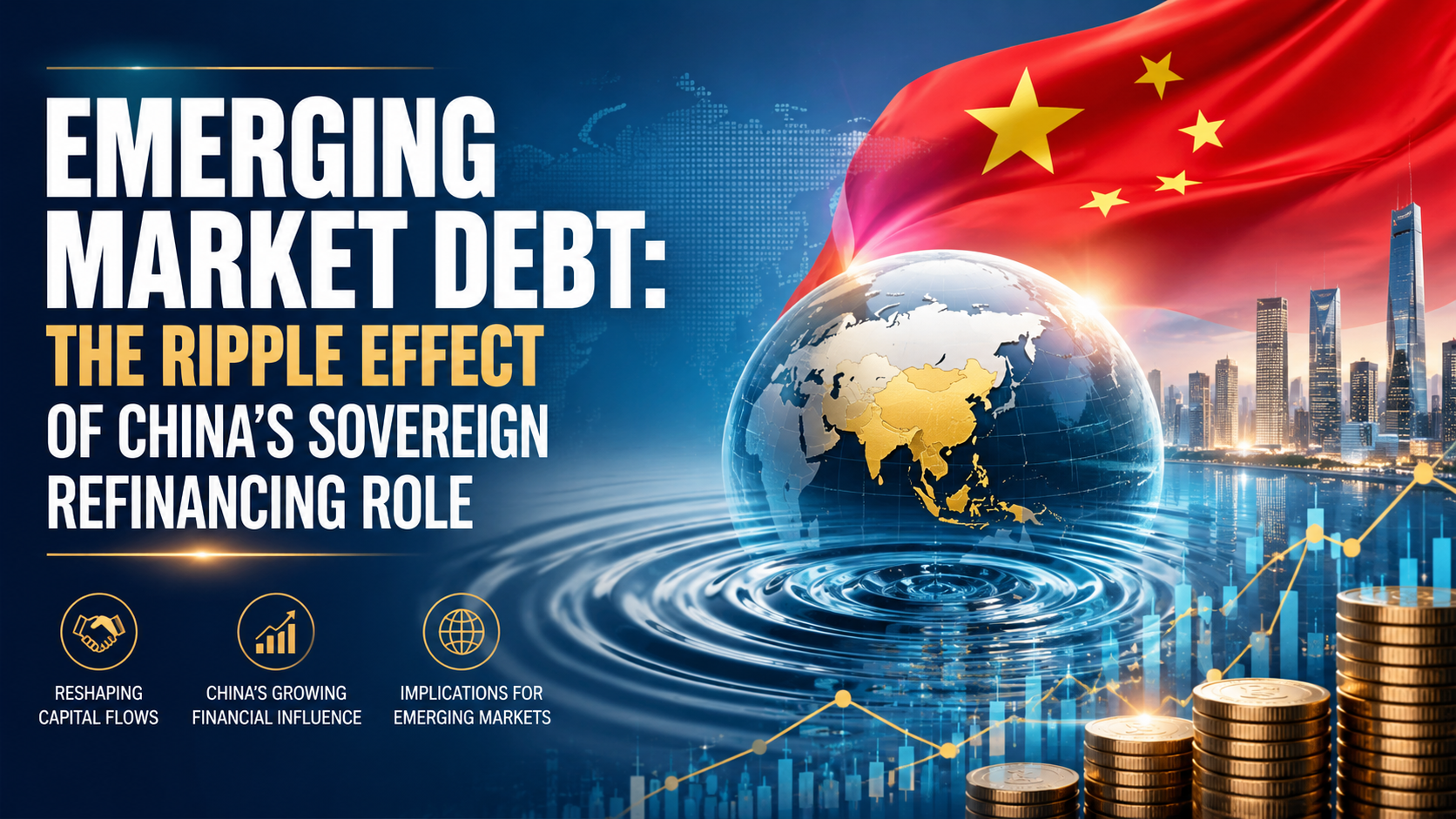
Emerging and developing economies face refinancing needs of more than $9 trillion in 2026, according to the Institute of International Finance’s Global Debt Monitor — the largest wall of maturing sovereign and corporate debt these markets have ever faced simultaneously. At the center of that system sits China, now the single largest issuer of emerging-market sovereign debt and, increasingly, the largest bilateral lender of last resort when smaller economies can’t refinance on their own. For institutional investors and foreign-policy-adjacent business strategists, understanding China’s dual role — dominant issuer and dominant creditor — is now a prerequisite for pricing emerging-market risk correctly.
Editorial note on sourcing: a specific figure describing a discrete “$1.3 billion” China sovereign refinancing transaction could not be independently verified against primary reporting at the time of writing. This article instead builds its analysis on verified, dated figures from the OECD, IIF, Moody’s, and peer-reviewed research, and any deal-level claim should be confirmed against primary sources (finance ministry statements, rating-agency releases) before publication or citation.
China’s Dual Role: Issuer and Creditor of Last Resort
China accounted for 45% of total EMDE sovereign bond issuance in 2024, up sharply from just 17% in the 2007–2014 period, according to the OECD’s Global Debt Report 2025. By 2025, China remained the top borrower among a concentrated group — China, India, Brazil, Egypt, and Argentina together represented 78% of EMDE central-government borrowing, per the OECD’s Global Debt Report 2026.
Domestically, Beijing has simultaneously executed one of the largest local-government debt refinancing programs in history: a 6 trillion yuan (roughly $839 billion) swap of “hidden” local-government debt into standardized bonds, approved in late 2024 and implemented through 2026, according to VOA News. By mid-2026, Chinese provinces had used nearly 94% of that swap allowance, according to Bloomberg.
Internationally, China has also re-entered dollar sovereign bond markets at scale — its 2026 international offering was reported as its largest ever, oversubscribed well beyond target, according to Business Standard/Reuters reporting on the prior comparable issuance. This dual positioning — massive domestic refinancing plus expanding international issuance — gives China outsized influence over EM bond-market liquidity and pricing benchmarks that smaller sovereigns then reference for their own issuance.
The $9 Trillion Wall: Why 2026 Is Different
The scale of what’s coming due matters more than any single deal. Key figures from the IIF’s Global Debt Monitor and OECD’s 2026 report:
- Gross EMDE central-government borrowing crossed $4 trillion in 2025, up from roughly $3 trillion in 2024.
- Around 36% of outstanding EMDE bond stock matures within three years.
- Low-income countries face the sharpest cliff: 52% of their outstanding bonds mature by 2028, with 29% due by the end of 2026 alone.
- Secondary-market yields on maturing debt now exceed 10% for non-investment-grade sovereigns, meaning refinancing at current rates locks in materially higher debt-service costs than the original issuance.
Refinancing Cost Comparison: Then vs. Now
| Issuer Tier | Original Issuance Yield (illustrative range) | 2026 Refinancing Yield | Refinancing Risk |
|---|---|---|---|
| Investment-grade EMDEs (e.g., select Gulf, Southeast Asia sovereigns) | 3–5% | 5–7% | Moderate — absorbable within fiscal space |
| Non-investment-grade EMDEs | 6–8% | 10%+ | High — debt-service costs rising faster than revenue growth |
| Low-income issuers (heavy China bilateral exposure) | Concessional/below-market | Market-rate or restructured terms | Severe — 29% of debt stock matures by end of 2026 |
Source: OECD Global Debt Report 2025/2026 (see citations above); ranges are illustrative of documented tier-level trends, not specific bond issues.
The Restructuring Precedent: What Happens When Refinancing Fails
China’s response to sovereign distress has evolved into a distinct pattern that investors increasingly price into risk premiums. Research published via the National Bureau of Economic Research documents a rising trend of “re-structurings” — repeated restructurings of the same debt with the same creditor — echoing the drawn-out resolution patterns of prior global debt crises. Angola, Ecuador, Seychelles, Sri Lanka, and Venezuela have each undergone two or more restructurings with Chinese state creditors.
Sri Lanka’s case is illustrative of the mechanics: China Development Bank extended a $500 million financing facility in 2020, and a subsequent equity-linked arrangement brought in $1.12 billion in cash that Colombo used to repay non-Chinese creditors, according to Oxford Academic’s International Affairs journal. These bilateral bridge arrangements illustrate how China’s rescue lending functions as a parallel track to traditional Paris Club-style restructuring — often faster to arrange, but less transparent to third-party bondholders pricing the same sovereign’s risk.
Regional Ripple Effects: Where Investors Should Watch Closely
Direct Exposure Zones
- Sub-Saharan Africa: Heaviest concentration of low-income issuers facing near-term maturity walls and prior China restructuring history (Angola, Zambia).
- South Asia: Sri Lanka’s precedent shapes how markets price Pakistan and Bangladesh refinancing risk.
- Latin America: Ecuador and Venezuela carry documented repeat-restructuring histories; Argentina remains among the top-five EMDE borrowers by volume.
Indirect / Second-Order Exposure
- Gulf and Southeast Asian investment-grade sovereigns face rising benchmark yields even without direct restructuring risk, simply because China’s issuance volume moves the EM bond-pricing benchmark broadly.
- Enterprise B2B lenders and trade-finance providers operating in these corridors should treat sovereign-refinancing stress as a leading indicator of counterparty and currency risk, not a lagging one.
An Investor Risk-Monitoring Framework
- Track maturity-wall concentration, not headline debt-to-GDP. A country with moderate debt-to-GDP but a heavy 2026–2028 maturity cliff carries more near-term risk than a higher-leverage country with a smoothed maturity profile.
- Distinguish China’s domestic refinancing (yuan-denominated, largely contained) from its role as an external EM creditor (dollar/foreign-currency exposure, higher spillover risk).
- Watch for repeat-restructuring signals. Countries with a prior China restructuring are statistically more likely to require another, per the NBER research above — treat this as a standing risk flag, not a one-time resolved event.
- Monitor secondary-market yield spreads on maturing debt versus issuance-year yields as the clearest real-time signal of refinancing stress building in a specific sovereign.
The Bottom Line
China’s simultaneous role as the largest domestic debt-refinancer in EM history and the most influential external creditor to distressed sovereigns makes it the single most important variable in the 2026 emerging-market debt outlook. The $9 trillion refinancing wall isn’t a uniform risk — it’s concentrated in low-income issuers with the heaviest prior China bilateral exposure, and that concentration is exactly where enterprise investors, trade-finance providers, and sovereign-risk analysts should be focusing due diligence through the remainder of 2026.
Discover more from The Economy
Subscribe to get the latest posts sent to your email.

Key Takeaways
- NIST finalised its first three post-quantum cryptography standards in August 2024, ending an eight-year global evaluation process; a fifth backup algorithm, HQC, was selected in March 2025.
- The post-quantum cryptography market is projected to exceed $15 billion by 2030, and industry voices including the Boston Consulting Group warn that “starting in 2030 will already be too late.”
- The “harvest now, decrypt later” threat is active today: adversaries are already capturing encrypted financial data at scale, banking on future quantum decryption capability — meaning banks’ current encryption choices carry decades-long risk exposure.
- Three regulatory deadlines converge in late 2026/early 2027: NIST’s FIPS 140-2 to Historical transition (September 21, 2026), the EU’s national PQC strategy milestone (December 31, 2026), and NSA CNSA 2.0 acquisition requirements.
- JPMorgan Chase is directly engaged in NIST’s Migration to Post-Quantum Cryptography project, signalling that large financial institutions are treating this as a present-tense operational priority, not a future contingency.
Why Banking Is Ground Zero for the Quantum Transition
Every major cybersecurity upgrade cycle has a sector that moves first because it has the most to lose. For post-quantum cryptography, that sector is banking. Every RSA key, every ECC certificate, every TLS handshake, every VPN tunnel, every digitally signed document, every encrypted database was built on mathematics that quantum computers will break — not might break, will break.
Industry analysts project the post-quantum cryptography market will exceed $15 billion by 2030 as governments and enterprises execute mandated migration timelines, with the “harvest now, decrypt later” threat already active: adversaries are capturing encrypted data at scale today, banking on future quantum decryption capability. For a bank, that threat model is uniquely severe — financial records, account credentials, and transaction histories captured today remain sensitive for decades, well past any reasonable estimate of when a cryptographically relevant quantum computer will exist.
The Standards Are No Longer Theoretical
NIST finalized the first three post-quantum cryptography standards in August 2024, ending an eight-year global evaluation process. A fifth algorithm, HQC, was selected as a backup in March 2025, and NIST is not finished: FIPS 206 (FN-DSA), designed specifically for bandwidth-constrained applications, is expected to be finalised sometime between 2026 and 2027. The message from standards bodies has shifted decisively from research to implementation. Since NIST standardised its first post-quantum cryptographic algorithms in 2024, governments and cybersecurity agencies worldwide have shifted focus from research to implementation, with organisations now expected to assess their cryptographic exposure, define migration strategies, and begin preparing critical systems for a quantum-resistant future.
The Regulatory Deadline Convergence
What makes 2026 the genuine inflection year — rather than another year of PQC discourse without action — is the simultaneous arrival of several binding deadlines. Three independent dates converge in late 2026 and early 2027: NIST’s FIPS 140-2 to Historical transition on September 21, 2026, the EU NIS Cooperation Group’s national strategy milestone on December 31, 2026, and the NSA CNSA 2.0 acquisition requirement timeline.
US federal policy has also hardened. Urgency increased in 2026 when the United States issued an Executive Order accelerating the transition to post-quantum cryptography for high-value assets and calling for faster validation of PQC modules, with similar guidance from NIST, Germany’s BSI, and the UK’s National Cyber Security Centre reinforcing the same message across regions. EO-14412 mandates an accelerated, government-wide migration to PQC for federal systems, establishing binding deadlines for high-value assets and directing the Federal Acquisition Regulatory Council to require contractor compliance with NIST PQC standards — a provision with direct implications for any bank holding federal contracts or processing government-linked payment flows.
The EU framework, published by the NIS Cooperation Group in June 2025, calls for member states to publish national PQC strategies and initiate cryptographic inventories by the end of 2026. Banks operating across US and EU jurisdictions now face two parallel, binding compliance clocks rather than one.
Banks Are Already at the Table
This is not a theoretical exercise for the financial sector — major institutions are directly embedded in the standards-development process. JPMorgan Chase Bank, N.A. is listed among the participating organisations in NIST’s Migration to Post-Quantum Cryptography project at the National Cybersecurity Center of Excellence, alongside firms including Samsung SDS and Thales. That level of direct engagement from a systemically important bank is a strong signal of how seriously the sector is treating implementation timelines.
Comparative Table: Classical vs. Post-Quantum Cryptography Migration for Banks
| Dimension | Classical Cryptography (RSA/ECC) | Post-Quantum Cryptography (NIST-standardised) |
|---|---|---|
| Mathematical basis | Factoring/discrete logarithm problems | Lattice-based, hash-based problems (ML-KEM, ML-DSA, SLH-DSA) |
| Quantum vulnerability | Breakable via Shor’s algorithm once quantum computers mature | Designed to resist both classical and quantum attacks |
| Key/signature size | Smaller | Generally larger, raising bandwidth/storage overhead |
| Deprecation timeline | Deprecated by 2030, disallowed by 2035 (per 2024 NIST guidance) | Becoming the mandated standard across the same window |
| Migration complexity | N/A (legacy baseline) | Multi-year program touching PKI, identity, network, application layers |
Why It Matters: The “Harvest Now, Decrypt Later” Math
The investment case for treating PQC as urgent rather than deferrable rests on a simple risk-timing framework. Mosca’s theorem compares three time horizons: the time required to migrate systems to post-quantum cryptography (X), the time during which data must remain secure (Y), and the estimated arrival of cryptographically relevant quantum computers (Z). If X + Y > Z, the migration is urgent — and for many organisations, Y extends well into the 2030s and beyond, since financial data may need protection for decades.
For a bank, Y is not a hypothetical variable — mortgage records, long-dated financial contracts, and account-holder personal data routinely carry multi-decade sensitivity windows. That makes the migration timeline math for financial institutions among the least forgiving of any sector.
Practical Migration Challenges Banks Must Budget For
PQC migration brings real practical challenges: many candidate algorithms require larger key sizes, increasing the data that must be stored and transmitted, along with greater computational overhead that can slow processing speed — and these algorithms may not integrate cleanly into older, legacy-heavy systems, which describes much of core banking infrastructure. A system built today with hardcoded RSA-2048 will require a full code rewrite for migration, while a system built with algorithm-agile design — where algorithm and key configuration sit outside core business logic — can migrate by updating configuration alone. That architectural distinction is now a genuine due-diligence question for any bank’s technology stack.
What to Do Next
- Complete a full cryptographic asset inventory now — banks cannot migrate what they haven’t mapped, and inventory work is consistently cited as the essential first step across every institutional PQC playbook.
- Prioritise algorithm-agile architecture in new systems to avoid costly full rewrites during the next migration phase.
- Track the three converging 2026-27 deadlines (NIST FIPS 140-2 transition, EU national strategy milestone, NSA CNSA 2.0 acquisition requirements) as hard planning anchors, not soft guidance.
- Treat long-dated data — mortgages, trusts, multi-decade financial contracts — as the highest-priority migration category, given the “harvest now, decrypt later” exposure window.
- Monitor vendor and cybersecurity-equity exposure to the PQC market as it scales toward its projected $15 billion 2030 valuation, including hardware security module (HSM) and cryptographic-inventory tooling providers.
FAQ
Is post-quantum cryptography migration actually urgent, or is this a future-proofing exercise banks can defer?
It is genuinely time-sensitive. The “harvest now, decrypt later” threat is active today — adversaries are already capturing encrypted data at scale, betting on future quantum decryption capability, meaning data encrypted with classical methods now is already at risk for future exposure regardless of when quantum computers actually arrive.
What are the key NIST post-quantum standards banks need to implement?
NIST expects that two digital signature standards (ML-DSA and SLH-DSA) and one key-encapsulation mechanism standard (ML-KEM) will provide the foundation for most post-quantum cryptography deployments, with a backup algorithm (HQC) and a bandwidth-optimised standard (FN-DSA) rounding out the framework.
What is the deadline for banks to complete post-quantum migration?
NIST’s 2024 guidance states that classical public-key cryptography (RSA and Elliptic Curve Cryptography) should be deprecated by 2030 and disallowed by 2035, though several institutions, including Cloudflare, have set earlier internal targets, and regulatory deadlines are converging specifically around late 2026 and early 2027.
Discover more from The Economy
Subscribe to get the latest posts sent to your email.

Treasury Secretary Scott Bessent has doubled the size of Treasury debt buybacks — to at least $4 billion per operation starting September 9, 2026 — in an effort to push down long-term yields that hit a roughly 19-year high, with 30-year mortgage rates tracking near 6.75% as a result.
What Bessent Just Did
On August 19, 2026, the U.S. Treasury Department announced it would “at least double” the size of its buybacks of 10- to 30-year government debt, starting September 9, in an effort to relieve pressure on longer-dated yields, according to Treasury’s own announcement as reported by CNBC. The prior ceiling was $2 billion per operation; Bessent has said the new figure could run above $4 billion per issue, depending on market conditions.
Why Now: A Bond Market Under Real Stress
The move followed a punishing stretch for long-dated Treasurys. National debt crossed $40 trillion for the first time this month, and the 30-year yield touched its highest level in roughly 19 years — a period predating the 2008 financial crisis. Since the outbreak of the Iran war earlier in 2026, the 10-year yield has climbed nearly 70 basis points, pushing 30-year mortgage rates to around 6.75%, according to market analysts.
Bessent, appearing on CNBC, was candid about the intent: the intervention is partly about signaling that the administration believes current yields don’t reflect underlying fundamentals, and that the Treasury has a “big toolkit” to deploy if needed.
Did It Work? A Mixed and Fading Result
The initial announcement briefly worked. The 10-year note fell to 4.647% and the 30-year fell to 5.196% the day of the announcement, based on CNBC’s market coverage. But the relief didn’t hold — by the next session, yields had erased those declines and moved higher than before Treasury’s intervention, with the 30-year touching as high as 5.27%. Some fixed-income strategists were blunt about the limits of the tool: one Evercore ISI strategist dismissed the plan as a weak version of the Fed’s old “Operation Twist,” warning it risks backfiring if markets read it as panic rather than confidence.
There’s also a funding mechanics wrinkle worth understanding: Treasury doesn’t print money the way the Fed can. To fund the buybacks, it likely has to issue more short-term bills — effectively swapping long-dated debt for short-dated debt, which reshapes the yield curve rather than reducing total debt outstanding, per reporting on the funding mechanism.
Key Yield Levels to Track
| Instrument | Level (week of Aug. 17–21, 2026) | Relevance |
|---|---|---|
| 30-year Treasury | ~5.20%–5.27% | Long-end mortgage pricing benchmark |
| 10-year Treasury | ~4.65%–4.70% | Primary mortgage-rate benchmark |
| 2-year Treasury | ~4.18% | Tracks Fed policy expectations |
| 30-year fixed mortgage | ~6.75% | Direct consumer borrowing cost |
| National debt | $40 trillion+ | Structural backdrop for yield pressure |
What This Means If You’re Shopping a Mortgage or Refinance
The 10-year Treasury yield is the benchmark lenders price fixed mortgages off of, so Bessent’s intervention matters directly to anyone house-hunting or considering a refinance. The takeaway isn’t that rates are about to collapse — analysts broadly agree buybacks can smooth volatility but don’t resolve the deficit and inflation pressures driving yields higher. If you’re already carrying a mortgage originated when 30-year rates were meaningfully higher, it’s worth periodically re-running the math on refinancing, factoring in closing costs against the monthly savings at today’s roughly 6.75% benchmark. If you’re borrowing for the first time, locking a rate during a Treasury-driven dip (like the brief one on August 19) versus waiting is a real trade-off worth discussing with a mortgage broker who can show live rate locks rather than yesterday’s headline number.
Strategic Outlook
- Don’t expect a durable rate collapse from buybacks alone — the relief has already partly reversed within 24 hours in past instances.
- Watch the 10-year, not the Fed funds rate, for mortgage-pricing signals.
- If refinancing, compare quotes across multiple lenders now rather than waiting for a “perfect” rate environment that may not arrive.
- Bond investors should note that Treasury’s buyback-funded-by-bill-issuance approach could keep short-term rates elevated even as it dampens long-end volatility.
This is not financial advice. Treasury market dynamics are complex and rapidly shifting; consult a licensed financial advisor or mortgage professional before making borrowing or investment decisions.
Discover more from The Economy
Subscribe to get the latest posts sent to your email.

The Medicaid Churn: Front-End Revenue Cycle Risks for Enterprise Hospitals

The 2026 Crypto Regulatory Shift: What It Means for Institutional Investors

AI-Powered Training: The Next Multi-Billion Dollar Ecosystem in Fitness

BRICS Summit 2026: Economic Implications of the India-China Diplomatic Thaw

Emerging Market Debt: The Ripple Effect of China’s Sovereign Refinancing Role

Dropping Oil & Surging Gold: Navigating Safe-Haven Investments in Q3

2026 AI Stock Frenzy: How to Position Your Portfolio

The AI Disruption in Financial Risk Management: Moving Beyond Record Banking Profits

The Rise of Green Aviation: Balancing High Fuel Prices with Sustainable Infrastructure

US-China Relations in Q3 2026: Trade Tariffs and Supply Chain Risks

Emerging Markets Rebound: Top Stock Strategies for the Gulf and South Asia

Tackling the 2026 Global Food Crisis: Policy Shifts and Market Speculation

Post-Quantum Encryption in Banking: The Next Frontier in Cybersecurity Investments

The Financial Cost of Sanctions: Afghanistan’s Economy 5 Years Under the Taliban

China Politburo July 2026: Stimulus Signals Explained

Russia Fuel Shortages 2026: Inside a Cracking War Economy

Top 15 Financial Stocks for Investment in PSX

State Farm’s $5B Dividend 2026: Who Qualifies & Payout Dates

Pakistan Passed Its Third IMF Review

SpaceX Stock Lockup Expiration Explained: Why $123B in Shares Could Hit the Market

Pakistan IMF Program 2026: Inside the Push Toward an Interest-Free Economy

Andy Burnham, UK Gilts and Mortgages: July 2026 Explainer

Russia Oil Revenue 2026: How Sanctions on Rosneft and Lukoil Are Draining the War Chest

Pakistan’s 2026 Monsoon Floods Threaten Fragile Economic Recovery as Inflation Nears 9%

Russia Oil Revenue 2026: The Iran War Windfall and What a Hormuz Deal Means for Moscow

Gold Price 2026: Why Bullion Has Fallen 25% From Its January Record High

Canada US Trade War 2026: Inside Carney’s Push to Cut Ties With Trump’s Tariffs

Russia’s Budget Deficit Blew Past Its Full-Year Target in Three Months
-

 Markets & Finance8 months ago
Top 15 Stocks for Investment in 2026 in PSX: Your Complete Guide to Pakistan’s Best Investment Opportunities
-

 Analysis6 months ago
Johor’s Investment Boom: The Hidden Costs Behind Malaysia’s Most Ambitious Economic Surge
-

 Analysis6 months ago
Top 10 Stocks for Investment in PSX for Quick Returns in 2026
-

 Analysis7 months ago
Brazil’s Rare Earth Race: US, EU, and China Compete for Critical Minerals as Tensions Rise
-

 Banks7 months ago
Best Investments in Pakistan 2026: Top 10 Low-Price Shares and Long-Term Picks for the PSX
-

 Investment8 months ago
Top 10 Mutual Fund Managers in Pakistan for Investment in 2026: A Comprehensive Guide for Optimal Returns
-

 Global Economy8 months ago
15 Most Lucrative Sectors for Investment in Pakistan: A 2025 Data-Driven Analysis
-

 Global Economy8 months ago
Pakistan’s Export Goldmine: 10 Game-Changing Markets Where Pakistani Businesses Are Winning Big in 2025