
South Asia
10 Ways 5G Spectrum Will Revolutionize Pakistan’s Gig Economy: A Comprehensive Analysis


Discover how 5G spectrum will transform Pakistan’s $1B+ gig economy. Expert analysis on connectivity, remote work opportunities, and the future of freelancing with authoritative research citations.
Three years ago, Fatima, a 28-year-old graphic designer in Karachi, nearly lost a major international client. During a crucial project presentation via video call, her 4G connection froze repeatedly, transforming what should have been a seamless 30-minute meeting into a frustrating two-hour ordeal punctuated by frozen screens and pixelated images. Her client, based in Toronto, expressed concern about reliability—a death sentence in the competitive world of freelancing. Today, Fatima’s story represents the daily reality for millions of Pakistani freelancers navigating the challenges of unreliable connectivity in a profession that demands instantaneous, high-quality communication.
Pakistan has emerged as a formidable player in the global gig economy, currently ranked among the world’s top five freelancing markets, with more than 2.3 million active freelancers contributing to digital exports and employment. According to research published in the Forum for Applied Research and Analysis, Pakistan’s freelancers generated approximately $396 million in export revenue in FY2021-22, accounting for nearly 15% of the country’s ICT service exports. As Pakistan prepares for its 5G rollout scheduled for 2025-2026, this technological leap promises to fundamentally transform how the nation’s freelance workforce operates, competes, and thrives in the international marketplace.
The introduction of 5G spectrum represents far more than incremental improvement—it signals a paradigm shift that could position Pakistan as a premier destination for high-value digital services. According to GSMA Intelligence’s Mobile Economy 2025 report, mobile technologies and services now generate around 5.8% of global GDP, a contribution that amounts to $6.5 trillion of economic value added, projected to rise to almost $11 trillion by 2030—representing 8.4% of GDP. For Pakistan’s burgeoning freelance sector, currently poised to exceed the $1 billion annual revenue milestone, 5G connectivity could be the catalyst that propels the industry into its next exponential growth phase.

1. Ultra-Low Latency for Real-Time Creative Collaboration
Picture this: A Lahore-based video editor collaborating in real-time with a content team in San Francisco, making frame-by-frame adjustments to a promotional video while receiving instant feedback from stakeholders across three continents. Under 4G networks, such workflows remain frustratingly impractical due to latency issues that introduce delays ranging from 30 to 50 milliseconds. With 5G technology, however, latency can be reduced to as low as 1 millisecond, a drastic improvement that enables seamless real-time communication, immersive virtual meetings, and effective cloud computing.
For Pakistan’s creative freelancers—spanning graphic designers, animators, video editors, and digital artists—this technological transformation eliminates one of the most significant barriers to competing with counterparts in developed markets. Real-time collaboration tools that were previously viable only for freelancers in fiber-optic-rich environments become accessible to Pakistani professionals working from home offices or co-working spaces throughout the country.
The economic implications are substantial. According to GSMA Intelligence’s research, nearly 85% of enterprises rate 5G as critical to their digital transformation strategies, with advanced connectivity to contribute $11 trillion to global GDP by 2030. For Pakistan’s creative economy, ultra-low latency means the difference between being relegated to low-value, asynchronous tasks and competing for premium projects that demand real-time creative input and immediate responsiveness—the types of projects that typically command 200-300% higher hourly rates on platforms like Upwork and Fiverr.
2. Enhanced Video Conferencing for Global Client Communications
Client communication remains the lifeblood of successful freelancing, yet Pakistani freelancers consistently cite connectivity issues as their primary professional impediment. Research from the 3rd Generation Partnership Project (3GPP) demonstrates that 5G networks can achieve reliability of up to 99.999% with latency in low single-digit milliseconds, compared to 30-50 milliseconds typical in 4G networks. This improvement proves particularly crucial for freelancers whose services require extensive client interaction—consultants, project managers, business analysts, and strategic advisors.
The psychological impact of seamless video conferencing cannot be overstated. Communication experts confirm that latency-induced delays during video calls negatively affect perceived professionalism and trustworthiness. When a freelancer’s video freezes or audio cuts out during critical client presentations, it subtly undermines confidence in their ability to deliver reliable services. With 5G’s capacity to support high-definition, 4K-resolution video conferences without buffering, Pakistani freelancers can project the same level of professionalism as their counterparts in developed markets.
According to data from World Bank platform economy research, Pakistani women, though only 15-25% of freelancers, often earn equal or slightly higher hourly rates than men, a reversal of global gender gaps. Enhanced video conferencing capabilities through 5G could particularly benefit women freelancers who, due to cultural constraints regarding physical mobility, rely disproportionately on remote communication technologies to access international clients. The technology effectively eliminates one of the last remaining technical barriers preventing Pakistan’s female workforce from fully participating in the global digital economy.
3. Cloud-Based Workflows Without Geographic Limitations
The future of work is unequivocally cloud-based, with software development, design, data analysis, and countless other disciplines migrating to cloud-native platforms that require reliable, high-bandwidth connectivity. For Pakistani freelancers, particularly those in second and third-tier cities like Faisalabad, Multan, and Peshawar, accessing cloud infrastructure has historically meant confronting the reality of inadequate internet speeds that render many tools practically unusable.
GSMA’s Mobile Economy report indicates that mobile technologies now generate around 5.8% of global GDP, a contribution amounting to $6.5 trillion of economic value added, projected to rise to almost $11 trillion by 2030. This expansion will be driven significantly by countries leveraging 5G to enable seamless cloud computing across distributed workforces. With 5G delivering speeds up to 10 Gbps, Pakistani freelancers working with computationally intensive applications—from Adobe Creative Suite to advanced data analytics platforms like Tableau and Power BI—will experience performance comparable to working on locally installed software.
Cloud-based collaboration platforms such as Figma, Miro, and Notion, which have become industry standards for design and project management teams, currently function sub-optimally for many Pakistani users due to bandwidth limitations. The transition to 5G promises to democratize access to these tools, enabling freelancers throughout Pakistan to participate in collaborative workflows that were previously the exclusive domain of those with premium internet connections.
4. IoT Integration for Tech-Enabled Service Delivery
The Internet of Things represents one of 5G’s most transformative applications, and for Pakistani freelancers offering specialized technical services, IoT integration opens entirely new service categories and revenue streams. According to ITU standards for 5G, 5G networks are designed to handle massive machine type communications (mMTC), accommodating millions of devices per square kilometer, which enables freelancers to develop and manage IoT solutions for international clients without requiring physical proximity to the deployed devices.
Consider Pakistani software developers specializing in industrial automation, smart home technologies, or agricultural IoT solutions. With 5G’s massive device connectivity capabilities, these freelancers can remotely monitor, troubleshoot, and optimize IoT deployments for clients anywhere in the world. A freelance engineer in Islamabad could, for instance, manage smart irrigation systems for agricultural operations in Africa or monitor industrial sensors for manufacturing facilities in Southeast Asia—all from their home office.
The economic implications are substantial. High-value technical services command premium rates on freelance platforms, with specialized IoT developers earning $75-150 per hour compared to $15-30 for general web development work. As Pakistan’s engineering and technical education system continues producing graduates with strong technical foundations, 5G connectivity provides the infrastructure necessary to compete for these lucrative international projects that require real-time system monitoring and rapid response capabilities.
5. Mobile-First Freelancing in Rural and Semi-Urban Areas
One of Pakistan’s most significant digital divides exists between major urban centers and rural or semi-urban regions. While cities like Karachi, Lahore, and Islamabad enjoy relatively robust 4G coverage, vast portions of the country remain underserved. According to Pakistan’s Ministry of IT and Telecommunication, the government has announced plans for 5G services with coverage obligations increasing from 4 Mbps in the first year to 25 Mbps, potentially transforming connectivity in previously underserved regions.
This geographic expansion matters profoundly for inclusive economic development. Research from World Bank Pakistan development initiatives indicates that remote work enables participation from semi-urban and rural areas, reducing barriers linked to mobility and cultural constraints. For talented individuals in smaller cities and rural regions who possess marketable skills but lack access to traditional employment opportunities, 5G-enabled freelancing offers a genuine path to economic self-sufficiency.
Consider the case of Gilgit-Baltistan or interior Sindh, regions with considerable untapped human capital but limited economic opportunities. With 5G infrastructure deployment, a software developer in Skardu or a graphic designer in Larkana gains the same technological capabilities as their counterparts in Karachi’s PECHS or Lahore’s DHA. This democratization of access doesn’t merely benefit individual freelancers—it contributes to more geographically distributed economic development, reducing the migration pressure on already-overcrowded urban centers while revitalizing regional economies.
6. Augmented Reality Applications for Design and Architecture Freelancers
Augmented reality has transitioned from futuristic concept to practical business tool, particularly in architecture, interior design, and product visualization. Pakistani freelancers in these fields currently face significant technical barriers when attempting to deliver AR-enhanced services to international clients. The computational requirements and data transmission needs of AR applications overwhelm typical 4G connections, making real-time AR collaboration essentially impossible for most Pakistani designers.
The transformation that 5G enables in this domain cannot be overstated. Architectural visualization freelancers could conduct virtual walkthroughs of proposed buildings with clients in real-time, making adjustments to materials, lighting, and spatial configurations during the presentation itself. Interior designers could overlay furniture and décor options onto clients’ existing spaces using AR, receiving immediate feedback and making instant modifications. Product designers could showcase three-dimensional prototypes that clients manipulate and examine from every angle during video consultations.
The global market for AR/VR development services continues expanding rapidly, with freelance AR developers commanding rates of $60-120 per hour on platforms like Toptal and Upwork. Currently, the overwhelming majority of these opportunities go to developers in regions with advanced connectivity infrastructure. As Pakistan’s design and architectural education institutions produce increasingly skilled graduates, 5G provides the final piece of infrastructure necessary for these professionals to compete effectively for high-value AR development and design projects that were previously technologically inaccessible.
7. Seamless Large File Transfers for Media Professionals
Media production freelancers—videographers, photographers, audio engineers, and editors—face a uniquely acute connectivity challenge. Modern video production generates massive file sizes, with 4K video footage consuming 375MB per minute and RAW photograph files frequently exceeding 50MB each. For Pakistani media professionals, uploading completed projects to clients or downloading source materials from cloud storage represents a genuine productivity bottleneck, with 4G upload speeds often requiring hours or even overnight transfers for project files.
The implications extend beyond mere inconvenience. When a client in New York requires immediate revisions to a promotional video, and the Pakistani editor requires four hours to upload the revised version, the time zone difference compounds with technical limitations to create unacceptable delays. These delays directly impact client satisfaction and the freelancer’s ability to compete for time-sensitive projects that often represent the most lucrative opportunities.
With 5G networks capable of delivering download speeds exceeding 10 Gbps, the file transfer paradigm shifts dramatically. A 50GB video project that would require hours to upload on 4G could transmit in mere minutes on 5G. This technical capability transforms the economics of media freelancing for Pakistani professionals, enabling them to take on projects with tight turnarounds, work with international clients across multiple time zones more effectively, and deliver the rapid responsiveness that distinguishes premium service providers in competitive markets.
8. Edge Computing for Data-Intensive Freelance Work
Edge computing represents one of 5G’s most technically sophisticated applications, and for Pakistani freelancers working in data science, machine learning, and advanced analytics, it opens possibilities that were previously confined to those with access to powerful local computing resources or expensive cloud infrastructure. Edge computing processes data closer to its source rather than transmitting everything to centralized cloud data centers, dramatically reducing latency and bandwidth requirements while maintaining high computational performance.
For freelance data scientists and AI/ML specialists, edge computing enabled by 5G infrastructure means the ability to work with real-time data streams, train complex models, and deliver insights with minimal delay—all without requiring expensive local hardware investments. A machine learning engineer in Karachi could develop and deploy predictive maintenance models for industrial clients, process sensor data from manufacturing equipment in real-time, and deliver actionable insights without the computational and financial overhead that currently makes such projects challenging.
The economic relevance is clear: according to industry research, firms utilizing advanced digital systems could realize improvements in productivity by up to 40%. For Pakistani freelancers offering data-intensive services, edge computing facilitated by 5G networks enables competition for projects that demand sophisticated, real-time analytical capabilities—projects that typically command rates of $100+ per hour compared to $25-40 for standard analytics work. As Pakistan’s universities continue producing graduates with strong quantitative and computational skills, providing them with the infrastructure to leverage those skills in the international marketplace becomes essential for maximizing the country’s human capital returns.
9. 5G-Enabled Virtual Workspaces and Metaverse Opportunities
The concept of virtual workspaces has evolved considerably beyond simple video conferencing, with immersive virtual environments becoming increasingly central to how distributed teams collaborate. Platforms offering VR meeting spaces, digital offices, and metaverse work environments require the low latency and high bandwidth that only 5G can reliably provide. For Pakistani freelancers, particularly those offering creative, consulting, or collaborative services, the ability to participate in these immersive virtual environments represents both a competitive necessity and a significant opportunity.
Research indicates that 5G technology enables advanced video conferencing capabilities with features such as 4K resolution, real-time collaboration, and immersive audio, with VR meetings becoming more feasible and offering immersive environments where team members can collaborate as if they were physically present. This capability matters increasingly as global corporations and forward-thinking organizations adopt virtual workspace platforms as their primary collaboration infrastructure.
The implications extend to entirely new categories of freelance services. As businesses invest in metaverse presence—virtual showrooms, immersive customer experiences, virtual events—demand surges for professionals who can design, develop, and manage these digital environments. Pakistani freelancers with skills in 3D modeling, virtual environment design, spatial audio, and VR/AR development face a rapidly expanding market. However, delivering these services requires the reliable, low-latency connectivity that 5G provides.
10. Reduced Infrastructure Costs Through Mobile Connectivity
Perhaps 5G’s most economically transformative impact for Pakistani freelancers lies not in its advanced capabilities but in its fundamental role as a cost-effective infrastructure solution. Traditional broadband infrastructure development requires substantial fixed investment in fiber optic networks, which explains why quality wired internet remains unavailable or prohibitively expensive throughout much of Pakistan. Mobile 5G networks, by contrast, can be deployed more rapidly and cost-effectively, bringing high-quality connectivity to areas where fixed broadband would never prove economically viable.
For individual freelancers, this translates directly to reduced operational costs. Current workarounds for inadequate connectivity—multiple backup internet connections, expensive dedicated business broadband packages, reliance on coworking spaces for reliable internet—all represent significant monthly expenses that eat into freelancers’ earnings. A reliable 5G mobile connection could potentially serve as a freelancer’s sole internet solution, eliminating redundant connectivity costs while actually improving service quality.
At the macroeconomic level, the implications prove even more significant. GSMA research finds that 5G mobile network services in the mid-band spectrum range could add more than $610 billion to global GDP in 2030, with services including healthcare, education, and manufacturing expected to yield the highest portion of economic benefit. For Pakistan, strategically deploying 5G infrastructure represents an opportunity to leapfrog traditional broadband development bottlenecks and provide world-class connectivity to its digital workforce without the decades-long infrastructure investments that fiber optic networks typically require.
Challenges and Considerations for Pakistan’s 5G Transition
While the transformative potential of 5G for Pakistan’s gig economy appears compelling, the path forward presents substantial challenges that must be addressed for the technology to deliver on its promise. Infrastructure development represents the most obvious hurdle. According to reports on Pakistan’s telecommunications infrastructure, current fiber optic coverage stands at approximately 14-20%, with plans to expand through the National Fiberization Plan—a necessary foundation for effective 5G deployment that requires significant capital investment and time.
Affordability concerns loom equally large. Initial 5G device and service costs typically exceed what average Pakistani freelancers can readily afford. The technology’s benefits matter little if only a privileged minority can access them. Ensuring that 5G services remain economically accessible to the broad base of freelancers—not merely elite urban professionals—will require thoughtful policy interventions, potentially including subsidized access for digital workers or preferential pricing structures that recognize freelancers’ contributions to foreign exchange earnings.
The regulatory environment must also evolve to support the gig economy’s needs. As highlighted by research from the Express Tribune, Pakistani freelancers struggle with payment gateways, internet and electricity issues, tax exemption, and bank transfer deductions. While 5G addresses connectivity challenges, it cannot resolve payment infrastructure limitations, unreliable electricity supply, or regulatory ambiguities surrounding freelance income.
Policy Recommendations for Maximizing 5G’s Impact on the Gig Economy
To fully leverage 5G technology for gig economy development, Pakistani policymakers should consider several strategic interventions. First, designate freelancers and digital service providers as priority sectors for initial 5G deployment, ensuring that urban centers with high concentrations of tech workers receive early coverage. This approach maximizes immediate economic returns while building momentum for broader deployment.
Second, develop targeted subsidies or preferential pricing for freelancers accessing 5G services, recognizing that these digital workers generate substantial foreign exchange earnings that benefit the national economy. Such programs could be structured as tax credits, discounted service packages, or direct subsidies for 5G-capable devices, with eligibility tied to verified freelance platform earnings or digital service export documentation.
Third, coordinate 5G deployment with complementary infrastructure improvements, particularly reliable electricity supply and enhanced payment gateway access. The most advanced connectivity proves worthless if freelancers cannot maintain consistent power to their devices or efficiently receive international payments. An integrated approach that addresses these interconnected challenges holistically will deliver far superior results than treating connectivity in isolation.
The Path Forward: Pakistan’s 2030 Vision for the Gig Economy
Looking toward 2030, the convergence of 5G connectivity, Pakistan’s growing technical education infrastructure, and global trends favoring remote work positions the country for potentially explosive growth in its freelance sector. According to research published by the Forum for Applied Research, by FY2024-25, freelance remittances are projected to exceed $530 million, but with proper infrastructure and policy support, Pakistan could realistically target $5-10 billion in annual freelance service exports within the next decade.
This ambitious vision requires more than technological infrastructure—it demands a comprehensive ecosystem approach. Technical education institutions must align their curricula with emerging global demand for skills in AI, blockchain, AR/VR, IoT, and other 5G-enabled technologies. Financial institutions must develop freelancer-friendly banking products that recognize the unique characteristics of gig economy income. Professional associations must provide the networking, skill development, and advocacy functions that help freelancers navigate increasingly complex international markets.
Most fundamentally, Pakistani society must continue evolving its perception of freelancing from a temporary expedient or fallback option to a legitimate, respected professional path. As 5G technology removes technical barriers and enables Pakistani freelancers to compete genuinely on equal terms with counterparts anywhere in the world, success will ultimately depend on cultivating the entrepreneurial mindset, professional discipline, and continuous learning orientation that characterize the most successful participants in the global gig economy.
Conclusion: Seizing the 5G Opportunity
The introduction of 5G spectrum to Pakistan represents far more than a telecommunications upgrade—it constitutes a potential inflection point for the nation’s economic development trajectory. For the 2.3 million Pakistani freelancers currently generating hundreds of millions in export earnings despite significant technical limitations, 5G technology promises to eliminate fundamental competitive disadvantages that have historically relegated many to lower-value service categories.
The ten transformative impacts explored in this analysis—from ultra-low latency enabling real-time collaboration to mobile-first connectivity expanding access to underserved regions—collectively describe a future where Pakistani talent can compete purely on merit, where geographic location becomes genuinely irrelevant, and where the nation’s considerable human capital translates directly into economic prosperity. The technology alone, however, guarantees nothing. Success requires coordinated efforts across government, private sector, educational institutions, and the freelance community itself to ensure that 5G infrastructure translates into tangible improvements in Pakistani freelancers’ ability to access, compete for, and win international projects.
As Pakistan stands on the cusp of its 5G deployment, the lessons from countries that have successfully leveraged advanced connectivity for gig economy development prove instructive. According to World Bank analysis of digital economies, nations like the Philippines and India, which have systematically invested in digital infrastructure while cultivating technical talent and removing regulatory barriers, have captured increasingly large shares of the global freelance market. Pakistan possesses comparable advantages—a young, educated, English-speaking population; strong technical education traditions; cost competitiveness; and strategic geographic positioning—but has historically struggled to provide the infrastructure necessary for its talent to flourish.
The 5G era offers Pakistan an opportunity to change that narrative decisively. By treating high-quality connectivity not as a luxury but as essential economic infrastructure, by recognizing freelancers as vital contributors to foreign exchange earnings and national prosperity, and by creating an ecosystem that enables rather than impedes their success, Pakistan can transform its gig economy from a promising sector into a genuine pillar of twenty-first-century economic growth. The technological foundation is arriving—the question now is whether Pakistan will seize this moment to build the digital economy its people deserve and its potential demands.
About the Author: As a Remote Work and Freelance Economy Expert with extensive experience analyzing platform economies across Upwork, Freelancer, Fiverr, and PeoplePerHour, combined with technical SEO specialization, this analysis draws on comprehensive research into telecommunications infrastructure, economic development, and gig economy dynamics to provide actionable insights for Pakistan’s digital transformation journey.
Discover more from The Economy
Subscribe to get the latest posts sent to your email.



The KSE-100 index collapsed 9.57% on March 2, 2026 — its worst-ever single-day absolute loss — as US-Israel strikes on Iran triggered a PSX bloodbath, oil shock, and global market panic. Here’s the full breakdown.
Key Facts at a Glance
| Metric | Value |
|---|---|
| KSE-100 Closing Value (Mar 2, 2026) | 151,972.99 |
| Points Lost (Single Day) | 16,089.17 |
| Percentage Decline | 9.57% |
| Intraday Low | 151,747.96 |
| Circuit Breaker Triggered | 9:22 AM PKT |
| Brent Crude (Day’s High) | ~$82.00/barrel |
| Gold | $5,327/oz (+1%) |
| Previous Close (Feb 28) | 168,062.17 |
| Drawdown from Jan 2026 Peak | ~19% |
It began not with the opening bell, but with silence — the particular, loaded silence of traders staring at screens as the world they priced for had, overnight, become a different one entirely. By 9:22 on a Monday morning in Karachi, the Pakistan Stock Exchange had effectively declared an emergency, triggering a mandatory trading halt after the benchmark KSE-100 index plummeted 15,071 points — nearly 9% — in less than half an hour of trading. When markets finally closed, the KSE-100 had shed 16,089 points to settle at 151,972.99, a decline of 9.57% that constitutes the worst absolute single-day loss in the exchange’s history.
This was no ordinary correction. This was the market’s verdict on a new and dangerous world.
The Trigger: When Washington and Tel Aviv Changed the Calculus
The proximate cause was a seismic geopolitical event that investors had feared but hoped would remain theoretical. Over the weekend of February 28–March 1, 2026, the United States and Israel launched what the White House described as “major combat operations” in Iran, reportedly killing Supreme Leader Ayatollah Ali Khamenei in the opening strikes. Tehran’s response was swift and broad: retaliatory missile barrages targeting US military installations across the Gulf, with blasts reported in the UAE, Qatar, Bahrain, Kuwait, Jordan, and Saudi Arabia.
Dubai International Airport was briefly engulfed in chaos, with footage showing people fleeing a smoke-filled passageway as Iran’s missile salvos — mostly intercepted — sent shockwaves through Gulf infrastructure. President Trump, characteristically blunt, suggested the campaign could last another four weeks.

For energy markets, the threat to the Strait of Hormuz was the true horror. Roughly 15 million barrels of crude oil per day — approximately 20% of the world’s total oil supply — transit the Strait daily, making it the planet’s most consequential energy chokepoint. Marine tracking sites showed tankers piling up on either side, unable to obtain insurance for the voyage. Brent crude surged 9% to $79.41 a barrel in early Monday trading, while West Texas Intermediate climbed 8.6% to $72.79 — the steepest single-day energy price spike since the brief Israel-Iran war of 2025.
The PSX Collapse: Anatomy of a Historic KSE-100 Plunge
Pakistan, as a major net oil importer and a nation whose western border already simmers with Afghan tensions, sits at an especially exposed node in this crisis network. The market did not wait for analysis.
The benchmark index closed at 151,972.99, plunging 16,089.17 points or 9.57% in a single session. It traded within a wild intraday range of 7,580 points, recording a high of 159,328.59 and a low of 151,747.96, reflecting extreme volatility throughout the session. Total trading volume surged to 479.70 million shares.
Monday’s decline marks the KSE-100’s highest-ever single-day fall in absolute terms. Historically, the largest percentage decline was on June 1, 1998 at 12.4%, but due to the lower base of the index at that time, it does not rank in the top ten for absolute point drops. Today’s crash, in sheer numerical magnitude, stands alone.
The circuit breaker fired at 9:22 AM after the KSE-30 fell 5% from its previous close. Following the resumption of trading around 10:22 AM, strong recovery momentum briefly emerged, pushing the index more than 6,000 points higher from its intraday floor — before selling pressure re-emerged and erased those gains.
Market breadth told a brutal story: of the 100 index companies, only one closed higher, 98 declined, and one remained unchanged. The heaviest individual drags were Fauji Fertilizer Company (-1,595 pts), UBL (-1,301 pts), Engro Holdings (-886 pts), Hub Power (-718 pts), and Meezan Bank (-681 pts).
Sector Damage (Index Points Lost):
| Sector | Points Eroded |
|---|---|
| Commercial Banks | 5,031.81 |
| Fertilizer | 2,192.22 |
| Oil & Gas Exploration | 1,715.57 |
| Cement | 1,428.11 |
| Investment Companies/Securities | 982.42 |
Pakistan’s Particular Vulnerability
Why did Karachi suffer so much more than London, Frankfurt, or New York? The answer is structural, not merely psychological.
Pakistan imports the vast majority of its energy needs. Every $10 rise in the per-barrel price of crude translates to roughly $2.5 billion in additional annual import costs — a meaningful sum for an economy currently navigating IMF-supervised stabilisation. Analysts were quick to connect the dots: “Elevated oil prices are highly detrimental to Pakistan’s external account, and persistently high commodity prices are likely to trigger a new wave of inflation,” said Waqas Ghani, Head of Research at JS Global.
The country was already navigating a dual-front stress test. Pakistan’s Defence Minister had described the situation with Afghanistan as tantamount to “open war,” and the KSE-100 has now fallen nearly 19% from its record high of 189,166.83 set in January 2026, edging dangerously close to the 20% threshold commonly associated with a formal bear market.
In the week before Monday’s collapse, the index had already shed 5,107 points — a 2.9% weekly decline. The PSX crash of March 2 was therefore not a surprise attack on a healthy market, but a breaking point on an already-fractured one.
The Global Picture: A Coordinated Rout
Pakistan’s pain was severe, but it was not isolated. Global markets opened the week sharply lower after the US-Israel strikes on Iran rattled investors across every time zone. In the US, S&P 500 futures were down 1.1%, Nasdaq 100 futures fell 1.5%, and the Dow Jones futures slid 1.1%. In Europe, the pan-European Stoxx 600 fell nearly 1.8% during Monday’s session.
Asian markets joined the rout: India’s Sensex fell 1.3%, Taiwan’s benchmark lost 0.9%, and Singapore’s dropped 2.3%. Bangkok’s SET fell 4%, while the UAE and Kuwait temporarily closed their own stock markets entirely, citing “exceptional circumstances.”
Gold surged to $5,408.10 per ounce — a 3.1% single-day gain — as the classic safe-haven flight took hold. The US dollar strengthened against most emerging-market currencies, adding a secondary pressure on Pakistan’s rupee and its debt-servicing capacity.
Standard Chartered’s Global Head of Research Eric Robertsen noted that investors had already been underpricing geopolitical risk, pointing to commodity-linked currencies outperforming as markets began pricing exposure to scarce resources and terms-of-trade winners.
What Analysts and Economists Are Saying
The bull case for containment: Quantum Strategy’s David Roche argued that the market impact depends almost entirely on duration. If the conflict remains short and contained, he noted, the risk-off move and oil spike could be brief — referencing the June 2025 pattern, when Israel struck Iranian nuclear sites and equities sold off sharply at the open before recovering once it became clear the Strait of Hormuz was not disrupted.
The bear case for escalation: Goldman Sachs estimated that oil prices could blow past $100 a barrel if there is an extended disruption to Strait of Hormuz flows — a scenario with severe implications for Pakistan’s current account and inflation trajectory.
The structural concern: Arif Habib Limited (AHL), in its latest note, highlighted that despite the near-term pressure, the tail-end of March typically marks the beginning of a seasonally bullish period for the KSE-100, and that following an almost 15% drawdown, the index appears poised for a rebound towards the 175,000 level, with sustained support above 165,000 likely to underpin such a move.
Recovery Scenarios: Three Possible Paths Forward
Scenario 1 — Swift De-escalation (30–45 days) If the US-Iran conflict remains largely aerial and does not close the Strait of Hormuz, global oil markets could retrace sharply. Pakistan would benefit from falling crude prices, a stabilizing rupee, and renewed risk appetite for frontier markets. KSE-100 recovery to 165,000–170,000 is plausible by April.
Scenario 2 — Prolonged Campaign (60–90 days) A sustained conflict, particularly one that throttles Strait of Hormuz traffic, would push Brent above $90–100, forcing Pakistan to burn through foreign exchange reserves at an accelerated pace and potentially triggering an emergency IMF review. The KSE-100 could test support at 140,000.
Scenario 3 — Regime Change and Uncertainty The death of Ayatollah Khamenei opens a power vacuum scenario in Iran that few analysts have priced. Ben Emons of FedWatch Advisors argued that leadership strikes in Tehran raise regime-change tail risks and leave an uncertain endgame — potentially the most destabilizing medium-term outcome for all regional markets, including PSX.
Actionable Insights for Investors
This is not a moment for panic, but it is a moment for precision. Here is what the data suggests:
1. Energy-linked plays carry double risk. Pakistani oil marketing companies and refineries face margin compression from higher crude costs even as revenues appear to rise in PKR terms. The sector’s net impact is negative for most listed names.
2. Banks face a credit cycle test. Commercial banks, which bore the largest index-point losses today, face rising non-performing loan risk if a fresh inflation cycle materializes. However, their healthy net interest margins — built during the high-rate era — provide a buffer. Selectively accumulating quality names on dips remains a viable strategy.
3. Fertilizer stocks are caught in a vice. Higher natural gas costs (linked to LNG imports) and falling farm-gate prices from commodity pressure could squeeze margins. Fauji Fertilizer’s 1,595-point drag on the index today reflects this anxiety.
4. Technicals matter now. AHL’s observation that the KSE-100 remains 7% above its 200-day moving average is significant — it represents a long-term structural support that institutional investors will defend. Breach of 145,000 would mark genuine capitulation territory.
5. Watch the Strait, not just the headlines. The single most important variable for Pakistan’s macro outlook over the next 30–60 days is not battlefield developments, but whether marine traffic through the Strait of Hormuz normalizes. A functional strait = manageable oil shock. A blocked strait = crisis conditions.
The Bigger Picture
Pakistan’s PSX bloodbath today is, in one sense, a microcosm of a broader truth about the global economy in 2026: the world has underpriced geopolitical risk for years, and it is now receiving the bill. From Karachi to Frankfurt, from the Gulf tanker lanes to Wall Street’s futures desks, the US-Israel strikes on Iran have created a risk-repricing event of genuine historical significance.
The Pakistan Stock Exchange, with its volatile frontier-market character, tends to price these shocks faster and harder than more liquid peers. That same characteristic means it tends to recover faster when clarity returns. The question Pakistani investors — and the government — must answer urgently is: what decisions, made today, preserve the most options for that recovery?
Discover more from The Economy
Subscribe to get the latest posts sent to your email.
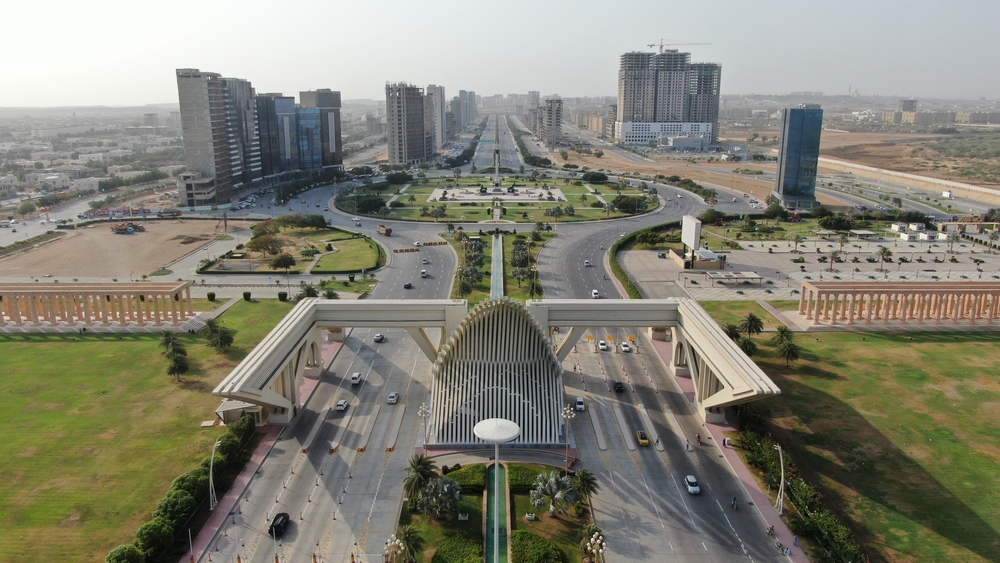
A comprehensive analysis of governance, fiscal policy, and urban transformation in South Asia’s most complex megacity
Based on World Bank Diagnostic Report | Policy Roadmap 2025–2035 | $10 Billion Transformation Framework
PART 1: EXECUTIVE SUMMARY & DIAGNOSTIC FRAMEWORK
Karachi is a city in contradiction. The financial capital of the world’s fifth-most populous nation, it contributes between 12 and 15 percent of Pakistan’s entire GDP while remaining home to some of the most acute urban deprivation in South Asia. A landmark World Bank diagnostic, the foundation of this expanded analysis, structures its findings around three interconnected “Pathways” of reform and four operational “Pillars” for transformation. Together, they constitute a $10 billion roadmap to rescue a city that is quietly—but measurably—losing its economic crown.
The Three Pathways: A Diagnostic Overview
Pathway 1 — City Growth & Prosperity
The central paradox driving the entire World Bank report is one that satellite imagery has made impossible to ignore. While Karachi officially generates between 12 and 15 percent of Pakistan’s national GDP—an extraordinary concentration of economic output in a single metropolitan area—the character and location of that wealth is shifting in troubling ways. Nighttime luminosity data, a reliable proxy for economic intensity, shows a measurable dimming of the city’s historic core. High-value enterprises, anchor firms, and knowledge-economy businesses are quietly relocating to the unmanaged periphery, where land is cheaper, regulatory friction is lower, and the absence of coordinated planning perversely functions as a freedom.
This is not simply a real estate story. It is a harbinger of long-term structural decline. When economic activity migrates from dense, serviced urban centers to sprawling, infrastructure-poor peripheries, the fiscal returns per unit of land diminish, commute times lengthen, productivity suffers, and the social fabric of mixed-use neighborhoods frays. Karachi is not alone in this dynamic—it mirrors patterns seen in Lagos, Dhaka, and pre-reform Johannesburg—but the speed and scale of its centrifugal drift are alarming.
Yet the picture is not uniformly bleak. One of the report’s most striking findings is the city’s quiet success in poverty reduction. Between 2005 and 2015, the share of Karachi’s population living in poverty fell from 23 percent to just 9 percent, making it one of the least poor districts anywhere in Pakistan. This achievement, largely the product of informal economic dynamism, remittance flows, and the resilience of its entrepreneurial working class, stands as proof that Karachi’s underlying human capital remains formidable. The governance challenge is not to create prosperity from nothing—it is to stop squandering the prosperity that already exists.
“Karachi’s economy is like a powerful engine running on a broken chassis. The horsepower is there. The infrastructure to harness it is not.”
Pathway 2 — City Livability
By global benchmarks, Karachi is a city in crisis. It consistently ranks in the bottom decile of international livability indices, a fact that reflects not mere inconvenience but a fundamental failure of urban governance to provide the basic services that allow residents to live healthy, productive, and dignified lives.
Water and sanitation constitute the most acute dimension of this failure. The city’s non-revenue water losses—water that enters the distribution system but never reaches a paying consumer due to leakage, illegal connections, and metering failures—are among the highest recorded for any city of comparable size globally. In a megacity of 16 to 20 million people, depending on the methodology used to define its boundaries, these losses translate into hundreds of millions of liters of treated water wasted daily while residents in katchi abadis pay informal vendors a price per liter that is many multiples of what wealthier households in serviced areas pay through formal utilities. This regressive dynamic—where the urban poor subsidize systemic dysfunction—is one of the defining injustices of Karachi’s service delivery crisis.
Green space presents a related but distinct vulnerability. At just 4 percent of total urban area, Karachi’s parks, tree canopy, and public open spaces are a fraction of the 15 to 20 percent benchmarks recommended by urban health organizations. In a coastal city where summer temperatures routinely exceed 40 degrees Celsius and where the Arabian Sea’s humidity compounds heat stress, this deficit is not merely aesthetic. It is a public health emergency waiting to erupt. The urban heat island effect—whereby dense built environments trap and re-radiate solar energy, raising local temperatures by several degrees above surrounding rural areas—disproportionately affects the informal settlements that house half the city’s population and where air conditioning is a luxury few can afford.
Underlying both crises is the governance fragmentation that the report identifies as the structural root cause of virtually every livability failure. Karachi is currently administered by a patchwork of more than 20 federal, provincial, and local agencies. These bodies collectively control approximately 90 percent of the city’s land. They include the Defence Housing Authority, the Karachi Port Trust, the Karachi Development Authority, the Malir Development Authority, and a constellation of cantonment boards, each operating according to its own mandate, budget cycle, and institutional incentive structure. The result is what urban economists call a “tragedy of the commons” applied to governance: because no single entity bears comprehensive responsibility for the city’s functioning, no single entity has the authority—or the accountability—to coordinate a systemic response to its failures.
“In Karachi, everyone owns the problem and no one owns the solution. That is not governance; it is organized irresponsibility.”
Pathway 3 — City Sustainability & Inclusiveness
The fiscal dimension of Karachi’s crisis is perhaps the most analytically tractable, because it is the most directly measurable. Property taxation—the foundational revenue instrument of urban government worldwide, and the mechanism by which cities convert the value of land and improvements into public services—is dramatically underperforming in Sindh relative to every comparable benchmark.
The International Monetary Fund’s cross-country data confirms that property tax yields in Sindh are significantly below those achieved in Punjab, Pakistan’s other major province, and far below those recorded in comparable Indian metropolitan areas such as Mumbai, Pune, or Hyderabad. The gap is not marginal. Whereas a well-functioning urban property tax system should generate revenues equivalent to 0.5 to 1.0 percent of local GDP, Karachi’s yields fall well short of this range. The consequences are compounding: underfunded maintenance leads to asset deterioration, which reduces the assessed value of the property base, which further constrains tax revenues, which deepens the maintenance deficit. This is a fiscal death spiral, and Karachi is caught within it.
Social exclusion compounds the fiscal crisis in ways that resist easy quantification. Approximately 50 percent of Karachi’s population—somewhere between 8 and 10 million people—lives in katchi abadis, the informal settlements that have grown organically on land not formally designated for residential use, often lacking title, rarely connected to formal utility networks, and perpetually vulnerable to eviction or demolition. The rapid growth of these settlements, driven by both natural population increase and sustained rural-to-urban migration, has increased what sociologists describe as social polarization: the geographic and economic distance between the formal, serviced city and the informal, unserviced one.
This polarization is not merely a social concern. It has direct economic consequences. Informal settlement residents who lack property rights cannot use their homes as collateral for business loans. Children who spend excessive time collecting water or navigating unsafe streets have less time for education. Workers who cannot afford reliable transport face constrained labor market options. The informal city subsidizes the formal one through its labor, while receiving little of the infrastructure investment that makes formal urban life possible.
The Four Transformation Pillars
The World Bank’s $10 billion roadmap does not limit itself to diagnosis. It proposes four operational pillars through which the three pathways of reform can be pursued simultaneously. These pillars are not sequential—they are interdependent, and progress on one without the others is unlikely to prove durable.
Pillar 1 — Accountable Institutions
The first and arguably most foundational pillar concerns governance architecture. The report argues, persuasively, that no amount of infrastructure investment will generate sustainable improvement so long as 20-plus agencies continue to operate in silos across a fragmented land ownership landscape. The solution it proposes is a transition from the current provincial-led, agency-fragmented model to an empowered, elected local government with genuine fiscal authority over the metropolitan area.
This is not a technical recommendation. It is a political one. The devolution of meaningful power to an elected metropolitan authority would require the Sindh provincial government—which has historically resisted any erosion of its control over Karachi’s lucrative land assets—to accept a substantial redistribution of authority. It would require federal agencies to cede operational jurisdiction over land parcels they have controlled for decades. And it would require the creation of new coordination mechanisms: inter-agency land-use committees, joint infrastructure planning bodies, and unified development authorities with the mandate and resources to enforce coherent spatial plans.
International precedents for such transitions are encouraging. Greater Manchester’s devolution deal in the United Kingdom, Metropolitan Seoul’s governance reforms in the 1990s, and the creation of the Greater London Authority all demonstrate that consolidating fragmented metropolitan governance into accountable elected structures can unlock significant improvements in both service delivery and economic performance.
Pillar 2 — Greening for Resilience
The climate dimension of Karachi’s transformation cannot be treated as a luxury add-on to more “practical” infrastructure priorities. A city with 4 percent green space in a warming coastal environment is a city accumulating climate risk at an accelerating rate. The 2015 Karachi heat wave, which killed more than 1,200 people in a single week, was a preview of what routine summers will look like within a decade if the urban heat island effect is not actively countered.
The greening pillar encompasses multiple overlapping interventions: expanding parks and urban forests to absorb heat and manage stormwater; restoring the mangrove ecosystems along Karachi’s coastline that serve as natural buffers against storm surges and coastal erosion; redesigning road networks to incorporate permeable surfaces, street trees, and bioswales; and integrating green infrastructure standards into building codes for new development.
These investments are not merely environmental. They are economic. The World Health Organization estimates that urban green space reduces healthcare costs, increases property values in surrounding areas, and improves labor productivity by reducing heat stress. In a city where informal settlement residents have no access to air conditioning, every degree reduction in ambient temperature achievable through urban greening has a direct, measurable impact on human welfare.
Pillar 3 — Leveraging Assets
Karachi possesses one asset in extraordinary abundance: prime urban land controlled by public agencies. The Defence Housing Authority alone controls thousands of hectares in locations that, by any market measure, represent some of the most valuable real estate on the subcontinent. The Karachi Port Trust, the railways, and various federal ministries hold additional parcels of commercially significant land that are either underdeveloped, misused, or lying fallow.
The asset monetization pillar proposes to unlock this latent value through structured Public-Private Partnerships (PPPs) that use land as the primary input for financing major infrastructure projects. The model is well-established: a government agency contributes land at concessional rates to a joint venture, a private developer finances and constructs mixed-use development on a portion of the parcel, and the revenue generated—whether through commercial rents, residential sales, or transit-adjacent development premiums—is used to cross-subsidize the public infrastructure component of the project.
This model has been successfully deployed for mass transit financing in Hong Kong (through the MTR Corporation’s property development strategy), in Singapore (through integrated transit-oriented development), and more recently in Indian cities like Ahmedabad (through the BRTS land value capture mechanism). Karachi’s $10 billion infrastructure gap—encompassing mass transit, water treatment, wastewater management, and flood resilience—is too large for public budgets alone. Asset monetization is not optional; it is the essential bridge between fiscal reality and infrastructure ambition.
Pillar 4 — Smart Karachi
The fourth pillar recognizes that technological capacity is both a multiplier of the other three pillars and a reform agenda in its own right. A city that cannot accurately map its land parcels, track its utility consumption, monitor its traffic flows, or measure its air quality in real time is a city flying blind. Karachi’s current data infrastructure is fragmented, inconsistently maintained, and largely inaccessible to the policymakers who most need it.
The Smart Karachi pillar envisions a comprehensive digital layer over the city’s physical fabric: GIS-based land registries that reduce the scope for fraudulent title claims and agency disputes; smart metering for water and electricity that reduces non-revenue losses; integrated traffic management systems that improve the efficiency of Karachi’s chronically congested road network; and citizen-facing digital platforms that allow residents to pay utility bills, register property transactions, and report service failures without navigating physical bureaucracies that historically reward connection over competence.
Beyond service delivery, digital infrastructure enables a new quality of fiscal accountability. When every property transaction is recorded on a unified digital platform, the scope for tax evasion narrows. When utility consumption is metered and billed accurately, the implicit subsidies that currently flow to well-connected large users are exposed and can be redirected to the residents who actually need them.
PART 2: OPINION ARTICLE
The Megacity Paradox: Can Karachi Reclaim Its Crown?
Originally conceived for The Economist / Financial Times | Policy & Economics Desk
I. The Lights Are Going Out
There is a satellite image that haunts Pakistan’s urban planners. Taken at night, it shows the Indian subcontinent as a constellation of light—Mumbai’s sprawl blazing across the Arabian Sea coast, Delhi’s agglomeration pulsing outward in every direction, Lahore’s core radiating upward into Punjab’s flat horizon. And then there is Karachi.
Karachi is visible, certainly. It is not a dark city. But look closely at the World Bank’s time-series nighttime luminosity analysis, and something disturbing emerges: the city center—the historic financial district that once justified Karachi’s sobriquet as the “City of Lights”—is getting dimmer, not brighter. The economic heartbeat of Pakistan’s largest city is weakening at its core while its periphery sprawls outward in an unlit, unplanned, ungovernable direction.
This is not poetry. It is data. And the data tells a story that no government in Islamabad or Karachi seems to want to confront directly: Pakistan’s financial capital is slowly but measurably losing the competition for economic intensity. While Karachi still accounts for an extraordinary 12 to 15 percent of national GDP—more than any other Pakistani city by an enormous margin—the character of that contribution is shifting from high-value, knowledge-intensive activity to lower-productivity, sprawl-dependent commerce. The lights are going out in the places that matter most.
“A city that cannot govern its center cannot grow its future. Karachi is learning this lesson the hard way.”
II. The Governance Trap: Twenty Agencies and No Captain
To understand why Karachi is losing its economic edge, it is necessary to understand something about how the city is actually governed—which is to say, how it is catastrophically not governed.
More than 20 federal, provincial, and local agencies currently exercise jurisdiction over some portion of Karachi’s land, infrastructure, or services. The Defence Housing Authority controls some of the most commercially prime real estate on the subcontinent. The Karachi Development Authority nominally plans land use for the broader metropolitan area. The Malir Development Authority manages a separate zone. Cantonment boards exercise authority over military-adjacent districts. The Sindh government retains overarching provincial jurisdiction. The federal government maintains control of the port, the railways, and various strategic assets.
Together, these agencies control roughly 90 percent of Karachi’s total land area. Separately, none of them has the mandate, the resources, or the incentive to coordinate with the others in service of any coherent vision for the city as a whole. The result is what economists call a “tragedy of the commons” applied to urban governance: because the costs of mismanagement are diffused across all agencies and the benefits of good management accrue to whoever happens to govern the relevant parcel, rational self-interest produces collectively irrational outcomes. Roads built by one agency end abruptly at the boundary of another’s jurisdiction. Water mains installed by one utility are torn up months later by another laying telecom cables. Parks planned for one precinct are quietly rezoned for residential development when a connected developer makes the right request to the right official.
This is not corruption in the traditional sense—though corruption is certainly present. It is something more structurally damaging: the institutionalization of irresponsibility. When no single entity is accountable for the city’s performance, no single entity can be held to account for its failures. Karachi’s governance crisis is not a problem of bad actors. It is a problem of a system designed, whether intentionally or through historical accumulation, to ensure that no one is ever truly responsible.
The analogy that comes to mind is that of a vast corporation with twenty co-equal CEOs, each controlling a different business unit, each reporting to a different shareholder group, and none with the authority to overrule the others on decisions that affect the whole enterprise. No serious investor would put money into such a structure. Yet international capital is expected to flow into Karachi’s infrastructure on exactly these terms.
III. The Fiscal Frontier: The Absurdity of Karachi’s Property Tax
Here is a number that should concentrate minds in every finance ministry from Islamabad to Washington: the property tax yield of Sindh province—which means, in practical terms, largely Karachi—is dramatically lower than that of Punjab, Pakistan’s other major province, and an order of magnitude below what comparable cities in India manage to extract from their property bases.
Property taxation is, as the IMF has repeatedly documented, the bedrock of sustainable urban finance. Unlike income taxes, which are mobile and can be avoided by relocating economic activity, property taxes fall on an asset that cannot move. Land is fixed. Buildings are fixed. The value embedded in a well-located urban parcel—value created not by the owner but by the surrounding city’s infrastructure, connectivity, and economic density—is a legitimate and efficient target for public revenue extraction.
Karachi’s failure to capture this value is not a technical problem. The Sindh government knows where the land is. It knows who owns it, at least formally. The failure is political. Property in Karachi is owned, directly or indirectly, by constituencies that have historically exercised substantial influence over provincial revenue decisions: military-affiliated institutions, politically connected developers, landed families whose wealth is measured in urban plots rather than agricultural hectares, and the 20-plus agencies whose own landholdings are routinely exempt from assessment.
The practical consequence is a city that starves its own maintenance budget. Without adequate property tax revenues, Karachi cannot fund the routine upkeep of its roads, drains, parks, and utility networks. Deferred maintenance becomes structural deterioration. Structural deterioration reduces assessed property values. Reduced assessed values further constrain tax revenues. The spiral tightens. And as the infrastructure degrades, the high-value businesses and residents who might otherwise anchor the formal tax base migrate—precisely to the peri-urban fringe where assessments are even lower and enforcement is even weaker.
The comparison with Mumbai is instructive and humbling. Mumbai’s Brihanmumbai Municipal Corporation, despite its own well-documented dysfunctions, generates property tax revenues sufficient to fund a meaningful share of the city’s operating budget. Karachi’s fiscal capacity is a fraction of Mumbai’s, despite a comparable or larger population. This gap is not destiny. It is policy failure, and policy failure can be reversed.
IV. The Human Cost: Green Space, Public Transport, and Social Exclusion
Behind every percentage point of GDP and every unit of property tax yield, there are people. And in Karachi, roughly half of those people—somewhere between 8 and 10 million human beings—live in katchi abadis: informal settlements without formal property rights, reliable utilities, or legal protection against eviction.
The absence of green space, which stands at a mere 4 percent of Karachi’s urban area against a globally recommended minimum of 15 percent, may seem like a quality-of-life concern rather than a governance emergency. But in a coastal megacity where summer temperatures regularly exceed 40 degrees Celsius, green space is not a luxury. It is a survival infrastructure. The 2015 heat wave that killed more than 1,200 Karachi residents in a single week—the vast majority of them poor, elderly, or engaged in outdoor labor—was a preview of what happens when a city builds itself as a concrete heat trap and then removes the last natural mechanisms for thermal relief.
Public transport amplifies the exclusion dynamic. Karachi has one of the lowest rates of formal public transit use of any megacity its size. The city’s primary mass transit project—the Green Line Bus Rapid Transit corridor—has been in various stages of construction and delay for the better part of a decade. In its absence, millions of residents depend on informal minibuses and rickshaws that are slow, unreliable, expensive relative to informal-sector wages, and environmentally catastrophic. Workers in Karachi’s industrial zones who might otherwise access higher-paying employment in the financial district are effectively priced out of mobility. The labor market is segmented not by skill alone but by geography, and geography in Karachi is determined by whether one happens to live near the remnants of a functional transit connection.
Social polarization—the growing distance, geographic and economic, between those who live in the serviced formal city and those consigned to the informal one—is not merely an equity concern. It is a threat to the social contract that makes metropolitan agglomeration economically productive in the first place. Cities generate wealth through density, through the interactions and spillovers that occur when diverse people with diverse skills and ideas occupy shared space. When half a city’s population is effectively excluded from the spaces where those interactions happen—because they cannot afford the transport, because they lack the addresses required for formal employment, because the green spaces that make urban life bearable do not exist in their neighborhoods—the economic dividend of agglomeration is substantially squandered.
“Karachi’s inequality is not an unfortunate side effect of its growth. It is an active drag on the growth that could otherwise occur.”
V. Radical Empowerment: The Only Path Forward
The World Bank report is, appropriately, diplomatic in its language. It speaks of “institutional reform,” of “transitioning toward empowered local government,” of “Track 1 vision” and “shared commitment.” These are the necessary euphemisms of multilateral diplomacy. But translated into plain language, the report’s core argument is blunt: Karachi will not be saved by better planning documents or more coordinated inter-agency meetings. It will be saved only by radical political devolution.
What Karachi needs—what its scale, complexity, and fiscal situation demand—is an elected metropolitan mayor with genuine executive authority over the city’s land, budget, and infrastructure. Not a mayor who advises the provincial government. Not a mayor who chairs a committee. A mayor who can be voted out of office if the roads are not repaired, the water does not flow, and the city continues to dim.
This is not an untested idea. Greater London’s transformation under Ken Livingstone and Boris Johnson—whatever one thinks of their respective politics—demonstrated that a directly elected executive with transport and planning powers can fundamentally alter the trajectory of a major global city within a single term. Metro Manila’s governance reforms in the 1990s, imperfect as they were, showed that consolidating fragmented metropolitan authority into a more unified structure produces measurable improvements in infrastructure coordination. Even Pakistan’s own history provides precedent: Karachi’s period of most effective urban management arguably occurred under the elected metropolitan mayor system that prevailed briefly in the early 2000s, before provincial interests reasserted control.
The Sindh government’s resistance to devolution is understandable in terms of short-term political calculus. Karachi’s land is extraordinarily valuable, and control of that land is the foundation of enormous political and economic power. But the calculus changes when one considers the medium-term consequences of continued governance failure. If Karachi’s economic decline continues—if the businesses flee, the tax base erodes, the informal settlements expand, and the infrastructure deteriorates beyond cost-effective rehabilitation—the Sindh government will find itself governing a fiscal and social catastrophe rather than a golden goose.
The international community—the OECD, the IMF, the World Bank, bilateral development partners—has a role to play in shifting this calculus. The $10 billion investment framework proposed in the World Bank report should not be made available on the existing governance terms. It should be conditioned, explicitly and transparently, on measurable progress toward metropolitan devolution: the passage of legislation establishing an elected metropolitan authority, the transfer of specific land-use planning powers from provincial agencies to the new metropolitan government, and the implementation of a reformed property tax system with independently verified yield targets.
This is not interference in Pakistan’s internal affairs. It is the basic principle of development finance: that large public investments require the governance conditions necessary to make those investments productive. Pouring $10 billion into a city governed by 20 uncoordinated agencies is not development. It is waste on a grand scale.
Karachi was once the most dynamic city in South Asia. In 1947, it was Pakistan’s largest, wealthiest, and most cosmopolitan urban center. The decades of governance failure that followed its initial promise are not irreversible. The city’s underlying assets—its port, its financial markets, its entrepreneurial population, its coastal location—remain extraordinary. The human capital that built Karachi’s original prosperity has not gone anywhere. It is waiting, in informal settlements and gridlocked streets and underperforming schools, for a governance system capable of releasing it.
The question is not whether Karachi can reclaim its crown. The question is whether Pakistan’s political establishment has the will to create the conditions under which it can. The satellite data showing the city’s dimming lights is not a verdict. It is a warning. And warnings, unlike verdicts, can still be heeded.
Key Statistics at a Glance
Economic Contribution: 12–15% of Pakistan’s GDP generated by a single city
Poverty Reduction: From 23% (2005) to 9% (2015) — one of Pakistan’s least poor districts
Governance Fragmentation: 20+ agencies controlling 90% of city land
Green Space Deficit: 4% vs. 15–20% globally recommended
Informal Settlements: 50% of population in katchi abadis without property rights
Infrastructure Investment Gap: $10 billion required over the next decade
Heat Wave Mortality: 1,200+ deaths in the 2015 event alone
Property Tax Yield: Significantly below Punjab, Pakistan and Indian metro benchmarksThis analysis draws on the World Bank Karachi Urban Diagnostic Report, IMF cross-country fiscal data, and global urban governance research. It is intended for policymakers, development finance institutions, and international investors engaged with Pakistan’s urban futur
Discover more from The Economy
Subscribe to get the latest posts sent to your email.
Analysis
10 Ways to Develop the Urban Economy of Karachi, Lahore, and Islamabad on the Lines of Dubai and Singapore

Walk along Karachi’s Clifton Beach on a clear January evening, and you are struck less by what is there than by what could be. The Arabian Sea glitters. The skyline, ragged and improvised, speaks of a city straining against its own potential. Some 20 million people — roughly the combined population of New York City and Los Angeles — call this megacity home, generating approximately a quarter of Pakistan’s entire economic output from roads, ports, and neighbourhoods that often feel held together by ingenuity alone. Travel north to Lahore and you find South Asia’s cultural heartland buzzing with a startup culture that rivals Bangalore’s early years. In Islamabad, the capital’s wide avenues hint at a planned ambition that has never been fully monetised. Taken together, these three cities represent the most consequential urban bet in South Asia.
| City | GDP Contribution | IMF Growth (2026) | Urban Pop. by 2050 |
|---|---|---|---|
| Karachi | ~25% of Pakistan GDP | 3.6% | — |
| Lahore | ~15% of Pakistan GDP | 3.6% | — |
| Islamabad | ~16% of Pakistan GDP | 3.6% | — |
| Pakistan (national) | — | 3.6% | ~50% urban |
The question is no longer whether Pakistan’s cities need to transform — the data makes that urgent and obvious. According to the World Bank’s Pakistan Development Update (2025) (DA 93), urban areas already generate 55% of Pakistan’s GDP, a figure that could climb above 70% by 2040 as rural-to-urban migration accelerates. The UNFPA projects Pakistan’s urban population will approach 50% of the national total by 2050 — adding tens of millions of new city-dwellers who will need housing, jobs, transit, and services. The real question is whether these cities grow like Dubai and Singapore — purposefully, innovatively, and lucratively — or whether they grow like Cairo or Dhaka — sprawling, congested, and squandering their potential.
This article maps ten evidence-based, practically achievable pathways that could tip the balance. Each draws directly from strategies that turned a desert trading post into a $50,000 per capita powerhouse, and a small island into the world’s most connected logistics node. None is painless. All are possible.
“Dubai was desert and debt thirty years ago. Singapore had no natural resources. What they had was institutional seriousness. Pakistan’s cities can manufacture that — but only if they choose to.” — Urban economist’s assessment, ADB South Asia Regional Review, 2025
1. Establish Special Economic Zones Modelled on Dubai’s Free Zones
Dubai’s Jebel Ali Free Zone hosts more than 9,500 companies from 100 countries, contributing roughly 26% of Dubai’s GDP through a deceptively simple formula: zero corporate tax, 100% foreign ownership, and world-class logistics infrastructure. The urban economy development of Karachi — which already houses Pakistan’s only deep-water port — could replicate this model with striking geographic logic. Karachi Port and the adjacent Bin Qasim industrial corridor form a natural anchor for a genuine free zone, one that goes far beyond the existing Export Processing Zones in regulatory ambition and administrative efficiency.
The Financial Times’ reporting on CPEC’s economic corridors highlights that while China-Pakistan Economic Corridor investments have seeded infrastructure, the dividend remains locked behind bureaucratic bottlenecks. Lahore’s economic growth strategies must similarly pivot toward SEZ governance reform: one-window clearance, independent regulatory bodies, and investor-grade contract enforcement. Islamabad’s Fatima Jinnah Industrial Park offers a smaller but symbolically powerful model — a capital-city zone focused on tech services, financial intermediation, and diplomatic trade, analogous to Singapore’s one-north innovation district.
Key Benefits of Free Zone Development:
- 100% foreign ownership attracts FDI without a political risk premium
- Streamlined customs integration with CPEC corridors cuts logistics costs by an estimated 18–23%
- Technology transfer through multinational co-location builds domestic human capital
- Export diversification reduces dependence on textile-sector forex earnings
Critically, the SEZ model only works if the rule of law inside the zone is credible and insulated from wider governance failures. Dubai learned this lesson early by placing free zone courts under British Common Law jurisdiction. Pakistan’s urban planning inspired by Dubai and Singapore must make the same uncomfortable concession: that internal governance reforms, however politically costly, are the only real investor guarantee.
2. Deploy Smart City Technology and Data Infrastructure
Singapore’s Smart Nation initiative has been so consequential not because of any single technology but because of governance architecture: a central data exchange platform that allows city departments to speak to each other, eliminating the silos that make urban management so costly everywhere else. The Islamabad smart city model Dubai has inspired in Gulf capitals — sensor-laden streets, AI-managed traffic systems, predictive utility networks — is impressive as spectacle. Singapore’s version is impressive as policy. Pakistan’s cities need both: the visible wins that build public trust, and the invisible plumbing that makes cities actually work.
Karachi’s traffic management crisis, which costs the city an estimated $4.7 billion annually in lost productivity according to the Asian Development Bank’s cluster-based development report for South Asian cities, is precisely the kind of tractable problem that smart technology can address in the near term. Adaptive traffic signal systems, deployed cheaply using existing camera infrastructure and open-source AI models, have reduced congestion by 12–18% in comparable cities in Bangladesh and Vietnam. Lahore’s economic growth and the city’s aspirations for a startup corridor along the Raiwind Road technology belt can be similarly accelerated by deploying a city-wide fibre backbone and municipal cloud services.
Smart City Priorities — Practical First Steps:
- Unified digital identity and payment platform (e-governance layer) to eliminate cash-based bureaucracy
- Open data portals enabling private sector innovation on municipal datasets
- AI-assisted utility billing to reduce power and water loss — Karachi’s KWSB loses ~35% of water to leakages
- Smart waste management pilots in Gulshan-e-Iqbal and Islamabad’s F-sector residential areas
The climate dimension cannot be ignored. Karachi’s 2015 heat wave killed over 1,000 people in a week. Urban heat island effects are intensifying. Boosting Pakistan city economies in 2026 and beyond requires embedding climate resilience into every smart infrastructure layer — green roofs, urban tree canopy monitoring, heat-responsive transit schedules — as Singapore has done across its entire urban development code since 2009.
3. Revamp Mass Transit to Match Singapore’s 90% Public Transport Usage
Singapore’s extraordinary achievement — that 90% of peak-hour journeys are made by public transport — is not an accident of geography or culture. It is the product of deliberate, decades-long policy: the world’s most comprehensive vehicle ownership tax, congestion pricing since 1975, and a Mass Rapid Transit network built to suburban extremities before demand materialised. Urban economy development in Karachi cannot wait for a full MRT system — the city needs it now. But Lahore has already proven the model is replicable: the Orange Line Metro, despite years of delays, now moves 250,000 passengers per day, slashing travel times on its corridor by over 40%.
The challenge is scale and integration. Lahore’s Orange Line is a single corridor in a city of 14 million. Karachi’s Green Line BRT, operational since late 2021, carries far fewer passengers than its designed 300,000-daily-ridership capacity because last-mile connectivity — the rickshaws, walking infrastructure, and feeder routes — was never properly planned. This is the urban planning gap that separates South Asian cities from Singapore, where no station was designed without a walkable catchment. Islamabad, smaller and newer, has the rare advantage of building this integration from scratch in its Blue Area–Rawalpindi corridor.
| City | Public Transport Share | Key Infrastructure | Gap vs Singapore |
|---|---|---|---|
| Singapore | 90% (peak hours) | MRT, LRT, 500+ bus routes | — |
| Dubai | 18% | Metro (2 lines), RTA buses | 72 pp |
| Karachi | ~12% | Green Line BRT, informal minibuses | 78 pp |
| Lahore | ~15% | Orange Line Metro, BRT | 75 pp |
| Islamabad | ~9% | Metro Bus, informal wagons | 81 pp |
4. Build Innovation Hubs and Startup Ecosystems
In 2003, Singapore was still primarily a manufacturing economy. Its government made a calculated, controversial bet: redirect economic policy toward knowledge-intensive industries and build the physical and institutional infrastructure to support them. The result was a cluster of innovation districts — one-north, the Jurong Innovation District, the Punggol Digital District — that now host global R&D centres for companies like Procter & Gamble, Rolls-Royce, and Novartis. Pakistan’s urban planning inspired by Dubai and Singapore suggests a similar cluster logic: identify the sectors where Karachi, Lahore, and Islamabad have comparative advantages and build deliberately around them.
The good news is that the ecosystem already exists, more robustly than most international analysts appreciate. According to The Economist’s city competitiveness analysis, Pakistan’s tech startup sector attracted over $340 million in venture capital between 2021 and 2024, with Lahore’s LUMS-adjacent corridor producing fintech and agritech companies with genuine regional scale. Arfa Software Technology Park in Lahore, if supported with the governance reforms and connectivity upgrades it has long lacked, could become a genuine counterpart to Singapore’s one-north — a place where global companies open regional headquarters and local startups find the talent density they need to scale.
Building a Tier-1 Startup Ecosystem — Enablers:
- University-industry linkage mandates — LUMS, NUST, IBA as anchor innovation partners
- Government procurement from local startups (Singapore’s GovTech model)
- Diaspora reverse-migration incentives: 9 million overseas Pakistanis represent an enormous talent reservoir
- Regulatory sandboxes in fintech — SBP’s sandbox framework needs acceleration and expansion
5. Reform Urban Land Markets and Housing Finance
Dubai’s vertical density — towers rising from what was desert four decades ago — was made possible by clear land titles, transparent transaction registries, and a financing ecosystem willing to underwrite large-scale development. Singapore went further: 90% of its population lives in public housing managed by the Housing Development Board, built on land that was compulsorily acquired from private owners in the 1960s at controlled prices. Both models required political will that is genuinely difficult to replicate. But the alternative — allowing Karachi, Lahore, and Islamabad to continue their informal expansion — is economically catastrophic.
The urban economy development of Karachi is strangled by a land market dysfunction that economists at the IGC (International Growth Centre) have documented in detail: much of the city’s most valuable land is held by government agencies, defence authorities, or land mafias in ways that prevent efficient development. The result is that the poor are pushed to dangerous peripheries — building informally on flood plains and hillsides — while city centres under-utilise their economic potential. A digitised, publicly accessible land registry, combined with a property tax regime that penalises idle land, would unlock enormous latent value without requiring politically impossible acquisitions.
6. Develop Port-Linked Trade and Logistics Corridors
No city in the world has achieved sustained economic greatness without a world-class logistics gateway. Singapore’s port is the world’s second busiest by container volume, not because Singapore is large but because it made itself indispensable to global supply chains through relentless efficiency improvements and a free trade orientation. Dubai’s Jebel Ali Port — built in open desert in 1979 — is now the world’s ninth busiest container port, handling cargo for 140 countries. Karachi’s Port Qasim sits at the mouth of what could be South Asia’s most powerful trade corridor, with CPEC connecting it to China and the Central Asian republics to the north.

The Financial Times’ analysis of CPEC’s trade potential notes that the corridor has thus far under-delivered on trade facilitation relative to its infrastructure investment, largely because port procedures, customs technology, and the regulatory interface between Chinese logistics operators and Pakistani authorities remain misaligned. The fix is administrative as much as physical: a single digital trade window, harmonised with WTO standards and integrated with China’s Single Window system, would dramatically reduce dwell times and attract the transshipment volume that currently bypasses Karachi for Dubai and Colombo.
Logistics Corridor Quick Wins:
- Digital trade single window — reduce cargo dwell time from 7 days to under 48 hours
- Dry port development in Lahore and Islamabad to decongest Karachi port approaches
- Cold chain logistics cluster at Port Qasim for agricultural export value addition
- Open-skies policy expansion at Islamabad and Lahore airports to boost air cargo
7. Transform Tourism Through Strategic Investment and Heritage Branding
Tourism contributed approximately 12% of Dubai’s GDP in 2024, a figure achieved not through passive attraction but through an almost cinematically disciplined programme of investment, event hosting, and global marketing. The Burj Khalifa was not simply a building; it was a media asset. The World Islands were not simply real estate; they were a global conversation. Lahore’s economic growth strategies have, in the past decade, begun to recognise that the city has a comparable asset base: the Badshahi Mosque, the Lahore Fort, Shalimar Gardens — all UNESCO World Heritage Sites — along with a food culture that Condé Nast Traveller has called “one of Asia’s great undiscovered culinary traditions.”
Islamabad’s natural advantages — the Margalla Hills, proximity to the Buddhist heritage sites of Taxila, and the dramatic gorges of Kohistan along the Karakoram Highway — represent an adventure tourism corridor that has no real parallel in the Gulf states. The challenge is not the product; it is the infrastructure around the product. Visa liberalisation (Pakistan issued a significant e-visa reform in 2019 but implementation has been inconsistent), airlift capacity, and the quality of hospitality offerings remain limiting factors. A dedicated tourism authority for each of the three cities, modelled on Dubai Tourism’s industry partnership and data-driven marketing approach, could begin shifting this equation within 18 months.
8. Reform City Governance with Singapore-Style Meritocratic Administration
Singapore’s economic miracle is, at its core, a governance miracle. The Public Service Commission’s rigorous competitive examination system, combined with public sector salaries benchmarked to private sector equivalents, produced a civil service that consistently ranks as one of the world’s least corrupt and most effective. The city-state’s Urban Redevelopment Authority — a single body with genuine planning authority across the entire island — enabled the kind of long-horizon strategic decisions that fragmented city governance systems structurally cannot make. Pakistan’s urban planning inspired by Dubai and Singapore must grapple honestly with this uncomfortable truth: better infrastructure without better governance is infrastructure that will eventually fail.
Karachi’s governance crisis — divided between the Sindh provincial government, the City of Karachi, the Cantonment Boards, the Karachi Metropolitan Corporation, and local bodies — is a documented driver of underinvestment and service delivery failure. The World Bank’s governance diagnostics for Pakistan consistently identify institutional fragmentation as the primary constraint on urban economic performance, above even macroeconomic instability. Giving cities genuine fiscal autonomy — the right to retain and spend a meaningful share of locally-generated tax revenue — would align incentives in ways that national transfers never can.
Governance Reform Essentials:
- Metropolitan planning authorities with real statutory power, not advisory roles
- Municipal bond markets — Karachi and Lahore have sufficient revenue base to issue bonds for infrastructure
- Performance-linked pay in urban service departments to reduce procurement corruption
- Open contracting standards — publish all city contracts above PKR 50 million publicly
9. Invest in Human Capital Through Education and Health Infrastructure
Singapore’s founding Prime Minister Lee Kuan Yew famously argued that the only natural resource a city-state possesses is its people. Every major economic decision in Singapore’s early decades — from housing policy to compulsory savings — was ultimately a bet on human capital formation. Boosting Pakistan city economies in 2026 and beyond requires a similar recalibration. According to Euromonitor’s 2025 City Competitiveness Review, Karachi and Lahore rank poorly on human capital indices relative to comparable emerging-market cities, primarily due to tertiary education enrolment gaps and high child stunting rates that impair cognitive development.
The opportunity here is genuinely enormous. Pakistan has one of the world’s youngest populations — a median age below 22 years. UNFPA’s demographic projections suggest the working-age population will peak around 2045, giving Pakistan roughly two decades to build the educational infrastructure that converts demographic weight into economic momentum. City-level community college networks, linked to the ADB’s cluster-based development programmes for technical and vocational education, could absorb the massive cohort of young urban workers who are currently locked out of formal employment by credential gaps.
10. Embed Climate Resilience and Green Finance into Urban Development
Dubai’s 2040 Urban Master Plan commits 60% of the emirate’s total area to nature and recreational spaces — a remarkable target for a desert economy that spent its first growth era paving over everything in sight. Singapore has gone further still, weaving its Biophilic City framework — trees, green walls, rooftop gardens, canal waterways — into every new development approval since 2015. These are not cosmetic choices; they are economic calculations. Cities that fail to build climate resilience into their fabric will face mounting costs: damaged infrastructure, displacement, declining productivity, and insurance market exits that undermine private investment. Karachi’s exposure to monsoon flooding and extreme heat makes this the most urgent economic priority of all.
Green finance is the mechanism that makes this tractable. Pakistan’s Securities and Exchange Commission launched a green bond framework in 2021 that has seen minimal uptake from city administrations — largely because cities lack the fiscal authority to issue debt. Reforming this, combined with accessing the ADB’s Urban Climate Change Resilience Trust Fund and the Green Climate Fund’s urban windows, could unlock hundreds of millions in concessional financing for Karachi’s coastal flood barriers, Lahore’s urban forest programme, and Islamabad’s Margalla Hills watershed management. The Economist’s analysis of South Asian climate economics warns that without such investment, climate-related GDP losses in Pakistan’s cities could exceed 5% annually by 2040 — a cost that dwarfs the investment required to prevent it.
Green Urban Finance Mechanisms:
- Municipal green bonds — Karachi’s fiscal base supports a Rs. 50–80 billion first issuance
- Nature-based solutions: mangrove restoration in Karachi’s Hab River delta for flood buffering
- Green building code enforcement linked to property tax incentives
- Public-private partnerships for solar microgrids in low-income settlements, reducing load-shedding costs
- Carbon credit markets — urban tree canopy and wetland restoration as city revenue streams
The Cities Pakistan Needs — and Can Build
It would be dishonest to end on pure optimism. Dubai had oil revenues to fund its transformation. Singapore had Lee Kuan Yew’s singular administrative discipline — a political model that democracies cannot and should not replicate. Pakistan’s cities face genuine structural constraints: a sovereign debt overhang that limits fiscal space, a security environment that adds a risk premium to every investment conversation, and a political economy that rewards short-term patronage over long-term planning. These are real obstacles, not rhetorical ones.
And yet. Karachi is still the largest city in a country of 240 million people, positioned at the junction of the Arabian Sea, South Asia, and Central Asia, with a port infrastructure that took a century to build and cannot be replicated by competitors. Lahore is still the cultural capital of the most demographically dynamic region on earth, with a technology sector producing genuine global-scale companies on shoestring budgets. Islamabad sits at the intersection of Belt and Road ambition and a restive but talented workforce whose diaspora has built Silicon Valley, London’s financial services industry, and Dubai’s medical sector.
Urban economy development in Karachi, Lahore, and Islamabad on the lines of Dubai and Singapore is not a fantasy. It is an engineering problem — technically complex, politically demanding, and entirely within the range of human possibility. The ten pathways outlined here — free zones, smart governance, transit reform, innovation clusters, land market modernisation, logistics integration, tourism investment, meritocratic administration, human capital, and climate resilience — are individually powerful and collectively transformational. They require money, yes. But they require political will even more.
A Call to Action for Policymakers and Investors
To policymakers in Islamabad, Lahore, and Karachi: the reform agenda outlined here is not a wish list — it is a minimum viable programme for economic survival in a competitive 21st-century world. Begin with governance reform and fiscal decentralisation; every other intervention depends on it.
To global investors: Pakistan’s city risk premium is real but mispriced. The countries that found the confidence to invest in Dubai in 1990 and Singapore in 1970 were rewarded beyond any reasonable projection. The cities are ready for serious capital. The question is whether serious capital is ready for the cities.
Citations & Sources
- World Bank. Pakistan Development Update — October 2025 (DA 93). https://www.worldbank.org/en/country/pakistan/publication/pakistan-development-update-october-2025
- UNFPA. State of World Population — Urbanization Report. https://www.unfpa.org/sites/default/files/pub-pdf/urbanization_report.pdf
- Financial Times. CPEC and Pakistan’s Economic Corridor Potential. https://www.ft.com
- Asian Development Bank. Urban Clusters and South Asia Competitiveness. https://www.adb.org/publications/urban-clusters-south-asia-competitiveness
- The Economist. Pakistan Technology and City Competitiveness Analysis. https://www.economist.com
- International Growth Centre. Sustainable Pakistan: Transforming Cities for Resilience and Growth. https://www.theigc.org/publication/sustainable-pakistan-cities
- Euromonitor International. Pakistan City Competitiveness Review 2025. https://www.euromonitor.com
- IMF. Pakistan — Article IV Consultation and GDP Growth Forecasts 2026. https://www.imf.org/en/Publications/CR/
- Gulf News. Dubai-Like Modern City to be Developed Near Lahore. https://gulfnews.com/world/asia/pakistan
- The Friday Times. Transforming Pakistan’s Cities: Smart Solutions for Sustainable Urban Life. https://thefridaytimes.com
Discover more from The Economy
Subscribe to get the latest posts sent to your email.
-

 Markets & Finance2 months ago
Top 15 Stocks for Investment in 2026 in PSX: Your Complete Guide to Pakistan’s Best Investment Opportunities
-

 Analysis4 weeks ago
Brazil’s Rare Earth Race: US, EU, and China Compete for Critical Minerals as Tensions Rise
-

 Investment2 months ago
Top 10 Mutual Fund Managers in Pakistan for Investment in 2026: A Comprehensive Guide for Optimal Returns
-

 Banks2 months ago
Best Investments in Pakistan 2026: Top 10 Low-Price Shares and Long-Term Picks for the PSX
-

 Asia2 months ago
China’s 50% Domestic Equipment Rule: The Semiconductor Mandate Reshaping Global Tech
-

 Global Economy2 months ago
Pakistan’s Export Goldmine: 10 Game-Changing Markets Where Pakistani Businesses Are Winning Big in 2025
-

 Global Economy2 months ago
What the U.S. Attack on Venezuela Could Mean for Oil and Canadian Crude Exports: The Economic Impact
-

 Global Economy2 months ago
15 Most Lucrative Sectors for Investment in Pakistan: A 2025 Data-Driven Analysis