
Weather Stations
The Political Economy of Weather Stations: How They Help Mitigate Approaching Disasters

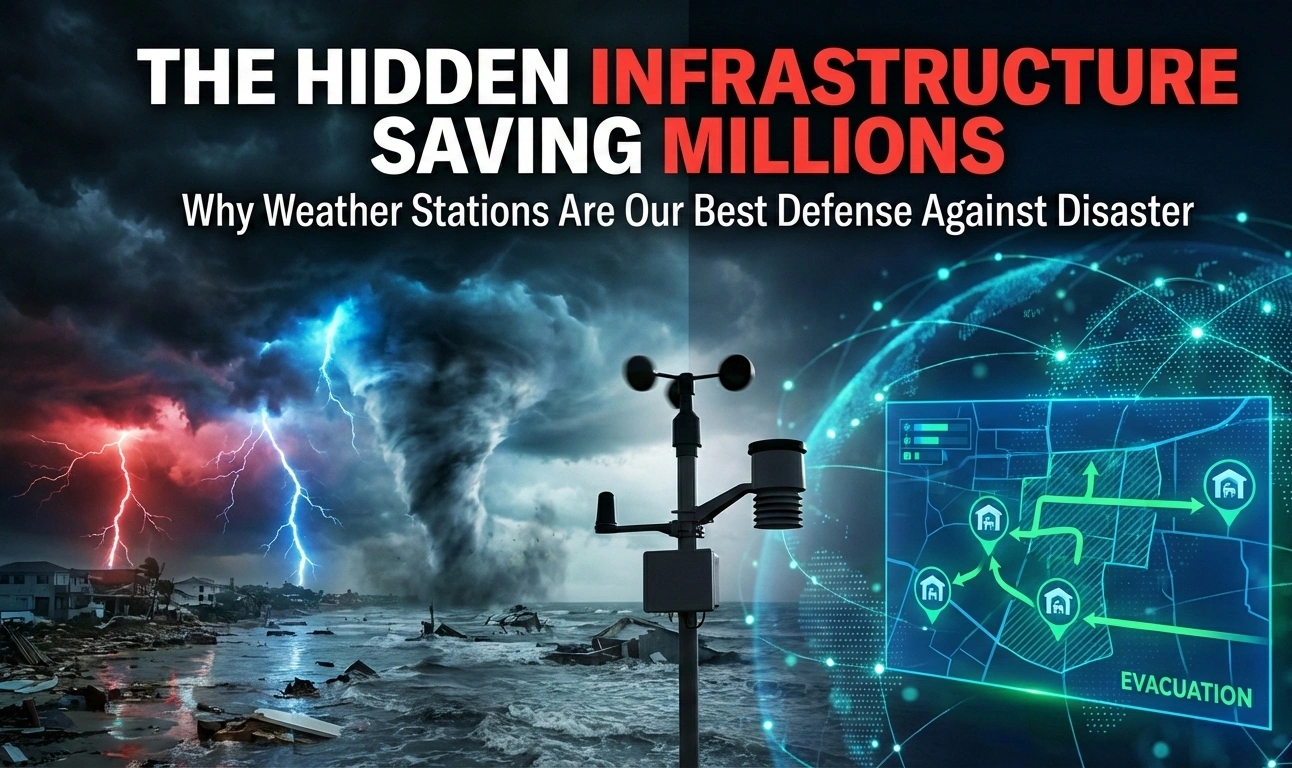
Explore how weather stations and early warning systems deliver 9:1 returns on investment, saving thousands of lives annually—yet remain chronically underfunded amid rising climate disasters and political battles.
When Cyclone Remal barreled toward Bangladesh on May 26, 2024, meteorologists had already tracked its path across the Bay of Bengal for days. The Bangladesh Meteorological Department, drawing on data from three radar stations and satellite feeds from NOAA and Japanese sources, issued warnings that cascaded through government channels, mobile networks, and 76,000 trained volunteers. By the time 400 square kilometers of coastline faced storm surges twelve feet above normal levels, over 4 million people had received early warnings, and 9,424 evacuation centers stood ready. The death toll, though tragic, numbered in the dozens rather than the thousands that similar cyclones once claimed.
Six months earlier and half a world away, the Los Angeles wildfires unfolded under different circumstances. Despite California’s sophisticated meteorological infrastructure, a confluence of severe Santa Ana winds, unprecedented drought conditions, and aging weather monitoring networks created blind spots in forecasting. The fires became the most expensive wildfire in U.S. history, causing over $60 billion in damage.
These contrasting narratives expose a fundamental tension in disaster preparedness: weather stations and early warning systems represent one of humanity’s most cost-effective shields against natural catastrophes, yet they remain chronically underfunded, politically contentious, and unevenly distributed across the globe. As climate change intensifies the frequency and severity of extreme weather, the political economy of meteorological infrastructure has emerged as a critical determinant of who lives and who dies when disaster strikes.
The Architecture of Anticipation: How Weather Stations Enable Disaster Mitigation
At its core, a weather station is deceptively simple—sensors measuring temperature, humidity, wind speed, atmospheric pressure, and precipitation. Yet these modest instruments form the foundation of a sophisticated global architecture that transforms raw atmospheric data into lifesaving intelligence.
Modern early warning systems operate on four interdependent pillars, according to the World Meteorological Organization: risk knowledge, monitoring and warning services, dissemination and communication, and preparedness and response capability. Weather stations anchor the second pillar, providing the real-time observational data that feeds into numerical weather prediction models.
Consider the cascading chain of information that precedes a hurricane warning. Ground-based weather stations across coastal regions continuously transmit data on atmospheric pressure drops and wind speed increases. These measurements integrate with Doppler radar systems—71% of newly commissioned meteorological hubs now use Doppler technology to differentiate particle velocity and storm direction. Satellite observations from geostationary platforms add macro-scale atmospheric imaging. Ocean buoys relay critical information about sea surface temperatures and wave heights.
This multi-source data flows into supercomputers running global circulation models that simulate atmospheric physics with increasing precision. The European Centre for Medium-Range Weather Forecasts and the National Centers for Environmental Prediction crunch millions of observations daily, producing probabilistic forecasts that cascade down to national meteorological services, then to regional offices, and finally to local communities.
The effectiveness of this system depends on data density and quality. Research indicates that just 24 hours of advance warning can reduce storm or heatwave damage by up to 30%. In India’s LANDSLIP project, improved rainfall detection has enabled authorities to collaborate with local NGOs in developing national landslide forecasting, with detection advances allowing warning lead times to improve by up to eight hours in Nepal’s flood-prone regions.
Yet despite these technological capabilities, the system’s weakest link remains its physical infrastructure. Weather stations require consistent maintenance, regular calibration, and continuous power supplies—mundane requirements that become politically fraught when budgets tighten and priorities shift.
The Public Goods Problem: Why Weather Data Is Chronically Underfunded
Weather information exemplifies what economists call a “pure public good”—non-excludable and non-rivalrous. When Bangladesh’s meteorological service issues a cyclone warning, it cannot exclude non-payers from receiving the information, nor does one person’s use of the forecast diminish its availability to others. This creates the classic free-rider problem that plagues public goods provision.
The political consequences manifest starkly in funding debates. In the United States, the Trump administration’s 2026 budget proposal sought to eliminate NOAA’s Office of Oceanic and Atmospheric Research entirely, cut nearly 50% of NASA’s Earth science missions, and reduce overall NOAA spending by $100 million below congressional appropriations. Congress pushed back, but bureaucratic delays have created operational chaos. Multiple regional climate centers shut down in April 2025 when contract reviews stalled, leaving 21 states without crucial drought monitoring and historical temperature data services.
The problem extends beyond partisan politics. NOAA’s Integrated Ocean Observing System, which provides critical data for coastal forecasts through a network of buoys and sensors, has faced chronic underfunding despite bipartisan congressional support. Authorized in 2009 with an independent study recommending $715 million annually, the program has received at most $42.5 million—a level at which it has stagnated for years. As Jake Kritzer of the Northeast Regional Association of Coastal Ocean Observing Systems noted, “Think of it like a car”—aging equipment eventually fails without maintenance, and aging ocean monitoring buoys are beginning to show their limits.
The underfunding creates a perverse dynamic. When disasters strike areas with inadequate early warning systems, the human and economic costs vastly exceed the investment required to prevent them. Yet politically, it’s far easier to secure emergency disaster relief funding after catastrophes than to appropriate money for preventive infrastructure that operates invisibly when successful. As Rick Spinrad, former NOAA administrator, observed regarding congressional funding stabilization efforts: “I’m glad Congress is providing a voice of reason, but real improvement in services will require more than just a stabilization to levels of past investments.”
International cooperation compounds these challenges. The World Meteorological Organization facilitates the exchange of millions of weather observations worldwide daily, underpinning the accuracy of global forecasts. Yet this system depends on all countries maintaining adequate observing networks and sharing data freely—a commitment that strains when nations face budget pressures or perceive meteorological data as commercially valuable.
The Systematic Observations Financing Facility (SOFF) addresses this gap by providing long-term financing and technical assistance to support countries in generating and exchanging basic surface-based observational data. Through peer advisor programs, 20 national meteorological services with strong expertise now offer technical support to 62 beneficiary countries. Yet even these collaborative mechanisms struggle against the fundamental economics: weather infrastructure generates diffuse benefits that accrue to everyone, making concentrated political constituencies for sustained funding difficult to mobilize.
The Cost-Benefit Case: Quantifying the Value of Early Warnings
If public goods problems create political challenges for weather infrastructure funding, the economic evidence for investment remains overwhelmingly compelling. Multiple rigorous studies have demonstrated that early warning systems deliver among the highest returns of any disaster risk reduction measure.
The Global Commission on Adaptation established a cost-benefit ratio of 9:1 for early warning systems—higher than investments in resilient infrastructure or improved dryland agriculture. This means every dollar invested in early warning capability generates an average of nine dollars in net economic benefits. The Commission also found that providing just 24 hours’ notice of an impending storm or heatwave reduces potential damage by 30%, and that an $800 million investment in such systems in developing countries could prevent annual losses of $3 billion to $16 billion.
World Bank research provides even more granular estimates. A 2012 policy research working paper analyzed upgrading hydrometeorological information production and early warning capacity in all developing countries to developed-country standards. The potential benefits include:
- Between $300 million and $2 billion per year in avoided asset losses due to natural disasters through better preparedness and early protection of goods and equipment
- An average of 23,000 saved lives annually, valued between $700 million and $3.5 billion using Copenhagen Consensus guidelines
- Between $3 billion and $30 billion per year in additional economic benefits from optimizing economic activities using weather information (agriculture, energy, transportation, water management)
Total annual benefits reach between $4 billion and $36 billion globally. Because expensive components like earth observation satellites and global weather forecasts already exist, the incremental investment cost is relatively modest—estimated at approximately $1 billion annually, yielding benefit-cost ratios between 4 and 36.
More recent analysis confirms these findings. Ongoing World Bank research estimates that between 1978 and 2018, early warning systems averted $360 billion to $500 billion in asset losses and $600 billion to $825 billion in welfare losses. Universal access to early warning systems could prevent at least $13 billion in asset losses and $22 billion in well-being losses annually.
The benefits extend beyond disaster avoidance. Crop advisory services boost agricultural yields by an estimated $4 billion annually in India and $7.7 billion in China. Research demonstrates that a 1% increase in forecast accuracy results in a 0.34% increase in crop yields. Similarly, fisherfolk earnings optimize when supported by fishing zone advisories that account for changing climate conditions.
Heat warning systems, though less studied, show equally impressive returns. Ahmedabad’s Heat Action Plan averts an estimated 1,190 heat-related deaths annually, while Adelaide’s Heat Health Warning System demonstrates a benefit-cost ratio of 2.0 to 3.3 by reducing heat-related hospital admissions and ambulance callouts.
Perhaps most telling is the mortality differential. Countries with limited to moderate Multi-Hazard Early Warning System coverage have nearly six times higher disaster-related mortality compared to those with substantial to comprehensive coverage—a mortality rate of 4.05 per 100,000 population versus 0.71 per 100,000.
Global Success Stories and Persistent Gaps
Bangladesh stands as the paradigmatic success story in disaster risk reduction through early warning systems. In 1970, Cyclone Bhola killed an estimated 500,000 people. By 2007, when Cyclone Sidr struck with comparable intensity, deaths had fallen to 4,234—a more than 100-fold reduction. This transformation resulted from sustained investment in the Cyclone Preparedness Programme, operated jointly by the government and Bangladesh Red Crescent Society since its approval by Prime Minister Sheikh Mujibur Rahman in the 1970s.
The program now operates through 203 employees and approximately 76,020 volunteers across seven zones, 13 districts, 42 sub-districts, and 3,801 units. When Cyclone Remal approached in May 2024, this network swung into coordinated action. The Bangladesh Meteorological Department tracked the storm using three radar stations in Dhaka, Khepupara, and Cox’s Bazar, supplemented by satellite data from NOAA and Japanese sources. Warnings cascaded through extensive telecommunication networks, mobile alerts, and face-to-face volunteer communications. The result: despite displacing 800,000 people and affecting 4.6 million, the death toll remained minimal thanks to timely evacuations and 9,424 evacuation centers opened by the government.
India has made comparable strides in high-altitude monitoring. Following major glacial lake outburst floods in 2013 and 2023, the National Disaster Management Authority established the National GLOF Risk Mitigation Programme. The program installed solar-powered automatic weather stations at sites more than 5,000 meters above sea level, deployed unmanned aerial vehicles for localized hazard mapping, and created a dynamic risk inventory identifying 195 high-risk glacial lakes among 28,000 in the Himalayas—7,500 within India.
Yet these successes highlight persistent gaps. As of 2024, 108 countries report some early warning capacity—more than double the 2015 level—but this still leaves approximately one-third of the global population without adequate multi-hazard warning systems. The gap concentrates in least developed countries and small island developing states, precisely the regions most vulnerable to climate change impacts.
The Climate Risk and Early Warning Systems (CREWS) initiative has invested over $100 million addressing this disparity in vulnerable nations, while the Systematic Observations Financing Facility provides long-term financing for basic surface-based observational data. The 2022 “Early Warnings for All” initiative, spearheaded by UN Secretary-General António Guterres, aims to provide protection for everyone on Earth by 2027. Yet achieving this target requires accelerating current implementation rates while confronting the political and economic barriers that have historically constrained weather infrastructure investment.
Mozambique illustrates both the potential and the challenges. Cyclone Idai in March 2019 killed over 600 people and caused $3 billion in damages, exposing critical gaps in early warning capabilities. Supported by a $265 million World Bank Disaster Risk Management and Resilience Program, Mozambique developed a comprehensive early warning system using cutting-edge technology. When Cyclone Freddy made landfall in 2023, the improved system demonstrated the life-saving power of preparedness. Yet sustaining these capabilities requires ongoing investment that competes with myriad other development priorities in resource-constrained nations.
Fragile and conflict-affected states face compounded challenges. In Haiti, years of political instability, gang violence, and weak institutions have severely impeded early warning system development despite the country’s acute vulnerability to hurricanes, floods, and earthquakes. In Afghanistan, the World Bank and WMO have pioneered using 3D printing technology to locally produce materials for weather station construction, equipped with solar power to operate in areas with limited electricity access. These innovations demonstrate that technical solutions exist even in extremely difficult contexts, yet they require sustained international support and functional governance structures to operate reliably.
The 2025 Breaking Point: Funding Crises and Political Turbulence
The first half of 2025 represented a watershed for weather infrastructure politics. Climate Central reported that costs associated with catastrophic weather events totaled $101.4 billion—the costliest six-month period on record. The fourteen extreme weather events crossing the billion-dollar threshold included six tornado outbreaks across the Midwest, four severe storms on the East Coast, two severe storms and a hailstorm in Texas, and the Los Angeles wildfires.
Yet as disaster costs soared, weather infrastructure funding faced unprecedented political attacks. The Trump administration’s budget proposals sought to eliminate NOAA’s research arm, cut weather satellite programs, and reduce overall NOAA spending by hundreds of millions below congressional appropriations. While Congress largely rejected these cuts in bipartisan votes—providing $634 million for NOAA’s Office of Oceanic and Atmospheric Research versus the administration’s proposed zero funding—bureaucratic obstruction persisted.
New layers of federal review within the Department of Commerce and Office of Management and Budget delayed critical grant cycles. Secretary of Commerce Howard Lutnick’s requirement for personal sign-off on grants exceeding $100,000 created bottlenecks affecting routine operations. The Integrated Ocean Observing System faced the prospect of funding gaps at the peak of hurricane season. Regional climate centers serving 21 states went dark in April 2025 when contract approvals stalled, eliminating crucial drought monitoring and historical climate data services farmers and researchers depend upon.
The political turbulence extended beyond federal agencies. State-level responses varied dramatically. Arizona created a Workplace Heat Safety Task Force following its 2024 Extreme Heat Preparedness Plan. Connecticut formed a Severe Weather Mitigation and Resiliency Advisory Council and passed legislation requiring communities to account for disaster risks in local planning. Rhode Island enacted the Resilient Rhody Infrastructure Fund for local climate resilience projects. Vermont released its inaugural Resilience Implementation Strategy, though implementing the full strategy would cost approximately $270 million in one-time funds and $95 million annually—sums that remain politically contentious.
Meanwhile, some positive developments emerged internationally. The Severe Weather Forecasting Programme expanded coverage to Central America and early 2025 to Southeastern Asia-Oceania. The Space for Early Warning in Africa project launched as part of the Africa-EU Space Partnership Programme to enhance continental capability for Earth observation services. The Global Observatory for Early Warning Systems Investments, a collaborative platform led by UNDRR and WMO with nine international financial institutions, began consolidating project-level data using a shared classification system.
Yet these initiatives, while valuable, operate against headwinds. The first half of 2025 demonstrated that FEMA’s disaster budget model—relying on historic data rather than future risk predictions—left the agency chronically underfunded. Just eight days into fiscal year 2025, FEMA had spent half its annual disaster budget. This reactive approach means critical relief arrives slower for disaster victims while sending ever-growing bills to taxpayers after the fact, rather than investing proactively in prevention and early warning systems that reduce both human suffering and fiscal costs.
Climate Change: The Accelerating Imperative
The political and economic challenges surrounding weather infrastructure occur against the backdrop of accelerating climate change, which fundamentally alters the risk calculus. Under a 1.5°C warming scenario, average annualized losses could reach 2.4% of GDP. Yet current emissions trajectories point toward higher warming levels, with correspondingly greater impacts.
Extreme weather events are becoming more frequent, more intense, and more costly. The 2024 Atlantic hurricane season saw 27 confirmed billion-dollar weather and climate disaster events in the United States—an average of one every two weeks. This represents not merely bad luck but a structural shift in atmospheric physics as greenhouse gases trap more heat energy, warm ocean surfaces fuel stronger storms, and atmospheric water vapor content increases by approximately 7% per degree Celsius of warming.
These changes stress existing early warning systems in multiple ways. Historical baselines for extreme weather become less reliable as predictors of future events. Compound disasters—where multiple hazards strike simultaneously or in rapid succession, as Bangladesh experienced in 2024 with Cyclone Remal followed by flash floods in the Haor Region, riverine floods in the Jamuna Basin, and devastating flash floods in Chattogram affecting 18 million people—challenge response systems designed for single hazards.
Weather station networks calibrated for historical climate patterns may require recalibration and densification. Radar systems must track more intense precipitation events. Satellite systems need enhanced resolution to capture rapid intensification of tropical cyclones. Flood forecasting models require updates to account for changing hydrological patterns. All of these technical necessities demand sustained investment precisely when political will appears most fragile.
The paradox is acute: climate change simultaneously increases the value of early warning systems and makes sustained funding more politically difficult. As disaster costs mount, emergency response consumes budget capacity that could otherwise support preventive infrastructure. Political polarization around climate science creates headwinds for meteorological agencies perceived as documenting climate change. The temptation to cut “invisible” preventive systems intensifies as immediate disaster response demands escalate.
Yet the alternative—continuing to underfund weather infrastructure while climate risks intensify—represents a catastrophically false economy. Every dollar not invested in early warning systems today translates into multiple dollars in disaster losses tomorrow, along with preventable deaths and suffering.
Toward a Sustainable Political Economy of Weather Infrastructure
Breaking the cycle of underinvestment requires confronting several interconnected challenges. First, the public goods problem demands innovative financing mechanisms that can mobilize sustained resources despite free-rider incentives. The CREWS initiative and SOFF demonstrate that multilateral funding pools can address gaps in vulnerable countries, yet they operate on scales insufficient for global needs.
One promising approach involves hybrid public-private models. The World Economic Forum’s 2025 white paper “Catalysing Business Engagement in Early Warning Systems” calls on governments to incentivize business participation and make meteorological data as accessible as possible. Private sector actors ranging from agriculture to insurance to transportation depend on accurate weather information; mechanisms that capture some of this economic value could supplement public funding.
However, commoditization of weather data creates risks. If basic observational data becomes proprietary rather than freely shared, the global exchange system coordinated by WMO could fragment, reducing forecast accuracy worldwide. The challenge lies in designing systems where private sector contributions supplement rather than substitute for public investment, while preserving the open data sharing that underpins effective early warning systems.
Second, political constituencies for preventive infrastructure need strengthening. Disaster survivors provide powerful testimony, but successful early warning systems operate invisibly—their victories are disasters that don’t occur, deaths that don’t happen, economic losses that don’t materialize. Building political support requires consistently communicating these avoided harms and highlighting the asymmetric returns on investment.
Bangladesh offers instructive lessons. The dramatic mortality reductions from cyclones created political champions for continued investment in the Cyclone Preparedness Programme. When lives saved number in the hundreds of thousands, the political case for sustained funding becomes compelling. Replicating this dynamic in countries without such stark before-and-after contrasts requires proactive documentation of early warning system performance and aggressive communication of cost-benefit evidence.
Third, institutional design matters profoundly. The recent turbulence at U.S. federal agencies demonstrates how weather infrastructure depends on bureaucratic stability and professional autonomy. When grant approvals require cabinet-level sign-offs, when career scientists face political purges, when research programs face repeated elimination attempts, the capacity to maintain sophisticated early warning systems degrades regardless of nominal funding levels.
Countries that have successfully sustained meteorological capacity over decades typically embed these functions in technocratic institutions with stable budgets and clear mandates. The European Centre for Medium-Range Weather Forecasts operates as an independent intergovernmental organization with member state contributions insulated from annual political battles. Similar models could enhance resilience of national meteorological services to political turbulence.
Fourth, integration with broader climate adaptation strategies creates synergies. Early warning systems deliver immediate disaster risk reduction benefits while simultaneously supporting longer-term adaptation planning. Meteorological data informs decisions about infrastructure siting, agricultural practices, water resource management, and coastal zone development. Framing weather infrastructure as essential adaptation infrastructure rather than discretionary spending shifts political calculations.
Finally, international cooperation requires sustained cultivation. Climate and weather cross borders; no country can achieve adequate forecasting capacity in isolation. The WMO’s Global Basic Observing Network addresses geographical inconsistencies in internationally exchanged data, but depends on voluntary compliance with observational standards and data sharing protocols. As climate impacts intensify and disasters multiply, maintaining cooperative frameworks against nationalist or mercantilist pressures represents a critical diplomatic priority.
The False Economy of Underinvestment
In January 2026, as this analysis goes to press, the political future of weather infrastructure remains contested. Congressional appropriators have largely rejected the most draconian proposed cuts to NOAA and NASA Earth science programs, yet bureaucratic obstruction continues. Regional climate centers remain shuttered. Ocean buoy networks face aging equipment and inadequate maintenance budgets. International funding for early warning systems in vulnerable countries remains orders of magnitude below identified needs.
This persistent underinvestment represents a textbook false economy—one where penny-wise, pound-foolish decisions prioritize immediate budget pressures over vastly larger long-term costs. The economic evidence is unambiguous: every dollar invested in early warning systems generates four to thirty-six dollars in benefits. The humanitarian case is even more compelling: adequate early warning systems reduce disaster mortality by a factor of six.
Yet knowing what we should do and mustering the political will to do it remain frustratingly disconnected. The challenge is not technical—we possess the meteorological science, the satellite technology, the computational capacity, and the organizational know-how to build and maintain effective early warning systems globally. The challenge is political: mobilizing sustained investment in public goods that generate diffuse benefits, operate invisibly when successful, and require long-term thinking in political systems optimized for short-term calculations.
The experience of Bangladesh demonstrates that dramatic progress is possible when political will aligns with sustained investment. The country’s transformation from suffering 500,000 cyclone deaths in 1970 to minimizing casualties from comparable storms today stands as one of the great disaster risk reduction achievements of the modern era. Replicating this success globally requires recognizing that weather infrastructure represents not a luxury expenditure but essential public infrastructure—as fundamental as roads, electrical grids, or water systems.
As climate change intensifies and disaster costs mount, the question is not whether to invest in early warning systems but whether we do so proactively or continue learning expensive lessons with each preventable catastrophe. The first half of 2025, with its record-breaking $101.4 billion in disaster costs, illustrates the fiscal and human consequences of inadequate investment. The contrast between Bangladesh’s effective cyclone response and California’s devastating wildfires highlights how infrastructure choices determine outcomes.
The political economy of weather stations ultimately reflects deeper questions about collective action, public goods provision, and societal time horizons. In an era of climate disruption, our ability to answer these questions well—to build and sustain the meteorological infrastructure that turns atmospheric chaos into actionable intelligence—will help determine which communities thrive and which face preventable disasters. The technology exists; the economic case is proven; the humanitarian imperative is clear. What remains uncertain is whether political systems can rise to meet a challenge where the costs of failure compound with each passing year.
Discover more from The Economy
Subscribe to get the latest posts sent to your email.


-

 Markets & Finance2 months ago
Top 15 Stocks for Investment in 2026 in PSX: Your Complete Guide to Pakistan’s Best Investment Opportunities
-

 Analysis1 month ago
Brazil’s Rare Earth Race: US, EU, and China Compete for Critical Minerals as Tensions Rise
-

 Banks2 months ago
Best Investments in Pakistan 2026: Top 10 Low-Price Shares and Long-Term Picks for the PSX
-

 Investment2 months ago
Top 10 Mutual Fund Managers in Pakistan for Investment in 2026: A Comprehensive Guide for Optimal Returns
-

 Asia2 months ago
China’s 50% Domestic Equipment Rule: The Semiconductor Mandate Reshaping Global Tech
-

 Global Economy2 months ago
Pakistan’s Export Goldmine: 10 Game-Changing Markets Where Pakistani Businesses Are Winning Big in 2025
-

 Global Economy2 months ago
What the U.S. Attack on Venezuela Could Mean for Oil and Canadian Crude Exports: The Economic Impact
-

 Global Economy2 months ago
15 Most Lucrative Sectors for Investment in Pakistan: A 2025 Data-Driven Analysis