
Analysis
Sodium’s Moment: Why Sodium-Ion Batteries Matter Now

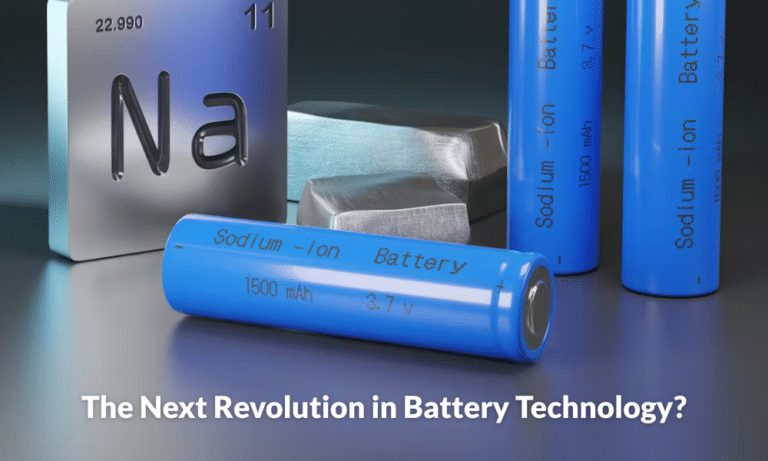
As CATL’s Naxtra cells hit passenger cars in 2026 and MIT names the technology a Breakthrough of the Year, sodium-ion batteries are poised to redraw the map of electrification—from winter-proof EVs to cheaper grid storage. Here’s why the shift is happening faster than anyone predicted.
It is February 2026, and in Inner Mongolia—one of the coldest inhabited regions on Earth—a sedan rolls off an assembly line fitted with a battery that contains no lithium. The car is the Changan Nevo A06, its chemistry is sodium-ion, and its cells are stamped with the name Naxtra, the new flagship battery brand of CATL, the world’s largest battery producer. Outside, the temperature hovers around minus thirty Celsius. Inside the pack, the discharge power at that temperature is roughly triple what an equivalent lithium iron phosphate battery could deliver. The car drives away. In a single uneventful moment, an idea that spent two decades circling the perimeter of serious energy science became a commercial product.
This is the context behind a deceptively simple observation that has begun circulating among investors, policymakers, and grid planners in early 2026: sodium-ion batteries are finally arriving, and they are arriving faster than almost anyone predicted. On January 12, MIT Technology Review included sodium-ion batteries in its annual list of 10 Breakthrough Technologies, a roster whose alumni include mRNA vaccines and deep learning. By January 23, CATL’s CTO had publicly confirmed that the Naxtra line would enter mass-market passenger vehicles in Q2 2026, starting with a GAC Aion model. The acceleration is not coincidental. It is the product of converging forces—technical, economic, and geopolitical—that have been building for years and are now, simultaneously, reaching maturity.
Why Sodium-Ion Batteries Matter Now: The Chemistry in Plain Language
A sodium-ion battery (sodium ion battery, or SIB) works on precisely the same principle as a lithium-ion cell: ions shuttle between a cathode and an anode through an electrolyte, releasing or storing electrical energy as they move. Swap lithium for sodium and the physics remain largely intact. The crucial difference lies not in electrochemistry but in raw materials.
Lithium is a geographically concentrated element. Roughly 60 percent of the world’s economically extractable lithium reserves sit in Chile, Australia, and Argentina, with China controlling the dominant share of refining capacity. Sodium, by contrast, is the sixth most abundant element in the Earth’s crust. It is present in seawater, rock salt, and the mineral deposits that underlie much of the inhabited world. It costs, on average, a fraction of lithium carbonate to source at the raw-material level, and it requires none of the cobalt or nickel that have historically plagued lithium-ion supply chains with ethical sourcing concerns and price volatility.
The practical limitation is equally clear: sodium ions are larger and heavier than lithium ions, making it harder to achieve the same energy density per kilogram. For much of the last decade, that gap was simply too large to overcome commercially. What has changed is not the fundamental physics, but the engineering response to it.
CATL Naxtra: From Lab to Road
The clearest evidence of sodium-ion batteries’ maturation is CATL’s Naxtra line, unveiled at the company’s inaugural Super Tech Day in April 2025. The Naxtra passenger-vehicle cell achieves an energy density of 175 Wh/kg—matching the higher end of lithium iron phosphate (LFP) performance and representing the highest energy density among commercialised sodium-ion batteries globally. By using a cell-to-pack architecture that eliminates intermediate modules, CATL extracts up to 400 kilometres of range on the Chinese driving cycle, with the company projecting that range will climb toward 600 km as the sodium supply chain matures.
The cold-weather story is even more striking. At minus 40 degrees Celsius, the Naxtra pack retains over 90 percent of its usable capacity. At minus 30 degrees, its discharge power is approximately three times higher than an equivalent LFP battery. Stable power delivery has been demonstrated down to minus 50 degrees. For context: standard lithium-ion EVs in Norwegian or Canadian winters routinely lose 30 to 40 percent of their stated range in sub-zero temperatures, a phenomenon that has slowed adoption in precisely the high-latitude markets that most need to decarbonise transport.
The deployment timeline is now concrete. Changan Automobile rolled out the world’s first mass-production sodium-ion passenger car in Inner Mongolia on February 5, 2026, with full market release targeted for mid-year. The GAC Aion line and JAC commercial vehicles are next in CATL’s confirmed schedule, with mass production of Naxtra cells across all segments expected to reach meaningful scale by July 2026. Simultaneously, CATL has deployed the Naxtra 24V heavy-duty truck start-stop battery, which the company claims reduces total lifecycle costs by 61 percent versus traditional lead-acid batteries and delivers reliable cold starts after a full year of idle storage.
Sodium Ion vs Lithium Ion 2026: Reading the Cost Curve
The price comparison between sodium-ion and lithium-ion is more nuanced than early headlines suggested. Sodium-ion cells currently average around $59 per kilowatt-hour, while LFP cells average $52 per kWh—meaning, counterintuitively, that today’s sodium-ion batteries are marginally more expensive than the cheapest lithium chemistry. The paradox is structural: sodium-ion’s material costs are genuinely lower, but production volumes remain small, keeping per-unit manufacturing costs elevated.
The crossover is coming, and it will be driven by two factors working simultaneously. First, lithium carbonate prices, which fell sharply through 2023 and 2024, have begun ticking upward again in early 2026, eroding LFP’s cost advantage. Second, sodium-ion manufacturing infrastructure does not require expensive retooling. The process for making sodium-ion cells closely mirrors that of lithium-ion production lines, allowing manufacturers to repurpose existing equipment. Industry research suggests sodium-ion cells can ultimately be manufactured at 20 to 30 percent below LFP cost once production scales to comparable volumes.
Several cost drivers that analysts often overlook reinforce this trajectory:
- No cobalt, no nickel. Sodium-ion cathodes—typically layered oxide or Prussian blue analogue structures—use inexpensive, widely available materials.
- Aluminium current collectors. Unlike lithium-ion cells, which require copper foil for the anode current collector (copper trading at around $9,000 per tonne), sodium-ion cells can use aluminium throughout, since sodium does not alloy with aluminium at low potentials.
- Simpler thermal management. The superior thermal stability of sodium-ion cells reduces the cost of battery management systems and cooling infrastructure, particularly in stationary storage applications.
- Cycle life. CATL claims over 10,000 cycles for Naxtra cells, dramatically reducing lifetime cost calculations for grid storage operators.
Sodium-Ion Battery Market Projections 2030: Between Caution and Ambition
The forecasting range for sodium-ion batteries is exceptionally wide, which itself tells a story about the technology’s position: past proof-of-concept, not yet at predictable scale. IDTechEx projects global sodium-ion production capacity could exceed 100 GWh annually by 2030, up from an estimated 9 to 10 GWh shipped in 2025. IRENA analysts, surveying a wider set of industry sources, report projections ranging between 50 and 600 GWh per year by 2030—a fivefold spread that reflects genuine uncertainty about the speed of demand pull-through.
Chinese industry research is somewhat more bullish, projecting the country’s domestic sodium-ion market alone growing from roughly 10 GWh in 2025 to 292 GWh by 2034, at an average annual growth rate near 45 percent. China currently accounts for more than 95 percent of announced global production capacity, with the pipeline of sodium-ion factory construction projects expanding relentlessly.
In market value terms, the global sodium-ion battery sector was worth approximately $1.17 billion in 2024 and is projected to reach $6.83 billion by 2034. More conservative estimates place the 2030 figure at around $2 billion, reflecting uncertainty about the pace of passenger-vehicle adoption outside China.
Sodium-Ion Batteries EVs: Where the Technology Fits Today
The common mistake in early coverage of sodium-ion was to frame it as a direct challenger to premium lithium—a replacement for the long-range, high-performance packs in luxury EVs. That framing was always wrong. The more accurate picture, emerging clearly in 2026, is one of complementarity across a segmented market.
Where sodium-ion is most competitive right now:
- Urban passenger cars and city EVs. The 400 km range of the Naxtra system covers more than half of typical daily driving needs in China and Europe. For buyers who charge overnight and drive urban routes, energy density is not the binding constraint—cost is.
- Two- and three-wheelers. Scooter maker Yadea launched four sodium-ion-powered models in 2025, and delivery-fleet operators in Chinese cities have begun piloting battery-swap stations for sodium-ion two-wheelers. Low-speed EVs and cargo bikes represent a market of hundreds of millions of units where the energy-density penalty is irrelevant.
- Battery-swap infrastructure. CATL’s own Choco-Swap network—targeting over 2,500 stations in 120 Chinese cities by end of 2026—is explicitly designed to accommodate Naxtra sodium cells, making swap-station economics viable at lower capital cost per installed kWh.
- Grid storage. The most transformative near-term application may be stationary. In May 2025, China Southern Power Grid commissioned a 200 MW hybrid storage station in Yunnan Province, combining sodium-ion and lithium-ion cells to stabilise output from more than 30 wind and solar plants. In the United States, Peak Energy signed a multi-year agreement in late 2025 to supply 4.75 GWh of sodium-ion storage systems to Jupiter Power between 2027 and 2030.
Sodium-Ion Batteries Geopolitics: The Strategic Significance Beyond Chemistry
Energy security analysts have been slow to fully map the geopolitical implications of sodium-ion’s rise, but those implications are substantial. The lithium-ion battery value chain is, in blunt terms, a Chinese supply chain: China refines roughly 60 percent of the world’s lithium, produces the majority of cathode materials globally, and manufactures nearly three-quarters of the world’s battery cells.
Sodium-ion does not immediately disrupt that structure—CATL and BYD are, after all, the leading sodium producers. But it creates a structural opening. Because sodium is abundant on every continent, governments in Europe, Southeast Asia, South Asia, and sub-Saharan Africa can, in principle, build competitive sodium-ion industries without dependence on geographically concentrated upstream supply chains. The European Economic and Social Committee (EESC) formally called for sodium-ion batteries to be placed at the centre of EU industrial strategy in late 2025, with dedicated studies and stakeholder work under development. European startups—Faradion (UK, acquired by India’s Reliance Industries), Tiamat (France, backed by Stellantis), Altris (Sweden), and PHENOGY—are building an ecosystem designed to capture the technology before China fully locks in its advantage.
For emerging markets, the calculus is even more direct. A sodium-ion grid-storage industry requires no lithium imports, no cobalt sourcing from the Democratic Republic of Congo, and no dependence on deep-sea mining of manganese nodules. The raw material is, almost literally, salt. For economies in South and Southeast Asia seeking to build domestic energy-storage capability alongside rapidly expanding solar and wind generation, that is a genuinely transformative proposition.
Sodium-Ion Batteries Cold Weather Performance: The Nordic Opportunity
There is a particular irony in the fact that lithium-ion batteries perform worst precisely where electrification incentives are strongest. Scandinavian governments have offered among the world’s most generous EV subsidies, yet Norwegian and Swedish EV owners consistently report the most severe winter range anxiety. At minus 20 Celsius, a standard NMC lithium battery pack can lose 35 to 40 percent of its rated capacity. At minus 30, some LFP packs cease to accept meaningful charge at all.
The Naxtra system’s ability to charge at minus 30 degrees and retain 90 percent capacity at minus 40 addresses this problem at the chemistry level rather than through expensive thermal management additions. While CATL has not announced European distribution of the Naxtra passenger platform, its architecture is clearly designed with cold-climate markets in mind. LG Energy Solution’s decision to open a sodium-ion pilot line in China in late 2025 suggests the Korean battery sector—which supplies significant European and North American capacity—is preparing for western deployment.
BYD, the Hard-Carbon Bottleneck, and the Road Ahead
CATL’s Naxtra launch has attracted the most attention, but it is not operating alone. BYD began constructing its first sodium-ion battery factory in Xuzhou in January 2024, committing 10 billion yuan ($1.4 billion) to a facility targeting 30 GWh of annual output. The company is simultaneously advancing a third-generation sodium-ion platform designed for up to 10,000 charge cycles—significantly beyond the 2,000 to 3,000 cycles typical of LFP—though it has not yet disclosed energy density specifications for that generation. HiNa Battery Technology, a specialist firm backed by the Chinese Academy of Sciences, has four sodium-ion product lines in commercial production, including low-speed EV and energy-storage formats.
The most pressing technical constraint is not the cell itself but the anode material. Sodium-ion batteries require hard carbon—a disordered carbon structure derived from organic precursors like coconut shell, resin, or biomass—rather than the graphite used in lithium-ion cells. Hard-carbon supply chains remain nascent, and scaling them while maintaining quality and cost competitiveness is the principal bottleneck limiting how quickly sodium-ion can move beyond its current deployment envelope. Several Chinese chemical companies are building hard-carbon anode plants—Wuhan Tian Na Technology is constructing a 130,000-tonne-per-year facility backed by CNY 58 billion in investment—but the timelines are measured in years, not months.
A balanced assessment must also acknowledge that sodium-ion is not, and may never be, the right chemistry for every application. Long-range premium EVs, aviation electrification, and high-density portable electronics will continue to demand the energy-per-kilogram performance that advanced lithium chemistries—and eventually solid-state cells—can provide. The future of electrification is not a single chemistry triumphant, but a diversified portfolio of technologies, each matched to the application for which its properties are best suited.
The Dual-Chemistry Era: What Comes Next
The image that best captures sodium-ion’s trajectory is not displacement but diversification. CATL itself calls this the “Multi-Power Era”—a strategic framing in which Naxtra sits alongside LFP, NMC, and the company’s next-generation Shenxing superfast-charging cells, each addressing a different layer of the market. The company’s own Freevoy Dual-Power battery combines a sodium-ion cell with an LFP cell in a single pack, using sodium’s cold-temperature superiority for low-state-of-charge winter performance while relying on LFP for energy density at moderate temperatures.
For grid operators, policymakers, and infrastructure investors, the practical near-term message is this: sodium-ion batteries are now commercially available, cost-competitive with LFP at the system level in stationary storage, and improving on a steep cost-and-performance curve. Projects planned today for 2027 and 2028 delivery should evaluate sodium-ion seriously. For EV markets, the chemistry fills a genuine gap in the cost and climate-resilience spectrum that neither LFP nor NMC currently addresses. And for governments with ambitions to build domestic battery industries without the geopolitical baggage of lithium dependence, sodium-ion represents the most accessible entry point in the history of electrochemical storage.
The car that rolled out of Inner Mongolia in February was unremarkable to look at. Salt-based chemistry, sub-zero temperatures, commercial-grade engineering. But the uneventfulness was the point. Technologies only truly arrive when they stop being surprising.
FAQ: Sodium-Ion Batteries 2026
What makes sodium-ion batteries different from lithium-ion batteries in 2026?
Sodium-ion batteries use sodium ions—derived from abundant, inexpensive salt-based materials—instead of lithium to store and release electrical energy. The core electrochemical process is nearly identical to lithium-ion, but sodium-ion cells offer superior cold-weather performance, simpler supply chains with no cobalt or nickel dependency, and lower projected manufacturing costs at scale. The main trade-off remains lower energy density compared to high-end lithium-ion chemistries.
Why do sodium-ion batteries perform better in cold weather than lithium-ion?
Sodium ions have faster ionic conductivity at low temperatures relative to the electrochemical constraints of lithium intercalation in graphite. CATL’s Naxtra cells retain over 90 percent of usable capacity at minus 40 degrees Celsius and can charge at minus 30 degrees—conditions under which LFP batteries experience severe power and capacity degradation. This makes sodium-ion batteries particularly valuable for EVs in Nordic, Canadian, and high-altitude Asian markets.
What are the sodium-ion battery market projections for 2030?
Projections vary widely. IDTechEx estimates global production capacity could exceed 100 GWh per year by 2030. IRENA surveys of industry sources place the range at 50 to 600 GWh annually. Chinese industry analysts project China’s domestic market alone could reach nearly 300 GWh by 2034. The market’s value is projected to grow from roughly $1.2 billion in 2024 to between $2 billion and $6.8 billion by 2030 to 2034, depending on EV adoption rates and grid storage deployment speed.
When will CATL’s Naxtra sodium-ion batteries be available in passenger vehicles?
CATL began mass production of Naxtra sodium-ion batteries for passenger vehicles in Q2 2026. The first mass-production car equipped with Naxtra cells—the Changan Nevo A06—was unveiled in Inner Mongolia in February 2026, with market release targeted for mid-year. The GAC Aion line and JAC commercial vehicles are also confirmed for Naxtra deployment, with CATL targeting full volume production across passenger, commercial, and energy storage segments by July 2026.
What are the geopolitical implications of sodium-ion batteries for global energy supply chains?
Because sodium is one of the most abundant elements on Earth, sodium-ion batteries can, in principle, be manufactured without the geographically concentrated supply chains that characterise lithium-ion. This reduces dependence on lithium from Chile, Argentina, and Australia, cobalt from the Democratic Republic of Congo, and Chinese refining capacity. European governments and the EESC have identified sodium-ion as a strategic priority for building domestic battery industries. For emerging markets in South Asia, Southeast Asia, and Africa, sodium’s ubiquity offers a realistic pathway to energy storage self-sufficiency without the political and economic entanglements of lithium procurement.
Discover more from The Economy
Subscribe to get the latest posts sent to your email.


Analysis
KSE-100 Plunges Nearly 7% Amid Escalating Middle East Tensions: What It Means for Pakistan’s Economy
The digital clock on Mr. Ahmed’s trading terminal in Karachi’s bustling financial district had barely clicked past 9:15 AM when the screen turned a ghastly red, reflecting the collective dread that swept through the Pakistan Stock Exchange (PSX). His life savings, meticulously built over decades of cautious investment, seemed to evaporate with each precipitous drop in the KSE-100 Index.
“It’s not just numbers on a screen,” he’d often tell his children, “it’s the future of our family, the cost of our education, the roof over our heads.” Today, that future felt acutely fragile. The morning’s aggressive sell-off wasn’t merely a market correction; it was a visceral reaction to geopolitical tremors reverberating from distant shores, a stark reminder of Pakistan’s deep integration into a volatile global economy.
Why KSE-100 Fell Today: A Cascade of Geopolitical Risk
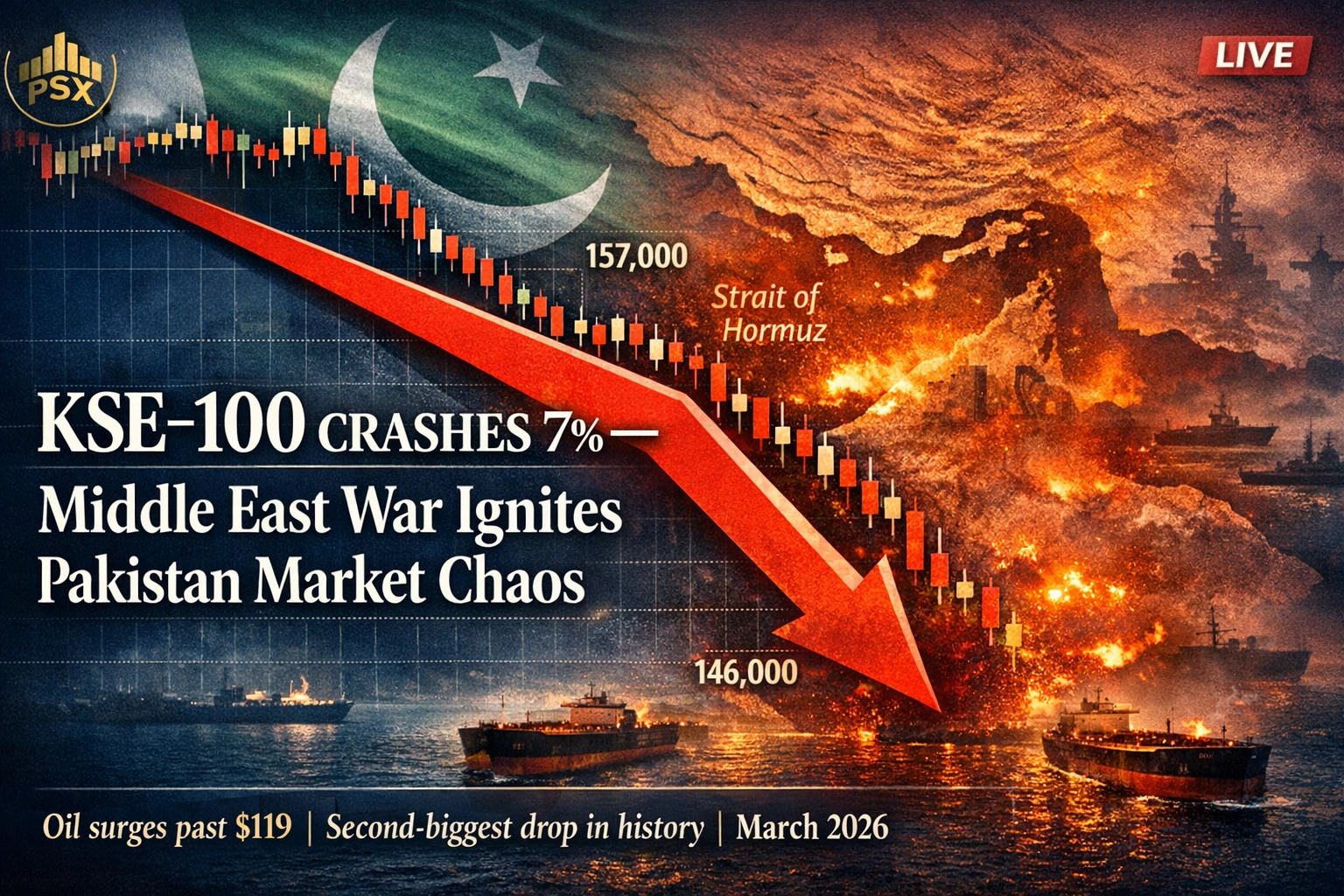
Monday, March 9, 2026, will be etched into the annals of Pakistan’s financial history as a day of profound market distress. The KSE-100 Index settled at 146,480.14, marking a stunning 11,015.96 points (or 6.99%) decline. This devastating fall, the second-highest single-day percentage drop in the index’s history, sent shockwaves across the nation’s financial landscape.
The day began with an immediate and aggressive sell-off, shedding 9,780.15 points (6.21%) by 9:22 AM. This dramatic freefall triggered a full market halt, as per PSX rules for circuit breakers, with the KSE-30 Index down 5%. Trading resumed precisely an hour later, at 10:22 AM, yet any hopes of a substantial recovery were dashed. A limited midday rebound gave way to a largely sideways and uncertain afternoon, as investors grappled with the unfolding global narrative.
The primary catalyst for this precipitous decline was unmistakably clear: escalating tensions in the Middle East. The deepening U.S.-Israeli conflict with Iran has unleashed a wave of uncertainty across global markets, but its impact is acutely felt in economies like Pakistan, highly dependent on imported energy. The immediate and most alarming fallout has been in the oil markets, with prices surging by an astounding ∼20% to multi-year highs, now exceeding $119 per barrel. Fears of disruption to the vital Strait of Hormuz, through which a significant portion of the world’s oil transits, have ignited a scramble for energy security and sent commodity markets into disarray [reuters_oil_surge_analysis].
A Troubling Precedent: KSE-100 Single-Day Decline 2026
The severity of today’s market performance is amplified by its historical context. Topline Securities research highlights a deeply concerning trend: the three largest single-day declines in the KSE-100’s history have all occurred in 2026. This alarming statistic suggests not merely a temporary blip, but potentially a new, more volatile paradigm for Pakistan’s equity markets, underscoring the fragility inherent in its economic structure in the face of external shocks.
Historically, Pakistan’s markets have shown resilience, navigating political upheavals, economic crises, and regional conflicts. However, the confluence of persistent domestic vulnerabilities — including perennial balance of payments issues, high public debt, and inflationary pressures — with intensified global geopolitical instability is creating a perfect storm. The market’s reaction today is a testament to the fact that while local factors are always at play, the sheer force of global events can swiftly overshadow them, particularly when they impinge on fundamental economic costs like energy.
Macroeconomic Fallout: Impact of Iran Conflict on Pakistan Stock Market
The implications of the surging oil prices and the wider Middle East conflict for Pakistan’s economy are profound and multifaceted.
- Inflationary Spiral: Pakistan is a net oil importer, making its economy highly vulnerable to global energy price shocks. A sustained increase in oil prices to over $119/barrel will inevitably translate into higher domestic fuel and power costs. This will directly feed into an already elevated inflation rate, eroding purchasing power and potentially triggering social unrest. The State Bank of Pakistan will face immense pressure to maintain tight monetary policy, further stifling economic growth [bloomberg_energy_crisis_inflation_shock].
- Rupee Depreciation & Balance of Payments Crisis: Higher oil import bills will place an unbearable strain on Pakistan’s foreign exchange reserves. This intensified demand for dollars to finance imports will inevitably lead to further depreciation of the Pakistani Rupee. A weaker rupee makes all imports more expensive, fueling a vicious cycle of inflation and exacerbating the balance of payments deficit. The central bank’s ability to defend the currency will be severely tested.
- IMF Programme Jeopardised: Pakistan is currently engaged in a critical International Monetary Fund (IMF) programme, which often hinges on fiscal discipline and external account stability. The unforeseen surge in oil prices could derail key macroeconomic targets, jeopardizing tranche disbursements and potentially leading to renegotiations or even suspension of the programme. This would send a catastrophic signal to international lenders and investors, further tightening access to much-needed external financing.
- FDI Flight and Investor Confidence: Foreign Direct Investment (FDI), always a sensitive indicator, is likely to pull back significantly. Global investors perceive Pakistan as an emerging market with inherent risks; escalating regional conflict and economic instability dramatically heighten that risk premium. The why KSE-100 fell today Middle East Iran war narrative sends a clear message of heightened risk, prompting a flight to safer assets and reducing the appetite for frontier market exposure.
- Energy Cost & Industrial Output: For Pakistan’s manufacturing and industrial sectors, higher energy costs mean reduced competitiveness and increased operational expenses. This could lead to factory closures, job losses, and a slowdown in economic activity, further dampening prospects for growth and poverty alleviation.
Global Echoes & Investor Lessons: Lessons from Past Crises
The current geopolitical and energy shock, while unique in its specifics, echoes past crises that have tested the resilience of emerging markets. Comparisons might be drawn to the oil shocks of the 1970s or the Asian Financial Crisis of the late 1990s, where external vulnerabilities coupled with internal imbalances created systemic risks. Bloomberg’s analysis of the Iran conflict’s impact on emerging markets [bloomberg_emerging_markets_fallout] highlights the fragility of recovery narratives when confronted with such potent external forces.
For international investors, today’s PSX trading suspended oil price surge 2026 event serves as a sharp reminder of the importance of geopolitical risk assessment, especially in regions with high energy import dependence and pre-existing economic fragilities. Diversification, hedging strategies, and a keen eye on global macro trends become not just advisable, but imperative. The KSE-100, once hailed for its potential, now stands as a cautionary tale of how quickly sentiment can turn amidst global uncertainty.
Outlook: Will Markets Stabilise?
The immediate outlook for the Pakistan Stock Exchange decline remains precarious. While the initial shock of the largest single-day falls KSE-100 history event has been absorbed, sustained market stability will depend on several critical factors:
- De-escalation in the Middle East: Any diplomatic breakthroughs or de-escalation of military tensions would provide immediate relief to oil markets and, by extension, to Pakistan’s economy. However, the current trajectory suggests a prolonged period of uncertainty.
- Global Oil Price Trajectory: If oil prices consolidate at or above $119/barrel, the economic headwinds for Pakistan will persist and intensify. A significant pullback in crude prices would offer a much-needed reprieve.
- Policy Response: The Government of Pakistan and the State Bank will need to demonstrate swift and decisive policy responses. This includes robust fiscal management to mitigate inflationary pressures, strategic foreign exchange interventions (if feasible), and clear communication with the public and international stakeholders to restore confidence. Austerity measures, however unpopular, may become unavoidable.
- International Support: The role of international financial institutions and friendly nations will be crucial. Access to emergency financing or favourable credit lines could provide a much-needed buffer against external shocks and prevent a full-blown financial crisis.
Conclusion: Navigating the Storm with Measured Hope
Today’s dramatic events on the Pakistan Stock Exchange are more than just a blip on the radar; they are a stark reflection of the interconnectedness of global finance and geopolitics. The KSE-100’s near 7% plunge underscores Pakistan’s acute vulnerability to external shocks, particularly when domestic economic fundamentals remain challenging.
For investors, both local and international, prudence is paramount. For policymakers, the path ahead demands decisive action, strategic foresight, and unwavering commitment to economic stability. While the immediate future appears fraught with challenges, Pakistan has a history of resilience. With judicious policy-making, transparent communication, and timely international support, the nation can hope to navigate these tempestuous waters. The human stories, like Mr. Ahmed’s, remind us that behind every market statistic lies real livelihoods, real aspirations, and a profound hope for a more stable tomorrow.
Discover more from The Economy
Subscribe to get the latest posts sent to your email.
The room at the State Bank of Pakistan’s Karachi headquarters may have been airconditioned on a warm Monday morning, but the temperature in global energy markets was anything but. As Governor Jameel Ahmad chaired the second Monetary Policy Committee meeting of 2026, Brent crude was careening past $103 a barrel — its highest since 2022 — while tanker traffic through the Strait of Hormuz had ground to a near-halt under the shadow of the US-Israeli war on Iran. The MPC’s decision, telegraphed by virtually every analyst in the market, arrived with unusual unanimity: the benchmark policy rate would stay unchanged at 10.5%.
It was a pause born not of confidence, but of calibrated caution — and perhaps the most consequential hold in Pakistan’s two-year monetary easing cycle.
SBP MPC Decision March 2026: What the Statement Actually Says
The official Monetary Policy Statement was diplomatically precise in framing the dilemma. “While the incoming data was largely consistent with the macroeconomic projections shared after the January meeting,” the MPC noted, “the Committee observed that the macroeconomic outlook has become quite uncertain following outbreak of the war in the Middle East.”
That single sentence encapsulates the entire complexity facing Pakistan’s central bank in March 2026: the domestic data looks broadly fine; the external world does not.
The MPC went further, identifying three concrete transmission channels through which the conflict is striking the Pakistani economy: a sharp rise in global fuel prices, elevated freight and insurance costs, and disruptions to cross-border trade and travel. “Given the evolving nature of events,” it added, “the intensity and duration of the conflict will both be important determinants of the impact on the domestic economy.”
In other words, the SBP is watching, not acting — and deliberately so.
Pakistan Interest Rate Hold: The Numbers Behind the Decision
To understand why the MPC held, it helps to survey the macroeconomic landscape that informed the room.
Inflation rebounding, but manageable — for now. After dipping as low as 3% mid-2025, Pakistani consumer price inflation climbed to 5.8% year-on-year in January 2026 and further to 7% in February — the upper edge of the SBP’s 5–7% medium-term target range. Core inflation has remained persistently sticky, hovering around 7.4% in recent months. The MPC had flagged at the January meeting that some months in the second half of FY26 could breach 7%; February’s print validated that warning precisely. With petrol prices raised by Rs55 per litre to Rs321.17 in the days before the meeting — a direct pass-through of the global energy shock — the domestic inflation trajectory has become materially more uncertain.
The external account: resilience with caveats. The current account posted a surplus of $121 million in January 2026, compressing the cumulative July–January FY26 deficit to just $1.1 billion. Workers’ remittances — a structural pillar of Pakistan’s external financing — continued to absorb a significant share of the trade deficit, while the SBP’s ongoing interbank foreign exchange purchases helped drive liquid FX reserves to $16.3 billion as of February 27, up from $16.1 billion in mid-January. The committee set a firm target of reaching $18 billion by June 2026 — a milestone that now depends critically on the timely realisation of planned official inflows, including disbursements under Pakistan’s $7 billion IMF Extended Fund Facility.
GDP momentum intact but under threat. Large-scale manufacturing growth has surprised to the upside this fiscal year, and the SBP maintained its GDP growth projection at 3.75–4.75% for FY26. Private sector credit expanded by Rs187 billion between July and November FY25, led by textiles, wholesale & retail, and chemicals. Consumer financing — particularly auto loans — has strengthened as financial conditions eased. But the current oil shock introduces a significant headwind: higher input costs, squeezed margins, and the prospect of renewed monetary tightening if inflation reaccelerates.
Pakistan Economy Risks: The Gulf Conflict Inflation Channel
The geopolitical backdrop informing this decision is arguably the most volatile since Russia’s invasion of Ukraine in February 2022, and the MPC explicitly drew that parallel. “The macroeconomic fundamentals, especially in terms of inflation and the country’s FX and fiscal buffers, are better compared to the time of the start of the Russia-Ukraine war in early 2022,” the statement noted — a reassuring comparison, but one that implicitly acknowledges the severity of the threat.
Here is what has unfolded in the space of roughly ten days:
| Event | Market Impact |
|---|---|
| US-Israeli strikes on Iran begin (Feb 28) | Brent crude +25% in two weeks |
| Strait of Hormuz shipping near-halted | Freight & war-risk insurance surges |
| Iraq output collapses 60–70% | Global supply shortfall ~20 mb/d |
| Brent crude surpasses $103/bbl (Mar 9) | Highest since Russia-Ukraine shock |
| Qatar warns of $150/bbl risk | G7 emergency reserve discussions begin |
For Pakistan specifically, the pass-through arithmetic is sobering. The country imports virtually all of its crude oil requirements; historically, a $10 rise in Brent crude adds approximately 0.5–0.6 percentage points to Pakistan’s CPI within two to three quarters. With Brent having surged nearly $30 above its pre-conflict baseline, the potential inflation add-on over the coming two quarters — absent countervailing fiscal measures — could be 1.5–1.8 percentage points. That alone would push headline inflation toward 8.5–9%, well outside the target range and into territory that could force the SBP’s hand toward a rate increase.
The freight and insurance channel matters too. Pakistan’s exports — textiles, leather goods, surgical instruments — predominantly move by sea. War-risk insurance premiums for vessels transiting the Gulf region have spiked dramatically since late February, compressing export margins and threatening the competitiveness that the country has painstakingly rebuilt over the past eighteen months. Importers face mirror-image pressures: higher landed costs for energy, industrial inputs, and food commodities.
SBP Rate Decision Analysis: Why the Easing Cycle Has Effectively Paused
This is the SBP’s second consecutive hold — a sharp turn from the aggressive easing trajectory of the previous eighteen months. Between June 2024 and December 2025, the Monetary Policy Committee delivered a cumulative 1,150 basis points of rate cuts, bringing the policy rate down from a record 22% to 10.5%. That was one of the most dramatic easing cycles in any major emerging market during that period, and it was earned: inflation collapsed from multi-decade highs above 38% to the lower single digits, the rupee stabilised, and FX reserves rebuilt from critical lows.
The January 2026 hold surprised many analysts — Arif Habib Limited had pencilled in a 75bps cut to 9.75%, and a Reuters poll had pointed to a 50bps reduction — but it now reads as prescient caution. Governor Ahmad flagged at that press conference that inflation could breach 7% in some second-half months. It did, in February. The Middle East crisis then eliminated whatever residual space for cuts remained.
A Reuters poll conducted ahead of Monday’s meeting found near-unanimous consensus for a hold, with Topline Securities reporting that 96% of survey respondents expected no rate cut — a remarkable about-face from the 80% who had anticipated a cut ahead of January’s meeting. The shift in market expectations speaks to how quickly the geopolitical risk premium has repriced Pakistan’s monetary outlook.
The IMF’s own guidance reinforces the SBP’s caution. During its second programme review, the Fund urged that monetary policy remain “appropriately tight and data-dependent” to keep inflation expectations anchored and external buffers intact — language that sits uncomfortably with near-term rate cuts.
SBP FX Reserves and the External Account: A Fragile Resilience
Perhaps the most reassuring aspect of Monday’s statement was its treatment of the external account. The current account surplus in January, continued SBP interbank purchases, and the gradual rebuild of FX reserves to $16.3 billion all suggest that Pakistan enters this shock with considerably better buffers than it possessed in 2022 — when reserves plunged below $4 billion and the country teetered on the edge of sovereign default.
That buffer is real, but it is not inexhaustible. Three risks loom:
Oil import bill expansion. Pakistan’s monthly crude import bill will rise sharply if prices sustain above $100/bbl. The SBP’s current account deficit projection of 0–1% of GDP for FY26 was modelled on oil in the $70–80 range. A prolonged Hormuz closure tilts that range meaningfully toward the upper bound — or beyond it.
Remittance disruptions. A significant portion of Pakistani workers are employed in Gulf states — Saudi Arabia, the UAE, Qatar, and Kuwait collectively host over 4 million Pakistani expatriates. Gulf economic disruption, energy revenue compression, and potential labour-market contraction in those countries could dampen remittance flows, removing a critical current account stabiliser.
Official inflow timing. The SBP’s $18 billion FX reserve target for June 2026 hinges on planned official inflows materialising on schedule. Geopolitical turbulence has historically caused IMF disbursement delays and bilateral lending hesitancy. Any slippage here would tighten the external constraint and, with it, the SBP’s room for manoeuvre.
Pakistan Economy Risks and Scenarios: Three Paths From Here
Scenario 1 — Rapid de-escalation (probability: low-medium). A swift US-Iran deal and Hormuz reopening within two to four weeks would allow oil prices to retreat toward $70–80/bbl, stabilise Pakistan’s import bill, and potentially reopen the door to a 25–50bps cut at the May 2026 MPC meeting. This is the base case for FY26 projections remaining intact.
Scenario 2 — Prolonged but contained conflict (probability: high). A six-to-eight week Hormuz disruption, with Brent stabilising in the $90–110 range, would push Pakistan’s CPI toward 8–9% in Q4 FY26 and FY27 Q1. The SBP holds through May and likely through July, pausing the easing cycle for two to three meetings. GDP growth dips toward the lower end of the 3.75–4.75% range.
Scenario 3 — Escalation and infrastructure damage (probability: low but non-trivial). Qatar’s energy minister has warned publicly that sustained Hormuz closure could drive Brent to $150/barrel — a scenario that Goldman Sachs estimates could add 0.7 percentage points to Asian inflation for every $15 oil price increase under a six-week closure. For Pakistan, that arithmetic implies a potential CPI overshoot to 10–12%. The SBP would be forced to consider a rate increase — a reversal that would set back the economic recovery significantly, pressure fiscal consolidation, and complicate the IMF programme.
Implications for Pakistani Borrowers, Investors, and Exporters
Corporate borrowers and SMEs: The 10.5% policy rate, while materially lower than the 22% peak, still represents a significant real financing cost for businesses. The hold — and the likelihood of an extended pause — delays the relief that industry bodies had anticipated from a return to single-digit rates. The Pakistan Business Council and various textile associations had lobbied for further cuts to restore export competitiveness.
Fixed-income investors: Government securities yields, which had been compressing in anticipation of further rate cuts, will likely stabilise or widen slightly at the short end as the hold extends. T-bill yields in the 10.5–11% range remain attractive in real terms relative to expected near-term inflation, but the duration risk on longer-tenor PIBs rises in a scenario where rate hikes become plausible.
Equity markets: The KSE-100 index, which had benefited significantly from falling rates and improving macro fundamentals, faces a more challenging environment. Energy sector stocks — particularly downstream oil marketing companies — face margin compression as import costs rise. However, the broader index may find some support from the fact that the SBP is holding rather than hiking, signalling that it views FY26 macroeconomic projections as still broadly achievable.
Exporters and remittance recipients: The PKR/USD exchange rate — which had stabilised in the 278–285 range — faces upward pressure from the widening trade balance. Topline Securities’ pre-MPC survey projected PKR stability in the 280–285 range through June 2026, a projection that assumes oil prices partially retrace from current peaks. Any significant rupee depreciation would create an imported inflation feedback loop that complicates the SBP’s task further.
Structural Reforms: The SBP’s Unanswered Question
Monday’s statement, like its January predecessor, reiterated the need for a “coordinated and prudent monetary and fiscal policy mix — as well as productivity-enhancing structural reforms — to increase exports and achieve high growth on a sustainable basis.” That language has appeared in virtually every MPC statement for years. It points to a fundamental vulnerability that no interest rate decision can resolve.
Pakistan’s export base, dominated by low-value-added textiles, has shown structural stagnation relative to regional peers. Its tax-to-GDP ratio — with FBR revenue growth decelerating to 7.3% in December 2025, well short of budgeted targets — remains among the lowest in Asia. Its energy import dependency leaves the current account structurally exposed to precisely the kind of shock that has arrived this week.
The SBP can hold rates, build reserves, and manage the short-term pass-through of oil prices. What it cannot do is substitute for the fiscal discipline, industrial policy, and governance improvements that would reduce Pakistan’s structural vulnerability to external shocks. The Gulf war has exposed that vulnerability with stark clarity.
Outlook: Cautious Resilience, Rising Risks
The SBP’s decision to hold at 10.5% was the right call for a central bank navigating a crisis of uncertain magnitude and duration. Pakistan enters this shock with better buffers than it possessed in 2022 — higher reserves, lower inflation, a stabilised currency, and an active IMF backstop. Those are not trivial advantages.
But the window for complacency is narrow. Brent crude at $103 and rising, a Hormuz chokepoint under active military threat, and a domestic inflation trajectory already touching the upper edge of the target range leave the SBP with limited runway. Governor Ahmad and his committee have effectively entered a watchful holding pattern: data-dependent, geopolitics-sensitive, and acutely aware that the next move could be a hike rather than a cut.
For global investors watching Pakistan’s emerging-market trajectory, the message is nuanced: the macro stabilisation story remains intact, but the risk premium has risen meaningfully. Sovereign spreads, equity valuations, and the rupee will all need to reprice for a world where $100+ oil is not a tail risk but a baseline.
The easing cycle that began in June 2024 is, for now, on hold. Whether it resumes — or reverses — depends on decisions being made not in Karachi, but in Washington, Tel Aviv, and Tehran.
Discover more from The Economy
Subscribe to get the latest posts sent to your email.
Analysis
Oil Prices Surge as Iran War Escalates: Brent Crude Hits $108, on Track for Record Single-Day Jump
Supply cuts, Hormuz shipping fears, and a widening Middle East conflict are driving crude toward territory not seen since 2022 — and the economic aftershocks are only beginning.
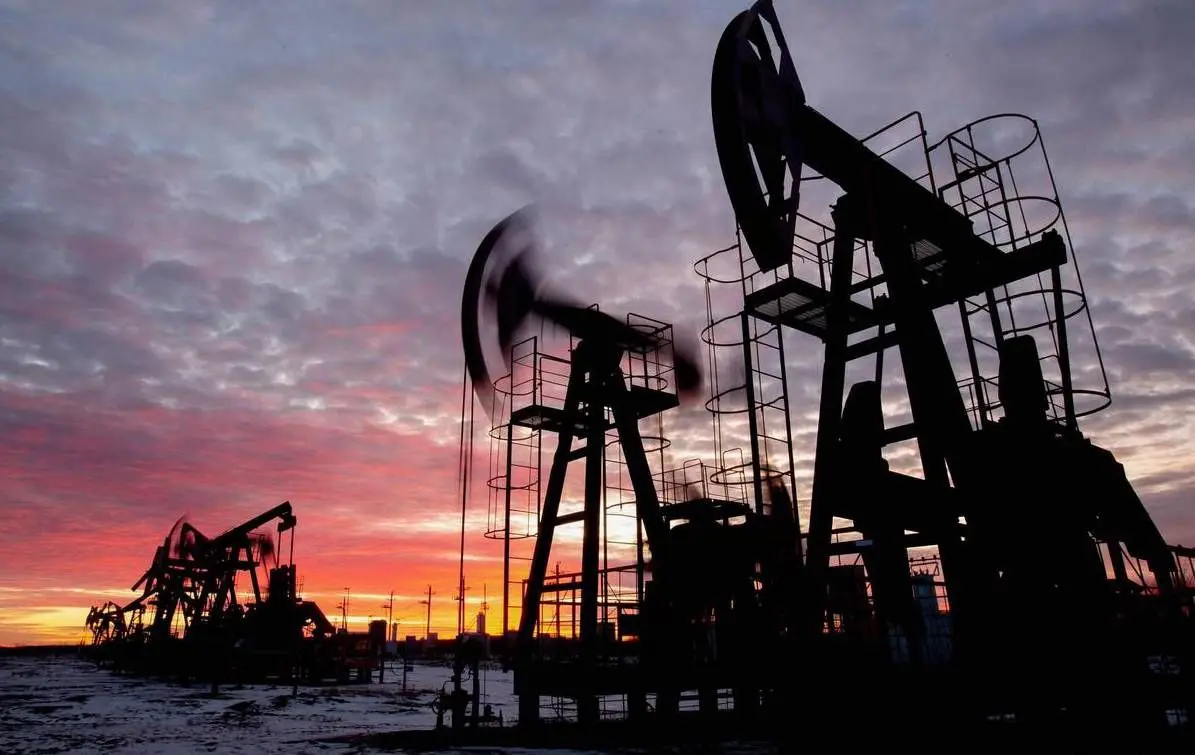
Brent crude futures climbed $15.51, or 16.7%, to $108.20 a barrel on Monday, while US West Texas Intermediate rose $14.23, or 15.7%, to $105.13 — levels unseen since mid-2022, and prices that, if sustained through the close, would mark the largest single-day percentage gain in the modern history of crude benchmarks. The catalyst is neither OPEC politics nor a hurricane in the Gulf of Mexico. It is war.
The expanding US-Israeli military confrontation with Iran — now entering what analysts describe as its most destabilising phase — has injected a risk premium into global energy markets that paper traders, physical buyers, and sovereign wealth funds alike are scrambling to price. Oil pared some of its earlier highs by midday in London, a modest retreat that disciplined traders read not as relief but as the natural breath of a market absorbing something genuinely unprecedented.
Why This Surge Is Different From Every Previous Middle East Flare-Up
Students of the oil market are accustomed to the ritual: missiles fly, crude spikes, diplomats talk, prices retreat. The pattern held through the 2019 Abqaiq attack on Saudi Aramco’s infrastructure, through the 2020 killing of Qasem Soleimani, and through a dozen lesser crises over the past decade.
This time, three structural factors make the calculus profoundly different.
First, major producers have already cut supply. OPEC+ entered this crisis with output voluntarily restrained, meaning there is limited spare capacity to cushion a physical disruption — a point underscored in the IEA’s most recent Oil Market Report, which flagged historically thin global buffers.
Second, the conflict’s geography touches the Strait of Hormuz directly. Approximately 21 million barrels of crude pass through that 33-kilometre chokepoint every day — roughly one-fifth of global consumption. Iranian naval doctrine has long included the option of mining or blockading the strait in extremis, and analysts at Argus Media have warned for months that even a partial disruption lasting two to three weeks could drain OECD commercial inventories to critically low levels.
Third, shipping insurance markets are already responding. War-risk premiums on tankers transiting the Persian Gulf have surged to levels not seen since the 1980s Tanker War, according to underwriters at Lloyd’s. Vessel operators are rerouting around the Gulf of Oman where possible — adding days and cost to journeys that Asian refiners have long taken for granted.
The Asian Importer Problem: Most Exposed, Least Hedged
No region of the world is more structurally vulnerable to a sustained Hormuz disruption than Asia. Japan, South Korea, India, and China collectively import the overwhelming majority of their crude from the Gulf — a dependency built over decades of cost-optimised supply chains that assumed geopolitical stability as a given.
Japanese refiners, operating under long-term contract structures that offer some price protection, are nonetheless exposed to spot market tightness when tanker availability collapses. South Korean petrochemical complexes, among the world’s most sophisticated, are built around a steady diet of Arab Light and Kuwait Export Crude that has no obvious short-term substitute. India, which has in recent years diversified toward discounted Russian Urals, still draws significant volumes from the Gulf and faces its own logistical constraints.
China presents the most complex picture. Beijing holds the world’s largest strategic petroleum reserve, which independent analysts at Kpler estimate could cover roughly 90 days of net import needs at current drawdown rates. That buffer buys time — but not indefinitely — and Chinese refiners scrambling for replacement barrels from West Africa or Latin America would face significant freight cost increases that would erode the margin advantage they currently enjoy.
The macro effect: inflation imported from the energy complex, at precisely the moment Asian central banks believed they had wrestled domestic price pressures under control.
The Road to $120: Scenarios and Probabilities
Commodity desks from Goldman Sachs to BNP Paribas have in recent weeks published scenario analyses suggesting Brent could reach $120 to $130 per barrel if the Hormuz strait is even partially obstructed. A full closure — which Iran has threatened but never executed — would, in most models, push prices toward $150 or beyond, a level that historical precedent suggests would trigger demand destruction across the global economy.
Monday’s rally, though dramatic, still prices in only a partial risk premium. Markets are not yet trading a closure; they are trading the credible possibility of one. That distinction matters enormously.
Key variables the market is watching:
- Duration of active hostilities: A contained exchange followed by ceasefire negotiations would likely see Brent retrace toward $90. A multi-week campaign, particularly one involving Iranian strikes on regional infrastructure, changes the calculus entirely.
- US strategic petroleum reserve deployment: The Biden and Trump administrations have both used SPR releases as a political tool during price spikes. A coordinated IEA release could provide short-term relief — though the IEA’s own guidance suggests member states’ reserve levels have not fully recovered from previous drawdowns.
- US shale response time: American tight oil producers can accelerate output, but the supply response typically takes six to nine months to materialise at scale — cold comfort to a market in acute distress today.
At the Pump: The Human Arithmetic of $108 Oil
The gap between a barrel of Brent crude and the price a commuter pays at a filling station in Manchester, Mumbai, or Minneapolis is not fixed — it is shaped by refinery margins, taxes, retail competition, and currency effects. But at $108 per barrel, the direction of travel for retail fuel prices is unambiguous.
In the United States, where the American Automobile Association tracks retail gasoline in real time, analysts expect the national average to breach $4.00 per gallon within days if futures hold at current levels — a threshold that past polling consistently identifies as the point at which consumers begin visibly altering behaviour: cancelling discretionary road trips, accelerating electric vehicle enquiries, and cutting spending elsewhere.
In Europe, where fuel is already heavily taxed and prices are denominated in euros, the inflationary pass-through is somewhat muted at the retail level but amplified through industrial energy costs. Airlines, petrochemical producers, and logistics companies face immediate margin compression.
For airlines specifically, jet fuel typically represents 20 to 25 percent of operating costs in normal conditions. At current crude levels — and jet fuel commands a premium over crude — that ratio climbs sharply. IATA, the industry’s global body, had projected a return to comfortable profitability for the sector in 2026; those projections are being quietly revised.
Central Banks, Inflation, and the Policy Bind
For monetary policymakers, an oil shock of this magnitude at this juncture is the scenario they hoped to avoid. The Federal Reserve, the European Central Bank, and the Bank of England have spent the better part of three years battling inflation driven in part by the 2021–2022 commodity super-cycle. Having largely succeeded, they are now staring at a potential re-ignition from the supply side — and supply-side inflation is, by definition, something interest rates cannot efficiently address.
The bind is acute: raise rates to signal inflation-fighting resolve, and risk choking off a recovery still tender in several major economies. Hold rates, and risk un-anchoring inflation expectations that took painful years to re-establish.
ECB board members speaking this month had already flagged geopolitical energy risk as the primary tail scenario in their projections. That tail has, as of Monday morning, arrived.
What Comes Next: A Forward Look for Households, Airlines, and Markets
The honest answer, which professional forecasters are reluctant to offer but which the evidence demands, is that uncertainty is now the dominant variable. The range of plausible outcomes — from a rapid ceasefire that allows prices to retrace to $85, to a prolonged conflict that sustains crude above $110 for months — is wider than at any point since the COVID-19 demand collapse of 2020.
What can be said with confidence:
- Households in fuel-import-dependent economies face a material squeeze on disposable income beginning this quarter, with the lowest-income deciles hardest hit as a share of spending.
- Airlines will begin passing costs through within weeks, with surcharges on long-haul routes appearing first, followed by broader fare increases if oil remains elevated.
- Central banks will be slower to cut rates than markets had priced, with rate-cut expectations for mid-2026 across the G7 now requiring significant reassessment.
- Asian sovereign buyers will accelerate their already-underway diversification strategies — both toward non-Gulf suppliers and, at a structural level, toward domestic renewable capacity.
The oil market’s message on Monday was neither hysterical nor irrational. It was the sound of the world repricing risk it had chosen, for too long, to ignore.
Discover more from The Economy
Subscribe to get the latest posts sent to your email.
-

 Markets & Finance2 months ago
Top 15 Stocks for Investment in 2026 in PSX: Your Complete Guide to Pakistan’s Best Investment Opportunities
-

 Analysis1 month ago
Brazil’s Rare Earth Race: US, EU, and China Compete for Critical Minerals as Tensions Rise
-

 Banks2 months ago
Best Investments in Pakistan 2026: Top 10 Low-Price Shares and Long-Term Picks for the PSX
-

 Investment2 months ago
Top 10 Mutual Fund Managers in Pakistan for Investment in 2026: A Comprehensive Guide for Optimal Returns
-

 Asia2 months ago
China’s 50% Domestic Equipment Rule: The Semiconductor Mandate Reshaping Global Tech
-

 Global Economy2 months ago
Pakistan’s Export Goldmine: 10 Game-Changing Markets Where Pakistani Businesses Are Winning Big in 2025
-

 Global Economy2 months ago
What the U.S. Attack on Venezuela Could Mean for Oil and Canadian Crude Exports: The Economic Impact
-

 Global Economy2 months ago
15 Most Lucrative Sectors for Investment in Pakistan: A 2025 Data-Driven Analysis