
Rea Estate
Gen X Millennials Real Estate Inheritance: $124T Wealth Transfer


Baby boomers control $19T in real estate. Discover how Gen X and Millennials will inherit unprecedented wealth and whether they’re prepared for the great wealth transfer ahead.
The $124 Trillion Question Nobody’s Asking
Picture this: Your parents hand you the keys to a $2 million waterfront property in Naples, Florida. Along with it comes a complex portfolio of real estate investments, tax implications you’ve never studied, and decisions that could either preserve or evaporate generations of accumulated wealth within a decade. Are you ready?
Most people aren’t. And that’s the uncomfortable truth sitting at the heart of the largest wealth transfer in human history.
Over the next decade, roughly 1.2 million individuals with net worths of $5 million or more will pass down more than $38 trillion globally, according to research from Coldwell Banker Global Luxury. But zoom out to the full 25-year horizon, and the numbers become almost incomprehensible: $124 trillion in assets will change hands through 2048, with $105 trillion flowing to heirs and $18 trillion designated for charitable causes, per wealth management firm Cerulli Associates.
Featured Snippet Answer: The great wealth transfer in real estate refers to the $124 trillion in assets—including approximately $19 trillion in property holdings—that baby boomers will pass to younger generations through 2048, representing the largest intergenerational wealth shift in history and fundamentally reshaping luxury real estate markets.
At the center of this seismic shift sits real estate—the single largest asset class in most affluent portfolios. Baby boomers currently own nearly $19 trillion in U.S. real estate wealth, representing roughly 41% of all property nationwide despite comprising less than 20% of the population. This isn’t just money changing hands. It’s an entire economic order being rewritten, one inheritance at a time.
Yet here’s what keeps me up at night as someone who’s spent two decades analyzing political economy and wealth dynamics: two-thirds of Gen Z adults report they’re not confident in their understanding of personal finance, and even among their slightly older millennial counterparts, financial literacy rates remain alarmingly low. We’re watching the greatest wealth transfer in history unfold while the recipients are woefully unprepared to manage it.

The Unprecedented Scale: How We Got Here
To understand the magnitude of what’s coming, we need to grasp how baby boomers accumulated this staggering real estate fortune in the first place. This wasn’t luck—it was timing, policy, and compounding advantage working in concert over five decades.
The boomer generation benefited from what economists call a “perfect storm” of wealth accumulation conditions. They entered their prime earning years during the post-war economic expansion, purchased homes when median prices were 2-3 times annual household income (compared to 5-7 times today), and rode an unprecedented wave of property appreciation that saw U.S. home prices surge 47% in just the last five years alone.
But the real wealth multiplier came from policy decisions. Mortgage interest deductions, favorable capital gains treatment on primary residences, and historically low interest rates—particularly the sub-4% mortgages many boomers locked in during the 2010s—created a systematic wealth-building machine that younger generations simply cannot replicate.
According to Federal Reserve data analyzed by Self Financial, boomers hold 51.7% of the nation’s total wealth, with real estate comprising 22.7% of their net worth. Generation X trails with 29.4% of real estate holdings valued at approximately $14 trillion, while millennials own just 20.4%—roughly $10 trillion worth of property, or less than two-thirds of what boomers owned at the same age.
The geographic concentration tells an even more interesting story. Florida dominates the landscape of boomer wealth concentration, claiming five of the top ten metros where retirees hold the most real estate equity. In North Port-Bradenton alone, homeowners aged 65 and older hold $97 billion in property value, representing more than half of all homeowners in that metro area. Naples-Marco Island follows with $70 billion, and Cape Coral adds another $62 billion to Florida’s real estate empire.
This concentration isn’t accidental. It reflects deliberate lifestyle arbitrage—warm weather, no state income tax, purpose-built retirement communities—combined with decades of appreciation in markets that became increasingly desirable. These properties aren’t just homes; they’re multi-million-dollar assets that will soon change hands, whether through inheritance, sale, or some combination of both.
Political Economy Analysis: The Wealth Transfer as a Defining Moment
From a political economy perspective, this wealth transfer represents far more than a private family matter multiplied across millions of households. It’s a stress test for American capitalism, a potential inflection point for wealth inequality, and a policy challenge that Washington is woefully unprepared to address.
Let’s start with the tax dimension, because nothing reveals political priorities quite like tax policy. The federal estate tax exemption—the amount you can transfer tax-free at death—has become a political football with profound implications. Under recent legislation signed in July 2025, the exemption will increase to $15 million per person in 2026, with adjustments for inflation in future years. This represents a significant win for wealthy families and creates a substantial planning opportunity.
But here’s the political economic reality that few people discuss openly: Only about 0.1% of estates will ever pay federal estate taxes under these thresholds. The 40% federal rate applies only after you’ve exhausted your exemption, and with proper planning—trusts, gifting strategies, valuation discounts—even ultra-wealthy families can significantly reduce their exposure.
What does this mean? It means the great wealth transfer will largely proceed without the “progressive taxation” drag that many assume exists. Generational wealth will compound, not disperse. The gap between those inheriting substantial assets and those inheriting nothing will widen dramatically.
Consider the numbers: Millennials are set to inherit $46 trillion, more than any other demographic, by 2048. But this wealth is not evenly distributed. A small percentage of millennials—those whose parents or grandparents own substantial real estate and financial assets—will receive life-changing inheritances. The majority will receive little to nothing.
This bifurcation has profound political implications. We’re creating two Americas: one where young professionals inherit real estate portfolios that instantly catapult them into wealth they could never accumulate through earnings alone, and another where individuals struggle to afford their first home despite advanced degrees and solid careers.
The policy response has been remarkably muted. While politicians debate marginal tax rates on ordinary income, the real wealth transfer—through appreciated real estate, stepped-up basis at death, and sophisticated trust structures—proceeds largely untouched. Some proposals have suggested limiting stepped-up basis or imposing stricter rules on grantor trusts, but these have gained little traction in a political environment reluctant to appear “anti-family.”
From my vantage point as a political economy analyst, this represents a fundamental mismatch between rhetoric and reality. We debate wealth inequality while facilitating the largest tax-advantaged wealth transfer in history. We worry about social mobility while creating structural advantages that compound across generations.
The National Association of Realtors reports that baby boomers now account for 42% of all home buyers, up from 38% just a year ago for millennials. Half of older boomers and 40% of younger boomers are purchasing homes entirely with cash. This isn’t a generation preparing to downsize and release housing inventory—it’s a generation continuing to accumulate and control assets, extending their economic dominance even as biological succession looms.
The international dimension adds another layer of complexity. Dubai’s prime real estate market is projected to grow 5% in 2025, while Paris real estate is experiencing a renaissance with prices projected to rise 2.5% as U.K. and U.S. buyers capitalize on currency advantages. Wealthy Americans are diversifying globally, meaning some of this inherited wealth will flow out of U.S. markets entirely, seeking tax optimization and lifestyle advantages abroad.
The Real Estate Component: Why Property is Central to This Transfer
Real estate occupies a unique position in this wealth transfer, and understanding why requires appreciating its distinctive characteristics as an asset class.
First, real estate represents the largest single asset for most affluent households. Unlike stocks that can be easily divided, or cash that can be quickly spent, real estate comes with emotional attachments, practical complexities, and significant transaction costs. When someone inherits a family home in Santa Rosa with $54 billion held by retirees in that metro, they’re not just receiving a financial asset—they’re inheriting decisions about family legacy, property management, potential sale, and tax planning.
Second, real estate benefits from what I call “politically protected appreciation.” Through zoning restrictions, NIMBY (Not In My Backyard) policies, and limited new construction in desirable markets, existing property owners have essentially weaponized local government to restrict supply and drive up values. Luxury home inventory has reached a two-year high, up 40.4% for single-family and 42.6% for attached properties since last year, but this increase still pales in comparison to demand, particularly in prime coastal markets.
The luxury real estate market is experiencing its own evolution. According to Coldwell Banker’s mid-year analysis, median sold prices for single-family luxury homes rose 1.8% year-over-year and 8.0% over 2023, while attached homes saw an 8.4% year-over-year gain and a 16.5% jump compared to 2023. Despite economic uncertainty, quality properties in prime locations continue commanding premium prices.
But here’s what makes this transfer particularly interesting from a market dynamics perspective: buyer composition is shifting dramatically. Coldwell Banker research shows that 43% of surveyed Luxury Property Specialists report a rise in Millennial and Gen Z purchases, while 29% report stable or growing Gen X activity. These younger buyers are arriving earlier than anticipated—some through early inheritances, others through the “giving while living” trend, and still others through equity gains from earlier property purchases.
Regional patterns reveal strategic considerations driving this market. Florida’s dominance isn’t just about weather—it’s about tax strategy. States with no income tax and favorable estate planning environments are seeing concentrated wealth accumulation. The Villages, where 78% of homeowners are 65 and up, represents the highest concentration of senior homeownership in the country, yet median home prices remain relatively modest at $369,900 compared to coastal alternatives.
California presents a different narrative entirely. Despite high taxes and cost of living, Santa Rosa-Petaluma shows retirees holding $54 billion in real estate wealth, drawn by wine country lifestyle, cultural amenities, and proximity to San Francisco. Barnstable Town on Cape Cod demonstrates another pattern: $34 billion in boomer-owned real estate with median prices near $900,000, where coastal charm and New England heritage command premium valuations despite seasonal limitations.
The attached luxury market—condominiums and townhomes—tells a more nuanced story. Sales have softened slightly compared to single-family estates, reflecting rate sensitivity among buyers and fewer new listings. Yet this segment may become increasingly important as aging boomers eventually downsize, potentially flooding markets with high-end condos in urban centers and resort communities.
Current data shows total owner-occupied real estate valued at $47.9 trillion nationwide, with home equity reaching $34.5 trillion at the beginning of 2025. Boomers control roughly half of this equity pie, representing unprecedented stored wealth that will eventually transfer.
Preparation Strategies: How Affluent Families Are Navigating Succession
The sophisticated approach wealthy families are taking to prepare for this transfer reveals both innovation and persistent challenges. I’ve observed three distinct preparation tiers emerging in the luxury market.
Tier One: Formal Estate Planning with Multi-Generational Strategy
At the highest wealth levels—families with $30 million-plus net worth—comprehensive planning is standard. These families engage teams including estate attorneys, tax advisors, family office professionals, and wealth psychologists to create detailed succession frameworks.
Strategic approaches include spousal lifetime access trusts (SLATs), intentionally defective grantor trusts (IDGTs), and dynasty trusts designed to preserve wealth across multiple generations. These structures allow assets to grow outside the taxable estate while maintaining some degree of family control and access.
The annual gifting strategy has become particularly important. Individuals can gift up to $19,000 per recipient annually without using any estate tax exemption, creating a simple but powerful wealth transfer mechanism. A couple with three children and six grandchildren could transfer $342,000 annually ($19,000 × 18 gifts) without touching their lifetime exemption—that’s $3.42 million over ten years.
For real estate specifically, families are employing family limited partnerships (FLPs) and qualified personal residence trusts (QPRTs) to transfer property at discounted valuations. A parent might contribute a $5 million vacation home to an FLP, claim valuation discounts of 30-40% due to lack of marketability and minority interest, then gift limited partnership interests to children. The IRS challenges some of these structures, but properly structured FLPs remain effective tools.
Tier Two: Professional Guidance with Selective Implementation
Families in the $5-30 million range typically engage estate attorneys and financial advisors but implement strategies more selectively. They focus on high-impact moves: updating wills and trusts, titling property appropriately, establishing irrevocable life insurance trusts (ILITs) to provide liquidity for estate taxes or equalization among heirs.
According to data, only 42% of boomers have full estate plans in place, a shockingly low figure given the wealth at stake. Even among those who do have plans, many are outdated, failing to account for recent tax law changes or family circumstances like divorce, remarriage, or estrangement.
Question: What is the great wealth transfer in real estate?
The great wealth transfer refers to the $124 trillion in assets baby boomers will pass to younger generations through 2048, including approximately $19 trillion in U.S. real estate holdings. This represents the largest intergenerational wealth shift in history, with 1.2 million individuals worth $5 million or more transferring $38 trillion in the next decade alone, fundamentally reshaping luxury property markets worldwide.
Real estate succession planning in this tier often involves practical considerations. Should we transfer the beachfront property now or wait? How do we handle a rental property portfolio with three children who have different risk tolerances? What happens to the family farm when nobody wants to farm?
One innovative approach gaining traction: “inheritance dry runs” where parents give adult children smaller amounts (perhaps $50,000-100,000) to invest independently, observing how they handle it before larger transfers occur. This reveals financial maturity—or lack thereof—while stakes remain manageable.
Tier Three: Minimal Planning, Maximum Risk
Perhaps most concerning, many affluent families engage in minimal succession planning, assuming everything will “work itself out.” Research shows that 52% of boomers do not plan to leave an inheritance, believing they will spend it all, while one-third haven’t discussed inheritance plans with their children.
This lack of communication creates fertile ground for family conflict. When real estate represents 25-40% of net worth and carries emotional significance—”This is where we summered for forty years”—the absence of clear succession plans becomes explosive. Adult children discover competing assumptions about who gets what, often only after parents are incapacitated or deceased.
The tax consequences can be severe. Without proper planning, estates face unnecessary taxation, properties sell in fire sales to cover bills, and family members sue each other over interpretation of vague will provisions. Experts warn that 70% of wealthy families lose their wealth by the second generation, often due to poor planning and family conflict rather than market losses.
Generational Readiness Gap: Are Gen X and Millennials Prepared?
This is where reality collides with optimism in painful ways. The short answer is: No, most are not prepared. But the longer answer reveals why and what we can do about it.
Research from Seismic shows that only 26% of Gen Z feel well-prepared for major financial changes, while two-thirds lack confidence in their personal finance understanding. While Gen Z is younger and will inherit later, their millenni al siblings don’t fare dramatically better.
The financial literacy gap is staggering. Fewer than 30% of millennials correctly answer basic questions about interest rates, inflation, and risk diversification, according to global financial capability surveys. This isn’t about intelligence—it’s about education and experience. Traditional schooling fails to incorporate practical financial education, and many young adults reach their 30s never having discussed money meaningfully with parents or mentors.
When it comes to real estate specifically, the knowledge gaps become acute. How many millennials understand:
- Step-up in basis and its tax implications?
- Property tax reassessment upon inheritance?
- The difference between qualified personal residence and investment property treatment?
- When to sell versus hold rental properties?
- How to evaluate whether inherited real estate fits their portfolio?
The answer, in most cases, is very few.
Cultural factors compound these challenges. Many families treat money as taboo, avoiding discussions about inheritance, estate plans, or financial values. Parents fear appearing presumptuous or creating entitlement; adult children worry about seeming greedy or opportunistic. This silence persists even as $124 trillion waits in the wings.
Interestingly, both baby boomers and Gen X agree that younger generations aren’t ready: 42% of boomers and 45% of Gen X believe younger people are unprepared to handle inherited wealth responsibly. Yet these same older generations often fail to provide education, mentorship, or gradual responsibility to build competence.
There’s also a values mismatch that creates tension. Millennials prioritize sustainability, impact investing, and ESG (Environmental, Social, Governance) factors, while their parents focused on total return and wealth preservation. When a millennial inherits a portfolio including fossil fuel royalties or factory farm investments, value conflicts emerge alongside financial decisions.
The geographic dimension matters too. Millennials account for 60% of global cryptocurrency users and are 7% more likely to be interested in investments than average consumers—but they’re also the generation living furthest from homeownership. They understand digital assets but lack experience with real estate fundamentals.
Yet there are positive signals. Approximately 74% of U.S. teens express keen interest in learning more about financial topics, and millennials are 33% more likely than average internet users to manage budgets as part of their jobs. When given access to education and tools, younger generations demonstrate eagerness to learn.
The challenge isn’t capability—it’s preparation and timing. We’re approaching the largest wealth transfer in history with recipients who lack experience managing wealth of this magnitude.
Market Ripple Effects: How This Transfer Will Reshape Luxury Real Estate
The wealth transfer isn’t a future event—it’s already reshaping markets in real time, creating opportunities and dislocations that will intensify over the next decade.
The Inventory Question
Conventional wisdom suggested a “silver tsunami” would flood markets with housing inventory as boomers downsized or passed away. Reality has proven more complex. Many boomers are aging in place, with some even buying additional properties, as NAR data shows them regaining the top spot as the largest buyer cohort.
Yet inventory dynamics are shifting. Luxury home inventory has reached two-year highs, suggesting that some high-end property holders are beginning to list. This creates interesting dynamics: more choice for buyers, but also more competition for sellers who must differentiate quality properties from others.
The Cash Buyer Phenomenon
Perhaps the most striking market shift is the surge in all-cash offers. According to Coldwell Banker’s research, 96% of luxury agents report cash offers are holding steady or increasing in 2025. Over half have seen substantial increases in cash purchases during just the first five months of 2025.
What’s driving this? Two factors converge. First, elevated interest rates make mortgage costs significant even for wealthy buyers. Jason Waugh, president of Coldwell Banker Affiliates, explains: “Cash provides leverage, speed, and security. Why absorb borrowing costs if you have the cash to close?”
Second, many buyers represent first-generation wealth transfer—adult children receiving early inheritances or tapping home equity from previous properties to move up. They’re deploying inherited capital or liquidating other inherited assets into real estate, viewing property as a stable wealth preservation vehicle.
Market Bifurcation
A clear divide is emerging between ultra-wealthy buyers ($30 million-plus net worth) and affluent-but-not-ultra-rich buyers ($1-5 million). Coldwell Banker surveys show that ultra-wealthy buyers remain active and pursue second, third, even fourth homes, while lower-tier luxury buyers act more cautiously, seeking deals, delaying decisions, or targeting renovation projects.
This split creates two parallel luxury markets operating under different rules. Top-tier properties in prime locations with exceptional quality sell quickly, often above asking price. Secondary luxury—nice homes in good areas but without that ineffable “wow” factor—sits longer and requires price reductions.
Geographic Rebalancing
Remote work flexibility is enabling lifestyle-first location decisions, allowing people to prioritize quality of life over proximity to employment. This benefits markets like Prescott, Arizona, where retirees hold $27 billion across nearly 58% of homeowners age 65-plus, with median prices around $669,000—offering better value than coastal alternatives.
International markets are seeing American wealth flow outward. Dubai prime real estate is growing 5% annually, Paris is experiencing a renaissance with 2.5% price growth, while Portugal and Spain gain traction among buyers seeking affordability and investment potential. Some inherited wealth will deploy globally, diversifying both for returns and tax optimization.
The Everyday Millionaire Effect
Rising home equity has created what UBS calls “Everyday Millionaires”—individuals who’ve crossed the million-dollar net worth threshold primarily through home appreciation rather than high incomes. These move-up buyers are entering luxury markets for the first time, changing buyer composition and expectations.
These buyers want move-in ready properties with smart home technology, sustainability features, and indoor-outdoor living spaces. They’re less interested in project homes requiring extensive renovation. Properties with spa bathrooms, chef-style kitchens, and seamless outdoor integration are driving current market interest.
Investment Mindset Evolution
Sixty-eight percent of luxury specialists report clients are maintaining or increasing real estate investments in 2025, viewing property as a hard asset that preserves wealth during stock market volatility. Real estate’s historically low correlation with equities makes it an attractive diversification tool, particularly for wealth-transfer recipients managing newly inherited portfolios.
But younger generations bring different investment philosophies. Millennials invest in gold at rates 20% higher than any other consumer group and dominate cryptocurrency adoption. They may view real estate differently than their parents—as one asset class among many, not necessarily the bedrock of wealth preservation.
Expert Opinion & Conclusion: Navigating the Decade of Transfer
After decades analyzing wealth dynamics, political economy, and real estate markets, I’ve reached several conclusions about this historic transfer.
First, the wealth transfer is inevitable but its impact is not predetermined. Whether this moment becomes a catalyst for broader prosperity or accelerates inequality depends on choices made by families, policymakers, and institutions over the next ten years.
Second, preparation is everything. Families who engage in open communication, provide financial education, and implement sophisticated succession planning will see wealth compound across generations. Those who avoid difficult conversations and wing it will likely join the 70% of wealthy families who lose their fortunes by the second generation.
Third, real estate will remain central but evolve. The $19 trillion in boomer-owned property won’t simply replicate in the hands of heirs. Some will sell, converting real estate to diversified portfolios. Others will leverage properties differently, possibly through syndication, fractional ownership, or new models we haven’t yet imagined. The dominance of single-family homes in wealth storage may give way to more diversified approaches.
Fourth, policy intervention seems unlikely but necessary. The political will to meaningfully address intergenerational wealth transfer appears absent. Recent legislation increased estate tax exemptions to $15 million per person, making the system even more favorable to wealth preservation. Without changes to step-up in basis, estate taxation, or transfer mechanisms, inequality will widen as inheritance becomes the primary determinant of lifetime wealth.
Fifth, financial literacy is the great equalizer—if we act now. The 74% of teenagers wanting to learn about finance represent hope. If we can meet this demand with quality education—in schools, workplaces, and families—we can create a generation capable of managing inherited wealth responsibly.
For luxury homeowners preparing to transfer wealth: Start conversations now. Bring adult children into estate planning discussions. Provide smaller inheritances during your lifetime to test readiness. Engage professional advisors. Create opportunities for children to manage property, make investment decisions, and learn from mistakes while you’re available to guide.
For Gen X and millennials expecting to inherit: Educate yourself about real estate, tax planning, and wealth management. Ask questions even when uncomfortable. Understand not just what you might inherit, but your parents’ wishes, values, and hopes for how assets should be used. Consider that refusing to discuss these topics doesn’t make you noble—it makes you unprepared.
For policymakers: The current trajectory concentrates wealth, reduces mobility, and creates a permanent economic aristocracy. While politically difficult, addressing step-up in basis, implementing progressive transfer taxes, and expanding first-generation homeownership programs would create a more equitable system.
The next decade will be unlike any we’ve experienced. Nearly 12,000 people will turn 65 each day through 2025, accelerating the transfer. Millennials will inherit $46 trillion by 2048, fundamentally altering their economic position. The luxury real estate market will transform as new buyers with new values and priorities reshape demand.
This is more than statistics and tax strategies. It’s about whether America remains a place where hard work and talent determine success, or becomes a hereditary wealth society where birth determines destiny. The great wealth transfer will test whether we’re equal opportunity capitalists or simply excellent at pretending.
The keys to those million-dollar properties are about to change hands. The question isn’t just who gets them—it’s what they’ll do with them, and what kind of society we’ll build in the process.
The transfer is coming. Ready or not.
Key Statistics
- $124 trillion – Total wealth transferring through 2048 globally
- $19 trillion – Baby boomer-owned U.S. real estate value
- $46 trillion – Amount millennials will inherit by 2048
- 41% – Percentage of all U.S. real estate owned by baby boomers
- 96% – Luxury agents reporting stable or increased cash offers
- 26% – Gen Z adults feeling well-prepared for financial changes
- 42% – Baby boomers with complete estate plans in place
Sources Referenced:
- Coldwell Banker Global Luxury Mid-Year Report 2025
- Fortune: The $124 Trillion Great Wealth Transfer
- Federal Reserve Flow of Funds Data
- Cerulli Associates Wealth Transfer Report
- National Association of Realtors Generational Trends Report 2025
- Institute for Luxury Home Marketing
- Plante Moran Estate Planning Update
- Citizens Bank Wealth Transfer Planning Guide
- CPA Practice Advisor: Gen Z Financial Preparedness
- Merrill Lynch: Great Wealth Transfer Impact Research
- GlobalWebIndex Financial Literacy by Generation
Discover more from The Economy
Subscribe to get the latest posts sent to your email.


Analysis
Dubai Real Estate 2026: Inside the $5.1 Billion Ultra-Prime Boom and the Cooling Mid-Market

Dubai recorded 296 home sales above $10 million in the first half of 2026 — a record $5.1 billion in ultra-prime transactions, according to Knight Frank data — even as the broader rental and mid-market segment continued to soften, with Abu Dhabi’s rent freeze still in place and over 18,000 units handed over in Dubai in the first five months of the year alone (Mitchell’s Commercial Realty).
The Headline Number vs. the Structural Story
Dubai’s GDP expanded 2.4% year-on-year in Q1 2026 to AED 232 billion, led by non-oil sectors including wholesale, retail, and financial and insurance services — growth that held up through the regional conflict period even as some external commentary predicted it would stall (Edwards & Towers). Total H1 property sales reached $78 billion across more than 86,000 transactions, the second-highest first-half performance on record, though still below 2025’s exceptional run (Arabian Business).
The Angle Most Property Coverage Misses: This Isn’t the 2008 Cycle
A single data point captures why this cycle behaves differently from Dubai’s prior boom-bust pattern: only 4% of homes sold in Dubai last year were resold within 12 months of purchase, compared with 25% during the 2008 cycle, according to market data reported by Edwards & Towers (Edwards & Towers). That shift from short-term flipping toward end-user and long-term investor ownership is the single most important structural difference between today’s market and the speculative excess that preceded the global financial crisis.
Foreign Capital Is Flowing In, Not Out
Foreign investment in Dubai real estate rose 26% to $40.4 billion in the first half of 2026, while luxury real estate investment specifically increased 26% to $23.9 billion (Arabian Business). The UAE’s 2025 foreign direct investment reached a record AED 177.3 billion ($48.3 billion), placing the country among the world’s top ten FDI destinations — a base that is cushioning the property sector’s adjustment even as Q2 saw three consecutive months of price declines in the broader residential segment (Mitchell’s Commercial Realty).
Oil Output Hit a Record, and Technology Access Just Expanded
UAE crude output reached an all-time high of 4.1 million barrels per day in June, even as Dubai’s own growth is now overwhelmingly non-oil in composition. Separately, a US technology access upgrade now places the UAE alongside the UK, India and South Korea in terms of advanced technology availability — a shift with multi-year implications for data-centre, power infrastructure and high-income technical talent demand, rather than an immediate market catalyst (Mitchell’s Commercial Realty).
The Population Story Underpinning Demand
Dubai’s population surpassed 4 million in 2025, with a further 175,000–225,000 residents projected for 2026, driven increasingly by long-term residents and skilled migrants rather than short-term speculative buyers, according to Engel & Völkers’ market review — a demand base the IMF expects to be supported by roughly 5% UAE economic growth in 2026 (Engel & Völkers).
What to Watch for the Rest of 2026
The UAE Central Bank has forecast 9.8% economic growth for 2027, a figure that, if realised, would mark a sharp acceleration from the current cycle’s more moderate pace — and would test whether Dubai’s pipeline of over 100,000 additional announced units can be absorbed without reproducing the oversupply dynamics of prior cycles.
Discover more from The Economy
Subscribe to get the latest posts sent to your email.
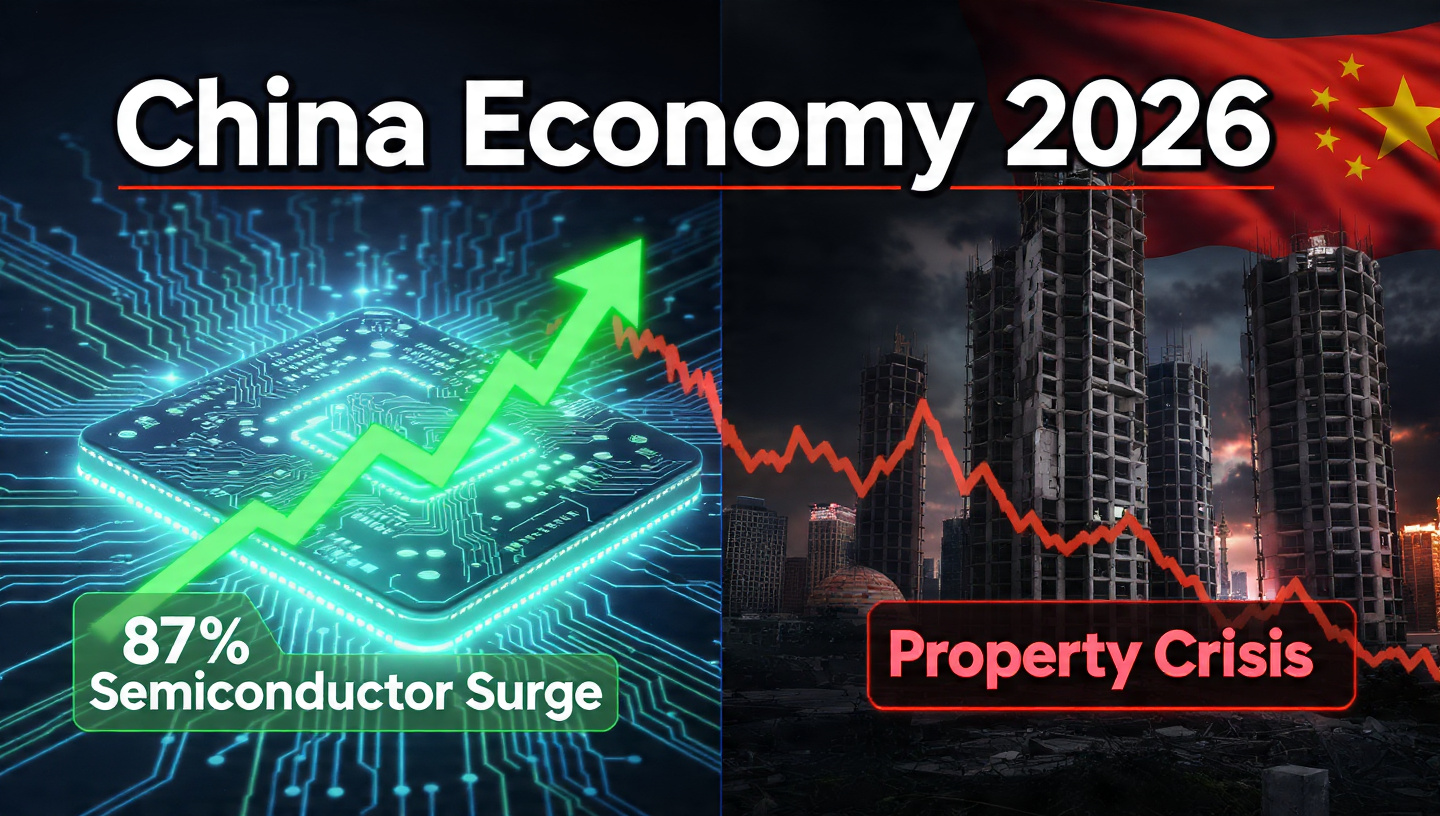
China’s May 2026 data shows high-tech manufacturing up 15.1% while property investment fell 16.2%. How Beijing’s export-led gamble is reshaping global supply chains.
The National Bureau of Statistics’ May 2026 release confirmed what economists had begun calling China’s “industrial divergence.” Scale-above industrial value-added output grew 4.5% year-on-year in May, accelerating 0.4 percentage points from April, with high-tech manufacturing surging 15.1%. The semiconductor sector was the standout: domestic output jumped 87% from the prior year, while China’s exports of semiconductors were up 110% from a year earlier, exports of mobile phones climbed 44%, and automatic data-processing machines rose 66%.
The Export Engine Running at Full Throttle
China‘s May exports (denominated in US dollars) were up 19.6% from a year earlier — the second biggest monthly increase since January 2022. The first two months of 2026 had registered an extraordinary 39.6% gain. Over all of 2025, China recorded a trade surplus exceeding $1.2 trillion — the largest ever posted by any country — as manufactured goods, particularly in advanced technology categories, poured into global markets.
The strength carries a double driver. First, the global AI boom has generated extraordinary demand for semiconductors and related hardware, where China‘s manufacturing base has rapidly scaled. Second, as domestic demand softened, manufacturers redirected capacity toward export markets. Gary Ng, senior Asia Pacific economist at Natixis, characterised this as the operative dynamic: “China’s exports have decelerated as the Iran war starts to affect global demand and supply chains,” though he noted the moderation was from record levels.
China’s economy in mid-2026 resembles a dual exposure photograph — one frame showing a technology powerhouse outpacing global rivals, the other depicting a property market in structural retreat that is slowly draining household wealth.
Goldman Sachs had projected 5–6% annual growth in China’s exports and raised its 2026 real GDP forecast to 4.8% — above both IMF projections and Bloomberg consensus. That upgrade rested on the observation that Chinese exports demonstrated resilience even against elevated US tariffs that hit 100% in April 2025 before settling at 30% in May following a bilateral agreement. Chinese exports of chips, semiconductors, autos, and auto parts continued to expand despite the tariff headwinds.
The Property Hole That Will Not Close
The other side of the ledger is less encouraging. In the first five months of 2026, fixed-asset investment fell 4.1% year-on-year — the steepest decline since May 2020. Within that, property investment dropped 16.2%. Given that roughly two-thirds of Chinese household wealth is held in real estate, the wealth destruction is persistent and consequential. Consumers saving to restore depleted balance sheets rather than spending is the logical response — and it explains why domestic retail demand has been chronically soft despite headline economic growth of 5% in 2025.
The Economist Intelligence Unit’s Nick Marro captured the strategic bet underlying Beijing’s trajectory: “There’s a strong emphasis on doubling down on manufacturing and ensuring that China’s competitive positioning in global supply chains remains sticky.” China‘s 15th Five-Year Plan (2026–2030), approved in late 2025, explicitly prioritises advanced manufacturing, semiconductors, AI, renewable energy, and digital infrastructure — doubling down on supply-side transformation rather than demand-side stimulus.
The Global Spillover: China Shock 2.0
The US-China Economic and Security Review Commission flagged a “14 percent surge in China Shock 2.0,” noting that developing markets are bearing the brunt of an export deluge driven by China’s market distortions. Unlike the original China Shock of the 2000s — which displaced labour-intensive, low-value manufacturing in rich economies — China Shock 2.0 is crowding out high-tech, high-value manufacturing in Europe and Japan. Goldman Sachs estimates that for every 1 percentage point of export-driven boost to Chinese GDP, other economies may see a 0.1 to 0.3 percentage point drag, with tech-intensive producers facing acute pressure.
Meanwhile, China’s voracious appetite for advanced chips it cannot yet manufacture domestically has produced a paradox: China imported a record $135 billion in semiconductors in the most recent quarter as AI investment accelerates. The country remains dependent on foreign-made advanced logic chips dominated by ASML, creating a structural vulnerability that its Five-Year Plan is designed to remedy — but may not resolve within this decade.
The Endgame of the Xi Gamble
The Economist captured the existential dimension of Beijing‘s strategy by quoting Johns Hopkins University‘s Yuen Yuen: “At no time in modern history has a large country gone all in on investment in high-end technology while also navigating a slowing economy and a local-government debt crisis.” Xi Jinping’s wager is that the technology-driven growth model scales faster than the old property-and-construction model collapses. The data through mid-2026 suggest the race is closer than Beijing’s official narrative acknowledges.
China’s GDP growth target for 2026 is the lowest since 1991 at 4.5–5%. Meeting it will depend on whether AI and green technology exports can sustain momentum against an Iran-related global slowdown that is already beginning to weigh on overall demand. The outcome will shape global trade balances, supply chain geography, and the AI chip economy for the next decade.
Discover more from The Economy
Subscribe to get the latest posts sent to your email.
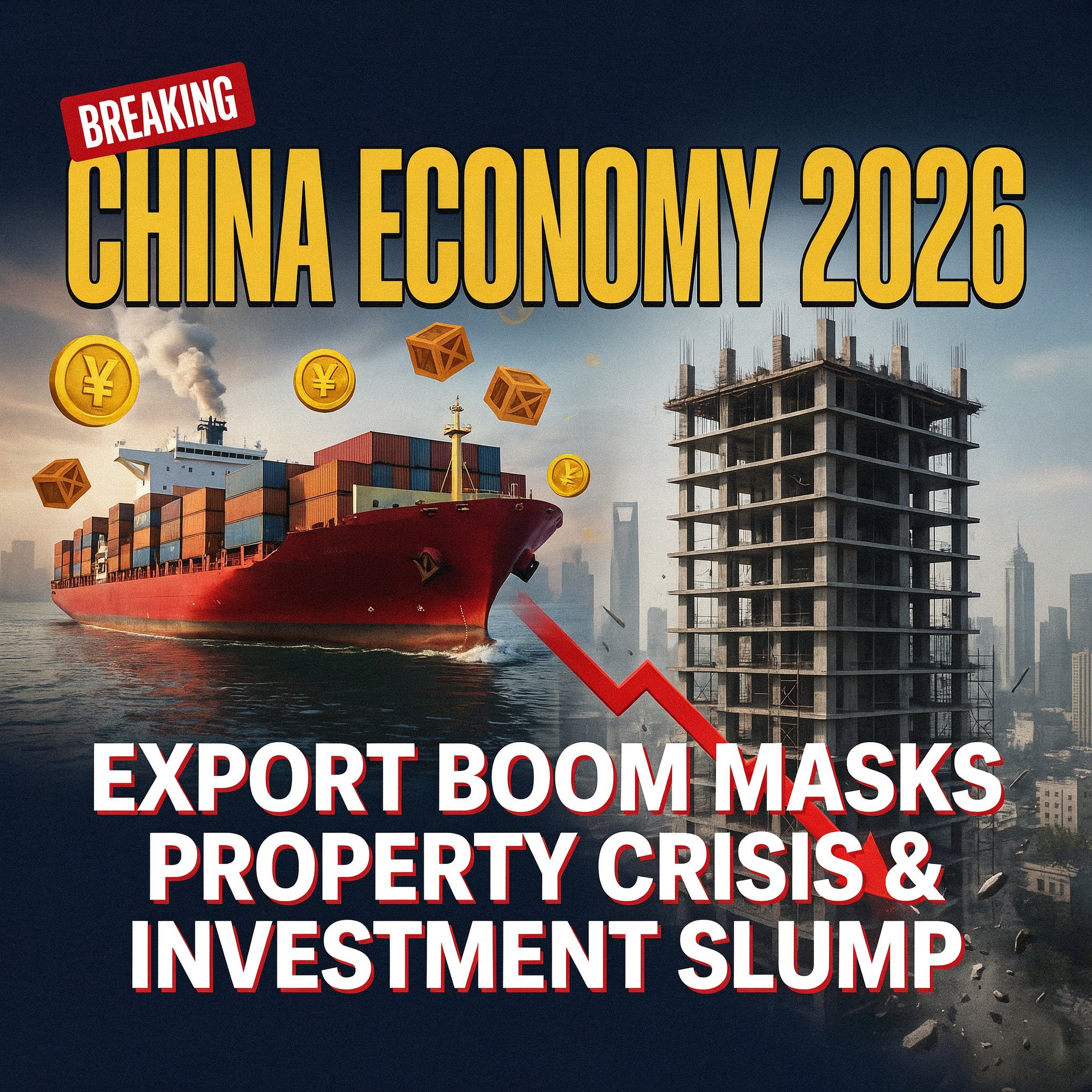
China’s exports surged 19.6% in May 2026, driven by AI semiconductors. But property investment fell 16.2% and fixed-asset investment hit its worst decline since COVID. Here’s the full picture.
China’s economy in 2026 is running a structural split that masks deep fragility behind impressive headline numbers. Exports are booming—up 19.6% in May from a year earlier, the second largest increase since January 2022—while the property sector, which underpins roughly two-thirds of household wealth, is contracting at its fastest pace since the early months of the COVID-19 pandemic.
The divergence is not sustainable indefinitely. Until the housing market stabilizes, the export engine—however powerful—cannot compensate for the structural drag on domestic demand, household confidence, and private investment that the property collapse creates.
The Export Machine Is Running on AI
The export numbers are genuinely striking. Semiconductor exports from China were up 110% year-over-year in May 2026, according to data from Deloitte Insights. Mobile phone exports grew 44%. Automatic data-processing machines—a category that captures computers and data storage equipment used in AI infrastructure—rose 66%. Between January and February 2026, total exports surged 39.6% from the prior year period, the largest two-month gain since 2022.

Two forces are driving this export strength. The first is genuine technological demand: global AI infrastructure buildout, particularly across Southeast Asia, the Gulf states, and Europe, is creating enormous appetite for Chinese-produced hardware components at every tier of the supply chain. The second is a more defensive dynamic—inventory building. Companies in trade-sensitive markets are pulling forward purchases in anticipation of further global supply chain disruptions linked to the Middle East conflict and continued U.S.-China trade friction.
That second driver carries embedded risk. If the supply chain disruption that motivated the inventory building does not materialize at the severity that buyers feared, a demand hangover could follow—slowing export growth sharply in the back half of 2026 and into 2027.
Property Investment Is Collapsing
Against the export strength, the property picture is alarming. Property investment fell 16.2% in the first five months of 2026 compared to the same period a year earlier. Fixed-asset investment overall declined 4.1% in the same period—the steepest contraction since May 2020. Even excluding property, fixed-asset investment was down 1.2% year-on-year. Manufacturing investment grew just 0.4%, suggesting businesses are reluctant to expand capacity when demand signals are uncertain.
The property crisis matters disproportionately because of its wealth effect. Roughly two-thirds of Chinese household wealth is held in real estate. When home prices fall, households do not merely lose nominal value—they respond by saving more and spending less, attempting to rebuild or stabilize balance sheets. That behavioral response deepens the demand shortfall, reinforces the cycle of developer distress, and makes a bottom in the market harder to reach.
National home prices continued falling in May, at a faster pace than April. Weakness was evident across most cities. The one pocket of relative stability was in first-tier cities—Beijing, Shanghai, Guangzhou, Shenzhen—where new-home prices rose for the third consecutive month, suggesting that government support measures may be gaining marginal traction in the most liquid and desirable markets. But analysts describe the national recovery as “uneven rather than broad-based.”
The PBOC Moves on Infrastructure, Not Stimulus
The People’s Bank of China Governor Pan Gongsheng announced a series of financial market measures in late June, including steps to increase the use of overnight reverse repo operations, narrow the short-term interest rate corridor, and promote offshore use of the renminbi. The announcements appeared to be part of a longer-term effort to strengthen monetary transmission and support yuan internationalization.
Critically, the package did not represent broad-based monetary stimulus. No major rate cuts were announced. No large-scale property rescue fund was launched. Analysts interpreted the measures as policymakers signaling continued focus on financial market development and liquidity management rather than a shift toward aggressive easing.
The restraint reflects a genuine policy dilemma. Chinese household debt levels have risen significantly. Property developers are burdened by debt accumulated during the excess-capacity boom of the 2010s. Aggressive stimulus risks inflating new bubbles rather than resolving underlying imbalances. Until organic demand—rather than government support—can fill the gap left by falling property investment, the recovery will remain patchy.
Industrial Production Holds, Investment Doesn’t
Industrial production grew 4.5% year-on-year in May, slightly below the average of the past two years. By subsector: manufacturing output grew 4.4%, utilities climbed 7.6%, and mining rose 2.3%. These are positive numbers—not crisis-level readings—but they reflect an economy in which output is sustained by export demand rather than by the kind of capital formation and domestic consumption that generate self-reinforcing growth cycles.
China’s full-year 2026 GDP growth is expected to remain in positive territory, driven by the export surge and infrastructure spending, but the Deloitte forecast notes that growth is “not being fueled by domestic demand”—meaning the economy is not generating inflationary pressure at home. That permits the PBOC to maintain a relatively stable interest rate environment, but it also means that any slowdown in export demand could quickly transmit into a broader growth deceleration with limited domestic offsets available.
The medium-term question for China’s economy in 2026 is whether the property market finds a floor before the export tailwind fades. The historical precedent for property-led downturns in emerging markets suggests the adjustment period is measured in years, not quarters.
Discover more from The Economy
Subscribe to get the latest posts sent to your email.

Pakistan Gulf Investment Outflows 2026: Peace Deal Stakes Explained

Canada Trade Diversification 2026: China, Indonesia, UAE Deals Explained

US Forced-Labour Tariffs on 60 Countries: The Hidden Trade Shock of 2026

Global Central Banks 2026: Fed, BoE and BoJ Decisions Could Reshape Markets

Gulf Capital Retreat From Pakistan 2026: UAE Loan Freeze & What It Means

Pakistan’s Most Reliable Export Is Its People: Remittances Hit $41.6 Billion, Overtaking Total Exports

Indonesia’s Confidence Problem: Record Investment, a Sinking Rupiah, and a Widening Credibility Gap

Down But Not Out: Inside the Slow Sinking of Russia’s War Economy

China’s Growth Slips to a Four-Year Low: Why Beijing Still Won’t Pull the Stimulus Trigger

The Johor-Singapore Corridor: How Malaysia Became Southeast Asia’s AI Infrastructure Powerhouse

Canada’s Economy ‘On Pause’: Inside the CUSMA Deadline That Passed Without a Deal

Dubai’s Millionaire Magnet: How the UAE Turned Middle East Turmoil Into a Capital Safe-Haven Boom

Britain’s Sixth Prime Minister in a Decade: What Starmer’s Exit Means for Gilts, Sterling and Your Portfolio

Anthropic Offers Up to $600,000 Salary for Critical IPO Role as AI Giant Prepares for Wall Street Debut

Carry Trade Unwind 2026: How the Yen’s Snapback Triggered a Global Margin Call

AI Bubble Warning 2026: Why BIS, IMF and Bank of England Fear a Market Crash

BRICS De‑Dollarization Strategy Takes Shape with $15 Billion Local‑Currency Push

The AI Super Bubble Is Ready to Burst

Russia Bans Diesel Exports 2026: Global Fuel Market Impact Explained

Strait of Hormuz Blockade 2026: Oil Prices Surge 9% as US-Iran Conflict Reignites

Private Credit Warning: Most BDCs Turn Unprofitable in 2026, Reuters Finds

IMF Cuts Pakistan Growth Forecast, Raises Inflation to 8.4%

Bitcoin $150k Milestone Achieved as US Sovereign Crypto Pivot Looms
Gulf Capital Retreat From Pakistan 2026: UAE Loan Freeze & What It Means

India Economic Rise 2026: How the Subcontinent Toppled Japan

Strait of Hormuz 2026: Why Markets Still Don’t Trust It’s Open

Argentina Economy 2026: Milei’s Fiscal Surplus, Inflation Drop to 29%, and What Comes Next

China Housing Market Turnaround: White‑List Model Stabilises Prices
-

 Markets & Finance7 months ago
Top 15 Stocks for Investment in 2026 in PSX: Your Complete Guide to Pakistan’s Best Investment Opportunities
-

 Analysis5 months ago
Johor’s Investment Boom: The Hidden Costs Behind Malaysia’s Most Ambitious Economic Surge
-

 Analysis5 months ago
Top 10 Stocks for Investment in PSX for Quick Returns in 2026
-

 Analysis6 months ago
Brazil’s Rare Earth Race: US, EU, and China Compete for Critical Minerals as Tensions Rise
-

 Banks6 months ago
Best Investments in Pakistan 2026: Top 10 Low-Price Shares and Long-Term Picks for the PSX
-

 Investment7 months ago
Top 10 Mutual Fund Managers in Pakistan for Investment in 2026: A Comprehensive Guide for Optimal Returns
-

 Global Economy7 months ago
15 Most Lucrative Sectors for Investment in Pakistan: A 2025 Data-Driven Analysis
-

 Global Economy7 months ago
Pakistan’s Export Goldmine: 10 Game-Changing Markets Where Pakistani Businesses Are Winning Big in 2025
Pingback: Florida braces for a historic generational wealth transfer - caa | Capital Analytics Associates