
Digital
DBS PayLah China QR Expansion: Now Accepted at Over 100 Million Merchants

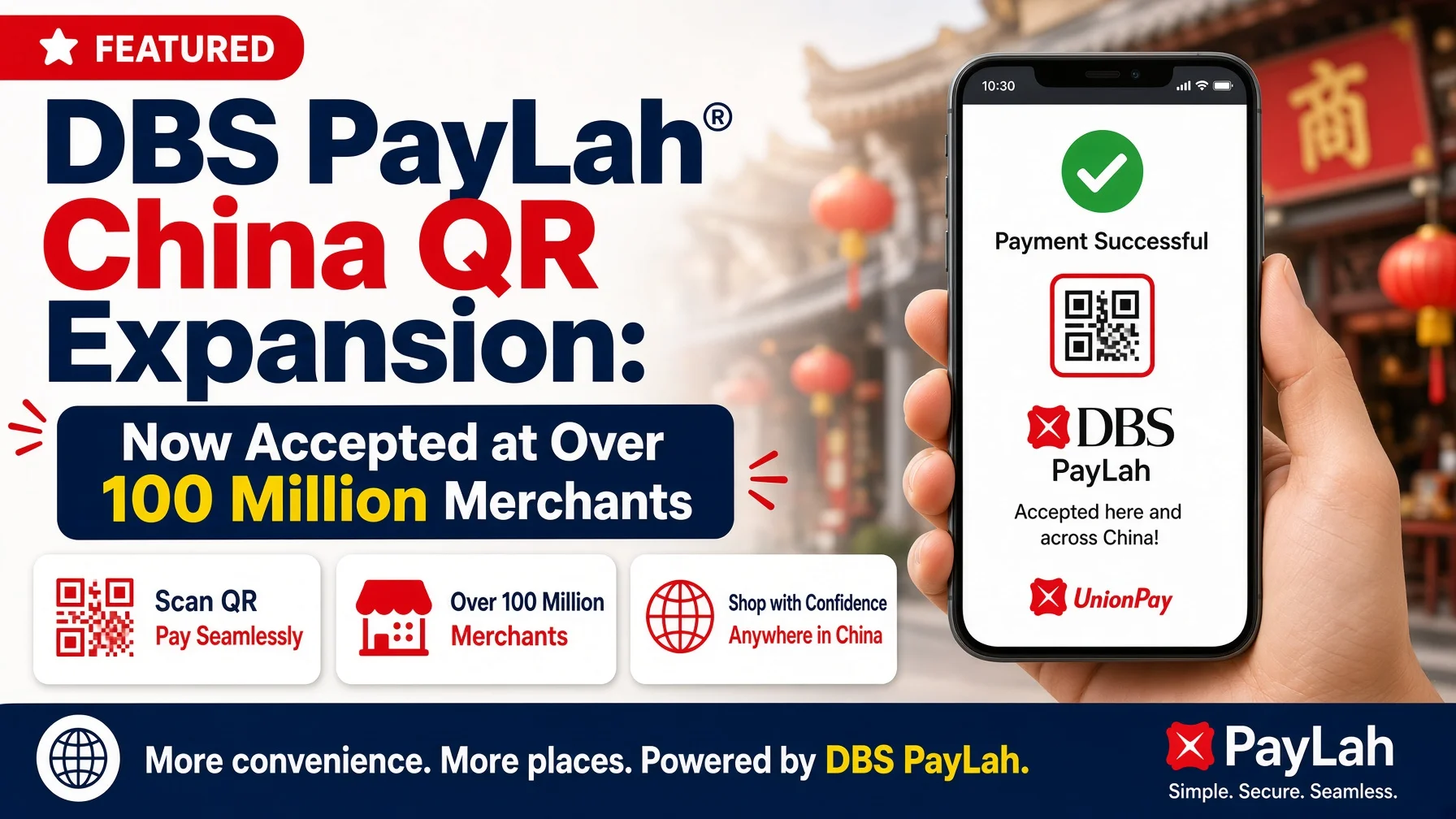
DBS PayLah! users can now make QR-code payments at more than 100 million Alipay and Weixin Pay partner merchants across mainland China without additional transaction fees charged by the bank. When combined with DBS’s existing UnionPay QR connectivity, the Singapore lender becomes the first bank in the country to support both “scan” and “present” methods across all three major Chinese QR ecosystems. Channel NewsAsia
More than three million PayLah! users gain the capability. Before confirming a payment the app displays the amount in Chinese yuan, the applicable foreign-exchange rate, and the Singapore-dollar equivalent. The expansion was announced on 12 November 2026 and arrives against a backdrop of recovering inbound travel: Chinese authorities recorded 11.6 million foreign trips between July and September 2026, up 15.6 percent year-on-year. The Straits Times
For travelers the practical result is the ability to pay at the large majority of Chinese shops, restaurants, and attractions using a familiar Singapore app rather than downloading local wallets or carrying substantial cash.
Table of Contents
- How Does the New DBS PayLah China Feature Work?
- Which Payment Networks Are Now Supported?
- Are There Extra Fees, Limits, or Cashback Offers?
- Why Does This Matter for Singapore and Regional Travelers?
- How Does DBS Compare with Other Banks?
- Practical Tips for Using PayLah in China
- Key Takeaways
- Frequently Asked Questions
How Does the New DBS PayLah China Feature Work?
Users must update the PayLah! app to the latest version. They can then either scan a merchant’s QR code or generate their own PayLah QR code for the merchant to scan. The transaction flow remains inside the DBS app; no separate Chinese wallet is required for merchant payments. Partnerships with Ant International (Alipay+) and TenPay Global (Weixin Pay) enable the connectivity. Channel NewsAsia and DBS statements
Which Payment Networks Are Now Supported?
- Alipay (via Alipay+ / Ant International)
- Weixin Pay (via TenPay Global)
- UnionPay (already live for overseas QR since 2022)
DBS has stated it is currently the only Singapore bank offering both directional methods across the three ecosystems. Merchants range from major retailers to neighborhood shops and restaurants. The Straits Times
Are There Extra Fees, Limits, or Cashback Offers?
DBS does not impose additional transaction fees on these QR payments. Standard foreign-exchange margins still apply and are shown before confirmation. Daily and other PayLah limits continue to govern usage. From 16 November 2026 to 31 January 2027 the bank is running cashback promotions for first-time overseas QR users and certain first Alipay+ transactions, with amounts up to a few Singapore dollars per qualifying payment. The Straits Times
Why Does This Matter for Singapore and Regional Travelers?
China’s retail economy is overwhelmingly QR-based. The ability to pay at over 100 million acceptance points without maintaining a local bank account or multiple apps removes a long-standing friction point. Singapore was among the top source markets for the recent rise in foreign arrivals. The same PayLah app already supports QR payments in Malaysia, Thailand, Indonesia, Taiwan, and other Alipay+ markets, creating a broader regional network. Channel NewsAsia
How Does DBS Compare with Other Banks?
DBS is first to market with full three-network coverage. UOB has publicly indicated it plans to launch China QR payment functionality through its TMRW app by the end of 2026, also targeting more than 100 million acceptance points. Competitive responses from other Singapore and regional banks are widely expected. Zaobao and related reporting
Practical Tips for Using PayLah in China
- Update the app and test a small transaction early in the trip.
- Confirm the FX rate and SGD equivalent on screen before authorizing.
- For payments to individuals or very small vendors using personal QR codes, DBS Remit into an Alipay or Weixin wallet remains available.
- Keep a backup payment method (card or modest cash) for the minority of locations that may not accept the networks.
- Monitor cashback eligibility if traveling during the promotional window.
Feature Comparison
| Feature | DBS PayLah (Nov 2026) | Typical Local Chinese Wallet | Traditional Card |
|---|---|---|---|
| Merchant coverage (China) | 100 m+ | Very high | Lower |
| Extra app required | No | Yes | No |
| FX transparency | Shown in-app | Varies | Varies |
| Best for | SG/regional travelers | Residents / long stays | Backup |
Key Takeaways
- More than 100 million Alipay and Weixin Pay merchants are now accessible via DBS PayLah.
- DBS is the first Singapore bank with full three-ecosystem (Alipay, Weixin, UnionPay) QR support.
- No additional DBS transaction fees; exchange rate displayed before payment.
- Cashback promotions run through 31 January 2027.
- Aligns with a measurable recovery in foreign travel to China.
Frequently Asked Questions
Do I need a Chinese bank account or to download Alipay/WeChat?
No. Merchant payments are completed entirely inside the updated DBS PayLah! app.
Can I pay individuals or small vendors who only have personal QR codes?
For personal codes the recommended route remains DBS Remit into your own Alipay or Weixin wallet, then paying from there.
Is there a special spending limit for China?
Standard PayLah daily and transaction limits apply; check the app for your current caps.
Will the cashback be automatic?
Promotional cashback is credited according to the campaign terms for qualifying first-time or specified transactions.
Are other Singapore banks offering the same service yet?
DBS is first; UOB has announced plans for a comparable launch by the end of 2026.
Conclusion
DBS PayLah!’s expansion to more than 100 million Chinese merchants removes one of the most common payment frictions for Singapore and regional visitors. For travel-focused publishers, the story combines timely product news with clear practical value: millions of users can now transact seamlessly across China’s dominant QR networks. As inbound travel continues to recover and competing banks roll out similar capabilities, cross-border QR interoperability is likely to become a standard expectation rather than a differentiator. Travellers who update the app before departure will find everyday spending in China materially simpler.
Discover more from The Economy
Subscribe to get the latest posts sent to your email.


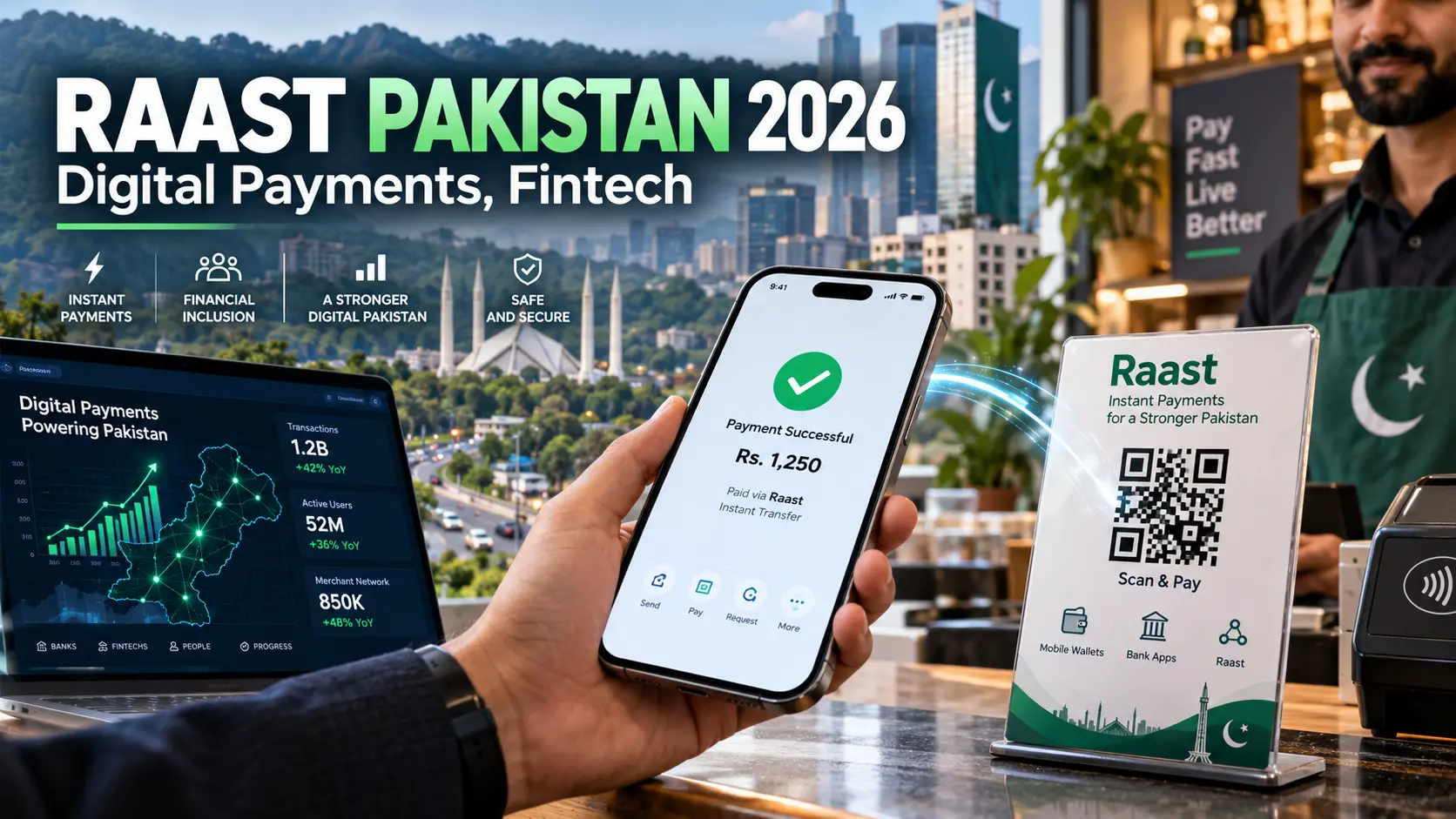
Understand Raast, QR payments and Pakistan’s digital-rupee debate. See what works now, what remains unverified and how merchants can reduce cash costs.
Key Takeaways
- The SBP’s payment-system publications include an FY2025–26 annual review announced on 6 October 2026, providing a formal basis for tracking digital adoption.
- Raast supports instant-payment use cases and domestic merchant collection; that does not mean a universally available Pakistani retail central-bank digital currency has launched.
- The SBP announced financial-inclusion index results on 7 October 2026; access and actual usage should be treated as different measures.
- For shops and households, transparent fees, fraud protection, reliable acceptance and dispute resolution matter more than the label cashless.
A shopkeeper in Rawalpindi may receive dozens of electronic transfers in one day and still prefer cash because he cannot reconcile the payments quickly at closing time. That tension explains the promise and the limits of Raast Pakistan 2026. A modern payment network can move money rapidly, but it does not automatically fix weak accounting, cybercrime or trust between merchants and customers.
Pakistan’s digital ecosystem now includes bank applications, e-money wallets, card terminals and Raast payment services. Meanwhile, the idea of a digital rupee attracts attention that sometimes confuses an existing transfer system with a hypothetical new form of central-bank money. The distinction matters. Here is how the technologies work, what the current evidence shows and what would make digital adoption useful for ordinary businesses rather than another regulatory slogan.
What is Raast Pakistan 2026, and how does it work?
Raast is a payment infrastructure system designed to allow eligible financial institutions and users to move money quickly. It supports different services, including person-to-person transfers and merchant payments as supported by participating institutions. It is not itself a bank account or a digital token that users can hold independently of their payment provider.
A customer typically interacts through a banking or participating payments application. The service connects to the regulated payment system; the money moves between accounts under the rules of the participating financial institutions. Merchant QR acceptance can simplify collection when the payer and receiver have compatible services and usable connectivity.
The State Bank’s payments-review reports are the source to consult for payment volumes, value and user adoption. The regulator announced its FY2025–26 Annual Payment Systems Review on 6 October 2026, and the report period should not be confused with the current FY2026–27 first quarter.
The difference between a payment rail and an account
A rail is the infrastructure that transmits and settles a payment instruction. An account stores a customer’s legally recognised balance. A QR code typically provides the recipient information that the application uses to initiate a payment; it is not proof by itself that the merchant has been paid. Sellers should confirm the transaction inside their own provider’s authenticated interface.
How far has digital adoption actually gone?
Digital retail transactions have grown significantly within Pakistan’s regulated banking and payment ecosystem. The SBP quarterly and annual publications document that growth across mobile applications, electronic-money institutions, internet banking and merchant payments. But a crucial statistical caveat often disappears from headlines: transactions outside the formal banking system are not necessarily counted in those reported digital-versus-cash shares.
That means a statement such as ‘most bank-channel retail payments are digital’ cannot be rewritten as ‘most spending in Pakistan is digital’. A vegetable purchase made with physical cash, an undocumented informal loan or a family payment outside participating institutions may not appear in the denominator.
| Measure | What it indicates | What it cannot prove |
|---|---|---|
| Digital retail transaction count | Formal electronic payments processed | Total cash spending nationwide |
| Digital transaction value | Rupee amount passing through recorded channels | Number of unique households |
| Registered users | Access or enrolment at an institution | Regular active use |
| Merchant QR registrations | Potential acceptance points | Payments successfully completed |
| Complaints or fraud losses | Some consumer-protection risks | All incidents, including unreported fraud |
The SBP financial-inclusion announcement of 7 October 2026 reinforces the importance of distinguishing having access to financial services from using them reliably. The stronger policy question is whether more people can pay and be paid at a lower real cost with fewer unresolved disputes.
Why do small businesses still rely on cash?
Cash has no app login, does not require battery power and can be accepted by a customer who lacks a smartphone. Those are genuine advantages for a rural vendor or a small urban business. Cash also carries risks: theft, miscounting, travel time, expensive physical handling and a limited audit trail.
Digital acceptance introduces a different cost set. A merchant needs an account or wallet, working connectivity, a trained employee and a reliable way to verify transactions. Some payments involve provider fees or settlement issues. A shopkeeper may also fear customer chargebacks or scams that impersonate an approved payment notification.
The correct question is therefore not ‘How can cash be abolished?’ but ‘Which payments are safer and cheaper when digitised?’ A business with repetitive supplier payments may benefit from electronic records even if small over-the-counter sales remain mixed.
The World Bank framework for Pakistan links stronger private-sector conditions to inclusion and productivity. For merchant payments, adoption should be judged by practical saved time, lower cash-handling loss and better access to formal finance, rather than installation targets alone.
Is Pakistan launching a digital rupee, and is it the same as Raast?
A central-bank digital currency (CBDC) would be a form of digital central-bank money governed by a defined legal and technical design. A wallet balance held with a commercial provider and a payment transfer using Raast are different things. Neither becomes a retail CBDC simply because a phone screen shows rupees.
Policy debate and exploration are not equivalent to a public rollout. The SBP press-release record and official economic-data and operations portal are appropriate sources for verified details of any pilot, eligibility, licensing or public launch. In this research, a generally available retail digital rupee as of 19 October 2026 was not independently verified; this article therefore does not present one as operating.
A digital rupee would raise policy questions beyond payment speed: privacy, offline access, fraud liability, bank funding, transaction limits and compatibility with existing accounts. The eventual design could matter more than its name. For example, a system without practical safeguards for stolen phones might exclude users who need easy redress.
Raast already solves a different problem: getting authorised payment instructions between participating institutions. Its performance can be evaluated now without assuming the future architecture of central-bank digital money.
What are the risks of a more digital financial system?
Payment fraud can move as quickly as legitimate money. Criminals may impersonate banks, send false payment screenshots or persuade a user to reveal a PIN. Shop employees sometimes release goods before the actual credit appears in the authenticated merchant interface.
Consumer protection requires clear transaction confirmations, liability rules and accessible complaints. A fraud victim should be able to report an incident promptly and receive a tracking number. Data protection is equally important: a payment history should not become an unrestricted record available to unrelated businesses or agencies without lawful safeguards.
Operational resilience is another issue. During a network outage, a small merchant needs a practical fallback. Dependence on a single payment app or provider can create concentration risk. Merchants may benefit from more than one lawful acceptance option, while regulators should define common standards for security and interoperability.
The SBP regulatory announcements and payment-system reviews should be monitored for changing operating rules and fraud trends. A large transaction count is not a measure of trustworthiness unless the system can also show how failures are handled.
How can digital payments improve access to credit and tax compliance?
A business with consistent customer payments can create evidence of turnover. That evidence may help a responsible lender assess seasonality and repayment prospects. A new shop can begin with a simple daily record: opening cash, digital sales, refunds, supplier purchases and closing balance. When records match bank activity, the owner has a more credible business profile.
The SBP’s July 2026 SME definitions classify micro, small and medium firms by turnover for banking-regulatory purposes. Digital receipts could help corroborate turnover, but they do not automatically qualify the business for financing. The lender still has to examine profit margin, debt and expected cash flows.
A broader formal record can also make tax filings easier. Yet coercion without convenience can push small merchants toward avoidance. Start with inexpensive acceptance, understandable reporting and a fair correction process for mistaken records. The World Bank-supported FBR revenue reforms are relevant to the wider goal of increasing voluntary formal compliance.
For a household, digital transfers can help document rent or school fees. For a freelancer, domestic instant payments may make it easier to pay local subcontractors. Cross-border customer receipts, however, still require appropriate international settlement mechanisms and compliance.
What This Means for You
Merchant: Confirm a payment on your own banking or wallet application, not a customer screenshot. Reconcile digital receipts with sales daily and keep access credentials separate from ordinary employees’ devices where possible.
Household: Use strong account protection, never share one-time codes and record transaction references for payments that might later be disputed. Verify the recipient carefully before confirming a large transfer.
Freelancer: Use regulated cross-border receipt channels for foreign invoices and local digital rails for compliant domestic payments. Do not confuse a domestic Raast identifier with an international bank account.
Policymaker: Publish consistent measures of active use, merchant success rates, fraud complaints and outages. Include offline and low-connectivity consumers rather than treating app downloads as universal financial inclusion.
Raast is Pakistan’s instant-payment infrastructure connecting participating financial institutions and payment services for authorised transfers, including supported person-to-person and merchant-payment use cases. Customers access it through eligible banking or payment interfaces. It is not itself a separate bank account or a central-bank digital currency.
What to Watch Next
- 26 October 2026: The State Bank monetary-policy decision and any revision to its inflation assessment; verify any schedule change with the SBP.
- Early November 2026, exact release date to be confirmed: Pakistan Bureau of Statistics October inflation and merchandise-trade releases.
- Late October–November 2026, date not yet confirmed: Any IMF Executive Board announcement on the October staff-level agreement; staff agreement is not Board approval.
- Throughout FY2026–27: Updated SBP monthly balance-of-payments and remittance statistics; compare cumulative results rather than one month alone.
Frequently Asked Questions
What is Raast in Pakistan?
Raast is Pakistan’s instant-payment infrastructure connecting participating financial institutions and payment services for authorised transfers, including supported person-to-person and merchant-payment use cases. Customers access it through eligible banking or payment interfaces. It is not itself a separate bank account or a central-bank digital currency.
Is a digital rupee available to everyone in Pakistan in October 2026?
A generally available retail central-bank digital rupee was not independently verified from the official sources consulted as of 19 October 2026. Policy exploration and pilots should not be mistaken for a public launch. Use official SBP announcements for changes to legal status or availability.
Can a small shop receive money through Raast QR payments?
A shop can use supported merchant-payment services through a participating provider, subject to onboarding, eligibility and the provider’s current operating rules. Merchants should verify settlement in their authenticated app or account rather than accepting a screenshot as proof.
Will digital payments eliminate cash in Pakistan?
Not automatically. Cash remains useful where smartphone access, connectivity and digital literacy are limited. Digital channels can reduce some cash-handling costs, but consumers and businesses need choice, reliable fallback options and clear fraud protections. Bank-channel transaction statistics do not measure all cash spending nationwide.
Can Raast transaction history help a business get a loan?
A documented payment history may help demonstrate turnover when it is reconciled with genuine invoices and business expenses. It is not an automatic loan qualification. Banks still examine cash flow, profitability, debt obligations and applicable SBP rules.
Pakistan will become more digitally capable when a street vendor can accept a payment, verify it and resolve a mistake without specialist help. Raast is useful infrastructure. A future digital rupee may add something different. Neither deserves to be judged by the logo alone
Discover more from The Economy
Subscribe to get the latest posts sent to your email.
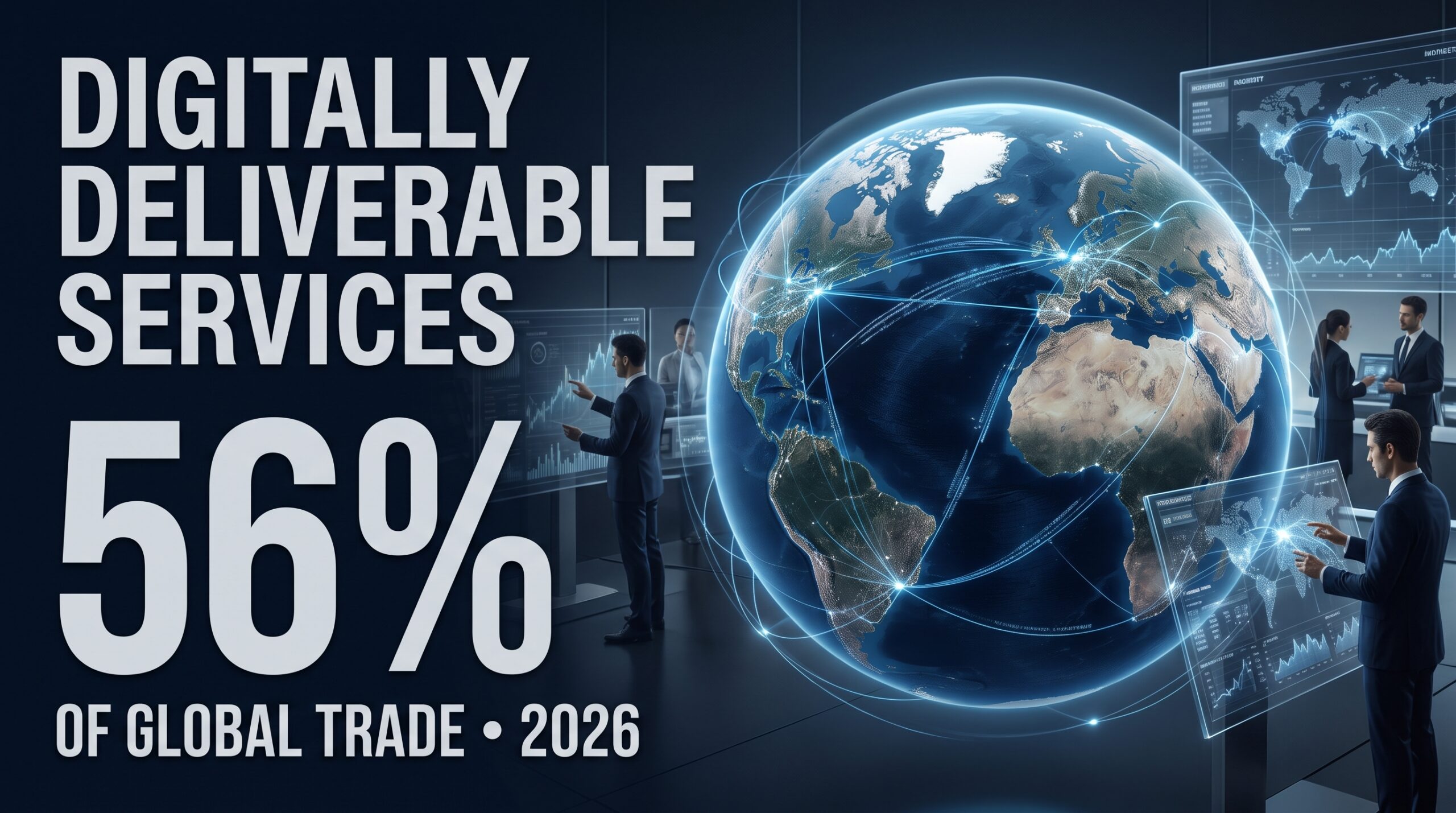
Global trade policy debates in 2026 remain heavily focused on tariffs, container shipments, and factory reshoring — the visible, physical mechanics of international commerce. Beneath that debate, a quieter and arguably more consequential shift has already occurred: services that can be delivered remotely over computer networks — everything from IT consulting and financial services to creative and professional work — now account for 56% of all global services exports, according to UN Trade and Development (UNCTAD) data for 2024. For global business strategy, trade policy, and cross-border investment planning, this is no longer an emerging trend to monitor. It is the dominant structural fact of modern services trade.
Key Takeaways
- Digitally deliverable services accounted for 56% of all global services exports in 2024, per UNCTAD, up from a much smaller base a decade earlier — a share that has grown consistently over most of the last ten years.
- Global exports of digitally deliverable products rose 10% in 2025, continuing a similarly strong pace from the prior year, with developed economies exporting roughly $4.1 trillion and developing economies exporting an estimated $1.3 trillion.
- Developing economies’ exports of digitally deliverable services grew 12% in 2025, outpacing developed economies’ 9% growth — even as developing economies crossed the $1 trillion export threshold in this category for the first time in 2023.
- In Least Developed Countries (LDCs), digitally deliverable services represent just 16-20% of services exports — roughly a third of the global average — highlighting a widening digital trade divide even as the category grows globally.
- The WTO forecasts overall services trade growth slowing to 4.4% in 2026 (down from 6.8% in 2024), even as digitally delivered services growth remains comparatively resilient at 5.6%, reinforcing the category’s role as the more durable engine of services trade growth.
What “Digitally Deliverable” Actually Means
The 56% figure requires a precise definition to be useful for strategic planning. UNCTAD and the WTO define digitally deliverable services as those services that can be delivered remotely over information and communications technology (ICT) networks such as the internet — a category distinct from, though closely related to, the narrower measure of services actually delivered digitally in a given transaction. The digitally deliverable category encompasses ICT services themselves, along with sales and marketing services, financial services, professional and technical services, insurance services, intellectual-property-related services, and education and training services, among others.
This matters for trade strategy because it captures structural potential for remote delivery across an entire services category, not merely transactions that happened to occur digitally in a given year — making it a more forward-looking indicator of which service sectors are positioned to continue shifting toward borderless, low-marginal-cost delivery models.
The Ten-Year Trend: A Structural, Not Cyclical, Shift
The growth in digitally deliverable services’ share of total services trade has been remarkably consistent rather than a pandemic-era anomaly. While the COVID-19 pandemic did produce a temporary spike — with some measures of digitally delivered services trade briefly exceeding 60% of total services trade in 2020 — the subsequent partial normalization in 2021 and 2022 did not erase the underlying structural trend. By 2024, the 56% figure represented a continuation of growth that has been sustained over most of the past decade, with the strongest regional gains recorded in Asia (a 7.9 percentage point increase in the digitally deliverable share of total services exports over ten years) and North America (7.6 percentage points over the same period).
Global exports of digitally deliverable products continued this trajectory into 2025, rising approximately 10% year-on-year — matching the prior year’s growth rate and confirming this is a sustained trend rather than a one-time post-pandemic adjustment.
The Developed-Developing Divide: Converging, But Unevenly
The distribution of digitally deliverable services trade in 2025 illustrates both genuine progress and a persistent structural gap. Developed economies accounted for roughly three-quarters of digitally deliverable exports in 2025, worth approximately $4.1 trillion, while developing economies exported an estimated $1.3 trillion — a meaningful and growing share, but still a fraction of the developed-economy total. Developing economies’ growth rate in this category (12% in 2025) outpaced developed economies (9%), suggesting a genuine, if gradual, convergence trend.
However, this aggregate convergence masks a widening gap within the developing world. The distance between a relatively small number of highly successful developing-economy exporters and the much larger group of countries struggling to build export share in this category has widened, not narrowed, even as the overall developing-economy total has grown. Least Developed Countries illustrate this divide most starkly: digitally deliverable services represent only 16-20% of their total services exports — roughly a third of the 56% global average — and LDCs’ share of global digitally deliverable services exports has actually declined from 0.24% to 0.19% over the 2015-2023 period, despite a 43% increase in the absolute value of their exports in this category over the same window. UNCTAD’s own assessment is direct on this point: without targeted intervention, the digital economy risks entrenching existing global trade inequalities rather than alleviating them.
Sector Composition: Where the Value Concentrates
Within digitally deliverable services trade, value is heavily concentrated in a handful of sub-sectors. Computer services and financial services together represent the largest components of digitally delivered trade specifically, with other business services (encompassing diverse professional, management, and technical services) forming a substantial share of the “Other commercial services” category that dominates global services trade composition more broadly — that broader category accounted for roughly 60% of total global services trade in 2024, with Europe alone contributing about 40% of those exports.
Regional trade-flow patterns within this category also reveal distinct structural differences: European digitally deliverable service exports are heavily intra-regional, with 62% of exports remaining within the region, while North America is overwhelmingly externally oriented, exporting 82% of its digitally deliverable services outside the region — a divergence with direct implications for how trade policy shifts in one bloc ripple into the other.
Why This Matters for 2026 Trade Policy and Business Strategy
The WTO’s 2026 outlook for overall commercial services trade shows deceleration — growth is projected to slow to roughly 4.4%, down sharply from 6.8% in 2024, driven primarily by weaker transport services growth (a direct casualty of the broader merchandise trade slowdown linked to elevated 2026 tariff activity) and softer travel growth. Digitally delivered services, by contrast, are forecast to grow at a comparatively resilient 5.6% in 2026 — meaningfully outpacing the broader services trade average and reinforcing the category’s role as the more durable growth engine within global services trade during a period of broader trade policy uncertainty.
This resilience has a structural explanation directly relevant to 2026’s tariff environment: digitally deliverable services are not directly subject to tariffs in the way merchandise trade is, though they remain vulnerable to indirect spillover effects through their links to goods trade and broader economic output. For businesses and policymakers navigating an increasingly tariff-affected trade environment, this relative insulation is a meaningful strategic consideration — a services-export strategy weighted toward digitally deliverable categories carries structurally different tariff exposure than a goods-export strategy.
Strategic Implications by Stakeholder
- For exporters in developing and emerging markets: The 12% growth rate in digitally deliverable services exports from developing economies in 2025 suggests genuine, executable opportunity — but the widening gap between top-performing and struggling exporters within the developing world means market access, digital infrastructure investment, and skills development remain binding constraints rather than solved problems.
- For multinational trade and tax strategy teams: The sharp divergence in regional trade orientation (Europe’s 62% intra-regional share versus North America’s 82% extra-regional share) should directly inform where digitally deliverable service lines are structured and where cross-border service agreements are domiciled.
- For trade policymakers, including in Pakistan and similar emerging markets: The LDC data point — a declining global export share despite rising absolute export value — is a cautionary signal that digital services export growth alone does not guarantee improved relative competitive position without deliberate, targeted digital trade infrastructure investment.
- For portfolio and country-risk analysts: Given digitally deliverable services’ comparative tariff insulation and stronger 2026 growth forecast relative to transport and travel services, economies with services-export mixes weighted toward this category may exhibit somewhat greater resilience to an escalating tariff environment than goods-export-dependent economies.
Frequently Asked Questions
What percentage of global trade is digitally deliverable services?
Digitally deliverable services accounted for 56% of all global services exports in 2024, according to UNCTAD — a share that has grown consistently over the past decade and continued rising into 2025 with roughly 10% annual export growth.
Are digitally deliverable services affected by tariffs?
Not directly — digitally deliverable services are not subject to tariffs in the same way goods are, though they remain vulnerable to indirect spillover effects from broader merchandise trade slowdowns and economic uncertainty linked to tariff activity.
Is the digital services trade gap between rich and poor countries closing?
Only partially. Developing economies grew digitally deliverable services exports faster than developed economies in 2025 (12% versus 9%), but Least Developed Countries’ share of global digitally deliverable exports actually declined from 2015 to 2023, despite rising absolute export values.
Conclusion
The 56% figure represents one of the more consequential, if underdiscussed, structural facts in global trade today: more than half of all services traded internationally can now be delivered without a ship, a truck, or a border crossing in the traditional sense. For businesses and policymakers focused on 2026’s tariff-dominated trade headlines, the digitally deliverable services trend offers both a note of resilience — a growth engine comparatively insulated from tariff policy — and a note of caution, as the data makes clear that this resilience and growth are not being distributed evenly across the global economy.
Discover more from The Economy
Subscribe to get the latest posts sent to your email.

Uber’s pursuit of Delivery Hero has finally crossed the finish line, and the structure of the winning bid says as much about the state of global food-delivery competition as the headline price itself.
The Deal Terms
Uber will acquire Frankfurt-listed Delivery Hero in a deal valued at €41.50, or $47.59, per share, with Dutch technology investor Prosus offloading its near-17 percent stake in Delivery Hero to Uber as part of the transaction. The improved offer follows a rejected earlier approach: one of Delivery Hero’s major shareholders had turned down a €38-per-share offer from Uber back in May, forcing Uber to sweeten terms by roughly 9 percent to get the deal across the line.
The transaction’s second component is arguably more strategically important than the headline acquisition. Delivery Hero will simultaneously sell its businesses across 14 markets to SSW Partners in a deal worth $1.4 billion, specifically covering territories where Delivery Hero’s operations would otherwise overlap directly with Uber’s existing footprint post-acquisition — a structure clearly designed to pre-empt antitrust objections in those markets.
Why the Divestiture Structure Matters
Regulators across Europe and Asia have grown increasingly wary of food-delivery consolidation given the sector’s history of just two or three dominant platforms per market. By carving out the 14 overlapping markets into a separate sale to SSW Partners before regulatory review even begins, Uber and Delivery Hero appear to be attempting to neutralise the most obvious competition concerns pre-emptively — a playbook increasingly common in large tech-platform M&A globally.
Market Reaction
The market’s initial reaction was muted rather than euphoric: Delivery Hero shares fell about 1 percent on the news, suggesting investors had already priced in a deal at or near these terms following months of on-and-off negotiations, or harboured lingering doubts about regulatory approval timelines given the multi-market divestiture complexity involved.
The Broader M&A Backdrop
The Uber-Delivery Hero transaction lands amid a broader resurgence in large-scale industrial and technology M&A. On the same trading day, Swiss engineering group ABB agreed to acquire UK-listed industrial flow-control specialist Rotork for £4.1 billion, or $5.6 billion — ABB’s biggest-ever acquisition, sending Rotork shares soaring 66.7 percent in morning trading (a deal covered in greater depth in our companion piece on the UK industrial M&A wave). The concurrent timing of two multi-billion-dollar cross-border deals suggests dealmakers are treating current valuations and financing conditions as a window worth acting on before the Fed’s tightening bias, discussed elsewhere in this series, potentially raises the cost of acquisition financing further.
What It Means for Consumers and Competitors
For consumers across Uber’s and Delivery Hero’s combined markets, the immediate practical question is pricing power: fewer major platforms per market historically correlates with reduced promotional intensity and, eventually, higher delivery fees, even as the SSW Partners carve-out is designed to preserve at least nominal competition in the 14 most overlap-sensitive territories. Competing platforms — from DoorDash in the US to regional players across Southeast Asia — will be watching regulatory reception to this deal closely as a signal for how much further consolidation authorities are willing to tolerate in a sector still recovering from pandemic-era overexpansion.
Featured Snippet
How much is Uber paying for Delivery Hero? Uber’s takeover of Delivery Hero values the company at €41.50 ($47.59) per share, an increase from a previously rejected €38 offer. As part of the deal, Delivery Hero will sell its operations in 14 overlapping markets to SSW Partners for $1.4 billion.
Discover more from The Economy
Subscribe to get the latest posts sent to your email.

SoftBank’s $3.7 Billion Turbine Loss: What the AI Power Bet Reveals

Hong Kong Land Acquires Wheelock Place and Renames It Landmark Orchard

DBS PayLah China QR Expansion: Now Accepted at Over 100 Million Merchants

Nvidia Stops Reporting Singapore Revenue After It Hit 22% of Sales: What Investors Need to Know

Global Trade and Tariffs 2026:WTO Barometer Still Shows Growth

Extended Producer Responsibility Changes and the UK Hospitality Sector

GDP and Economic Growth in the US: How It’s Measured, Current Trends

Economic Globalization: How Global Trade Shapes the US Economy, Jobs, and Consumers

Best Life Insurance Companies in the United States 2026: Our Top 5 Picks

Pakistan Auto Policy 2026-31 Explained: EV Tax Cuts, $6 Billion Export Target

When Dollar Debt and Food Imports Collide: The Currency Squeeze

Why Freight and Storage Costs Keep Food Prices High After Oil Falls

Personal Injury Lawyer Near Me in NYC: How to Find the Right Attorney After an Accident

Why Falling World Food Prices Do Not Always Lower Grocery Bills

Dow Jones Today: Dow Slips 237 Points After the Worst Day Since April 2025

US–Iran Conflict in October 2026: Hormuz, Oil Prices and Diplomacy

Pakistan IMF Programme 2026: Why Bailouts Keep Returning

SSI November 2026 Payment: Why Benefits Arrive October 30

US–China AI Export Controls in 2026: Chips, Testing Rules and Corporate Risk

2027 Federal Tax Brackets: New IRS Rates and Standard Deductions Explained

Singapore Stock Market Outlook 2027: The STI’s Bank-and-Yield Test

World Bank Debt Report 2026: The $9.4 Trillion Burden Behind the Recovery

IMF Global Outlook 2027: The Recovery Is Real, but the Divide Is Growing

Stock Market Crash 2026? What the November Rout Actually Tells Us

KSE-100 Index 2026: Is Pakistan’s Stock-Market Recovery Sustainable?

Germany–France ‘Made in Europe’ Deal Could Reshape China’s EV Ambitions

Global Markets Today: The AI Sell-Off Has Become a Test of Liquidity

Singapore’s Bank Sell-Off Is Really a Test of What Stability Is Worth
-

 Markets & Finance10 months ago
Top 15 Stocks for Investment in 2026 in PSX: Your Complete Guide to Pakistan’s Best Investment Opportunities
-

 Analysis9 months ago
Johor’s Investment Boom: The Hidden Costs Behind Malaysia’s Most Ambitious Economic Surge
-

 Analysis9 months ago
Top 10 Stocks for Investment in PSX for Quick Returns in 2026
-

 Banks10 months ago
Best Investments in Pakistan 2026: Top 10 Low-Price Shares and Long-Term Picks for the PSX
-

 Analysis9 months ago
Brazil’s Rare Earth Race: US, EU, and China Compete for Critical Minerals as Tensions Rise
-

 Investment10 months ago
Top 10 Mutual Fund Managers in Pakistan for Investment in 2026: A Comprehensive Guide for Optimal Returns
-

 Global Economy11 months ago
15 Most Lucrative Sectors for Investment in Pakistan: A 2025 Data-Driven Analysis
-

 Global Economy11 months ago
Pakistan’s Export Goldmine: 10 Game-Changing Markets Where Pakistani Businesses Are Winning Big in 2025