
Human Resourcs
America’s Workers Are Vanishing From the Labor Force — And It’s Not the Usual Reasons


The US labor force participation rate has fallen to its lowest level in 50 years outside of the Covid-19 pandemic period, a decline that is reshaping how economists read every other US labor market indicator, according to CNBC’s ongoing coverage of the trend.
Why a Falling Unemployment Rate Can Be Misleading
A shrinking labor force participation rate means fewer working-age Americans are actively employed or looking for work — a dynamic that can mechanically push the headline unemployment rate lower even when underlying labor-market health is deteriorating, since people who stop searching for jobs are no longer counted as unemployed. That distinction matters enormously for how policymakers, including the Federal Reserve under new chair Kevin Warsh, interpret incoming jobs data at a moment when the central bank has explicitly moved away from forward guidance and toward a purely data-driven policy stance.
The AI Overlay on an Already Complex Picture
The participation decline is unfolding against the backdrop of intensifying debate over AI’s labor-market impact. A National Bureau of Economic Research study published in February 2026 found that despite widespread adoption, 90% of firms reported no measurable impact of AI on workplace productivity or employment levels, a finding that has been widely cited by critics of the AI investment boom as evidence that current valuations have outrun genuine productivity gains, according to Wikipedia’s tracking of the AI bubble debate. That gap between AI investment intensity and measured labor-market effects complicates the task of isolating how much of the participation decline, if any, is attributable to automation versus other structural and demographic factors.
A Global Pattern of Labor Market Caution
The US is not alone in exhibiting unusual labor-market dynamics. Canada’s labor market has settled into what Indeed Canada economist Brendon Bernard describes as a “low-hire, low-fire” pattern, where weak hiring and weak layoffs combine to keep the unemployment rate stable even as underlying momentum stays soft, according to Yahoo Finance Canada’s economist survey. The UK has shown a similar caution pattern, with businesses reporting weakened operating conditions and falling revenue expectations even as headline employment figures remain comparatively stable, according to CPA’s coverage of the Institute of Directors’ June sentiment survey.
The Grid and Heat Stress Layer
Compounding the labor-market picture, an extreme heat wave is straining power grids across the eastern United States heading into the July 4 holiday travel period, with the largest US power grid operator, PJM, escalating emergency actions to avoid blackouts, according to CNBC’s reporting on the grid strain. The combination of extreme weather events and elevated electricity demand tied partly to AI data-center growth adds a further layer of complexity for businesses managing both workforce planning and operational continuity through the summer months.
What Economists Are Watching Next
With the Federal Reserve no longer providing forward guidance on its policy path, incoming labor-market data — including the closely watched participation rate — will carry outsized weight in shaping market expectations for the remainder of 2026. Economists caution that a genuinely healthy labor market requires participation, hiring, and wage growth to move together; a scenario in which unemployment appears low purely because discouraged workers have exited the labor force altogether would represent a materially weaker underlying picture than the headline rate suggests, with direct implications for consumer spending forecasts across the US retail, housing, and services sectors heading into the back half of 2026.
Discover more from The Economy
Subscribe to get the latest posts sent to your email.



The crucial economic question about artificial intelligence is no longer whether it can perform useful tasks. It is who captures the savings, who bears the transition costs and whether productivity gains become better wages or merely lower labour demand. In 2026, the evidence points to meaningful changes in tasks and workplace organization, but not to a uniform wave of whole-job replacement.
The International Labour Organization’s 2025 occupational exposure index found that one in four workers globally are in an occupation with some exposure to generative AI; 3.3% of employment was in the highest exposure category. Exposure measures what the technology could affect, not how many workers have lost their jobs. The ILO’s June 2026 review says measured gains are uneven, and reported time savings have not yet consistently appeared as higher aggregate output or earnings.
Key takeaways
- Exposure to AI is not the same as job destruction; many occupations contain tasks that still need human judgment.
- Productivity gains may flow to consumers, owners, skilled workers or employers, depending on competition and bargaining power.
- Entry-level career pathways may be particularly vulnerable if firms automate routine tasks used for training juniors.
- Technical skills matter, but communication, domain expertise, validation and accountability remain economically valuable.
- Pakistan and other South Asian economies need skills systems and service-export strategies built around human-plus-AI work.
Why the job count is the wrong first question
The public debate frequently divides occupations into two categories: those that AI will replace and those it cannot touch. Labour markets are more complicated. A job is a bundle of tasks involving routine work, exceptions, relationships, judgment and responsibility. AI may automate some tasks, improve others and create new obligations for oversight.
Consider an accountant. Software can help classify transactions and draft reports, but reconciliation, control design, auditing standards and professional responsibility remain important. An employer may redesign staffing, prices and workflow rather than dismiss the entire occupational category. The direction of employment depends on whether higher productivity expands demand for the service as well as reduces hours per client.
That is why the ILO’s refined index treats transformation as a more likely broad outcome than total redundancy. The study also finds exposure varies by occupation, sex and country-income group, making a single global job-loss prediction especially unreliable.
Who receives the productivity dividend?
There are at least four potential recipients. Customers may receive lower prices or better service. Owners may receive larger margins. Workers may receive higher wages, shorter hours or more secure employment. And firms may reinvest the gains to expand services and create different jobs.
The distribution depends on competition, regulation, bargaining, training and the scarcity of complementary skills. A monopolistic or highly concentrated market can produce a different wage outcome from a competitive sector with strong demand for skilled labour. Productivity and wage growth are connected over the long run, but there is no mechanical guarantee that each worker receives a proportional raise immediately.
The OECD’s January 2026 study of digital technology diffusion finds firms that adopt advanced technologies tend to be more productive, while human and technological capital help explain part of that advantage. It does not establish that installing an AI application alone causes the full observed productivity difference. Managers who treat adoption as a software purchase without organizational reform may be disappointed.
The entry-level bottleneck
Entry-level workers traditionally learn through simpler tasks: preparing documents, reviewing routine cases, researching first drafts or organizing datasets. If AI absorbs much of this work, firms can gain immediate efficiency while unintentionally weakening the training ladder into senior roles.
The ILO’s June 2026 evidence review identifies the erosion of opportunities for younger workers as a potential risk. The outcome is not predetermined. Firms can preserve junior development by assigning AI-assisted work that still requires explanation, validation, client interaction and progressively harder decisions.
Governments and educators should respond to the training challenge, not assume that all workers can instantly retrain themselves into engineering roles. Apprenticeships, supervised work experience and accessible continuing education may be more useful than generic certificates promising expertise after a short course.
A distributional framework for AI at work
| Change | Who might gain | Who faces risk | Policy or firm response |
|---|---|---|---|
| Faster routine drafting | Consumers, businesses | Junior task specialists | Train verification and client judgment |
| Automated customer support | Firms, customers | Entry-level support staff | Create escalation and complex-case paths |
| AI-assisted coding | Software teams | Workers dependent on simple tasks | Emphasize testing, architecture and security |
| Better scheduling and logistics | Companies, customers | Workers facing closer monitoring | Transparent standards and worker input |
| Data-driven performance scoring | Managers | Workers under opaque evaluation | Explainability, contestability and privacy |
Original framework. Effects vary across sectors, occupations and labour institutions.
The table reveals a larger point: automation can improve consumer service while imposing concentrated transition costs on a smaller workforce. That may increase total economic welfare and still be socially disruptive. Policy needs to address both realities rather than reject useful technology or dismiss affected workers.
Skills that are becoming more valuable
AI literacy is necessary but insufficient. The highest-value professional often understands a real-world domain and can judge whether the model’s answer is correct. In healthcare, finance, engineering and law, mistakes carry consequences; responsibility cannot simply be handed to a chatbot. Data protection, communication, conflict resolution and ethical judgment remain valuable.
For workers entering the market, a useful portfolio should show the outcome of their work: a verified analysis, a functioning application, a documented process improvement or credible client results. Employers have reason to value candidates who can explain how they checked AI-generated outputs, handled uncertainty and recognized limitations.
In practical terms, training should emphasize three layers: foundational numeracy and communication; field-specific expertise; and the ability to supervise and integrate digital tools. Treating prompt-writing alone as a complete career strategy risks leaving workers exposed as interfaces and model capabilities change.
The international wage divide
The technology can make some digital services easier to trade internationally, potentially expanding demand for remote professionals. It can also lower the price of routine outsourced work if many suppliers use the same tools. A country dependent on repetitive low-margin services might face pricing pressure even as total service volumes grow.
The IMF’s October 2026 global outlook describes AI investment as a key economic support in parts of the world, but benefits are uneven. That asymmetry could widen if only countries with strong digital infrastructure, capital and skills capture the higher-value segments of the market.
A policy response should focus on enabling complementary capabilities: language and communication standards, secure cross-border payments, dependable internet, domain-specialized training and professional certification. Subsidizing AI-tool subscriptions without building these foundations is unlikely to deliver sustainable wage growth.
Pakistan’s labour-market opportunity
Pakistan has potential in software, digital services, accounting support, design and specialized remote work. But competitiveness depends on the quality, reliability and accountability of the service delivered. AI tools can improve throughput while also exposing lower-value tasks to international competition.
Education policy should therefore avoid a narrow choice between teaching everyone to code and protecting all existing jobs. Students need mathematics, writing, digital competency and real project work; mid-career workers need flexible retraining; employers need incentives to train juniors rather than merely cut routine roles.
A domestic labour-market strategy should also address access. Workers with unreliable electricity, poor connectivity, limited English proficiency or costly international payments are less likely to capture new opportunities. Improving these foundations can turn a technological change into a broader economic opening instead of a concentrated dividend.
How firms should measure AI productivity honestly
Counting AI users or prompts is not enough. A better evaluation compares quality-adjusted output, cycle time, error rates, customer satisfaction and employee workload before and after introduction, while accounting for the cost of software, training, quality assurance and security. Controlled trials where feasible are stronger evidence than anecdotal success stories.
The ILO’s empirical review cautions that reported time savings do not necessarily translate into higher measured output. Firms must decide what they do with time saved: increase output, improve quality, reduce overtime or reduce staff. These choices shape both productivity numbers and labour relations.
Workers should be involved in workflow design because they often know where automated outputs fail. Transparent accountability can increase adoption by making expectations clearer. Secretive surveillance and opaque performance penalties can undermine trust, even when tools are technically efficient.
Why macro growth is not a promise of job security
The world economy can benefit from AI capital spending before the associated productivity gains reach ordinary workplaces. The WTO’s October 2026 analysis attributes a large contribution to global merchandise-trade growth to AI-enabling goods. That measures orders for equipment moving through international supply chains, not higher wages for employees using AI tools.
The UNCTAD 2026 investment report highlights investment concentrated in strategic sectors. This creates a possible mismatch: capital owners and specialized suppliers can record gains while workforces elsewhere encounter task restructuring and uncertain pay. The issue is not whether investment should proceed, but whether adoption and worker development broaden its benefits.
Market concentration also creates financial risk. The IMF Global Financial Stability Report raises concerns about an AI-related asset correction. If expectations are revised abruptly, firms may cut recruitment or training even while the underlying technology remains useful. Workforce programmes should therefore avoid depending entirely on continuous capital-market optimism.
Policy choices that could improve wage outcomes
The labour-market response should combine high-quality basic education with affordable skills upgrading, rules for worker data and performance monitoring, support for genuine job transitions and stronger competition so the benefits of innovation are not captured only by a few dominant firms.
Publicly funded training should be evaluated by real employment and wage outcomes, not enrolments or certificates issued. Industrial and export policy should reward measurable skills transfer and customer value. Schools and universities should teach students to interrogate machine-generated results rather than treat them as authoritative.
None of this implies that governments can or should guarantee every historical job title. The more realistic objective is to help people retain bargaining power, income opportunities and routes into high-value work as tasks change.
Risks and limits of the evidence
Occupational exposure scores describe technological potential, not realized unemployment. Firm surveys may overstate adoption or time savings, while national productivity data are slower to reflect reorganization. Labour-market outcomes also vary across countries with different regulations and welfare systems. Predictions about the exact number of jobs AI will remove should be treated skeptically unless based on transparent methods and dates.
Frequently asked questions
Will AI replace one in four jobs?
No. The ILO found one in four workers are in occupations with some exposure, not that one in four jobs will disappear.
Does AI always raise wages?
No. Wage outcomes depend on competition, bargaining, demand, skills and whether firms pass productivity gains to employees.
Why might entry-level workers be vulnerable?
Some routine tasks used to train junior workers are easier to automate, potentially narrowing the first steps of a career unless companies redesign training.
Is AI improving productivity in 2026?
Studies show task-level gains, but evidence of widespread measured output and earnings improvements remains uneven.
Which skills should students build?
Foundational reasoning, domain expertise, communication, data literacy, critical verification and responsible tool integration.
How can Pakistan benefit?
By strengthening digital infrastructure, education, international payments and high-quality exportable services that combine AI with human expertise.
Conclusion
The AI labour debate should move beyond dramatic forecasts of mass replacement and equally unhelpful promises of effortless prosperity. Technology changes tasks; institutions determine how many people share the gains. The best economic strategy is to measure genuine productivity, preserve routes into skilled work and strengthen workers’ capacity to negotiate the transition. If those conditions fail, AI can raise measured efficiency while deepening the divide between those who own the systems and those whose labour is reorganized around them.
Discover more from The Economy
Subscribe to get the latest posts sent to your email.

The 2027 Veterans Affairs disability compensation increase is linked to the newly announced 3.6% Social Security cost-of-living adjustment. The Social Security Administration published that percentage on October 14, 2026, and VA explains that disability compensation uses the same annual percentage adjustment. That does not mean all veterans will receive an identical dollar increase. Your existing monthly payment, combined disability rating, eligible dependents and certain payment offsets determine the actual calculation. The essential distinction is between an official percentage and an individualized award letter. For primary-source background, consult SSA October 14 announcement; VA compensation rates; SSA 2027 fact sheet. In a fast-moving topic, publication time and information cutoff matter: subsequent events may require updating the figures or legal status, not merely changing the date in the footer.
What has been officially announced
SSA confirmed a 3.6% 2027 COLA on October 14, replacing predictions published before the agency’s release. Its adjustment begins for Social Security benefits payable in January 2027, while increased Supplemental Security Income payments begin December 31, 2026. Veterans should not assume those Social Security disbursement dates are the same as VA deposit dates. The VA compensation website explicitly says that VA disability COLAs match Social Security’s percentage under law. The precise VA rate tables should be checked when the agency publishes or updates them. This article is about the rate change, not an assertion that any particular veteran’s payment has already increased.
How a percentage becomes an individual payment
A COLA works on the eligible base amount. Illustratively, multiplying $1,000 by 0.036 produces a $36 change and an adjusted total of $1,036. A $2,000 benefit yields a $72 arithmetic increase. These are not VA rating-table entries and should not be presented as 10%, 50%, or 100% disability compensation rates. The real award is calculated using statutory tables and the person’s dependency situation. A veteran with a spouse or children may receive a different absolute increase from an otherwise similarly rated veteran without dependents. Rounding conventions and deductions may also affect the displayed deposit.
The 2027 Veterans Affairs disability compensation increase is linked to the newly announced 3.6% Social Security cost-of-living adjustment.
Dependents, combined ratings and special compensation
The VA notes that eligible dependents may affect payments where a combined disability rating is at least 30%. Special monthly compensation can apply to particular severe disabilities or losses under separate criteria, making a generic table inadequate for everyone. Combined ratings are not simply the sum of individual conditions, so a change in one diagnosis should not be converted mechanically into a new combined percentage. Further, retirement-pay coordination, prior separation payments or other individual factors can affect the amount paid. Editorial charts should disclose their dependency assumptions and their effective dates in the column headings rather than hide them beneath a sensational figure.
2027 budgeting: gross change versus spending power
A 3.6% nominal payment increase does not demonstrate that every veteran will be better off in real terms. Housing, medicines, groceries and insurance can rise at different rates from the inflation index used to set the COLA. Build a basic household comparison using last year’s recurring expenses and next year’s expected bills. For example, a $72 monthly COLA is $864 over twelve months before payment-specific adjustments; that money may cover a recurring prescription, utility bill or part of a rent rise. Avoid claiming the COLA fully compensates every cost increase, because each household’s spending basket differs.
The safest way to check your own rate
Start with the latest VA compensation schedule for the applicable year, note your disability rating and household dependency category, and compare the official amount with your benefit history. Log into your VA account or review your award documentation if an amount seems unexpected. If a spouse, dependent child, school-age dependent or parent has changed status, contact the agency using its official process. Do not supply account passwords to third-party COLA calculators or assume a private website’s table is authoritative. The agency’s published figures—not estimates circulating on social media—should control your personal financial planning.
Worked example: how to interpret a difficult headline
A veteran paid $1,650 monthly might calculate $59.40 as a simple 3.6% illustration, leading to $1,709.40 before any statutory rounding or other changes. That is useful for household planning but not an official award. Another veteran might have a different dependency category and a higher eligible base. Compare the percentage consistently, then consult the actual table rather than transferring the first veteran’s dollar increase to the second. This is a deliberately illustrative comparison unless explicit documented numbers are identified. It should not be mistaken for a real person’s financial circumstances, an unverified event, or a guaranteed forecast. Its purpose is to show how a reader can apply the underlying principle and identify which information still needs to be checked.
Three concepts that are often confused
| Concept | What it actually establishes |
|---|---|
| Official percentage | 3.6% SSA COLA is confirmed; it is not a forecast. |
| Illustrative increase | A multiplication example is not an official disability-rating table. |
| Actual deposit | Individual dependency, offsets and payment rules can matter. |
These distinctions are more than technical niceties. They change the answer to the reader’s question. An estimate does not carry the same evidentiary weight as a final rule; an announcement does not have the same practical consequence as a completed transaction; and a provisional interpretation should not be presented as a confirmed event. Wherever a live source supplies a new fact, the editor should check whether the old text still describes the right stage of the process.
A reader’s verification workflow
Start by recording the precise claim and the date it was allegedly true. Open the primary announcement or filing rather than a social-media screenshot. Ask whether the source has an incentive to present only the most favorable interpretation, and corroborate material facts with reputable independent reporting where available. For numerical claims, note the denominator, timeframe and whether the number is a stock, a flow, a forecast or a realized result. For legal claims, note the court, agency, stage of proceedings and exact published document.
Next, separate information useful for immediate decisions from context that merely explains the headline. A person may need to act on a deadline even when the long-run political debate remains unresolved. Someone evaluating a security may need financing details, while a customer comparing technology products needs a tested specification and local warranty terms. The same headline can matter for different reasons; the article should therefore provide an actionable answer without implying that every reader faces the same circumstances.
Indicators and developments worth monitoring
- Publication of complete VA 2027 compensation tables.
- Any statutory or administrative change to payment dates.
- Updates to individual dependency or rating circumstances.
- Changes in VA online account notices.
Avoid treating these signals as a checklist that mechanically predicts the future. Some are leading indications and others are lagging measurements. A change becomes significant only after its magnitude, source and comparison period are understood. If two reputable sources disagree, explain the source of the difference—definitions, timing, jurisdiction, measurement or uncertainty—instead of selecting whichever number makes the strongest headline. That practice strengthens both reader trust and the article’s usefulness in search features that surface isolated paragraphs.
The specific information advantage of this article
A published percentage is easy to quote; a defensible veteran-benefits explanation must also identify combined-rating, dependency and special-monthly-compensation distinctions. Generic internet tables rarely account for the exact individual award, so the most useful original value is a worked, explicitly illustrative calculation and a link to the VA category rules.
Frequently asked questions
Is the 2027 VA increase confirmed?
The underlying matching COLA is 3.6%, officially announced by SSA; use VA’s published compensation table to confirm exact dollar rates. For individual decisions, consult the primary institution or product provider, and use the exact relevant date.
Does everyone get the same number of extra dollars?
No. Percentage increases applied to different eligible base payments result in different dollar changes. For individual decisions, consult the primary institution or product provider, and use the exact relevant date.
Does the adjustment change my disability rating?
No. A cost-of-living adjustment changes payment rates, not the medical or legal basis for a disability rating. For individual decisions, consult the primary institution or product provider, and use the exact relevant date.
Can I estimate the new amount now?
You can calculate 3.6% of your current eligible base as an illustration, then reconcile it with VA’s official tables. For individual decisions, consult the primary institution or product provider, and use the exact relevant date.
Bottom line
The 2027 Veterans Affairs disability compensation increase is linked to the newly announced 3.6% Social Security cost-of-living adjustment. The Social Security Administration published that percentage on October 14, 2026, and VA explains that disability compensation uses the same annual percentage adjustment. That does not mean all veterans will receive an identical dollar increase. Your existing monthly payment, combined disability rating, eligible dependents and certain payment offsets determine the actual calculation. The essential distinction is between an official percentage and an individualized award letter. The best next step is to identify which of the monitored developments could change this answer and use a current, authenticated record before acting. Clear distinctions between confirmed facts, estimates, proposals and contested claims are more valuable than dramatic certainty.
Discover more from The Economy
Subscribe to get the latest posts sent to your email.
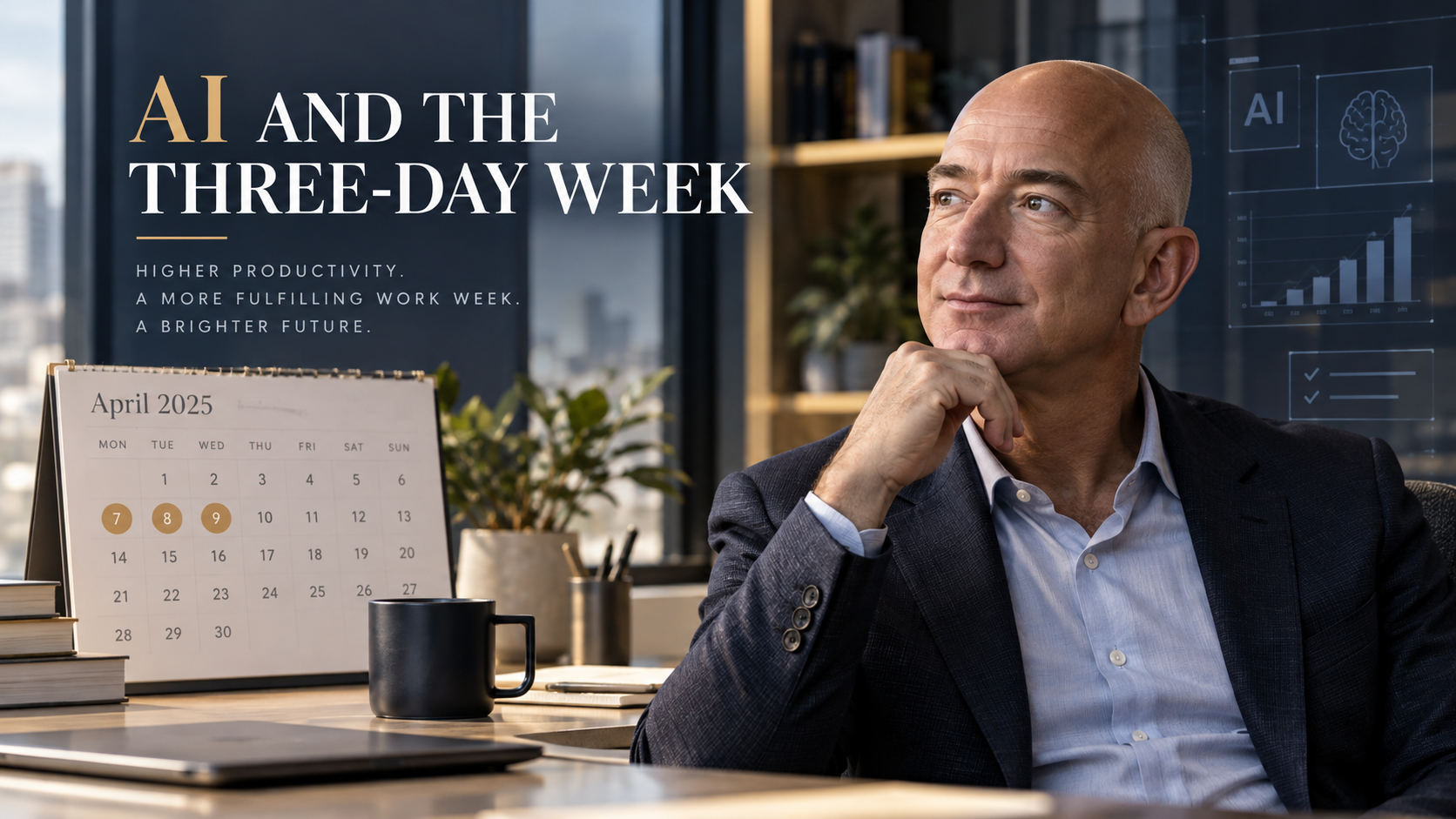
Jeff Bezos has floated a future in which artificial intelligence makes workers productive enough that some people might choose a three-day workweek while still supporting their families. The Amazon founder made the point during an October 7, 2026 interview with Fox News. He did not announce that Amazon is adopting a three-day schedule or that AI guarantees shorter hours for everyone. The underlying distinction is crucial: Bezos was describing a possible long-term economic outcome, not a new employment policy. Fox News’s account of the interview and Fast Company’s focused coverage make that clear.
Key takeaways:
- Bezos linked the possibility of fewer working days to future gains in AI-driven productivity.
- He suggested greater output could make single-income households or shorter working schedules financially feasible for some families.
- There is no evidence in the cited interview of a universal three-day-workweek plan at Amazon.
- Research shows AI can save time on some tasks, but broad effects on compensation and employment remain unsettled.
What did Jeff Bezos say?
In the Fox interview, Bezos discussed an optimistic vision of technological progress. His argument was that powerful AI tools could raise economic output enough to expand people’s choices. If a person can generate greater value in less time—and share financially in that improvement—working fewer days could become an option rather than a forced reduction in income.
That scenario is different from predicting every office will close on Thursdays and Fridays. It is also different from a government-mandated reduction in work hours. Fast Company reported Bezos’s additional concern that firms might face labor shortages if people respond to higher productivity by choosing more leisure time.
The prediction has attracted attention because it reverses the most alarming version of the AI-and-jobs debate. Instead of imagining machines replacing so many workers that employment vanishes, Bezos emphasized the possibility of prosperity, shorter hours and tighter labor supply.
Why the productivity argument matters
Labor productivity is commonly measured as output per hour worked. That is the U.S. Bureau of Labor Statistics’ definition. A software developer completing work that used to require ten hours in six may produce more per hour. A customer-service team handling routine requests faster may serve more customers without increasing headcount at the same rate.
But greater task efficiency does not automatically mean that an employee receives proportionally higher wages or fewer shifts. Businesses choose how to allocate productivity gains among pricing, investment, expansion, profits, compensation and staffing. Workers’ bargaining power, competition, management priorities and public policy can all shape the outcome.
A simple illustration—not a forecast
Imagine an employee currently produces 40 units of useful output during a 40-hour week. Productivity is one unit per hour. If technology raises the rate to 1.67 units an hour, a 24-hour week could, arithmetically, produce approximately 40 units.
That calculation only shows a technical possibility. It assumes the tasks can be reorganized, demand stays sufficiently steady, management accepts the schedule, and pay arrangements remain favorable. Healthcare, aviation, emergency services, logistics and many other occupations require coverage across specific hours; AI cannot simply eliminate the need for people to be present.
The important question is not whether an AI tool sometimes saves time. It is whether the gain is widespread, reliable and shared in a way that makes shorter schedules financially sustainable.
What does current research show about AI and jobs?
The evidence is more restrained than the boldest predictions. A June 2026 International Labour Organization review found evidence of real but uneven productivity gains. It also concluded that large-scale job displacement had remained limited in the material reviewed, while warning about inequality, weakened entry-level pathways and shifting job quality.
Separately, Yale’s Budget Lab tracker, updated September 15, 2026, reported no clear economy-wide labor-market disruption attributable to AI in the indicators it examined. Its researchers cautioned that the findings could change as technology adoption and data evolve.
These results do not prove Bezos wrong. They show that the conditions for a large-scale three-day week have not yet been demonstrated by broad labor data. Firms are experimenting with AI, but productivity effects differ among tasks, occupations and organizations.
Task savings are not the same as job transformation
An AI assistant might draft a first version of a memo quickly, but a professional still needs to check accuracy, speak with clients, make decisions and accept responsibility. A factory might improve planning efficiency while remaining constrained by physical machinery. A hospital might automate paperwork yet still need the same number of nurses for bedside care.
This distinction between automating tasks and replacing whole jobs is essential. Headlines suggesting a direct line from better chatbots to a nationwide three-day week skip multiple economic steps.
Could workers keep the same pay while working less?
They could in some workplaces, but that would require an employer decision, collective agreement, regulatory change or a labor-market environment supportive of higher effective hourly compensation. An employee moving from five eight-hour days to three eight-hour days would cut weekly hours from 40 to 24—a 40% reduction in hours. Keeping weekly pay unchanged would require compensation per hour to increase by about 67%, before considering other changes in productivity or operating costs.
That is a much larger adjustment than ordinary schedule flexibility. The arithmetic does not make it impossible; it makes the necessary improvement explicit. By contrast, a four-day, 32-hour schedule requires a 20% reduction in hours, a different benchmark entirely.
Any employer trial must ask whether output, service quality, employee retention and customer coverage are maintained. Studies of particular programs may be promising, but results do not transfer uniformly to every industry.
What about Amazon employees?
There is no verified connection between Bezos’s prediction and an official companywide Amazon three-day-workweek policy. Bezos is Amazon’s founder and executive chair, but his personal economic forecast should not be presented as a company announcement.
Amazon operates a mixture of offices, warehouses, cloud-computing facilities, transportation networks and other businesses. Working-hour patterns depend on the role and contract. A broad change in hours would require formal employee communications and operational planning, not merely comments in a television interview.
Readers searching “Is Amazon switching to three days?” should therefore receive an unambiguous answer: not on the basis of this interview.
Could AI create a labor shortage instead of mass unemployment?
Bezos’s labor-shortage concern is plausible as a scenario, but it is not an established forecast. If incomes rose while more workers elected to reduce hours, businesses might face greater competition for labor. Yet other forces could push the opposite way: some jobs could be automated, employers could reduce hiring, or new industries might absorb displaced workers.
The net result will depend on adoption speed, which tasks AI performs reliably, the cost of computing and energy, economic growth and how governments and companies manage the transition. Reuters’ October 2026 discussion of AI at work also emphasized that AI is changing tasks within jobs, with younger and experienced workers potentially affected differently.
Frequently asked questions
Did Jeff Bezos predict a three-day workweek?
Yes. He discussed it as a possible consequence of greater AI productivity during an October 7, 2026 Fox News interview. It was not a commitment to a timetable.
Is Amazon moving to a three-day workweek?
No companywide shift was announced in the interview. Any claimed policy should be verified against Amazon’s official employment communications.
Would a three-day workweek mean three eight-hour days?
Not necessarily. A three-day schedule could mean 24 hours, longer shifts or another arrangement. Bezos did not establish a universal definition or wage agreement.
Will AI eliminate the need to work?
There is no evidence supporting that as an inevitable outcome. The ILO’s 2026 review describes heterogeneous gains and risks rather than the disappearance of work.
Could AI make one-income households more common?
It could in theory if household purchasing power rises materially, but wages, housing costs, childcare, benefits and employment security also matter. The claim remains a scenario, not a confirmed demographic trend.
When could three-day workweeks become common?
No defensible national timetable can be inferred from the cited interview. Some employers may experiment sooner than others.
The bigger economic question
The provocative part of Bezos’s vision is not whether software can perform individual tasks faster. It is whether future productivity gains become broadly shared prosperity. If workers capture enough benefit, shorter schedules may become more feasible. If gains are concentrated in profits or paired with job insecurity, fewer working hours could instead mean lower household income. Those are fundamentally different futures, and the evidence today does not settle which will dominate.
Discover more from The Economy
Subscribe to get the latest posts sent to your email.

The Global South: Debt, Climate Finance and Investment in 2026

Energy Security Is the New Economic Security

Can Global Tourism Survive Geopolitical Shocks?

Global Maritime Hegemony: How China Secured Over 81% of All New Shipbuilding Orders

The Coming Battle Over AI, Jobs and Wages

Why Developing Economies Face a Sharper Inflation Problem

The New Geography of Trade: Are Supply Chains Coming Home?

Is AI Saving Global Growth or Creating the Next Bubble?

Global Banking Trends 2026: Digital Banks, AI and Compliance

Gold vs US Dollar vs Bitcoin in 2026: Inflation Hedge Compared

How Global Interest Rates Affect Savings, Loans and Investments

How to Invest During High Inflation: A Global Guide

Best Global Stocks to Watch in 2026: Four Sectors to Research

Pakistan’s 2027 Growth Strategy: Exports, AI, Energy and Jobs

Crude Oil & Petroleum Market Analysis: OPEC+ Decisions and Price Forecasts

World’s Largest Economies: Ranking the Top Global Powers

Silver Price Today: Why the Xi-Trump AI Standoff Is Fueling a Safe-Haven Rally

Top US Convenience Store Chains: Store Counts, EV Charging, and Sales Trends

Algorithmic Dogfights: Why the U.S. and China Must Establish Rules of Engagement for Autonomous Air Power

Who Is Shivon Zilis? The Neuralink Executive at the Center of the Musk–OpenAI Trial

Corporate America Faces a New Debt Test as US Borrowing Costs Surge

Business Insurance: What Coverage You Actually Need and What It Costs in 2026

Global Economic Outlook 2026: 7 Forces Reshaping Markets, Trade and Business

Social Security Extra $90 Deposit: Who Qualifies for the October 2026 Medicare Rebate?

Gold Falls 3.7% as Yields Surge: Is Gold Still a Safe Haven in 2026?

Stock Market Today: Dow, S&P 500, and Nasdaq Retreat as Treasury Yields

US 10-Year Yield Hits 5.24%: What the Historic Bond Market Sell off Means for Mortgages and Investors

MAS Allocates S$1.45 Billion to Five Asset Managers in Third EQDP Batch: Total Deployment Reaches S$5.4 Billion
-

 Markets & Finance10 months ago
Top 15 Stocks for Investment in 2026 in PSX: Your Complete Guide to Pakistan’s Best Investment Opportunities
-

 Analysis8 months ago
Johor’s Investment Boom: The Hidden Costs Behind Malaysia’s Most Ambitious Economic Surge
-

 Analysis8 months ago
Top 10 Stocks for Investment in PSX for Quick Returns in 2026
-

 Banks9 months ago
Best Investments in Pakistan 2026: Top 10 Low-Price Shares and Long-Term Picks for the PSX
-

 Analysis9 months ago
Brazil’s Rare Earth Race: US, EU, and China Compete for Critical Minerals as Tensions Rise
-

 Investment10 months ago
Top 10 Mutual Fund Managers in Pakistan for Investment in 2026: A Comprehensive Guide for Optimal Returns
-

 Global Economy10 months ago
15 Most Lucrative Sectors for Investment in Pakistan: A 2025 Data-Driven Analysis
-

 Global Economy10 months ago
Pakistan’s Export Goldmine: 10 Game-Changing Markets Where Pakistani Businesses Are Winning Big in 2025