
Markets & Finance
JS-SEZ Master Plan 2026: Southeast Asia’s Boldest Economic Bet

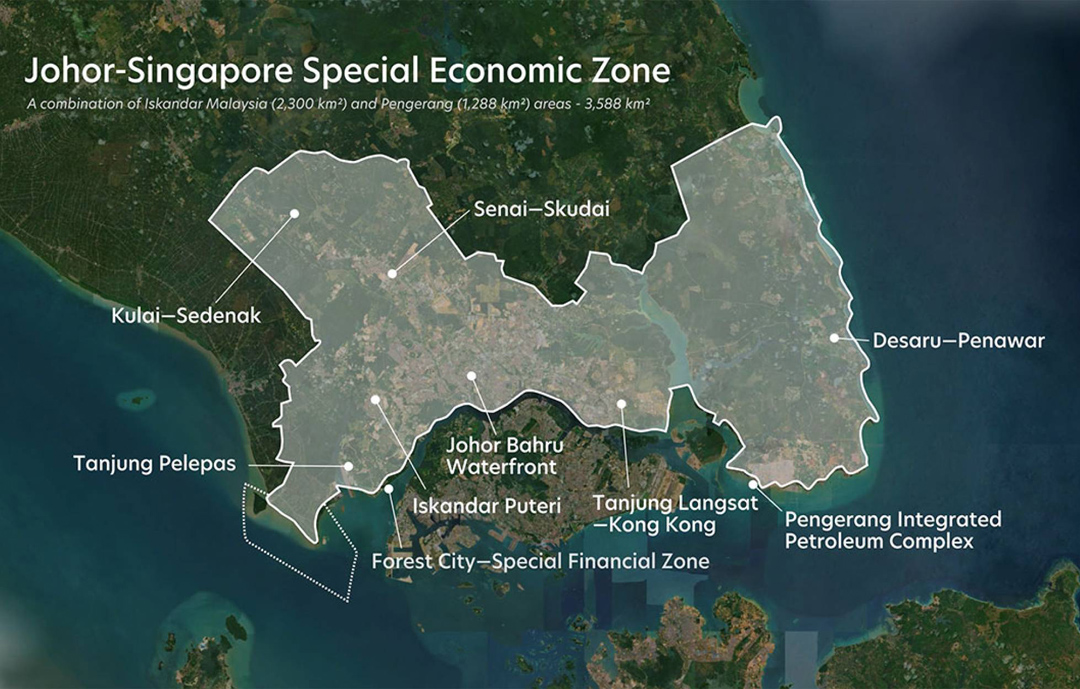
The Johor-Singapore SEZ master plan is reshaping Southeast Asia’s tech map. Data centres, semiconductors, and the RTS Link are turning the JS-SEZ into 2026’s most compelling investment corridor.
There is a phrase that tends to get recycled at investment forums across Southeast Asia — the promise of a “win-win.” It rolls easily off the tongue and means almost nothing. So when Vinothan Tulisi, director of the Malaysian Investment Development Authority’s Singapore office, stood before a room of business leaders on April 13 and said, “We are not talking about a zero-sum game here,” you might have expected the usual polite scepticism. You would have been wrong.
The context was a dialogue jointly organised by the Singapore Press Club and the Johor Economic, Tourism and Cultural Office (Jetco) Singapore — a gathering convened to discuss the Johor-Singapore Special Economic Zone, or JS-SEZ. The topic was not just another bilateral handshake. The master plan for one of Asia’s most ambitious cross-border economic corridors is nearing public release, and the sectors generating the most heat — data centres and semiconductors — happen to be the same industries that geopolitics is frantically rewiring around the world.
This, as the bankers like to say, is not a coincidence.
What the JS-SEZ Master Plan Actually Says
The JS-SEZ was formally signed on January 7, 2025, a bilateral agreement between Malaysia and Singapore to weave the southern Malaysian state of Johor into a seamless economic corridor with the city-state. The zone spans approximately 3,571 square kilometres — nearly five times the land area of Singapore itself — and targets accelerated growth across 11 key sectors, from advanced manufacturing and digital economy to logistics, green energy, and financial services.
The investment blueprint was launched on March 30, 2026 in Johor Bahru, the culmination of months of planning by Malaysia’s Ministry of Economy under Economy Minister Akmal Nasrullah Mohd Nasir. A more detailed master plan — the operational roadmap for all implementing parties — follows in parallel. The launch was originally scheduled for earlier in March, and the brief delay only sharpened the anticipation from investors watching closely from Hong Kong, Tokyo, Riyadh, and Silicon Valley.
The incentive architecture is striking. Companies qualifying under the JS-SEZ framework are eligible for a 5% corporate tax rate for up to 15 years in priority sectors including semiconductors, AI, medical devices, and advanced manufacturing. Knowledge workers who relocate to operate within the zone receive a 15% flat personal income tax rate for up to a decade — a figure designed explicitly to attract the Malaysian diaspora home from Singapore and to tempt expatriates who have long treated Johor as a dormitory suburb rather than a destination.
The application window runs until December 31, 2034. There is, in other words, real urgency to move.
Data Centres: The Sector That Started the Stampede
If any single industry has defined Johor’s transformation story over the past three years, it is data centres. As of late 2024, Johor hosts over 50 data centres, making it one of the largest concentrated hubs of digital infrastructure in all of Southeast Asia. Microsoft, Equinix, Princeton Digital Group, GDS International, ByteDance — these are not names that make speculative bets.
The arithmetic is straightforward. Singapore is land-constrained and power-hungry; data centre developers have been bumping against capacity ceilings in the city-state for years. Johor offers exactly what Singapore cannot: land priced at a fraction of Singapore’s rates, expanding power infrastructure, sufficient water resources, and — critically — fibre connectivity and proximity to Singapore’s subsea cable ecosystem. Rangu Salgame, CEO of Princeton Digital Group, captured the mood precisely when he told Fortune: “Johor is adding data centre capacity at a speed and scale I’ve not seen ever anywhere else.”
The JS-SEZ framework formalises and supercharges this dynamic. Under the bilateral agreement, companies can pursue what has been termed a “twinning” or “plus-one” strategy — maintaining high-value functions, client relationships, and financial operations in Singapore while building out the compute-heavy, land-intensive infrastructure in Johor. The SEZ makes that split operationally seamless in ways that previously required considerable regulatory navigation.
There are, however, friction points that the master plan must address candidly. In late 2025, Johor state authorities issued a temporary moratorium on new approvals for water-cooled data centres to protect local water supplies — a sensible constraint that nonetheless rattled investors who had been pencilling in aggressive build schedules. The pause is forcing a necessary technological pivot toward air-cooling and closed-loop liquid-cooling systems, aligning the region’s data infrastructure more closely with ESG requirements that institutional capital increasingly demands. It is a short-term headache that, managed well, could produce a greener, more sustainable data corridor than would otherwise have emerged.
Power grid strain is a related concern. Malaysia’s National Energy Transition Roadmap is integrating renewable energy commitments into the JS-SEZ framework, but AI-driven data centres are pushing global power demand up by roughly 20% annually, and Johor’s grid needs to keep pace. Early movers who lock in power capacity reservations now will be significantly advantaged.
Semiconductors: The Geopolitical Play
Here is where the JS-SEZ story gets genuinely interesting — and where the master plan’s strategic intelligence will be judged by history.
The global semiconductor supply chain is fracturing. What analysts at The Edge Malaysia have called the bifurcation into “Blue Silicon” and “Red Silicon” — a US-aligned and China-aligned chip world — is creating acute pressure on every country that has built its economic model on neutral, export-driven chip manufacturing. Malaysia currently handles approximately 13% of global chip assembly, testing, and packaging. Its semiconductor exports have surged — rising nearly 20% year-on-year between January 2025 and January 2026, with integrated circuits comprising 32% of total export value. That is both an extraordinary achievement and a vulnerability.
Prime Minister Anwar Ibrahim has framed Malaysia’s strategic position explicitly: the country offers a “neutral and non-aligned location” for companies that need to manufacture chips without being conscripted into one geopolitical bloc or another. Malaysia’s National Semiconductor Strategy targets a cumulative investment of RM500 billion (approximately US$118 billion), with RM25 billion in public support phased across multiple stages. By early 2025, more than RM63 billion in private investment had already been secured.
The JS-SEZ turbocharges this ambition by placing Johor — with its land, its lower-cost labour pool, and its direct connection to Singapore’s engineering talent and financial capital — at the centre of a cross-border semiconductor corridor. The zone’s cleanroom-ready industrial parks, including the 745-acre Sedenak Tech Park and the 509-acre Nusajaya Tech Park, are designed to support exactly the kind of controlled-environment manufacturing that chip assembly and advanced electronics require.
The risk, as several analysts have noted with considerable candour, is that Malaysia cannot simultaneously court US hyperscalers and deepen ties with Chinese chip firms without eventually being forced to choose. Washington’s scrutiny of technology transfer flows through ASEAN is intensifying. Johor’s data centre build-out has already attracted both American giants (Microsoft, Equinix) and Chinese players (ByteDance, GDS), operating in the same geography under what is currently a comfortable ambiguity. Whether that ambiguity remains comfortable through the remainder of this decade is, frankly, the most important geopolitical question the JS-SEZ master plan does not yet fully answer.
The RTS Link: Infrastructure as Economic Destiny
No honest account of the JS-SEZ can proceed without addressing the project that binds the entire vision together: the Johor Bahru–Singapore Rapid Transit System Link.
The RTS Link is a 4-kilometre rail shuttle connecting Bukit Chagar station in Johor Bahru with Woodlands North station in Singapore, with a journey time of approximately five minutes. By April 2026, the project has surged past 90% completion, with passenger operations targeted to commence by end-2026 and full launch by January 2027. The first driverless train arrived in Woodlands for demonstration on February 4, 2026, and the Land Transport Authority of Singapore has confirmed the project remains on schedule.
The system’s numbers are worth dwelling on. Peak capacity is 10,000 passengers per hour in each direction, with trains running every 3.6 minutes during peak periods. Expected daily ridership upon opening is 40,000 commuters — a figure projected to grow to 140,000 in the long term, absorbing at least 35% of the current human traffic at the Johor–Singapore Causeway, one of the world’s most congested land border crossings. Fares will be set between MYR 15.50 and MYR 21.70, or roughly S$5–S$7 per journey — affordable enough to make daily cross-border commuting a genuine lifestyle option, not an executive perk.
What the RTS Link does, in economic terms, is collapse the psychological distance between two cities that are physically separated by a single strait. Today, the Causeway crossing — jammed with lorries, motorcycles, and commuters — can take anywhere from 30 minutes to several hours. Five minutes changes everything. It allows a Singaporean engineer to live in Johor (where a three-bedroom condominium costs a fraction of its Singapore equivalent), work in a Johor-based manufacturing facility, and still attend a Friday evening client dinner in Singapore’s CBD. It enables a Johor-based SME to pitch investors in Singapore in the morning and be back at the factory floor by afternoon.
This is not theoretical. Singapore-based firms have already committed more than S$5.5 billion (approximately RM19 billion) to the JS-SEZ since the agreement was signed. Johor recorded RM27.4 billion in foreign direct investment in the first quarter of 2025 alone — an astonishing RM24 billion increase compared to the same period in 2024. The RTS Link, when it opens, will accelerate that trajectory further. Logistics operators, talent recruiters, and property developers are already pricing this in.
The Talent Gap: The Problem Nobody Wants to Discuss Loudly
There is a risk embedded in the JS-SEZ’s most optimistic projections that tends to be relegated to footnotes in investor presentations: talent shortages.
A Singapore Business Federation survey found that the majority of Singaporean companies citing difficulties in Johor named manpower challenges as their primary obstacle — specifically, problems with employment pass issuance and sourcing technically skilled workers. Johor’s population of 4.1 million is growing faster than Singapore’s, which is promising for future workforce depth. But the specialised skills required by semiconductor fabs, hyperscale data centres, and AI infrastructure simply cannot be conjured by policy decrees and tax incentives alone.
The Johor Talent Development Council (JTDC) has responded with “train and place” programmes specifically targeting the data centre and semiconductor sectors, aligning university and TVET outputs with investor needs. Malaysia has also launched an ASEAN Framework for Integrated Semiconductor Supply Chain (AFISS) to coordinate regional specialisation, with each member state playing a defined role. These are necessary and welcome initiatives. But the honest timeline for building a deep engineering talent base measured in years and cohorts, not quarters.
The 15% flat personal income tax for knowledge workers is an intelligent piece of the solution — a targeted offer to Singapore-resident Malaysians and regional expatriates to plant roots on the Johor side of the corridor. If the RTS Link makes the commute trivial, and the tax rate makes the economics compelling, the draw of Johor’s dramatically lower cost of living could make the talent equation work faster than sceptics anticipate. The Ibrahim Technopolis (IBTEC), a 7,300-acre innovation sandbox designed to be Asia’s largest, will be critical in anchoring this talent cluster through shared facilities and collaborative infrastructure for SMEs and multinationals alike.
A Complementary Ecosystem, Not a Rival One
The panellists at the April 13 Singapore Press Club dialogue kept returning to a concept that deserves to be the intellectual frame for the entire JS-SEZ project: complementarity. The zone works not because Johor is trying to replicate Singapore — that would be absurd — but because each side brings precisely what the other lacks.
Singapore contributes: world-class financial infrastructure, global legal and regulatory credibility, a deep pool of multinational corporate headquarters, sophisticated logistics operations, and unmatched connectivity to international capital markets. Johor contributes: four times Singapore’s land area, significantly lower operational costs (the median monthly wage in Johor remains roughly one-seventh of Singapore’s), an expanding energy grid, robust water resources, and room for the kind of industrial-scale infrastructure that simply cannot be built in a city-state of 728 square kilometres.
As Knight Frank Malaysia’s executive director Amy Wong Siew Fong observed, this proposition is compelling precisely because “both Malaysia and Singapore governments have demonstrated strong commitment to streamlined governance, transparency and collaboration” — giving investors the institutional confidence that the framework will not unravel under a change of government or a bilateral diplomatic temperature shift.
This bilateral maturity is itself underappreciated. Malaysia–Singapore relations have historically oscillated between warm cooperation and pointed friction over water agreements, airspace, and maritime boundaries. The fact that both governments have committed to a single transshipment permit system for land-based cargo (down from two), are rolling out QR code-based passport-free clearance at land checkpoints, and have jointly legislated the CIQ arrangements for the RTS Link — all signal an institutional seriousness that is genuinely new.
The SiJoRi Region and the Larger Vision
Zoom out far enough, and the JS-SEZ is one piece of a larger mosaic: the SiJoRi region — Singapore, Johor, and Riau Islands — a triangular economic zone that has been a concept since the 1990s but is only now acquiring the infrastructure and policy architecture to function as an integrated unit.
Nomura’s analysts wrote in December 2025 that they expect Malaysia’s economy to grow by 5.2% in 2026, driven in substantial part by JS-SEZ-related investment momentum. Malaysia captured 32% of Southeast Asia’s AI funding in recent years — a remarkable share for a country that the global tech press still largely associates with semiconductor assembly rather than frontier AI infrastructure.
If the master plan executes as designed, if the RTS Link delivers its passenger numbers, if the power grid keeps pace with data centre demand, and if the talent pipeline matures within five years rather than ten — the SiJoRi region has a credible claim to becoming Southeast Asia’s premier AI, semiconductor, and digital infrastructure corridor. Not the only one. Penang, Batam, and the Klang Valley all have serious ambitions. But the combination of bilateral institutional depth, geographic proximity to Singapore, and the sheer concentration of committed capital makes the Johor corridor distinctive.
The Verdict: Masterstroke, With Caveats
The JS-SEZ is not a magic wand. The master plan’s critics — and they are not wrong — point to execution risks that are real and stubborn: talent shortages that take a generation to address, power and water constraints that require infrastructure investment at a pace politics often struggles to sustain, regulatory alignment challenges across two sovereign systems with different legal traditions, and a geopolitical tightrope walk on semiconductors that could become dramatically less comfortable if US export control enforcement sharpens its focus on Malaysia.
But the critics tend to underestimate something equally real: the quality of the bilateral institutional commitment this time around. The RTS Link, nearly complete, is a physical manifestation of political will. The tax framework, legally anchored until 2034, provides the kind of certainty that long-term industrial investment demands. And the timing — with global chip supply chains scrambling for neutral, reliable geography amid the US-China technology cold war — is, for once, genuinely in Malaysia’s favour.
Vinothan Tulisi was right on April 13. This is not a zero-sum game. Done well, the JS-SEZ represents something Southeast Asia rarely produces: a bilateral economic relationship where both partners are structurally stronger together than apart, and where the geopolitical moment is aligned with their comparative advantages rather than working against them.
The master plan is on the table. The train is nearly ready. The capital is circling. What the SiJoRi region does with this convergence of factors — that is the story the next decade will tell.
Discover more from The Economy
Subscribe to get the latest posts sent to your email.


The VIX is the most quoted number in finance that almost nobody trades correctly.
It is not a price. It is not a direction. It is an annualised estimate of how much movement S&P 500 options traders are paying to protect against over the next 30 days — and that distinction is where most retail money is lost.
As of the close on 18 September 2026, the VIX stood at 14.81, down 4.1% on the session, after retreating from 17.71 two days earlier. Here is what that actually tells you.
Key Takeaways
- Current level: around 14.81, below the long-term midpoint and well off the 35.30 high of the past 52 weeks.
- What it measures: 30-day implied volatility of S&P 500 options — expected movement, not direction.
- Seasonality is real: the VIX median sits near 16.5 in late August and climbs toward 19 by early October.
- You cannot buy the index. Exposure comes via futures, options or ETPs, each with its own decay.
- Mean reversion is the defining property. Volatility trends back toward its long-run average, which is what shapes the futures curve.
What the VIX Actually Measures
The VIX is calculated by Cboe from a strip of near-term S&P 500 index option prices. Cboe’s own description emphasises the point most commentary misses: volatility is mean-reverting, and that property drives the shape of the VIX futures term structure.
A VIX of 15 implies annualised expected volatility of 15%. Divide by roughly 16 (the square root of 252 trading days) and you get an expected daily move of about 0.94% in the S&P 500.
That is the translation worth memorising. VIX 15 means “the options market expects roughly 1% daily swings.” VIX 30 means roughly 1.9%.
Why “Fear Gauge” Is a Misleading Nickname
The index says nothing about which way the market will move. Stocks can rally with elevated volatility and drift lower with subdued volatility. What changes when the VIX rises is the width of the expected outcome range, not its centre.
Reading the Current Level
| Reading | Interpretation | Typical Market Condition |
|---|---|---|
| Below 13 | Extreme complacency | Late-stage calm; hedges are cheap |
| 13–17 | Low / normal | Trending markets, orderly rotation |
| 17–25 | Elevated | Genuine two-sided uncertainty |
| 25–35 | High stress | Correction underway, correlations rise |
| Above 35 | Crisis | Forced deleveraging, liquidity gaps |
The VIX has eased substantially from the 21.51 reading in early June and the 20.66 high in late July, leaving equity-market risk perceptions relatively low despite unresolved questions on inflation, growth and Federal Reserve policy. The MOVE index, which tracks Treasury volatility, closed the same session at 80.64 — a reminder that bond markets are pricing more uncertainty than equity markets are.
That divergence is the single most interesting signal in the current tape.
The Seasonal Pattern Traders Actually Use
Volatility has a calendar. The VIX median since 1990 sits around 16.5 in late August, rises toward 18 by mid-September, and reaches roughly 19 in early October. September has historically been the weakest month for the S&P 500 since 1950, averaging a 0.6% decline.
Midterm election years sharpen the pattern. Stocks have often struggled from late summer into early autumn during midterm years before recovering into November — which makes 2026 a textbook setup for anyone building a seasonal hedge.
None of this is a trading system. It is a prior, and priors get overwhelmed by news.
How to Trade the VIX
You cannot buy the index itself. There are four practical routes, and they behave very differently.
1. VIX Futures
The purest expression. VIX futures provide a direct play on expected volatility, and expressing a long or short view means buying or selling contracts across the curve.
The catch is the term structure. In calm markets the curve is in contango — later-dated futures trade above spot — so a long position bleeds value as each contract rolls down toward settlement.
2. VIX Options
Options on the index allow defined-risk positioning. Long calls function as disaster insurance: cheap when nothing is happening, expensive exactly when you want them.
3. Volatility ETPs
Exchange-traded products track futures indices, not spot VIX. In persistent contango, they lose value structurally. They are tactical instruments measured in days, not buy-and-hold assets.
4. Direct S&P 500 Put Hedges
Often the cleanest approach. Instead of trading volatility as an asset, buy protection on the thing you actually own.
| Instrument | Best Use | Main Risk |
|---|---|---|
| VIX futures | Short-term directional volatility view | Roll cost in contango |
| VIX options | Defined-risk tail hedge | Premium decay |
| Volatility ETPs | Days-long tactical trades | Structural value erosion |
| S&P 500 puts | Portfolio insurance | Cost during calm markets |
The Volatility Risk Premium
One structural fact underpins most professional volatility strategies. Implied volatility from S&P 500 options tends to trade at a premium to the volatility the market subsequently realises.
Current data illustrates it precisely: with the VIX at 14.81, realised 30-day volatility was 9.49. Options buyers were paying for roughly 50% more movement than actually occurred.
That premium is why selling volatility is profitable most of the time — and catastrophic occasionally. Short-volatility strategies collect small, regular income and then surrender years of it in a single week. Size accordingly.
Practical Uses for Ordinary Investors
Most people should not trade the VIX at all. They should read it.
- As a hedging cost gauge. A VIX near 14 means downside protection is comparatively cheap. That is when to buy insurance, not after a crash.
- As a position-sizing input. Rising implied volatility mechanically increases the risk of any fixed-dollar position.
- As a contrarian sentiment check. Extreme readings in either direction have historically preceded reversals more often than continuations.
- As a reason to do nothing. Elevated volatility is when disciplined investors are rewarded for inaction.
What This Means for the Global Market in 2027
Coverage of the VIX rarely looks past today’s print. Four things matter more.
Bond volatility leads equity volatility. With the MOVE index elevated relative to a subdued VIX, any repricing of rate expectations is the most likely trigger for an equity volatility spike.
Policy transition risk is underpriced. Markets have warmed to the new Federal Reserve leadership, with the volatility index touching year-to-date lows in late August. Complacency around a policy regime change is historically expensive.
Geopolitics remains the fat tail. Volatility exploded on Middle East headlines earlier in 2026 before grinding back down. That mechanism has not gone away.
Concentration amplifies everything. With index returns driven by a narrow set of AI-linked names, single-stock disappointments now transmit to the whole index — meaning future volatility spikes may be sharper and shorter than historical averages imply.
Frequently Asked Questions
What is a normal VIX level?
A reading between roughly 13 and 20 is historically normal. The VIX closed at 14.81 on 18 September 2026, below its long-term midpoint.
Can you buy the VIX directly?
No. The VIX is a calculated index, not a tradable security. Exposure requires futures, options or exchange-traded products that track futures.
Why do VIX ETFs lose money over time?
They hold futures, not the spot index. When the futures curve is in contango, each roll sells a cheaper contract and buys a more expensive one, eroding value.
Does a high VIX mean stocks will fall?
No. The VIX measures expected size of movement, not direction. Markets can rise sharply while volatility is elevated.
Discover more from The Economy
Subscribe to get the latest posts sent to your email.
Markets & Finance
Presidential Stock Market Performance: How Trump’s Second Term Compares to History

Executive Summary: Since the November 5, 2024, presidential election, the U.S. stock market has navigated trade policy shifts, fluctuating tariff structures, and shifting interest rate expectations. Despite a sharp ~20% drawdown in early 2025, the S&P 500 generated a total return of 36.0% through September 2026, according to performance tracking from U.S. Bank Wealth Management.
While headline figures show strong market resilience, understanding how this performance ranks against modern predecessors—including Joe Biden, Barack Obama, Bill Clinton, and Ronald Reagan—requires examining underlying corporate earnings, market breadth, and Federal Reserve policy dynamics.
Historical Benchmark: S&P 500 Returns Across Modern Administrations
To accurately compare presidential stock market records, performance must be evaluated across full 4-year terms alongside cumulative mid-term benchmarks. Historical index data compiled by S&P Dow Jones Indices and analyzed by Schroders Investment Management shows that markets have historically trended upward regardless of party affiliation, averaging an annual total return of over 12% since 1946.
| Administration & Term | Period | S&P 500 Total Return (4-Year) | Cumulative 22-Mo. Benchmark | Primary Market Driver / Context |
|---|---|---|---|---|
| Ronald Reagan (Term 2) | 1985–1988 | +91.8% | +32.4% | Post-inflation recovery & 1980s tax restructuring |
| Bill Clinton (Term 1) | 1993–1996 | +88.6% | +21.2% | Early tech adoption & productivity boom |
| Bill Clinton (Term 2) | 1997–2000 | +88.6% | +48.1% | Dot-com expansion |
| Barack Obama (Term 1) | 2009–2012 | +85.1% | +41.5% | Post-Global Financial Crisis market rebound |
| Donald Trump (Term 1) | 2017–2020 | +81.3% | +24.8% | Tax Cuts and Jobs Act of 2017 & deregulation |
| Joe Biden | 2021–2024 | +66.3% | +18.4% | Post-pandemic stimulus & Tech/AI mega-cap surge |
| Barack Obama (Term 2) | 2013–2016 | +52.9% | +28.6% | Steady economic expansion & low interest rates |
| Donald Trump (Term 2) | 2025–2026 (In Progress) | N/A | +36.0% | Corporate earnings growth, domestic energy, & tech resilience |
Core Drivers of the 2025–2026 Equity Rally
1. Fundamental Earnings Growth Beat Expectations
Unlike market cycles driven purely by price-to-earnings (P/E) valuation expansion, the equity gains during 2025 and 2026 have been anchored in corporate earnings execution. S&P 500 second-quarter revenue grew over 16% year-over-year, while quarterly earnings surged 53%, more than doubling initial Wall Street forecasts. Third-quarter projections compiled by research teams at Bloomberg indicate sustained top-line revenue growth near 12% and earnings growth of 28%.
2. Market Rotation and Small-Cap Expansion
A notable divergence in Trump’s second term compared to earlier cycles is the broadening of market participation beyond mega-cap technology companies (“The Magnificent Seven”):
- Small-Cap Performance: The Russell 2000 and broader small-cap indices surged 60%+ from their April 2025 lows through September 2026.
- Sector Diversification: Financials, domestic industrials, and energy sectors saw accelerated inflows following regulatory easing and domestic energy development policies.
3. Institutional Volatility and Unprecedented Portfolio Activity
The market landscape in 2025 and 2026 has been marked by high policy-driven volatility. Disclosures analyzed by CBS News Financial Analysis and reporting from Reuters revealed unprecedented trading volume within executive investment accounts, executing thousands of transactions across defense, technology, real estate, and energy sectors during key legislative shifts.
Stay Ahead of the Markets
Subscribe to our free daily newsletter for institutional-grade analysis on how macroeconomic policies impact your portfolio.
Macro Economic Headwinds: Rates, Debt, and Inflation
While stock indices sit near historic highs, structural macroeconomic challenges remain. Here is a snapshot of the current macroeconomic realities:
- Elevated Federal Debt Costs: Data from the Federal Reserve Bank of St. Louis (FRED) highlights that the average interest rate on marketable U.S. Treasury debt climbed to 3.44%, compared to 1.42% in 2022. This elevation increases federal debt service obligations as maturing Treasury notes are refinanced at higher prevailing yields.
- Consumer Spending Shifts: Retail sales grew 5.0% year-over-year, though monthly momentum slowed. Wage growth at 3.2% provides ongoing income expansion but remains closely balanced against cumulative consumer price levels.
Analytical Summary: Wall Street vs. White House Context
Historical market analysis published by Morgan Stanley demonstrates that political leadership is only one of many variables driving long-term equity returns. Key takeaways for investors include:
- Policy vs. Fundamentals: Short-term market swings frequently respond to trade declarations, tariffs, and executive actions, but multi-year equity performance remains dictated by corporate earnings, cash flows, and monetary policy.
- Divided Government Advantages: Historically, markets under both Democratic and Republican presidents have posted above-average gains during periods of divided congressional control, which tends to limit radical fiscal shifts.
- Portfolio Discipline: Rebalancing asset allocations and maintaining broad sector diversification remains the primary protection against political and geopolitical market cycles.
What are your thoughts on the market’s response to recent trade policies? Share your perspective in the comments below, or check out our detailed breakdown of sector-by-sector performance in 2026.
Discover more from The Economy
Subscribe to get the latest posts sent to your email.
Bitcoin’s four-year cycle has been one of the most-watched patterns in crypto. It links price peaks and crashes to the supply event known as the halving.
So far, 2026 has looked a lot like the pattern. Here is where the price stands, what the cycle predicts and what analysts expect.
Key Takeaways
- Where we are: Bitcoin traded near $77,566 on September 16, 2026. CoinDCX
- The peak: Bitcoin peaked at $126,000 in October 2025 and had fallen roughly 50% by August. Mudrex
- Cycle theory: If history repeats, a bottom would land in late 2026.
- Analysts have cut targets: Major banks have lowered their 2026 forecasts.
- Key level: The 200-day moving average is the line technical traders are watching.
What Is the Bitcoin Four-Year Cycle?
Bitcoin’s supply issuance halves about every four years. Historically, price peaks followed each halving by roughly a year, then a deep drawdown followed.
Past cycles support this. The 2017 rally and the 2021 high both followed halvings. Each peak was followed by a long decline.
Bitcoin’s decline this cycle, about 54%, is milder than the 75% to 90% peak-to-trough crashes of 2014, 2018 and 2022. Some analysts read that as evidence of a maturing asset. CoinGecko
Bitcoin Price Today and Key Levels
| Level | Meaning |
|---|---|
| $126,000 | October 2025 all-time high |
| About $64,000 | Early August 2026 trading level |
| $73,077 | 200-day EMA, a key pivot |
| $80,000–$82,000 | Resistance zone traders watch |
The 50-day average recently crossed above the 200-day, a “golden cross” for the first time this year. Technical signals are mixed, and such patterns often fail. Treat them as one input, not a prediction. CoinDCX
One analysis says a sustained break below the 200-day EMA at $73,077 would invalidate the recent breakout. CoinDCX
Bitcoin Price Forecast for 2026: What Analysts Say
Forecasts have moved lower this year. Citi cut its target twice, from $143,000 to $82,000, and Standard Chartered cut from $150,000 to $100,000. Bernstein cut once, from $200,000 to $150,000. CoinGecko
If the four-year pattern holds, a market bottom could arrive between October and December 2026, with a possible range of $50,000 to $55,000. That range lines up with the 200-week moving average. Mudrex
Prices have already moved above that level, so the cycle bottom may have come earlier and higher than the pattern suggested. Nobody knows.
Prediction markets turned bearish in July, putting under 20% odds on $90,000 by year-end. Sentiment has improved since, but expectations remain cautious. CoinGecko
Bitcoin Price Forecast 2027
Long-range forecasts are speculative. Scenarios help frame the range.
| Scenario | Rough Outcome | What Would Need to Happen |
|---|---|---|
| Cycle holds | Slow recovery in 2027 | Bottom confirmed, gradual accumulation |
| Cycle breaks bullish | New highs sooner | Strong institutional inflows |
| Deeper bear | Retest of lower support | Macro shock or weak demand |
These are frameworks, not predictions. Anyone quoting a precise 2027 price is guessing.
What Could Break the Cycle
The cycle is a pattern, not a law. Four forces could change it.
- ETFs and institutions. Large regulated funds bring different buyers than earlier cycles.
- Interest rates. Central bank policy affects appetite for risk assets.
- Regulation. Clearer rules could attract capital, and tighter ones could deter it.
- Macro shocks. Energy prices and geopolitical events can hit all risk assets.
How Investors Can Approach the Market
- Use dollar-cost averaging. Spreading purchases reduces timing risk.
- Size positions carefully. Only invest money you can afford to see drop 50% or more.
- Know your holding route. Direct coins and spot ETFs carry different costs and risks.
- Watch the 200-day level and macro news.
- Keep records for taxes.
This article is general information, not financial advice.
What This Means for the Global Market in 2027
Most forecasts fixate on a single price. Here is what matters more.
Liquidity decides the next leg. Bitcoin has tracked global liquidity and risk appetite. Watch central bank policy.
Institutional adoption is the wild card. If ETFs and brokerages keep bringing in long-term holders, volatility may narrow.
The next halving is in 2028. Some analysts already anchor forecasts to it. The cycle may shift in timing if it continues at all.
Correlation with tech stocks. Bitcoin’s moves have followed large AI-linked stocks at times, so the two markets can turn together.
Frequently Asked Questions
What is the Bitcoin price prediction for 2026?
Forecasts vary widely, and major banks have cut their targets. Prices traded near $77,000 in mid-September.
Will Bitcoin hit a new high in 2027?
Nobody can say. If the four-year cycle holds, a new high is more likely later than in 2027.
Is the Bitcoin four-year cycle still valid?
It has matched 2026 so far, with a drop from an October 2025 peak. The decline has been milder than in past cycles.
When will Bitcoin bottom?
The cycle suggests late 2026, but bottoms are only clear in hindsight. Watch the 200-day and 200-week averages.
Discover more from The Economy
Subscribe to get the latest posts sent to your email.

VIX Index Explained: How to Trade Wall Street’s Fear Gauge Today

Commercial vs Residential Real Estate: Which Wins in 2026?

Presidential Stock Market Performance: How Trump’s Second Term Compares to History

2026 Real Estate Market News: Are We Heading for a Correction?

Bitcoin Price Forecast 2026–2027: Will the 4-Year Cycle Hold?

Fidelity Crypto vs. Traditional Brokerages: A Guide for Modern Investors

The 2026 Global Smartphone Market: AI Integration and Competitor Analysis

SpaceX IPO: How Aerospace Is Reshaping Tech Startup News

Fidelity Investments Review: Maximizing Returns in a Volatile Stock Market

How Crypto Transformed the Trump Fortune: A $1.4 Billion Financial Breakdown

Global Pension Systems Ranked: The World’s Best and Worst Retirement Frameworks

Global Supply Chain Vulnerabilities: From Eurasian Trade Corridors to Food Consumer Recalls

Why 5% U.S. Treasury Yields Signal a Global Market Regime Shift.

Federal Reserve Defies White House Pressure: Inside Trump’s Demand for Sub-1% Interest Rates After Historic 2026 Rate Hike

State Farm’s $5B Dividend 2026: Who Qualifies & Payout Dates

US-China Relations in Q3 2026: Trade Tariffs and Supply Chain Risks

Top 30 Stocks for Investment in PSX for Massive ROI in 2026

SpaceX Starship Flight 14: First Orbital Attempt & Starlink V3 Launch Explained

The 2026 Crypto Regulatory Shift: What It Means for Institutional Investors

AI Chip Stocks 2026: The Best Semiconductor Investments Beyond Marvell

Tween Back-to-School Trends 2026: What’s Driving the $85B Season

AI-Powered Training: The Next Multi-Billion Dollar Ecosystem in Fitness

Oil Prices Break $100 in 2026: Middle East Conflict & Energy Markets

10-Year Treasury Yield Hits 4.80%: What It Means for Rates & Portfolios

Fidelity Investments Review 2026: SPAXX Yields & Zero-Fee Funds

Shein Clothes Quality & Safety in 2026: What Lab Tests Show

BRICS+ Cross-Border Payments 2026: Interoperability Explained

MRVL Earnings 2026: Why Marvell Sank Despite Beating Estimates
-

 Markets & Finance9 months ago
Top 15 Stocks for Investment in 2026 in PSX: Your Complete Guide to Pakistan’s Best Investment Opportunities
-

 Analysis7 months ago
Johor’s Investment Boom: The Hidden Costs Behind Malaysia’s Most Ambitious Economic Surge
-

 Analysis7 months ago
Top 10 Stocks for Investment in PSX for Quick Returns in 2026
-

 Analysis8 months ago
Brazil’s Rare Earth Race: US, EU, and China Compete for Critical Minerals as Tensions Rise
-

 Banks8 months ago
Best Investments in Pakistan 2026: Top 10 Low-Price Shares and Long-Term Picks for the PSX
-

 Investment8 months ago
Top 10 Mutual Fund Managers in Pakistan for Investment in 2026: A Comprehensive Guide for Optimal Returns
-

 Global Economy9 months ago
15 Most Lucrative Sectors for Investment in Pakistan: A 2025 Data-Driven Analysis
-

 Global Economy9 months ago
Pakistan’s Export Goldmine: 10 Game-Changing Markets Where Pakistani Businesses Are Winning Big in 2025