
AI
Gwynne Shotwell’s Moonshot: How SpaceX Plans to Build AI Data Centers in Orbit and Manufacture Satellites on the Lunar Surface

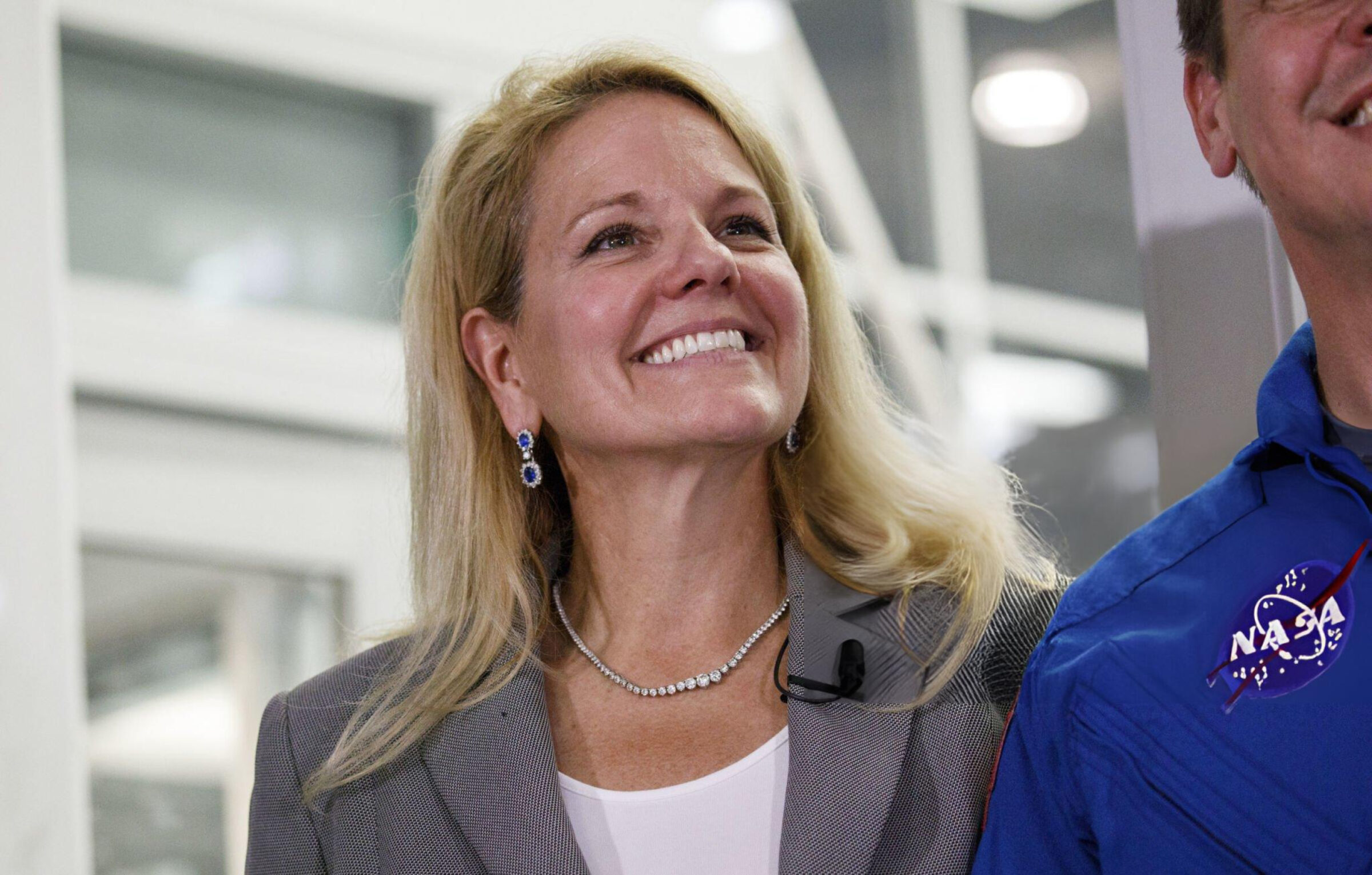
The woman behind history’s most valuable private company is steering a $1.25-trillion enterprise toward a future where artificial intelligence lives in space — and is built on the Moon.
On a Friday morning in February, inside a building roughly the size of sixteen football fields, the air smells of stainless steel and ambition. Eighteen Starship spacecraft line the gleaming white floor of SpaceX’s Starfactory in Starbase, Texas — some nothing more than enormous cylindrical barrels, nearly 30 feet across, awaiting their destinies. Others stand fully assembled, tapered nosecones already fitted, ready to be lifted atop their towering first-stage boosters to form a rocket that, at 40 stories, dwarfs every launch vehicle in history. Walking a high catwalk above this cathedral of engineering, surveying the controlled chaos below, is Gwynne Shotwell — President and COO of SpaceX, nearly 24 years into her tenure, and now the operational commander of what has quietly become the most consequential company on Earth.
“By 2028,” she says, casting her gaze across the factory floor, “these should be long gone. They better have flown by then.”
That sentence carries more weight than it might seem. Because buried inside it — inside every weld seam and stainless-steel barrel on that factory floor — is a plan to reshape not just how humanity reaches space, but what humanity does once it gets there. Shotwell and SpaceX are not simply building rockets. They are constructing the physical infrastructure for a new civilization’s computing backbone: artificial intelligence data centers in orbit, satellite manufacturing plants on the Moon, and a trillion-dollar company preparing to go public in what will likely be the largest IPO in capital markets history.
The Gwynne Shotwell AI Moon strategy is no longer a vision statement. It is an engineering program.
From Employee No. 7 to the World’s Most Valuable Company
Shotwell joined SpaceX in 2002 as its seventh employee, having persuaded a young Elon Musk over a cocktail-party conversation that his fledgling rocket venture desperately needed someone to sell it to the world. She was right then, and she has been right about most things since. Over more than two decades, she transformed SpaceX from an eccentric California startup that nearly went bankrupt in 2008 into a $1.25-trillion enterprise that dominates commercial launch, operates the world’s largest satellite constellation, and holds multi-billion-dollar contracts with both NASA and the U.S. Department of Defense.
The metrics alone are staggering. SpaceX’s Falcon 9 has now completed more than 630 successful launches, including a record 165 flights in 2025 alone. Starlink, the satellite internet service Shotwell championed from early ideation, now serves over 9.2 million active subscribers globally and generated more than $10 billion in revenue last year. The company reported approximately $16 billion in total revenue for 2025 and, according to Reuters, profit approaching $8 billion — numbers that would place it comfortably among the most profitable technology companies in the world, if it were public.
As of February 2026, it is becoming something larger. On February 2, SpaceX announced a landmark merger with xAI, Elon Musk’s artificial intelligence company, in an all-stock deal that valued the combined entity at $1.25 trillion — the largest private merger in recorded history. With a targeted IPO valuation now approaching $1.75 trillion, SpaceX is preparing to file its S-1 prospectus for a June 2026 listing that analysts expect to raise more than $75 billion, shattering Saudi Aramco’s $29.4 billion record from 2019.
Shotwell’s role is expanding accordingly. “It will morph over time,” she told TIME, “which is how my role has always gone.”
That is a characteristically understated way of describing what amounts to the operational merger of the world’s most powerful launch infrastructure with one of the most capable AI research programs on the planet. NASA Administrator Bill Nelson once said of Musk: “One of the most important decisions he made is he picked a president named Gwynne Shotwell. She runs SpaceX. She is excellent.” The coming years will test that excellence at a scale no executive in aerospace has ever faced.
The Convergence: Why SpaceX Needed xAI, and Vice Versa
To understand why Musk structured this merger — and why Shotwell is now driving its integration — you need to understand what AI actually needs, and what AI actually costs.
Global data center electricity consumption is projected to exceed 1,000 terawatt-hours in 2026, nearly double what it was just four years ago. A January 2026 report by Bloom Energy projects that U.S. data centers’ total combined energy demand will nearly double between 2025 and 2028, from 80 to 150 gigawatts — the equivalent of adding a country with Spain’s entire energy consumption in just three years. Goldman Sachs projects that data center power consumption will push core inflation up by 0.1 percent in both 2026 and 2027, as capacity market prices in key grid regions spike tenfold. Water is equally strained: AI data centers consume billions of gallons annually for cooling, concentrated precisely in the driest American regions where solar power is abundant.
This is not a minor inefficiency. It is a civilizational bottleneck.
Musk identified it publicly at the World Economic Forum in Davos in January: “The lowest-cost place to put AI will be in space, and that will be true within two years, maybe three at the latest.” Over the past three weeks, SpaceX has filed plans with the FCC for what amounts to a million-satellite data-center network. Shotwell confirmed in her TIME interview that she is “surprised it got little news” — an observation that speaks to how dramatically the mainstream press has underestimated the technical and economic substance of this plan.
The physics of orbital computing are compelling. According to a Starcloud whitepaper referenced by the World Economic Forum, a solar array in a dawn-dusk sun-synchronous orbit can generate over five times the energy of an equivalent array on Earth, achieving a capacity factor above 95 percent compared to just 24 percent for terrestrial solar farms. Cooling — the other existential problem for data centers — becomes passively trivial: deep space is roughly 270 degrees Celsius colder than room temperature, eliminating the need for energy-intensive chillers and fresh-water cooling systems entirely. According to IEEE Spectrum analysis, one architecture envisions a 240-kilowatt satellite housing two GPU racks with 144 processors, networked across 4,300 satellites to deliver a gigawatt of computing power.
For SpaceX, the logic is circular in the most profitable possible way. Shotwell put it plainly: “Starlink basically created this incredible demand for Falcon 9, and the AI satellites will do the same for Starship launches.” The more AI satellites SpaceX needs to launch, the more Starships must fly. The more Starships fly, the cheaper and more reliable each flight becomes. The cheaper each flight becomes, the more economically rational it is to move computing infrastructure to orbit. It is a flywheel that no other company on Earth has the launch capacity to spin.
The Technical Architecture: What a SpaceX Orbital Data Center Actually Looks Like
The FCC filing for up to one million AI satellites is not a placeholder. It reflects a specific engineering vision that has been taking shape inside both SpaceX and xAI since at least mid-2025.
The satellites themselves are conceptually distinct from Starlink’s existing broadband mesh. Rather than routing internet traffic between ground stations and end users, these AI satellites would function as distributed compute nodes — effectively, server farms in orbit. Each would carry specialized processing hardware, draw on continuous solar generation, and radiate waste heat passively into deep space through large metallic panels. Their orbital positioning would be optimized not primarily for latency to ground users, but for inter-satellite laser communication links that minimize the lag between compute nodes.
The merger with xAI provides the software layer: Grok’s large language models, reasoning engines, and inference systems would run natively on this distributed space-based architecture. The integration of Starlink’s global satellite mesh with xAI’s language models is explicitly designed to move massive compute workloads into space to exploit continuous solar energy and natural radiative cooling. This reframes the entire competitive landscape for SpaceX. The company would no longer be competing with Boeing or Lockheed Martin for launch contracts. It would be competing — and potentially undercutting — Microsoft Azure, Amazon Web Services, and Google Cloud, while being the only provider on Earth that controls launch vehicles, satellite hardware, and the AI models running on top of them.
The Lunar Gambit: Mass Drivers, Mining, and Manufacturing on the Moon
If the orbital AI constellation sounds audacious, the lunar vision that follows is genuinely unprecedented in the history of industrial planning.
Shotwell’s preferred scenario — which she describes as achievable “ideally in five years” — involves constructing a manufacturing base on the lunar surface capable of producing AI satellites from materials mined on the Moon. The gravitational physics are the core argument: with lunar gravity at roughly one-sixth of Earth’s, launching a payload from the Moon’s surface requires exponentially less energy than lifting an equivalent mass off Earth. Mass drivers — electromagnetic catapults that accelerate cargo along a track before releasing it into space — would serve as the primary launch mechanism, since the Moon’s lack of atmosphere eliminates aerodynamic drag entirely. The combination of locally sourced materials, in-situ manufacturing, and electromagnetic launch could reduce the effective cost of deploying each AI satellite by an order of magnitude compared to Earth-based production and Starship-based launch.
“If we’re building these satellites on the Moon with elements and materials from the Moon,” Shotwell told TIME, “it would be much faster and cheaper to launch them.”
This is not science fiction. The Moon’s regolith contains silicon, aluminum, iron, titanium, and oxygen in exploitable concentrations. Semiconductor fabrication from lunar silicon is technically challenging but not physically impossible. The governance question — who regulates a private lunar manufacturing base, and under what legal framework — remains genuinely unresolved; Shotwell acknowledged as much in her TIME interview. “It’s a great question,” she said of how a lunar city might be governed, “and I don’t know the answer.”
That honesty is telling. SpaceX is moving faster than the regulatory frameworks designed to constrain it, which is both its greatest competitive advantage and its most significant long-term liability.
The Artemis Alignment: Moon First, Mars Later
The lunar manufacturing vision intersects with a more immediate program: NASA’s Artemis initiative to return humans to the Moon. SpaceX’s Starship is the designated Human Landing System (HLS) for Artemis IV, currently targeting a crewed touchdown in early 2028. “It’s a hard problem and the whole architecture is complex,” Shotwell said, “but we’re gunning for 2028.”
Standing on the Starfactory catwalk and gesturing at the assembled vehicles below, she added: “By 2028, these should be long gone. They better have flown by then.”
The strategic logic of prioritizing the Moon over Mars — a subtle but significant shift from SpaceX’s founding narrative — is now explicit. Musk himself has described the near-term focus as a “self-growing city on the Moon” achievable within a decade, while Shotwell carefully insists the Mars vision has not been abandoned. What has changed is sequencing: the Moon offers both a near-term demonstration platform for SpaceX’s infrastructure capabilities and a potential manufacturing base that could dramatically accelerate the Mars timeline.
The geopolitical dimension of this sequencing deserves underscoring. China’s lunar ambitions are advancing on a parallel track: the China National Space Administration has targeted a crewed lunar landing by 2030 and has announced its intention to establish a permanent lunar research station by 2035. The industrial and strategic implications of whichever nation — or private entity — first establishes durable manufacturing infrastructure on the Moon are difficult to overstate. Control of the Moon’s resources, particularly water ice at the poles that could be converted to rocket propellant, could determine the economics of deep space access for decades.
Starship: The Machine That Makes It Possible
None of this is achievable without Starship — and Starship, in 2026, is finally becoming real.
Eleven uncrewed Starships have been launched since 2023, each producing 16.7 million pounds of thrust from its 33 first-stage engines — more than double the ground-shaking power of the Apollo-era Saturn V. The Super Heavy booster’s catch system — whereby the launch tower’s mechanical arms literally catch the returning booster mid-air — has now been demonstrated successfully, representing arguably the most dramatic reusability achievement in aerospace history.
| Vehicle | First Stage Thrust | Payload to LEO | Reusability |
|---|---|---|---|
| SpaceX Starship | 16.7 million lb (33 engines) | ~150 tonnes (target) | Full stack reusable |
| Saturn V | ~7.9 million lb (5 engines) | 130 tonnes | Expendable |
| SpaceX Falcon 9 | ~1.7 million lb (9 engines) | 22.8 tonnes | Booster reusable |
| United Launch Alliance Vulcan | ~1.7 million lb (2 engines) | 27 tonnes | Expendable |
Starship’s payload capacity and full reusability are what make the orbital AI constellation economically conceivable. A single Starship mission can deliver dozens of satellites simultaneously; with rapid reuse, the marginal cost per kilogram continues to fall toward targets that would have seemed hallucinatory a decade ago. Shotwell’s estimate that Starlink’s internal demand drove Falcon 9 reliability gains applies equally to what AI satellite demand will do for Starship: the production pressure of 1 million AI satellites is not a bug in the plan. It is the reliability engine.
Challenges, Risks, and the Skeptics’ Case
To engage seriously with this vision requires engaging seriously with its obstacles.
Launch economics at scale: Even with SpaceX driving down costs, launching hardware into orbit still runs roughly $1,500 per kilogram. A functional AI satellite with meaningful compute density — two GPU racks, as in the IEEE architecture — would weigh hundreds of kilograms. At current prices, scaling to one million satellites is a multi-trillion-dollar proposition before manufacturing costs are counted.
Latency: Signals traveling to low Earth orbit and back introduce delays of roughly 20-40 milliseconds — manageable for most workloads, but potentially problematic for real-time inference applications. For geostationary orbit, round-trip latency approaches 240 milliseconds, which is genuinely prohibitive for many AI use cases.
Radiation hardening: Consumer-grade semiconductors degrade rapidly in orbit’s radiation environment. Radiation-hardened components cost significantly more and typically lag terrestrial chips by several generations in computational efficiency.
Space traffic: Shotwell acknowledged the debris concern in her TIME interview, comparing 30,000 satellites to 30,000 cars — sparse if positions are known and communicated. But 1 million satellites is an order of magnitude beyond anything currently in orbit, and regulators at the FCC, ITU, and equivalent bodies in other countries will scrutinize collision-avoidance architecture rigorously.
Governance and geopolitics: A private lunar manufacturing base operated by a U.S. company raises profound questions under the Outer Space Treaty of 1967, which prohibits national appropriation of the Moon but is silent on private resource extraction. The legal framework is evolving, and SpaceX’s first-mover advantage may crystallize before international consensus does — which is precisely what competitors in Beijing are calculating.
The skeptics within the technical community are not wrong to raise these objections. Fortune’s reporting found that while Musk and some bulls argue space-based AI could become cost-effective within a few years, many experts say meaningful scale remains decades away. One COO of a terrestrial data center company put it bluntly: “Putting the servers in orbit is a stupid idea.” But that same Fortune piece noted the counterpoint that carries more historical weight: “You shouldn’t bet against Elon.” In 2002, putting a reusable rocket on a pad in Texas seemed equally stupid. In 2026, it is the global standard for commercial launch.
The IPO and the Economic Stakes
When SpaceX goes public — likely in June 2026, at a valuation that may reach $1.75 trillion — investors will not simply be buying a rocket company. They will be buying a thesis about where computation goes next.
SpaceX generated approximately $16 billion in revenue in 2025 with EBITDA of roughly $7.5 billion, with analysts projecting $23.8 billion in 2026 revenue. The Starlink business unit, with its 9.2 million paying subscribers and near-monopoly on high-performance satellite broadband in dozens of markets, is already functioning as a cash-generative telecommunications utility. The xAI integration adds an AI product layer — Grok and the inference infrastructure behind it — and, more importantly, the strategic rationale for deploying that compute into orbit.
The IPO structure is expected to include dual-class shares, maintaining Musk’s voting control while accessing public capital. Retail investors are reportedly being allocated up to 30 percent of shares — three times the Wall Street standard — a decision that reflects both populist branding and practical recognition that the SpaceX story resonates most powerfully with individuals who have watched it unfold in real time.
For the broader space economy, the public offering has catalytic implications. Morgan Stanley has estimated the total space economy could reach $1 trillion annually by 2040; SpaceX’s IPO will function as a pricing signal for every space-adjacent startup, satellite operator, and launch services competitor in the world.
Future Scenarios: Three Trajectories for the SpaceX AI Moon Strategy
Scenario A — Compressed timeline (2028–2031): Starship achieves full reusability and high cadence by 2028, enabling Artemis IV crewed Moon landing and initial Starlink V3/AI satellite deployment. Lunar base groundbreaking by 2030, first in-situ manufactured AI satellites launched from the Moon by 2031. Combined SpaceX entity becomes the world’s most valuable company by market capitalization, displacing Apple or Nvidia.
Scenario B — Extended timeline (2031–2036): Technical setbacks in Starship development — orbital refueling complexity, heat shield durability, booster cadence — push timelines out by three to five years. AI constellation reaches 100,000 satellites by 2032, lunar manufacturing by 2035. SpaceX remains dominant but faces meaningful competition from Amazon’s Project Kuiper and Blue Origin’s New Glenn.
Scenario C — Regulatory disruption: International coordination on space traffic and lunar governance hardens into binding treaty obligations that constrain private resource extraction and orbital congestion. A major collision event in low Earth orbit triggers FCC and ITU responses that throttle the AI satellite constellation before it reaches scale. SpaceX pivots toward terrestrial AI infrastructure, leveraging xAI’s software capabilities rather than its orbital ambitions.
Most analysts consider Scenario B the base case. Scenario A, as SpaceX’s history suggests, cannot be dismissed. Scenario C is the risk that neither Shotwell nor any investor in SpaceX’s IPO fully prices in.
FAQ: SpaceX AI on the Moon and Orbital Data Centers
What exactly are SpaceX’s AI satellites? SpaceX has filed with the FCC for licensing to operate up to one million AI satellites in orbit. These are not traditional communications satellites — they are designed to function as distributed computing nodes, essentially data centers in space. Each satellite would generate power from solar arrays, run AI inference workloads, and radiate waste heat passively into the cold of space. They are designed to circumvent the energy and cooling crises that are constraining terrestrial AI infrastructure.
Why is SpaceX planning to manufacture satellites on the Moon? The Moon’s gravitational pull is approximately one-sixth of Earth’s. Launching a satellite from the lunar surface requires dramatically less energy than lifting an equivalent payload from Earth. If satellites can be built from materials mined on the Moon — silica for semiconductors, aluminum and titanium for structures, oxygen for propellant — and launched via electromagnetic mass drivers, the cost per satellite could fall by an order of magnitude compared to Earth-based production.
What is the SpaceX-xAI merger and why does it matter? In February 2026, SpaceX completed an all-stock acquisition of xAI, Elon Musk’s AI company, in a deal valued at $1.25 trillion — the largest private merger in history. The combination links SpaceX’s launch vehicles and satellite infrastructure with xAI’s Grok language models and AI research. The stated goal is to build space-based AI infrastructure: orbital data centers powered by the SpaceX launch system and running xAI software.
When will humans return to the Moon, and what role does SpaceX play? SpaceX’s Starship is the designated Human Landing System for NASA’s Artemis IV mission, targeting a crewed lunar landing in early 2028. Shotwell has publicly committed to this timeline, stating the 18 Starships currently in production at Starbase need to have flown “long before then.”
Is Gwynne Shotwell the most important person in the space industry? She is arguably the most consequential. While Elon Musk provides the strategic vision and the public narrative, Shotwell has been the operational architect of SpaceX for nearly 24 years — building the commercial manifest, managing regulatory relationships across five federal agencies and dozens of governments, scaling Starlink from concept to 9 million subscribers, and now integrating xAI into a $1.75-trillion pre-IPO enterprise. NASA’s own administrator has called her “excellent.” The industry does not disagree.
The Next Industrial Revolution Will Be Launched from Texas
In the long sweep of economic history, there are moments when the physical location of industrial production shifts so fundamentally that the old maps become useless. The textile mills moved from cottage to factory. Steel moved from forge to blast furnace. Computing moved from mainframe to server farm. Each transition concentrated wealth, reshaped geopolitics, and rendered the previous infrastructure obsolete within a generation.
What Gwynne Shotwell is building — methodically, incrementally, from a factory floor in South Texas — is the infrastructure for a transition of equivalent magnitude. If the AI satellites fly, if the orbital data centers come online, if the lunar manufacturing base is established before Beijing’s equivalent program achieves the same, then the question of where artificial intelligence lives — where it is powered, where it is cooled, where it is built — will have been answered by a woman from a small town in northern Illinois who once convinced a young engineer that his rocket company needed someone to sell it to the world.
She was right then. The next two decades will reveal whether she is right about everything else. The odds, surveyed from a catwalk above eighteen half-built Starships on a Texas factory floor, look better than anyone outside that building has yet fully understood.
Discover more from The Economy
Subscribe to get the latest posts sent to your email.



The third-quarter 2026 earnings season arrives with investors asking whether corporate profits justify expensive stocks and elevated financing costs. Reuters’ October 9 market preview identified major U.S. banks and the upcoming inflation data as key near-term events. An earnings preview should be careful with dates: a company’s announced release time is verifiable; its actual result is not known until published. Sources: Reuters market week ahead and Reuters chip demand report.
The important context competitors can overlook
Bank commentary can reveal credit quality, deposit pricing, commercial borrowing and investment-banking activity. In technology, watch the gap between AI revenue growth and the cost of building data centers. Consumer-facing businesses offer different clues: pricing power, discounting, spending patterns and margin pressure from transportation or labor. Each sector may be telling a different part of the economic story. For primary-source checks and current reporting, see Reuters market week ahead and Reuters market breadth. The key distinction is preview without inventing earnings that have not happened.
Bank profits, AI spending and consumer earnings reveal different parts of the economy. Separate scheduled announcements, management forecasts and confirmed quarterly results. Research cutoff: October 12, 2026; confirm developing facts before publication.
A practical way to use this information
For every results story, separate reported revenue, adjusted earnings, guidance and free cash flow. Compare the release with consensus only if the estimate is dated and sourced. Include management’s explanation of one-off gains or impairments, and quote the most meaningful risk disclosure. A company can beat a quarterly forecast yet fall if investors expected stronger forward guidance.
An earnings scorecard readers can actually use
| Metric | What it answers | Common misreading |
|---|---|---|
| Revenue | Did customers buy more? | Revenue growth automatically means cash generation |
| Operating margin | Did each dollar of sales produce more operating profit? | Temporary charges always reflect normal operations |
| Free cash flow | Was cash generated after major investments? | Noncash earnings and cash are interchangeable |
| Forward guidance | What is management signaling next? | Guidance is a confirmed future result |
For bank earnings, add credit-loss provisions and deposit costs; for AI firms, add capital expenditure and utilization. A fuller scorecard is more useful than the headline beat/miss framing seen in many fast earnings articles.
What to verify before making a decision
The right next step is to identify the source, timestamp and applicable market or jurisdiction. Check whether a number is a historical observation, official announcement, target, forecast or scenario. If you intend to act financially, legally or commercially, use the relevant provider’s current terms and obtain professional advice where appropriate. The sources cited here establish context; they are not a substitute for live prices, individual eligibility checks or binding agreements.
Reader questions
Which earnings matter most in October 2026? Large banks, leading chip companies and consumer businesses can help explain different pressures in the economy.
Does beating estimates guarantee a rally? No. Expectations for future growth and valuation often matter as much as the reported quarter.
The bank earnings signals that extend beyond Wall Street
Large banks often report early in earnings season and can provide a window into lending, deposits and the health of consumers and businesses. Net interest income indicates what a bank earns from assets such as loans after its funding costs, but it should be read alongside deposit pricing and balance-sheet changes. A rising interest margin may support profits while simultaneously raising financing costs for borrowers. Loan-loss provisions are another important signal: management estimates expected credit losses using assumptions that can change as the economic outlook changes.
Credit-card delinquencies, consumer balances and commercial real-estate exposure can reveal pockets of stress before broader indicators show deterioration. Yet one bank’s customer mix may not represent the entire nation. A lender focused on wealthy households could report very different trends from a bank serving customers with lower disposable incomes. Earnings articles should avoid treating an executive’s anecdote as an official macroeconomic statistic, even when the comment offers valuable context.
The AI spending test: orders are not profits
Technology companies may announce record capital expenditure, new data centers or faster AI-related revenue growth. Investors should ask where in the chain a figure sits. A chip order is revenue for a supplier only under relevant accounting conditions. A cloud provider’s capital investment is an expense or asset decision rather than proof that end-user services are profitable. Enterprise customers may test AI tools for months before committing to large long-term contracts. Demand can be strong and returns uneven at the same time.
Look at management’s guidance for capital expenditure, depreciation and expected utilization. Compare recurring revenue with one-time setup fees or equipment sales. Rising sales accompanied by escalating delivery costs may produce lower margins than expected. Conversely, an initially costly rollout may yield operating leverage as capacity fills. The correct question is whether management’s stated timetable is supported by reported progress, not whether the company uses the phrase “AI transformation.”
What consumer-company results can reveal
Retailers, restaurants, airlines and payment companies see different portions of household demand. Revenue growth can come from higher prices, more transactions, acquisitions or a change in product mix. Same-store sales help isolate performance at established outlets, but their precise definition varies by company. Gross margin can fall despite rising revenue when labor, transport and input costs increase. Strong premium product sales may coexist with financial pressure on budget shoppers. A useful consumer earnings article looks for such differences.
When a company raises its full-year forecast, identify the starting forecast and the assumptions that changed. Was the increase driven by demand, pricing, exchange rates or reduced expense? An earnings beat relative to analysts’ estimates can occur even if operating performance deteriorated from a year earlier. Readers deserve both comparisons. Future guidance may be more important to the share price than the prior quarter’s reported earnings, but the response can differ according to expectations already embedded in valuation.
How to read one earnings release in ten minutes
Start with the publication timestamp and confirm the quarter ended when you think it did. Read revenue, operating income, net income and cash flow before the chief executive’s prepared quotations. Compare with the corresponding prior-year quarter, not only the immediately preceding one for a seasonal business. Identify adjusted measures and find their reconciliation with generally accepted accounting figures. Check whether share buybacks altered earnings per share. Then review guidance, debt, capital expenditure and the transcript for questions management was reluctant to answer.
Finally, compare the share-price move with the broader sector and the timing of other macroeconomic news. A company may post strong numbers and fall because investors expected even stronger results; another can rise on less disappointing guidance. Avoid writing that “investors rejected the results” unless the evidence makes the causal link clear.
Build a rolling earnings scoreboard
For each selected company, use columns for release date, quarter, revenue, year-over-year growth, operating margin, EPS, free cash flow, guidance change and key management caveat. Mark any still-unreported company as scheduled, never “reported.” Link to the actual investor-relations release and update the row after publication. A screenshot or commentary from a secondary source can help explain reaction, but should not replace the issuer’s filing.
A reliable earnings hub is useful precisely because it separates the known from the anticipated. It helps readers compare banks, technology firms and consumer businesses without turning forecasts into facts or mistaking one impressive quarter for a universal economic conclusion.
Discover more from The Economy
Subscribe to get the latest posts sent to your email.

IREN is no longer adequately explained as a bitcoin-mining stock. In its fiscal-2026 results, the company reported $128.8 million of AI Cloud Services revenue versus $16.4 million a year earlier, alongside $578.2 million in bitcoin-mining revenue. That combination makes IREN a transition story, not a pure-play cloud software business. Its shares can reflect both cryptocurrency risk and expectations about future GPU data-center execution. Sources: IREN fiscal results and IREN contract update.
The important context competitors can overlook
The numbers require context. IREN reported a fiscal-year net loss of $702.6 million, affected by large noncash impairments as mining machines were decommissioned. In July, it announced additional AI developer contracts and lifted its targeted annualized run-rate revenue above $4 billion for year-end 2026. An ARR target, signed contract value and recognized revenue are different measures; treating them as interchangeable inflates the apparent certainty of a growth story. For primary-source checks and current reporting, see IREN fiscal results and Reuters chip demand report. The key distinction is distinguish company targets, revenue, cash use and accounting losses.
IREN’s AI cloud expansion needs to be analyzed alongside remaining bitcoin mining, infrastructure spending, customer commitments and the difference between projections and recognized revenue. Research cutoff: October 12, 2026; confirm developing facts before publication.
A practical way to use this information
Build an earnings checklist around installed GPU capacity, commissioned power, customer concentration, contract timing, financing dilution, capital expenditure and free cash flow. Compare new quarterly AI Cloud revenue with management’s previous projections rather than focusing on stock-price momentum. Readers should verify the actual IREN quote separately; the article makes no claim about today’s live market price.
IREN’s reported transition in one table
| FY2026 measure | Reported result | Editorial interpretation |
|---|---|---|
| AI Cloud Services revenue | $128.8 million | Fast-growing, but still a smaller revenue stream |
| Bitcoin mining revenue | $578.2 million | Legacy business remained substantial |
| Total revenue | $707.0 million | A multi-activity business, not all AI |
| Net loss | $702.6 million | Accounting losses affected by impairments |
All figures above come from the company’s FY2026 results. The company-reported forward target above $4 billion in annualized AI Cloud run-rate revenue is a different unit from realized FY2026 sales. A fair stock analysis asks what must be commissioned, financed and billed to convert ambition into future earnings.
What to verify before making a decision
The right next step is to identify the source, timestamp and applicable market or jurisdiction. Check whether a number is a historical observation, official announcement, target, forecast or scenario. If you intend to act financially, legally or commercially, use the relevant provider’s current terms and obtain professional advice where appropriate. The sources cited here establish context; they are not a substitute for live prices, individual eligibility checks or binding agreements.
Reader questions
Is IREN still a bitcoin miner? It reports bitcoin-mining activity while shifting investment toward AI Cloud.
Is its announced ARR target the same as revenue earned? No. An annualized target is forward-looking and not the same as recognized financial-statement revenue.
Why the transition from bitcoin mining to AI is financially complex
IREN’s history in energy-intensive computing can provide useful infrastructure, but running AI cloud capacity introduces a different operating model. Bitcoin mining revenue depends heavily on network economics, digital-asset prices and power costs. AI cloud revenue typically depends on customer commitments, expensive GPU equipment, uptime, networking and the ability to deliver contracted services. Both may use data centers, yet the hardware, customer relationships, accounting treatment and capital requirements differ. Investors should not treat the company as a conventional software business merely because an increasing portion of its revenue is associated with artificial intelligence.
The distinction matters when comparing financial results. A new GPU fleet can be deployed over several quarters while the associated contracts start at different dates. Announced purchase agreements, secured power capacity and future customer targets do not all become recognized revenue immediately. Look for management’s explanation of deployment timing, contract start dates, cost of revenue and capacity utilization. Where a release presents projected annualized figures, check whether they assume a full year of operation at a level that has not yet been achieved.
How to read the financial statements
Begin with three documents: the earnings release, the actual financial statements and the notes explaining financing obligations. The income statement shows revenue and expenses within a period. The cash-flow statement indicates whether operations generated cash and how much went toward equipment or other investment. The balance sheet shows cash, debt, assets and liabilities at a particular date. A company expanding data-center infrastructure may report strong sales growth while using substantial cash for GPUs, networking and construction. That combination is neither automatically successful nor inherently unsustainable; its implications depend on returns and funding.
Do not rely on adjusted earnings metrics alone. They can be informative, but they may exclude recurring economic costs such as stock-based compensation or depreciation. Depreciation is particularly relevant when hardware becomes obsolete faster than expected. Investors should ask whether contracted cash flows are sufficient to cover power, staffing, hardware replacement and the cost of capital. An accounting loss and negative free cash flow are different measures and deserve separate discussion.
A practical valuation framework for IREN stock
A basic checklist compares current enterprise value with a range of plausible future operating outcomes, not merely a price target copied from a social feed. First, divide reported revenue by business segment and identify how each segment is changing. Second, map committed capital spending and available financing. Third, test operating margins under conservative assumptions for energy, staffing, hardware and customer utilization. Fourth, consider dilution: raising new equity can fund growth while reducing the ownership percentage of existing shareholders.
It is important to separate company projections from independently confirmed results. If a company plans to add a large amount of contracted GPU capacity, ask what portion is installed, accepted by customers and producing billable work. Also ask whether contractual minimums, termination provisions or performance requirements could alter the realized economics. A company can meet a deployment milestone and still deliver weaker investor returns if financing or equipment costs exceed expectations.
The concentration and execution risks behind an AI cloud thesis
Large customers can validate demand, but an unusually concentrated customer base may expose revenue to renegotiations, delayed projects or changes in purchasing strategy. Hardware manufacturers and data-center builders also compete for equipment and electrical infrastructure. Permits, transformer deliveries, cooling systems, networking and labor constraints can affect timelines. If a new project runs late, interest expense or depreciation may start before meaningful revenue arrives. If AI demand grows faster than capacity, the reverse may occur—but investors should support either case with evidence.
Bitcoin exposure may remain material during the transition. An analyst comparing IREN with a pure AI infrastructure firm must account for retained mining activity and other balance-sheet sensitivity. It is also worth reading governance disclosures and related-party transactions when the company is funding a rapid expansion cycle. These factors do not establish that a given contract or project is flawed; they help investors evaluate the range of plausible outcomes.
A quarterly dashboard worth maintaining
Record segment revenue, segment gross margin where reported, operating cash flow, capital expenditure, debt, share count, operating GPU capacity and customer commitments for each quarter. Mark reported results separately from targets. Then add a short note explaining whether each change came from a one-time transaction, organic expansion or a change in accounting presentation. A spreadsheet with consistent definitions is usually more informative than a comparison of headline share prices on two random days.
Use IREN’s investor-relations releases and regulatory filings as the baseline, cross-checking dates and financial definitions. A rapidly changing story can be compelling without assuming that all future contracted revenue will arrive on schedule or produce an attractive profit margin.
Discover more from The Economy
Subscribe to get the latest posts sent to your email.

China’s AI-powered microdrama boom is changing more than television. From military history and political storytelling to international streaming platforms, Beijing sees new opportunities to communicate with audiences at home and abroad. But whether viral entertainment produces lasting political influence remains uncertain.
A fictional character delivers a dramatic line. Music rises. The screen cuts to black just as the story reaches its most emotional moment. Seconds later, the next episode appears, drawing viewers further into a digital world where entertainment, cultural identity and political messaging can increasingly overlap.
This is the landscape of China’s booming AI microdrama industry—and it is becoming a significant arena in the country’s broader effort to build technological capabilities and communicate its stories internationally.
In October 2026, the People’s Liberation Army’s news media centre entered this increasingly competitive space with The Iron Remembers, an AI-produced historical microdrama highlighted in a South China Morning Post investigation.
The production illustrates an emerging approach to public communication: turning subjects traditionally associated with official speeches, commemorations and documentaries into accessible serialized entertainment.
Yet the larger story extends far beyond state-produced videos. Chinese businesses are developing AI-powered storytelling tools, exporting mobile drama platforms, experimenting with synthetic actors and attracting support from local governments determined to build globally competitive digital industries.
Together, these developments raise a consequential question: Could China transform its commercial success in short-form entertainment into a new kind of cultural and political influence?
The answer depends not just on the content of the stories, but on who produces them, how they reach audiences and whether viewers actually change their attitudes.
Key Takeaways
- China is increasingly using AI-assisted microdramas in cultural communication, public education and official messaging.
- China’s broadcasting regulator reported more than 800 million domestic microdrama viewers and a market exceeding 100 billion yuan in 2025.
- Reuters reported 221,900 AI shows launched on Douyin during the first half of 2026, demonstrating the scale—and saturation—of the emerging market.
- Chinese-linked short-drama platforms are expanding overseas, although commercial popularity does not automatically translate into political persuasion.
- China’s new regulations encourage industry development while strengthening content oversight, rights protection and AI disclosures.
- The biggest unanswered question is whether repeated exposure to digital entertainment will produce measurable, lasting changes in international opinion.
What Are AI Microdramas?
AI microdramas are short, serialized video stories created with varying levels of artificial intelligence assistance. They are commonly designed for smartphones, with fast-moving plots, emotionally engaging characters and episodes that often last only a few minutes.
Unlike conventional television dramas, these productions generally emphasize quick engagement, frequent plot twists and a strong reason to continue watching.
Some are predominantly live-action productions using AI for editing, visual effects or translation. Others rely heavily on synthetic imagery, computer-generated characters, artificial voices and AI-assisted animation.
That distinction matters. A drama incorporating an automated subtitle tool is not equivalent to a production featuring wholly synthetic actors and environments.
The business model also differs from conventional television. Many services combine free introductory episodes with advertising, subscriptions or payments that unlock subsequent installments.
Platforms such as ReelShort, DramaBox and ShortMax demonstrate how this Chinese-developed entertainment model has reached overseas markets.
Researchers Jiaxin Yang and Dechun Zhang, writing for the London School of Economics’ Media@LSE, argue that microdramas are changing the relationship between cultural products and the platforms used to discover them.
That transformation has implications far beyond the entertainment business.
Why Beijing Is Embracing AI-Powered Political Storytelling
For decades, Chinese official communication relied heavily on newspapers, broadcasters, documentaries and organized political education.
These formats remain influential within China’s media system. However, they now compete for attention with entertainment platforms that offer highly personalized content and constantly refreshed viewing experiences.
Official institutions increasingly recognize that messages delivered through familiar digital formats may be more engaging than formal presentations.
The October 2026 example of The Iron Remembers illustrates this change.
According to SCMP’s reporting, the PLA news media centre produced the AI microdrama as part of a wider emergence of officially supported productions exploring Chinese history, public policy and national achievements.
Rather than simply delivering information, this type of content presents a narrative in which audiences follow characters, encounter conflicts and experience emotional resolutions.
The difference is strategically important.
A documentary may explain an institution’s interpretation of an event. A dramatic narrative can encourage viewers to identify emotionally with characters experiencing that event.
This does not mean audiences necessarily accept the intended message. But storytelling offers officials an additional means of reaching people who might otherwise ignore explicitly political material.
The Associated Press reported in April 2026 that China’s state media had embraced AI animation, satire and social media storytelling to communicate its interpretation of major international developments.
One example involved an animated depiction of the Iran conflict using symbolic animal characters to represent geopolitical actors.
Such productions demonstrate a deliberate move toward digital formats that can circulate across borders.
The difference between official messaging and ordinary entertainment
Not every Chinese-produced microdrama is a government publicity campaign.
The distinction is essential:
| Type of content | Typical purpose | Potential influence |
|---|---|---|
| Commercial microdramas | Attract viewers and generate revenue | Spread entertainment formats and cultural familiarity |
| Cultural and educational dramas | Promote history, tourism or public knowledge | Increase awareness of selected cultural and social themes |
| Officially sponsored productions | Communicate institutional priorities and narratives | Reinforce or promote particular interpretations of events |
| State-produced geopolitical animations | Present national or foreign-policy viewpoints | Shape discussion around international issues |
These categories can overlap, particularly when public institutions collaborate with private producers.
But treating every Chinese-owned entertainment application as a coordinated propaganda operation would go beyond the available evidence.
China’s AI Microdrama Industry Is Expanding at Extraordinary Speed
The economic scale of the sector helps explain why Chinese authorities and businesses have become deeply interested in its development.
According to figures presented by China’s National Radio and Television Administration and reported by the State Council Information Office in September 2026, microdramas had attracted more than 800 million viewers domestically.
The regulator said the industry exceeded 100 billion yuan, or approximately $15 billion, in 2025.
It also reported approximately 430,000 microdramas released in the first eight months of 2026, with more than 90% produced using AI technologies.
These are official industry figures. The definition of an AI-assisted production is important when interpreting them: using AI somewhere in a production workflow does not necessarily mean the entire drama was generated synthetically.
Independent reporting also points to explosive growth.
A Reuters investigation published September 25, 2026 cited industry data showing that 221,900 new AI shows launched on Douyin during the first half of 2026.
Only 1,055 exceeded 100 million views, underlining a crucial commercial reality: rapid production is not the same as guaranteed audience success.
China’s microdrama industry: Key figures
| Indicator | Reported figure | Source and period |
|---|---|---|
| Domestic microdrama audience | More than 800 million | Chinese broadcasting regulator, September 2026 |
| Domestic market size | Over 100 billion yuan | Regulator’s 2025 estimate |
| Microdramas released | Approximately 430,000 | Official figures, first eight months of 2026 |
| AI shows launched on Douyin | 221,900 | DataEye figures reported by Reuters, first half of 2026 |
| Shows exceeding 100 million views | 1,055 | Same Reuters-reported dataset |
The figures describe different datasets and should not be added together or treated as directly comparable.
What they collectively illustrate is a rapidly industrializing form of entertainment.
For government institutions interested in producing large volumes of educational or political content, this new production capacity offers substantial opportunities.
How AI Is Changing the Economics of Storytelling
Traditional filmmaking requires actors, production crews, physical sets, location arrangements and extensive post-production.
Generative AI can replace or accelerate some of those activities, particularly in animation, fantasy sequences, synthetic environments, translation and visual effects.
In its September investigation, Reuters reported that producing AI short dramas had become substantially cheaper in China during the first half of 2026.
The report cited state broadcaster CCTV’s estimate that production costs had fallen from approximately 5,000 yuan per minute to a few hundred yuan.
The figures refer to reported production costs, not an industrywide audited average, and actual expenditure varies considerably with quality and production techniques.
AI makes it possible to produce a scene that once required elaborate costumes, locations and physical sets with a much smaller team.
For a commercial studio, this can improve production economics.
For a communications organization, it can allow a wider variety of themes to be tested and distributed.
But AI does not eliminate the need for human editorial judgment.
Successful productions still require coherent writing, compelling characters, effective direction and an understanding of audience expectations.
Excessive reliance on automated content generation can also produce repetitive narratives, unrealistic performances and visual inconsistencies.
Reuters documented concerns about oversupply, copyright disputes, employment disruption and the unauthorized use of performers’ likenesses.
Those weaknesses could ultimately determine whether the industry’s rapid expansion is sustainable.
China’s Overseas Microdramas and the Rise of Platform Soft Power
The international implications are especially important.
China’s traditional cultural exports—including films, television series and literature—often reach foreign audiences as explicitly Chinese products.
Microdramas operate differently.
A Chinese-linked platform can commission stories featuring American actors, English-language dialogue and locations designed to appeal to viewers in North America.
Other productions can be adapted for Southeast Asian, European, Latin American or Middle Eastern audiences.
As a result, overseas viewers may consume entertainment developed within China’s digital media industry without necessarily knowing where its production and distribution system originated.
This is part of what researchers describe as platform soft power.
In their August 2026 analysis for Media@LSE, Yang and Zhang explain that cultural influence increasingly depends on the digital systems connecting entertainment to audiences.
Those systems include recommendation engines, app interfaces, monetization methods and the data generated through continuous viewing.
The important shift is from exporting a single recognizable cultural product to expanding an entire entertainment ecosystem.
An overseas audience might not develop a stronger attachment to China after watching a romantic drama. Nevertheless, repeated engagement can make a Chinese-developed entertainment format familiar and commercially successful.
Whether that familiarity eventually affects national perceptions is an empirical question, not an established outcome.
Soft power is not the same as propaganda
Soft power generally describes the capacity to attract and influence others through appeal rather than coercion.
Propaganda involves communication designed to promote a particular viewpoint or political objective.
A private company’s romantic drama can contribute to the international visibility of its creative industry without communicating any government position.
A military-produced historical animation has a different institutional purpose.
The most useful analysis therefore distinguishes between commercial influence, cultural exposure and directed political messaging.
Conflating them obscures the very mechanisms researchers are trying to understand.
From National History to Foreign Policy: AI’s New Role in Digital Communication
China’s official adoption of short-form storytelling is not limited to portraying its own history.
The Associated Press documented how Chinese state media used AI-produced animations to comment on international conflicts and criticize American foreign policy.
One prominent example featured a symbolic white eagle portraying the United States in an animated interpretation of the Iran conflict.
The creative approach matters because it gives complicated political events recognizable characters and a simple visual storyline.
A viewer does not have to read a diplomatic statement or understand extensive historical background to grasp the production’s intended viewpoint.
However, simplification carries risks.
Geopolitical conflicts rarely fit neatly into stories featuring heroes, villains and single causes.
When political communication adopts the techniques of popular entertainment, the distinction between explanation, persuasion and selective framing can become less obvious.
This challenge is not unique to China.
Governments, political movements and organizations around the world use emotional storytelling, social media influencers and short-form video to communicate with audiences.
AI increases the potential scale, speed and visual sophistication of these methods.
The core issue is whether audiences can identify the origin, purpose and evidentiary basis of the content they encounter.
Can AI Microdramas Actually Change Public Opinion?
This is the central question—and the available research calls for caution.
High view counts may demonstrate effective distribution or entertainment appeal. They do not, by themselves, prove that audiences have changed political beliefs.
In a 2026 study published in Comparative Political Studies, researchers Siyu Liang and Lachlan McNamee examined the persuasive effects of favorable messaging about China.
Their study used two survey experiments involving 4,800 respondents in China and the United States.
The researchers found that American respondents evaluated favorable messages about China more positively when they were delivered by an American rather than a Chinese influencer. The comparable approach did not persuade Chinese respondents in the same way.
This research examined influencer-based propaganda, not AI microdramas specifically. It therefore provides relevant evidence about audience identity and persuasion, but it cannot establish the effectiveness of synthetic storytelling.
Still, the finding suggests an important limitation for international messaging campaigns: credibility, audience identification and the messenger’s perceived authenticity can influence how information is received.
Meanwhile, wider international attitudes toward China remain mixed.
A Pew Research Center survey published in July 2025 found that a median of 36% of adults across 25 surveyed countries viewed China favorably, compared with 54% who held unfavorable views.
That survey predates the latest phase of the microdrama boom and does not measure exposure to these productions.
It provides context rather than evidence for or against their success.
To establish whether microdramas genuinely change opinions, researchers would need studies tracking exposure, political attitudes and lasting behavioral changes across different audiences.
Until such evidence exists, claims that AI-produced dramas are decisively reshaping international public opinion should be treated carefully.
China’s Government Is Supporting the Industry—and Tightening Its Rules
The microdrama boom is not developing without official oversight.
China’s National Radio and Television Administration has supported industry expansion while introducing measures governing production, distribution and content.
Its 2025 Micro Drama Plus initiative sought to integrate short dramas with tourism, legal education, science communication, traditional culture and other economic and social activities.
The program, outlined in a government announcement, illustrates how authorities regard microdramas as more than entertainment.
Such productions can also become tools for promoting regional destinations, industries and selected public-policy objectives.
A further regulatory milestone arrived in 2026.
China’s Microdrama Development Management Measures, published by its broadcasting regulator, took effect on September 1, 2026.
The rules define microdramas as serialized productions with individual episodes shorter than 20 minutes and establish a tiered oversight system.
They distinguish ordinary productions from those involving sensitive subjects such as politics, military affairs, diplomacy and national security.
The measures also support overseas production and international cultural exchanges.
This creates an important dual dynamic.
China wants its microdrama industry to innovate, expand internationally and generate economic value. At the same time, domestic regulators retain significant authority over which subjects and narratives may circulate.
The resulting balance between creative experimentation and regulatory control could shape the industry’s global competitiveness.
AI Disclosure, Copyright and the Risk of Synthetic Manipulation
The growing realism of AI-generated video introduces additional questions.
How can viewers determine whether a character is real?
Who owns the voice or appearance of a synthetic performer?
What happens when a politically sensitive animation is shared without its original source or context?
And should viewers receive clearer disclosures when they encounter state-produced or artificially generated material?
China introduced requirements for labeling AI-generated content effective September 2025, according to Reuters’ reporting on the regulations.
In September 2026, Chinese broadcasting officials also said AI-produced microdramas must carry appropriate labels and that platforms should verify permissions for the use of people’s voices and likenesses.
These developments reflect broader concerns about synthetic media.
The United Nations Educational, Scientific and Cultural Organization (UNESCO) has warned that realistic AI-produced material challenges people’s ability to distinguish authentic information from fabrication.
The risk is not simply that false images might be created.
It is also that genuine-looking content can circulate outside its original context, without information about who produced it, why it was created or whether it depicts actual events.
Those concerns are especially significant for historical reenactments and geopolitical storytelling, where audiences may interpret realistic images as documentary evidence.
For media organizations and digital platforms, clear disclosures and responsible attribution are becoming central questions of credibility.
Why China’s AI Microdrama Strategy Matters to the United States and the World
Chinese microdramas are part of a wider transformation in global media.
Three overlapping changes are occurring.
First, entertainment production is becoming more accessible. Small studios can use AI tools to produce material that previously required significantly larger budgets.
Second, distribution is increasingly platform-centered. Audiences discover stories through recommendations, social media advertising and mobile applications rather than traditional broadcast schedules.
Third, competition for attention has become international. A Chinese-developed storytelling model can compete directly for American, European or Southeast Asian viewing time.
These trends create commercial opportunities for businesses across multiple countries, including advertisers, creative professionals, app developers and digital distributors.
But they also raise questions about transparency, cultural representation, labor protections, intellectual property and the influence of platform recommendation systems.
For governments, understanding foreign digital-media ecosystems matters because entertainment, commercial technology and public communication can intersect.
For audiences, the challenge is distinguishing ordinary fiction from intentionally persuasive material without assuming that all foreign entertainment is politically directed.
For independent publishers, researchers and journalists, the responsibility is to examine production ownership, financial incentives, institutional sponsorship and evidence of actual audience effects.
That is more informative than judging influence solely by the nationality of an app developer or the number of times a video has been viewed.
The Next Phase of China’s AI Microdrama Expansion
Several trends are likely to shape the industry’s development after 2026.
The first is greater production efficiency. As AI video tools improve, studios may be able to create and localize dramas with smaller teams and shorter production cycles.
The second is quality-driven competition. When audiences have access to vast numbers of synthetic productions, compelling storytelling may become more important than the novelty of AI-generated visuals.
The third is international localization. Platforms seeking to succeed overseas will need to understand local languages, performers, cultural preferences and consumer protection requirements.
The fourth is closer regulatory scrutiny. Copyright disputes, synthetic likenesses, political messaging and platform transparency could become increasingly important policy issues.
Finally, measurement of influence will matter more.
The industry’s political significance should ultimately be judged not by the volume of material produced, but by the extent to which exposure affects attitudes, familiarity and behavior.
Those outcomes require evidence that remains limited today.
Frequently Asked Questions
What are Chinese AI microdramas?
Chinese AI microdramas are short, serialized digital videos produced with varying levels of artificial intelligence assistance. They commonly feature mobile-first storytelling, rapid plot developments and episodes lasting only a few minutes.
Why is China using AI microdramas for public communication?
AI microdramas allow official organizations to present history, culture and public-policy themes in familiar entertainment formats. They can also reduce some production costs and help organizations reach audiences who might not engage with traditional institutional messaging.
Are all Chinese microdramas political propaganda?
No. Many are commercial entertainment productions created primarily to generate revenue. Some are cultural or educational programs, while others are produced or commissioned by official institutions to communicate particular messages.
How big is China’s microdrama industry?
China’s broadcasting regulator reported more than 800 million domestic viewers and a market exceeding 100 billion yuan in 2025. The figures describe the broader microdrama sector, not exclusively AI-generated productions.
Are Chinese microdramas popular outside China?
Chinese-developed or China-linked platforms have attracted international audiences, with services operating across North America, Southeast Asia, Latin America and other markets. Their overseas popularity varies by platform, market and individual production.
Can AI microdramas influence political opinions?
They may contribute to awareness, familiarity and emotional engagement, but reliable evidence that AI microdramas themselves produce lasting political attitude changes remains limited. Popularity and persuasion should not be treated as the same outcome.
Does China regulate AI-generated microdramas?
Yes. China has introduced labeling requirements for AI-generated content and has established a regulatory framework for microdrama production and distribution, including additional scrutiny of certain sensitive subjects.
Final Analysis: The Battle for Attention Is Bigger Than Propaganda
China’s AI microdrama expansion is not simply a story about official messaging becoming more entertaining.
It is also about an emerging production industry, new international distribution systems, evolving cultural exports and increasingly sophisticated synthetic media.
Beijing’s interest is understandable: storytelling can reach audiences that conventional institutional communication often struggles to engage.
Private companies, meanwhile, see opportunities to build profitable global entertainment businesses around inexpensive production and mobile-first distribution.
These ambitions sometimes reinforce one another, but they should not be treated as identical.
A successful commercial application does not necessarily create political loyalty. Nor does a widely shared government-produced animation prove that its intended message persuaded viewers.
The deeper shift is that artificial intelligence has made sophisticated audiovisual storytelling easier to produce, adapt and distribute at scale.
The strategic question is no longer whether China can produce enormous quantities of digital content. It is whether that content can earn trust, sustain attention and generate meaningful cultural influence beyond the screen.
That is the test that will determine whether China’s AI microdrama boom becomes a lasting force in global media—or simply another wave of rapidly produced online entertainment.
Discover more from The Economy
Subscribe to get the latest posts sent to your email.

Q3 2026 Earnings Season: The Bank, AI and Consumer Signals That Really Matter

Treasury Yields in 2026: Why Higher Bond Rates Matter for Stocks, Mortgages and Savings

KOSPI 2026: Why South Korean Stocks Turned Volatile and What AI Investors Should Watch

IREN Stock in 2026: AI Cloud Growth, Bitcoin Transition and the Risks Investors Miss

Stock Market Crash in 2026? Warning Signs, Scenarios and a Calm Investor Checklist

Peso Mexicano vs Dólar Estadounidense: A Practical USD/MXN Guide for October 2026

Is the Stock Market Open on Columbus Day 2026? NYSE, Nasdaq and Bonds Explained

Concert Ticket Prices in 2026: Dynamic Pricing, Fees and How to Buy Safely

High-Yield Savings Accounts in 2026: How to Compare APY Without Chasing a Headline

EU-China Trade Deal 2026: How Beijing and Brussels Avoided a Trade War—and Who Wins

Social Security 2027 COLA Announcement: Date, Formula and What Retirees Should Check

China’s AI Microdrama Boom: How Beijing Is Reshaping Global Media

Q3 2026 Earnings Preview: Can Record Profit Expectations Keep Wall Street’s Rally Alive?

Russia Diesel Deal 2026: Oil Prices and Inflation Risks

China Stocks Today: Are Big Economies in Asia Nearing a Market Bottom?

World’s Largest Economies: Ranking the Top Global Powers

Global Pension Systems Ranked: The World’s Best and Worst Retirement Frameworks

Elon Musk’s Next Moves: Disrupting the 2026 Global Economy

Pakistan Economy 2026: Inside the SBP’s Balancing Act

GasBuddy Market Insights: How Crude Price Shifts Impact Local Fuel Cost Averages

Crude Oil & Petroleum Market Analysis: OPEC+ Decisions and Price Forecasts

Global Equity Market Divergence: US Tech vs. European Dividend Stocks vs. Asian Growth

IMF & World Bank Global Economic Outlook: Growth Forecasts Across Europe and Asia

Silver Price Today: Why the Xi-Trump AI Standoff Is Fueling a Safe-Haven Rally

Bitcoin Price Forecast 2026–2027: Will the 4-Year Cycle Hold?

Asian Stock Markets 2026: Japan, China, Pakistan & More

The Future of Silicon: Supply Chain Vulnerabilities in the 2026 Tech Sector

SpaceX IPO: How Aerospace Is Reshaping Tech Startup News
-

 Markets & Finance9 months ago
Top 15 Stocks for Investment in 2026 in PSX: Your Complete Guide to Pakistan’s Best Investment Opportunities
-

 Analysis8 months ago
Johor’s Investment Boom: The Hidden Costs Behind Malaysia’s Most Ambitious Economic Surge
-

 Analysis8 months ago
Top 10 Stocks for Investment in PSX for Quick Returns in 2026
-

 Banks9 months ago
Best Investments in Pakistan 2026: Top 10 Low-Price Shares and Long-Term Picks for the PSX
-

 Analysis8 months ago
Brazil’s Rare Earth Race: US, EU, and China Compete for Critical Minerals as Tensions Rise
-

 Investment9 months ago
Top 10 Mutual Fund Managers in Pakistan for Investment in 2026: A Comprehensive Guide for Optimal Returns
-

 Global Economy10 months ago
15 Most Lucrative Sectors for Investment in Pakistan: A 2025 Data-Driven Analysis
-

 Global Economy10 months ago
Pakistan’s Export Goldmine: 10 Game-Changing Markets Where Pakistani Businesses Are Winning Big in 2025