
Global Economy
Lagarde: ECB Ready to Raise Rates ‘At Any Meeting’ as Iran War Fuels Inflation

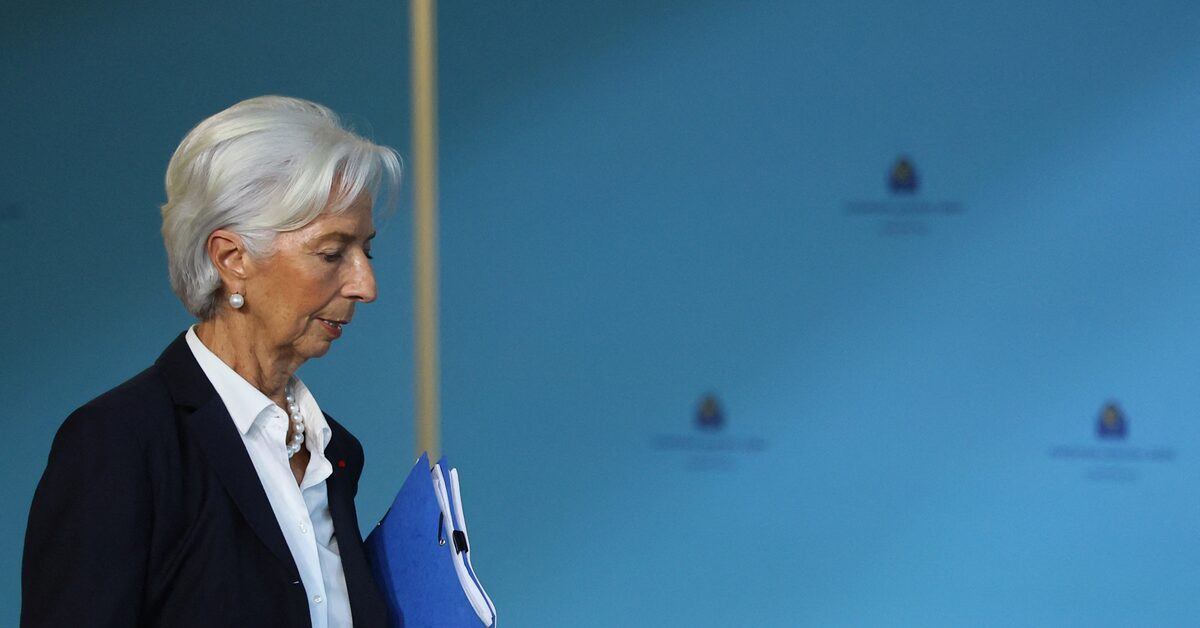
The central bank that spent two years engineering the perfect soft landing is now watching the runway catch fire.
Speaking at the ECB Watchers Conference in Frankfurt on Wednesday, European Central Bank President Christine Lagarde delivered the most explicit hawkish signal Frankfurt has fired in nearly four years: “We are prepared, if appropriate, to make changes to our policy at any meeting.” The Irish Times Six short words. Enormous implications.
The timing is not accidental. Soaring energy costs brought on by the conflict in the Middle East are stoking fears of another inflation spike like the one four years ago, with Bundesbank chief Joachim Nagel and others signalling borrowing costs may need to be lifted as soon as April if the price outlook sours further. The Irish Times Lagarde’s carefully chosen phrase — “at any meeting” — is central-bank language for: we are not waiting for a scheduled window; the next move could come at any of the eight annual gatherings on our calendar. Markets heard her clearly.
The immediate market reaction confirmed it. ECB-dated OIS now price 16 basis points of hikes through April — up from 14.5bp before the sources update hit the wires — while Bloomberg reported the possibility of a rate hike in April, and Reuters sources suggested April was too early but June increasingly viable. Marketnews The euro, which had been softening all week amid risk-aversion, traded at 1.1457 against the greenback — down from 1.1778 before U.S.-Israeli attacks on Iran began — making imports, including energy, more expensive for buyers in the eurozone. Morningstar European equities absorbed a fresh leg lower, and German Bund yields climbed as traders repriced the front end.
This is not the Christine Lagarde who, just weeks ago, was serenely describing Frankfurt’s policy stance as being in a “good place.” That phrase — her mantra through six consecutive hold decisions — has now been retired, deliberately. “We are starting from a good base, so I’m not saying we are in a good place — we are both well-positioned and well-equipped to deal with the development of a major shock that is unfolding,” CNBC she told reporters after the March 19 Governing Council decision. The language shift is not cosmetic. In the theology of ECB communications, “good place” was a dovish comfort signal; its removal is an act of institutional vigilance.
The Iran Shock: Why the ECB’s Inflation Calculus Collapsed Overnight
To understand how dramatically the picture shifted, consider the ECB’s own projections. At the December 2025 meeting, staff projected headline inflation averaging 1.9% in 2026, 1.8% in 2027, and 2.0% in 2028 — a Goldilocks path that seemed to confirm the ECB could sit comfortably at its neutral 2% deposit rate indefinitely. European Central Bank That serenity lasted exactly eleven weeks.
U.S.-Israeli attacks on Iran began in late February 2026 Global Banking and Finance, and by the time the Governing Council convened on March 19, the energy landscape had been redrawn. Brent crude closed at $90 per barrel on the technical cut-off date of March 11 — yet by the meeting itself, it was trading in a range of $112–$115, having touched $119 during the session. The Irish Times Natural gas prices followed a similar trajectory. The ECB’s own updated staff projections incorporated this shock, and the numbers are stark.
The ECB’s latest staff projections show inflation averaging 2.6% in 2026, before easing to 2.0% in 2027 and 2.1% in 2028 Euronews — a revision of more than half a percentage point for this year alone, driven entirely by energy. But the baseline is already obsolete. In a more adverse scenario — involving stronger and longer-lasting disruptions to oil and gas supply through the Strait of Hormuz — inflation could rise to 3.5% in 2026. In a severe scenario, where energy prices remain elevated for longer, headline inflation could reach as high as 4.4% in 2026. Euronews
To put that last number in context: eurozone inflation has not touched 4% since the tail-end of the post-Ukraine energy crisis. The ECB would be back in emergency territory before summer.
Growth, meanwhile, has been revised sharply lower. The ECB expects GDP growth of just 0.9% in 2026, 1.3% in 2027, and 1.4% in 2028 TRADING ECONOMICS — essentially stagnation-adjacent for the current year. The stagflationary cocktail that haunted the 2022–2023 cycle is back on the table.
‘Monitor Closely’: Decoding the ECB’s Institutional Vocabulary
Inside the ECB, language carries the weight of precedent. Officials and seasoned ECB-watchers know that certain phrases function as coded escalation signals — a vocabulary that stretches back decades and is never used carelessly.
The fact that the well-known phrase “monitor closely” has returned to ECB communications is a clear signal that the central bank has shifted to a higher alert. In the past, the term “monitor closely” had always been a sign of high alertness — the time it was used was during the short-lived banking tensions in March 2023 and before in 2022. In the distant past, “monitor closely” was followed by “vigilance” in the run-up to rate hikes. ING THINK
That sequencing matters enormously. The 2022 cycle — when the ECB spent months saying it was “monitoring” inflation before eventually being forced into the most aggressive tightening campaign in its history — is the institutional ghost Frankfurt is desperate not to repeat. “In those four years, we have learned,” Lagarde said, noting that interest rates are now higher, inflation lower, and the labour market less overheated than four years ago, when the economy was re-emerging from the COVID-19 pandemic. “I think we also understand better the mechanism of the pass-through into indirect and second-round effects.” Global Banking and Finance
That self-aware acknowledgment of the 2022 policy mistake is the most important sentence Lagarde has delivered in years. It signals that the ECB’s reaction function has fundamentally changed: the central bank will not let second-round effects embed before it acts. “We will not act before we have sufficient information on the size and persistence of the shock and its propagation,” she said at the ECB Watchers Conference. “But we will not be paralysed by hesitation: our commitment to delivering 2% inflation over the medium term is unconditional.” The Irish Times
What Markets Are Pricing: Hike Paths, Bond Yields, and the April Trigger
The market reaction to the ECB’s hawkish pivot has been swift and instructive. Traders are pricing in two or three rate hikes by December, even as most economists still see no change, betting that the ECB would not tolerate another war-fuelled spike in inflation after being stung by Russia’s 2022 invasion of Ukraine. Global Banking and Finance
The April 29–30 meeting is now in live play. ECB policymakers would be ready to raise interest rates as soon as their next meeting should fallout from the war in Iran push inflation too far above target, according to people familiar with the situation. While nothing has been decided yet and a later date may be more appropriate, factors including signs of second-round effects could trigger such a move at the April 29–30 gathering. Bloomberg
The oil price threshold matters. A rate rise at the April meeting would require an even bigger surge in energy prices, with one of the sources mentioning a $200 per barrel oil price as a potential trigger. Benchmark Brent crude touched $119 per barrel on March 19. The ECB itself said that a “severe” scenario under which crude peaks at almost $150 per barrel by June would likely require “tighter monetary policy.” Global Banking and Finance
Economists at Barclays said the ECB would raise rates in a scenario where Brent crude settled at around $100 a barrel — compared to $113 at the time of the meeting — and natural gas at 70 euros. RTÉ With spot prices already comfortably above that threshold, the bar to a June hike, at minimum, is looking increasingly low.
Key Takeaways:
- ECB deposit rate remains at 2.0% (sixth consecutive hold), main refinancing rate at 2.15%
- Lagarde replaced “good place” language with “well-positioned and well-equipped” — a significant hawkish shift
- Baseline 2026 inflation: 2.6%; severe scenario: 4.4%
- Brent crude at ~$112–119/bbl at March 19 meeting vs. March 11 cut-off assumption of $81/bbl
- Markets pricing 16bp of hikes through April; 2–3 hikes by December
- EUR/USD at approximately 1.1457, weaker post-war, amplifying imported inflation
- April 29–30 ECB meeting is the next live decision point
The Stagflation Trap: Growth Risks and the Dual Mandate Squeeze
Here lies the ECB’s cruellest dilemma. The same oil shock that threatens to push inflation higher is simultaneously crushing the growth outlook. GDP growth has been revised down to just 0.9% for 2026 — barely above stagnation — as the war weighs on real incomes, business confidence, and consumption. Euronews An economy growing at sub-1% is not one that screams “raise rates.”
And yet Lagarde has made clear that the ECB will not be paralysed by this tension. The key variable is second-round effects — the mechanism by which an initial energy shock bleeds into wages, services prices, and long-run inflation expectations. “If persistent, higher energy prices may lead to a broader increase in inflation through indirect and second-round effects — a situation which requires close monitoring,” Lagarde said. Euronews
“The experience of the 2022 energy crisis, and consumers’ expectations still scarred from that episode, could make the ECB quicker to hike if energy pressures are sustained,” HSBC economist Fabio Balboni noted. Morningstar Crucially, Isabel Schnabel, a prominent anti-inflation hawk among ECB policymakers, has also warned about the “scars” that episode left on households and businesses — though she notes an important difference: monetary and fiscal policies are not loose this time, which should help limit inflationary pressures. RTÉ
In a scenario where the war in the Middle East and soaring energy prices remain limited in time, the ECB will talk like a hawk but not walk like a hawk. However, if energy prices stay high or higher for longer and find their way into other parts of the eurozone economy, the central bank apparently wouldn’t shy away from rate hikes. ING THINK
That is the critical fork in the road. Duration, not magnitude, is the decisive variable. A spike that resolves in eight weeks is one problem. A sustained disruption lasting into Q3 2026 — with supply chains rerouted, shipping costs elevated, and wage negotiators armed with fresh grievances — is something else entirely.
Global Spillovers: The Fed, the BOE, and Emerging Market Currencies
Frankfurt is not facing this shock in isolation. The Federal Reserve kept rates unchanged, as expected, and its Summary of Economic Projections showed policymakers still expect to deliver one rate cut in 2026 and another one in 2027. Officials revised inflation higher, with PCE inflation now expected at 2.7% at the end of 2026 versus 2.4% in December, while growth was revised to 2.4% versus 2.3% previously. FXStreet
The Bank of England, meanwhile, voted unanimously to keep its benchmark interest rate on hold at 3.75%. Before the war in Iran erupted in late February, the BOE had been expected to cut its key interest rate. CNBC That rate-cut cycle is now indefinitely suspended.
Central banks in the United States, Canada, Japan, Britain, Sweden, and Switzerland delivered broadly similar messages — a global synchronised pause, with a hawkish tilt. Global Banking and Finance The synchronicity matters: when multiple major central banks simultaneously signal willingness to tighten, the knock-on effects for emerging market economies that borrowed in dollars and euros — from Turkey to Indonesia to South Africa — can be severe, as capital flows back towards developed-market yields.
For the euro area, the weaker EUR/USD compounds the inflation problem directly. Energy is priced in dollars. A euro that buys fewer dollars means European households pay more for every barrel of crude and cubic metre of gas, regardless of what happens to spot commodity prices. The currency channel is, in effect, a built-in amplifier on the energy shock — and it is currently working against Frankfurt.
What Investors and Businesses Should Watch
What Investors Should Watch:
- April 30 ECB Decision: The next meeting is the true test. Monitor Brent crude pricing in the two weeks preceding — if it holds above $100/bbl, a hike becomes a live possibility. If it retreats toward $85, the ECB is likely to hold and reassess in June.
- Second-Round Effect Indicators: Watch the ECB’s Wage Tracker (updated monthly), eurozone services inflation, and industrial selling price surveys. These are Lagarde’s own stated tripwires.
- Inflation Expectations: The 5y5y EUR inflation swap — the market’s long-run inflation gauge — is the ECB’s preferred thermometer for anchoring risks. Any sustained move above 2.5% would be an emergency signal for Frankfurt.
- Hormuz Developments: Geopolitical developments in the Strait of Hormuz remain the dominant macro variable for the next 6–8 weeks, overriding all conventional economic indicators.
- EUR/USD: A further decline in the euro amplifies the imported inflation channel, potentially pulling the ECB’s trigger sooner. Watch 1.12 as a line in the sand.
Eurozone Growth at Risk: The Political Economy of Austerity Under Fire
There is a painful irony in the current configuration. Germany, the eurozone’s fiscal anchor, is finally loosening its legendary Schuldenbremse — the constitutional debt brake — to fund defence and infrastructure spending, a stimulus long demanded by Brussels. That fiscal expansion, however welcome in the short run, arrives precisely as the energy shock threatens to reignite inflation.
Investors are already bracing for higher government borrowing in response to the Iran crisis — a shift that comes on top of Germany’s plans to sell more debt to ramp up military and infrastructure spending. That could further fuel inflation and has already pushed up bond market borrowing costs before any ECB action. Global Banking and Finance
The result is a doubly challenging environment for southern European sovereigns — Italy, Spain, Portugal — whose financing costs are sensitive to both ECB policy rates and market risk premia. Should the ECB raise rates in June, peripheral bond spreads will widen, potentially triggering the very financial fragmentation that Frankfurt’s Transmission Protection Instrument (TPI) was designed to prevent.
Growth in the eurozone could drop by 0.2% in 2026 if the impact of the conflict persists, according to the UK-based National Institute of Economic and Social Research. Morningstar Against an already-revised baseline of 0.9%, that would push the eurozone to the verge of contraction. The ECB’s communications department will have to perform extraordinary feats of policy narrative management to explain rate hikes amid near-recession conditions — if that moment arrives.
The Verdict: Hawkish Pivot, Conditional Tightening, and the Long Game
Step back from the daily noise, and the strategic picture that emerges from Frankfurt is coherent, if uncomfortable. The ECB has made a deliberate choice to move from passive accommodation to active vigilance — not a tightening, but a pre-positioning. All in all, a rate hike is not yet on the table, but today’s meeting clearly marks a hawkish pivot. ING THINK
Lagarde’s “at any meeting” formulation is the monetary policy equivalent of a chess player picking up a piece and placing their hand on it, without yet committing to a square. The signal is intentional: the ECB has options, the ECB is watching, and the ECB will not repeat 2022’s mistake of labelling a sustained shock “transitory.”
“This hawkish tilt supports our view that the ECB is more likely to raise rates rather than lower them this year, with cuts now seemingly out of the question,” noted Roman Ziruk, senior market analyst at Ebury. The Irish Times
The next six weeks — running up to the April 29–30 Governing Council — will determine whether this is a credible hawkish posture or the opening act of an actual tightening cycle. The variables are brutally simple: oil prices, wage data, and the trajectory of a war that no economist’s model fully anticipated. If Lagarde sounds like a hawk today, it is because history — painful, recent, institutional memory — has taught her that waiting costs dearly.
In Frankfurt, the fireside chat is over. The fire is outside.
There is something quietly extraordinary about watching Christine Lagarde retire the phrase “good place” after using it as a near-liturgical mantra through six consecutive hold decisions. Central bank language is a form of institutional trust management — every repeated phrase becomes a commitment, and every abandoned phrase becomes a statement about the world having changed.
The phrase “at any meeting” is doing significant work here. It is not “we are considering raising rates.” It is not “the next meeting is live.” It is a blanket statement of optionality: we could act in April, June, July, September — wherever the data takes us. This is textbook forward guidance deployed in reverse — rather than anchoring expectations of inaction, Lagarde is deliberately leaving them unanchored, forcing markets to price a broader distribution of outcomes.
The deeper question — and the one that keeps ECB-watchers up at night — is whether the central bank has internalized the right lesson from 2022. That crisis showed the catastrophic cost of wishful thinking: the ECB’s initial “transitory” framing delayed tightening by crucial months, allowing inflation expectations to drift and ultimately requiring emergency-speed rate hikes that hurt growth. The self-awareness Lagarde displayed this week, noting “in those four years, we have learned,” is encouraging. But institutional memory is most reliable when it is written into frameworks and processes, not just recited from podiums.
What this moment also reveals is the irreversibility of the geopolitical dimension in central banking. For three decades post-Cold War, energy markets were treated as a background variable — occasionally disruptive, never structural. 2022 changed that. The Iran shock of 2026 confirms it. Central banks are now, unavoidably, geopolitical actors — making monetary decisions whose outcomes depend on military developments they cannot observe, predict, or control. Christine Lagarde did not train for that role at Sciences Po. But she is, with increasing command, learning to inhabit it.
People Also Ask: Related Questions
- Will the ECB raise interest rates at the April 2026 meeting? ECB sources reported by Bloomberg and Reuters suggest a hike is possible at April 29–30, contingent on sustained energy price elevation and emerging second-round inflation effects. Markets are pricing 16bp of hikes through April.
- What did Lagarde say at the ECB Watchers Conference on March 25, 2026? Lagarde said the ECB “will not be paralysed by hesitation” and is “prepared, if appropriate, to make changes to our policy at any meeting” — the clearest hawkish signal since the Iran war began.
- How does the Iran war affect eurozone inflation and ECB rates? The conflict has pushed Brent crude above $115/bbl, causing the ECB to revise its 2026 inflation forecast from 1.9% to 2.6%. A severe scenario with sustained energy disruptions could push inflation to 4.4% in 2026, which the ECB has said would require tighter monetary policy.
- What is the current ECB interest rate in 2026? As of March 19, 2026, the ECB deposit facility rate is 2.0%, the main refinancing rate is 2.15%, and the marginal lending rate is 2.4%. All three are unchanged for the sixth consecutive meeting.
- How is EUR/USD responding to ECB hawkish signals and the Iran war? EUR/USD has weakened from around 1.1778 pre-war to approximately 1.1457, reflecting combined risk-aversion and dollar strength. A weaker euro amplifies imported energy inflation, potentially accelerating the ECB’s decision to raise rates.
Discover more from The Economy
Subscribe to get the latest posts sent to your email.


When the Trump administration’s tariff regime rattled export-dependent Asian economies in 2025, Malaysia’s finance ministry response stood out for its composure. “We didn’t panic,” the finance minister told reporters, describing a deliberate strategy of diversification and negotiation rather than reactive concessions (Fortune).
From crisis response to execution agenda
That composure has carried into 2026. Malaysia’s economy minister has described this year explicitly as one of “execution,” as the Anwar Ibrahim administration works to lock in the policy gains built through 2025’s trade turbulence (Fortune). The framing matters: it signals Putrajaya sees 2026 less as a year of new initiatives and more as a year of delivering on commitments already made — the Johor-Singapore Special Economic Zone chief among them.
The semiconductor exposure that both helps and constrains
Malaysia’s electrical and electronics sector accounts for roughly 40% of total exports, with semiconductors alone comprising about 65% of E&E exports (J.P. Morgan Private Bank). That concentration is precisely why Malaysia benefited from 2025’s tariff exemptions on semiconductors, electronics and pharmaceuticals, and precisely why any future change to those exemptions carries outsized risk for Malaysian growth relative to more diversified regional peers (J.P. Morgan Private Bank).
The Johor-Singapore SEZ as the structural bet
Johor’s 7,300-acre innovation sandbox, part of the new special economic zone with Singapore, is Malaysia’s clearest attempt to convert its manufacturing base into a higher-value regional hub rather than remain a low-cost assembly point (Fortune). The zone’s stated ambition — combining Johor’s “land and scale” with Singapore’s “capital and speed” — positions the region to capture AI-linked infrastructure and hardware investment that would otherwise bypass both countries individually (Fortune).
Corporate consolidation follows the growth signal
Confidence in Malaysia’s execution story is visible in corporate activity too: two Southeast Asia 500 companies are reportedly exploring a merger that would form Malaysia’s largest construction conglomerate, a scale bet that typically follows — rather than precedes — genuine confidence in a multi-year infrastructure pipeline (Fortune).
The regulatory friction points
Not every 2026 storyline is frictionless. Malaysia has moved to temporarily block the Grok AI platform alongside Indonesia following a sexual-deepfake scandal, illustrating that Malaysia’s AI-forward economic strategy is running in parallel with an increasingly assertive AI-governance posture — a tension regional investors should track as a signal of how Malaysia intends to regulate the same technology sector it is courting for investment (Fortune).
What “execution” needs to mean by year-end
For Malaysia’s 2026 narrative to hold, three things need to materialise beyond announcements: measurable Johor SEZ tenant commitments, continued semiconductor export resilience against any tariff-exemption rollback, and a construction-sector consolidation that actually delivers infrastructure rather than simply consolidating market share.
Discover more from The Economy
Subscribe to get the latest posts sent to your email.

Dubai’s transformation from oil-adjacent trading post to global capital hub is no longer a talking point — it is a measurable trend. The emirate’s newly launched Economic Survey 2026 shows GDP climbing to $265 billion alongside rising employment, while international family offices are gathering for the Family Office Summit Dubai 2026 as the city cements its position as a family-wealth hub (Gateway Group; Arabian Business).
The non-oil growth engine
The UAE enters 2026 with the World Bank projecting national growth of roughly 5%, well above the global average, driven substantially by 5.3% expansion in the non-oil sector (Barchart). Technology, green energy and healthcare are the top-performing sectors, and 64% of UAE executives expect trade volumes to exceed 2025 levels — confidence underpinned by the country’s expanding network of Comprehensive Economic Partnership Agreements (Barchart). Historically, oil production accounted for half of Dubai’s GDP; today it contributes less than 1% (Wikipedia/Economy of Dubai).
Why family offices specifically are relocating
The Family Office Summit Dubai 2026 is drawing international participants precisely because the emirate has built regulatory infrastructure — inside jurisdictions like the DIFC — designed to attract exactly this category of capital. As one DIFC executive noted, incentives alone are no longer enough to win global finance; institutional credibility and regulatory clarity now matter more, which explains why firms such as Sixth Street have opened Abu Dhabi offices as global investment houses deepen their Middle East presence (Gateway Group).
Infrastructure is compounding the pull
Beyond finance, the UAE’s infrastructure build-out is reinforcing the wealth-hub thesis. Etihad Rail’s Abu Dhabi–Fujairah passenger service and the Madinat Zayed and Liwa station openings, arriving ahead of schedule, signal a state execution model that investors increasingly cite as a differentiator versus regional peers (GCC Business Watch). Dubai has also rolled out a AED 1 billion economic support package aimed at business liquidity and resilience amid regional geopolitical headwinds (GCC Business Watch).
The regional competition for capital
Dubai’s rise is happening alongside — not in isolation from — a broader Gulf capital race. Saudi Arabia’s economy is set for stronger growth per IMF assessments, and Gulf sovereign and corporate capital is increasingly being deployed across sectors from AI infrastructure to green growth commitments, meaning Dubai’s wealth-hub status will need continual reinforcement rather than passive maintenance (GCC Business Watch).
The bottom line for investors
For family offices weighing jurisdiction, Dubai’s pitch in 2026 combines three elements rarely available together: near-zero effective taxation, a non-oil economy growing faster than most G20 peers, and physical and financial infrastructure being built ahead of demand rather than in reaction to it. That combination — not simply low tax rates — is what is now pulling global family wealth toward the emirate.
Discover more from The Economy
Subscribe to get the latest posts sent to your email.
Analysis
Global Growth Forecast 2026: IMF, World Bank Outlooks and the “Slow-Hire, Slow-Fire” Labor Market
The IMF’s latest outlook trims global growth to approximately 3.1% for 2026, while modestly upgrading its forecast for Latin America and the Caribbean to 2.3% — a combination that reflects a somewhat better regional narrative sitting inside a tougher external environment overall, according to a Global Economy Briefing compiling recent multilateral forecasts. The World Bank’s own separate projection puts global growth at 2.5% for 2025, down from 2.9% in 2024, explicitly citing the Middle East conflict, inflation, and higher borrowing costs as the key drags on the global economy.
The labor market phrase everyone’s using now
In the United States specifically, labor market data has settled into a pattern economists have taken to calling “slow-hire, slow-fire.” Job growth slowed more than expected in June, yet the unemployment rate actually fell to 4.2%, while weekly jobless claims have continued edging down — a combination that supports the view of a labor market cooling gradually rather than deteriorating sharply, according to Reuters data cited in the Global Economy Briefing. In practice, this means companies are neither hiring aggressively nor laying off at scale — a holding pattern that has become one of the defining features of the 2026 US economy.
Why this equilibrium matters for markets far beyond the US
This dynamic carries global consequences because it directly shapes how quickly the Federal Reserve is willing to cut interest rates — and Fed policy, in turn, drives the dollar and US Treasury yields that constrain monetary policy choices worldwide. For Latin America specifically, a slower-than-hoped Fed easing path keeps US yields and the dollar supportive, which constrains how aggressively central banks like Brazil’s Copom can cut their own policy rates without destabilizing their currencies, per the same briefing. Brazil’s central bank illustrated this tension directly, cutting the Selic rate to 14.00% from 14.25% on August 5 — a fourth consecutive cut, but a cautious one given the external backdrop.
The market backdrop these forecasts are landing in
These growth downgrades and labor-market signals are arriving alongside a genuinely unusual market moment. US equities have been hitting fresh records even amid the softer macro data — the Dow Jones Industrial Average recently closed above 54,000 for the first time — driven substantially by optimism around a potential Strait of Hormuz resolution rather than by underlying growth acceleration. That combination of record equity markets and trimmed global growth forecasts is itself a signal: markets appear to be pricing in relief from a specific geopolitical risk more than they are pricing in a broad-based acceleration in economic activity.
What to watch next
The interplay between these threads — Fed policy responding to a “slow-hire, slow-fire” labor market, global growth forecasts constrained by Middle East-linked energy shocks, and emerging-market central banks navigating a supportive dollar — is likely to remain the dominant macro narrative through the rest of 2026. A resolution to the Strait of Hormuz standoff would remove one major drag simultaneously cited by the World Bank, the IMF, and US labor-market watchers alike, making it one of the few catalysts capable of shifting all three storylines at once.
Key takeaways
- The IMF projects 2026 global growth at approximately 3.1%; the World Bank puts 2025 growth at 2.5%, down from 2.9% in 2024.
- Both institutions cite Middle East conflict, inflation, and higher borrowing costs as primary global growth drags.
- The US labor market has entered a “slow-hire, slow-fire” pattern: June job growth slowed, but unemployment fell to 4.2% and jobless claims kept declining.
- A slower Fed easing path constrains rate-cutting room for emerging-market central banks, including Brazil’s Copom.
- Record US equity markets are currently being driven more by Strait of Hormuz optimism than by underlying growth acceleration.
FAQ
What is the IMF’s global growth forecast for 2026? Approximately 3.1%, according to the IMF’s recent World Economic Outlook update.
What does “slow-hire, slow-fire” mean? A US labor market pattern where companies are neither hiring aggressively nor conducting large-scale layoffs — job growth is slowing, but the unemployment rate has stayed relatively low and stable.
Why does Fed policy matter for other countries’ interest rates? A slower US rate-cutting path tends to keep the dollar and US Treasury yields elevated, which constrains how much room other central banks — particularly in emerging markets — have to cut their own rates without weakening their currencies.
Discover more from The Economy
Subscribe to get the latest posts sent to your email.

Russia’s War Economy Got a Reprieve From Iran

China’s Economy Has a Structural Problem: Factories Are Winning, Households Are Losing

How Malaysia “Shrugged Off” Trump’s Tariffs — and What Comes Next

Singapore’s AI Boom Is Now a Two-Country Story

Why Global Family Offices Are Converging on Dubai in 2026

A Weak Jobs Report Just Rewired the Fed’s Autumn — And Wall Street Cheered

Britain’s Fragile Rebound Meets a Budget Deadline and a Trump Ultimatum

Pakistan’s Economy Grew 3.7% — So Why Doesn’t It Feel Like a Recovery?

Top 15 Financial Stocks for Investment in PSX

Pakistan Exports 2026: Record $35.6B Forecast Masks Trade Deficit Risk

UK’s Jobs Downturn Now Matches the 2008 Financial Crisis — And AI Is Accelerating It

Fed Rate Cut Bets Surge After Shock US Jobs Report Exposes Labor Market Cracks

Pakistan’s Trade Gap Widens to $3.95bn Despite Meeting FY26 Current Account Target

Why Ottawa Is Betting on Dubai: Inside Canada’s Gulf Trade Pivot

Gold Price Forecast 2026: Fed’s July 29 Decision and Record Central Bank Buying Explained

China Politburo July 2026: Stimulus Signals Explained

Pakistan Economy 2026: GDP Grows 3.7% as IMF Completes EFF Review Amid Middle East Risk

Strait of Hormuz Blockade 2026: Oil Prices Surge 9% as US-Iran Conflict Reignites

Down But Not Out: Inside the Slow Sinking of Russia’s War Economy

Gulf Capital Retreat From Pakistan 2026: UAE Loan Freeze & What It Means

Global Stock Market Selloff 2026: Stagflation Fears Return as Iran Conflict Reignites

Pakistan’s Economic Survey FY26: Inflation Spike Insights

Russia Fuel Shortages 2026: Inside a Cracking War Economy

Strait of Hormuz Crisis 2026: How Trump’s Toll U-Turn Exposes Global Economic Risk

Russia’s War Economy Model Is Starting to Crack, Think Tank Warns
Top 15 Financial Stocks for Investment in PSX

Bank of England Rate Decision Amid Energy Crisis

Pakistan’s Economic Growth: Resilience Amid Challenges
-

 Markets & Finance7 months ago
Top 15 Stocks for Investment in 2026 in PSX: Your Complete Guide to Pakistan’s Best Investment Opportunities
-

 Analysis6 months ago
Johor’s Investment Boom: The Hidden Costs Behind Malaysia’s Most Ambitious Economic Surge
-

 Analysis6 months ago
Top 10 Stocks for Investment in PSX for Quick Returns in 2026
-

 Analysis6 months ago
Brazil’s Rare Earth Race: US, EU, and China Compete for Critical Minerals as Tensions Rise
-

 Banks7 months ago
Best Investments in Pakistan 2026: Top 10 Low-Price Shares and Long-Term Picks for the PSX
-

 Investment7 months ago
Top 10 Mutual Fund Managers in Pakistan for Investment in 2026: A Comprehensive Guide for Optimal Returns
-

 Global Economy8 months ago
15 Most Lucrative Sectors for Investment in Pakistan: A 2025 Data-Driven Analysis
-

 Global Economy8 months ago
Pakistan’s Export Goldmine: 10 Game-Changing Markets Where Pakistani Businesses Are Winning Big in 2025