Analysis
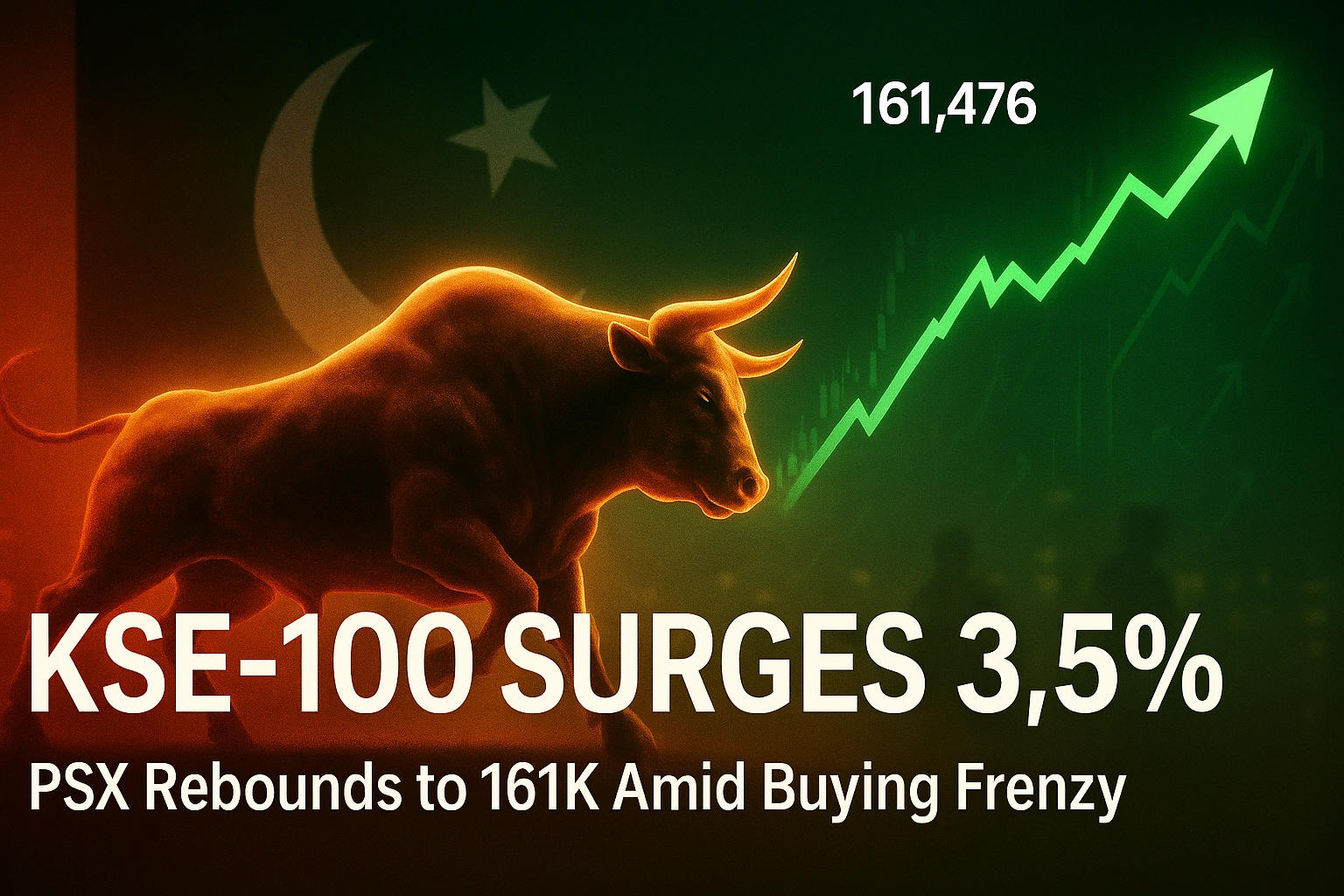
Pakistan’s Bourse Finds Its Footing: KSE-100 Gains 3.5% in Defiant Thursday Rally
A market battered by geopolitics and panic-selling staged one of its most convincing recoveries of the year — but seasoned investors know the hard work is just beginning
There is a peculiar kind of quiet that settles over a trading floor the morning after chaos. The screens are the same. The tickers keep scrolling. But the fingers on keyboards move with a different energy — cautious, calculating, then, as the session matures, something closer to conviction. That was the texture of Thursday’s session at the Pakistan Stock Exchange. By the time the closing bell rang on March 5, the benchmark KSE-100 Index had gained 5,433.46 points, settling at 161,210.67 — a rise of 3.49% that confirmed, at least for now, that the worst of the week’s freefall was behind Pakistan’s equity markets.
The intraday high of 161,476.84, touched in the closing minutes of trade, told an even more bullish story: buyers were not merely nibbling at discounts. They were pressing into the market with force.
The Week That Broke Records — and Nerves
To appreciate Thursday’s significance, one must first reckon with the magnitude of what preceded it. On March 2 — a session that Pakistani financial historians will struggle to contextualise — the KSE-100 collapsed by 16,089 points, or 9.57%, closing at 151,972.99. It was the single largest one-day point decline in the exchange’s history. The trigger: escalating Middle East hostilities following joint US-Israeli strikes on Iranian military infrastructure and Tehran’s retaliatory strikes on US installations across Gulf states. Panic-led liquidation, amplified by mutual fund redemptions and retail stop-losses, turned an anxious morning into a rout.
Tuesday brought a partial reprieve — the index clawed back 5,159 points to close at 157,132 — but the recovery lacked staying power. Wednesday saw a renewed retreat of 1,354 points, the index settling at 155,777.21 as investors, still shaken, remained unwilling to commit. It was the scale of Thursday’s surge — 5,433 points, or 3.49%, marking one of the strongest single-day gains in recent sessions — that finally signalled a genuine shift in sentiment. Minute Mirror
Despite the turbulence, the KSE-100 remains approximately 41.73% higher than it was a year ago TRADING ECONOMICS, a fact that sophisticated international investors, scanning Bloomberg’s KSE-100 quote page for entry points, will not have missed.
Anatomy of a Rally: Sectors That Drove the 5,433-Point Surge
Thursday’s PSX buying momentum was emphatically broad-based. This was not a sector-specific bounce driven by a single commodity supercycle or a policy announcement. It was, as Arif Habib Limited’s Deputy Head of Trading Ali Najib put it, a market-wide expression of renewed confidence.
A widespread buying spree swept across oil and gas exploration companies, oil marketing companies, power generation, automobile assemblers, cement, commercial banks, and refinery stocks. Profit by Pakistan Today The breadth of that buying matters: when rally participation is narrow, it often reflects short-covering rather than genuine re-engagement. When cement producers and automobile assemblers move alongside refiners and banks, it suggests institutional portfolios are being rebuilt from the ground up.
The index-heavy names that drove the arithmetic were formidable. Attock Refinery, Hub Power Company, Mari Petroleum, OGDC, Pakistan Petroleum Limited, Pakistan Oilfields, Pakistan State Oil, Sui Northern Gas Pipelines, Sui Southern Gas Company, MCB Bank, Meezan Bank, National Bank of Pakistan, and UBL all traded firmly higher. Profit by Pakistan Today Collectively, the leading contributors added approximately 3,334 points to the overall benchmark gain. Minute Mirror
The energy complex’s outperformance deserves special attention. Oil and gold prices moved higher globally amid ongoing supply concerns — a direct tailwind for Pakistan’s upstream exploration players and refiners, whose dollar-linked revenues benefit from any crude price elevation. For a country that imports a significant share of its energy needs, the calculus is complex: higher oil prices widen the current account deficit even as they lift exploration-sector equities. Investors, for now, chose to focus on the equity upside.
Total traded volume reached 718.6 million shares, with total transaction value standing at approximately PKR 35 billion Minute Mirror — robust figures that suggest this was not a low-liquidity, technically-driven drift upward but a session characterised by genuine two-way price discovery tilting decisively toward buyers.
Why It Matters: The Global Mirror
Pakistan’s markets rarely move in isolation from global risk appetite, and Thursday was no different. Asian equities advanced broadly as US Treasury prices declined, reflecting improved risk appetite after recent volatility linked to Middle East tensions. MSCI’s broad index of Asia-Pacific shares outside Japan rose 2.9%, South Korea’s KOSPI led the region with a gain of 10.4%, and Japan’s Nikkei added 2.9%. Profit by Pakistan Today
That global backdrop provided critical cover for PSX’s recovery. When risk-off sentiment dominates globally, frontier and emerging markets suffer disproportionately — capital flees to safe-haven assets and Pakistan’s thin foreign investor base tends to compress valuations sharply. Thursday’s shift in that global dynamic gave local institutional investors — the real swing factor in PSX liquidity — permission to re-engage without fear of being caught on the wrong side of an international tide.
US benchmark 10-year Treasury yields rose 2.7 basis points to 4.109%, while the 30-year bond yield climbed 3.1 basis points to 4.748%. Profit by Pakistan Today Rising yields typically signal a rotation away from bonds and into risk assets — including equities in frontier markets that had been beaten down to historically attractive valuations. Trading Economics data confirms that despite Thursday’s sharp recovery, the KSE-100 has still declined roughly 12.47% over the past month, leaving ample room for further mean-reversion if geopolitical anxieties continue to subside.
The IMF Variable and Pakistan’s Macro Scaffolding
No analysis of PSX momentum is complete without interrogating the broader macroeconomic architecture in which these market swings occur. Pakistan is currently operating within the framework of an IMF Extended Fund Facility — a programme that has done much of the structural heavy lifting to stabilise the rupee, compress the current account deficit, and begin unwinding the circular debt that has long strangled the power sector.
In a telling development this week, the IMF mission team decided to conduct virtual discussions for the third review of the Extended Fund Facility and the second review of the Resilience and Sustainability Facility, citing the prevailing security situation. The Express Tribune The decision to proceed virtually rather than suspend the review process entirely is significant. It signals that the Fund considers Pakistan’s reform trajectory sufficiently credible to maintain engagement — even as security conditions complicate standard operations. For foreign investors monitoring Pakistan’s sovereign risk profile, this is a quiet but meaningful confidence signal.
The rupee’s relative stability through this turbulent week also merits attention. A currency that holds its ground during an equity market shock of the magnitude seen on March 2 suggests underlying foreign exchange reserves and current account dynamics that are meaningfully more resilient than Pakistan’s position even eighteen months ago. That stability reduces hedging costs for international portfolio investors and lowers the barrier to re-entry.
Reading the Road Ahead: Catalysts and Risks
The KSE-100 Index closes at 161,210.67 with a convincing recovery narrative — but the intelligent investor must resist the temptation to extrapolate a single session into a trend.
The central risk remains geopolitical. The Middle East situation that triggered the March 2 sell-off has not resolved; it has merely paused. Any resumption of direct military exchanges between Iran and US-Israeli forces would almost certainly reignite the risk-off impulse that sent the KSE-100 to its worst single-day performance in history. Pakistan’s geographic proximity to multiple regional flashpoints — including continued uncertainty along the Afghan border — means that geopolitical tail risks are not abstract for PSX investors; they are priced with a premium.
On the domestic side, the upcoming IMF review outcome, energy sector reform progress, and any revision to the State Bank’s monetary policy stance will serve as the next key inflection points. The central bank has been cautiously easing — a trajectory that supports equity valuations by compressing the discount rate applied to future earnings — but inflation’s stickiness could complicate any further cuts.
The catalysts for sustained recovery are equally real. Analysts attributed Thursday’s rally partly to bargain hunting after recent heavy losses and improved sentiment among institutional investors Minute Mirror — the classic post-crash dynamic of sophisticated money stepping into the vacuum left by panic-sellers. If earnings season in the coming weeks confirms that the underlying corporate performance of Pakistan’s blue-chips remains intact, the valuation case for KSE-100 at these levels is compelling by any regional comparison.
The cement sector’s participation in Thursday’s rally is worth watching as a leading indicator of domestic economic momentum — cement volumes are a proxy for construction and infrastructure activity. Similarly, automobile assembler performance tracks consumer credit and disposable income trends. Both sectors buying in suggests that the damage to domestic economic confidence, while real, may be shallower than the March 2 panic implied.
A Market Finding Its Level
There is a question that every serious investor in frontier markets must eventually confront: at what point does volatility become opportunity? The KSE-100’s journey this week — from an all-time high earlier this year, through the historic 9.57% single-session collapse, through the grinding partial recoveries and renewed selloffs, to Thursday’s broad-based KSE-100 gains 3.5% vindication — has been, in miniature, the story of Pakistan’s equity market itself: high-drama, technically oversold, and carrying within its volatility the seeds of disproportionate returns for those with the patience and conviction to stay the course.
The PSX buying momentum on Thursday was not merely a technical bounce. It was a signal — tentative, yes, and hedged with legitimate near-term risks — that the market’s fundamentals have not broken. The index’s trajectory over the next four to six weeks will determine whether March 5 is remembered as the first day of recovery or merely as a false dawn. History suggests that in markets like Pakistan’s, where institutional depth is growing but retail sentiment remains prone to panic, the truth usually lies somewhere instructively between the two.
The KSE-100’s next chapter is unwritten. But Thursday’s 5,433-point script was, at minimum, a compelling opening act.
FAQ (FREQUENTLY ASKED QUESTIONS)
Q1: Why did the KSE-100 gain 3.5% today on March 5, 2026? The KSE-100 rebounded 5,433 points as broad-based buying returned across energy, banking, cement, and automotive sectors, aided by improving global risk appetite following easing Middle East tensions and a 2.9% rise in Asian equity indices.
Q2: What caused the KSE-100 to crash 16,000 points on March 2, 2026? The KSE-100 recorded its worst-ever single-day fall of 16,089 points (-9.57%) after joint US-Israeli airstrikes on Iran triggered global risk-off sentiment, panic selling, and mutual fund redemption pressure at the Pakistan Stock Exchange.
Q3: What is the KSE-100 intraday high for March 5, 2026? The KSE-100 hit an intraday high of 161,476.84 during the final minutes of Thursday’s trading session before closing at 161,210.67.
Q4: Which sectors led the KSE-100 recovery on March 5, 2026? Oil and gas exploration, oil marketing companies, commercial banks, power generation, cement, automobile assemblers, and refinery stocks all participated in the broad-based rally, contributing approximately 3,334 index points collectively.
Q5: Is the KSE-100 still down from its all-time high after the March 2026 crash? Yes. Despite Thursday’s 3.49% gain, the KSE-100 remains approximately 12.47% below its level from a month prior and well below its all-time high, though it remains roughly 41.73% higher year-on-year.
Q6: How does the IMF programme affect Pakistan Stock Exchange performance? Pakistan’s ongoing IMF Extended Fund Facility has stabilised the rupee and improved Pakistan’s macro fundamentals. The IMF’s decision to continue virtual review discussions despite security concerns signals sustained programme engagement, which supports investor confidence in PSX-listed equities.
Q7: What are the key risks that could reverse the KSE-100 recovery? The primary risks include a re-escalation of Middle East hostilities, a negative outcome from the IMF’s third EFF review, rupee instability, persistent inflation limiting State Bank rate cuts, and any deterioration in regional security along Pakistan’s borders.
Discover more from The Economy
Subscribe to get the latest posts sent to your email.
Analysis
Thailand’s $30 Billion Debt Gamble: Necessary Crisis Medicine or Fiscal Recklessness?
Thailand mulls raising its public debt ceiling to 75% of GDP for $30 billion in new borrowing. Is it bold crisis management or a dangerous leap into a fiscal abyss? An in-depth analysis.
In a country where fiscal prudence has long doubled as national identity, the numbers arriving from Bangkok this week carry a weight beyond arithmetic. Thailand’s government is quietly moving to raise its public debt ceiling — for the second time in five years — to make room for roughly one trillion baht, or $30 billion, in fresh borrowing. The culprit this time is not a pandemic but a geopolitical wildfire: the US–Iran conflict that has throttled global energy markets, pushed Brent crude toward $100 a barrel, and exposed, with brutal clarity, just how dangerously dependent the Thai economy remains on imported energy. The question confronting Prime Minister Anutin Charnvirakul is one faced by finance ministers across the emerging world: when does necessary stimulus tip into a debt spiral you cannot escape?
A Ceiling Built for Calmer Times
Thailand’s current public debt ceiling of 70% of GDP was itself an emergency upgrade. In September 2021, as the pandemic ravaged Southeast Asia’s second-largest economy, Prime Minister Prayut Chan-o-cha’s government raised the statutory cap from 60% to 70% under the State Fiscal and Financial Disciplines Act of 2018, unlocking room for 1.5 trillion baht in Covid-era borrowing. At the time, it was sold as a temporary measure. Five years on, public debt has never come close to falling back below 60%, and the ceiling the government once vowed to treat as a hard limit is about to be cracked open again.
Bloomberg reported today that officials from the Finance Ministry and the Prime Minister’s office are in active discussions to raise that ceiling to 75% of GDP — a five-percentage-point jump that would unlock approximately one trillion baht in new fiscal space. Deputy Prime Minister Pakorn Nilprapunt confirmed Monday that the government is preparing an emergency decree for initial borrowing of up to 500 billion baht. A final decision requires sign-off from the fiscal and monetary policy committee chaired by Anutin himself, a politician better known for populism than fiscal discipline.
The Energy Shock Making the Case
The economic rationale for intervention is not contrived. Thailand is, by the metrics that matter most in an oil shock, among the most exposed economies in Asia. The country’s net energy imports run to roughly 6–8% of GDP — the largest such deficit in the region — and approximately 58% of its fuel imports originate from the Middle East. When the Strait of Hormuz tightened and oil prices surged, Thailand didn’t just feel a headwind. It walked into a wall.
The transmission is already visible across three channels:
- Energy costs: KKP Research estimates that a moderate-conflict scenario with oil at $90–105/barrel inflicts approximately 202.9 billion baht in additional energy costs on the Thai economy.
- Exports: Higher input costs cascade through Thailand’s manufacturing supply chains — petrochemicals, plastics, automotive parts — shaving an estimated 195 billion baht from export revenues.
- Tourism: Gulf tourism, which normally accounts for 7% of total visitor spending, has collapsed to near zero following airport closures caused by Iranian attacks in March, cutting tourism income by an estimated 29 billion baht.
The Bank of Thailand has already slashed its 2026 GDP growth forecast to 1.3%, down from 1.9% projected just four months ago, assuming the conflict ends in the second half of the year. The World Bank’s April 2026 East Asia and Pacific Economic Update independently arrived at the same figure, identifying Thailand alongside Laos and Cambodia as the region’s most exposed economies. In a prolonged-war scenario, with Brent at $135–145, independent analysts at SCB EIC warn that growth could crater to just 0.2% while inflation surges toward 5.8%.
The Oil Fund: A Fiscal Time Bomb Already Ticking
Before examining the wisdom of a debt ceiling increase, it is worth understanding the fiscal pressure already on the table. Thailand’s Oil Fund — the statutory mechanism that cushions domestic fuel prices against global volatility — was, as of late March, burning through an extraordinary 2.59 billion baht per day, with its accumulated deficit reaching 35 billion baht and monthly subsidy exposure of approximately 80 billion baht. When the Oil Fund exhausts its own borrowing capacity and the government is forced to issue sovereign guarantees for its liabilities, those debts convert directly into public debt. The ceiling increase, in this light, is partly a belated recognition of contingent liabilities already crystallising on the state’s balance sheet.
The baht, meanwhile, has depreciated approximately 5% against the dollar in recent months, eroding the purchasing power of Thailand’s import-heavy economy and adding a currency dimension to what was already an inflationary energy shock. Foreign investors pulled $823 million net from Thai equities and $705 million from bonds in March alone — the largest combined outflow since October 2024. Every baht of new sovereign borrowing must be priced against that backdrop.
The IMF’s Uncomfortable Counterview
Here is where the story becomes uncomfortable for Bangkok’s fiscal architects. Less than a year ago, the International Monetary Fund explicitly advised Thailand to reinstate its former 60% debt ceiling — not raise the existing one to 75%. The Fund’s concern was structural: Thailand’s “fiscal space” — the buffer between current debt and a level that impairs the state’s ability to absorb future shocks — is eroding faster than headline numbers suggest. Off-budget borrowing through state-owned enterprises and instruments like Section 28 of the Fiscal Responsibility Act add further opacity to the true debt burden.
The IMF’s warning that a sustainable ceiling, accounting for future shock risk, may be as low as 66% reads today not as excessive caution but as prescient. Thailand’s public debt is already projected at 68.17% of GDP by the end of fiscal year 2026 under baseline assumptions — before any new emergency borrowing. Add one trillion baht in fresh issuance and the ratio easily pushes toward 73–74%, a whisker from the proposed new ceiling, with no guarantee that the energy shock ends on schedule.
Fiscal Credibility: The Asset Markets Cannot Price
The core risk is one that does not appear in any quarterly budget statement: fiscal credibility. Thailand’s investment-grade sovereign rating and its ability to borrow domestically at relatively low spreads have rested, in part, on a public perception — reinforced by law — that its government respects statutory debt limits. Raising the ceiling twice in five years, and in the current episode doing so via an emergency decree that bypasses the normal legislative deliberation, sends a signal to bond markets that the ceiling is political rather than structural.
Consider the global context. The post-2022 emerging-market debt landscape has been fundamentally reshaped by the era of higher-for-longer interest rates and successive external shocks. Countries from Sri Lanka to Pakistan to Ghana discovered, at enormous social cost, that the distance between “manageable” debt and debt crisis compresses rapidly when growth disappoints, currencies weaken, and refinancing costs spike simultaneously. Thailand is not in that class — it has deeper capital markets, stronger institutions, and a far healthier current account. But the direction of travel matters as much as the current coordinates.
MUFG Research notes one important mitigant: unlike 2022, Thailand enters this shock with a current account surplus of approximately 3% of GDP, versus a deficit of 2.1% during the Russia-Ukraine episode. That is a genuine buffer. But it also argues for a more targeted, time-limited borrowing programme — not a permanent ceiling expansion that becomes the new baseline for the next crisis.
What the Money Should Buy — and What It Should Not
Not all stimulus is equal, and Thailand’s government has not yet specified how the new funds would be raised or spent. That ambiguity is itself a warning sign. The experience of Covid-era emergency decrees across Southeast Asia — where large borrowing programmes were approved in principle, then captured by political patronage, transfers to loss-making state enterprises, or infrastructure projects of questionable economic return — should weigh heavily on the design of any new spending package.
The case for spending is strongest in three areas:
- Targeted energy subsidies for households and small enterprises below an income threshold, replacing the blunt Oil Fund mechanism that subsidises luxury vehicle owners alongside the genuinely vulnerable.
- Reskilling and manufacturing resilience investments that reduce long-term energy intensity — a structural reform Thailand has deferred for two decades.
- Tourism infrastructure that diversifies away from Gulf and Chinese dependency, building resilience for the next shock.
The case for spending is weakest in two areas:
- Blanket cash transfers that generate consumption without addressing the supply-side energy constraint.
- Capital injections into state-owned enterprises — energy companies, airlines, transit networks — that absorb fiscal resources without improving allocative efficiency.
Government Spokesperson Rachada Dhnadirek’s carefully vague assurance that Anutin’s administration “will explore all options to ease the hardship of the public” is precisely the kind of language that has historically preceded fiscally undisciplined spending in Thailand’s political economy.
The ASEAN Lens: Thailand Is Not Alone, But It Is Not Average
Thailand’s predicament mirrors, with regional variations, a broader ASEAN fiscal dilemma. The World Bank estimates that US tariffs — now running roughly nine percentage points higher on average than in 2024 — are shaving 0.5 percentage points or more from Thai GDP on top of the energy shock. The compound effect of simultaneous trade and energy shocks, arriving at precisely the moment that a new government needs political credibility, is genuinely severe.
Yet within ASEAN, the contrast with Malaysia is instructive. Malaysia — a net oil exporter — has seen its fiscal position strengthen as prices rise, even while raising diesel prices to 39.54 baht per litre. Indonesia is managing its energy exposure through a combination of production diversification and targeted subsidy reform. Vietnam, despite similar exposure to global supply chains, has maintained tighter fiscal discipline and is benefiting from trade-diversion away from China.
Thailand’s structural challenge is not merely cyclical. The World Bank’s April 2026 assessment explicitly links the country’s growth underperformance to a failure to advance structural reforms — not just to external shocks. Raising a debt ceiling without a credible medium-term fiscal framework for returning debt below 70% risks entrenching, not resolving, that structural weakness.
The Verdict: Borrow — But Bind Yourself While You Do
This column’s position is neither dogmatic austerity nor blank-cheque stimulus. The case for emergency borrowing is real: Thailand faces an asymmetric external shock that its monetary policy tools — with the policy rate already at historically low levels and the baht already under pressure — cannot adequately address alone. Fiscal intervention is warranted.
But the design of that intervention matters enormously. The Thailand debt ceiling increase to 75% of GDP should be conditional, not permanent. Specifically, the government should:
- Sunset the new ceiling — legislate an automatic return to 70% once public debt falls below 71% for two consecutive fiscal years, removing the political incentive to treat 75% as the new normal.
- Ring-fence the borrowing with mandatory quarterly expenditure disclosure and an independent audit mechanism, publishing spending breakdowns in line with IMF fiscal transparency standards.
- Link new issuance to structural benchmarks — energy efficiency targets, subsidy means-testing completion, and tourism diversification metrics — that create accountability beyond the next election cycle.
- Engage multilateral creditors early: An ADB policy-based loan or IMF precautionary arrangement would reduce market borrowing costs and send a credibility signal to bond investors.
Thailand has borrowed its way through crises before and emerged. The 1997–98 Asian Financial Crisis remains the region’s most searing lesson in what happens when debt management loses its anchor. Anutin’s government would be wise to remember that the baht’s credibility, once lost, took a decade to restore.
A $30 billion bet on fiscal stimulus, properly designed and tightly governed, can be crisis medicine. Executed carelessly, in the heat of political pressure and with the spending plan still “not finalised,” it risks being the first act of a longer, more painful fiscal drama — one whose consequences will outlast any single government, any single energy shock, and quite possibly, this prime minister’s tenure.
Discover more from The Economy
Subscribe to get the latest posts sent to your email.
Analysis
Kevin Warsh: Trump’s Next Fall Guy at the Fed?
The Nominee to Lead the World’s Most Powerful Central Bank Wants Big Changes. But There’s Risk of Confrontation with the President Over Interest Rates.
Tomorrow morning, at 10 a.m. in Washington, a 55-year-old former investment banker turned Hoover Institution fellow will sit before the Senate Banking Committee and attempt the most perilous balancing act in contemporary economic governance. Kevin Warsh, President Donald Trump’s nominee to chair the Federal Reserve, must simultaneously convince senators that he will pursue price stability with independence, assure markets that he won’t torch the institutional credibility it took decades to build, and somehow avoid telegraphing to his future boss in the White House that he does not, in fact, intend to slash interest rates to 1 percent on demand.
This is not merely a confirmation hearing. It is the opening act of what may become the defining institutional drama of Trump’s second term — and the outcome will reverberate from Frankfurt to Jakarta, from London gilt markets to South Asian currency floors.
The Nomination Nobody Saw Coming — and Everyone Did
Trump announced Warsh’s nomination on January 30, 2026, formally submitting it to the Senate on March 4. On its surface, the choice was bold: Warsh is a Republican economist with genuine monetary policy experience, having served as the youngest-ever Fed governor from 2006 to 2011, navigating the white-water rapids of the global financial crisis alongside Ben Bernanke. He is credentialed (Stanford undergraduate, Harvard Law), well-connected (Morgan Stanley investment banker before his Fed tenure, advisory work for Stanley Druckenmiller’s family office thereafter), and politically aligned.
But Warsh’s financial disclosures, filed this week in a dense 69-page document, reveal a wealth profile that sets him apart from every Fed chair in modern history. His personal holdings range between $135 million and $226 million — the imprecision owing to Senate disclosure rules that allow assets to be reported in open-ended ranges, with two positions in the “Juggernaut Fund” listed simply as “over $50 million each.” His wife, Jane Lauder, granddaughter of cosmetics legend Estée Lauder, carries an estimated net worth of $1.9 billion according to Forbes. Combined, the Warsh-Lauder household may represent the wealthiest family ever to occupy the Fed’s Eccles Building.
Senator Elizabeth Warren, never one to miss a theatre cue, was already scrutinizing the fund disclosures Thursday, pointing to the opacity of the Juggernaut holdings as a potential conflict-of-interest issue. Warsh has pledged to divest if confirmed — a commitment his legal team will need to execute with considerable speed, given that Powell’s term expires May 15 and the White House has made clear it wants its man in the chair by then.
That timeline is under pressure from an unexpected quarter. Senator Thom Tillis of North Carolina, a senior Republican on the Banking Committee, has declared he will block Warsh’s final confirmation vote unless the Justice Department drops its criminal investigation into Powell — a probe many believe was manufactured specifically to bully the current chair into rate cuts. Republicans hold a razor-thin Senate majority, meaning Tillis’s objection alone can derail the entire nomination. As of this writing, the DOJ investigation remains open. Jeanine Pirro, U.S. Attorney for the District of Columbia, has pledged to press forward despite setbacks. The confirmation math is deeply uncomfortable for everyone involved.
From Hawk to Hawkish Dove: The Policy Evolution That Made Him Palatable to Trump
If you had asked financial markets in 2011 whether Kevin Warsh would ever be seen as a rate-cut ally, the response would have been laughter. During his tenure as Fed governor, Warsh was among the most vocal critics of quantitative easing, warning presciently that the Fed’s expanding balance sheet would create long-term distortions in capital markets. He dissented against what he viewed as mission creep — a central bank that had metastasised from lender of last resort into a structural participant in government bond markets.
That hawkishness has not vanished. It has been refashioned. In the years since leaving the Fed, Warsh has constructed an intellectual framework that allows him to advocate for lower short-term interest rates while simultaneously demanding dramatic reductions in the Fed’s $6.7 trillion balance sheet. The argumentative keystone is artificial intelligence. Warsh contends that an AI-driven productivity surge — already visible in frontier sectors, he argues — creates the conditions under which rate cuts need not be inflationary. If AI meaningfully expands productive capacity, the neutral interest rate falls, and current policy rates are, in this framing, de facto restrictive even without any acceleration in prices.
It is a seductive thesis. It also has its serious critics. Chicago Fed President Austan Goolsbee told journalists in February that the Fed should emphatically not bank on AI-driven productivity gains to pre-emptively justify looser policy. “You can overheat the economy easily,” Goolsbee cautioned, urging “circumspection.” The concern is not merely theoretical. Futures markets, even before the U.S. military struck Iranian nuclear and oil infrastructure, had priced in only 50 basis points of cuts through the entirety of 2026 — a signal that institutional investors simply do not believe Warsh can deliver the rate environment Trump envisions.
The Iran Shock and the Inflation Trap
This is where the geopolitical and the monetary collide with particular force. The U.S. attack on Iran — the energy shock reverberating through global commodity markets — has sent oil prices surging toward and beyond $100 a barrel. Inflation forecasts, which had been drifting downward through early 2026, are now trending back up. Remarkably, futures markets have begun pricing a non-trivial probability of a rate hike from the Federal Reserve before year’s end, not a cut.
Into this environment steps a nominee whose central economic argument — AI productivity as a disinflationary force — now must compete with the hard, immediate reality of petrol price pass-through, supply chain disruptions from Middle Eastern instability, and consumer expectations growing unmoored. The irony is almost Shakespearean: Trump nominated Warsh partly because he seemed willing to cut rates; now Warsh may be confirmed into a situation where the economically responsible course is to hold rates steady or tighten.
This is the fall-guy scenario, and it deserves to be named plainly. If Warsh takes the chair in May, inherits an economy facing renewed inflation from energy shocks, and then declines to cut rates aggressively — as economic prudence would likely demand — Trump will have a perfect target. The president who demanded 1 percent interest rates will face a Fed chair who is not delivering them. The chair will be blamed, publicly and loudly, for economic pain that originated in geopolitical decisions made in the White House’s own Situation Room.
Warsh will not be the first economist to occupy that chair under those circumstances. He would, however, be the first to have sought it in the full knowledge of the trap being laid.
The Structural Agenda: Balance Sheet, Regime Change, and the “Family Fight” Model
Strip away the rate-cut politics and what remains is genuinely interesting. Warsh envisions a Fed that is leaner, less communicative in public, and more disciplined in its market interventions. His critique of forward guidance — the practice of telegraphing future policy moves to markets in granular detail — is substantive: he argues it has made the Fed a prisoner of its own communications, forced to delay necessary adjustments because it has over-committed in its messaging.
In a 2023 interview, Warsh outlined what he calls the “family fight” model of policymaking: robust, unconstrained debate behind closed doors, followed by institutional unity in public. This represents a deliberate departure from the era of dissent-as-performance, where individual FOMC members have used public speeches to pre-negotiate policy in the open, fragmenting the institution’s voice and market credibility simultaneously.
The balance-sheet agenda is where Warsh’s structural convictions are most consequential for global markets. He has argued consistently that the Fed’s multi-trillion-dollar holdings of Treasuries and mortgage-backed securities represent a distortion of capital markets — one that has, paradoxically, suppressed long-term yields while subsidizing federal borrowing and inflating asset prices. A Warsh-led Fed pursuing aggressive quantitative tightening would push long-term rates higher even as short-term rates are cut, a “hawkish dove” configuration that has almost no historical precedent. The closest analogy is perhaps the late 1990s Greenspan era, when exceptional productivity growth (from the early internet buildout) allowed the economy to absorb tighter financial conditions without triggering recession. Warsh is betting the AI moment is analogous. It may be. It may not be.
The Independence Question: Does He Mean It?
The central question hanging over the April 21 hearing is one no senator will frame quite so bluntly but every analyst is asking: will Kevin Warsh be functionally independent from the president who appointed him?
The legal and institutional architecture of Fed independence is formidable. The Treasury-Fed Accord of 1951 enshrined it. Decades of practice have reinforced it. Markets price in a substantial “independence premium” — the expectation that the Fed will respond to economic data rather than political instruction. Any erosion of that premium would trigger a dollar selloff, a spike in Treasury yields, and a rapid repricing of sovereign risk that would transmit across emerging-market currencies from the Turkish lira to the Indonesian rupiah.
Warsh has said, repeatedly, that independence is “crucial” to the Fed’s function. But he has also argued, in language that pleased the White House, that independence does not preclude immediate rate cuts and that the Fed has, under Powell, overstepped into policy territory beyond its mandate — from climate risk to social equity. These are arguments that conveniently align with the administration’s preferences while being framed in the language of institutional restraint.
The CFR’s Roger Ferguson put it sharply: financial markets will react decisively to any sign that the Fed is abandoning its data-driven approach. The OMFIF was blunter still, noting that “presumably ex-hawk Warsh is capable of reading Truth Social and got the memo” on rate cuts. That observation is as concise a summary of the confirmation’s underlying tension as any I have encountered.
The risk is not necessarily that Warsh will be a crude supplicant. It is subtler. A chair who believes, genuinely and in good faith, that AI productivity justifies rate cuts will, in the near term, produce outcomes indistinguishable from a chair who is simply following orders. The divergence comes later — when inflation data turns inconvenient, when the oil shock bites harder, when the data demands a hold or a hike. It is at that moment that the question of independence becomes existential, not theoretical.
Global Stakes: What the Rest of the World Is Watching
The Federal Reserve’s decisions reverberate well beyond American borders, and the world’s central bankers are watching tomorrow’s hearing with unusual intensity.
In the eurozone, the ECB faces its own dilemma: a weakening growth outlook and a dollar that has been volatile against the euro as Warsh’s confirmation odds have fluctuated. A hawkish balance-sheet Warsh who nonetheless cuts short-term rates creates a peculiar dollar trajectory — weaker in short-term interest rate differential terms, but stronger in longer-term credibility terms. European policymakers cannot easily model that divergence.
In Asia, the picture is more acute. Japan’s Bank of Japan has been edging toward policy normalisation after decades of ultra-loose settings; a Fed that moves erratically based on political pressure would complicate Tokyo’s ability to anchor yen expectations. South Korea and Taiwan, with their deep integration into U.S. semiconductor supply chains and their extreme sensitivity to U.S. monetary conditions, are watching rate expectations with the attention of nervous creditors.
For emerging markets, the stakes are existential in the literal financial sense. Dollar-denominated debt in countries from Ghana to Sri Lanka to Pakistan has been refinanced on the assumption of gradual Fed normalisation. A Warsh Fed that delivers abrupt policy swings — cutting aggressively and then reversing under inflation pressure — would produce the kind of dollar volatility that has historically triggered emerging-market crises. The 1994 “taper tantrum” and the 2013 episode are still institutional memories in finance ministries from Nairobi to Jakarta.
Key Risks at a Glance
Senate confirmation hurdles: Senator Tillis’s blocking posture remains the most immediate obstacle. The DOJ investigation into Powell must conclude, or a political arrangement must be reached, before Warsh can reach the full Senate floor.
Oil-shock inflation trap: With Brent crude approaching $100 and Iran-related supply disruptions ongoing, the economic environment may simply not permit the rate cuts Trump is demanding — placing Warsh between political expectations and empirical reality from day one.
FOMC internal dynamics: Warsh would inherit a committee populated with economists who are skeptical of his AI-productivity thesis and committed to data-dependence. Herding that committee toward his preferred regime without triggering public dissent will test the “family fight” model immediately.
Markets pricing a rate hike: Futures markets pricing a 35–40% probability of a rate hike by December represent the starkest possible rebuke of the political narrative that Warsh was nominated to validate. Markets are telling the White House, as politely as they can manage, that the data does not cooperate with the political preference.
Conflict-of-interest scrutiny: The partially opaque Juggernaut Fund holdings, the Druckenmiller family office advisory relationship, and the Estée Lauder board connections of his wife will all face rigorous Democratic interrogation. The Fed has been plagued by ethics controversies under Powell; a fresh scandal in the opening months of Warsh’s tenure would be institutionally devastating.
The Fall Guy Thesis, and the Alternative
Let me be direct, as this column has always endeavoured to be: there is a real and non-trivial probability that Kevin Warsh is walking into a trap of historical proportions. A president who demands 1 percent rates in an economy facing energy-driven inflation is setting his Fed chair up to fail publicly. When Warsh — if he is as serious about his own intellectual framework as he claims — resists that pressure, the blame will flow downward, not upward. The president who manufactured the demand will not absorb the political cost of the unfulfilled promise. The chair who refused to deliver it will.
This is the “fall guy” scenario, and it is not a fringe interpretation. It is a structural feature of the relationship Trump has publicly constructed with his own nominee.
But there is an alternative reading that deserves equal weight. If the AI productivity thesis is substantially correct — if 2026 and 2027 see measurable gains in total factor productivity driven by AI deployment across the economy — then Warsh’s framework may prove prescient rather than convenient. A Fed chair who both cuts short-term rates and shrinks the balance sheet, who liberalises bank regulation without abandoning prudential oversight, and who restores internal deliberative discipline to the FOMC, could be a genuinely transformative figure. Not because he served the president’s preferences, but because the president’s preferences happened to align, in this narrow window, with what the economy actually needed.
History will record which of these two Warshes materialises. The April 21 hearing is unlikely to settle the question definitively — confirmation hearings rarely do. But watch carefully for one thing in his testimony: how he responds when senators ask whether he would resist political pressure to cut rates if inflation were rising. The specificity or vagueness of that answer will tell you everything about which of these men we are actually welcoming into the most powerful monetary policy chair on earth.
What Warsh Should Do — and What He Probably Won’t
Let me close with a prescription, because economists who decline to prescribe are merely commentators in academic disguise.
Warsh should use his confirmation hearing tomorrow to make one unambiguous commitment: that the Federal Reserve’s policy decisions will be driven solely by its dual mandate data and its long-run inflation credibility, and that no future communication from the White House will be treated as a policy input. He should announce that he will not pre-brief the administration on rate decisions, will not discuss upcoming FOMC votes with Treasury officials, and will not use social media interactions with the president as evidence of economic consensus.
He should then build a policy framework genuinely anchored in the AI-productivity thesis — not as a convenient justification for cuts the president wants, but as a seriously evidenced analytical position subject to revision when contradicted by data. If oil shocks persist and inflation rises, he must say clearly and publicly that cuts are off the table. If AI productivity materialises as forecast, the cuts will follow naturally from the data.
This path is the one that preserves institutional credibility, serves the long-run interest of American households and businesses, and — not incidentally — protects Warsh himself from becoming history’s footnote as the chair who let the Fed’s independence die quietly under the cover of a productivity boom that never fully arrived.
Whether he takes it depends entirely on the quality of his own convictions. Tomorrow morning, the markets will begin to find out.
Discover more from The Economy
Subscribe to get the latest posts sent to your email.
Analysis
Malaysian Ringgit Set to Test New High for 2026, Strategists Say
Despite a bruising 4% slide in March as the Iran war roiled markets, the ringgit has clawed its way back — and the case for fresh 2026 highs is stronger than the headlines suggest.
Live Data Snapshot — April 20, 2026
| Indicator | Level |
|---|---|
| USD/MYR (spot) | 3.9555 ▾ |
| YTD Performance | +9.47% |
| 2026 Year-to-Date High | 3.88 |
| Q1 2026 GDP Growth | 5.5% |
| MUFG Year-End Target | 3.70 |
| Hyperscaler DC Investment | MYR 90B+ |
The numbers hit the wires just before dawn on Friday, and they were better than almost anyone had forecast. Malaysia’s Department of Statistics confirmed first-quarter GDP growth of 5.5% — comfortably ahead of the Bloomberg consensus of 5.1%, and a ringing endorsement of an economy that, in a year defined by war premiums and dollar volatility, has consistently refused to follow the emerging-market script. By mid-morning in Kuala Lumpur, the ringgit had ticked higher, nudging back toward the gravitational pull of 3.88 per dollar — the level it kissed in late February, the year-to-date high for the Malaysian ringgit 2026, just days before the US-Iran conflict erupted and pulled it to 4.10.
The question exercising desks from Singapore to New York is no longer whether the ringgit’s March correction was a detour or a destination. It was, on the weight of evidence accumulating this weekend, emphatically the former. The currency is currently trading around 3.9555, having already recovered the bulk of its 4% March drawdown. And a widening coalition of strategists — from Loomis Sayles and Deutsche Bank to MUFG — is making the case that the Malaysian ringgit 2026 high will not merely be retested, but surpassed. The structural foundations underpinning this view are the subject of this analysis: 5.5% GDP, a clean macro policy framework, and a data-centre investment wave of tectonic scale that has fundamentally rewritten Malaysia’s place in the global technology supply chain.
The March Dip in Context: Fear, Not Fundamentals
To understand where the ringgit is going, it helps to understand why it stumbled. The US-Iran conflict, which erupted in earnest in late February following escalating incidents in the Strait of Hormuz, triggered one of the sharpest bouts of emerging-market risk aversion since the 2022 Federal Reserve hiking cycle. Oil markets spiked. The dollar jumped. And a number of Asian currencies — the ringgit among them — were sold indiscriminately by global funds reducing exposure to anything that carried the word “emerging.”
The irony, as any close observer of Malaysia’s macro position would note, is that the country is a net energy exporter. Rising oil prices — the very catalyst for risk-off selling — are, by most conventional analysis, accretive to Malaysia’s current account. Bank Negara Malaysia data shows the trade surplus widened to MYR 22.1 billion in January 2026, up from MYR 19.3 billion a year earlier, driven by electrical and electronics exports (MYR 22.1 billion) and palm oil products (MYR 7.0 billion). The ringgit’s sell-off, in other words, was a liquidity-driven dislocation rather than a signal about deteriorating domestic fundamentals — and the market has begun to correct it accordingly.
“Malaysia offers a relatively rare mix of resilient growth, credible macro management, distance from key geopolitical flashpoints, and a diversified economy spanning oil to data centres.”
— Hassan Malik, Global Macro Strategist, Loomis Sayles (an affiliate of Natixis Investment Managers)
Hassan Malik’s phrase — “a relatively rare mix” — deserves to be unpacked, because it is analytically precise rather than promotional. Most of the currencies outperforming in the emerging-market universe in any given year are leveraged to a single theme: commodity tailwinds, a rate-differential play, or a post-crisis bounce. The ringgit’s 2026 story is genuinely multi-variate, and that structural diversification is the thesis in miniature.
5.5%: The GDP Print That Changes the Calculus
Malaysia’s economy grew 5.5% year-on-year in Q1 2026 — its fastest quarterly pace since 2022, and its second consecutive year of acceleration after expanding 5.2% across the whole of 2025. The advance estimate, released by the Department of Statistics Malaysia, exceeded even the most bullish in the Bloomberg survey, and it comes against a backdrop of genuine global headwinds: an active Middle Eastern conflict, a US tariff regime recalibrated by the Supreme Court’s ruling against Trump’s reciprocal levies, and a structurally cautious global consumer.
What drove the beat? The combination is instructive. Fixed investment — the category most directly tied to the data-centre buildout — remained a significant contributor, though it has normalised slightly from its Q4 2024 peak of 3 percentage points of year-on-year growth. Electrical and electronics exports, Malaysia’s dominant goods category, continued to print strongly. Tourism receipts accelerated. And domestic consumption, supported by a labour market that remains near full employment and a government fiscal stance that has been disciplined without being austere, provided a stable base.
Malaysia: Key Macro Scorecard — April 2026
| Indicator | Latest Reading | Prior Period | Signal |
|---|---|---|---|
| Q1 2026 GDP Growth (yoy) | 5.5% | 5.2% (2025 full year) | ✅ Upside surprise |
| Trade Surplus (Jan 2026) | MYR 22.1bn | MYR 19.3bn (Jan 2025) | ✅ Widening |
| USD/MYR (spot, Apr 20) | 3.9555 | ~4.10 (March lows) | ✅ Recovering |
| USD/MYR (2026 YTD high) | 3.88 | — | ⚡ Key resistance |
| Foreign Bond Inflows (YTD) | MYR 16.52bn | — | ✅ Strong demand |
| BNM Policy Rate | Steady | Unchanged since last review | ✅ Credible anchor |
| MUFG End-Year Forecast | 3.70 | GDP 2026 revised to 4.9% | ✅ Bullish bias |
Sources: BNM, DoS Malaysia, MUFG Research, Bloomberg, Trading Economics. Data as of 20 April 2026.
MUFG, which revised its 2026 GDP forecast for Malaysia upward to 4.9% (from 4.5%) in February, had flagged at the time that its end-Q1 USD/MYR forecast was 3.85 — a level last seen in early 2018. The Q1 GDP outperformance has, if anything, strengthened the bank’s medium-term conviction, with its full-year target for the currency sitting at the more ambitious 3.70 level. That would represent an appreciation of around 5.7% from current levels and would constitute a genuine multi-year high for the ringgit versus the dollar.
The Data-Centre Thesis: Johor’s Transformation and Its Currency Impact
Perhaps the single most consequential structural development in the MYR USD outlook 2026 — and one that differentiates Malaysia from virtually every other ASEAN economy — is the extraordinary scale of data-centre investment flowing into the country. This is not, at this point, an emerging story. It has been building since Singapore’s 2019 moratorium on new data-centre permits redirected hyperscaler capex southward into a country with cheaper land, manageable electricity costs, and a strategic position 40 minutes by road from one of the world’s busiest financial and technology hubs.
What has changed in 2026 is the sheer magnitude of committed capital and the accelerating pace of construction. Mordor Intelligence values the Malaysian data-centre market at USD 6.14 billion in 2025, forecasting it will reach USD 11.40 billion by 2031 at a CAGR of 10.86%. Hyperscaler commitments to Malaysia now total at least MYR 90.2 billion, comprising Oracle’s USD 6.5 billion plan, Google’s USD 2 billion cloud region, Microsoft’s USD 2.2 billion expansion, and contributions from ByteDance, Amazon, Alibaba, and NTT DATA. In aggregate, Malaysia attracted at least MYR 210.4 billion (USD 51.4 billion) in digital investment across 2023 and 2024 alone, per official government data.
Johor, the state that borders Singapore, has absorbed the bulk of this surge. As of November 2025, Arizton Advisory estimates Johor’s data-centre pipeline at approximately 4.0 GW of upcoming power capacity, with 700 MW under active construction and 3.3 GW in planned or announced stages. The Sedenak Tech Park in Kulai — once rows of textile factories — now hosts Microsoft, Oracle, ByteDance, and Tencent on a 745-acre complex.
Malaysia — Hyperscaler Investment Commitments (USD Equivalent)
| Company | Committed Investment | Primary Focus |
|---|---|---|
| Oracle | USD 6.5 billion | Cloud + AI infrastructure |
| Microsoft | USD 2.2 billion | Cloud region (Johor SEA-3) |
| YTL / NVIDIA | USD 2.25 billion | AI-ready campuses |
| USD 2.0 billion | New cloud region | |
| ByteDance / TikTok | Multibillion | Johor data hub |
| Amazon Web Services | Multibillion | Regional infrastructure |
| Alibaba | Multibillion | Cloud expansion |
Sources: Mordor Intelligence, Arizton Advisory, Bloomberg, ResearchAndMarkets. Figures are announced commitments and may include phased disbursements.
Why Data Centres Move Currencies
The Malaysia data centre ringgit impact operates through three distinct channels, each of which is relevant to the MYR USD outlook 2026.
First, the construction and operational phases of these projects generate sustained foreign direct investment inflows — hard currency that must be converted into ringgit to pay Malaysian contractors, engineers, and utilities. Second, the projects elevate Malaysia’s position in the global technology value chain, attracting a broader category of supply-chain investment in components, cooling systems, and networking infrastructure. Third, and perhaps most importantly for long-run currency valuation, they diversify Malaysia’s export base away from a historical dependence on commodity cycles — reducing the currency’s beta to oil and palm oil price swings and introducing a more stable, structural source of dollar earnings.
In short: every server rack commissioned in Johor is, in a small but real sense, a vote in favour of the ringgit’s long-term purchasing power. The cumulative effect of MYR 90 billion in committed hyperscaler capital is not trivial when mapped against an economy of Malaysia’s size.
Deutsche Bank’s Case: Ringgit Has a Structural Edge Over ASEAN Peers
Deutsche Bank‘s Sameer Goel, the bank’s global head of emerging markets and APAC research, articulates the regional comparative advantage with precision. In his assessment, Malaysia’s “robust cyclical fundamentals going into the conflict, status as a net energy exporter, and linkages to the global tech capex cycle” combine to put the ringgit at “a relative advantage within the region.” This is a more nuanced claim than a simple bullish call — it positions the ringgit as a relative outperformer in a basket of ASEAN currencies, rather than an absolute directional bet in isolation.
The comparison matters. Consider the regional peer group. The Thai baht remains hobbled by a tourism recovery running below pre-pandemic trajectory and an export sector exposed to a softening Chinese consumer. The Indonesian rupiah carries a persistent current account deficit concern and a political risk premium tied to fiscal discussions in Jakarta. The Philippine peso is buffeted by remittance-flow volatility and a banking sector navigating higher-for-longer interest rates. The Vietnamese dong, for all the narrative about supply-chain diversification, lacks the depth and convertibility to attract the kind of institutional flows that move currency markets at scale.
Against this backdrop, the Malaysian ringgit’s combination of current account surplus, fiscal consolidation, credible central bank independence, and tech-sector tailwinds constitutes a genuinely differentiated value proposition.
ASEAN Currency Relative Performance Snapshot — 2026 YTD
| Currency | 2026 YTD vs USD | Key Support | Key Vulnerability |
|---|---|---|---|
| Malaysian Ringgit (MYR) | +9.47% | Data centres, net energy exporter | Iran conflict, US tariff residuals |
| Thai Baht (THB) | +3–5% est. | Tourism recovery | Below-trend growth, political noise |
| Indonesian Rupiah (IDR) | Lagging | Commodity exports | Current account deficit |
| Philippine Peso (PHP) | Mixed | Remittances | Rate sensitivity, fiscal pressure |
| Singapore Dollar (SGD) | Stable | MAS policy, financial hub | Trade openness, geopolitical exposure |
Estimates compiled from Bloomberg, MUFG, Deutsche Bank, and Trading Economics as of April 2026. Non-MYR figures are illustrative approximations.
Bank Negara’s Quiet Masterclass in Policy Credibility
One of the most underappreciated drivers of the ringgit’s 2026 strength is the institutional credibility of Bank Negara Malaysia (BNM). In an environment where emerging-market central banks face the perennial temptation to cut rates pre-emptively or to deploy reserves in defence of a weakening currency, BNM has done neither. Its decision to hold rates steady — a signal of confidence in domestic demand durability and a commitment to containing inflation without sacrificing the growth outlook — was read by markets as a mark of precisely the kind of “credible macro management” that Hassan Malik cited.
The evidence of institutional confidence is visible in the bond market. Foreign investors have accumulated MYR 16.52 billion in Malaysian bonds year-to-date, per Bloomberg data — an inflow pace that is substantial by historical standards and that provides a structurally supportive undercurrent for the currency. When global funds make a medium-term allocation to Malaysian fixed income, they are not simply chasing yield; they are expressing a view on the durability of Malaysia’s macro framework. The ringgit, in this sense, is the equity of the Malaysian state.
The Government’s AI Cloud Wager
Prime Minister Anwar Ibrahim’s announcement — embedded in the 2026 state budget — of a RM 2 billion allocation for a sovereign AI cloud adds a further dimension to the structural story. This is not merely a tech subsidy; it is a statement of industrial policy intent that positions Malaysia explicitly as a node in the global AI infrastructure chain, rather than a passive recipient of foreign direct investment. The distinction matters for currency markets because it signals a longer policy time horizon — a government investing in AI capacity intends to capture the productivity and export-revenue benefits of that capacity over a multi-year cycle.
The Geopolitical Risk: Real, but Misread
It would be intellectually dishonest to dismiss the risks entirely. The US-Iran conflict is not a peripheral event. It has disrupted shipping lanes, elevated oil-price volatility, and introduced a category of uncertainty into global risk pricing that was absent at the start of the year. The ringgit’s 4% slide in March was not irrational — it was the market’s reasonable first-pass response to a conflict whose trajectory and duration were, and remain, unknowable.
⚠️ Risk Factors to Monitor
Investors should weigh: (1) a prolonged Strait of Hormuz disruption that could reduce net energy-export receipts; (2) any escalation triggering a broader EM risk-off episode and indiscriminate Asia FX selling; (3) US tariff policy uncertainty — Malaysia’s US export share has risen to 16.4% (Jan 2026) from ~15.3% at end-2025, increasing sensitivity to bilateral trade shocks; and (4) the pace of data-centre commissioning versus the timeline of dollar-inflow realisation. A delay in construction could defer some of the capital-account support currently priced into market expectations.
What the market has since recognised — and what the Q1 GDP print has crystallised — is that Malaysia’s exposure to the conflict is structurally cushioned in ways that distinguish it sharply from genuinely conflict-proximate economies. The country’s net energy exporter status means higher oil prices are, on balance, a terms-of-trade positive. Its data-centre investment pipeline is denominated in long-term commitment agreements that are not disrupted by a two-week diplomatic pause in hostilities. And its geographic distance from the conflict zone — a point Malik specifically flagged — reduces the risk of contagion through tourism, labour-market, or trade-finance channels.
The phrase “Malaysian ringgit strengthening despite Iran conflict” has become a minor SEO phenomenon in financial media circles over recent weeks. The grammatical framing is telling: “despite” implies the conflict ought to have been a more decisive headwind than it proved. The more accurate formulation is perhaps “the ringgit strengthening because Malaysia’s structural position cushions it from the conflict.” That reframing carries significantly different investment implications.
Why Malaysian Ringgit Will Hit Fresh 2026 Highs: Five Reasons
- GDP acceleration creates a self-reinforcing narrative. At 5.5% in Q1, Malaysia is growing faster than its ASEAN neighbours by a widening margin. Growth differentials, over time, drive capital flows — and capital flows drive currencies. The data released on Friday will be read as confirmation, not aberration, of a durable expansion.
- The 3.88 level is a technical magnet, not a ceiling. Having been reached once, the year-to-date high acts as a reference point for options desks, momentum strategies, and trend-following funds. A clean break — supported by the trade data due Monday — could trigger a cascade of automated orders that accelerates the move well beyond 3.88 toward the 3.70 level MUFG targets for year-end.
- Hyperscaler FDI provides multi-year capital account support. Unlike portfolio flows, which can reverse in hours, the USD 51+ billion in committed digital investment flows through the capital account over years. This creates a structural dollar supply that is not correlated with risk sentiment cycles.
- Bank Negara’s credibility reduces the risk premium. Markets apply a discount to currencies where the central bank is perceived as politically influenced or reactive. BNM has — through its steady-hand approach in a difficult year — earned a credibility premium that is now priced into the currency’s relatively tight bid-ask spreads and the confidence of foreign bond investors.
- Dollar weakness provides the macro tailwind. The broader USD context matters. The Supreme Court’s invalidation of Trump’s reciprocal tariffs, combined with evidence of Fed policy remaining on hold, has weakened the structural case for a strong dollar. A softer USD/DXY regime is the single most powerful macro tailwind available to the ringgit — and it appears to be materialising.
Investor Implications: How to Position for the MYR USD Outlook 2026
For institutional investors, the ringgit’s story in 2026 is most cleanly accessed through Malaysian Government Securities (MGS and MGII), both of which offer real yield that is positive and credibly anchored by BNM’s policy framework. Foreign inflows of MYR 16.52 billion YTD suggest this trade is well-established, but not crowded to the point of exhaustion.
- FX carry: Long MYR / short USD carry trades remain constructive given the BNM hold stance and positive real yield differential. The trade is most efficient via 3-month NDF contracts for investors without onshore market access.
- Equity exposure: Malaysian equities with data-centre and technology supply-chain exposure — notably within the KLCI’s tech and industrial subsectors — offer a way to express the structural thesis with additional upside leverage if the capacity buildout accelerates further.
- Corporate hedging: Malaysian exporters who receive USD revenues face an increasingly unfavourable conversion environment as the ringgit strengthens. Firms with large US-dollar receivables should be reviewing their rolling hedge ratios in light of the MUFG 3.70 year-end target.
- Regional portfolio allocation: A shift in ASEAN currency weights toward MYR and away from IDR and PHP — the most current-account-challenged of the peer group — is consistent with the regional relative-value thesis articulated by Deutsche Bank’s Sameer Goel.
The Bigger Picture: Malaysia as a Structural Story, Not a Trade
There is a version of this analysis that treats the ringgit’s 2026 strength as a cyclical phenomenon — a well-timed coincidence of strong GDP, tech FDI, and a temporarily weak dollar that will fade when the cycle turns. That version is wrong, or at least incomplete.
The deeper story is that Malaysia has spent the better part of a decade diversifying away from its historical identity as an oil-and-commodities economy and toward a position as a node in the global AI and digital infrastructure supply chain. As analysts at the Asia Society Policy Institute have noted, the country’s National AI Roadmap, its Johor-Singapore Special Economic Zone (established January 2025), the cross-border rail link due at end-2026, and Prime Minister Anwar’s RM 2 billion sovereign AI cloud commitment are not disconnected policy initiatives — they are components of a coherent industrial strategy aimed at embedding Malaysia permanently in the global technology value chain.
Currencies, in the long run, are claims on the productivity and competitiveness of their underlying economies. An economy that is successfully adding USD 11+ billion of data-centre capacity, attracting Google, Oracle, Microsoft, ByteDance, and Amazon simultaneously, growing at 5.5% in the face of a Middle Eastern conflict, and managing its macro framework with the discipline of a central bank that has earned genuine institutional trust — that economy’s currency has earned its 2026 gains. And if the trade data due Monday confirms that exports held up even as the Iran war rippled through shipping markets, the next target will not be 3.88. It will be 3.70.
The ringgit new high 2026 is not a question of whether. It is, on the basis of every structural indicator available this morning in Kuala Lumpur, a question of when.
Discover more from The Economy
Subscribe to get the latest posts sent to your email.
-
Markets & Finance3 months agoTop 15 Stocks for Investment in 2026 in PSX: Your Complete Guide to Pakistan’s Best Investment Opportunities
-
Analysis2 months agoBrazil’s Rare Earth Race: US, EU, and China Compete for Critical Minerals as Tensions Rise
-
Analysis2 months agoTop 10 Stocks for Investment in PSX for Quick Returns in 2026
-
Banks3 months agoBest Investments in Pakistan 2026: Top 10 Low-Price Shares and Long-Term Picks for the PSX
-
Investment3 months agoTop 10 Mutual Fund Managers in Pakistan for Investment in 2026: A Comprehensive Guide for Optimal Returns
-
Global Economy4 months agoPakistan’s Export Goldmine: 10 Game-Changing Markets Where Pakistani Businesses Are Winning Big in 2025
-
Global Economy4 months ago15 Most Lucrative Sectors for Investment in Pakistan: A 2025 Data-Driven Analysis
-
Asia4 months agoChina’s 50% Domestic Equipment Rule: The Semiconductor Mandate Reshaping Global Tech