Analysis
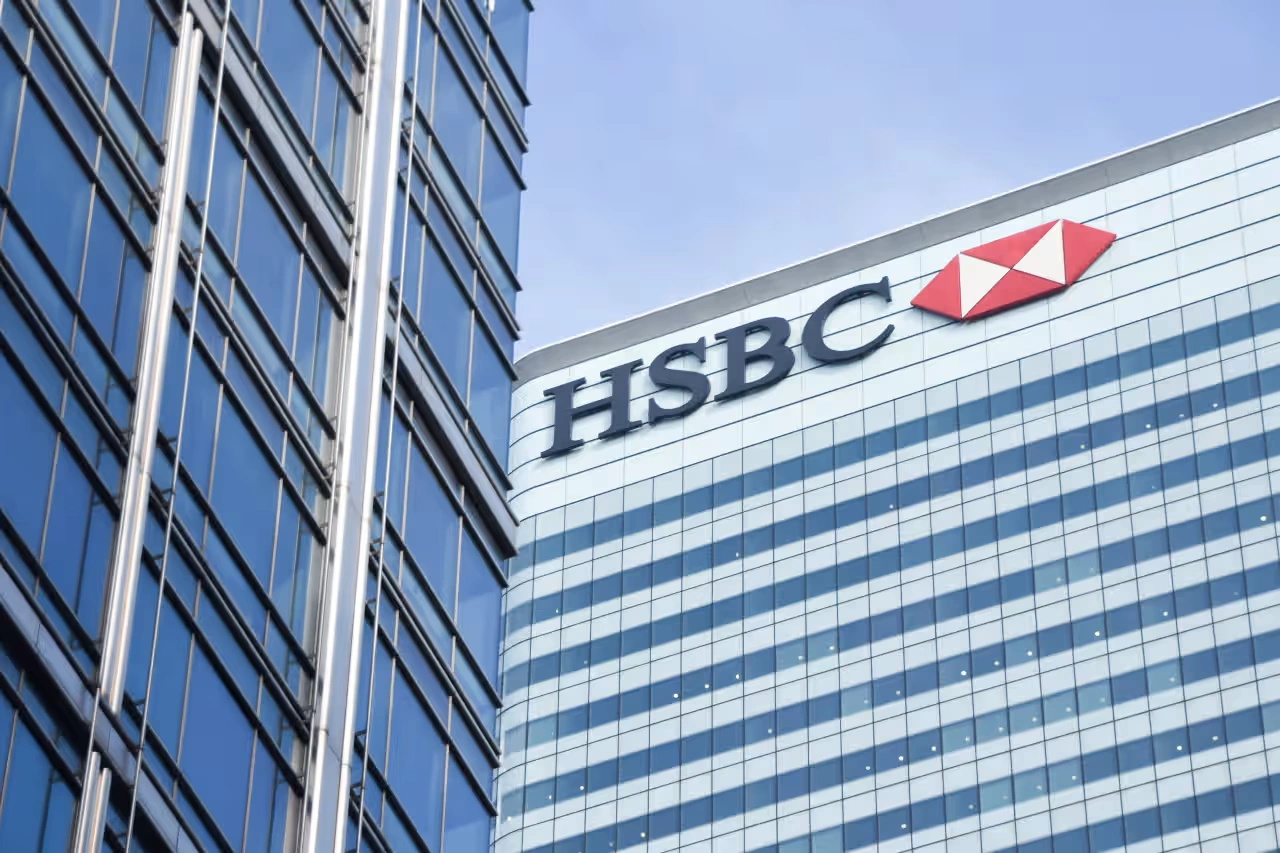
Inside HSBC’s 2026 Restructuring: The $600bn Balance Sheet Optimization Play
In the mahogany-rowed offices of Canary Wharf, the air has shifted. For decades, HSBC—the “World’s Local Bank”—tried to be everything to everyone, a sprawling colonial-era relic attempting to compete in every corner of the financial universe. But under the clinical leadership of CEO Georges Elhedery, the bank is shedding its skin.
The result? The emergence of a $600 billion debt machine.
By pivoting away from high-glamour, low-yield advisory and equity underwriting in Western markets, HSBC has effectively doubled down on what it does best: moving massive amounts of credit through its global arteries. As revealed in the HSBC 3Q 2025 Earnings Release, the bank is no longer just a lender; it is a high-velocity origination and distribution engine.
The $600 Billion Balance Sheet: HSBC’s New Powerhouse
At the heart of Elhedery’s “Simplification” program is the newly minted Corporate and Institutional Banking (CIB) division. This isn’t just a name change; it’s a consolidation of power. By merging Global Banking and Markets with Commercial Banking, HSBC has created a unit with a near-$600 billion balance sheet dedicated to dominating the credit lifecycle.
This strategy—which we might call HSBC balance sheet optimization—is designed to exploit the bank’s unique footprint. While Wall Street titans like JPMorgan often struggle with local liquidity in emerging markets, HSBC sits on a $1.7 trillion deposit base (as of 3Q 2025).
Why the Shift to Debt?
The math is simple. Equity underwriting is volatile and requires expensive “star” bankers. Debt financing, however, is the bread and butter of global trade. By focusing on HSBC financing strategies that prioritize debt origination over M&A advice, the bank is targeting more predictable, recurring revenue streams.
“We are moving from 0% single accountability… to now about 60% of our revenue generated under single accountability,” Elhedery recently noted, signaling an end to the “matrix” bureaucracy that once slowed the bank to a crawl.
The Mechanics of the Machine: CLOs, SRTs, and Private Credit
To keep this machine running without falling foul of stringent capital requirements, HSBC is employing a sophisticated toolkit of financial engineering.
The “machine” functions through three primary levers:
- Significant Risk Transfers (SRTs): By selling the “first loss” piece of its loan portfolios to private investors, HSBC can reduce its risk-weighted assets (RWAs) without actually selling the loans. This allows for rapid capital recycling.
- Collateralized Loan Obligations (CLOs): HSBC has become a dominant force in the CLO market, bundling mid-market loans into tradable securities, essentially acting as a bridge between corporate borrowers and yield-hungry institutional investors.
- HSBC Private Credit Alliances: In a “if you can’t beat ’em, join ’em” move, the bank has formed deep partnerships with private credit funds. This allows HSBC to originate loans that might be too risky for its own balance sheet and pass them off to partners, earning a fee in the process.
This shift toward global debt distribution has allowed HSBC to report a Q3 2025 pre-tax profit of $7.7 billion (excluding notable items), as reported by Reuters.
The Rivalry: How HSBC is Competing with JPMorgan in Debt Markets
For years, the narrative was that US banks had won the global banking war. However, 2025 has seen a surprising counter-offensive. While JPMorgan remains the undisputed king of the “bulge bracket,” HSBC is winning the battle for the “Global South” and tech-heavy corridors.
Data from Bloomberg suggests that HSBC has overtaken several US peers in dollar-denominated bond bookrunning for tech giants and emerging market sovereigns. The bank’s ability to offer “end-to-end” financing—from simple credit lines to complex cross-border debt issuance—makes it a formidable opponent.
| Feature | HSBC Strategy | JPMorgan Strategy |
| Primary Focus | Debt Origination & Trade Finance | Full-service Investment Banking |
| Geographic Edge | Asia & Middle East (The “East-West” Bridge) | US Domestic & Global M&A |
| Capital Tool | Balance Sheet Scale ($3T+ Assets) | Market Making & Fee-Based Advisory |
Risks in the Gears: Macroeconomic Headwinds
No machine is without its friction points. As The Economist has frequently warned, a “debt machine” is only as healthy as the global economy’s ability to service that debt.
- Interest Rate Volatility: While high rates have boosted banking net interest income (NII) to an expected $43 billion+ for 2025, a sharp “hard landing” could lead to a spike in expected credit losses (ECLs).
- The Hong Kong Factor: Despite the pivot, HSBC remains heavily exposed to the Hong Kong commercial real estate (CRE) sector, which has seen significant pressure in 2025.
- Regulatory Scrutiny: Regulators are increasingly wary of “shadow banking” ties, particularly the private credit alliances that HSBC is now championing.
Conclusion: The Investor’s Journey
HSBC’s transformation is a journey from a sprawling empire to a focused, high-tech fortress. For investors, the appeal lies in the bank’s commitment to a 50% dividend payout ratio and its upgraded Return on Tangible Equity (RoTE) guidance of “mid-teens or better” for 2025.
By fashioning a $600 billion debt machine, Georges Elhedery isn’t just cutting costs; he is redefining what it means to be a global bank in a fragmented world. Whether this machine can weather the next global downturn remains the $600 billion question.
Discover more from The Economy
Subscribe to get the latest posts sent to your email.
Analysis
‘Clear Leader’ in Southeast Asia: Analysts Overwhelmingly Bullish on Grab
Grab Holdings (NASDAQ: GRAB) delivered its strongest-ever first quarter on May 5, 2026 — yet the stock still trades near a 52-week low. That disconnect, analysts say, is precisely the opportunity.
There is a particular kind of market moment that veteran investors learn to recognize: a fundamentally strong business, beset by a sudden regulatory headline, trading at a price that reflects panic rather than analysis. Grab Holdings finds itself squarely in that position today.
On May 5, the Singapore-headquartered super-app posted first-quarter 2026 revenues of $955 million — up 24% year-over-year and comfortably ahead of the $914 million analysts had pencilled in. Adjusted EBITDA surged 46% to a record $154 million, marking the company’s 17th consecutive quarter of adjusted EBITDA growth. Profit for the period reached $120 million, versus a mere $10 million a year earlier — a twelvefold improvement. Monthly transacting users climbed 16% to 51.6 million, while on-demand gross merchandise value hit $6.1 billion, accelerating into what is traditionally the company’s softest seasonal quarter.
By nearly every operational metric, Grab is performing like a company that has permanently turned the corner. Yet the shares were trading at roughly $3.87 as of this writing — close to a 52-week low of $3.48, and some 40% below the analyst consensus price target of approximately $6.28 to $6.56. That gap, implying upside of 65% to 70% or more, has become one of the more striking mispricings in emerging-market technology.
The explanation lies in a single regulatory bombshell from Jakarta — and why Grab’s management, and an overwhelming majority of Wall Street analysts, believe the market has dramatically overstated its impact.
Q1 2026: A Profit Machine Firing on All Cylinders
Grab’s Q1 2026 results did not merely beat expectations. They illustrated a business model that is simultaneously deepening its moat and broadening its margin profile across three interdependent pillars: mobility, deliveries, and financial services.
Mobility — Grab’s original ride-hailing engine — remains the crown jewel of the group’s P&L. Revenue rose 19% year-over-year to $337 million, with segment adjusted EBITDA climbing 24% to $198 million, affirming the group’s dominant position in the regional ride-hailing market. Strong GMV expansion was underpinned by continued growth in mobility monthly transacting users and the early dividends of AI-driven marketplace efficiencies, including the company’s “Turbo” driving mode, which management says has already increased driver earnings by 23% — a metric that is as much about driver retention and supply-side resilience as it is about technology.
Deliveries contributed revenue of $510 million, up 23% year-over-year, driven by GMV expansion and an increasingly profitable advertising business layered atop its food delivery platform. Of particular note: GrabMart, the group’s grocery delivery vertical, now accounts for 10% of deliveries GMV and is growing at 1.7 times the rate of food delivery. Grocery users order with 1.8 times the frequency of food-only users — a powerful indication of the stickiness and upward value migration that the super-app model enables.
Financial Services was the quarter’s standout growth story. Revenue jumped 43% year-over-year to $107 million, propelled by a gross loan portfolio that more than doubled to $1.44 billion — with management reiterating a target of $2 billion by year-end. Loan disbursals surged 67% to exceed $1 billion in the quarter. The segment continues to operate at a loss — adjusted EBITDA of negative $17 million — but that loss narrowed sharply from negative $30 million a year earlier, and the company has firmly reiterated its target of fintech segment adjusted EBITDA breakeven in the second half of 2026.
The balance sheet, meanwhile, provides formidable strategic optionality. Grab ended the quarter with $6.9 billion in gross cash liquidity and $5.0 billion in net cash liquidity — a war chest that underpins its recently launched $400 million accelerated share repurchase program, part of a previously approved $500 million buyback mandate. “This is a reflection of our conviction in Grab’s long-term value at these dislocated prices,” CEO Anthony Tan told investors. It is difficult to argue with his framing.
Full-year 2026 guidance was reaffirmed at revenue of $4.04 billion to $4.10 billion (implying 20–22% growth) and adjusted EBITDA of $700 million to $720 million (implying 40–44% growth). Trailing twelve-month adjusted free cash flow reached $489 million — a metric that underscores the underlying quality of the business in ways that standard EBITDA reporting often obscures.
The Analyst Consensus: Overwhelmingly Bullish, Carefully Differentiated
The analytical community’s view on Grab is about as unified as it gets in a stock where regulatory uncertainty warrants genuine debate. 26 of 27 Wall Street analysts currently rate the stock a Buy, with a consensus price target of approximately $6.28 to $6.56, implying upside of 65% to nearly 70% from current levels.
The range of price targets, however, reflects divergent views on the severity and duration of the Indonesia commission cap headwind:
| Firm | Rating | Price Target |
|---|---|---|
| Evercore ISI (Mark Mahaney) | Buy | $8.00 |
| Barclays | Outperform/Buy | $7.00 |
| Jefferies | Buy | $6.70 |
| Morgan Stanley | Overweight | $6.40 |
| HSBC | Buy | $6.20 |
| BofA Securities | Buy | $6.20 |
| Mizuho | Outperform | $6.00 (lowered) |
| JPMorgan | Overweight | $5.90 (lowered) |
| Barclays (conservative) | Buy | $4.50 |
The spread between the most optimistic and most conservative targets — $8.00 to $4.50 — reflects less a disagreement about Grab’s fundamental trajectory and more a calibration exercise around Indonesia’s regulatory timeline, the macroeconomic oil price environment, and the pace of the fintech segment’s path to profitability.
InvestingPro’s screening flags a PEG ratio of just 0.18 for Grab — strikingly low for a company growing revenue at 20%+ and EBITDA at 40%+. Moody’s, for its part, recently upgraded Grab’s corporate family rating to Ba2 with a stable outlook, citing continued earnings growth and its leading Southeast Asian market position. The credit analysts, it appears, are ahead of the equity market.
Regulatory Headwinds: The Indonesia Commission Cap, Unpacked
The regulatory development that rattled markets — and shaved tens of millions off Grab’s market capitalization in late April — deserves careful examination, because the initial reaction almost certainly overstated the structural risk.
On May 1, Indonesian President Prabowo announced a regulation capping ride-hailing platform commissions for two-wheel motorcycle-taxi (ojol) drivers at 8%, down from the current range of 15–20%. The announcement was a genuine surprise — Grab had specifically stated during its February 2026 Q4 earnings call that no commission cap changes were being proposed. The regulation also mandates expanded social protections and insurance for gig workers across deliveries and ride-hailing, which Grab had partly anticipated through a Rp100 billion driver welfare program announced in January 2026.
The headline risk is real: Indonesia represents approximately 17–19% of Grab’s Mobility GMV and roughly 20% of consolidated adjusted EBITDA, making it a material market. However, the actual scope of the cap has been significantly narrower than initial reports suggested.
During the Q1 earnings call, COO Alex Hungate delivered the crucial clarification: the 8% cap applies specifically to ojol two-wheel drivers, and that segment represents less than 6% of Grab’s total Mobility GMV. Four-wheel vehicle drivers, who earn substantially above Indonesia’s minimum wage, are not subject to the regulation in the same way. “We are therefore reiterating our expectations for Mobility margins to stabilize within the historical range,” Hungate said.
Grab’s mitigation levers are meaningful: fare adjustments, renegotiated incentive structures, and a cooperative posture with regulators aimed at “shaping a balanced implementation” of the decree. The fuel crisis sweeping Southeast Asia — which prompted Grab to temporarily raise its Singapore fuel surcharge from S$0.50 to S$0.90 per trip — is also providing cover for consumer-facing pricing adjustments that partially offset commission compression.
The broader regulatory question for Grab is structural, not episodic: Southeast Asian governments are increasingly treating digital platform operators as quasi-utilities, scrutinizing commission structures, data practices, and competitive behavior. That is a headwind Grab must manage continuously — but it is also a headwind that, given Grab’s embedded position in daily consumer life, is unlikely to prove fatal.
Competitive Moat: Why Grab Remains the Clear Regional Leader
The case for Grab’s competitive durability rests on a simple but powerful set of facts: no other regional operator comes close to matching its geographic breadth, ecosystem depth, or the compounding flywheel of its super-app model.
Grab operates across eight countries in Southeast Asia, a region of 680 million people with a rapidly expanding middle class, deepening smartphone penetration, and chronic underbanking. Its closest regional rival, GoTo (Gojek/Tokopedia), is overwhelmingly concentrated in Indonesia — a massive market, to be sure, but a geographically constrained competitive position that limits GoTo’s total addressable market.
The market share data tells a compelling story:
- Ride-hailing across Southeast Asia: Grab commands approximately 70% market share regionally, compared to GoTo’s Indonesia-focused position.
- Indonesia specifically (by order volume): Grab holds 63% of ride-hailing to GoTo/Gojek’s 36%, a data point that significantly complicates the narrative of GoTo as a serious regional threat.
- Southeast Asia food delivery: Grab leads with approximately 55% market share (equating to roughly $9.4 billion in GMV), while Foodpanda holds 15.8% and Gojek just 10.5%. ShopeeFood (Sea Group) and Thailand’s LINEMAN have shown growth at 8.8% and 8.1% respectively, but remain sub-scale at the regional level.
GoTo’s first-ever positive net income, achieved in late 2025, is a genuine competitive development — and a sign that the regional digital economy is maturing. But structural concentration of operations in Indonesia, the absence of a meaningful regional payments or lending network comparable to Grab’s, and limited corporate M&A firepower relative to Grab’s $5 billion net cash pile leave GoTo structurally disadvantaged as a pan-regional challenger.
Foodpanda, owned by Germany’s Delivery Hero, has been losing market share steadily; Grab’s acquisition of Foodpanda’s Taiwan operations for $600 million — secured at a roughly 30% discount to the price Uber was said to have considered — marks Grab’s first geographic expansion beyond Southeast Asia. Jefferies analysts view the deal as enabling Grab to “replicate its Southeast Asian delivery success in Taiwan, driven by affordability, reliability, and technology.” The EBITDA contribution is not expected before 2028, but the strategic logic — entering a high-density, digitally sophisticated market at distressed-asset pricing — is characteristic of Grab’s disciplined capital deployment.
SeaMoney (Sea Group’s fintech arm) and GoPay (GoTo’s digital payments unit) are legitimate fintech competitors, particularly in Indonesia and Vietnam. But neither offers the three-way flywheel — ride, eat, pay — at Grab’s regional scale. Network effects compound asymmetrically: the more users Grab adds to GrabPay, the more attractive its merchant offers become; the more merchants join, the more reason users have to keep the app active; the more active users there are, the richer the data set for credit decisioning in GrabFin. That is a virtuous cycle that took Grab thirteen years to build, and it cannot be acquired or replicated in a single funding round.
Growth Drivers: Fintech, AI, and the Path to 2028
The medium-term investment thesis for Grab rests on three compounding growth drivers that are still in relatively early stages.
Financial Services: The Margin Frontier. GrabFin’s gross loan portfolio doubling to $1.44 billion in a single year — with a $2 billion year-end target and disbursals exceeding $1 billion in Q1 alone — reflects the under-penetration of formal credit across Southeast Asia. An estimated 70% of adults in the region remain underbanked or entirely unbanked. Grab’s GX Bank (Malaysia) and GXS Bank (Singapore) are accumulating deposits and lending infrastructure at speed; combined deposits stood at $1.6 billion at quarter-end. When fintech reaches adjusted EBITDA breakeven in H2 2026, it will transition from a drag on group margins to an accretive driver — representing the single most significant near-term re-rating catalyst for the stock.
AI-Driven Efficiencies: Compounding the Flywheel. Grab’s AI infrastructure investment — which pushed regional corporate costs to $114 million in Q1 (management says this will now stabilize) — is already generating operational returns. Turbo driving mode’s 23% improvement in driver earnings is the most tangible example. The company is deploying AI across demand forecasting, dynamic pricing, credit scoring, fraud detection, and hyper-personalized in-app recommendations. CEO Anthony Tan has spoken of “leaning deeply into AI to out-serve our users,” and while such language is now ubiquitous across technology earnings calls, Grab’s data advantage — billions of transactions across ride, delivery, payment, and credit — gives its AI investment a differentiated training set that smaller regional players simply cannot replicate.
Regional Ecosystem Expansion. Grab’s partners — drivers, merchants, and food vendors — earned more than $15 billion on the platform in 2025, up 19% year-over-year. This is not just a financial statistic; it is the foundation of a political economy. When regulators in Jakarta or Kuala Lumpur consider regulatory interventions, the two to three million gig workers whose livelihoods depend on Grab’s marketplace represent a constituency that moderates the most punitive policy impulses. It is a structural mitigant that is rarely modelled in sell-side EBITDA scenarios, but it is real.
Looking toward 2028, analysts at Jefferies project meaningful EBITDA contribution from the Taiwan foodpanda integration, fintech segment profitability at scale, and continued GMV expansion across the core mobility and deliveries businesses — all compounding against a base of deep market share leadership.
Risks: A Balanced View
No credible investment analysis is complete without a clear-eyed accounting of the risks. For Grab, they are as follows:
Regulatory contagion. The Indonesia commission cap could inspire similar moves by regulators in Malaysia, Vietnam, or the Philippines — particularly as government interest in platform worker protections intensifies across the region. A coordinated regulatory tightening across multiple markets would require a more fundamental reassessment of the profit trajectory.
Fuel and macroeconomic volatility. Elevated fuel prices compress driver earnings and create upward pressure on Grab’s partner incentives, which reached $650 million in Q1 2026 (on-demand incentives at 10.5% of GMV). In a prolonged fuel crisis, the cost of keeping supply healthy could erode margin gains elsewhere.
Credit quality in lending. The loan book’s rapid expansion — doubling in a year — is a potential source of portfolio quality risk if Southeast Asian macroeconomic conditions deteriorate. Management says credit quality remains within risk appetite, but this warrants close monitoring as the portfolio scales toward $2 billion.
GoTo consolidation. A potential Grab–GoTo merger, which remains speculative despite persistent market discussion, could face lengthy antitrust review. A combined entity would hold an extraordinary concentration of market power — potentially approaching 99% in some Indonesian segments — creating genuine regulatory risk and execution complexity.
Integration of Taiwan operations. The Foodpanda Taiwan acquisition introduces a new geography with different consumer behaviors, competitive dynamics (iFood, local players), and regulatory requirements. Integration costs will weigh on near-term profitability before EBITDA contribution materializes post-2028.
The Investment Thesis: Dislocated Quality in a Structurally Growing Market
Grab’s current market valuation presents a familiar paradox: a company delivering record profitability, 17 consecutive quarters of EBITDA growth, a $5 billion net cash position, and a $489 million trailing free cash flow run rate — trading at a price that implies the market is discounting nearly everything that has gone right and pricing in everything that could go wrong.
The Indonesia commission cap is a real headwind. But its actual scope — affecting less than 6% of Mobility GMV — has been clarified, management has reiterated its full-year margin guidance, and Grab’s response has been measured and regulatory-cooperative rather than adversarial.
The deeper story is one of structural positioning in a region undergoing rapid digital transformation. Southeast Asia’s internet economy is forecast to reach $600 billion in GMV by 2030. Grab, with its 51.6 million monthly transacting users, eight-country footprint, growing fintech platform, and AI-powered operational flywheel, is the closest thing the region has to an indispensable digital infrastructure provider.
With 26 of 27 analysts maintaining Buy ratings, a consensus price target implying 65–70% upside, a PEG ratio of just 0.18, a Moody’s Ba2 credit upgrade, and management buying back $400 million of its own stock at these prices, the signals are pointing in a consistent direction.
The market, as is its occasional habit, appears to be confusing a regulatory headwind with a structural impediment. Analysts who have followed Grab since its 2021 SPAC listing — and through its long, disciplined journey from billion-dollar losses to sustained profitability — are not making that mistake.
Conclusion: The Long Game in Southeast Asia
Thirteen years ago, Anthony Tan and Tan Hooi Ling launched a modest ride-hailing app in Malaysia, pitching it to taxi drivers who had grown skeptical of a market moving beneath their feet. Today, Grab is the economic backbone of daily life for more than 50 million users across Southeast Asia’s most dynamic cities — connecting people with transport, food, credit, insurance, and income in a single application.
The Indonesia commission cap is a genuine test of regulatory relationship management and cost structure resilience. It is not an existential threat to a company holding $5 billion in net cash, generating nearly half a billion dollars in annual free cash flow, and growing adjusted EBITDA at 46% in what it describes as its softest seasonal quarter.
In markets like Southeast Asia, where regulatory landscapes shift and macroeconomic conditions fluctuate with greater frequency than in developed markets, the defining advantage is not the absence of headwinds. It is the institutional capacity to absorb, adapt, and continue compounding. Grab, by every operational and financial measure available, has demonstrated that capacity. The analysts who have spent years studying the company’s ecosystem have taken note.
The market, it seems, is still catching up.
Discover more from The Economy
Subscribe to get the latest posts sent to your email.
Analysis
When the World’s Oil Tap Runs Dry: Inside the Strait of Hormuz Crisis Reshaping Global Energy Markets
There is a number that haunts every finance minister, central banker, and airline CFO on the planet right now: $114. That was the intraday peak for Brent crude on Monday, May 4th — a staggering 60% above where it traded just ten weeks ago, before the world woke up to the most severe oil supply disruption in recorded history. It is a number that means $6-a-gallon gasoline on California’s freeways, fuel rationing queues in Karachi and Dhaka, and the spectre of 1970s-style stagflation returning to haunt a global economy that was only just finding its footing.
The story of how we arrived here — how a waterway barely 33 kilometres wide at its narrowest point came to hold the entire global economy in a chokehold — is, at its core, a story about the lethal intersection of nuclear brinkmanship, the fragility of energy infrastructure, and three decades of strategic miscalculation by policymakers who assumed the Strait of Hormuz would always, eventually, stay open.
It will not always stay open. We are living through the proof.
The Price Shock: What the Numbers Are Actually Telling Us
Let’s start with the raw data, because the numbers themselves are extraordinary.
Brent crude surged nearly 6% to close at $114.44 per barrel on Monday — its highest level since May 2022 — before pulling back to $113.24 on Tuesday morning as a fragile ceasefire showed signs of fracture. WTI, the U.S. benchmark, settled at $106.42 before easing to $104.57. Both contracts remain up roughly 60% since the U.S. and Israeli-led air war against Iran began on February 28th — the steepest two-month rally in the history of the crude oil market.
What the price action tells us about trader psychology is revealing: markets are not pricing in a resolution. They are pricing in prolonged uncertainty with intermittent ceasefire noise providing brief relief. The classic “buy the rumour, sell the fact” dynamic has been replaced by something grimmer — a market that has become structurally adapted to crisis, where every diplomatic statement is greeted with scepticism and every escalation triggers mechanical, algorithmic buying.
The volatility itself is informative. A 6% single-session spike in Brent is not normal market behaviour; it reflects genuine fear that the next morning’s headlines could remove another tranche of supply. As ING’s commodities strategist Warren Patterson noted in a research note to clients: “The oil market has moved from over-optimism to the reality of the supply disruption we are seeing in the Persian Gulf. The longer this disruption persists, the less the market can rely on inventory, and the greater the need for further demand destruction.”
The only mechanism that drives demand destruction, as Patterson implicitly acknowledges, is higher prices. Which is precisely why Exxon Mobil CEO Darren Woods warned investors on Friday that the market still hasn’t absorbed the full impact of the disruption. “There’s more to come,” Woods said on Exxon’s Q1 earnings call. He wasn’t bluffing.
The Strait That Runs the World: A Geography Lesson the World Learned Too Late
| Key Metric | Pre-Crisis (Feb 2026) | Current (May 2026) |
|---|---|---|
| Daily oil flow through Hormuz | ~20 million barrels/day | ~3.8 million barrels/day |
| Brent Crude Price | ~$70/barrel | ~$113/barrel |
| Global oil supply disruption | Baseline | -10.1 million barrels/day |
| Strait traffic vs. peacetime | 100% | Approx. 4% (Goldman est.) |
| IEA global observed oil inventories (March drop) | — | -85 million barrels |
The Strait of Hormuz — 21 miles across at its narrowest, straddling Iran to the north and Oman to the south — was, until February 28th, the conduit for roughly 20% of the world’s seaborne oil trade and 20% of its LNG. The numbers were always known; the vulnerability was always documented; the strategic risk was always theorised. What was not adequately war-gamed was what happened when Iran chose to act on its most extreme leverage rather than merely threaten it.
Iran’s Revolutionary Guard Corps has laid sea mines in the strait, boarded and attacked merchant vessels, and issued warnings forbidding transit. According to the IEA’s April 2026 Oil Market Report, shipments through Hormuz had by early April fallen to just 3.8 million barrels per day — compared to more than 20 million before the crisis. The IEA’s executive director did not mince words, calling it “the greatest global energy security challenge in history.”
Goldman Sachs analysts, meanwhile, estimated that the combined effect of the Strait’s closure and attacks on energy infrastructure has reduced global daily production by a staggering 14.5 million barrels. To put that figure in context: at its peak disruption, the 1973 Arab Oil Embargo removed approximately 4.4 million barrels per day from global markets. The current shock is more than three times larger.
The IEA confirms that global oil supply plummeted by 10.1 million barrels per day in March alone, the largest single-month drop in the agency’s five-decade history. Global observed inventories fell by 85 million barrels in March, with stocks outside the Middle East drawn down by a significant 205 million barrels as flows through Hormuz were choked off.
Fire at Fujairah: When Infrastructure Becomes a Weapon
Monday’s renewed market shock arrived at 6 a.m. UAE time, when Iranian drones breached Emirati air defenses and struck the Fujairah oil hub — one of the world’s largest bunkering ports and a critical chokepoint for tanker re-fuelling operations. The UAE’s defense ministry confirmed that it intercepted 12 ballistic missiles, three cruise missiles, and four drones launched from Iran, but the drone that slipped through ignited a fire at the storage terminal.
Three people were injured. The financial damage is incalculable.
The attack on Fujairah was not random. It was a calculated strike on one of the few alternative energy export routes available to Gulf producers attempting to bypass the blocked strait. Saudi Arabia’s East-West Pipeline (Petroline), with roughly 5 million barrels per day of theoretical capacity, and the Abu Dhabi Crude Oil Pipeline, which routes around the Strait to Fujairah itself, represent the only meaningful alternatives to Hormuz transit for the region’s producers. Hitting Fujairah is Iran’s way of closing the escape hatch.
The U.S. military confirmed that Iran’s IRGC also launched cruise missiles at American warships and commercial vessels in the waterway, while U.S. forces reported “defending all commercial ships” against drones and small boats. Two American-flagged vessels did manage to transit the strait under naval escort — a symbolic, if operationally limited, proof-of-concept for President Trump’s “Project Freedom” initiative. Markets were unimpressed. As one analyst quipped: escorting two ships through a mined strait to demonstrate normalcy is rather like opening one lane of a motorway after a major earthquake and declaring traffic flowing.
The Supply Arithmetic: Why Recovery Will Take Months, Not Weeks
Here is the analytical dimension that the breathless daily price commentary tends to miss: even if Hormuz reopened tomorrow, the supply problem would not be solved quickly.
According to Wood Mackenzie’s Head of Upstream Analysis, Fraser McKay, it could take Iraq alone up to nine months to reach prior production levels after a reopening — due to reservoir management complexities and resource constraints. Some wells, shut in hastily in the opening days of the conflict, may have been permanently damaged.
The IEA estimates that even after reopening, it would take around two months to re-establish steady exports, and initial volumes would remain below pre-conflict levels. More pointedly: essentially all of the world’s meaningful spare production capacity — housed in Saudi Arabia and the UAE — is itself trapped behind the blockade. The U.S. shale sector, often romanticised as a swing producer capable of absorbing global shocks, simply cannot substitute for the scale of disruption here.
Goldman’s base case, as of late April, assumed Hormuz normalises by end of June 2026 — a timeline their analysts noted carried “considerable scepticism” even when written. Under sustained production losses near 2 million barrels per day, Goldman projects Brent reaching the $115–$120 range in Q3 and Q4 2026. But that assumes June reopening. The ceasefire announced on April 8th has already frayed dramatically.
The U.S. blockade of Iranian ports, initiated on April 13th, has created what analysts are calling a “dual blockade” — Iran blocking ships from leaving the Gulf, the U.S. blocking ships from reaching Iran. The result is an energy purgatory from which there is no technical exit, only a diplomatic one.
Ripple Effects: From Petrol Forecourts to Supply Chains to the Dining Table
The economic damage extends far beyond crude prices, and its full scope is only beginning to be understood.
For consumers: Californian pump prices have topped $6 a gallon for 87-octane gasoline — a level last seen during the worst post-COVID supply crunch. European fuel prices are rising sharply. In Asia and the developing world, the pain is more acute: Pakistan, Bangladesh, Vietnam, and Zimbabwe are experiencing severe fuel shortages. The Philippines declared a state of emergency in March.
For food security: The Strait of Hormuz carries over 30% of global urea exports — the critical fertiliser input for corn and wheat production. Disruption to the fertiliser supply chain during the spring planting season is now seeping into food price projections. The Food Policy Institute in London has warned of long-term food price increases. Gulf states, which depend on the Strait for over 80% of their caloric imports, are experiencing a concurrent grocery supply emergency — with retailers like Lulu Retail airlift-pricing staples after 70% of the region’s food imports were disrupted.
For airlines: Jet fuel shortages are now being reported across parts of Asia and Oceania, complicating flight schedules and hammering airline margins. Shipping costs have surged as major carriers including Maersk, CMA CGM, and Hapag-Lloyd rerouted around Africa’s Cape of Good Hope, adding weeks to transit times and hundreds of millions in fuel costs per voyage.
For central banks: The macroeconomic script that was written through 2024 and early 2025 — disinflation, rate normalisation, soft landing — has been shredded. The IEA characterises this crisis as echoing the 1970s energy crisis through “acute supply shortages, currency volatility, inflation, and heightened risks of stagflation and recession.” Interest rate reductions expected earlier this year are now either postponed or, in some cases, being reconsidered as upward moves to combat imported inflation.
Investment Implications: The Winners, the Losers, and the Structural Shifts
For investors navigating this landscape, the crisis is simultaneously a pricing windfall and a structural warning.
Integrated oil majors — ExxonMobil, Shell, BP, TotalEnergies — are reporting sharply stronger Q1 earnings. Saudi Arabia, with a fiscal breakeven of approximately $70–$80 per barrel, is generating substantial surplus revenue at current prices. These are, for now, the crisis’s clearest beneficiaries.
Oil-importing economies face the sharpest medium-term pain. India, which imports approximately 85% of its crude oil requirements, is one of the most exposed large economies. Indian refiners have pivoted aggressively toward Russian crude imports as Middle Eastern supplies evaporated. The government has raised export duties on diesel and aviation fuel to protect domestic availability — a politically costly but economically necessary intervention.
The structural shift accelerating beneath the headlines is more significant than the daily price chart. Every board room energy conversation that previously categorised renewable transition as a “long-term strategic priority” is now being revisited with urgency. Solar, wind, battery storage, and nuclear capacity — politically contested and economically uncertain in February — now represent an obvious insurance policy against the geopolitical volatility that fossil fuel dependency inescapably entails.
The crude lesson of the Hormuz crisis — a lesson that will be written into energy policy curricula for decades — is that diversification is not a luxury. It is a survival strategy.
What Comes Next: Three Scenarios
Scenario 1 — Diplomatic resolution (base case, but fading): U.S.-Iran negotiations produce a framework agreement. Hormuz reopens by late June or July. Brent stabilises in the $90–$100 range through H2 2026 as inventories slowly rebuild and production restarts. Inflation pressure eases; central banks resume rate cuts. Markets rally.
Scenario 2 — Prolonged stalemate (increasingly plausible): The current dual blockade persists through Q3. Brent tests the $120–$130 range. Global growth forecasts are cut. Several emerging market economies enter recession. Demand destruction becomes the only mechanism that rebalances the market, and it is brutal.
Scenario 3 — Escalation (tail risk, non-negligible): A miscalculation — a U.S. warship struck, or Iranian infrastructure in the Gulf hit by a significant attack — tips the standoff into broader military confrontation. Brent exceeds $150. Strategic petroleum reserves are released globally. The global economy enters the most severe energy crisis since World War II.
ING’s Patterson and Manthey wrote on Tuesday that markets may find some relief following President Trump’s comments suggesting the conflict could continue for two to three weeks — implying, at least, a defined timeline. But the analysts added a crucial caveat: markets would view this with “considerable scepticism, given the recent escalation and the repeated extensions of projected timelines for ending hostilities since the conflict began.”
The market has heard this before. Every week for ten weeks.
FAQ: Oil Prices and the Hormuz Crisis
Q: Why have oil prices surged above $110 per barrel? Iran’s blockade of the Strait of Hormuz has removed approximately 20% of the world’s seaborne oil trade from the market since late February 2026, creating the largest supply disruption in history. Combined with attacks on energy infrastructure across the Gulf, global oil supply has fallen by more than 10 million barrels per day.
Q: What is the Strait of Hormuz and why does it matter? The Strait of Hormuz is a narrow sea lane between Iran and Oman through which approximately 20% of global oil and 20% of global LNG passed before the crisis. There is no viable full alternative: bypass pipelines through Saudi Arabia and the UAE collectively carry roughly 6.5 million barrels per day, a fraction of Hormuz’s prior throughput of over 20 million.
Q: How long could oil prices stay this high? Goldman Sachs projects Brent will average $90 per barrel in Q4 2026 in its base case (up nearly $30 from pre-crisis levels), assuming Hormuz reopens by end of June. If the blockade persists, $115–$120 Brent in Q3/Q4 is a real scenario, and $130+ cannot be ruled out in a further escalation.
Q: Will U.S. shale production offset the supply loss? Not meaningfully at this scale. The disruption is simply too large — over 10 million barrels per day of shut-in production — and U.S. shale ramp-up timelines are measured in months. The world’s spare production capacity is itself largely trapped in the Gulf behind the blockade.
Q: What does this mean for inflation and interest rates? The supply shock is unambiguously inflationary for energy-importing economies. Central banks that had been expected to cut rates through 2026 are now in a wait-and-see posture. A prolonged shock risks entrenching a new inflationary cycle that could require rate increases rather than cuts.
Q: How will this affect renewable energy investment? The crisis will likely accelerate it. Oil above $110 makes renewables economically competitive across a wider range of use cases. The strategic argument — that fossil fuel dependence creates catastrophic geopolitical exposure — has rarely been made more viscerally.
Q: Is a diplomatic resolution possible? It is the only resolution. There is no military path that reopens Hormuz quickly. The question is whether U.S.-Iran negotiations can produce a framework acceptable to both Tehran and Washington — and, critically, whether the terms of any nuclear deal can be agreed before the economic damage becomes irreversible.
Discover more from The Economy
Subscribe to get the latest posts sent to your email.
Analysis
America’s Electoral Vandalism Crisis: Why Eroding Trust in Elections Threatens Democracy More Than Any Single Theft
By the time the votes are counted in November 2026, American democracy may have survived its most dangerous season — not because the election was stolen, but because so many people were already certain it would be.
The numbers arriving this spring tell a story that, on its surface, should reassure anyone who loves democratic governance. RaceToTheWH’s latest model, updated in late April 2026, places Democrats’ odds of retaking the House majority at 78.2% — a figure that has risen sharply in recent weeks as strong fundraising data and Virginia’s mid-decade redistricting shifted multiple seats from Republican to Democratic columns. At Polymarket and Kalshi, the prediction markets now favor a Democratic Senate takeover 55% to 45%, a scenario almost nobody credited a year ago when Republicans held a 53-seat advantage. President Trump’s job approval, per an April 2026 Strength In Numbers/Verasight poll, has sunk to a dismal 35%, with a net rating of -26 — his worst reading yet, dragged down by a stunning -46 net approval on prices and inflation. Democrats lead the generic congressional ballot by seven points, 50% to 43%.
A democratic optimist might look at these figures and exhale. The guardrails are holding. The voters are speaking. The system is working.
But the system is also being quietly dismantled — not in the dramatic fashion of jackbooted paramilitaries seizing polling stations, but in the slow, grinding, almost bureaucratic fashion of institutional corrosion. The real threat to American democracy in 2026 is not electoral theft. It is electoral vandalism: the systematic degradation of public faith in the very processes that make democratic outcomes legitimate. And that form of destruction, unlike the brazen variety, leaves no smoking gun, no crime scene, and no obvious remedy.
The Distinction That Matters: Theft vs. Vandalism
Democratic theorists have long focused on the mechanics of election fraud — ballot stuffing, voter roll manipulation, machine tampering — as the primary vulnerability of electoral systems. This framing, while not without merit, misses a more insidious threat that operates upstream of the vote count itself. A stolen election requires a conspiracy of sufficient scale and audacity to produce a false result. Electoral vandalism requires only the persistent, credible-sounding assertion that the result — whatever it is — cannot be trusted.
The distinction matters enormously. Theft is a discrete event, subject to investigation, reversal, and accountability. Vandalism to institutional trust is cumulative, self-reinforcing, and notoriously difficult to repair. Sociologists who study institutional legitimacy note that trust, once comprehensively fractured, does not reconstitute simply because subsequent events prove the original fears groundless. A population conditioned to expect fraud will tend to interpret clean results as evidence of successful concealment rather than genuine fairness. This is the epistemic trap into which American politics has been steadily falling since at least 2020 — and arguably since 2000.
The mechanisms of modern electoral vandalism are less exotic than they sound. They include: the appointment of election-skeptical officials to positions with certification authority; the removal of nonpartisan federal infrastructure that election administrators rely upon; the normalization of pre-emptive result challenges before a single ballot is cast; and the weaponization of legal processes to cast doubt on legitimate electoral procedures. None of these, individually, steals an election. Together, they erode the shared epistemic foundation without which no election result, however fairly obtained, can function as a genuine democratic mandate.
What the Data Actually Shows — and What It Conceals
The polling landscape for 2026 is, by any conventional measure, catastrophic for Republicans. An April 13 Economist-YouGov survey found Trump’s overall job approval at 38%, with 86% of self-identified Republicans still backing him — a figure that illustrates both the depth of his base’s loyalty and the ceiling it imposes on his party’s midterm prospects. The Cook Political Report and Sabato’s Crystal Ball, following Virginia’s April 21 redistricting earthquake, have moved a remarkable string of formerly safe Republican seats into competitive or Democratic-leaning territory.
Forecasters at 270toWin tracking Kalshi’s prediction market odds paint a map increasingly favorable to Democratic control. The economic fundamentals reinforce the picture: the Federal Reserve Bank of St. Louis projects real GDP growth of roughly 1.8% for 2026, a sluggish figure that historical modeling suggests would cost the incumbent party significant House seats. Democrats need to flip just three seats for a House majority — a threshold that, given the structural headwinds, now appears well within reach even before the Virginia gerrymander’s full effects are tallied.
And yet beneath this encouraging topography lies a profoundly unsettling substructure of civic distrust. Gallup’s 2024 survey data recorded a record 56-percentage-point partisan gap in confidence that votes would be accurately cast and counted — with 84% of Democrats expressing faith in the process against just 28% of Republicans. That 28% figure represents the endpoint of a long decline: as recently as 2016, a majority of Republicans trusted the vote count. The percentage of all Americans saying they are “not at all confident” in election accuracy has climbed from 6% in 2004 to 19% today. These are not rounding errors. They are the statistical signature of a legitimacy crisis in slow motion.
The 2024 election produced a partial — and telling — correction in these numbers. Per Pew Research, 88% of voters said the 2024 elections were run and administered at least somewhat well, up from 59% in 2020. Trump voters’ confidence in mail-in ballot counts surged from 19% to 72%. But this recovery was almost entirely contingent on the outcome: Trump’s voters trusted the system because their candidate won. Harris’s voters, having lost, expressed somewhat lower confidence than Biden voters had in 2020. The lesson is stark and should alarm anyone who considers themselves a democratic institutionalist: American confidence in elections has become less a measure of electoral integrity than a barometer of partisan outcomes. The process is trusted when your side wins. This is not democracy’s foundation — it is its corrosion.
The Infrastructure of Doubt: Guardrails Removed, Officials Threatened
The structural assault on election integrity infrastructure has been methodical. The Brennan Center for Justice, which has tracked federal election security architecture across administrations, documented in 2025 how the Trump administration froze all Cybersecurity and Infrastructure Security Agency (CISA) election security activities pending an internal review — then declined to release the review’s findings publicly. Funding was terminated for the Elections Infrastructure Information Sharing and Analysis Center, a network that provided low- or no-cost cybersecurity tools to election offices nationwide. CISA had, before these cuts, conducted over 700 cybersecurity assessments for local election jurisdictions in 2023 and 2024 alone.
The administration also targeted Christopher Krebs, whom Trump himself had appointed to lead CISA in 2018, for the offense of declaring the 2020 election “the most secure in American history.” A presidential memorandum directed the Department of Justice to “review” Krebs’s conduct and revoked his security clearances — establishing, with unmistakable clarity, the message that officials who defend electoral outcomes against political pressure do so at personal and professional peril.
The Brennan Center’s 2026 survey of local election officials found that 32% reported being threatened, harassed, or abused — and 74% expressed concern about the spread of false information making their jobs more difficult or dangerous. Eighty percent said their annual budgets need to grow to meet election administration and security needs over the next five years. Overall satisfaction with federal support dropped from 53% in 2024 to 45% in 2026. The Arizona Secretary of State articulated what many officials feel: without federal assistance, election administrators are “effectively flying blind.”
These developments matter not primarily because they create opportunities for technical fraud — the decentralized nature of American election administration makes large-scale technical manipulation extraordinarily difficult — but because they generate precisely the appearance of vulnerability that vandals require. The narrative writes itself: reduced federal oversight, intimidated local officials, terminated information-sharing networks. For the portion of the electorate already primed toward suspicion, each cut to election infrastructure becomes further evidence of a rigged system.
The Roots of Distrust: A Bipartisan Inheritance
Intellectual honesty demands an acknowledgment that distrust in American elections is not a purely Republican pathology, manufactured ex nihilo after 2020. The erosion of confidence has bipartisan antecedents that predate the current moment.
The contested 2000 presidential election left lasting scars on Democratic confidence. In 2004, Democratic skepticism about electronic voting machines — particularly in Ohio — produced claims that have since been largely debunked but that at the time circulated widely among mainstream progressive voices. Democratic politicians regularly raised doubts about the integrity of Georgia’s 2018 gubernatorial election, Stacey Abrams’s loss becoming a cause célèbre in ways that, without endorsing either narrative, mirror the structural form of the claims made after 2020. The language of “voter suppression,” while describing genuine and documented policy choices, sometimes bleeds into a broader implication that any election producing an adverse result for marginalized communities is, by definition, illegitimate.
These are not equivalent to the specific and demonstrably false claims made about the 2020 presidential election, which were litigated in over sixty courts and rejected by Republican-appointed judges across multiple states. But they are relevant context. A political culture in which both parties maintain reserves of result-contingent skepticism is one in which no outcome can serve as a genuine social contract. The asymmetry matters — the scale and institutional reach of post-2020 denialism dwarfs its predecessors — but the underlying cultural permissiveness toward convenient distrust is a shared creation.
Pew Research data on institutional trust tells an even longer story. In 1958, 73% of Americans trusted the federal government to do the right thing almost always or most of the time. By the early 1980s, following Vietnam and Watergate, that figure had collapsed to roughly 25%. It has never sustainably recovered. Trust in government now functions almost entirely as a partisan instrument: Democrats’ trust in the federal government is currently at an all-time low of 9%, while Republicans’ stands at 26% — the inversion of figures from the Biden years, when Republicans registered 11% and Democrats 35%. As Gallup has documented, the party in power trusts the government; the party out of power doesn’t. In such an environment, elections cannot function as legitimating events — they simply determine which half of the country feels temporarily reassured.
Why November 2026’s Likely Democratic Wave May Make Things Worse
Here is the uncomfortable paradox at the heart of this analysis: a large Democratic electoral victory in November 2026 — the outcome that most models currently favor — may actually deepen the legitimacy crisis rather than resolve it.
Consider the dynamics. If Democrats retake the House and, against the Senate map’s structural disadvantages, claim the upper chamber as well, a significant portion of the Republican base — primed by years of election-denial messaging, deprived of the institutional confidence-building infrastructure that CISA once provided, and consuming media ecosystems that frame any adverse result as fraudulent — will simply not accept the outcome as legitimate. This is not speculation; it is extrapolation from documented patterns. Research from States United Democracy Center found that decreased voter confidence in elections may have reduced 2024 turnout by as many as 4.7 to 5.7 million votes. A dynamic in which significant numbers of Americans opt out of a process they consider fraudulent compounds, over time, into a self-fulfilling delegitimation.
The international context amplifies the concern. Students of democratic backsliding in Hungary, Poland, Turkey, and Brazil will recognize the pattern: the erosion of electoral legitimacy rarely begins with outright fraud. It begins with the cultivation of a narrative in which elections are inherently suspect — a narrative that prepares the ground for extraordinary measures should any specific result prove inconvenient. Viktor Orbán did not simply steal Hungarian elections; he spent years constructing a legal and media architecture in which the definition of a “fair” election was progressively redefined to mean one his party won. The United States is not Hungary. Its federalism, its independent judiciary, its civil society infrastructure, and its free press represent formidable structural defenses. But those defenses are not self-sustaining. They require a citizenry that grants them legitimacy — and that citizenry is fracturing.
Internationally, American credibility as a democratic exemplar has already taken grievous damage. The State Department’s annual democracy reports — instruments of soft power that Washington has deployed for decades — ring increasingly hollow when allies and adversaries alike can point to polling data showing that a quarter of Americans have “not at all” confidence in their own vote count. The soft power cost is not theoretical; it is evidenced in the enthusiasm with which authoritarian governments, from Moscow to Beijing, have amplified American electoral distrust as a propaganda instrument.
What Repair Would Actually Require
There is no single policy remedy for a crisis that is as much cultural and epistemological as institutional. But several interventions suggest themselves with particular urgency.
Restore and insulate federal election security infrastructure. The gutting of CISA’s election security function is the most obviously reversible damage. A bipartisan statutory framework — moving election security support out of executive branch discretion and into a structure analogous to the Federal Election Commission’s nominal independence — would provide some insulation against future administrations weaponizing or defunding these functions. The appetite for such legislation is currently thin, but the architecture of the argument exists.
Establish a national election integrity commission with genuine bipartisan credibility. Not the performative exercises in partisan recrimination that have characterized previous “election integrity” initiatives, but a body modeled on the Carter-Baker Commission of 2005 — imperfect as that effort was — with subpoena authority, public reporting mandates, and a mandate to address both voter access and vote security concerns without treating them as inherently antagonistic. The Brookings Institution and the Bipartisan Policy Center have produced serious policy frameworks in this space that deserve legislative attention.
Elevate and protect local election officials. The Brennan Center’s surveys make clear that the front line of American democracy is populated by underfunded, understaffed, increasingly threatened county clerks and registrars whose anonymity and vulnerability make them ideal targets for political pressure. Federal hate crime protections for election workers, increased HAVA funding, and state-level salary parity reforms would all help retain the experienced professionals on whom procedural legitimacy ultimately depends.
Cultivate cross-partisan electoral norms. Political leaders — on both sides — who campaign on the implicit or explicit premise that any adverse result is fraudulent should be called to account by peers, donors, and media with a seriousness that has been largely absent. This is not a call for false equivalence. The scale and institutional embedding of post-2020 denialism is without precedent in the modern era. But the underlying cultural norm — that elections are legitimate only when your side wins — will not be defeated by partisan argument alone. It requires leaders within each coalition who are willing to pay a political cost for defending process over outcome.
The Verdict History Will Write
November 2026 will almost certainly produce a significant Democratic electoral advance. The forecasting models are, by this point, less predictions than diagnoses of structural forces that would require a dramatic, unforeseen intervention to reverse. A Democratic House, and possibly a Democratic Senate, will be the likely result of a president’s second-term unpopularity compounded by economic anxiety, tariff-driven inflation, and the accumulated weight of policy decisions that polling suggests a majority of Americans oppose.
But history will not remember 2026 primarily as the midterm that broke Republican legislative power. It will remember it as the moment when the long-accumulating deficit of electoral legitimacy finally became impossible for reasonable observers to ignore — when the data on trust, participation, and institutional confidence converged into a portrait not of a system functioning under stress, but of a system whose foundational assumptions were in active decomposition.
Democracy, the political theorist Robert Dahl observed, requires not just free and fair elections, but the shared belief that elections are free and fair. One without the other is theater — elaborate, expensive, and increasingly unconvincing theater. The United States is not yet at the endpoint of that degradation. But it is measurably, documentably, closer than it was. And the distance to recovery, which seemed manageable in 2021, grows harder to traverse with each passing cycle in which the vandals — from whatever direction they come — are permitted to work undisturbed.
The votes will be counted in November. The question that should occupy serious people between now and then is not who will win, but whether enough Americans will believe the answer to make winning mean anything at all.
Frequently Asked Questions
What is “electoral vandalism” and how is it different from election fraud? Electoral vandalism refers to the systematic erosion of public faith in elections through disinformation, institutional dismantling, and political intimidation — without necessarily changing any vote tallies. Unlike outright fraud, which involves altering results, vandalism attacks the legitimacy of the process itself, making citizens doubt outcomes regardless of their accuracy.
What do the latest polls show about the 2026 midterms? As of April 2026, Democrats lead the generic congressional ballot by approximately 7 points. Forecasting models put Democratic odds of retaking the House at roughly 78%, while prediction markets give Democrats a 55% chance of reclaiming the Senate — an outcome that would have seemed implausible just one year ago.
Why is trust in U.S. elections so low? Gallup recorded a record 56-point partisan gap in election confidence in 2024, with only 28% of Republicans expressing confidence in vote accuracy before the election. Post-2024, confidence rebounded sharply — but primarily among Trump voters after he won, suggesting confidence tracks outcomes rather than genuine process faith.
What happened to federal election security infrastructure? The Trump administration froze CISA’s election security activities in early 2025 and terminated funding for key information-sharing networks. According to the Brennan Center, 32% of local election officials have been threatened, harassed, or abused, and 80% say their budgets are insufficient for the security needs they face.
What would genuine election integrity reform look like? Effective reform would require restoring nonpartisan federal cybersecurity support for election offices, establishing a bipartisan election integrity commission with real authority, protecting local election workers through federal law, and — most critically — rebuilding a cross-partisan norm in which process legitimacy is not contingent on outcome.
Discover more from The Economy
Subscribe to get the latest posts sent to your email.
-
Markets & Finance4 months agoTop 15 Stocks for Investment in 2026 in PSX: Your Complete Guide to Pakistan’s Best Investment Opportunities
-
Analysis3 months agoTop 10 Stocks for Investment in PSX for Quick Returns in 2026
-
Analysis3 months agoBrazil’s Rare Earth Race: US, EU, and China Compete for Critical Minerals as Tensions Rise
-
Banks4 months agoBest Investments in Pakistan 2026: Top 10 Low-Price Shares and Long-Term Picks for the PSX
-
Investment4 months agoTop 10 Mutual Fund Managers in Pakistan for Investment in 2026: A Comprehensive Guide for Optimal Returns
-
Global Economy5 months ago15 Most Lucrative Sectors for Investment in Pakistan: A 2025 Data-Driven Analysis
-
Global Economy5 months agoPakistan’s Export Goldmine: 10 Game-Changing Markets Where Pakistani Businesses Are Winning Big in 2025
-
Analysis3 months agoJohor’s Investment Boom: The Hidden Costs Behind Malaysia’s Most Ambitious Economic Surge