
Banks
Best Investments in Pakistan 2026: Top 10 Low-Price Shares and Long-Term Picks for the PSX


Discover the best investment in Pakistan 2026 with our expert analysis of top 10 best low price shares to buy today in Pakistan and 10 best shares to buy today in Pakistan for long term growth. Data-driven insights on PSX opportunities.
Pakistan’s Equity Market Emerges as a Global Outlier
As dawn breaks over Karachi’s I.I. Chundrigar Road in January 2026, the Pakistan Stock Exchange (PSX) continues a remarkable transformation that has captivated frontier market investors worldwide. The benchmark KSE-100 Index climbed to 185,099 points on January 16, 2026, gaining over 60% compared to the same period last year, cementing Pakistan’s position among the best-performing bourses globally for the third consecutive year. For investors seeking the best investment in Pakistan 2026, understanding this structural shift—from macroeconomic stabilization to corporate earnings acceleration—has become essential.
This comprehensive analysis examines why equities represent the optimal asset class for Pakistani and international investors in 2026, identifies the top 10 best low price shares to buy today in Pakistan with compelling value propositions, and profiles the 10 best shares to buy today in Pakistan for long term wealth creation. Drawing on current data from Arif Habib Limited, AKD Research, Taurus Securities, and authoritative macroeconomic sources including the IMF and Asian Development Bank, we provide rigorous fundamental analysis while acknowledging inherent risks in this frontier market.
Disclaimer: This article is for informational and educational purposes only and does not constitute personalized financial, investment, tax, or legal advice. All investments carry risk, including potential loss of principal. Readers should conduct independent research and consult qualified financial advisors before making investment decisions. Past performance does not guarantee future results.
Pakistan’s Economic and Market Outlook for 2026: Fragile Stability Meets Structural Headwinds
Macroeconomic Fundamentals: Cautious Optimism Amid Reform Fatigue
Pakistan’s economy enters 2026 exhibiting tentative stability following a turbulent 2023-2024 period marked by currency crises, political uncertainty, and devastating floods. The International Monetary Fund projects Pakistan’s real GDP growth at 3.6% for FY2026, moderating from earlier estimates as the nation navigates a delicate balance between IMF-mandated fiscal consolidation and growth imperatives. The IMF’s Extended Fund Facility (EFF), approved in September 2024, has delivered significant progress in stabilizing the economy, with gross foreign reserves reaching $14.5 billion by end-FY25, up from $9.4 billion a year earlier.
The inflation trajectory presents a mixed picture. After touching double digits in 2024, the IMF forecasts consumer price inflation moderating to 6% in FY2026, although recent flood-related food price shocks and energy tariff adjustments create upside risks. The State Bank of Pakistan has begun a monetary easing cycle, cutting the policy rate to three-year lows near 11%, providing tailwinds for interest-rate-sensitive sectors while maintaining real rates sufficiently positive to anchor inflation expectations within the 5-7% target range.
The external account remains Pakistan’s Achilles’ heel. The current account deficit is projected to widen modestly in FY26 due to import-led demand recovery, though remittance inflows—totaling approximately $3 billion monthly—provide crucial support. Pakistan’s economy continues to grapple with structural challenges: energy sector circular debt exceeding PKR 2.5 trillion, tax-to-GDP ratios among the world’s lowest at under 10%, and climate vulnerability underscored by the 2025 floods that disrupted agricultural output.
PSX Performance: From Frontier Backwater to Asia-Pacific Leader
The Pakistan Stock Exchange’s transformation has been nothing short of extraordinary. According to Arif Habib Limited’s strategy report, the KSE-100 Index delivered an impressive 57% USD-based return in FY25, making it the best-performing market in the Asia-Pacific region. This outperformance reflects multiple factors: sharp rerating from depressed valuations (forward P/E expanding from 3x to approximately 8x), robust corporate earnings growth particularly in banking and energy sectors, and sustained domestic liquidity as alternative investment options remain limited.
Looking forward, brokerage houses present divergent but uniformly constructive targets for the KSE-100 in 2026:
- Arif Habib Limited: 208,000 points by December 2026, implying 21.6% upside
- Taurus Securities: 206,000 points, translating to 24% return from levels at end-November 2025
- AKD Research: 263,800 points by December 2026, suggesting 53% appreciation fueled by monetary easing and structural reforms
The market trades at a forward P/E of 6.8x and price-to-book ratio of 1.1x for FY26, attractive relative to regional frontier market averages, suggesting room for further multiple expansion if political stability persists and the IMF program remains on track.
Key Catalysts and Risk Factors for 2026
Growth Drivers:
- Monetary Easing Cycle: Further policy rate cuts anticipated through H1 2026, benefiting leveraged sectors (banks, cement, auto) and stimulating credit growth
- Corporate Earnings Momentum: Earnings growth projected at 14% (excluding banks and E&Ps) for FY26, with overall growth at 9.2%
- Foreign Investment Recovery: AHL forecasts foreign portfolio inflows of $150-200 million in FY26, reversing FY25’s net outflows of $304 million
- Privatization Pipeline: Successful PIA divestment signals renewed reform momentum; DISCO privatizations (IESCO, GEPCO, FESCO) could attract significant capital
- Remittance Resilience: Overseas Pakistani inflows provide structural support to external accounts and domestic consumption
Headwinds and Vulnerabilities:
- Political Uncertainty: Pakistan’s governance remains fragile; policy reversals or institutional conflicts could derail the reform agenda
- Climate Risks: Intensifying monsoons and glacial lake outburst floods threaten agricultural productivity and infrastructure
- Global Trade Tensions: US tariff policies and reciprocal measures create uncertainty for export-oriented sectors
- Energy Sector Malaise: Circular debt overhang and capacity payments strain fiscal resources
- Currency Volatility: PKR depreciation risks persist despite relative stability in recent months
- Tax Revenue Shortfalls: Chronic inability to broaden the tax base constrains fiscal space for development spending
Why Equities Remain the Best Investment in Pakistan 2026
Comparative Asset Class Returns: Equities Dominate
For Pakistani investors navigating a challenging macroeconomic environment, asset allocation decisions in 2026 carry significant weight. According to Arif Habib Limited’s investment strategy report, equities remain the top choice for 2026, with the KSE-100 projected to deliver 21.60% returns, significantly outperforming gold (5.15%), silver (7.89%), and Treasury Bills (10.05%). This performance gap reflects both the depressed starting valuations of Pakistani equities and the repricing potential as macroeconomic stability improves.
Alternative investment classes present less compelling risk-adjusted prospects:
- Real Estate: The property market faces structural headwinds from increased taxation, documentation requirements, and elevated borrowing costs. Rental yields remain anemic in major urban centers, and transaction volumes have slumped. For investors seeking housing or rental income, real estate retains relevance, but capital appreciation appears limited in 2026.
- Fixed Income (Government Securities): With 10-year Pakistan Investment Bonds yielding approximately 12% and Treasury Bills around 10%, fixed income offers respectable nominal returns but struggles to generate meaningful real returns after accounting for 6% inflation. Moreover, falling interest rates will compress bond yields, creating capital losses for holders of long-duration securities.
- Gold and Precious Metals: Traditional inflation hedges like gold face limited upside in a moderating inflation environment. Silver’s industrial demand provides some support, but projected single-digit returns pale compared to equity market potential.
- Foreign Currency (USD/PKR): Currency depreciation expectations of 12.45% suggest the PKR will continue weakening, making USD holdings attractive for capital preservation but inferior to equities for growth.
The Equity Advantage: Structural and Cyclical Tailwinds Converge
Pakistan’s equity market benefits from a unique confluence of factors in 2026:
Valuation Opportunity: Despite the strong 2023-2025 rally, the KSE-100’s forward P/E of 6.8x remains below historical averages and well below regional peers. This suggests the market has not overshot fundamentals, leaving room for continued multiple expansion as foreign investors rediscover Pakistan.
Earnings Growth: Corporate profitability is accelerating across key sectors. Banks are reporting return on equity (ROE) exceeding 20% as net interest margins benefit from still-elevated lending rates. Exploration & production companies are capitalizing on new discoveries and favorable gas pricing. Fertilizer manufacturers enjoy government support and agricultural demand recovery. Cement producers are positioned for infrastructure spending linked to CPEC Phase II and post-flood reconstruction.
Liquidity Environment: The KSE-100 maintains high liquidity with average daily trading volume of $102 million in FY25, ensuring institutional investors can enter and exit positions without significant market impact. Deepening domestic participation—driven by limited alternative investment options—provides a stable demand base.
Dividend Income: Many PSX blue-chips offer attractive dividend yields of 5-10%, providing income streams that cushion against market volatility. In a falling interest rate environment, dividend-yielding stocks become increasingly attractive to income-focused investors.
Shariah-Compliant Options: For investors seeking halal investments, the PSX offers robust Islamic indices (KMI-30, Meezan Pakistan Index) comprising companies adhering to Shariah principles, broadening the investable universe for a significant demographic.
Top 10 Best Low-Price Shares to Buy Today in Pakistan: Value Opportunities in Undervalued Segments
The following ten stocks represent compelling value propositions for investors seeking exposure to Pakistan’s equity market at accessible price points. These names trade at relatively low absolute prices (generally under PKR 300), exhibit strong fundamentals or turnaround potential, and offer meaningful upside based on current valuations. This section focuses on undervalued shares, penny stocks with improving fundamentals, and companies poised to benefit from sector-specific catalysts in 2026.
Important Note: “Low-price” or “penny stock” classification refers to absolute share price, not market capitalization or fundamental quality. Investors should assess these opportunities based on business fundamentals, growth prospects, and risk factors rather than price alone. Position sizing should be conservative, and stop-losses prudent.
1. TRG Pakistan Limited (TRG) – Technology & IT Services
Sector: Technology & Communication
Current Price Range: PKR 75-80
52-Week Range: PKR 49.50 – 84.39
P/E Ratio: 4.97 (TTM)
Market Cap: ~PKR 34 billion
Investment Thesis:
TRG Pakistan operates through its subsidiary in business process outsourcing (BPO), Medicare insurance, and IT-enabled services sectors, with significant exposure to the US market. Trading at an exceptionally low P/E multiple of under 5x, the stock appears undervalued relative to its earnings power. The company has navigated governance challenges and shareholder disputes, which have weighed on sentiment but created an attractive entry point for value investors. Recent corporate actions, including foreign investment inflows and operational restructuring, suggest improving fundamentals. The technology sector globally commands premium valuations; TRG’s discount reflects Pakistan-specific risks and governance concerns that may dissipate in 2026.
2026 Catalysts:
- Resolution of shareholder disputes creating clarity for investors
- Potential foreign investment transactions enhancing liquidity
- BPO sector tailwinds from global companies seeking cost-competitive offshore destinations
- Currency depreciation benefiting USD-denominated revenue streams
Risks:
- Governance and shareholder conflict history
- Limited Shariah compliance (excludes Islamic investors)
- US economic slowdown could impact BPO demand
- High operational leverage to client concentration
2. Engro Fertilizers Limited (EFERT) – Agricultural Inputs
Sector: Fertilizer
Current Price Range: PKR 240-245
52-Week Range: PKR 145.25 – 263.30
P/E Ratio: 14.57 (TTM)
Dividend Yield: ~6-7% (estimated)
Market Cap: ~PKR 428 billion
Investment Thesis:
EFERT operates one of Pakistan’s most efficient urea manufacturing plants (EnVen facility), delivering superior profit margins compared to older competitor facilities. The company’s competitive moat stems from low-cost natural gas feedstock access (government-subsidized) and world-class operational efficiency. Pakistan’s agricultural sector, representing nearly 20% of GDP, requires consistent fertilizer inputs; government subsidies support farmer affordability, ensuring stable demand. EFERT has traded down from 2024 highs above PKR 260, creating a value entry point ahead of the spring 2026 application season. The stock is Shariah-compliant and offers regular dividend income.
2026 Catalysts:
- Agricultural sector recovery following flood-affected FY25 harvest
- Government maintaining fertilizer subsidies to support food security
- Potential gas price stability under IMF program
- Spring and autumn crop application seasons driving volume growth
Risks:
- Natural gas allocation uncertainties (feedstock risk)
- Government policy changes on subsidies or pricing
- Competition from Fauji Fertilizer (FFC) and Fatima Fertilizer
- Monsoon disruptions affecting agricultural activity
- Limited international growth opportunities (domestic market saturation)
3. Faysal Bank Limited (FABL) – Commercial Banking
Sector: Commercial Banks
Current Price Range: PKR 90-95
Target Price (Dec 2026): PKR 104.8 (per broker estimates)
Dividend Yield: 8.9% (CY26E), 10% (CY27E)
EPS: PKR 14.4 (2026E), PKR 16.2 (2027E)
Investment Thesis:
Faysal Bank represents a small-to-mid-cap banking play offering compelling valuation and dividend yield. As interest rates decline through 2026, banks with strong deposit franchises and improving asset quality will benefit from net interest margin stability and lower provisioning requirements. Faysal Bank’s relatively low absolute share price makes it accessible to retail investors, while institutional participation remains limited, creating potential upside as the name gains visibility. The banking sector overall appears positioned for strong 2026 performance given falling funding costs, improving loan growth, and robust capital adequacy ratios. Faysal’s dividend policy—targeting 8-10% yields—provides attractive income while investors await capital appreciation.
2026 Catalysts:
- Monetary easing cycle expanding net interest margins
- Credit growth recovery as private sector borrowing improves
- Asset quality improvements reducing provisioning charges
- Potential M&A interest from larger banks or foreign investors
Risks:
- Smaller scale limits competitive positioning vs. Big-5 banks
- Asset quality deterioration if economic recovery falters
- Concentration risks in loan book (SME, agriculture segments)
- Regulatory changes affecting profitability (ADR/CRR requirements)
4. Attock Cement Pakistan Limited (ACPL) – Construction Materials
Sector: Cement
Current Price Range: PKR 200-220 (estimated)
Market Position: Mid-tier cement producer
Investment Thesis:
Pakistan’s cement sector stands to benefit from multiple demand drivers in 2026: CPEC-related infrastructure development, government low-cost housing initiatives (5 million homes program), post-flood reconstruction, and private sector construction recovery. Attock Cement, part of the diversified Attock Group, operates efficient production capacity in northern Pakistan, serving key consumption centers. The sector faced overcapacity pressures in FY25, but capacity utilization is improving as demand recovers. Cement stocks are cyclical plays on economic growth; with GDP forecast at 3.6%, domestic consumption should strengthen. Export opportunities to Afghanistan (pending border reopening) and other regional markets provide upside optionality.
2026 Catalysts:
- Infrastructure spending linked to CPEC Phase II and provincial development
- Post-flood reconstruction driving cement demand
- Potential Afghanistan border reopening restoring export volumes
- Energy cost moderation improving margins
Risks:
- Sector overcapacity triggering price competition
- Energy costs (coal, electricity) volatility
- Monsoon seasonality disrupting construction activity
- Cement levies and taxation increasing input costs
- Afghanistan trade relations remain uncertain
5. Pakistan Petroleum Limited (PPL) – Energy (Exploration & Production)
Sector: Oil & Gas Exploration
Current Price Range: PKR 217.2 (Dec 2025 reference)
Target Price: PKR 261 (Dec 2026, per broker estimates)
EPS: PKR 34.6 (2026E), PKR 35.3 (2027E)
Dividend Yield: 6.0% (2026), 6.9% (2027)
Investment Thesis:
PPL complements OGDC as a major E&P sector investment, offering exposure to Pakistan’s hydrocarbon production with attractive dividend yields. The company has maintained strong free cash flow generation through efficient operations and strategic asset development. Recent discoveries in the Nashpa Block and other exploration areas enhance reserve replacement ratios, critical for long-term sustainability. E&P stocks benefit from energy price stability and government support for domestic production to reduce import dependency. PPL’s joint ventures with international oil companies provide technical expertise and de-risk exploration activities. The stock’s relatively low price point compared to historical levels suggests a value entry, particularly for income-seeking investors attracted by 6-7% dividend yields.
2026 Catalysts:
- New well completions and production ramp-ups
- Favorable gas pricing negotiations with government
- Discovery upside from ongoing exploration programs
- Stable global oil prices supporting profitability
Risks:
- Exploration risk (dry wells, geological uncertainties)
- Government gas pricing policies affecting revenue
- Regulatory changes in petroleum sector
- Mature fields facing natural production decline
- Currency risk on dollar-denominated revenues
6. D.G. Khan Cement Company Limited (DGKC) – Construction Materials
Sector: Cement
Current Price Range: PKR 180-200 (estimated)
Market Cap: Mid-tier cement producer
Investment Thesis:
DGKC, part of the Nishat Group conglomerate, operates significant cement manufacturing capacity in Punjab and Khyber Pakhtunkhwa provinces. The company benefits from proximity to major consumption centers (Lahore, Islamabad, Peshawar) and efficient logistics infrastructure. DGKC has historically traded at discounts to sector leader Lucky Cement, creating relative value opportunities. The stock appeals to investors seeking cement sector exposure at more accessible price points than LUCK. Nishat Group’s financial strength and diversification (banking through MCB, textiles, power) provide implicit support. Cement demand fundamentals remain constructive for 2026 given infrastructure requirements and construction activity recovery.
2026 Catalysts:
- Market share gains in northern Pakistan construction markets
- Potential capacity expansions or efficiency improvements
- Provincial infrastructure projects (roads, bridges, housing)
- Corporate action potential (dividends, buybacks) given Nishat Group’s shareholder-friendly approach
Risks:
- Intense competition from Lucky Cement, Bestway, and others
- Energy cost pressures compressing margins
- Seasonal construction slowdowns (monsoons)
- Overcapacity in Pakistan cement industry
- Economic slowdown reducing cement offtake
7. Maple Leaf Cement Factory Limited (MLCF) – Construction Materials
Sector: Cement
Current Price Range: PKR 40-50 (estimated based on historical patterns)
Export Markets: Afghanistan, Middle East, Africa
Investment Thesis:
Maple Leaf Cement represents a more speculative, high-risk/high-reward play within the cement sector. The company’s export focus to Afghanistan and African markets differentiates it from domestically-oriented peers but also introduces geopolitical and logistical risks. Recent corporate actions, including the announced acquisition of a majority stake in Pioneer Cement, signal growth ambitions and potential value creation through consolidation. MLCF has historically exhibited higher volatility than larger cement names, attracting traders and speculators. For long-term investors, the stock offers exposure to Pakistan’s cement industry at a deep discount to sector leaders, with optionality on successful M&A execution and export market development.
2026 Catalysts:
- Pioneer Cement acquisition closing and synergy realization
- Afghanistan border reopening restoring export volumes
- African market penetration and volume growth
- Domestic market share gains through competitive pricing
Risks:
- Afghanistan political instability and trade disruptions
- Export logistics complexities and shipping costs
- Integration risks from M&A activity
- Financial leverage increasing with expansion investments
- Smaller scale limiting pricing power vs. industry leaders
8. Agritech Limited (AGL) – Agricultural Technology/Inputs
Sector: Miscellaneous/Agriculture
Current Price Range: Under PKR 100 (estimated for accessibility)
Investment Thesis:
Pakistan’s agriculture sector, employing nearly 40% of the workforce, requires modernization and technology adoption to improve yields and resilience. Companies operating in agricultural technology, inputs (seeds, pesticides), or value-added processing stand to benefit from government initiatives supporting food security and farm productivity. While specific fundamentals for smaller agricultural plays vary, the sector offers thematic exposure to Pakistan’s structural need for agricultural development. Investors should conduct thorough due diligence on individual companies in this space, focusing on those with government contracts, innovative products, or strong distribution networks.
2026 Catalysts:
- Government agricultural subsidies and support programs
- Climate-resilient crop varieties gaining adoption
- Export opportunities for agricultural products
- Technology partnerships with international agritech firms
Risks:
- Weather dependency and climate volatility
- Small-cap liquidity challenges
- Limited financial transparency in some firms
- Commodity price fluctuations
- Government policy changes affecting profitability
9. National Bank of Pakistan (NBP) – Commercial Banking
Sector: Commercial Banks
Current Price Range: PKR 80-90 (estimated)
Dividend Yield: 10.1% (CY25), 10.9% (CY26)
Government-Owned: Yes (majority stake)
Investment Thesis:
As Pakistan’s largest state-owned bank by branch network, NBP offers a unique investment profile combining government backing with commercial banking upside. The bank’s extensive rural and semi-urban presence positions it to capture government-to-person (G2P) payment flows, agricultural lending, and remittance business. NBP has historically lagged private-sector banks (MCB, UBL, HBL) in profitability and efficiency metrics, but ongoing digitalization efforts and management reforms could narrow this gap. The stock’s primary appeal lies in exceptional dividend yields exceeding 10%, attractive for income-focused investors, and implicit government support reducing credit risk. Privatization speculation occasionally surfaces, which would likely revalue the franchise at a premium.
2026 Catalysts:
- Digital banking initiatives improving efficiency
- Agricultural lending growth with government support
- Potential privatization or strategic partnership
- Dividend sustainability given strong capital ratios
Risks:
- Government ownership limiting operational flexibility
- Asset quality pressures from government-directed lending
- Slower technology adoption vs. private banks
- Political interference in management decisions
- Branch network rationalization costs
10. Hum Network Limited (HUMN) – Media & Entertainment
Sector: Media & Broadcasting
Current Price Range: PKR 5-8 (estimated penny stock)
Investment Thesis:
Hum Network operates Pakistan’s leading entertainment television channels, including Hum TV, known for popular drama serials that command significant viewership across South Asia and the diaspora. The stock trades at extremely low absolute prices, reflecting challenges in Pakistan’s media sector (advertising slowdowns, regulatory pressures, piracy). However, the company’s content library has enduring value, and digital distribution opportunities (streaming platforms, YouTube) offer monetization potential beyond traditional TV advertising. This is a highly speculative position suitable only for investors comfortable with entertainment sector volatility and penny stock risks. Upside scenarios include content licensing deals, international partnerships, or acquisitions by larger media groups.
2026 Catalysts:
- Digital streaming revenue growth (YouTube, OTT platforms)
- Content export to Middle East and international markets
- Advertising market recovery with economic stabilization
- M&A interest from regional media groups
Risks:
- Penny stock volatility and liquidity constraints
- Advertising market remaining subdued
- Regulatory uncertainties in media sector
- Content production costs rising
- Piracy impacting revenue realization
- Limited financial transparency
Investment Strategy for Low-Price Shares:
These ten opportunities span multiple sectors and risk profiles. Conservative investors should focus on established names like EFERT, PPL, and Faysal Bank, which offer reasonable valuations, dividend income, and lower volatility. More aggressive investors might allocate smaller portions to speculative plays like TRG, MLCF, or HUMN, recognizing heightened risk but also asymmetric upside potential.
Diversification is critical: No single position should exceed 5-10% of an equity portfolio. Regularly review holdings, set stop-losses (typically 15-20% below entry), and take profits incrementally as targets are achieved. Always confirm current prices, fundamentals, and news flow before initiating positions, as market conditions evolve rapidly.
10 Best Shares to Buy Today in Pakistan for Long-Term Growth: Blue-Chip Quality and Dividend Compounding
For investors prioritizing wealth preservation, steady compounding, and lower volatility, the following ten stocks represent Pakistan’s premier blue-chip franchises. These companies demonstrate durable competitive advantages, consistent profitability, robust dividend policies, and resilience through economic cycles. Long-term holdings (3-5+ year horizon) in these names have historically generated mid-to-high teens annualized returns, significantly outpacing inflation and fixed income alternatives.
1. United Bank Limited (UBL) – Banking Sector Leader
Sector: Commercial Banks
Current Price: PKR 495.90 (as of Jan 7, 2026)
Market Cap: Over $3 billion (PKR 1.24 trillion)
1-Year Performance: +50%+
P/E Ratio: ~10x (estimated)
Dividend Yield: 5.37%
Why It’s a Top Long-Term Pick:
United Bank Limited has surged past the $3 billion market capitalization threshold, making it one of Pakistan’s most valuable financial institutions. UBL operates an extensive branch network exceeding 1,765 branches nationwide, providing unmatched distribution reach for deposits and lending. The bank’s diversified business model—spanning retail, corporate, SME, and international operations—reduces concentration risk and generates stable earnings through economic cycles.
UBL’s strength lies in superior asset quality, digital banking leadership, and consistent dividend payments. The bank reported robust Q1 FY25 results with profit after tax surging 124% year-over-year, demonstrating operating leverage as interest rates moderate. Management’s focus on high-margin segments (credit cards, consumer finance, trade finance) positions UBL to benefit from Pakistan’s credit growth recovery in 2026. As a subsidiary of Bestway Group (UK), UBL benefits from international expertise and capital access.
Long-Term Growth Drivers:
- International operations providing geographic diversification and FX earnings
- Remittance market leadership (HBL Express branches worldwide)
- Digital banking platform HBL Konnect gaining traction
- Trade finance dominance supporting export/import businesses
- AKFED ownership ensuring strong governance and stability
Risks:
- Regulatory scrutiny in international markets (AML/CFT compliance costs)
- Geopolitical risks affecting overseas operations
- Domestic market share pressures from aggressive competitors
- Technology infrastructure investments requiring capital
Long-Term Target: PKR 220-250 (2027-2028), with steady dividend income
4. Oil & Gas Development Company Limited (OGDC) – Energy Sector Backbone
Sector: Oil & Gas Exploration & Production
Current Price: PKR 175-185 (estimated)
Market Cap: Largest E&P company in Pakistan
Dividend Yield: 6-8% (historical average)
Government Ownership: Significant stake (strategic asset)
Why It’s a Top Long-Term Pick:
OGDC operates as Pakistan’s flagship exploration and production company, contributing approximately 50% of domestic oil and gas production. The company’s massive acreage position across Pakistan provides extensive exploration optionality, while producing fields generate strong cash flows supporting generous dividend distributions. OGDC’s quasi-government status ensures access to prime exploration blocks and preferential treatment in licensing rounds.
The E&P sector benefits structurally from Pakistan’s energy deficit and import substitution policies. OGDC’s diversified asset base—spanning oil wells, gas fields, and LPG production—reduces commodity price risk. Recent discoveries and appraisal wells suggest meaningful reserve additions ahead, critical for maintaining production plateaus. For long-term investors, OGDC offers a rare combination of energy sector exposure, dividend income exceeding 6%, and inflation hedge characteristics (hydrocarbon prices correlating with general price levels).
Long-Term Growth Drivers:
- Exploration success adding reserves and extending production life
- Government support for domestic production (pricing, regulatory)
- Energy demand growth driven by economic expansion and population
- LPG business providing margin upside
- Dividend sustainability from strong free cash flow generation
Risks:
- Mature field production declines
- Government interference in pricing and operational decisions
- Exploration risk (dry wells, geological complexity)
- Global energy transition reducing long-term hydrocarbon demand
- Currency risk on dollar-linked revenues
Long-Term Target: PKR 220-240 (2027-2028), with 6-8% annual dividends
5. Lucky Cement Limited (LUCK) – Cement Sector Champion
Sector: Cement
Current Price: PKR 420-450 (estimated)
Market Cap: Largest cement producer by market value
Dividend Yield: 3-4%
Regional Presence: Pakistan, Iraq, DRC (Congo)
Why It’s a Top Long-Term Pick:
Lucky Cement dominates Pakistan’s cement industry with the largest market capitalization, most efficient operations, and strongest brand equity. The company’s integrated operations—clinker production, cement grinding, coal mining, power generation—provide cost advantages and margin resilience. Lucky’s international expansion into Iraq and Democratic Republic of Congo demonstrates management’s ambition and provides geographic diversification beyond Pakistan’s cyclical construction market.
The stock has historically commanded premium valuations reflecting quality, operational excellence, and growth execution. Lucky’s consistent profitability through cement sector downturns, combined with prudent capital allocation and regular dividends, makes it a defensive play within the cyclical construction materials sector. The company’s balance sheet strength positions it to pursue consolidation opportunities or capacity expansions when sector conditions warrant.
Long-Term Growth Drivers:
- Domestic infrastructure boom (CPEC Phase II, housing programs)
- Export markets (Iraq, Afghanistan, East Africa) reducing Pakistan dependency
- Operational efficiency gains from technology and process improvements
- Potential M&A creating consolidation value
- Energy cost management through captive power and coal supply integration
Risks:
- Cement sector overcapacity pressuring pricing
- Energy cost volatility (coal, electricity)
- International operations carrying geopolitical and operational risks (Iraq, DRC)
- Competition from Bestway, DG Khan, and others
- Economic slowdown reducing construction activity
Long-Term Target: PKR 550-600 (2027-2028), with modest dividend contributions
6. Fauji Fertilizer Company Limited (FFC) – Fertilizer Industry Leader
Sector: Fertilizer
Current Price: PKR 140-150 (estimated post-split or adjusted)
Market Cap: Dominant urea producer
Dividend Yield: 5-7%
Shareholder: Fauji Foundation (military-linked conglomerate)
Why It’s a Top Long-Term Pick:
FFC operates Pakistan’s most extensive fertilizer manufacturing network, with plants strategically located near gas fields to secure low-cost feedstock. The company’s market leadership in urea (Pakistan’s most-consumed fertilizer) provides pricing power and volume stability. Fauji Foundation’s ownership ensures operational continuity, access to capital, and alignment with national agricultural priorities.
Pakistan’s chronic food security challenges necessitate consistent fertilizer availability, making FFC’s operations nationally critical. Government subsidies support farmer affordability, while FFC’s efficient operations deliver healthy margins even during subsidy reductions. The company’s diversified product portfolio (urea, DAP, CAN) reduces single-product risk. For long-term investors, FFC offers stable cash flows, regular dividends (5-7% yields), and defensive characteristics (agriculture is less economically sensitive than industrial sectors).
Long-Term Growth Drivers:
- Agricultural demand growth from population expansion and food requirements
- Government support maintaining fertilizer subsidies
- Natural gas feedstock access at concessional rates
- Potential expansions into value-added products or international markets
- Dividend sustainability from strong balance sheet
Risks:
- Government subsidy policy changes
- Natural gas allocation uncertainties (feedstock interruptions)
- Competition from EFERT, Fatima Fertilizer
- Import parity pricing pressures from international urea markets
- Environmental regulations on emissions
Long-Term Target: PKR 180-200 (2027-2028), with consistent dividend income
7. Systems Limited (SYS) – Technology & IT Services
Sector: Technology
Current Price: PKR 600-650 (estimated)
Market Cap: Leading IT services and software company
Dividend Yield: 2-3%
Export Focus: 80%+ revenues from international clients
Why It’s a Top Long-Term Pick:
Systems Limited represents Pakistan’s premier technology export success story, delivering software development, business process services, and technology solutions to clients across North America, Middle East, and Europe. The company’s client roster includes Fortune 500 companies, testifying to service quality and competitive positioning. Systems Limited benefits from Pakistan’s cost-competitive IT talent pool, earning USD-denominated revenues while managing PKR-denominated costs—a natural currency hedge.
The global shift toward digital transformation, cloud computing, and AI integration drives sustained demand for offshore IT services. Systems Limited’s investments in emerging technologies (AI/ML, blockchain, IoT) position it to capture premium segments. For long-term investors, the stock offers exposure to secular technology trends, dollar revenue streams, and growth potential exceeding traditional sectors.
Long-Term Growth Drivers:
- Global IT services market expansion
- Digital transformation spending by enterprises worldwide
- Currency depreciation enhancing PKR-based profitability
- Geographic expansion into high-growth markets (Middle East, Southeast Asia)
- Talent availability in Pakistan providing competitive edge
Risks:
- Client concentration in specific sectors (financial services)
- Competition from Indian IT giants and global consulting firms
- Currency volatility affecting reported PKR earnings
- Talent retention challenges (wage inflation, brain drain)
- Economic slowdowns in client markets reducing IT budgets
Long-Term Target: PKR 800-900 (2027-2028), with modest dividend income
8. Pakistan Tobacco Company Limited (PTC) – Consumer Staples
Sector: Tobacco
Current Price: PKR 1,000-1,200 (estimated, absolute price varies)
Market Cap: Dominant cigarette manufacturer
Dividend Yield: 5-8% (historically generous)
Parent Company: British American Tobacco (BAT)
Why It’s a Top Long-Term Pick:
PTC operates as a classic consumer staples defensive holding, manufacturing and distributing cigarettes in Pakistan under licenses from British American Tobacco. Tobacco’s addictive nature ensures demand stability regardless of economic conditions—consumption may even rise during downturns. PTC’s pricing power, stemming from oligopolistic market structure, allows passing through excise tax increases to consumers, protecting margins.
The company generates exceptional free cash flow, enabling generous dividend distributions often exceeding 5-8% yields. PTC’s defensive qualities shine during market volatility, providing portfolio ballast when growth stocks falter. For long-term investors willing to accept tobacco sector ESG considerations, PTC offers inflation protection, steady income, and capital preservation.
Long-Term Growth Drivers:
- Population growth expanding smoker base
- Premiumization (trading up to higher-margin brands)
- Pricing power offsetting excise tax increases
- Operational efficiency from lean operations and automation
- Dividend sustainability from cash generation
Risks:
- Regulatory risks (taxation, packaging restrictions, advertising bans)
- Global anti-smoking trends potentially reaching Pakistan
- Illicit trade (smuggling, counterfeit cigarettes)
- ESG investor exclusion reducing demand
- Health litigation (though limited precedent in Pakistan)
Long-Term Target: Capital preservation + 6-8% annual dividend income
9. Hub Power Company Limited (HUBC) – Power Generation
Sector: Power Generation & Distribution
Current Price: PKR 150-170 (estimated)
Market Cap: Significant independent power producer
Dividend Yield: 5-6%
Power Plants: Multiple sites with diverse fuel sources
Why It’s a Top Long-Term Pick:
HUBC pioneered independent power production in Pakistan in the 1990s, establishing a portfolio of power plants utilizing oil, coal, and renewable energy sources. The company’s power purchase agreements (PPAs) with the government provide revenue visibility and protection from fuel price volatility through pass-through mechanisms. HUBC’s diversified generation mix reduces single-fuel dependency risk.
Pakistan’s electricity demand growth—driven by population, industrialization, and urbanization—ensures long-term offtake for HUBC’s capacity. The company’s dividend policy distributes substantial cash flows to shareholders, offering 5-6% yields. Recent investments in renewable energy (wind, solar) position HUBC for Pakistan’s energy transition while maintaining thermal capacity for baseload requirements.
Long-Term Growth Drivers:
- Electricity demand growth from economic expansion
- PPA revenue certainty reducing cash flow volatility
- Renewable energy expansion (wind, solar projects)
- Capacity payment structures ensuring returns
- Dividend sustainability from contracted revenues
Risks:
- Circular debt delaying government payments
- PPA renegotiation risks (government seeking tariff reductions)
- Fuel supply disruptions affecting generation
- Renewable energy competition reducing thermal plant utilization
- Regulatory changes in power sector
Long-Term Target: PKR 180-200 (2027-2028), with steady dividend income
10. Engro Corporation Limited (ENGRO) – Diversified Conglomerate
Sector: Multi-Sector Conglomerate
Current Price: PKR 400-420 (estimated)
Market Cap: Leading diversified industrial group
Subsidiaries: Fertilizer (EFERT), Foods, Polymer & Chemicals, Energy, Telecommunications Infrastructure
Dividend Yield: 3-4%
Why It’s a Top Long-Term Pick:
Engro Corporation serves as a holding company for one of Pakistan’s most successful industrial conglomerates, with interests spanning fertilizers, petrochemicals, foods, energy, and telecommunications infrastructure. This diversification provides resilience through economic cycles—when one segment faces headwinds, others may compensate. Engro’s management team has a track record of value creation through strategic investments, operational improvements, and portfolio optimization.
The corporation’s stake in Engro Fertilizers (EFERT), Engro Polymer & Chemicals, and Engro Foods provides exposure to agriculture, manufacturing, and consumer sectors. Recent expansions into digital infrastructure (Engro Infiniti telecom towers) position the group to benefit from Pakistan’s telecommunications growth. For long-term investors, ENGRO offers a “one-stop” Pakistan exposure vehicle, with professional management and dividend income.
Long-Term Growth Drivers:
- Subsidiary value realization through spin-offs or stake sales
- Strategic investments in high-growth sectors (digital infrastructure)
- Operational improvements across portfolio companies
- M&A opportunities leveraging group’s financial strength
- Dividend growth from subsidiary cash flow generation
Risks:
- Conglomerate discount (holding company structure)
- Individual subsidiary risks affecting group valuation
- Capital allocation challenges across diverse businesses
- Regulatory uncertainties in multiple sectors
- Execution risk in new ventures
Long-Term Target: PKR 500-550 (2027-2028), with modest dividend contributions
Sector Spotlight: Deep Dive into Pakistan’s Top Investment Themes for 2026
Banking Sector: Interest Rate Cycle Drives Outperformance
Pakistan’s banking sector enters 2026 as the most favored by institutional investors, projected to deliver exceptional returns. According to Arif Habib Limited’s sector analysis, banks are expected to achieve 11.7% earnings growth in 2026, driven by falling funding costs, improving loan-to-deposit ratios, and better asset quality.
Comparative Banking Metrics (2026 Estimates):
| Bank | Current Price (PKR) | Target Price (Dec 2026) | Dividend Yield (%) | P/E Ratio | Key Strength |
|---|---|---|---|---|---|
| UBL | 495.90 | 600-650 | 5.37% | ~10x | Market cap leader, digital banking |
| MCB | 428.00 | 550-600 | 8.27% | 10.09x | Premium HNW/SME focus, Nishat Group |
| HBL | 180-190 | 220-250 | 5.64% | ~9x | International diversification |
| FABL | 90-95 | 104.8 | 8.9% | 6.6x | High dividend yield, value play |
| NBP | 80-90 | 95-105 | 10.1% | ~6x | Government backing, rural reach |
Why Banking Wins in 2026:
The State Bank of Pakistan’s monetary easing cycle, with rates declining from peaks above 22% to 11%, fundamentally transforms bank economics. Lower funding costs improve net interest margins even as lending rates moderate. Credit growth, dormant during the 2023-2024 crisis, is recovering as private sector confidence returns. Banks with strong deposit franchises (UBL, MCB, HBL) benefit most, capturing funding cost advantages while repricing loans gradually.
Asset quality improvements reduce provisioning requirements, directly boosting bottom lines. Non-performing loan ratios have declined across the sector, reflecting economic stabilization and aggressive recovery efforts. Additionally, banks’ investments in government securities—accumulated during high-rate periods—generate substantial interest income, supporting profitability even if loan growth lags.
Investment Strategy:
Overweight banking sector at 25-30% of equity portfolio. Emphasize quality names (UBL, MCB, HBL) for core positions, with selective allocations to high-yielders (FABL, NBP) for income. Avoid smaller banks with weak asset quality or limited capital buffers.
Energy Sector: E&P Companies Shine, Power Faces Headwinds
Pakistan’s energy sector bifurcates between upstream exploration & production (E&P) companies and downstream power generation. E&P firms benefit from supportive pricing policies and discovery potential, while power companies navigate circular debt challenges and PPA renegotiation risks.
E&P Sector Fundamentals:
OGDC and PPL dominate Pakistan’s hydrocarbon production, contributing critical energy security and foreign exchange savings (import substitution). Both companies trade at attractive valuations relative to international E&P peers, with forward P/E ratios in single digits and dividend yields above 6%. Recent discoveries and appraisal drilling suggest reserve additions, though investors should temper expectations given Pakistan’s challenging geology.
The government’s push for domestic production—motivated by expensive LNG imports exceeding $15/mmbtu—creates a favorable policy environment. E&P companies receive dollar-linked gas prices, providing inflation hedge characteristics and currency benefit when the PKR depreciates.
Power Generation Outlook:
HUBC and other independent power producers face more complex outlooks. While PPAs provide revenue certainty, circular debt (delayed payments from distribution companies) strains cash flows. The government has initiated PPA renegotiations to reduce capacity payments, creating uncertainty for future returns. However, electricity demand growth and the need for reliable baseload capacity ensure HUBC’s plants remain essential, limiting downside risks.
Comparative Energy Metrics:
| Company | Sector | Current Price (PKR) | Dividend Yield (%) | Key Driver | Primary Risk |
|---|---|---|---|---|---|
| OGDC | E&P | 175-185 | 6-8% | Domestic production, discoveries | Field depletion |
| PPL | E&P | 217.20 | 6.0% | Joint ventures, new wells | Gas pricing |
| HUBC | Power | 150-170 | 5-6% | PPA revenue certainty | Circular debt |
Investment Strategy:
Favor E&P over power generation. Allocate 15-20% to OGDC/PPL for dividend income and inflation hedging. Limit power sector exposure to 5-10%, focusing on companies with diversified fuel sources and strong balance sheets (HUBC).
Cement Sector: Infrastructure Boom Materializing
Pakistan’s cement industry, with installed capacity of approximately 82 million tons, has endured years of overcapacity and weak demand. However, 2026 may mark an inflection point as multiple demand catalysts converge: CPEC Phase II infrastructure projects, post-flood reconstruction requirements, government low-cost housing initiatives, and private sector construction recovery.
Cement dispatches (domestic + export) are projected to grow 6-8% in FY26, driven primarily by domestic consumption. However, export dynamics remain uncertain due to Afghanistan border closures and regional competition. Cement stocks are cyclical plays leveraged to economic growth and construction activity.
Leading Cement Companies:
| Company | Market Position | Key Advantage | 2026 Outlook |
|---|---|---|---|
| LUCK | Industry leader | Operational efficiency, international expansion | Positive |
| DG Khan | North focus | Proximity to major markets, Nishat Group | Neutral-Positive |
| Attock | Mid-tier | Strategic location, Attock Group diversification | Neutral |
| MLCF | Export-focused | Afghanistan/Africa markets, M&A activity | Speculative-Positive |
Risks:
Overcapacity triggers price wars if demand disappoints. Energy costs (coal, electricity) remain volatile, compressing margins. Seasonal monsoons disrupt construction activity for 2-3 months annually. Environmental regulations on emissions may impose compliance costs.
Investment Strategy:
Selective allocation (10-15% of portfolio) to quality names like LUCK for long-term infrastructure exposure. Treat smaller names (DGKC, MLCF) as tactical positions for 6-12 month holding periods, exiting when sector sentiment peaks.
Technology & IT Services: Pakistan’s Silicon Valley
Pakistan’s technology sector, led by companies like Systems Limited and TRG Pakistan, offers rare growth stories in a frontier market. The sector’s USD-denominated export revenues, young talent pool, and exposure to global digital transformation trends make it structurally attractive.
Sector Catalysts:
- Global IT services spending projected to exceed $1.3 trillion in 2026
- Pakistan’s cost competitiveness (30-40% lower than India)
- Government support through tax incentives and infrastructure (software technology parks)
- Currency depreciation enhancing dollar-earning profitability
Risks:
Client concentration in specific geographies or industries creates vulnerability. Talent retention challenges intensify as demand outstrips supply, driving wage inflation. Competition from India, Philippines, and Eastern Europe limits pricing power.
Investment Strategy:
Allocate 10-15% to technology sector for growth exposure. Favor established exporters (Systems Limited) with proven client relationships. Treat TRG Pakistan as a speculative turnaround play with limited position sizing (2-3% maximum).
Fertilizer Sector: Agriculture’s Critical Input
Fertilizers are essential inputs for Pakistan’s agriculture, which employs 37% of the workforce and contributes 22% to GDP. FFC and EFERT dominate the urea market, benefiting from government subsidies, low-cost natural gas feedstock, and captive demand.
Sector Fundamentals:
Urea demand correlates with crop cycles (Rabi and Kharif seasons), creating seasonal revenue patterns. Government fertilizer subsidies ensure farmer affordability during economic hardships, supporting volume stability. Recent agricultural policy emphasis on food security suggests subsidy support will persist through 2026.
Natural gas allocation remains the sector’s primary risk. Fertilizer plants require consistent feedstock; interruptions force production halts and margin compression. However, both FFC and EFERT have secured long-term gas supply arrangements with government backing.
Investment Strategy:
Hold 10-12% in fertilizer stocks for defensive exposure and dividend income. Prefer EFERT for growth (newer, more efficient plant) and FFC for stability (market leadership, diversification). Monitor monsoon patterns and government policy closely.
Risk Factors and Diversification Strategies: Navigating Frontier Market Volatility
Political and Governance Risks
Pakistan’s political landscape remains fragile following the February 2024 elections. While the current coalition government has maintained the IMF program and avoided policy shocks, institutional tensions between civilian authorities, military establishment, and judiciary create uncertainty. Political instability can trigger capital flight, currency depreciation, and policy reversals that undermine investment returns.
Mitigation Strategies:
- Limit Pakistan exposure to 5-15% of total global portfolio for international investors
- Diversify across sectors to reduce political economy risks (avoid concentrating in state-owned enterprises)
- Monitor policy developments closely; reduce exposure during periods of heightened instability
- Favor companies with international operations or dollar revenues less dependent on domestic politics
Currency Risk: PKR Depreciation Trajectory
The Pakistani rupee has historically depreciated 5-8% annually against the USD, with occasional sharp devaluations during crisis periods. The IMF projects PKR depreciation continuing in 2026, albeit at more gradual rates given improved external buffers. For investors in PKR-denominated equities, currency risk can erode USD-based returns.
Mitigation Strategies:
- Favor export-oriented companies (technology, textiles) earning dollar revenues
- Select E&P firms with dollar-linked pricing (OGDC, PPL)
- Hedge currency exposure through forward contracts if available
- Accept currency risk as part of frontier market investment thesis; focus on companies delivering returns that exceed depreciation rates
Liquidity and Market Access Risks
The PSX, while improving, remains a frontier market with limited daily trading volumes compared to emerging markets. Large institutional orders can move prices significantly, creating execution challenges. Additionally, repatriation restrictions or capital controls—though currently absent—could be imposed during crises.
Mitigation Strategies:
- Focus on large-cap, liquid stocks (UBL, MCB, LUCK, OGDC) for core holdings
- Limit position sizes in small-cap/penny stocks to amounts that can be liquidated within 1-2 weeks
- Maintain 10-15% cash buffer for opportunistic buying during market corrections
- Understand PSX trading mechanisms (settlement cycles, price limits) before investing
Sector Concentration and Diversification
Pakistan’s equity market exhibits concentration in banking, energy, and cement sectors, which together comprise 60%+ of KSE-100 index weight. Over-concentration in these sectors amplifies specific risks (regulatory changes affecting banks, commodity price shocks for energy).
Optimal Portfolio Construction:
For a balanced Pakistan equity portfolio targeting long-term growth, consider the following sector allocation:
- Banking: 25-30% (UBL, MCB, HBL core; FABL for income)
- Energy: 20-25% (OGDC, PPL, HUBC)
- Fertilizers: 10-12% (FFC, EFERT)
- Cement: 10-15% (LUCK primary; DGKC/MLCF tactical)
- Technology: 10-15% (Systems Limited, TRG)
- Consumer Staples: 5-8% (PTC for defensiveness)
- Industrials/Conglomerates: 5-10% (ENGRO)
- Cash/Tactical Opportunities: 5-10%
This allocation balances growth (banking, technology), income (fertilizers, E&P), and defensiveness (consumer staples), while maintaining liquidity for opportunistic deployments.
Macroeconomic Shocks: Climate, Commodity Prices, Global Recessions
Pakistan faces external vulnerabilities beyond domestic control:
Climate Change: Pakistan ranks among the world’s most climate-vulnerable nations. Intensifying monsoons, glacial melt, and heat waves threaten agriculture, infrastructure, and human capital. The 2025 floods disrupted cement dispatches, agricultural output, and economic activity, illustrating climate’s economic impact.
Commodity Prices: As a net importer of energy, Pakistan’s trade balance and inflation respond to global oil and LNG prices. Sustained commodity price increases strain fiscal accounts and current account deficits.
Global Recessions: Pakistan’s exports (textiles, rice) and remittances depend on economic health in destination markets (US, EU, Middle East). Global slowdowns reduce export demand and remittance inflows.
Mitigation Strategies:
- Maintain diversified asset allocation beyond equities (gold, foreign currency, real estate)
- Focus on companies with defensive business models or essential services (fertilizers, staples)
- Monitor global macro developments; reduce equity exposure during periods of elevated global risks
- Accept volatility as inherent to frontier markets; avoid panic selling during corrections
Shariah Compliance Considerations
For Muslim investors requiring halal investments, Pakistan offers robust Shariah-compliant options through dedicated Islamic indices (KMI-30, Meezan Pakistan Index). Major banks operate Islamic banking windows, while many industrial companies are Shariah-compliant by nature (fertilizers, cement, technology).
Non-Compliant Sectors to Avoid:
- Conventional banking (interest-based lending)
- Tobacco companies
- Entertainment/media (selective)
- Alcohol producers (not applicable in Pakistan)
Compliant Investment Universe:
- Islamic banking windows (Meezan Bank)
- E&P companies (OGDC, PPL)
- Fertilizers (FFC, EFERT)
- Cement (LUCK, DGKC)
- Technology (Systems, TRG)
- Select industrials and conglomerates
Conclusion: Balancing Opportunity and Prudence in Pakistan’s Equity Market
As Pakistan’s economy cautiously emerges from recent turmoil, the equity market presents a compelling—albeit risky—investment proposition for 2026. The best investment in Pakistan 2026 remains diversified equity exposure, combining quality blue-chips for stability, undervalued opportunities for alpha generation, and income-generating holdings for portfolio ballast. Our analysis of the top 10 best low price shares to buy today in Pakistan highlights accessible entry points across technology (TRG), fertilizers (EFERT), banking (FABL, NBP), cement (DGKC, MLCF), energy (PPL), and speculative plays (HUMN), each offering distinct risk-return profiles.
For long-term wealth creation, the 10 best shares to buy today in Pakistan for long term growth—UBL, MCB, HBL, OGDC, LUCK, FFC, Systems Limited, PTC, HUBC, and Engro Corporation—form the backbone of a resilient portfolio. These companies demonstrate competitive moats, consistent profitability, dividend sustainability, and alignment with Pakistan’s structural growth trends. Collectively, they provide exposure to banking sector rerating, energy security imperatives, infrastructure development, agricultural demand, digital transformation, and consumer staples defensiveness.
Investors must approach Pakistan with eyes wide open to inherent risks: political fragility, currency depreciation, climate vulnerability, and frontier market illiquidity. However, for those willing to accept volatility and conduct rigorous due diligence, the PSX’s attractive valuations, improving fundamentals, and transformational potential offer asymmetric return opportunities rarely available in developed markets.
Key Takeaways for 2026:
- Prioritize Quality: Focus on companies with strong balance sheets, proven management, and durable competitive advantages
- Diversify Thoughtfully: Spread exposure across sectors to mitigate concentration risks
- Harvest Dividends: In an uncertain environment, dividend-yielding stocks (6-10% yields) provide income cushions
- Stay Informed: Monitor IMF program compliance, political developments, and global macro trends
- Think Long-Term: Short-term volatility is inevitable; maintain 3-5 year investment horizons
- Consult Professionals: Engage qualified financial advisors familiar with Pakistan’s market dynamics
- Start Small, Scale Gradually: For new investors, begin with modest allocations and increase exposure as confidence builds
The Pakistan Stock Exchange in 2026 is neither a guaranteed wealth generator nor a market to ignore. It demands active engagement, realistic expectations, and disciplined risk management. For investors who navigate wisely, balancing optimism with prudence, the rewards can be substantial.
Final Disclaimer: This article is provided for informational and educational purposes only and does not constitute personalized financial, investment, tax, or legal advice. The author and publisher are not registered financial advisors or investment professionals. All investments in securities, including those discussed herein, carry risks including the potential for complete loss of principal. Past performance of any security or market does not guarantee future results. Readers are strongly encouraged to conduct independent research, verify all data and claims, and consult with qualified, licensed financial advisors, tax professionals, and legal counsel before making any investment decisions. The information presented reflects conditions as of January 2026 and may become outdated; always verify current prices, fundamentals, and market conditions before investing. The author and publisher disclaim all liability for investment decisions made based on this content.
Disclaimer:The information provided in this article is for general informational and educational purposes only and does not constitute financial, investment, or professional advice. Investing in securities involves substantial risks, including the potential loss of principal. Past performance is not indicative of future results. Readers are strongly urged to conduct their own thorough due diligence, consider their financial situation, risk tolerance, and investment objectives, and consult qualified financial advisors or professionals before making any investment decisions. The author and publisher assume no liability for any losses or damages arising from the use of this information.
Discover more from The Economy
Subscribe to get the latest posts sent to your email.


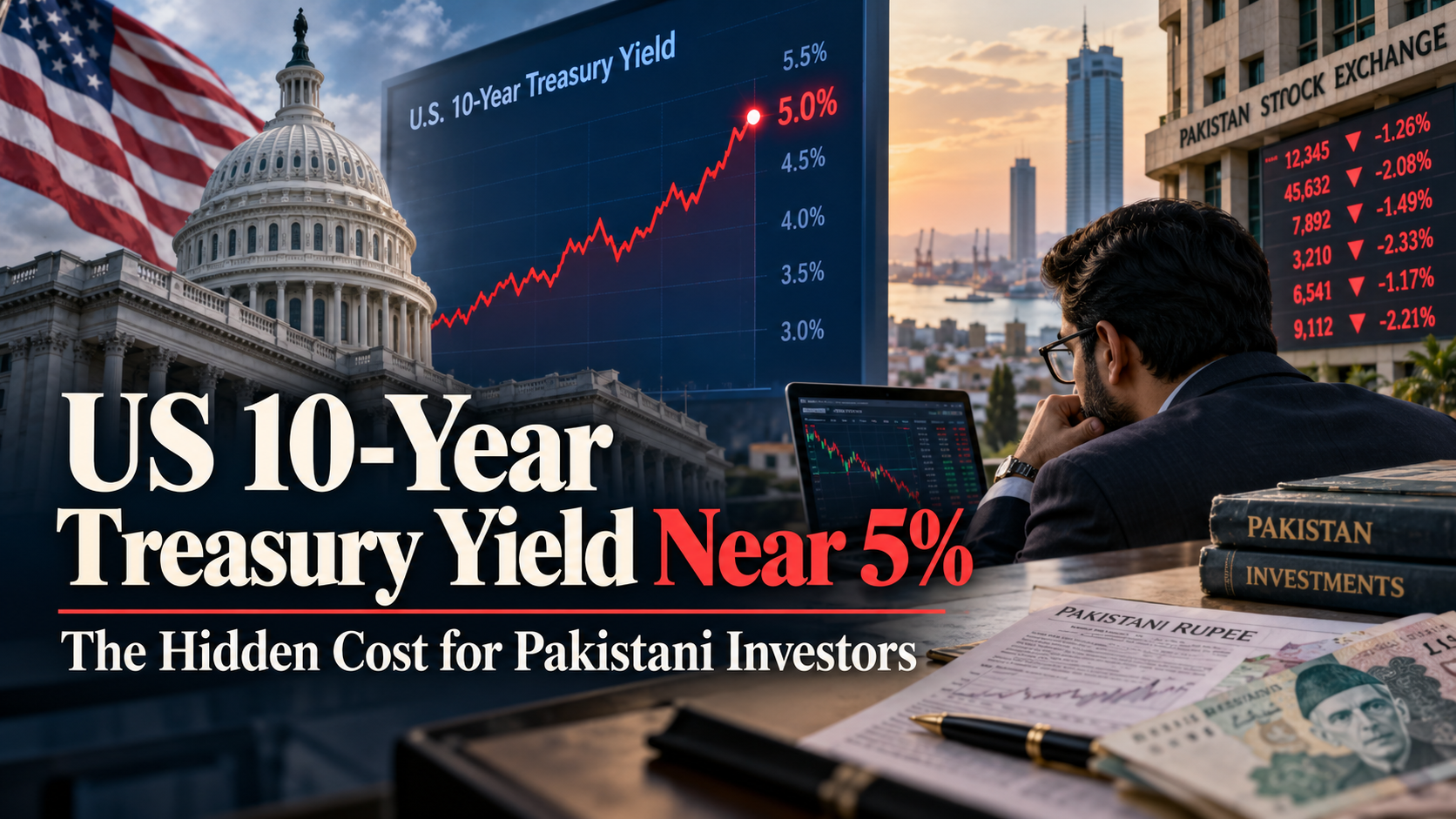
A US government bond can change the required return on a Pakistani investment without a single dollar physically crossing the border. The link runs through a basic idea: when a benchmark asset yields more, investors demand a stronger reason to take additional currency, liquidity and credit risks elsewhere.
The yield on the US 10-year Treasury stood near 5.00% on October 23, 2026, after reaching about 5.24% on October 9, according to historical Treasury-yield data. The user-friendly phrase above 5% should therefore be treated as a description of much of October, not a guaranteed quote for every moment of the latest trading day.
A bond yield is not a savings-account rate
A government-bond yield is the return implied by its market price and promised cash flows, assuming the relevant payment and holding assumptions. When investors sell an existing fixed-coupon bond and its price falls, its yield typically rises. That inverse relationship is central to interpreting the US Treasury market.
The 10-year yield reflects a mixture of expected short-term policy rates, expected inflation and a term premium for holding longer-dated debt. It can fall even while central-bank inflation concerns persist, for example if growth fears rise or investor demand for safe securities strengthens. Reading any single yield move as a pure Fed forecast is a mistake.
Four ways it reaches Pakistan
1. Dollar funding becomes a tougher benchmark. Investors weighing dollar-denominated assets may compare emerging-market returns with those available in US government debt. Pakistani external bonds must compensate for additional sovereign and market risk, although observed spreads change independently of benchmark yields.
2. Currency calculations shift. A domestic bond offering a high rupee yield can still disappoint a foreign investor if depreciation erodes converted returns. For Pakistani investors with future dollar obligations, currency exposure is similarly relevant.
3. Valuations face a higher discount rate. Equity valuations are sensitive to the interest rate used to discount expected future earnings. Companies promising distant profits may be more exposed than businesses generating cash immediately, but there is no perfect sector rule.
4. Sovereign refinancing risk draws scrutiny. Global debt investors assess not only current yields but also how costly it will be for governments to refinance existing obligations. Local T-bills and PIBs are nevertheless priced mainly by Pakistan-specific inflation, liquidity, central-bank policy and credit conditions; US yields do not mechanically set auction cutoffs.
The price-risk example
Imagine a fixed-coupon bond with a duration of seven years. A one-percentage-point increase in yields would imply an approximate 7% price decline, all else equal, using the basic duration approximation. That is not a prediction and not an exact valuation; convexity, yield-curve changes and cash-flow structure matter. It illustrates why holding a bond fund is different from locking in a bank deposit.
Duration risk also works in reverse: bond prices can rise when market yields fall. An investor buying only because the quoted coupon looks attractive may discover later that the resale price has moved against them.
What the latest global backdrop adds
The Federal Reserve raised its policy range to 3.75%–4.00% in September, amid persistent inflation concerns. At the same time, oil-market instability has made imported inflation a more acute concern for Pakistan. The IMF’s October World Economic Outlook forecasts 3.1% world growth for 2026 and highlights downside risks from conflict and financing strains.
This combination means bond yields may be high for reasons that are not benign. A superficially attractive yield could reflect inflation anxiety, fiscal uncertainty or a global risk premium. Investors need to ask why the yield is high, not just how high it is.
A useful comparison table
| Asset | Return quoted in | Main extra risk to examine |
|---|---|---|
| US 10-year Treasury | USD | Duration, inflation, reinvestment |
| Pakistan T-bill | PKR | Domestic rate/inflation, reinvestment |
| Pakistan Investment Bond | PKR | Duration, inflation, liquidity |
| Pakistan dollar bond | USD | Sovereign credit spread, liquidity, duration |
| PSX equity | PKR | Earnings, valuation, currency and market risk |
Currency hedging is not a free lunch
A Pakistani saver comparing foreign-currency investments with domestic government paper must think about more than headline yield. Converting rupees to dollars and back can involve spreads, banking charges, legal requirements and foreign-exchange movement. A hedging instrument, where available and suitable, usually embeds a cost related to interest-rate differences and market conditions. It cannot simply erase currency risk without consequence.
Tax treatment also matters. A quoted yield before withholding tax, custody expense or fund fees is not comparable with an after-tax return from another product. Similarly, a dollar asset can generate a positive dollar return but a different return in rupees. The investor should calculate both if future expenses are split between currencies.
For institutional portfolios, bond duration and liquidity become central. A long-maturity bond may have an attractive yield to maturity but be unsuitable for liabilities due next month. For individuals, the ability to meet an emergency expense without selling at a loss may be worth more than an extra percentage point of advertised return.
The sound comparison is liability-matched, not headline-driven: decide when the money is needed, in what currency and how much market-price movement is tolerable before selecting an asset.
Does a 5% US yield mean Pakistan must offer 5% plus a fixed margin?
No. Each instrument differs in currency, maturity, credit, liquidity and taxation; spreads vary with markets and policy.
Are US Treasuries risk-free?
They are commonly treated as a benchmark for dollar credit risk, but their market prices are not risk-free. Inflation and interest-rate changes can erode purchasing power and resale value.
What should a Pakistani retail investor do first?
List liabilities by currency and timing, then compare instruments on an after-tax, after-inflation and liquidity-adjusted basis. Seek licensed guidance where suitable.
The takeaway: a 5% US benchmark changes the world’s price of patience. Pakistani investors should respond by measuring real cash flows and risks, not by chasing whichever country advertises the biggest nominal yield.
Discover more from The Economy
Subscribe to get the latest posts sent to your email.

The Federal Reserve’s next interest-rate decision is scheduled for October 28, 2026, at the conclusion of a two-day Federal Open Market Committee meeting. For investors in Karachi, New York or Kuala Lumpur, the question is bigger than whether the Fed raises rates by another quarter point. It is whether persistent inflation and an energy shock will keep global financing conditions restrictive for longer.
The Federal Reserve’s September 16 statement confirmed a 25-basis-point increase in the federal funds target range to 3.75%–4.00%. The official October calendar fixes the next announcement for Wednesday, October 28. Predictions about the decision remain predictions until the statement is published.
Why the market cannot simply assume a hold
The Fed faces two forces pulling in different directions. A resilient US economy can withstand tighter financial conditions better than a slowing one, while high energy prices can feed inflation expectations. At the same time, tightening further risks increasing pressure on rate-sensitive sectors and debt-servicing costs. The September meeting minutes describe concern about elevated inflation and the geopolitical backdrop.
Traders often express their expectations through futures pricing, but a specific percentage quoted earlier in October may no longer be representative on October 25. A responsible preview should avoid presenting an old implied probability as a live market estimate. The announcement, accompanying statement and press conference deserve more attention than any one probability screen.
The three policy scenarios
Hold, with a hawkish message. The Fed leaves its target at 3.75%–4.00% but stresses persistent inflation. Treasury yields and the dollar could remain firm if investors infer that further increases are possible. A hold is not necessarily dovish.
Another 25-basis-point rise. A new increase could push short-term dollar funding costs higher, depending on whether it is already priced in. For emerging markets, this may sharpen competition for capital and raise the hurdle rate for risky assets.
Hold, with a softer outlook. If the language signals growing confidence on inflation, longer yields might ease and investors could reassess the attractiveness of emerging-market equities and bonds. Any such response would also depend on earnings, geopolitics and risk appetite.
How the Fed reaches the Pakistan Stock Exchange
The direct transmission is limited by Pakistan’s domestic policy and market structure, but there are real channels. The first is the US dollar: a stronger dollar can raise the local price of imports and influence emerging-market currency expectations. The second is global yields: investors compare returns across sovereign debt markets and require compensation for currency and credit risks. The third is equity valuation: higher discount rates can reduce the present value of future corporate earnings, particularly for expensive growth assets.
For Pakistan, imported energy complicates that picture. If a Fed hike reflects sticky US inflation linked to oil, local investors must evaluate both international monetary tightening and Pakistan’s own fuel-import exposure. The World Bank’s Pakistan Development Update reports improving macroeconomic conditions but also acknowledges conflict-related pressure.
Bonds versus stocks: the difference matters
Pakistan Treasury bills and investment bonds primarily respond to domestic rates, inflation expectations, liquidity and sovereign risk. Their yields need not mirror US Treasuries day for day. PSX sectors also differ: banks, exporters, highly leveraged firms and energy producers can react quite differently to the same exchange-rate or interest-rate surprise.
A simplistic Fed hikes, PSX falls formula misses positioning. Prices often move on the gap between expectations and the actual decision. Even a rate hike can coincide with a stock rally if the market expected a larger move or welcomes clarity.
A practical announcement-day checklist
| Watch | Why |
|---|---|
| Fed funds target range | Immediate policy decision |
| Statement language on inflation | Signal for coming meetings |
| Treasury yield reaction | Changing dollar discount rates |
| Dollar index and EM currencies | Cross-border risk sentiment |
| Brent crude | Separate but powerful inflation channel |
| Pakistan KIBOR, rupee and SBP communications | Local transmission |
The IMF’s October outlook cautions that energy importers outside the AI investment value chain have a difficult growth outlook. This makes risk diversification and the distinction between nominal yields and real returns especially relevant.
Why the press conference may matter more than the quarter-point move
Central-bank announcements bundle several messages. A policy-rate decision tells markets what the committee did today. The statement signals which risks officials emphasise. The chair’s subsequent explanations can change expectations about the next several meetings. Traders may initially react to the rate itself, then reverse direction as they digest the path implied by the language.
For emerging-market investors, that distinction is crucial. A 25-basis-point increase accompanied by confidence that inflation pressure is subsiding may prove less restrictive for global risk appetite than an unchanged rate accompanied by warnings of more tightening. The yield curve, dollar and market-implied path are useful contemporaneous checks, although each has competing drivers.
Pakistan-based investors should also consider market hours. US decisions may arrive after domestic exchanges have closed, while other Asian markets trade the following session. A next-day index move can reflect overnight global earnings or geopolitical events as well as the Fed. Attribution requires comparing the timing of all material news.
For a rigorous post-meeting update, include the exact target range, vote, key wording changes and a timestamped Treasury yield. Replace the scenarios with the actual decision rather than leaving the preview to masquerade as a live result.
When will the Fed decision be released?
The Fed lists the October 27–28 meeting and a 2 p.m. Eastern announcement on October 28. Verify time conversion and possible schedule changes before publishing a live ticker.
Is a rate hike guaranteed?
No. September’s action and October’s risks do not predetermine the committee’s vote.
Should Pakistani investors sell stocks because of the Fed?
There is no universal answer. Investment time horizon, portfolio concentration, company balance sheets and currency exposure matter more than a one-day headline.
Bottom line: October 28 is a test of the Fed’s inflation tolerance. For Pakistan, the most important signal will be how the decision reshapes the dollar, energy costs and global demand for emerging-market risk—not the label hike or hold alone.
Discover more from The Economy
Subscribe to get the latest posts sent to your email.

The global Banking growth is becoming more uneven, capital is increasingly sensitive to financing costs, and investors must distinguish a convincing story from an investable price. This guide focuses on research methods and risks rather than predictions of guaranteed returns. The IMF October 2026 outlook projects 3.1% global growth and 4.7% inflation for 2026, while the IMF financial-stability assessment warns that market resilience coexists with important vulnerabilities.
Key takeaways
- Match each investment decision to its time horizon, currency and ability to withstand losses.
- Separate observable earnings or contractual cash flows from optimistic forecasts.
- Compare diversification, fees, taxes, liquidity and regulatory restrictions before committing capital.
- Track primary institutional evidence and update assumptions when conditions change.
- Readers in Pakistan should consider rupee exposure and availability of regulated investment channels.
Why this matters now
The central question behind global banking trends 2026 is not merely what may happen next. It is which economic mechanisms could change cash flow, purchasing power or risk. The Bank for International Settlements’ 2026 review describes an economy supported by technological investment but constrained by geopolitical and fiscal pressures. A robust financial plan must therefore survive both a favourable and an adverse scenario.
Digital banks are extending beyond borders
Technology can reduce the need to duplicate large physical branch networks, but banking remains subject to local licensing, deposit protection, consumer law and capital rules. Cross-border scale is a business model, not a regulatory exemption. Readers should distinguish a licensed bank from an e-money provider, broker or unregulated payments application. See the primary institutional research.
For practical analysis, separate the baseline, the upside case and the downside case. Document the specific development that would change your assessment. Assess timing: a promising long-term theme may still be inappropriate for cash needed within twelve months.
Artificial intelligence in credit and fraud
Banks use machine learning for transaction screening, fraud detection, service operations and risk analysis. The operational promise is significant, but opaque credit models can create unfair outcomes, and false-positive fraud alerts can disrupt customers. Model governance requires testing, human accountability, explainability and correction routes. Customer consent does not remove every data-protection obligation. See the primary institutional research.
For practical analysis, separate the baseline, the upside case and the downside case. Document the specific development that would change your assessment. Assess timing: a promising long-term theme may still be inappropriate for cash needed within twelve months.
Cybersecurity is now systemic finance risk
An attack against a large processing vendor can affect many institutions simultaneously. The IMF’s October 2026 stability assessment identifies sophisticated cyber threats alongside sovereign-yield and AI valuation shocks. Banks should test recovery procedures, third-party concentration, authentication controls and incident communications, not merely purchase security software. See the primary institutional research.
For practical analysis, separate the baseline, the upside case and the downside case. Document the specific development that would change your assessment. Assess timing: a promising long-term theme may still be inappropriate for cash needed within twelve months.
Compliance: technology must support judgment
Anti-money-laundering monitoring, sanctions screening and know-your-customer processes are increasingly automated. False matches and poor data can cause excessive account restrictions, while under-detection carries serious legal exposure. Institutions need measurable controls, independent audits and escalation channels. The Financial Stability Board provides international coordination context but rules vary by jurisdiction. See the primary institutional research.
For practical analysis, separate the baseline, the upside case and the downside case. Document the specific development that would change your assessment. Assess timing: a promising long-term theme may still be inappropriate for cash needed within twelve months.
What Pakistani customers and banks should do
Customers should verify a provider’s licensing status, understand complaint mechanisms, enable strong authentication and never disclose one-time passcodes. Financial firms need resilient payment systems, staff training and clear consent practices. Track SBP circulars for locally applicable requirements rather than extrapolating foreign regulations to Pakistan. See the primary institutional research.
For practical analysis, separate the baseline, the upside case and the downside case. Document the specific development that would change your assessment. Assess timing: a promising long-term theme may still be inappropriate for cash needed within twelve months.
Comparison and decision framework
| Question | Stronger evidence | Warning sign |
|---|---|---|
| What drives returns? | Audited cash flows, clear contract or transparent index | Undefined or projected returns |
| What can go wrong? | Explicit scenario and downside analysis | Claims of guaranteed gains |
| Is it affordable to hold? | Low transparent fees and adequate liquidity | Leverage, costly spreads or lockups |
| Is access legitimate? | Appropriate licensing and clear legal rights | Unverified brokers or custody |
| Is the exposure diversified? | Multiple independent sources of return | One company, sector or currency |
What it means for Pakistani savers and investors
A Pakistani reader faces both international investment risk and local purchasing-power risk. For example, a foreign asset can rise in US-dollar terms while the rupee conversion and transaction costs alter the realized local outcome. The opposite can also occur. Record the starting exchange rate, applicable taxes, custody charges and capital-transfer restrictions, and confirm current requirements with the State Bank of Pakistan and the relevant securities regulator. Overseas access should not be assumed universally available.
An emergency reserve, expensive consumer debt and near-term family obligations deserve attention before any speculative allocation. A portfolio that cannot meet a sudden cash requirement may force sales at the worst moment. The objective is not to remove risk—impossible in markets—but to choose risks that fit the investor’s actual liabilities.
Risks, limitations and uncertainty
Institutional forecasts are conditional and can change after policy decisions, commodity shocks, conflict escalation or unexpectedly weak earnings. Historic correlations are not binding promises about future asset performance. The analysis does not provide live stock prices, current investment product quotes, real-time exchange rates or individualized tax advice. Prices, regulations and product eligibility should be checked on the transaction date.
Frequently asked questions
Is this a guaranteed investment opportunity?
No. Every financial asset or strategy involves uncertainty. The existence of a popular investment theme is not evidence that an individual security is fairly priced.
What should beginners examine first?
Understand the product, the financial loss you could tolerate, fees and liquidity. Verify the provider and decide whether the money may be needed soon.
How do interest rates affect the analysis?
They influence financing costs, discount rates, exchange rates and demand. The effect differs by sector, maturity and business balance sheet.
Can Pakistani residents invest in foreign markets?
Access depends on current foreign-exchange, banking, brokerage, securities and tax rules, and on the investor’s individual circumstances. Check current regulations and regulated providers rather than assuming access.
How often should this analysis be refreshed?
Review institutional economic releases monthly and re-evaluate immediately after material earnings, regulatory or policy changes. Avoid reacting mechanically to every daily market movement.
Is diversification enough to prevent losses?
No. Diversification may reduce company-specific risk but cannot eliminate broad market, currency, inflation or systemic risks.
Conclusion
Sound financial decisions begin with verifiable evidence, reasonable valuation, awareness of uncertainty and a plan that survives adverse outcomes. Readers should compare multiple independent sources and avoid letting a compelling headline substitute for due diligence.
Discover more from The Economy
Subscribe to get the latest posts sent to your email.

Gold Near $4,000: Buy, Hold or Wait? A Pakistan Tola Price Guide

US 10-Year Treasury Yield Near 5%: The Hidden Cost for Pakistani Investors

Fed Meeting on October 28: Hike or Hold—and Why Pakistan Investors Should Care

Can Pakistan Turn US–Iran Mediation Into an Economic Dividend?

Oil Above $100: How Higher Crude Prices Reach Pakistan’s Rupee, Petrol and Imports

SBP Interest Rate at 11.5%: What Will Decide Pakistan’s Next Policy Move?

The Global South: Debt, Climate Finance and Investment in 2026

Energy Security Is the New Economic Security

Can Global Tourism Survive Geopolitical Shocks?

Global Maritime Hegemony: How China Secured Over 81% of All New Shipbuilding Orders

The Coming Battle Over AI, Jobs and Wages

Why Developing Economies Face a Sharper Inflation Problem

The New Geography of Trade: Are Supply Chains Coming Home?

Is AI Saving Global Growth or Creating the Next Bubble?

Crude Oil & Petroleum Market Analysis: OPEC+ Decisions and Price Forecasts

Silver Price Today: Why the Xi-Trump AI Standoff Is Fueling a Safe-Haven Rally

Top US Convenience Store Chains: Store Counts, EV Charging, and Sales Trends

Algorithmic Dogfights: Why the U.S. and China Must Establish Rules of Engagement for Autonomous Air Power

Who Is Shivon Zilis? The Neuralink Executive at the Center of the Musk–OpenAI Trial

Corporate America Faces a New Debt Test as US Borrowing Costs Surge

Social Security Extra $90 Deposit: Who Qualifies for the October 2026 Medicare Rebate?

Global Economic Outlook 2026: 7 Forces Reshaping Markets, Trade and Business

Business Insurance: What Coverage You Actually Need and What It Costs in 2026

MAS Allocates S$1.45 Billion to Five Asset Managers in Third EQDP Batch: Total Deployment Reaches S$5.4 Billion

Stock Market Today: Dow, S&P 500, and Nasdaq Retreat as Treasury Yields

Gold Falls 3.7% as Yields Surge: Is Gold Still a Safe Haven in 2026?

Anthropic Bans Sustained Abuse of Claude AI Under New Usage Policy Effective November 12, 2026

US 10-Year Yield Hits 5.24%: What the Historic Bond Market Sell off Means for Mortgages and Investors
-

 Markets & Finance10 months ago
Top 15 Stocks for Investment in 2026 in PSX: Your Complete Guide to Pakistan’s Best Investment Opportunities
-

 Analysis8 months ago
Johor’s Investment Boom: The Hidden Costs Behind Malaysia’s Most Ambitious Economic Surge
-

 Analysis8 months ago
Top 10 Stocks for Investment in PSX for Quick Returns in 2026
-

 Analysis9 months ago
Brazil’s Rare Earth Race: US, EU, and China Compete for Critical Minerals as Tensions Rise
-

 Investment10 months ago
Top 10 Mutual Fund Managers in Pakistan for Investment in 2026: A Comprehensive Guide for Optimal Returns
-

 Global Economy10 months ago
15 Most Lucrative Sectors for Investment in Pakistan: A 2025 Data-Driven Analysis
-

 Global Economy10 months ago
Pakistan’s Export Goldmine: 10 Game-Changing Markets Where Pakistani Businesses Are Winning Big in 2025
-

 Analysis8 months ago
Top 10 Countries with the World’s Strongest Currencies in 2026 — Ranked & Analysed