
Analysis
KSE-100 Sheds Over 300 Points After Volatile Trading at PSX as Oil Volatility and Iran Conflict Weigh on Sentiment

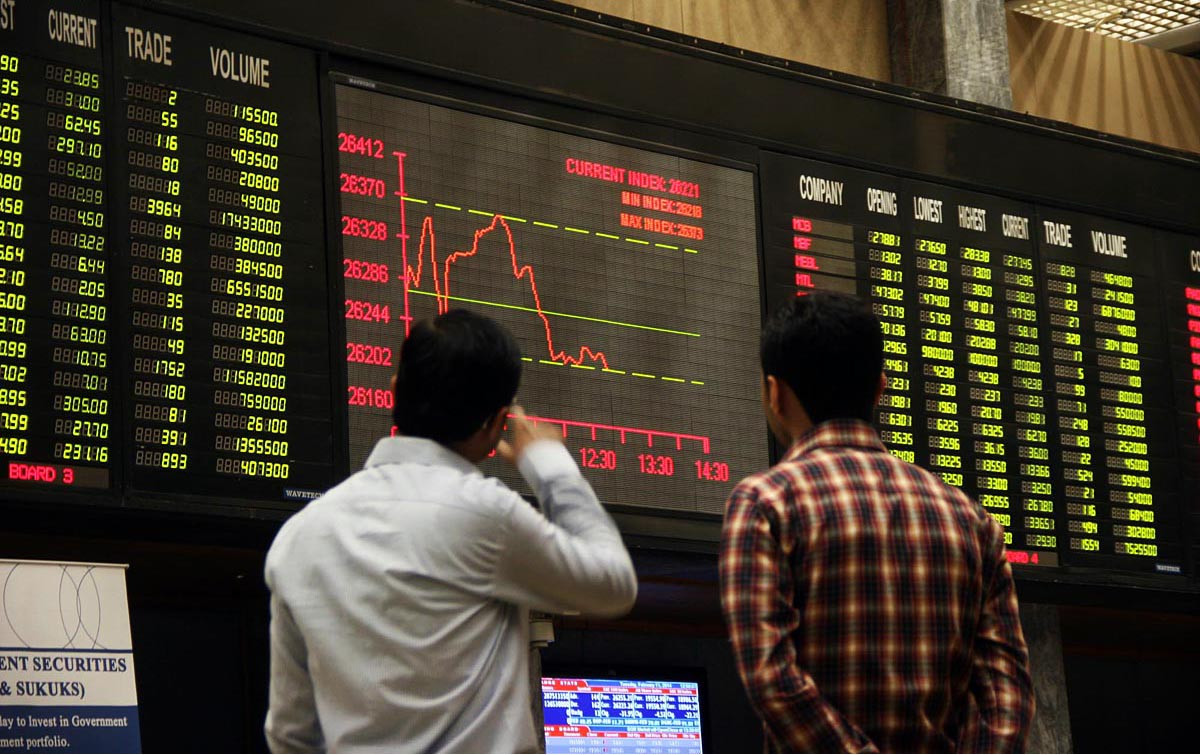
Pakistan’s benchmark KSE-100 Index tumbled 318 points to close at 155,858.47 amid profit-taking and geopolitical jitters over the US-Israeli war on Iran. Full analysis, laggards, gainers and global context.
Pakistan’s stock market offered a masterclass in contradictions on Wednesday. The KSE-100 index opened with genuine conviction — briefly soaring more than 2,000 points above Tuesday’s close before the bulls ran headlong into the same wall that has defined this week’s trading: crude oil swinging between the high-$70s and low-$90s within a single session, and a geopolitical crisis in the Persian Gulf that is rewriting the rules of global energy markets in real time. By the closing bell, the PSX benchmark index settled at 155,858.47, a net loss of 318.65 points, or 0.20%, in a session that traversed nearly 2,972 points of intraday range — a reminder that in Karachi, as in New York and Tokyo this week, tranquility is the riskiest posture of all.
The Session in Charts: From Early Surge to Mid-Day Collapse
The morning belonged to the optimists. Buoyed by the previous day’s extraordinary rebound — Tuesday’s +9,696.97 points gain of 6.62% to 156,177.12 had been one of the most dramatic single-session recoveries in the exchange’s recent history — buyers arrived early and with purpose. By 10:55 a.m., the KSE-100 intra-day high had reached 158,624.51, reflecting a market that was briefly pricing in de-escalation, dovish oil, and stabilising global risk appetite.
It did not last.
The tide turned somewhere between the late-morning tea break and the pre-lunch lull. Selling pressure, initially measured, gathered momentum through mid-session, and by 1:00 p.m. the early gains had been entirely surrendered. The KSE-100 intra-day low of 155,652.35 — reached before a modest stabilisation into the close — tells the story of an index that spent the afternoon clawing back ground it had already lost. The final print of 155,858.47 represents a market caught between warring impulses: a genuine appetite for recovery on one hand, and the gravitational pull of unresolved macro anxiety on the other.
KTrade Securities equity trader Ahmed Sheraz characterised the session as “volatile,” noting that “intermittent bouts of profit-taking” kept the index range-bound throughout the day, with global cues offering mixed signals at best. The Express Tribune
Heavyweights Drag the Benchmark
Key Laggards (combined erosion: ~634 index points)
| Stock | Sector |
|---|---|
| United Bank Limited (UBL) | Banking |
| Pakistan Petroleum Limited (PPL) | Oil & Gas |
| Oil & Gas Development Company (OGDC) | Oil & Gas |
| Meezan Bank Limited | Islamic Banking |
| Mari Petroleum Company Limited | Oil & Gas |
Key Gainers (combined contribution: ~577 index points)
| Stock | Sector |
|---|---|
| Engro Holdings Limited | Diversified |
| Bank AL Habib Limited | Banking |
| Askari Bank Limited | Banking |
The fingerprints of the KSE-100 laggards — United Bank Limited, PPL, and OGDC — tell a coherent story. Two of the three most destructive contributors to Wednesday’s decline were energy names, and their underperformance is inseparable from the wider crude oil drama playing out in real time. For PPL and OGDC in particular, the paradox is sharp: higher international oil prices theoretically boost upstream revenue, but the Pakistan stock exchange volatile session around energy stocks reflects something more complex — investor fear that sustained, geopolitically-driven price spikes will blow a hole through Pakistan’s import bill, pressuring the external account and, by extension, the currency, corporate margins, and policy rates simultaneously.
The banking sector presented a split verdict. UBL and Meezan Bank dragged from one side, while Bank AL Habib and Askari Bank provided meaningful offset from the other, suggesting selective repositioning rather than a wholesale sector rotation.
On the volume board, Bank of Punjab led all-share activity with 37.71 million shares traded, followed closely by K-Electric at 37.69 million and Cnergyico PK at 27.35 million shares. [Related: Pakistan’s banking sector outlook and dividend yields — read our analysis]
Global Backdrop: Oil, Iran and Investor Nerves
The impact of Iran war on PSX and oil prices has been the defining narrative of March 2026, and Wednesday’s session clarified rather than resolved it. Oil prices remain well below the near-$120 peak reached earlier in the week, hovering around $90 a barrel ahead of the G7 meeting convened to coordinate the proposed release of strategic petroleum reserves. Euronews
The catalyst for Wednesday’s brief crude retreat was significant. The International Energy Agency proposed what would be its largest-ever release of oil reserves, with Brent slipping to around $87 per barrel in Asian trade before recovering, while WTI hovered near $82.60 following the announcement. Bangladesh Sangbad Sangstha The decision — expected to exceed the 182 million barrels released after Russia’s invasion of Ukraine in 2022, which was itself a record TheStreet — underscores just how unprecedented the supply dislocation from the Strait of Hormuz closure has become.
Brent had settled at $94 per barrel on March 9, up roughly 50% from the start of the year and the highest since September 2023, as petroleum shipments through the Strait of Hormuz collapsed and some Middle East oil production was shut in entirely. U.S. Energy Information Administration That context makes Wednesday’s partial pullback look less like a trend reversal and more like a pause. One energy market analyst warned that if the conflict is not resolved by the end of the week, oil prices could spike back above $100 a barrel. CNBC
For Pakistan, a country that imports the majority of its petroleum requirements and whose currency reserves remain structurally sensitive to energy price shocks, this is not an abstract debate. Every sustained $10 rise in Brent drains roughly $2.5–3 billion annually from the current account — a calculation that sits at the heart of investor caution in Karachi. Topline Securities, in its market commentary, identified volatile international oil prices as a central driver of Wednesday’s range-bound, indecisive trading — a characterisation confirmed by the index’s inability to hold any of its early-session gains.
The broader Asian picture was more constructive: the MSCI Asia-Pacific ex-Japan index gained 1.6%, the Nikkei climbed 2.1%, and South Korea’s Kospi advanced a robust 3.2%, as regional markets absorbed the IEA news with cautious optimism. US futures added +0.4%, suggesting Wall Street was minded to at least stage a tentative recovery. The PSX market closes down 318 points even as this global tailwind was in evidence — a reflection of Pakistan’s particular vulnerability to the energy price channel relative to its Asian peers.
Rupee Holds Steady as Volumes Contract
Amid the noise, the Pakistani rupee provided a moment of unexpected quiet. The currency strengthened fractionally — gaining Re 0.01 to close at 279.35 against the US dollar — a stabilisation that, while modest, is meaningful given the inflationary and external account pressures that an energy shock of this magnitude typically imposes on frontier-market currencies.
Volume metrics were less reassuring. All-share turnover fell to 441.87 million shares from Tuesday’s 486.52 million, while the value of shares traded contracted from Rs 31.22 billion to Rs 24.98 billion — a decline of roughly 20% in a single session. When momentum fades on a rally day, volume typically tells you whether the retreat is orderly or panicked; Wednesday’s numbers suggest the former. Breadth was marginally positive: 216 issues advanced against 201 declining, with 60 unchanged — a 51/49 split that mirrors the psychological ambivalence visible in every hour of trading.
What Lies Ahead: Outlook for PSX Investors
The PSX benchmark index 155,858.47 closes Wednesday in a position that is neither technically broken nor convincingly repaired. The index has now shed more than 35,000 points from its all-time high of 191,032 recorded earlier in 2026 — a decline of roughly 18% that places it in correction territory by most conventional definitions. The severity of that move, however, must be understood against what has been a genuinely extraordinary geopolitical shock. Few global benchmarks have faced the direct headwinds of an active war in their country’s primary energy supply corridor while simultaneously managing a post-IMF-programme transition.
The tactical picture, as articulated by analysts across multiple brokerages, points to a “sell-on-strength, buy-on-dips” dynamic that could persist for weeks. The KSE-100 index today March 2026 is likely to remain hostage to three variables: the duration of the Strait of Hormuz disruption, the success or failure of the IEA’s record reserve release in capping crude, and — crucially — whether the IMF and State Bank of Pakistan signal policy continuity in response to the external account pressures building in real time.
Market strategists advise maintaining exposure to fundamentally strong sectors — banks, oil and gas, high-dividend names — while avoiding excessive positions in speculative or cyclical equities during this phase of elevated uncertainty. The Express Tribune
🗂 Quick-Reference Summary: Wednesday, 11 March 2026
| Metric | Value |
|---|---|
| KSE-100 Close | 155,858.47 |
| Change | −318.65 pts (−0.20%) |
| Intraday High | 158,624.51 |
| Intraday Low | 155,652.35 |
| All-Share Volume | 441.87 million shares |
| Total Value Traded | Rs 24.98 billion |
| Advancers / Decliners | 216 / 201 |
| PKR/USD | 279.35 (+Re 0.01) |
| Brent Crude | ~$87.89 (+0.2%) |
| WTI Crude | ~$83.47 |
| Previous Close (Tue) | 156,177.12 (+6.62%) |
For longer-horizon investors, the thesis remains intact but requires patience. Pakistan’s macro stabilisation story — the fiscal consolidation, falling inflation, FX reserve rebuilding — does not dissolve because of a two-week geopolitical convulsion. What it does is delay the timeline for re-rating, and raise the required risk premium for foreign participation. When the smoke clears over the Strait of Hormuz, and it will, the country that sat at KSE-100 index 101,598 just twelve months ago — now trading at 155,858.47 even after a bruising correction — will invite a second look.
Until then, the old market adage applies with unusual precision in Karachi this week: in uncertainty, breadth is your balance sheet.
Discover more from The Economy
Subscribe to get the latest posts sent to your email.



Key Takeaways
- Rolex’s secondary market rose approximately 7.9% year-over-year as of 2026 (per WatchCharts data) — trailing Patek Philippe (+16.2%) and Tudor (+11.4%) but still outperforming Audemars Piguet (+3.4%).
- Rolex raised U.S. retail prices 4–9% in January 2026 (steel models ~5.6%, gold models ~8.7%), narrowing the historical gap between retail and pre-owned pricing.
- Not every model appreciates: steel sports references (Submariner, GMT-Master II, Daytona) have held value far better than two-tone or widely available dress references like the standard Datejust.
- The Lady-Datejust posted the sharpest 2026 gain among tracked collections — up 22.73%, from roughly $9,269 to $11,376 — driven by demand for smaller, “everyday luxury” watches.
- Gold’s rise past $2,400/oz has directly lifted the investment case for Rolex’s precious-metal references (Day-Date, Sky-Dweller, Yacht-Master).
The Model-by-Model Picture
| Category | 2026 Trend |
|---|---|
| Lady-Datejust | +22.73% (strongest performer among tracked collections) |
| Steel sports models (Submariner, GMT-Master II) | Held value well; corrected from 2022 peak but stabilized above retail |
| Daytona | Corrected from highs above $50,000 to the mid-$30,000s; still among the most sought-after references |
| Two-tone/widely available Datejust | Flat to negative — “holds value” is an overstatement for this category |
| Gold references (Day-Date, Sky-Dweller) | Lifted by gold’s rise above $2,400/oz |
Why the “Rolex Always Appreciates” Myth Is Fading
The pandemic-era boom pushed some references — the Daytona above all — to speculative highs disconnected from historical norms. Since the March 2022 peak, steel sports models have compressed meaningfully, and dealers who bought inventory near the top have in some cases faced 20–40% markdowns on liquidation. The lesson for 2026 buyers: Rolex as a category is not a monolith. Value retention depends heavily on specific reference, condition, and whether the piece comes with box and papers (“full set”).
What’s Actually Driving 2026 Strength
- Retail price increases raise the floor. When a new Submariner retails at $10,050 (up from $9,500), a pre-owned example at $11,000–$12,000 suddenly represents a smaller premium — narrowing the gap without secondary prices actually moving.
- Supply discipline remains Rolex’s core lever. The brand has never confirmed production numbers, and secondary-market premiums remain entirely a function of Rolex’s own manufacturing decisions — a risk factor as much as a support.
- Certified Pre-Owned rollout. Rolex’s now fully rolled-out CPO program has changed how buyers transact in the used market, adding a layer of brand-verified legitimacy that supports pricing.
The Case for Rolex as a Portfolio Diversifier
Financial advisors increasingly frame luxury watches not as a replacement for equities or bonds, but as a tangible, historically low-correlation diversifier — one that carries its own risks (illiquidity, condition-dependent pricing, no yield) but has demonstrated multi-decade resilience for specific references.
Is Rolex a good investment in 2026?
It depends heavily on the specific reference. Steel sports models like the Submariner and Daytona have held or grown in value; two-tone and widely available dress models generally have not. Overall, Rolex’s secondary market rose about 7.9% year-over-year in 2026, trailing Patek Philippe but ahead of Audemars Piguet.
Discover more from The Economy
Subscribe to get the latest posts sent to your email.

Navigating Mortgage and Loan Refinancing in a High-Yield Environment
Global public debt crossing critical thresholds has kept central bank policies volatile, resulting in fluctuating US Treasury yields throughout 2026. For homeowners and commercial property holders burdened by previous high-interest borrowing cycles, finding optimal refinance windows has become a high-stakes financial puzzle. Stalled disinflation and stubborn employment numbers mean rate cuts are incremental, requiring borrowers to act with precision.
Timing your mortgage or commercial loan refinance in this environment requires a deep understanding of yield curve movements and lender risk appetites.
Decoding 2026 Refinance Dynamics
The 10-Year Treasury Yield Benchmark
Mortgage rates continue to track closely with the 10-year US Treasury yield. When macroeconomic anxiety spikes debt issuance, yields rise, tightening consumer borrowing capacity. Savvy borrowers monitor weekly Treasury auctions to lock in rates during brief dip windows.
Hybrid ARMs and Alternative Structures
With fixed rates remaining elevated, 7/1 and 10/1 adjustable-rate mortgages (ARMs) have surged in popularity. These products offer lower initial monthly payments, giving borrowers breathing room until central bank easing cycles fully materialize.
| Loan Product | Current Rate Range | Best For | Key Risk Factor |
| 30-Year Fixed Mortgage | 6.2% – 6.8% | Long-term predictability | Higher initial monthly outlay |
| 7/1 Hybrid ARM | 5.5% – 5.9% | Short-term ownership / flipping | Rate reset risk after year 7 |
| Commercial Refinance | 7.0% – 8.2% | Corporate asset restructuring | Strict DSCR lender covenants |
Actionable Steps for Successful Refinancing
To maximize your chances of securing favorable refinance terms in a volatile market, follow a disciplined preparation strategy.
Boost Your Credit Score Immediately: Lenders in 2026 are applying stringent credit tiering; a 20-point increase can drop your APR by a crucial quarter-point.
Shop Regional Credit Unions: Smaller financial institutions often offer portfolio loans with more flexible underwriting than major national banks.
Calculate the Break-Even Point: Ensure your total closing costs are recouped through monthly savings within 24 months of closing.
“Market Strategist View: Refinancing in 2026 is an exercise in opportunistic timing. Borrowers must maintain immaculate financial profiles ready to strike the moment Treasury yields dip.”
Mastering the complexities of today’s debt environment ensures you can successfully lower your debt service costs and protect your long-term financial stability.
Discover more from The Economy
Subscribe to get the latest posts sent to your email.

The days of pulling generic auto insurance quotes based purely on your zip code and age are officially over. In 2026, insurance comparison engines are powered entirely by generative AI and real-time telematics. These platforms digest thousands of live data points—ranging from your driving smoothness via connected vehicle sensors to real-time traffic congestion patterns—to generate hyper-personalized premiums instantly.
For consumers, this evolution represents both a massive opportunity for savings and a hidden trap for penalty pricing. Understanding how AI algorithms evaluate risk is essential for anyone looking to lower their monthly auto insurance premiums.
How AI Comparison Engines Evaluate Your Risk Profile
Behavioral Telematics and Connected Cars
Modern cars stream performance data directly to insurance aggregators. Generative AI models analyze braking sharpness, acceleration curves, cornering G-forces, and phone distraction metrics. Drivers who maintain smooth, defensive habits are rewarded with dynamic rate cuts of up to 40% compared to traditional rating tiers.
Predictive Traffic and Weather Modeling
AI tools now cross-reference your daily commute route with predictive weather and accident probability models. If your standard parking location or driving corridor has a statistically higher incidence of uninsured motorist claims, your quotes will reflect that hyper-local risk assessment.
| Comparison Factor | Traditional Rating Model | 2026 Generative AI Model | Impact on Premium |
| Mileage & Usage | Annual estimated odometer reading | GPS tracking & live trip duration | High (up to 35% savings) |
| Driving Behavior | MVR driving record & accidents | Real-time braking, speed, & G-force | Critical (determines tier) |
| Vehicle Tech | Make, model, and safety rating | ADAS calibration & repair cost data | Moderate |
Strategies to Lower Your AI-Driven Insurance Quote
To outsmart the algorithm and secure the lowest possible premium in 2026, drivers must proactively manage their digital footprint on insurance platforms.
Opt-In for Telematics Trial Periods: Many insurers offer immediate 15% discounts just for installing their driving app; let it track safe habits for 30 days to lock in permanent savings.
Scrub Unverified Public Records: Ensure your motor vehicle report is free of clerical errors that AI risk models misinterpret as reckless behavior.
Compare AI Aggregators: Use platforms that integrate multi-carrier API feeds rather than single-brand comparison sites to find the best risk-adjusted rate.
“Industry Note: AI-driven pricing rewards transparency and precision. Drivers who actively manage their telematics data consistently out-save those relying on legacy quote calculators.”
Embracing AI comparison tools allows savvy policyholders to customize coverage limits precisely to their driving habits, eliminating wasted premium spend while ensuring robust protection.
Discover more from The Economy
Subscribe to get the latest posts sent to your email.

VIX Index Explained: How to Trade Wall Street’s Fear Gauge Today

Commercial vs Residential Real Estate: Which Wins in 2026?

Presidential Stock Market Performance: How Trump’s Second Term Compares to History

2026 Real Estate Market News: Are We Heading for a Correction?

Bitcoin Price Forecast 2026–2027: Will the 4-Year Cycle Hold?

Fidelity Crypto vs. Traditional Brokerages: A Guide for Modern Investors

The 2026 Global Smartphone Market: AI Integration and Competitor Analysis

SpaceX IPO: How Aerospace Is Reshaping Tech Startup News

Fidelity Investments Review: Maximizing Returns in a Volatile Stock Market

How Crypto Transformed the Trump Fortune: A $1.4 Billion Financial Breakdown

Global Pension Systems Ranked: The World’s Best and Worst Retirement Frameworks

Global Supply Chain Vulnerabilities: From Eurasian Trade Corridors to Food Consumer Recalls

Why 5% U.S. Treasury Yields Signal a Global Market Regime Shift.

Federal Reserve Defies White House Pressure: Inside Trump’s Demand for Sub-1% Interest Rates After Historic 2026 Rate Hike

State Farm’s $5B Dividend 2026: Who Qualifies & Payout Dates

US-China Relations in Q3 2026: Trade Tariffs and Supply Chain Risks

Top 30 Stocks for Investment in PSX for Massive ROI in 2026

SpaceX Starship Flight 14: First Orbital Attempt & Starlink V3 Launch Explained

The 2026 Crypto Regulatory Shift: What It Means for Institutional Investors

AI Chip Stocks 2026: The Best Semiconductor Investments Beyond Marvell

Tween Back-to-School Trends 2026: What’s Driving the $85B Season

AI-Powered Training: The Next Multi-Billion Dollar Ecosystem in Fitness

Oil Prices Break $100 in 2026: Middle East Conflict & Energy Markets

10-Year Treasury Yield Hits 4.80%: What It Means for Rates & Portfolios

Fidelity Investments Review 2026: SPAXX Yields & Zero-Fee Funds

BRICS+ Cross-Border Payments 2026: Interoperability Explained

Shein Clothes Quality & Safety in 2026: What Lab Tests Show

MRVL Earnings 2026: Why Marvell Sank Despite Beating Estimates
-

 Markets & Finance9 months ago
Top 15 Stocks for Investment in 2026 in PSX: Your Complete Guide to Pakistan’s Best Investment Opportunities
-

 Analysis7 months ago
Johor’s Investment Boom: The Hidden Costs Behind Malaysia’s Most Ambitious Economic Surge
-

 Analysis7 months ago
Top 10 Stocks for Investment in PSX for Quick Returns in 2026
-

 Analysis8 months ago
Brazil’s Rare Earth Race: US, EU, and China Compete for Critical Minerals as Tensions Rise
-

 Banks8 months ago
Best Investments in Pakistan 2026: Top 10 Low-Price Shares and Long-Term Picks for the PSX
-

 Investment8 months ago
Top 10 Mutual Fund Managers in Pakistan for Investment in 2026: A Comprehensive Guide for Optimal Returns
-

 Global Economy9 months ago
15 Most Lucrative Sectors for Investment in Pakistan: A 2025 Data-Driven Analysis
-

 Global Economy9 months ago
Pakistan’s Export Goldmine: 10 Game-Changing Markets Where Pakistani Businesses Are Winning Big in 2025