Analysis
Iran War Singapore Growth & Inflation 2026: Gan’s Warning Explained | A Wake-Up Call for Asia
DPM Gan Kim Yong told Parliament on April 7, 2026 that the Iran war will hurt Singapore’s GDP and push inflation higher. Here’s what it means for Asia’s open economies — and why the forecast revision coming in May could be the most consequential in a decade.
Singapore’s Moment of Reckoning Has Arrived
The chamber was unusually charged for a Tuesday afternoon. More than seventy parliamentary questions had been filed — a volume that, by Singapore’s meticulous standards, signals genuine institutional alarm. When Deputy Prime Minister and Minister for Trade and Industry Gan Kim Yong rose to address Parliament on April 7, 2026, the words he delivered were neither catastrophist nor comforting. They were something more unsettling than both: calibrated, honest, and unmistakably ominous. “As a small and highly open economy,” he said, “Singapore will not be able to insulate ourselves completely from this crisis. Growth in the coming quarters is likely to be affected by the ongoing conflict.”
Outside on Shenton Way, the morning’s trading boards told a parallel story — the Straits Times Index down, freight quotes climbing, electricity tariffs that had already been revised upward on April 1 now looking like a floor rather than a ceiling. For Singapore, a city-state with no hinterland, no domestic energy base, and no insulation from the global price of anything, the Iran war is not a distant geopolitical abstraction. It is an arriving economic storm, and Gan’s parliamentary statement was the clearest official admission yet that the government’s own forecasts — upgraded as recently as February to a bullish 2% to 4% GDP growth for 2026 — will need to be revisited.
This is the story of why that revision matters, and what it reveals about the structural vulnerabilities of every small, trade-dependent economy in a world increasingly shaped by great-power conflict.
Not Ukraine Redux: Why This Shock Is Different in Kind
Experienced market watchers were quick to reach for the 2022 Russia-Ukraine playbook when the US-Israeli strikes on Iran began on February 28, 2026. That instinct is understandable but analytically dangerous. The Ukraine episode was primarily a European energy shock — devastating for the continent’s natural gas grid, but geographically contained in ways that allowed Asian economies to pivot rapidly toward alternative suppliers and routes. The Iran war is something structurally different, and more globally corrosive.
The Strait of Hormuz, through which approximately 20% of the world’s traded oil passes alongside vast volumes of liquefied natural gas, does not have a European bypass. The closure of the strait triggered by the conflict has disrupted roughly a fifth of global oil supply, sending Brent crude surging to over US$82 per barrel — a 30% increase since the start of 2026 and the highest level since January 2025. Unlike the Suez Canal, for which alternative routing around the Cape of Good Hope is slow and costly but physically possible, the Hormuz chokepoint forces rerouting that simply cannot be accomplished at comparable volumes or speed.
More critically, the war’s cascading effects are not bounded by energy markets. Analysts have described the economic impact as the world’s largest supply disruption since the 1970s energy crisis, encompassing surges in oil and gas prices, wide disruptions in aviation and tourism, and volatility in financial markets. That characterisation — the 1970s benchmark — is one that Singapore’s older policymakers understand viscerally. The 1973 oil embargo reshaped the city-state’s energy strategy for a generation. What is unfolding in 2026 is arriving with far greater interconnectedness and far less margin for response.
The Four Channels: How the Iran War Hits Singapore’s Economy
Energy and Chemicals: The First and Loudest Channel
Singapore is one of Asia’s pre-eminent refining and petrochemicals hubs. Its Jurong Island complex processes millions of barrels of crude annually, supplying refined products and chemical feedstocks across the region. When global crude prices surge and Gulf supply contracts abruptly, the feedstock economics of that entire industrial ecosystem are upended. Parliamentary questions filed for the April 7 sitting explicitly asked whether Singapore’s petrochemical and refining sectors face risks to output, margins and competitiveness given the republic’s role as a regional energy and chemicals hub.
Gan confirmed that the spike in global oil and natural gas prices will inevitably raise fuel and electricity costs for Singapore, and that cost increases will “feed through to broader inflation.” He went further, calling the supply disruption from the Hormuz closure “the worst disruption since the 1973 oil embargo” — language that carries particular weight from a minister known for understatement.
Electricity tariffs were already revised upward from April 1. Singaporean authorities have warned of sharper increases to come, with cooking gas prices also rising, though some providers said they may absorb costs for hawker centres. For industrial consumers — manufacturers, data centres, cold-chain logistics — these are not headline distractions. They are margin compressors arriving on top of already elevated input costs.
Manufacturing: The Second-Round Hit
Singapore’s manufacturing sector — which encompasses electronics, biomedical products, and advanced chemicals — does not consume crude oil directly in most of its processes. But energy is embedded in every stage of global supply chains, and when shipping costs and input prices rise simultaneously, the squeeze reaches even the most advanced factories.
Senior economists at DBS Group Research noted that Singapore’s economy is confronting uncertainty from a relatively strong position, with solid growth momentum buoyed by global AI-related tailwinds and still-low inflation at the start of 2026. That strength, real as it is, does not make the republic immune to margin compression in its externally-facing industries. Semiconductor packaging, precision engineering, and pharmaceutical manufacturing all depend on global logistics networks whose costs are now rising sharply.
The AI demand tailwind that powered Singapore’s manufacturing resilience through early 2026 remains intact — demand for advanced chips has not diminished. But when energy and transport costs rise across the supply chain, even AI-driven production is not entirely insulated. Earnings risk for Singapore’s listed manufacturers is real and, as yet, inadequately priced by equity markets.
Transport and Travel: The Visible Daily Pain
Here is where the economic shock becomes humanised. Jet fuel prices have climbed in lockstep with crude, squeezing airline operating margins and threatening the air connectivity on which Singapore’s Changi Airport — the city’s most strategically important piece of infrastructure — depends. Parliamentary questions addressed fare adjustments by ride-hailing operators Grab and ComfortDelGro, asking whether the Ministry of Transport was consulted and what regulatory oversight is in place to prevent private-hire and taxi operators from passing on fuel costs unchecked. The fact that cab drivers received a S$200 fuel subsidy in the April 7 package is telling: the government recognises that transport cost pass-throughs are already live.
Aviation and tourism were singled out among the sectors facing wide disruptions from the conflict. For Singapore, which has positioned itself as Asia’s premier transit hub and whose aviation-adjacent services — hospitality, MICE, retail — form a meaningful slice of services GDP, a sustained softening in air traffic flows is a multi-quarter drag that GDP models may not yet fully capture.
Domestic Services: The Inflation Spiral That Begins in Changi Road
The most economically insidious channel is the one that receives the least analytical attention: the inflationary pass-through into domestic services. When fuel prices rise, school bus operators raise fares — something already visible in Singapore’s local reports. When electricity tariffs rise, restaurants’ operating costs rise; when food import costs climb because freight is more expensive, hawker centre prices follow. These are the mechanisms through which an energy shock migrates from the oil market to the heartland household.
As school bus driver V. Parath put it plainly: “The price of everything in Singapore is increasing.” That is not merely anecdote. It is a leading indicator that core inflation is beginning to broaden from energy and transport into services — a broadening that, once embedded in wage expectations, becomes structurally stickier.
Pull Quote: “This is not a standard energy shock. It is a simultaneous hit to feedstock costs, freight rates, exchange-rate dynamics and consumer confidence — arriving in an economy that was already managing multiple transition pressures. Singapore’s buffers are real and substantial. But buffers are finite.”
The Macro Ripple: MAS, the SGD, and an Unenviable Policy Dilemma
The Monetary Authority of Singapore’s principal policy instrument is the exchange rate, not the interest rate. The central bank manages the Singapore dollar against an undisclosed basket of trading partner currencies within a policy band, adjusting the slope, width, and centre of that band to target imported inflation. In a standard energy shock, the textbook response is to allow or even encourage modest SGD appreciation to absorb imported price increases.
MAS confirmed in early March that it is conducting a formal assessment of the domestic financial system’s exposure, and that the Singapore dollar nominal effective exchange rate remains within its established appreciating policy band — positioning intended to dampen imported inflationary pressures.
But the policy dilemma is more complex than the textbook suggests. Broader dollar strength driven by safe-haven demand and reduced US Federal Reserve rate-cut expectations — with futures markets now pricing the first fully priced Fed cut as late as September, two months later than the July consensus prevailing before the conflict — has compressed Singapore’s room to manoeuvre. A SGD that appreciates against the USD provides some imported-price relief but simultaneously hits the competitiveness of Singapore’s export-facing industries at precisely the moment when their margins are already being squeezed.
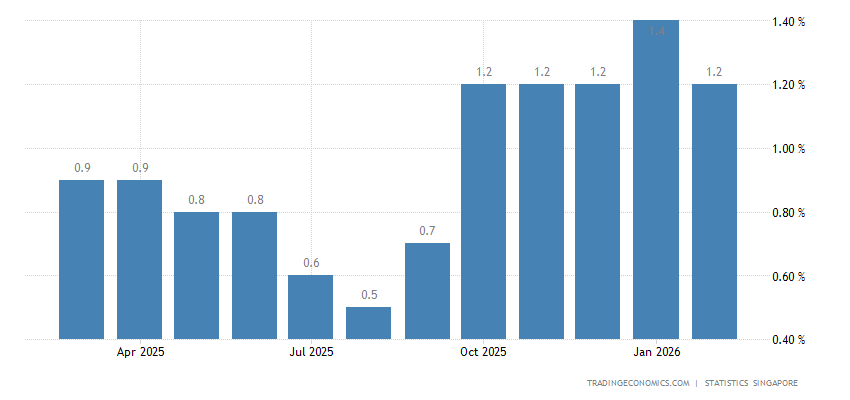
Maybank economist Chua Hak Bin had flagged inflation as an underappreciated risk in 2026, citing rising semiconductor prices and the unwinding of Chinese export deflation — a deflationary cushion that had kept manufactured goods prices suppressed for several years. A Gulf supply shock superimposes an energy cost surge on top of those pre-existing pressures. If the conflict persists beyond four to six weeks, Singapore’s core inflation could break above MAS’s 1–2% forecast band, creating pressure on the central bank to shift its exchange-rate policy.
That band adjustment, if it comes, will be one of the most significant MAS signals in years — and it is coming into view.
The Limits of “Safe Haven”: Why Singapore Is Not Immune to Structural Fragmentation
For a generation, Singapore cultivated — and largely deserved — a reputation as Asia’s most resilient small open economy: deep reserves, AAA fiscal credibility, trade agreements with virtually every major partner, and an uncanny institutional capacity to navigate geopolitical turbulence without becoming its casualty. That reputation is not false. But this crisis is exposing its conditionality.
Coordinating Minister for National Security K. Shanmugam warned on April 7 that markets have yet to factor in the worst-case scenario — and that Singapore cannot rule out power disruptions if the conflict in Iran further disrupts global energy supplies. A sitting minister explicitly raising the spectre of power disruption in a city whose every competitive advantage rests on the reliability of its infrastructure is not rhetoric — it is a risk disclosure.
The structural issue is one that Singapore shares with a cohort of ultra-open economies whose prosperity was architected for a rules-based, multilateral trade order. Taiwan, South Korea, and the Netherlands are the most obvious analogues. Each is deeply integrated into global supply chains, each imports most of its energy needs, and each has built extraordinary competitiveness precisely by maximising openness rather than pursuing autarky. In a world of discrete shocks — a pandemic here, a trade dispute there — openness is the right bet. In a world where great-power conflict is becoming endemic rather than episodic, that calculus deserves harder scrutiny.
The Iran war’s economic impact is not merely a supply shock. It is a signal that the frequency and geographic scope of geopolitical disruptions may be structurally higher going forward than the models that underpin Singapore’s growth forecasts were calibrated for. When Gan says growth in the coming quarters will be “affected,” he is describing an outcome. The deeper question is whether Singapore’s — and Asia’s — planning frameworks are being updated to account for a world where such statements become a recurring feature rather than an exception.
May’s Forecast Revision: What to Expect — and Fear
Singapore’s GDP advance estimate for the first quarter is due on April 14, with a full economic outlook update scheduled for May. The first-quarter numbers will almost certainly show resilience — Gan himself acknowledged that early data indicate economic activity held up well through Q1. That resilience, largely built on AI-driven electronics demand and services strength, will briefly reassure markets.
May’s revision is another matter. The 2% to 4% full-year GDP forecast issued in February was calibrated for a world in which the Iran conflict was either resolved or contained within weeks. Singapore’s predicament is shaped by geography as much as policy — the republic sits far from the conflict zone, yet its economy is tied tightly to global trade, imported food and imported fuel. Any threat to Gulf energy production or maritime passage through strategic chokepoints can ripple quickly into Asian benchmark prices, freight costs and business sentiment.
A sustained conflict — and with over a month of fighting already in the books, “sustained” is no longer a tail risk — points to a revised growth forecast closer to the lower end of the current range or potentially below it. Inflation forecasts, already tracking against MAS’s 1–2% core target band, are likely to be revised upward. For households and SMEs that have not yet felt the full pass-through of April’s electricity tariff increase, the coming months will be measurably harder.
What Policymakers Must Do — and What Singapore Offers as Model
The S$1 billion support package unveiled on April 7 — boosting the corporate income tax rebate from 40% to 50%, advancing grocery vouchers to June, and providing S$200 supplements to both eligible households and cab drivers — is competent crisis management. It cushions the immediate pain, demonstrates governmental responsiveness, and signals institutional credibility to markets. It is not, however, a structural solution.
For Singapore specifically, the priorities are now fourfold. First, accelerate energy diversification — Shanmugam noted that Singapore is studying alternatives including nuclear power to broaden its fuel mix, a move that was politically contentious eighteen months ago and is now strategically urgent. Second, extend supply-chain diplomacy aggressively: the Singapore-Australia joint energy security statement of March 23, 2026 is exactly the kind of bilateral redundancy-building that needs to be replicated across multiple partners and commodity categories. Third, provide targeted, time-limited support for SMEs facing acute energy and freight cost pressure — the risk of SME failures compressing domestic employment and spending is underappreciated. Fourth, and most importantly, begin recalibrating the medium-term planning framework to assume a structurally less stable geopolitical environment than the one that informed Singapore’s last decade of growth strategy.
For the broader cohort of open Asian economies — South Korea, Taiwan, Vietnam, Thailand — Singapore’s predicament is a live case study in vulnerabilities they share. The lesson is not to retreat from openness, which remains the correct long-term bet for small economies without large domestic markets. It is to build genuine redundancy into energy, food, and supply-chain systems; to cultivate multiple geopolitical relationships that provide diplomatic buffer in crises; and to hold fiscal capacity in reserve precisely for moments like this one.
Singapore has those reserves. Its institutions are among the world’s most capable. The response so far has been measured, credible, and appropriately scaled. But Gan’s words in Parliament on April 7 should be read not only as a situational update but as a structural warning — to Singapore, and to every economy that built its prosperity on the assumption that the global order would remain permissive. That assumption is now, unmistakably, in question.
The bumpy ride ahead is not Singapore’s alone.
Discover more from The Economy
Subscribe to get the latest posts sent to your email.
Analysis
Top Record Labels and Start-up Suno Hit Impasse in AI-Generated Music Talks — Who Blinks First?
The future of a $28 billion industry hangs on a negotiation neither side seems able to finish. And that, more than any algorithm, is the real threat.
Something remarkable happened in November 2025, and the music industry has been parsing its implications ever since. Warner Music Group — which had, only sixteen months prior, joined Universal Music and Sony Music in filing sweeping copyright infringement lawsuits against Suno AI — abruptly changed its posture. It dropped the case, signed a licensing partnership, and, in what reads almost as a corporate trophy acquisition, sold Suno the concert-discovery platform Songkick. Warner’s CEO Robert Kyncl called it “a victory for the creative community that benefits everyone.” Rolling Stone The cynics rolled their eyes. The optimists saw a template.
They were both wrong, or at least premature. Because as of April 2026 — with Suno sitting on a post-Series C valuation of $2.45 billion and 100 million users — Universal Music and Sony Music remain in active litigation against Suno, with no settlement in sight. Digital Music News The Suno AI impasse 2026 is not merely a legal dispute. It is the music industry’s most consequential standoff since the labels sued Napster in 1999. Then, they were right to fight. Now, the question is whether their resolve reflects strategic wisdom or organizational paralysis — and whether Suno, drunk on venture capital and its own mythology, has dangerously miscalculated how much runway it actually has.
The Road to Impasse
To understand the AI-generated music record labels talks breakdown, you need a timeline — not just a set of headlines, but a map of competing interests that hardened, over twenty-four months, into something resembling a war of attrition.
It began in June 2024, when the Recording Industry Association of America coordinated a pair of landmark lawsuits on behalf of all three major labels. The complaints, filed in federal courts in Boston and New York, accused both Suno and Udio of training their AI models on “unimaginable” quantities of copyrighted music without permission or compensation — “trampling the rights of copyright owners” at scale. Billboard The damages sought ran to hundreds of millions of dollars per company.
Both startups pushed back with a fair-use defense — the same legal shield that has sheltered every disruptive tech company since Google indexed the internet. Suno and Udio argued that their models transformed copyrighted inputs into entirely new outputs, and that the music industry was using intellectual property law not to protect artists, but to crush competitors it saw as threats to its market share. Billboard
By June 2025, Bloomberg reported that all three majors were in licensing talks with both platforms, seeking not just fees but “a small amount” of equity in each company — echoing the Spotify playbook from the late 2000s, when streaming’s survival required giving the labels a seat at the table. Music Business Worldwide The talks, sources warned at the time, could fall apart. They did. Partially.
Udio, the smaller, more pliable of the two AI music startups, moved first toward accommodation. It signed a deal with Universal in October 2025, followed quickly by Warner. The price of peace was steep: Udio pivoted from a platform that generated songs at the click of a button to something closer to a fan-engagement tool, operating as a “walled garden” where nothing created can leave the platform. Billboard For Udio’s investors, the terms stung. For the music industry, they were a proof of concept.
Then came Warner’s November settlement with Suno — the one Kyncl celebrated as a “paradigm shift.” But here is what the press releases obscured: Universal and Sony have not followed Warner’s lead. Their cases against Suno remain active, and sources close to the negotiations describe both companies as significantly closer to “we’ll see you in court” than to any equity handshake. Music Business Worldwide The Suno Universal Sony licensing deadlock is not merely unresolved — it is hardening.
More damning still: Suno’s CEO Mikey Shulman pledged publicly in November 2025 that licensed models trained on WMG content would debut in 2026, with the current, allegedly infringing V5 retired. It is now April 2026. No such model has appeared. Suno V5, unlicensed, continues to power the platform. Music Business Worldwide The absence of that promised upgrade tells you something important about how difficult it actually is to build a competitive generative music system within licensed constraints.
What the Impasse Really Means for Creators, Labels, and Tech
Strip away the litigation and the valuations, and what you have is a civilizational argument about the nature of creativity — and who gets paid for it.
Suno’s pitch to its users is seductive: anyone can be a songwriter now. Type a prompt, receive a song. The company claims 100 million users Rolling Stone, a figure that would have seemed fantastical five years ago. Its CEO has spoken of “a world where people don’t just press play — they play with their music.” There is something genuinely democratizing about that vision. Music production has always been gated by access to capital, instruments, studios, and a particular form of trained intuition. Suno smashes every one of those gates.
And yet — and this is the argument that Universal and Sony are making, even if they articulate it poorly in legal briefs — democratizing production is not the same as democratizing artistry. There is a difference between removing barriers to creation and removing the value of creation. The music industry’s fear is not that Suno will produce the next Beyoncé. It is that Suno will produce ten million competent-sounding tracks that crowd out every emerging human artist from playlists, sync licenses, and streaming revenue — not because those tracks are better, but because they are cheaper and infinitely reproducible.
This is what critics in the industry have taken to calling “AI slop” — a term borrowed from the visual arts world, where image generators flooded stock libraries with technically proficient but culturally hollow imagery. UMG head Lucian Grainge, opening 2026, acknowledged that “trying to smother emerging technology is futile,” but maintained an uncompromising focus on advantageous licensing terms Digital Music News — an implicit concession that the issue is not AI itself, but AI without rules.
The economic stakes are not hypothetical. Recorded music generated more than $28 billion in global revenues in 2024, according to IFPI data, with streaming accounting for the vast majority of that. Streaming’s royalty structure is already precarious — a fraction of a cent per stream, divided among rights holders through a system that has been criticized for systematically underpaying artists. Now layer onto that a potential tsunami of AI-generated content. Even if each Suno track generates a tiny fraction of streams per unit time, the sheer volume — millions of songs, uploaded by millions of users — compresses the royalty pool for every human artist. The math is not reassuring.
A further complication: under the deals being structured, Suno and Udio have vowed to retire their current models and launch new ones trained exclusively on licensed works — but clearing the most popular songs is fiendishly complex. Many modern pop and hip-hop hits have ten or more songwriters attached, signed to different publishers, requiring individual clearances. A single refusal from one songwriter can disqualify an entire song from use. Billboard The licensed ecosystem, in other words, risks being a Potemkin village — legally credentialed but musically barren.
Lessons from Warner’s Deal vs. the Holdouts
The Suno Warner settlement impact on industry offers a Rorschach test. Read it optimistically, and you see proof that the two sides can find common ground: licensed training data, opt-in frameworks for artists, equitable revenue-sharing, and a model that respects both innovation and IP. Warner’s Kyncl articulated the principle clearly: “AI becomes pro-artist when it adheres to our principles — committing to licensed models, reflecting the value of music on and off platform, and providing artists and songwriters with an opt-in for the use of their name, image, likeness, voice, and compositions in new AI songs.” Rolling Stone
Read it pessimistically — or more precisely, read it through the lens of what happened in the months since — and a different story emerges. Sources suggest that for Suno, the Warner deal was never primarily about building a better model. It was about buying time — and buying a more sympathetic posture in court. Music Business Worldwide A signed deal with one of three majors does not settle the other two lawsuits. It does, however, allow Suno’s CEO to sit before cameras and imply that the industry has broadly moved on. It has not.
Irving Azoff, the legendary manager who founded the Music Artists Coalition, offered what might be the most clear-eyed read of the situation. “We’ve seen this before — everyone talks about ‘partnership,’ but artists end up on the sidelines with scraps,” Rolling Stone he said following the Udio-Universal settlement. The warning echoes every previous moment at which the music industry was promised that technology would expand the pie — and found, a decade later, that most of the slice had gone to the platform.
Universal and Sony’s harder line, then, is not simply intransigence. It is strategy informed by institutional memory. They watched their predecessors negotiate Spotify from a position of weakness, granting licensing terms in the early 2010s that felt reasonable then and look disastrous now. They are unwilling to repeat that error with a technology that is, potentially, far more disruptive. As one analysis noted, the major labels are effectively becoming “AI landlords” — positioning themselves as gatekeepers of the training data every AI music company will ultimately need. VoteMyAI That is a strong negotiating position, and they know it.
Global Ramifications
The Suno AI impasse 2026 is not merely an American story. Its reverberations are already being felt across three continents.
In Europe, the legal pressure on generative AI music has intensified. GEMA, the German collection society and licensing body, filed a copyright infringement action against Suno in January 2025 Music Business Worldwide — the first major European enforcement action against an AI music generator and a signal that the transatlantic regulatory consensus is moving toward stricter accountability for training data practices. Denmark’s Koda has taken similar preliminary positions. The EU AI Act, which entered force in stages through 2025 and 2026, imposes transparency requirements on AI systems — requirements that generative music platforms are only beginning to grapple with. A system that cannot fully account for what it was trained on is a system that cannot easily comply.
On streaming platforms, the pressure is also building. Spotify and Apple Music have begun enforcing the DDEX industry standard for AI disclosure, requiring creators who distribute AI-generated music to flag it as such during the upload process. Mystats This matters more than it might initially appear. If AI-generated tracks must be labeled, they can be sorted, analyzed, and ultimately segregated — giving streaming platforms, labels, and listeners the data they need to make informed choices. It also opens the door to preferential algorithmic treatment: a world in which human-made music receives a discovery advantage simply by virtue of its provenance is not a world Suno’s investors have priced into that $2.45 billion valuation.
For independent artists, the situation is uniquely precarious. They receive none of the direct licensing income that might flow to a major label from a deal with Suno, and they face the full competitive pressure of AI-generated content flooding the same discovery channels they depend on. As licensing frameworks formalize, independent creators may face opt-in systems that require them to actively engage with complex, legally novel agreements simply to protect music they made themselves. Jack Righteous The administrative burden could be crushing for artists without legal counsel.
The Path Forward — My Prescription
I have spent considerable time in the past week reviewing the legal filings, the balance sheets, the settlement terms, and the public statements of everyone involved in the future of AI music after Suno impasse. Here is what I believe must happen — and what likely will, whether either side admits it or not.
First, Universal and Sony should settle — but only from a position of strength, and only with structural guarantees. The Spotify precedent is instructive, but the lesson is not that the labels were wrong to cut deals; it is that they were wrong to cut deals without sufficient equity upside and without enforceable quality controls. A settlement with Suno that includes an equity stake at a $2.45 billion valuation, mandatory licensed-only model deployment with auditable compliance, a robust opt-in framework for artists, and direct royalty flows to songwriters — not just labels — would represent genuine progress. Such a deal would establish an influential precedent for how AI companies pay artists and music companies going forward. Billboard Without that precedent, every subsequent negotiation will be conducted in a legal vacuum.
Second, Suno must deliver on its promises. The company pledged in November 2025 that licensed models would launch in 2026 and that V5 would be deprecated. It is April 2026. Neither has happened. Music Business Worldwide This is not a minor operational delay. It is a credibility crisis. If Suno cannot build a competitive model within licensed constraints, it should say so — because the alternative, continuing to power a $2.45 billion business on models two major labels consider infringing, is not a sustainable strategy. It is a bet that the courts will move slowly enough to let the company escape. That is not a business plan. It is a gamble.
Third, the industry needs a collective licensing framework — an AI equivalent of ASCAP or BMI — that can efficiently clear training data at scale. The current model, in which every AI company must negotiate individual deals with every major (and every independent, and every songwriter), is impossibly friction-heavy. A statutory or voluntary collective license for AI training data — with compulsory reporting, transparent royalty distribution, and mandatory artist opt-in — would resolve the clearance bottleneck that currently threatens to make licensed AI music practically unworkable. Several European collecting societies are already experimenting with frameworks of this kind. The American industry should accelerate its own version.
Fourth, artists themselves need direct representation in these negotiations. Azoff’s warning that artists end up “on the sidelines with scraps” Rolling Stone is historically well-grounded. The deals being struck today involve label executives and AI executives negotiating over creative content that neither group actually makes. Songwriters and performers need seats at the table, not press releases about “opt-in frameworks” crafted after the fact.
Conclusion
There is a version of this story that ends well. It looks something like this: Universal and Sony, having extracted maximum leverage from their litigation, reach structured licensing deals with Suno in late 2026 or early 2027. Suno deploys its licensed models, sacrificing some capability for legal clarity. A collective licensing framework emerges to handle clearances at scale. Artists receive both opt-in protections and a direct share of the royalty streams AI generates. The technology and the tradition find a way to coexist — each making the other more interesting.
There is also a version that ends badly. Suno, denied deals with two of three major labels, continues operating on its unlicensed models and bets on a favorable court ruling. The ruling goes against it. The company restructures, its $2.45 billion valuation evaporates, and the market concludes that AI music is legally untouchable — scaring off investment and leaving the space to less scrupulous operators in jurisdictions with weaker IP enforcement. Meanwhile, hundreds of millions of AI-generated tracks flood streaming platforms, suppressing royalties for human artists who never had anything to do with Suno in the first place.
The labels’ hard line is, on balance, the correct posture. Not because AI music is inherently bad — it is not — but because technology without accountability is a race to the bottom, and in creative industries, the bottom is a very ugly place. The question is whether Universal and Sony can hold that line long enough to extract terms that actually protect artists, or whether they hold it so long that the market moves around them entirely.
As Music Business Worldwide has observed, one licensing deal does not launder a training dataset. Music Business Worldwide That is true in law. Whether it holds true in the court of commercial reality — where 100 million users, a $250 million war chest, and the frictionless appeal of a song-in-seconds keep accruing — is the more urgent question.
The music industry has survived the piano roll, the radio, the cassette tape, the MP3, and the stream. It will survive AI. The only thing it cannot survive is negotiating away its future in a moment of exhaustion. Universal and Sony appear to understand that. Suno, with its runway of capital and its unapologetic CEO, seems to be betting they will eventually forget it.
Someone is about to be proven very wrong.
Discover more from The Economy
Subscribe to get the latest posts sent to your email.
Analysis
Beyond the Strait: Why Global Trade Is Learning to Live Without Hormuz
There is a peculiar irony embedded in the current catastrophe. The Strait of Hormuz, that 34-kilometre sliver of contested water between Iran and Oman, is right now the most consequential geography on earth. Brent crude briefly touched $126 a barrel in March 2026 — its highest level in four years — as tanker traffic through the strait collapsed toward zero, Iranian drones struck Fujairah’s storage tanks, and Washington threatened to “obliterate” Iranian power plants unless shipping resumed within 48 hours. The head of the International Energy Agency, Fatih Birol, called it the largest supply disruption in the history of the global oil market. He is probably right.
And yet, the thesis this crisis appears to confirm — that the Strait of Hormuz is an eternal, irreplaceable artery of civilisation — is precisely the thesis that the crisis itself is demolishing. Pain concentrates the mind. When 150 tankers anchored off Fujairah and the world scrambled for alternatives, it exposed not just the Strait’s centrality but the desperate fragility of any system built around a single chokepoint. The question that matters is not “how do we get oil through Hormuz today?” It is the one no panicked government in a war room is asking: “Will we still need to?”
The answer, over the arc of the next two decades, is increasingly no. And understanding why requires looking not at what is flowing through the Strait right now, but at what is flowing around it — in pipelines, rail corridors, liquefied natural gas tankers from Louisiana and Alberta, and electrons streaming through intercontinental fibre cables.
The Chokepoint That Could Never Be Replaced — Until It Suddenly Must Be
The numbers are genuinely staggering. According to the IEA, an average of 20 million barrels per day of crude and petroleum products transited the Strait in 2025 — representing roughly 25% of all seaborne oil trade and about 20% of global petroleum liquids consumption. Five countries — Iraq, Kuwait, Qatar, Bahrain, and Iran — have no meaningful pipeline bypass infrastructure whatsoever. The EIA estimates that roughly 14 million barrels per day are structurally locked to the maritime passage with no alternative route to global markets. Qatar and the UAE together account for nearly 20% of global LNG exports, almost all of it transiting Hormuz. Even fertiliser — that unglamorous linchpin of food security — flows through in quantity, representing up to 30% of internationally traded supply.
This dependency did not arise from carelessness. It arose from geology, economics, and decades of compounding infrastructure decisions. The Persian Gulf states sit atop the world’s most concentrated reserves, and the Strait is simply the only door out of the room. You cannot argue yourself out of geography.
But geography is only the stage. What plays out on it is a function of technology, capital, political will, and time. On all four dimensions, the structural case for Hormuz’s long-term indispensability is weakening — faster than most analysts, trapped in the urgent present, are willing to acknowledge.
The Energy Transition Is Not a Political Slogan. It Is a Supply Curve.
Start with demand. The IEA’s Oil 2025 report projects that demand for oil from combustible fossil fuels — the stuff that actually moves through tankers and pipelines — may peak as early as 2027. Global oil demand overall is forecast to reach a plateau around 105.5 million barrels per day by 2030, with annual growth already slowing from roughly 700,000 barrels per day in 2025–26 to a near-trickle thereafter. China — which absorbed more than two-thirds of global oil demand growth over the past decade and whose appetite once seemed boundless — is on track to see its oil demand peak before 2030, driven by an extraordinary surge in electric vehicle adoption, high-speed rail expansion, and structural economic rebalancing.
The numbers on clean energy investment are equally telling. In 2025, clean energy investment — renewables, nuclear, grids, storage, and electrification — reached roughly $2.2 trillion, twice the $1.1 trillion flowing to oil, natural gas, and coal combined. Global investment in data centres alone is expected to hit $580 billion in 2025, surpassing the entire annual budget for global oil supply. The energy system that those data centres will eventually run on is solar, wind, and nuclear — not crude from Kharg Island.
None of this means oil demand collapses overnight. The IEA’s Current Policies Scenario, restored in the 2025 World Energy Outlook, projects that global oil could continue growing until 2050 under today’s policy settings — a sobering reminder that transition is a trajectory, not a switch. But “trajectory” is the operative word. The direction is unambiguous. Every electric vehicle on the road — and the global EV fleet is projected to grow sixfold by 2035 in the IEA’s Stated Policies Scenario — is a barrel of oil that will never load onto a tanker and never transit the Strait of Hormuz. At scale, those barrels accumulate into a structural reduction in the Strait’s gravitational pull on global commerce.
The Corridors Rising in the Strait’s Shadow
Even before a single barrel of oil demand falls permanently, the physical architecture of global trade is being redrawn by corridors that deliberately circumvent Hormuz and its neighbourhood.
The most ambitious is the India-Middle East-Europe Economic Corridor (IMEC), which received a significant boost when President Trump and Prime Minister Modi jointly declared it “one of the greatest trade routes in all of history” in February 2025. A landmark EU-India trade deal signed in January 2026 further accelerated IMEC’s momentum, with construction on key rail, port, and highway segments having commenced in April 2025. IMEC is not just an oil bypass. It is a multimodal corridor linking Indian Ocean shipping to Gulf rail networks to Mediterranean ports — carrying container cargo, digital infrastructure (fibre cables), and clean energy flows. For the Gulf states, it represents something strategically profound: a pathway to becoming trade and green energy hubs rather than merely hydrocarbon exporters.
Turkey, meanwhile, is positioning itself as the indispensable energy corridor for a post-Hormuz world. Turkish Energy Minister Alparslan Bayraktar cited the Kirkuk-Ceyhan pipeline’s 1.5 million barrel-per-day capacity as a viable alternative, while flagging longer-term concepts including Qatari gas reaching Europe via Turkish pipeline infrastructure. TurkStream gas flows to Europe rose 22% year-on-year in March 2026, even as Hormuz choked. The current crisis is not disrupting Turkey’s corridor ambitions. It is turbocharging them.
Then there is LNG — the great wildcard in global energy trade. The very nature of liquefied natural gas makes it geographically flexible in a way that crude oil pipelines never can be. A cargo of LNG can load in Sabine Pass, Louisiana, and deliver to Tokyo, Marseille, or Mumbai, entirely indifferent to what happens in any given strait. New LNG projects surged in 2025, with approximately 300 billion cubic metres of new annual export capacity expected to come online by 2030 — a 50% increase — with roughly half being built in the United States. American LNG, arriving in Asia and Europe via the Atlantic and Pacific rather than the Persian Gulf, is quietly restructuring the energy map. When Qatari LNG is stranded behind a closed Hormuz, a cargo from Corpus Christi feels not like a supplement but like a successor.
What the Crisis Is Actually Teaching Us
Here is what the 2026 crisis reveals in sharp relief: the system’s Achilles heel is not the Strait itself, but the failure to invest seriously in alternatives before the emergency.
Saudi Arabia’s East-West pipeline (Petroline) reportedly has design capacity of up to 7 million barrels per day, yet was running at only 2 million barrels per day as of early 2026 — meaning five million barrels of daily bypass capacity sat idle for years due to infrastructure bottlenecks and the absence of political urgency. The UAE’s ADCOP pipeline to Fujairah, capable of 1.8 million barrels per day, is similarly underutilised — and its terminal has now been struck by drones. Iraq’s southern fields, which produce the bulk of its exportable crude, have no meaningful inland pipeline connection to the northern Kirkuk-Ceyhan route. Roughly 14 million barrels per day remain structurally dependent on a waterway that Iran can threaten to close — and periodically does.
The lesson is not that alternatives are impossible. It is that alternatives require decades of sustained political commitment to mature. The countries now scrambling are paying the compound interest on decisions deferred since 2019, when Houthi drones struck Aramco’s facilities and the world briefly panicked before moving on. The world should not move on this time.
The Digital Trade Revolution: Routes Without Geography
There is a third dimension to this shift that rarely appears in energy columns, because it is invisible, weightless, and does not require a tanker: the explosive growth of digital trade and the services economy.
Digital commerce — software, financial services, intellectual property, telemedicine, AI-enabled business services — now accounts for a substantial and rapidly growing share of global economic value. It flows through submarine cables and spectrum, not through straits. IMEC’s digital pillar — a network of new intercontinental fibre-optic cables — is explicitly designed to create an alternative data corridor that bypasses choke geographies entirely. As the share of economic activity that is digital continues to expand — accelerated by AI, remote work, and platform economies — the share of global GDP that depends on physical chokepoints like the Strait of Hormuz will shrink, structurally and inexorably.
This is not a utopian projection. It is already happening. India’s digital services exports exceeded $200 billion in 2025. Southeast Asian e-commerce platforms transact trillions annually. None of it cares whether tankers can get through 34 kilometres of contested Gulf waters.
Recommendations for Policymakers: The Strategic Imperatives
The 2026 crisis is a forcing function. The question is whether governments will use it. Here is what they should do:
Accelerate pipeline bypass capacity in the Gulf. Saudi Arabia should fast-track the Petroline to its announced 7 million barrel-per-day capacity and actively negotiate with Iraq and Kuwait to begin engineering — not just discussing — northern corridor alternatives. The infrastructure gap between design capacity and utilised capacity is, at this moment, unconscionable.
Fund IMEC, not just endorse it. India has yet to establish a dedicated implementing body or commit specific funds to IMEC. That must change. The corridor needs a multilateral financing mechanism — modelled on the Bretton Woods institutions but purpose-built for twenty-first-century connectivity — not merely high-level communiqués.
Accelerate the LNG diversification that already works. The U.S., Canada, Australia, and Qatar (where pipeline exports to Turkey could reduce Hormuz dependency) should be treated as a strategic consortium for global energy security. New LNG infrastructure approvals should be fast-tracked under energy security frameworks.
Price the risk of Hormuz dependency into investment decisions. Insurers and sovereign wealth funds should be required to model Hormuz-closure scenarios in energy asset valuations. The underpricing of chokepoint risk — as this crisis has devastatingly illustrated — is a market failure with systemic consequences.
Invest in demand-side transition with strategic urgency. Every percentage-point reduction in global oil demand reduces Hormuz’s leverage over the world economy. EV incentives, renewable energy deployment in emerging economies, and energy efficiency standards are not merely climate policies. They are geopolitical risk management.
The Arc of the Argument
Crises have a way of feeling permanent in their midst. The 1973 oil embargo reshaped energy policy for a generation. The 1979 Iranian revolution convinced analysts that Persian Gulf dependency was an eternal condition of industrial civilisation. Neither prognosis proved correct. Alternatives emerged. Technologies shifted. Demand patterns evolved.
The 2026 Hormuz crisis is the most serious test of the global energy system since the 1970s. The World Economic Forum’s Global Risks Report 2026 already identifies geoeconomic confrontation as a key driver reshaping global supply chains, noting that “securing access to critical inputs is increasingly being treated as a matter of economic and national security.” Governments and industries are hearing that message with a clarity that previous near-misses never produced.
The Strait of Hormuz will matter enormously for years — perhaps decades — to come. To claim otherwise would be to misread the current data. But its structural importance to the global economy is on a long, slow, inexorable decline, driven by the energy transition, the rise of alternative corridors, the geography-defying nature of digital commerce, and the hardwired human instinct to find another road when the old one is blocked.
The future of global trade will not be decided in the narrow waters between Oman and Iran. It will be decided in solar farms in Rajasthan, LNG terminals in Louisiana, fibre cable landing stations in Haifa and Marseille, and EV factories in Hefei. The chokepoint is a reminder of where we came from. What we build next determines where we go.
Discover more from The Economy
Subscribe to get the latest posts sent to your email.
Analysis
Ackman’s €55bn Gambit: Wall Street Reaches for the Soul of Music
Bill Ackman’s Pershing Square bids €55.75bn for Universal Music Group — a bold SPARC merger, NYSE relisting play, and activist masterstroke that could reshape global entertainment finance.
There is a particular kind of audacity that separates the truly great dealmakers from the merely wealthy ones. It is the ability to look at a €31 billion company, one that controls the recordings of Taylor Swift, Drake, Lady Gaga, and The Beatles’ entire back catalogue — and declare, publicly, with the full force of a non-binding term sheet, that the world has been catastrophically wrong about its value. Bill Ackman did exactly that on Tuesday morning, submitting a €55.75 billion proposal to the board of Universal Music Group that is simultaneously a takeover bid, a structural intervention, a corporate governance manifesto, and perhaps the most consequential single act in the history of music-industry finance.
The numbers alone are theatrical. Pershing Square’s cash-and-stock deal, worth approximately €55.8 billion ($64.4 billion), would see UMG shareholders receive a total of €9.4 billion in cash and 0.77 shares of new stock for each share currently held. That equates to roughly €30.40 per share — a 78% premium to last week’s closing price of €17.10. In a market still nursing tariff-induced vertigo, it reads less like a merger proposal and more like a declaration of war against misvaluation itself.
The Deal, Deconstructed: What Ackman Is Actually Proposing
Strip away the financial engineering and what emerges is a thesis of elegant simplicity: Universal Music Group is one of the finest businesses on the planet, systematically mispriced by structural noise. Pershing Square cited six specific factors it believes have depressed UMG’s stock: uncertainty over the Bolloré Group’s 18% stake; the postponement of a US listing; balance sheet underutilisation; the absence of a disclosed capital allocation plan; a failure of investors to credit UMG’s €2.7 billion Spotify stake in its valuation; and what Ackman termed “suboptimal” shareholder communications.
Each point is surgical. Each is addressable. Together they constitute not a diagnosis of a failing business — Ackman himself praised CEO Sir Lucian Grainge effusively — but a bill of indictment against the governance architecture surrounding an excellent one. “Since UMG’s listing, Sir Lucian Grainge and the company’s management have done an excellent job nurturing and continuing to build a world-class artist roster and generating strong business performance,” Ackman said, before pivoting: “UMG’s stock price has languished due to a combination of issues that are unrelated to the performance of its music business.”
Under the proposed structure, Pershing’s SPARC Holdings would merge with UMG, and the combined entity — incorporated as a Nevada Corporation — would be listed on the New York Stock Exchange. The cash component, funded through SPARC’s rights holders, committed debt financing, and proceeds from Pershing’s Spotify stake, is carefully calibrated. It is designed primarily to offer the Bolloré Group — holder of an 18.5% stake that has hung over UMG like a Gallic storm cloud since its 2021 Euronext Amsterdam listing — a clean exit.
Pershing Square said all equity financing would be backstopped by itself and its affiliates, with debt financing committed at signing, and expects the deal to close by end of 2026.
The proposed deal mechanics, summarised:
| Element | Detail |
|---|---|
| Total deal value | ~€55.75bn ($64.4bn) |
| Price per share | €30.40 (78% premium to last close) |
| Cash component | €9.4bn (€5.05/share) |
| Stock component | 0.77 shares of New UMG per UMG share |
| Vehicle | Pershing Square SPARC Holdings (SEC-registered SPARAC) |
| New listing | New York Stock Exchange |
| Target close | End of 2026 |
| Board refresh | Michael Ovitz proposed as chair; 2 Pershing Square directors |
Why Ackman Wants the World’s Biggest Music Machine
The superficial answer is that Ackman saw a bargain. UMG has lost 26% of its market value in the past 12 months and was valued at just €31.4 billion before Tuesday’s announcement — a staggering discount for a company that generates consistent double-digit earnings growth and sits at the absolute commanding heights of intellectual property capitalism.
But the deeper answer is structural. Ackman purchased 10% of UMG in 2021 through a deal with Vivendi at approximately €18.27 per share, making him an early believer in its potential. Since then, he has watched the share price grind lower despite the business performing admirably — revenues and earnings growing at 11% and 13% per year respectively, while the Amsterdam listing provided insufficient liquidity and suppressed institutional access for US investors unable to purchase non-US-listed securities.
This is, at its core, a thesis about listing arbitrage — the premium that New York capital markets attach to great businesses versus their European equivalents. The S&P 500 trades at roughly 20x forward earnings. Amsterdam’s AEX sits closer to 13x. For a business of UMG’s quality and growth trajectory, that gap represents tens of billions in unrealised value. Ackman intends to unlock it via relisting.
There is also the artist economy argument, which deserves more attention than it has received. The music industry’s economics have been fundamentally restructured by streaming. Spotify, Apple Music, and their successors have converted what was once a lumpy, piracy-damaged revenue model into something approaching a recurring subscription business. UMG, home to global artists including Taylor Swift, Drake, and Lady Gaga, was spun out of Vivendi and listed on Euronext Amsterdam in 2021 with an initial valuation of €46 billion — and the business case for premium valuations has only strengthened since as streaming penetration has deepened globally. The irony is that UMG has executed precisely the transformation it promised, and the market has responded with indifference.
The Blank-Cheque Masterstroke: SPARC, Not SPAC
Much will be written conflating this deal with the SPAC boom of 2020-21 — that frothy, ultimately discrediting period of blank-cheque company proliferation that ended in regulatory scrutiny and spectacular write-downs. The conflation is understandable but wrong.
Pershing Square SPARC Holdings is technically a SPARAC — a Special Purpose Acquisition Rights Company — a vehicle Ackman designed precisely to avoid the structural defects of its SPAC predecessor. Where traditional SPACs forced investors to commit capital before a deal was identified, SPARAC rights holders only invest once a specific target is announced and they have full information to evaluate it. There is no dilutive warrant structure. There is no forced redemption dynamic. The optionality resides entirely with the investor, not the promoter.
It is, in essence, a rights-based acquisition vehicle that aligns incentives in ways the original SPAC format catastrophically failed to do. The SEC registered SPARC Holdings four years ago, and Ackman has been patient — waiting, as great investors do, for a target worthy of the vehicle’s ambition. Universal Music Group, one suspects, was always the destination.
Pershing’s move comes after UMG last month delayed a plan for a US listing, walking back on an agreement with Pershing, which had exercised its right to request a US offering and had argued a New York listing would boost UMG’s share price and liquidity. That reversal appears to have been the proximate trigger. When the elegant solution — a consensual secondary listing — was blocked, Ackman reached for the bolder instrument: full acquisition.
Strategic and Cultural Implications for the Music Industry
The implications extend far beyond the balance sheet. Universal Music Group is not merely a large corporation; it is, in important respects, the custodian of recorded culture. It controls the catalogues of artists spanning a century of popular music — from The Beatles to Bad Bunny — and its decisions about licensing, royalties, artificial intelligence, and streaming economics ripple through the entire creative ecosystem.
Ackman’s proposed governance changes are, on balance, more activist than revolutionary. He wants Michael Ovitz, the former CAA co-founder and Walt Disney president, to chair the board, alongside two Pershing Square representatives as directors. Ovitz’s reputation in talent representation and entertainment strategy is formidable; his appointment would signal a reorientation toward artist relationships and content strategy, not merely financial engineering.
The AI dimension cannot be overstated. Music labels are currently engaged in a defining legal and commercial battle over the use of their catalogues to train AI systems. UMG has been among the most aggressive in asserting rights — suing AI audio companies and demanding licensing frameworks. A NYSE-listed UMG, with a US activist shareholder structure and American governance norms, will likely pursue this battle with greater institutional firepower and investor support. American capital markets tend to reward IP maximalism. The implications for artists, AI companies, and streaming platforms are profound.
Key stakeholders and their likely positions:
| Stakeholder | Position | Strategic Implication |
|---|---|---|
| Bolloré Group (18.5%) | Seeking exit; cash component designed for them | Deal cannot proceed without their support |
| Vivendi (~10%) | Complex position as ex-parent | Likely supportive if premium maintained |
| Sir Lucian Grainge (UMG CEO) | Praised by Ackman; contract renegotiation proposed | Retention critical; may seek enhanced terms |
| UMG Artists | No direct vote; indirect interest in stability | NYSE listing may attract greater US investor coverage |
| Spotify | UMG holds €2.7bn stake | Complex licensing interdependence; deal may reassess |
Financial Engineering and Market Reaction
The market’s immediate verdict was unambiguous. UMG shares jumped as much as 28% in early Amsterdam trading following the announcement, before paring gains to trade approximately 15% higher. The stock had been down roughly 11% year-to-date entering Tuesday. Shares of Vivendi and the Bolloré Group were both higher — Vivendi up 11% and Bolloré up 6.3% — a clear signal that the broader conglomerate structure around UMG views this as a liquidity event long overdue.
The valuation case is compelling when stress-tested. UMG generates approximately €10 billion in annual revenues with EBITDA margins expanding toward the mid-twenties as streaming cost structures mature. Apply the multiple of peers — compare it to, say, Live Nation’s trading multiples or the private market transaction comps for music IP — and €30.40 per share begins to look not generous but fair. The 78% premium to a depressed share price does not, in this analysis, represent aggressive overpayment. It represents correction of a persistent anomaly.
The Spotify stake alone — valued at approximately €2.7 billion — represents nearly 9% of UMG’s current market capitalisation and has never been adequately reflected in analyst valuations. In the transaction structure, its monetisation becomes explicit rather than embedded and ignored.
One structural observation deserves attention: 17% of UMG shares will be bought back and cancelled as part of the transaction, concentrating ownership in the new entity while reducing dilution for remaining shareholders. This is the quiet architecture of a deal designed to maximise value in the hands of long-term holders rather than short-term arb traders.
Risks, Regulatory Roadblocks, and Counter-Moves
This is where intellectual honesty demands a departure from the deal’s considerable charms.
The Bolloré problem is real, and it is large. Nicolas Marmurek, an analyst at M&A specialists Square Global, noted bluntly: “Unless Bolloré supports the move, the proposal looks very much dead from the start. We doubt Bolloré will accept such terms.” The Bolloré Group is not a passive portfolio investor; it is a French conglomerate with its own regulatory entanglements, a controlling patriarch in Vincent Bolloré, and a history of strategic opacity. The cash component — €9.4 billion — is designed to offer them an exit. Whether they want an exit, on these terms, at this moment, is the $64 billion question. Literally.
Regulatory complexity compounds this. A transaction of this scale, involving a Dutch-listed company with French shareholders, a US acquisition vehicle, and a proposed NYSE relisting, traverses at least three major jurisdictions and regulatory regimes. EU merger control, Dutch financial market authority oversight, SEC registration requirements, and French market regulator AMF scrutiny of the Bolloré/Vivendi stake all represent genuine friction — not necessarily fatal, but time-consuming and expensive. Ackman’s year-end target may prove optimistic.
There is also the question of what this deal does to competitive dynamics. A US-listed, Pershing Square-controlled UMG would face heightened scrutiny in its licensing and AI negotiations — both from counterparties emboldened by antitrust concern and from legislators increasingly attentive to Big Culture’s market power. Warner Music Group and Sony Music, UMG’s two major competitors, will not be passive observers. Both have the scale and relationships to complicate regulatory approval processes.
Finally — and this is rarely discussed — there is the artist dimension. Major recording artists command extraordinary negotiating leverage in 2026. The consolidation of ownership around activist shareholder structures has historically produced cost discipline that artists and their managers experience as pressure on royalty terms and advance commitments. Any perception that a Pershing Square-controlled UMG would prioritise financial returns over artist relationships could accelerate the movement toward independent labels, direct licensing, and artist-owned catalogues that has already begun reshaping the industry’s edges.
My Expert Opinion: The Bigger Picture for Global Entertainment and Capital Markets
Let me be direct: this is one of the most interesting large transactions attempted in global capital markets in years, and it is more likely to succeed than the sceptics assume — but for reasons that extend beyond the deal’s immediate mechanics.
Bill Ackman is not primarily a music industry investor. He is a capital allocation activist who identified, five years ago, that the world’s most valuable IP business was being systematically underpriced by European listing constraints and governance ambiguity. The SPARC vehicle, the Lucian Grainge relationship, the Bolloré exit structure — none of this is improvised. This is the end of a long-form strategic play, executed with the patience and deliberateness that distinguishes Ackman’s best campaigns from his more turbulent episodes.
The broader thesis — that great businesses listed in small-liquidity markets are systematically undervalued relative to NYSE-listed equivalents — is not just true; it is increasingly obvious to sophisticated allocators globally. Arm Holdings’ relocation to Nasdaq, the parade of European companies exploring dual listings, the premium that US institutional capital demands for domestically-listed assets — all of these are manifestations of the same phenomenon Ackman is now monetising at scale.
For the music industry specifically, a successful UMG-Pershing transaction would have generational consequences. It would cement music IP as a mainstream institutional asset class, driving capital allocation toward royalty funds, catalogue acquisitions, and artist-equity structures at a scale that would transform the economics of every recording artist signed to a major label. The money that follows a NYSE-listed, S&P-eligible Universal Music Group into the sector would dwarf the private equity inflows of the past decade.
And on AI: a better-capitalised, US-governance-aligned UMG will be a more formidable adversary for technology companies seeking to licence or circumvent music rights. That is good for artists, good for label economics, and potentially very good for the broader case that creative IP deserves robust legal protection in the generative AI age.
Forward-Looking Outlook: Three Scenarios
Scenario A — The Deal Closes (Probability: ~45%): Bolloré agrees to the cash exit terms; UMG’s board, satisfied with the governance concessions and premium, recommends acceptance; regulatory approvals are secured by Q3. New UMG lists on NYSE in December 2026, immediately entering institutional indices, attracting US-oriented fund flows, and trading at a multiple that vindicates Ackman’s thesis. The 0.77-share component ultimately prices above the implied €30.40 equivalent. Ackman books one of the great activist trade completions.
Scenario B — Partial Success (Probability: ~35%): Bolloré refuses the exit terms; Ackman’s public pressure, however, forces UMG’s board to commit to a US listing without the full merger. A secondary NYSE listing proceeds in 2027, share price recovers meaningfully, and Pershing’s existing stake is vindicated without the complexity of full acquisition. Messier, but profitable.
Scenario C — Collapse (Probability: ~20%): Bolloré, exercising shareholder veto power, rejects the terms. Regulatory pushback in France and the Netherlands proves intractable. Ackman withdraws; UMG shares give back their premium; the saga continues. Even in this scenario, the public articulation of UMG’s undervaluation likely places a floor under the stock that did not exist before Tuesday morning.
In all three scenarios, one thing is clear: the world’s most valuable music business will never be invisible again.
Discover more from The Economy
Subscribe to get the latest posts sent to your email.
-
Markets & Finance3 months agoTop 15 Stocks for Investment in 2026 in PSX: Your Complete Guide to Pakistan’s Best Investment Opportunities
-
Analysis2 months agoBrazil’s Rare Earth Race: US, EU, and China Compete for Critical Minerals as Tensions Rise
-
Banks3 months agoBest Investments in Pakistan 2026: Top 10 Low-Price Shares and Long-Term Picks for the PSX
-
Investment3 months agoTop 10 Mutual Fund Managers in Pakistan for Investment in 2026: A Comprehensive Guide for Optimal Returns
-
Analysis2 months agoTop 10 Stocks for Investment in PSX for Quick Returns in 2026
-
Asia3 months agoChina’s 50% Domestic Equipment Rule: The Semiconductor Mandate Reshaping Global Tech
-
Global Economy3 months agoPakistan’s Export Goldmine: 10 Game-Changing Markets Where Pakistani Businesses Are Winning Big in 2025
-
Global Economy3 months ago15 Most Lucrative Sectors for Investment in Pakistan: A 2025 Data-Driven Analysis