
Lending Agencies
Pakistan Economy 2026: GDP Grows 3.7% as IMF Completes EFF Review Amid Middle East Risk

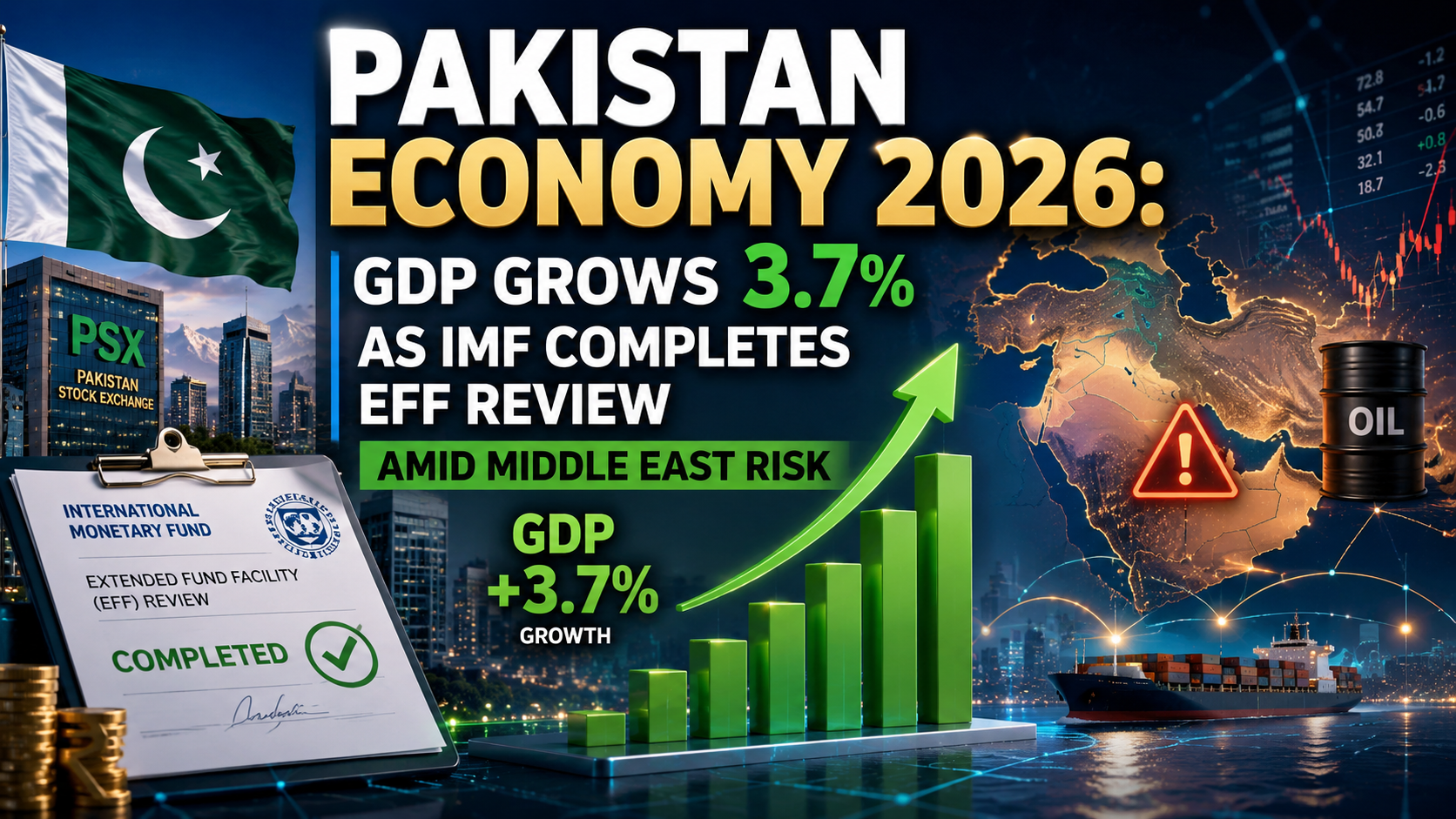
Pakistan’s economy expanded 3.7% in FY26, its fastest pace in four years, according to the government’s Economic Survey, even as the IMF’s Executive Board flagged the ongoing Middle East conflict as a cloud over the country’s near-term outlook after completing the third review of its Extended Fund Facility program.
GDP Growth and the IMF’s Verdict
Finance Minister Muhammad Aurangzeb presented the Economic Survey of FY26 in Islamabad in June, showing GDP growth that, while the fastest in four years, still fell short of the government’s own target, according to Dawn. The survey noted the KSE-100 index rose 18.4% between July and March of FY26, driven by strong corporate earnings, a falling policy rate, easing inflation, and the successful review of the IMF-EFF program.
The IMF’s Executive Board formally completed the third review of the Extended Fund Facility and the second review of the Resilience and Sustainability Facility in May 2026, noting that fiscal performance had been strong, with a primary surplus of 1.6% of GDP expected in FY26, in line with program targets, according to the IMF’s official statement. Gross reserves stood at $16 billion at end-December, up from $14.5 billion at end-June 2025.
Growth Drivers and Persistent Risks
The IMF’s detailed staff report attributed the acceleration in GDP growth — averaging 3.8% year-on-year in FY26 H1 — to the auto, construction, and garment industries, even as flooding in July-August 2025 weighed on output, according to the IMF Country Report. Headline inflation, however, climbed to 7.3% year-on-year in March as higher global commodity prices began passing through to domestic energy costs, with core inflation holding at 7.6%.
Pakistan’s central bank, the State Bank of Pakistan, cut its policy rate by 50 basis points in December 2025 before holding it at 10.5% through January and March 2026, per the same IMF report. The central bank also lowered banks’ cash reserve requirement from 6% to 5%, effective January, to support credit growth.
The Social Cost Behind the Recovery
Despite the headline recovery, the IMF’s own analysis flagged a stark deterioration in poverty indicators: Pakistan’s poverty headcount rate rose to 25.3% in FY24, up from 18.3% in FY22, driven by overlapping shocks including COVID-19, flooding, and sustained economic instability. Health and education outcomes remain weak relative to other lower-middle-income countries, underscoring the gap between macroeconomic stabilization and household-level welfare.
The Middle East War and What Comes Next
The IMF explicitly warned that “the impact of the war in the Middle East clouds Pakistan’s near-term outlook,” a caution that has only grown more relevant following the July 2026 collapse of the US-Iran ceasefire and the reinstated Strait of Hormuz blockade, according to the IMF’s staff report summary. As a major oil importer, Pakistan remains exposed to a renewed spike in global energy prices, which could complicate the central bank’s tight monetary stance and pressure the current account just as reserve rebuilding has started to gain traction. The IMF’s next mission to Pakistan is expected in the second half of 2026, with discussions on the FY27 budget continuing in parallel, according to The Indian Panorama.
Discover more from The Economy
Subscribe to get the latest posts sent to your email.


Global growth forecasts have been on a genuine roller coaster through 2026, and the two institutions tasked with tracking that trajectory — the International Monetary Fund and the World Bank — have delivered a consistent underlying message even as their specific numbers moved: the global economy has proven more resilient than feared at each individual shock, but the 2020s as a whole are on track to be the weakest decade for growth since the 1960s, and inflation’s decline has stalled rather than completed.
The IMF’s 2026 Forecast Trajectory
| WEO Report | Global Growth 2026 | Global Growth 2027 | Inflation 2026 | Key Driver |
|---|---|---|---|---|
| January 2026 | 3.3% | 3.2% | Declining | Technology investment, fiscal/monetary support |
| April 2026 | 3.1% | 3.2% | Rising to 4.4% | Middle East war outbreak |
| July 2026 | 3.0% | 3.4% | Revised up to 4.7% | Disinflation trend stalled; energy/food prices |
The swing between January and April 2026 — a full 0.2-point downgrade to growth alongside a jump in the inflation forecast — was driven almost entirely by the outbreak of war in the Middle East, which IMF Chief Economist Pierre-Olivier Gourinchas described directly: “The war has stopped that momentum and we now project growth of 3.1 percent this year… with inflation rising to 4.4 percent, a sharp departure from the previous trend.”
By July, the Fund’s own briefing described the resulting trajectory as a “V-shaped recovery” — weaker 2026 growth than the pre-war forecast, followed by a stronger 2027 rebound (revised up to 3.4%) — while cautioning that the disinflation trend in place since early 2024 has stalled, with headline inflation revised upward for both 2026 and 2027 versus the April forecast.
Three Scenarios, Not One Baseline
Reflecting the genuine uncertainty introduced by the Middle East conflict, the IMF’s April 2026 report broke from its traditional single-baseline format and instead presented three explicit scenarios:
- Reference forecast: assumes a short-lived conflict with a moderate 19% rise in energy prices in 2026 — global growth at 3.1%, inflation at 4.4%.
- Adverse scenario: assumes further disruption, higher energy prices, elevated inflation expectations, and tighter financial conditions throughout the year — growth falling to 2.5%, inflation rising to 5.4%.
- Severe scenario: assumes energy supply disruptions extend into 2027, with greater macroeconomic instability across advanced and emerging markets alike.
This scenario-based approach itself signals how much weight the Fund places on geopolitical risk as the dominant swing factor in the current outlook, ahead of more traditional cyclical drivers like monetary policy stance or fiscal consolidation pace.
Regional Divergence: Winners and Losers
The IMF’s reporting has consistently emphasized that the aggregate global figures mask sharply uneven regional impacts:
- The euro area continues to underperform, with subdued growth reflecting unresolved structural headwinds, lingering effects of elevated post-Ukraine-invasion energy prices, and real appreciation of the euro relative to competitor export currencies. Planned defense-spending increases are expected to provide only gradual support, given commitments to reach target spending levels by 2035.
- The United States has been a relative bright spot, with growth projected at 2.4% for 2026 in the January update, supported by fiscal measures and continued technology-driven investment.
- Energy-importing and vulnerable emerging market economies are bearing the brunt of the Middle East war’s growth and inflation impact, hit through three distinct channels the IMF identifies explicitly: higher energy and food prices directly; persistence in wage and price inflation; and a broader confidence shock affecting investment decisions.
- Countries integrated into the AI-driven technology value chain are seeing that demand partly offset war-related headwinds, creating a genuine bifurcation between economies positioned to capture AI infrastructure investment and those that are not.
The World Bank’s Parallel — and More Pessimistic — Assessment
The World Bank’s Global Economic Prospects reports have tracked a broadly similar trajectory but with a structurally lower growth baseline and a starker framing of the developing-world implications:
- January 2026: Global GDP growth projected at 2.6% in 2026, recovering to 2.7% in 2027 — an upward revision from the Bank’s own June 2025 forecast, driven primarily by stronger-than-expected U.S. performance.
- Structural framing: World Bank Group Chief Economist Indermit Gill’s foreword to the Bank’s report states plainly that, barring a change in trajectory, “the 2020s are on track to become a lost decade for far too many developing economies,” noting that virtually half of all developing economies have failed since 2019 to narrow the income gap with the world’s most prosperous economies.
- A longer-term counterpoint: The same report expresses genuine optimism about the 2030s specifically, arguing that AI, energy transformation, and deeper regional integration represent economic forces powerful enough to unlock transformative progress in the next decade — but only if the necessary preparation begins now.
Sovereign Debt: The Structural Vulnerability Beneath the Cyclical Numbers
Both institutions have devoted increasing analytical attention in 2026 to rising sovereign debt burdens across emerging market and developing economies (EMDEs):
- Rising debt is driving up EMDE borrowing costs, particularly for the most indebted nations, creating a self-reinforcing dynamic the World Bank’s June 2026 report analyzes in detail under a dedicated section on “A Rising Challenge: Sovereign Debt Levels and Interest Rates in EMDEs.”
- Fiscal rules show measurable benefit: World Bank analysis finds that countries adopting formal fiscal rules see budget balances improve by 1.4 percentage points of GDP within five years — but Deputy Chief Economist M. Ayhan Kose cautions that “credibility, enforcement, and political commitment ultimately determine whether fiscal rules deliver stability and growth,” meaning the rules alone are insufficient without genuine follow-through.
- The scale of the underlying problem remains severe by any historical standard: global public debt has reached roughly $97 trillion, developing-country debt service payments have surged sharply since 2021, and dozens of developing countries remain in or at high risk of debt distress — a burden that in some cases consumes over half of national federal budgets on debt servicing alone, severely constraining capacity for development spending.
What to Watch Through Late 2026 and Into 2027
- Middle East conflict duration: Every IMF scenario is explicitly conditioned on conflict duration and scope; a longer or broader war would mechanically push outcomes toward the adverse or severe scenarios described above.
- Whether the “V-shaped recovery” materializes: the IMF’s July 2027 growth upgrade to 3.4% depends on the disinflation trend resuming and energy-price disruptions fading — neither of which is guaranteed given the stalled disinflation the Fund itself flagged.
- EMDE debt distress escalation: with borrowing costs elevated and debt service consuming a growing share of national budgets across dozens of developing economies, any further increase in global interest rates or a renewed dollar appreciation would tighten conditions further for the most vulnerable sovereigns.
- AI-driven investment durability: both institutions flag a reassessment of AI-driven productivity expectations as a genuine downside risk — if technology investment cools faster than currently assumed, it would remove one of the few consistent offsetting forces cited across every 2026 forecast vintage.
Bottom Line
The IMF’s 2026 growth forecast has been revised down and its inflation forecast revised up twice this year, driven primarily by the Middle East war’s disruption to energy markets and confidence — even as the Fund now projects a rebound to 3.4% growth in 2027. The World Bank’s parallel assessment is structurally more pessimistic about developing economies specifically, warning the 2020s risk becoming a lost decade for growth convergence, with rising EMDE sovereign debt and borrowing costs compounding the cyclical pressure from the war-driven inflation spike.
Discover more from The Economy
Subscribe to get the latest posts sent to your email.
Pakistan is running two demanding reform programs at once, and they don’t obviously fit together. On one track, the IMF is pressing for stricter fiscal controls, expanded tax collection, and continued tight monetary policy under its Extended Fund Facility. On the other, Pakistan’s own constitution now mandates the removal of “riba” — interest — from the economy entirely, with a deadline set for January 2028, following a constitutional amendment passed in October 2024, according to IMF Country Report 25/109.
The IMF’s side of the ledger
Pakistan’s economic recovery gained real momentum in the first half of FY26, with GDP growth averaging 3.8% year-on-year, driven by the auto, construction, and garment industries, even as flooding in July-August weighed on output, according to IMF staff reporting. Inflation, however, climbed to 7.3% year-on-year in March as higher global commodity prices passed through to domestic energy costs. Foreign reserves have been rebuilding steadily — from $14.5 billion at end-June 2025 to $16 billion by end-December — while the primary fiscal surplus is expected to reach 1.6% of GDP in FY26, in line with IMF targets.
In May 2026, the IMF Executive Board completed the third review of Pakistan’s Extended Fund Facility and second review of its Resilience and Sustainability Facility, unlocking roughly $1.1 billion and $220 million respectively and bringing total disbursements under the two programs to about $4.8 billion, according to the IMF’s official press release. The Fund explicitly credited Pakistan’s “strong implementation” for maintaining stability despite the disruption from the Middle East war.
The parallel Islamic finance transformation
Running alongside that fiscal program is a structural transformation few outside Pakistan are tracking closely: the State Bank of Pakistan is required to develop a full financial sector strategy detailing the legal, regulatory, and strategic path to a riba-free economy, addressing monetary policy implementation, public debt management, and bank supervision — with a strategy deadline the IMF set for end-June 2026, per the same country report. Parliament has already moved on a related front, approving the Virtual Assets Bill in March 2026 and formally establishing the Pakistan Virtual Assets Regulatory Authority.
Why the IMF is watching this transition warily
The IMF’s own language signals concern about execution risk: publishing the riba-free transition plan “will help align the expectations of market participants, investors, and regulators… and mitigate concerns about any possible cliff effect,” according to the country report language. That is diplomatic phrasing for a real structural risk — an abrupt, poorly sequenced transition away from conventional interest-based finance could destabilize a banking sector the IMF has spent years helping stabilize.
The tax reform Pakistan still owes
Beyond monetary policy, Pakistan has committed to finalizing a new audit manual and centralizing taxpayer audit selection by August 2026, accelerating its Retailer Tax Registration Scheme, and making its Tax Policy Office fully operational, according to ProPakistani’s summary of IMF commitments. The Federal Board of Revenue has continued missing collection targets, prompting the IMF to propose making FBR revenue goals a formal Quantitative Performance Criteria — a stricter enforcement mechanism than before.
Why this matters for Gulf and global investors
Pakistan’s dual reform track — IMF-style fiscal orthodoxy alongside a constitutionally mandated Islamic finance transition — is unusual among IMF program countries and is drawing renewed Gulf capital interest, visible in DIFC’s decision to bring its Dubai FinTech Summit to Pakistan for the first time in August 2026 (see our companion report). Investors assessing Pakistan’s banking sector need to model both trajectories simultaneously, not just the more familiar IMF fiscal metrics.
Discover more from The Economy
Subscribe to get the latest posts sent to your email.
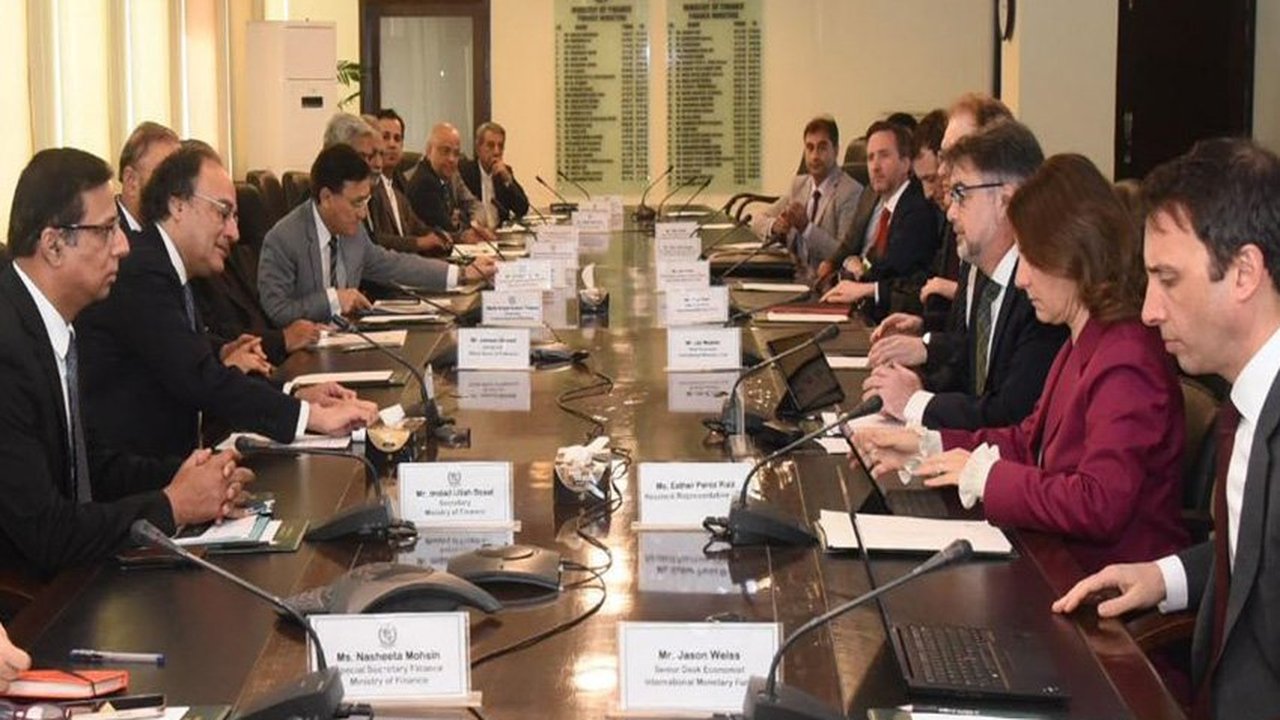
The IMF’s Executive Board completed Pakistan’s third review of its 37-month Extended Fund Facility (EFF) and second review of its Resilience and Sustainability Facility (RSF) on May 8, 2026, unlocking roughly $1.1 billion under the EFF and $220 million under the RSF, according to the IMF’s official statement. Total disbursements under both arrangements now stand at roughly $4.8 billion. Acting Chair Nigel Clarke credited Pakistan’s “strong program implementation” for supporting macroeconomic recovery and building resilience to shocks.
The Genuinely Good Numbers
By the IMF’s own account, the underlying data supports the assessment. GDP growth accelerated to an average of 3.8% year-on-year in the first half of FY26, driven by the auto, construction and garment industries, even accounting for flood disruption in July-August, according to the IMF’s staff report. Inflation, while ticking up to 7.3% year-on-year in March as commodity price pass-through hit domestic energy prices, remained within a broadly contained range, with core inflation at 7.6%. The current account was described as broadly balanced, and reserve rebuilding exceeded earlier projections — the State Bank of Pakistan projects reserves continuing to climb to roughly $18 billion by June 2026, according to analysis from the Islamabad Policy Research Institute.
The State Bank confirmed receipt of $1.3 billion from the IMF on May 12, 2026, according to CSS Prep’s policy analysis, which notes reserves had fallen to dangerously low levels in 2022-2023 before this recovery.
The External Risk the IMF Flagged Explicitly
The Fund’s own report is notably candid about downside exposure: under its April 2026 World Economic Outlook adverse scenario, the cumulative hit to Pakistan’s GDP from continued Middle East conflict could rise to around 1.5 percentage points by FY27, with inflation and the current account deficit each worsening by roughly 1.5-2.5 percentage points of GDP, according to the IMF’s staff country report. Given Pakistan’s reliance on imported energy, oil price volatility discussed in the IMF’s global outlook feeds directly into this specific country risk.
The Reform Question That Keeps Recurring
The structural policy conditions attached to this review read as familiar territory: sustaining fiscal consolidation, broadening the tax base, maintaining tight monetary policy to keep inflation within the State Bank’s target range, and advancing energy-sector reform — commitments the IMF’s own end-of-mission statement described as still “ongoing” rather than complete, per the IMF’s March 2026 mission statement.
A sharper framing comes from Pakistani policy analysts themselves: reforms that would genuinely break the IMF-program cycle — broadening the tax base to include agriculture and retail, ending energy subsidies, privatizing loss-making state-owned enterprises — impose concentrated, visible costs on politically organized interest groups, while the benefits of reversing those costs are diffuse and delayed, according to CSS Prep’s analysis. That political-economy imbalance, the analysis argues, consistently favors populist continuation of stabilization support over the structural reform that would end the need for it — a pattern this third review’s genuine macroeconomic progress doesn’t yet break.
Social Cost of the Adjustment
Pakistan’s poverty headcount rate rose to 25.3% in FY24, up sharply from 18.3% in FY22, driven by overlapping shocks from COVID, floods and inflation, according to the IMF’s staff report. The Benazir Income Support Programme (BISP) remains the primary social protection mechanism absorbing the distributional cost of IMF-mandated energy price increases and fiscal tightening — whether its scale is adequate remains, in the IMF’s own words, a live policy question rather than a settled one.
Discover more from The Economy
Subscribe to get the latest posts sent to your email.

High-CPM Finance Niches 2026: Publisher Monetization Blueprint

IMF & World Bank 2026 Global Economic Outlook: Growth, Inflation, Debt

Pork Recall 2026: USDA Guanciale Listeria Recall in 8 States Explained

Zelda: Ocarina of Time Switch 2 Remake — Release Date & Everything Confirmed

Social Security Trust Fund 2032: OASI Depletion Timeline Explained

Oracle (ORCL) Stock Analysis: AI Cloud Growth Ahead of Sept 10 Earnings

2027 Social Security COLA: 3.5% Increase Explained

Non-State Actors and AI 2026: The Push for Global Guardrails

Mandatory Lobbying Registers 2026: Corporate Risk Guide

Beyond $100 Oil: Why the Geopolitical Shock at Hormuz Marks a Structural Turning Point

Digitally Deliverable Services: 56% of Global Trade in 2026

AI Data Center Real Estate 2026: Power & Grid Battle Guide

Smart Glasses Privacy Crisis 2026: Regulation & Compliance

Refinance Options Amid the 2026 Global Debt Crisis and Shifting US Treasury Yields

State Farm’s $5B Dividend 2026: Who Qualifies & Payout Dates

US-China Relations in Q3 2026: Trade Tariffs and Supply Chain Risks

Gold’s Wild 2026: From a Record $5,600 Peak to a 24% Crash and Back Toward $4,500

Oil Surges as Strait of Hormuz Traffic Collapses Again

The Rocket That Won’t Quit: Inside SpaceX’s Falcon 9 Launch Machine

Bank of England Set to Hold Rates Through Year-End, Reuters Poll Shows

The 2026 Crypto Regulatory Shift: What It Means for Institutional Investors

SpaceX Starship Flight 14: First Orbital Attempt & Starlink V3 Launch Explained

Retail Earnings Week: What Home Depot, Target & Walmart Reveal

AI-Powered Training: The Next Multi-Billion Dollar Ecosystem in Fitness

China’s Economy Has a Structural Problem: Factories Are Winning, Households Are Losing

AI Chip Stocks 2026: The Best Semiconductor Investments Beyond Marvell

Russia’s Black Sea Oil Exports Fall for a Fifth Straight Week

Global Chip Selloff Deepens: What’s Driving the Aug. 19 Semiconductor Rout
-

 Markets & Finance8 months ago
Top 15 Stocks for Investment in 2026 in PSX: Your Complete Guide to Pakistan’s Best Investment Opportunities
-

 Analysis7 months ago
Johor’s Investment Boom: The Hidden Costs Behind Malaysia’s Most Ambitious Economic Surge
-

 Analysis7 months ago
Top 10 Stocks for Investment in PSX for Quick Returns in 2026
-

 Analysis7 months ago
Brazil’s Rare Earth Race: US, EU, and China Compete for Critical Minerals as Tensions Rise
-

 Banks8 months ago
Best Investments in Pakistan 2026: Top 10 Low-Price Shares and Long-Term Picks for the PSX
-

 Investment8 months ago
Top 10 Mutual Fund Managers in Pakistan for Investment in 2026: A Comprehensive Guide for Optimal Returns
-

 Global Economy9 months ago
15 Most Lucrative Sectors for Investment in Pakistan: A 2025 Data-Driven Analysis
-

 Global Economy9 months ago
Pakistan’s Export Goldmine: 10 Game-Changing Markets Where Pakistani Businesses Are Winning Big in 2025