Opinion
Pension reforms or financial massacre?

Since the announcement of Budget 2025-2026, the government employees in both centre and the provinces have been immersed in protest for their rightful demands such as Disparity Reduction Allowance (DRA), raise in Salaries given the prevailing inflation and old age benefits such as pension. Millions of employees belonging to various Departments under banner of the Sindh Employees Alliance (SEA) have been protesting in provincial headquarter Karachi and at Division level .
The heat, anger and frustration pervaded Sindh’s air in August. The same scene was repeated from Hyderabad to Nawabshah, from Badin to tiny towns nestled in the rural centre of the province: government workers locking up their offices, getting up from their desks, and taking to the streets. Teachers, clerks, revenue employees, and others who support the province’s operations were now raising slogans together against what they described as the “economic murder” of their future.
Some held handwritten signs, while others carried banners with bold slogans. At the edge of a rally, one of them, Razia Bibi, a primary school teacher with almost 30 years of experience, stood silently. “I taught generations; now I’m left with uncertainty,” was the simple message on her sign. The words spoke for themselves, so she didn’t have to yell. She and thousands of others felt that the government’s new pension regulations were a betrayal rather than merely a change in policy.
The Sindh Finance Department’s announcement of the Sindh Civil Servants (Defined Contribution Pension) Rules 2025 on August 21 served as the impetus for this unrest. The official justification was straightforward: a new system was required to make the pension bill sustainable because it had become too large for the provincial budget. For those impacted, however, the situation was much more chaotic. The old, guaranteed pension system will be replaced by one that is based on market fluctuations under the new regulations, which will be applicable to anyone hired or regularized after 1 July 2024.
A civil servant could retire under the previous arrangement knowing exactly how much they would get each month for the rest of their life. They were able to plan, dream, and feel safe because of that promise. That certainty is no longer there. Workers will be required to deposit 10 percent of their pay into a personal account, with the government contributing the remaining 12 percent. Private pension fund managers will invest the funds, and the ultimate distribution will be solely based on the performance of those investments. The pension may be sufficient if the markets perform well. That’s the retiree’s problem if they don’t.
Furthermore, the changes don’t end there. Even for those who are currently employed, benefits are being subtly reduced by changes to the West Pakistan Civil Services Pension Rules, 1963, which were announced along with the new programme. Instead of using final pay, which is a smaller amount, pensions will be calculated using the average of the last 24 months’ salary. After ten years, some dependents’ family pensions will expire. A person’s pension could be reduced by up to 10 percent if they decide to retire early.
These measures are about numbers for the government. They are about survival for workers. More than just a technical adjustment, the transition from a defined benefit to a defined contribution system involves a risk transfer. That risk was borne by the government under the previous system. The person does in the new one. And that risk feels like a loaded dice in a nation where salaries have only increased by 12 percent, inflation has recently risen above 200 percent, and many workers already make less than their counterparts in other provinces.
The wound is only made worse by the elimination of additional benefits for new hires, like group insurance and the Disparity Reduction Allowance. It creates a two-class system in which those hired after July 2024 must live with uncertainty while those hired before that time retain their guaranteed pensions. This division is destructive in addition to being unfair. It causes animosity, lowers morale, and deters young talent from choosing public service as a career in Sindh.
Amid fear of less pension and cut in pensionary benefits, thousands of teachers and other employees have opted for voluntary retirement before their superannuation being unsure about the future to escape financial loss. Until the promise of public service in Sindh is restored with dignity, that is a cause worth fighting for. Hence, it is believed by various public sector employees that instead of provision of DRA, Sindh Government has committed the financial massacre of employees in the guise of pension reforms.
The contrast with how elected officials are treated is even more painful. Low-paid employees are told to make sacrifices for the sake of fiscal restraint, while lawmakers continue to enjoy lavish benefits and allowances. Discussing shared hardship is challenging when the burden is so unequally divided.
The reaction has been quick. In support of their colleagues who were protesting, the Sindh Professors and Lecturers Association in Hyderabad observed a black day by donning armbands. Clerks in Sanghar staged a sit-in outside the office of the district commissioner. Revenue employees in Moro and Daur locked their offices and participated in protests calling for the reinstatement of job quotas for the surviving family members of deceased workers, a privilege that the new framework had taken away. Female educators have been particularly outspoken in rural areas. For many women, the only way to become financially independent is to work for the government. That independence is jeopardized in the absence of a stable pension.
Public services have already been interrupted by the protests. Thousands of students’ lessons have been delayed as a result of school closures. In many offices, administrative work has slowed or ceased. It is difficult to overlook the irony: the government has incited unrest that is undermining the very services it purports to protect in the name of preserving the province’s finances.
There are alternative paths. Employees would have a stronger foundation for their retirement savings if the government increased its contribution to the new pension plan to at least 15 percent or 20 percent. It could link pensions to inflation to maintain their value over time and guarantee a minimum pension amount, preventing any retiree from falling into poverty. It could address corruption in procurement and budgeting, reduce unnecessary spending elsewhere, and enhance pension fund management. By taking these actions, financial issues would be resolved without fully burdening workers.
Above all, the government could speak with those whose lives these policies are changing. In a ledger, civil servants are more than just numbers. They are the health professionals who work in distant clinics, the teachers who open young minds, and the clerks who keep the government’s machinery running. Their efforts serve as the cornerstone for the province’s future. The services they offer are compromised when their security is compromised.
There is more to the August 2025 protests than just a response to one policy. They serve as a warning, an indication that public employees will not stand by and watch their rights being taken away. They also serve as a reminder of the annoyance that has been brewing for years due to low income, growing expenses, and a feeling of being ignored. Ignoring this puts the government at risk for both ongoing instability and a long-term drop in the calibre and stability of its workforce.
Reforming pensions is not always bad. Numerous nations have had to modify their systems to take into account shifting economic conditions and demographic trends. However, reform needs to be transparent, equitable, and aimed at preserving the honour of those who have dedicated their professional lives to serving the public good. It shouldn’t serve as an excuse to cut costs at the expense of the most vulnerable. That test is not met by the Sindh Defined Contribution Pension Rules 2025 as they currently stand. They remove guarantees without providing sufficient safeguards. Employees are separated into winners and losers. They make retirement a question mark instead of a promise.
Now, the Sindh government must make a decision. It may continue, resulting in short-term cost savings but long-term instability and mistrust. Alternatively, it can pay attention to the voices on the streets, accept the justifiable concerns of its workers, and seek a solution that strikes a balance between social justice and financial responsibility. Although it will be more difficult, the second route is the only one that pays tribute to the sacrifices and service of those who keep this province running.
Pensions are ultimately about more than just money. They are about acknowledgment— a means by which society can tell its public servants, “Your work was important, and we won’t leave you in your old age.” A generation-old bond of trust would be broken if that were taken away. Fairness, respect, and the freedom to retire fearlessly were the main concerns of the August 2025 protests, which went beyond financial figures. Until the promise of public service in Sindh is restored with dignity, that is a cause worth fighting for.
Amid fear of less pension and cut in pensionary benefits, thousands of teachers and other employees have opted for voluntary retirement before their superannuation being unsure about the future to escape financial loss. Until the promise of public service in Sindh is restored with dignity, that is a cause worth fighting for. Hence, it is believed by various public sector employees that instead of provision of DRA, Sindh Government has committed the financial massacre of employees in the guise of pension reforms.
Discover more from The Economy
Subscribe to get the latest posts sent to your email.



Introduction
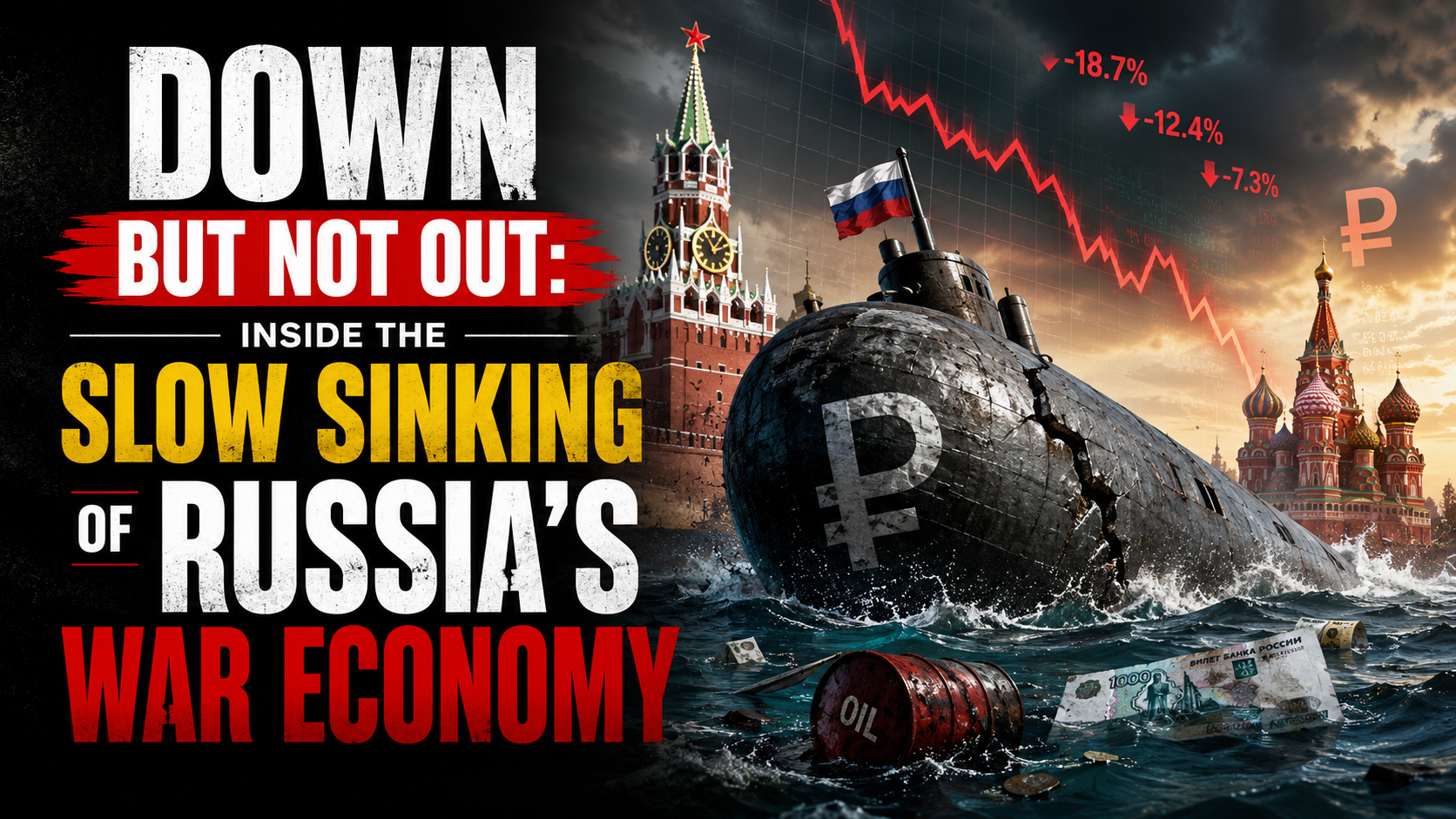
The European Council formally extended its economic sanctions against Russia for another full year on 25 June 2026, keeping restrictive measures in place until 31 July 2027 (Council of the EU). More than four years into the war, the headline story of Russia’s economy has shifted from whether sanctions would work to a more nuanced question: how much longer can the Kremlin keep financing the war before the accumulated strain becomes impossible to hide behind favorable official statistics.
The Sanctions Architecture, Renewed Again
The EU’s economic measures against Russia, first introduced in 2014 and dramatically expanded after the February 2022 full-scale invasion, now span trade, finance, energy and dual-use technology restrictions, alongside asset freezes and travel bans on a broad range of individuals and entities (Council of the EU). Since February 2022, the EU has adopted 20 separate sanctions packages, and the European Council has explicitly stated it remains determined to keep weakening Russia’s war economy by further reducing its energy revenues, curbing shadow-fleet oil shipping operations and constraining its banking system (Council of the EU). Separately, on 3 July 2026 the EU sanctioned six individuals connected to the poisoning and death of opposition figure Alexei Navalny, underscoring that the sanctions regime continues to expand on human-rights grounds as well as economic ones (Council of the EU Sanctions Timeline).
The Headline Numbers Beijing-Style Optimism Can No Longer Explain Away
Russia’s GDP is now put at roughly $2.51 trillion, the world’s eleventh-largest economy — comparable in size to South Korea despite Russia’s vastly larger landmass and resource base — with 2026 growth projected at just 1.0% and inflation running at 5.2% (Statistics of the World). More pessimistic estimates put full-year 2026 growth even lower, at around 0.4%, which would be worse than 2025’s already-weak 1% expansion and would mark a sharp deceleration from the 4.1% growth Russia posted in 2023 as it forged new trading relationships to route around initial sanctions (Forbes).
Oil and gas revenues — historically around half of Russia’s state income — have fallen to roughly a quarter, a deliberate outcome of Western sanctions strategy that targets how much Russia earns from exports rather than blocking those exports outright (Stockholm School of Economics/SITE). Russia’s oil and gas budget revenues reportedly halved in January 2026 alone, with crude prices falling below $73 a barrel before the Middle East conflict briefly reversed the trend, sending Brent surging more than 55% to near $120 a barrel at its peak (Forbes).
The Middle East War: A Temporary Lifeline With Long-Term Costs
The spike in oil prices tied to the Iran conflict, combined with a period of eased US sanctions enforcement on Russian oil under President Trump, offered Moscow unexpected fiscal breathing room in mid-2026 (Forbes). But that same conflict has undermined Russia’s longer-term energy diversification ambitions in the region: two Russian-backed power plant projects in Iran have been put on hold, along with oil and gas exploration work and plans to build new transit routes linking Russia to India via Iran (Forbes).
The Gap Between Official Statistics and Underlying Reality
Perhaps the most important analytical point from recent research is not about any single data point but about the reliability of Russian statistics themselves. Torbjörn Becker of the Stockholm Institute of Transition Economics has argued the real test of sanctions is not whether they end the war overnight, but how much they erode the Kremlin’s capacity to finance it — and by that measure, the evidence points to deeper strain than headline GDP figures suggest (Stockholm School of Economics/SITE). Becker notes that Russia’s economy grew only modestly in 2022 despite oil prices rising sharply that year — a gap between expected and actual performance that implies a considerably larger hidden economic hit than the official contraction figures showed (Stockholm School of Economics/SITE). Compounding the problem, Russian authorities have stopped publishing several key statistics since 2022, making independent assessment of inflation, consumption and real economic conditions increasingly difficult — leading Becker to conclude that “statistics have become part of the narrative” rather than a neutral measure of economic reality (Stockholm School of Economics/SITE).
The Military-Civilian Economic Split
A recurring theme across recent analysis is the growing bifurcation between Russia’s overheating military-industrial sector and a stagnating civilian economy. This imbalance has pushed interest rates higher and forced the liquidation of a striking 71% of Russia’s gold reserves to help fund continued war spending (Forbes). Russia’s total fossil fuel export revenue is estimated at roughly €734 million per day, underscoring just how central hydrocarbon income remains to the entire war financing model even as that revenue stream shrinks (Forbes).
The Counter-Narrative: Wages Still Rising
It would be inaccurate to describe Russia’s economy as in freefall. CSIS research notes that Russian salaries rose 17.8% in nominal terms and 8.7% in real terms in 2024 compared to 2023, with disposable incomes up 6.1% in 2023 and 7.3% in 2024 — growth rates not seen in Russia in almost two decades (CSIS). Government budget projections still expect real salaries to rise, albeit at a decelerating pace: 7% in 2025, 5.7% in 2026 and 4.1% in 2027 — a marked slowdown from the 2024 peak but still roughly double the pre-invasion decade average (CSIS). This wage growth, driven substantially by wartime labor shortages and military-adjacent spending, is precisely the kind of headline-stabilizing data point that has allowed Putin to argue publicly that sanctions have failed to cripple his economy (Fortune) — even as think tanks describe the broader trajectory as pushing Russia toward what one report calls an “economic, political, and military abyss” (Fortune).
What Comes Next
Renewed legislative pressure in Washington — including the Sanctioning Russia Act introduced with strong bipartisan support — signals appetite in the US for tightening the screws further, even as the loss of a key congressional champion for that effort has complicated the political path forward (TIME). Whether the EU’s renewed sanctions regime, continued oil price pressure, and constrained reserves ultimately force a shift in Kremlin calculus toward negotiation remains the central open question for 2027.
Key Takeaways
- The EU has extended Russia sanctions for a further year, through 31 July 2027, continuing a regime built from 20 separate packages since 2022.
- Russia’s 2026 GDP growth is forecast between 0.4% and 1.0%, a sharp deceleration from 2023’s 4.1% post-shock rebound.
- Oil and gas revenue’s share of Russian state income has fallen from roughly half to about a quarter as Western sanctions target export earnings specifically.
- Russia has liquidated a large share of its gold reserves to sustain war financing amid a widening split between an overheating military sector and a stagnating civilian economy.
- Official Russian statistics likely understate the true economic strain, according to independent economists who cite a widening gap between reported and expected performance.
Sources: Council of the EU, Council of the EU Sanctions Timeline, Stockholm School of Economics/SITE, Forbes, Statistics of the World, CSIS, Fortune, TIME
Discover more from The Economy
Subscribe to get the latest posts sent to your email.
The Federal Reserve’s independence faces its most serious test in decades: a Justice Department investigation into Chair Jerome Powell over building-renovation costs, a Supreme Court case over Trump’s attempt to fire Governor Lisa Cook, and an incoming chair nomination openly tied to Trump’s demand for rates cut “by a lot” — all unfolding as the Fed tries to keep monetary policy decisions separate from the White House.
An institutional crisis hiding inside a rate-cut story
Most financial coverage this year has framed the Federal Reserve story as a simple tug-of-war over interest rates. That framing understates what is actually happening: a structural challenge to the 111-year-old convention that US monetary policy sits outside presidential control — a convention every advanced economy has treated as a prerequisite for market credibility.
The three fronts of the fight
1. The Powell investigation. In January, federal prosecutors served grand jury subpoenas tied to Powell’s congressional testimony about roughly $2.5 billion in cost overruns on the Fed’s headquarters renovation. Powell called the inquiry a “pretext” for punishing the central bank for not cutting rates as quickly as the administration wants, and warned it should be viewed “in the broader context of the administration’s threats and ongoing pressure” on the institution (CNBC). Every living former Fed chair signed a joint statement calling the probe an unprecedented attempt to use prosecutorial pressure to undermine central bank independence (NBC News).
2. The Lisa Cook case. The Supreme Court has separately taken up whether Trump can remove Fed Governor Lisa Cook over mortgage-fraud allegations she denies — a case with direct bearing on whether a president can reshape the Fed’s voting board outside the normal confirmation process (Euronews).
3. The succession fight. Trump has said publicly that Powell’s replacement — due when his term as chair ends in 2026 — should be someone who “believes in lower interest rates, by a lot” (Bloomberg). Analysts note this is a break from decades of precedent in which presidents, whatever their private preferences, avoided direct pressure on the Fed’s leadership pipeline.
Why markets are watching the mechanics, not just the rhetoric
It’s worth noting a structural check that has received less attention than it deserves: the Fed chair casts only one of twelve votes on the Federal Open Market Committee. Appointing a more compliant chair does not, by itself, guarantee the rate cuts Trump wants — any change still requires majority support across the full committee (CBS/AOL).
That has not stopped the market repricing. Following Powell’s Jackson Hole remarks suggesting the Fed could act if the labour market kept weakening, traders moved to price an 85% probability of a September rate cut, sending the S&P 500, Nasdaq and Dow higher while the dollar index and Treasury yields fell — a reaction some economists read as evidence that political pressure is already bleeding into policy expectations, independent of the FOMC’s actual vote (Barchart).
At the same time, inflation data complicates the picture for anyone expecting an easy capitulation. The Fed’s preferred inflation gauge, the PCE price index, sat at 2.8% year-over-year as of November — still above the Fed’s 2% target — while the FOMC’s December dot plot showed a more cautious rate path than markets had previously expected, with the median policymaker view placing the federal funds rate in the low-to-mid 3% range by the end of 2026 (CNBC).
Why it matters beyond the US
Central bank independence is not a purely domestic US concern. The dollar’s role as the world’s reserve currency, and Treasury yields’ function as the global risk-free benchmark, mean that any erosion in perceived Fed independence has second-order effects on borrowing costs from London to Karachi. Emerging-market central banks — including the State Bank of Pakistan and Bank Indonesia — routinely calibrate their own policy against expected Fed moves; a Fed seen as politically compromised makes that calibration harder and potentially more volatile for every economy that prices debt off US Treasuries.
RSM chief economist Joe Brusuelas has predicted Powell will use his public platform to mount “an erudite but accessible defense of central bank independence” at upcoming FOMC press conferences — a sign that Fed leadership itself views the institutional question, not just the rate decision, as the story that matters (AOL/CBS).
What to watch next
- Whether the DOJ investigation into Powell produces formal charges or fizzles amid criticism of its timing
- The Supreme Court’s ruling on the Cook removal case, which could set precedent for presidential authority over independent agency officials generally
- Trump’s formal nomination for the next Fed chair, and how openly that nominee campaigns on a specific rate target
- Whether the FOMC’s committee-based voting structure continues to act as a moderating check regardless of who chairs the meetings
The rate-cut headlines will keep coming. The more consequential story is whether the institutional guardrails around the Fed — designed explicitly to keep monetary policy insulated from electoral cycles — hold through 2026.
Discover more from The Economy
Subscribe to get the latest posts sent to your email.
Most headlines on Russia’s economy in July 2026 focus on the latest sanctions package or oil price cap negotiation. The more important story is structural: the model Russia has used to fund its war for four years is showing real signs of running out of road.
The core finding
A research brief from the Center for Strategic and International Studies (CSIS) argues Putin is pushing Russia toward an “economic, political, and military abyss,” according to Fortune. While Russia’s economy remains large — roughly $2.6 trillion — growth is slowing and shrinking on a quarterly basis, with 2026 growth projected at just 0.4%, worse than 2025’s 1% growth, which itself narrowly avoided recession.
Analysts describe Russia’s approach as a form of “military Keynesianism” — the state investing heavily in militarizing the economy while extending financial support to households affected by the war. But per Fortune’s reporting, “after more than four years of war, that well is running dry.” Russia’s fiscal reserves are dwindling, and 71% of the country’s gold reserves have been liquidated to sustain spending.
The number that matters most: oil and gas budget share
The most underreported data point here: the share of oil and gas receipts in Russia’s federal budget revenue fell to just 23% in 2025 — the lowest share in two decades — according to the Oxford Institute for Energy Studies, cited by Fortune. To compensate, Russia has turned to expansive taxation, including raising VAT from 20% to 22% — a move that has proven unpopular domestically.
This matters because Russia’s economy has historically been described, correctly, as fossil-fuel dependent — with oil and gas taxation making up 44% of federal revenues in the decade before the Ukraine invasion, and still around 24.5% over the first three quarters of 2025, according to a Brookings Institution analysis. A further slide to 23% signals the sanctions and diversification pressure are compounding, even as Russia continues finding workarounds through its “shadow fleet.”
The Iran-war reprieve was temporary — and it’s over
The Iran war offered Russia a brief lifeline: Brent crude surged more than 55% at its peak, nearing $120 a barrel, after President Trump eased some sanctions on Russian oil, per Fortune. But that chaos also undermined Russia’s own long-term energy and infrastructure projects in the Middle East — two Russian-linked power plants in Iran were put on hold, along with oil and gas exploration and plans to link Russia to India via Iran through new transit routes. Since then, oil prices have normalized as demand softened and the Strait of Hormuz reopened, removing that temporary cushion.
The sanctions escalation now in motion
The pressure is intensifying on multiple fronts simultaneously. US senators unveiled a sweeping bipartisan Russia sanctions bill in mid-July, which would impose mandatory sanctions on Russian political and military leaders including President Putin, and up to a 100% tariff on the top five countries — including China and India — that purchase Russian crude oil and natural gas, according to CNN. Separately, the EU has been racing to avoid an automatic upward revision of its Russian oil price cap, which would otherwise jump from $44.10 to roughly $58 per barrel if a new sanctions package wasn’t agreed by July 15, per Euronews.
Analysis from the Center for European Policy Analysis notes the outcome depends heavily on whether India and China accept the risk of secondary sanctions: “If China stands firm, Moscow’s dependence on Beijing deepens,” per CEPA. If Russian seaborne oil exports were to fall to near-zero, the budget would lose roughly a quarter of its revenue — an extreme but non-trivial scenario given the pace of legislative and diplomatic pressure building in July 2026.
Why this matters beyond Russia
For countries positioned between Western sanctions regimes and continued Russian energy purchases — including India, and by extension trade partners like Pakistan whose remittance and trade flows intersect with Gulf and South Asian energy markets — the trajectory of Russia’s budget dependency and the secondary-sanctions risk attached to its buyers is a live variable, not a settled one. A further deterioration in Russia’s oil-and-gas revenue share would likely accelerate Moscow’s reliance on China specifically, reshaping regional energy-trade alignments well beyond the Russia-Ukraine conflict itself.
FAQ
What percentage of Russia’s federal budget comes from oil and gas? 23% in 2025 — the lowest share in two decades, according to the Oxford Institute for Energy Studies.
What is Russia’s projected GDP growth for 2026? 0.4%, according to CSIS research cited by Fortune — down from 1% growth in 2025.
What is “military Keynesianism” in the context of Russia’s economy? A term analysts use to describe Russia’s strategy of heavy state investment in militarizing the economy alongside financial support for war-affected households, functioning as a form of stimulus that is now showing signs of fiscal strain.
Discover more from The Economy
Subscribe to get the latest posts sent to your email.

Global Central Banks 2026: Fed, BoE and BoJ Decisions Could Reshape Markets

Gulf Capital Retreat From Pakistan 2026: UAE Loan Freeze & What It Means

Pakistan’s Most Reliable Export Is Its People: Remittances Hit $41.6 Billion, Overtaking Total Exports

Indonesia’s Confidence Problem: Record Investment, a Sinking Rupiah, and a Widening Credibility Gap

Down But Not Out: Inside the Slow Sinking of Russia’s War Economy

China’s Growth Slips to a Four-Year Low: Why Beijing Still Won’t Pull the Stimulus Trigger

The Johor-Singapore Corridor: How Malaysia Became Southeast Asia’s AI Infrastructure Powerhouse

Canada’s Economy ‘On Pause’: Inside the CUSMA Deadline That Passed Without a Deal

Dubai’s Millionaire Magnet: How the UAE Turned Middle East Turmoil Into a Capital Safe-Haven Boom

Britain’s Sixth Prime Minister in a Decade: What Starmer’s Exit Means for Gilts, Sterling and Your Portfolio

Anthropic Offers Up to $600,000 Salary for Critical IPO Role as AI Giant Prepares for Wall Street Debut

EU Readies Crisis Team for Potential China Rare Earths Stand-Off as Supply Chain Risks Mount

Singapore Weighs Hedge Fund Tax Cuts to Counter Hong Kong’s Growing Financial Challenge

Facebook and Instagram Experience Global Outage

Carry Trade Unwind 2026: How the Yen’s Snapback Triggered a Global Margin Call

AI Bubble Warning 2026: Why BIS, IMF and Bank of England Fear a Market Crash

BRICS De‑Dollarization Strategy Takes Shape with $15 Billion Local‑Currency Push

Male Labor Force Participation Rate 2026: Why Men Are Leaving & Economic Impact

The AI Super Bubble Is Ready to Burst

Russia Bans Diesel Exports 2026: Global Fuel Market Impact Explained

Strait of Hormuz Blockade 2026: Oil Prices Surge 9% as US-Iran Conflict Reignites

Private Credit Warning: Most BDCs Turn Unprofitable in 2026, Reuters Finds

IMF Cuts Pakistan Growth Forecast, Raises Inflation to 8.4%

Bitcoin $150k Milestone Achieved as US Sovereign Crypto Pivot Looms
Gulf Capital Retreat From Pakistan 2026: UAE Loan Freeze & What It Means

India Economic Rise 2026: How the Subcontinent Toppled Japan

Strait of Hormuz 2026: Why Markets Still Don’t Trust It’s Open

Argentina Economy 2026: Milei’s Fiscal Surplus, Inflation Drop to 29%, and What Comes Next
-

 Markets & Finance7 months ago
Top 15 Stocks for Investment in 2026 in PSX: Your Complete Guide to Pakistan’s Best Investment Opportunities
-

 Analysis5 months ago
Johor’s Investment Boom: The Hidden Costs Behind Malaysia’s Most Ambitious Economic Surge
-

 Analysis5 months ago
Top 10 Stocks for Investment in PSX for Quick Returns in 2026
-

 Analysis6 months ago
Brazil’s Rare Earth Race: US, EU, and China Compete for Critical Minerals as Tensions Rise
-

 Banks6 months ago
Best Investments in Pakistan 2026: Top 10 Low-Price Shares and Long-Term Picks for the PSX
-

 Investment7 months ago
Top 10 Mutual Fund Managers in Pakistan for Investment in 2026: A Comprehensive Guide for Optimal Returns
-

 Global Economy7 months ago
15 Most Lucrative Sectors for Investment in Pakistan: A 2025 Data-Driven Analysis
-

 Global Economy7 months ago
Pakistan’s Export Goldmine: 10 Game-Changing Markets Where Pakistani Businesses Are Winning Big in 2025