
Business
Stock Market Today: Wall Street Rallies Ahead of Fed Decision as Big Tech Earnings Loom

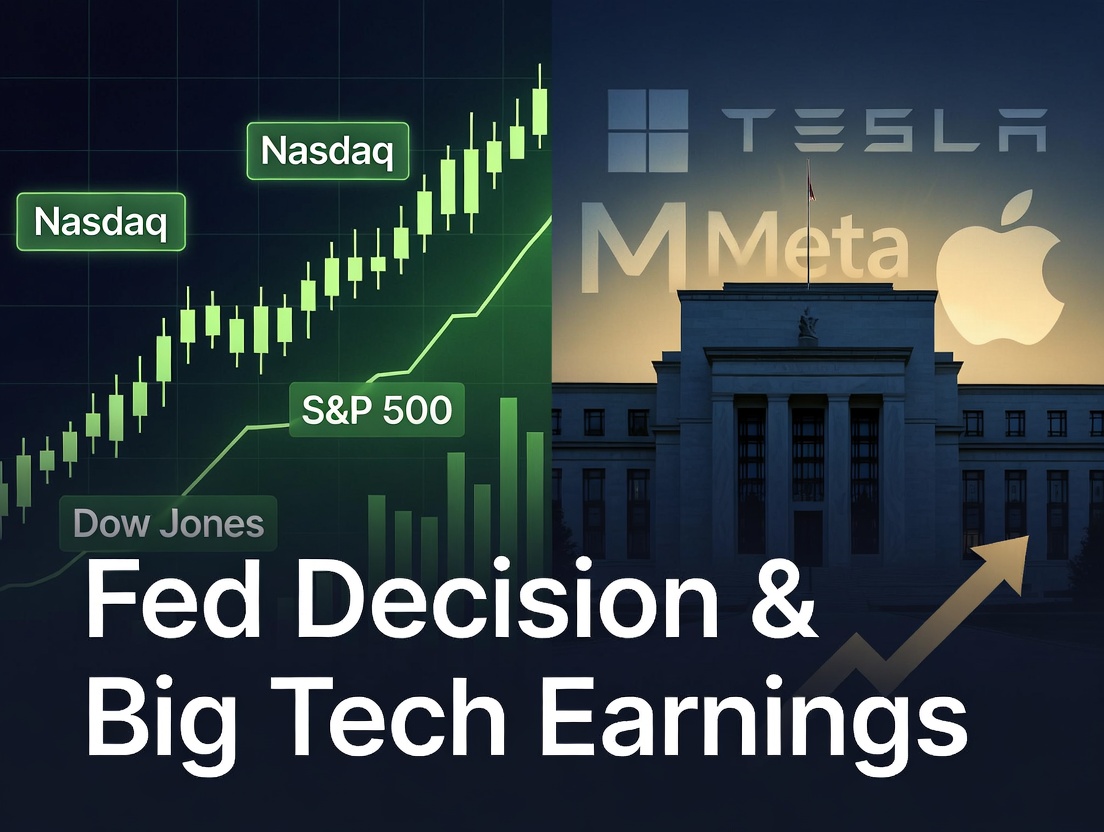
Wall Street opened Wednesday with cautious optimism, as investors positioned for a consequential convergence of monetary policy and corporate earnings that could define the market’s trajectory for months to come. Nasdaq 100 futures rose about 0.5% Yahoo Finance, leading the advance, while S&P 500 futures inched up 0.2% Yahoo Finance. The technology-heavy surge offered a counterpoint to Dow futures, which struggled near the flatline amid sector-specific pressures.
The stock market today reflects a delicate balancing act. The S&P 500 notched a record close on Tuesday of 6,978 Yahoo Finance, placing the benchmark index tantalizingly close to the psychological 7,000 threshold. Yet beneath this surface strength lies a web of uncertainties that few earnings seasons have had to navigate simultaneously: a Federal Reserve caught between political pressure and institutional independence, trillion-dollar questions about artificial intelligence returns, and the specter of policy upheaval at the world’s most powerful central bank.
The Fed Decision: Politics Meets Monetary Policy
Wednesday afternoon’s Federal Reserve announcement marks the central bank’s first rate decision of 2026, and the stakes extend well beyond the expected outcome. CME Group’s Fedwatch tool indicates a 97.2% probability that the Fed will maintain interest rates at the current 3.5% to 3.75% range Stocktwits, effectively pausing the easing cycle that delivered three consecutive quarter-point cuts in the final months of 2025.
The pause itself is unremarkable. What transforms this meeting into a pivotal moment is the extraordinary political backdrop. Earlier this month, the Justice Department served the Fed with subpoenas over testimony Powell made before Congress related to the $2.5bn renovation of the central bank’s headquarters Al Jazeera. In a rare video statement, Powell characterized these moves as pretexts designed to undermine the Fed’s independence, declaring that the threat of criminal charges stemmed from the central bank setting rates based on economic assessment rather than presidential preferences.
The tension between the White House and the Fed has been simmering for months. President Trump has repeatedly called for lower interest rates, even as inflation remains elevated above the Fed’s two percent target. Markets currently expect the Fed to cut once or twice this year — most likely in June and December, according to futures market pricing CNBC. That measured approach stands in sharp contrast to the administration’s more aggressive stance, creating what some economists describe as the most fraught period for central bank independence in modern American history.
According to CNBC, Chair Powell’s press conference will likely become a referendum on Fed autonomy as much as a policy briefing. The question hanging over Wednesday afternoon is whether Powell can navigate this political minefield while maintaining the institutional credibility that underpins effective monetary policy.
Big Tech Earnings: The AI Reckoning Begins
While the Fed commands immediate attention, the real test for equity markets arrives after the closing bell. Microsoft, Meta Platforms, and Tesla report fourth-quarter results Wednesday evening, followed by Apple on Thursday. Collectively, these technology behemoths will provide the first comprehensive read on whether the extraordinary capital expenditures flowing toward artificial intelligence infrastructure are beginning to generate commensurate returns.
The numbers tell a sobering tale of investor expectations. For Microsoft, the expectation is of $3.88 per share in earnings on $80.2 billion in revenues, representing year-over-year growth rates of +20.1% and +15.2% Yahoo Finance. Yet the stock has underperformed recently, pressured by concerns about margin compression as AI-related spending accelerates. Analysts polled by FactSet expect capex to rise to $99 billion this fiscal year CNBC, up substantially from prior periods.
Meta faces perhaps the most acute scrutiny. Analysts expect $8.15 per share in earnings on $58.4 billion in revenues, representing year-over-year growth rates of +1.6% and +20.7% Yahoo Finance. The modest earnings growth belies massive investments in AI and the metaverse. When Meta last reported in October, the stock tumbled despite solid fundamentals, a reaction driven entirely by elevated spending guidance. Investors want clarity on when these investments translate into bottom-line results.
Tesla’s position is equally precarious. The electric vehicle maker faces headwinds from increased competition and margin pressure in its core automotive business, even as it advances autonomous vehicle technology. Apple, meanwhile, must demonstrate that its iPhone supercycle thesis remains intact while addressing questions about its own AI strategy and capital allocation.
Bloomberg reports that the four hyperscalers — Microsoft, Meta, Alphabet, and Amazon — are expected to boost capital expenditures to over $470 billion in 2026 from approximately $350 billion in 2025. That represents an investment surge of historic proportions, predicated on the assumption that artificial intelligence will fundamentally reshape the technology landscape. Whether that thesis proves correct may hinge on the guidance these companies provide this week.
Market Breadth and Underlying Dynamics
The divergence in Wednesday’s pre-market action speaks to broader market tensions. While technology shares lifted Nasdaq futures, the Dow struggled under the weight of sector-specific disappointments. UnitedHealth’s shares tumbled over 15% Yahoo Finance after the Trump administration announced it would keep Medicare payment rates steady, triggering a broader retreat across healthcare insurers.
This uneven performance reflects a market grappling with rotating leadership and uncertain catalysts. The S&P 500’s record close Tuesday marked impressive resilience, yet that strength remains concentrated in a narrow cohort of stocks. The Magnificent Seven technology giants, which once powered market gains with seemingly effortless momentum, have lagged the broader market over the trailing twelve months. Their collective performance through this earnings season will likely determine whether market breadth finally expands or concentration intensifies.
The Path Forward: Scenarios and Implications
As Wednesday’s events unfold, three distinct scenarios emerge. In the first, Powell delivers a dovish hold, signaling patience on rates while emphasizing the Fed’s data-dependent approach. Big Tech earnings meet or exceed expectations, with management teams providing credible paths to AI monetization. Markets rally on reduced uncertainty, and the S&P 500 pushes decisively above 7,000.
The second scenario is less benign. Powell’s press conference devolves into repeated questions about political pressure, undermining confidence in Fed independence. Tech earnings disappoint, or worse, guidance points to continued spending without clear revenue visibility. Volatility spikes as investors reassess both policy support and growth assumptions.
The third possibility splits the difference: The Fed maintains its cautious stance successfully, but tech earnings prove mixed, with some companies demonstrating AI progress while others struggle. Markets digest the results without dramatic moves, entering a period of consolidation as investors await more data.
What seems increasingly clear is that 2026 will test market resilience in ways that 2025’s concentrated leadership never fully addressed. The stock market today stands at an inflection point, caught between political uncertainty, technological transformation, and the timeless challenge of valuation. How these forces resolve may well determine whether this year’s market narrative proves triumphant or cautionary.
Discover more from The Economy
Subscribe to get the latest posts sent to your email.


Markets & Finance
Presidential Stock Market Performance: How Trump’s Second Term Compares to History
Executive Summary: Since the November 5, 2024, presidential election, the U.S. stock market has navigated trade policy shifts, fluctuating tariff structures, and shifting interest rate expectations. Despite a sharp ~20% drawdown in early 2025, the S&P 500 generated a total return of 36.0% through September 2026, according to performance tracking from U.S. Bank Wealth Management.
While headline figures show strong market resilience, understanding how this performance ranks against modern predecessors—including Joe Biden, Barack Obama, Bill Clinton, and Ronald Reagan—requires examining underlying corporate earnings, market breadth, and Federal Reserve policy dynamics.
Historical Benchmark: S&P 500 Returns Across Modern Administrations
To accurately compare presidential stock market records, performance must be evaluated across full 4-year terms alongside cumulative mid-term benchmarks. Historical index data compiled by S&P Dow Jones Indices and analyzed by Schroders Investment Management shows that markets have historically trended upward regardless of party affiliation, averaging an annual total return of over 12% since 1946.
| Administration & Term | Period | S&P 500 Total Return (4-Year) | Cumulative 22-Mo. Benchmark | Primary Market Driver / Context |
|---|---|---|---|---|
| Ronald Reagan (Term 2) | 1985–1988 | +91.8% | +32.4% | Post-inflation recovery & 1980s tax restructuring |
| Bill Clinton (Term 1) | 1993–1996 | +88.6% | +21.2% | Early tech adoption & productivity boom |
| Bill Clinton (Term 2) | 1997–2000 | +88.6% | +48.1% | Dot-com expansion |
| Barack Obama (Term 1) | 2009–2012 | +85.1% | +41.5% | Post-Global Financial Crisis market rebound |
| Donald Trump (Term 1) | 2017–2020 | +81.3% | +24.8% | Tax Cuts and Jobs Act of 2017 & deregulation |
| Joe Biden | 2021–2024 | +66.3% | +18.4% | Post-pandemic stimulus & Tech/AI mega-cap surge |
| Barack Obama (Term 2) | 2013–2016 | +52.9% | +28.6% | Steady economic expansion & low interest rates |
| Donald Trump (Term 2) | 2025–2026 (In Progress) | N/A | +36.0% | Corporate earnings growth, domestic energy, & tech resilience |
Core Drivers of the 2025–2026 Equity Rally
1. Fundamental Earnings Growth Beat Expectations
Unlike market cycles driven purely by price-to-earnings (P/E) valuation expansion, the equity gains during 2025 and 2026 have been anchored in corporate earnings execution. S&P 500 second-quarter revenue grew over 16% year-over-year, while quarterly earnings surged 53%, more than doubling initial Wall Street forecasts. Third-quarter projections compiled by research teams at Bloomberg indicate sustained top-line revenue growth near 12% and earnings growth of 28%.
2. Market Rotation and Small-Cap Expansion
A notable divergence in Trump’s second term compared to earlier cycles is the broadening of market participation beyond mega-cap technology companies (“The Magnificent Seven”):
- Small-Cap Performance: The Russell 2000 and broader small-cap indices surged 60%+ from their April 2025 lows through September 2026.
- Sector Diversification: Financials, domestic industrials, and energy sectors saw accelerated inflows following regulatory easing and domestic energy development policies.
3. Institutional Volatility and Unprecedented Portfolio Activity
The market landscape in 2025 and 2026 has been marked by high policy-driven volatility. Disclosures analyzed by CBS News Financial Analysis and reporting from Reuters revealed unprecedented trading volume within executive investment accounts, executing thousands of transactions across defense, technology, real estate, and energy sectors during key legislative shifts.
Stay Ahead of the Markets
Subscribe to our free daily newsletter for institutional-grade analysis on how macroeconomic policies impact your portfolio.
Macro Economic Headwinds: Rates, Debt, and Inflation
While stock indices sit near historic highs, structural macroeconomic challenges remain. Here is a snapshot of the current macroeconomic realities:
- Elevated Federal Debt Costs: Data from the Federal Reserve Bank of St. Louis (FRED) highlights that the average interest rate on marketable U.S. Treasury debt climbed to 3.44%, compared to 1.42% in 2022. This elevation increases federal debt service obligations as maturing Treasury notes are refinanced at higher prevailing yields.
- Consumer Spending Shifts: Retail sales grew 5.0% year-over-year, though monthly momentum slowed. Wage growth at 3.2% provides ongoing income expansion but remains closely balanced against cumulative consumer price levels.
Analytical Summary: Wall Street vs. White House Context
Historical market analysis published by Morgan Stanley demonstrates that political leadership is only one of many variables driving long-term equity returns. Key takeaways for investors include:
- Policy vs. Fundamentals: Short-term market swings frequently respond to trade declarations, tariffs, and executive actions, but multi-year equity performance remains dictated by corporate earnings, cash flows, and monetary policy.
- Divided Government Advantages: Historically, markets under both Democratic and Republican presidents have posted above-average gains during periods of divided congressional control, which tends to limit radical fiscal shifts.
- Portfolio Discipline: Rebalancing asset allocations and maintaining broad sector diversification remains the primary protection against political and geopolitical market cycles.
What are your thoughts on the market’s response to recent trade policies? Share your perspective in the comments below, or check out our detailed breakdown of sector-by-sector performance in 2026.
Discover more from The Economy
Subscribe to get the latest posts sent to your email.
When the benchmark 10-year U.S. Treasury yield crosses the 5.0% threshold, financial markets undergo a structural paradigm shift. Far beyond a routine spike in borrowing costs, a 5% yield alters the hurdle rate for global capital, re-prices risk across every asset class, and exposes systemic sovereign debt fragilities.
1. The 5.0% Benchmark: Why the “Risk-Free” Rate Reshapes Equities
The 10-year U.S. Treasury note is the foundational anchor of global finance. Its yield represents the risk-free rate ($R_f$) utilized in the Capital Asset Pricing Model (CAPM) and Discounted Cash Flow (DCF) models worldwide.
When $R_f$ rises from 2%–3% to over 5%, the present value of future corporate earnings contracts exponentially.
$$\text{Present Value} = \sum_{t=1}^{n} \frac{CF_t}{(1 + WACC)^t}$$
As the Weighted Average Cost of Capital ($WACC$) climbs alongside Treasury yields:
- Growth Stocks & Big Tech: Long-duration growth equities—where the majority of projected cash flows sit far in the future—suffer the sharpest valuation multiple compressions.
- Equity Risk Premium (ERP) Squeeze: With risk-free Treasury bills yielding 5%, the additional premium required to hold volatile equities shrinks dramatically, prompting institutional capital to migrate from stocks to bonds.
- Corporate Liquidity Crunch: Corporate debt refinancing costs double or triple compared to pre-2022 issuance levels, directly eroding net profit margins reported to the U.S. Securities and Exchange Commission.
2. Macroeconomic Catalysts: What Is Driving the Bond Sell-Off?
The surge to 5%+ yields is driven by three primary structural forces rather than a single economic data point:
┌─────────────────────────────────────────────────────────────────────────┐
│                      DRIVER 1: FISCAL EXPANSION                         │
│  U.S. national debt interest + mandatory entitlement outlays now absorb │
│  ~98% of federal tax revenues (Source: U.S. Treasury Department).       │
└────────────────────────────────────┬────────────────────────────────────┘
                                     │
                                     ▼
┌─────────────────────────────────────────────────────────────────────────┐
│                     DRIVER 2: ISSUANCE MISMATCH                         │
│  84% of 12-month Treasury debt issuance concentrated in short-term T-   │
│  Bills, creating severe rollover sensitivity to rate hikes.             │
└────────────────────────────────────┬────────────────────────────────────┘
                                     │
                                     ▼
┌─────────────────────────────────────────────────────────────────────────┐
│                     DRIVER 3: CAPITAL COMPETITION                       │
│  Corporate AI CAPEX spending (~$700B–$900B/yr) competes with sovereign  │
│  bond issuance for global institutional capital reserves.               │
└─────────────────────────────────────────────────────────────────────────┘
Sovereign Debt & Supply Shock
As documented by the U.S. Department of the Treasury, massive fiscal deficit spending has accelerated net bond issuance. Because traditional central bank buyers engaged in quantitative tightening (QT) while foreign sovereign buyers reduced purchases, price discovery has shifted to price-sensitive private institutional investors who demand higher yields (term premium) to absorb debt supply.
Global Central Bank Tightening Synchronicity
Monetary policy decisions from the Federal Reserve System and global partners—such as the Bank of Japan raising interest rates—have reinforced elevated global rate floors. Official global debt perspectives from the International Monetary Fund highlight how high real yields strain emerging market borrowing capacity.
3. Sector Impact Analysis & Asset Class Vulnerabilities
| Asset Class / Sector | Impact Level | Primary Vulnerability / Opportunity |
| Mega-Cap Big Tech | Moderate to High | CAPEX borrowing costs rise; DCF discount rate expansion reduces forward P/E multiples. |
| Commercial & Residential Real Estate | Severe Headwind | Mortgage rates track 10-year yields; refinancing resets create valuation pressure. |
| Short-Term T-Bills & Money Market | Highly Favorable | Yields above 5% offer competitive risk-adjusted real returns without duration risk. |
| Hard Assets (Gold / Precious Metals) | Strategic Hedge | Fiscal deficit concerns and dollar devaluation risks enhance gold’s monetary status. |
| Asian & Emerging Market Equities | Selective Upside | Valuations in South Korea, Japan, and India trade at significant discounts relative to U.S. multiples. |
4. Tactical Asset Allocation Framework
Navigating a 5%+ Treasury yield environment requires balancing yield capture, capital preservation, and equity growth.
Core Portfolio Takeaways
- The Cash-Equivalent Shield: Allocating 35% to short-dated T-Bills mimics Warren Buffett’s liquidity strategy at Berkshire Hathaway, locking in 5%+ yields while preserving optionality for market corrections as reported by CNBC Markets.
- Selective Equity Quality: Focus equity exposure on companies with pristine balance sheets, low debt-to-equity ratios, and pricing power capable of outrunning inflation.
- Monetary Hedges: Gold and hard assets provide downside protection against potential currency weakness if central banks step in to cap bond yields through yield curve intervention. Further macroeconomic debt analysis is regularly updated by Bloomberg Markets and Reuters Financial News.
Discover more from The Economy
Subscribe to get the latest posts sent to your email.

Key Takeaways
- Rolex’s secondary market rose approximately 7.9% year-over-year as of 2026 (per WatchCharts data) — trailing Patek Philippe (+16.2%) and Tudor (+11.4%) but still outperforming Audemars Piguet (+3.4%).
- Rolex raised U.S. retail prices 4–9% in January 2026 (steel models ~5.6%, gold models ~8.7%), narrowing the historical gap between retail and pre-owned pricing.
- Not every model appreciates: steel sports references (Submariner, GMT-Master II, Daytona) have held value far better than two-tone or widely available dress references like the standard Datejust.
- The Lady-Datejust posted the sharpest 2026 gain among tracked collections — up 22.73%, from roughly $9,269 to $11,376 — driven by demand for smaller, “everyday luxury” watches.
- Gold’s rise past $2,400/oz has directly lifted the investment case for Rolex’s precious-metal references (Day-Date, Sky-Dweller, Yacht-Master).
The Model-by-Model Picture
| Category | 2026 Trend |
|---|---|
| Lady-Datejust | +22.73% (strongest performer among tracked collections) |
| Steel sports models (Submariner, GMT-Master II) | Held value well; corrected from 2022 peak but stabilized above retail |
| Daytona | Corrected from highs above $50,000 to the mid-$30,000s; still among the most sought-after references |
| Two-tone/widely available Datejust | Flat to negative — “holds value” is an overstatement for this category |
| Gold references (Day-Date, Sky-Dweller) | Lifted by gold’s rise above $2,400/oz |
Why the “Rolex Always Appreciates” Myth Is Fading
The pandemic-era boom pushed some references — the Daytona above all — to speculative highs disconnected from historical norms. Since the March 2022 peak, steel sports models have compressed meaningfully, and dealers who bought inventory near the top have in some cases faced 20–40% markdowns on liquidation. The lesson for 2026 buyers: Rolex as a category is not a monolith. Value retention depends heavily on specific reference, condition, and whether the piece comes with box and papers (“full set”).
What’s Actually Driving 2026 Strength
- Retail price increases raise the floor. When a new Submariner retails at $10,050 (up from $9,500), a pre-owned example at $11,000–$12,000 suddenly represents a smaller premium — narrowing the gap without secondary prices actually moving.
- Supply discipline remains Rolex’s core lever. The brand has never confirmed production numbers, and secondary-market premiums remain entirely a function of Rolex’s own manufacturing decisions — a risk factor as much as a support.
- Certified Pre-Owned rollout. Rolex’s now fully rolled-out CPO program has changed how buyers transact in the used market, adding a layer of brand-verified legitimacy that supports pricing.
The Case for Rolex as a Portfolio Diversifier
Financial advisors increasingly frame luxury watches not as a replacement for equities or bonds, but as a tangible, historically low-correlation diversifier — one that carries its own risks (illiquidity, condition-dependent pricing, no yield) but has demonstrated multi-decade resilience for specific references.
Is Rolex a good investment in 2026?
It depends heavily on the specific reference. Steel sports models like the Submariner and Daytona have held or grown in value; two-tone and widely available dress models generally have not. Overall, Rolex’s secondary market rose about 7.9% year-over-year in 2026, trailing Patek Philippe but ahead of Audemars Piguet.
Discover more from The Economy
Subscribe to get the latest posts sent to your email.

VIX Index Explained: How to Trade Wall Street’s Fear Gauge Today

Commercial vs Residential Real Estate: Which Wins in 2026?

Presidential Stock Market Performance: How Trump’s Second Term Compares to History

2026 Real Estate Market News: Are We Heading for a Correction?

Bitcoin Price Forecast 2026–2027: Will the 4-Year Cycle Hold?

Fidelity Crypto vs. Traditional Brokerages: A Guide for Modern Investors

The 2026 Global Smartphone Market: AI Integration and Competitor Analysis

SpaceX IPO: How Aerospace Is Reshaping Tech Startup News

Fidelity Investments Review: Maximizing Returns in a Volatile Stock Market

How Crypto Transformed the Trump Fortune: A $1.4 Billion Financial Breakdown

Global Pension Systems Ranked: The World’s Best and Worst Retirement Frameworks

Global Supply Chain Vulnerabilities: From Eurasian Trade Corridors to Food Consumer Recalls

Why 5% U.S. Treasury Yields Signal a Global Market Regime Shift.

Federal Reserve Defies White House Pressure: Inside Trump’s Demand for Sub-1% Interest Rates After Historic 2026 Rate Hike

State Farm’s $5B Dividend 2026: Who Qualifies & Payout Dates

US-China Relations in Q3 2026: Trade Tariffs and Supply Chain Risks

Top 30 Stocks for Investment in PSX for Massive ROI in 2026

SpaceX Starship Flight 14: First Orbital Attempt & Starlink V3 Launch Explained

The 2026 Crypto Regulatory Shift: What It Means for Institutional Investors

AI Chip Stocks 2026: The Best Semiconductor Investments Beyond Marvell

Tween Back-to-School Trends 2026: What’s Driving the $85B Season

AI-Powered Training: The Next Multi-Billion Dollar Ecosystem in Fitness

Oil Prices Break $100 in 2026: Middle East Conflict & Energy Markets

10-Year Treasury Yield Hits 4.80%: What It Means for Rates & Portfolios

Fidelity Investments Review 2026: SPAXX Yields & Zero-Fee Funds

Shein Clothes Quality & Safety in 2026: What Lab Tests Show

MRVL Earnings 2026: Why Marvell Sank Despite Beating Estimates

BRICS+ Cross-Border Payments 2026: Interoperability Explained
-

 Markets & Finance9 months ago
Top 15 Stocks for Investment in 2026 in PSX: Your Complete Guide to Pakistan’s Best Investment Opportunities
-

 Analysis7 months ago
Johor’s Investment Boom: The Hidden Costs Behind Malaysia’s Most Ambitious Economic Surge
-

 Analysis7 months ago
Top 10 Stocks for Investment in PSX for Quick Returns in 2026
-

 Analysis8 months ago
Brazil’s Rare Earth Race: US, EU, and China Compete for Critical Minerals as Tensions Rise
-

 Banks8 months ago
Best Investments in Pakistan 2026: Top 10 Low-Price Shares and Long-Term Picks for the PSX
-

 Investment8 months ago
Top 10 Mutual Fund Managers in Pakistan for Investment in 2026: A Comprehensive Guide for Optimal Returns
-

 Global Economy9 months ago
15 Most Lucrative Sectors for Investment in Pakistan: A 2025 Data-Driven Analysis
-

 Global Economy9 months ago
Pakistan’s Export Goldmine: 10 Game-Changing Markets Where Pakistani Businesses Are Winning Big in 2025